




Abstract
In correctional practice, acute and stable dynamic risk factors are conceptually distinct. This distinction, however, has limited empirical support. We suggest that when compared with stable factors, change in acute risk factors over short time periods should demonstrate a stronger association with imminent recidivism. Using a sample of high-risk New Zealand male parolees, we examined recidivism and change in scores on the Acute and Stable subscales from the Dynamic Risk Assessment for Offender Re-entry (DRAOR). Short-term acute change was more strongly associated with imminent recidivism than short-term stable change. Notably, Acute change predicted imminent recidivism even after controlling for the most current acute assessment. Furthermore, variability across Acute, but not Stable, subscale scores enhanced prediction of imminent recidivism. These findings support the largely untested theoretical distinction between stable and acute risk factors, and tentatively support using DRAOR’s Acute subscale to guide immediate intervention decisions.
In the ongoing search for more accurate methods to predict recidivism, little attention has been given to imminence. The ability to predict imminent recidivism could have important implications for correctional practice, including more targeted intervention and risk management. In theory, risk assessment measures that incorporate acute dynamic risk factors should be best suited to predicting imminent recidivism. Acute dynamic risk factors are, conceptually, variables that change rapidly and are closely associated with the timing of recidivism (Hanson & Harris, 2000). In other words, an increase in the presence or severity of acute risk factors may signal that recidivism is imminent. In contrast, stable dynamic risk factors are, conceptually, variables that change relatively more slowly and are more strongly associated with long-term risk potential (Hanson & Harris, 2000). There are now several risk measures that incorporate this conceptual distinction between acute and stable dynamic risk factors but with limited empirical research. In this study, we propose a method for testing the distinction and apply the method to assessment data collected in routine practice, from a measure—the Dynamic Risk Assessment for Offender Re-entry (DRAOR; Serin, 2007)—that uses the stable-acute distinction.
Testing the Concept of Dynamic Risk Factors
Risk measures that assess conceptually dynamic (i.e., variable) risk factors are now in routine use in correctional practice; however, there is surprisingly limited research showing that these measures demonstrate dynamic properties. By definition (Andrews & Bonta, 1994), dynamic risk factors should demonstrate three essential criteria: (a) an association with increased recidivism, (b) capacity to change over time, and (c) an association between change and recidivism. Meta-reviews indicate few studies have found a clear link between change in nominally dynamic risk factors and recidivism, especially when focusing on dynamic risk constructs rather than risk tools (Beggs, 2010; Serin et al., 2013). There is stronger emerging evidence for the dynamic properties of risk tools containing ratings of multiple conceptually dynamic factors (for a review, see Davies et al., in press) but more research is still needed to establish that nominally dynamic risk factors and composite dynamic risk measures are dynamic.
For research examining the link between change and recidivism, it is essential that the measure is reassessed on multiple occasions. Researchers can calculate change scores by subtracting an initial, baseline assessment score from the reassessment score. When examining if change scores are associated with recidivism, change effects may be misleading without also accounting for baseline scores in the model (Baglivio et al., 2017). Alternately, researchers can more simply examine whether the reassessment score is associated with recidivism after controlling for the baseline assessment score. Conceptually and statistically, testing the incremental validity of change scores over a baseline score is equivalent to testing the incremental validity of reassessment scores over a baseline score; either incremental effect coefficient provides the same information and interpretation (Laird & Weems, 2011). For example, consistent with Andrews and Bonta’s (1994) criteria, both Lloyd et al. (2020) and Davies et al. (2022), using frequent assessments of DRAOR Stable and Acute subscales, showed that change incrementally predicted recidivism beyond baseline scores. They further showed that current scores predicted recidivism better than recent reassessments combined into averages, representing even stronger support for these risk scores’ dynamic properties.
There may be additional value in examining the association between change and recidivism after controlling for the level of risk after the period of purported change (Davies et al., in press). Change is at least partly associated with recidivism after controlling for baseline because the updated score indicates an individual’s current risk level. For example, comparing two currently employed individuals who share all other risk factors, the individual who loses their job becomes at higher risk for recidivism, whereas the individual who retains employment requires no update to their risk for recidivism. A similar but distinct question is whether the individual who recently became unemployed is at a higher risk of recidivism than the individual who has been consistently unemployed. In other words, if two individuals have the same current level of dynamic risk, is their change score prior to that assessment relevant to their risk of recidivism? This idea requires a test of the association between change and recidivism after controlling for dynamic risk at reassessment. Previous studies examining the relationship between change and recidivism provide implicit evidence that prior change can predict recidivism incrementally to current risk levels (Cohen & VanBenschoten, 2014; Mulvey et al., 2016; Vose et al., 2013), but we are unaware of explicit empirical tests, despite their potential to enhance understanding of the recidivism process and the prediction of imminent recidivism (Davies et al., in press).
The Distinction Between Stable and Acute Dynamic Risk Factors
Dividing dynamic risk factors into stable and acute risk factors has considerable potential for correctional practice and theory. In their initial description of the distinction, Hanson and Harris (2000) emphasized several practical benefits. They proposed that stable risk factors should be targeted in psychological interventions to achieve enduring change (e.g., characteristic substance misuse and negative affectivity), whereas acute risk factors needed more immediate monitoring and intervention because they are related to the timing of recidivism (e.g., intoxication and current negative mood); Polaschek and Yesberg (2018, p. 341) termed the latter practice a “microintervention.” The distinction also has theoretical potential. Beech and Ward (2004) conceptualized stable risk factors as individual traits or vulnerabilities and acute risk factors as either psychological states or triggering events, arguing that this framework could advance understanding of the offense process. Similarly, Douglas and Skeem (2005) described the stable-acute distinction as useful for advancing theoretical understanding of risk state (i.e., propensity to engage in criminal behavior at any point).
Empirical criteria for distinguishing acute and stable risk factors are tied to their stated definitions. A rapid increase in the presence or severity of acute risk factors may signal imminent recidivism (Hanson & Harris, 2000); in other words, acute risk factor scores should increase over short periods immediately prior to recidivism. There is currently no clear definition of imminent recidivism, but acute factors are expected to change within days, hours, or minutes (Hanson & Harris, 2000), rather than months or years. By contrast, we suggest that stable risk factors fail to meet both the rapid change and imminence criteria of acute risk factors but demonstrate properties consistent with dynamic risk factors.
Few studies have investigated whether risk measures are dynamic; even fewer directly compared measures of conceptually acute and stable dynamic risk factors. Formative studies by Hanson and Harris (2000) and Zamble and Quinsey (1997) nevertheless had several limitations. These authors identified acute dynamic risk factors—through retrospective interviews and file reviews—as variables that worsened in the month prior to recidivism. Variables identified included substance use, negative mood, and negative cognitions. However, this methodology relies on potentially unreliable or biased participant recall and pre-selection of known recidivists. Furthermore, Zamble and Quinsey used a very small comparison group of people who did not recidivate, making it unclear to what extent variables predicted recidivism. Hanson and Harris’s findings are arguably more robust; they used a larger comparison group and found a statistically significant relationship between change and recidivism. They also investigated whether variables met the criteria for acute factors, stable factors, or both. However, this comparison was limited because stable factors were rated as “ever a problem” during supervision. Thus, their methodology did not require observing changes in stable factors. They also focused solely on sexual recidivism. As such, these studies provide limited evidence to support the stable-acute distinction.
Subsequently, more robust prospective research began to examine composite measures of variables rather than variables themselves. Drawing on Hanson and Harris (2000), Hanson et al. (2007) created measures of conceptually stable and acute risk factors—the STABLE-2000/STABLE-2007 and ACUTE-2000/ACUTE-2007—then assessed a large sample of individuals on community supervision in Canada for sexual convictions. Although scores on both measures were significantly associated with several recidivism outcomes (see also Hanson et al., 2015), change scores over short and long time periods were unrelated to recidivism, thus failing the criteria for dynamic risk factors. Updating their approach with a more robust analytical technique, Babchishin and Hanson (2020) used a sample that overlapped substantially with Hanson et al.’s (2007) data and found that ACUTE-2007 change scores were significantly associated with sexual, violent, and any recidivism. However, they did not include analyses with STABLE-2007; thus, their study provides limited evidence for the distinction between stable and acute risk factors. Brown et al. (2009) and Jones et al. (2010) demonstrated that dynamic risk measures labeled as stable and acute changed, but they did not examine short-term change or imminent recidivism. Finally, Vasiljevic and colleagues (2017, 2020) investigated short-term change in nominally acute (but not stable) risk factors by conducting daily assessments during the first 30 days after release from prison. Change was associated with a return to the criminal justice system for any reason, but the follow-up period was 1 year, too long to be considered a measure of imminent recidivism.
Arguably, two studies using DRAOR Stable and Acute subscales currently offer the strongest empirical evidence for the distinction between nominally stable and acute dynamic risk factors. Importantly, Lloyd et al. (2020) and Davies et al. (2022) measured imminent recidivism: criminal acts (including breaches) that typically occurred within 1 week of an assessment and never more than 6 weeks. Reassessment with either subscale enhanced prediction, but this effect was stronger for Acute scores, as theorized. One caveat is that these findings may reflect differences in practice more than conceptual differences between stable and acute factors. As theorized, there was a greater observed change in Acute than Stable scores, enhancing the likelihood of an Acute reassessment effect. But scoring policy covaried with the theorized distinction; supervision officers were recommended to keep a “watching brief” on the Stable items but to review and score the Acute items at each assessment. Although DRAOR Stable and Acute items are intended to predict general recidivism, item content is very similar to item content on STABLE-2007 and ACUTE-2007, respectively, allowing for meaningful comparison with other studies examining stable and acute factors (e.g., Hanson et al., 2007).
Variability May Also Distinguish Stable and Acute Dynamic Risk Factors
Acute risk factors should not simply show a stronger association between short-term change and imminent recidivism but should increase immediately prior to recidivism (Hanson & Harris, 2000). But, if acute risk factors change more rapidly, they are more likely to increase and decrease over any period. Over longer periods, there may be no recorded change if an acute risk factor shifted but then returned to a previous state, but the intervening variability should be comparatively greater. Several studies found greater variability in DRAOR Acute than Stable scores (Davies et al., 2022; Lloyd et al., 2020; Polaschek & Yesberg, 2018) although, as noted in the preceding section, differences in assessment practice may have contributed to these findings.
Although previously unexamined, greater acute factor score variability may precede recidivism because individuals with more chaotic or unstable lives experience more risk and life-destabilizing factors. Zamble and Quinsey’s (1997) coping-relapse theory of recidivism suggests risk increases when individuals lack prosocial resources to cope with stressful life events or environmental triggers. Alternately, greater variability may not relate to recidivism because people who achieve stability in the community do so through cyclical “fits and starts,” similar to those who eventually recidivate after cycling through multiple aborted change attempts. Notably, Lloyd et al. (2020) found greater pre-recidivism variability (average measured fluctuation between assessments) on both the DRAOR Stable and Acute subscales compared with variability among people who did not recidivate during the follow-up. Using the same metric, Davies et al. (2022) observed a similar but much smaller group difference in Acute variability and no Stable difference. Neither study included variability in their prediction models.
The Present Study
Using their dataset, this study extends Davies et al.’s (2022) findings that change in DRAOR Stable and Acute scores predicted imminent recidivism to focus on whether prediction effects using these subscales are consistent with the conceptualized stable-acute distinction. Prior analyses examined change across 6 months using baseline scores as the reference point and created averages across varying lengths of time from 1 to 8 weeks, but Davies et al. did not examine or compare how DRAOR Stable and Acute scores changed just prior to recidivism.
The primary aim of this study was to compare the relationship between change in DRAOR Stable scores and imminent recidivism to the relationship between change in DRAOR Acute scores and imminent recidivism. We pursued this aim in three ways. First, we examined and compared change in DRAOR Stable and Acute subscales over varying periods immediately prior to recidivism. Prior analyses with this dataset conducted over the full follow-up period (Davies et al., 2022) showed Stable and Acute scores generally declined across reassessment, even among those who eventually recidivated, consistent with similar research (Hanson, 2018; Hanson et al., 2018; Lloyd et al., 2020; Polaschek & Yesberg, 2018). Thus, any increase in acute risk immediately prior to recidivism, which is what would be hypothesized based on the concept of acute risk (Hanson & Harris, 2000), would be atypical compared with the general trend. One way by which recorded increases could occur is if community supervision officers had advance warning of impending recidivism, which can potentially occur when supervision officers are responsible for both assessing risk and initiating recidivism proceedings as is the case for parole violations. To explore this possibility, we separately examined patterns of change prior to reconvictions for parole violations and reconvictions for any other types of recidivism (about which supervision officers could have no prior notice). This first step was primarily descriptive and retrospectively examined change before post hoc–identified recidivism events; because this step focused only on recidivists, it did not provide an indication of whether change scores were associated with imminent recidivism.
Second, we modeled the relationship between short-term change and imminent recidivism against two reference points. First, we controlled for baseline dynamic risk. We expected that change scores would be positively associated with the likelihood of imminent recidivism. We note that a positive relationship does not necessarily require increases in risk scores immediately prior to recidivism and decreases in scores at other times; rather, a positive relationship could be found if risk scores either increased more or decreased less prior to recidivism than at other times. We hypothesized that a positive relationship would be found for both Stable and Acute subscales but expected a stronger effect for Acute. Second, we controlled for current dynamic risk score. Again, we expected to find a positive relationship between change scores and imminent recidivism. We are unaware of prior research examining this potential effect, so we considered these analyses to be largely exploratory. However, our hypothesis was that recent life destabilization may indicate a higher level of imminent risk compared with relatively long-standing problems with reintegration, even among individuals who share the same current level of dynamic risk.
Third, we explored the relationship between variability in dynamic risk factors and recidivism, controlling for baseline or current dynamic risk. Because an overall change score may mask instability between assessments, we investigated whether dynamic score variability predicted recidivism incremental to change. We also considered these analyses to be exploratory.
Method
Participants
The sample consisted of 966 men (M age = 30.8, SD = 8.6, range = 17–60) released on parole and assessed on the DRAOR at least once between September 1, 2012, and August 31, 2015, while supervised in the community by New Zealand community corrections staff. We excluded 43 men who were released on parole during this period but did not have relevant DRAOR scores. Eighteen men had only a single DRAOR assessment; although no change was possible for these men, we retained them to ensure unbiased prediction models (Davies et al., 2022). The sample had an average Risk of Reconviction*Risk of Re-imprisonment (RoC*RoI) score (see below) of 0.76 (SD = .07), indicating a 76% likelihood of returning to prison within 5 years. Most were New Zealand Māori (64.5%) or New Zealand European (27.3%), with a small proportion recorded as Pasifika (7.6%), Asian (0.3%), or Other (0.3%). Seventeen men were serving a life sentence: an indefinite custodial sentence with eligibility for life parole at a specified point in their sentence. Parole, once granted, is also indefinite (unless they violate conditions of parole and are returned to prison). The other 949 men had prison sentences averaging 3.4 (SD = 2.1) years with 10 months (M = 292.3 days, SD = 164.4) on parole. The most serious offense for the current imprisonment sentence was primarily either non-sexual violence (46.6%) or a property offense (34.0%), with a smaller proportion imprisoned for drug-related offenses (8.5%), sexual violence (5.7%), offenses against justice (3.8%), and traffic offenses (1.4%).
Measures
Dynamic Risk Assessment for Offender Re-entry
The DRAOR (Serin, 2007) is a structured dynamic risk assessment tool designed for case management of individuals supervised in the community. It has 19 items divided into a Stable subscale (6 items, score range 0 to 12), Acute subscale (7 items; score range 0 to 14), and Protect subscale (6 items; not used in this study) based on their theorized temporal and directional relationship with recidivism. The Stable items include antisocial attitudes, traits, and peers whereas Acute items include situations (e.g., employment, living situation, victim access), internal states (e.g., anger, negative mood), and behaviors (e.g., substance use, relationship conflict). For the Stable and Acute items, a score of 0 indicates not a problem, a score of 1 indicates slight or possible problem, and a score of 2 indicates definite problem. Higher subscale scores are expected to indicate a higher likelihood of recidivism. In New Zealand, community supervision officers assess supervisees at each reporting session. Prisoners’ community supervision officer may do a pre-release assessment with them, but otherwise, the first assessment occurs shortly after release. Policies recommend that supervision officers reassess Acute items after every session but only rescore Stable items when some time has passed or new information emerges (Serin et al., 2012). Scores are recorded electronically. Several studies have demonstrated the predictive validity of DRAOR subscales (Davies et al., 2022; Lloyd et al., 2020; Yesberg & Polaschek, 2015) and longitudinal measurement invariance (Davies et al., 2022; Lloyd et al., 2020), indicating change in scores reflected change in latent constructs rather than changes in scoring behavior.
Risk of Reconviction*Risk of Re-imprisonment
The Risk of Reconviction*Risk of Re-imprisonment (RoC*RoI; Bakker et al., 1999) is a static-factor-based risk tool used in New Zealand corrections. Scores range between 0 and 1 and represent the likelihood of an individual being reconvicted and sentenced to prison within 5 years (e.g., RoC*RoI score of 0.50 = 50% likelihood). RoC*RoI scores are generated automatically by a computer algorithm and are typically updated following each new conviction and sentence. Variables include age, and criminal history indicators such as age at first conviction, number of previous prison sentences, and length of most recent sentence. Previous research has indicated that RoC*RoI scores discriminate general recidivism outcomes leading to reimprisonment (area under the curve = .76; Bakker et al., 1999; Nadesu, 2009).
Demographic Information and Recidivism
The New Zealand Department of Corrections provided information about individuals’ date of birth, ethnicity, and index conviction. Recidivism data were extracted from New Zealand’s National Conviction Records database. We defined recidivism as the first crime leading to conviction recorded after release on parole. This definition included convictions for parole violations, but some analyses separate these convictions from convictions for other types of recidivism. The date of the recidivism event was the date on which the crime was committed.
Procedure
We obtained ethical approval from the Victoria University of Wellington School of Psychology Human Ethics Committee to use these data. The dataset included all DRAOR assessments and recidivism events between September 1, 2012, and August 31, 2015, for all participants. To define the initial, baseline DRAOR score, we selected, in decision-making order, the assessment recorded (a) on the day of release (n = 318; 32.9%), (b) shortly prior (no more than 30 days; M days before release = 7.1) to release (n = 58; 6.0%), or (c) shortly after (no more than 28 days; M days after release = 2.6) release (n = 590 men; 61.1%). We organized assessment and recidivism data into week-long discrete-time periods, ensuring that prediction was always prospective. Consistent with our focus on imminent recidivism, we restricted our dataset to the 6-month period after release from prison when reassessments were frequent. Thus, we retained assessments up to 26 weeks, and recidivism events up to 27 weeks, after release.
Because assessment never occurs simultaneously with the predicted event, prediction always requires researchers to choose what assessment information is relevant at the time of the event. Using discrete-time hazard models (see Singer & Willett, 2003), we assumed that the “shelf life” of an assessment was typically 1 to 2 weeks but never more than 6 weeks (at which point we censored the case). On average, the men in the sample were assessed once a week (M = 7.5 days, SD = 5.0). During weeks when participants were not scheduled to meet with their supervision officer (or met together more than once), we used the most recent score (or chose the final score of the week; see Davies et al., 2022). In Appendix A of the Online Supplementary Materials, we show the number of individuals remaining during each week of the follow-up and the proportion of scores in that week carried forward from a previous assessment. The final dataset was 16,652 assessment scores (M per person = 17.2, SD = 9.3, range = 1–27); 4,780 scores (28.7%) carried forward adjacent assessment scores. As we have previously noted (Davies et al., 2022), the rate of imputation was not substantively different for eventual recidivists and non-recidivists nor was imputation more likely immediately prior to recidivism compared with other points in the follow-up. Of the 460 (47.6%) people with recorded recidivism, 205 (44.6%) were convicted for a violation of their parole conditions, 113 (24.6%) for a non-sexual violent offense, 64 (13.9%) for a property-related offense, 35 (7.6%) for offenses against justice, 29 (6.3%) for traffic-related offenses, 13 (2.8%) for drug-related offending, and 1 (0.2%) for a sexual offense.
Calculating Change and Variability Scores
Our data organization strategy assumed no change when no assessment occurred; this created conservative tests of change and variability while ensuring we calculated each change metric based on the same amount of time. We next calculated total change and variability scores that updated the change score and cumulative change score with every new week of follow-up, and eight moving change and variability scores each ranging from 1 to 8 weeks (i.e., the short-term change and variability scores). We calculated total change scores by subtracting the relevant previous score from the observed score (i.e., negative change scores indicate a decrease in risk and positive scores indicate an increase in risk). For a total change, the previous score was always the score at release, with the observed score updating each week. For moving change scores, the relevant previous score depended on the length of time (e.g., we calculated a 4-week change score by subtracting the score recorded 4 weeks prior to the current observed score).
We defined variability as cumulative absolute change. We summed all absolute weekly change scores so higher variability scores indicated greater fluctuation between first and last scores even if scores returned to baseline levels by the last score, reflecting both any change between consecutive assessments and the amount of change that occurred. Polaschek and Yesberg (2018) calculated the standard deviation across a series of scores, but the cumulative absolute change was more suitable for our short time frame.
In Appendix B of the Online Supplementary Materials, we provide an example of a fictional individual’s observed scores, change scores, and variability scores. As Appendix B shows, the variability score replicated the absolute value of the change score across 1 week; across 4 weeks, the variability score summed all absolute 1-week change scores over the prior 4 weeks. However, in the first weeks of the follow-up, all metrics shared the same values because there had not yet been a change over longer periods (see italicized values in Appendix B).
Plan of Analysis
Calculating Rates of Change and Variability
We calculated change and variability in DRAOR Stable and Acute subscales scores over the complete 6-month follow-up for both the full sample and separately for those who were or were not reconvicted. We have previously established in this sample (Davies et al., 2022) that across the full 6 months DRAOR Stable and Acute scores decreased, with comparatively more, and statistically significant change in Acute scores, and on both subscales non-recidivists’ scores decreased significantly more than those for eventual recidivists. But comparisons of total change are misleading; the follow-up period ended once recidivism occurred, so those who recidivated had significantly (p < .001) fewer weeks (M = 10.4, SD = 7.2) than non-recidivists (M = 21.5, SD = 7.8) over which to demonstrate change. Thus, we further calculated rate of change (i.e., mean weekly change: total change divided by number of follow-up weeks). Similarly, for variability, we compared rates of fluctuation (i.e., mean absolute weekly change, or total absolute change from week-to-week divided by number of weeks).
Calculating Change Prior to Recidivism
Second, we calculated two sets of descriptive statistics to examine the change in risk scores that preceded imminent recidivism. The first set focused on change prior to known recidivism events. These analyses establish the patterns of the change prior to recidivism but do not indicate whether change predicts recidivism because there is no control group (i.e., either a group of non-recidivists or a comparison time where recidivism did not occur). We calculated the mean change in Stable and Acute subscale scores between the assessment immediately prior to recidivism and the preceding assessments recorded 1 to 8 weeks prior. We separated these descriptive analyses for parole violation convictions versus any other type of recidivism. While these analyses were retrospective, the second set examined score increases across all week-to-week assessments, indicating how frequently recidivism followed these increases. Prospectively, an increase in risk may indicate imminent recidivism but must be balanced by the known rate of similar increases that did not precede recidivism. Therefore, while still descriptive in nature, these analyses provide a stronger indication of whether change scores may predict imminent recidivism. We calculated the proportion of weeks where scores increased or decreased by two or more points, increased or decreased by one point, or remained unchanged, then reported the frequency of subsequent recidivism following these score-change patterns.
Estimating Discrete-Time Hazard Models Predicting Imminent Recidivism
Third, we estimated two sets of discrete-time hazard models predicting imminent recidivism; each set included nine models, meaning 18 in total. In each set of nine models, we included both change and variability scores as predictors. One of nine examined the complete follow-up; the remaining eight specified assessment time spans from 1 to 8 weeks prior to the most current assessment. The first set of nine models controlled for static risk (i.e., RoC*RoI) and baseline DRAOR Stable and Acute scores. Except for the complete follow-up analyses where the baseline was always the first, initial score, baseline refers to the earliest assessment of the time span (e.g., the baseline score was 2 weeks prior to the current score in the 2-week analysis). The second set of models replaced baseline scores with the current Stable and Acute scores. The only difference between these models and the first set of models is the parameter estimates for the change scores; models over the same period have the same overall model fit (see Laird & Weems, 2011).
All models included a constant—a linear representation of time (labeled week)—and an interaction term between RoC*RoI scores and time. The representation of time is required for all discrete-time hazard models (Singer & Willett, 2003) and the interaction term accounted for a violation of the assumption of proportionality of hazards for the RoC*RoI scores. While we included only individuals with sufficient assessments to calculate the relevant change score in the descriptive statistics (i.e., individuals needed at least 4 assessments to calculate change across 3 weeks to the current assessment), we included all individuals in all prediction analyses. We present models including change and variability as simultaneous predictors; we also estimated models examining these predictors independently. Although parameter estimates differed slightly between these modeling approaches, the direction and magnitude of the findings were the same. We conducted analyses using SPSS (Version 25; IBM Corp, 2017) and R (Version 3; R Core Team, 2017).
Results
Rates of Change and Variability
The means of the total change scores—calculated by simply subtracting the release score from the final score—were between 1 and 2 points for both DRAOR subscales: Stable M = 1.26, SD = 1.66, Acute: M = 1.76, SD = 1.75. Weighting change scores by a number of observed weeks, rates of mean weekly change were similar when comparing people who eventually recidivated (Stable: M = .01, SD = .20; Acute: M = −.05, SD = .31) with those who did not (Stable: M = −02, SD = .23; Acute: M = −.05, SD = .29). Both groups demonstrated relatively greater Acute change. Across the full sample, mean cumulative absolute change scores over the complete follow-up (i.e., total variability) were significantly (p < .001, d = 0.86) greater on Acute (M = 4.83, SD = 4.60) than Stable (M = 1.71, SD = 2.27). Variability scores illustrated that substantial fluctuation occurred between release and final assessments, particularly on the Acute subscale, and this fluctuation was not reflected in total change scores. Still, as we reported previously (Davies et al., 2022), average rates of week-to-week fluctuation were similar for people who eventually recidivated (Stable: M = .11, SD = .21, Acute: M = .36, SD = .40), and those who did not (Stable: M = .12, SD = .22, Acute: M = .30, SD = .32).
Change Prior to Known Recidivism
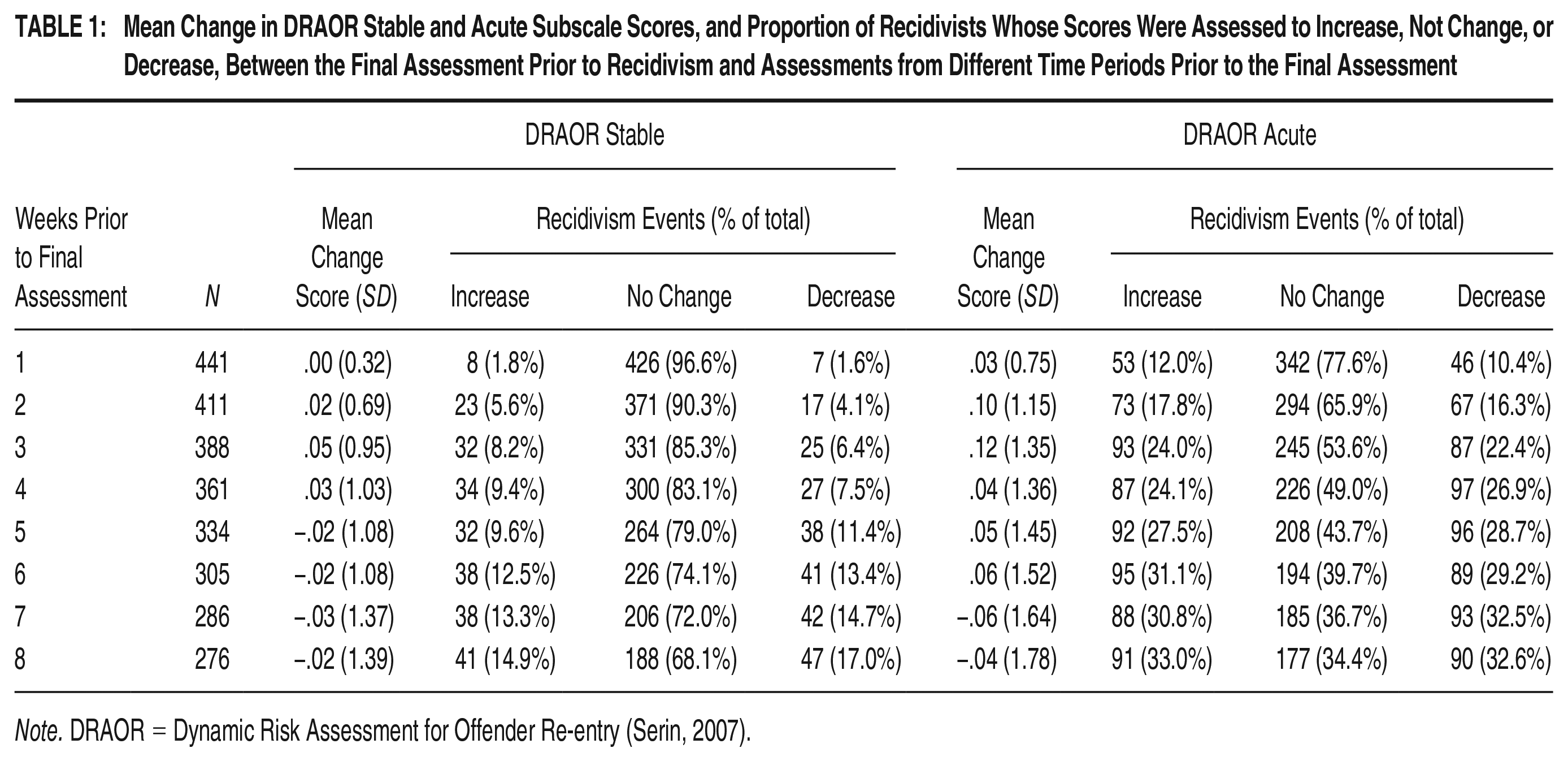
As shown in Table 1, mean change scores prior to recidivism were close to zero across all lengths of time for both Stable and Acute. Categorically, it was most typical for recidivism to follow no change in DRAOR score than an increase or decrease. Furthermore, for both subscales, the proportion of recidivism events where scores increased in the preceding weeks was closely comparable to the proportion where scores decreased, counterintuitively indicating that both decreases and increases may signal recidivism. However, on average, there were small increases in risk over relatively short periods of time prior to recidivism, a notable point of difference with change over longer time frames when scores typically decreased. This reflects the slightly higher proportion of increasing scores prior to recidivism over those weeks. We observed the largest increase across Acute scores over 2 or 3 weeks prior to the pre-recidivism assessment, consistent with Acute risk factors increasing in the days to weeks prior to recidivism. Acute scores were more likely to change in either direction prior to recidivism than scores on the Stable subscale (e.g., prior week Acute score increases preceded 12.0% of recidivism events cf. approximately 10.4% for score decreases; the equivalent Stable proportions were 1.8% and 1.6%, respectively).
Mean Change in DRAOR Stable and Acute Subscale Scores, and Proportion of Recidivists Whose Scores Were Assessed to Increase, Not Change, or Decrease, Between the Final Assessment Prior to Recidivism and Assessments from Different Time Periods Prior to the Final Assessment
Note. DRAOR = Dynamic Risk Assessment for Offender Re-entry (Serin, 2007).
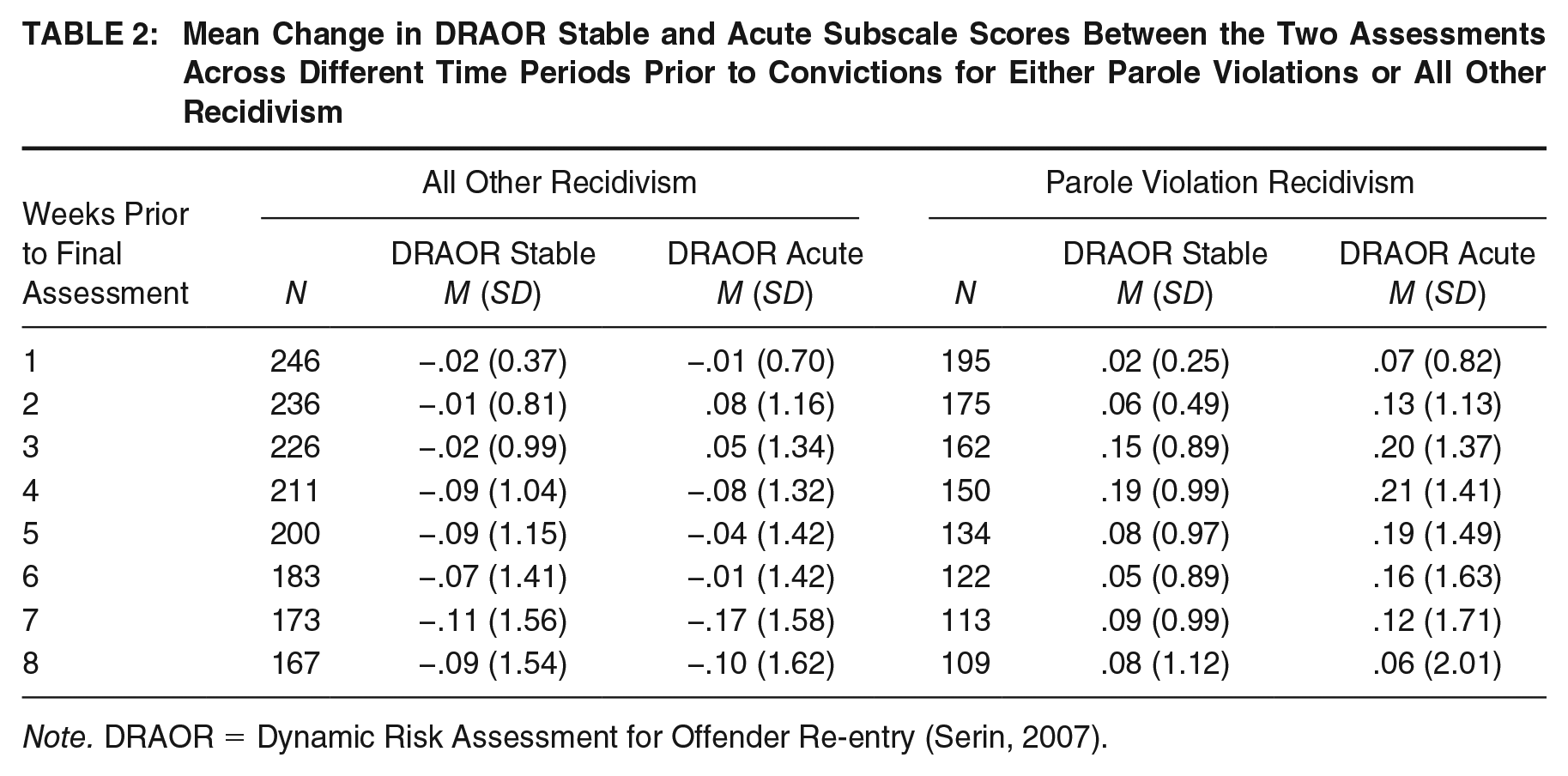
Mean change across assessments prior to parole violation recidivism was higher than change prior to other types of recidivism (Table 2). More notably, although all scores were close to zero, all mean change scores before parole violation recidivism were positive (indicating risk increased on average), whereas the mean change scores for other types of recidivism were almost all negative (indicating a decrease in risk). This pattern was consistent for both DRAOR subscales. The only statistically significant difference between change scores prior to parole violation versus other recidivism was 4-week change on the Stable subscale (p = .01, d = .28); all other comparisons were not statistically significant (p > .05).
Mean Change in DRAOR Stable and Acute Subscale Scores Between the Two Assessments Across Different Time Periods Prior to Convictions for Either Parole Violations or All Other Recidivism
Note. DRAOR = Dynamic Risk Assessment for Offender Re-entry (Serin, 2007).
Frequency of Recidivism Following Different Change Score Patterns
Two related trends were evident in the frequencies of recidivism following various observed changes across Stable and Acute scores (for full results, see Appendix C of the Online Supplementary Materials). First, across all time periods and on both DRAOR subscales, scores more frequently decreased than increased. For example, across assessments spanning 8 weeks (i.e., the final row of Appendix C), on 3,844 (39.2%) occasions, Acute scores decreased by one or more points whereas increases occurred only 2,178 (22.2%) times. Second, recidivism was less likely to follow decreasing risk and more likely to follow increasing risk. Continuing the prior example, recidivism occurred following 2.3% of decreasing Acute scores across an 8-week period compared with 4.2% of increasing scores. This pattern was strongest for the Acute subscale across periods of 2 to 5 weeks. For example, recidivism followed 5.9% of occasions with two-point or higher Acute score increases over a 3-week period.
Discrete-Time Hazard Models Predicting Imminent Recidivism
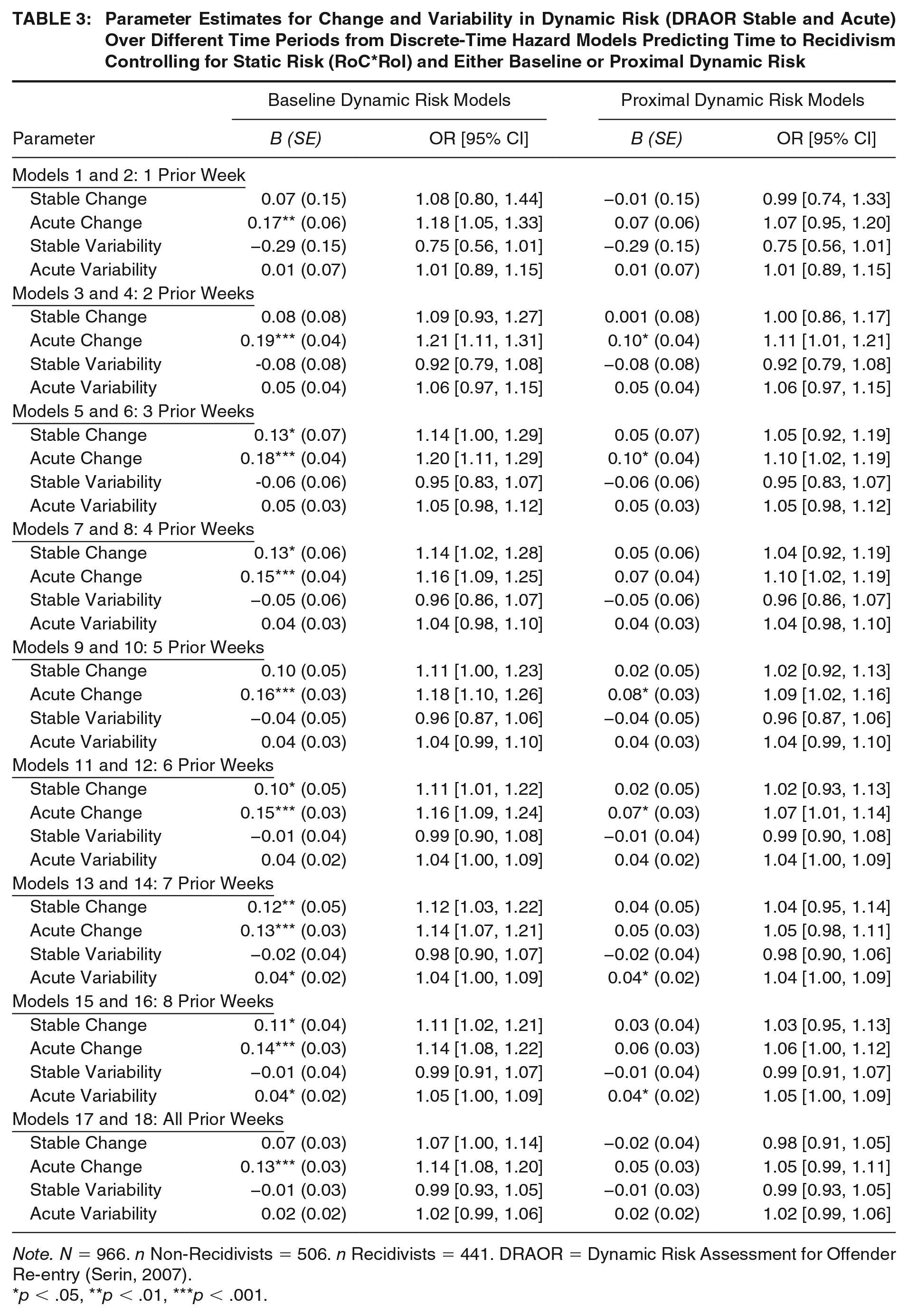
In Table 3, we report parameter estimates for change and variability scores predicting imminent recidivism after controlling for static risk (Roc*RoI scores), time, and initial, baseline, or current, proximal DRAOR Stable and Acute scores. Table 3 presents abridged results; see Appendix D of the Online Supplementary Materials for full model results. There was no evidence of multicollinearity of the change and variability scores, with all tolerance values above 0.2 (see Davies, 2019).
Parameter Estimates for Change and Variability in Dynamic Risk (DRAOR Stable and Acute) Over Different Time Periods from Discrete-Time Hazard Models Predicting Time to Recidivism Controlling for Static Risk (RoC*RoI) and Either Baseline or Proximal Dynamic Risk
Note. N = 966. n Non-Recidivists = 506. n Recidivists = 441. DRAOR = Dynamic Risk Assessment for Offender Re-entry (Serin, 2007).
p < .05, **p < .01, ***p < .001.
After controlling for static risk and baseline dynamic risk, Acute score change over any time period was a statistically significant predictor of imminent recidivism. Odds ratios suggested the change-recidivism relationship was strongest over 2 to 3 weeks. Stable score change was also a statistically significant predictor over most time periods. For both subscales, higher change scores (i.e., indicating risk score change in a positive direction or, equivalently, weaker change in a negative direction) were associated with an increased likelihood of recidivism. After controlling for static risk and proximal dynamic risk, neither Stable score change nor variability was associated with imminent recidivism. However, Acute change scores across 2 to 6 weeks (with the exception of 4-week periods) were statistically significant predictors of recidivism. Odds ratios suggested the relationship between Acute change and recidivism was weaker in these models than in similar models controlling for baseline risk. Finally, because of the statistical equivalence of the models, the relationship between variability and recidivism was consistent whether controlling for baseline or current risk scores. After controlling for either baseline or proximal risk, Acute score variability across 7- and 8-week periods demonstrated incremental predictive validity, with greater variability associated with a higher likelihood of imminent recidivism.
Discussion
This study examined whether composite scores that sum conceptually dynamic risk factors may signal when recidivism is imminent. Empirical findings largely supported the conclusion that short-term change on a measure of conceptually acute dynamic risk factors was systematically associated with imminent recidivism. Descriptive analyses showed, on average, acute risk tended to increase over the 2 to 3 weeks prior to recidivism, with recidivism more likely to occur following increases than decreases in acute risk, although recidivism was highly unlikely to follow any individual increase in acute risk scores. Most important, short-term change predicted imminent recidivism in regression models, after controlling for current, proximal levels of acute risk factors. This effect was small but indicated that short-term change in acute risk itself signified when recidivism is more likely, after accounting for the current sum of acute risk factors. The observed relationship was positive, consistent with the idea that increases in acute risk may signal imminent recidivism, but, as noted earlier, is also consistent with the interpretation that risk scores decreased less prior to recidivism than prior to weeks where recidivism did not occur.
Our analyses provided a unique test of the conceptual distinction between acute and stable dynamic risk factors. In particular, we found relatively stronger associations between short-term change and imminent recidivism when using conceptually acute compared with stable risk factors. We did observe some association between shorter-term change in stable risk scores and imminent recidivism, but, consistent with our proposed definitions, statistically significant change in stable scores occurred over 1- to 2-month timeframes in our regression models controlling for baseline risk. Also consistent with our hypotheses, effects associated with stable risk scores were smaller or statistically non-significant more than effects associated with acute risk scores, particularly in the more robust regression models.
Research distinguishing stable and acute risk scores is new. There is limited empirical research examining the dynamic properties of dynamic risk factors (Beggs, 2010; Davies et al., in press; Serin et al., 2013) and even less research examining our suggested empirical criteria for identifying acute risk factors: an association between short-term change and imminent recidivism. Others have noted the absence of empirical evidence supporting the stable-acute distinction (Beech & Ward, 2004; Brown et al., 2009; Douglas & Skeem, 2005; Hanson et al., 2007) and most previous research with putative acute risk factors (Babchishin & Hanson, 2020; Hanson et al., 2007; Hanson & Harris, 2000; Zamble & Quinsey, 1997) has tested only one or neither of these two criteria. This study builds on DRAOR research that similarly examined imminent recidivism but did not focus on short-term change (Davies et al., 2022; Lloyd et al., 2020). We suggest the methodology used here offers a viable framework for further research.
Two other findings from this study are notable. To our knowledge, this is the first study to explicitly test the association between change and recidivism after controlling for current, proximal risk; the typical approach controls instead for baseline risk (Davies et al., in press). We found a change in acute (but not stable) risk scores was associated with imminent recidivism after controlling for proximal risk. This is consistent with limited, reinterpreted evidence from previous research designed to address other research questions (Cohen & VanBenschoten, 2014; Mulvey et al., 2016; Vose et al., 2013). Importantly, our finding suggests a change in acute risk uniquely predicts recidivism after accounting for the level of risk after the period of recorded change. In other words, two individuals assessed with the same current acute risk score may have different likelihoods of recidivism if they had a previously recorded risk score that was different. This pattern raises important practical and theoretical implications (for a discussion, see Davies et al., in press), but replication and greater specificity are needed before considering these implications in more detail or recommending a change to practice. We advocate that future research similarly examine the relationship between change and recidivism using both the typical approach—controlling for baseline risk—and the additional approach we have used—controlling for proximal risk—because both approaches have important practical and theoretical implications.
Second, we found variability in acute risk (i.e., intermediate change between the change score assessments) was associated with imminent recidivism, even after controlling for static risk, the change score, and the final score within the change score (i.e., current, proximal risk). Individuals with greater Acute score fluctuation in the past approximately 2 months were more likely than individuals with less fluctuation to imminently recidivate. This finding is consistent with and extends descriptive DRAOR research that showed greater score fluctuation among people who eventually recidivated compared with non-recidivists (Davies et al., 2022; Lloyd et al., 2020; Polaschek & Yesberg, 2018) and is consistent with the coping relapse theory (Zamble & Quinsey, 1997). In the present study, we observed a variability-recidivism relationship for DRAOR Acute but not Stable scores, providing further support for the stable-acute distinction. Interestingly, variability was only associated with recidivism when measured over longer (although still relatively short) 7- to 8-week time periods. It may be that a longer series of assessments is necessary before a meaningful pattern of fluctuation develops; over shorter periods, a variability score is unlikely to be meaningfully different from a change score. The fact we did not have scores available for every week of the follow-up (and instead carried forward risk information from earlier assessments) may also have contributed to this pattern. In addition, one possibility suggested by our results but not explicitly tested, is that a combination of very short-term change and slightly longer-term variability may produce optimal predictive validity. Clearly, further research examining variability and recidivism is needed.
Limitations and Future Research
There are two critical limitations that disrupt the straightforward interpretation of our central findings and caution against making any far-reaching recommendations for practice. First, observed distinctions between acute and stable risk factor scores may fully, or at least in part, reflect how raters assessed the items rather than an underlying conceptual distinction. As we noted in the previous text, policies require that community supervision officers in New Zealand score DRAOR Acute, but not Stable, after every session. We observed substantially more change and variability on Acute than Stable, consistent with this scoring approach. However, we believe it is unlikely that scoring behavior fully explains the acute-stable distinction observed in this study because policies also required supervision officers to update Stable scores when meaningful client change occurred. Still, a more rigorous test of the stable-acute distinction would use an implementation strategy that does not take an explicit stance on which dynamic factors are more variable than others. Yet, the scoring timeframe is an inherent feature of any well-defined scale item; failing to provide supervision officers with a recommended scoring timeframe for core dynamic factors would create a study with poor conceptual and ecological validity. Alternatively, future research may more productively focus on change across individual risk items, or use construct-based research designs (e.g., self-report).
Consistent with all previous field-based DRAOR research, the second critical limitation is that our dataset did not contain supervision officer-level information. Previous researchers have discussed this limitation at greater length (Davies et al., 2022; Lloyd et al., 2020; Yesberg & Polaschek, 2015). Most relevant for the present study, we had no information about how correctional staff may have contributed to changes in DRAOR scores, nor how they acted in response to DRAOR assessment information. That increases in acute risk occurred prior to recidivism may mean that supervision officers did not respond with microinterventions (see Polaschek & Yesberg, 2018) or these were insufficient to prevent recidivism. Alternately, Babchishin and Hanson (2020) noted that observed change-recidivism associations may be naturally weakened by interventions that effectively prevent recidivism. Consistent with their training, there is some evidence that community supervision officers in New Zealand attend to DRAOR factors during supervision sessions (Davies & Bowman, 2015), but more in-depth field research of the role of supervision officers in the change process (as well as the examination of other potential change agents, e.g., psychologists and family members) is needed.
It may also be that the change-recidivism relationship was driven by supervision officers simultaneously scoring DRAOR while planning to initiate convictions for violations of parole conditions. Consistent with this explanation, Acute and Stable scores increased more often immediately prior to parole violation recidivism than before other recidivism events. A rater’s advanced knowledge of upcoming potential convictions would represent a serious problem of criterion contamination. However, an increase in risk prior to initiating parole violation proceedings is not definitive evidence of criterion contamination; it is just as likely that risk behaviors were genuinely increasing leading to an increase in DRAOR scores and then parole violation proceedings. In addition, although there are fewer checks and balances on raters changing DRAOR scores, a conviction for a parole violation involves meeting the required burden of proof. In New Zealand, the decision to pursue a conviction represents a serious step given the range of other options available to supervision officers for responding to non-compliance (Norman et al., 2022). Parole violations therefore likely capture the most serious or repeated instances of non-compliance, which is why they were included in the outcome measure in this study. Furthermore, excluding parole violations from the outcome measure would have presented serious conceptual problems because it is a violation of Cox regression (and thus, discrete-time hazard) model assumptions to ignore one outcome to focus only on a simultaneous, more serious outcome. Future researchers should consider the feasibility of conducting Cox regression with competing risk outcomes; it was not possible to conduct this type of modeling with our sample (due to too few competing risks observed).
Our outcome measure was officially recorded convictions, and it is well-established (e.g., Farrington et al., 2003) that convictions do not count unreported or non-prosecuted criminal behavior. In this study, the timing of recidivism was a central factor in determining the relationship between short-term change in dynamic risk and imminent recidivism, but some observed increases in acute (or stable) risk may have preceded unrecorded offending behavior. Thus, we may have observed a stronger relationship between short-term change and imminent recidivism if using a more sensitive measure of recidivism (e.g., self- or partner-report, new arrests, new charges, etc.); of course, a weaker relationship between short-term change and imminent recidivism would be observed if a pattern different from the one observed in this study (i.e., decreases in risk prior to recidivism rather than increases) was evident for the more sensitive outcome. As a further limitation, we did not conduct analyses separately across cultural groups. It is critical to examine cross-cultural invariance of effects, but this is beyond the scope of the current article; Coulter et al. (2023) used similar datasets with DRAOR scores to report measurement invariance, discrimination, and calibration analyses across cultural groups.
As future research better supports the stable-acute conceptual distinction, potential interaction effects between stable and acute factors will also warrant attention. For example, Polaschek and Yesberg (2018) found that individuals with higher stable risk scores at release from prison had greater variability in acute risk during the first two months after release. However, they did not test the relationship between this interaction and recidivism. There are also theoretical pathways (see Beech & Ward, 2004) that suggest a change in stable risk factors precedes a change in acute risk that, in turn, signals imminent recidivism.
Implications for Practice and Conclusion
With further replication, there are several potential practice applications related to clear evidence of a conceptual distinction between stable and acute dynamic risk factors; in particular, measures of acute risk factors could allow decision-makers to determine risk for—and communicate more confidently about—recidivism imminence. Because this study adds to the limited evidence base supporting risk measures with conceptually distinct stable and acute risk factors (e.g., Fernandez et al.,2015, 2014; Serin, 2007) and adds further evidence that short-term changes in acute risk factors may signal imminent recidivism as previously only theorized, correctional staff may benefit from explicitly considering acute risk factors (and being mindful of current changes in acute risk) within their risk management strategies. Because several measures built on the stable-acute distinction are already used in routine practice, our findings arguably support existing practice. Still, we caution that practitioners should not focus too strongly on observed changes in stable or acute risk. Rather, our results are consistent with findings throughout the field that show that static risk is the strongest predictor of recidivism and proximal dynamic risk needs to be considered within the broader landscape of risk information.
By establishing that a composite measure of acute dynamic risk factors can predict imminent recidivism, this study represents a first step toward correctional practice in this area that is better underpinned by empirical evidence. Ultimately, the aim should be an evidence-informed approach for identifying risk factors that may signal imminent recidivism and an evidence-informed understanding of the best way to respond to changes in those risk factors, both in community supervision and in other areas of correctional practice. Although it is necessary to implement to evaluate, it is equally necessary that practice does not substantially overstep evidence; the field’s wide adoption of the stable-acute distinction suggests that, to some extent, practice has been leading evidence for some years. We hope that further research similar to the present study, both with the DRAOR and other dynamic risk assessment measures, will continue to close remaining practice-research gaps.
Supplemental Material
sj-docx-1-cjb-10.1177_00938548231174903 – Supplemental material for Do Some Dynamic Risk Factors Signal Imminent Recidivism? Testing the Conceptual Distinction Between Stable and Acute Dynamic Risk Factors
Supplemental material, sj-docx-1-cjb-10.1177_00938548231174903 for Do Some Dynamic Risk Factors Signal Imminent Recidivism? Testing the Conceptual Distinction Between Stable and Acute Dynamic Risk Factors by Simon T. Davies, Caleb D. Lloyd and Devon L. L. Polaschek in Criminal Justice and Behavior
Footnotes
AUTHORS’ NOTE:
Some analyses in this article were previously presented in Simon T. Davies’s doctoral thesis at Victoria University of Wellington (see Davies, 2019). The views expressed are those of the authors and not necessarily those of the New Zealand Department of Corrections. Caleb D. Lloyd is a co-author of the 2017 version of the DRAOR scoring manual and co-developer of the DRAOR training program and training certification. We thank the Department of Corrections for providing the data used in this article.

References
Supplementary Material
Please find the following supplemental material available below.
For Open Access articles published under a Creative Commons License, all supplemental material carries the same license as the article it is associated with.
For non-Open Access articles published, all supplemental material carries a non-exclusive license, and permission requests for re-use of supplemental material or any part of supplemental material shall be sent directly to the copyright owner as specified in the copyright notice associated with the article.
