




Abstract
Antisocial attitudes are a strong predictor of reoffending and frequently incorporated into risk assessment tools, including the Youth Level of Service/Case Management Inventory (YLS/CMI). However, YLS/CMI Attitudes/Orientation domain items appear to cover different issues—antisocial attitudes and willingness to engage in treatment—which have different implications for case management and service provision. Latent Class Analysis of data from 798 Canadian youth probationers identified four classes based on item endorsement on the Attitudes/Orientation domain: High Overall Attitude Needs (19%), Predominantly Antisocial Attitude Items (20%), Predominantly Lack of Service Engagement (9%), and Low Overall Attitude Needs (52%). Class differences were found on index offense, criminogenic needs, and recidivism, with the High Overall Attitude Needs class presenting as most “negative,” followed by Predominantly Antisocial Attitude Items, Predominantly Lack of Service Engagement, and Low Overall. Understanding attitudes based on this class conceptualization can assist probation officers in targeting services more effectively to justice-involved youth.
Structured risk assessment tools are widely used to predict risk of recidivism and determine the needs of individuals involved in the criminal justice system, which allows for targeted service provision (Bonta & Andrews, 2017). The Youth Level of Service/Case Management Inventory (YLS/CMI; Hoge & Andrews, 2002, 2011) is one of the most frequently utilized and well-validated youth risk assessment and case management tools for justice system–involved youth (e.g., Hoge & Andrews, 2011; Olver et al., 2009).
The YLS/CMI was developed based on the Risk-Need-Responsivity (RNR) framework, a correctional psychology rehabilitation model that operates under three core principles. The Risk Principle states that the intensity of intervention should be in keeping with the individual’s level of risk to reoffend. The Need Principle states that intervention should focus on strong and direct predictors of reoffending—termed criminogenic needs. According to the Responsivity Principle, services must be tailored to individual characteristics and needs that, while not directly predictive of reoffending, impact the effectiveness of interventions (Bonta & Andrews, 2017). General responsivity refers to the use of relevant, evidence-based strategies for behavioral change while specific responsivity relates to the tailoring of interventions to specific needs/characteristics of the individual (Bonta & Andrews, 2017).
The YLS/CMI assesses risk in eight criminogenic need domains—Prior and Current Offenses/Dispositions, Education/Employment, Substance Abuse, Personality/Behavior, Family Circumstances/Parenting, Peer Relations, Leisure/Recreation, and Attitudes/Orientation—and is used to guide service delivery. Aside from criminal history, these domains represent dynamic factors that can be targeted and changed through intervention (Bonta & Andrews, 2017). Reductions in recidivism of up to 30% have been demonstrated when these principles are met in service delivery (Bonta & Andrews, 2017; Duncan et al., 2010; Luong & Wormith, 2011), particularly when dynamic factors are successfully addressed (Peterson-Badali et al., 2015; Smith et al., 2009; Vieira et al., 2009).
The YLS/CMI Attitudes/Orientation domain assesses antisocial/procriminal attitudes—defined as “thoughts, feelings and beliefs that are supportive of criminal conduct” (Bonta & Andrews, 2017, p. 123). One of the “Big Four” risk factors most predictive of recidivism, antisocial attitudes have long been a clinical focus in correctional psychology (Bonta & Andrews, 2017; Sutherland, 1947). Antisocial attitudes have been consistently predictive of criminality and recidivism in both adults and justice-involved youth (Serin et al., 2013; Skilling & Sorge, 2014). Indeed, meta-analyses have revealed a strong predictive link between antisocial attitudes and recidivism in adults (Gendreau et al., 1996; Walters, 2012) and youth (Hubbard & Pratt, 2002; Olver et al., 2014) involved in the criminal justice system. Antisocial attitudes have also been consistently associated with a variety of other problematic behaviors: aggressive and externalizing behaviors (Gini et al., 2014; Granic & Butler, 1998; Helmond et al., 2015), gang membership (O’Brien et al., 2013), negative attitudes about education, employment and authority (Elliott et al., 1985), substance use (Jones et al., 2012), and violence (Fritz et al., 2008), which are themselves criminogenic needs.
Specific measures of antisocial attitudes that have been evaluated in relation to offending include the Pride in Delinquency Scale (Shields & Whitehall, 1991) and the Criminal Sentiments Scale–Modified (Shields & Simourd, 1991), higher scores on which have both been significantly associated with reoffending in youth (Skilling & Sorge, 2014). The Measures of Criminal Attitudes and Associates (Mills et al., 2004) measures antisocial attitudes and peers and has also been predictive of recidivism in adults (Mills et al., 2004) and male youth (O’Hagan et al., 2019). In turn, reducing antisocial attitudes involves identifying and modifying these beliefs, typically through a cognitive-behavioral approach (Banse et al., 2013; Bonta & Andrews, 2017). Evaluations of specific programs targeting procriminal attitudes have demonstrated significant reductions in antisocial beliefs and reduced recidivism posttreatment (Simourd et al., 2016; Tong & Farrington, 2006).
Assessment of antisocial attitudes is thus a common feature of evaluations of risk for recidivism and, as noted above, is one of the seven criminogenic need domains included in the YLS/CMI. This particular need domain comprised five items. On their face, three of these items directly address antisocial attitudes (attitudes supportive of criminal behavior, oppositional or defiant behavior to authority figures, and insensitive/uncaring toward others) while the remaining two items tap into an individual’s willingness and/or motivation to address their criminogenic needs through services (not looking for services, refusing services offered) (Hoge & Andrews, 2002). Given that the five items appear to represent different aspects of antisocial attitudes, in the present study we aimed to explore the Attitudes/Orientation domain of the YLS/CMI to determine whether distinct latent classes exist within the overall group of youth with needs in this domain.
While significant focus has been placed on procriminal attitudes and their role in criminal behavior and recidivism, an individual’s willingness to engage in services is also a key factor in successful rehabilitation (McMurran, 2002; Mossière & Serin, 2014). Poor commitment to programming can be exhibited through lack of engagement in services (poor attendance, low effort) or noncompletion of the full protocol of treatment (Howells & Day, 2007). Low treatment engagement has been highlighted as a concern in justice-involved individuals, with lower treatment completion rates for high-risk individuals compared with those at lower risk for recidivism (McMurran, 2002). Completion rates are also lower when treatment takes place in the community rather than within an institution (McMurran & Theodosi, 2007), a finding that has particular relevance for youth, as nearly 89% of justice-involved youth are given community sentences (Statistics Canada, 2019/2020).
The relationship between antisocial attitudes and treatment completion has also been explored. Olver et al. (2011) conducted a meta-analysis of predictors of treatment attrition in a sample of justice-involved adults and found that antisocial personality and criminal attitudes and thinking were significant predictors of program dropout. Similar findings were reported by Nunes and Cortoni (2006), who found that treatment completion rates were lower for individuals with higher levels of antisocial attitudes in a sample of male justice-involved adults. These findings provide support for the inclusion of the treatment motivation items within a criminogenic need domain focused on antisocial attitudes and orientation.
Failure to complete cognitive-behavioral treatment programs has been associated with significantly higher recidivism rates in samples of adults and youth in the criminal justice system (Cann et al., 2005; McMurran & Theodosi, 2007). Furthermore, noncompletion is associated with multiple negative outcomes, including increased time spent in secure settings (Long et al., 2013), lower staff motivation (Howells & Day, 2007), lower client motivation toward future treatment (Olver et al., 2011), and blunted therapeutic alliance (Ward et al., 2004.)
Increasing a justice-involved individual’s openness to treatment involves examining and then modifying both internal and external factors negatively impacting their ability to change (Howells & Day, 2007). The most widely used intervention in this domain is motivational interviewing (McMurran, 2002, 2009). Studies have demonstrated its efficacy in motivating individuals with substance abuse needs to engage in service (Dunn et al., 2001). In a systematic review of motivational interviewing outcomes with justice-involved adults, McMurran (2009) found increased motivation to change and reduced offending with individuals who engaged in treatment. Treatment for antisocial attitudes in justice-involved youth typically involves cognitive-behavioral therapy aimed at restructuring negative thought patterns (Bonta & Andrews, 2017), but it does not include a motivational enhancement component to it. Motivational interviewing typically utilizes a client-centered approach focused on developing an individual’s desire to and belief in their ability to change (McMurran, 2002). Although both of these modalities provide important services, their foci clearly differ.
The Current Study
Historically, despite being one of the “big four” risk factors predictive of recidivism, antisocial attitudes and orientation are less likely to be addressed through services than other criminogenic need domains in youth and adults (Bonta et al., 2008; Luong & Wormith, 2011; Peterson-Badali et al., 2015). As noted in the above review, the services (case management strategies and/or interventions) required to address antisocial/procriminal attitudes and willingness to engage in treatment differ. Therefore, it is important to examine the YLS/CMI Attitudes/Orientation criminogenic need domain in more detail given that the content of the items suggests two separate issues may be at play for individuals who are rated as moderate-high need in this domain. It may be that the treatment engagement items are reflective of antisocial attitudes generally but it is possible they actually reflect a different aspect of a youth’s functioning and therefore different service provision may be needed to effectively address these two areas of criminogenic need within this one YLS/CMI domain (Bonta & Andrews, 2017; McMurran, 2002, 2009).
To explore whether different classes of youth exist in terms of needs identified in this domain, a Latent Class Analysis (LCA) based on items endorsed on the Attitudes/Orientation domain of the YLS/CMI was conducted on a sample of youth from Ontario, Canada, serving probation sentences. This person-based approach allows for the identification of subgroups of youth who may have distinct intervention needs with respect to attitudes, to more properly tailor interventions to their specific needs. To ensure that services are matched to a young person’s specific needs, it may be necessary to explore beyond total domain scores and examine the specific content of the criminogenic need domains.
Based on the nature of YLS/CMI items and existing literature, we predicted that two distinct classes would emerge: one group with predominantly antisocial attitudes (e.g., procriminal values, defiance) and another with needs related to willingness to engage in rehabilitative interventions (e.g., not seeking/rejecting services). Furthermore, given the empirical link between antisocial attitudes and violent/aggressive behavior (Fritz et al., 2008; Granic & Butler, 1998), we predicted that youth with predominately antisocial attitudes would present with more violent index offenses than youth with primarily treatment willingness needs, for which no such link has been demonstrated. Antisocial attitudes have been linked to multiple risk factors and delinquent behaviors (substance use, violence, antisocial peers, etc.), captured on the YLS/CMI (Fritz et al., 2008; Granic & Butler, 1998; Jones et al., 2012; Skilling & Sorge, 2014). Thus, we predicted that youth with predominantly antisocial attitudes would also present with higher needs in the domains of Personality/Behavior, Substance Use, and Peer Relations, and would also reoffend at higher rates than youth with fewer antisocial needs. Poor treatment engagement is also a predictor of recidivism (Cann et al., 2005). Thus, we predicted that individuals for whom lack of willingness to engage in services was endorsed would demonstrate higher recidivism rates than youth with no needs identified in the Attitudes/Orientation domain, though still less than the antisocial attitudes group.
Method
Participants
Data were obtained from the file information of 798 youth (702 male and 96 female) who had completed a court-ordered forensic assessment at a mental health center in a large urban Canadian city and who consented to have their clinical information used for research purposes (87.3% of youth seen in the clinic consented to research involvement). As seen in Tables 3 and 4, subsamples were examined in certain analyses due to missing data on some variables of interest. Research Ethics Board approval for this study was obtained prior to the study commencement, as were all necessary judicial approvals.
Assessments were conducted between 2001 and 2017, to assist judges in making or reviewing a sentence and to inform probation officers’ case management planning. Participant ages ranged from 12 to 18 at the time of assessment, with a mean age of 16 years (see Table 4). As Table 3 shows, the sample comprised primarily Black and White youth, followed by youth identified as Asian (including South Asian, East Asian and South-East Asian) and those who reported another race/ethnicity (e.g., Middle Eastern, Latinx). Index offense that precipitated referral for assessment comprised violent, but not sexual, offenses (e.g., assault, robbery), nonviolent offenses (e.g., theft, drug-related, breaking and entering), and sexual offenses (e.g., sexual assault, invitation to touching). There were no significant differences between males and females in terms of age, t(797) = 1.85, p = .65, or race/ethnicity, χ2(1, n = 698) = 3.96, p = .66. In terms of index offense, a greater proportion of males (18.1%) than females (5.4%) were charged with a sexual offense, while a higher proportion of violent offense charges than expected were seen in the female group (64.1%) than the male group (54.4%); while statistically significant, χ2(1, n = 782) = 9.50, p = .009, the effect size was small, Cramer’s V = .11 (Kim, 2018). Females reoffended at a lower rate (36.8%) than expected compared with males (54.1%), χ2(1, n = 547) = 7.14, p = .008. The effect size for this difference was also small, Cramer’s V = .10 (Kim, 2018). The size of the female subsample (n = 96) was insufficient to conduct LCA separately for male and female youth. Therefore, to address the possibility of gender differences in class solutions, LCA was conducted with both the entire sample and with males only.
Data Sources, Measures, and Coding
Variables used in the present study came from a clinical database containing information obtained from several sources, including interviews with multiple informants (e.g., youth, parents, service providers), standardized instruments completed by multiple informants (e.g., youth and parents), as well as collateral reports such as school documentation and previous assessment results. Data were extracted by the first author from this database in 2019.
Forensic Assessments
Risk/need assessments occurred prior to sentencing and were led by clinicians (psychologists, psychiatrists) who specialize in adolescent forensic mental health service. Guided by the RNR framework, information on youth developmental history, prior justice system involvement family, peer and other relationships, education, and behavioral and mental health functioning (including substance use) was gathered via several methods as noted above. Written reports included a clinical mental health and forensic risk/criminogenic need summary as well as recommendations for intervention. An estimate of risk to reoffend, as well as recommendations for addressing identified criminogenic needs, was based on the YLS/CMI (Hoge & Andrews, 2002), which clinicians completed based on the entirety of the assessment information gathered.
The YLS/CMI (Hoge & Andrews, 2002, 2011) is a 42-item checklist that assesses criminogenic needs in eight domains empirically linked to reoffending: History of Criminal Conduct, Family Circumstances and Parenting, Current School/Employment Functioning, Peer Affiliations, Alcohol and Drug Use, Leisure and Recreational Activities, Personality and Behavior, and Attitudes/Orientation. Within each domain, items, scored as present or not present, are summed to determine a total domain score; scores are categorized as Low, Moderate, or High needs based on the scoring manual for the measure. Total risk is calculated by summing domain totals. Previous studies have demonstrated strong internal consistency and predictive validity for the tool in terms of reoffending (Schmidt et al., 2005; Vieira et al., 2009; Vitopoulos et al., 2012). The main focus for the current study was the YLS/CMI items in the Attitudes/Orientation domain. Endorsements of the five items in this domain were used in the LCA to determine class membership. The five items in the domain (reworded due to copyright issues) were attitudes supportive of criminal behavior, not looking for services, refusing services offered, oppositional or defiant behavior to authority figures, and insensitive/uncaring toward others. In the current study, the internal consistency of the full YLS/CMI measure was excellent (α = .90) and the consistency of the Attitudes/Orientation domain was good (α = .71.)
Criminal Records
Recidivism data were obtained from a national police criminal records database and were collected in 2016. Reoffending was defined as whether or not a youth was convicted of one or more new offenses in the 3-year period following the sentencing date associated with the charge(s) that brought them in for assessment (index offense). Given the length of time it takes to process a charge through the youth court system, it is not possible that a conviction dated within 3 months of a youth’s sentencing on the index offense could be for a charge incurred after the index charge (i.e., be a reoffense). Therefore, to account for court processing time, we added 3 months to the sentencing date and coded recidivism as “yes” if there was a conviction within 3 years of that date.
Analytic Plan
Preliminary analyses included a basic examination of the YLS/CMI scores including the mean total scores for the sample on the YLS/CMI as well as for the individual dynamic criminogenic need domains. Differences between males and females on total YLS/CMI scores and the Attitudes/Orientation domain were then determined using t tests. Finally, the accuracy of the YLS/CMI in predicting recidivism was examined using receiver operating characteristic (ROC) analysis.
LCA was used to determine whether discrete and meaningful subgroups exist in terms of needs on the Attitudes/Orientation domain. Attitudes/Orientation items were used as indicators of class membership. Given that sample sizes of 300 or greater are generally considered reasonable for LCA analysis (Nylund-Gibson & Choi, 2018), the current sample of 798 provided sufficient power for analysis. MPlus, version 8 (Muthèn & Muthèn, 2010) was used to conduct the LCA using a three-step process. First, models were built using the set of five categorical Attitudes/Orientation items on the YLS/CMI. Individuals were then assigned to latent classes based on thresholds of items endorsed. Finally, the multinomial logistic regression model was estimated. Multiple models were tested, with the selection of the final class model determined as follows: First, the statistical significance of the proposed models was examined. If a model was statistically significant, Akaike information criterion (AIC) and Bayesian information criterion (BIC) were reviewed. These two values estimate the likelihood of a model being true and are best used together, with lower AIC and BIC values indicating a better fit when comparing models. A significant Lo–Mendell–Rubin adjusted likelihood ratio test (LRT) further indicated a better fit for a model. Two classification diagnostic statistics were also considered. Entropy is a measure of the quality of separation between classes, with higher entropy values indicating better distinction and a value of one suggesting perfect class separation. Average latent class posterior probabilities for class assignment were also considered, with higher probabilities for the most likely class being ideal (Muthén & Muthén, 2010). We next reviewed the item responses for class solutions that were viable candidates based on review of AIC, BIC, LRT, and entropy values. This involved assessing the utility of classes by examining responses to determine whether there were meaningful (interpretable) patterns (e.g., as suggested by existing literature, which was also reflected in our hypotheses; Collins & Lanza, 2010; Muthén & Muthén, 2010).
Next, the classes were compared on key variables. Chi-square statistics were calculated for all associations between categorical variables (gender, race/ethnicity, index offense, recidivism) and phi values (φ) or Cramer’s V were used for measures of effect size. Analysis of variance was used to examine class differences on continuous variables (age, risk scores), with Tukey’s honest significance test (HSD) used for post hoc analyses of pairwise differences and eta-squared (η2) measuring effect size. The following variables were used for class comparisons: age, gender (coded as 0 = females 1 = males), ethnicity (coded as 1 = White, 2 = Black, 3 = Asian, 4 = Other), YLS/CMI domain scores across the six other criminogenic need domains, type of index offense (coded as 1 = violent, nonsexual, 2 = nonviolent, nonsexual, 3 = sexual), and recidivism (coded as 0 = no conviction within 3 years of assessment, 1 = conviction within 3 years of assessment).
Results
Preliminary Analyses
Youth’s mean total YLS/CMI score was 19.83 (SD = 9.21), which falls within the Moderate Risk category (Hoge & Andrews, 2002). Mean scores for the six dynamic criminogenic need domains (excluding Attitudes/Orientation, the mean score of which was 1.83) can be found in Table 4; all mean scores fell within the Moderate Risk range. There were no significant differences between males and females in terms of total YLS/CMI score, t(797) = 1.38, p = .10, or the Attitudes/Orientation domain score, t(797) = .54, p = .89. Rates of clinician endorsements for the specific Attitudes/Orientation items were as follows: Attitudes supportive of criminal behavior, 36.7% (n = 298); Oppositional or defiant behavior to authority figures, 49.6% (n = 400); Insensitive/low consideration of others, 29.3% (n = 239); Not looking for services, 50.7% (n = 405); and Specifically declining services, 25.9% (n = 207).
ROC analysis using the YLS/CMI total risk score to predict reoffense produced a significant area under the curve (AUC = .70, p < .001). Thus, with a 95% confidence interval (CI), there was a 70% probability that a randomly selected recidivist would obtain a higher total YLS/CMI score than a randomly selected nonrecidivist, 95% CI [0.67, 0.74], which is considered a medium effect (with the threshold for a large effect starting at .71; Rice & Harris, 2005).
Are There Distinct Classes of Youth Based on YLS/CMI Attitudes/Orientation Item Endorsement?
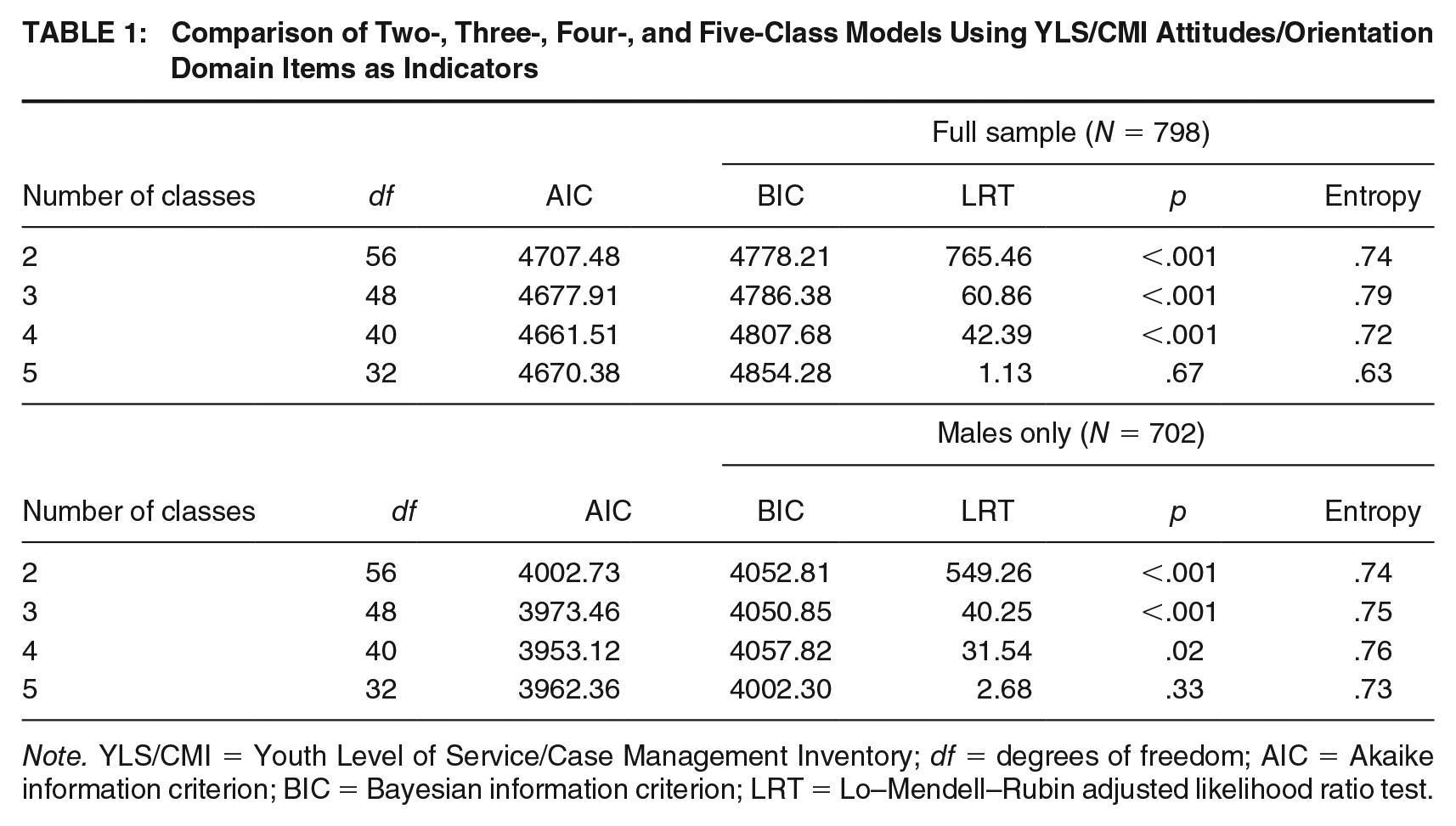
As seen in Table 1, AIC indicators were lowest for the four-class solution in both the full and male-only samples. BIC values were lowest for the two-class model in the full sample and for the three-class model in the male-only subsample. LRT values were not significant for the five-class solutions in both samples so these class solutions were not further explored. The average latent class probabilities for the most likely latent class membership were .91, .88, .80, and .88 for Classes 1, 2, 3, and 4, respectively for the full sample, and .93, .82, .77, and .87 in the male-only sample. All models had similar entropy values, which ranged from .74 to .79. Because the AIC and BIC indicators suggested different solutions—and because meaningfulness of class solutions is integral to their usefulness—we next examined item responses to interpret the two-, three-, and four-class models and determine the best solution. Response patterns for the three solutions were similar across the full and male-only samples. The two-class model had scores dispersed evenly across all items; therefore, the two classes could not be distinguished from one another, rendering them uninterpretable. Review of item responses in the three-class model indicated one class exhibiting high scores across all items, with both the other classes presenting with average scores across items related to both antisocial attitudes and willingness to engage in services, indicating a lack of distinctiveness between these two classes. In contrast, in the four-class model, discussed in detail below, each class differed clearly and qualitatively from the other. Therefore, based on interpretability of the classes (Collins & Lanza, 2010), the four-class model was chosen. Because the solutions (see Table 1) and item response patterns for the four-class model were very similar for the full sample and male-only sub-sample, we used the full sample in subsequent analyses.
Comparison of Two-, Three-, Four-, and Five-Class Models Using YLS/CMI Attitudes/Orientation Domain Items as Indicators
Note. YLS/CMI = Youth Level of Service/Case Management Inventory; df = degrees of freedom; AIC = Akaike information criterion; BIC = Bayesian information criterion; LRT = Lo–Mendell–Rubin adjusted likelihood ratio test.
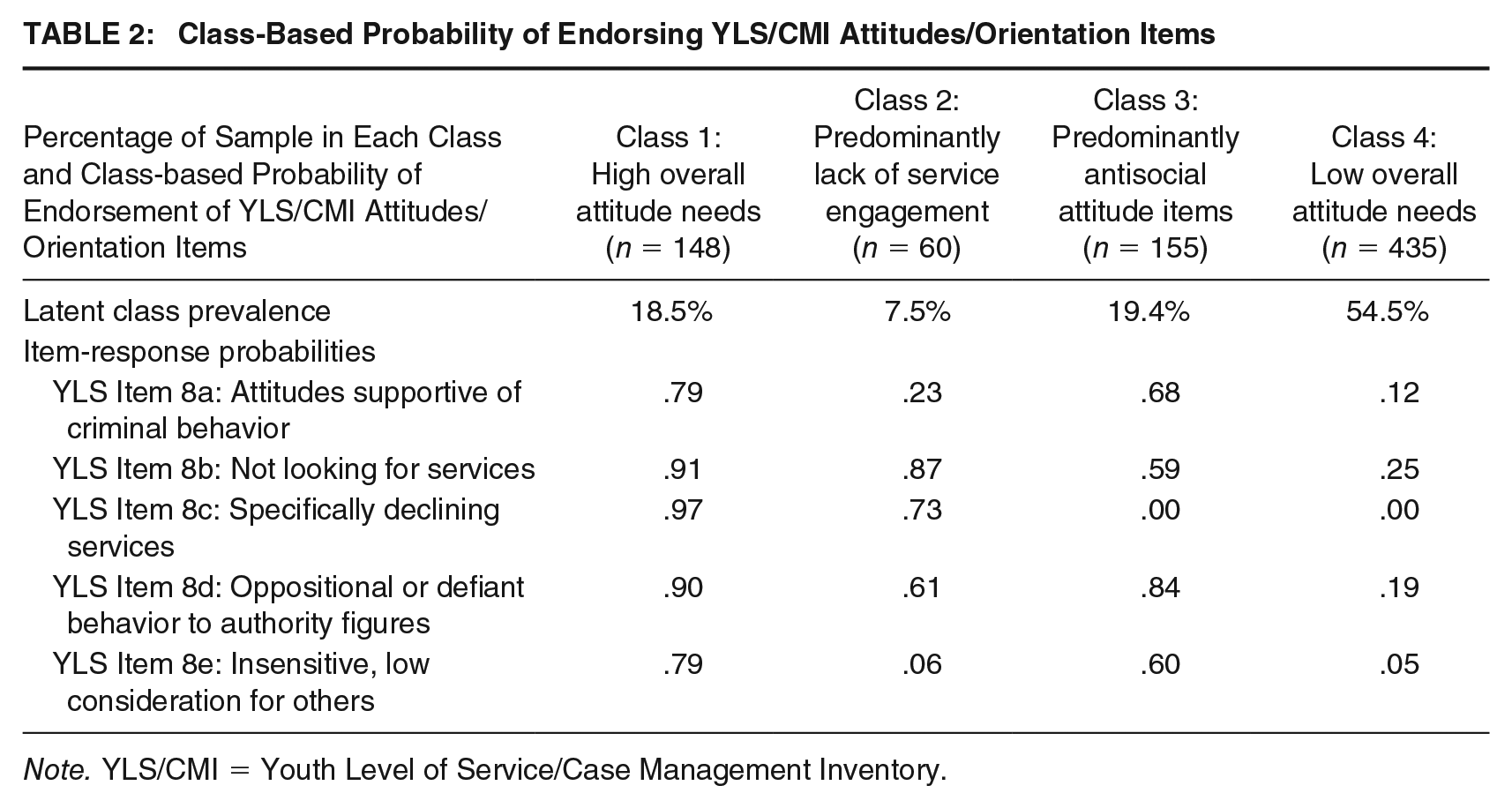
Classes were named according to the patterns of items endorsed on the Attitudes/Orientation domain of the YLS/CMI (see Table 2). The first class, comprising 18.1% of the sample, was characterized by endorsements across all five indicators, and was labeled High Overall Attitude Needs. The second class comprised 7.6% of the sample, with endorsed indicators reflecting lack of interest in treatment (Not looking for services and Specifically declining services); this class was labeled Predominantly Lack of Service Engagement. The third class comprised 18.9% of the sample and was characterized by high scores on indicators associated with antisocial/procriminal attitudes (Attitudes supportive of criminal behavior, Oppositional or defiant behavior to authority figures). Labeling this class required more consideration, as fairly high endorsements were also exhibited on the item Not looking for services. Two key considerations factored into the final classification decision. First, endorsements of this item were still lower than those seen in the Predominantly Lack of Service Engagement class, while items relating to antisocial attitudes were higher. Second, scores on the second “treatment resistance” item, Specifically declining services, were very low. Although failing to seek help clearly relates to treatment motivation, actively rejecting services seems particularly key in relation to desire to engage in treatment and the low percentage of endorsements on this item increased confidence in the decision to label this class Predominantly Antisocial Attitude Items. The fourth class, comprising 55.3% of the sample, was characterized by low endorsements across all items in the domain; this class was labeled Low Overall Attitude Needs.
Class-Based Probability of Endorsing YLS/CMI Attitudes/Orientation Items
Note. YLS/CMI = Youth Level of Service/Case Management Inventory.
Do Classes Differ in Terms of Demographic, Offense, Risk, and Need Variables?
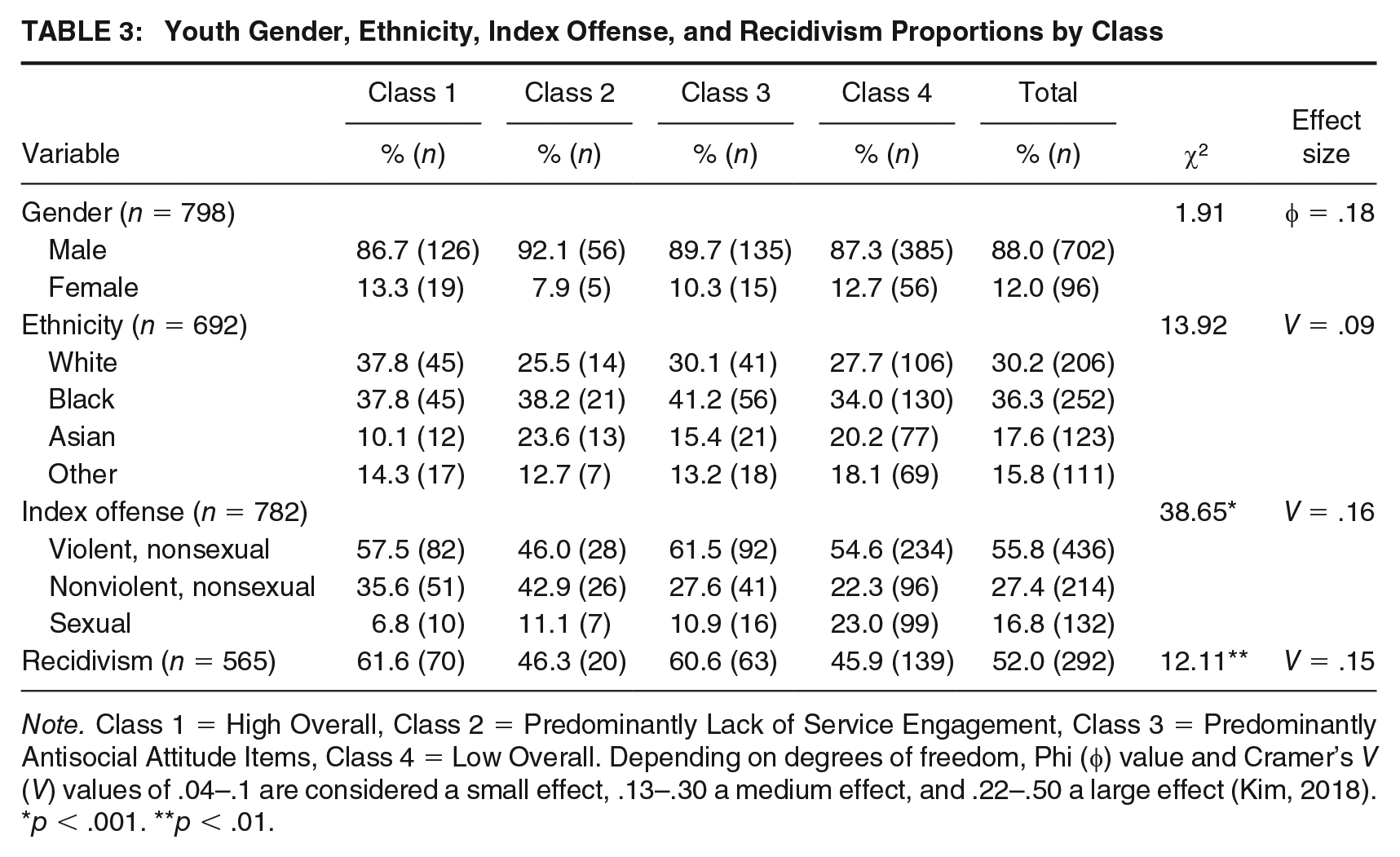
Next, differences between the four classes were examined in terms of age, gender, race/ethnicity, index offense, and YLS/CMI risk scores (see Tables 3 and 4). No significant differences across the four classes were found with respect to age, gender, or race/ethnicity. As Table 3 shows, classes differed significantly in terms of index offense. Post hoc analysis of adjusted residuals revealed significant differences in terms of sexual offenses, with cases in the High Overall Attitude Needs and Predominantly Antisocial Attitude Items classes committing fewer than expected sexual offenses and Low Overall Attitude Needs having the most sexual offense charges (see Table 3). However, given small cell sizes, comparisons between the Predominantly Antisocial Attitude Items and High Overall classes were likely underpowered. There were also significant post hoc differences in terms of nonviolent offenses, with cases in the Predominantly Lack of Service Engagement class having the greatest proportion of nonviolent offense charges, followed by the High Overall Attitude Needs class and the Low Overall Attitude Needs class (see Table 3). No significant differences between classes were found in terms of violent offenses.
Youth Gender, Ethnicity, Index Offense, and Recidivism Proportions by Class
Note. Class 1 = High Overall, Class 2 = Predominantly Lack of Service Engagement, Class 3 = Predominantly Antisocial Attitude Items, Class 4 = Low Overall. Depending on degrees of freedom, Phi (φ) value and Cramer’s V (V) values of .04–.1 are considered a small effect, .13–.30 a medium effect, and .22–.50 a large effect (Kim, 2018).
p < .001. **p < .01.
Mean Age and YLS/CMI Dynamic Criminogenic Need Domain Scores by Class.
Note. Class 1 = High Overall, Class 2 = Predominantly Lack of Service Engagement, Class 3 = Predominantly Antisocial Attitude Items, Class 4 = Low Overall. For each domain, mean risk scores for classes that share a superscript letter did not differ significantly from one another in post hoc tests using Tukey’s honest significance test. Where classes do not share the same letter, the means were significantly different. Partial eta-squared (η2) value of .01 is considered a small effect, .06 a medium effect, and .14 a large effect (Murphy & Myors, 2004). YLS/CMI = Youth Level of Service/Case Management Inventory; CI = confidence interval.
p < .001.
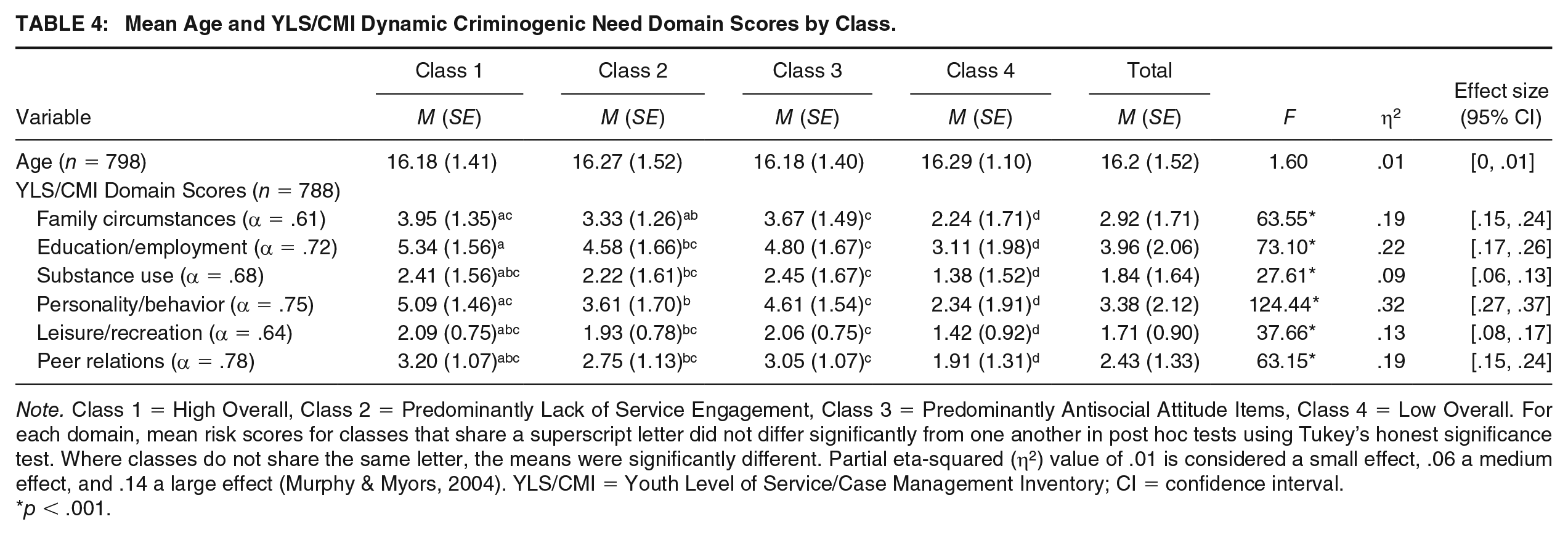
Significant class differences were evident across the six dynamic criminogenic need domains of the YLS/CMI (see Table 4). Tukey’s HSD post hoc analyses indicated that the Low Overall Attitude Needs class was characterized by significantly lower need scores than all other classes in all domains (p < .001 in all cases). Youth in the High Overall Attitude Needs class had significantly higher need scores than those in all other classes in the Education domain (p = .05 for the difference with Predominantly Antisocial Attitude Items and p = .03 for the difference with Predominantly Lack of Service Engagement). Youth in the High Overall Attitude Needs class also had higher need scores than those in the Predominantly Lack of Service Engagement class in the Family Circumstances (p = .04) and Personality/Behavior (p < .001) domains. Youth in the Predominantly Antisocial Attitude Items class also had higher need scores than those in the Predominantly Lack of Service Engagement class in the Personality/Behavior domain (p = .001); this was the only domain in which the Predominantly Lack of Service Engagement and Predominantly Antisocial Attitude Items classes differed significantly. There were no differences between the High Overall Attitude Needs, Predominantly Antisocial Attitude Items, and Predominantly Lack of Service Engagement classes in Substance Use, Leisure/Recreation, or Peer Relations domain scores.
Class Membership and Recidivism
As Table 3 shows, recidivism rates differed significantly between classes, with post hoc analysis of adjusted residuals indicating significant pairwise differences (p = .01) between the Low Overall Attitude Needs class, which reoffended at the lowest rate, and both the High Overall Attitude Needs and Predominantly Antisocial Attitude Items classes.
Discussion
In this study, we utilized LCA to determine whether total scores in the YLS/CMI Attitudes/Orientation domain mask discrete subgroups with potentially distinct treatment needs given that the five items in this domain appear to tap into different aspects of antisocial attitudes/orientation (e.g., frank antisocial attitudes vs. attitudes related to willingness to engage in services). The case management strategies for these two areas differ (with treatment for antisocial attitudes generally focused on identifying and restructuring these antisocial thought patterns, and treatment around engagement focused on increasing internal motivation to change), making it important to understand the nature of individuals’ needs in this domain to ensure that services are correctly matched. Results of the LCA supported the presence of distinct classes of youth based on patterns of item endorsements (i.e., needs) in the Attitudes/Orientation domain of the YLS/CMI. These classes also had distinct patterns in terms of their index offenses, scores on the other YLS/CMI criminogenic need domains and rates of recidivism.
Identified Latent Classes
It was hypothesized two classes would emerge, representing youth with needs predominantly related to either overt antisocial attitudes or willingness to engage in services. Results supported these two classes as well as two others. Roughly 19% of the sample represented Predominantly Antisocial Attitude Items youth, while 8% had needs based mostly on a lack of willingness to engage with services (Predominantly Lack of Service Engagement). The other two classes were characterized by either a high (High Overall Attitude Needs, 19% of the sample) or low (Low Overall Attitude Needs, 55% of the sample) frequency of endorsements across all items in the Attitudes/Orientation domain. There was a relatively low number of youth with predominantly treatment resistance needs. However, though this class was small, it should be stressed that this number represents youth with solely treatment resistance items endorsed. The High Overall Attitude Needs class, which represented 18% of the sample, also endorsed items in this area at a high frequency, and clinicians often endorsed the item Specifically declining services for individuals in the Predominantly Antisocial Attitude Items class. Thus, it appears that low motivation to engage in services often presents along with other risk factors, although can also be a primary area of need.
Patterns Within and Between Classes
The most “negative” presentation was seen in the High Overall Attitude Needs class, which had the highest domain risk scores and recidivism rates. The Predominantly Antisocial Attitude Items class presented similarly to the High Overall Attitude Needs class in several respects, including high rates of violent index offenses. Individuals in the Predominantly Lack of Service Engagement class generally fell in the “middle,” with lower risk and recidivism than Predominantly Antisocial Attitude Items and High Overall Attitude Needs youth but higher rates than seen in Low Overall Attitude Needs youth. Relative to the other classes, the Low Overall Attitude Needs class (which was the largest of the four) presented with the lowest domain risk scores and recidivism rate. However, it should be noted that youth in this class are not a “low risk” group in that 46% of the youth in this group reoffended across all types of offense. Interestingly, this group had the highest proportion of index sexual offenses of all classes, which is consistent with prior research indicating that youth charged with sexual offenses typically have lower recidivism rates than those whose charges do not include sexual offenses (Sipe et al., 1998).
Given the initial study goal of determining the presence of youth with distinctly antisocial needs versus low willingness to engage in services, comparisons between these two classes were of specific interest. As predicted, given that antisocial attitudes are considered one of the “Big Four” risk factors most predictive of recidivism (Bonta & Andrews, 2017), Predominantly Antisocial Attitude Items youth presented with significantly higher recidivism rates than the Predominantly Lack of Service Engagement class. It was also predicted that, with the demonstrated link between antisocial behavior and aggression/violence (e.g., Granic & Butler, 1998), the Predominantly Antisocial Attitude Items class would present with a higher percentage of violent initial offenses; this also proved to be the case. The two classes also differed significantly on the Personality/Behavior domain of the YLS/CMI, which was predicted given the link between antisocial attitudes and behaviors (Bonta & Andrews, 2017). Contrary to predictions, the two classes did not differ significantly on the Peer Relations or Substance Use domains of the YLS/CMI. The Substance Use finding may be partly explained by the fact that, although substance use has been linked with antisocial attitudes, lack of treatment engagement is also frequently noted in substance users (e.g., Dunn et al., 2001). Finally, it is important to note that although the High Overall Attitude Needs and Predominantly Antisocial Attitude Items groups were quite similar overall, youth in the High Overall Attitude Needs class—which presented with both antisocial attitudes and lack of willingness to engage in services needs on the YLS/CMI—had the most negative outcomes of all four classes. Thus, resistance to services might amplify risk and subsequent negative outcomes for youth with additional criminogenic needs, perhaps through lack of subsequent engagement in programming.
Implications for Case Management and Intervention
The results of this study have the potential to inform programming in terms of targeted interventions for justice-involved youth. The negative outcomes seen in youth in the Predominantly Antisocial Attitude Items class confirms the importance of interventions targeting antisocial/procriminal attitudes. However, as highlighted, items reflecting willingness to engage in services were also frequently endorsed in the High Overall Attitude Needs class. Thus, increasing a youth’s readiness and willingness to engage in treatment remains an important target of interventions, in addition to addressing antisocial attitudes through service intervention.
From a practical standpoint, rather than using total domain scores when planning interventions for youth identified with moderate to high Attitudes/Orientation needs, service providers can use the knowledge of discrete classes for information on how best to intervene based on a youth’s attitude profile, in accordance with the responsivity principle (Bonta & Andrews, 2017). For example, youth in the Predominantly Lack of Service Engagement class, while not expressing procriminal attitudes, were generally characterized by negative attitudes toward authority figures, which may extend toward service providers (e.g., youth workers, counselors, and therapists). Understanding these attitudes would be helpful for providers to keep in mind when working with these youth, to improve motivation and meet their specific needs. Thus, looking beyond total domain scores when matching services to needs seems prudent.
Given the similarities between the High Overall Attitude Needs and Predominantly Antisocial Attitude Items classes, questions may be raised regarding the utility of considering them distinct groups. While similarities were clear, there was a key difference in endorsement of one of the willingness to engage in service items. Specifically, youth in the High Overall Attitude Needs class were frequently scored to refuse services that were offered to them (YLS/CMI item Specifically declining services) while Predominantly Antisocial Attitude Items youth were not. Thus, although both classes have comparable risk and recidivism rates, their LCA profiles suggest different implications for intervention. While youth in the Predominantly Antisocial Attitude Items class may be more receptive to intervention aimed at modifying antisocial attitudes, High Overall Attitude Needs youth may initially require motivational interviewing and other incentives for engagement from a skilled service provider as a “first-line” goal before more targeted services are offered. If a youth is not open to participating in services, the likelihood of success in programming is low, no matter how well-tailored it may be to their specific criminogenic needs. A lack of readiness or willingness to engage might impact both accepting services and engagement within sessions. For these individuals, interventions aimed at increasing their openness to treatment (e.g., motivational interviewing) may help build their chances of success in subsequent programming targeted toward their specific criminogenic needs (Higley et al., 2019; Mossière & Serin, 2014).
Study Limitations and Future Research Directions
While the present study is characterized by a number of strengths, including the use of real-world clinical data and field ratings from a relatively large sample of youth, several features of our study place limitations on the conclusions that can be drawn and offer opportunities for further research. First, the sample consisted entirely of youth who had received court-ordered assessments. Youth receiving such assessments represent a small, and generally higher risk, portion of the population of justice-involved youth (Jack & Ogloff, 1997); therefore, it will be important to examine the attitudes classes in a broader sample of youth involved in the criminal justice system. At just over 50%, the overall reoffense rate in our study underscores this as a relatively high-risk sample. In addition, the classes differed in terms of reoffense, with the Predominantly Antisocial Attitude Items and High Overall Need classes being characterized by significantly higher reoffense rates than the classes that were not characterized by high prevalence in endorsement of antisocial/procriminal attitudes. It is therefore important to examine whether the inclusion of lower risk youth changes the number or nature of latent classes. In the current sample, almost half of youth were scored as having oppositional or defiant behavior to authority figures and nearly 40% as having attitudes supportive of criminal behavior. It is reasonable to expect that youth who are at lower risk, overall, would be less likely to express (and be assessed as holding) procriminal attitudes and be characterized by lower levels of treatment disengagement/noncompletion (e.g., McMurran, 2002). However, it is not clear whether this would change the nature or number of “attitude” classes; the structure may hold even in a sample more representative of the entire population of youth involved in the criminal justice system. This will be an interesting and important question to examine in a future study.
Second, participants were largely male and the sample was primarily Black or White in their self-reported ethnicity; research examining latent classes with diverse samples of sufficient subgroup size would allow for a more robust and nuanced examination of whether class composition differs with respect to sociodemographic variables such as gender and race/ethnicity. In particular, with respect to race/ethnicity, the reality and salience of the experience of racism by Indigenous and racialized (particularly Black) youth requires that attitudes be understood in relation to legitimate anger and mistrust toward the criminal justice system and its actors (Skilling & Sorge, 2014) and this issue, while raised (e.g., Piquero, 2015), remains underresearched. This issue has implications not only for the interpretation of variables and findings in research (e.g., Huang et al., 2021), but for professional practice (i.e., correctional and clinical assessment and intervention), and represents an important area for additional study.
Third, we utilized the five attitude items from the YLS/CMI to create the latent classes. As a widely used tool that is used not only to classify a youth’s risk to reoffend, but to inform service planning, it is important to examine the YLS/CMI at the domain level. Indeed, it was the apparent distinctiveness, on their face, of items within the Attitudes/Orientation domain—and the implications of this for intervention—that prompted the questions examined in our study. However, this is clearly a small number of items to measure a complex construct, and while this research represents an important first step in examining whether there are distinct classes of youth with “attitude” needs, future research using a multimeasure, multisource assessment of attitudes will provide a more robust basis for further examining this question.
The results of the present study present several other avenues for future research. It may be useful to examine patterns of class membership over time. A latent transition analysis could examine whether class membership is consistent over multiple time points or if youth shift from one class to another (for example, do youth often “start out” in the Predominantly Antisocial Attitude Items or Predominantly Lack of Service Engagement classes and then “branch off” into High Overall Attitude Needs?). In addition, given the previously noted limitations, it will be important to replicate the findings of this study along with exploration of convergent validity of groups with external measures of treatment readiness and antisocial attitudes, with a specific eye to using measures that have been shown to be reliable and valid with a focus on intersectionality (e.g., boys and girls from various racial/ethnic backgrounds). Further theoretical work on the similarities and differences of antisocial attitudes versus treatment readiness would deepen our understanding of these constructs and our ability to understand the specific needs of individuals with needs in these areas. Similarly, validation of existing tools related to willingness to engage in services (e.g., treatment readiness) and exploration of the impact of these constructs on subsequent outcomes with youth samples will be important in deepening the ability to tailor services to a youth’s specific needs and characteristics.
This study illustrates the value of a latent class approach in uncovering discrete groups within overall criminogenic need domains to more specifically determine individual needs and areas of intervention. It also reaffirmed the key role of antisocial/procriminal attitudes on recidivism for justice-involved youth. The results demonstrated that specific needs within the Attitudes/Orientation domain of the YLS/CMI are associated with recidivism, confirming the importance of targeted intervention for youth with needs identified in this domain.
Footnotes
Authors’ Note:
This study was supported by funding from the Social Science and Humanities Research Council of Canada to the second and third authors.
