




Abstract
This study examined the predictive properties of the Ontario Domestic Assault Risk Assessment (ODARA) in a large Canadian, predominantly Indigenous, sample from a geographic region with the highest rates of intimate partner violence (IPV) in the country. A random stratified sample of 300 men (92.7% Indigenous) court adjudicated for an IPV offense was drawn from six Northern Saskatchewan Royal Canadian Mounted Police detachment regions. The ODARA was rated from police records and recidivism data were obtained via official criminal records over a mean 4.7-year follow-up. ODARA scores had small to moderate predictive accuracy (AUC/C = .58–.67) for IPV and other recidivism outcomes in the aggregate sample and Indigenous subsample. E/O index analyses demonstrated that the ODARA Ontario norms overpredicted IPV recidivism at high scores but underpredicted it at lower mid-range scores. Implications for use of the ODARA to assist frontline police personnel in IPV risk assessment and management are discussed.
Intimate partner violence (IPV), or the attempted, threatened, or completed act(s) of physical, psychological, or sexual abuse, including intimidating and controlling behaviors, against a former or current romantic partner (Campbell et al., 2018; Canadian Association of Chiefs of Police [CACP], 2016) is an international societal problem. IPV does not discriminate based on age, gender, sexual identity, socioeconomic status, or cultural background (CACP, 2016), and remains a prevalent issue in Canada. In 2017, 30% of all police-reported violent crime consisted of IPV complaints, with 80% of victims being female (Burczycka et al., 2018; CACP, 2016). The Canadian province of Saskatchewan has the highest rate of IPV occurrences (682 victims per 100,000 population) in the country (Burczycka et al., 2018); however, Northern Saskatchewan, in particular, has the highest violent crime rate against young women and girls (13,886 victims per 100,000 population), a rate five to six times higher than that found in Southern Saskatchewan (Rotenberg, 2019). Although Canada has been a leader in the development and validation of IPV risk assessment tools (Hilton, 2021; Hilton & Ennis, 2020) to assess and manage risk, IPV remains a pervasive social and health concern.
IPV Risk Assessment and Law Enforcement
From a police perspective, the CACP (2016) believes that responding to the issue of IPV is not only a police matter, but a shared responsibility among law enforcement, public health, and community and social agencies. As IPV occurrences are some of the most complicated and high-risk calls a police officer can respond to (Campbell et al., 2018), risk assessment is an important part of this process. Law enforcement considers multiple factors to be a priority in regard to dealing with IPV occurrences and risk assessment, including: relationship status (i.e., recently separated, cohabitating); frequency and level of violence (i.e., choking, sexual assault); current incidents of harassment, threats, and/or stalking; access to weapons; substance abuse; age difference of perpetrator and victim; mental health of perpetrator and victim; suicide risk; children from previous relationship(s); and pregnancy (Campbell et al., 2018; Hilton et al., 2004). With a primary goal of risk assessment being to prevent further violence against the victim and contribute to ideas regarding monitoring, supervising, and treating IPV perpetrators (CACP, 2016), the use of empirically based risk assessment tools by frontline law enforcement officers contributes positively to public safety, proper allocation of resources (physical and financial), and coordinated responses to IPV occurrences (Campbell et al., 2018; Olver & Jung, 2017).
Overview of IPV Risk Measures and Their Predictive Properties
The forensic risk assessment literature has clearly established the superior predictive performance and clinical utility of structured assessment approaches over unstructured clinical judgment, including IPV risk assessment (Helmus & Bourgon, 2011; Messing & Thaller, 2013; van der Put et al., 2019). A risk instrument, however, is not the same thing as a risk assessment (Mills, 2017); the latter is a dynamic process of combining and integrating information from multiple sources, using multiple methods, across multiple domains of functioning (Olver, 2016). Per the principles of risk (i.e., recidivism can be predicted and service intensity should be matched to risk level), need (prioritize dynamic risk factors, aka criminogenic needs for treatment), and responsivity (tailor service delivery to individual client characteristics) or RNR model (Bonta & Andrews, 2007), risk assessment informs intervention and risk management. A key psychometric attribute of a valid and useful risk assessment measure, however, is that it has predictive validity (aka predictive accuracy) for the targeted outcome for which it was designed to appraise risk and ultimately, prevent.
Predictive accuracy, in turn, can be examined through discrimination (relative risk) and calibration (absolute risk). Discrimination concerns the extent to which recidivists can be differentiated from nonrecidivists on the basis of risk scores, while calibration concerns the rates of recidivism associated with risk scores, such as the extent to which observed rates of recidivism correspond to those expected from a normative reference group (Helmus & Babchishin, 2017). Discrimination is frequently examined through metrics such as area under the curve (AUC). AUC values range from 0 to 1.0 and represent the probability that randomly selected recidivist will score higher than a randomly selected nonrecidivist. With values of .50 representing chance-level accuracy, AUC magnitudes of .56, .64, and .71 represent small, medium, and large effects, respectively (Rice & Harris, 2005).
Quantitative reviews of the IPV risk assessment literature have found IPV-specific risk measures, general violence risk measures, or measures of forensically relevant constructs (e.g., psychopathy) to have comparable, and broadly, moderate range predictive validity for IPV recidivism. The most recent meta-analysis (van der Put et al., 2019) found the Danger Assessment (DA; Goodman et al., 2000), Spousal Assault Risk Assessment Guide—Version 2 (SARA-V2; Kropp et al., 1995) and its derivative, the Brief Spousal Assault Form for Evaluation of Risk (B-SAFER; Kropp et al., 2005), and the Ontario Domestic Assault Risk Assessment (ODARA; Hilton et al., 2004) to be the most frequently validated tools.
The DA is one of the oldest IPV risk assessment measures, originally designed for use by clinical staff to determine the risk of possible future lethal violence in domestic situations, using victim interviews or self-reports as a means of data collection (Goodman et al., 2000). In contrast to other IPV measures, the DA specifically appraises risk of harm to a specific victim; hence, its development and use in women’s shelters. Comprising 15 items (e.g., history of general violence and IPV; accessibility of weapons; substance abuse; suicidality; jealousy), the measure has demonstrated broadly moderate predictive accuracy for IPV recidivism (AUC = .657) across 10 evaluations (van der Put et al., 2019).
The SARA, now in its third edition (SARA-V3; Kropp & Hart, 2015), is a structured professional judgment (SPJ) measure comprised of static (e.g., indicators of spousal assault and general criminal history) and dynamic (e.g., relationship problems, unemployment, and IPV supportive attitudes) predictors. Its derivative, the B-SAFER, is a condensed version of the original, designed for the use of frontline police officers (Kropp et al., 2005). As SPJ measures, the items are not summed to generate numeric scores linked to recidivism probabilities (i.e., actuarial), but rather the nature and pattern of item ratings are used to inform risk level and management. Many evaluations of the SARA-V2 and the B-SAFER have examined their use in an actuarial manner. The van der Put et al. (2019) review found moderate predictive accuracy for the SARA-V2 (AUC = .643, k = 10) and a small significant effect for the B-SAFER (AUC = .597, k = 5).
Finally, the ODARA is a 13-binary-item actuarial risk assessment measure designed for use by frontline police officers to assess risk related to IPV occurrences (Hilton et al., 2004, 2008, 2014; Olver & Jung, 2017). The item content is predominantly static in nature and includes criminal history, details of the index offenses, and victim and familial demographics. Across 10 studies in the van der Put et al. (2019) meta-analysis, the ODARA had moderate predictive accuracy (AUC = .690) for IPV recidivism. Moreover, a variant of the ODARA with weighted predictors and a 14th item incorporating Psychopathy Checklist—Revised (PCL-R) score had high predictive accuracy for spousal assault recidivism (AUC = .715, k = 3).
Although the van der Put et al. (2019) meta-analysis did not examine prediction of other recidivism outcomes (e.g., general violence, any recidivism), a sizable literature exists to demonstrate that IPV-specific measures also tend to be predictive of such outcomes, even though they were not developed to assess risk for such outcomes per se. For instance, previous research has found the ODARA to also predict violent (AUC = .65–.81) and general (AUC = .69–.81) recidivism (Hilton & Eke, 2016; Messing & Thaller, 2013; Olver & Jung, 2017; Seewald et al., 2017). The ODARA also has some validation research supporting its predictive properties with female IPV perpetrators (Hilton et al., 2014; Olver & Jung, 2017). What is lacking in the literature, however, are studies regarding the predictive accuracy of risk assessment instruments with non-white populations, including Indigenous persons (Olver, 2016; Shepherd & Lewis-Fernandez, 2016). Although the validation samples for the ODARA, other IPV measures, as well as other risk tools involve ethnoculturally heterogenous samples—including overrepresentation of Indigenous persons—psychometric research stratified by ethnocultural heritage, and particularly Indigenous ancestry, as has been much less frequent.
This matter came to the fore in Ewert v. Canada (2015); Ewert, a man of Métis heritage serving a life sentence for sexual homicide sued the Correctional Service of Canada (CSC) on the grounds that its use of conventional risk assessment measures in his case was unconstitutional, that such measures were culturally biased against Indigenous persons, and their use resulted in harms to Mr. Ewert. The matter was initially ruled in favor of the Plaintiff (Ewert v. Canada, 2015) and then overturned on appeal (Canada v. Ewert, 2016). The final verdict generated in the Supreme Court of Canada (Ewert v. Canada, 2018) ruled that the use of such measures was not unconstitutional; however, that the CSC failed in its duty to establish the psychometric properties of these measures for use with Indigenous persons.
Although the ODARA was not among the tools impugned in the Ewert matter, the issues bear no less relevance, particularly given the overrepresentation of Indigenous persons as victims and perpetrators of IPV. One study to our knowledge has examined the ODARA on a small subsample of Canadian Indigenous peoples. In an unpublished doctoral dissertation, Buchanan (2009) examined the predictive accuracy of the ODARA in an urban Saskatchewan sample of men under provincial jurisdiction for IPV. In the prediction of 2-year IPV recidivism, the ODARA had moderate predictive accuracy for Indigenous men (n = 53; AUC = .64; IPV base rate 29.2%) and a large effect for non-Indigenous men (n = 41; AUC = .77; IPV base rate 7.3%).
A Northern Saskatchewan Population
In Canada, Indigenous people are overrepresented within the criminal justice system not only as the accused, but also as victims (Brownridge, 2008; CACP, 2016; Department of Justice [DOJ], 2017). Northern Saskatchewan comprises only 4% of the province’s total residents (Allen & Perreault, 2015); however, it has the highest rate of police-reported IPV in Canada and the second-highest proportion (16%) of Indigenous residents in Canada (Rotenberg, 2019). Moreover, in 2015, the rate of victimization due to a violent crime was over twice as high for Indigenous versus non-Indigenous people (DOJ, 2017). Scrim (2017) describes victimization among Indigenous people as the mirror image of Indigenous offending, as more often than not, the perpetrators are members of the victim’s community (i.e., spouses, friends, and family members). Not only are Indigenous women and girls at a higher risk of being IPV victims, they are also more likely to experience increasingly severe forms of violence. For instance, the rate of Indigenous female homicide victims (4.8) was six times that of non-Indigenous homicide victims (0.77) per 100,000 in 2015.
The colonization of Canada by Europeans since the 1600s has had a devastating impact on the lives and social structures of Indigenous people, which continues today. Colonization theory posits that many of the issues faced by Indigenous people stem from their historical experiences, therefore, this is a lens from which violence against Indigenous women must be examined (Brownridge, 2003, 2008). The impact of colonization, residential schools, and work camps have negatively impacted Indigenous communities and has been recognized as influencing elevated rates of IPV, especially in the Canadian North. This may be influenced by economic, social, and cultural insecurities that have stemmed from a history of assimilation and exclusion (CACP, 2016; Rotenberg, 2019).
The Indigenous people of Northern Saskatchewan have been influenced by the ever-changing economic influences and constant cultural breakdown by both church and government programming since the late 1600s (Bell, 1928). The men of fur trading companies frequently married Indigenous women as the Canadian traders were well aware that having an Indigenous spouse had value in adding knowledge to the trader’s understanding of Indigenous life (Van Kirk, 1983). The French and British fur trade economy brought with them the Roman Catholic and Protestant religions which viewed the Indigenous people as heathen, did not appreciate the power of Indigenous women in their homes and society, and taught noninterference in IPV. In the 1800’s, the Canadian federal government, in cooperation with the Roman Catholic and Protestant churches began to establish residential schools (Truth and Reconciliation Commission of Canada [TRC], 2015). According to the 2015 TRC Report, Canada prohibited Indigenous spiritual practices, incarcerated Indigenous spiritual leaders, and confiscated sacred Indigenous objects. Children were separated from their parents and sent to residential schools, not to educate, “but primarily to break their link to their culture and identity” (TRC, 2015, p. 2). The Indian Residential School system’s removal of children from their family circles emotionally ravaged and produced enduring damage to the children and their families.
All of the above led to culture erosion, loss of language, lack of parent skills, unhealthy intimate relationships, and family breakdowns for the last five to seven generations. This is what Indigenous communities in Northern Saskatchewan, and across Turtle Island (i.e., Canada) are dealing with today. One of the positive facts is, as an ethnicity, Indigenous people have the highest proportion of nonalcohol societies at over 33% (Johnson, 2016). There is a movement of returning to the original teachings and languages of the land and the young people are moving this way faster. This way of life is alcohol and drug free, family and community oriented, land based, and respectful of women.
Various social and demographic variables have been identified as criminogenic risk factors related to IPV victimization and/or perpetration in Indigenous families: being young; less educational attainment; increased unemployment levels; cohabitation (living common-law); single-parent families; rural demographic (geographic isolation); alcohol and substance abuse; and, larger family size (Brownridge, 2008; CACP, 2016; Scrim, 2017). As actuarial risk tools, such as the ODARA, do not take many of the aforementioned individual and historical circumstances into account, it is important that research be conducted to examine the predictive validity of these types of risk assessment measures in this unique demographic.
The Present Study
This study is an examination of the ODARA in a predominantly Indigenous (93%) sample from Northern Saskatchewan, given the high rates of IPV in the North, the overrepresentation of Indigenous persons as victims and perpetrators of IPV, and the scarcity of validation research on the tool with Indigenous persons. Our primary hypothesis was that ODARA scores and risk bands would evince approximately moderate predictive accuracy (i.e., discrimination) for IPV recidivism and other recidivism outcomes consistent with the limited literature examining the ODARA with a small Indigenous subsample (Buchanan, 2009). Our secondary hypothesis was that higher observed rates of IPV recidivism would be associated with increasing ODARA scores. Given the lack of prior precedent for ODARA research with Indigenous persons, we did not advance specific hypotheses about whether rates of IPV observed in the current sample associated with ODARA scores, corresponded closely to the rates expected from ODARA norms (i.e., calibration) and a predominantly white sample (e.g., Hilton et al., 2004).
Method
Ethics
The first author received operational approval and collaborated with various units within the Royal Canadian Mounted Police (RCMP) throughout the undertaking of this study. The second author, in turn, was a Member of the First Nations community and sworn RCMP officer assigned to collaborate with the first and last authors to ensure the inclusion of the broader Indigenous community. Ethical approval was received from the University of Saskatchewan Behavioral Research Ethics Board (ID#1547).
Participants
Using archival data, participants (N = 300) were randomly selected from six detachment areas located in Treaty Areas 8 and 10 in Northern Saskatchewan on the Canadian Prairies, which consists of the provinces of Alberta, Saskatchewan, and Manitoba. Participants were male, 18 years of age or older, had an occurrence of physical and/or sexual IPV against a female partner resulting in charges, and had current or previous cohabitation with their intimate partner. Demographic information was accessed, collected, and deidentified by the first author and approved RCMP personnel in a secure area of the police detachment and maintained on a secure drive. In all, 90% of participants were of First Nations ancestry, 2.7% were of Métis ancestry, 1.3% were white, and 0.3% were of Asian ancestry; the small remainder was of unknown ancestry. The mean age at the time of the IPV index offense was 32.8 years (Min = 18, Max = 63, SD = 10.4). In terms of marital status, 15% of the sample was common-law, 3.7% were married, 70.7% were never married, and 10% were separated at the time of the index offense.
Materials
ODARA
The ODARA is an actuarial risk assessment measure for domestic violence consisting of 13 empirically selected dichotomous items pertaining to domestic relationships, the risk of antisocial behavior, and nondomestic violence (Hilton, 2021; Hilton et al., 2004). Possible scores range from 0 to 13 and can be arranged into seven risk categories of 0, 1, 2, 3, 4, 5 or 6, and 7 to 13. As detailed in the literature review, abundant empirical evidence exists supporting the ODARA’s predictive properties for future IPV as well as other recidivism outcomes (Helmus & Bourgon, 2011; Hilton et al., 2004; van der Put et al., 2019). Interrater reliability details are provided in the Procedure.
Recidivism
Recidivism was coded for four categories: (a) IPV recidivism (i.e., any spousal assault recidivism as determined from police records), (b) violent (i.e., any actual, attempted, or threatened harm to another person, including IPV offenses) recidivism, (c) nonviolent recidivism (i.e., nonpersonal injury offenses such as thefts, breaches, drug offenses), and (d) any (i.e., all) recidivism (i.e., violent or nonviolent). The following recidivism details were coded: (a) release date (or equivalent); (b) date of first reconviction; (c) date of first new IPV offense (charge or reconviction); (d) date of first new violent offense (charge or reconviction); (e) date of first new nonviolent offense (charge or reconviction). Finally, total new charges and convictions for IPV, violent, and nonviolent offenses were counted for each participant.
Procedure
Data Capture
Two police databases were used during the data collection process: the Police Report Occurrence System (PROS) and the Canadian Police Information Center (CPIC). PROS is the RCMP’s national records management system “containing information on individuals who have come into contact with police, either as suspects, victims, witnesses or offenders, from initial occurrence to final disposition,” with approximately 1.6 million occurrence files processed each year (Privacy Commissioner of Canada, 2011, p. 3). CPIC, in turn, is the national criminal records database maintained by the RCMP of charges, convictions, and sentencing information for persons in Canada. PROS and CPIC were accessed by the first author, an employee of the RCMP who was trained in the use of these systems. Systematic random sampling was conducted of all men flagged by the RCMP as having a criminal charge or conviction for IPV. Data were gathered from six different RCMP detachments located in Northern Saskatchewan (Treaty Areas 8 and 10), with 50 participants being randomly selected from each detachment area during the timeframe. These detachments were selected as high priority areas requested by the RCMP for inclusion in this study. As each detachment area varies greatly in size and total population, the queries began with the smallest detachment area first, ending with the largest detachment area. The date range of (2010 to 2015) was used to query for index offenses, beginning with offenses occurring on December 31, 2015, and working backwards in time to avoid duplicate identified participants. The time frame was selected to ensure adequate number and representation of cases, as well as sufficient follow-up time to code recidivism and examine associations with outcome. As PROS catalogs occurrence reports chronologically, the information pertaining to a given IPV index offense in a given year could be extracted separately to code the ODARA.
Index Offenses
Using the PROS database, index offenses were defined as having occurred closest to, but no later than, December 31st, 2015, that involved charges related to physical and/or sexual assault against a female intimate partner (current or ex-spouse, girlfriend, common-law partner) by a male perpetrator, who may or may not be cohabitating at the time of the offense. The male perpetrator was at least 18 years of age at the time of the offense. The only occurrences of physical and/or sexual violence resulting in charges that were excluded from this study were those resulting in the death of the victim. Each perpetrator identified from the index offense was run on CPIC to access his criminal record, which contains detailed information regarding all identified criminal charges, dispositions, arrests, and convictions, to generate the recidivism outcome variables.
Pre-Index Offense Criminal History
A total was coded regarding all previous IPV, general violence, and nonviolent general offenses located on police occurrence reports and criminal records for each identified index offense. IPV offenses were defined as any physical and/or sexual assault against a current or previous spouse or partner, whether they were cohabitating at the time of the offense or not. General violence offenses were categorized as any act of physical and/or sexual violence against another person other than a current and/or intimate partner. Nonviolent general offenses included any other offense which did not pertain to violence against another person (i.e., breaching court orders, theft, fraud).
Post-Index Offense Recidivism
Recidivism was coded for each new offense listed on police occurrence reports and criminal records for each participant following their date of release from custody. IPV (or spousal assault) is not its own entity within the Canadian Criminal Code. Some CPIC entries will have flags as spousal assault, while others do not. To ensure capture of new violent offenses that involved IPV, and accurately code IPV recidivism, the case and incident was also cross-referenced in PROS to ascertain the nature of the offense (i.e., IPV or not). All convictions originated as charges; however, not all charges resulted in conviction (e.g., stay of proceedings, dismissed); both categories of outcome variable are processed in court when a criminal matter is adjudicated, the date of which is provided on the CPIC entry. If a charge results in conviction, it is listed only as a conviction, if a charge does not result in conviction, it is listed at the end of the document in a separate section of offenses not intended for sentencing purposes. The dates for the first reconviction (any), first IPV occurrence (charge or conviction), first general violence occurrence (charge or conviction), and first nonviolent general offense (charge or conviction) was recorded. The total number of new charges and convictions was recorded for each category of recidivism, and the final charge/conviction category was dichotomized to generate the four binary recidivism outcomes. The charge/conviction date was used as the end date for a given outcome to compute time to recidivism for survival analyses. When charges and convictions for the same category (e.g., a dismissed IPV charge and a sentenced IPV conviction) were listed, the earlier of the two dates was selected as the end date. For nonrecidivists, the time interval used was the release to the community following the IPV index offense up to the data collection date (or the registered date of death for deceased persons).
ODARA Scoring
The first and second authors were each trained on the ODARA through by the ODARA 101 course, as offered by the Waypoint Center for Mental Health Care (Hilton & Ham, 2015). To score the ODARA, occurrences related to domestic violence were first queried on PROS and then the information required to score the measure was taken from the police file, itself. The first author completed ODARA ratings for all 300 participants used for primary analyses. ODARA ratings were completed using information obtained from PROS prior to obtaining CPIC data and thus blind to recidivism outcome to prevent criterion contamination.
To establish interrater reliability, the second author independently doubled coded approximately 10% of cases from PROS identified through systematic random sampling of every tenth case. Two cases could not be retrieved during the second round of coding resulting in a final interrater reliability n of 28 independently double coded cases. The second author accessed the exact same occurrences on PROS as the first author to score the ODARA. As these files were more historical in nature with charges having been concluded in the judicial system, there would be no reason for the occurrences to have changed in any way; as such, both raters accessed the same body of information from this records system to score the ODARA.
Strong interrater reliability as assessed via the intraclass correlation coefficient, single measure, absolute agreement, two-way mixed effects model (ICCA1) = .75, 95% CI [.53–.87] was obtained for ODARA total scores, corresponding to the lower bounds of “Excellent” (per Cicchetti & Sparrow, 1981) or “Good” (per Koo & Li, 2016) reliability. An ICCA1 of .75 would be interpreted as 75% of differences in ODARA scores being due to trait variability (i.e., individual differences in IPV risk), while 25% would be attributable to nontrait factors, such as rater error (Boccaccini et al., 2014). In addition, we examined the interrater reliability of ODARA risk category ratings through computing Gwet’s AC1 (chance corrected agreement coefficient) via package “irrCAC (version 1.0)” (Gwet, 2019) through R 4.0, which yielded satisfactory agreement, AC1 = .68, 95% CI [.49–.89], Percent Agreement = 71.4.
Data Analytic Plan
First, descriptive statistics (M and SD) and risk band percentages of ODARA scores and item frequencies were calculated for the total sample to provide a profile of IPV risk and a reference to the Hilton et al. (2004) norms. Second, to examine the discrimination properties of the ODARA (per the first hypothesis), area under the receiver operating curve (AUC) and Harrell’s C analyses were conducted for both the entire sample and the Indigenous portion (i.e., First Nations and Métis) of the sample for the four recidivism outcomes: IPV recidivism, violent recidivism, nonviolent recidivism, and any recidivism. Given the centrality of the IPV recidivism variable for this study, AUCs were also computed examining the prediction of recidivism using 1, 2, 3, 4, and 5-year fixed follow-ups (i.e., ensuring participants had equal time at risk). Harrell’s C was also computed to examine predictive accuracy of ODARA scores for the four outcomes over variable follow-ups. C is analogous to AUC and is interpreted as the probability that given two recidivists, the individual with the higher score will reoffend sooner.
Third, given that later analyses would demonstrate that ODARA score was positively correlated with age at IPV index offense while age at IPV index was inversely associated with recidivism (i.e., older men had more serious offense history, yet had lower recidivism rates), the AUCs and Cs were repeated controlling for age. This was done by regressing ODARA score on the age variable, saving the residual (i.e., which would represent ODARA score variance independent of age), and then rerunning all AUCs/Cs on the residual ODARA score. Kaplan–Meier survival analyses were conducted by examining trajectories of each recidivism outcome over time for the ODARA risk categories which were compared using the log-rank chi-square test.
Fourth, we examined the calibration properties of the ODARA through E/O index analyses (per the second hypothesis). The E/O index compares the expected rates of recidivism over a defined follow-up for a reference group at a given score or set of scores to those observed from an independent sample. This was done through comparison of rates of IPV recidivism at risk thresholds for the current sample compared to the inaugural ODARA sample and norms (Hilton et al., 2004) and an urban Canadian Prairie sample from the greater Edmonton area in the neighboring province of Alberta (Olver & Jung, 2017). E/O index values above 1.0 represent overprediction of recidivism by the reference group, values under 1.0 represent underprediction, while values of 1.0 indicate perfect calibration. The E/O index is significant when the 95% CI does not overlap with 1.0:
Finally, to examine the IPV recidivism rates associated with ODARA scores, rates of IPV recidivism at 4-year fixed follow-up (i.e., the longest fixed time period while retaining most of the sample) were examined at each ODARA risk band. We examined both observed rates and those predicted by logistic regression at specific ODARA scores using the logistic function:
Results
ODARA Descriptive Information
The sample in this study (N = 300) was comparable to those found by Hilton et al. (2004; N = 425) and Olver and Jung (2017; N = 300). This study and Hilton et al. used index offenses that consisted of male perpetrators assaulting female victims, while Olver and Jung included female perpetrators in their sample. The three different studies used varying populations: this study used a Northern Saskatchewan sample, which is highly rural in nature with a large portion of the sample consisting of Indigenous men; Hilton et al.’s sample was gleaned from both rural and urban centers from across the province of Ontario and did not account for race; Olver and Jung’s sample was taken from an urban prairie sample, with half of the sample being classified as Caucasian (55.3%) and a smaller proportion of the sample being identified as First Nations or Métis (30.3%). In this sample, the mean ODARA score was 5.91 (Min = 0, Max = 11, SD = 2.16). This sample, in contrast to Hilton et al. (2004), yielded a higher percentage of cases in the higher risk bands of 5 or 6 (30.7% vs. 21.9%, respectively) and 7 to 13 (44% vs. 23.3%, respectively). ODARA risk category and item frequencies are detailed in Table 1.
ODARA Risk Category and Item Frequencies
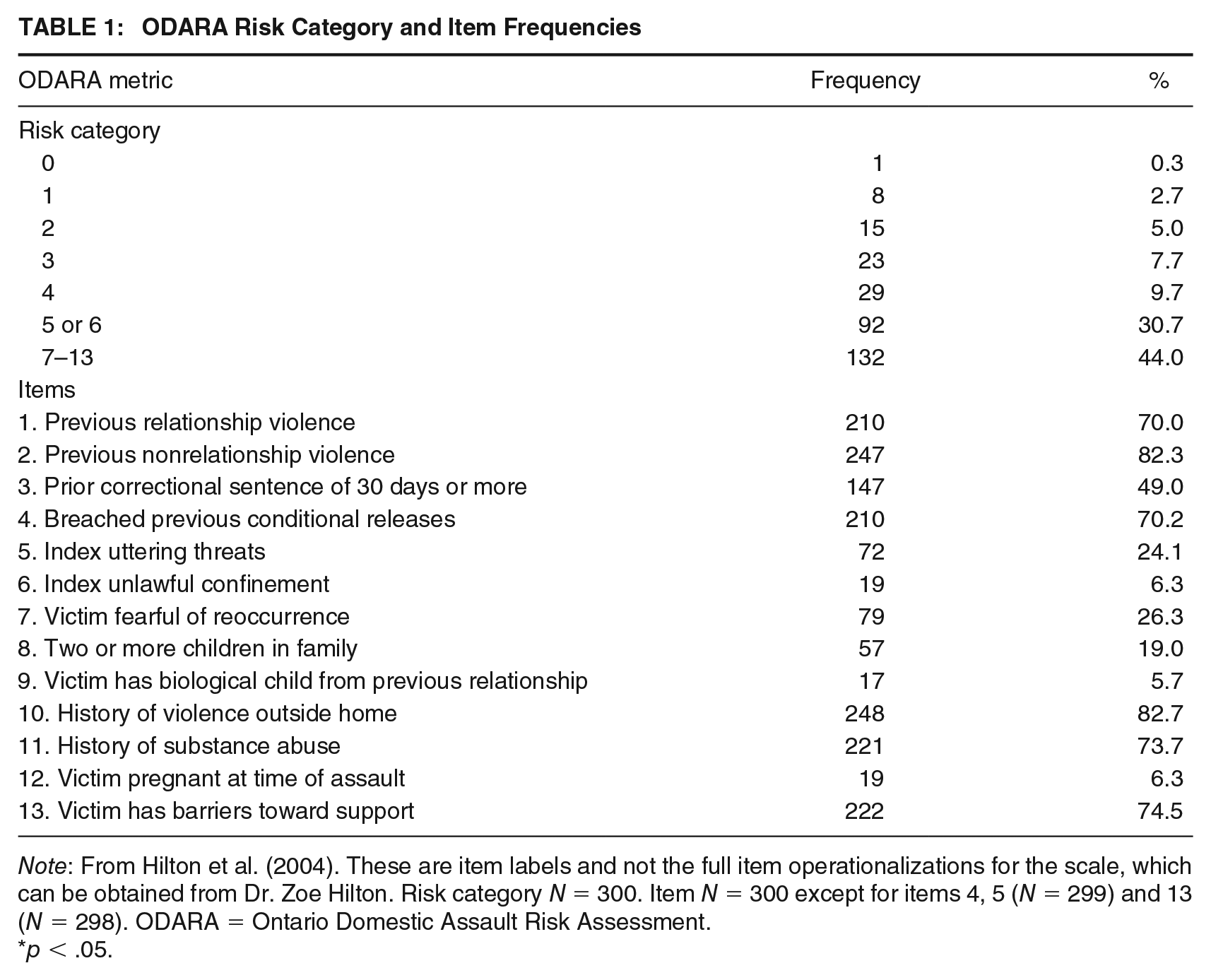
Note: From Hilton et al. (2004). These are item labels and not the full item operationalizations for the scale, which can be obtained from Dr. Zoe Hilton. Risk category N = 300. Item N = 300 except for items 4, 5 (N = 299) and 13 (N = 298). ODARA = Ontario Domestic Assault Risk Assessment.
p < .05.
Discrimination Properties of the ODARA
Information regarding subsequent IPV, general violence, and nonviolent general recidivism was coded up until March 2020 resulting in a mean follow-up period of 4.70 years after the date of the index offense (SD = 1.10). During the follow-up, 134 men (44.7%) committed another IPV offense (M = 1.53; Min = 0, Max = 47; SD = 3.73); 180 men (60.0%) committed another general violent offense (M = 2.69, Min = 0, Max = 47; SD = 4.64), 197 men (65.7%) committed another nonviolent offense (M = 7.36; Min = 0, Max = 94; SD = 12.77), and 219 men (73.0%) any new offense (M = 7.36; Min = 0, Max = 94; SD = 12.77).
AUC and C
AUC magnitudes were highly similar across the four recidivism outcomes and generally identical among Indigenous men compared to the overall sample (Table 2). ODARA total scores had significant small to medium AUCs across the total sample and large Indigenous subsample (AUCs = .62–.65); C values were slightly lower and small in magnitude. There was a trend for AUCs to increase slightly for IPV recidivism with increasing length of time of fixed follow-up, although owing to small N and power constraints, 5-year IPV AUCs were not significant. ODARA scores were positively correlated with age at IPV index offense (r = .13, p < .001) which in turn was significantly inversely related to IPV recidivism (r = −.22, p < .001). Thus, younger men had higher rates of recidivism, but older men had higher ODARA scores. Indeed, a Cox regression survival analysis demonstrated that both variables significantly (p < .001) incrementally predicted IPV recidivism over time (age
AUC and Harrell’s C Values for ODARA Scores in the Prediction of Recidivism Outcome as a Function of Indigenous Ancestry, Age, and Follow-Up
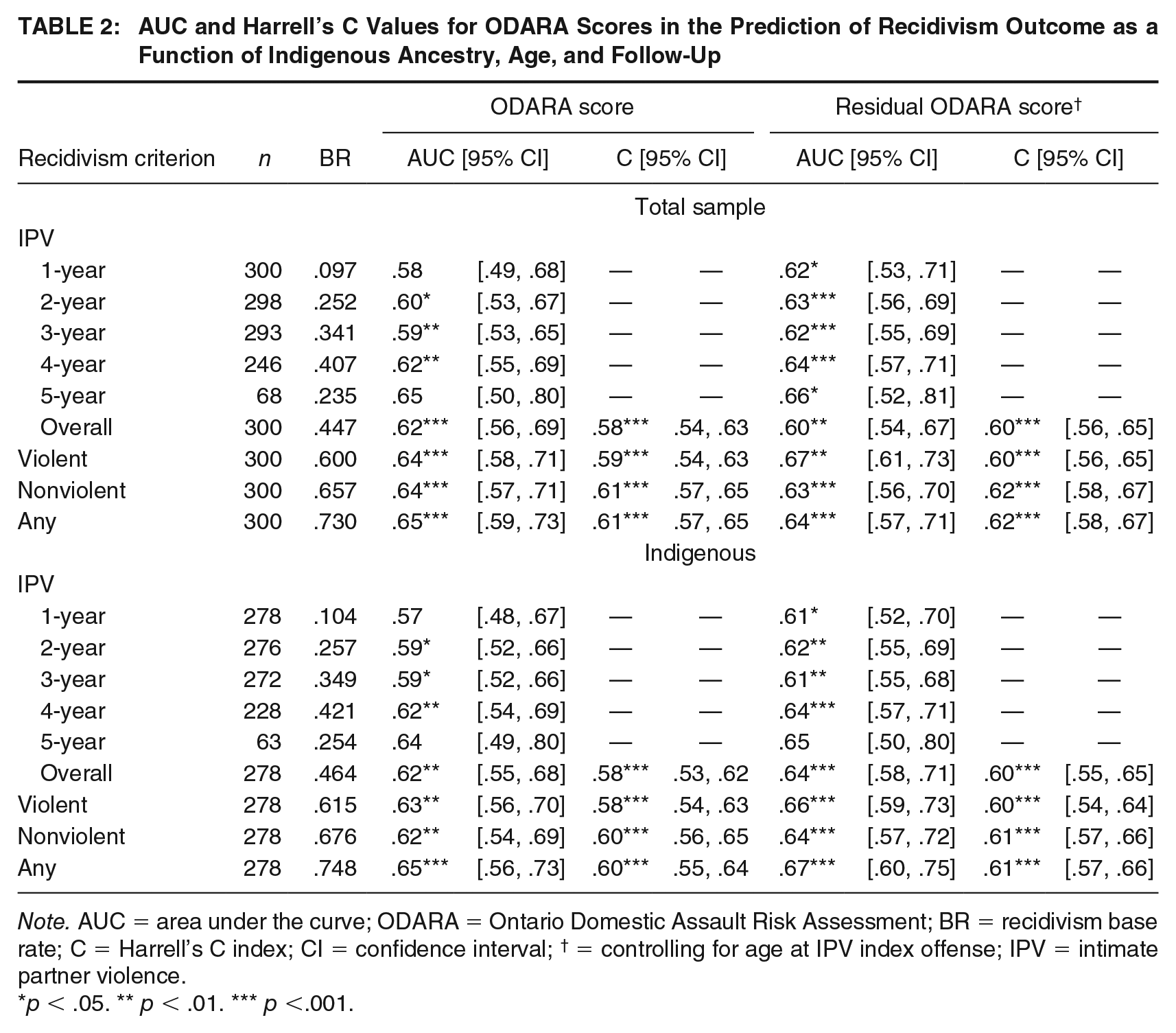
Note. AUC = area under the curve; ODARA = Ontario Domestic Assault Risk Assessment; BR = recidivism base rate; C = Harrell’s C index; CI = confidence interval; † = controlling for age at IPV index offense; IPV = intimate partner violence.
p < .05. ** p < .01. *** p <.001.
Kaplan–Meier Survival Analyses
Kaplan–Meier survival analyses were conducted for each of the predefined ODARA risk categories for the four recidivism outcomes. The results of log rank pairwise comparisons are reported in Table 3 with the curves presented in Figures 1a–d. For IPV recidivism (Figure 1a), the highest risk band (7–13) had the steepest trajectories of recidivism of all the risk groups, with pairwise differences being significant for all but comparison for individuals with scores of 3. The lowest risk group also had significantly lower rates of IPV recidivism than each higher risk group. The high-risk band (7–13) also had significantly faster and higher rates of general violent recidivism (Figure 1b) than each of the remaining ODARA groups, while the 5 or 6 risk band was significantly higher than the two lowest risk groups. Moreover, the highest risk band (7–13) had significantly higher and faster rates of nonviolent recidivism (Figure 1c) for all but the 5 or 6 group, which in turn had higher rates of recidivism for this outcome compared to the three lowest risk groups. This pattern of findings was observed with respect to any recidivism (Figure 1d) for the 7 to 13 and 5 or 6 groups; individuals scoring 4 also had steeper trajectories of any recidivism than the two lowest risk groups.
Results of Pairwise Comparisons of Survival Curves (Log Rank Chi Square) of ODARA Risk Bands for Recidivism
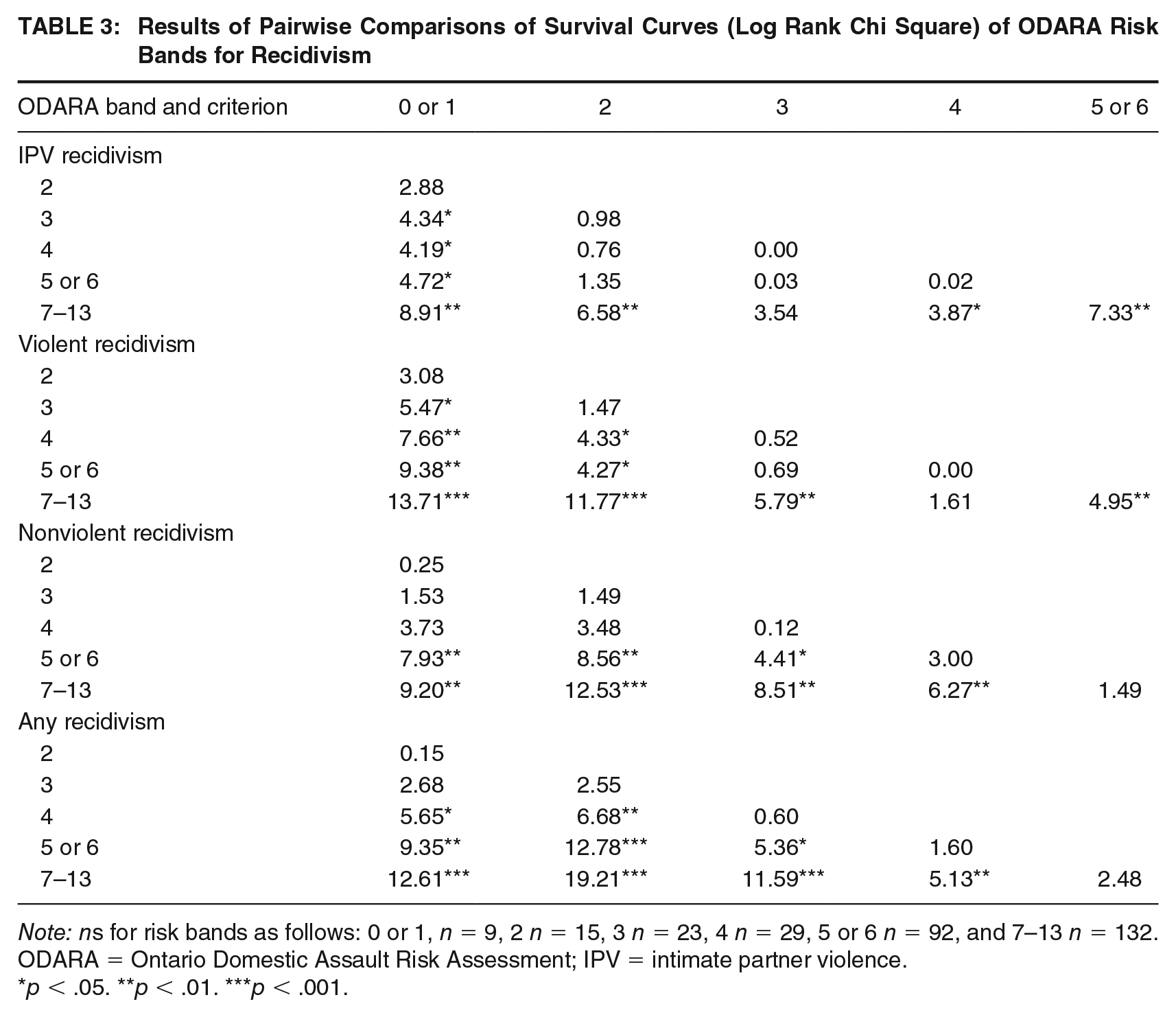
Note: ns for risk bands as follows: 0 or 1, n = 9, 2 n = 15, 3 n = 23, 4 n = 29, 5 or 6 n = 92, and 7–13 n = 132. ODARA = Ontario Domestic Assault Risk Assessment; IPV = intimate partner violence.
p < .05. **p < .01. ***p < .001.
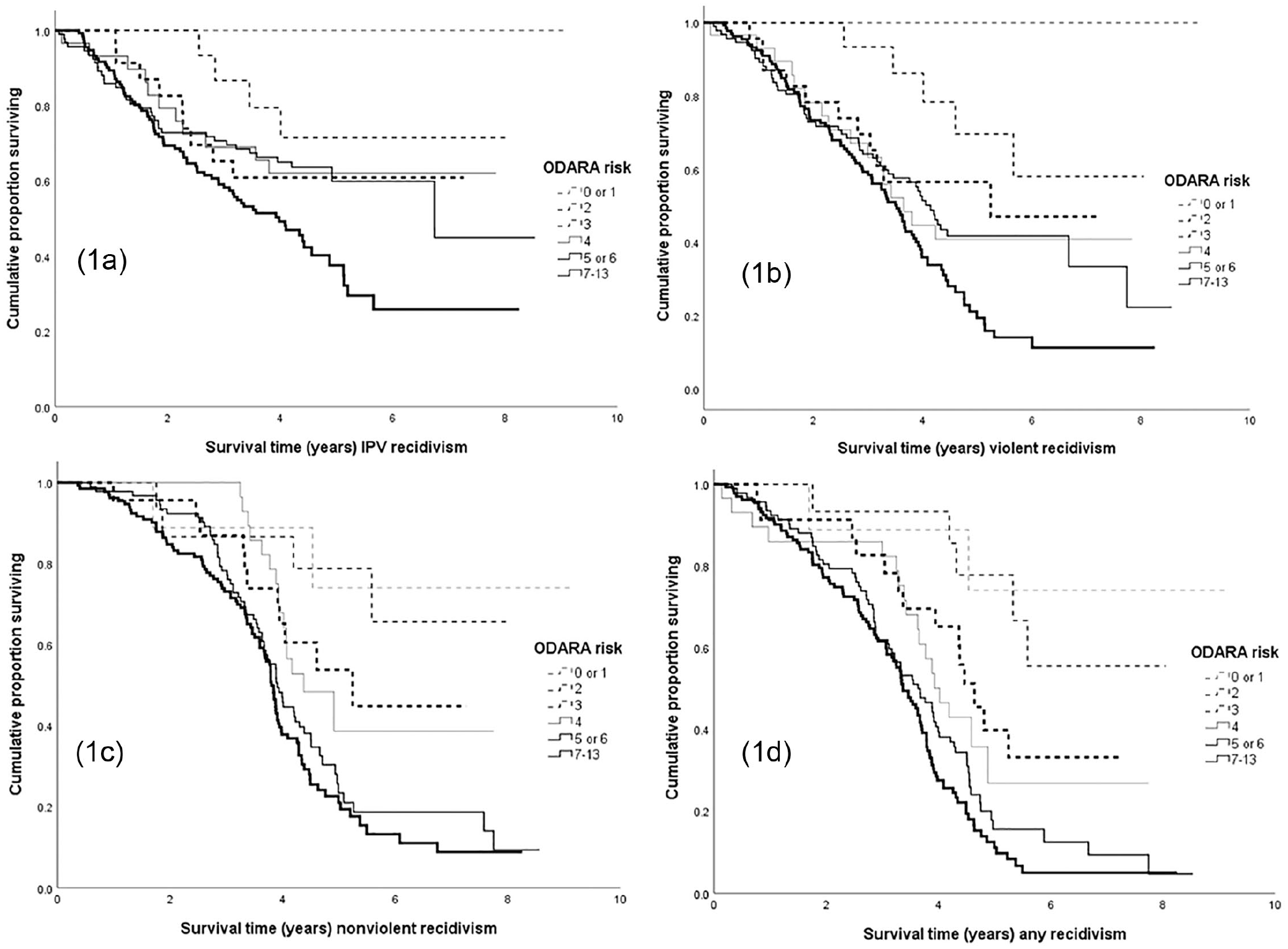
Survival Analysis: Trajectories of IPV (1a), Violent (1b), Nonviolent (1c), and Any (1d) Recidivism Over Time as a Function of ODARA Risk Band
Calibration Properties of the ODARA for IPV Recidivism
Table 4 presents the results of calibration analyses examining IPV recidivism rates associated with ODARA scores for the current sample compared to the Hilton et al. (2004) normative sample and the Olver and Jung (2017) Edmonton sample. The Hilton et al. (2004) comparison employs an unfixed follow-up. Given that this study had nearly identical mean follow-up and amount of variability therein (M = 4.70 years, SD = 1.10) compared to Hilton et al. (M = 4.79 years, SD = 1.08), the direct comparison using unfixed follow-ups is justified. As seen in this figure, this study sample had higher recidivism at mid-range scores (E/O < 1.0), but lower recidivism at extreme scores (E/O > 1.0), with overprediction significant at scores of 5 or 6. The bottom half of Table 4 compares the present sample using a 3-year, fixed-year follow-up at ODARA scores at or below 2 (low risk), mid-range of 5 (scores 3–6, medium risk), and mid-range of 8 (scores 7–13) per Olver and Jung’s (2017) urban Prairie sample. As seen here, the IPV recidivism rates were comparable for low risk groups; however, the recidivism rates for the Northern Saskatchewan sample were triple to quadruple of those of the Edmonton sample at the medium and high-risk categories with E/O index values significant.
Calibration Analyses: E/O Index Comparing Current Sample to ODARA Reference Groups on Rates of IPV Recidivism
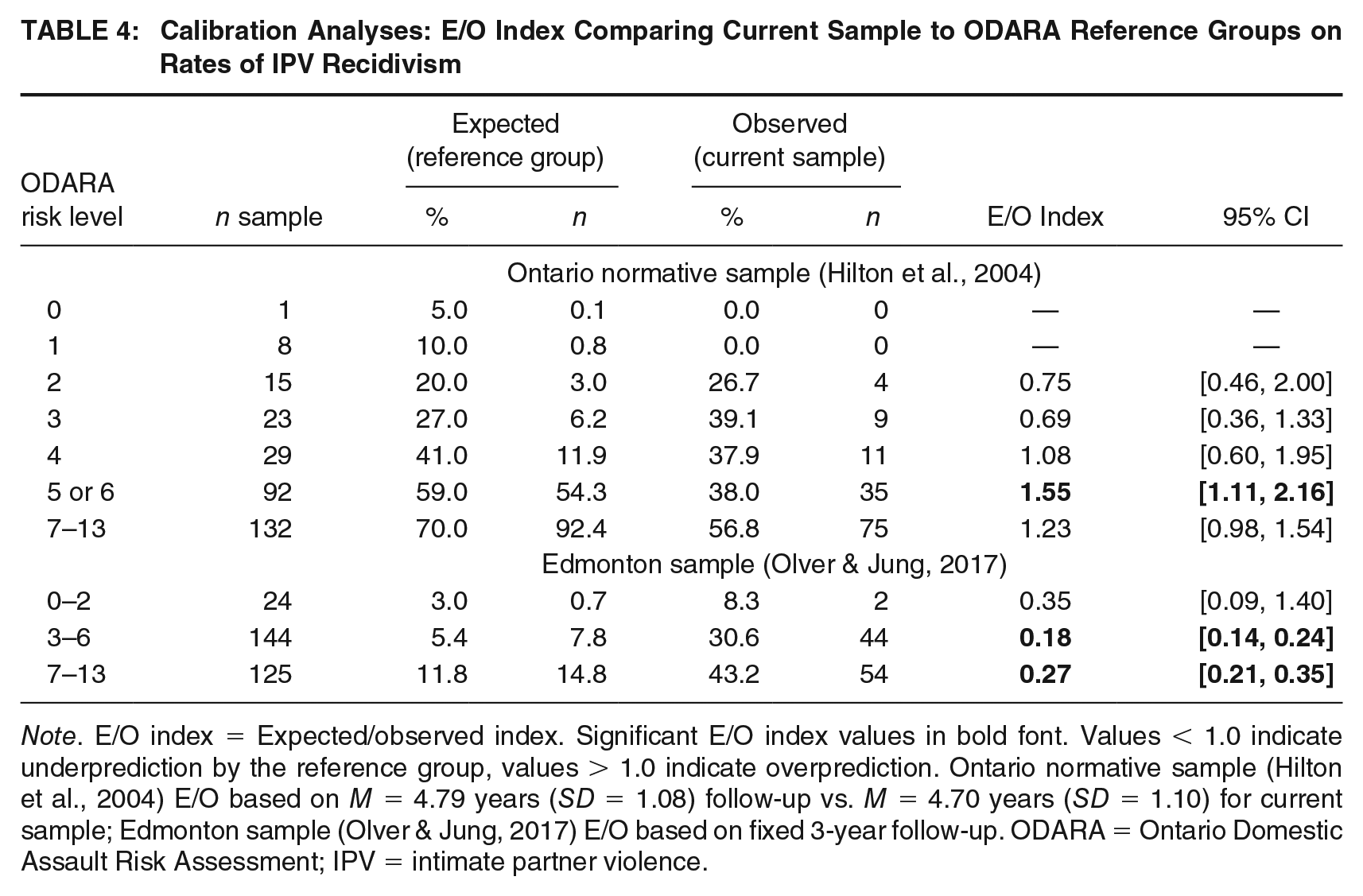
Note. E/O index = Expected/observed index. Significant E/O index values in bold font. Values < 1.0 indicate underprediction by the reference group, values > 1.0 indicate overprediction. Ontario normative sample (Hilton et al., 2004) E/O based on M = 4.79 years (SD = 1.08) follow-up vs. M = 4.70 years (SD = 1.10) for current sample; Edmonton sample (Olver & Jung, 2017) E/O based on fixed 3-year follow-up. ODARA = Ontario Domestic Assault Risk Assessment; IPV = intimate partner violence.
A 4-year fixed follow-up was employed to examine IPV rates within the longest community time window available for men in the sample. Logistic regression was also conducted to generate predicted rates of IPV recidivism at each ODARA risk category—for categories with multiple scores, the mean for that group of scores was employed when entered into the logistic function: (ODARA
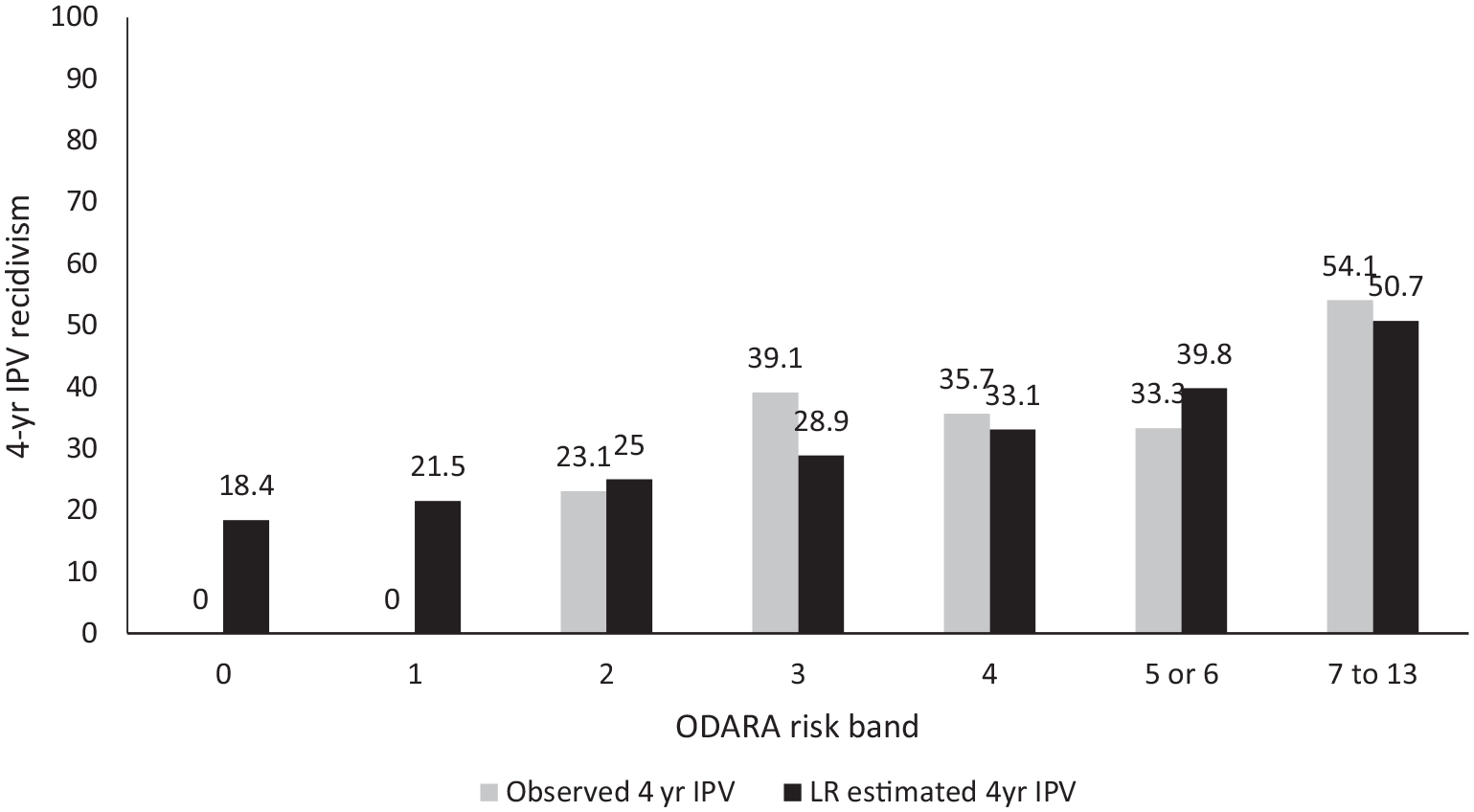
Fixed 4-Year Follow-Up of Actual Versus Projected IPV Recidivism Using Logistic Regression (B1 = 0.193, B0 = −1.487)
Discussion
This study examined the predictive properties of the ODARA in a predominantly Indigenous Northern Saskatchewan sample for IPV recidivism and other criminal justice outcomes; to our knowledge, this is the first study to do so in a predominantly non-white sample. About three quarters of men scored in the top two risk tiers (5 or 6; 7–13) with a mean score of 5.9 (SD = 2.2), in contrast to the Ontario-based ODARA construction sample (M = 2.9, SD = 2.1; Hilton et al., 2004) and its cross-validation samples (M = 4.1, SD = 2.2 and 3.5, SD = 2.0; Hilton et al., 2008); the differences between the samples in ODARA scores approached or exceeded a full standard deviation. Residing in the North and often remote communities, the men in this study had a high frequency of prior police contacts, including past instances of relationship violence. The closest parallels would be Jung et al.’s (Jung & Buro, 2017; Olver & Jung, 2017) sample from a large urban center in the neighboring province of Alberta, which had a similarly high mean score (5.4, SD = 2.2) and most of its sample in the top two risk bins, as well as the Buchanan (2009) dissertation (M = 5.9, SD = 2.2, range 0–10) from Saskatchewan’s two largest urban centers in the south-central parts of the province. In our view, the high ODARA scores exemplify the significant problem of IPV in the Canadian Prairie Provinces in general, and Northern Saskatchewan in particular.
Discrimination and Calibration Properties of the ODARA in Northern Saskatchewan
Were these higher scores associated with higher probability of IPV recidivism or other recidivism outcomes? The answer is a “yes” with some important caveats. The sample was followed up an average of nearly 5 years in the community, during which almost half (45%) the men were charged or convicted for a new IPV offense, 60% for any violent (including IPV) offense, about two thirds for any nonviolent offense, and nearly three quarters for any offense. The IPV recidivism rates were 50% higher than Hilton et al. (2004) although it is on par with the higher risk samples from Hilton et al. (2008) at 41% and 49% (mean 5 years follow-up). The Jung samples had rates of IPV recidivism below 10% (convictions) or around 20% (charges or convictions). Given that the sample was almost entirely (93%) of Indigenous composition, predictive validity analyses (AUC or C) that were stratified by ancestral group did not generate different findings. ODARA scores generated broadly small in magnitude AUC/C values most frequently within the low .60s, across most outcomes, including IPV recidivism. Predictive accuracy values were slightly higher when fixed follow-ups were employed. The AUC and C values are lower than the weighted effects (AUC = .690) reported in the van der Put et al. (2019) meta-analysis, but it is consistent with the smaller effects used to generate the estimate.
What may account for the slightly lower predictive accuracy of the ODARA in the present sample? Given the structure of the ODARA, with a heavy weighting of historical offense variables, older men had slightly higher ODARA scores because they had accumulated more offense history on one hand, although younger men were more likely to reoffend. By controlling for age at IPV index, predictive accuracy increased slightly for all recidivism outcomes, IPV included. Although predictive validity improved after controlling for age, still, effect sizes tended to be somewhat lower than that observed in the extant literature. The calibration analyses were illuminating. As anticipated, higher rates of IPV recidivism were observed at successively higher risk levels, although the pattern was less uniform than observed in Hilton et al. (2004) and much higher than in Olver and Jung (2017). The present sample seemed to have a large medium-risk group with ODARA scores of 2 to 6 generating recidivism rates from 23% to 39%, with highs and lows observed at the extreme ends (0–1 and 7–13).
E/O index analyses demonstrated that the Hilton et al. (2004) sample overpredicted IPV recidivism by about 50% at scores of 5 or 6, and by approximately 23% in the top tier of 7–13 (70% vs. 57%) in this sample; conversely, Hilton et al. (2004) underpredicted recidivism for the lower middle risk bands (scores of 2 and 3). The top tier in Hilton et al. (2004) comprised less than 5% of their sample, while it made up nearly half of the current sample. Actual recidivism rates are extremely unstable, especially at extreme scores with small cell numbers (i.e., 70% may be an unstable estimate), which may account for the disparity. The use of logistic regression served to smooth out the peaks and valleys of actual recidivism rates within a given risk band, by modeling a trajectory of IPV recidivism estimated at the individual score bands.
This is not likely the whole picture, however. Olver and Jung (2017) found that SARA scores incremented the ODARA in the prediction of IPV recidivism, while ODARA scores incremented the SARA in the prediction of general violence, and both measures were uniquely predictive of any and all offending. The ODARA on its own does not provide a comprehensive appraisal of IPV risk, and there are likely individual differences in unmeasured dynamic risk factors that could help explain observed rates of recidivism. For instance, in Olver and Jung (2017), the psychosocial adjustment domain of the SARA—which assesses general risk-need variables such as relationship instability, employment problems, substance abuse, personality pathology, active symptoms of severe mental health problems, and suicidal/homicidal ideation—uniquely predicted IPV recidivism controlling for the ODARA and other SARA domains.
Even still, the unique Northern context, lived experience and colonial history of Canada’s Indigenous peoples must also be considered in contextualizing these findings. In this study, the Indigenous people would be the Níhithawak (Woodlands Cree), Néhinawak (Swampy Cree), Denesuliné (Dene), and the Métis of the North. The predominantly Indigenous nature of the sample may also contribute to somewhat lower discrimination and issues in calibration for the ODARA; particularly because some research has demonstrated Indigenous-non-Indigenous group differences to be accentuated on static risk measures but smaller on dynamic measures (e.g., Olver, 2016). Wilson and Gutierrez (2014) note that other unmeasured social, contextual, or cultural variables and circumstances that account for higher rates of recidivism but not captured in conventional risk tools can also attenuate predictive accuracy.
Clinical and Policing Implications for IPV Risk Assessment and Management
The results broadly support the discrimination and calibration properties of the ODARA for IPV recidivism on a Northern Prairie and predominantly Indigenous sample. However, modeling in age at IPV index improved prediction, and it is anticipated that a nonredundant measure of dynamic risk factors (whether these be violence general or IPV specific) may improve prediction and case planning. Moreover, the ODARA likely is best suited as a screen by frontline police officers in the North investigating domestic incidents. It can be used to triage the riskiest cases to prevent IPV from occurring or escalating, and to keep vulnerable persons in the household safe. Furthermore, the information obtained from victim statements during police interviews may be used to assist with ODARA scoring and to increase accuracy.
In a Canadian survey, Saxton et al. (2020) found that more than three quarters of the 77 police officers surveyed reported using structured IPV risk assessment measures in their response to IPV calls routinely or frequently for risk assessment (i.e., evaluating potential for further harm to the survivor) or risk management (i.e., strategies to reduce risk, such as monitoring, supervision, or referral to services). Furthermore, nearly two thirds of police officers reported frequently or routinely using risk measures for safety planning (e.g., change in residence and flagging for high-priority response). The tool most frequently used was the ODARA by a wide margin at 63.2%. A caveat, however, is that there could be a selection bias in this survey (i.e., more conscientious officers who use tools were likely to also complete the survey) as well as issues of representativeness, given the small sample size.
For instance, Ballucci et al. (2020) found that there was considerable variability among New Brunswick police detachments in use of the ODARA in response to IPV calls, even though there is a province-wide mandate for frontline officers to use the measure in this context. When the ODARA was used, however, officers were significantly more likely (70.2%) to arrest the perpetrator (i.e., a risk management strategy) than when they did not use it (26.8%). Per the risk and need principles, use of the ODARA enables an appraisal of potential for future violence—and justification to detain perpetrator (Ballucci et al., 2020)—which, along with contextual variables (e.g., presence of physical violence, perpetrator intoxication, weapon use) can inform risk management and safety planning strategies per the need principle.
As a long-term projection of risk, the ODARA may have less promise. We do know from these findings that very high scores (7–13) are worrisome and absent intervention of some sort do not bode well for victim safety. The problem is, however, lower middle scores represent a point of ambiguity, and it is likely that other assessment information (such as taking into account age or other dynamic measures, such as the SARA) could improve safety planning. For instance, measures such as the Domestic Violence Screening Instrument-Revised (DVSI-R; a screener for risk for family violence in general) can be augmented with other IPV-specific measures to inform risk management and safety planning (Williams, 2012). Relatedly, Spivak et al. (2020) recommended the Victoria Police Screening Assessment for Family Violence Risk (VP-SAFvR) in Australia be used as a screen for family violence by frontline officers and supplemented with a more comprehensive assessment measure where indicated to inform case prioritization and IPV risk management. In all, the use of multiple measures (per the principles of risk and need) by frontline officers in their response to IPV incidents could be viable, particularly given that the Saxton et al. (2020) survey found that about one third of police officers completing the survey reported using more than one measure.
Finally, these study findings make an argument for localized ODARA norms to inform IPV risk screening and police responses in the North, although the IPV recidivism rates in this sample over nearly 5 years (44.7%) were not far off the 2-year rates from urban Saskatchewan (29.1%) in a much smaller sample (Buchanan, 2009). Although further research is likely needed to refine and expand possible provincial prairie ODARA norms, this sample is a large representative one of Indigenous men adjudicated for IPV offenses in Saskatchewan’s North. Using the Hilton et al. (2004) norms, we are concerned could lead to under projections of risk (and concordant risk containment efforts) at lower middle scores. There are multiple possible explanations for the higher observed recidivism rates in this study, such as the use of comprehensive sources of recidivism data (CPIC) cross-checked with another database (PROS), as well as the unique social and contextual circumstances of Saskatchewan’s north (e.g., isolation, availability of services) and its higher rates of violence (Rotenberg, 2019).
Limitations, Conclusions, and Future Directions
There are several study strengths and limitations with implications for future research. This study featured an understudied sample in a region where IPV is particularly prevalent and a significant concern. The findings have practical value and extend the body of risk assessment research with Indigenous persons. Moreover, methodologically, the sample was a fairly large and representative sampling of the major RCMP detachment regions in Saskatchewan’s North. Comprehensive and credible archival data sources were used to code the ODARA and outcome variables, by raters with formal ODARA training certification, and substantial experience navigating these RCMP police information systems to yield quality, reliable data. These method and design features bolster the credibility, integrity, generalizability, and utility of study findings. There remains a significant need for further IPV risk assessment research with Indigenous persons, including replication of this study and extension to other measures, samples, and settings. This should also include comparisons of the validity and reliability of the ODARA between Indigenous and non-Indigenous (e.g., white) persons within the same sample. Finally, a feasibility study for routine use of the ODARA by frontline police officers in Saskatchewan’s would be a worthwhile applied research endeavor.
Perhaps the most significant study limitation is that it featured a single, predominantly, static IPV risk assessment tool. We do not know to what extent dynamic IPV-specific or general violence risk measures may increment the prediction of IPV in this population, and as such, further research would be warranted to examine multiple static and dynamic tools to replicate and extend the current findings. This limitation notwithstanding, this study findings indicate that the ODARA can be considered a potentially valuable tool for frontline police personnel responding to IPV-related calls in a high-risk population. With the potential to decrease bias and improve accuracy, the ODARA may be a dependable, valid, user-friendly tool to assist decision-making in response to potentially dangerous and precarious IPV incidents.
