




Abstract
Criminal expertise relates to the notion that some individuals may develop domain-specific offending skills that differentiate them from those with less skills or experience (i.e., novices). In the expertise literature, burglary has emerged as a distinct type of “expert” offense, therefore the current study sought to determine whether criminal expertise is more evident in the crime-commission process of sexual burglary compared to sexual robbery. We used binary logistic regression to compare the pre-crime, crime, and post-crime behaviors of 870 cases of hybrid sexual assault that occurred during the commission of either a burglary (N = 319) (or) robbery (N = 479), both of which involved personal theft from a stranger victim. Findings suggest that the crime commission process of sexual burglary involves a more sophisticated modus operandi and greater expertise in detection avoidance (e.g., strategies to protect their identity and destroying and removing evidence) compared to sexual robbery.
“Expertise” is a multi-faceted concept that generally refers to the manifestation of specific characteristics, skills, and knowledge that are distinctive from those of novices or less experienced people (Ericsson, 2006). First introducted to the field of sexual violence by Ward (1999) in relation to persistent child sexual offending is the notion of “criminal expertise.” Criminal expertise is thought to develop over time; however, some individuals may become functional “experts” in sexual offending even without continual practice through indirect means, such as covert modeling and rehearsal (e.g., sexual fantasies) or symbolic modeling (e.g., pornography; Nee & Ward, 2015). According to Nee and Ward (2015), “criminal expertise” manifests through both structural representations of skills and knowledge as well as observable, behavioral manifestations that differ from that of a novice. Structural representations of criminal expertise have largely been examined in relation to the development of knowledge and skills in memory (e.g., heuristics and short-cuts) and offense scripts or cognitive schemas (see Nee & Ward, 2015 for a review). Behavioral manifestations of expertise, however, are observable in the crime-commission process, such as using strategies to avoid detection, planning the crime, and target appraisal for victims and locations (e.g., Ó Ciardha, 2015; Ward, 1999).
In the broader expertise literature, individuals with burglary convictions have emerged as “expert” decision-makers (Nee, 2015) and burglary offenses have been deemed to be a “model of rationality” (Cromwell et al., 1991; Nee, 2015) as it is thought to involve considerable skill and planning (Pedneault et al., 2015). As such, sexual burglary (i.e., a hybrid offense involving breaking and entering as well as theft and sexual assault) provides a unique opportunity to examine the notion of criminal expertise within this potential “expert” population. In contrast, street robbery is typically described as a more “novice” or “amateur” crime, committed by a person who acts impulsively and pays little attention to the costs associated with their offense (e.g., Feeney, 1986; Piotrowski, 2011). As a result, sexual robbery (i.e., a hybrid offense involving theft by force and sexual assault) may involve a more novice or unsophisticated crime-commission process when compared to sexual burglary. We therefore expect to find differences in behavioral manifestations of expertise between sexual robbery and sexual burglary offenses.
Literature Review
On one hand, it has been argued that successfully engaging in criminality does not require special skills (Hirschi, 1986), but others have argued that this apparent “absence in decision-making” is not an indication of a lack of skills and planning, but rather, demonstrates that some people have developed in-depth knowledge and skills that allow them to make better and more instantaneous decisions, particularly in situations that require urgent action (Nee & Meenaghan, 2006). In other words, experts are thought to have domain relevant knowledge stored in cognitive scripts, and once activated, these scripts enable them to process information and make decisions rapidly (Ward, 1999). According to Ward (1999), this allows some individuals to engage in behaviors during the crime-commission process that reflect criminal sophistication and are indicative of offense related skills (e.g., planning an offense, knowing how to avoid detection, and how to respond to various contingencies such as victim resistance), which can be used to differentiate them from more those with more novice offense skill sets.
The notion of criminal expertise can be directly linked to rational choice theory (RCT). According to Cornish and Clarke (1986), during the commissioning of a crime, a person will behave rationally in order maximize rewards while minimizing risks. Moreover, RCT provides a framework to understand how decisions are made and proposes rationality and self-interest as the cornerstones of decision making (Pedneault et al., 2015). Central to this theory is the perspective that criminal behavior is not fundamentally different than non-criminal behavior; actions tend to be rational and goal oriented to satisfy commonplace needs (e.g., sex, money, status, and excitement or thrill; Clarke & Felson, 1993). RCT also acknowledges that people have access to limited information to make decisions and that decisions are often “bounded” by situational constraints (Cornish & Clarke, 1986). These bounded decisions or “cognitive short-cuts” are used to evaluate available alternatives and allow individuals to make decisions that will enable satisfying results while minimizing risks (Piotrowski, 2011). Hirschi’s (1986) assertions have therefore been vulnerable to challenge, as interview-based studies on decision-making among persons with previous offenses has revealed strong evidence of technical and interpersonal skill and knowledge relevant to specific crime opportunities (e.g., Bennett & Wright, 1984; Cromwell et al., 1991; Wright et al., 1995). Nonetheless, Ward’s (1999) introduction of the expertise literature to sexual offending was still considered controversial at the time as there was still little agreement among criminologists as to whether these individuals possess specialized skills and knowledge that could facilitate their decision-making (Chopin et al., 2021).
In fact, Ward (1999) was introduced while criminal career studies were highlighting the generality of offending patterns among persons convicted of sexual crimes (e.g., Sample & Bray, 2003; Simon, 1997, 2000) The lack of evidence related to specialization in sexual crimes provides insight as to why the expertise framework was slow to gain traction in the field. Moreover, it helps to explain why any influence it did have, was mainly in relation to “persistent” child sexual offending, which is characterized by specialization in sexual crimes (see Lussier, 2005, for a review) and the ability to avoiding detection for long periods of time (Ward, 1999). Nevertheless, the distinction between “specialization” in criminal careers and “specialization” in expertise is important to make, as the two are not synonymous. Specialization in sexual offending is generally referred to as the perceived probability of repeating the same type of crime when arrested next (Blumstein et al., 1986). On the other hand, criminal expertise refers to the possession of domain specific knowledge and offense related skills that allows one to function well at what they do (i.e., functional expertise), and are distinctive from novices (Nee & Ward, 2015; Ó Ciardha, 2015). For example, studies have shown that individuals across a variety of different offending domains may develop a set of skills designed specifically to reduce the risks of police detection (e.g., Cherbonneau & Copes, 2005; Gallupe et al., 2011).
Criminal Expertise in Relation to Hybrid Offenses
A hybrid offense refers to the literal definition of the term, meaning something that has been produced by the combination of two or more distinct elements (Beauregard & Chopin, 2020). Thus, the term “hybrid” reflects the nature of the offense—and not is not necessarily related to the person’s motivation—though we do discuss the possibility of inferring whether the primary motivation is sexual or not in our discussion. In the current paper, hybrid offenses involve a sexual offense that occurs in conjunction with another crime (e.g., either burglary or robbery), which in this sense, infers some degree of offense related versatility on behalf of the person. Nonetheless, there is little insight into whether the crime-commission process of hybrid offenses will reflect specialized knowledge or skills (i.e., behavioral indicators of expertise) and whether this varies depending on the hybrid nature of the offense.
Behavioral Indicators of Criminal Expertise
To date, most studies focused on how structural forms of expertise develop in relation to cognitive skills and the formation of implicit schemas (Nee & Ward, 2015 for a review). For example, studies have shown that individuals experienced in burglary undertake routine scanning of the environment for suitable targets in advance of the actual crime (Bennett & Wright, 1984) and were able to recognize environmental factors (e.g., occupancy, access to the property and security features) that influenced their decision to offend (Nee & Taylor, 2000; Taylor & Nee, 1988). Although these studies provided empirical evidence to support the notion of criminal expertise in burglary, and specifically that expert knowledge is gained from past experience (i.e., schemas) and then applied through cognitive or behavioral skills (e.g., memory cues and target selection behaviors), there is a large gap in the literature regarding how other types of behaviors manifest over the entire crime-commission process. In other words, the focus has mainly been on measuring expertise through cognitive skills and pre-crime behaviors, paying little attention to behaviors during the crime (e.g., level of violence) or post-crime (i.e., through detection avoidance strategies, such as cleaning up the crime scene, removing evidence). Nonetheless, Ward (1999) proposed several plausible examples of how criminal expertise could manifest behaviorally in those who have “expertise” in sexual offending. He suggested that these “tangible competencies” would include strategies used to avoid police detection such as taking precautions with offense locations, being able to regulate their emotional state, deceiving people close to them, and conducting constant risk appraisal. Moreover, Ward suggested that compared to novices, experts would be better at manipulating or disarming victims, deceiving authorities, and maintaining normal relationships with friends, families, and partners.
Outside of Bourke et al. (2012), who examined expertise in persistent child sexual offending (e.g., grooming techniques and target selection), there has been limited evidence to support Ward’s (1999) assertions. This is because few studies have directly applied Ward’s theoretical framework to explicitly test for behavioral manifestations of expertise over the entire crime-commission process. This is especially true for sexual crimes that involve adult victims, nonetheless, as Ó Ciardha (2015) highlights “this is unfortunate because Ward makes some clear conclusions about expertise and rape” (p. 27). In fact, several studies have provided indirect support for Ward’s (1999) hypotheses on “tangible competencies.” For example, Park et al. (2008) have examined the various decisions that persons with single and serial sexual offenses make to avoid detection and used these as an indicator of criminal sophistication. Park and colleagues determined that serial offenses were more criminally sophisticated and involved behaviors such as forensic awareness, controlling the victim’s resistance through verbal reassurances, and using a surprise attack more frequently. Similarly, other studies have made explicit connections between the crime-commission process of sexual offenses and behaviors that are indicative or skill or experience. For instance, studies have shown that destroying and removing evidence can be a marker of past criminal experience (Davies et al., 1997) or an indication of sophistication and planning (Reale et al., 2020) in sexual offenses.
Over two decades later, Chopin et al. (2021) were the first to apply the criminal expertise proposed by Ward (1999) to persons with rape convictions, focusing exclusively on the behavioral manifestations of criminal expertise across the crime-commission process. The authors found that a sophisticated modus operandi predicted the use of detection avoidance strategies, such as destroying and removing evidence or protecting their identity. Chopin et al. (2021) concluded that for adult rape, criminal expertise in sexual offending should demonstrate a strong level of crime planning, controlling its process from the pre-crime phase to the end of the crime, being able to perform varied and intrusive sexual acts, while also adopting forensic awareness.
Taken together, these studies provide a basis for exploring behavioral indicators of expertise in sexual crimes. Moreover, this perspective allows for empirical research on expertise to extend beyond the person’s psychological processes (e.g., through the development of offense schemas) and target selection behaviors (i.e., pre-crime) to also include an examination of the entire the criminal event (i.e., including the crime and post-crime processes). In other words, the focus shifts to consider how expertise manifests in the skilled behaviors and choices made over the crime-commission process and whether this is distinguishable from more novice or less sophisticated offense processes. In using this approach, we can provide a systematic framework to assess the indicators of criminal expertise, which is relevant for both theory and practice.
The Crime-Commission Process of Sexual Burglary
Although sexual burglary has yet to be examined through the expertise framework specifically, similar to burglary, there is evidence of rational and strategic decision-making through an examination of the crime-commission process. For instance, Pedneault et al. (2015) examined rationality in sexually motivated burglaries. Using 224 incidents of residential burglary with a sexual component, they found that sexual burglary was rational in nature. More specifically, they found that individuals in their sample were more likely to commit their offense when female victims were home, when they are unlikely to resist because they were sleeping, and in the absence of a capable guardian. Moreover, most sexual burglaries were found to occur on lower floors, which limits efforts required for break-ins and makes it easier to flee the scene. According to Pedneault and colleagues, although the results indicated that sexual motivation was evident, most incidents clearly involved substantial rational organization around situational cues and thus lend support for the notion that individuals who commit burglary act rationally. However, the extent that this reflects a higher degree of skill or sophistication in their crime-commission process in comparison to other sexual crimes is much less understood.
The Crime-Commission Process of Sexual Robbery
Although there is no research that directly applies the notion of criminal expertise to street robbery or hybrid sexual robbery, there have been several studies that have provided indirect evidence of expertise through an examination of the crime-commission process. In doing so, these studies have positioned the typical street robbery offense as being committed by a person who engages in less sophisticated form of decision-making and tends to prioritize the immediate need for gratification (e.g., monetary, thrill, excitement) over the costs of the crime (e.g., Deakin et al., 2007). For instance, Feeney (1986) suggested that persons who commit robbery gave little thought to the act, evidenced by their general lack of planning or consideration of possible consequences. Moreover, persons who commit street robbery have been described as impulsive and opportunistic (e.g., Piotrowski, 2011; Smith, 2003) and tend to be younger and more reckless (Alarid et al., 2009; Deakin et al., 2007; Piotrowski, 2011; Smith, 2003; Wright & Decker, 2002). On the contrary, some studies of street robbery have found evidence of more sophisticated decision-making related to target selection, although these decisions still appear to be linked closely with short-term benefits (e.g., Deakin et al., 2007). As a result, other researchers (e.g., Wright & Decker, 2002) have raised skepticism about the extent that these behaviors are indicative of “skilled” decision-making, because they appear to be limited to a few key situational factors (e.g., selecting a familiar location with good getaway exits).
Collectively these findings demonstrate that persons who commit street robbery do engage in some evaluation of cost–benefits; however, this does not appear to be reflected in a particularly sophisticated or skilled crime-commission processes outside of target appraisal (e.g., victim and location selection). Thus, it is possible that sexual robbery will involve similar decision-making processes and therefore show less skill or sophisticated behaviors over the crime-commission process, compared to sexual burglary. Considering that target-selection behaviors have been directly tied to individual motive (Wright et al., 1995), differences in behavioral indicators of expertise between sexual burglary and sexual robbery may not only offer support for rational choice explanations but also provide greater insight into motivational differences between hybrid offenses.
Current Study
Despite the introduction of criminal expertise to the literature on sexual offending over 20 years ago (Ward, 1999), very few studies have applied this framework to better understand the role that skills and expertise may play in the choices and subsequent actions taken during the crime-commission process. We therefore use the expertise literature (e.g., Ward, 1999) as well as empirical studies on skilled decision-making and criminal sophistication in sexual offending (e.g., Beauregard & Proulx, 2017; Chopin et al., 2019, 2021; Davies et al., 1997; Park et al., 2008), burglary (e.g., Nee, 2015; Nee & Meenaghan, 2006; Nee & Taylor, 2000) and robbery (e.g., Deakin et al., 2007; Wright & Decker, 2002) to formulate behavioral indicators of expertise for the current study. Moreover, based on existing literature on criminal expertise in burglary, which positions these individuals as experts and rational decision makers (e.g., Nee, 2015; Nee & Meenaghan, 2006; Nee & Taylor, 2000), sexual burglary may involve a distinctively more skilled and sophisticated crime-commission process. Conversely, individuals who commit street robbery have frequently been described as lacking sophistication (e.g., Piotrowski, 2011) and limited in their skilled decision-making abilities (e.g., Wright & Decker, 2002). As such, sexual robbery may involve similar decision-making processes, thereby representing a more “novice” or “amateur” type of offense that will show less overt behavioral manifestations of expertise over the crime-commission process than sexual burglary. Thus, the current study seeks to advance our understanding of criminal expertise by determining (a) the extent that behavioral manifestations of criminal expertise are evident across the entire crime-commission process and (b) whether sexual burglary involves a more “expert” crime-commission process when compared to sexual robbery. Specifically, we hypothesize that skilled decision-making and criminal sophisticated modus operandi behaviors will be associated more with sexual burglary than with sexual robbery, particularly in the crime and post-crime phases. To test these hypotheses, we utilize a large sample of offenses involving either robbery (i.e., property was forcibly taken from the victim) and sexual assault (or) burglary (i.e., breaking and entering), theft, and sexual assault.
Method
Sample
This study is based on a sample of 870 solved hybrid stranger sexual assault/theft cases (i.e., sexual robbery) and stranger sexual assault/theft and burglary (i.e., sexual burglary) cases against female victims that occurred in France between 1985 and 2018. We examined solved cases so that we could include the personal characteristics of our sample and because we are focused on behavioral manifestations of criminal expertise during the crime-commission process and not the actual outcome of this process (i.e., whether the case was solved or unsolved). We also chose to focus on stranger sexual assaults, not only because these cases tend to be more difficult for police to solve (e.g., Bouffard, 2000), but also because acquaintance rapes have been found to have distinctive offending patterns from stranger rapes (see Bownes et al., 1991; Koss et al., 1988). Differences in victim-perpetrator relationships could therefore impact how expertise manifests behaviorally (e.g., target appraisal, victim control methods, whether a person takes steps to protect their identity, etc.).
The sample was obtained from a national police database operated by the Ministry of Interior in France. Crime analysts maintained this database by using different sources of information (e.g., forensic and investigative reports, witness and offender interviews, etc.) related to the criminal case. Detailed and unique information about the crime-commission process is completed by criminal investigators assigned to the case and is recorded in investigative files that are compiled, analyzed and entered into the database by a team of crime analysts who are experts in violent crimes. Information related to forensic awareness strategies comes from forensic services, legal medicine, and interviews with the victims and is compiled and entered into this database. Although missing data is possible, for the current study there are no missing data for any of the variables used. Cases included in the present study included a sexual assault (i.e., a contact sexual offense) against a victim and involve either a (a) burglary or (b) robbery. A contact sexual offense for the purposes of this study includes any vaginal/anal penetration (63.7%), rubbing penis against victim (9.3%), masturbation (19.8%), cunnilingus (6.9%), fellatio (48.5%), foreign object insertion (2.5%), digital penetration (27.2%), fondling (56.2%), and kissing (27.0%). With the exception of cunnilingus, no statistical differences were observed in sexual acts between sexual burglary and sexual robbery.
Measures
Dependent Variable: Sexual Robbery vs. Sexual Burglary
To be classified as sexual burglary (coded as 1), the offense involved breaking-and-entering a building or residence, personal theft, as well as contact sexual assault. To be classified as sexual robbery (coded as 0), the offense involved robbery (i.e., property was forcibly taken from the victim) in a public or outdoor location (i.e., “street” robbery) as well as contact sexual assault.
Independent Variables
Based on previous studies, 26 variables related to criminal expertise were examined and conceptualized under two main subcategories (a) characteristics of the victim and characteristics of the “persons with sexual burglary or robbery offenses” (herein referred to POs), and (b) modus operandi: pre-crime, crime, and post-crime.
Characteristics of the victim and POs
The first subcategory includes eight variables related to POs and victim characteristics. Victim variables were selected because previous studies have shown that more criminally sophisticated persons tend to target their victims, especially those who are from a vulnerable population (e.g., Beauregard & Proulx, 2017; Chopin et al., 2021; Wright & Decker, 2002). Characteristics for POs were included based on previous studies that suggest criminally sophisticated persons with sexual offenses will be older, socially adept, and have a history of previous offenses (e.g., Bourke et al., 2012; Ward, 1999). Alcohol and drug use prior to the crime was included as a control, as studies have found this to be a common feature of street robbery (e.g., Piotrowski, 2011). Except for the POs and victim age (coded continuously) all variables are dichotomous (0 = no, 1 = yes): (1) Age of the PO (range = 16–71), (2) PO used drugs or alcohol prior to the crime, (3) PO had past criminal convictions, 1 (4) PO was married/living with someone at the time of the offense, (5) Age of victim (range = 14–94), (6) Victim used drugs or alcohol prior to crime, (7) Victim from a criminogenic environment (e.g., sex trade worker, homeless, involved in criminal activities), and (8) Victim is single.
Modus operandi
For modus operandi (MO), all 18 variables reflect criminal sophistication in modus operandi behavior (e.g., Beauregard & Proulx, 2017; Ceccato, 2014; Chopin et al., 2021; Park et al., 2008) and can infer the presence of expertise in sexual (Chopin et al., 2021; Ward, 1999), burglary (Nee, 2015; Nee & Meenaghan, 2006; Nee & Ward, 2015), and robbery crimes (Deakin et al., 2007; Wright & Decker, 2002). All variables under modus operandi were coded dichotomously (0 = no; 1 = yes) with the exception of two continuous variables (number of Sexual acts; range = 1–8; and Total number of detection avoidance strategies used; range: 0–10). We separated these MO variables into three phases to reflect the criminal process (pre-crime, crime, and post-crime).
The pre-crime phase included variables that have been found in previous literature to be indicative of planning and expertise in violent and sexual crimes (e.g., Beauregard & Proulx, 2017; Ceccato, 2014; Chopin et al., 2021; Goodwill et al., 2012; Reale et al., 2020; Ward, 1999; Wright & Decker, 2002). These included the following: (9) Victim was targeted, (10) Brought weapon to offense, (11) Selected a deserted crime location (where witnesses are unlikely to hear, see, or interrupt the crime), and (12) Selected a familiar crime location.
The crime phase included offense behaviors found in previous literature to be related to a sophisticated modus operandi in sexual and violent offending (Chopin et al., 2019, 2021; Goodwill et al., 2012; Park et al., 2008; Reale et al., 2020; Ward, 1999). These included the following: (13) Types of items stolen (1 = valuable; 2 = fetish 3 = both), (14) No physical resistance from victim, (15) No non-sexual violence (i.e., no beating, stabbing, or asphyxiation), (16) Reassured victim, (17) Weapon used to threaten/displayed only, (18) Wore gloves, (19) Wore a mask, (20) Blindfolded or gagged the victim, (21) Acted on the environment, 2 and (22) Number of sexual acts committed.
Finally, the post-crime phase included behaviors that have been identified in previous literature as indicative of expertise in detection avoidance or previous experience in sexual crimes (e.g., Beauregard & Proulx, 2017; Chopin et al., 2019, 2021; Davies et al., 1997; Park et al., 2008; Reale et al., 2020; Ward, 1999). These included the following: (23) Victim unable to escape/was not rescued, (24) Threatened, bribed, or told victim not to report, (25) Destroyed or removed evidence, and (26) Total number of detection avoidance strategies used. 3
Analytical Strategy
A three-step analytical process was used to analyze the data. As a first step, we ran descriptive statistics to explore the extent that criminal expertise was evident in the crime-commission process of sexual burglary and sexual robbery. The second step involved the use of bivariate analyses (i.e., chi-square and Mann–Whitney’s U test for non-parametric continuous variables) to examine the relationships between the dependent variable (sexual burglary and sexual robbery) and the independent variables. To determine which variables to include in the multivariate analysis, we decided to retain variables with p-values less than .10 to ensure all potentially relevant variables at the multivariate level were accounted for (Hosmer et al., 2013). 4 We also tested for multicollinearity and no correlations were higher than .161 (available upon request). For the third step, a four-block sequential binary logistic regression was performed. Model 1 includes victim and POs characteristics associated with criminal expertise. Models 2 to 4 reflects offense characteristics associated with criminal expertise and sophisticated MO. Specifically, Model 2 adds the pre-crime factors related to planning, Model 3 adds crime factors related to a sophisticated modus operandi, and Model 4 adds post-crime factors related to detection avoidance. This was done, not only to understand the impact of each variable while accounting for the other significant variables in the model, but also to identify whether expertise in certain stages of the crime-commission process was more important in explaining the difference between sexual burglary and sexual robbery.
Results
Table 1 presents the results of the bivariate analyses between the dependent and the independent variables. Table 1 also includes descriptive statistics for the sample as a whole, and for both sexual burglary and sexual robbery, respectively. In terms of the victim characteristics, only victim age was significantly different between sexual robbery and burglary (U = 72,305.50, p < .001, r = .01). More specifically, victims of sexual burglary were an average age of 35 years old (SD = 18.4), compared to victims of sexual robbery who were an average age of 28 years old (SD = 12.5). Interestingly, there were no significant differences in POs characteristics between groups, although some findings were approaching significance. 5 In the pre-crime phase, several differences were observed between sexual robbery and sexual burglary. For sexual burglary, it was more common for their victims to be targeted (χ2 = 9.74, p = .002) but for sexual robbery, it was more common to bring a weapon to the crime (χ2 = 5.41, p = .020) and choose a location that was familiar (χ2 = 48.45, p = .000).
Descriptive Statistics and Bivariate Comparison of Criminal Expertise in Sexual Burglary vs. Robbery
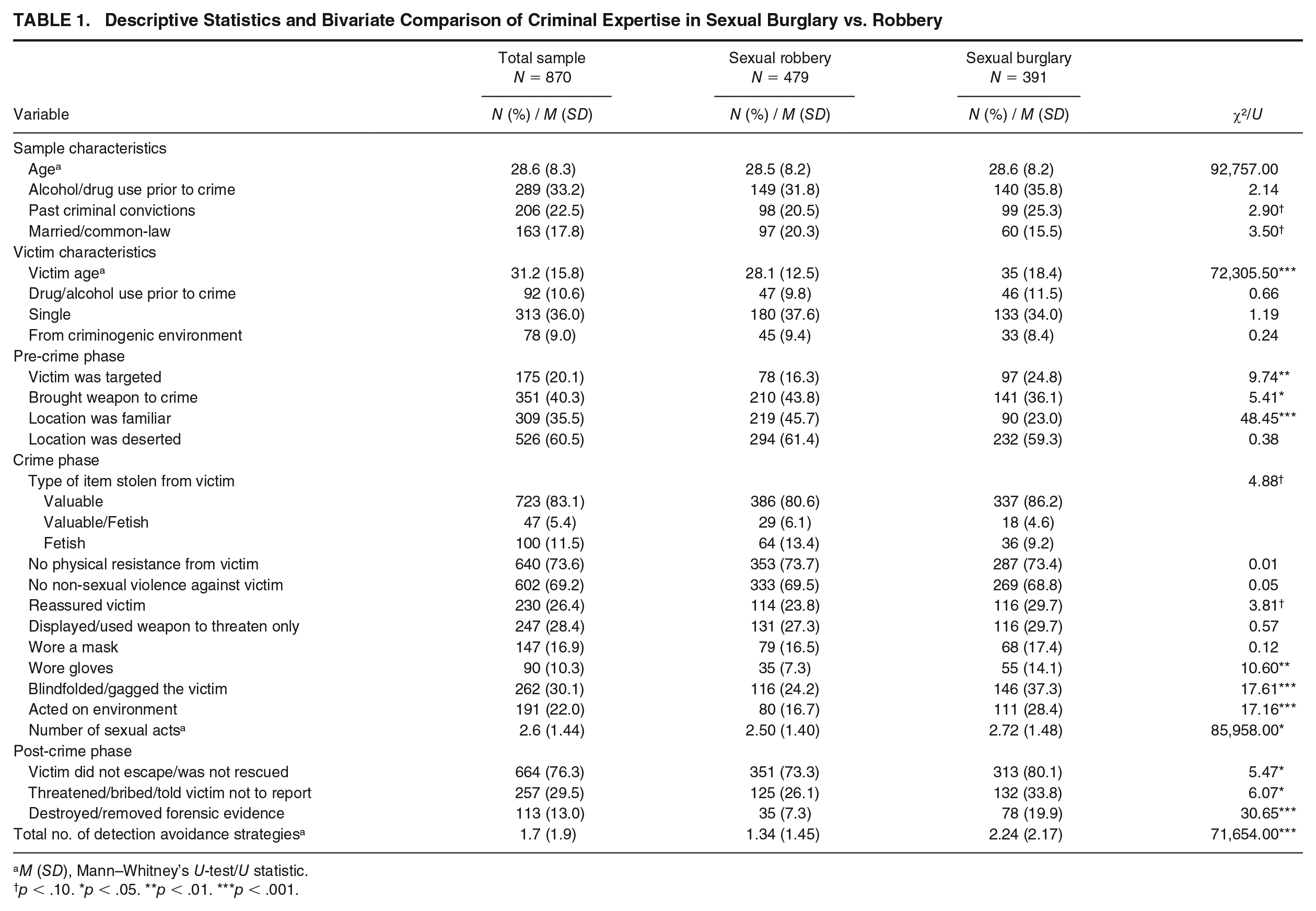
M (SD), Mann–Whitney’s U-test/U statistic.
p < .10. *p < .05. **p < .01. ***p < .001.
In the crime phase, sexual burglary involved significantly more sexual acts compared to sexual robbery (U = 85,958.00, p = .032, r = .00) and more precautions related to avoiding detection. More specifically, detection avoidance strategies such as wearing gloves (χ2 = 10.60, p = .001), using a blindfold or gagging the victim’s mouth (χ2 = 17.61, p < .001), and acting on the environment (χ2 = 17.16, p < .001) were more common for sexual burglary compared to sexual robbery. In the post-crime phase, destroying or removing evidence was more common in sexual burglary (χ2 = 30.44, p < .001) as well as having control over the crime scene so that victims were not able to escape or be rescued by a third party (χ2 = 5.47, p = .019). Threatening or bribing the victim not to report was also more common for sexual burglary than sexual robbery (χ2 = 6.07, p = .014). Finally, total number of detection avoidance strategies was greater for sexual burglary (U = 71,654.00, p < .001, r = .01) than sexual robbery.
Table 2 presents the findings of the binomial sequential regression examining differences in criminal expertise between sexual burglary (= 1) and sexual robbery (= 0). Model 1 includes victim and POs characteristics. Findings indicated that there were no significant differences in POs characteristics related to criminal expertise between sexual burglary and sexual robbery. In terms of victim characteristics, findings indicated that a one-unit increase in victim age was associated with a 1.03 times greater odds of sexual burglary, compared to sexual robbery (β = .03, p < .001). Model 2 adds pre-crime characteristics related to an PO’s expertise. Victim age remains significant in Model 2. In addition, findings from Model 2 indicate when a victim was targeted, the offense was 1.74 times more likely to be a sexual burglary, than a sexual robbery (β = .68, p < .001). However, when a familiar location was chosen (β = –1.10, p < .001) and a weapon was brought to the crime scene (β = –.30, p = .045), the offense was respectively .34 times and .74 times less likely to be a sexual burglary, compared to a sexual robbery.
Sequential Binary Logistic Regression of Criminal Expertise Factors Predicting Sexual Burglary vs. Robbery
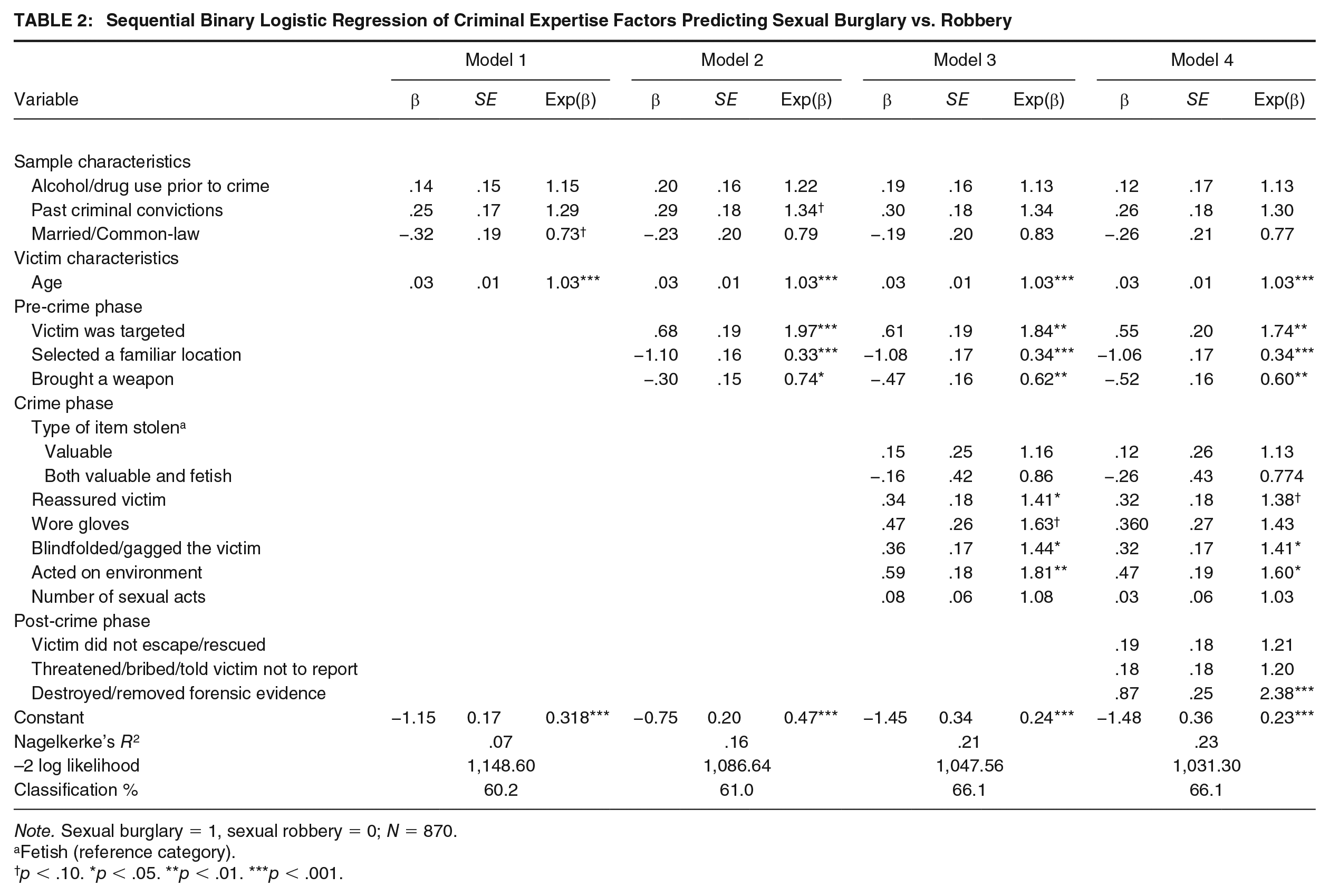
Note. Sexual burglary = 1, sexual robbery = 0; N = 870.
Fetish (reference category).
p < .10. *p < .05. **p < .01. ***p < .001.
Model 3 adds crime characteristics related to an PO’s expertise. All variables in Models 1 and 2 remain significant and in the expected direction, in Model 3. In addition, findings from Model 3 indicate that during the crime phase, when an PO blindfolds or gags their victim’s mouth (β = .36, p = .033) or acts on their environment (β = .59, p = .002), it was a respectively 1.44 and 1.81 times more likely to be a sexual burglary, compared to a sexual robbery. Moreover, when an PO reassures their victim, it was 1.41 times more likely to be a sexual burglary (β = .34, p = .049). Finally, Model 4 adds the post-crime characteristics related to expertise. With the exception of victim reassurance, all other variables from Model 1 to 3 remain significant, and in the expected direction. In addition, findings from Model 4 indicate that destroying or remove evidence was 2.38 times more likely in sexual burglary compared to sexual robbery (β = .87, p = < .001).
Discussion
The current study sought to advance our understanding of criminal expertise by determining the extent that behavioral manifestations of criminal expertise were evident across the entire crime-commission process and whether sexual burglary involves a more “expert” crime-commission process when compared to sexual robbery. Our findings support the hypothesis that the modus operandi of sexual burglary is more sophisticated and skilled compared to sexual robbery. Moreover, our study is one of the first to use the expertise framework to provide direct empirical support for Ward (1999) regarding behavioral manifestations of expertise in sexual offending across the entire crime-commission process. We have shown that this framework extends beyond persistent child sexual offending and can be applied to other types of sexual crimes, including those that are hybrid in nature.
Pre-Crime Phase: Sexual Burglary
In the pre-crime phase, we anticipated the possibility that fewer distinctions would be found between sexual burglary and sexual robbery offenses, given the research on target selection skills in both burglary (e.g., Nee & Meenaghan, 2006) and street robbery (e.g., Deakin et al., 2007). However, we found that sexual robbery involved more behaviors associated with planning during the pre-crime phase than sexual burglary. Although somewhat unexpected, we interpret this to be an indication that sexual burglary motivations are primarily sexual, and as a result, led them to weigh the costs-benefits of their crime differently than a person who is motivated to commit burglary. For example, numerous studies indicated that, in general, individuals who commit burglary purposely target residences in familiar locations as a strategy to decrease risk (Nee, 2015 for a review). Although going to a location that is less familiar may not be ideal for a residential burglary, this may be the “cost” of finding a suitable victim in a sexual burglary (Pedneault et al., 2015).
Considering that in the pre-crime phase, targeting victims was more common for sexual burglary, this is an interesting possibility that may provide insight into the main motivations for those who commit sexual assault as well as steal personal items during a burglary. More specifically, targeting a victim is not a strategy that would be expected among individuals who were seeking to maximize gains (i.e., valuable items obtained through the burglary) while minimizing the risk of detection (i.e., by selecting an unoccupied residence) if the primary motivation is theft. On the contrary, this strategy perfectly demonstrates the cost–benefit analysis that a person would make if the primary purpose of the burglary were in fact to find a vulnerable victim to sexually assault. This is important because both Gottfredson and Hirschi (1990) as well as Felson (2006) suggested that rape occurring in home invasions are in fact opportunities that arose during regular burglaries, and therefore should be considered “bonuses” to theft.
Pre-Crime Phase: Sexual Robbery
In the pre-crime phase, we found that selecting a familiar location and bringing a weapon to the offense was more likely in sexual robbery than in sexual burglary. These particular behaviors are thought to reflect a person who is in a “state of readiness” to commit an offense, which requires enough knowledge to perceive a criminal opportunity when it emerges in a known “awareness space” (Nee, 2015). Thus, it may be that individuals who committed sexual robbery went to a familiar location and were already in possession of a weapon when the opportunity for a violent encounter emerged. For instance, one of the easiest ways to ensure compliance during a robbery is to intimidate the victim from the outset either by using threats, physical violence or by revealing a weapon (Deakin et al., 2007). Moreover, research on street robbery shows that those who are experienced in robbery tend to target familiar locations because they are better able to find suitable victims (Deakin et al., 2007) and prefer to have prior knowledge about the location to enable faster getaways (Deakin et al., 2007; Wright & Decker, 2002). Thus, it seems that the conditions that make an opportunistic street robbery attractive (i.e., access to victim, ability to intimidate/enforce compliance with a weapon, and familiar location that enables a faster getaway) are the same conditions that are desirable for a sexual robbery. As such, it is possible that these individuals were in a state of readiness—or exhibited premeditated opportunism (Rossmo, 2000)—for a violent encounter and chose to both sexually assault and steal from their victim because the conditions allowed for both with little increased risk.
Crime and Post-Crime Phases
Although interesting differences were observed in the pre-crime phase, the most important findings between sexual burglary and robbery occurred in the crime and post-crime phases. More specifically, we found that sexual burglary can be differentiated from sexual robbery based on the skilled actions taken over the crime-commission process specifically related to avoiding detection. At the bivariate level, sexual burglary not only involved more detection avoidance strategies on average, but all types of detection avoidance strategies occurred at a greater frequency than in sexual robbery. Moreover, at the multivariate level, the crime-commission process of sexual burglary indicated clear precautions taken during the crime-phase to avoid detection, such as acting on the environment (e.g., disabling alarms, blocking exits) and preventing the victim from seeing their identity or making noise (e.g., blindfolding and gaging the victim). Finally, in the post-crime phase, the detection avoidance strategy to destroy and remove evidence remained significantly more likely in sexual burglary, even after considering all victim controls, PO characteristics, and other crime phases.
It is important to note that the nature of sexual burglary being exclusively indoors may increase the likelihood that a person will choose to act on their environment and/or be more attuned to the risk of forensic evidence being left behind. However, the nature of the location cannot be the sole factor in explaining whether an individual will be “forensically aware,” as destroying and removing evidence is typically quite rare even for sexual crimes that occur indoors (e.g., Beauregard & Bouchard, 2010). Moreover, destroying or removing evidence is a sophisticated strategy used by those who have prior offense experience (e.g., Davies et al., 1997) and is an indication of expertise in detection avoidance (e.g., Reale et al., 2020). Furthermore, the crime-commission process of sexual burglary in the current study closely resembles the “expert rape” identified by (Chopin et al., 2021) who had sophisticated modus operandi’s and used various forensic awareness strategies to avoid detection. Moreover, Park et al. (2008) found that forensic awareness was a strategy used by criminally sophisticated persons who committed serial sexual offenses. Thus, sexual burglary in the current study involved the use of detection avoidance strategies that are consistent with those identified in other experienced or criminally sophisticated sexual crimes.
Taken together, sexual burglary appears to involve greater “expertise” because of the superior detection avoidance strategies and more sophisticated modus operandi behaviors observed over the crime-commission process. It is important to reinforce that we do not equate this a “specialized” criminal career in sexual offending, as we do not have the data that would enable us to draw such conclusions. Rather, our findings support the hypothesis that sexual burglary involves domain specific skills that are distinctively more sophisticated when compared to sexual robbery. This is especially important in the context of hybrid offending because our findings highlight the notion that even while individuals may show evidence of being “versatile” in their offending, they may still develop a set of functional, domain-specific skills to help them achieve them offense-related goals and reduce their risks of detection.
Theoretical Implications
Differences observed in behavioral indicators of expertise between sexual burglary and sexual robbery also sheds light on different decision-making processes that may underly these offenses. For instance, the dual-systems theory (Stanovich, 1999) suggests that risk-taking behaviors like committing a crime involve the operation of two distinct but interconnected systems—one of which is the immediate reward system and is focused on the “here and now”—and a second system that involves rational, deliberate, future-oriented and directed at longer term objectives. Accordingly, for persons who committed a sexual burglary, it appears that long-term rewards are at the forefront of decision-making, which is reflected in the various strategies to avoid detection observed across the entire crime-commission process. These are similar decision-making processes that have been described in burglary (Nee & Meenaghan, 2006) and persistent child sexual offending (Bourke et al., 2012; Ward, 1999), and can be reflected in actions taken during the crime-commission process such as planning, identification of targets, conducting risk appraisal, and taking steps to avoid detection (Nee & Ward, 2015). Thus, perhaps the connection between burglary and sexual burglary may be that the kind of person who would engage in one of these offenses will also engage in the other. Indeed, studies have shown that a considerable proportion of individuals convicted of a sexual crime also have a history of burglary offending (e.g., Harris et al., 2013; Horning et al., 2010).
In terms of the expertise literature, this provides evidence that persons who commit burglary (whether or not it occurs in conjunction with a sexual offense) may represent a type of “expert” decision-maker (Nee & Ward, 2015), and thus may be capable of committing more sophisticated crimes that require planning and strategy to be successful. This is important because those who commit sexual burglary may present an increased risk to engage in future sexual offending, and perhaps escalate to even more serious type of sexual offenses, such as sexual murder (Schlesinger & Revitch, 1999). However, when a person prioritizes the immediate “benefits” (e.g., monetary, sexual, power, or thrill) of the crime, this can be reflected in a more impulsive and opportunistic crime-commission process that lacks skill (e.g., Deakin et al., 2007). This is consistent with the type of short-term decision-making that has been observed in studies of street robbery (e.g., Alarid et al., 2009; Deakin et al., 2007; Piotrowski, 2011; Wright & Decker, 2002). Although sexual robbery in the current study involved some degree of skill in the pre-crime behaviors, when accounting for the entire crime-commission process, there is little evidence to suggest that these offenses involved the type of skilled decision-making that would be particularly relevant for a person who is prioritizing long-term rewards like detection avoidance. Rather, skilled behaviors were most evident in actions that provide immediate benefits (e.g., bringing a weapon to ensure victim compliance and selecting a familiar location for accessibility to victims and a quick get-away).
Practical Implications
Finally, we believe our findings have relevance for assessment and treatment. RCT suggests that individuals develop skills to assess and respond to crime opportunities through practice (Nee & Ward, 2015). Research has shown that experienced individuals in various types of crimes may develop a set of skills designed specifically to reduce the risks of police detection (e.g., Cherbonneau & Copes, 2005; Gallupe et al., 2011). Moreover, it is those who demonstrate expertise in detection avoidance, who are also thought to be the most coercive and controlling subset of interpersonally violent individuals, have better emotional regulation, and the most entrenched and embedded schemes (Fortune et al., 2015). Thus, due to the accumulated “expertise,” those who are more criminally experienced or more sophisticated in their offending behavior may be more difficult to treat (Bourke et al., 2012). This is especially important because burglary, whether sexual or not, has been linked with dangerousness and covaried with future violence in samples involving persons who have been convicted of a sexual crime (Thornton et al., 2003).
Differences between people’s decision-making processes (e.g., prioritization of short term vs. long-term benefits) and offense related skills also has relevance for treatment. As both Ó Ciardha (2015) and Bourke et al. (2012) note, persons convicted of a sexual offense are often viewed as being “deficit-based,” and as a result, risk factors and treatment needs are largely framed around their inabilities (e.g., the inability to emotionally regulate or inhibit behaviors). Thus, one of the benefits of using the expertise framework is the fact that it examines their competencies, rather than just focusing on their social and psychological deficits (Fortune et al., 2015). By breaking down the offense process to micro decisions and their consequences, this could aid clinicians in detecting maladaptive coping strategies and areas where poor coping responses may prompt engagement in future offending (Bourke et al., 2012). Moreover, by gaining a better understanding the area of an individual’s relative strengths (e.g., self-regulation) it is easier to engage them in treatment, which may also aid in developing more constructive and personally motivating intervention strategies (Fortune et al., 2015). Thus, by attempting to understand the methods used by individuals to avoid detection for their crimes and the extent that these efforts can be accounted for and measured, researchers and clinicians strive to identify areas for prevention, intervention, evaluation, and rehabilitation (Bourke et al., 2012).
Limitations and Future Research
There are some limitations to this study that must be noted. First, data used in the current study includes cases that occurred between 1985 and 2018. Over the course of more than 30 years, investigative and forensic techniques have evolved, and as such, this could have implications for the detection of forensic awareness strategies. This possibility is limited, however, given the fact that a large proportion of the cases (86.6%) occurred since the year 2000. Second, there are some methodological biases and issues that are inherent to police data (for examples see Chopin & Aebi, 2019). Third, all solved cases in the current sample were single incidents (i.e., non-serial rapes), however, there are some cases where investigators may fail to identify links between cases. As a result, we were unable to determine what role undetected serial offenses may play in expertise. It is also possible that some expertise behaviors included in the currents study are associated more with a specific type of crime (e.g., sexual offending), and may not be as generalizable to other types of crimes. Future studies should therefore explore offense-specific behaviors as they relate to expertise on other populations. Similarly, studies should examine the role of criminal expertise in other types of sexual crimes, such as in serial rape or sexual homicide, which constitute the most serious forms of sexual offending. Studies should also test whether behavioral manifestations of expertise are more evident in those who have successfully evaded detection by examining unsolved sexual crimes. Future research on these areas may provide unique insight into the role that expertise may play on the types of strategies used by experts to avoid police detection.
Finally, because we did not have access to detailed criminal histories, we are unable to determine which stage individuals are in their criminal career, whether they had a history of property or burglary offenses, and how this may have influenced their development of expertise. It is important to note, however, that criminal history is less relevant for the current study because our main goal was to capture objective behavioral indicators of expertise that manifest in the crime-commission process and not how expertise develops over time (e.g., through structural representations). Although there were no differences between sexual burglary and sexual robbery in terms of whether they had a history of previous convictions, reliance on official data (e.g., convictions) to inform the development of expertise comes with its own set of limitations, such as sexual burglary offenses being pled down (Harris et al., 2013). Therefore, future research should strive to include data from using both official (e.g., charges and convictions) and unofficial (e.g., offender interviews) sources to build a more complete picture of the role that prior offending plays in the development of expertise. In doing so, practitioners would be in a better position to understand the vulnerabilities or cues that may delay, or prevent, the reoccurrence of offending behavior (Bourke et al., 2012). Moreover, the inclusion of more detailed offense histories would allow for a better assessment of how structural and behavioral indicators of expertise are related to individuals who are specialized compared to versatile in their offense histories, which may have relevance for treatment and practice.
Footnotes
The authors declare that they have no conflict of interests, including financial interests.
This work was supported by the Social Sciences and Humanities Research Council of Canada (752-2019-1788).
