




Abstract
Individuals who sexually offended against both children and adults might be particularly dangerous. However, studies on this group are rare due to methodological difficulties. We investigated adverse childhood experiences, criminological variables, and other characteristics as well as recidivism in individuals who sexually offended against mixed-aged victims (ISOMAVs) compared to individuals who exclusively offended against adults (ISOAs) or children (ISOCs). Compared to previous studies, we applied more stringent classification criteria by including only individuals with at least two past sexual offenses. Analyses revealed that ISOMAVs more often had an extensive history of sexual offending. In addition, they were more likely than ISOAs to assault males, and more likely than ISOCs to assault strangers. Violent reoffending was more common in ISOMAVs compared to ISOCs, but ISOMAVs showed no more sexual recidivism. Other findings, limitations, and implications for research and practice are discussed.
Introduction
The term “sex offender” is commonly used in the scientific discourse as well as in media reports, and it suggests that individuals who sexually offended are a homogeneous group (Galeste et al., 2012). Common beliefs about this group are, for example, that they are “specialists” in sexual offending, that their risk for recidivism is exceptionally high, or that they are not amenable to treatment (Levenson et al., 2007; Quinn et al., 2004). Such general assumptions and a lack of differentiation can lead to “one-size-fits-all” solutions in treatment and management policies (Budd & Mancini, 2016; Lösel & Schmucker, 2017; Mancini & Pickett, 2016; Quinn et al., 2004). Although there are overall encouraging results on treatment effectiveness (Schmucker & Lösel, 2015, 2017), treatment in prison settings is still discussed controversially, and some large studies even suggest unintended negative effects, that is, more reoffending in treated than in control groups (e.g., Mews et al., 2017). This can be due to various methodological, context, and treatment factors (e.g., Lösel et al., 2020), but individual characteristics may also play an important role.
Contrary to popular beliefs, individuals who engaged in sexual offending are in fact a heterogeneous group, and gaining knowledge about etiological mechanisms and risk factors for different subgroups helps to identify therapeutic needs and to apply specific management strategies. Common ground of various typologies with regard to sexual offending (e.g., Bickley & Beech, 2001; M. L. Cohen et al., 1971; Gannon et al., 2012; Groth et al., 1977, 1982; Kingston et al., 2014; Knight, 1999; Yates & Kingston, 2006) is the differentiation between individuals who sexually offended against adults (ISOAs) and individuals who sexually offended against children (ISOCs). Comparative studies support this distinction (e.g., L. J. Cohen et al., 2007; Francia et al., 2010; Henn et al., 1976; Joyal et al., 2014).
In this study, we focus on the less-noticed group of individuals who sexually offended against both adult and child victims (i.e., individuals who sexually offended against mixed-aged victims [ISOMAVs]). Some research suggests that this subgroup might be exceptionally dangerous with elevated recidivism rates and psychopathic traits (e.g., Harris et al., 2011; Porter et al., 2000). In the following, we provide an overview of findings on victim age–based typologies of sexual offending.
Distinctive Characteristics of ISOAs and ISOCs
In the past decades, most studies on victim age–based typologies of sexual offending have focused on ISOAs and ISOCs and found substantial differences between the two groups. Overall, ISOAs seem to have more in common with individuals who have a history of nonsexual and violent offending than ISOCs in terms of general criminal conduct and criminogenic factors. ISOAs seem to be more frequently diagnosed with a personality disorder, especially antisocial personality, compared to ISOCs (Henn et al., 1976; Jackson & Richards, 2007). In an early study by Henn et al. (1976), ISOAs displayed a more general antisocial lifestyle with a greater variety of different offenses during their lifespan, whereas ISOCs were more specialized in sexual offending. Other, more recent studies, also found higher rates of general and violent (re)offending in ISOAs compared to ISOCs (Feelgood et al., 2005; Harris et al., 2011; Lussier, 2005; Lussier et al., 2005; Olver & Wong, 2006; Rettenberger et al., 2015). The higher rates of general antisocial behavior and violent offending in ISOAs are in line with findings on elevated levels of aggressiveness (Marshall et al., 1995; Shechory & Ben-David, 2005) and psychopathic personality traits (Jackson & Richards, 2007; Olver & Wong, 2006; Porter et al., 2000, 2009; Rice & Knight, 2019). In several studies, ISOAs scored particularly higher on Factor 2 of the Psychopathy Checklist—Revised (PCL-R; Hare, 2003), which reflects the social deviance/criminality component of the psychopathy construct (Olver & Wong, 2006; Porter et al., 2000). Accordingly, the use of physical force or weapons in the commission of sexual offenses is more likely among ISOAs and their sentences tend to be more severe (L. J. Cohen et al., 2007; Hamdi & Knight, 2012; Rebocho & Gonçalves, 2012). Other distinctive characteristics with regard to sexual offending are the age of onset, as well as victim gender and relationship to the victim. L. J. Cohen et al. (2007) found ISOAs to be younger when they first offend and to be more likely to offend against stranger victims, whereas ISOCs were more likely to target male victims.
With regard to psychiatric disorders, a meta-analysis conducted by Whitaker et al. (2008) revealed more internalizing problems such as anxiety and depression in ISOCs, although this finding has not been supported by some later primary studies (Francia et al., 2010; Shechory & Ben-David, 2005). Concerning substance abuse problems, a literature review conducted by Kraanen and Emmelkamp (2011) revealed inconclusive results, but other empirical studies which were not included in the review pointed toward a heightened prevalence of substance abuse (Shechory & Ben-David, 2005) and more substance use–related offending in ISOAs than ISOCs (Craissati, 2004; Hamdi & Knight, 2012). Studies on aspects of social functioning indicate that ISOCs have a lower self-esteem compared to ISOAs (Whitaker et al., 2008) and are more avoidant (Francia et al., 2010) and less confident in social situations, particularly in other-sex interactions (Dreznick, 2003; Marshall et al., 1995). With respect to traumatic childhood experiences, there also seem to be group differences, with sexual abuse being more common in ISOCs and physical abuse being more common in ISOAs (Jespersen et al., 2009).
Previous Research and Findings on ISOMAVs
Although a considerable share of persons with a history of sexual offending show sexual interest in victims of different age groups and target child as well as adult victims (Heil et al., 2003; Laws, 1994), research on ISOMAVs is scarce. In studies relying solely on index offense information for the victim age–based categorization of sexual offending (e.g., Connolly & Woollons, 2008; Gudjonsson & Sigurdsson, 2000), the identification of ISOMAVs is simply not possible. In addition, the number of identified individuals with mixed-aged victims is rather small. Most studies revealed sample rates of ISOMAVs between 6% and 20% (e.g., Brown et al., 2015; Cann et al., 2007; Joyal et al., 2016; Kemper & Kistner, 2007; Leroux et al., 2016; Olver & Wong, 2006; Porter et al., 2000, 2009; Vess & Skelton, 2010), with the majority being at the lower end of this range, so that large initial sample sizes are required for group comparisons. Thus, ISOMAVs are frequently either excluded from the analyses (e.g., Glowacz & Born, 2013) or otherwise categorized, for example, with regard to their most frequent or most serious offense (e.g., Bartosh et al., 2003).
So far, studies comparing adult ISOMAVs to other offender groups focused mainly on measures of psychopathy applying the PCL-R (Hare, 2003). Porter et al. (2000) reported a much higher rate of psychopaths in ISOMAVs (64.0 %) compared to ISOCs (6.3 % - 10.8 %) or ISOAs (35.9 %) with a significant difference between the first two groups. This is in line with other studies that found significantly higher psychopathy scores in ISOMAVs compared to ISOCs (Brown et al., 2015; Jackson & Richards, 2007; Olver & Wong, 2006; Porter et al., 2009; Rice & Knight, 2019). Besides, Brown et al. (2015) found lower stress reactivity in ISOMAVs compared to ISOAs or ISOCs, which led the authors to conclude that ISOMAVs resemble the emotionally stable type of psychopathy, allowing them to target various victims without experiencing particular discomfort. Accordingly, in an interview-based study on the modus operandi of sexual offending, Beauregard et al. (2012) found ISOMAVs to be the most rational subgroup, allowing them to adapt their offense strategy to the type of victim and to be more “successful” in the completion of an offense. Regarding the age of onset of sexual offending, ISOMAVs seem to resemble ISOAs but to be younger than ISOCs (Rice & Knight, 2019). A recent study on adults convicted of offenses against mixed-aged victims by Rice and Knight (2019) investigated traumatic experiences and found the highest rates of child neglect and physical abuse in ISOMAVs compared to ISOAs or ISOCs, whereas the rate of sexual abuse victimization was in between the two comparison groups. Although group differences did not reach significance, the authors conclude that the overall level of traumatic experiences might be especially high in ISOMAVs (Rice & Knight, 2019).
Studies providing recidivism data found higher rates for sexual reoffending in ISOMAVs compared to ISOAs and ISOCs, whereas violent recidivism rates were higher in ISOAs, but lower in ISOCs (Harris et al., 2011; Olver & Wong, 2006; Parent et al., 2011; Vess & Skelton, 2010). One study which included information on any recidivism found the highest rate in a group of ISOMAVs (Harris et al., 2011). In Vess and Skelton’s (2010) study, information on recidivism was restricted to new convictions, whereas the other studies mentioned here included additional information (e.g., charges).
Some further studies on victim age crossover focused on juveniles and investigated aspects such as the criminal history, characteristics of the sex offenses or treatment participation and compliance. Leroux et al. (2016) found ISOMAVs to have more general criminal charges than ISOCs, and Kemper and Kistner (2007) found a more extensive history of sexual offending in ISOMAVs compared to ISOAs and ISOCs. Not only age crossover but also relationship and gender crossover seems to be more prevalent in ISOMAVs compared to ISOAs or ISOCs (Kemper & Kistner, 2007; Leroux et al., 2016). ISOMAVs seem to be more likely than ISOAs to target any male victims and more likely than ISOCs to target stranger victims (Joyal et al., 2016). Alcohol- or drug-related sexual offending seems to be less common in ISOMAVs compared to ISOAs, and they might injure their victims more frequently than ISOCs (Leroux et al., 2016). Finally, several studies suggest that ISOMAVs might behave less compliant in therapy and are at a higher risk to drop out of treatment than the two comparison groups (Kemper & Kistner, 2007; Parks & Bard, 2006).
The Present Study
Although previous research on ISOMAVs revealed some consistent trends, more data are necessary for differentiated approaches in assessment and treatment. Therefore, the aim of this study was to expand research on this group. Based on the aforementioned findings on relevant factors for differentiating victim age–based subgroups of individuals who sexually offended, we investigated various constructs that seem to differentiate between ISOAs, ISOCs, or ISOMAVs, namely, adverse childhood experiences, aspects of general criminal conduct, sex offending variables, and behavior in prison. In addition, we analyzed potential differences in recidivism of ISOMAVs compared to ISOAs and ISOCs.
In general, we expected ISOMAVs to be more similar to ISOAs than ISOCs. Compared to ISOCs, we expected ISOMAVs to show a more extensive history of general criminal conduct and more violent behavior, which might also be reflected in more problematic, especially violent behavior, during imprisonment. We also expected ISOMAVs to display a more extensive history of sexual offending with an earlier age of onset and to be more likely to offend against stranger victims. Finally, we assumed ISOMAVs to show higher rates of therapy refusal and more adverse childhood experiences compared to ISOCs.
Compared to ISOAs, we expected ISOMAVs to have a more extensive history of sexual offending, to be more likely to offend against male victims, and to be less likely to offend under the influence of alcohol. In addition, we assumed ISOMAVs to show more therapy refusal in prison and to have experienced a more troubled childhood. With regard to recidivism, we expected ISOMAVs to have higher general and sexual recidivism rates than the other two groups, whereas violent recidivism in ISOMAVs was expected to be higher compared to ISOCs but lower compared to ISOAs. As research on ISOMAVs is often limited by small sample sizes, we aimed for a substantial number of participants.
Method
Sample
The initial sample included 1,486 males with a history of sexual offending who had been released from Bavarian prisons between January 2004, and June 2015. Each of them had been sentenced to more than two years of imprisonment for a sexual index offense according to Art. 11 of the Bavarian Penitentiary Law (e.g., sexual abuse of children, sexual assault, sexual coercion, rape). Based on information from their prison files, participants had been categorized by prison staff into three distinct groups regarding the age of their victims (detailed information on data collection is provided in the subsequent section): ISOCs had only victims under the age of 14 years. ISOAs had only offended against victims of 14 years or older. ISOMAVs had at least one victim younger than 14 years and at least one victim of 14 years or older. 1 The age cutoff was set to 14 years because this is the age limit in German law for a person to be defined as a child (e.g., a conviction for child abuse requires the victim to be younger than 14 years). We decided to include only those individuals in our analyses who had at least two separate convictions for a hands-on sexual offense or who had offended against two different victims. On one hand, only individuals with at least two sexual offenses can be identified as ISOMAVs, which would otherwise lead to a selection bias toward a more extensive criminal history of this group. On the other hand, the inclusion of individuals with only one known sex offense might cause substantial misclassification. Finally, this led to the inclusion of 508 participants, comprising 287 ISOCs (56.5 %), 136 ISOAs (26.8 %), and 85 ISOMAVs (16.7 %).
The participants’ age at the time of release from prison ranged from 20 to 81 years (M = 45.6, SD = 12.3). The average number of any previous convictions was 3.6 (SD = 5.1, range = 0–26), and 40.7% had been convicted for more than one sexual offense prior to incarceration (including the index offense). About one-quarter of our sample (26.4%) had a migration background and more than half of the sample received correctional treatment during imprisonment, either in social therapeutic facilities (39.4%) or in the form of individual or group therapy sessions in the regular prisons (18.7%).
Measures and Data Collection
The Sex Offender Questionnaire
Comprehensive data on our participants were collected around the time of their release from prison. This data base was implemented in 2004 by the Criminological Research Unit of the Bavarian State Ministry of Justice (in the following referred to as CRU) as part of an ongoing evaluation. For this purpose, the CRU had developed the Sex Offender Questionnaire, a 72-item instrument which was rated by experienced prison staff (mostly psychologists) based on prison file information. The rating procedure was highly standardized, as there was a manual with operational definitions and coding rules for each variable. Completed questionnaires were sent to the CRU for manual data entry or were transmitted electronically.
The Sex Offender Questionnaire included items from widely used risk assessment instruments (e.g., Static-99, Sexual Violence Risk-20 [SVR-20], Historical-Clinical-Risk Management-20 [HCR-20]), as well as items developed by the CRU based on empirical findings about risk factors for reoffending. Variables comprised biographical data (e.g., family background, intimate relationships), sex offense-related, and other criminological data (e.g., number of previous offenses, characteristics of the victims of sexual offending), psychiatric and clinical data (e.g., alcohol or drug abuse, psychiatric disorders), items on conduct in prison (e.g., type and duration of treatment participation, behavior in prison) and items on the expected living conditions after release (e.g., housing situation, family support). The response format was mainly categorical. Ordinal and categorical variables with more than two response categories were dichotomized for our analyses.
The following variables from the Sex Offender Questionnaire were included in our analyses: victim of physical child abuse/sexual abuse/neglect (0 = no/no clear evidence, 1 = yes), broken home (0 = no/only minor or temporary problems, 1 = severe problems), number of previous convictions, juvenile delinquency (0 = no, 1 = any juvenile sanctions), nonsexual violent delinquency (0 = no, 1 = any conviction for a nonsexual violent offense), number of previous sex offense convictions (0 = two or less, 1 = more than two), number of sex offense victims, sexual offending against any stranger victims (0 = no, 1 = yes), sexual offending against any male victims (0 = no, 1 = yes), causing physical damage (0 = no, 1 = yes), age at first convicted sex offense, alcohol-related sexual offending (0 = no, 1 = yes), refusal of therapy in prison (0 = no, 1 = yes), severe disciplinary infractions in prison (0 = no, 1 = yes), and severe violent behavior in prison (0 = no, 1 = yes).
Three additional variables were included as control variables in recidivism analyses: time at risk, treatment status, and Static-99 score. Time at risk (in months) was defined as the time between an individual’s release from prison and the day the recidivism data were retrieved. Treatment status was coded dichotomously with 0 = no sex offense specific treatment and 1 = any sex offense specific treatment (individual therapy/group therapy/social therapy; see Lösel et al., 2020). The Sex Offender Questionnaire included all items of the Static-99 (Hanson & Thornton, 1999), a 10-item actuarial risk assessment instrument for individuals who sexually offended, and sum scores were calculated as an indicator for each participant’s static risk for reoffending.
Recidivism Data
Information on reconvictions was obtained from the German Federal Central Crime Register in March 2019. Reconvictions were categorized according to three different criteria: general recidivism (any reconviction), sexual recidivism (reconviction for a sexual offense), and violent recidivism (reconviction for a nonsexual violent offense).
Results
Bivariate Analyses
Table 1 contains descriptive statistics for all variables relating to adverse childhood experiences, general criminal history, sexual offending, and behavior in prison. Chi-square analyses and one-way analyses of variance (ANOVAs) revealed significant group differences for almost all variables (p < .05) except for victim of child abuse, broken home, and number of sex offense victims. The largest differences between groups with medium to large effect sizes (Cramer’s V > 0.3 or η2 > 0.06) were found for nonsexual violent delinquency, targeting stranger victims, targeting male victims, causing physical damage, and age at first sex offense. To avoid the problem of increased Type-1 errors by multiple testing, we conducted a multinomial logistic regression analysis with ISOMAVs as the reference category to figure out which variables significantly differentiate this group from ISOAs and/or ISOCs.
Descriptive Statistics for Three Victim Age–Based Groups of Individuals Who Sexually Offended
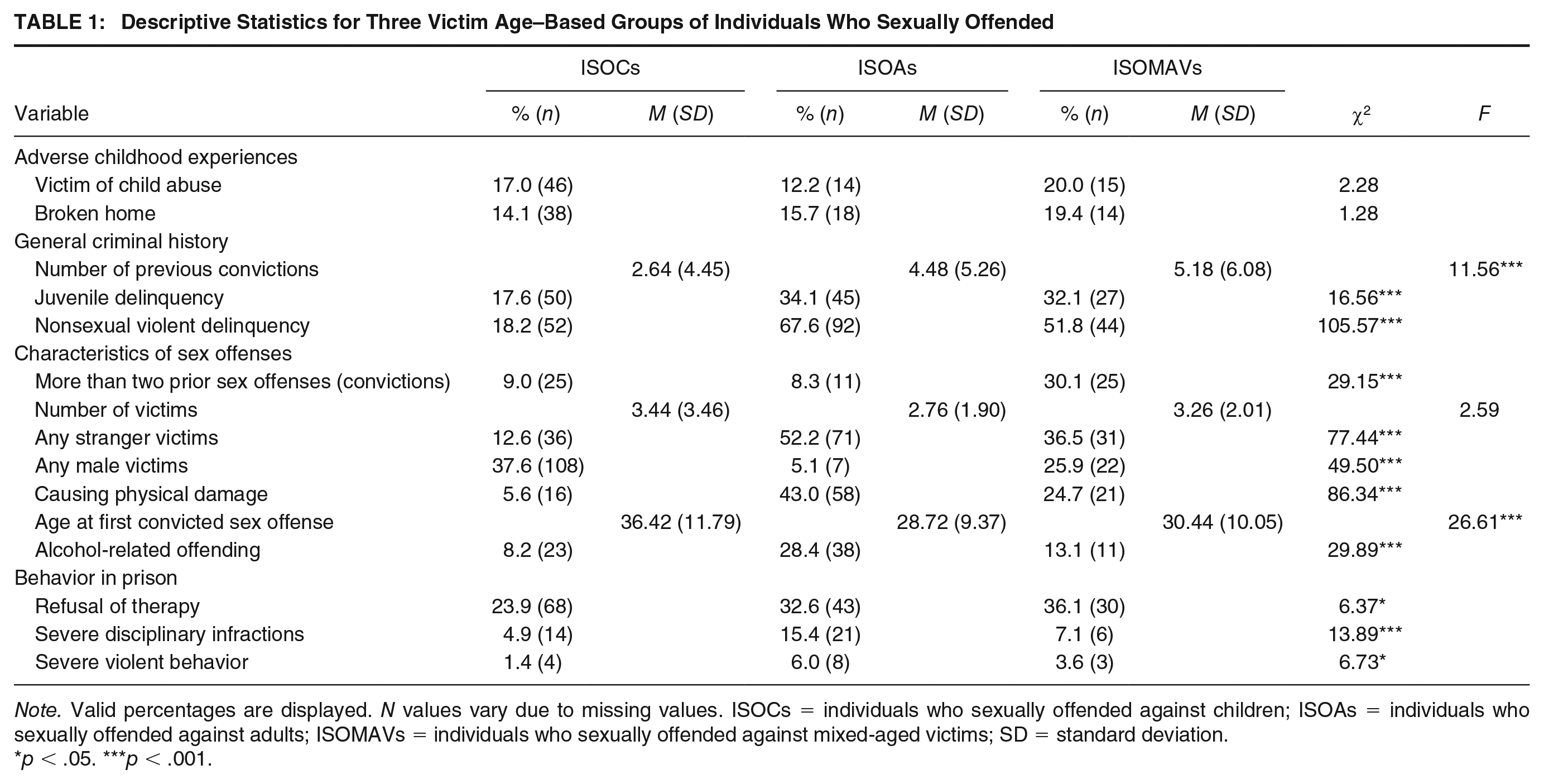
Note. Valid percentages are displayed. N values vary due to missing values. ISOCs = individuals who sexually offended against children; ISOAs = individuals who sexually offended against adults; ISOMAVs = individuals who sexually offended against mixed-aged victims; SD = standard deviation.
p < .05. ***p < .001.
Multinomial Logistic Regression Analysis
Prior to conducting multivariate analyses, we imputed missing values to maintain a substantial sample size and thus preserve statistical power (for an overview of missing data methods see Kleinke et al., 2011). For the variables in the regression model, the number of missing values ranged from 0 to 51, with two variables having more than 5% missing values (victim of child abuse: 9.3%, broken home: 10.0%). Although the overall amount of missing data for the analysis model was small (1.9%), listwise deletion of cases would have caused a loss of 98 cases and thus almost 20% of our initial sample. As ratings were mainly based on prison files, missing data could be explained by insufficient information in some files.
We conducted multiple imputation (MI) because single imputation procedures (e.g., regression-based single imputation) underestimate the variability of imputed values which leads to an underestimation of standard errors. The basic principle of MI is the generation of multiple imputed data sets with varying imputed values, which accounts for the uncertainty that is associated with missing data (Graham, 2012). Statistical analyses are then conducted for each data set separately, and parameter estimates are combined into a single outcome following Rubin’s (1987) rules. In this study, MI was conducted in IBM SPSS Statistics, version 26, using the Markov Chain Monte Carlo method (MCMC), a Bayesian procedure simulating random drawings from the population. We included all variables from the regression model (see Table 2) in the imputation model and created 40 imputed data sets based on recommendations by Graham (2012).
Multinomial Logistic Regression Analysis Comparing Three Victim Age–Based Groups of Individuals Who Sexually Offended
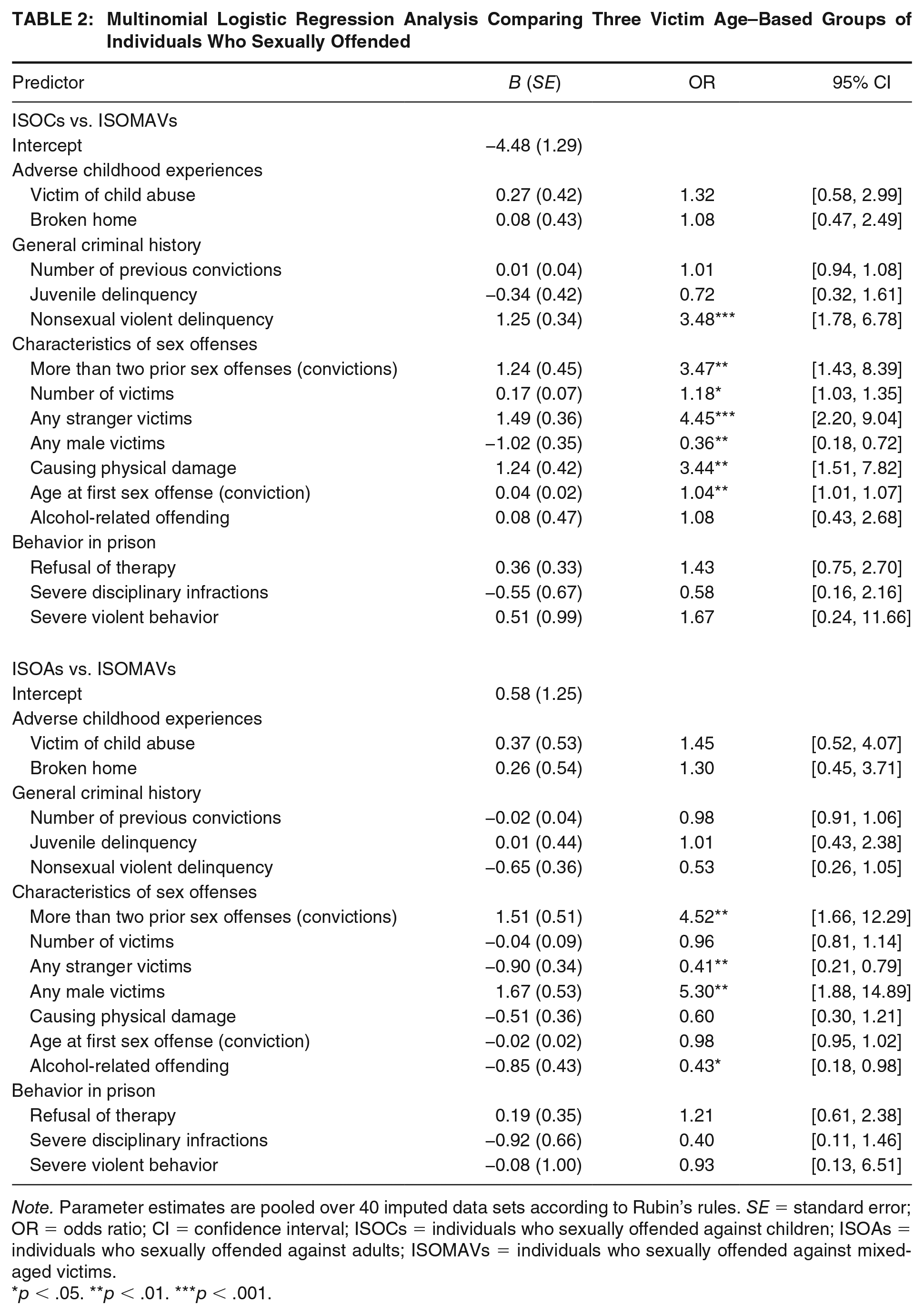
Note. Parameter estimates are pooled over 40 imputed data sets according to Rubin’s rules. SE = standard error; OR = odds ratio; CI = confidence interval; ISOCs = individuals who sexually offended against children; ISOAs = individuals who sexually offended against adults; ISOMAVs = individuals who sexually offended against mixed-aged victims.
p < .05. **p < .01. ***p < .001.
Following the MI procedure, a multinomial logistic regression analysis was conducted with the victim age–based categorization of participants as the dependent variable (1 = ISOCs, 2 = ISOAs, 3 = ISOMAVs) and ISOMAVs as the reference group. All predictor variables were entered into the model simultaneously because sequential entering often overweights the largest effects on the bivariate level. Parameter estimates were combined over the 40 imputed data sets and are displayed in Table 2. For dichotomous predictors, odds ratios >1 indicate that the odds of the predictor variable being present in ISOMAVs are greater than the odds of the predictor variable in the reference group (ISOCs or ISOAs). Odds ratios <1 indicate that the odds of the predictor variable being present in ISOMAVs are lower than the odds of the predictor variable in the reference group (ISOCs or ISOAs). For example, the odds of ISOMAVs having a history of nonsexual violent offending are approximately three and a half times (odds ratio [OR] = 3.48) greater than the odds of ISOCs.
The multinomial logistic regression analysis revealed that several predictors significantly (α = .05) distinguished ISOMAVs from ISOCs and/or ISOAs. Compared to ISOCs, ISOMAVs were more likely to have a history of nonsexual violent offending. Regarding characteristics of sexual offending, ISOMAVs were significantly different from ISOCs on almost all variables in our analysis. They had more often been convicted for more than two prior sex offenses before the index offense, had a lower number of victims, were more likely to target stranger victims, physically injured their victim(s) more often, and started offending at a younger age. In addition, they were less likely to target male victims compared to ISOCs. ISOMAVs could not be differentiated from ISOCs regarding adverse childhood experiences or problematic behavior in prison.
When compared to ISOAs, ISOMAVs were more often convicted for more than two prior sex offenses. Furthermore, they were less likely than ISOAs to target strangers and more likely to target males. Alcohol-related sexual offending was less likely for ISOMAVs compared to ISOAs. Again, indicators of adverse conditions in childhood and problematic behavior in prison did not differentiate ISOMAVs from ISOAs.
Recidivism Analyses
The reoffending rates of the three comparison groups were examined in a separate set of analyses for different reasons. First, recidivism analyses were conducted for a reduced subsample of 456 participants because 47 participants had been released into a foreign country (three participants with missing information on this variable were also excluded) and thus the registration of new convictions in the German register was unlikely. In addition, two participants were physically incapable of reoffending due to severe health problems. Second, recidivism analyses require the control of confounding variables, such as the time at risk or treatment status.
The mean time between an individual’s release from prison and data retrieval from the German Federal Central Crime Register was 113.7 (SD = 42.1) months and varied between 37 and 180 months. Due to a substantial time delay between the date of an offense and its entry in the register, the actual time at risk might have been somewhat shorter. Recidivism rates for different outcome criteria are reported in Table 3. The highest rates of general recidivism were found in ISOMAVs compared to the other two groups. Regarding sexual and violent recidivism, the rates of ISOMAVs were in between those of the two comparison groups.
Number of Recidivists in Three Victim Age–Based Groups of Individuals Who Sexually Offended
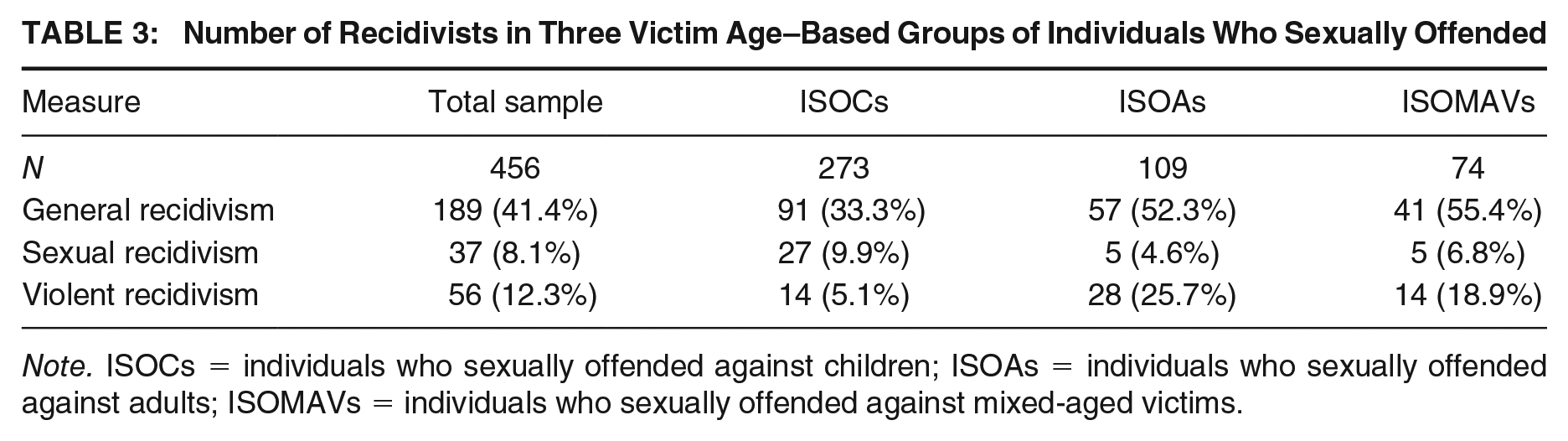
Note. ISOCs = individuals who sexually offended against children; ISOAs = individuals who sexually offended against adults; ISOMAVs = individuals who sexually offended against mixed-aged victims.
We conducted three separate hierarchical logistic regression analyses for each recidivism criterion as the dependent variable (general, sexual, violent) to determine whether group membership significantly predicts recidivism when confounding variables are controlled. The recidivism risk (Static-99 score), the time at risk, and the treatment status were considered as confounders and were entered into the analyses first (model 1). In a second step, the victim age–based group variable was added (model 2) to examine whether it predicted recidivism beyond the confounding variables. As Static-99 scores could not be calculated for 20 participants, regression analyses were based on 436 cases due to listwise deletion of cases. As shown in Table 4, all three regression analyses revealed highly significant total effects and the predictor variables explained up to 26% of the variance in recidivism. Group membership had an independent effect on violent recidivism. Compared to ISOMAVs, ISOCs (OR = 0.33 [95%-CI: 0.14, 0.77], p = .011) were significantly less likely to be reconvicted for a violent offense after release from prison (Δχ2 (2) = 19.22, p < .001). Regarding general and sexual recidivism, no significant effect of group membership was found.
Three Binomial Logistic Regression Analyses With General Recidivism, Sexual Recidivism, and Violent Recidivism as Dependent Variables
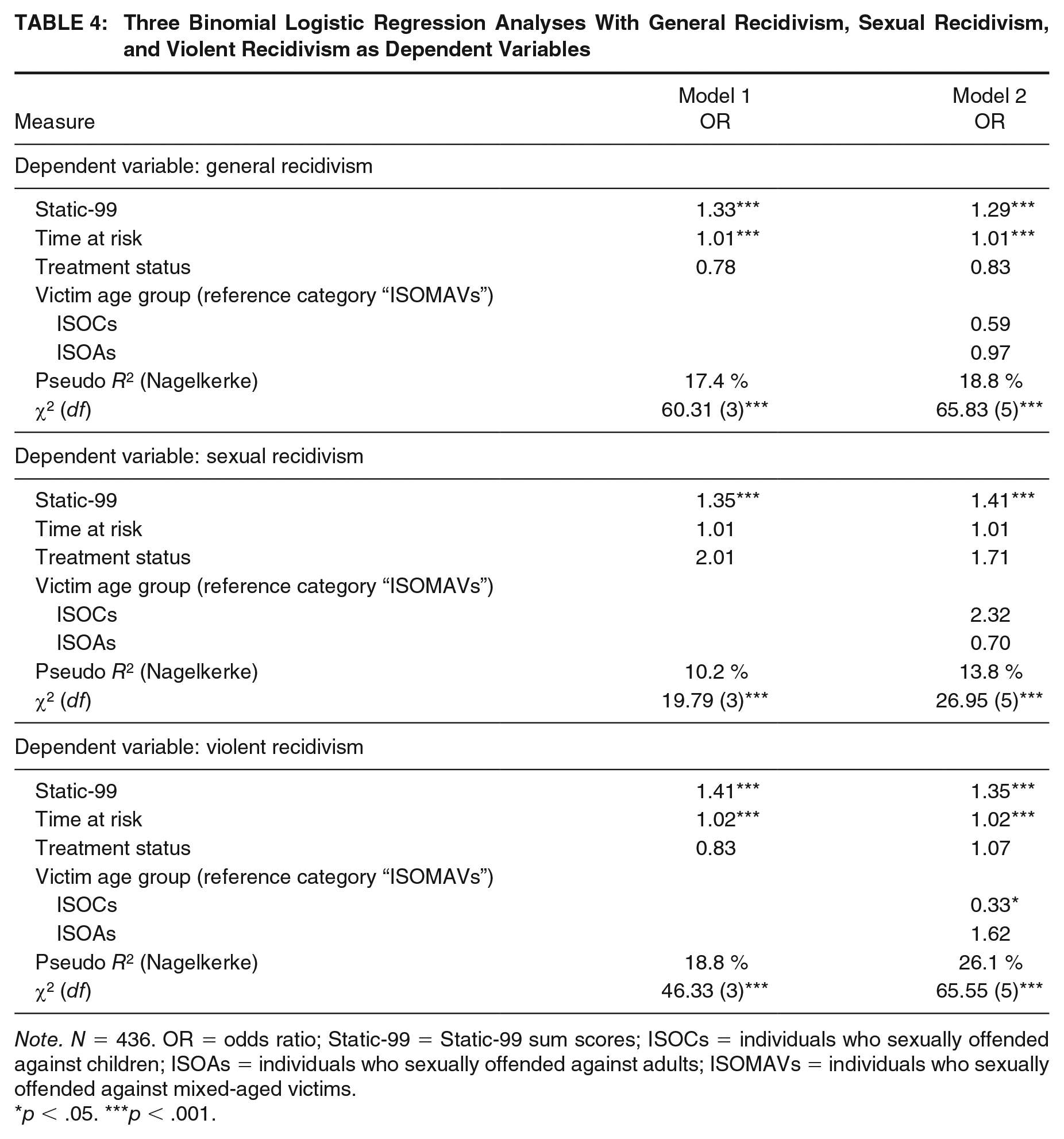
Note. N = 436. OR = odds ratio; Static-99 = Static-99 sum scores; ISOCs = individuals who sexually offended against children; ISOAs = individuals who sexually offended against adults; ISOMAVs = individuals who sexually offended against mixed-aged victims.
p < .05. ***p < .001.
Discussion
Previous studies comparing ISOMAVs to other victim age–based groups are rare and mainly focused on measures of psychopathy. Furthermore, statistical analyses were frequently based on small subsamples of this particular group. Thus, drawing on past findings, we aimed at expanding knowledge regarding adverse childhood experiences, criminal history indicators, characteristics of sexual offending, behavior in prison, and recidivism in ISOMAVs compared to ISOAs and ISOCs.
Adverse Childhood, Criminal History, Sexual Offending, and Behavior in Prison
In general, we expected ISOMAVs to be more similar to ISOAs which was supported by the results from our multinomial logistic regression analysis because a larger number of predictor variables significantly distinguished ISOMAVs from ISOCs than from ISOAs. Overall, differentiating characteristics were mainly related to sexual offending. As we presumed, we found ISOMAVs to start offending at a younger age than ISOCs and to have a more extensive history of sexual offending than both comparison groups. Regarding the age of onset, our results were in line with Rice and Knight (2019), who found ISOCs to be significantly older than ISOAs and ISOMAVs when they commit their first sex offense. It stands out that the mean ages of onset in our study were overall higher (e.g., ISOCs in our study were on average around 10 years older) compared to Rice and Knight (2019), which might be explained by differing sources of information. Whereas, our data were based on officially registered convictions, Rice and Knight (2019) had additional information from police reports and clinical files, which might include information on sexual offending prior to the first convicted offense.
Concerning the history of sexual offending, almost one-third (30.1%) of ISOMAVs in our study had more than two previous convictions for a sexual offense, whereas the rates for the two comparison groups were below 10%. This is in line with findings in adult and juvenile samples (Brown et al., 2015; Kemper & Kistner, 2007), where ISOMAVs displayed the highest mean number of sexual offenses. Despite the increased number of convictions for a sexual offense, we found ISOMAVs to have a significantly smaller number of victims compared to ISOCs. This might be explained by the fact that victims of child abuse tend to disclose long after the abuse took place (Smith et al., 2000), which allows ISOCs to continue offending without being detected. In turn, the disclosure of a single victim often leads to the uncovering of further assaults against other victims (e.g., when multiple cases of abuse took place within an institution, for example, a sports club). As a consequence, multiple offenses against multiple victims might be often cumulated in a single trial and result in a single conviction. With regard to victim gender and the relationship to the victim, the results supported our assumptions that ISOMAVs are more likely to target males than ISOAs and more likely to target strangers than ISOCs. In fact, ISOMAVs seem to fall between the comparison groups with regard to both factors which indicates that ISOMAVs are highly opportunistic, not only with respect to victim age, but also other victim characteristics. This is in line with findings from Kemper and Kistner (2007), who found the highest rates of gender and relationship crossover in ISOMAVs. Another study on juveniles found alcohol-related offending to be less common in ISOMAVs compared to ISOAs and causing physical injury to their victims to be more common in ISOMAVs compared to ISOCs (Leroux et al., 2016). These findings were supported in our adult sample.
Our presumption that ISOMAVs might in general display a more extensive history of criminal conduct compared to the other two groups was not supported in our data. Neither the total number of previous convictions, nor juvenile offending significantly distinguished them from the comparison groups. However, having a history of nonsexual violent offending was more common in ISOMAVs compared to ISOCs, which is consistent with previous findings on increased psychopathy in this group as well as findings in this study regarding the use of violence during sexual offending (Porter et al., 2000, 2009).
The tendency of ISOMAVs to act more violently than ISOCs was not reflected in staff ratings regarding their behavior in prison. The proportion of ISOMAVs showing severe violent behavior in prison or more general disciplinary infractions was in between those of the other two groups and no significant differences were found in our multivariate analysis. In addition, contrary to what we expected, we did not find ISOMAVs to be more likely to refuse therapy in prison. This hypothesis was based on studies on juveniles where ISOMAVs were most likely to be removed from group therapy sessions and to drop out of treatment (Kemper & Kistner, 2007; Parks & Bard, 2006), indicating that this group might in general have more negative attitudes toward treatment and thus refuse treatment participation more often. Taken together, the nonsignificant differences in our study regarding problematic institutional behavior suggest that antisocial and violent conduct in ISOMAVs might be less impulse-driven and more opportunistic and thus restricted to situations where force is needed to break a victim’s resistance. This in line with Brown et al.’s (2015) suggestion that ISOMAVs resemble an emotionally stable type of psychopath, which might enable them to behave more socially adapted when it is to their benefit. In a study conducted by Porter et al. (2009), psychopathic individuals with a history of sexual offending had a 2.43 (OR) times higher chance of being granted conditional release than a nonpsychopathic comparison group, which might be explained by their ability to deceive decision-makers. Finally, on a descriptive level, we found the rates of child abuse and severe family problems to be highest in ISOMAVs, but in contrast to our hypothesis, adverse childhood experiences did not significantly differentiate them from the other two groups.
Recidivism
ISOMAVs showed the highest rate of general recidivism. The sexual recidivism rate was highest in ISOCs, followed by ISOMAVs and then ISOAs. In contrast, violent recidivism was most prevalent in ISOAs, followed by ISOMAVs and ISOCs. After controlling for the time at risk, a measure for the static risk of reoffending (Static-99), and treatment status in logistic regression analyses, we found a significant effect of group membership on violent recidivism. ISOMAVs were significantly more likely than ISOCs to commit a new violent offense. These findings are partially in line with previous research. Several studies on adults with a history of sexual offending found a similar pattern for violent recidivism (ISOCs < ISOMAVs < ISOAs) as in our sample (Harris et al., 2011; Olver & Wong, 2006; Parent et al., 2011). Our pattern of general reoffending was also similar to findings by Harris et al. (2011). Regarding sexual recidivism, our findings differ from previous studies where ISOMAVs reoffended more frequently than the other two groups (Harris et al., 2011; Olver & Wong, 2006; Parent et al., 2011). One plausible explanation might be that we applied different inclusion criteria and considered only participants with at least two previous (sex offense) convictions or at least two different victims. Consequently, our comparison groups might have been more similar to each other regarding the history of sexual offending than those in previous studies, where ISOMAVs (but not ISOAs or ISOCs) had by definition at least two sex offense convictions or charges. Since prior sexual offending is a strong predictor for future sexual offending, recidivism rates in ISOMAVs could have been inflated in other studies. Besides, the comparability of our results to other studies is limited by various factors, such as, different follow-up periods, different sources of information (e.g., charges and/or convictions), different definitions of sexual recidivism (e.g., only hands-on offenses vs. any sexual offense), different classification criteria (e.g., inclusion vs. exclusion of incest offenders, different age cutoffs), and general sample characteristics (e.g., high-risk vs. low-risk individuals). As in other fields of criminology, replication of findings needs intensive consideration (Farrington et al., 2019; Lösel, 2018).
Strengths and Limitations
One of the strengths of our study is the relatively large overall sample size and group size of ISOMAVs in comparison to most prior studies in the field. Thus, we were able to carry out multivariate analyses on a broad range of characteristics, while former studies were often restricted to conducting multiple bivariate comparisons. Another strength of our study concerns the inclusion criteria of our sample. We included only individuals who had at least two previous convictions for a sexual offense or at least two different victims. In this way, we made sure that the victim age–based categorization of the participants in our study was based on at least two different incidents of sexual offending. Previous studies also included individuals with a single sex offense and categorized them as either ISOAs or ISOCs, which might cause methodological problems. In particular, it leads to a bias toward a more extensive history of sexual offending in ISOMAVs because their classification requires at least two sexual offenses. This problem and its possible influence on study results have been brought up before by other authors (e.g., Rice & Knight, 2019). Apart from the aforementioned methodological considerations, findings on repeat sexual offending might be of special interest for policy and practice due to the increased threat they pose to public safety.
Besides the strengths of our study, there are also some limitations that have to be considered. First, the information we had on (sex) offense history as well as recidivism was restricted to data from the German Federal Central Crime Register which includes only officially registered convictions. Although reconvictions are an accepted and valid measure of reoffending, the dark figure of sexual offending is assumed to be high (DeLisi et al., 2016; Scurich & John, 2019), and the availability of additional information (e.g., information on criminal charges from police files) would probably have led to the detection of higher actual reoffending rates and a somewhat different classification of individuals. Another source of classification bias, which is common in studies on victim age crossover, might have been caused by individuals with multiple victims close to our age cutoff of 14 years. For example, an individual with two victims, one 13 and the other 14 years old would have been assigned to the group of ISOMAVs, even though the victims were actually the same age. However, the exclusion of individuals with only a single sex offense might in general have counteracted the problem of misclassification in our study. On the downside, this may limit the generalizability of our results to lower risk populations. In fact, the mean Static-99 sum score in our sample was significantly higher than the mean score of those individuals excluded from the analyses. Nonetheless, our analyses revealed significant group differences, which are largely in line with previous findings where individuals with a single offense were included in the sample.
Conclusions and Practical Perspectives
Taken together, our findings support the distinction of ISOMAVs from other victim age–based groups of individuals who sexually offended. Some previous findings on elevated sexual recidivism rates in this group were not confirmed in our study, what may help to avoid stigmatization. However, their extensive history of sexual offending, their opportunistic behavior regarding victim characteristics, and high rates of violent recidivism suggest that they pose a special threat to public safety. Therefore, information on an individual’s whole history of sexual offending should be considered to identify ISOMAVs and inform treatment and management strategies. When therapy planning focuses on sexual offending in general and primarily on the sexual index offense, more specific antisocial tendencies and violent behavior in ISOMAVs might be underestimated. However, the results of our study and previous research indicate that impulsive behavior and aggression should be addressed in the treatment of ISOAs but also ISOMAVs, it might play a lesser role in the treatment of individuals who exclusively assaulted child victims. On the basis of risk-need-responsivity (RNR) principles (Bonta & Andrews, 2017; Hanson et al., 2009), ISOMAVs should receive intensive treatment with a special focus on their responsivity during imprisonment and in postrelease monitoring. Even though ISOMAVs did not show higher rates of therapy refusal, the prevention of treatment dropout may require special efforts from therapeutic staff when dealing with this group (Kemper & Kistner, 2007; Parks & Bard, 2006), especially in the light of findings on increased psychopathy levels (Olver & Wong, 2011). Comprehensive assessments of criminogenic needs and motivations for sexual offending normally precede therapy planning and implementation. Modern treatment approaches are often more modular and contain some individualized elements that aim to combine structured programs with more flexibility in response to specific individual needs and also strength-based elements as suggested in the Good Lives Model (Ward & Brown, 2004). Some of these concepts are already contained in the widened RNR Model (Andrews et al., 2011), but further differentiation is appropriate. Our findings suggest that certain characteristics of different victim age–based subgroups may help in these approaches. This would enable more differentiated approaches in practice and contribute to sound explanations of the heterogeneity of findings in meta-analyses of outcome evaluations (e.g., Schmucker & Lösel, 2017). Of course, further studies on large samples are needed to replicate our findings and extend the knowledge about victim age-based typologies.
Footnotes
The study has been funded by the Bavarian State Ministry of Justice and independently carried out at the Friedrich-Alexander-University Erlangen-Nuremberg (Germany).
The authors declared no potential conflicts of interest with respect to the research, authorship, and/or publication of this article.
