




Abstract
There is bourgeoning empirical support for the usage of the Structured Assessment of Protective Factors (SAPROF) across many jurisdictions, but there is a dearth of research on the Structured Assessment of Protective Factors for Violence Risk—Youth Version (SAPROF-YV). This study examined (a) the predictive validity of the SAPROF-YV ratings for general recidivism and (b) the incremental predictive validity of the SAPROF-YV ratings when used in conjunction with the Youth Level of Service/Case Management Inventory (YLS/CMI) 2.0 ratings. Using a sample of 822 male youths who were involved with the justice system and under community supervision in Singapore, the results showed that the SAPROF-YV total score and final protection judgment rating were significantly predictive of general recidivism. Moreover, the SAPROF-YV total score and final judgment rating showed incremental predictive validity over the YLS/CMI 2.0 total score and risk rating. Overall, the results suggest that SAPROF-YV ratings are suited for assessing justice-involved youth within the Singaporean context and can be used in conjunction with YLS/CMI 2.0 ratings for predicting recidivism.
Introduction
Youth offending and desistance are criminological phenomena that have received a lot of attention from scholars and policy makers. In the existing literature of forensic risk assessment, a risk factor refers to a variable associated with increased likelihood of a negative outcome (Farrington et al., 2016). Numerous studies have documented the risk factors predicting recidivism in justice-involved youth (see e.g., Cottle et al., 2001 for a review). In particular, the Risk Needs Responsivity (RNR) framework is well established for the risk assessment and treatment of justice-involved youth and is widely adopted by youth rehabilitation services around the globe (Bonta & Andrews, 2017). The practice of assessing the risk of (re)offending has been a predominantly deficits-based approach until recently, and this typically involves using actuarial and/or structured professional judgment measures to assess empirically derived risk factors to determine an overall risk classification (de Vries Robbé & Willis, 2017).
More recently, scholars have examined protective factors that are related to why and how people desist from (or stop) offending (e.g., Maruna, 2001), as well as what increases the likelihood of prosocial functioning and a meaningful life. In general, protective factors refer to all personal, social, and environmental factors that reduce the risk of future offending behavior (de Vries Robbé, Geers, et al., 2015). A protective factor could be opposite to risk factors (McAra & McVie, 2016; White et al., 1989), or a distinct and stand-alone factor separated from the presence of risk factors (Borum et al., 2006). Nonetheless, research on the utility of protective factors in assessing justice-involved youth and predicting recidivism is limited as compared with the extensive extant research on risk assessment.
Assessing Risk of Reoffending in Justice-Involved Youth
Research studies have shown that structured risk assessment methods (i.e., actuarial and structured clinical judgment approaches) are not only more accurate than unstructured clinical judgment, but they are also preferred because of their increased transparency and reliability (see Heilbrun et al., 2010, for a review). Notably, many structured risk assessment measures perform well in identifying individuals with higher risk of violence and other forms of offending and are deemed to be useful for informing treatment as well as management decisions (Fazel et al., 2012).
Although there are many youth risk assessment measures, one of the most commonly used for assessing justice-involved youth is the Youth Level of Service/Case Management Inventory (YLS/CMI 2.0; Hoge & Andrews, 2002, 2011). Importantly, the YLS/CMI 2.0 has been extensively examined in studies of youth offending and recidivism, in both western (e.g., McGrath & Thompson, 2012; Onifade et al., 2008; Perrault et al., 2017; Rennie & Dolan, 2010; Schmidt et al., 2011) and Asian contexts (e.g., Chu et al., 2014, 2015, 2016; Takahashi et al., 2013). In a meta-analytic review of youth risk assessment measures, Schwalbe (2007) found that the weighted area under curve (AUC) of YLS/CMI 2.0 ratings for predicting juvenile recidivism was .64. As a general rule for practice, AUCs greater than .54, .63, and .71, as well as correlation coefficients that are greater than .10, .24, and .37, are regarded as small, moderate, and large effects, respectively (Rice & Harris, 2005).
Another meta-analysis by Olver et al. (2009) also suggested moderate to large effect sizes of YLS/CMI 2.0 ratings in predicting general, nonviolent, and violent recidivism (mean-weighted correlation coefficient = .32, .29, and .26, respectively). Further meta-analyses by Schwalbe (2008), Olver et al. (2009), as well as Pusch and Holtfreter (2018) showed that the YLS/CMI 2.0 was useful for predicting general recidivism in male (r values = .32, .33, and .28, respectively) and female (r values = .40, .36, and .25, respectively) youth. In the meta-analyses by Olver et al. (2009) and Pusch and Holtfreter (2018), the YLS/CMI 2.0 ratings also showed moderate effect sizes for predicting violent recidivism in males (r values = .23 and .30, respectively) and females (r values = .24 and .29, respectively).
In addition, Singapore has adopted the YLS/CMI and subsequently YLS/CMI 2.0 as the primary measure to assess the risk and needs of justice-involved youth since the introduction of RNR framework in the early 2000s (Chua et al., 2014). The validity of YLS/CMI 2.0 has been examined in the Singaporean context using a sample of 3,264 justice-involved youths (Chu et al., 2015). The AUCs for the YLS/CMI 2.0 total score were .64, .65, and .67 for the overall sample, male, and female subsamples, respectively. Overall, these findings suggest that the YLS/CMI 2.0 ratings showed moderate effect sizes for predicting general and violent recidivism.
Assessing Protective Factors in Justice-Involved Youth
Notwithstanding that some youth risk assessment measures included strengths or protective factors (e.g., YLS/CMI 2.0; Hoge & Andrews, 2011, the Structured Assessment of Violence Risk in Youth [SAVRY]; Borum et al., 2006, and START-Adolescent Version [START-AV]; J. L. Viljoen et al., 2014), research on the utility of these strengths and protective factors is limited as compared with the extensive extant research on risk factors. Although some studies reveal that protective factors in youth risk assessment measures are either correlated with nonoffending or that they are useful in predicting desistance from further offending (Chu et al., 2015; Lodewijks et al., 2010; Rennie & Dolan, 2010; Shepherd et al., 2014), there is also evidence to suggest that the incremental predictive validity of protective factors over the risk assessment total score is limited (Chu et al., 2016; Schmidt et al., 2011). At times, the inclusion of these strengths and protective factors in the assessment measures seem like an afterthought in a risk-focused arena, and the paucity of assessment measures that strictly assess protective factors or strengths for justice-involved youth are obvious.
Structured Assessment of Protective Factors
One of the “specialist” structured assessment measures for protective factors is the Structured Assessment of Protective Factors (SAPROF), which provides a more balanced and accurate assessment of violent or offending behavior (de Vogel et al., 2009, 2012). There is an increasing number of published studies on the SAPROF in the recent years, with the majority coming from Europe and a few isolated studies emanating from Canada, Japan, as well as Singapore (see Table 1 for a review). The review showed that the SAPROF was researched mostly with adult forensic psychiatric patients and adults who sexually offended (see Table 1). Several other studies have also investigated the SAPROF ratings’ predictive validity for violence with civil psychiatric patients, community psychiatric patients, as well as youth who sexually offended. As shown in Table 1, the SAPROF ratings generally yielded good predictive validity for violent and general offending, but the ratings’ predictive validity for sexual offending was mixed.
The Predictive Validity of SAPROF Ratings for Violent, Sexual, and General Recidivism*
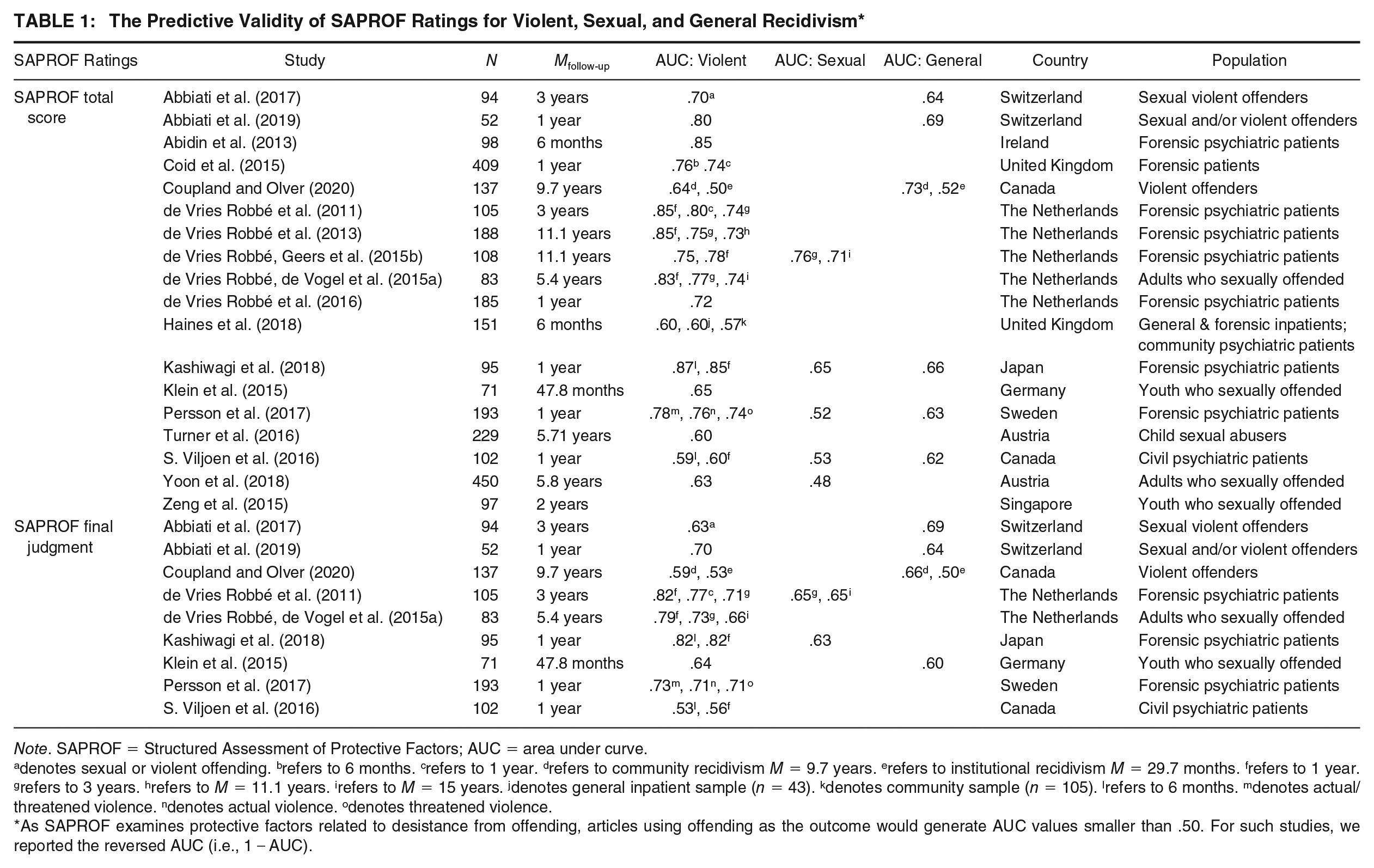
Note. SAPROF = Structured Assessment of Protective Factors; AUC = area under curve.
denotes sexual or violent offending. brefers to 6 months. crefers to 1 year. drefers to community recidivism M = 9.7 years. erefers to institutional recidivism M = 29.7 months. frefers to 1 year. grefers to 3 years. hrefers to M = 11.1 years. irefers to M = 15 years. jdenotes general inpatient sample (n = 43). kdenotes community sample (n = 105). lrefers to 6 months. mdenotes actual/threatened violence. ndenotes actual violence. odenotes threatened violence.
As SAPROF examines protective factors related to desistance from offending, articles using offending as the outcome would generate AUC values smaller than .50. For such studies, we reported the reversed AUC (i.e., 1 – AUC).
Most of the published studies also showed moderate to large effect sizes for predicting desistance from offending when the SAPROF is used in conjunction with the Historical, Clinical, Risk Management-20 (HCR-20) and the Sexual Violence Risk-20 (SVR-20; see Table 2). In addition, integrated scores accounting for both risk and protective factors, such as the HCR-SAPROF and SVR-SAPROF index scores, showed higher predictive validity for recidivism (or aggression in some cases) than the HCR-SAPROF and SVR-SAPROF final judgment ratings. Further review suggests that there was generally modest incremental predictive validity for desistance from offending when the SAPROF was used in conjunction with the HCR-20 and SVR-20 (i.e., HCR-SAPROF and SVR-SAPROF index scores and final judgment ratings) as compared to using only risk assessment measures (e.g., SVR-20, and HCR-20; see Table 2), and there were mixed results when these improvements were tested for significance over different follow-ups (see e.g., de Vries Robbé et al., 2013).
The Predictive Validity of HCR-SAPROF and SVR-SAPROF Ratings for Violent, Sexual, and General Recidivism*
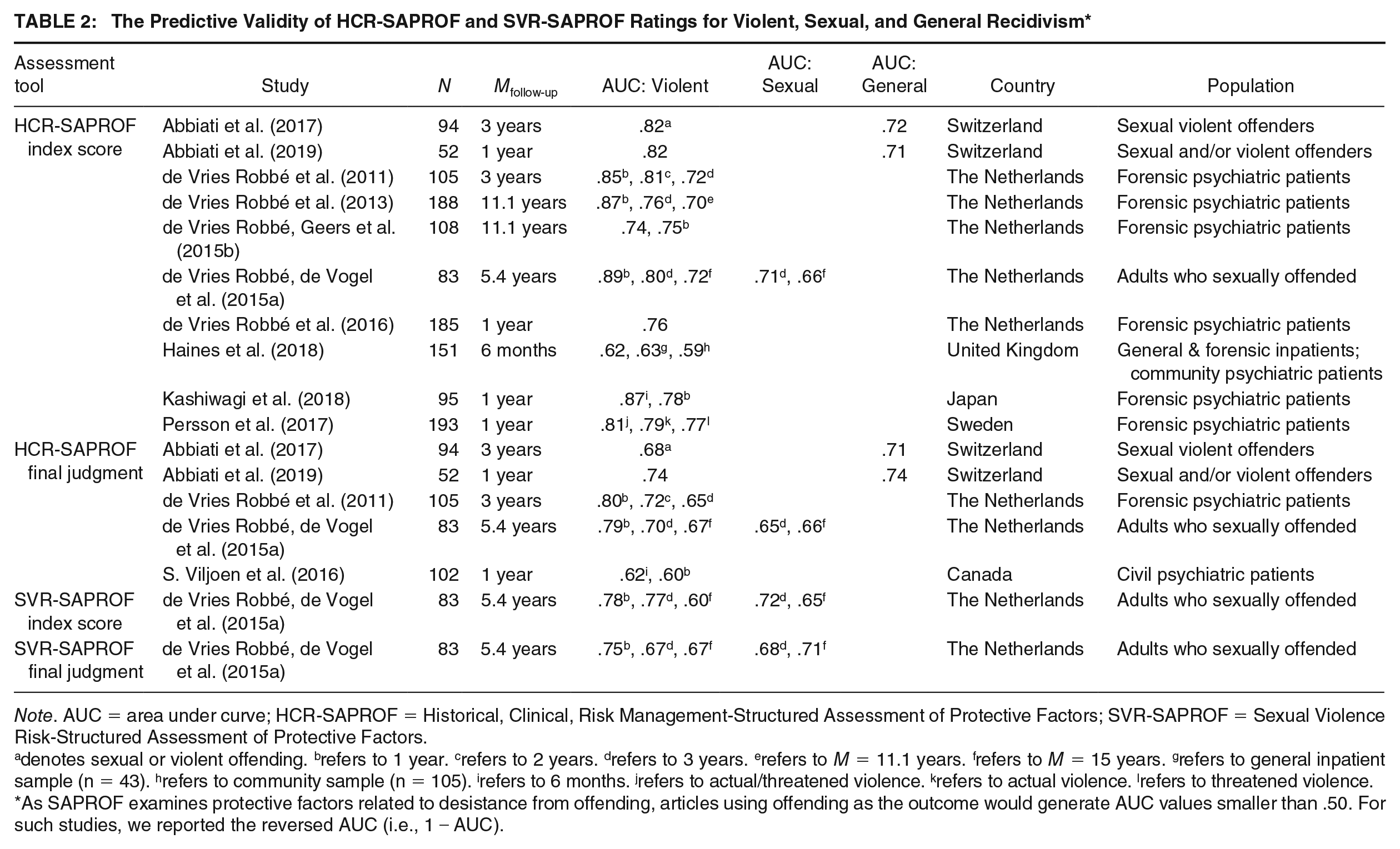
Note. AUC = area under curve; HCR-SAPROF = Historical, Clinical, Risk Management-Structured Assessment of Protective Factors; SVR-SAPROF = Sexual Violence Risk-Structured Assessment of Protective Factors.
denotes sexual or violent offending. brefers to 1 year. crefers to 2 years. drefers to 3 years. erefers to M = 11.1 years. frefers to M = 15 years. grefers to general inpatient sample (n = 43). hrefers to community sample (n = 105). irefers to 6 months. jrefers to actual/threatened violence. krefers to actual violence. lrefers to threatened violence.
As SAPROF examines protective factors related to desistance from offending, articles using offending as the outcome would generate AUC values smaller than .50. For such studies, we reported the reversed AUC (i.e., 1 – AUC).
With respect to SAPROF’s utility for predicting desistance from offending in justice-involved youth, Klein et al. (2015) examined 71 male youths who sexually offended in Germany and found that the SAPROF total score had a moderate effect size for predicting general, sexual, and violent recidivism (AUCs = .66, .65, and .65). However, a study of 97 Singaporean youths who sexually offended indicated that the SAPROF was poor for predicting desistance from sexual and nonsexual recidivism (Zeng et al., 2015).
SAPROF-YV
More recently, de Vries Robbé, Geers, et al. (2015) have introduced the Structured Assessment of Protective Factors for Violence Risk—Youth Version (SAPROF-YV). Similar to the SAPROF, it offers a checklist to measure protective factors for youth aged between 12 and 18 years. It covers four domains of protective factors—resilience (e.g., self-control), motivational (e.g., attitudes toward agreements and conditions), relational (e.g., peers), and external (e.g., pedagogical climate). The development of the SAPROF-YV was through extensive literature review, pilot studies, feedback from clinical professionals, and was guided by past experience and knowledge from the SAPROF.
Empirical research of SAPROF-YV has been limited. Li et al. (2019) proposed the typology of risk and protective factors in a sample of 701 Singaporean youths under community supervision. Using the SAPROF-YV and YLS/CMI 2.0, the study provided evidence for a classification of five risk and protective factors which included: (a) promotive factor, (b) hazard factor, (c) mixed factor, (d) booster factor, and (e) buffer factor. Specifically, promotive and hazard factors are protective and risk factors, respectively. They are nonlinearly related to the outcome in a direct relationship. The mixed factor is either a protective or risk factor that is linearly related to the outcome in a direct relationship. The booster factor could augment the effect of risk or protective factors, whereas the buffering factor could reduce the effect of a risk factor. Li et al. (2019) found that most SAPROF-YV factors were mixed protective factors. In addition, SAPROF-YV factors of attitudes toward agreements and conditions, motivation for treatment, perseverance, and school/work were strong booster factors for high pedagogical climate. SAPROF-YV factors of self-control, future orientation, and school/work were strong buffering factors against low pedagogical climate.
Furthermore, the predictive validity of SAPROF-YV ratings in youth has not been fully examined. Bhanwer (2016) found the SAPROF-YV ratings showed large and moderate effect sizes for predicting minor verbal and physical aggression (respectively) in a sample of 39 adolescents psychiatric, emotional, and/or behavioral issues. However, Scholten (2017, n = 37 youth detainees) found the predictive validity of the SAPROF-YV ratings for violent incidents, and the incremental validity of the SAPROF-YV ratings (in addition to SAVRY ratings) were statistically nonsignificant. It should be noted that these unpublished studies had utilized very small samples. To the best of the authors’ knowledge, currently no published study has used administrative data and a large sample to examine the predictive validity of SAPROF-YV ratings for (re)offending behaviors in justice-involved youth.
The Present Study
Considering that there is currently limited empirical knowledge pertaining to the utility of the SAPROF-YV ratings for recidivistic outcomes within non-western contexts, this study sought to examine the validity of the SAPROF-YV in predicting general recidivism using a large sample of male youth under community supervision in Singapore. In addition, this study sought to examine the incremental predictive validity of the SAPROF-YV total score and final protection rating when used in conjunction with the YLS/CMI 2.0 total score and final risk rating. Specifically, this study aimed to address the following research questions (RQs):
Is the SAPROF-YV total score correlated with the YLS/CMI 2.0 total score?
Do the SAPROF-YV total score and final judgment have a significant association with general recidivism, respectively?
Does the predictive accuracy for general recidivism improve significantly when the SAPROF-YV ratings used in conjunction with the YLS/CMI 2.0 ratings, as compared to using only the YLS/CMI 2.0 ratings?
Method
Participants
There were 1,000 youths under community supervision in Singapore whose orders ended in 2014 and 2015. Among them, 46 cases had missing data on demographics, YLS/CMI 2.0, or SAPROF-YV. These were removed from the analysis. In addition, there were eight individuals aged below 12 or above 18 years at the start of their orders. Given that SAPROF-YV was developed for youth between 12 and 18 years, they were removed from the analysis. It resulted in a sample of 946 youths. The majority were males (n = 822, 87%). Given the small number of females in the sample (n = 124, 13%), the following analysis focused on males, which led to a final sample size of 822.
The average age of the males in the sample was 16.09 (SD = 1.42, Mdn = 16). Among the 818 youths with available information on offense type, approximately 29% of them (n = 234) committed violent offenses (e.g., causing hurt), 7% (n = 59) committed sexual offenses (e.g., having sex with a minor), and 64% (n = 525) committed nonviolent nonsexual offenses (e.g., theft). The average length of probation orders was 19.38 months (SD = 4.32).
Measures
Protective Factors
The presence of protective factors was assessed at the start of the probation order. In this study, the protective factors were measured by SAPROF-YV. SAPROF-YV comprises 16 dynamic protective factors. Most items were rated on a three-point scale: “clearly present,” “present to some extent,” and “hardly present.” However, the court order item was rated as “neither court-ordered supervision nor mandatory treatment is in place,” “either court-ordered supervision or mandatory treatment is in place,” and “court-ordered supervision and mandatory treatment are both in place.” The item “medication” was excluded from the analysis as it was coded as “NA” for all individuals in the sample. This indicates that no medication has been prescribed or recommended for the youth’s psychopathology, or medication is neither directly, nor indirectly linked to offending behavior.
The final protection judgment was also coded on a three-point scale, including low, moderate, and high levels of protection. The rating was obtained using the Structured Professional Judgment approach, based on all information used for the coding of the aforementioned 16 protective factors. However, data on final protection judgment were available for the 2015 cohort only. Hence, the sample size for the analyses of final protection judgment was 413.
Risk Factors
The level of risk factors was assessed at the start of the probation order. It was measured by the Youth Level of Service/Case Management Inventory 2.0 (YLS/CMI 2.0; Hoge & Andrews, 2011), which was the chosen risk assessment measure for youth justice agencies in Singapore since the implementation of the RNR framework (Chua et al., 2014). The YLS/CMI 2.0 comprises of 42 items in eight domains (i.e., Prior and Current Offenses/Dispositions, Family Circumstances/Parenting, Education/Employment, Peer Relations, Substance Abuse, Leisure/Recreation, Personality/Behavior, and Attitudes/Orientation). A total risk/need score was obtained by summing up the item scores. It was further categorized into low, moderate, and high levels of risk/need, based on the norms developed and validated in the Singaporean context (Chu et al., 2015).
Outcome
In this study, the outcome variable was general recidivism. General recidivism was defined as any subsequent conviction of violent, sexual, and nonviolent nonsexual offenses committed after the initial court order, breaches of court orders, or any combination of the aforementioned outcomes. The follow-up period was 2 years after the start of each individual’s probation order. The rate of general recidivism for this sample was 22% (n =184).
Procedure
The ethics approval for this research study was obtained from the Ministry of Social and Family Development. A total of seven research assistants were involved in the file coding. These research assistants had attended a 1-day customized, intensive training program for the SAPROF-YV, which involved lectures, discussions, case studies, and scoring practices. The training sessions were conducted by a senior research specialist, who is a certified trainer for the SAPROF-YV.
The YLS/CMI 2.0s for the youth under community supervision were completed by their respective probation officers, based on face-to-face interviews and reports at the presentencing stage before the youth started serving their probation order. Reports included (a) psychological reports prepared by psychologists at the Clinical and Forensic Psychology Service, (b) charge sheets, (c) statement of facts, (d) any previous assessment and treatment reports, as well as (e) school reports. Although the inter-rater reliability for the YLS/CMI 2.0 subscales was not available, the probation officers completed a 3-day, accredited YLS/CMI 2.0 training program.
The coding of SAPROF-YV was mainly based on information from the aforementioned reports at presentencing stage and the presentence reports prepared by the probation officers. Following de Vries Robbé et al. (2011), the inter-rater reliability was examined by the Intraclass Correlation Coefficients (ICCs), using a two-way random model with a consistency definition for single measures. ICCs were calculated among all seven research assistants on 16 randomly selected cases, which resulted in 112 data points for each ICC. According to a recent guideline on sample size requirements (Bujang & Baharum, 2017), a sample of 15 cases assessed by each rater is sufficient to detect ICC as low as 0.2 for an alpha value of .05 and a minimum power of 80% with seven raters. The results showed that the ICCs ranged from .67 (external pedagogical climate) to .97 (perseverance) for the 13 included protective factors for the SAPROF-YV, and an ICC of 0.93 for the total protection score. According to Fleiss (1986), single measure ICC larger than .75 indicates excellent reliability, ICC between .60 and .75 indicates good reliability, and ICC between .40 and .60 indicates moderate reliability. Based on these cut-off values, the SAPROF-YV total score had excellent inter-rater reliability in this study. In addition, all individual SAPROF-YV items had good to excellent inter-rater reliabilities. This is consistent with previous research on SAPROF-YV, which showed high ICCs of .85 and .88 in two different youth samples (de Vries Robbé et al., 2011; de Vries Robbé, de Vogel, Koster, & Bogaerts, 2015).
In addition to the case file coding for the SAPROF-YV, administrative data were extracted for the outcome variable of general recidivism. Official data on the breaches of the court orders and conviction of violent, sexual, and nonviolent nonsexual offenses were obtained. Subsequently, the data were linked with the assessment of risk and protective factors as well as sociodemographic data.
Plan of Analyses
First, the correlation between YLS/CMI 2.0 and SAPROF-YV total scores was tested. It served to answer RQ1 about the concurrent validity of SAPROF-YV ratings. As YLS/CMI 2.0 measured the risk and needs of justice-involved youth, whereas the SAPROF-YV captured the presence of protective factors; a negative correlation between the two scores was expected.
Second, logistic regression and receiver operating characteristic [ROC] analysis were carried out to answer RQ2 on the validity of SAPROF-YV in predicting general recidivism. Logistic regression models were built using SAPROF-YV total score and the final protection judgment as independent variables, respectively. Subsequently, the area under ROC curve (AUC) was computed for each model. The AUC value could be used to quantify the overall ability of the logistic models in discriminating between recidivists and nonrecidivists and has been commonly used to measure model performance in risk assessment literature (e.g., Schwalbe, 2007). We further tested whether the SAPROF-YV total score accurately measured the likelihood of general recidivism for youth with different risk scores using a logistic regression model. The model included the SAPROF-YV and YLS/CMI 2.0 total scores as continuous variables and an interaction term between the two.
Next, to answer RQ3 about the incremental validity of the SAPROF-YV total score to the YLS/CMI 2.0 total score, we adopted the hierarchical logistic regression framework. The YLS/CMI 2.0 total score and the SAPROF-YV total score were entered into the model in two steps. The AUC values obtained from the two steps were compared. In addition, the model fit indices (i.e., likelihood-ratio χ2, akaike information criterion [AIC], and bayesian information criterion [BIC]) of the two models were compared. The incremental validity of SAPROF-YV final judgment was also tested. Logistic regression was conducted with the YLS/CMI 2.0 rating and the SAPROF-YV final judgment entered into the model in two steps. Model comparison was executed by examining the AUC values, likelihood-ratio χ2, AIC, and BIC values. Analyses were conducted using STATA version 15. Specifically, after estimating the logistic regression models using the LOGISTIC command, the LROC command was used to compute the AUC values, and the ROCCOMP command was used to compare two AUC values.
Results
Descriptive Statistics
The mean total score of the SAPROF-YV for the sample was 15.76 (SD = 3.72, range = 5–27). The SAPROF-YV total score was negatively associated with general recidivism (r = −.44, p < .001). In addition, among the 413 youths with available information of the final judgment, approximately 8% (n = 33) reported low level of protection, 63% (n = 262) moderate level, and 29% (n = 118) high level.
On the other hand, among the 822 youths, approximately 40% (n = 329) reported low level of risk, 43% (n = 355) moderate level, and 17% (n = 138) high level based on the YLS/CMI 2.0 ratings. The mean total score of the YLS/CMI 2.0 was 14.31 (SD = 5.78, range = 1–29). The YLS/CMI 2.0 total score had a positive and significant relationship with general recidivism (r = .29, p < .001).
Validity of the SAPROF-YV Total Score and Final Judgment
Concurrent Validity
The correlation between YLS/CMI 2.0 and SAPROF-YV total scores was tested. Results showed that the SAPROF-YV total score was found to be negatively associated with the YLS/CMI 2.0 total score (rSAPROF-YLS = −.40, p < .001). It suggested high concurrent validity of the SAPROF-YV total score.
Predictive Validity
Logistic regression was conducted to test the impact of the SAPROF-YV on general recidivism. The results showed that an increase in the SAPROF-YV total score led to a decline in the odds of general recidivism (odds ratio [OR] = 0.70, SE = 0.02, p < .001, 95% confidence interval [CI] = [.65–.74]). The results of the ROC analysis indicated a large effect of the SAPROF-YV total score in predicting general recidivism (AUC = .80, SE = 0.02, 95% CI = [.76–.84]).
In addition, logistic regression with the SAPROF-YV total score, the YLS/CMI 2.0 total score, and an interaction term between the two was conducted to test if the relationship between SAPROF-YV and general recidivism remains regardless of risk scores. The results showed that the interaction effect between the SAPROF-YV total score and the YLS/CMI 2.0 total score was not statistically distinguishable from zero (p = .662). This indicated that the relationship of the SAPROF-YV total score with general recidivism did not vary across risk scores.
The predictive validity of the SAPROF final judgment was also tested using logistic regression and subsequent ROC analysis. The results of logistic regression showed that a higher level of protective factor was associated with a lower rate of general recidivism. Using youth with low level of protection as the reference group, youth with moderate and high levels of protection were about 78% and 97% less likely, respectively, to breach the probation order or reoffend (OR = 0.22, SE = 0.08, p < .001, 95% CI = [.10–.46] for moderate level and OR = 0.03, SE = 0.02, p < .001, 95% CI = [.01–.09] for high level). The results of ROC analysis indicated that the final protection judgment of the SAPROF-YV had a moderate effect in predicting general recidivism (AUC = .70, SE = 0.02, 95% CI = [.65–.74]).
Incremental Validity
We compared the model with the YLS/CMI 2.0 total score as the predictor (Model 1) against the model with both the SAPROF-YV and the YLS/CMI 2.0 total scores as predictors (Model 2). Results of the logistic regression and the AUC comparison are shown in Table 3. In general, both the YLS/CMI 2.0 total score and the SAPROF-YV total score were significantly associated with the likelihood of general recidivism. The inclusion of the SAPROF-YV total score to the model significantly improved the predictive accuracy for general recidivism (χ2[1, N = 822] = 31.56, p < .001).
Results of Logistic Regression, ROC Comparison Analysis and Model Fit Indices
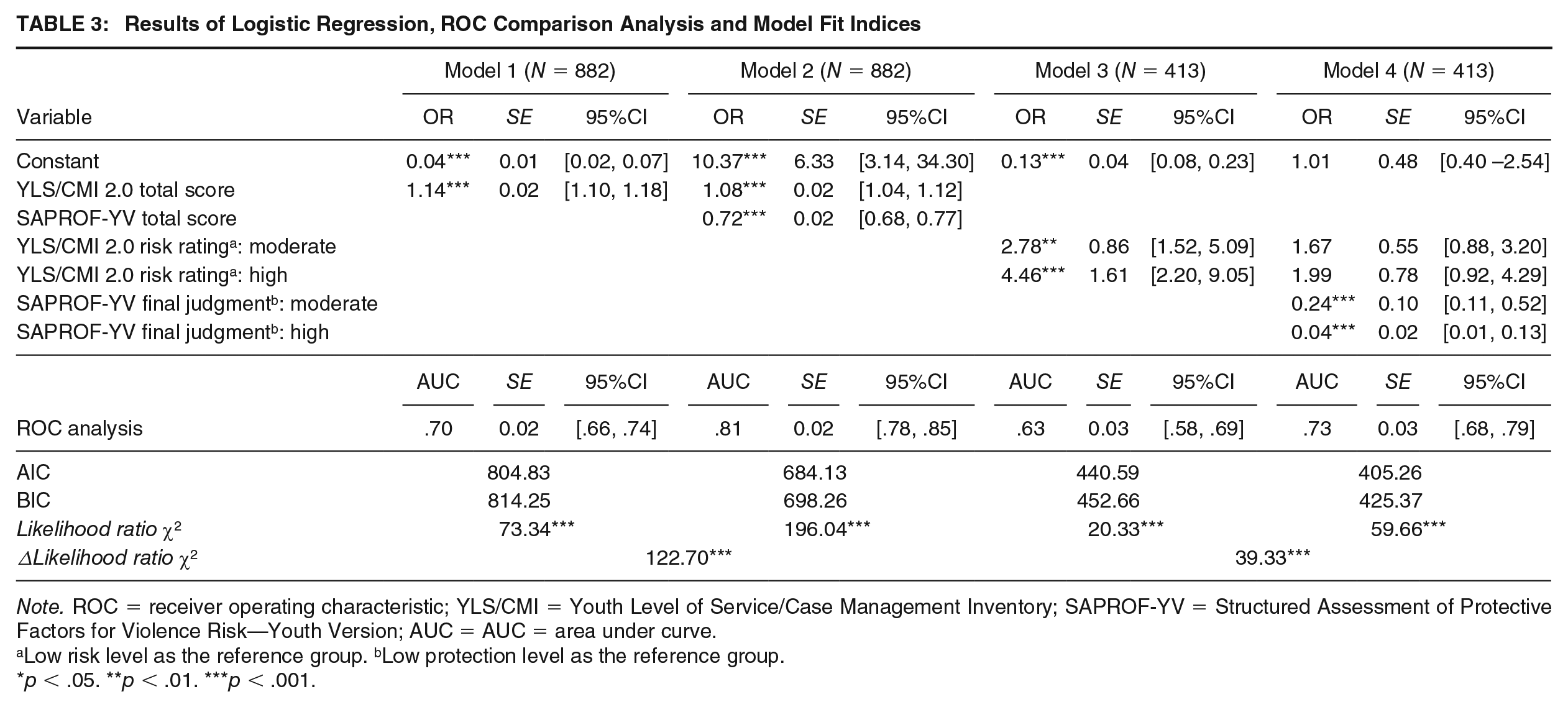
Note. ROC = receiver operating characteristic; YLS/CMI = Youth Level of Service/Case Management Inventory; SAPROF-YV = Structured Assessment of Protective Factors for Violence Risk—Youth Version; AUC = AUC = area under curve.
Low risk level as the reference group. bLow protection level as the reference group.
p < .05. **p < .01. ***p < .001.
In addition to AUC values, the model fit indices of the models with and without the SAPROF-YV total scores were compared. The likelihood ratio test was conducted. Results showed that the model improved significant after including the SAPROF-YV total score (χ2[1, N = 822] = 122.70, p < .001). Furthermore, the AIC and BIC values for Model 2 were much lower than Model 1. Although there are no absolute standards for evaluating differences in AIC and BIC indices, Raftery (1995) suggests that absolute differences in BIC indices greater than 10 are very strong. It indicated that in this study, the model fit was improved after the inclusion of the SAPROF-YV total score.
The incremental validity of the SAPROF-YV final judgment was also tested. Model 3 included YLS/CMI 2.0 risk rating as the only predictor and Model 4 included both SAPROF-YV final judgment and YLS/CMI 2.0 risk rating as predictors. The association between YLS/CMI 2.0 risk rating and general recidivism became statistically indistinguishable from zero after adding the SAPROF-YV final judgment into the logistic regression model. Furthermore, the inclusion of the SAPROF-YV final judgment significantly improved the predictive accuracy for general recidivism (χ2[1, N = 413] = 34.28, p < .001). Results of the likelihood ratio test also indicated that the model fit for Model 4 improved significantly as compared to Model 3 (χ2[1, N = 822] = 39.33, p < .001). In addition, Model 4 reported lower values of AIC and BIC as compared to Model 3, which also indicated a better model fit.
Discussion
This study aimed to gain insights into the utility of SAPROF-YV, a structured assessment tool for protective factors, in predicting recidivism in male youth under community supervision. Results provided supporting evidence for the SAPROF-YV’s concurrent validity, predictive validity, as well as incremental validity in predicting general recidivism. This includes any conviction of violent, sexual, and nonviolent nonsexual offenses that were committed following the initial court order, breaches of court orders, or any combination of the aforementioned outcomes, in a non-western context.
As an independent island-state in Southeast Asia, Singapore has a low crime rate. With a total population of 5.47 million (Singapore Department of Statistics, 2015), Singapore reported a total of 32,964 crime cases in 2016 (Singapore Police Force, 2017). Furthermore, Singapore has a low recidivism rate among justice-involved youth. In this study, the general recidivism rate with a 2-year follow-up was about 22%. Similarly, Chu et al. (2015) reported that the rate of general recidivism for Singaporean justice-involved youth who were charged between 2004 and 2008 was about 38%, with a mean follow-up period of 1,765 days. On the other hand, about 65% of youth sentenced to rehabilitation orders in the United Kingdom reoffended within 1 year (Ministry of Justice & National Statistics, 2018), and 50% youth released from community sentence in Texas, United States reoffended within 3 years (Texas Juvenile Justice Department, 2018). Although there were differences in the definition of recidivism and the length of follow-up period, the recidivism rate in Singapore was, in general, lower than Western countries. Examining the predictive validity of the SAPROF-YV ratings for general recidivism in Singapore would improve our understanding about the utility of assessing protective factors in the context of low crime rate and low recidivism rate.
The Concurrent Validity of the SAPROF-YV
This study found a significant negative correlation between the SAPROF-YV and the YLS/CMI 2.0 total scores, which confirmed the concurrent validity of the SAPROF-YV. The results were in line with the findings from previous SAPROF-related studies, which have found significant correlations between the SAPROF and other risk assessment tools, such as HCR-20 and SVR-20 (e.g., Abbiati et al., 2017; de Vries Robbé, de Vogel, Koster, & Bogaerts, 2015).
In addition, the values of the correlation coefficients showed that the SAPROF-YV only partially overlapped with the YLS/CMI 2.0, indicating that the presence of protective factors did not definitively imply the absence of risk factors. Put differently, there could be a unique contribution of assessing protective factors for male youth under community supervision to obtain a more complete picture of factors associated with general recidivism.
The Predictive Validity of the SAPROF-YV
The predictive validity analyses revealed significant results for the SAPROF-YV. Both the correlation analyses and logistic regressions suggested that the SAPROF-YV total score was a significant predictor for general recidivism among male youth under community supervision, albeit it is a negative association. Furthermore, the ROC analyses found that the SAPROF-YV total score and final judgment showed large and moderate effect sizes for predicting general recidivism, respectively (AUCtotal_score = .80; AUCfinal_judgment = .70). Overall, the findings were consistent with the results from existing SAPROF literature. In particular, the predictive validity of the SAPROF-YV total score for general recidivism in this study was found to be higher than those of the SAPROF total score in Western studies (Abbiati et al., 2017, 2019; Klein et al., 2015; Turner et al., 2016; Yoon et al., 2018). On the other hand, the predictive validity of the SAPROF-YV final judgment rating in this study was comparable with those of the SAPROF final judgment in Western studies (Abbiati et al., 2017, 2019; Klein et al., 2015). Taken together, the findings from the predictive validity analyses provided supporting evidence for using the SAPROF-YV ratings to assess protective factors and predict general recidivism for male justice-involved youth. The use of the SAPROF-YV in youth rehabilitation services may facilitate a more comprehensive assessment and effective interventions.
The Incremental Validity of the SAPROF-YV
Singapore has adopted the YLS/CMI and subsequently the YLS/CMI 2.0 as the primary measure to assess the risk and needs of justice-involved youth since the introduction of the RNR framework in the early 2000s (Chua et al., 2014). The validity of YLS/CMI 2.0 has been examined in the Singaporean context using a sample of 3,264 youths (Chu et al., 2015). The YLS/CMI 2.0 total score was found to be moderately predictive of general recidivism (AUC = .64 for the entire sample and AUC = .65 for the male subsample). Our findings were consistent with Chu et al. (2015).
Building upon the previous study on the predictive validity of the YLS/CMI 2.0 ratings, this study examined the incremental validity of the SAPROF-YV in addition to the YLS/CMI 2.0 for predicting general recidivism. When the SAPROF-YV total score/final judgment was used in conjunction with the YLS/CMI 2.0 total score/risk rating, the predictive accuracy for general recidivism improved significantly as compared to the model using the YLS/CMI 2.0 total score/risk rating only. The findings indicated that the SAPROF-YV total score and final judgment rating have sufficient value to complement risk-focused tools (e.g., the YLS/CMI 2.0) in assessment and treatment for male youth under community supervision. Applying the SAPROF-YV in assessments could gain a more complete and balanced picture of youth under community supervision.
Implications
One major value of the SAPROF-YV could be its prospective guidance for intervention efforts. The SAPROF-YV provides a dynamic, protection-focused assessment of youth for the upcoming 6 months, though there seems to be utility for long-term assessments. Considering the individuals’ development, the dynamic nature of the SAPROF-YV and its utility over short- to medium-term timeframes allows professionals to focus on building strength in youth. This could have a positive influence on the reduction of youth’s offending behavior and ultimately facilitates their reintegration to the society. Importantly, the SAPROF does not only measure individual variables but takes into account contextual and environmental dynamic factors that are purportedly protective in nature. That being said, the SAPROF-YV was not intended to replace existing risk-focused assessment tools, rather it complements the predominant risk-oriented assessment practices in youth rehabilitation. In particular, the SAPROF-YV user manual suggested that SAPROF-YV should be rated concurrently with a risk assessment tool and that the final decision should be made based on the findings of both SAPROF-YV and the risk-focused tool.
It is clear that the SAPROF-YV has substantial utility for assessing the risk of recidivism (or desistance from reoffending); and it offers a more balanced assessment that complements the traditionally risk-focused assessments. Notably, risk assessments should be contextualized, and the SAPROF-YV provides the platform to do so. However, a pertinent question would relate to how clinicians can integrate data from the risk-focused assessment measures with those that examine protective factors (e.g., SAPROF-YV). Further research can perhaps shed light on how clinicians can account for the interactive relationship of various protective and risk factors with general recidivism, for example, the booster or buffering effects as detailed in Li et al. (2019) and integrate the complex information quantitatively and qualitatively into their risk assessments and formulations. It could in turn provide useful information for case management and intervention planning related to youth under community supervision.
In addition, with large amount of data on risk and protective factors as well as individuals’ socioeconomic status, machine-learning models could be utilized to predict recidivism of justice-involved youth. Such data-driven approach does not make any assumptions on how each factor influences the outcome. This approach could be more accurate and robust than conventional statistical methods, especially in an information-rich environment (Ting et al., 2018). In this sense, information obtained from the predictive modeling could augment professional decisions and help stakeholders to identify individuals who may require more attention and support.
Limitations
First, this study shared the limitations of other studies using retrospective chart review method (Gearing et al., 2006). Although commonly used in clinical research, the retrospective chart review is limited by possible absence of relevant files or missing information in the files as data were not recorded for research purposes in the first place. To address the main methodological problems using this design, two full release cohorts of probation cases were used in this study to avoid sampling and power issues. All relevant case files were used when coding SAPROF-YV to provide as much information as possible. In addition, it would be rewarding to conduct a prospective study to collect more information about justice-involved youth and better predict recidivism.
Second, the YLS/CMI 2.0 was rated prospectively by probation officers based on face-to-face interviews, whereas the SAPROF-YV was coded retrospectively by research assistants based on case reports. Despite these differences, the same time frame was applied to both tools (i.e., the presentencing stage before the probation order started). In addition, the information gathered by the probation officers during interviews was also included in their respective case reports, which were in turn used as one of the sources to code for SAPROF-YV. In other words, the discrepancy between the information available to probation officers and that to research assistants would not be extensive. Nevertheless, interpretation of the findings should take into consideration the different coding methods of the two assessment tools.
Third, the SAPROF-YV was developed to assess the protective factors for youth with violent behavior. Nonetheless, given the data constraints, this study examined the use of SAPROF-YV in predicting general recidivism, which includes any conviction of violent, sexual, and nonviolent nonsexual offenses that were committed following the initial court order, breaches of court orders, or any combination of the aforementioned outcomes. Future research could examine the relationship of SAPROF-YV with technical violation and reconviction, respectively. Furthermore, it would be beneficial to conduct prospective research to collect more information about the types of offending behavior and examine the validity of SAPROF-YV in predicting different types of reoffenses, particularly violent offenses.
Fourth, pertaining to gender differences, the study examined the validity of the SAPROF-YV for male youth under community supervision. Female youth were not examined, given the small subsample size. The pathways for offending may vary for male and female justice-involved youth, which would lead to differences in the impact of risk and protective factors on offending behavior. Future research could explore the utility of SAPROF-YV in assessing female youth involved in the justice system and further look into gender differences in the pathways for (re)offending. This may help provide empirical evidence to support gender-responsive interventions in youth rehabilitation.
Finally, this study used a medium-term follow-up (2-years) for general recidivism. Future studies could examine the utility of SAPROF-YV in predicting recidivism with a longer follow-up period to further confirm its long-term predictive validity. Given that the SAPROF-YV items are dynamic in nature and that these protective factors can be reassessed within 6 to 12 months, it is possible to use such information from multiple time points to capture the change of protective factors over time. This could improve the accuracy in predicting recidivism and understand how protective factors influence recidivism.
As a concluding remark, this study provided supporting evidence on the concurrent validity, predictive validity, and incremental validity of the SAPROF-YV in predicting general recidivism among Singaporean male youth under the community supervision. It contributed to the existing literature related to protective factors and provided useful information for policy and interventions related to youth assessment and rehabilitation.
