




Abstract
The present study sought to replicate and extend current knowledge on the relevance of emotion regulation (ER) for psychopathy. In a large sample of incarcerated adult males (N = 578), latent profile analysis (LPA) and structural equation modeling (SEM) were employed to examine person- and variable-centered associations between self-reported ER and both self-report and clinical ratings of psychopathy. With LPA, participants were classified into three profiles corresponding to low, medium, and high ER. The low-ER profile displayed higher affective traits across psychopathy assessments compared with the other profiles. The same pattern of findings was evident for overt behavioral features of psychopathy, but not for interpersonal traits. SEM results were consistent with LPA findings: interpersonal (positively), affective, and lifestyle (negatively) facets had unique associations with a superordinate ER latent variable. Findings replicate and extend prior associations between psychopathy and ER and suggest differential links between ER and affective and interpersonal traits of psychopathy.
Keywords
The construct of psychopathy is represented by a cluster of affective (e.g., lack of empathy and remorse), interpersonal (e.g., manipulation and grandiosity), and behavioral (e.g., impulsivity and irresponsibility) features, along with early, persistent, and versatile antisocial tendencies (Hare & Neumann, 2008; Neumann et al., 2007). In addition, some investigators consider boldness/fearless dominance as a stand-alone feature of the psychopathy construct (Lykken, 1995; Patrick et al., 2009). The inclusion of indices of antisociality and fearless dominance within the construct of psychopathy has been the center of ongoing debates (Crego & Widiger, 2015; Hare & Neumann, 2010; Lilienfeld et al., 2012; Miller & Lynam, 2012; Skeem & Cooke, 2010). Thus, combining different operationalizations of psychopathy within a same study is desirable to achieve a comprehensive understanding of the construct. Conceptual debates notwithstanding, it is widely recognized that psychopathy has substantial impact on the criminal justice and forensic mental health care systems, largely due to the disproportionate cost that psychopathic individuals pose on society, their high rates of recidivism, and their resistance to existing treatment approaches (DeLisi et al., 2018; Reidy et al., 2015; Skeem et al., 2011).
An emotion regulation (ER) framework has been a useful transdiagnostic approach for understanding the development and manifestation of psychopathology in general, and personality disorders in particular (Dimaggio et al., 2017; Kring & Sloan, 2009). However, the construct of ER has been relatively neglected in the psychopathy field, which may be due in part to a conception of the psychopath as a “calm, cool, and collected” predator (Baskin-Sommers, 2017). Treatment guidelines for psychopathy are pessimistic about the utility of interventions aimed at improving ER for psychopathic individuals (Wong & Hare, 2005). Nevertheless, psychopathy is a form of personality pathology (Cleckley, 1941/1988; Hare & Neumann, 2008; Patrick et al., 2009), and a deeper understanding of ER in psychopathy appears to be a productive avenue of investigation and may eventually inform interventions targeting ER (Garofalo & Neumann, 2018). In an attempt to provide incremental knowledge in this area, the present study aimed at replicating and extending recent findings (e.g., Garofalo, Neumann, & Velotti, 2018) on the associations between psychopathic traits and ER among incarcerated adult males, by combining person- and variable-centered methods.
Emotion Regulation and Psychopathy: Conceptual Background
Many accounts of psychopathy emphasize abnormalities in emotional functioning as central features of the disorder (Blair, 2005; Cleckley, 1941/1988; Hare, 2003; Lykken, 1995; Patrick et al., 2009); yet, there is no consensus on the exact nature or scope of such abnormalities (Seara-Cardoso & Viding, 2015). Early theorists described the presence of low frustration tolerance, emotional instability, and uncontrolled emotional reactions in the psychopathic syndrome (Garofalo & Neumann, 2018), but these features have received little empirical scrutiny compared with other aspects of emotional functioning (Hoppenbrouwers et al., 2016). Yet, these earlier recognized features of emotional disturbance align with the broader concept of ER, defined here as the ability to monitor, use, and modulate emotional experiences and expression to promote adaptive functioning (Etkin et al., 2015). Thus, trait ER, typically measured through self-report, assesses individual differences in emotional awareness (i.e., propensity to attend to one’s own emotional experience), emotional clarity (i.e., extent to which individuals understand the emotion they are feeling), and emotional modulation (i.e., the capacity to maintain or increase positive emotions and decrease negative emotions). Conceptually, the emotional modulation component is perhaps the most directly linked to the layperson idea of regulating emotions (i.e., engaging in strategies to modify one’s emotional experience and/or expression). However, attention to emotions and emotional understanding are likewise considered as integral components in most contemporary models of ER (Gratz & Roemer, 2004; Gross & Barrett, 2011).
Specifically, theories that emphasize the functional nature of emotions go beyond equating the concept of ER with emotional control, arguing that ER does not necessarily involve immediate efforts to reduce (negative) emotional arousal. Rather, these perspectives argue that difficulties in the capacity or propensity to modulate or reduce negative emotional arousal are at least as maladaptive as difficulties in the capacity or propensity to (a) experience and differentiate the full range of emotional experiences (i.e., emotional clarity or understanding); (b) to monitor and evaluate emotions (i.e., attention to emotion, or emotional awareness); and (c) to respond spontaneously (i.e., emotional acceptance) as they unfold (Barrett et al., 2001; Cole et al., 1994; Gross & Munoz, 1995; Thompson & Calkins, 1996).
Examples of self-report instruments of trait ER in line with the above conceptualization are the widely used Trait Meta-Mood Scale (TMMS; Salovey et al., 1995) and the more recent Difficulties in Emotion Regulation Scale (DERS; Gratz & Roemer, 2004). 1 The research literature indicates that the TMMS and DERS are significantly intercorrelated (e.g., Giromini et al., 2012). In addition, the TMMS has demonstrated good convergent and discriminate validity (e.g., Salguero et al., 2010; Salovey et al., 2002), consistent with its conceptualization as an index of ER. Moreover, studies have highlighted that the TMMS scales are linked to electrophysiological (Fisher et al., 2010) and structural brain characteristics (Koven et al., 2011) involved in ER. Thus, the TMMS in particular is an optimal measure for assessing components of ER.
Although the TMMS and DERS are meant to capture multiple components of ER in an attempt to elucidate differential associations with external correlates, the extent to which each of these components can be selectively impaired at the individual level remains unclear. Currently, the research literature suggests the components of ER are tightly interconnected (Garofalo & Neumann, 2018). Also, interventions aimed at improving ER, broadly construed, have proven effective in the treatment of other forms of severe personality pathology (Gratz et al., 2015). In this context, it is helpful to examine the relevance of ER for psychopathy from a person-centered perspective, to understand whether psychopathic traits are higher in individuals with selected (i.e., single components) versus global disturbances in ER. One recent study has addressed this issue by employing latent profile analysis (LPA; Garofalo, Neumann, et al., 2018) and found that ER difficulties assessed with the DERS subscales were tightly interconnected at the person level, as they did not find evidence of individual profiles with impairments in some (e.g., emotional clarity) but not in other (e.g., emotion modulation) domains of ER. An important difference between the DERS used in Garofalo, Neumann, et al.’s (2018) study and the TMMS used in the current study is that the TMMS only assesses a portion of the ER skills that are operationalized in the DERS model of ER.
From a theoretical standpoint, uncovering an empirical association between psychopathic traits and poor ER can provide novel insights into the possible processes underlying the typical affective characteristic of the disorder (e.g., callousness), as well as its more overt, behavioral features (e.g., impulsivity, antisociality). From a clinical perspective, identifying the importance of ER in the manifestation of psychopathy would provide practitioners with a dynamic risk factor for violence that is amenable to change if properly treated (Garofalo, Velotti, & Zavattini, 2018; Roberton et al., 2015). Indeed, poor ER has consistently been linked to aggression and violence, including more proactive forms of aggression (Garofalo, Velotti, et al., 2018; Roberton et al., 2012), and may at least partly account for the association between psychopathy and aggression (Harenski & Kiehl, 2010; Long et al., 2014).
Emotion Regulation and Psychopathy: The State-of-the-Art
In contrast to studies on emotional reactivity, recognition, and processing, only few studies have examined associations between psychopathy and trait ER (Garofalo & Neumann, 2018; Kosson et al., 2016). In these studies, both the interpersonal–affective and the antisocial–lifestyle traits of psychopathy were related with lower levels of ER across different populations (i.e., community and prison samples) and different psychopathy measures (i.e., self-report and clinician-rated) based on Hare’s (2003) Psychopathy Checklist—Revised (PCL-R) conceptualization. Notably, these associations were widespread across ER components, and relatively larger effect sizes were reported for negative associations between ER and the antisocial-lifestyle psychopathic traits, compared with interpersonal-affective traits (Malterer et al., 2008; Miller et al., 2010).
A characteristic of most previous studies is that they relied on the early two-factor conceptualization of psychopathy, collapsing (PCL-R) interpersonal–affective traits into what is referred to as Factor 1 and antisocial–lifestyle traits into Factor 2. Neumann and colleagues have shown that a four-factor model provides a more nuanced understanding of the psychopathy syndrome, and that the four factors have differential links with external correlates (Hare & Neumann, 2008). Importantly, the interpersonal and affective traits of psychopathy had shown associations in opposite directions (positive and negative, respectively) with higher IQ, better executive functioning, and white matter volume (Baskin-Sommers et al., 2015; Vitacco et al., 2005; Yang et al., 2005), all of which have relevance for ER. Thus, parsing the interpersonal and affective features of psychopathy in separate components may shed light on differential associations with ER as well.
Other studies have examined associations between self-report measures of ER and psychopathy using the Psychopathic Personality Inventory—Revised (PPI-R; Lilienfeld & Widows, 2005), which parses the interpersonal and affective features of psychopathy in separate components (fearless dominance and coldheartedness, respectively). In both undergraduate and substance user samples, higher scores on the PPI-R self-centered impulsivity factor (akin to antisocial-lifestyle features) were associated with poorer ER. Conversely, higher scores on the PPI-R fearless dominance factor were associated with better ER (Donahue et al., 2014; Long et al., 2014; Watts et al., 2016), and this effect was driven by positive associations between ER and the subscales of stress immunity and social potency (Donahue et al., 2014; Long et al., 2014). Finally, ER was largely unrelated to the PPI-R coldheartedness scale (Donahue et al., 2014; Long et al., 2014; Watts et al., 2016), which captures callous affective traits. Notably, there was a uniform pattern of associations between the different components of ER and psychopathic traits.
In summary, most prior studies supported an association between the antisocial–lifestyle features of psychopathy and poorer ER across domains. In contrast, associations between ER and the interpersonal and affective traits of psychopathy seem to differ based on which measure of psychopathy was used (e.g., PCL-R vs. PPI-R) and on whether interpersonal and affective traits are considered separately or as one factor. A more comprehensive examination of these relations could be achieved by combining these different operationalizations of psychopathy within the same study. In addition, all prior studies were focused on variable-centered associations. In contrast, a person-centered approach might help elucidate whether selective components of ER can be impaired at the individual level and whether distinct constellations of ER impairments are differentially related to psychopathic traits. The potential advantage of using person-centered approaches has a long history in psychology: for example, Block (1971, p. 13) argued compellingly that while Variable-centered analyses are useful for understanding the differences between people and what characteristics go with what characteristics in a group of individuals . . . ultimately, psychology will need to seek understanding of the configuration and systematic connection of personality variables as these dynamically operate within a particular person.
Such an approach may be particularly important to provide information that is clinically meaningful. More comprehensively, variable- and person-centered approaches entail substantially different assumptions and treatment of the data, and thus, converging results across approaches substantially aids in demonstrating the verisimilitude of the findings.
To the best of our knowledge, only one recent study has attempted to identify ER profiles and determine how such profiles were associated with psychopathic traits in a sample of individuals convicted for violent offenses (Garofalo, Neumann, et al., 2018). In this study, using LPA, Garofalo, Neumann, et al. (2018) reported that difficulties in ER subcomponents—measured with the six DERS subscales—varied globally across individuals in terms of severity rather than distinct DERS profiles. Interestingly, the low, medium, and high ER profiles had linear associations with the affective and lifestyle traits of psychopathy, which were linked to poorer ER. A similar trend emerged for the antisocial facet, but not for the interpersonal facet (Garofalo, Neumann, et al., 2018). These findings are in accordance with differential associations between cognitive processes and affective versus interpersonal traits of psychopathy. However, Garofalo, Neumann, et al. (2018) did not examine whether these differential relationships with ER extended to the unique variance in affective and interpersonal features of psychopathy when controlling for their shared variance. Indeed, they reported that a superordinate psychopathy factor had significant associations with poorer ER, even after controlling for indices of general psychological distress.
Despite the novel approach adopted, Garofalo, Neumann, et al.’s (2018) study was limited in that it only relied on one self-report measure of psychopathy. This could have unduly inflated associations with self-reported ER due to shared method variance. In addition, it is unclear whether those findings would generalize to alternative operationalizations of psychopathy, such as those that include fearless dominance traits. Finally, Garofalo, Neumann, et al.’s (2018) recent work did not examine relations between ER and the unique variance in psychopathy facets, which could have important conceptual and clinical implications, since psychopathy variants tend to differ in the extent they are characterized by interpersonal psychopathic traits (e.g., Mokros et al., 2015). In light of these considerations and of the increasing acknowledgment of the importance of replication studies in psychological research, the present study was designed to replicate and extend these recent findings and further elucidate associations between psychopathy and ER.
The Present Study
To further our understanding of the relevance of ER in psychopathy, the present study employed both person- and variable-centered methods to (a) uncover latent profiles of incarcerated individuals based on trait ER skills assessed through the TMMS (Salovey et al., 1995); (b) examine how the emergent ER profiles differed on both clinician-rated and self-report psychopathic traits; and (c) model associations between latent ER and psychopathic personality traits, while accounting for general psychopathological distress, verbal cognitive ability (as a proxy of IQ), and age. Based on the conceptual framework that led to the development of multidimensional measures of ER, including the TMMS, one might expect different profiles to emerge showing impairments in some but not other TMMS scales (e.g., one profile with selected problems in emotional modulation but not in attention to emotions and emotional clarity). However, based on recent reviews of the weak discriminant validity of subscales included in ER measures (e.g., John & Eng, 2014), and recent ER research (Garofalo, Neumann, et al., 2018), it was plausible to expect that individuals will instead be differentiated dimensionally (i.e., by degrees rather than kind) in terms of broad ER impairments across domains. Thus, we expected to uncover at least two latent classes, with one showing poorer or lower ER. Next, we hypothesized that participants with lower ER would show higher psychopathic traits across domains, with the exception of interpersonal traits (based on the findings of Garofalo, Neumann, et al., 2018), and that these associations would be supported by variable-centered analyses.
Method
Participants and Procedures
The data for the current study were generously shared by Professor Joseph Newman (personal email communication, November 25, 2016, at 1:51 PM). The sample consisted of 578 adult males incarcerated in Wisconsin state prisons. Data on race/ethnicity and age were not available for all 578 cases, but for those who had a value for these variables, the sample was composed of both White (44%) and Black (56%) incarcerated males with a mean age of 29.24 (SD = 7.11) years. With respect to the ER and psychopathy variables used in the current study, there were only trivial difference between the cases with (57%) versus without (43%) full demographic information (i.e., missing both race/ethnicity and age data; most nonsignificant, mean η2 = .01). 2 Potential participants were randomly selected among incarcerated males not older than 50 years, excluding those with a psychotic or bipolar disorder, with estimated IQ < 70, or currently taking psychotropic medication (according to institutional file information). All participants were briefed about the study procedures in both written and oral form and provided written informed consent to take part in the study. Participants were also informed that participation was voluntary and were ensured that their decision to participate would not have any influence on their correctional status. Study procedures received ethical approval from the local university institutional review board.
Measures
Trait Meta-Mood Scale
The TMMS was used to assess trait ER (Salovey et al., 1995). The TMMS is a self-report questionnaire including 30 items. Participants had to rate to what extent they agreed with each statement on a 5-point Likert-type scale ranging from 1 (strongly disagree) to 5 (strongly agree). The TMMS measures three related dimensions of ER: attention to emotions, that is, the tendency to pay attention to and reflect upon emotions (e.g., “I don’t pay much attention to my feelings,” reverse scored); clarity of emotional experience (e.g., “I can’t make sense out of my feelings,” reverse scored); and emotional repair, that is, the typical ability to decrease negative emotional states (e.g., “No matter how badly I feel, I try to think about pleasant things”). Greater scores on each scale indicate greater ER propensities. The three TMMS scales can be summed to produce an overall TMMS score, which has been shown to be a reliable and valid index of trait ER (Salovey et al., 1995).
Psychopathy Checklist—Revised
The PCL-R is a clinical measure of psychopathy based on a semi-structured interview and file information (Hare, 2003). The PCL-R consists of 20 items indicative of psychopathic traits, each scored on a 3-point scale (0 = clearly not present, 1 = maybe present, 2 = clearly present). Although early work with the PCL-R revealed a replicable two-factor structure, subsequent factor analytic studies have revealed that the PCL-R items are best modeled as first-order facets measuring interpersonal (e.g., grandiosity, manipulation), affective (e.g., lack of empathy and remorse), lifestyle (e.g., impulsivity and irresponsibility), and antisocial (e.g., early conduct problems and versatile antisocial behavior) features (Neumann et al., 2015). Two of the 20 items (promiscuous sexual behavior, and many short-term marital relationships) do not load on any facets but contribute to the PCL-R total scores, which can range from 0 to 40. In line with standard practices (Hare, 2003), scores of 30 or above on the PCL-R can be used to identify “psychopathic” individuals for research purposes. The reliability and construct validity of the PCL-R are well established (Neumann et al., 2015). For the present study, PCL-R ratings were based on information gathered during a semi-structured interview and collateral information found in the institutional files. Interviews and file reviews were conducted by undergraduate or graduate students after completion of a formal PCL-R training, which consisted of both didactic (e.g., readings and clinical cases) and practical training (e.g., observation of and supervision by an expert rater). Ongoing group supervision was arranged to resolve concerns with the ratings and to minimize rater drift. To gauge inter-rater reliability, a second rater was present in the room and provided independent PCL-R ratings for 47 participants. The intra-class correlation coefficient was .95.
Psychopathic Personality Inventory
Self-report psychopathic traits were assessed using the PPI (Lilienfeld & Andrews, 1996), a 187-item questionnaire designed to measure a broad range of psychopathic traits, including those described by Cleckley (1941/1988). Participants had to rate the items on a 4-point Likert-type scale ranging from 1 (false) to 4 (true). The PPI includes eight subscales: fearlessness (i.e., risk taking and lack of anticipatory anxiety), social potency (i.e., charm and leadership), stress immunity (i.e., limited response to stress provoking events), coldheartedness (i.e., callousness and lack of empathy), Machiavellian egocentricity (i.e., selfishness and exploitative interpersonal orientation), carefree nonplanfulness (i.e., irresponsibility and lack of future orientation), blame externalization (i.e., moral disengagement and perception of others as cause of troubles), and impulsive nonconformity (i.e., recklessness and noncompliance with social norms). The PPI total score has been proposed to represent a global index of psychopathic traits with adequate psychometric properties and construct validity (Lilienfeld & Fowler, 2006). Seven of the eight PPI scales are often combined to create two higher-order factors. The fearlessness, social potency, and stress immunity subscales load onto the fearless dominance factor. The Machiavellian egocentricity, carefree nonplanfulness, blame externalization, and impulsive nonconformity subscales load on the self-centered impulsivity factor. The coldheartedness subscale represents a stand-alone dimension that does not load onto either factor. In the present study, we focused on the eight lower-order subscales of the PPI, because prior studies have shown that they have divergent associations with ER.
Symptom Checklist-90-Revised
The Symptom Checklist-90-Revised (SCL-90-R) was used to control for the potential confounding of general psychological distress (Derogatis, 1994). The SCL-90-R includes 90 items rated on a 5-point Likert-type scale that measures the presence and severity of psychological symptoms across different domains. In the present study, we used the items tapping on somatization, depression, anxiety, hostility, phobic anxiety, and paranoid ideation, to compute a proxy of general psychological distress (see Figure 1 for factor loadings).
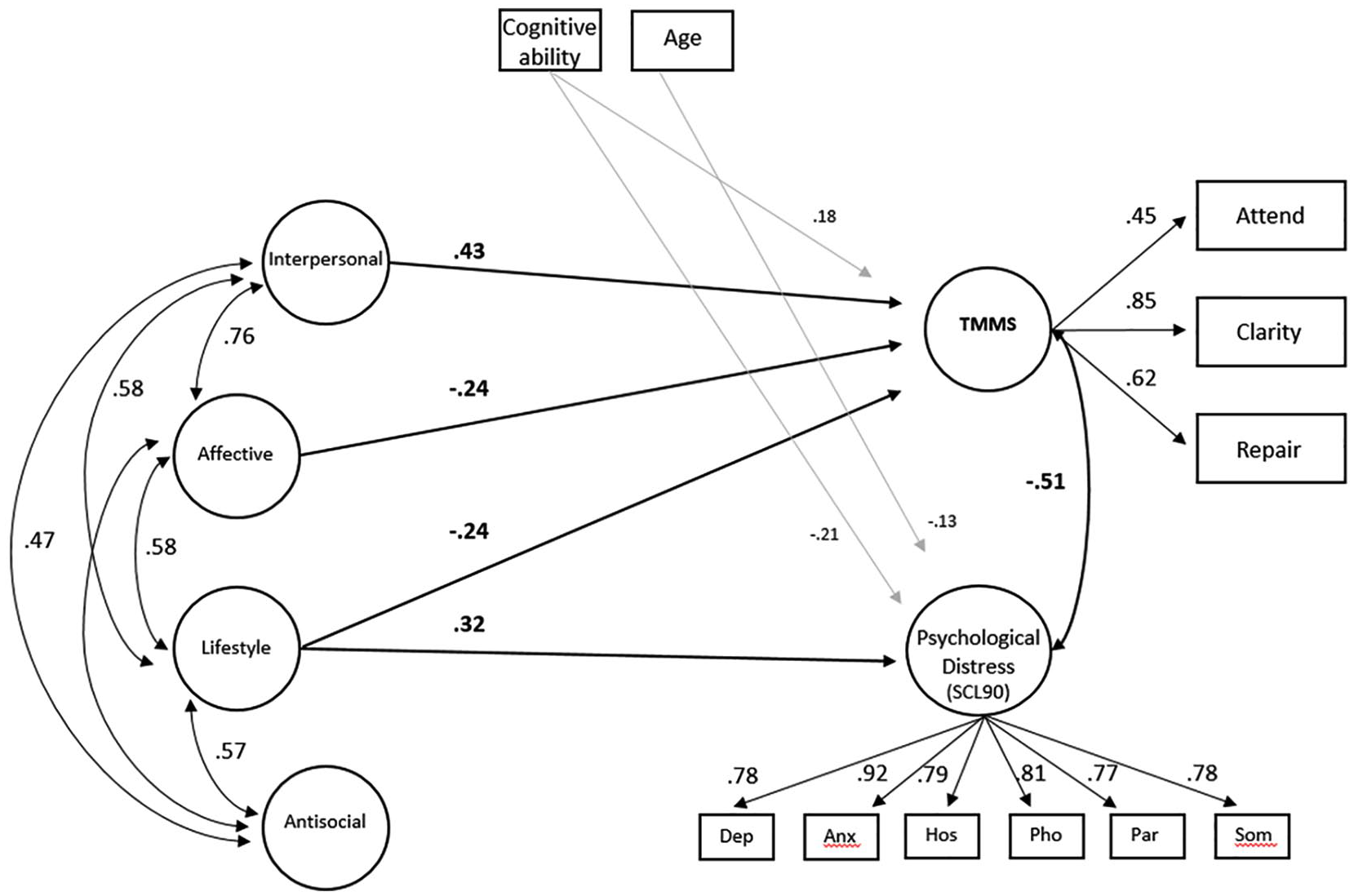
Structural Equation Modeling Results: PCL-R Factors Predicting TMMS and SCL-90 Factors, Controlling for Age and Cognitive Ability
Shipley Institute of Living Scale
To control for a proxy of IQ, we used the Shipley Institute of Living Scale (SILS), a measure of verbal cognitive ability including 40 vocabulary items and 20 abstract reasoning items (Zachary, 1986).
Data Analytic Approach
Descriptive statistics, internal consistency values, and bivariate correlations were computed for all study variables. Latent variable methods were employed using Mplus (Muthén & Muthén, 2013). LPA was used to determine whether individuals could be classified in subgroups based on their TMMS profiles across the three different domains (i.e., attention to emotions, clarity of emotional experience, and emotional repair). LPA is a person-centered approach used to cluster participants on a set of variables (i.e., identify within the data latent subgroups of individuals that are similar in terms of constellations of indicators through maximum likelihood estimation) and represents an extension of latent class analysis for continuous observed variables (Hallquist & Wright, 2014). This model-based technique seeks to identify nominal variables underlying the continuous data (Rost, 2006). The best solution is obtained when the average latent class probabilities for the most likely class membership are .80 or greater (Rost, 2006). The Bayesian information criterion (BIC) and sample-size-adjusted BIC are reliable indices for selecting the optimal model based on simulation studies (Nylund et al., 2007). Models with the lower BIC values are preferred. The Lo–Mendell–Rubin (LMR) likelihood difference tests the fit between two nested models that differ by one class. A significant p-value indicates that a model fits the data significantly better than a model with one less class. A nonsignificant LMR test for k classes indicates that the k – 1 class solution is a better model. Theoretical coherence is also useful for deciding on optimal number of classes. Because each strategy offers a different means of identifying the optimal number of classes, we used a set of strategies for selecting viable model solutions (i.e., BIC, LMR p-value, and classification accuracy). To be comprehensive, we also used Latent Gold (Vermunt & Magidson, 2005) to test that our findings replicated with a different modeling program.
To validate TMMS profiles, primary analyses involved a series of planned comparisons (one-way analyses of variance [ANOVAs]) between a hypothesized low-ER profile with the other profile(s) that emerged from the LPA with higher ER. The PCL-R facets and the PPI subscales were used as dependent variables. To be comprehensive, we also conducted the recently developed three-step approach (Asparouhov & Muthén, 2014), which resulted in a similar pattern of profile validation. In addition, we tested through chi-square analyses whether the low-ER profile had proportionally more cases above the PCL-R cut-off for psychopathy, compared with the other profile(s). The profiles were also compared on age, education, race/ethnicity, and cognitive ability.
Second-stage analyses involved a variable-centered approach, structural equation modeling (SEM), using weighted least square mean and variance adjusted (WLSMV) estimation to model ordinal data. Confirmatory factor analysis (CFA) was conducted using PCL-R and TMMS items as indicators for their respective factors. We expected adequate fit for a combined PCL-R/TMMS model given previous research. Structural integrity of the PPI was tested through CFA, using the scale items as indicators for each of their respective eight PPI factors. Based on past research (Neumann et al., 2013), we hypothesized that this model would not show adequate fit and the PPI could, therefore, not be modeled in variable-centered analyses. In that case, SEM analyses would be conducted to test the four PCL-R facets as predictors of a superordinate TMMS factor, controlling for age, cognitive ability, and general psychological distress. Nevertheless, given the traditional appeal and the potential conceptual relevance of the PPI, it would be retained for the person-centered analysis. To assess model fit, a two-index strategy was adopted (Hu & Bentler, 1999), using the incremental comparative fit index (CFI) and the absolute root mean square error of approximation (RMSEA) index. We relied on the traditional CFI ≥ .90 and RMSEA ≤ .08 as indicative of acceptable model fit to avoid falsely rejecting viable latent variable models, given that model complexity increases the difficulty of achieving conventional levels of model fit (West et al., 2012).
Results
Descriptive statistics, internal consistency, and a full correlation matrix are reported in Table 1. For the total sample, 83 (14.4%) of participants met PCL-R cut-off (≥30) for psychopathy, 333 (57.6%) had scores between 18 and 29, and 162 (28%) were below 18. There was a broad pattern of inverse associations between psychopathy and TMMS scales, except for PCL-R interpersonal and PPI social potency and stress immunity scales (see Table 1). These associations fell in the small-to-moderate range.
Means, Standard Deviations, Internal Consistency (α and MIC) Coefficients, and Zero-Order Correlations for All Study Variables (N = 578)
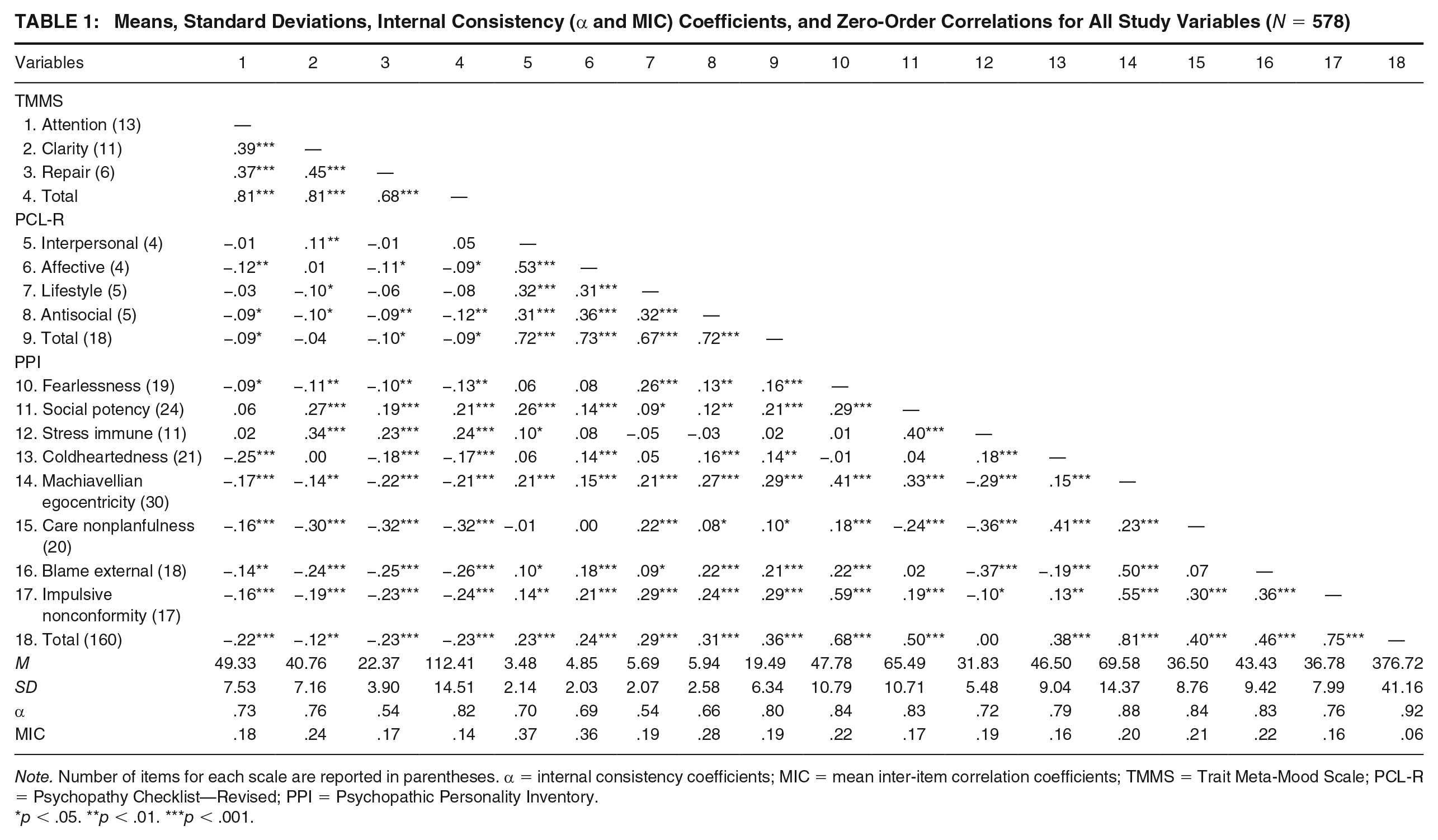
Note. Number of items for each scale are reported in parentheses. α = internal consistency coefficients; MIC = mean inter-item correlation coefficients; TMMS = Trait Meta-Mood Scale; PCL-R = Psychopathy Checklist—Revised; PPI = Psychopathic Personality Inventory.
p < .05. **p < .01. ***p < .001.
Person-Centered Results: Latent Profile Analysis
The LPA results indicated that a 3-class solution was optimal (Table 2). The results revealed that the latent classes were characterized by high, medium, and low levels of ER propensities (see Table 3). These results were replicated when analyses were run in Latent Gold. In addition to the LMR results, our choice was based on the decreasing differences between BIC values, and on the fact that the 4-class solution included a class size that was not of substantive value (i.e., the fourth class had 0.7% of participants, that is, less than four participants). Class 3 (C3; n = 286, 49.5%) reported the highest scores on each TMMS dimension (i.e., better ER), compared with C2 (n = 240, 41.5%) with moderate ER, and finally C1 (n = 51, 9%) with poorer ER. This solution demonstrated good classification accuracy (80%–86%). We generated ANOVA-based effect sizes (η2) to characterize the differences across profiles on the TMMS scales, all were in the moderately strong-to-strong range (Table 3). The profiles did not differ with respect to age, F(2, 469) = 0.43, p = .65, or education, F(2, 316) = 2.30, p = .10, and only showed a modest difference in cognitive ability, F(2, 267) = 4.45, p = .01. Follow-up analyses for cognitive ability revealed a small effect size (η2 = .03) difference between C2 (M = 89.32, SD = 13.57) and C3 (M = 94.18, SD = 12.01); C1 (M = 90.64, SD = 13.77) did not differ from C2 or C3. The profiles did not differ in race/ethnicity, χ2(2) = 3.58, p = .17.
Latent Profile Analysis Results: Model Fit Indices for 1- to 6-Class Solutions
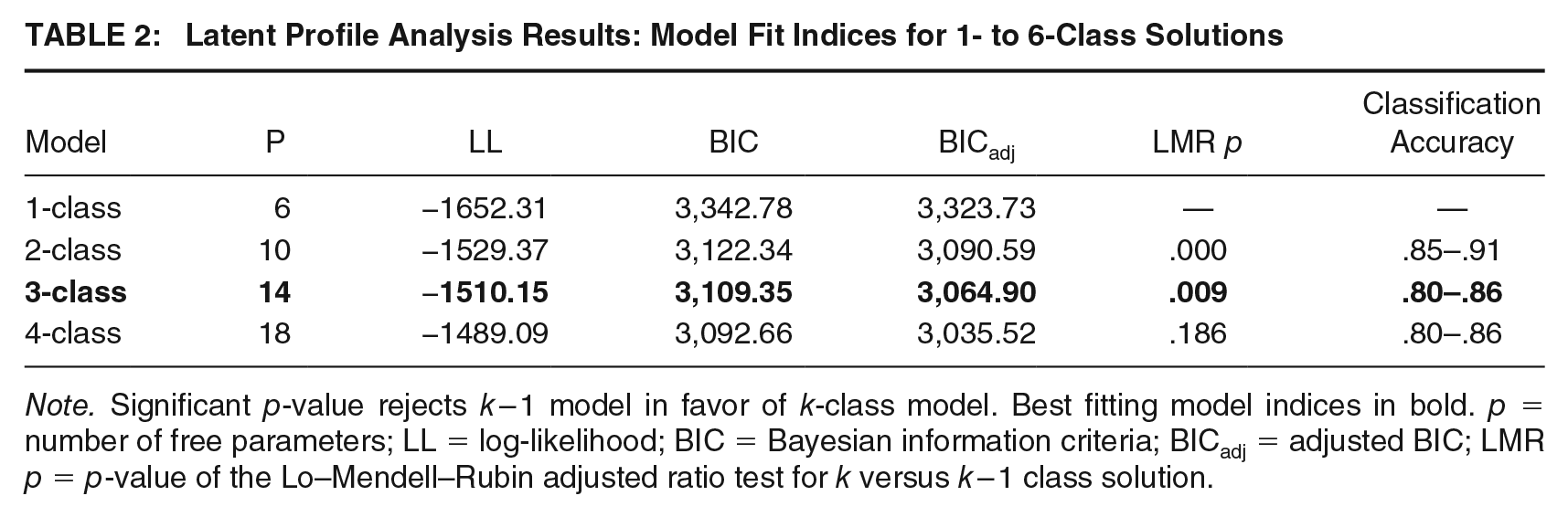
Note. Significant p-value rejects k – 1 model in favor of k-class model. Best fitting model indices in bold. p = number of free parameters; LL = log-likelihood; BIC = Bayesian information criteria; BICadj = adjusted BIC; LMR p = p-value of the Lo–Mendell–Rubin adjusted ratio test for k versus k – 1 class solution.
TMMS Subtypes: Mean Item Scores on Emotion Regulation, Psychopathic Trait Facets, and Psychopathy Scale Totals
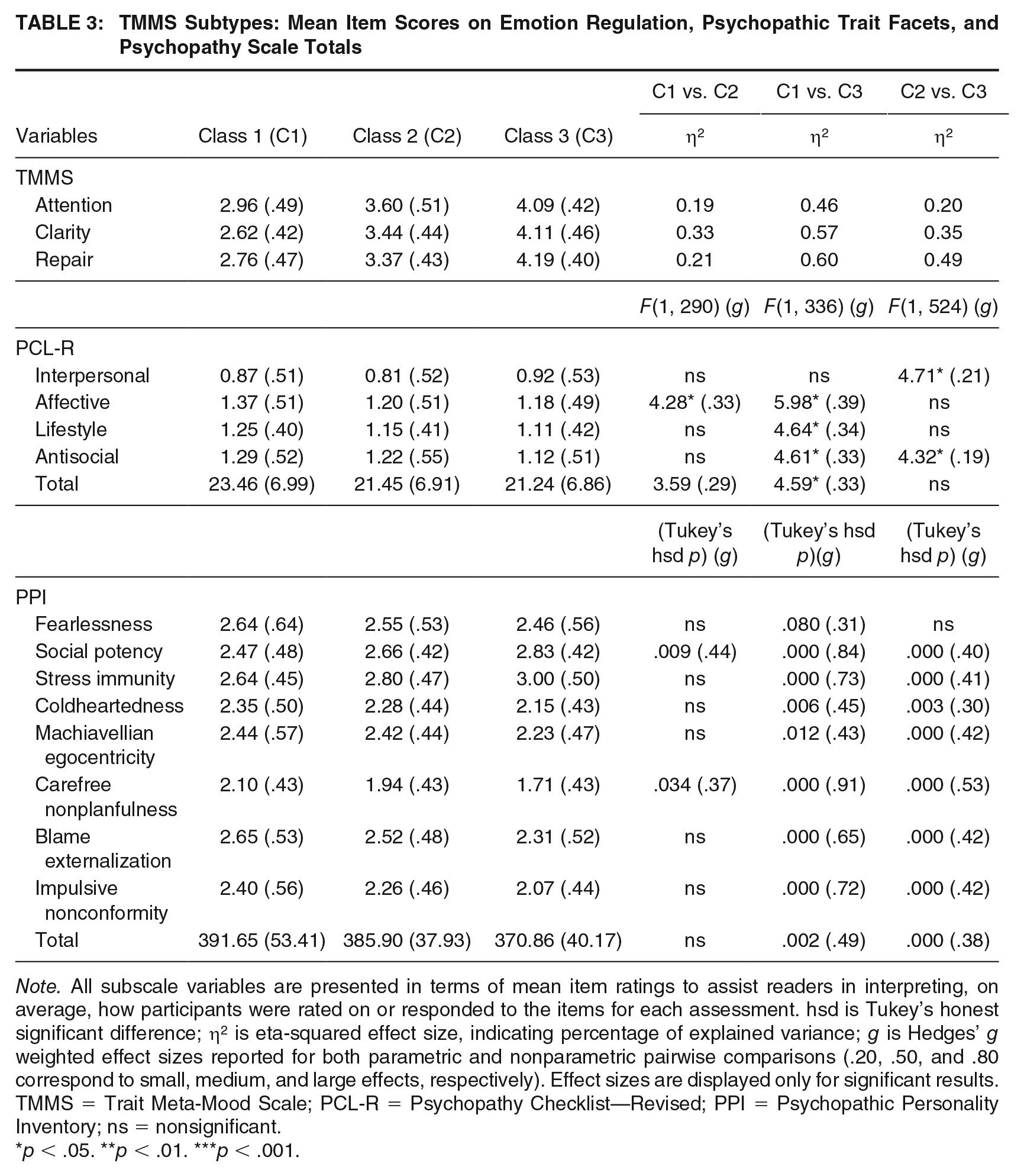
Note. All subscale variables are presented in terms of mean item ratings to assist readers in interpreting, on average, how participants were rated on or responded to the items for each assessment. hsd is Tukey’s honest significant difference; η2 is eta-squared effect size, indicating percentage of explained variance; g is Hedges’ g weighted effect sizes reported for both parametric and nonparametric pairwise comparisons (.20, .50, and .80 correspond to small, medium, and large effects, respectively). Effect sizes are displayed only for significant results. TMMS = Trait Meta-Mood Scale; PCL-R = Psychopathy Checklist—Revised; PPI = Psychopathic Personality Inventory; ns = nonsignificant.
p < .05. **p < .01. ***p < .001.
Chi-square analyses indicated that C1 (poor ER) contained the largest proportion of participants (25%) with PCL-R ≥ 30, compared with C2 (14%) and C3 (13%), respectively, χ2(1) = 4.08 and χ2(1) = 5.08 (ps < .05). The latter two classes did not differ in proportion of participants meeting criteria for the research diagnosis of psychopathy, χ2(1) = 0.78, p = .38. Next, planned comparisons indicated that C1 had a higher PCL-R total score compared with both C2 and C3 (Table 3). Similarly, C1 had significantly higher mean item ratings for the PCL-R affective facet, compared with both C2 and C3. Interestingly, C2 (moderate ER) and C3 (good ER) differed with respect to the interpersonal (C3 > C2) and antisocial (C2 > C3) facets. Overall, the three ER profiles evidenced positive linear associations with the PCL-R affective, lifestyle, and antisocial facets. The same pattern of results was found through the three-step approach, which accounts for classification error.
With respect to the PPI self-centered impulsivity scales, C1 had greater mean item scores compared with C3. Furthermore, all comparisons across profiles were significantly different for carefree nonplanfulness. A more mixed pattern of subtype differences emerged for the fearless dominance scales. First, C3 had significantly higher mean item ratings for stress immunity and social potency, compared with C1 and C2. No significant differences occurred on fearlessness, although the pattern of association was inverse compared with stress immunity and social potency (i.e., C1 had a nonsignificantly higher mean item scores compared with C3, p = .08). Finally, C1 reported higher coldheartedness than C3 (see Table 3). Differences on psychopathic traits across profiles were generally associated to small-to-moderate effect sizes, with relatively stronger effects for the PPI compared with the PCL-R, likely due to shared method variance.
Variable-Centered Results: Structural Equation Modeling Analysis
CFA Results
For the PCL-R/TMMS CFA, all items were set to load on their respective factors. Model fit was acceptable (CFI = .90, RMSEA = .04), providing support for both the four-factor model of psychopathy and a three-factor model of the TMMS domains. All items loaded significantly on their factors (ps< .001). The factor intercorrelations for the PCL-R (range = .47–.76) and TMMS (range = .57–.65) were strong. The TMMS factors were uniformly associated with the PCL-R factors, providing support for using a superordinate TMMS factor for the SEM analyses. Consistent with previous PPI modeling results (Neumann et al., 2008, 2013), eight factors were sufficient to reproduce the observed data (RMSEA = .04); however, incremental model fit for an eight-factor PPI model was poor (CFI = .51), indicating little structural coherence and thus SEM was not conducted with the PPI.
SEM Results
Figure 1 provides the graphical depiction and standardized model parameters for the SEM results. Model fit was good (CFI = .92, RMSEA = .04) and accounted for 15% of the TMMS factor variance and 12% of the psychological distress (SCL-90-R) factor variance. Controlling for shared variance among PCL-R factors, as well as the effects of age and cognitive ability, SEM results revealed that the affective and lifestyle psychopathy factors predicted poorer ER (TMMS superordinate factor). In contrast, the interpersonal factor positively predicted ER. The lifestyle factor also positively predicted the psychological distress factor, which was inversely related to ER. Increased age and cognitive ability predicted lower psychological distress, and higher cognitive ability predicted better ER. Taken together, the pattern of associations shows that the unique variance in the affective and lifestyle PCL-R factors was linked with poorer ER, but the unique variance in the interpersonal PCL-R factor was associated with better ER. Notably, these effects could not be accounted for by age, psychological distress, or cognitive ability. 3
Discussion
Summary of Findings
The present study used both latent variable- and person-centered approaches to examine the associations between trait ER and different measures of psychopathic traits in a large sample of incarcerated males. Replicating and extending previous findings, the results of the present study offer new insights on the usefulness of ER to understand psychopathy, at least for those components of ER captured in the TMMS method of operationalization. Overall, the findings are in line with previous studies showing that ER disturbances reflect global versus selected impairments. In addition, our findings corroborate links between psychopathy and poorer ER and also provide evidence that specific features of the psychopathy construct are differentially associated with ER. Importantly, across psychopathy assessments and approaches, the findings highlight that affective features of psychopathy were negatively associated with ER, while interpersonal aspects were positively associated with ER. Of note, rather than being redundant, the consistency of the results obtained with variable- and person-centered approaches speaks for the robustness of these findings. Thus, the uniform LPA and SEM results provide a means of translating information about variable associations to information at the person level (Block, 1971).
Person-Centered Findings
The LPAs conducted with the three TMMS scales indicated that a 3-class model provided a parsimonious solution with good classification accuracy. Rather than uncovering different combinations of ER propensities (i.e., elevation on some but not other scales of the TMMS), individuals were better classified based on the severity of impairments (or lack thereof) in ER, as was recently reported with a different measure of ER (Garofalo, Neumann, et al., 2018). This pattern suggests that disturbances in the ER components measured by the TMMS may involve broad problems that differ in degree and not in kind. Thus, the latent class that reported difficulty in attending to emotions also had greater difficulties in discriminating between different emotions, and difficulties in repairing negative emotional experiences and maintaining positive ones. These results appear to question the possibility of dissociations among trait ER processes at the person level, such that naturally occurring subtypes of individuals did not show selected impairments in specific domains of ER (John & Eng, 2014). Clinically, this may indicate that interventions aimed at improving ER should target all of these components, though at the same time, improvement in one component would likely to be associated with improvements in other components. Thus, for some individuals, it may be easier initially to learn how to attend to their emotions (e.g., mindfulness) versus repair them (e.g., cognitive reappraisal). However, readers should bear in mind that at this point, these are highly speculative suggestions and at least should be considered for their potential relevance for incarcerated populations rather than for interventions targeting ER in different populations.
Across the three TMMS profiles, linear associations with PCL-R ratings were evident, such that the C1 profile with the lowest levels of ER displayed the highest level of psychopathic traits, and this profile also presented with the greatest proportion of cases meeting diagnostic criteria for psychopathy. When examining psychopathy at facet level, the three TMMS subgroups revealed linear associations with the affective, lifestyle, and antisocial facets of the PCL-R, in line with results obtained using the Self-Report Psychopathy scale (Paulhus et al., 2016) in a sample of incarcerated males convicted of violent crimes (Garofalo, Neumann, et al., 2018). These results indicate that as the degree of problems with ER increases, so does the likelihood of finding cases of individuals with elevated psychopathic traits in the affective, lifestyle, and antisocial domains. In contrast, the C3 subtypes who reported better ER displayed higher interpersonal features, compared with the C2 subtypes who displayed moderately good ER.
Results involving the PPI were generally consistent with those involving the PCL-R, despite the different operationalization of the construct. Participants with lower levels of ER also reported greater features in the self-centered impulsivity domain, capturing the more externalizing traits of the psychopathic personality. The PPI stress immunity and social potency scales showed a linear trend in the opposite direction, suggesting that higher levels of these features were related to better ER, whereas fearlessness was largely unrelated to ER. In contrast, the C1 profile with poor ER showed greater scores on the coldheartedness scale. Taken together, the results suggest that ER problems are associated with increased affective callousing assessed through both clinical-interview (PCL-R) and self-report (PPI) methods. Conversely, interpersonal features of psychopathy were either unrelated or positively related to ER.
Variable-Centered Findings
The SEM findings supported the person-centered results. A fine-grained SEM representing the four facets of psychopathy indicated that—accounting for the effects of age, cognitive ability, and psychological distress—it was mainly the unique variance in the affective and lifestyle facets that negatively predicted ER, while the interpersonal facet positively predicted ER. Taken together, the results are consistent with previous research indicating that the psychopathy facets show divergent associations with external correlates (Hare & Neumann, 2008; Hicks & Patrick, 2006). More specifically, the positive relation between the interpersonal facet and ER is consistent with prior findings, linking the unique variance in the interpersonal facet with higher IQ, better executive functioning, and white matter volume (Baskin-Sommers et al., 2015; Vitacco et al., 2005; Yang et al., 2005). Notably, although both the affective and the lifestyle facets were associated with poorer ER, only the lifestyle facet was also related to greater levels of psychological distress (i.e., indexed by the SCL-90-R factor), which in turn had a moderately strong inverse association with better ER. Therefore, it could be that problems in ER linked to the behavioral traits of psychopathy go hand in hand with the experience of psychopathological symptoms. In contrast, affective features of psychopathy were not predictive of psychological distress, which fits with the assumption that these features are unrelated or inversely related to indices of general psychopathology, particularly internalizing symptoms. Yet, the current results suggest that poorer ER was associated with both PCL-R and PPI affective traits. 4 These results suggest that maladaptive ER strategies (e.g., emotional suppression; Garofalo & Neumann, 2018) may play a role in both the affective and the lifestyle behavioral features of psychopathy but for different reasons. Interestingly, this pattern of results fits with thinking on the neural basis of ER, which is distinct from the “unfolding of the emotion itself” and which may be “carried out consciously or non-consciously” (Etkin et al., 2015, p. 693).
The findings that the PCL-R interpersonal facet and the PPI stress immunity and social potency scales were linked with better ER might be interpreted as supporting the argument that certain psychopathic features are associated with adaptive functioning (Patrick et al., 2009). Yet, these features alone are not sufficient to indicate the presence of psychopathy (Lynam & Miller, 2015). These relations should be interpreted in light of the more general pattern of associations between the other PCL-R and PPI scales, and poor ER. Individuals with higher levels of psychopathy across domains could appear to manage their emotions when conning or manipulating others, but their affective (e.g., callousness) and behavioral tendencies (e.g., impulsivity) ultimately characterize their personality functioning in terms of poorer ER.
Implications and Future Directions
The variable-centered findings fit nicely with the person-centered results in that participants with poorer ER tended to present higher levels of psychopathy, including theoretically central affective traits. The current findings extend current knowledge by examining associations between psychopathic traits and ER at the facet level, across different conceptualizations and assessment methods of psychopathy, while controlling for potential confounds. Overall, it appears that—as in the case of other personality disorders (Dimaggio et al., 2017; Fossati et al., 2013; Velotti & Garofalo, 2015)—impairments in ER related to psychopathy span across all domains rather than being circumscribed to a specific ER domain. In line with recent findings (Garofalo, Neumann, et al., 2018), our results apply to those components of ER assessed by the TMMS (poor emotional clarity, poor attention to emotion, and reduced ability or propensity to modulate emotional experiences). Thus, it may be the degree of severity—rather than different types—of impairments in ER propensities that matter for personality pathology, in line with recent dimensional models of personality disorders (Morey, 2017). If impairments in ER can be corroborated as a transdiagnostic factor underlying the expression of many personality disorders, including psychopathy, future research seems warranted to examine what distinguishes the different forms of personality pathology, for example, investigating ER in combination with early temperamental or basic personality dispositions (DeLisi & Vaughn, 2015; Lynam & Miller, 2015), as well as attachment disturbances (Walsh et al., 2018). Furthermore, these results may have important practical implications, as they suggest that psychopathic individuals may benefit from treatments aimed at improving ER skills. The latter suggestion may be especially important for policy makers dealing with treatment innovation and delivery for incarcerated individuals with psychopathic traits. Indeed, existing guidelines for the treatment of psychopathy discourage from targeting ER skills based on the assumption that this would not have an impact on the personality pathology and related violent behavior of psychopathic individuals (Wong & Hare, 2005). Yet, these recommendations may need to be tempered in light of accumulating findings linking psychopathy with ER problems, as well as ER problems with aggression and violent behavior (Garofalo, Velotti, et al., 2018; Roberton et al., 2015).
Limitations
The current findings should be considered in light of some limitations. First, we relied on a self-report measure of ER. Future investigations with informant report or laboratory measures are thus warranted. Second, the cross-sectional design of the study does not allow us to speculate about the directionality of the associations between psychopathy and ER. Nevertheless, the current findings may help frame hypotheses and design studies to test the longitudinal associations between psychopathic traits and ER over time. Third, our reliance on an incarcerated adult male sample calls for replications in different populations. In particular, it will be important to replicate the LPA results in community or psychiatric samples, as different profiles may emerge as a function of the population under investigation. Finally, it should be noted that the effect sizes of the associations reported between ER and psychopathy were small to moderate in magnitude. This should not be surprising given that multiple factors (and, by extensions, causes) will necessarily be associated with a complex pathological condition like psychopathy (Lilienfeld et al., 2016). Yet, we contend that the clinical relevance of ER warrants attention, as treatments for ER have proven successful in the context of other forms of psychopathology (Kring & Sloan, 2009) and hold promise to reduce the aggressive tendencies related to psychopathic traits (Garofalo, Velotti, et al., 2018; Roberton et al., 2015).
Conclusion
In conclusion, the present findings provide incremental evidence for the role that ER may play in the emotional functioning of psychopathic individuals (e.g., Harenski & Kiehl, 2010). In line with recent studies (Garofalo, Neumann, et al., 2018; Hoppenbrouwers et al., 2016; Neumann et al., 2013), results suggest that affective disturbances in psychopathy extend beyond emotional deficiencies to problems in managing emotions and are not only limited to the behavioral features of psychopathy but also associated with affective features. We argue that a focus on ER may provide insights on the development of psychopathy, its manifestation in aggressive tendencies and antisocial behavior, and inform treatments for psychopathic individuals.
Footnotes
Authors’ Note:
We are forever deeply indebted to Emeritus Professor Joe Newman, for his continued generosity in sharing his ideas and data for our research.
