




Abstract
Latina/o/x/e families who experience migration-related separation face the heart-wrenching decision to live apart from each other, often to obtain better life opportunities for the entire family. In these situations, children live in a country separate from one or more parents, while a primary caregiver (e.g., the other parent, a grandmother, an aunt) looks after the children. Utilizing semi-structured interview data with 20 family triads (i.e., separated parent, separated child, primary caregiver) and drawing from the long-distance relational maintenance model (LDRMM), this study explores how primary caregivers help or impede separated parents and children’s relational maintenance, while living apart in two different countries. Prospectively, caregivers were usually tasked with the responsibility of informing the child and helping them understand the upcoming family separation. Introspectively, most primary caregivers facilitated relational maintenance by directly connecting the child with the parent, providing the resources for the two parties to communicate (e.g., cellphone, WIFI), and emphasizing the benefits of the separation. Retrospectively, primary caregivers helped the children understand the separated parents’ return; however, this often came at the expense of the primary caregiver feeling forgotten or overlooked by the child.
Using 2010 to 2018 U.S. nationally representative data with 94,731 immigrant children, Cartwright and Chacon (2021) found that 25.8% (one in four children) had lived in a country separate from at least one of their parents because of migration, with the average length of separation being 1.24 years and the largest group being of Mexican origin. Because of extreme political turmoil, poverty, threats to safety, and limited opportunities, many Latina/o/x/e 1 parents make the heart-wrenching decision to live in a country separate from their children, with the hopes of eventually being reunited (Suárez-Orozco et al., 2011). Sometimes, children are the ones to migrate to another country for better opportunities, while the parent(s) remain in their home country. Alternatively, one or both parents may migrate to the United States, while the children remain in their home country with the other parent or an extended family member. Although many Latina/o/x/e families plan to reunite, severe poverty; increasing U.S.-Mexico border restrictions and scrutiny; the treacherous journey to and from the United States; and limited legal options for obtaining a work visa, permanent residence, or naturalized citizenship often prevent separated parents and children from reuniting (Dreby, 2015; González et al., 2017).
Being separated is often devastating for parents and their children, which can contribute to decreased wellbeing for both parties (Dreby, 2010). Separation at a young age means some children grow up never knowing their separated parent in person, with children commonly reporting that they feel like strangers and do not know what to say to their separated parent (Suárez-Orozco et al., 2011; Verdezoto & Llanes, 2020). Children have also reported feeling resentment, hatred, forgotten, abandoned, and uncared for by their separated parents (Verdezoto & Llanes, 2020). Given the toll that a strained separated parent-children relationship can have on the involved parties, exploring how separated Latina/o/x/e immigrant parents and their children remain emotionally connected, while living apart is crucial to their wellbeing.
Several studies (e.g., Suárez-Orozco et al., 2011; Valdez et al., 2024; Verdezoto & Llanes, 2020) have considered the communication between separated parents and their children; however, Mazzucato and Schans (2011) called for research that considers primary caregivers. They argued that, “The role of the caregiver of the child in the country of origin is understudied, but the scant studies on the topic suggest that the caregiver is extremely important for the wellbeing of the child” (Mazzucato & Schans, 2011, p. 705). Indeed, primary caregivers act as communication gatekeepers largely affecting the extent to which the separated parent and child can communicate with each other and how they feel about each other (Verdezoto & Llanes, 2020). Primary caregivers can frame the separation and the separated parents’ actions in ways that help the children understand the separation and their separated parents’ behaviors, all of which can contribute to how separated children feel about the separated parents and themselves. In short, primary caregivers are the liaisons between separated parents and their children, making primary caregivers communication gatekeepers that shape the extent to which separated parents and children can engage in relational maintenance (i.e., sustain a sense of continuity and desired levels of emotional connection in their relationships, Ogolsky & Stafford, 2022).
Currently, relational maintenance research has primarily considered highly-resourced adult romantic relationships in the United States (Ogolsky & Stafford, 2022); therefore, the present study extends past theorizing of relational maintenance by revealing how the primary caregiver enables, enhances, or inhibits relational maintenance for under-resourced separated Latina/o/x/e immigrant families. 2 Moreover, our study extends relational maintenance theorizing by providing a triadic approach, interviewing separated Latina/o/x/e parents, primary caregivers, and separated children (20 family triads; 60 individuals) to uncover similarities and differences in perspectives. Furthermore, we draw from the long-distance relational maintenance model (LDRMM; Merolla, 2010), which emphasizes the importance of considering relational maintenance prior to, during, and following the separation. Communication and relationships are dynamic, but few studies consider how maintenance can look different at various stages of separation. Lastly, when considering how primary caregivers play a role in separated parents and children’s relationship maintenance, we also consider how, if at all, culture and structural elements (e.g., technology access and literacy, financial strain, location/environment) can explain such communication processes.
Moving Beyond the Dyad: The Importance of Primary Caregivers
The long-distance relational maintenance model (LDRMM; Merolla, 2010) identifies different ways in which individuals maintain emotional connection before (i.e., prospective), during (i.e., introspective), and after (i.e., retrospective) geographic separation. LDRMM simultaneously encourages communication and relationship scholars to consider intrapersonal, dyadic, and network strategies that people use to preserve their relationship; sustain their relationship’s current state—which could be emotionally close or estranged; or improve their relationship (Scharp, 2019). Intrapersonal maintenance refers to engaging in psychological efforts such as looking at photos and reflecting on positive memories, as reported by some separated children in Suárez-Orozco et al.’s (2011) study. Dyadic maintenance refers to the separated parties communicating with each other in ways that help maintain the relationship such as engaging in positivity, assurances, and talking about the day. Lastly, network maintenance refers to communicating with and receiving support from others, including family members (e.g., primary caregiver, siblings, extended family) and friends (Merolla, 2010).
Furthermore, Stafford and Canary (1991) categorized relational maintenance behaviors into five strategies: (a) positivity, (b) openness, (c) assurances, (d) networks, and (e) sharing tasks, most of which occur at the LDRMM’s dyadic maintenance level. Positivity includes optimistic interactions with the partner such as a separated parent complimenting a separated child on their school accomplishments. Openness refers to direct disclosures, for example, the primary caregiver encouraging the separated child to talk about their feelings about the separation. Assurances include behaviors that convey love and commitment to the relationship, such as the separated parent calling the family often to show relational commitment and care. Network maintenance strategies include spending time with shared social groups (e.g., upon reunification both the separated parent and primary caregiver spend time with each other’s relatives). Lastly, sharing tasks refer to co-owning family responsibilities (e.g., a separated parent may call to help their children with their homework).
Stafford and Canary’s (1991) strategies are often examined at the dyadic maintenance level. With our study’s focus on primary caregivers, we highlight how the LDRMM’s network maintenance, in the form of the primary caregivers’ communication and actions, play a role in separated parents and children’s understanding of the separation and how they remain emotionally connected across the geographical distance. More specifically, primary caregivers’ interpretations of the separation; communication and relationship with the separated parent; and communication and relationship with the separated child likely shape the separated parent and child’s perspectives on the separation and how they feel toward each other. For example, primary caregiver’s communication about the separation has the potential to encourage or discourage the child’s desire to communicate with their parent (Hilaire, 2008). Indeed, a separated mother in Suárez-Orozco et al. (2002) reported that she had a good relationship with her separated daughter, which the mother attributed to the primary caregiver (the grandmother in this case), who “always spoke well of me” (p. 636). By contrast, Verdezoto and Llanes (2020) reported how a separated child’s mother refused to let the child talk to his father after the father no longer sent remittances to his mother. Because the primary caregiver, in most instances, is the first line of communication between the separated parent and the child, the extent to which the primary caregiver speaks positively about the separated parent and the separation itself is likely connected to how the child feels toward the separated parent.
This brings to light a crucial, but often overlooked aspect of family separation, the role of the primary caregiver. Few studies have considered how the primary caregiver’s communication shapes immigrant parents and children’s relational maintenance. Such studies (e.g., Hernández, 2013; Mitrani et al., 2004) that have recognized the primary caregiver have not considered the caregiver’s perspective firsthand, nor have they placed the primary caregiver at the forefront of their studies. Yet, primary caregivers are at the forefront of managing relationships across distance and are pivotal to the child’s wellbeing. By considering the primary caregiver’s perspective, we can extend theory by providing a deeper understanding of how network maintenance is related to: (a) how the separated parent and child come to understand the separation, (b) how the separated parent and child feel about the separation and each other, and (c) how the separated parent and child maintain their relationship. Addressing these theoretical gaps can also provide practical benefits by increasing awareness of the central role that primary caregivers play in helping separated parents and children remain emotionally connected and by providing families with intrapersonal, dyadic, and network strategies.
Primary Caregivers’ Maintenance at Different Stages of Separation
When considering intrapersonal, dyadic, and/or network strategies, the LDRMM also calls for studying relational maintenance prior to (i.e., prospective), during (i.e., introspective), and following (i.e., retrospective) the separation (Merolla, 2010). The LDRMM treats relational maintenance as a dynamic, ongoing communication and cognitive process that does not only start once separation occurs (Merolla, 2012). Prospectively, efforts can be made to communicate about the upcoming separation, explaining why the separation has to occur; discussing what the separation means for the relationship; setting expectations for communication during the separation; and anticipating the length of the separation (Merolla, 2010). Culturally, separated Latina/o/x/e fathers often assume financial responsibility, while mothers, who are often primary caregivers, assume nurturing roles. Thus, it might be that primary caregivers are expected to emotionally support and explain the separation to the children. Currently, however, we know little about primary caregivers’ prospective actions and how they are associated with parents and children’s understanding of the separation and their relational maintenance. Some separated parents leave without saying goodbye, or the child is too young for them to process the separation (Verdezoto & Llanes, 2020), but for families where prospective maintenance can occur, we consider how primary caregivers contribute to immigrant parents and children’s relational maintenance prior to the separation.
Introspectively, a few studies (e.g., Suárez-Orozco et al., 2002; Verdezoto & Llanes, 2020) have reported how primary caregivers speak positively or negatively about the separated parent, which can shape the children’s interpretation of the separation and relational maintenance with the separated parent. For example, in Dreby (2007), a primary caregiver reported being afraid that her sister (the separated mother) would think that she was talking badly about her to her son, the caregiver’s nephew. When considering how primary caregivers’ actions are related to separated parents’ communication with their children, primary caregivers can also inform separated parents of their children’s behaviors, while living apart. Several children in Verdezoto and Llanes (2020) reported that their separated fathers used remittances to enforce rules, encourage “good behavior,” and promote doing well in school, which might occur because of primary caregivers informing the separated fathers of the children’s behavior.
After the reunion (i.e., retrospective), primary caregivers play multiple roles in the lives of separated parents and children. If reunification occurs, the separation of the primary caregiver might symbolize yet another abandonment (Dreby, 2007). Thus, depending on the relational quality between the child and the primary caregiver, as well as the primary caregiver and the separated parent, the reunification process might come with additional trauma. Indeed, children have reported missing their primary caregiver thereby making the reunification process much more difficult to endure (Lovato-Hermann, 2017).
In sum, primary caregivers can make a difference in separated parents and children’s understanding of the separation and their relational maintenance prospectively, introspectively, and retrospectively. In turn, such relational maintenance is likely to have implications for separated parents and children’s relational quality and wellbeing. Yet, few studies, if any, have taken a systematic approach to exploring the role of primary caregivers for separated immigrant families. Thus, we created the following research question:
RQ1: According to Latina/o/x/e separated parents, separated children, and primary caregivers, how do primary caregivers facilitate or impede parents and their children’s perceptions of the separation, as well as their prospective, introspective, and retrospective relational maintenance?
Considering Structural and Cultural Elements in Relational Maintenance
When exploring how Latina/o/x/e primary caregivers facilitate or impede separated parents and their children’s perceptions of the separation and their relational maintenance, it is crucial to also consider how structural and cultural elements might explain the utilization of certain relational maintenance strategies. For example, structural barriers (e.g., undocumented status and financial constraints) may exist that limit the types of relational maintenance strategies that can be employed (face-to-face interactions). In turn, separated parents and children are left to explore other ways to help maintain their relationship and navigate challenges. Whereas long-distance relationships that occur solely within the United States have a greater opportunity to rely on technology to help each other maintain connection, immigrant families might not have those resources readily accessible to them (e.g., Shah et al., 2019). Families might experience several obstacles such as financial strain, limited access to technology (and reliable technology), and a lack of infrastructure to obtain services. Such structural barriers can place pressure on the primary caregiver to find ways for the separated parent and child to connect.
In addition to structural elements, separated Latina/o/x/e families might adhere to certain cultural elements that relate to how they maintain their relationship at the intrapersonal, dyadic, and network levels across the three stages of separation. For example, traditional gender roles such as marianismo (i.e., expectations for mothers to care for the children, be the pillar of the family, self-sacrifice, be passive; Morales & Pérez, 2020) might be related to different forms of maintenance for mothers and fathers. Other cultural values, such as respeto (i.e., emphasis on deference and obedience to parents and other adults; Lopez et al., 2022) might also shape the way that Latina/o/x/e separated children maintain a relationship with their separated parent. To help explore how cultural and structural elements play a role in the maintenance process, we pose the following research question:
RQ2: How, if at all, do cultural and structural elements play a role in primary caregivers’ relational maintenance?
Lastly, a major contribution of the present study is its triadic data, which enables us to obtain a more holistic understanding of the separation process among Latina/o/x/e families, particularly when the primary caregiver’s perspective is largely absent from past literature. Identifying similarities and differences in viewpoints is theoretically important because we might find that our assumptions of relational maintenance—what it looks like and why it looks a certain way—only reflect one perspective. For example, we might gain some understanding of marianismo and relational maintenance when talking to primary caregivers, but we might be able to uncover other facets of marianismo by exploring the expectations that the separated fathers and separated children have of the primary caregiver. Shedding light on different perspectives is also practically important because it can help encourage empathy and perspective taking, while offering families ways to bridge the gaps in perspectives. Thus, we present the following research question:
RQ3: How, if all, do the perspectives of the separated parent, separated child, and primary caregiver align or differ from one another?
Methods
Data Collection
Prior to collecting data, we received approval from our university’s Institutional Review Board (IRB). In Winter 2021, we began recruiting and collecting data. We sent information about our study to different university email listservs, nonprofit organizations that work with Latina/o/x/e communities, social media platforms (e.g., Instagram, Facebook), and social networks, with the study information being in Spanish and English. Participating families primarily learned of the study from people in their social networks (i.e., snowball sampling), including social media. Eligibility requirements included families having to self-identify as Latinx, Latina, Latino, or Hispanic and either be currently separated for at least 6 months or currently reunited within the past 2 years but had been separated for at least 6 months. Separated children also had to be 9 to 17 years of age, and all three family members (i.e., separated parent, separated child, primary caregiver) had to participate. All of these eligibility requirements were chosen to increase the likelihood of separated children being old enough to remember aspects of the separation. Additionally, we felt that requiring at least a 6-month separation period would allow for families to have experienced enough time apart to have been affected by the family separation and to have developed relational maintenance strategies at different stages of separation.
Because most of the family members resided outside the United States, our research team used WhatsApp (i.e., low-cost messaging and voice social media platform), and when families did not have WhatsApp, we used direct international calling. At the beginning of each conversation, bilingual/bicultural research assistants informed each family member of the study’s purpose and their rights as participants. Each family member gave permission for their interviews to be audio recorded, and interviews ranged from 55 to 157 min (Mlength = 92.57 min, SD = 24.86). All study materials, including the consent forms, demographic surveys, and interviews were available in Spanish and English, although all 60 participants preferred Spanish. For participating in the study, each family member received $75 USD (i.e., $225 USD per family).
Participants
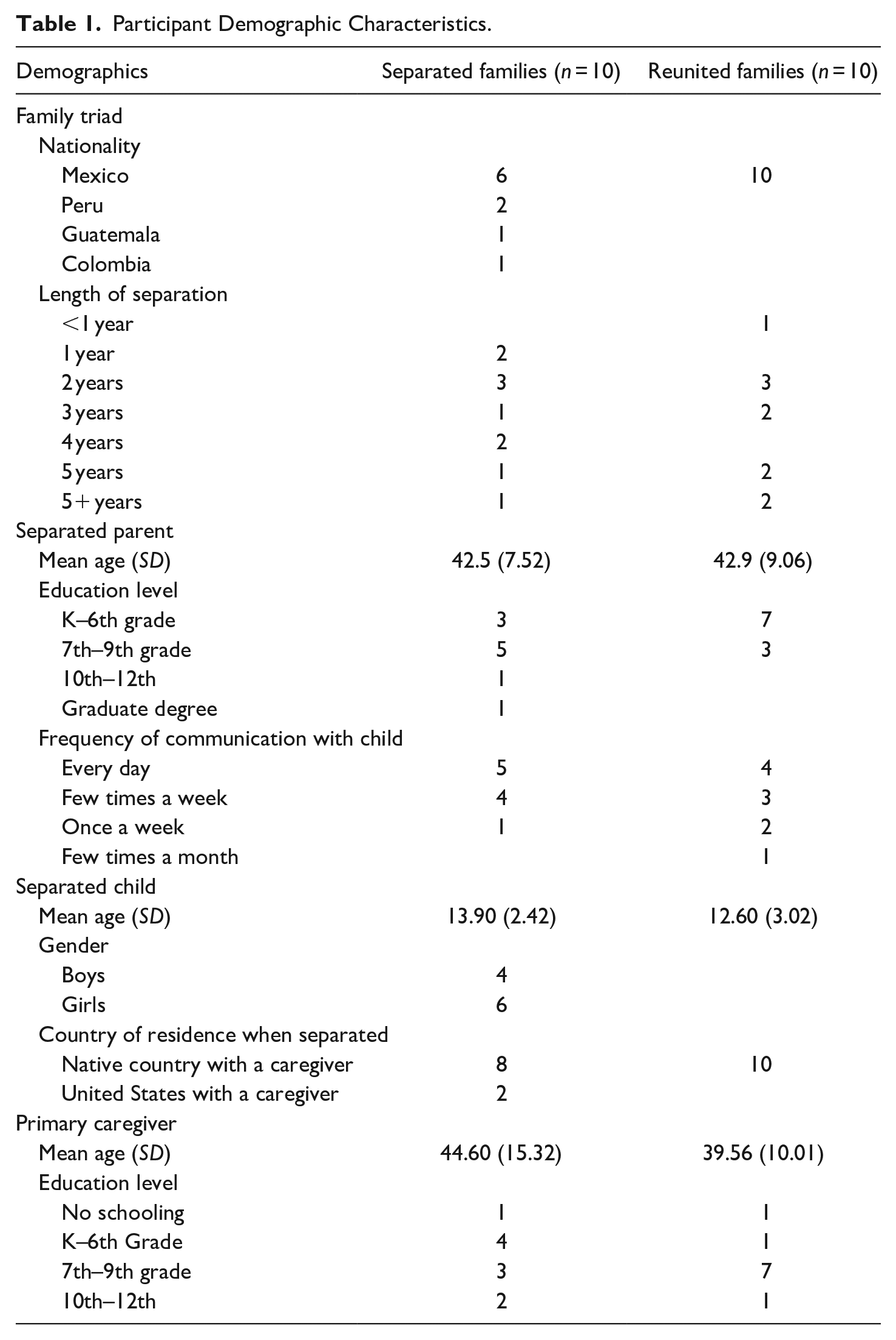
Altogether, 20 Latina/o/x/e family triads (i.e., 20 separated Latina/o/x/e parents, 20 separated Latina/o/x/e children, and 20 primary Latina/o/x/e caregivers; N = 60) participated in individual semi-structured telephone interviews. As seen in Table 1, which includes detailed demographic information, 10 of the families were reunited at the time of data collection, and 10 were still separated. At the end of the study, however, one family that had been previously separated were able to reunite. All migrating family members had migrated to the United States, and all reunited families resided in Mexico. The families that had reunited were families who experienced serial separation due to temporary work visas. Fathers would annually receive a 3- to 6-month visa to work in the United States. Thus, reunification was possible for them, whereas most of the other participants were undocumented immigrants who had no set return date in mind. Most primary caregivers were the other parent (n = 13), but three were grandmothers, three were an aunt or uncle, and one was a sister. In the thirteen instances (65%) where the other parent served as the primary caregiver, the father had migrated to the United States, while the child resided with the mother in their country of origin. Out of the other seven cases, five of those were instances where the mother migrated to the United States, and the father was absent from their lives. The remaining two families consisted of the child migrating to the United States with a relative, while the parent(s) remained in Mexico.
Participant Demographic Characteristics.
Interview Preparation
We created the interview guides to explore stress, communal and individual coping, and relational maintenance, with the current study concentrating on responses pertaining to relational maintenance and the role of the primary caregiver (see Table 2 in Supplemental Materials for sample questions). We developed an interview guide for each type of family member. Communication scholars with expertise in stress, coping, and relational maintenance, and Latina/o/x/e bilingual research assistants who had familiarity with separation, offered suggestions for improving the interview guides. The interview team consisted of the first author and five bilingual undergraduate Latina/o/x/e research assistants. Prior to interviewing families, the interview team underwent several weeks of training. As each member of the team conducted interviews, the team continued to meet weekly to discuss emerging themes and discuss interview challenges and solutions.
Data Analysis
To begin, we engaged in audibility as a way to increase the validity and trustworthiness of the data (Creswell & Creswell, 2017; Suter, 2009). Bilingual research assistants also transcribed the audio recordings verbatim, and they were cross-checked to assure agreement. To facilitate coding, we utilized NVivo, a qualitative data analysis software, and drew from Tracy’s (2019) recommendations. As an initial step, the first author applied first-level coding, highlighting text and writing descriptive notes to identify broad codes pertaining to the research question, while also staying open to additional codes. In this phase, codes such “primary caregiver hinder/facilitate,” “limited communication,” “cultural values,” and “structural barriers,” emerged. Afterwards, the first author engaged in second-level coding by consolidating codes together under corresponding themes (Tracy, 2019). During this phase, more detailed codes were created (e.g., “marianismo,” “necessary for family,” “limited pre-conversations,” and “feeling left out”). While coding, the first author paid attention to Owen’s (1984) recurrence (i.e., looking for an idea that came up more than once), repetition (i.e., paying attention to words or phrases that came up multiple times), and forcefulness (i.e., focusing on participant’s evocative language). Throughout this process, the first author discussed, scaffolded, and unpacked the codes with the second author.
The first author followed Tracy’s (2019) recommendations, creating a qualitative codebook with emerging themes, definitions, and exemplars to help maximize consistency among codes. In addition, data triangulation (Lincoln & Guba, 1985) was used, collecting data from three different family members to provide a holistic understanding of relational maintenance for separated Latina/o/x/e families. The first author also looked for similarities and discrepancies within individual interviews, within each triad, and between groups (e.g., between separated parents, separated children, and primary caregivers) via NVivo. Both authors worked together in selecting exemplars, revising the themes’ labels, and finalizing the themes’ definitions. Exemplars were provided to enable others to evaluate how well the data matched the themes (Creswell & Creswell, 2017; Suter, 2009).
Lastly, Creswell and Creswell (2017) suggest having a coder who shares common experiences or identities with the sample of interest. Not all qualitative studies may be able to include coders with the same lived experience as the phenomena of interest; however, when possible, it can be a strength. Including someone with the lived experiences can help researchers interpret the data better when the researchers do not have direct experience with the phenomena (Hemming et al., 2021). There may be aspects of the phenomena that the researchers may not fully understand or take into consideration if they are lacking direct experience with the phenomena. The first author—who identifies as Mexican and is fluent in Spanish—experienced separation from both of her parents for 3 years, while living with her grandmother in Mexico. Although the second author—who identifies as Chinese American—did not directly experience family separation, she grew up with stories of her father’s experience with migration-related family separation (see Supplemental Materials for positionality statement).
Findings
RQ1: The Primary Caregivers’ Role in the Separated Parent-Child Relationship
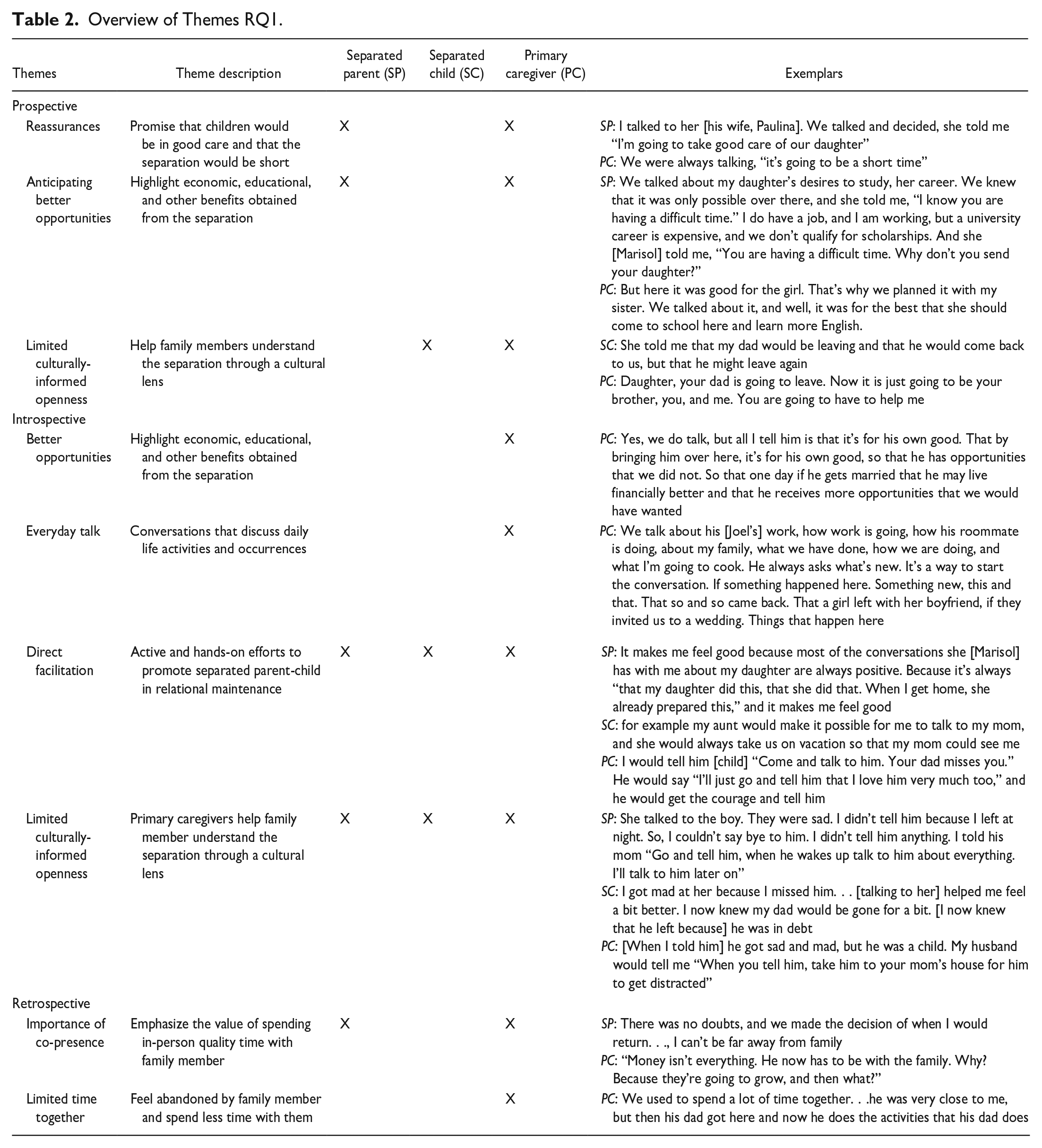
RQ1 explored how primary caregivers facilitate or impede separated parents and children’s relational maintenance. In this section, we discuss how primary caregivers participated in the parents’ and children’s relational maintenance prior to, during, and following separation. Within each time period, we describe the primary caregiver’s role through the lens of each family member (i.e., separated parent, separated child, primary caregiver; see Table 2).
Overview of Themes RQ1.
Prospective Maintenance (Prior to Separation)
Primary caregivers and separated parents both reported prospective themes of reassurances and better opportunities, while all primary caregivers and children reported the prospective theme of limited culturally-informed openness.
Reassurances
When considering how primary caregivers prospectively helped separated parents, one theme that emerged was reassurances. Although assurances usually refer to expressing love and commitment to the partner (Canary & Stafford, 1992), many of our primary caregivers (mostly wives) used reassurances to help separated parents (mostly husbands) feel better about their decision to migrate to the United States. Instead of focusing on building confidence in their love, explicitly, primary caregivers focused on reducing separated parents’ concerns and anxiety toward leaving their family behind. Often, primary caregivers reassured separated parents by: (a) promising to take good care of the children and (b) promising that the separation would only last for a short time. Primary caregivers did not want separated parents to worry; therefore, reassurances allowed separated parents to focus on their own arduous journey to the United States. As an example of reassurances, Jose Luis, a father who lived in the United States for 5 years, while his wife and daughter remained in Mexico, said:
I talked to her [his wife, Paulina]. We talked and decided, she told me “I’m going to take good care of our daughter. You go without worries, go calm.” That’s how we both decided who our daughter was going to be with.
Jose Luis’s wife, Paulina, shared a similar perspective, “We were always talking, ‘it’s going to be a short time’. In fact, those were always our conversations, ‘it’s going to be a short time. I’ll be back soon’, and ‘take care of the children. Take care of yourself’.” In maintenance studies on romantic relationships (Ogolsky & Stafford, 2022), couples may use assurances to solidify their relational commitment, and it is possible primary caregivers and separated parents used such assurances, as well. In our study, however, separated parents and primary caregivers often were concerned about the family and the children’s wellbeing, which may explain why they mostly reported reassurances. Through reassurances, primary caregivers seemed to help separated parents feel a little better about migrating to the United States and less worried about leaving their family behind. Separated parents also trusted that the primary caregiver would take good care of the children. This positive prospective theme likely sets a positive tone for primary caregivers to play an intermediary role between the separated parent and child.
Anticipating Better Opportunities
To help separated parents feel better about their decision to live apart from their family, separated parents and primary caregivers discussed how the upcoming separation would enable the family to experience better opportunities, which is the second prospective theme (i.e., anticipating better opportunities). Anticipating better opportunities included highlighting the benefits that would come from the separation such as being able to provide financially for the family and creating educational opportunities for the children. For example, Ximena lived in the United States with her aunt, Marisol (primary caregiver), while Ximena’s mother, Guadalupe (separated parent), lived in Mexico.
3
Guadalupe shared how Marisol was essential to helping her feel better about having Ximena live with Marisol in the United States:
We had talked about it. In fact, more than anything it was her [Marisol] who suggested it because my son was already over there. We talked about my daughter’s desires to study, her career. We knew that it was only possible over there, and she told me, “I know you are having a difficult time.” I do have a job, and I am working, but a university career is expensive, and we don’t qualify for scholarships. And she [Marisol] told me, “You are having a difficult time. Why don’t you send your daughter? It’s going to help me because I have my daughter here. She’s growing up on her own, and they are close in age. They are basically sisters. Neither of them would be alone.”
Like Guadalupe, Marisol shared how having Ximena join her in the United States would be beneficial to Marisol’s daughter.
I have a daughter who is the same age. My daughter needed some company. My daughter was always quiet or this and that. I didn’t have much time for her because of work. Now that my niece is here, it’s different. . . because over there it’s not as easy to study, in Mexico. Over there they must leave town to go to high school. But here it was good for the girl. That’s why we planned it with my sister. We talked about it, and well, it was for the best that she should come to school here and learn more English.
In this situation, Marisol helped Guadalupe feel better about sending Ximena to live with Marisol because the separation was framed positively as a way to provide better educational and career opportunities for Ximena and as a way to provide companionship to Marisol’s daughter. Anticipating better opportunities do not overlap with any of the strategies that Canary and Stafford (1992) proposed. Furthermore, maintenance research that discusses romantic relationships (e.g., Canary & Stafford, 1992; Merolla, 2010) has mainly considered strategies that solidify couples’ relational commitment to each other by, for example, being romantic, emphasizing love and commitment, determining the next time they will see each other, and exchanging relational tokens or spoors. For Latina/o/x/e families who have to live apart, prospective themes instead mainly centered around the family’s wellbeing, particularly the children’s future. This emphasis might reflect familismo (i.e., a value that highlights family interdependence, closeness, and support; Calzada et al., 2012), with parents thinking carefully about their children and making large sacrifices to provide them with opportunities.
Prospectively, Latina/o/x/e parents turned to primary caregivers to negotiate the separation and to frame the separation positively as a necessary means to obtaining better opportunities for their family. For families who framed the upcoming separation in positive ways that both primary caregivers and separated parents could accept, those separated parents seemed to be on good terms with the primary caregivers, and in turn, they may be more likely to help facilitate separated parents and children’s relationships in productive ways.
Limited Culturally-Informed Openness
Another prospective theme we identified is limited culturally-informed openness, such that among the very few children who received prior notice of their parent’s departure, primary caregivers often were the ones who informed the children of the separation and helped them understand it. Among the fathers who lived in the United States separate from their children, their wives were the ones who first informed their children of the separation. Fathers usually were the ones who decided that they had to go to the United States to seek better financial opportunities for the family, and their wives were expected to remain in their home country to care for their family and household. Such expectations might reflect traditional gender roles, including caballerismo (i.e., the expectation that man should be chivalrous, emotionally connected to family, and family-oriented individual; Arciniega et al., 2008) and marianismo (i.e., the expectation that women should be nurturing; Morales & Pérez, 2020). In many of the families who were interviewed, fathers felt it was their responsibility to bravely go to the United States to earn money and care for the family, and mothers felt they should care for the family.
As primary caregivers informed the children of the separation, primary caregivers often emphasized familismo (i.e., a value that highlights family interdependence, closeness, and support; Calzada et al., 2012) and encouraged the children to contribute in ways that would help the family manage the challenges of living apart. Paulina, a primary caregiver, reported how she told her daughter about the upcoming separation.
Daughter, your dad is going to leave. Now it is just going to be your brother, you, and me. You are going to have to help me. I know it is not your responsibility to help me with the baby. I know it is not your responsibility to help me because above all it is my responsibility, but if you help me, we are going to get ahead because your dad needs to leave. God willing in December he will come back, all well, we must push through. (Mother to 9-year-old daughter, currently reunited after being separated for 5 years).
Natalia, the daughter, shared that her mother tried to explain the upcoming separation, “She told me that my dad would be leaving and that he would come back to us, but that he might leave again. I said, ‘he is going to work and bring money’.” Here, Natalia indicated that conversation included anticipating better opportunities and also served to help her better understand the separation. In addition to instances representing familismo, we also observed aspects of marianismo and traditional gender roles, where the daughter was expected to maintain the household (i.e., sharing tasks). Whereas openness in Canary and Stafford (1992) focuses on being able to talk about the quality of the relationship and how each party feels about one another and the relationship, culturally-informed openness reflects the power dynamics between the primary caregiver and the children, as well as their cultural expectations for children. Many primary caregivers explained the separation to their children, while also making it clear that the children were expected to contribute to the family, now that the separated parent would be migrating to the United States.
Through the theme of limited culturally-informed openness, we observed how primary caregivers helped both separated parents and children understand why the separation was necessary. For separated children, these interactions allowed them to view their parent in a positive light and comprehend the upcoming change. This is crucial, because without this understanding or this framing, children might not be inclined to sustain a relationship with their separated parent. Similarly, if primary caregivers do not support the separated parents’ migration to the United States, that might set the tone for future introspective maintenance interactions.
Introspective Maintenance (During Separation)
For introspective maintenance, primary caregivers continued to emphasize better opportunities, and they reported the theme, everyday talk. All three family members reported primary caregivers engaging in direct facilitation and separated parents engaging in limited culturally-informed openness. The following section discusses the themes in detail.
Better Opportunities
Similar to before the separation, while living apart, better opportunities also emerged as an introspective theme. This theme represents separated parents’ challenging time adapting to the United States without their children and spouse. Thus, to support the parent in enduring the separation, the primary caregiver often emphasized that the separation was providing them with financial resources. This, in turn, enabled their children to access better educational opportunities and allowed the family to build a home of their own, among other benefits. For example, when asked how she and her husband managed the separation together, Adelaida, a primary caregiver to her 11-year-old daughter, Julia, said:
I think it was through talking, talking about the benefits of him [Julia’s father] being over there and us over here. I know that is a bit of a better life, that we were able to finish building our house, buy things that we needed or have savings for when he returns.
A common conversation across many couples in this study was that updates on the progress of the house they were building served as a tangible reminder of why they had to live apart. This and sharing other accomplishments (e.g., child’s academic progress) were the ways that the primary caregiver helped the separated parent feel like living apart was worth the sacrifice. As Michelle, a primary caregiver, mentioned:
We (child and herself) get along really well. He was always a good boy, he was a boy with really good grades in school, and at school he was well-behaved. That’s what I would ask of him so that the day that his dad returned, he would see all the diplomas so that his dad could see that he worked hard.
Most primary caregiver discussed the benefits of the separation to the children. Javier explained how he framed the separation for his 14-year-old nephew who came to the United States to live with Javier:
Yes, we do talk, but all I tell him is that it’s for his own good. That by bringing him over here, it’s for his own good, so that he has opportunities that we did not. So that one day if he gets married that he may live financially better and that he receives more opportunities that we would have wanted.
Here, Javier played a crucial role in framing the separation positively and as a necessity for his nephew to have better opportunities, including financial ones. Similarly, Adriana, whose husband migrated to the United States, while Adriana remained in Mexico with their 10-year-old daughter, stated, “I explained to her [daughter] that he had to leave, so that she would not need things, so that she was not missing food, so that she would not suffer.” Similar to the prospective theme of anticipating better opportunities, introspectively, primary caregivers continued to focus on the wellbeing of the family by highlighting the newly obtained resources. Although the theme does not directly align with one of Canary and Stafford’s (1992) traditional relational maintenance strategies, it revealed how primary caregivers’ efforts helped children understand that parents had migrated to the United States for the family. In turn, this framing may serve as relational maintenance, as it places the separated parent in a positive light and allows children to maintain a fond memory of separated parents and motivate children to maintain the relationship.
Everyday talk
When exploring how primary caregivers facilitated relational maintenance for separated parents, everyday talk, emerged as the second introspective theme. Everyday talk refers to when primary caregivers helped separated parents remain connected to their home country and their children, by providing separated parents with regular updates on local news and everyday occurrences. For example, Selena, a primary caregiver, discussed the conversations with her husband, Joel, who had migrated to the United States, while she remained in Mexico with their 17-year-old daughter, Juanita:
We talk about his [Joel’s] work, how work is going, how his roommate is doing, about my family, what we have done, how we are doing, and what I’m going to cook. He always asks what’s new. It’s a way to start the conversation. If something happened here. Something new, this and that. That so and so came back. That a girl left with her boyfriend, if they invited us to a wedding. Things that happen here.
Similarly, Adelaida, another primary caregiver whose husband migrated to the United States, while she cared for their 11-year-old daughter in Mexico, shared:
We talk about whether he already ate. He also asks us how we are doing, if we are okay. Things like that, that might seem insignificant. The basic stuff. I don’t know only about things that we do during the day, how our day was. When the girl [child] would go to school, he would ask about how it went, now that school is online, if she did her homework.
Rocio, a primary caregiver, also mentioned how she keeps her husband, a separated father, updated on their daughter, “[we talk about] how she is doing, how she is doing on her homework. Does she behave well?” Guadalupe, a separated mother, shared, Ximena’s (primary caregiver), efforts have allowed her to not only feel better about the situation but also proud of her daughter,
It makes me feel good because most of the conversations she [Marisol] has with me about my daughter are always positive. Because it’s always “that my daughter did this, that she did that. When I get home, she already prepared this,” and it makes me feel good. In the same manner, when she tells me “She didn’t do this, she didn’t do that” it makes me feel the same because I feel she is in good hands because I know that to a child, you must praise the accomplishments but also call their attention when something is not right.
By keeping the separated parent, up to date with everyday life, primary caregivers not only helped separated parents feel a sense of belonging but also enacted a sense of normalcy around the separation. Informing the separated parent of trivial manners allowed separated parents to feel connected and included within the family, thereby fortifying and maintaining relationships. Overall, most primary caregivers tried to make the separated parent feel confident in their decision to migrate, even though it was painful. When primary caregivers felt sad or lonely, they did not disclose this information to the separated parent because they did not want to contribute to the separated parent’s stress of being far away from family.
The theme of everyday talk most closely aligns with Canary and Stafford’s (1992) openness strategy. However, their strategy prioritizes conversations relating to transparency about feeling and thoughts about the relationship, thereby enhancing relational trust, the everyday talk enabled the separated parents to sustain their relationship because the primary caregivers provided insights into their daily lives despite the physical distance.
Direct Facilitation
A third introspective theme we observed when exploring the role of the primary caregiver was that of direct facilitation. This theme includes the primary caregivers’ active and hands on assistance in helping separated parents and children maintain their relationship. This theme included explicitly voicing the importance of maintain communication and a connection between the separated parent and child. Toward this end, Ximena a separated child that migrated with her aunt while her mother stayed in Mexico, shared her awareness of her primary caregiver’s, Marisol, efforts in helping maintain the relationship with her mother, “for example, my aunt would make it possible for me to talk to my mom, and she would always take us on vacation so that my mom could see me.” Here, Ximena shared that her aunt provided the financial means to pay for the phone and allow physical visitations with her mother.
For the two families in which the child migrated to the United States, separated children were excited to visit their parent(s) during summer break; however, seeing each other in person was not possible without the financial support of the primary caregiver. Javier, whose nephew migrated to the United States with him, while Alan, the separated father, remained in Mexico, shared:
We have never discouraged him [from reuniting with his parents]. On the contrary we encourage him to keep doing well in school, so that when summer vacation comes, we can send him over.
Here, Javier discusses plans to visit, an indication of financially facilitating relational maintenance between the separated child and parent. Both children who migrated to the United States were U.S. Citizens, so they did not face the barrier of being unable to frequently visit because of being undocumented.
Direct facilitation also occurred among primary caregivers residing in the home country. Michelle, a primary caregiver, directly facilitated relational maintenance between her separated husband and child by encouraging her husband to do the following:
More than anything, he (child) would always talk to his dad. I would always tell my husband, “Tell him that you are going to return, tell him that you are going to return, and you are going to see him, hug him, and be with him.”
Similarly, to help the separated parent and child remain emotionally connected, primary caregivers would use what Stafford and Canary (1991) call, assurances, by telling the children that the separated parent loves them. Areli, whose husband migrated to the United States, while she remained in Mexico with their 13-year-old son, said:
He [husband] would always ask me about him. “Tell him that I love him very much” because there were times when he didn’t want to talk because he was playing. I would tell him “Come and talk to him. Your dad misses you.” He would say “I’ll just go and tell him that I love him very much too,” and he would get the courage and tell him, “Dad, I love you very much, but it’s because I’m with my friends.” I would tell him that I felt bad because he didn’t want to talk, but he [husband] would understand because he would tell me, “Let him be. Let him play. He already came and told me that he loves me very much.”
In the family that had been separated the longest, Angelica, 12-year-old child who had lived apart from her mother, Teresa, had no recollection of Teresa because they had lived apart for over a decade. Nevertheless, Angelica shared that she knows her mother loves her because of what her grandmother (i.e., primary caregiver), Rocio, tells her, “My grandmother told me, ‘She did love you. It’s just that we didn’t have money. That’s why she left over there’. She told me, and that’s when I felt good knowing that my mom loves me.” In this case, Rocio’s use of assurances to positively frame her daughter, Teresa, as a loving mother enabled Angelica to think of her mother in a positive light and kept her desire for a mother-daughter relationship alive. Elisa, a primary caregiver to her grandson, noted that she talked positively and encouraged the reunification because the child belonged with his parents.
I tell him, “Hopefully you can already reunite” because with this illness despite taking care of myself, I tell him, “It would feel good that one day you reunite, you will be with your dad” because I can’t be selfish and keep him (child). I’ve already received enough love and I’m grateful to my son for giving me this responsibility. One day he has to leave with his dad.
Although the reunification meant that the child’s physical absence would leave a void, Elisa encouraged the reunification because she felt that her grandson belonged next to his parents. The primary caregiver’s supportive stance was particularly crucial for this family because as Edgar, Elisa’s grandson, stated, “they call my grandma first” because she was the only one with a cellphone in the household. Therefore, Edgar depended on his grandmother to maintain the relationship with his parents.
In addition to positively talking about the separated parent, some primary caregivers would show pictures and videos of the separated parent to the separated child. Isela, whose husband migrated to Mexico, while she remained in Mexico with their 10-year-old son, stated:
Because the boy was young, he didn’t know his dad. Over there, where I lived with my mom, there was a lot of men, many of my friends that I knew since we were kids and to all of them my boy would call them dad. He would ask “and my dad?” younger than a year old. I would laugh but as he got older, I would tell him, “That’s not your dad. Your dad is in the United States,” and I would show him pictures on my cellphone because I would give him pictures of his dad and I would show them to him.
Our theme of direct facilitation also does not directly overlap with Canary and Stafford’s (1992) framework; however, instances of assurances were evident when the primary caregiver consistently told the children their separated parent loves them. In our study, separated parents and children mainly heard the positives of each other through the primary caregiver. Primary caregivers engaged in numerous efforts to help separated parents and children maintain their relationship, which was particularly critical for children who were too young to remember the separated parent. Primary caregivers helped the separated children and parents’ relationship by showing separated parents and their children photos of each other, discussing the wellbeing of the separated children to the separated parent, and encouraged separated children to talk to their parent. A goal of the primary caregivers was to keep the separated child aware of their separated parent and vice versa to keep their relationship alive. In turn, this allowed the family members to hold each other in high regard and value their relationship.
Limited Culturally-Informed Openness
The last introspective theme, limited culturally-informed openness, represented limited transparency about the separation particularly from the separated parents toward their children. Like the prospective theme, introspectively it also meant that primary caregivers (typically mothers) shouldered the responsibility of providing information about the separation to children. Whereas Canary and Stafford’s (1992) openness strategy emphasizes transparency and openly sharing thoughts about the relationship, most of our separated parents relied on primary caregivers to be open with the children. In our study, limited openness from the separated parent, in itself, is an act of relational maintenance between the separated parent and child. Furthermore, our theme of openness had cultural underpinning, such as power dynamics and gender roles. While living apart, almost all the primary caregivers were in charge of helping the child understand the separation and maintain their relationship with their parent(s). Francisco, a father who had migrated to the United States, while his wife remained in Mexico with their 11-year-old son, said:
She talked to the boy. They were sad. I didn’t tell him because I left at night. So, I couldn’t say bye to him. I didn’t tell him anything. I told his mom “Go and tell him, when he wakes up talk to him about everything. I’ll talk to him later on.” (Francisco, separated parent from 11-year-old son, currently reunited, separated for 3 years).
Yolanda, the primary caregiver mentioned talking to her son while relying on extended family members for support:
[When I told him] he got sad and mad, but he was a child. My husband would tell me “When you tell him, take him to your mom’s house for him to get distracted. I would take him [to grandmother’s house].”
Here, Francisco engaged in limited culturally-informed openness and relied on gender roles (e.g., marianismo) to put the responsibility onto Yolanda. Yolanda discussed that she took the child to her mom’s house because Giovanni’s cousins could help him fill the gap brought upon by the physical absence of his father. Following the assumptions of the LDRMM (Merolla, 2010) and previous relational maintenance literature (Stafford & Canary, 1991), it is evident that social networks are important, particularly when valuing familismo. Giovanni, reported initially being angry, but the conversations with his mother helped him understand the separation,
I got mad at her because I missed him. . . [talking to her] helped me feel a bit better. I now knew my dad would be gone for a bit. [I now knew that he left because] he was in debt.
We may argue that these interactions are potentially the most significant in shaping the future of the separated parent and child relationship. Most children in our study were not given prior notice of the separation; therefore, the first time they found out about the drastic change in their lives was through the primary caregiver. Primary caregivers’ framing seemed to shape how the child thought about the separation and how they felt toward their separated parent.
Retrospective Maintenance (After the Separation)
Among 20 families, 10 had reunited, which required them to readjust their family dynamics. We explored primary caregivers’ retrospective role in facilitating or impeding relational maintenance between the separated parent and child. For the reunification period, primary caregivers and separated parents engaged in the theme of importance of co-presence, while only primary caregivers reported the theme of limited time together. In the following sections, these themes are further detailed.
Importance of Co-presence
Reunited families reported limited conversations about the separation period. Yet, when communication about the reunification occurred, a salient theme was importance of co-presence in which primary caregivers emphasized the value of spending in-person quality time with their children. For example, Areli, whose husband had migrated to the United States, while she remained in Mexico with their son, told her husband, “Money isn’t everything. He now has to be with the family. Why? Because they’re going to grow, and then what?” In these instances, primary caregivers helped separated parents make sense of the reunification by highlighting the benefits of copresence in their children’s lives. Areli’s husband, Jorge, shared a similar perspective, “there was no doubts, and we made the decision of when I would return. . ., I can’t be far away from family.” Importance of co-presence does not coincide with Canary and Stafford’s (1992) strategies. Instead, for Latina/o/x/e separated families, retrospective themes emphasized the significance of familismo. Here, the primary caregiver prioritized the separated parent and child’s wellbeing, offering guidance aimed at enhancing the long-term quality of the family relationship. This theme also highlights how structural barriers (e.g., documentation status) shaped the types of relational maintenance strategies enacted.
Limited Time Together
A second retrospective theme was limited time together, which refers to primary caregivers feeling abandoned by their children once separated fathers returned. Children seemed to favor spending more time with their father to make up for lost time. As Yolanda, a mother serving as the primary caregiver, stated, “it makes me feel as if he likes him more than me, or maybe it’s because I’ve never been separated from him, maybe if I left, he would be like that [with me].” Similarly, Paulina, a primary caregiver mother expressed feeling pushed aside, “sometimes I do feel down, why say no. at times I feel that they don’t need me, that it’s only the three of them (father and two children).” Michelle also expressed the shift in her child, “we used to spend a lot of time together. . .he was very close to me, but then his dad got here and now he does the activities that his dad does.”
In all three examples, the mothers (primary caregivers) share that the relationship shifted, and they perceive their child’s attention and time as one sided. They felt that the separated children were reinforcing the bond with their fathers who had been physically absent. When asked if they communicated their sense of being left out to the rest of the family, the primary caregivers said they kept these feelings to themselves. Although the theme of limited time together does not overlap with Canary and Stafford’s (1992) strategies, this might be an indication of protective buffering (i.e., hiding concerns for the wellbeing of others; Joseph & Afifi, 2010) as a means of relational maintenance. They would rather endure the pain than interrupt the separated parent-separated child relationship. Even after the separated parents returned, primary caregivers continued to facilitate relational maintenance, which underscores their nurturing and significant role in preserving family connections. Furthermore, the fact that only the primary caregivers reported limited time together with the child, but formerly separated parents and children did not, might be an indication that those two parties did not have a difficult time reconnecting. This may be attributed to the caregivers’ effective and active efforts at fostering the separated parent-child relationship during the separation.
RQ2: The Role of Cultural and Structural Elements
The second RQ explored how culture and structural elements play important roles in the caregiver’s network relational maintenance. In addition to the aforementioned examples of how maintenance strategies were shaped by culture, the following sections presents other ways in which culture and structural elements were salient, particularly through the themes of respeto and limited technology access.
Respeto
The reunification period seemed to have limited communication among the primary caregiver and the child. However, when communication did occur between the primary caregiver and the child, it was centered around preparing the child for reintegrating with the separated parent. As Selena, primary caregiver to daughter, mentioned:
I have always told them to not disrespect their father, to have patience with him, that we are already old and that our age doesn’t allow us to tolerate much. “Furthermore, understand him, because he missed some of your best years. In fact, you will always be our little kids, we are always going to see it that way. . .we have to enjoy the time he is with us.”
Here, Selena’s conversation with her daughter, Juanita, served several purposes: (a) to encourage a relationship with her father, (b) to help her understand the separation and reunification, and (c) to instill the cultural value of respeto. In this case, Selena’s efforts were critical because Juanita was an adolescent who might not remember her father well, which is why Selena highlighted the importance of being empathetic with her father. Juanita shared that she had differences with her father, “well right now I know that we both have different ways of thinking, and there are times when we do not agree and that’s when we argue.” Juanita also mentioned that conversations with her mom, “make me feel really good.” Interestingly, the father, Joel, mentioned that “Thank God we have a beautiful relationship.” It is possible that Selena’s relational maintenance efforts and inculcation of cultural values such as respeto fostered a positive relationship for Joel and Juanita.
Limited Technology Access
A primary structural element which was highlighted in our second theme was that of limited technology access. This theme showed the difficulty that families faced in trying to communicate because of limited cellphone service, lack of technology devices, no internet access. Given the geographical distance, technology access and literacy were paramount in helping families communicate. With lack of resources, Angel, a separated son from his father, discussed how his mom (primary caregiver), “she would take me with her to her job to make a videocall because they have internet where she works.” Furthermore, whereas some families had the privilege of making videocalls, other children reported instances of technology literacy as a barrier. They could only make phone calls (i.e., audio only) because the separated parent did not know how to make videocalls, “No, only normal calls, cause like WhatsApp he doesn’t know how to use it” (Yolanda, primary caregiver to son, currently reunited).
Structural barriers are an obstacle to the relational maintenance of the separated child and parent. Yet, again, the primary caregiver serves a monumental role in helping the separated parent maintain a relationship with the child. This also highlights the important role that the caregiver’s attitude toward the separation plays in the separated parent-child relational maintenance. If they have a negative outlook toward the separation, they might not be as motivated to make extra efforts toward connecting the separated child and the separated parent. Moreover, younger children might rely more on their primary caregiver to help them connect with their separated parent. The child might need help dialing an international phone number or might not have access to a cellphone. On the contrary, older children might own their own cellphone and have more agency in contacting, or not, their separated parents.
RQ3: Triadic Differences
Our last RQ looked at the differences and similarities among our triads. We noted similarities in perspectives throughout the exemplars in RQ1 and RQ2; therefore, in this section we will focus on the differences. Specifically, resentment as a theme emerged among separated children and the theme of feeling left out emerged among primary caregivers.
Resentment
Primary caregivers and separated parents did not share any negative thoughts or reports of each other or reported talking negatively to the child about the other adult. However, one child explicitly reported feeling a sense of resentment, our first theme in triadic difference, toward her separated father for leaving. Resentment came in the form of the child feeling that the separated parent chose financial opportunities over their family. Melissa, a 10-year-old daughter who had been living apart from her father for a year, shared the following.
I still think that she [mother] is still not okay with him [father] leaving. Because she said, he left us alone without knowing how we were going to be. It affected us a lot that he left far away, and that it was all only for money.
Here, Melissa sensed that her mother did not fully accept her father migrating to the United States, and Melissa perceived her father’s reason for leaving to be solely motivated by money. Melissa’s framing of her father leaving “only for money” suggests that Melissa does not perceive her father’s reason as justifiable. Melissa’s account of the separation exemplifies the potential role of positivity as relational maintenance and its ability to shape a child’s interpretation of the separation. Interestingly, when Melissa’s mother, Adriana, was asked about her conversation with her daughter, Adriana responded, “I explained to her that he was leaving, so that she wouldn’t need things, so that she would always have food, so that she wouldn’t suffer.” Furthermore, when we asked Adriana’s husband, Andres, about how his wife feels about them living apart, Andres said, “No, she has never made a comment. . .such as ‘oh, you left us’. No, not that type of comments. We agreed. She knows why I’m here (for better educational and financial opportunities for the family).” In short, it seems that when talking to Melissa, she sensed her mother did not fully accept her father migrating to the United States, and Melissa felt that her father’s reason for leaving (“only for money”) was not justifiable. Nevertheless, both parents discussed better opportunities when asked about the separation and types of conversations had regarding the separation. This finding emphasizes the importance of considering multiple family members because they may have different realities of the separation, which in turn may shape family functioning and wellbeing. Obtaining multiple perspectives might help explain gaps in relational quality among separated parents and their children.
Feeling Left Out
A triadic approach was able to better illuminate the additional hardships that the primary caregivers endured. Although many primary caregivers, who experienced reunification, reported feeling relieved and happy about the separated parent’s return, it came at a cost to them in the form of feeling left out. As previously mentioned, several primary caregivers felt their children prioritized the separated parent over them; however, the children viewed it differently. For example, Isela, whose husband had migrated to the United States, while she remained in Mexico with their son, said, “I felt rejected by him [child]. I would say, ‘come let’s do this’, ‘No, until my dad gets here’, ‘No, until daddy is here [gets home]’.” By contrast, her son, Alberto, shared that he had a good relationship with both parents, “we get along well. . .[it makes me feel] happy.” Thus, it seems that in the primary caregivers’ attempt to make the reunification as smooth as possible between the child and separated parent, some experienced emotional hurt from feeling forgotten by their children, but their children did not mean to communicate a preference for the separated parent.
Discussion
Drawing from Merolla’s (2010) long distance relationship maintenance model (LDRMM), the present study explored how primary caregivers facilitate or impede separated Latina/o/x/e parents and their children’s prospective, introspective, and retrospective relational maintenance when experiencing migration-based family separation. Past research has primarily focused on the relational maintenance between highly-resourced romantic partners from WEIRD backgrounds (Ogolsky & Stafford, 2022), often applying Canary and Stafford’s (1992) maintenance strategies. Our study’s findings extend such research and prior theorizing on relational maintenance by showing: (a) how maintenance might look different for under-resourced Latina/o/x/e families experiencing geographical separation, (b) how cultural and structural elements can shape the ways in which such families maintain their relationships, (c) how relational maintenance between two parties may largely depend on an intermediary (in this case, the primary caregiver), and (d) how obtaining multiple perspectives within a family can shed light on opportunities for bridging the gaps between families. The following section elaborates on these contributions in greater detail.
A major contribution of this study is its focus on primary caregivers, who have often been kept in the shadows of the parent-child relationship. When considering primary caregivers, none of our participants reported instances of primary caregivers impeding separated parents and children’s relational maintenance. Instead, all three parties discussed how primary caregivers helped separated parents and children understand why separated parents had to migrate to the United States, spoke positively of separated parents, encouraged children to talk to their parents, and helped separated parents and children remain connected despite the geographical distance. By contrast, Verdezoto and Llanes (2020) reported that a mother in their study did not allow her husband to talk to their child because her husband had stopped sending remittances; therefore, families with strained relationships may be more likely to report instances of the primary caregiver hindering the relational maintenance between separated parents and children. Our primary caregivers actively made conscious positive relational maintenance efforts, including encouraging the children to speak with their separated parents and keeping separated parents up-to-date on their children’s behaviors, milestones, and academic wellbeing. Thus, the families in our study might have already been functioning well as a family in managing the separation, and they might have been emotionally close.
The current study further underscored the crucial role of the primary caregiver’s communication as it helped parents and children understand the upcoming changes and difficulties—a process known as communication sense-making. Communication sense-making (CSM) can occur when people construct meaning of their lives through communicative explications (Koenig Kellas & Kranstuber Horstman, 2015). Sensemaking occurs through interpretation of shared information which helps create an understanding of an event. In our study, the primary caregivers engaged in sensemaking when they took the time to carefully explain the separation and parent’s physical absence in a positive manner, ensuring that the children could comprehend the process. The sensemaking observed in our study helped separated parents and children in a variety of ways, including fostering positive feelings toward each other and the separation itself. Given that migration-related separation may affect adult attachment behaviors for individuals who experienced separation as children (Venta et al., 2021), it is critical that we explore prosocial sensemaking behaviors to mitigate the negative effects of migration-related separation. Our findings suggest that primary caregivers may help separated parents and children engage in CSM. A CSM approach might provide further insights into how children take on new roles and process new expectations. CSM might also be informative in uncovering why certain coping strategies are used over others. For example, the way a primary caregiver frames the narrative (e.g., either villain or hero) might be connected to the separated parent-child relationship and wellbeing. Future studies should consider taking a systematic approach to exploring the caregivers’ role through a CSM lens.
Our findings emphasize the significance of prospective strategies in shaping introspective coping. The prospective theme, anticipating better opportunities, and the introspective theme, better opportunities, are examples of how messages prior to the separation set the foundation for coping during separation—primary caregivers reminded parents and children that the separation was worth the sacrifice and benefited the family in many ways. This communication strategy may be example of primary caregivers fostering anticipatory resilience (i.e., utilizing previous messages in future challenges). Given the uncertainty and stress surrounding migration-related separation, future studies may benefit from exploring how prospective messages shape introspective relational maintenance strategies, and consequently, help Latina/o/x/e families enact resilience.
In addition to learning more about the role of primary caregivers throughout the separation process, our study contributed to our understanding of relational maintenance from a cultural lens. The findings provide insights on how the Latina/o/x/e cultural value of marianismo (i.e., the expectation for the female to be self-sacrificing and nurturing; Carducci et al., 2020) is exemplified through the primary caregiver which may inform the type of relational maintenance strategies enacted (e.g., better opportunities, reassurance). The caregiver’s enactment of marianismo portrays their need to nurture and calm their family members to not disrupt the family structure. In turn, this sheds light on the self-sacrifice that the primary caregivers, who were mostly the mothers, must endure. Future studies might benefit from exploring the needs (e.g., support gaps) of the primary caregivers.
In addition to marianismo, our findings further revealed how culture may help determine which relational maintenance strategies are enacted. For example, respeto, marianismo, and caballerismo might mean that separated children and primary caregivers do not question separated fathers’ decisions to migrate or to reunite. Indeed, our participants discussed how there was not much talk about the separation after reunification (retrospective stage). Among our separated Latina/o/x/e families, silence or avoidance might be an ambivalent way of enacting relational maintenance. As Scharp (2021) argued, we should “interrogate the functional ambivalence of relational maintenance” (p. 451). Future relational maintenance research might gain valuable insights by focusing on silence and perceived lack of openness, especially through a cultural lens. This approach may uncover nuanced perspectives on how individuals within other cultures navigate and sustain their family relationships.
Another meaningful theoretical contribution of our study lies in its utilization of a triadic approach, which enhances our understanding of migration-related separation and relational maintenance. Our triadic approach highlighted how primary caregivers (mothers) felt disconnected from the family unit because they felt left out from the family unit upon the separated parent’s return. However, primary caregivers opted to endure the discomfort and pain of feeling excluded rather than intervene in the dynamic between the formerly separated parent and child. Importantly, neither the separated parent nor the separated child disclosed a sense of detachment toward the primary caregiver. Furthermore, this shows that even after reunification, primary caregivers still actively engaged in relational maintenance. Thus, an intermediary role was still present in facilitating relational maintenance between the formerly separated parent and child, a concept not accounted for in Canary and Stafford’s traditional theorizing of relational maintenance.
To this point, our triadic approach also allowed us to reveal how Latina/o/x/e separated families’ relational maintenance strategies differ from the traditional strategies. For instance, Canary and Stafford (1992) describe shared tasks as a communal strategy to fortify a romantic relationship. However, our participants disclosed that communication about the separation with the child was delegated to the mother and was not perceived as a communal task. This could possibly be explained by the cultural expectations Latina/o/x/e women are expected to enact. An additional strategy, not typically covered in traditional relational maintenance frameworks, emerged when our participants shared how conversations with the primary caregiver about upcoming and current better opportunities—before and during the separation—, helped them withstand the separation because it reminded them why the separation was necessary. This in turn, helped foster relational maintenance. Further, our findings uncovered that primary caregiver facilitated relational maintenance between the separated parent and child through conversations about daily life and mundane topics. These topics allowed the parent to feel integrated despite physical distance and seamlessly continue their relationship with their child. This is yet another novel way that Latina/o/x/e separated families enact relational maintenance.
Practical Contributions
From a practical standpoint, our study helps provide recommendations to improve the mental and relational wellbeing of the various parties involved in immigration-related separation. Because immigration-related separation brings upon many uncertainties (e.g., success of migration journey, return date, communication frequency), one way to help reduce this instability is to help make sense of the situation, particularly for children who are too young to understand. Caregivers can help mitigate the situation by explaining the upcoming separation as soon as possible, preferably with both parents present. This is in line with Donovan et al.’s (2017) finding that when children perceive that their parents treat them as peers and actively disclose information to them, there is greater relational closeness. During the separation, everyday talk and better opportunities can be more effective strategies. Unfortunately, during the reunification period, primary caregivers felt a sense of lack of belonging within their families. To mitigate this, efforts can be made to acknowledge the hardships and responsibilities that primary caregivers must shoulder. After reunifying, it might be beneficial, then, for separated parents and children to vocalize their love and care toward the primary caregiver.
Although our study sheds light on relational maintenance strategies that might enhance family connections during migration-related separation, it is essential to recognize that the responsibility should not solely rest on the individuals. Instead, we must acknowledge the systemic barriers that contribute to family separation and impede family reunification. Our findings may help advocate for improved immigration policies that enhance the wellbeing of our migrant families. Researchers can help inform nonprofits that work with immigrant communities, collaborating with culturally responsive therapists, and publish policy briefs.
Limitations and Future Directions
Although our study makes several noteworthy contributions, it is not without limitations. Latinas/os/xs/es are a heterogenous groups; however, the majority of our sample (80%) was from Mexico. Family separation and relational maintenance may differ within ethnic groups and between ethnic groups. Furthermore, all participants were asked to retrospectively report on their experiences living apart, but such experiences may have been difficult to recall, particularly for children. Lastly, most of the primary caregivers in our study were the other parent, but future research might consider extended relatives as primary caregivers; separated parents and children likely have different experiences depending on their relationship with the primary caregiver.
Despite these potential drawbacks, the present study extended past research on relational maintenance and migration-based family separation in numerous ways. First, we considered how primary caregivers act as intermediaries that shape how separated parents and children understand the separation, feel about the separation, feel about each other, and remain emotionally connected across large geographical distances. Second, we explored how primary caregivers act as communication gatekeepers prior to, during, and following separation, thereby revealing how relational maintenance is a form of communication continuity. Third, our findings showed how cultural and structural elements may explicate why certain types of relational maintenance strategies were used, thereby extending past theorizing on relational maintenance. In the context of under-resourced separated Latina/o/x/e families, network maintenance strategies (via primary caregivers) might be a pivotal, if not the only means that separated parents have to maintain a relationship with their child. Our findings showed that a child might not have the financial means or the ability to communicate (e.g., make a phone call or text) with their geographically separated parent. Thus, this study’s findings emphasize the crucial role that primary caregivers play in helping separated parents and children maintain their relationship, despite the geographical distance and limited resources.
Supplemental Material
sj-docx-1-crx-10.1177_00936502241265537 – Supplemental material for Relational Maintenance for Separated Latina/o/x/e Immigrant Parents and Their Children: A Focus on Primary Caregivers as Communication Gatekeepers
Supplemental material, sj-docx-1-crx-10.1177_00936502241265537 for Relational Maintenance for Separated Latina/o/x/e Immigrant Parents and Their Children: A Focus on Primary Caregivers as Communication Gatekeepers by Roselia Mendez Murillo and Jennifer A. Kam in Communication Research
Supplemental Material
sj-docx-2-crx-10.1177_00936502241265537 – Supplemental material for Relational Maintenance for Separated Latina/o/x/e Immigrant Parents and Their Children: A Focus on Primary Caregivers as Communication Gatekeepers
Supplemental material, sj-docx-2-crx-10.1177_00936502241265537 for Relational Maintenance for Separated Latina/o/x/e Immigrant Parents and Their Children: A Focus on Primary Caregivers as Communication Gatekeepers by Roselia Mendez Murillo and Jennifer A. Kam in Communication Research
Footnotes
Acknowledgements
We thank Alma, Ashley, Gardenia, Maybeline, and Ylianna for their assistance with this study. We are also grateful to the families who participated in our study and thank everyone who distributed our information flyer to families.
Data Availability Statement
The data that support the findings of this study are available on request from the corresponding author, [RMM]. The data are not publicly available due to information that could compromise the privacy of our vulnerable research participants.
Declaration of Conflicting Interests
The authors declared no potential conflicts of interest with respect to the research, authorship, and/or publication of this article.
Funding
The authors disclosed receipt of the following financial support for the research, authorship, and/or publication of this article: This study was supported by a Chicana/o Studies Institute’s Dissertation Grant and the Social Science Research Grant awarded to the first author, Roselia Mendez Murillo.

Supplemental Material
Supplemental material for this article is available online.