



Abstract
Can entertainment serve as a gateway to political interest and participation? In this paper, we examine the specific case of eudaimonic entertainment experiences (i.e., meaningful, moving, and thought-provoking entertainment experiences). To systematically analyze the influence of experiential and contextual factors associated with eudaimonic entertainment on political information processing, issue interest, and participation intentions, we conducted three experiments. Study 1 replicated positive effects of affective factors (arousal, negative valence, mixed affect, empathy, and feeling moved) on reflective thoughts, issue interest, and political participation intentions. Study 2 found positive associations of perceived personal relevance with reflective thoughts, issue interest, and political participation intentions. Study 3 found negative effects of absorption of cognitive resources on reflective thoughts, issue interest, and political participation intentions. The experimental variation of cognitive resources in Study 3 also allowed us to observe a reverse causal effect of reflective thoughts on affective factors.
Keywords
Can entertaining forms of political communication be useful to reach audience groups that are less interested in politics? And if so, how? A growing line of research suggests that entertaining formats such as political comedy, soft news, and drama can stimulate political interest (Baum, 2005; Young & Tisinger, 2006) and participation (Andersen, 2019; Cao & Brewer, 2008; Long et al., 2021). But not all forms of entertainment seem to have such positive outcomes, resulting in a complex pattern of positive, null, and occasionally negative effects (Becker, 2020; Delli Carpini, 2017). In this paper, we aim to further elucidate the conditions under which entertainment may be more (or less) likely to stimulate political interest and participation, with a special focus on the concept of eudaimonic entertainment experiences.
Our theoretical conceptualization of eudaimonic entertainment experiences was informed by the extended dual-process model of entertainment effects on political information processing and engagement (Schneider et al., 2021). This model assumes that, on the one hand, entertainment can serve hedonic functions in that it helps individuals improve their mood and distract themselves from negative thoughts (Zillmann, 1988). In this case, careful consideration of political information is unlikely because hedonic mood management promotes a superficial, heuristic mode of information processing associated with cultivation effects (Gerbner et al., 2002; Shrum, 2002). On the other hand, entertainment consumption can also serve to satisfy eudaimonic needs such as the seeking of deeper insight, meaning, truth, and self-development (Oliver & Bartsch, 2010; Oliver & Raney, 2011). For example, viewers who feel moved by a movie or a TV program often experience a need to think about the content, discuss it with others, and seek further information about the issue (Bartsch & Schneider, 2014; Ellithorpe et al., 2019; Weinmann, 2017).
With regard to political communication, this eudaimonic type of entertainment experience holds particular promise as a gateway to political interest and participation (Bartsch & Schneider, 2014; Ellithorpe et al., 2019; Roth et al., 2018; Shah, 1998). Therefore, the purpose of the present research was to systematically analyze cognitive and affective factors associated with eudaimonic entertainment experiences and to examine their effects on politically relevant outcomes. Specifically, we aimed to replicate the effects of affective factors on reflective thoughts and issue interest (Bartsch & Schneider, 2014) and to examine whether this pattern of effects extends to individuals’ willingness to engage in more active forms of political participation such as demonstrating, signing a petition, and considering the issue in electoral decisions (Study 1). In addition, we aimed to examine positive effects of perceived personal relevance (Study 2) and negative effects of absorption of cognitive resources (Study 3) on reflective thoughts, issue interest, and political participation intentions. To increase the generalizability of results, we used a diverse set of stimulus materials representing different entertainment genres (e.g., soft news, TV series) and political issues (e.g., old-age poverty, autonomous driving, unmanned drone strikes, software trade with authoritarian regimes, 3D printing of guns).
The Extended Dual-Process Model of Entertainment Effects on Political Information Processing and Engagement
The hypotheses of our studies were derived from the extended dual-process model of entertainment effects on political information processing and engagement. A detailed discussion of this theoretical framework can be found elsewhere (Bartsch & Schneider, 2014; Schneider et al., 2021). Therefore, we will only shortly summarize the core theoretical assumptions and empirical findings and then turn to the research gaps addressed in our studies. Like other dual process models of entertainment (Lewis et al., 2014; Vorderer & Reinecke, 2012; Wirth et al., 2012), this model distinguishes between two modes of information processing: superficial, heuristic processing and careful, elaborate processing—with a specific focus on the processing of politically relevant information in entertainment media.
Hedonic Entertainment Experiences and Heuristic Information Processing
Entertainment is often considered a hedonic pastime that helps individuals improve their mood and escape from everyday concerns (Zillmann, 1988). Consistent with hedonic motivations, cultivation theory (Gerbner et al., 2002; Shrum, 2002) assumes that entertainment is typically processed in a heuristic mode where information, attitudes, and stereotypes portrayed in the media are assimilated into individuals’ worldviews without critical reflection. One side of the dual-process model covers this heuristic mode of information processing and explains how it can lead to implicit effects on audiences’ knowledge, attitudes, and behavior—as observed, for example, in research on cultivation (Gerbner et al., 2002; Shrum, 2002), fictional priming, and agenda setting (Holbert et al., 2003; Holbrook & Hill, 2005).
Eudaimonic Entertainment Experiences and Elaborate Information Processing
Compared to hedonic entertainment, the elaborate, eudaimonic side of the dual-process model is characterized by more serious motivations such as the seeking of deeper insight, meaning, truth, and self-development (Oliver & Raney, 2011). These eudaimonic goals can motivate individuals to turn to serious and potentially unpleasant media content that is unlikely to elicit hedonic enjoyment. Rather, the gratification derived from eudaimonic entertainment experiences has been described as appreciation, “an experiential state that is characterized by the perception of deeper meaning, the feeling of being moved, and the motivation to elaborate on thoughts and feelings inspired by the experience” (Oliver & Bartsch, 2010, p. 76).
The cognitive and affective components implied in this definition of eudaimonic appreciation are closely intertwined. Affective factors that are typically associated with eudaimonic entertainment experiences (moderate arousal, negative valence, mixed affect, empathy, and feeling moved) have been found to stimulate the cognitive process of elaboration and meaning-making (Bartsch & Schneider, 2014; Oliver al., 2012). Further, in contrast to the escapist content of hedonic entertainment, eudaimonic entertainment is often characterized by contextual factors that encourage cognitive processing such as a focus on real-world issues of personal and social relevance (Oliver & Hartmann, 2010) and a slower narrative pace, hence lower absorption of cognitive resources (Cupchik & Laszlo, 1994). With these cognitively stimulating factors associated with eudaimonic entertainment in mind, the dual-process model of entertainment (Schneider et al., 2021) assumes that reflective processing of serious social and political issues does not interfere with eudaimonic entertainment experiences. Rather, cognitive engagement with such issues is assumed to constitute an essential element of eudaimonic truth- and meaning-seeking.
Three broad clusters of reflective effects are assumed to result from such a reflective mode of information processing during eudaimonic entertainment: (a) information seeking in other media, (b) interpersonal deliberation, and (c) reflective effects on knowledge, attitudes, and behavior such as knowledge gain, opinion formation, and political participation (Schneider et al., 2021). Compared to the rich research literature on heuristic processing of entertainment and its resulting implicit effects, research on reflective effects of entertainment is a relatively new line of research in the domain of political communication (Bartsch & Schneider, 2014; Feldman, 2013; Feldman & Borum Chattoo, 2019; LaMarre, 2009; Polk et al., 2009). Therefore, our research focused on the eudaimonic side of the dual-process model.
The Relationship of Hedonic and Eudaimonic Entertainment Experiences
Concerning the relationship between hedonic and eudaimonic entertainment experiences, it is important to note that these two types of entertainment experiences are not mutually exclusive. Rather than opposite ends of a continuum, the theoretical construct and operationalization of hedonic and eudaimonic entertainment are conceptualized as independent orthogonal dimensions (Oliver & Bartsch, 2010), meaning that both types of entertainment experiences can coincide without interfering with each other.
Such a possible coexistence of hedonic and eudaimonic entertainment experiences is in line with the extended elaboration likelihood model (E-ELM, Ott et al., 2021; Slater & Rouner, 2002). The E-ELM assumes that narrative experiences such as empathy, identification, and transportation can promote a character-related type of involvement that is specific to the processing of narratives. While the original ELM (Petty & Cacioppo, 1986) assumes that involvement and elaboration are prompted by the perceived relevance of issues to individuals’ concerns about their own well-being, the E-ELM (Slater & Rouner, 2002) suggests that empathic concern for the well-being of characters in a story can have similar involvement and elaboration effects. This narrative-specific type of involvement has been linked to reflective thoughts (Bartsch & Schneider, 2014), a subtype of cognitive elaboration that is not primarily focused on arguments as in the original ELM but rather on the deeper meaning of narratives and related real-world issues.
Through the lens of the E-ELM (Slater & Rouner, 2002), such a narrative, character-focused form of involvement can promote both hedonic enjoyment (via fun and suspense) and eudaimonic appreciation (via empathy and reflective thoughts). In line with this reasoning, Hall and Zwarun (2012) predicted and found that both hedonic and eudaimonic entertainment experiences were positively correlated with transportation. Thus, hedonic and eudaimonic experiences seem to share involvement with a narrative as a common process, on the basis of which either hedonic or eudaimonic or both types of experiences can develop, depending on the specific motivational, affective, and cognitive processes associated with each form of entertainment.
Another important aspect to keep in mind is that hedonic and eudaimonic entertainment experiences are not limited to specific media genres or content features. While some genres (e.g., serious drama, Oliver & Bartsch, 2010) and some content features (e.g., character strengths, Dale et al., 2017) seem particularly likely to elicit eudaimonic responses, eudaimonic entertainment can be experienced in response to a remarkably broad spectrum of media content and genres—including satire (Becker, 2020; Feldman & Borum Chattoo, 2019), narrative news formats (Knop-Huelss et al., 2020; Robinson & Knobloch-Westerwick, 2021), sports (Hall, 2015), talk shows (Roth et al., 2018), and memes in social media (Rieger & Klimmt, 2019). As scholars have repeatedly noted, eudaimonic entertainment experiences are not predetermined by media content but in the eyes of the beholder (Delli Carpini, 2017; Vorderer & Reinecke, 2012).
Therefore, two caveats are in order on what the hypotheses and experimental design of the current research are not about: First, we do not compare the effects of hedonic versus eudaimonic entertainment experiences. Rather, we compare the effects of different levels of eudaimonic entertainment experiences, that is, the relative presence versus absence of such experiences. Second, we do not examine the effects of specific media genres or content features. Rather, we use experimental variations of the stimulus content and viewing context to reinforce or suppress specific facets of eudaimonic entertainment experiences to operationalize their effects on political interest and participation intentions.
Rationale and Hypotheses of the Present Research
From the reflective effects associated with eudaimonic entertainment experiences, two outcome variables were chosen for the present research: issue interest and political participation intentions. First, we sought to replicate prior evidence (Bartsch & Schneider, 2014; Oliver et al., 2012) that eudaimonic entertainment experiences can stimulate issue interest and information seeking about the political issues portrayed. Second, we aimed to extend research on eudaimonic entertainment effects on political participation intentions (Ellithorpe et al., 2019). In light of the emerging evidence of politically mobilizing effects of eudaimonic entertainment experiences, the third and main goal of our research was to systematically examine the influence of experiential and contextual factors that have been proposed as theoretical mechanisms behind such effects. In other words, we aimed to specify and test the conditions under which politically mobilizing effects of eudaimonic entertainment experiences occur.
The experimental factors to be examined as predictors of issue interest and political participation intentions were derived from the dual-process model of entertainment effects on political information processing and engagement (Schneider et al., 2021). We aimed to replicate the effects of affective factors (Study 1) and to examine the role of two additional context factors: perceived personal relevance (Study 2) and low absorption of cognitive resources (Study 3). Early theoretical work on dual process models of entertainment (Bartsch & Oliver, 2011; Bartsch & Schneider, 2014) included these additional factors as possible explanatory mechanisms. Other than affective factors and reflective thoughts, which represent the definitional core of eudaimonic appreciation (Oliver & Bartsch, 2010), however, perceived personal relevance and low absorption of cognitive resources can best be understood as contextual factors that facilitate the cognitive component of eudaimonic entertainment experiences. We included these factors to provide a comprehensive test of the model. Moreover, the interference effect of absorption of cognitive resources on reflective thoughts allowed us to operationalize possible reverse causal effects of reflective thoughts on affective factors.
Affective Factors (H1a-c)
Prior research on eudaimonic media effects has mainly focused on affective factors, including arousal, negative valence, mixed affect, feeling moved (Bartsch et al., 2014; Bartsch & Schneider, 2014), and empathy (Bartsch et al., 2018; Oliver al., 2012). This line of research suggests a strong theoretical and empirical link between affective components of eudaimonic entertainment experiences. In several studies (Bartsch et al., 2014; Bartsch & Schneider, 2014), arousal, negative valence, and feeling moved emerged as significant indicators of a latent affect variable that predicted reflective thoughts. Moreover, self-report measures of feeling moved and empathy were highly correlated (Bartsch et al., 2018) and associated with similar patterns of prosocial outcomes (Bartsch et al., 2018; Oliver et al., 2012)—a pattern of findings that suggests a common conceptual core.
The cognitively stimulating effects of basic affective factors (arousal, negative valence, and mixed affect) are explained in the dual-process model of entertainment (Schneider et al., 2021). In a nutshell, negative valence signals to the organism that important concerns are at stake and that careful information processing is required; arousal increases motivational activation and allocation of attentional resources, while the coactivation of positive and negative valence (mixed affect) can stimulate cognitive integration efforts (A. Lang, 2006).
In addition to these basic affective factors included in the original model, research on eudaimonic entertainment (Bartsch et al., 2018; Oliver et al., 2012) has identified complex affective components of eudaimonic entertainment experiences such as empathy and feeling moved that are assumed to arise from a combination of basic affective factors with a prosocial, other-oriented frame of mind. Feeling moved is defined by Bartsch et al. (2014) as “a socially oriented affective state with negative or mixed affective valence” (p. 128). This prosocial affect component is also reflected in the concept of empathy, “an other-oriented emotional response congruent with another’s perceived welfare” (Batson et al., 1997, p. 105).
Consistent with the E-ELM (Slater & Rouner, 2002), this prosocial affect component can be considered an involvement factor in its own right because it prompts individuals to shift their perspective from self-related concerns to the concerns of others. While the original ELM (Petty & Cacioppo, 1986) assumes that cognitive elaboration is prompted by the relevance of issues to individuals’ concerns about their own well-being, the E-ELM (Slater & Rouner, 2002) adds that empathic concern for the well-being of characters can have similar involvement effects: “the key mediating variable with respect to responses to characters may not necessarily be identification with those characters, but empathetic response to the characters” (p. 185).
Research on eudaimonic entertainment (Bartsch et al., 2018; Oliver et al., 2012) suggests that this line of reasoning can be further extended by a transfer of empathic concern from story characters to the whole social group of persons affected by an issue (e.g., disability, immigration, or old age). By stimulating concern for both story characters and social groups affected by the issue, empathy and feeling moved can motivate viewers to make sense of the issue and reflect on possible solutions. Such complex affective components of eudaimonic entertainment experiences are not a formal part of the extended dual-process model of entertainment (Schneider et al., 2021), yet they have often been included as empirical indicators of affective states associated with eudaimonic entertainment (Bartsch et al., 2014; Bartsch & Schneider, 2014; Oliver et al., 2012). Therefore, we propose considering complex affective components such as empathy and feeling moved as an important theoretical and empirical complement to the conceptualization of affective states associated with eudaimonic entertainment.
Taken together, several lines of theoretical and empirical evidence converge to suggest that affective factors associated with eudaimonic entertainment experiences can motivate reflective thoughts (Bartsch et al., 2014; 2018; Bartsch & Schneider, 2014; Knobloch-Westerwick et al., 2013). Given the strong conceptual and empirical overlap between these factors, we operationally defined affective states associated with eudaimonic entertainment as a latent construct that combines basic affective factors (arousal, negative valence, and mixed affect) and complex affective components (empathy and feeling moved). Empirically, self-report items of empathy (Batson et al., 1997) and feeling moved (Bartsch & Schneider, 2014) are similar or even identical and loaded on a common factor in prior research (Bartsch et al., 2018), therefore we treated empathy and feeling moved as one empirical variable in our measurement model. With this set of indicators, our operationalization of affective states associated with eudaimonic entertainment was consistent with the latent affect variable examined as a predictor of reflective thoughts in prior research (Bartsch et al., 2014; Bartsch & Schneider, 2014). Based on the theoretical and empirical evidence discussed above, we assumed that higher levels of affective states associated with eudaimonic entertainment experiences (arousal, negative valence, mixed affect, and empathy/feeling moved) have a positive effect on reflective thoughts about political information in entertainment media (H1a).
Further, we expected an indirect effect of affective factors on issue interest mediated by reflective thoughts. Research on political information seeking (Isbell et al., 2006; Marcus et al., 2000; Yang & Kahlor, 2013) suggests that elaboration and issue interest are motivated by similar affective factors. Thus, individuals’ motivation to reflect on a political issue seems to carry over to the seeking and processing of additional issue-relevant information. With specific regard to eudaimonic entertainment, the empirical link between reflective thoughts and issue interest seems to hold across the divide between entertainment and information media, such that individuals spent more time reading news articles and reported more issue interest after a moving and thought-provoking entertainment stimulus about the issue (Bartsch & Schneider, 2014). Similarly, feeling moved and reflective thoughts about a feature film predicted reflective thoughts about a documentary, issue interest, and further information seeking (Bartsch & Angerer, 2021). Such carry-over effects are consistent with the open-ended nature of the eudaimonic motive of truth- and meaning-seeking (Oliver & Raney, 2011), which does not stop at the end of the story. Therefore, we assumed that higher levels of affective states associated with eudaimonic entertainment experiences (arousal, negative valence, mixed affect, and empathy/feeling moved) have a positive indirect effect on issue interest mediated by reflective thoughts (H1b).
In the case of political participation, we expected direct as well as indirect effects of affective factors based on a prosocial shift in perspective elicited by emotions such as empathy and feeling moved that are typically associated with eudaimonic entertainment experiences. According to the empathy altruism hypothesis (Batson & Powell, 2003), this shift in perspective from self-focused to other-focused concerns can prompt individuals not only to take the perspective of those affected by the political issue portrayed but it should also motivate them to act in the interest of affected individuals or social groups (Batson & Powell, 2003; Haidt, 2003). This reasoning is consistent with concepts of public connection (Couldry et al., 2007) and civic culture (Dahlgren, 2009) that consider individuals’ capacity to see beyond their immediate self-interest as an important precondition of engagement in political issues of common concern. A growing line of research has linked eudaimonic entertainment experiences to prosocial changes in attitudes and behavioral intentions (Oliver et al., 2012; Schneider et al., 2016). However, the concept of prosocial behavior (Batson & Powell, 2003) is broader than political participation proper, hence the necessity to more specifically examine the potential of eudaimonic entertainment as a source of inspiration for political participation.
Both direct and indirect effects of affective factors are plausible. On the one hand, prosocial emotions can directly motivate prosocial behavior (Batson & Powell, 2003; Haidt, 2003), including some (but not all) forms of political participation. On the other hand, affective factors can reinforce political participation indirectly by stimulating reflective thoughts. According to the E-ELM (Slater & Rouner, 2002), cognitive rehearsal can reinforce a narrative’s attitudinal and behavioral effects. Therefore, we hypothesized that higher levels of affective states associated with eudaimonic entertainment have a positive effect on political participation intentions that is partly mediated by reflective thoughts (H1c).
Perceived Personal Relevance (H2a-c)
In Study 2, we aimed to examine the role of perceived personal relevance as a facilitating context factor of eudaimonic entertainment experiences. As assumed in the model of Schneider et al. (2021) and in line with the biographic resonance theory of eudaimonic entertainment (Klimmt & Rieger, 2021), perceived personal relevance of the characters’ issues can serve as a motivation for reflective thoughts. Biographic resonance is defined as “the emotionally loaded experience that a received entertainment content has something important to do with one’s self, one’s situation, one’s life history, and/or one’s (biographically rooted) current questions about life” (Klimmt & Rieger, 2021, p. 384). It is assumed to motivate cognitive processes of meaning-making and reflection because it allows individuals to interpret and cope with challenging life situations. Due to the focus of eudaimonic entertainment research on other-oriented emotions, the role of perceived personal relevance has remained under-researched in this context. However, research on literary reading (Koopman, 2015; Kuzmičová & Bálint, 2019) has found that readers were more inclined to engage in reflective thoughts if the characters’ issues were of personal relevance to themselves. Therefore, we expected that higher levels of perceived personal relevance of political information in entertainment media would have a positive effect on reflective thoughts (H2a).
Further, we expected reflective thoughts to mediate personal relevance effects on issue interest and political participation intentions. Consistent with the theoretical rationale behind the mediating role of reflective thoughts assumed in H1b (carry-over effects of cognitive involvement between entertainment and information media; Bartsch & Schneider, 2014) and H1c (reinforcing effects of cognitive rehearsal on attitudinal and behavioral effects of narratives; Slater & Rouner, 2002), we expected that higher levels of perceived personal relevance of political information in entertainment media have positive indirect effects on issue interest (H2b) and political participation intentions (H2c) mediated by reflective thoughts.
Absorption of Cognitive Resources (H3a-c)
In Study 3, we aimed to examine the role of cognitive resources as an additional context factor of eudaimonic entertainment experiences. Low to moderate absorption of cognitive resources leaves individuals with sufficient attentional capacity to engage in reflective thoughts (Schneider et al., 2021). Indirect evidence again comes from research on literary reading. Cupchik and Laszlo (1994) distinguished between action-focused and experience-focused reading, the latter of which is characterized similarly to eudaimonic entertainment experiences: “an attempt to understand the emotional experiences of a character in a specific context involves empathy and a sense for coherence in the experience. This should entail a slower processing of information as the reader develops a deeper interpretive structure” (p. 300). Consistent with this concept of experience-focused reading as a resource-intensive mode of processing, participants slowed their pace of reading for segments that “provided insight,” and if they judged the text to be “rich in meaning about life” (p. 297). In the case of audiovisual narratives, viewing pace is predetermined and cannot be slowed by the viewer to release additional cognitive resources. Therefore, we operationalized this resource-intensive mode of processing associated with eudaimonic entertainment experiences through the interference effect of a cognitively absorbing distractor task on reflective thoughts. Specifically, we assumed that higher absorption of cognitive resources has a negative effect on reflective thoughts about political information in entertainment media (H3a).
Based on the mediating role of reflective thoughts explained above, we further assumed that, with regard to political information in entertainment media, higher absorption of cognitive resources has a negative indirect effect on issue interest (H3b) and a negative indirect effect on political participation intentions (H3c) mediated by reflective thoughts.
Reverse Causal Effect of Reflective Thoughts on Affective Factors (H4)
The experimental manipulation of cognitive resources in Study 3 also allowed us to test the possibility of a reverse causal effect of reflective thoughts on affective factors. Although the influence of affective factors on reflective thoughts has been examined in several studies (Bartsch et al., 2014; Bartsch & Schneider, 2014; Oliver et al., 2012), it remains unclear whether, reversely, reflective thoughts can reinforce affective states that are typically associated with eudaimonic entertainment. According to cognitive appraisal theories of emotions (Lazarus, 1991; Scherer, 2001), such a reverse causal influence of reflective thoughts on affective factors is theoretically plausible. Appraisal theories assume that emotions are elicited as a result of cognitive appraisal processes that evaluate events with regard to a person’s goals and concerns—or in the case of other-focused emotions (Batson & Powell, 2003) with regard to the needs and concerns of others. Thus, if reflective thoughts about political information in entertainment media are impeded by a cognitively absorbing distractor task, then emotional responses should be diminished as well. Though theoretically plausible, this reverse causal effect of reflective thoughts on affective factors has not been examined in research on eudaimonic entertainment so far. We aimed to address this omission in our fourth and final hypothesis: Higher absorption of cognitive resources has a negative indirect effect on affective states associated with eudaimonic entertainment (arousal, negative valence, mixed affect, empathy/feeling moved) mediated by reflective thoughts (H4).
Method Overview
We conducted three experiments to test our hypotheses concerning the effects of affective factors (Study 1), perceived personal relevance (Study 2), and absorption of cognitive resources (Study 3) on reflective thoughts, issue interest, and political participation intentions. The three experimental factors were operationalized using stimulus materials from different entertainment genres (soft news, TV series) that dealt with a broad range of political issues (old-age poverty, autonomous driving, unmanned drone strikes, software trade with authoritarian regimes, private drones, 3D printing of guns). Participants rated their affective responses, reflective thoughts, issue interest, and political participation intentions concerning the political issues portrayed in the stimuli, which allowed us to test the assumed effects of eudaimonic entertainment experiences on these variables. Data, measures, and additional online materials are publicly available at the Open Science Framework (https://osf.io/yswuc/).
Procedure and Measures
The procedure and measures were similar across the three studies. First, participants provided basic demographic information (age, gender, and education). Then, participants were randomly assigned to the experimental conditions and presented with the respective stimulus materials. After viewing the stimuli, participants were asked to rate their affective and cognitive responses as well as their likelihood to seek further information and engage in different forms of political participation concerning the issues portrayed in the stimulus they had seen. If not indicated otherwise, responses were recorded on a 7-point scale. At the end of the study, participants were thanked and debriefed.
Affective Valence and Arousal
Valence and arousal were assessed using the self-assessment manikin (SAM; P. J. Lang, 1980), a pictorial rating scale. We used a SAM version in which arousal, positive valence, and negative valence were assessed on separate 5-point scales (Study 1: arousal: M = 2.11, SD = 1.14, positive valence: M = 1.90, SD = 1.12, negative valence: M = 2.16, SD = 1.25; Study 3: arousal: M = 2.39, SD = 1.14, positive valence: M = 1.65, SD = .96, negative valence: M = 2.48, SD = 1.30).
Mixed Affect
Mixed affect was calculated using procedures outlined by Ersner-Hershfield et al. (2008) based on the common minimum of positive and negative valence ratings. To obtain a high mixed affect score, ratings of both positive and negative valence needed to be high, whereas low ratings of either positive or negative valence ratings resulted in low mixed affect scores (Study 1: M = 1.38, SD = .66; Study 3: M = 1.34, SD = .63).
Empathy/Feeling Moved
As noted above, self-report items of empathy (Batson et al., 1997) and feeling moved (Bartsch & Schneider, 2014) are similar or even identical and loaded on a common factor in prior research (Bartsch et al., 2018). Therefore, empathy and feeling moved were assessed as one empirical variable using three items with clear loadings on the common factor (Bartsch et al., 2018): “moved,” “tender,” and “poignant” (Study 1: Cronbach’s α = .89, M = 2.63, SD = 1.57; Study 3: α = .85, M = 3.23, SD = 1.60).
Perceived Personal Relevance
Perceptions of personal relevance of the issue portrayed in the stimulus for Study 2 were assessed with two items following Liberman and Chaiken (1996) and Roser (1990; e.g., “The video has shown me that old-age poverty could affect me personally.” Spearman-Brown coefficient ρ = .90, M = 4.91, SD = 1.87).
Reflective Thoughts
Participants were asked to rate their agreement with four statements concerning their reflective thoughts about the stimulus. We used a shortened version of the scale of Bartsch and Schneider (2014) (four items, e.g., “The video made me think about important issues;” Study 1: α = .90, M = 3.51, SD = 1.69; Study 2: α = .90, M = 4.94, SD = 1.55; Study 3: α = .87, M = 3.99, SD = 1.55).
Issue Interest
Issue interest was assessed with two items (e.g., “How likely is it that you will seek further information about the issue of [. . .]?” Study 1: Spearman-Brown coefficient ρ = .88, M = 3.85, SD = 1.89; Study 2: ρ = .83, M = 4.47, SD = 1.78; Study 3: ρ = .87, M = 4.14, SD = 1.80).
Political Participation Intentions
Our measure of political participation intentions included six items based on Melo and Stockemer (2014) and Peng et al. (2010) (e.g., “How likely is it that you will . . . consider the issue of [. . .] in your voting decision,” “. . .sign a petition to support the cause of [. . .],” “participate in a demonstration concerning the issue of [. . .];” Study 2: α = .86, M = 4.24, SD = 1.47; Study 3: α = .91, M = 3.14, SD = 1.57). In Study 1, a short three-item version of this measure was used (α = .83, M = 3.11, SD = 1.68).
Stimuli and Pretest
Stimulus materials were selected from media genres such as serious drama and narrative soft news that have been associated with eudaimonic media experiences in prior research (Bartsch & Schneider, 2014; Oliver & Bartsch, 2010; Oliver et al., 2012) and included moving exemplars of persons affected by different political issues. Stimulus pretests were relatively extensive and included additional analyses concerning possible curvilinear effects of affective arousal (A. Lang, 2006). Due to space limitations, pretest results, power analyses, and manipulation checks for the main studies are reported in an appendix (Supplemental Appendix A).
In addition to the three experiments reported in this paper, a fourth experiment (Study 4) was conducted to examine the possibility of a curvilinear effect of arousal on reflective thoughts (Bartsch & Schneider, 2014; A. Lang, 2006). As reported in Supplemental Appendix C, the stimuli for Study 4 included arousing and potentially disturbing portrayals and were tested under laboratory conditions with careful informed consent and debriefing procedures. Curvilinear effects of arousal on reflective thoughts (A. Lang, 2006) were not observed with these or other stimulus sets. Therefore, arousal, negative valence, mixed affect, and empathy/feeling moved were all treated as linear influence factors contributing to the latent variable “affective state.”
Samples
The samples for Studies 1, 2, and 3 were recruited via an online access panel in Germany using quota-representative sampling, with different participants for each study. Participants who completed the online survey received a financial incentive from the panel provider Respondi. Sample sizes were planned based on pretest results. A priori power analyses are reported in Supplemental Appendix A. The sample size of Study 1 was 199 participants (52.8% male, 46.7% female; age M = 48.69, SD = 14.10; 48.7% with higher education). The sample size of Study 2 was 798 participants (54.3% male, 45.7% female; age M = 46.42, SD = 14.26; 56.2% with higher education). Moreover, the sample size of Study 3 was 346 participants (53.3% male, 46.7% female; age M = 44.19, SD = 14.18; 54.0% with higher education).
Study 1: Effects of Affective Factors (H1a-c)
Rationale for Study 1
The aim of Study 1 was to replicate prior research on the influence of affective factors on reflective thoughts (H1a) and issue interest (H1b) and to extend this pattern of findings to political participation intentions (H1c). Affective factors associated with eudaimonic entertainment (arousal, negative valence, mixed affect, and empathy/feeling moved) were manipulated by presenting participants with moving fictional exemplars of characters from a TV series who were affected by political issues (autonomous driving, private drones), versus a summary of factual information contained in the stimulus videos, without a moving fictional exemplar. Manipulation check results (Supplemental Table A2) and a correlation matrix (Supplemental Table B1) are reported in the Supplemental Appendix.
Results of Study 1
To test our first set of hypotheses concerning the effects of affective factors on reflective thoughts (H1a), issue interest (H1b), and political participation intentions (H1c), path models were analyzed using structural equation modeling (SEM) in Mplus (Version 8) with MLR estimation. 1 The affect manipulation (0 = no moving fictional exemplar, 1 = moving fictional exemplar) was entered as exogenous variable, affective state and reflective thoughts as mediators, and issue interest (Model 1a) and political participation intentions (Model 1b) as dependent variables. Consistent with the SEM of Bartsch and Schneider (2014), affective state was treated as a latent variable estimated from affective factors associated with eudaimonic entertainment (indicator coefficients: arousal: b = 1, negative valence: b = .59, SE = .14, p < .001, mixed affect: b = .29, SE = .09, p < .001, empathy/feeling moved: b = 1.87, SE = .27, p < .001). Indirect and total effects were estimated using bootstrapping procedures employing 10,000 bias-corrected bootstrap samples. All direct, indirect, and total effects are reported in Supplemental Tables B2 and B3.
Model 1a (H1a/b)
The SEM for issue interest as dependent variable (see Figure 1) showed an acceptable fit to the data (χ2 = 16.936, df = 95, p = .0497; CFI = .975; RMSEA = .067, 90% CI [0.002, 0.115]; SRMR = .040). The affective stimulus condition (0 = without moving fictional exemplar, 1 = with moving fictional exemplar) had a direct effect on the latent affect variable (b = .47, SE = .13 p < .001) as well as significant indirect effects on its indicators, arousal, negative valence, mixed affect, and feeling moved. As assumed in H1a, the affective stimulus condition had a significant indirect effect on reflective thoughts via affective state (bindirect = .92, SE = .26, bias-corr. 95% CI [0.471,1.495]). Further, as assumed in H1b, the affective stimulus condition had a significant indirect effect on issue interest via affective state and reflective thoughts (bindirect = .55, SE = .20, bias-corr. 95% CI [0.282, 1.113]).
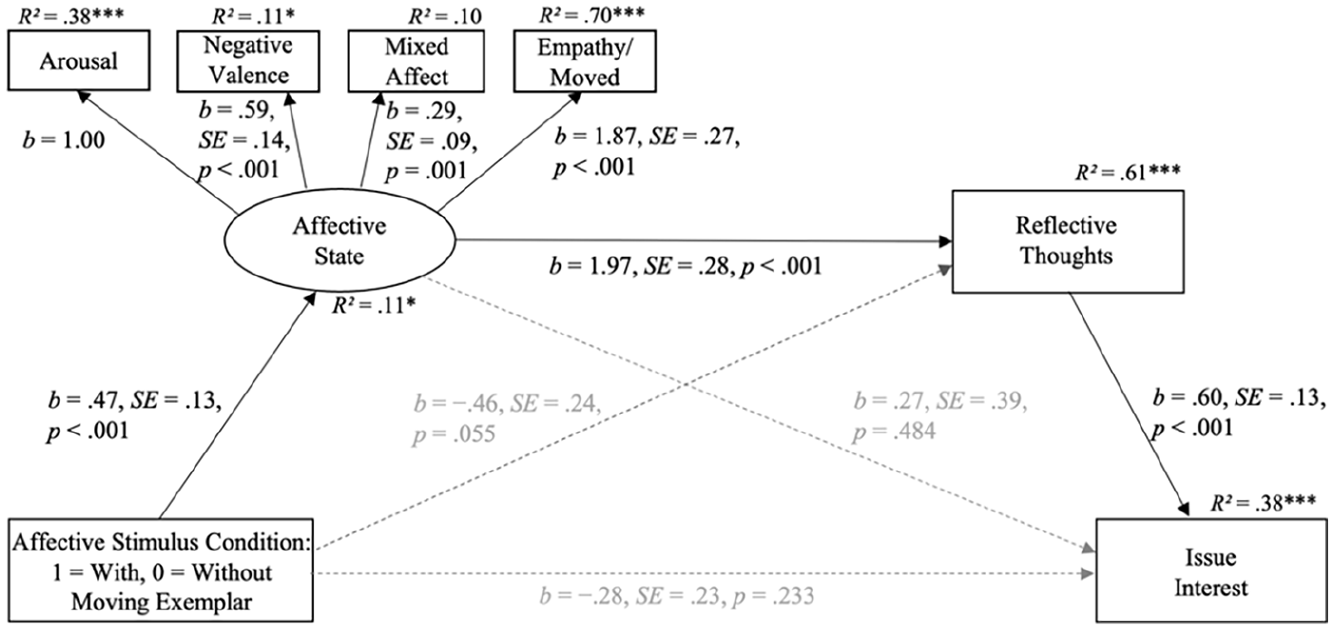
Model 1a—Influence of affective stimulus condition (moving fictional exemplar) on affective state, reflective thoughts, and issue interest.
Model 1b (H1a/c)
The SEM for political participation intentions as dependent variable (see Figure 2) showed an acceptable fit to the data (χ2 = 14.867, df = 9, p = .095; CFI = .982; RMSEA = .057, 90% CI [0.000, 0.107]; SRMR = .037). As reported for Model 1a, H1a was supported. Further, as assumed in H1c, the affective stimulus condition had a significant indirect effect on political participation intentions via affective state and reflective thoughts (bindirect = .47, SE = .21, bias-corr. 95% CI [0.211, 0.893]). The indirect effect of the affective stimulus condition on political participation intentions via affective state was not significant (bindirect = .22, SE = .26, bias-corr. 95% CI [−0.07, 0.85]), indicating full rather than partial mediation of this effect via reflective thoughts (deviating from the partial mediation assumption in H1c).
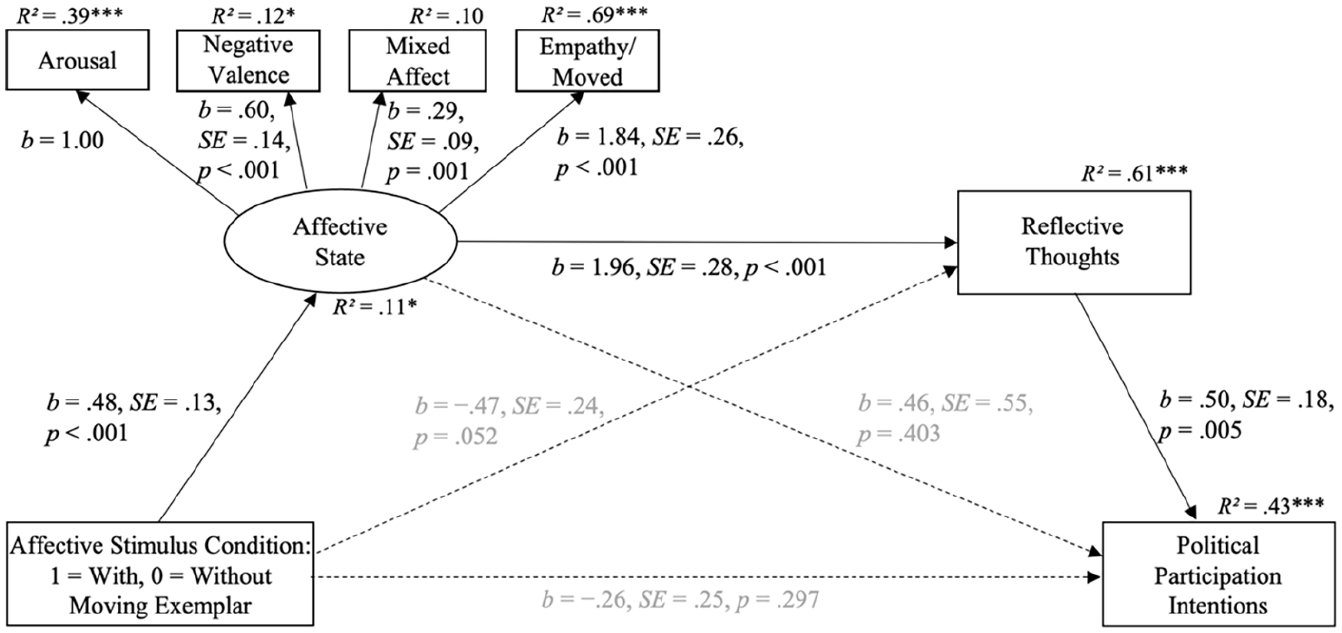
Model 1b—Influence of affective stimulus condition (moving fictional exemplar) on affective state, reflective thoughts, and political participation intentions.
The results of Study 1 replicate prior research concerning the effects of affective factors (arousal, negative valence, mixed affect, and empathy/feeling moved) on reflective thoughts (H1a) and issue interest (H1b). Moreover, affective factors associated with eudaimonic entertainment were found to stimulate political participation intentions indirectly by stimulating reflective thoughts (H1c). In this study, the expected direct effect of affective factors on political participation intentions was not observed. As reported in Supplemental Appendix C, however, the expected pattern emerged in Study 4, where affective factors had both a direct effect on political participation intentions and an indirect effect via reflective thoughts.
Study 2: Effects of Perceived Personal Relevance
Rationale for Study 2
In Study 2, we aimed to highlight the personal relevance of political issues addressed in entertainment media to examine its effects on reflective thoughts (H2a), issue interest (H2b), and political participation intentions (H2c). The experimental factor was modeled after the personal involvement manipulation by Petty and Cacioppo (1984). A soft news video about old-age poverty was introduced with a text manipulation informing participants that demographic development and legislation would make it likely versus unlikely that the issue could affect them personally.
Results of Study 2
The manipulation check for Study 2 (see Supplemental Table A2) revealed no main effect for the experimental factor (the introductory text manipulation of perceived personal relevance). Therefore, we could not test our second set of hypotheses experimentally. Instead, we used a correlational approach. A correlation matrix is reported in Supplemental Table B5. In addition, we analyzed path models with perceived personal relevance as exogenous variable, reflective thoughts as mediator, and issue interest (Model 2a) and political participation intentions (Model 2b) as dependent variables. Indirect and total effects were estimated using bootstrapping procedures employing 10,000 bias-corrected bootstrap samples.
Model 2a (H2a/b)
The path model for issue interest as dependent variable (see Figure 3) revealed that, consistent with H2a, perceived personal relevance had a significant direct effect on reflective thoughts (b = .50, SE = .03, bias-corr. 95% CI [0.445, 0.546]). Further, consistent with H2b, perceived personal relevance had a significant indirect effect on issue interest via reflective thoughts (bindirect = .31, SE = .03, bias-corr. 95% CI [0.255, 0.363]).
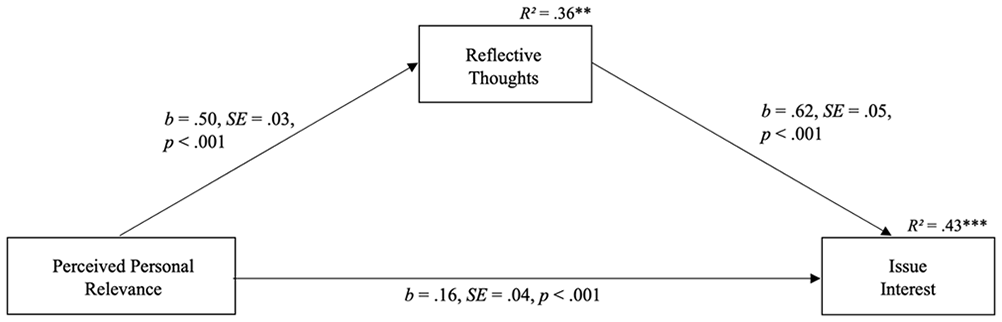
Model 2a— Influence of perceived personal relevance on reflective thoughts and issue interest.
Model 2b (H2a/c)
The path model for political participation intentions as dependent variable (see Figure 4) again supported H2a as reported for Model 2a. Further, consistent with H2c, perceived personal relevance had a significant indirect effect on political participation intentions via reflective thoughts (bindirect = .23, SE = .02, bias-corr. 95% CI [0.191, 0.281]).
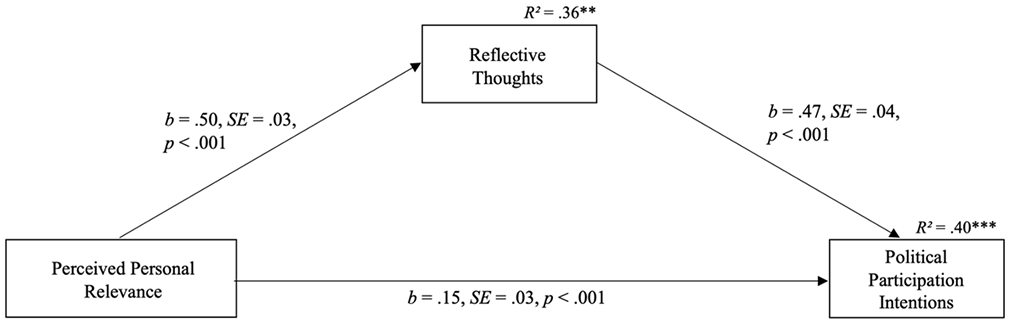
Model 2b—Influence of perceived personal relevance on reflective thoughts and political participation intentions.
Concerning our second set of hypotheses, the results supported the assumed effect of perceived personal relevance on reflective thoughts (H2a) as well as its indirect effects on issue interest (H2b) and political participation intentions (H2c) via reflective thoughts. It is important to note, however, that due to the nonsignificant manipulation check for the experimental manipulation of perceived personal relevance, the preconditions for the planned experimental test of H2a–c were not given. Therefore, our findings concerning H2a–c remain correlational.
Study 3: Effects of Absorption of Cognitive Resources
Rationale for Study 3
In the third experiment, we used a cognitively absorbing distractor task to examine the effects of absorption of cognitive resources on reflective thoughts (H3a), issue interest (H3b), and political participation intentions (H3c). In addition, we used this data set to test the assumed reverse causal effect of reflective thoughts on affective factors (H4). Three excerpts from a TV series about different political issues (unmanned drone strikes, software trade with authoritarian regimes, and 3D printing of guns) were used as stimuli. A distractor task to absorb cognitive resources was created by adding mental calculation tasks every 20 s during the video, versus no distractor task in the condition with low absorption of cognitive resources. A correlation matrix is reported in Supplemental Table B6.
Results of Study 3
The SEM models for testing the effects of absorption of cognitive resources on reflective thoughts (H3a), issue interest (H3b), and political participation intentions (H3c), and the reverse causal effect of reflective thoughts on affective factors (H4) were similar to those employed in Study 1, with two notable differences: The experimental manipulation of absorption of cognitive resources (1 = with distractor task, 0 = without distractor task) was the exogenous variable in this model, and the causal order of the mediators, reflective thoughts and affective state, was reversed. 2 As in Study 1, affective state was estimated as a latent variable (indicator coefficients: arousal: b = 1, negative valence: b = .88, SE = .12, p < .001, mixed affect: b = .16, SE = .07, p = .018, empathy/feeling moved: b = 1.99, SE = .23, p < .001). Indirect and total effects were estimated using bootstrapping procedures employing 10,000 bias-corrected bootstrap samples. All direct, indirect, and total effects are reported in Supplemental Tables B7 and B8.
Model 3a (H3a/b, H4)
The SEM for issue interest as dependent variable (see Figure 5) showed an acceptable fit to the data (χ2 = 29.738, df = 10, p = .001; CFI = .966; RMSEA = .076, 90% CI [0.045, 0.108]; SRMR = .033). Consistent with H3a, absorption of cognitive resources had a significant negative direct effect on reflective thoughts (b = −.51, SE = .17, p = .002). Further, as assumed in H4, absorption of cognitive resources had a significant negative indirect effect on affective state via reflective thoughts (bindirect = −.16, SE = .05, bias-corr. 95% CI [−0.264, −0.057]), indicating a reverse causal effect of reflective thoughts on affective factors. Moreover, as assumed in H3b, absorption of cognitive resources had a significant negative indirect effect on issue interest via reflective thoughts (bindirect = −.35, SE = .13, bias-corr. 95% CI [−0.625, −0.129]).
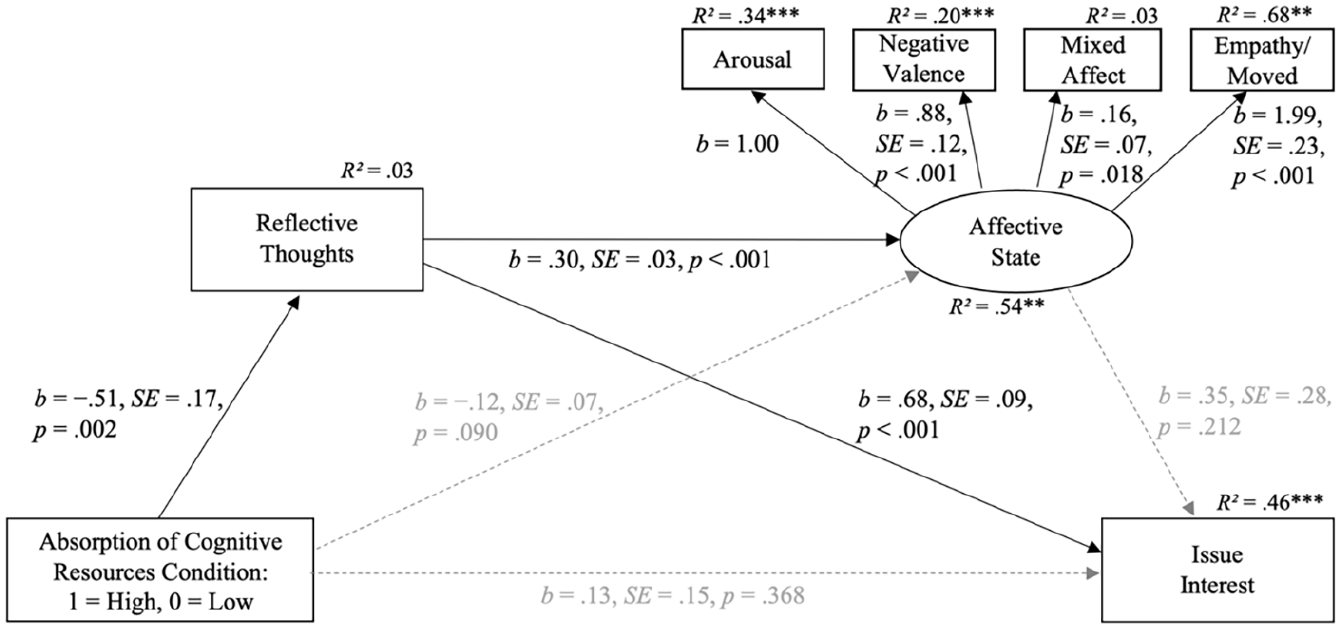
Model 3a—Influence of the absorption of cognitive resources condition (cognitively absorbing distractor task) on reflective thoughts, affective state, and issue interest.
Model 3b (H3a/c, H4)
The SEM for political participation intentions as a dependent variable (see Figure 6) showed an acceptable fit to the data (χ2 = 22.840, df = 10, p = .011; CFI = .977; RMSEA = .061, 90% CI [0.028, 0.094]; SRMR = .029). As reported for Model 3a, the effect of absorption of cognitive resources on reflective thoughts (H3a) and the reverse causal effect of reflective thoughts on affective factors (H4) were supported. Moreover, as assumed in H3c, absorption of cognitive resources had a significant negative indirect effect on political participation intentions via reflective thoughts (bindirect = −.20, SE = .09, bias-corr. 95% CI [−0.401, −0.061]). Further, consistent with the direct influence of affective factors assumed as part of H1c, affective state had a significant direct effect on political participation intentions (b = .82, SE = .28, p = .003).
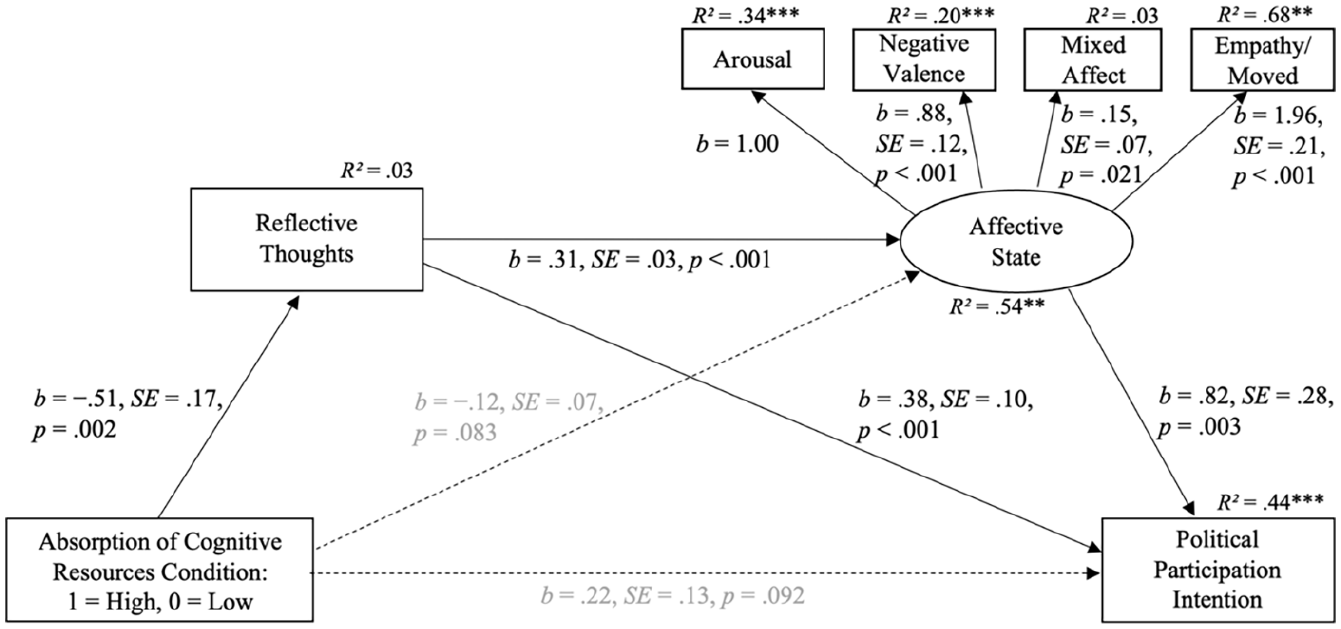
Model 3b—Influence of the absorption of cognitive resources condition (cognitively absorbing distractor task) on reflective thoughts, affective state, and political participation intention.
Taken together, the results of Study 3 complement those of Studies 1 and 2 by providing initial evidence that a lack of available cognitive resources can work against eudaimonic entertainment effects on reflective thoughts (H3a), issue interest (H3b), and political participation intentions (H3c). In addition, the results supported the assumption of a reverse causal effect of reflective thoughts on affective factors associated with eudaimonic entertainment (H4).
Discussion
Our studies aimed to replicate and extend prior research on the extended dual-process model of entertainment effects on political information processing and engagement (Schneider et al., 2021). Specifically, we aimed to advance a growing line of research by including political participation intentions as an outcome variable and by examining the effects of additional context factors on eudaimonic entertainment experiences.
Across three studies, including six entertainment stimuli on different political issues, we observed a consistent pattern of mediation effects that explained the influence of eudaimonic entertainment experiences on issue interest and political participation intentions. As predicted, reflective thoughts emerged as a hub for indirect effects of other factors associated with eudaimonic entertainment. Affective factors (Study 1 and Study 4, see Supplemental Appendix C), perceived personal relevance (Study 2), and absorption of cognitive resources (Study 3) each had indirect effects on issue interest and political participation intentions via reflective thoughts. The robustness of the cognitively mediated path to issue interest is in line with prior research (Bartsch & Angerer, 2021; Bartsch et al., 2018; Bartsch & Schneider, 2014). Moreover, the mediating role of reflective thoughts could be extended to political participation intentions across all studies. This pattern of findings highlights the role of eudaimonic truth- and meaning-seeking (Oliver & Raney, 2011) as a vital link between moving stories and serious political interest. Apparently, if a moving story fails to activate reflective processes of elaboration and meaning-making, issue interest and political participation intentions are less likely to emerge.
Additional direct effects emerged, but less consistently. Affective factors had direct effects on issue interest in Study 4 (but not in Studies 1 and 3) and on political participation intentions in Studies 3 and 4 (but not in Study 1). Perceived personal relevance had a direct effect on both issue interest and political participation intentions in Study 2. Thus, in some cases, eudaimonic entertainment effects seemed to involve direct action tendencies aroused by emotions or perceived personal relevance. Such direct action tendencies emerged less reliably, however, and were always combined with a thoughtful component that consistently emerged in the form of indirect effects via reflective thoughts.
The interference effect of a cognitively absorbing distractor task in Study 3 further substantiates the pivotal role of reflective thoughts in eudaimonic entertainment experiences. As expected, absorption of cognitive resources had a negative direct effect on reflective thoughts and negative indirect effects on issue interest and political participation intentions, across three entertainment stimuli dealing with different political issues. This pattern adds new insight to research on eudaimonic entertainment, which has predominantly focused on affective factors as independent variables so far (Bartsch & Schneider, 2014; Oliver et al., 2012). A relatively small body of research has examined the role of cognitive factors such as cognitive conflict (Knop-Huelss et al., 2020; Lewis et al., 2014) and cognitive challenge (Bartsch & Hartmann, 2017). Another related line of research has dealt with the role of ego depletion in entertainment experiences (Eden et al., 2018). Under conditions of mental exhaustion, individuals were more likely to select hedonic rather than eudaimonic entertainment, indicating that cognitive challenges associated with eudaimonic entertainment experiences may be overwhelming for individuals whose mental resources are depleted (Eden et al., 2018).
Moreover, the suppressor effects of the cognitive distractor task on both cognitive and affective components of eudaimonic entertainment experiences in Study 3 bear interesting parallels with the suppressor effects of distractor tasks on transportation (Green & Brock, 2000). These parallel findings point to the necessity of more closely examining the theoretical and empirical relationship between transportation and eudaimonic entertainment experiences (Ott et al., 2021). As already noted, the E-ELM (Slater & Rouner, 2002) assumes that transportation can stimulate cognitive involvement. It may sound paradoxical that transportation, characterized by absorption of cognitive resources (Green & Brock, 2000), can simultaneously stimulate reflective thoughts. A possible explanation is that empathy might be the driving force behind both transportation and reflective thoughts. On the one hand, empathy absorbs cognitive resources because it involves mental simulation of events from the characters’ perspective, thus contributing to the viewer’s sense of transportation (Busselle & Bilandzic, 2008). On the other hand, empathy may redirect cognitive resources to issue understanding and problem-solving because it is associated with concern for the well-being of others affected by the issue (Bartsch et al., 2018; Batson et al., 1997) or because a perceived similarity of characters with the self can encourage self-reflection (Klimmt & Rieger, 2021). Such mutually reinforcing effects of empathy and reflective thoughts could either occur during stimulus exposure if narrative pace is sufficiently slow to leave free cognitive resources or after exposure in the form of retrospective reflection and discussion (Ewoldsen et al., 2021; Slater & Rouner, 2002). Further research is needed to explore the specific timing of reflective thoughts and to elucidate their causal interplay with affective factors.
If substantiated in further research, a mutually reinforcing dynamic of affective and cognitive responses might explain how eudaimonic entertainment experiences unfold over time, resulting in lasting impressions (Oliver & Bartsch, 2010), interpersonal discussion (Landreville & Lamarre, 2011), and carry-over effects of affective and cognitive involvement to information media (Bartsch & Angerer, 2021; Bartsch et al., 2018; Bartsch & Schneider, 2014). Though methodologically challenging, the timing and unfolding interplay of affective and cognitive components of eudaimonic entertainment experiences could be examined using think-aloud methods, continuous response measurement, and experience sampling methods.
Our efforts to observe effects of perceived personal relevance as a reinforcing context factor of eudaimonic entertainment experiences in Study 2 yielded only correlational evidence. Participants’ perceptions of how relevant a story about old-age poverty was to them personally were correlated with reflective thoughts, issue interest, and political participation intentions, as expected. However, despite the relatively large number of stimuli pretested (see Supplemental Appendix A), pretest results for the experimental factor were generally weak and did not reach significance in the main study, although this study was well-powered to detect small effects. This suggests that perceived personal relevance of political issues was mainly grounded in daily life experiences and was not easily overridden by a short introductory text manipulation. Quasi-experimental research with groups that naturally differed in terms of perceived personal relevance of narrative texts yielded more substantial effects (Koopman, 2015; Kuzmičová & Bálint, 2019)—an approach that might be fruitfully applied to audiovisual narratives as well. Moreover, qualitative interviews and survey research suggest that full-blown experiences of biographic resonance can be powerful and associated with lasting effects on attitudes and behavior (Leonhard, 2024). However, such formative media experiences are relatively rare and idiosyncratic (Leonhard, 2024) and, therefore, difficult to elicit in an experimental setting.
Limitations
Several limitations of the present studies need to be noted. First, self-report measures are associated with important limitations, specifically in the case of the dependent variables, such as issue interest and political participation intentions. Participants in our experiments rated their likelihood of engaging in these behaviors, but we did not observe the behaviors as such. Therefore, further research using behavioral measures of issue interest and political participation is needed. For example, issue interest could be operationalized as selective exposure behavior and exposure time to hard news about the issue (Bartsch & Schneider, 2014). Actual political participation behavior could be assessed via self-report in a follow-up survey or observed in a survey experiment, including behavioral options such as making online donations, signing an online petition, or forwarding a political message.
Second, despite our experimental approach, several aspects of the findings remained correlational. As already noted, Study 2 yielded only correlational evidence of perceived personal relevance effects due to the failed experimental manipulation. Stronger manipulations or longitudinal research are needed to examine the assumed influence of perceived personal relevance as a context factor of eudaimonic entertainment experiences. Likewise, mixed affect emerged as a weak but significant indicator of affective states associated with eudaimonic entertainment in Studies 1 and 3 but did not significantly differ in the manipulation check for Study 1, meaning that evidence of its influence as a eudaimonic entertainment factor remained correlational. This relatively weak pattern of findings for mixed affect might be due to the predominantly negative content of our stimulus materials and should be followed up with entertainment content that combines positive and negative perspectives on political issues.
Moreover, the mediating variables in our SEM models were not manipulated independently. Thus, a causal interpretation of effects on the dependent variables is only warranted for the studies where the variables were manipulated (affective factors in Study 1 and reflective thoughts in Study 3). In those studies where they were measured as mediators (reflective thoughts in Studies 1 and 2 and affective factors in Study 3), their relationships with the dependent variables were correlational. In these cases, we cannot rule out a confounding influence of personality traits such as need for cognition and trait empathy or situational variables such as issue involvement.
In Studies 1 and 3, effects of the experimental manipulations on affective factors and reflective thoughts were significant (or marginally significant, in the case of reflective thoughts in Study 1), but the total effects on issue interest and political participation intentions were not significant. One possible explanation is that, despite significant effects on moving and thought-provoking experiences, exposure to a single 5-min stimulus might have been too short to observe significant downstream effects on political interest and participation intentions. Further research using full-length entertainment stimuli is needed to follow up on these results. However, as our conceptual independent variables were eudaimonic entertainment factors as opposed to the manipulation itself (Tao & Bucy, 2007), we think that focusing only on non-significant total effects may have overlooked those mechanisms behind the significant indirect effects that we specifically wanted to test in our studies (Zhao et al., 2010). Still, it would be interesting to look at possible co-occurring and competing processes that may suppress, confound, or mediate other effects of the stimuli. For example, in Study 1, the moving fictional exemplars from US series might have distracted German participants from considering the issues portrayed as domestically relevant, such that the positive effect of exemplars via affective factors was canceled out. In Study 3, the cognitive distractor task might also have suppressed counterarguing, such that the effect of the distractor task via reflective thoughts was canceled out. Measurement of such possible parallel mediators is needed to elucidate further the observed pattern of significant indirect and nonsignificant total effects.
Finally, our findings are limited to the eudaimonic side of the dual-process model of entertainment effects on political information processing and engagement (Schneider et al., 2021). To compare the effects of hedonic versus eudaimonic entertainment experiences, further research using multifactorial designs is needed to systematically examine how high and low levels of hedonic and eudaimonic experiences interact in predicting political engagement.
Conclusion
With these limitations in mind, the three experiments reported in this paper provide further insight into eudaimonic entertainment experiences and their politically relevant outcomes. Using a variety of soft news and fictional entertainment stimuli about a broad range of political issues, we could identify a robust pattern of eudaimonic entertainment effects characterized by mutually reinforcing effects of affective factors and reflective thoughts, which in turn predicted individuals’ reported likelihood to seek further information and to engage in actions to address the issue. To be sure, this pattern of politically mobilizing effects is not what we would expect to see across the entirety of the entertainment media landscape. Nevertheless, we hope that our studies contribute to a growing line of research that has begun to elucidate the specific conditions under which entertainment media can make a serious and significant contribution to political discourse.
Supplemental Material
sj-docx-1-crx-10.1177_00936502241259921 – Supplemental material for The Influence of Eudaimonic Entertainment Experiences on Political Information Processing and Engagement
Supplemental material, sj-docx-1-crx-10.1177_00936502241259921 for The Influence of Eudaimonic Entertainment Experiences on Political Information Processing and Engagement by Anne Bartsch, Frank M. Schneider, Larissa Leonhard, Freya Sukalla and Andrea Kloß in Communication Research
Footnotes
Declaration of Conflicting Interests
The authors declared no potential conflicts of interest with respect to the research, authorship, and/or publication of this article.
Funding
The authors disclosed receipt of the following financial support for the research, authorship, and/or publication of this article: We gratefully acknowledge funding from the German Research Foundation [grant number BA 2827/4-1, and SCHN 1428/2-1].
Open Practices

Supplemental Material
Supplemental material for this article is available online.
Notes
Author Biographies
References
Supplementary Material
Please find the following supplemental material available below.
For Open Access articles published under a Creative Commons License, all supplemental material carries the same license as the article it is associated with.
For non-Open Access articles published, all supplemental material carries a non-exclusive license, and permission requests for re-use of supplemental material or any part of supplemental material shall be sent directly to the copyright owner as specified in the copyright notice associated with the article.
