




Abstract
Meaningful movies can serve as an anxiety buffer against the fear of death, unless death plays a central role in the movie. This invites the question what happens when death is central to a movie storyline. The present research introduces and tests the so-called fear transcendence route, a second terror management route in which meaningful movies about death invite viewers to virtually confront and transcend their fear of death. Two experiments (N = 206; N = 401) tested three preconditions for fear transcendence, that is, (1) death is salient in real life; (2) death is central to the storyline, and (3) the movie projects a specific meaning to death. We assessed effects on fear transcendence, operationalized as decreased fear of death; decreased death avoidance; increased death acceptance. Especially older viewers became less avoidant and more accepting of death when the preconditions for fear transcendence were met. Meaningful movies about death can thus evoke fear transcendence.
In popular movies like Titanic, Little Women, or A Star is Born, main characters often end up dead, or lose the person they love the most. The box office success of such movies is puzzling, given that humans go to great lengths to avoid thinking about death in real life. If humans are so afraid of death, what makes them voluntarily go to the cinema to watch main characters struggle with death?
Terror Management Theory (TMT; Greenberg et al., 1986) explains how humans typically deal with death. This existential psychological theory proposes that, just like other animals, human have a self-preserving tendency; they want to live and prolong life. However, unlike other animals, humans also have the unique capacity to self-reflect. This capacity allows them to rise above the limitations of personal identities and circumstances, but it also creates a vulnerability with terrifying potential, that is, the knowledge that they will die someday. Hundreds of empirical studies support the central TMT tenet that humans deal with the fear of death by pushing it outside of conscious awareness. This is achieved by adhering to cultural worldviews, such as nationalism, materialism, or religion, which function as an anxiety buffer (e.g., Burke et al., 2010). Of particular relevance to communication research, studies show that meaningful movies can also function as an anxiety buffer against the fear of death, and thereby suppress this fear. However, this route is blocked when death is central to the storyline (Rieger et al., 2015; Rieger & Hofer, 2017). These findings invite the question what happens when viewers are confronted with death in meaningful movies and whether these could serve another terror management function, next to the already confirmed anxiety buffering function.
The present research extends TMT to the communication domain by introducing and testing a second terror management route in which viewers use entertainment to safely approach the idea of death. We specifically propose that watching meaningful movies about death provides viewers with a unique opportunity to approach their fear of death, when salient, and potentially transform it in the so-called fear transcendence route. This implies that watching movies about death may provide a more constructive, conscious alternative to the classic terror management route which primary function is to keep death thoughts outside of conscious awareness. The evidence that individuals avoid thoughts about death in the real world is overwhelming (Burke et al., 2010), but this does not preclude the possibility that death thoughts could be approached in the virtual realm. Indeed, recent findings show that mortality salience motivated humans to engage with death movies with meaningful endings (Das & te Hennepe, 2022; Rieger & Schneider, 2022).
The possibility of a second TM route is of relevance to communication research on eudaimonic, meaningful entertainment because it connects this research to a tried and tested theoretical framework from the psychology domain. Building on recent eudaimonic entertainment studies, the present research provides a concrete framework with testable hypotheses about how watching meaningful entertainment interacts with the most fundamental human fear, that is, the fear of death. The present research also innovates TMT. The vast majority of TMT studies focused on defensive, rather than constructive, responses to the fear of death (for an exception see e.g., Cozzolino et al., 2004). By describing an alternative, more constructive route to deal with a fundamental human fear, the present research extends TMT with a second route in which meaningful entertainment is used to grapple with the fundamental fear of death, and specifies conditions for it.
In the next sections we first explain the basics of TMT and its key mechanisms, and provide the rationale for our extended TMT framework of Meaningful Entertainment (TMT-ME). We then specify three conditions that need to be met for movie viewers to take the more conscious fear transcendence route, and we explain how these conditions build on communication research on meaningful and self-transcendent entertainment experiences. We then present two experimental studies that focused on testing the preconditions and effects of the newly proposed fear transcendence route.
Death Thought Suppression Versus Fear Transcendence: Introducing a Second TM Route
The fact that humans have the unique ability to reflect has a downside; it has given them the knowledge that they will die someday, like all other living beings. TMT proposes that, to avoid becoming paralyzed by the fundamental fear of death, humans push death thoughts outside of conscious awareness, through a cultural anxiety buffer. This anxiety buffer consists of two components: a belief in the validity of a cultural worldview and its associated standards, and a belief that one is meeting cultural standards, which provides self-esteem (Rosenblatt et al., 1989). TMT has two key premises. The first premise is that when mortality is salient, individuals will show an increased desire to defend cultural worldviews that offer them literal immortality, such as the promise of an afterlife, or symbolic immortality, such as increased materialism or the desire to acquire high status products (Fransen et al., 2019). The second premise is that adhering to cultural worldviews decreases the fear of death, that is, it pushes death thoughts outside of conscious awareness. These two central TMT premises have received ample empirical support in the past decades, in hundreds of experiments in the psychology domain (see e.g., Burke et al., 2010).
Although TMT does not preclude the possibility of alternative TM routes, the vast majority of studies have focused on the way humans use cultural worldviews to suppress their fear of death. Becker (1973), whose work formed the basis for TMT, proposed that for humans, thoughts about their own unavoidable death, together with an innate drive toward self-preservation, create a potential for terror that they cannot escape [italics added], merely suppress (p. 55). The present research challenges this proposition by introducing and testing the possibility of a second TM route in an extended framework that we call the Terror Management Theory of Meaningful Entertainment (TMT-ME). The TMT-ME is specifically focused on entertainment experiences. It proposes that even though humans typically prefer to avoid or suppress death thoughts, they are in fact capable of approaching and overcoming this fear (i.e., transcendence), and they can be invited to do so by eudaimonic entertainment about death. Eudaimonic entertainment is conceptualized as meaningful and insight-giving entertainment that provides greater understanding of the human condition, such as the purpose of life and what it means to live a good life (Hofer & Rieger, 2019; Oliver & Bartsch, 2010). When eudaimonic movies pertain specifically to death, they can invite viewers to vicariously go through the emotions and thoughts of a protagonist who is confronted with their own imminent death or the loss of a loved one, and who is trying to make sense of the experience. The TMT-ME proposes that movies about death can invite viewers to confront the fear of death at a safe aesthetic distance, through the eyes of a protagonist. This experience can, in turn, invite them to embrace and transcend their fear of death (also see Das & te Hennepe, 2022).
The TMT-ME thus describes two different routes through which individuals can manage terror; (1) the already existing worldview defense route (Route I), in which viewers use meaningful media content to push thoughts about death out of their conscious awareness and (2) an additional, novel fear transcendence route (Route II), in which viewers use meaningful media content to grapple with death, and potentially change their attitudes toward death. We propose that entertainment experiences can result in different outcomes, depending on whether they function as an anxiety buffer against the fear of death (Route I), or invite viewers to transcend their fear of death (Route II). Previous communication research has provided evidence for Route I, showing that watching eudaimonic, meaningful entertainment can buffer the fear of death (Rieger et al., 2015). Following up on these findings, Rieger and Hofer (2017) reported that meaningful movies in which the protagonist died did not serve as an anxiety buffer function. From these findings we tentatively conclude that meaningful movies about death might provide an alternative route to manage terror. Thus far this proposition has not been addressed.
In the next sections we elaborate on the preconditions for the second TMT-ME route of fear transcendence; (1) the fear of death is salient for a viewer, (2) death plays a central role in the storyline, and (3) the movie projects a specific meaning to death. See Figure 1.
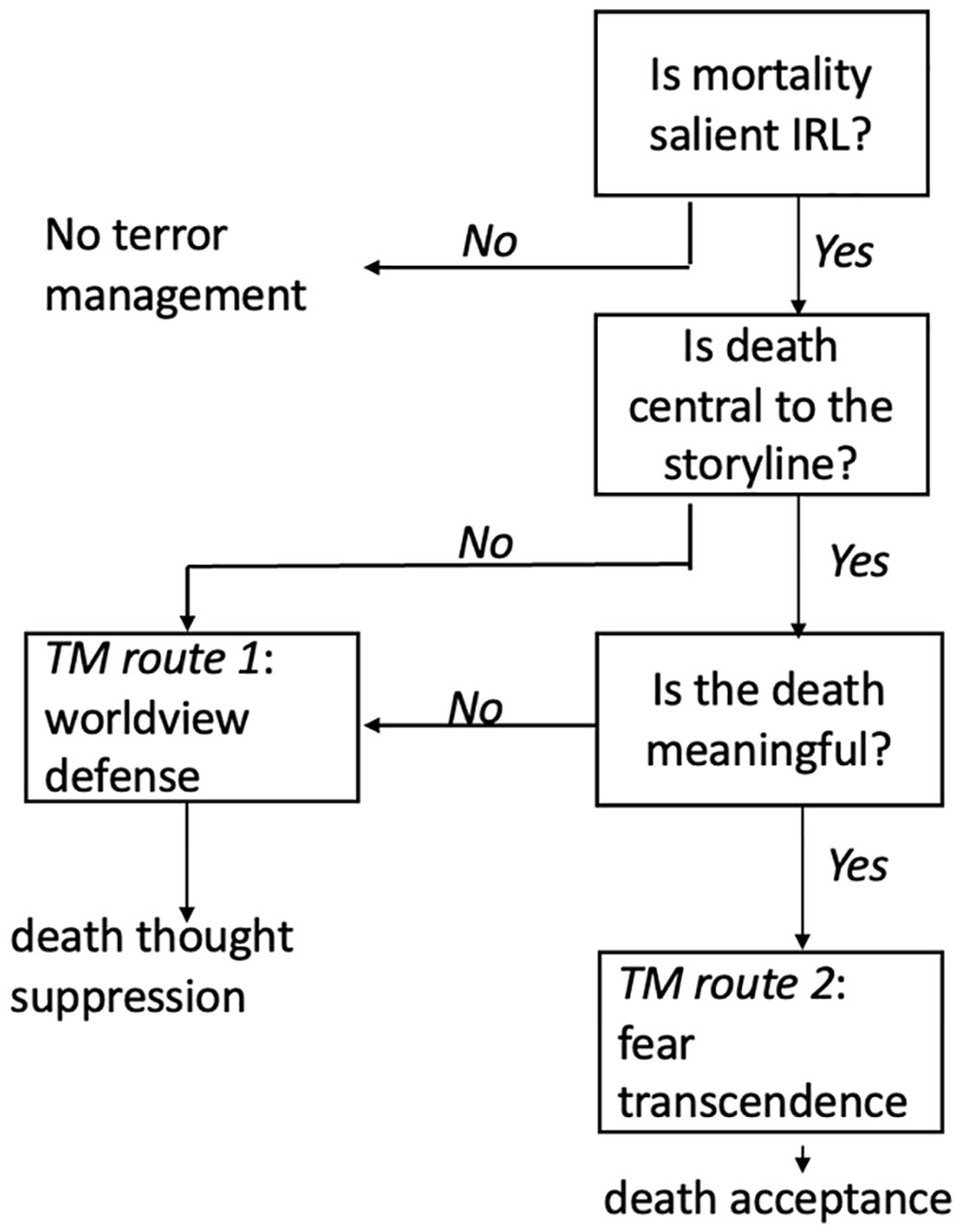
An extended terror management theory of meaningful media (TMT-ME).
Precondition I for Fear Transcendence: Salience of the Fundamental Fear of Death
At the root of all terror management processes lies the activation of the fear of death in the real world. TM research typically activates the fear of one’s own death by asking participants to: “Please describe the emotions the thought of your own death arouses in you”; and “Jot down, as specifically as you can, what you think will happen to you physically as you die and once you are physically dead.” Some studies have used a similar manipulation, replacing one’s own death with the death of a loved one. Mortality salience of self and mortality salience of a loved one activate death thoughts and cultural worldview defenses in the same way, although specific implications may vary across contexts (Greenberg et al., 1994).
Proposition I of the TMT-ME therefore states that the salience of the fundamental fear of death is a precondition for fear transcendence via movies about death. When the fundamental fear of death is not activated, individuals will have no terror management motive. They may still watch a movie about death, but they will not use it to suppress or transcend the fear of death. Proposition I pertains to the effects of watching movies about death, not to the selection of such movies. In contrast, when mortality is salient, individuals are faced with an urgent existential condition to which there is no actual relief, because all humans will eventually die. In these conditions, viewers may use movies to deal with their fear of death. Our proposition is in line with the more general TEBOTS argument that entertainment narratives may provide viewers with a means to alleviate the psychological burdens and demands placed upon them in real life (Slater et al., 2014). Even movies about death will provide a relatively safe space when the fear of death is salient in real life, because they elicit a simulation of the death of a story protagonist, not viewers’ own death.
Several research findings are in line with Proposition I that the fear of death has to be salient in real life in order to produce effects in media contexts, but thus far studies have not extended this reasoning to potential beneficial effects on fear transcendence. One study reported that only viewers who were asked to first reflect on the death of a loved one showed increased emotional and narrative processing of meaningful short films about loss; viewers for whom loss was not salient did not show these effects (Das & te Hennepe, 2022). Goldenberg et al. (1999) found that when participants had been reminded of death, a story in which death was portrayed evoked more emotional response, such as being touched, than a non-tragic story. Hofer (2013) similarly showed that when mortality had been made salient, viewers appreciated a film in which the protagonist died more than when mortality had not been made salient, but only among participants who scored high on search for meaning in life.
A first goal of the present research was to test Proposition I in the context of the newly proposed TMT-ME route of fear transcendence. Recent research has shown that certain forms of entertainment, specifically eudaimonic and self-transcendent experiences, can uplift viewers and loosen their attachment to the self (Janicke-Bowles, 2020). In a state of self-transcendence, individuals report feeling connected to a bigger whole (Janicke & Oliver, 2017). Building on these findings, we define fear transcendence as a state in which viewers’ fear of death and their attachment to cultural worldviews are (temporarily) lifted. We propose that this less self-oriented, more connected state is an auspicious moment in which viewers are open to consider novel perspectives on their existing worldviews, including more openness and acceptance of the fact that they, too, will die someday. We tested this proposition in two studies. We first assessed the general premise that self-transcendent processes are positively related to accepting of the idea of death as an unavoidable part of life. We then focused specifically on death attitudes as a conscious, deliberate measure of fear transcendence in two experimental studies, opposing the unconscious process of death thought suppression of the first TM route. Explicit death attitudes can be assessed with a validated scale that measures the fear of death, death avoidance, and death acceptance (Wong et al., 1994). We operationalize fear transcendence as a decrease in explicit fear of death or death avoidance, or an increase in death acceptance.
Precondition II for Fear Transcendence: Central Role of Death in the Storyline
Death is an important theme that contributes to the meaningfulness of entertainment, which can bring insight about issues involving death as a part of the human condition (Oliver & Hartmann, 2010). Unfortunately, causal evidence on the added value of death in movies—compared with movies about a non-death topic—is limited, and solid evidence for the terror management function of meaningful movies is limited to evidence for the first TM route.
Rieger et al. (2015) showed that viewers who had been reminded of death had less implicit activation of self-esteem after watching a meaningful film clip than after watching a funny or an informative film clip. The film clips in this study did not include death (Rieger et al., 2015, p. 363). These findings can be explained by the classical TM route, according to which adhering to the cultural worldview conveyed in the movie suppresses the fundamental fear of death. To test whether the same results obtain when the movie does refer to death, Rieger and Hofer (2017) compared two versions of a film, one in which viewers were informed at the end that the protagonist died and another in which they were informed he survived. Findings showed that for participants who had been reminded of their mortality, the film in which the protagonist survived resulted in less implicit self-esteem activation compared to a control group for whom mortality had not been made salient. The film in which the protagonist died elicited equally high implicit self-esteem activation for the mortality salient compared to the control group. TMT would explain this as an indication that movies can serve as a classical TMT anxiety buffer (Route I) when they provide the viewer with meaning and when death is not centrally featured in the storyline (Rieger et al., 2015; Rieger & Hofer, 2017). TMT research has shown that the anxiety buffering function does not decrease or solve the fear of death, it just (temporarily) suppresses it.
The present research extends these findings by examining how viewers process movies in which death plays a central role. Proposition II of the TMT-ME states that the centrality of death in the movie is a precondition for viewers to engage in fear transcendence. By centrality we mean that death plays a central role in the storyline, for example, because a main character dies, or because death is crucial to the integrity and development of the story and moves the story along its trajectory (cf. Chatman, 1978; Porter et al., 2002). The proposition is based on the idea that, in order to learn from death, a viewer must be confronted with thoughts and emotions about death while experiencing a movie.
Thus far this proposition has not been explicitly assessed, but some first evidence for the proposition that meaningful death movies can impact viewers’ death attitudes was provided by Slater et al. (2018). In this study, participants watched three excerpts from Hollywood movies that scored either high or low on eudaimonia. Two out of three of the eudaimonic clips (Up, Stand by Me) included death portrayals, whereas none of the non-eudaimonic clips did. Findings showed that the eudaimonic clip from one of the death-related movies increased death acceptance, compared with the non-eudaimonic clips. This study did not explicitly manipulate the presence or absence of death in the storyline, but we can conclude from the findings that it is possible to increase fear transcendence by watching death-related movies.
The present research aimed to provide a robust test of Proposition II that death has to be central in a movie, in order to evoke fear transcendence. To achieve this, we compared effects of movie endings in which a main character lives versus dies in one study, and we compared effects of movie clips about the death of a main character versus the ending of a relationship, that is, a breakup (vs. control) on fear transcendence (Route II). We included the comparison of two different types of death to verify that symbolic deaths, like relationship breakups, do not encompass physical death and are therefore less likely to serve a terror management function.
Precondition III for Fear Transcendence: Meaningful Death
How can a movie in which death plays a central role elicit fear transcendence? Building on research on eudaimonic and self-transcendent experiences, Proposition III states that movies need to portray death as meaningful in order to invite the second TM route of fear transcendence. Recent entertainment research has seen a surge of interest in the effects of eudaimonic entertainment experiences, which can facilitate meaning making and personal growth by touching on core aspects of the human condition and central values that can inspire viewers (Bartsch & Hartmann, 2017; Hofer et al., 2014). A central feature of eudaimonic experiences is the occurrence of mixed affect, that is, the simultaneous experience of happy and sad emotions (Oliver et al., 2012), or the emotion of being moved, in which individuals feel both sadness and joy simultaneously (Menninghaus et al., 2015; Oliver et al., 2012). Mixed affect is central to the experience of meaningfulness (Oliver et al., 2018), and meaningful endings evoke mixed emotions (Ersner-Hershfield et al., 2008; Larsen et al., 2021). Furthermore, research has documented a specific type of meaningful experiences, the so-called self-transcendent experiences, that arises “as viewers [..] recognize in themselves elements of shared humanity [..] and the potential for moral beauty, humility, courage, and hope” (Oliver et al., 2018, p. 384). Such experiences are characterized by a heightened awareness and appreciation of the interconnectedness among humans, nature, and the universe, and can be associated with specific moral, self-transcendent emotions such as elevation and inspiration.
These aspects of eudaimonic and self-transcendent media experiences might play a crucial role in fear transcendence. It has been suggested that in order to overcome stressors, the co-activation of positive and negative affect can be beneficial (Larsen, 2018; Larsen et al., 2003). An optimal proportion of positive and negative emotions may play a crucial role in healthy coping by keeping the stressful information in working memory sufficiently long, providing an opportunity for grappling with the stressor (Larsen et al., 2003, p. 220). Furthermore, the heightened state of connectedness and elevation that is associated with self-transcendent experiences may provide a temporary release from the ego-driven motives (Janicke-Bowles, 2020) that cultural worldviews are made of, and thereby facilitate fear transcendence.
A third goal of the present research was to test Proposition III that a movie has to portray the death as meaningful, and therefore elicit mixed, moved, and/or elevated emotions, in order to evoke fear transcendence. In one study we therefore compared effects of a mixed emotional death portrayal versus a negative emotional portrayal (vs. control) to verify that fear transcendence requires mixed emotions. In a second study, we further assessed the potential mediating role of mixed affect and the emotion of being moved.
Overview
The present research introduces and tests the proposition from the newly introduced TMT-ME that meaningful movies about death may allow viewers to grapple with their fear of death from a safe place, through vicarious experience, and transcend their fear of death, provided that three conditions are met. See Figure 1.
Specifically, the TMT-ME proposes that (1) a first and necessary step for terror management is the salience of the fear of death. If this condition is not met, then viewers might still watch a movie but will not use it to manage terror. The next step is (2) to assess to what extent death plays a central role in the movie. If this is not the case, then the worldview defense route will be taken, leading to death thought suppression. The third and final step is to assess if the story conveys a meaningful death by conveying or evoking the experience of being moved, or mixed affect. If this condition is met, then viewers will transcend the fundamental fear of death. Decreases in viewers’ fear of death or death avoidance, and increases in death acceptance are taken as an indication of fear transcendence (Route II).
Study 1
Study 1 tested Proposition I of the TMT-ME by experimentally manipulating the fear of losing a loved one (vs. neutral control) and assessing if fear transcendence only occurs when viewers’ mortality is salient. Study 1 also tested proposition II about the centrality of death in the storyline by asking participants to watch one of three (positive, negative, mixed emotional) edited extracts of the movie Me Before You (Rosenfelt et al., 2016), in which the centrality of death was manipulated (protagonist lived or died; cf. Rieger & Hofer, 2017). Proposition III, about the meaningfulness of death, was tested by manipulating the emotions in the movie ending, showing the protagonist either choosing to live (positive ending), choosing to end his life while leaving his lover heartbroken (negative ending), or choosing to end his life while leaving his lover sad but grateful (mixed ending). The study tested the following hypotheses and research question:
H1: Participants for whom mortality is salient report more mixed affect after viewing movies with mixed endings than after viewing movies with positive or negative endings; this difference is not observed among viewers for whom mortality is not salient.
H2: Participants for whom mortality is salient report more accepting death attitudes (less fear of death, less death avoidance, more death acceptance) after viewing movies with mixed endings than after viewing movies with positive or negative endings; this difference is not observed among viewers for whom mortality is not salient.
RQ1: Does mixed affect mediate the combined effects of mortality salience and mixed movie endings on accepting attitudes toward death?
Method
Design and Participants
Participants were randomly assigned to a 2 (Mortality Salience: MSLO, Control) × 3 (Movie Ending: Positive, Negative, Mixed) between subjects design. A total of 170 participants were women (75.9%) and 54 men (24.1%); age varied from 18 to 72 years old (M = 29.95, SD = 13.20). Most participants had a college (49.1%) or university education (27.2%); the remainder had vocational training (14.7%), high school education (7.6%), primary school (0.4%) or “different” education (0.9%). Gender (χ2(5) = 7.58, p = .181), education (χ2(25) = 14.94, p = .943), and age (F(5, 218) = .41, p = .843) were equally distributed across conditions.
Materials
Mortality Salience of a Loved One was manipulated based on Greenberg et al. (1994). This manipulation is similar to the classical mortality salience manipulation used in TMT, but focuses on the loss of a loved one instead of one’s own death. Participants were asked to write down who they were thinking of, and describe (a) the emotions they have when thinking of the death is this person and (b) what they think will happen to them physically after they die. Participants in the control condition were asked to describe (a) the emotions they have when thinking of watching television and (b) what they think will happen to them physically when they watch television (Das & te Hennepe, 2022).
To experimentally manipulate Movie Ending, participants watched one of three edited extracts of the movie Me Before You (Rosenfelt et al., 2016). All participants first watched a summary of the events in the movie; a young woman Louisa is hired as a companion for Will. Will is a former successful and active young man who no longer wants to live, after being permanently paralyzed in a traffic accident. Gradually the two protagonists develop feelings for each other. Depending on the experimental condition, a positive, mixed or negative emotional ending was then displayed. In the positive ending, Will decides, out of love, to not end his life, and he and Louisa are suggested to live happily ever after. This storyline conveys death avoidance for both main characters. In the negative ending, Will informs Louisa that he still intends to follow through with the assisted suicide, despite being in love, leaving Louisa heartbroken, sad and angry. This storyline conveys death avoidance from Louisa’s perspective, and death acceptance from Will’s perspective. The mixed ending shows a mixture of happy and sad events: Will decides to end his life, and Louisa makes peace with his decision and travels to Switzerland to be with Will during his last moments. This storyline shows death acceptance for both characters. All versions last approximately 5 min.
Procedure and Measures
The research was approved by a local ethics committee (#8712). Participants were recruited via social media (Facebook posts), personal messaging (WhatsApp), and at the university campus. Participation was online and voluntary. After an introductory text and informed consent, participants filled out demographics, and were assigned to the mortality salience or control condition. They then watched one of the three movie fragments, filled out the questionnaire, and were thanked and debriefed.
We used the Positive and Negative Affect Schedule (PANAS; Watson et al., 1998), with 10 positive and 10 negative affect items on a 5-point Likert scale as a manipulation check for movie ending, yielding reliable scales for positive (Cronbach α = .86) and negative affect (Cronbach α = .88). A Mixed Affect scale was created, using the MIN method, in which the common minimum of the positive and negative affect scales is taken (Ersner-Hershfield et al., 2008). We used PANAS because previous TMT studies have typically also used this measure to verify that mortality salience does not affect consciously experienced affect (Burke et al., 2010). However, these studies did not consider potential effects on mixed affect.
Fear Transcendence
To test our proposition that “fear transcendence as a state in which viewers’ fear of death, and their attachment to cultural worldviews is (temporarily) lifted,” the present study used a well-validated measure of death attitudes, the Death Attitude Profile-Revised (DAP-R; Wong et al., 1994). Specifically, the five subscales assessed participants death approach acceptance, escape acceptance, neutral acceptance, fear of death, death avoidance after exposure to the movies about death. Explicit death attitudes such as those measured by the DAP-R are conceptually different from typical TM responses to mortality salience such as death thought accessibility (DTA), which assesses the extent to which thoughts about death are activated outside of conscious control. In contrast, explicit death attitudes can change as a result of learning (e.g., Wallace et al., 2019). We therefore used the DAP-R as a measure of fear transcendence. Additionally, we provided empirical evidence that items of the DAP-R relate to self-transcendence, by assessing correlations with a validated measure of self-transcendence, specifically the subscale “Connectedness with a higher power” (Janicke & Ramasubramanian, 2017) in unpublished data from a larger TMT study (N = 229). The analyses confirmed that Connectedness with a Higher Power correlated positively with Death Acceptance (r = .39, p < .001). See Supplemental Appendix A for more details about these, and other, measures (including TM measures).
We used a 24-item scale, excluding items with explicit religious connotation (eight items) because the majority of the Dutch population is not religious. Factor analysis yielded the expected 5-factor solution. The largest factor (nine items; Eigenvalue 6.61) assessed the fear of death dimension (Cronbach α = .706), for example, “I have an extreme fear of death.” The second largest factor included five items that assessed the death avoidance dimension (Cronbach α = .87), for example, “I avoid death thoughts at all costs.” Factor analysis also confirmed that the original death acceptance dimension consisted of three subscales; an escape acceptance scale (three items; Cronbach α = .75), for example, “Death provides a relief from this terrible world,” and a neutral acceptance scale, for example, “Death is a natural aspect of life” (three items; Cronbach α = .73). The final dimension assessed approach acceptance, for example, “I believe in life after death” (four items; Cronbach α = .64).
We also included a measure of appreciation (see Supplemental Appendix B).
Statistical Analyses
We used analyses of variance to test H1 and H2. When control variables correlated significantly with the dependent variable of interest, we conducted the analyses with and without these variables as a covariate to control for robustness of the effects. Exploratory analyses for additional moderating factors were conducted using Helmert contrasts, in which the mixed movie condition was compared against the positive and negative movie condition using two different statistical analyses to verify robustness (PROCESS Model 3; Hayes, 2018). Data can be accessed through this link https://osf.io/z9baj/
Results
Testing H1
A MANOVA with mixed, positive, and negative affect as dependent variables, movie ending and mortality salience as independent factors, and age as a covariate, using Wilk’s λ, revealed a significant multivariate effect for age, F(3, 215) = 6.514, p < .001,
Testing H2
A MANOVA on the subscales fear of death, death avoidance, escape acceptance, approach acceptance, and neutral acceptance, with movie ending, and mortality salience as independent factors, and age as a covariate, using Wilk’s λ, revealed a significant multivariate effect for movie ending, F(10, 426) = 2.72, p = .003,
Inspection of the univariate effects revealed significant age effects on the subscales of fear of death, F(1, 217) = 8.21, p = .005,
Exploratory Analyses: The Role of Age. Because age had a significant and pronounced impact on the dependent variables, we explored whether age moderated the effects on death attitudes. Because the distribution of participants’ age revealed two separate curves with comparable numbers of participants; 18 to 25 year (N = 113) versus 26 to 72 year (N = 93), we used two different analyses to confirm the robustness of the findings. First, we ran the 2 × 3 analyses of variance described above with age as a dichotomous independent variable (young vs. older). Then, we reran the analyses with age as a continuous moderator, using Helmert contrasts to compare the mixed movie condition against the positive and negative movie condition (PROCESS Model 3; Hayes, 2018). We report detailed results only when both analyses confirmed the statistical significance of the findings.
The analyses of variance replicated the multivariate and univariate effects observed in the previously reported (M)ANOVAs for Death Attitudes, and additionally revealed a multivariate three-way interaction between movie ending, mortality salience, and age, F(10, 416) = 2.47, p = .007,
Simple effects analysis revealed that for younger participants who had watched the mixed movie ending, death avoidance increased in the mortality salience condition compared with the control condition, F(1, 193) = 4.25, p = .041,
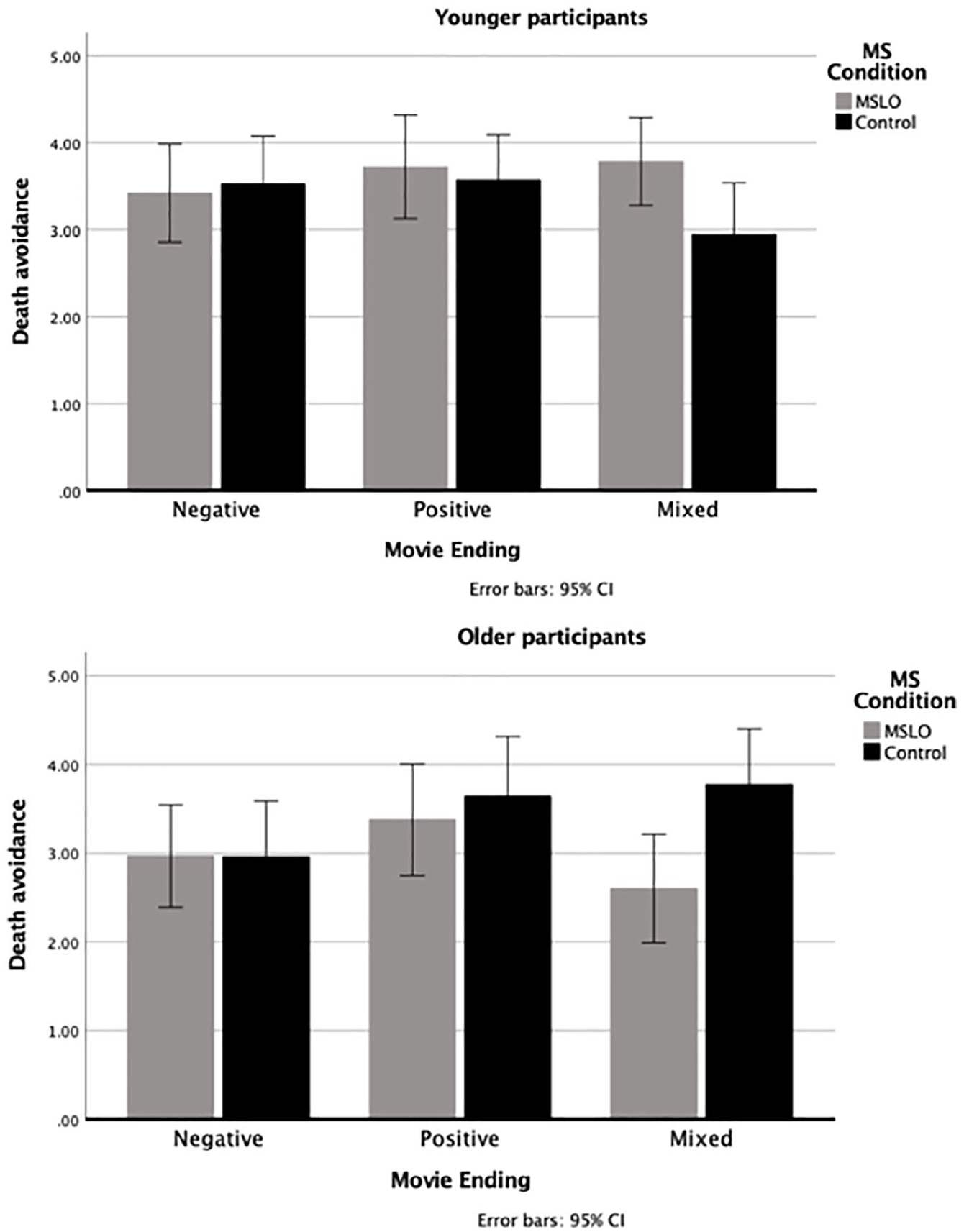
Death avoidance as a function of mortality salience (loved ones vs. control), movie ending (negative, positive, mixed) for younger viewers (top panel) and older viewers (bottom panel) in Experiment 1. Higher scores indicate more death avoidance.
Discussion
Older adults who watched a mixed movie ending about the death of a main character reported lower levels of death avoidance when the loss of a loved one was salient in the real world, compared with the control group. This pattern did not occur for the positive and negative movie endings, and it also did not occur for the younger age group. For the latter group, the mixed ending increased, rather than decreased, death avoidance when mortality was salient in real life. Overall, the findings provide some first evidence for our propositions that movies about death can invite fear transcendence, and affect death attitudes provided that mortality is salient for the viewer, and the movie portrays a meaningful death. However, the findings also suggest that age may be an additional boundary condition for movie-induced fear transcendence. It is noteworthy that the independent variables affected the death avoidance but not the death acceptance subscale, which may reflect the death attitude of the main character Louisa as a transitional role model in the mixed movie ending, who showed a decrease in death avoidance across the course of the storyline.
The counterintuitive finding that a positive ending increased, rather than decreased, a fear of death, can be related to the specific story; because Will does not die, the fear of his death may be perpetuated. The absence of an effect on participants’ mixed affect may be due to the use of PANAS, rather than a more specific measure of mixed affect or being moved typically used in entertainment research (Oliver et al., 2012). These and other issues were addressed in Study 2.
Study 2
Study 1 provided some preliminary support for TMT-ME, but not all hypotheses were confirmed. Study 1 had the drawback of a single message design; even though Will did not die in the positive movie ending, one could argue that also in this condition death was still rather central to the storyline. Finally, we did not observe the expected effects on mixed affect, which could be due to the fact that we used PANAS as a basis for this measure. More robust evidence is therefore needed to ascertain (1) that the effects of movies about death on fear transcendence are not story specific, (2) that effects are only observed for movies in which death is central, and (3) what the role of meaningful or self-transcendent emotions is in the fear transcendence process. To address these concerns, Study 2 employed a multiple message design with different types of meaningful endings; two movie fragments pertained to the death of a loved one and two movie fragments to the breakup of a relationship, that is, a meaningful ending that does not pertain to actual death. Two other fragments did not include a meaningful ending at all and therefore served as control. In addition, the findings of study 1 regarding age were taken into account in study 2 by recruiting only older participants over the age of 40.
We conducted a pretest to match the different movie fragments on key aspects, including validated measures of being moved, replacing the measure of mixed affect that was based on PANAS in Study 1. The study was preregistered at the Open Science Framework (https://osf.io/fhdmt). The following hypotheses were tested:
H1: Participants for whom mortality is salient have more accepting and less avoiding attitudes toward death when they have seen a death portrayal than when they have seen a control scene, whereas participants for whom mortality is not salient do not have different death attitudes when they have seen a death portrayal or a control scene.
H2: Participants for whom mortality is salient have more accepting and less avoiding attitudes toward death when they have seen a death portrayal than when they have seen a breakup portrayal, whereas participants for whom mortality is not salient do not have different death attitudes when they have seen a death portrayal or a breakup portrayal.
H3: Participants for whom mortality is salient have more accepting and less avoiding attitudes toward death when they have seen a breakup portrayal than when they have seen a control scene, whereas participants for whom mortality is not salient do not have different death attitudes when they have seen a breakup portrayal or a control scene.
Because being moved is beneficial for dealing with stressors like death anxiety, we expected that it would be responsible for the effects hypothesized above.
H4: The feeling of being moved mediates the effects hypothesized in H1, H2, and H3.
We also included a measure of death thought activation (DTA) to rule out the idea that the observed effects would be due to classical anxiety buffering effects. Thus, we pose an alternative hypothesis that would be supported if TMT applied to these effects. 1
H5: Death thought accessibility mediates the effects hypothesized in H1, H2, and H3.
Method
Design
The design was 2 × 3 between-subjects with mortality salience (induced vs. not induced) and type of ending in video clip (death portrayal vs. breakup portrayal vs. control portrayal) as factors. Two programs (Grey’s Anatomy and House) provided video clips for each condition, such that there were two death portrayals, two breakup portrayals and two control portrayals. Each participant was randomly assigned to watch one of these video clips.
Participants
We commissioned a research agency to collect data of 400 participants, and a total of 401 participants completed the study, who were all included in the sample. A similar number of men and women were recruited; 202 men (50.4%) and 199 women (49.6%). The age of participants was set between 40 and 80, based on the findings of experiment 1. The average age was 58.6 (SD = 10.3), with more people between 50–59 and 60–69 (both approx. 30%) than between 40–49 and 70–80 (both approx. 20%). The majority of participants had completed vocational education (39.9%), college (26.7%), or secondary education (22.2%). Few people had completed university (9.5%), only primary education (1%), or other (0.7%). Gender (χ2(11) = 9.99, p = .53), age (χ2(33) = 29.75, p = .63), and education (χ2(55) = 59.11, p = .33) were distributed equally across conditions.
Materials
Participants in the “mortality salience induced” condition were asked to describe (a) the emotions they have when thinking of their own death and (b) what they think will happen to them physically after they die. Participants in the “mortality salience not induced” condition were asked to describe (a) the emotions they have when thinking of watching television and (b) what they think will happen to them physically when they watch television (Greenberg et al., 1994).
The type of portrayal in the video clip was manipulated by selecting different fragments from the television series Grey’s Anatomy (Rhimes, 2014) and House (Shore, 2007). Death portrayal was instantiated by two fragments that both conveyed escape acceptance; the acceptance of death to escape suffering in life. In the death portrayal from Grey’s Anatomy (season 11, episode 21) the character Derek Shepherd dies. The fragment shows his wife Meredith Grey talking to a doctor about signing forms to consent to shutting down the machines keeping him alive and eventually her handing over the signed papers to the nurse and watching her husband die. In the death portrayal from House (season 4, episode 16) the character Amber dies. The fragment shows her boyfriend Wilson talking to his boss Cuddy about waking her up before the machines keeping her alive need to be shut down. Subsequently he talks to Amber on her death bed and he holds her when she dies. In the study all fragments were preceded by a text that describes how the characters got to this point.
Breakup portrayal was instantiated by two fragments. In the breakup portrayal from Grey’s Anatomy (season 11, episode 5) the characters Arizona and Callie break up. The fragment shows the characters in a therapy session where the therapist suggests they “take a break.” After the break, Callie tells Arizona she has decided to end their relationship. In the breakup portrayal from House (season 7 episode 15) the characters House and Cuddy break up. The fragment shows House promising Cuddy not to lie to her anymore, but subsequently he tells his friend Wilson he lied. Then, Cuddy breaks up with him for lying about taking pain killers. Control scene was instantiated by two fragments. In the control scene from Grey’s Anatomy (season 11, episode 18), the character Stephanie makes a silly dating mistake. In the control scene from House (season 3, episode 19) House plays a prank on his friend Wilson. The fragments were subtitled in Dutch, which is the usual way to translate television in the Netherlands.
All fragments were pretested among 130 participants recruited by the same research agency and with the same demographic characteristics as the main study (these participants were excluded from participating in the main study). The pretest showed that the death portrayals evoked more feeling of being moved (GA: M = 5.52, SD = 1.20; House: M = 5.97, SD = 1.09) than the breakup portrayals (GA: M = 4.03, SD = 1.63; House: M = 4.28, SD = 1.55) which in turn evoked more feeling of being moved than the control scenes (GA: M = 3.33, SD = 1.65; House M = 2.95, SD = 1.44; GA: F(3,126) = 12.99, p < .001, η2 = .24; House: F(3,125) = 30.79, p < .001, η2 = .43). The pretest also included two fragments in which virtue was portrayed. However, the pretest showed that these fragments (GA: M = 3.49, SD = 1.41; House M = 3.12, SD = 1.63) were not more moving than the control scene. Therefore, these fragments were not included in this study.
Questionnaire
The feeling of being moved was measured with nine items adapted from Menninghaus et al. (2015) and Oliver et al. (2012), such as “During watching I felt moved” and “I found the fragment uplifting.” Factor analysis with varimax rotation yielded two factors on which all included items loaded >.70 (and <.40 on the other factor). The first factor included “tender,” “touched,” “emotional,” “moved,” and “deeply moved” (see Menninghaus et al., 2015, for the distinction between being moved and being deeply moved). The second factor included “elevated,” “uplifted,” “inspired,” and “heart-warming.” This structure is similar to the ones found by Slater et al. (2019) and Das and te Hennepe (2022). Therefore, we followed their labeling of “being moved” (Cronbach’s α = .96), and “elevation” (Cronbach’s α = .84), with the former measure reflecting meaningful emotions and the latter self-transcendent emotions (see Janicke-Bowles et al., 2021 for this distinction).
Death thought accessibility (DTA) was measured with a 26-item word completion task of which eight items could be completed as either a death-related word or a non-death related word from Das et al. (2009). The number of correctly completed death words were used for the main analyses (M = 2.75, SD = 1.71). Death attitudes were measured with all 32 items from Wong et al. (1994); approach acceptance (10 items, Cronbach’s α = .95), escape acceptance (five items, Cronbach’s α = .86), neutral acceptance (five items, Cronbach’s α = .72), death avoidance (five items, Cronbach’s α = .91) and fear of death (seven items, Cronbach’s α = .89). Data can be accessed through this link https://osf.io/z9baj/
Study 2 also assessed mixed affect, identification with characters, absorption into the story world, and appreciation, and experience with loss. See Supplemental Appendix D for the analyses of these measures. Additionally, this study assessed if personal experience with loss affected the key dependent variables (see Supplemental Appendix G).
Analysis
The joint effects of mortality salience and the type of portrayal (H1–H3) were assessed with a 2 × 3 MANOVA on the five dimensions of death attitudes, using pairwise comparisons with Bonferroni correction for experimental condition. When control variables correlated significantly with the dependent variable of interest, we conducted the analyses with and without these variables to control for robustness of the effects. H4 and H5 were assessed by first conducting 2 × 3 ANOVAs to check whether there were interaction effects on the potential mediators. If so, a next step was to conduct moderated mediation analyses using Hayes’ (2018) bootstrapping procedure to test the hypotheses.
Results
Fear Transcendence
The MANOVA showed no omnibus main effect of mortality salience (Wilks’s λ (5,391) = .99, p = .56), no omnibus main effect of portrayal (Wilks’s λ (10,782) = .98, p = .94) and no omnibus interaction effect (Wilks’s λ (10,782) = .96, p = .16). The separate ANOVAs also showed no main or interaction effects on four of the five subdimensions Approach Acceptance, Neutral Acceptance, Fear of Death, and Death Avoidance (all p’s >.20).
For the subdimension Escape Acceptance, univariate analysis showed no main effects of mortality salience (F(1,395) = 2.30, p = .13) or portrayal (F < 1), but there was an interaction effect of mortality salience and portrayal (F(2, 395) = 4.06, p = .018, η2 = .020). Among participants who had seen a death portrayal, those who had been reminded of mortality had more escape acceptance (M = 4.25, SD = 1.56) than those who had not been reminded of mortality (M = 3.44, SD = 1.47, p = .002); this mortality salience simple effect was not observed among participants who had seen a breakup portrayal (p = .96) and participants who had seen a control scene (p = .63). Conversely, for participants who had been reminded of mortality, the death portrayal did not lead to significantly more escape acceptance than the breakup portrayal (p = .28) or the control scene (p = .17) and the breakup portrayal did not lead to more escape acceptance than the control scene (p = .99). Rerunning the analyses with the control variables as covariates showed the same results, and no significant effects for the covariates (absorption p = .33, identification p = .23, meaningful p = .57, thought-provoking p = .39). Because the first three hypotheses tested the effects of movie portrayal within mortality salience conditions, H1, H2, and H3 are not supported. See Table 1.
Means (Standard Deviations Between Brackets) of Death Attitudes by Condition in Study 2.
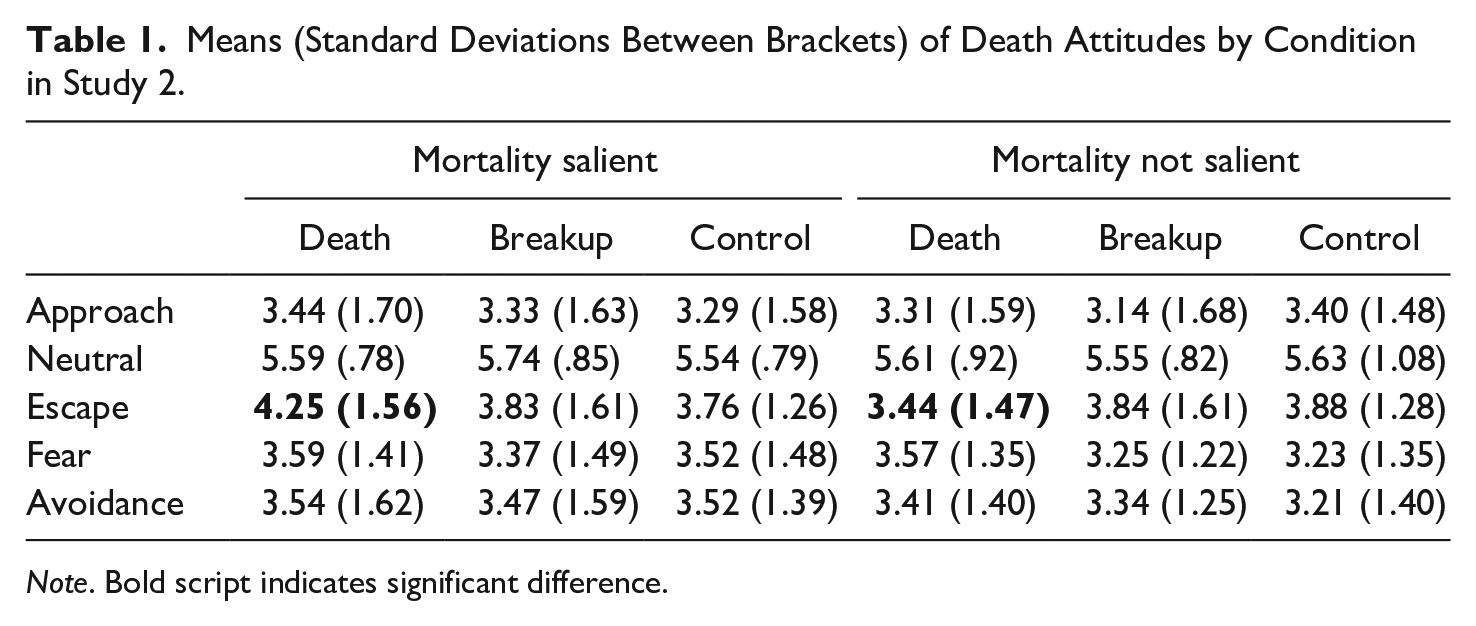
Note. Bold script indicates significant difference.
Being moved and DTA
A two-way ANOVA for Being Moved showed a main effect of portrayal (F(2,395) = 94.79, p < .001, η2 = .32). The death scene evoked a higher level of being moved than the breakup scene (p < .001) and the breakup scene more than the control scene (p < .001). The main effect for mortality salience did not reach significance (F(1,395) = 3.83, p = .051, η2 = .010). The interaction effect for mortality salience and portrayal was not significant (F < 1). The two-way ANOVA for Elevation showed a main effect of portrayal (F(2,395) = 6.62, p = .001, η2 = .032). The death scene evoked more elevation than the breakup scene (p = .012) and the control scene (p = .005), the breakup and control scene did not differ from each other (p = 1.0) The main effect for mortality salience did not reach significance (F(1,395) = 2.81, p = .095, η2 = .007). The interaction effect for mortality salience and portrayal was not significant (F < 1). See Table 2.
Means (Standard Deviations Between Brackets) of Potential Mediators by Condition in Study 2.
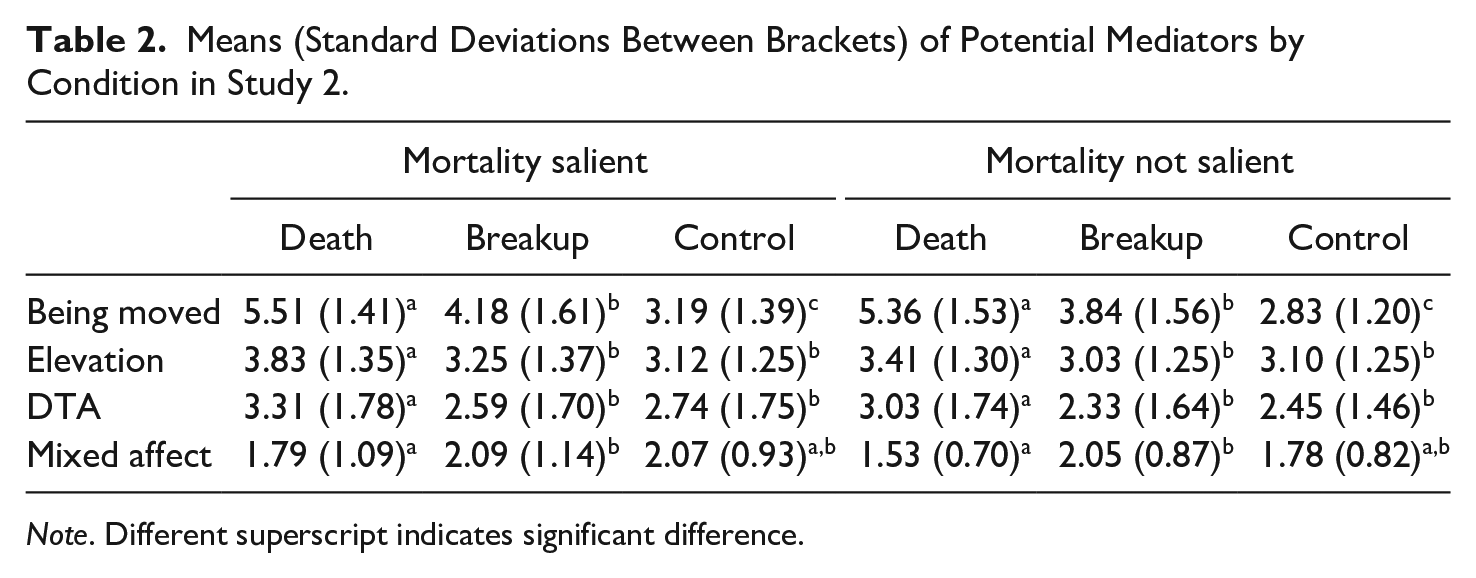
Note. Different superscript indicates significant difference.
A two-way ANOVA for DTA showed a main effect of portrayal (F(2,395) = 6.75, p = .001, η2 = .033). Pairwise comparisons with Bonferroni correction showed that the death scene evoked more implicit death thoughts than the breakup scene (p = .003) and the control scene (p = .017). The breakup scene and control scene did not differ from each other (p = 1.0). The main effect of mortality salience was not significant (F(1,395) = 2.66, p = .10), nor was the interaction effect (F < 1). See Table 2. Because none of the potential mediators showed an interaction effect of mortality salience and portrayal, no moderated mediation was tested. This means that H4 and H5 are not accepted.
For exploratory analyses on the b-path, see Supplemental Appendix E. For exploratory analyses of the relationship between mixed affect and being moved, see Supplemental Appendix F.
Discussion
Participants who saw a death portrayal had higher death acceptance when they had been reminded of their mortality than when they had not, whereas this mortality salience effect was not observed for participants who saw a breakup or control portrayal. Even though these results are not exactly as hypothesized, they show that death portrayals in meaningful entertainment can indeed change viewers’ death attitudes, provided that their fear of death was salient. That the effects were observed for the escape acceptance subscale suggest—as in Study 1—that the death attitude that was implied by the movie portrayal determines which particular death attitude subscale is changed.
General Discussion
This research introduced the TMT-ME, a novel extension of TMT, and tested three preconditions for movie-induced transcendence of a fear of death in two experimental studies. In the next section, we evaluate the strength of the evidence for TMT-ME, discuss theoretical implications for research on terror management and eudaimonic entertainment, and then go on to discuss limitations and directions for future research.
Evaluating the Evidence for TMT-ME
The TMT-ME proposes that movies about death can elicit fear transcendence under three specific conditions, namely (1) mortality is salient, (2) death is central to the movie storyline, and (3) death is portrayed as meaningful. Building on findings that people can learn to hold more positive attitudes toward death (e.g., Khader et al., 2010; Wessel & Rutledge, 2005), and that death acceptance attitudes positively relate to the self-transcendent concept of connectedness with a higher power, we operationalized fear transcendence as less fearful attitudes toward death, less avoidant death attitudes, and more accepting death attitudes.
Findings lend partial support for Proposition I that viewers’ mortality salience is a precondition for fear transcendence. Providing evidence for this proposition, a movie in which a protagonist died in a mixed emotional ending decreased death avoidance especially for viewers’ who had received a mortality reminder before watching the movie, compared with participants who had not received a mortality reminder (Study 1). Also supporting this proposition, participants who had received a mortality reminder before watching a movie showed increased death acceptance when they watched the death of a protagonist in a medical drama, compared with participants who had not received a mortality reminder (Study 2). However, Study 1 showed a main effect of movie ending on fear of death and death acceptance, which disconfirms proposition I. We therefore conclude that the evidence for Proposition I is mixed.
Proposition II that death has to play a central role in the movie in order to evoke fear transcendence, was fully supported. In Study 1, only movies in which a protagonist died evoked fear transcendence, specifically these movies increased death acceptance or decreased death avoidance. The movie in which the protagonist did not die increased, rather than decreased, the fear of death. In Study 2, we observed fear transcendence, specifically increased death acceptance, only for medical dramas in which a protagonist died; no effects were observed for dramas that portrayed the meaningful ending of a relationship, or no ending whatsoever. The findings confirm that fear transcendence is evoked by movies in which death is central to the storyline, and not by movies in which death is not central.
Proposition III stated that death in a movie should be meaningful, and therefore evoke meaningful emotions such as mixed affect and being moved, or self-transcendent emotions such as elevation, in order to elicit fear transcendence. Support for this proposition is equivocal. Study 1 showed that conveying mixed affect in a movie increased fear transcendence, but did not affect viewers’ mixed affect. Study 2 showed that medical dramas about death increased the emotion of being moved and elevation, but these emotions did not mediate the effects of the movie on fear transcendence. Overall, the findings suggest that meaningful or self-transcendent emotions can be evoked by death scenes, but these emotions do not explain the movies’ effects on fear transcendence.
Other Preconditions
In Study 1 especially (older) adults showed fear transcendence, and death movie watching even backfired for younger participants and decreased fear transcendence. For this reason, Study 2 only used participants between 40 and 80. The findings point to a fourth potential precondition for the fear transcendence route that should be confirmed by future research. Older viewers, because of their life experience and preference for emotional experiences (Carstensen et al., 2000), may be more open to approach the idea of death and emotionally process their fear. Younger viewers may lack the experience or the motivation, to vicariously learn life’s difficult lessons from movies.
Theoretical Implications: Managing Terror with Meaningful Movies
The newly introduced TMT-ME adds a second terror management route, termed the fear transcendence route, specifically focused on entertainment experiences. TMT-ME posits that entertainment can elicit two fundamentally different routes to manage their fear of death; (I) the classical worldview defense route, in which viewers use meaningful media content to push thoughts about death out of conscious awareness, and (II) an alternative, fear transcendence route, in which viewers use meaningful media content to approach and accept death. By not fleeing from, but vicariously confronting the thoughts and emotions experienced while identifying with a story protagonist who deals with death, viewers can overcome their fear and become more accepting of death. While previous research had provided evidence for TM Route I, by showing that meaningful media experiences can buffer against the fear of death (Rieger et al., 2015; Rieger & Hofer, 2017), the present study provides support for the existence of Route II, a route through which viewers transcend their fear of death.
There are several indications that Route II is indeed a terror management process, like Route I, albeit with opposed, more conscious, effects. First, we measured Death Thought Accessibility (DTA) which would be lowered if death thoughts were suppressed (Route I). Route I suppresses awareness of death but does not make people deal with their fear; rather, it covers it up while the existence of the fear remains. However, this is not what we found. In study 2 we found that meaningful movies about death did not lower, but rather increased death thought accessibility. This supports our premise that in Route II, meaningful movies about death do not push thoughts of death away but rather stimulate these thoughts. In Study 2, death thoughts were activated in viewers and they were consciously processing it while watching the movies. This supports the idea that Route II triggers a more conscious terror management process.
This idea is further supported by the finding that meaningful movies about death changed explicit, conscious death attitudes, indicating that the movies invited certain viewers to open up to a different perspective on death, and transcend their fear to consider less avoidant, more nuanced, accepting views on death. While in Route I, individuals avoid the thought of death by adhering to cultural worldviews that make them feel like a valuable member of society, in Route II, they are willing and able to reflect on the most fundamental fear, and draw conclusions about their personal relation to it. Together, the findings suggest that, although individuals may generally manage their fear of death through Route I, special conditions may allow them to rise above this fear through Route II.
Theoretical Implications: Meaningful Entertainment
Meaningful movies about death may be appreciated by many viewers (Supplemental Appendix B), and invite them to grapple with the inevitable problem of death. However, our findings suggest that the invitation to learn from this vicarious experience was only accepted by viewers whose fundamental fear of death was salient in real life, when the movie conveyed death as a meaningful ending, and when the viewer had some maturity of age. Hence, movie appreciation alone does not guarantee that vicarious experiences are transferred from the movie to the real world. These findings are in line with ideas from biographic resonance theory (Klimmt & Rieger, 2021), proposing that intra- and inter-individual differences interact with specific media content aspects in predicting eudaimonic-emotional outcomes of entertainment experiences. Our findings add to this theory by proposing specific conditions relevant for the biographic resonance of movies about death, and by showing that movies can resonate with fundamental human fears.
In the absence of mediating effects of the emotions of being moved or elevated, or of death thoughts in this study, it is an open question how exactly movies about death induce fear transcendence. Potentially, viewers’ reflection on the content of the portrayal plays a role (Bartsch et al., 2014), during or sometime after movie viewing. Meaningful death portrayals may make people reflect on death and think about what it means to them. In this way, reflective thought could play a crucial role in fear transcendence. This thought process may also take place in a retrospective fashion, when people reflect about what they have seen before (Khoo, 2016). In addition, the concept of Temporarily Expanding Boundaries Of The Self (TEBOTS) may be relevant for further research in this area (Slater et al., 2014). When viewers expand the boundary of their self-concept, they can experience events and situations which they normally would not be able to experience, of which death is a clear example. The ways in which this expansion of the self through narratives plays a role in the impact of death portrayals on viewers is a promising area for further research.
Limitations and Future Directions
Although the present research found supporting evidence for the proposition that meaningful movies about death can elicit fear transcendence, future research should further assess this proposition by explicitly comparing movies in which death plays a central versus more peripheral role (e.g., death occurring in the background of a war movie), and by (simultaneously) assessing effects on other dependent measures such as decreased cultural worldview defense or increased connectedness. By directly comparing both routes, further evidence can be uncovered for distinct causal effects.
Future studies should also investigate mediating processes. If meaningful emotions indeed play a role in healthy coping by keeping the stressful information in working memory long enough (Larsen et al., 2021), it could be worthwhile to further assess memory and reflective processes. This research should also assess if death attitude change persists over time, and if death movies can also induce openness to other worldviews besides death attitudes. Providing this additional evidence is important to rule out the alternative explanation that movie viewers temporarily change their death attitudes as a mere defensive response to the movie in an attempt to suppress death thoughts, rather than a fear transcendence response. We therefore also recommend measuring reflective thoughts during, or sometime after movie watching, for example, by using a measure of retrospective reflection.
The important role of the specific death portrayals in the movies is attested by the result that only death attitudes that were clearly present in the scenes were changed. This suggests that viewers’ simulation of the events in the movie, that is, viewers vicariously experiencing what the characters go through, is an important factor. Further studies should directly test the role of simulation of specific death portrayals. This could be done in different ways, for example by manipulating or experimentally varying identification with or empathy for protagonists with opposing death attitudes in a story. Alternatively, it could be worthwhile to compare the effects of movies in which protagonists have different death acceptance attitudes to test if indeed, simulating a protagonist’s wish to end their life leads to increases on the escape acceptance subscale of death attitudes, whereas a protagonist coming to accept death as a natural part of life would elicit changes in neutral death acceptance.
Specific self-transcendent processes could be relevant, such as a sense of connectedness, or the loosening of ego-involvement which can occur in a self-transcendent state (Janicke-Bowles, 2020). Future research should therefore also further investigate the relationship between terror management and self-transcendent processes. For example, should connectedness be regarded as a process that drives fear transcendence, or rather as an outcome of fear transcendence? Likewise, future studies should examine to what extent movies about death invite (longer term) reductions of the fear of death or, alternatively, an increased ability to deal with this fear.
Concluding Remark
When the fear of death is salient, individuals typically try to push death thoughts out of conscious awareness by adhering to cultural worldviews that give them a sense of meaning and self-esteem. Hundreds of TMT studies have shown that, when death thoughts go “underground,” they can increase nationalism, prejudice against outgroups, and other “isms” that are meant to protect the self from becoming overwhelmed by fear. The present research findings point to the possibility of an alternative route of dealing with the fear of death, which can be triggered by watching meaningful media. Meaningful movies in which death plays a central role may be able to inspire viewers for whom mortality is salient to face deep-seated fears, and transcend them. When this happens, unconscious fears may lose their tight grip, and viewers may become more open to view life and death as two sides of the same coin.
Supplemental Material
sj-docx-1-crx-10.1177_00936502241247868 – Supplemental material for When Meaningful Movies Invite Fear Transcendence: An Extended Terror Management Account of the Function of Death in Movies
Supplemental material, sj-docx-1-crx-10.1177_00936502241247868 for When Meaningful Movies Invite Fear Transcendence: An Extended Terror Management Account of the Function of Death in Movies by Enny Das and Anneke de Graaf in Communication Research
Footnotes
Acknowledgements
The authors thank Yara Kloosterboer, Willemijn Klein Swormink, Eva Klein Brinke, Maud van der Elsen, and Sjaan Oomen for their assistance in the development of the materials and data collection for Study 1.
Declaration of Conflicting Interests
The authors declared no potential conflicts of interest with respect to the research, authorship, and/or publication of this article.
Funding
The author(s) disclosed receipt of the following financial support for the research, authorship, and/or publication of this article: This project was funded by grant number 406.18.SW.039 of The Netherlands Organization for Scientific Research (NWO).

Supplemental Material
Supplemental material for this article is available online.
Notes
Author Biographies
References
Supplementary Material
Please find the following supplemental material available below.
For Open Access articles published under a Creative Commons License, all supplemental material carries the same license as the article it is associated with.
For non-Open Access articles published, all supplemental material carries a non-exclusive license, and permission requests for re-use of supplemental material or any part of supplemental material shall be sent directly to the copyright owner as specified in the copyright notice associated with the article.
