




Abstract
Individuals harboring perceptions that the “news will find me” (NFM) tend to be less active consuming traditional media, preferring news online and on social media. NFM has also been linked with lower political knowledge and political participation over time. What remains to be seen, however, is whether high-NFM individuals are in fact less likely to expose themselves to news once they do encounter it online. This preregistered study fills this gap in the literature by unobtrusively logging selection behaviors while U.S. adults browsed a mock news website featuring various hard and soft news stories. Consistent with our hypothesizing, NFM was associated with greater exposure to soft news. Additionally, we examined whether genre-specific NFM beliefs would predict less exposure to those news genres. We found support for this hypothesis in the context of science news, but for political news, this relationship depended on the news stories presented.
For democracy to thrive, citizens must be informed about current affairs (Delli Carpini & Keeter, 1996). By staying informed, citizens can engage in thoughtful deliberation and participate in the political arena by supporting candidates who represent their beliefs, interest, and values. Not only must citizens be accurately informed about ongoing public affairs, but they should also be active in consuming this content (Price & Neijens, 1998). The news media play an integral role in this regard, providing coverage of ongoing political and social matters (Delli Carpini & Keeter, 1996).
In the current digital media landscape, however, it is all too easy to take a passive stance to getting news updates. One phenomenon that may be at the heart of this issue is the news finds me perception (NFM), which refers to the belief that one does not need to actively follow the news to be well informed about public affairs because the news will “find me” through social media, social ties, and general internet use (Song et al., 2020). People holding NFM beliefs tend to have less political knowledge over time (e.g., Gil de Zúñiga et al., 2017; Lee, 2020), are less interested in politics (e.g., Gil de Zúñiga & Diehl, 2019), and are less likely to vote (e.g., Gil de Zúñiga & Diehl, 2019) relative to people who do not develop the perception.
To date, NFM research has primarily used longitudinal survey methods to predict political outcomes over time (Gil de Zúñiga et al., 2017; Gil de Zúñiga & Diehl, 2019; Park & Kaye, 2020; Song et al., 2020) or qualitative methods to understand lived NFM experiences (e.g., Oeldorf-Hirsch & Srinivasan, 2022; Toff & Nielsen, 2018). These investigations address the democratic consequences of believing the news will find me, such as political cynicism, political knowledge, and voting behavior. By design, however, these studies cannot speak to in-the-moment encounters people holding NFM beliefs have with news content. We aim to answer the question: What happens when these individuals do come across news content online? Because people harboring NFM beliefs are not used to meaningfully engaging with news and because they believe they are already well-informed about current affairs, when given the opportunity to choose from an array of news media content including hard news (e.g., politics, public affairs) and soft news (e.g., entertainment, sports), we posit that high-NFM individuals should generally be disinclined to choose hard news (Goyanes et al., 2023).
This premise has yet to be empirically tested in a controlled media setting (Haim et al., 2021), so we conducted the current study to explicitly evaluate it. Specifically, we adopted a mock website paradigm to unobtrusively track individuals’ news selection preferences. Exposure traces have been a productive measurement approach for much selective exposure research (Feldman et al., 2013; Hastall & Knobloch-Westerwick, 2013) and offer a window into actual behavioral choices that circumvent self-report concerns. This is the first study, to our knowledge, to take such an approach to understand NFM’s behavioral correlates in a tightly controlled media environment. Moreover, assessing selective exposure to news content has important theoretical implications, helping clarify the mechanisms underlying news use behavior online—mechanisms that have gone untested in prior work.
Additionally, although NFM has been conceptualized as a perception about political news, the scale typically used to measure NFM refers generally to “news” and “public affairs.” Because individuals may come to different conclusions about what constitutes news or public affairs (Edgerly & Vraga, 2020; Matthes et al., 2020), we felt it necessary to also consider (and measure) genre-specific NFM beliefs to contrast previous findings in the literature. Thus, this investigation integrates research on the NFM and selective exposure to test more granular predictions about whether NFM beliefs regarding specific news genres (i.e., political and science news) predict lower exposure to news stories in those genres.
The News Finds Me Perception (NFM)
Dimensions and Consequences of NFM
NFM refers to “the extent to which individuals believe they can indirectly stay informed about public-affairs—despite not actively following news—through internet use, information received from peers and online social networks” (Gil de Zúñiga et al., 2017, p. 107). NFM theorists have identified and validated three dimensions of the NFM construct (Song et al., 2020): an epistemic component (being informed), an instrumental component (reliance on peers), and a motivational component (not seeking). First, NFM is characterized by an epistemic sense that one is sufficiently informed about public affairs, as news will find them. Social media feeds contain much news-related content, both professionally produced and user-generated, and this ambient news environment may foster a mindset that one has adequate knowledge about what’s happening with one’s social ties and in the world more broadly (Hermida, 2010; Levordashka & Utz, 2016). Second, high-NFM individuals tend to rely on their peers and online social networks to get news updates. Although social media users cannot exert complete control over the content they encounter in their social media feeds, they do have the ability to curate their feeds by following accounts of their choosing (Bode, 2016; Thorson & Wells, 2016). Social media users might therefore expect to come across current affairs content because their peers will share it online. Third, because NFM encompasses beliefs that one is adequately informed and that one can depend on peers for news, there is little need to actively search for news. This (lack of) motivation is likely attributable to the rise of social media, which provide ample opportunities for users to let the news find them. This passive news experience in today’s digital media landscape stands in contrast to earlier models of news use, whereby members of the public were assumed to be active consumers who purposefully turned to the news to learn about current events (Tewksbury et al., 2001).
Since the term was first coined, NFM research has flourished, exploring NFM’s relationship with a variety of outcomes relevant for democratic health (for a review, see Gil de Zúñiga & Cheng, 2021). Individuals who believe the news will find them tend to have less political knowledge over time (Gil de Zúñiga et al., 2017; Gil de Zúñiga et al., 2020; Gil de Zúñiga & Diehl, 2019; Lee, 2020), less interest in politics (Gil de Zúñiga et al., 2020; Gil de Zúñiga & Diehl, 2019), and greater political cynicism (Song et al., 2020). Research has also connected NFM to lower levels of political participation (i.e., voting) both directly and indirectly through mechanisms like lower political knowledge and lower interest in politics (Gil de Zúñiga et al., 2020; Gil de Zúñiga & Diehl, 2019). These problematic consequences of the NFM are thought to occur—at least, in part—because NFM is linked to less use of traditional news, such as TV or print news (Gil de Zúñiga et al., 2017; Park & Kaye, 2020); less use of online media news, such as news aggregators (Park & Kaye, 2020); and greater use of social media for news (Gil de Zúñiga et al., 2017; Gil de Zúñiga et al., 2020). Qualitative findings tell a similar story, suggesting the NFM mentality often manifests in greater dependence on social media for incidental news exposure and minimal interest in intentionally seeking out news (Oeldorf-Hirsch & Srinivasan, 2022; Toff & Nielsen, 2018). Because political learning that occurs from news passively encountered on social media is likely to be shallow, reliance on social media for news should have little meaningful impact on political knowledge, which, in turn, dampens one’s involvement in politics (Gil de Zúñiga & Diehl, 2019).
In sum, the literature indicates greater levels of NFM stifle democratic determinants, largely due to a lack of motivation to deliberately seek out news content and therefore fostering a greater reliance on social media where high-NFM individuals expect to incidentally encounter news. However, previous studies gloss over an important question that has yet to be fully examined: How exactly do high-NFM individuals interact with news content when they do come across it online? If news is right in front of them, will they engage with it by clicking on the news story to learn more and how much time will they spend with the content? Regrettably, the available studies cannot shed light on these in-the-moment encounters that high-NFM individuals have with news when it enters their screen. Instead, NFM investigations have generally relied on self-reports of news exposure (Haim et al., 2021), which may be fraught with biases toward overreporting or underreporting actual exposure (e.g., Konitzer et al., 2021; Vraga & Tully, 2020). Researchers in this space accordingly have called for more attention to methodological approaches that bypass self-report biases by unobtrusively logging actual news engagement behaviors (Haim et al., 2021; Vraga et al., 2016)—an approach we take in this investigation.
News Engagement, Selective Exposure, and NFM
Because media users can select from vast quantities of information online, it is not feasible to attend to or consume all available content (Tsfati & Cappella, 2003). Media users expose themselves to information based on personal factors (e.g., knowledge, mood), contextual factors (e.g., source cues, algorithmic recommendations), and interactions between those factors—a phenomenon known as selective exposure (Knobloch-Westerwick, 2015). From a normative standpoint, selective exposure processes are troubling. If users skip over content that they find uninteresting, irrelevant, or unneeded—especially information about current affairs—they are unlikely to learn about current events related to politics, society, science, and the like. Much research studying the underpinnings of selective exposure has centered on the congruence between the content’s ideological slant and preexisting attitudes (e.g., Hart et al., 2009; Knobloch-Westerwick & Meng, 2009), but in this paper, we are concerned with selective exposure to news content as a function of whether one believes the news will find them.
How specifically might NFM shape selective exposure to news content when news is encountered online? On social networking sites, NFM might be associated with heightened exposure to news content; after all, social media are key spaces where high-NFM individuals report getting information about current affairs. However, in online spaces where news content is abundant (e.g., news aggregator sites like Google News and Apple News), there is good reason to believe that even when news is readily available to them, high-NFM individuals will be inclined to avoid (i.e., be less likely to expose themselves to) that news content.
News avoidance is a rather broad concept and can refer to intentional avoidance (purposefully ignoring news due to antipathy, anticipated negative affect, news distrust, or news overload) or unintentional avoidance (a passive form of low news engagement deriving from a preference for more entertaining options) (Skovsgaard & Andersen, 2020). People holding NFM views are not necessarily intentional news avoiders; they may still wish to be informed about ongoing societal affairs, which is not the case for intentional news avoiders (Gil de Zúñiga & Cheng, 2021). Even so, it has been argued that NFM may cultivate news avoidance behaviors over time, intentional or unintentional (Goyanes et al., 2023). Specifically, although high-NFM groups are open to staying up to date with the news, they may be ill-equipped to deal with the negative affect often elicited by news because they are less politically knowledgeable and less accustomed to traditional news. This unpleasant, even frustrating news experience could dampen their capacity to effectively deal with news, prompting them to disengage with news content. Thus, “even after ‘stumbling upon’ a piece of news, individuals high in NFM may shift their gaze toward a different post on the page or scroll down in search of a non-news related post as a news avoidance behavior” (Goyanes et al., 2023, p. 6). In support of this argument, Goyanes et al. (2023) found that NFM emerged as a stronger, more consistent predictor of self-reported news avoidance than political interest, trust in news, or news overload.
The argument for NFM dampening news exposure could also be made based on the idea that high-NFM people perceive they possess adequate knowledge about public affairs. This epistemic dimension of the NFM has been referred to as a kind of “self-delusion” (Gil de Zúñiga & Cheng, 2021, p. 6) or “self-confirmation bias” (Diehl & Lee, 2022, p. 3), such that high-NFM individuals to some degree are under the (false) impression they know more about current affairs than they actually do. In this way, the NFM mindset reflects a low-effort approach to cognitively processing news, in which heuristics guide news choices and dominate judgments about news content (Diehl & Lee, 2022; Strauß et al., 2021). Consistent with this train of thought, people with greater NFM tend to rate fake news as more credible (compared to people with lower NFM), and NFM amplifies the link between using social media for news and fake news credibility (Diehl & Lee, 2022). If high-NFM groups already believe they are sufficiently knowledgeable about ongoing public affairs and exert little effort toward news engagement, they may feel there is little to be gained from consuming news through traditional news sources. According to models of informational utility, selective exposure to information is driven by the extent to which one finds the information in one’s environment to be useful (Knobloch-Westerwick, 2015). Media users are therefore expected to engage with information (e.g., news content) that they perceive meets their surveillance needs. Applying this logic to high-NFM individuals, even if news is readily accessible to them as an option in their feed, those who believe news comes to them should still tend to pass over it because they perceive they are already informed.
Some additional empirical evidence is consistent with this argument that high-NFM individuals are unlikely to engage with news content. Namely, Haim et al. (2021) gathered digital trace data on participants’ browsing history and Facebook feeds and found that the “not seeking” dimension of NFM (negatively) predicted visits to news websites. Our investigation builds on Haim et al.’s work by addressing a few key methodological limitations. First, we allowed individuals to browse news content in a tightly controlled, mock media environment, thereby optimizing the conditions necessary to test the theoretical proposition that NFM can predict news selections (Hastall & Knobloch-Westerwick, 2013). For our browsing environment, we have elected to use a news aggregator-style context given that these platforms primarily feature hard news stories but also include some soft news stories, the latter of which we contend should attract high-NFM users. Second, we examined selective exposure at the level of individual news stories, and we also tracked time spent on the content (not merely page visits), providing further insight into the extent of news engagement (Haim et al., 2021). We hypothesize (“H”):
There has been a good deal of conceptual ambiguity in how scholars and journalists have defined hard versus soft news (Matthes et al., 2020; Reinemann et al., 2012), so to be clear, we distinguish hard from soft news based on the topic of the news. We treat matters related to politics, business, science, and COVID-19 as hard news because of their societal significance, whereas soft news includes entertainment-focused matters related to sports, celebrities, and entertainment. This conceptualization admittedly does not capture all possible dimensions of the hard versus soft news distinction (see Reinemann et al., 2012), but it is consistent with how key studies in this space have approached the two concepts (e.g., Curran et al., 2010).
NFM: A Concept About Political News?
In their original investigation, Gil de Zúñiga et al. (2017) defined NFM as “the extent to which individuals believe they can indirectly stay informed about public affairs. . .” (p. 107, emphasis added). Gil de Zúñiga and Cheng (2021) more recently have noted “NFM people hold the epistemic belief that they are well-informed about current political affairs and public events” (p. 3, emphasis added). Thus, conceptual definitions suggest NFM primarily represents beliefs about political news. To be clear, we follow Matthes et al. (2020) and consider political news to be news involving “(1) political actors, (2) decision-making authorities, (3) activities of planning, decision-making or realizing programs that relate to societal issues, or (4) news on the groups or people which are concerned by political decisions” (p. 1035).
Gil de Zúñiga et al. (2017) politics-focused conceptualization of NFM is further reinforced by the fact that NFM research has examined NFM’s link to politically oriented outcomes like political knowledge and political interest (e.g., Gil de Zúñiga & Diehl, 2019; Lee, 2020). If it is the case that the original NFM scale is primarily capturing perceptions about political news, the (negative) relationship identified in our first hypothesis should be driven by political news. In other words, the original NFM scale should be a stronger predictor of political news choices (operationalized here as news stories about U.S. politics, where this study was conducted) than of other news genres. Hence:
Toward More Specific NFM Beliefs
Although the NFM scale seems geared toward political news, the phrasing of the six-item NFM scale (Song et al., 2020) leaves room for ambiguity regarding what exactly constitutes news. Three items refer simply to “news” (e.g., “I can be well-informed even when I don’t actively follow the news”), and one item refers to “information” (“I rely on information from my friends based on what they like or follow through social media”). Such general phrasing is problematic because lay understandings of “news” vary considerably from person to person (Edgerly & Vraga, 2020), and rarely do survey researchers provide participants with a clear definition as to what they consider “news” to mean (Matthes et al., 2020). The other two NFM items do mention “public affairs” (e.g., “I’m up-to-date and informed about public affairs news, even when I do not actively seek news myself”). However, research participants may not equate “public affairs” exclusively with “politics,” potentially interpreting “public affairs” to mean news about sports or even tabloid journalism (Matthes et al., 2020), which are clearly outside the purview of the NFM construct.
This ambiguity could have important implications for NFM research and theorizing. If the NFM measure is inadvertently capturing perceptions about non-political news genres, this introduces extra noise into the data, perhaps leading researchers to underestimate the relationship between NFM and political outcomes. It is therefore worth testing more fine-grained NFM measures that explicitly identify the news genre(s) of interest, allowing for greater predictive power for relevant outcomes.
Furthermore, media users likely have varying levels of interest in different types of news. Some might be interested in news about politics, while others are interested in news about science or business or health. Users gravitate toward information that appeals to their goals, well-being, and interests (Kim, 2008)—so much so that personal relevance can impact news preferences even when the news comes from a politically dissonant source (Mummolo, 2016). This interest-based selectivity (Feldman et al., 2018) is especially salient in our modern, digital media landscape (Prior, 2005). However, just as some people might be especially inclined to consume certain types of news out of interest or personal significance, others may pass over those types of news, believing news about those matters will find them anyway. For example, an individual may believe political news will find them, relying on friends and social media to stay informed about political affairs. That same person may not hold NFM beliefs for other genres, such as science or the economy, actively seeking information on those matters to stay up to date. Thus, not only is it valuable to consider genre-specific NFM perceptions to improve the accuracy of the NFM construct in predicting relevant outcomes (e.g., exposure to corresponding news genres); doing so can also expand the scope of the NFM construct by assessing its applicability in a broader set of news domains found in the modern media landscape.
Individuals who are highly invested in a news matter are unlikely to be passive consumers of that information (i.e., low NFM). Supporting this contention, previous studies have linked NFM to lower levels of political interest in cross-sectional (Gil de Zúñiga et al., 2020; Park & Kaye, 2020) and causal autoregressive panel analyses (Gil de Zúñiga & Diehl, 2019). Although these studies do not fully clarify whether NFM and political interest are negatively linked because NFM weakens political interest or because NFM beliefs develop because of low interest, nonetheless, we expect that genre-specific NFM beliefs will be linked to less selective exposure to that news genre. Only one study so far has explored the utility of targeted NFM beliefs, focusing on NFM beliefs specific to COVID-19 news (Lin et al., 2023). The authors found that a COVID-specific NFM scale exhibited a similar association with self-reported COVID information seeking as the original, general NFM scale; however, only COVID-specific NFM predicted information insufficiency (i.e., perceiving one does not have enough information), suggesting some benefit to considering targeted NFM beliefs about specific news matters.
Of note, we focus our theorizing about specific NFM beliefs at the level of news genres, rather than in reference to specific current affairs issues (e.g., healthcare, immigration). Because NFM has been conceptualized as perceptions about politics as a news genre, we feel it is appropriate to maintain conceptual consistency and theorize at the genre level. Specifically, we examine two genre-specific NFM beliefs: politics NFM and science NFM. Only 17% of U.S. adults are active consumers of science news (Funk et al., 2017). There is precedent for considering (dis)interest in science news specifically given that researchers have studied issue (un)importance for global warming (Brenes Peralta et al., 2017; Krosnick et al., 2000) and space policy (Whitman Cobb, 2011), which may also imply that there are media users who are not particularly attentive to science news because they lack interest in science and feel science news will come to them. Thus, our final hypothesis is:
Methods
Recruitment and Procedure
Using CloudResearch to recruit through Amazon Mechanical Turk, we recruited N = 696 U.S. adults for a two-wave study in mid-March 2021. At wave one, participants completed a pretest that measured demographics, covariates, and NFM beliefs. A week later, returning participants (~80%) completed the second wave of the study in which they were asked to interact with a mock news website. By measuring the demographics, covariates, and NFM beliefs in advance of the mock website portion of the study, we aimed to minimize demand characteristics. This news website was formatted to resemble the main page of the Associated Press (AP) website (see Figure 1), featuring a variety of news stories and genres (described in detail below). We instructed participants to browse through the articles at their leisure, reading the stories that sounded interesting to them as they normally would online. This mock news feed used a “hub and spoke” logic in which each post on the feed constituted a spoke that participants could visit and then return to the news feed hub (Hastall & Knobloch-Westerwick, 2013). The mock layout was hosted on the survey platform SocSci Survey. To unobtrusively track participants’ browsing behavior, we used open-source programing code that logged clicks and amount of time spent on the various pages (Unkel, 2021). Participants browsed the pages for 4 min or clicking on 30 previews, whichever came first, but were not allowed to continue with the study until the 4 min had elapsed. This browsing time is comparable to the browsing limits used in other studies of a similar nature (e.g., Hastall & Knobloch-Westerwick, 2013).
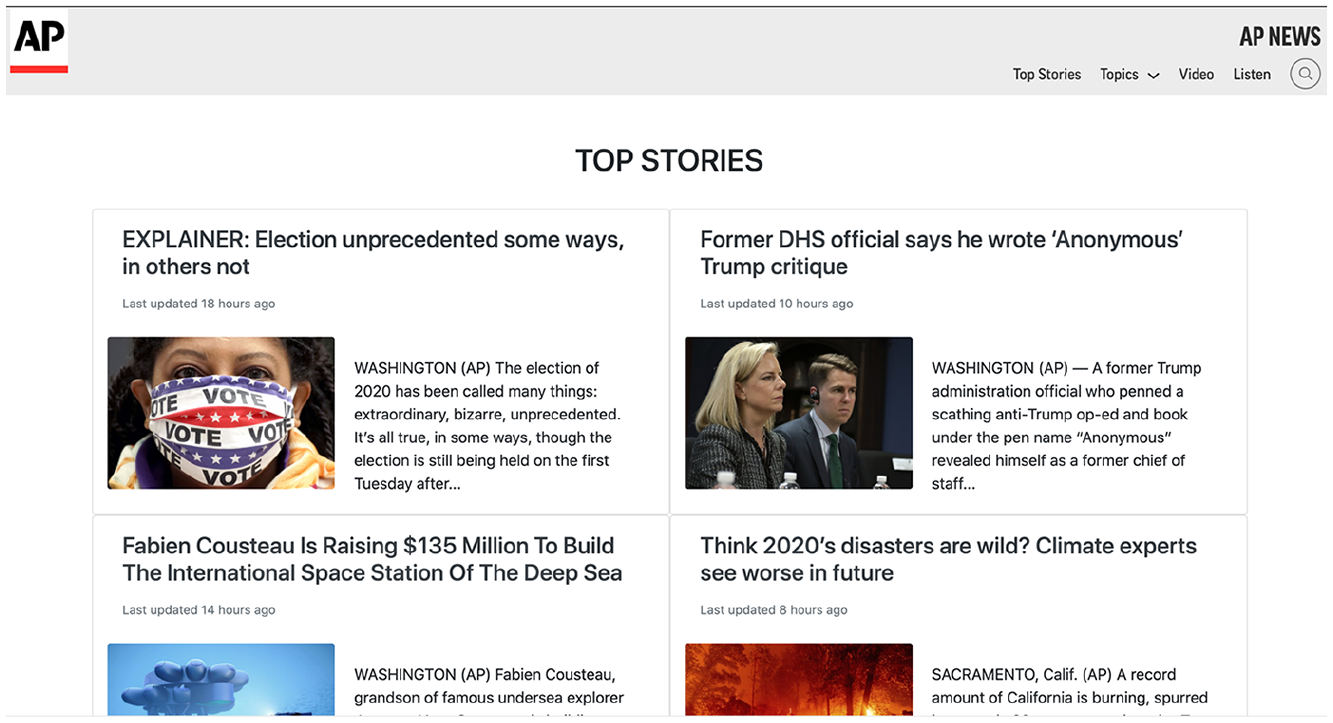
Mock news website.
After discarding cases where the two waves of data could not be matched, we excluded participants who failed either of two attention checks or who showed evidence of streamlining survey questions. These exclusions (n = 161) left us with N = 535 complete cases for analysis, which was slightly smaller than what we anticipated in our preregistration plan (https://aspredicted.org/cf7i5.pdf, N = 560 to achieve power = .80). In our final sample, participants (Mage = 41.6, SDage = 12.2) were split between women (50%) and men (50%). Most identified as White (85%) with a minority identifying as Black (5%) or another non-White, non-Black race (13%). The sample was primarily non-Hispanic (95%), and college educated (74%). On a household income scale of <$10 K (1) to $100 K+ (6), the average participant reported earning around $50 to $74.9 K (M = 4.26, SD = 1.34). Regarding politics, the plurality of participants were Democrats (46%) followed by Republicans (24%), Independents (27%), another party (2%), or no affiliation (2%). On a scale of extremely liberal (1) to extremely conservative (7), participants leaned somewhat liberal (M = 3.56, SD = 1.80). All data and syntax for this study are available online (https://osf.io/tjymb/).
Stimuli
The hub of the mock news website presented 13 news story previews (headlines, images, and leads) in random order: three COVID, three U.S. politics, two business, two science, two entertainment, and one sports. In contrast to other selective exposure studies in which participants are asked to choose from a set of news headlines that are all about a single issue (e.g., Stroud et al., 2019) or between stories about a single issue versus soft news (e.g., Feldman et al., 2018), our goal was to maximize ecological validity with a layout of news stories that spanned multiple news genres (Wojcieszak, 2021). We also wanted to provide news stories in proportion to the frequency of news genres one would reasonably encounter on the main page of a major news aggregator at the time of data collection (i.e., much attention to the U.S. election and COVID-19). We randomly assigned participants to one of three versions of the website, and each version featured different stories within each news genre. Having multiple versions reduces the likelihood that NFM effects, if any, are attributable to a single set of news stimuli (Brashers & Jackson, 1999). Speaking to the success of random assignment, there were no differences across website versions in terms of age, F(2, 532) = 2.33, p = .10, gender, X2(2), p = .19, race, X2(2), p = .49, or income, F(2, 532) = 1.27, p = .28.
The news stories were bona fide stories from the AP or USA Today, edited slightly for consistency of length in titles, leads, and story content. We chose the AP for our mock news website because it serves as a major source of news around the globe and generally presents politically centrist news coverage (AllSides, 2021). For the U.S. politics stories, each website version included one pro-Democrat story, one pro-Republican story, and one story about U.S. civics (e.g., the Electoral College). For the COVID stories, each version included one story about testing or treatment, one about COVID consequences (e.g., health effects), and one human interest story. The business articles in each version featured stories about the economy or business affairs. The two science articles included one climate-related article and one about miscellaneous science news (e.g., NASA asteroid samples) per version. The entertainment articles included updates from the film, television, and music industries, and the sports articles across the three versions were about three different sports (football, baseball, NASCAR).
We selected these news stories based on two rounds of pilot testing on CloudResearch (total N = 200) with a larger pool of news stories. The final news articles were selected because they were perceived as fitting their intended news genre (e.g., business articles were primarily seen as being about business and not COVID, politics, etc.). The pilot studies also confirmed that the political stories had their intended political leaning (pro-Democrat, pro-Republican, or politically neutral for the civics stories). Additionally, we made a concerted effort to allocate stories to the three website versions with roughly similar evaluation ratings in terms of perceived interestingness and comprehensibility. The titles, leads, and pilot test ratings for all news preview stimuli are available in Table S1 of our online appendix.
Measures
Selective Exposure
We operationalized selective exposure in two ways, both of which were recorded unobtrusively while participants perused the mock website. First, we created dichotomous variables of whether participants clicked on any article in a particular news genre (yes = 1, no = 0). We did this for hard news (whether participants clicked on any article about U.S. politics, science, COVID, or business; 99% did) as well as for U.S. politics stories (52% clicked) and science stories (55% clicked). Because there was so little variance in the dichotomous measure for hard news, however, we would be unable to properly test H1 as preregistered (NFM predicting avoidance of hard news) with this operationalization of hard news exposure. Instead, we created a dichotomous variable of whether participants clicked on any article about soft news (i.e., entertainment, sports), for which we had considerably more variance to test NFM’s predictive role (42% clicked on any soft news). The average and median number of articles selected was three (max = 10 articles).
Second, we created continuous variables of the total duration of time that participants spent on articles in a particular genre (Mpolitics = 34.14 s, SDpolitics = 46.79 s; Mscience = 36.19 s, SDscience = 47.74 s). To be consistent with our dichotomous measure of soft news for our test of H1, we looked at total time spent on soft news stories (M = 21.17 s, SD = 35.85 s). The average total amount of time spent on selected articles was M = 163.69 s (SD = 45.22 s). It is advantageous to consider multiple indicators of selective exposure because duration times suggest a deeper level of engagement with the material (i.e., reading) than mere clicks, and it is not uncommon for these two indicators to demonstrate different patterns of association with relevant predictor variables (e.g., Knobloch-Westerwick & Meng, 2009).
NFM
We assessed three forms of NFM, all measured on 10-point scales of strongly disagree (1) to strongly agree (10). The first was the general, 6-item version used in prior research (e.g., I rely on my friends to tell me what’s important when news happens, I can be well informed even when I don’t actively follow the news) (Song et al., 2020), which formed a reliable scale (Cronbach’s α = .84, M = 3.84, SD = 1.76). We also measured two genre-specific forms of NFM, randomly presented: NFM about U.S. politics (e.g., I rely on my friends to tell me what’s important when U.S. political news happens, I do not worry about keeping up with U.S. political news because I know it will find me) and NFM about science (e.g., I rely on my friends to tell me what’s important when science news happens, I do not worry about keeping up with science news because I know it will find me). These items formed reliable scales (αpolitics = .89, Mpolitics = 3.71, SDpolitics = 1.96; αscience = .89, Mscience = 3.21, SDscience = 1.82).
Covariates
Politics-Related Covariates
Our analyses controlled for political party affiliation as well as political ideology. As a measure of general political knowledge, we asked participants eight multiple choice questions about current U.S. political affairs and civics (e.g., What job or political office does Brett Kavanaugh currently hold? How many years are there in one full term of office for a U.S. Senator?). We created a summative index of the number of questions participants answered correctly (range = 0–8, M = 5.05, SD = 1.52).
Political Efficacy Beliefs
We controlled for three political efficacy beliefs that may be related to news selection patterns, all measured on 10-point scales of strongly disagree (1) to strongly agree (10). Internal efficacy was measured with two items (Niemi et al., 1991), such as I consider myself well qualified to participate in politics (Spearman-Brown = .80, M = 6.68, SD = 2.06). We assessed external efficacy with two items (Niemi et al., 1991), such as People like me don’t have any say in what the government does (reverse coded; Spearman-Brown = .86, M = 6.16, SD = 2.59). We measured epistemic efficacy with three items (Pingree, 2011), such as I feel confident that I can find the truth about political issues (α = .91, M = 6.74, SD = 1.91).
News-Related Covariates
We used a four-item measure of cognitive elaboration about the news (Eveland, 2001) with items like I often find myself thinking about what I have encountered in the news (α = .92, M = 6.07, SD = 2.02). We measured social media news use with 10 items on a scale of rarely (1) to all the time (10). Seven items measured social media use for news about specific issues (e.g., U.S. politics, COVID-19, science), and three items were about more general social media news behaviors (e.g., staying informed about current events and public affairs) (α = .91, M = 5.11, SD = 2.06). For TV news use, participants used the same 10-point scale to indicate how often they get news from five sources: network TV news, local TV news, MSNBC cable shows, CNN cable shows, and Fox cable shows (α = .71, M = 3.62, SD = 1.88). For print news use, participants used the same 10-point scale to report how often they get news from two types of sources: national newspapers and local newspapers (Spearman-Brown = .71, M = 3.64, SD = 2.47).
To measure trust in news from mainstream media, participants used a scale of not at all trust (1) to highly trust (10) to respond to two items: news from mainstream news media and news that is fact-checked (Spearman-Brown = .86, M = 6.20, SD = 2.34). To measure trust in social media news, participants used the same 10-point scale to report their trust in four types of online news: news you find on social media sites, news you find on Facebook, news you find on Twitter, and news that comes from unknown sources (α = .84, M = 3.07, SD = 1.57).
Genre Salience
Participants used a scale of strongly disagree (1) to strongly agree (10) to indicate how interested they are in information about U.S. politics and public affairs; science; and several other distractor items (e.g., COVID, business, entertainment). They used the same 10-point scale to indicate how personally important these issues are to them. Because the correlations were strong between the two items for U.S. politics (Spearman-Brown = .92) and science (Spearman-Brown = .90), we averaged these items into single variables of genre salience (Mpolitics = 7.23, SDpolitics = 2.22; Mscience = 7.07, SDscience = 2.25).
Results
We tested our hypotheses with binary logistic regressions (for clicking) and tobit regressions (for duration). Tobit models are appropriate when there is left or right censoring in the distribution of the outcome variable (Long, 1997), and this was the case for all our duration variables, which were zero-inflated (see also Mothes et al., 2019). Our regression models included a range of covariates that have been shown to associate with (or that theoretically could predict) news exposure, including demographics (e.g., Gil de Zúñiga et al., 2017), political orientation and political knowledge (e.g., Feldman et al., 2018; Haim et al., 2021), efficacy perceptions, general news use (e.g., Knobloch-Westerwick & Meng, 2009), and news trust (e.g., Strömbäck et al., 2020). When predicting selective exposure to the specific genres identified in H2 and H3 (U.S. politics and science), we also included genre salience as a covariate. When predicting duration, we also adjusted for the total number of spokes (i.e., news stories) participants selected.
Zero-Order Correlations
Before testing our hypotheses, we examined zero-order correlations between key study variables (Table 1). The original, general NFM measure was highly correlated with the politics-specific NFM measure (r = .87, p < .001), suggesting the original measure primarily captured perceptions about political news. General NFM was less correlated with science-specific NFM, though the two were still very strongly associated (r = .73, p < .001), indicating NFM may be an underlying construct that affects beliefs about multiple types of news genres. In light of these strong correlations, we opted not to include the NFM measures together in the same regression models so to avoid multicollinearity issues. This decision to run separate models is also theoretically justifiable: one model predicting hard/soft news exposure with the original NFM scale as a predictor (which is general in measuring “news” perceptions broadly) and other models predicting exposure to specific news genres using the genre-specific NFM scales. Most notably in Table 1, there were several significant correlations between the NFM measures and the various measures of selective exposure, which we formally assessed in our hypothesis tests below.
Zero-order Correlations (Two-Tailed) Among Key Study Variables.
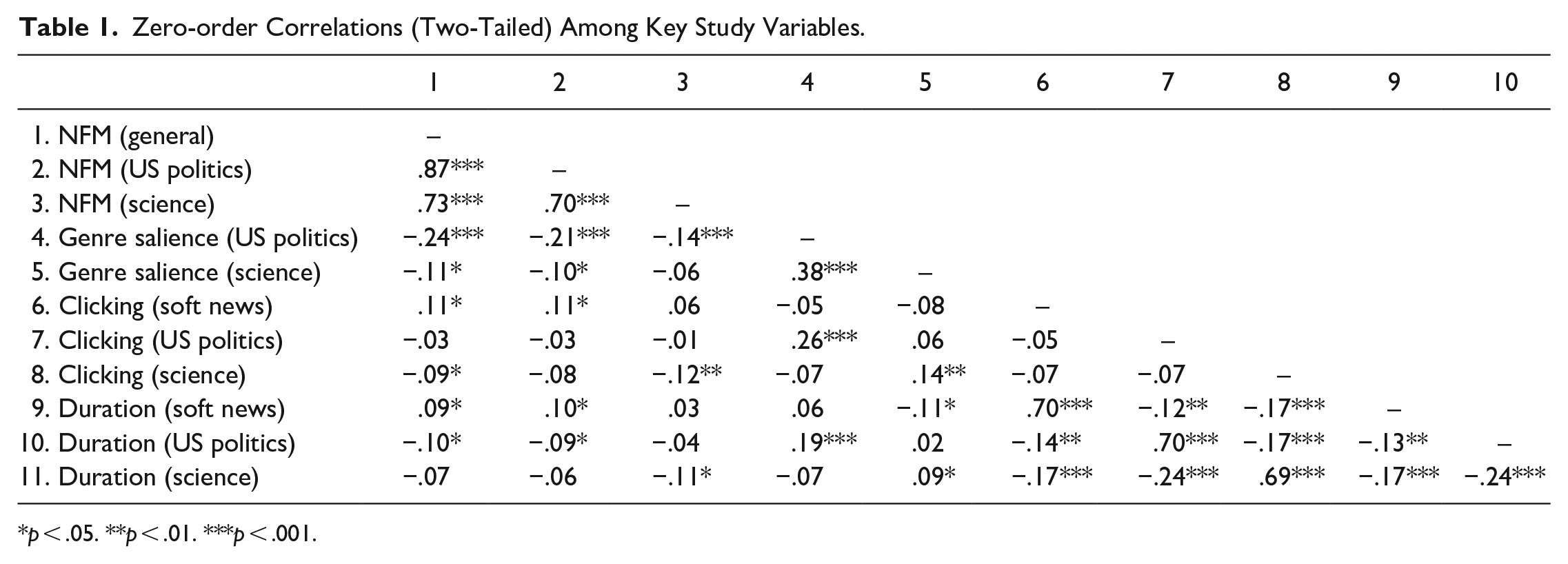
p < .05. **p < .01. ***p < .001.
NFM and Hard/Soft News Exposure (H1)
Our first hypothesis was that NFM would be negatively associated with selective exposure to hard news articles. As noted, due to the limited variance in the original dichotomous measure of hard news exposure (i.e., clicking on any hard news), we ran our analyses using measures of soft news exposure (results in Table 2). 1 NFM (general measure) was the only variable that significantly predicted clicking on soft news (odds ratio [OR] = 1.13, p = .04). Consistent with the logic of H1, for a one-unit increase on the NFM (general) scale, the odds of clicking on a soft news story rose by 13%. We saw a similar pattern with duration as the outcome variable, such that greater NFM (general) predicted greater time spent on soft news stories (β = 4.96, p = .03).
Predicting Selective Exposure to Soft News.
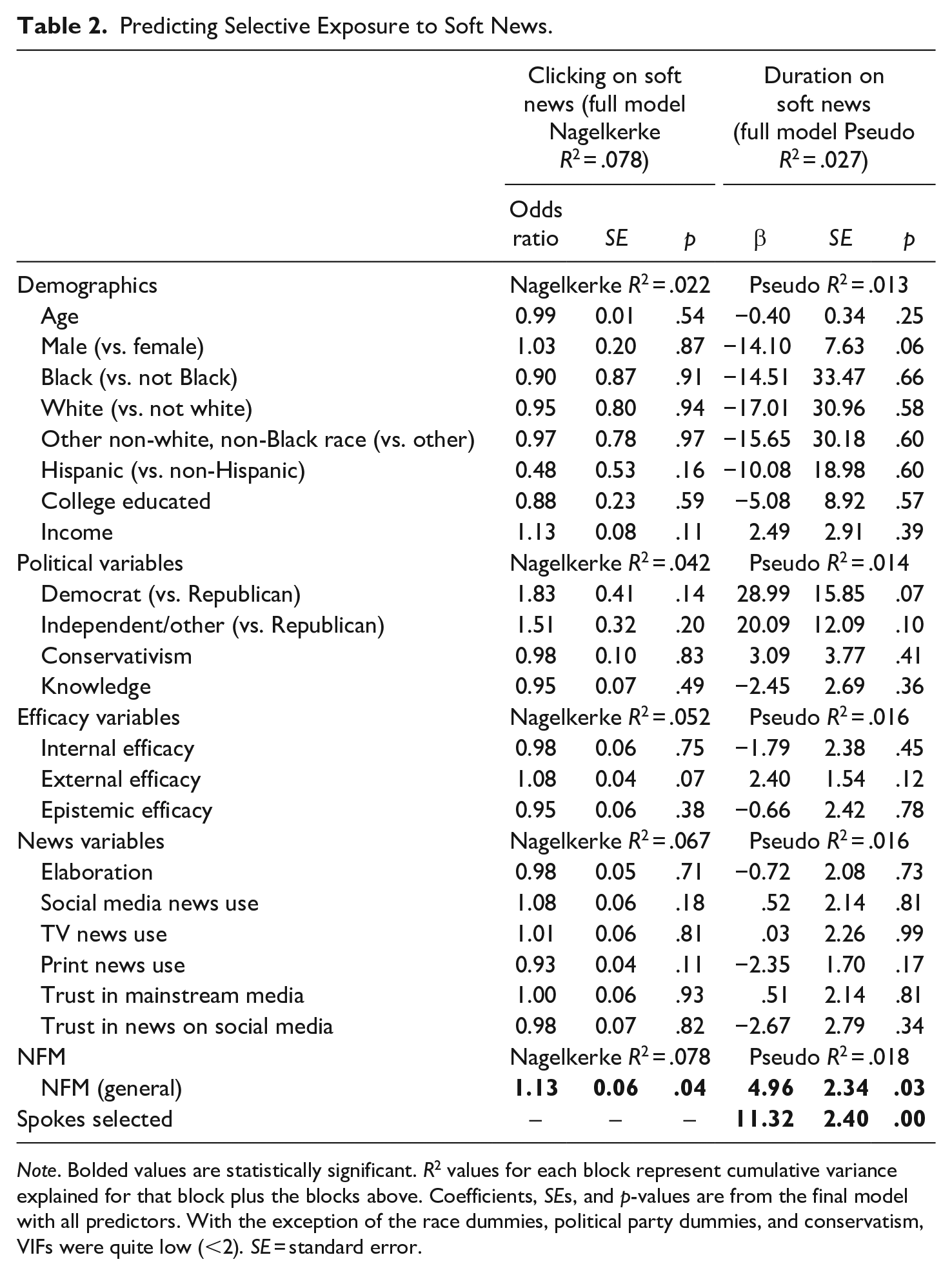
Note. Bolded values are statistically significant. R2 values for each block represent cumulative variance explained for that block plus the blocks above. Coefficients, SEs, and p-values are from the final model with all predictors. With the exception of the race dummies, political party dummies, and conservatism, VIFs were quite low (<2). SE = standard error.
NFM Predicting U.S. Politics Exposure More Than Other Issues (H2)
Predicated on the idea that the original NFM measure is capturing perceptions about political news—an assumption the zero-order correlations support (Table 1)—our second hypothesis was that NFM perceptions would exhibit a stronger (negative) relationship with selection of articles about U.S. politics than with selection of articles about other news issues. This test assumes that the original NFM measure will be significantly associated with U.S. political news selection, so we first tested whether that was the case. General NFM (i.e., the original scale) was not associated with clicking on articles about U.S. politics (OR = 1.01, p = .94; not shown in tables) or total duration on U.S. political articles (β = −1.81, p = .47; not shown in tables). Because there was no link between the original NFM measure and selective exposure to news stories about U.S. politics, these results do not support H2.
Genre-Specific NFM Perceptions (H3)
With H3, we expected that genre-specific NFM would predict avoidance of those genres. As shown in Table 3, politics-specific NFM was not associated with clicking on political stories (OR = 0.98, p = .76) or total duration spent on political stories (β = −1.72, p = .44).
Predicting Selective Exposure to Political News (from Politics-Specific NFM Perception).
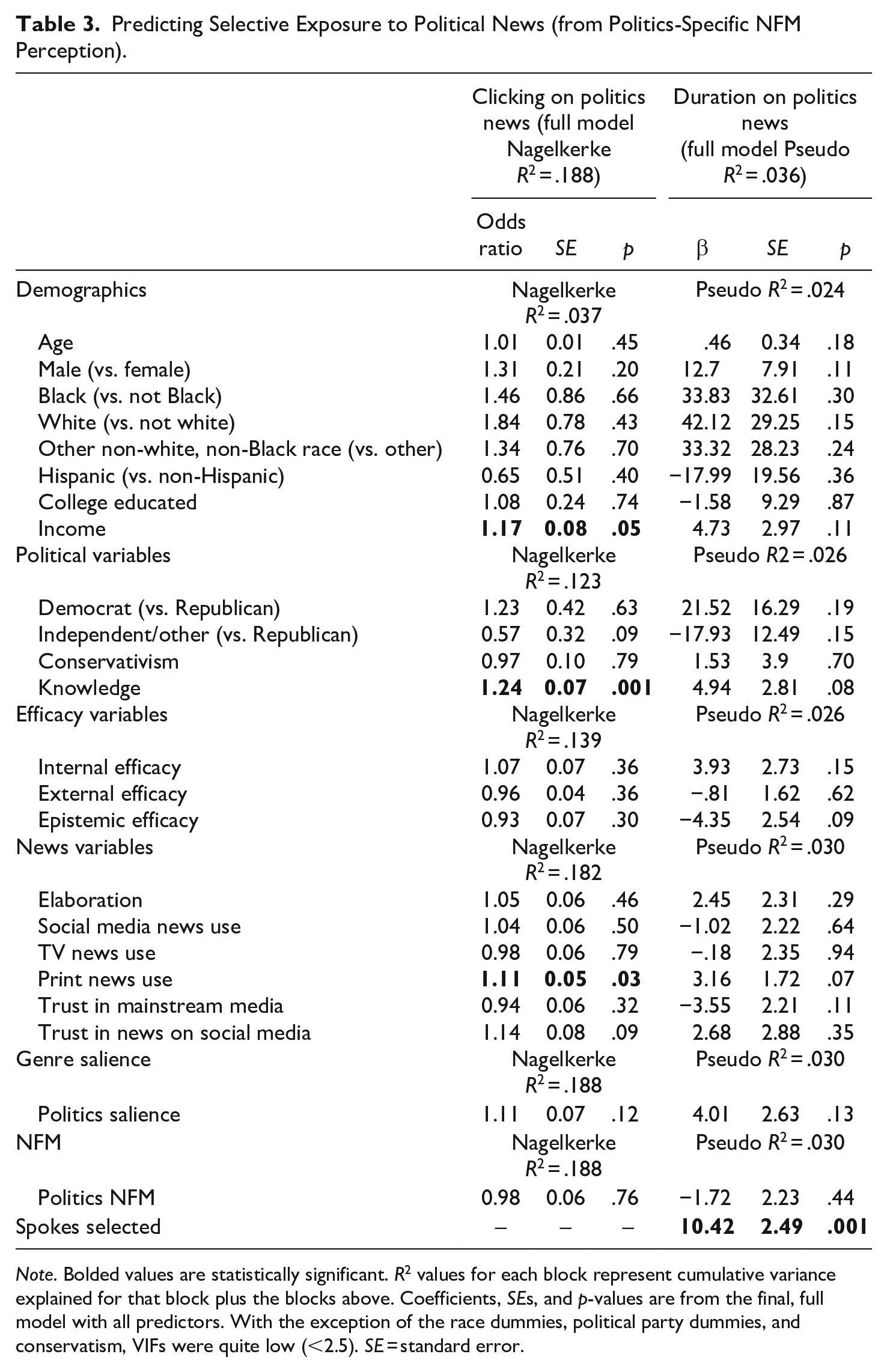
Note. Bolded values are statistically significant. R2 values for each block represent cumulative variance explained for that block plus the blocks above. Coefficients, SEs, and p-values are from the final, full model with all predictors. With the exception of the race dummies, political party dummies, and conservatism, VIFs were quite low (<2.5). SE = standard error.
Regarding science NFM (see Table 4), greater science NFM predicted significantly lower odds of selecting science news (OR = 0.85, p < .01). That is, a one-unit increase in science NFM was associated with 15% lower odds of selecting a science story. Moreover, science NFM was associated with less time spent on science articles (β = −5.17, p = .03). These results partially support H3. 2
Predicting Selective Exposure to Science News (from Science-Specific NFM Perception).
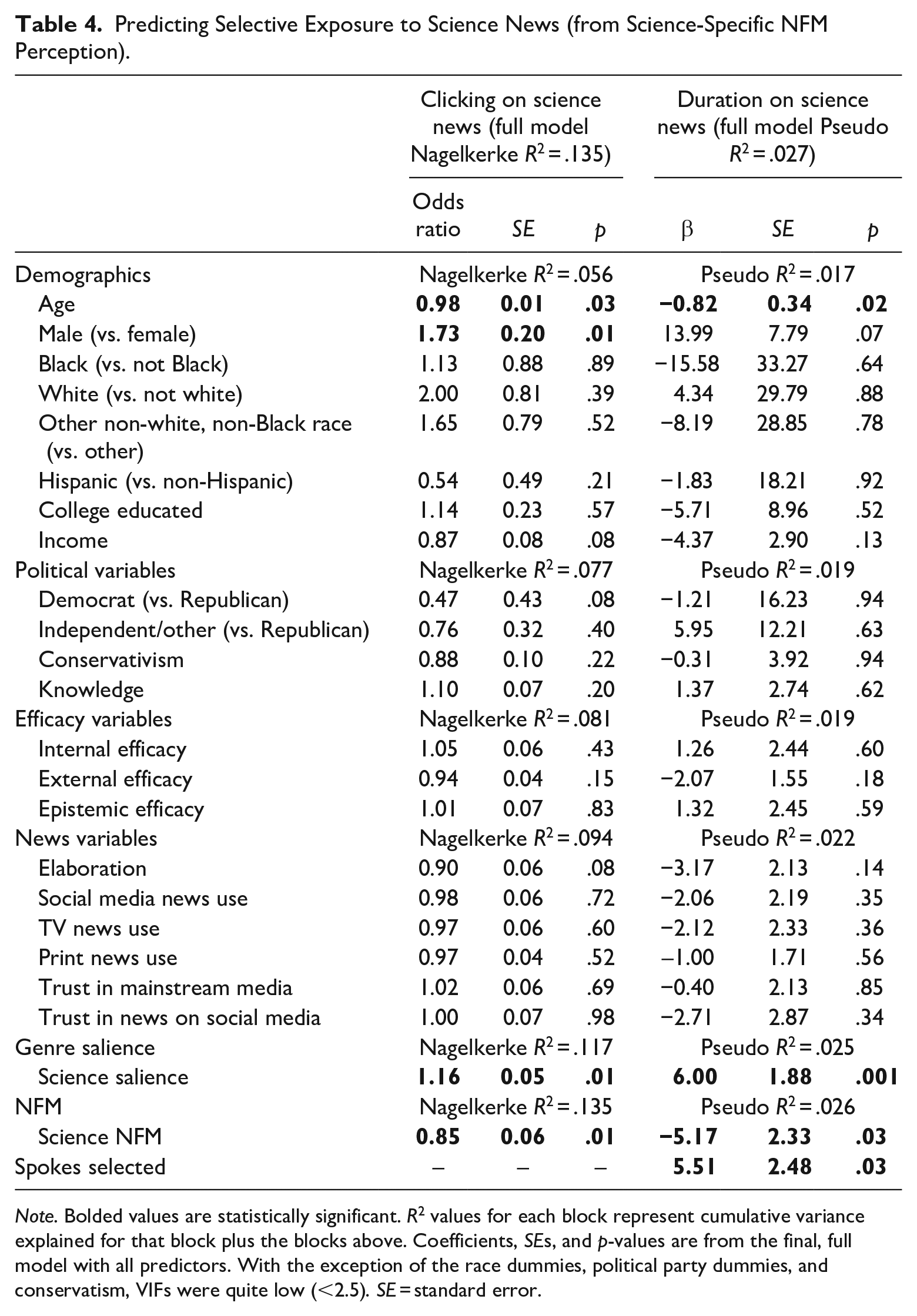
Note. Bolded values are statistically significant. R2 values for each block represent cumulative variance explained for that block plus the blocks above. Coefficients, SEs, and p-values are from the final, full model with all predictors. With the exception of the race dummies, political party dummies, and conservatism, VIFs were quite low (<2.5). SE = standard error.
Post Hoc Analyses
The analyses above collapsed data across all three website versions. However, we also wished to consider the role of website version. Including dummy variables in our analyses for website version (first version as the reference category) did not substantively alter our findings, but we did observe several interactions between website version and NFM perceptions. Regarding soft news exposure (H1), the general NFM measure interacted with both website version dummy variables to predict clicking on soft news (ORversion 2 dummy = 1.45, p < .01; ORversion 3 dummy = 1.32, p = .04). Probing these interactions, general NFM did not significantly predict clicking on soft news in versions 1 or 2 but did in version 3 (OR = 1.28, p = .02). There was one significant interaction between general NFM and website versions in predicting duration on soft news (βversion 2 dummy = 10.77, p = .04); however, probing these interactions revealed general NFM did not predict soft news duration in version 1 or version 2.
Regarding the original NFM measure predicting political news exposure (H2), website version interacted with the general NFM measure to predict clicking on political news (ORversion 3 dummy = 0.74, p = .04) and duration on political news (βversion 3 dummy = −16.04, p < .01). Probing the interaction revealed general NFM did not significantly predict clicking or duration on political news in versions 1 or 2 but marginally predicted lower odds of clicking in version 3 (OR = 0.81, p = .07) and predicted less time in version 3 (βversion 3 dummy = −13.50, p < .001).
Regarding genre-specific NFM predicting avoidance of those genres (H3), website version moderated politics-specific NFM’s relationship with clicking on a political story (ORversion 3 dummy = 0.68, p = .01) and duration on political stories (βversion 3 dummy = −16.52, p < .001). Politics-specific NFM predicted lower odds of clicking on a political story but only in version 3 (OR = 0.75, p < .01), predicted marginally greater time on political stories in version 1 (β = 8.60, p = .06), and predicted less time on political stories in version 3 (β = −12.34, p < .001). Website version did not interact with science NFM beliefs to predict selective exposure to the science stories. Taken together, these post hoc analyses indicate general NFM and politics-specific NFM predicted selective exposure differently depending on website version, but this was not the case for science NFM.
Discussion
At its core, the NFM construct is a perception about one’s news use (Gil de Zúñiga et al., 2017). Perceptions matter tremendously for media use and effects, as evidenced by the prominent role perceptions play in a variety of theoretical frameworks, such as the hostile media effect (Vallone et al., 1985), the third-person effect (Davison, 1983), and the spiral of silence (Noelle-Neumann, 1974). Ample research has similarly demonstrated that the perception that the news will find me (NFM) leads to lower interest in politics, lower political knowledge, and lower political participation over time (Gil de Zúñiga & Cheng, 2021). Even so, perceptions may or may not reflect what happens in reality. Our findings suggest that one’s belief that news will find me can correspond to actual news selection patterns, even when considering numerous factors that could also explain news choices, such as demographics, political knowledge, efficacy beliefs, and news use patterns. Although effect sizes were quite small in magnitude, it is notable that NFM predicted a preference for soft news even though the browsing interface presented three times as many hard news articles as soft news articles. It is not hard to imagine NFM could play an even larger role in explaining soft news selections in real news media environments where soft news content is in greater supply.
That high-NFM individuals showed a heightened preference for soft news is troubling on a few accounts. First, passing over current affairs content means that media users are unlikely to learn more about or elaborate further on the information (Oeldorf-Hirsch & Srinivasan, 2022), contributing to or even exacerbating knowledge gaps between high-NFM and low-NFM individuals (Gil de Zúñiga et al., 2017). Second, choosing soft news may itself result in deleterious consequences. Individuals who consume more soft news display higher levels of political cynicism compared to those consuming little soft news (Boukes & Boomgaarden, 2015), and separate research has demonstrated a positive association between political cynicism and NFM (Song et al., 2020). These previous findings, considered alongside our own, could imply the presence of a vicious cycle, whereby NFM drives soft news selections, which cultivates cynicism about politics, which in turn reinforces NFM. That said, it is important to bear in mind that the link we observed between the original NFM measure and selection of soft news was qualified by an interaction with website version—a point to which we return briefly.
Another goal of this study was to unpack whether NFM could be conceptualized as a genre-specific phenomenon to predict lower exposure to those news genres. We found support for this notion in the case of science NFM, such that believing that science news will find me was associated with lower engagement with science news content. Because greater exposure to science news enhances audiences’ perceived ability to understand science and perceived accessibility of science (Hwang & Southwell, 2009; Southwell & Torres, 2006), skipping over science content may undermine users’ confidence in their ability to meaningfully engage with science information and affairs. NFM studies have found that NFM negatively predicts political knowledge over time (Gil de Zúñiga et al., 2017, 2020; Gil de Zúñiga & Diehl, 2019; Lee, 2020), so future studies could apply a similar logic to test whether science-specific NFM leads to lower scientific knowledge.
The link between politics-specific NFM and selective exposure away from political news was less straightforward. We only saw evidence for a negative relationship between political NFM and exposure to political stories in one of the website versions we tested (and evidence for a marginally positive relationship in another version). In a similar fashion, although the original NFM scale predicted greater exposure to soft news in the full dataset, this relationship did not emerge in all website versions. These inconsistent patterns lend to a few possible interpretations and implications. It could be that the political news stories featured in some versions of the news site were more compelling than those featured in other versions, resulting in different news exposure patterns for high-NFM individuals. Our pilot data indicate this is not a plausible explanation because the political news previews were rated as about equally interesting across the website versions (see Table S1 in appendix). More likely, whether NFM leads to lower engagement with news seems to be contingent on the specific stories in question as well as the surrounding stories that compete for users’ attention. Politics is a rather broad news genre that encompasses many political matters (Feldman et al., 2018)—especially relative to science news—so it may be necessary to conceptualize and operationalize NFM at the level of specific political issues (e.g., healthcare, education policy) in order for politics-specific NFM to predict news selections. In further support of this explanation, as shown in Table 3, politics genre salience also did not predict participants’ political news exposure, suggesting that aggregating political news stories into a single genre may be too crude an approach for key antecedents like perceived importance and NFM to matter. Ultimately, the inconsistent associations we observed suggest that, at the very least, believing (political) news will find me does not support active seeking of news content when exposed to it either directly or incidentally. Hence, the only way for media users to learn about (political) current affairs is by purposefully engaging with news (Price & Neijens, 1998).
Practically, these results suggest providing more hard news (e.g., political or scientific) to high-NFM audiences is unlikely to be a useful strategy to increase their hard news exposure. Communication practitioners should consider more creative ways of communicating important scientific and political issues to high-NFM audiences, preferably on social media. On a methodological note, our findings indicate the original NFM scale is capturing beliefs about political news, as evidenced by its near-perfect correlation (r = .87) with a politics-specific version of the scale. In further support of this conclusion, the correlations the original NFM scale exhibited with our measures of selective exposure to political news were similar in magnitude to the correlations seen for the politics-specific NFM scale. Some scholars have raised concerns that self-report measures referring broadly to “news” or “current events” may unintentionally gauge experiences with non-political news or even soft news (Edgerly & Vraga, 2020; Matthes et al., 2020), but the patterns in our data should allay concerns that this issue applies to the original NFM scale. That said, it could be the case that a politics-specific NFM scale is a stronger (negative) predictor of the political outcomes often studied in the NFM literature (e.g., political knowledge, political involvement) than the original measure is, which should also be considered in future research.
Our findings also have implications for understanding the nature of genre-specific NFM beliefs. There was a negative link between personal interest in politics and politics-specific NFM, echoing prior studies in the NFM literature that have documented a negative relationship between NFM and political interest (Gil de Zúñiga et al., 2020; Gil de Zúñiga & Diehl, 2019; Park & Kaye, 2020). Of course, this does not preclude the possibility that there may be circumstances under which individuals perceiving political news will find them express interest in and engagement with political news. For one version of our news stimuli, for example, people who believed political news will find them spent marginally more time on political news stories than their low politics-NFM counterparts. Even so, the negative correlation suggests that, on average, people inclined to think that political news will find them are unlikely to be interested in political affairs. In contrast, science NFM was not associated at all with the personal importance of science news, meaning that that the belief that science news will come to you is completely independent of one’s interest in science. It appears, then, that science NFM stems not from a lack of personal involvement in science but perhaps from other factors (e.g., demographics, news habits).
Limitations
We wish to acknowledge several limitations of this work. First, we used a news website as the platform participants browsed, as opposed to having them browse from a list of Internet search hits (e.g., Unkel, 2021), headlines in an online magazine (e.g., Hastall & Knobloch-Westerwick, 2013), or posts in a social media feed (e.g., Vraga et al., 2016). We opted not to use a social media context for our stimuli, reasoning that in a social media context, NFM might be unrelated to news exposure or even predict greater exposure. We welcome future investigations that aim to replicate these findings in other online environments, including those that provide a wider range of news choices or more balanced options in terms of the proportion of hard versus soft news. Along these lines, the browsing experience featured slightly more political news stories than science stories, which could partly explain why we found support for our genre-specific NFM hypothesis in the context of science but not politics. Second, we focused on news genres (U.S. politics, science) rather than specific political or scientific issues (e.g., healthcare, climate change). We did so because NFM has been conceptualized at the level of news genres rather than specific political issues. Although we observed relatively strong associations among these genre-specific NFM measures and the original NFM measures, future studies could nevertheless explore the possibility of issue-specific NFM (e.g., economic or immigration news finds me).
Third, although we have argued (and found some qualified support for the idea) that high-NFM individuals should avoid news (Goyanes et al., 2023), our measures of selective exposure cannot distinguish intentional avoidance of news content from unintentional, passive avoidance. Studies in a similar vein as ours have gathered eye tracking data to unpack selective attention processes (Bode et al., 2017; Vraga et al., 2016), and we imagine it would be fruitful to study browsing behaviors in concert with eye tracking metrics to disentangle purposeful from passive avoidance (Ohme & Mothes, 2020). For example, intentional news avoidance should not only be characterized by minimal clicking on hard news stories; intentional avoidance means there should also be little visual attention paid to hard news. Triangulating measurements that reflect attention and exposure will surely enrich our understanding of the role NFM plays in news consumption and provide a better glimpse into how news avoidance behaviors map onto NFM. Fourth, we recruited interested participants through an online crowdsourcing platform, so the generalizability of our findings to the larger population (and those outside the U.S.) is an open question. Finally, we envision several opportunities to explore the link between NFM and news preferences as moderated by factors that we did not consider here, such as attitude congruence, news source, one’s current cognitive or affective state, etc.
Conclusion
All in all, a growing body of research has established that believing the “news will find me” (NFM) gives way to a host of democratically problematic outcomes over time (Gil de Zúñiga & Cheng, 2021). In spite of this accumulating evidence on NFM effects, communication scholars have yet to investigate what happens in those spur-of-the-moment encounters high-NFM individuals have with (hard) news. This investigation, as the first tightly controlled study on the NFM to unobtrusively track selection patterns, shows that high-NFM individuals were more likely than low-NFM individuals to selectively expose themselves to soft news about sports and entertainment, though this pattern may depend on the news content available. We also go beyond treating “news” monolithically, as much NFM research has done, providing evidence that science-specific NFM (and to a lesser degree, politics-specific NFM) corresponds to weaker engagement with news in those respective genres. These findings underscore the need for communication scholars to take a more nuanced approach to studying NFM, both in terms of how high-NFM individuals interact with the news options in front of them as well as the type of news genres being studied.
Supplemental Material
sj-docx-1-crx-10.1177_00936502231215528 – Supplemental material for Tuning Out (Political and Science) News? A Selective Exposure Study of the News Finds Me Perception
Supplemental material, sj-docx-1-crx-10.1177_00936502231215528 for Tuning Out (Political and Science) News? A Selective Exposure Study of the News Finds Me Perception by Chris Skurka, Mengqi Liao and Homero Gil de Zúñiga in Communication Research
Footnotes
Acknowledgements
We wish to thank our three reviewers for their thoughtful comments and Julian Unkel for his generosity in answering our many questions about programing the browsing interface.
Declaration of Conflicting Interests
The authors declared no potential conflicts of interest with respect to the research, authorship, and/or publication of this article.
Funding
The authors received no financial support for the research, authorship, and/or publication of this article.

Supplemental Material
Supplemental material for this article is available online.
Notes
Author Biographies
References
Supplementary Material
Please find the following supplemental material available below.
For Open Access articles published under a Creative Commons License, all supplemental material carries the same license as the article it is associated with.
For non-Open Access articles published, all supplemental material carries a non-exclusive license, and permission requests for re-use of supplemental material or any part of supplemental material shall be sent directly to the copyright owner as specified in the copyright notice associated with the article.
