




Abstract
Political advertisers have access to increasingly sophisticated microtargeting techniques. One such technique is tailoring ads to the personality traits of citizens. Questions have been raised about the effectiveness of this political microtargeting (PMT) technique. In two experiments, we investigate the causal effects of personality-congruent political ads. In Study 1, we first assess participants’ extraversion trait by means of their own text data (i.e., by using a personality profiling algorithm), and in a second phase, target them with either a personality-congruent or incongruent political ad. In Study 2, we followed the same protocol, but instead targeted participants with emotionally-charged congruent ads, to establish whether PMT can be effective on an affect-based level. The results show evidence that citizens are more strongly persuaded by political ads that match their own personality traits. These findings feed into relevant and timely contributions to a salient academic and societal debate.
Over the past few years, political campaigning has increasingly been shaped and facilitated by the forces of a commercialized social media marketplace. As a result, political campaigns increasingly make use of political microtargeting (PMT) on social media. This recent technique involves collecting and analyzing people’s personal data to send them tailored political messages. PMT has been widely used in the US (Kreiss, 2016), and more recently political campaigns in Europe (e.g., UK and the Netherlands) have also adopted the technique (Anstead, 2017; Dobber et al., 2017). While PMT can be used to mobilize and persuade citizens by reaching out to them in ways that are personally relevant, it also poses some societal risks. The Cambridge Analytica scandal highlighted some of these risks. The political consulting firm built personality profiles of hundreds of millions of Facebook users without their awareness (Confessore, 2018). Subsequently, that information was used to sway citizens by sending them tailored political messages, congruent with their personalities, meant to maximize the effects on the receivers’ political behavior.
The public outcry after the Cambridge Analytica scandal underlines the concern in society with this type of personality-congruent targeting. This form of PMT has been presented as a uniquely persuasive technique and was ‘blamed’ for the surprise victories of the U.K.’s Leave campaign in the Brexit referendum, and the victory of the Trump campaign in the 2016 U.S. election (e.g., Grassegger & Krogerus 2017). In 2016 there were only unsubstantiated and contradictory claims about the use of personality-congruent political messages in the UK and the US, and there was debate about whether personality-congruent microtargeting is even possible and effective (e.g., Confessore & Hakim, 2017; Kaye, 2016; Lapowsky, 2016). Some scholars suggested to take these claims with a grain of salt (e.g. Karpf, 2016). Since 2016, however, global companies such as Meltwater and IBM have added personality-congruent targeting to their toolboxes and offer these services to any political actor willing to pay (IBM, 2019; Meltwater, 2019). This brings about the risk of citizen manipulation, which occurs when data are used to identify citizens’ “decision-making vulnerabilities,” and when PMT-techniques are subsequently used to deliver tailored messages aimed to yield optimized effects to different citizens (see Susser et al., 2019, p. 1).
In this study, we conduct an empirical testing of the persuasion effects of personality-congruent PMT on the political attitudes and voting intentions of citizens. In a series of two experiments, we use an automated, computer-based personality assessment relying on participants’ own text data on a mock social networking site (i.e., based on a personality profiling algorithm) to target them with either a personality-congruent or non-congruent political ad. Put into a research question: to what extent are personality-congruent political ads more persuasive (i.e., change in political attitude and voting intention) than personality-incongruent and generic ads? Answers to this question will feed directly into relevant and timely contributions to a salient academic and societal debate.
Literature Review
Political Microtargeting and Personality Traits
Our digital footprints offer political actors a wealth of detailed information to mobilize and persuade us as citizens by means of political microtargeting (PMT; Zuiderveen Borgesius et al., 2018). Political actors often use PMT to send issue-congruent political messages. However, based on recent technological advances in computing and data analytics, the advertising industry is harvesting an increasingly granular set of psychometric data to trigger a whole range of emotional and subconscious responses (Chester & Montgomery, 2017; Ward, 2018). That is, political messages on social networking sites can now be tailored to fit the personality trait(s) of the recipients, and subsequently microtargeted to specific target audiences. This has been referred to as psychometric profiling, or the process by which the observed or self-reported actions are used to infer your personality traits. Although political actors have a long tradition in relying on psychology to understand citizens’ decision-making processes, psychometric profiling takes it a step further by mining vast quantities of personal data, which can be used for PMT purposes to have a more profound impact on political opinions and voter preferences (Bashyakarla, 2019). Before the advent of PMT, political actors were not able to collect these large amounts of personal data, analyze those data to gain insights (e.g., about people’s personality), and subsequently use those insights to deliver tailored messages aiming to optimize the persuasiveness of those messages (e.g. Gorton, 2016; Tufekci, 2014).
In the psychological literature, personality traits are often comprehensively represented by a Five-Factor Model (Cooper et al., 2013; Gerber et al., 2011; Mondak et al., 2010). This means that personality can be summarized in five distinct trait dimensions: (a) extraversion, (b) agreeableness, (c) conscientiousness, (d) neuroticism, and (e) openness to experience (Costa & McCrae, 1992; Goldberg, 1992). In this study, we particularly focus on extraversion, a trait that has been shown to be the most important dimension in affecting political outcomes (e.g., Cooper et al., 2013; Gerber et al., 2011; Mondak et al., 2010; Vecchione & Caprara, 2009). Extraversion implies an energetic approach to the social and material world and includes traits such as sociability, activity, assertiveness, and positive emotionality (John & Srivastava, 1999). Extraverts are usually upbeat, energetic, active, talkative, and assertive, while introverts are rather reserved or even shy (Cooper et al., 2013; Schoen & Schumann, 2007). By means of psychometric profiling models, these extraverted citizens can now receive political ads specifically tailored in line with their characteristics.
PMT has become the subject of heated (public and academic) debate. Scholars point to the risk of voter manipulation (Zuiderveen Borgesius et al., 2018), following from an information asymmetry between the political actor and the citizen (Tufekci, 2014). Political campaigns can base their actions on personal data, while people usually do not know that the messages they receive are tailored to their personality in order to maximize their effectiveness. Without this awareness, it is difficult to critically scrutinize the tailored messages. As such, microtargeting can qualify as manipulation: “the use of information technology to covertly influence another person’s decision-making, by targeting and exploiting their decision-making vulnerabilities” (Susser et al., 2019, p. 1).
Literature on effects of PMT-techniques is scarce. Under certain conditions, PMT-techniques seem to mobilize young voters (Haenschen & Jennings, 2019). Moreover, targeting Democratic voters with a Republican issue-congruent message increases support for the Republican candidate (Endres, 2019). There is some literature on effects of opinion-congruity in a non-microtargeted political setting. Matthes and Marquart (2015) as well as McGhee and Sides (2011) found that opinion-congruent ads increased political participation. Potentially, congruent political messages “give voters a reason to care about the outcome” (McGhee & Sides, 2011, p. 316). In this study, we contribute to knowledge development on the potential (causal) heterogenous effects of personality-congruent PMT on political outcomes. Based on the self-congruity theory (Sirgy, 1982), we investigate how citizens’ personality trait –extraversion- affects their responses (political attitudes and voting intention) to an extraverted political ad, and vice versa with introversion. Put differently, are extraverted citizens increasingly receptive to extravert-framed ads, and introverted citizens to introvert-framed ads? The theoretical underpinnings of this question are discussed in the next section.
Study 1
Personality and Ad Frame Congruity
Self-congruity theory posits that individuals prefer external stimuli when they are congruent with their own self-concept (Aaker, 1999; DeBono, 2006; Sirgy, 1982, 1985; Sirgy & Danes, 1982). Rosenberg (1979) defined self-concept as “the totality of the individual’s thoughts and feelings having reference to himself as an object” (p. 7). The self-concept consists of different dimensions (Markus & Kunda, 1986). A person’s personality trait can be considered one of those dimensions of the self-concept (Aaker, 1999). Initially, this theory was mainly adopted by marketing scholars to explain consumers’ preference for products and brands that match with their personal attributes or some aspect of the self (Solomon, 2018). However, its scope of application was soon expanded to persuasive communication, and in particular, advertising. In this area, self-congruity theory has been used to posit that congruent ads (i.e., ads that contain text that coincides with someone’s self-concept) are more effective than incongruent ads because they increase personal relevance (Hong & Zinkhan, 1995; Xue & Phelps, 2013). By now, many studies have applied self-congruity in the context of advertising, offering support for the claim that messages are more effective when the content is tailored to people’s personal characteristics (e.g., Hirsh et al., 2012; Matz et al., 2017; Moon, 2002; Wheeler et al., 2005; Zarouali et al., 2018). Although self-congruity theory can be apfplied to various attributes of the self-concept, some studies have focused on a specific part of the self-concept, i.e., a person’s personality trait(s). It was found that framing the text in an advertisement to match someone’s level of extraversion leads to a more positive attitude toward the brand (Wheeler et al., 2005), a better evaluation of the ad (Hirsh et al., 2012), more clicks and conversions (Matz et al., 2017), and an increase in persuasion (Moon, 2002).
Although these findings suggest a consistent message-personality congruity effect for commercial advertising, we found no reference to personality-congruent political advertising. In addition, the self-congruity theory studies in the commercial realm measured personality traits by means of self-report questionnaires (except for the study of Matz et al. (2017), which assessed personality based on Facebook likes). Recently, scholars showed that the Big Five personality traits can be accurately assessed based on language on social media (Park et al., 2015; Schwartz et al., 2013), and that computer algorithms can sometimes be as (or even more) accurate than humans in predicting these traits (Hinds & Joinson, 2019; Tskhay & Rule, 2014).
In this first study, we aim to investigate the congruity hypothesis based on users’ digital footprints (i.e., online text) on a social networking site, in reference to targeted political advertising, with the purpose of testing whether it influences citizens’ political attitudes and voting intention. People’s psychological profile will be assessed based on a personality profiling algorithm that analyzes their media text (this will be discussed in more detail in the methods section). Scholars have shown that social media language provide an important source for predicting people’s personality traits at a fine-gained level (Kern et al., 2016; Verhoeven et al., 2016). Applying computational linguistics to social media text is considered to be an accurate, unobtrusive and non-reactive window into the psychological characteristics of people’s everyday concerns (Schwartz et al., 2013). Thus, adopting an algorithmic personality profiling approach, we expect that:
Methods
Design and Sample
To test our conjectures, the present study employs a 2 (personality type: introvert vs. extravert) × 3 (political ad framing: introverted ad vs. extraverted ad vs. control ad) between subjects design. As reported in previous literature on message-framing research and personality traits, effect sizes tend to be within the range of small to moderate (e.g., Hirsh et al., 2012; Moon, 2002; Roczniewska & Higgins, 2019). Therefore, we conducted an a priori power analysis by using G*Power (Faul et al., 2007) with a significance level of α = 0.05, a moderate effect size of η2 = 0.06, and a statistical power of (1-β) = 0.80 (Cohen, 1988). For the power analysis, we have followed all the steps as outlined by Perugini et al. (2018). This revealed an estimated sample size of 158. We collected data from an online research panel in The Netherlands of 156 young adults aged 18-35 years (Mage = 25.97, SD = 4.49; 42% male). Data collection took place in December 2018, and during this period, no relevant political events happened, nor any political trend worth mentioning. Young adults were chosen given they are among the heavy users of social media, and hence, most often exposed to PMT on these platforms (Smith & Anderson, 2018). Since our treatment condition consisted of a political ad promoting a progressive left-wing party, participants had to meet the criterium of being left-leaning (i.e., these people will most likely be the target of a left-oriented political ad on social networking sites). Therefore, a screening question was introduced where participants had to indicate their left-right political orientation on a 11-point scale. Only participants having a score within the range of 1-6 were selected to participate.
A Mock Social Networking Site
For the purpose of this experiment, a mock social networking site has been created (see Figure A1 in the Appendix). This platform operates on a private server and offered the researchers full control over the online social environment, hereby decreasing the likelihood of extraneous influences (i.e., increasing internal validity). The social network was given the ‘look and feel’ of Facebook, and contained all the main functionalities and services of social media, such as a homepage with a news feed featuring mock posts, a personal profile page, a friends list, like buttons, a chat function, and so on. We created personal accounts on the social platform for every participant in the experiment, a couple of weeks prior to the experiment. At the start of the experiment, the subjects were given the credentials to log in to their accounts.
Procedure
As a cover story for the experiment, participants were told that they would conduct a usability test for a new SNS of our university. The experiment was conducted in two waves. In the first wave (T1), after participants gave their informed consent, they received instructions to log in, explore, and interact with the social network platform. They were briefed to write texts on the network, similar to how they would do on a real existing social network. They could write text in the “about me” section, post comments on the newsfeed posts, comment on news feed video’s, and so on. After doing so for five to ten minutes, they were told to log out, thereby ending phase 1 of the experiment. Based on this online session on the social network, we were able to extract all the text entries from the individual participants. By means of computational analyses (i.e., a personality profiling algorithm), we predicted participants’ personality trait (introvert or extravert) at T1 (see further).
Two weeks later, the same participants were re-contacted for the second wave (T2). Once again, participants had to log on to the social network. This time, they found a political microtargeted ad on their newsfeed that was either framed to match their personality type (condition 1), framed to the opposite personality type to create incongruence (condition 2), or the factual control ad (condition 3) (random exposure). After being exposed to one of these ads on their newsfeed, participants were re-directed back to the online survey to answer questions on the dependent variables, realism check, and suspicion probe. After finishing part two of the experiment, all participants were thoroughly debriefed. This experimental protocol is in accordance with the APA ethical standards, and has been approved by the ethical review board of our institution (ethical review board number: 2018-PCJ-9623).
Independent Variables
Personality profiling: Extraversion measurement
The extraversion personality trait was assessed based on automated text analysis, that is, author profiling. Author profiling is the task of deducing an author’s characteristics based on writing style. The main rationale behind author profiling is that each individual carries an individual stylome that can be linguistically quantified and identified. Natural language processing and text analytics techniques have opened up the possibility to automate the process of author profiling and apply it on a much larger scale. Automated personality profiling is a very specific type of application in the field of author profiling. It starts from the same hypothesis that a stylome can be identified for the writing style of people with a certain personality type. A study by Verhoeven et al. (2016) describes how a lot of user-generated content can be automatically collected for different personality types and how machine learning techniques can be trained on this data to build classification systems that can automatically identify the personality type of social media users with a fairly good degree of accuracy. Park et al. (2015) tested this computerized personality profiling against a self-administered personality assessment, and found this technique to be a valid way of personality recognition.
In this experiment, we used the Textgain API, which includes the automated identification of the introversion/extraversion personality trait of the author The classifier was trained on a large amount of textual data from people who volunteered their personality profile as metadata. More precisely, the classifier was trained on labeled data compiled from: (i) essays written by people whose personality type was gauged through an extended MBTI-test; (ii) a large amount of social media posts from people who had self-declared their Open Extended Jungian Type Scale on their social media feed (Luyckx & Daelemans, 2008; Verhoeven et al., 2016). The resulting dataset was cleaned and processed, removing unique identifiers and named entities to prevent overfitting.
Based on this training data, a machine learning classifier was developed to automatically induce the linguistic identifiers that accurately distinguish introverted versus extraverted writing style. This algorithm was used to perform the profiling of the users on the mock social networking site in this study. The output of the classifier places the person on a continuous scale on the personality-axis between extraverted and introverted. This is done by adding a “confidence” score to the prediction. The lower the score, the less obvious the personality type is from someone’s writing style, either because there are too few personality markers or the markers balance each other out. For example: for a person to be labeled as having an introverted writing style, a threshold of 15% confidence is used. This threshold was established during training of the machine learning classifier, by observing what confidence is needed on the continuous scale to trigger reliable and accurate binary labels (i.e., 0 = introverted vs. 1 = extraverted).
After T1, we collected all text data from participants (“about me” text, post comments, etc.) into a single string. In total, 230 participants entered some form of text. The average number of words per participant was 73.7 (in reality, we expect that political actors classify personalities on the basis of a much larger corpus of words, hereby making the classifier more accurate in its predictions). Fifteen participants did not have enough distinctive personality patterns in their writing (or too few words altogether). Sixteen participants entered less than 20 words (6 of them even less than 10). Six subjects did not follow the assignment correctly. Altogether, the classifier validly identified 82 introverts and 111 extraverts at T1. After re-contacting the same subjects, 156 users participated in T2. This sample consisted of 75 introverts (48%), and 81 extraverts.
Ad framing
The advertisement promoted a progressive, left-wing green party in The Netherlands (see Figure A2 in the Appendix). The ad image in all three conditions was held constant: an image of a road with wind turbines (referring to renewable energy). The only feature that differed, was the ad text. Our manipulation of ad text framing was consistent with the trait descriptions of introversion-extraversion found in the literature (e.g., Moon, 2002; McCrae & John, 1992). In addition, we also used specific words that people often use on social media and are found to correlate the most with introversion and extraversion (see Schwartz et al., 2013). In line with Moon (2002), who found that messages are more effective when the message style is in accordance with the recipient’s personality, we created an introverted ad based on weaker language consisting of questions and suggestions, void of confidence and dominance, and an extraverted framed ad based on stronger, confident and dominant language consisting of assertions and commands (Moon, 2002) (see Appendix). A pretest was conducted for the ad framing among 25 graduate students. We asked these participants how they rate the text phrasing included in the ad, ranging from 1 (introvert) to 10 (extravert). Results showed that the introvert-framed ad scored significantly below the scale midpoint (Mintro = 2.96; p < .001), whereas the extravert-framed ad had a rating significantly above the scale midpoint (Mextra = 7.76) [p < .001]. The control condition contained a factual text about the political party (e.g., when it was found, it’s political leaning, etc.). This control ad had the same text length as the two treatment conditions.
Dependent Variables
Attitude toward the political party
We employed two items from Seltzer and Zhang (2011) to assess citizens’ attitudinal response. They were asked to rate the political party [name party] on a 7-point scale, with the bipolar items “negative/positive” and “dislike/like”. Both items were aggregated to form a single index of attitude toward the political party (M = 4.56, SD = 1.36; α = .96).
Voting intention
Intention to vote was measured using a single scale item. Participants were asked how likely they would be to vote for the political party [name], with answer options ranging from one (very unlikely) to seven (very likely) (M = 4.49, SD = 1.71).
Additional Measures
Realism check
Participants were subjected to a realism check, asking them to which extent participants they found the mock social network, as well as the experimental protocol to be realistic. Answer options ranged from one (not at all realistic) to seven (very realistic). Findings revealed that subjects found the social networking site to be realistic (M = 5.31, SD = 1.45), as well as the experimental assignment (M = 5.25, SD = 1.36).
Suspicion check
By means of a suspicion probe, we aimed to ascertain that nobody identified the real goal of the experiment. This probe involved asking the participant what they thought the purpose of the study was (open-ended question). A screening of all answers revealed that no subject figured out the real ostensible purpose of the experimental study.
Results
Randomization Check
The number of participants was nicely balanced across conditions: condition 1 (introvert_control ad; n = 24), condition 2 (extravert_control ad; n = 24), condition 3 (introvert_introvert ad; n = 27), condition 4 (extravert_introvert ad n = 29), condition 5 (introvert_extravert ad; n = 24), and condition 6 (extravert_extravert ad; n = 28) [total sample: n = 156]. To control whether the randomization procedure has balanced various characteristics across the experimental conditions, a between-condition randomization check was performed at the outset of the analyses. This showed that the conditions did not differ with respect to age (F(5, 150) = .37, p = .55), gender (χ2(5) = 5.41, p = .37), education (χ2(20) = 20.41, p = .43), and social media intensity (F(5, 150) = .83, p = .53).
Main Analyses
The analyses were conducted based on a factorial analysis of variance (ANOVA). The independent variables were ad framing (control – introvert – extravert) and personality (introvert – extravert). The dependent variables were political attitude and voting intention (see Table A1 in Appendix for all the ANOVA results). The main effect of ad framing and personality on both dependent variables was not significant. However, a significant interaction effect was found between ad framing and voter personality for both dependent variables, political attitude [F (2, 150) = 10.22, p < .001; ηp 2 = .12] and voting intention [F(2, 150) = 10.04, p < .001; ηp 2 = .12] (see Table 1 for an overview of all the means).
Means (SD) for Dependent Variables as a Function of Ad Framing and Voter Personality.

Means within each factor and dependent variable that have a different superscript differ significantly at least at p < .05.
To test hypotheses 1 and 2, we performed a series of planned contrasts (Rosenthal & Rosnow, 1991; Rosenthal et al., 2000). The first two contrasts (one for each DV) were conducted for extraverted people, where we compared their ratings for the extravert-framed ad (congruent) to the two incongruent ads, that is, the introvert-framed ad and the control ad. Results revealed that the extravert-framed political ad was significantly more effective in increasing their attitude toward the political party than the incongruent ads; (t) = 3.71, p < .001. They also had a significant higher voting intention in the extraverted-framed ad condition, compared to the incongruent conditions; (t) = 3.68, p < .001. These results confirm H1.
Then, we conducted two similar planned contrasts for introverted participants. It was found that they had a significantly more positive political attitude in the introvert-framed ad condition, compared to the incongruent conditions; (t) = 3.29, p < .01. They also had significantly higher voting intentions when the ad was introvert-framed compared to the incongruent ads; (t) = 3.68, p < .001. This confirms H2.
Study 2
The aim of this second study is threefold: (1) to replicate the findings of Study 1 by operationalizing and testing the same research idea with a different set of manipulations, so to enhance the validity and robustness of the study; (2) to extend these findings by identifying the underlying mechanism; (3) to investigate the association between the personality classifier and participants’ self-reported personality in order to assess the accuracy of automated personality profiling as a measurement tool (this will be discussed in the results section).
Personality and Affect Congruity
In recent public and academic debates, the main concern regarding the practice of political microtargeting was the possibility to develop communication campaigns that effectively play out (inappropriate) emotional appeals to influence citizens’ decision-making (Tufekci, 2014; Ward, 2018). Therefore, in this second study, we match online users’ computationally-inferred personality trait with emotionally-charged political ads and investigate the impact of these tailored ads on political attitude and voting intention. In particular, previous research showed a strategic use of fear and enthusiasm appeals in political advertising (Brader, 2006; Borah, 2016). Enthusiasm and fear play a central role in the Affective Intelligence Theory (Marcus et al., 2000). This theory separates two distinct emotions in politics: enthusiasm as a positive affect, and fear as a negative affect. This framework theorizes differential effects of both emotion, meaning that they may generate distinct responses among different people. Enthusiasm appeals include content and imagery associated with success and good times, whereas messages with a fear appeal feature content and imagery associated with threats (Brader, 2005).
The responses to these emotional appeals may differ along the personality dimension introversion-extraversion (Brader & Valentino, 2007; Watson, 1988). It has been documented that extraverts are more susceptible to the influence of positive affect, whereas introverts are more susceptible to the influence of negative affect (Larsen & Ketelaar, 1991). Extraverted people are often characterized by emotional states such as enthusiasm and warmth (Larsen & Ketelaar, 1991), making them more susceptible for persuasion with these emotional appeals. For instance, Mooradian (1996) found that extraversion was positively related to positive ad-evoked feelings such as warmth. On their turn, introverts may have a stronger conditioned fear responses than extraverts, indicating a heightened susceptibility to fear-inducing appeals (Gray, 1970; Larsen & Ketelaar, 1991; Pineles et al., 2009). In this regard, Mowen et al. (2004) revealed that introversion was positively related to fear responses in advertising. A study conducted by Chang (2006) directly compared introverts and extraverts in their responses to emotional advertising. It was found that introverts evaluated negatively-valanced ads (e.g., a fearful ad) more favorably, while extraverts had more favorable evaluations when the ad-evoked affect was positive (e.g., an enthusiastic ad). In sum, we expect:
Mediating Role of Message Elaboration
An important underlying reason why introverts and extraverts could differ in their responsiveness toward congruent political ads is their motivation to think about or elaborate on these messages. A critical aspect of issue involvement is the perceived linkage of a communication to the self (e.g., someone’s personality), which is a well-established means of increasing message elaboration (Sahni et al., 2018). When people perceive a particular message to be matched with some part of their self (i.e., the message is made personally relevant or congruent), they engage in greater message scrutiny than when the message is perceived to be non-matching (Chang, 2006; Petty et al., 1995; Wheeler et al., 2005, 2008). Messages that are being processed with greater elaboration are more likely to influence citizens’ thoughts and behaviors and are more likely to be resistant to counterarguments (Petty & Cacioppo, 1986; Wheeler et al., 2008). In other words, a careful elaboration of a message could lead to individuals being more persuaded by the intrinsic arguments in a persuasive message.
Therefore, we expect that an affect-based political ad that is congruent with a participant’s personality (i.e., a fear-based ad matched with an introverted participant, and an enthusiasm-based ad matched with an extraverted participant) will lead to an increase in careful elaboration of that message, which in turn will generate an increase in political persuasion (see Figure 1 for visual representation of this moderated mediation). Based on this line of reasoning, we formulate the following hypothesis:
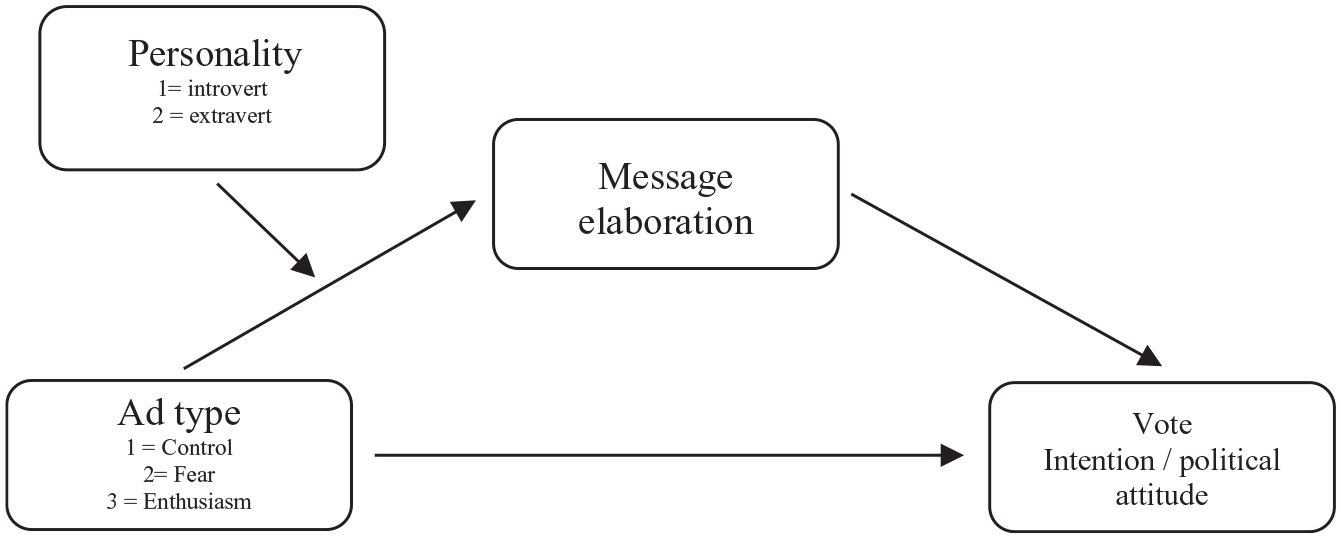
Visualization of the hypothesized moderated mediation model of personality on vote intention via message elaboration by ad type.
Methods
Design and Participants
A 2 (personality type: introvert vs. extravert) × 3 (political ad affect: enthusiasm ad vs. fear ad vs. control ad) between-subjects design was used. In terms of design, this study is rather similar to Study 1, in that it contains one factor with three political ad conditions that have different message framings (aimed at matching certain personality traits). Because of this, we decided to go for a sample size equivalent to Study 1, for which we conducted an a priori power analysis (estimated sample size: N = 158). In total, 150 young adults aged 18 to 35 in The Netherlands participated in the study (Mage = 28.33, SD = 4.96; 57% male). Data collection took place in May–June 2019, right after the 2019 European Parliament election. We chose to wait after this event to prevent the possible interference of election ads. In contrast to the left-leaning participants in the previous study, we recruited right-oriented citizens this time because the targeted ad in Study 2 promoted a Dutch right-wing party. To achieve this, the same screening as the previous study question was used where participants had to indicate their left-right political orientation on a 11-point scale. Only participants having a score within the range of 6 to 11 were selected to participate.
Stimuli and Procedure
This study followed the same procedure as the previous study (see above for a detailed description). In brief, the same social network was used to collect participants’ written text during their interaction with the platform in phase 1. Two weeks later, participants were re-contacted, and this time, they were randomly exposed to one of the targeted political ads on their news feed. After completing some post-treatment questions, all participants were thoroughly debriefed. This experimental protocol was entirely approved by the ethical review board of our institution (ethical review board number: 2019-PCJ-10259).
Independent Variables
Personality profiling: Extraversion measurement
The introversion vs. extraversion personality trait was assessed based on the automated text analyses described in Study 1 (using the same profiling algorithm). After T1, we again pulled all written text from participants into a single string of text. In total, 292 participants entered text on the social network. The average number of words per participant was 85.3. Eleven participants did not have enough distinctive personality patterns in their writing (or too few words altogether). Twenty-eight subjects entered less than 20 words (21 of them even less than 10). Eight participants did not follow the assignment correctly. In sum, a total of 124 introverts and 121 extraverts were identified at T1.
Around two weeks later, we re-contacted the same subjects for T2 of the experiment, and 150 subjects agreed to participated in this follow-up study. This left us with a sample consisting of 74 introverts (49%), and 76 extraverts.
Ad framing
The message advertised a right-wing liberal party in The Netherlands. All ad features (e.g., image, format, size, placement, etc.) were the same for the different treatment conditions, except for the ad text. According to Brader (2005), enthusiasm relates to things that are going well. Fear is a reaction to threat. Drawing upon the work of Brader (2005, 2006), the enthusiasm appeal text used a positive tone featuring a frame that implied that the national security of the country has never been better, while the fear appeal utilized a negative tone with a frame that conveyed the opposite, that is, the national security being threatened (see Appendix). Following Brader’s (2006) design, we conducted a pretest (N = 20) where the enthusiasm responses were measured with two items, whereas the fear responses were operationalized with a single item. For the enthusiasm ad, participants reported significantly higher levels of enthusiasm (Menthusiasm = 3.87) than the fear ad (Mfear = 2.45) [p < .001]. In contrast, the fear ad was reported to elicit significantly higher levels of anxiety (Mfear = 4.00) compared to the enthusiasm ad (Menthusiasm = 2.05) [p < .001]. In sum, the pretest was successful.
Dependent Variables
We used the same instruments as Study 1 to measure the dependent variables political attitude (M = 3.87, SD = 1.66; Chronbach’s α = .97) and voting intention (M = 3.58, SD = 1.97) (see measures Study 1 for more detailed information).
To measure participants’ self-reported personality, we employed Goldberg’s (1992) Big-Five factor markers from the International Personality Item Pool (IPIP). We used the 10 items assessing the introversion—extraversion trait. Participants were instructed to read ten statements and indicate how well they believed each statement described them on a seven-point scale (1 = very inaccurate to 7 = very accurate) (M = 4.19, SD = .91). The construct showed a good internal reliability (Chronbach’s α = .84).
Mediating Variable
Message elaboration was measured with four items originating from a study of Wheeler et al. (2005). The instrument assesses the self-expressed amount of cognitive effort that a person puts into reading a message and thinking about it. The authors used the measure in the context of an advertisement for a product, but the scale was amenable for use with political ads as well. Response options ranged from 1 (very little) to seven (a lot). The scale had a high Cronbach’s alpha of 0.94 (M = 2.97, SD = 1.38).
Additional Measures
The same realism questions from Study 1 revealed that participants evaluate the social networking site to be realistic (M = 5.36, SD = 1.28), and also found the experimental protocol to be realistic as well (M = 5.23, SD = 1.32). In addition, we went through all the answers that participants gave on the (open-ended) suspicion probe, and we conclude that no participants were aware of the true purpose of the study.
Results
Randomization Check
Similar to Study 1, the number of participants was nicely balanced across conditions: condition 1 (introvert_control ad; n = 20), condition 2 (extravert_control ad; n = 28), condition 3 (introvert_enthusiasm ad; n = 26), condition 4 (extravert_ enthusiasm ad n = 26), condition 5 (introvert_fear ad; n = 28), and condition 6 (extravert_fear ad; n = 22) [total sample: n = 150]. We conducted a balance test at the outset of the analyses. This revealed that the experimental conditions did not differ with respect to age (F(5, 144) = 1.13, p = .35), gender (χ2(5) = 6.22, p = .29), education (χ2(20) = 19.82, p = .47), and social media intensity (F(5, 144) = 1.09, p = .37).
Main Analyses
An ANOVA was conducted with ad framing (control – fear ad – enthusiasm ad) and voter personality (introvert – extravert) as factors, and voting intention and political attitude as two separate dependent variables (see Table in Appendix for full ANOVA results). When the dependent variable was set to political attitude, the omnibus test revealed a significant main effect for ad framing [F(2, 140) = 3.42, p < .05; ηp2 = .046] such that the-fear based (M = 4.12, SD = 1.63) and the enthusiasm-based ad (M = 4.01, SD = 1.73) were resulting in a more positive political attitude than the control ad (M = 3.33, SD = 1.51). This same main effect was also found for the dependent variable voting intention [F(2, 140) = 4.43, p < .05; ηp2 = .060] (Mfear = 3.90, SD = 2.01; Menthusiasm = 3.88, SD = 2.02; Mcontrol = 2.90, SD = 1.74). When inspecting the interaction, a significant moderation is revealed between ad type and personality [F(2, 140) = 4.44, p < .05; ηp2 = .060] on voting intention (see Table 2 for an overview of the means and standard deviations). However, the same interaction is not significant for political attitude [F(2, 140) = 2.54, p = .08; ηp2 = .035] (see Table A2 in the Appendix).
Means (SD) for Voting Intention as a Function of Ad Type and Voter Personality.
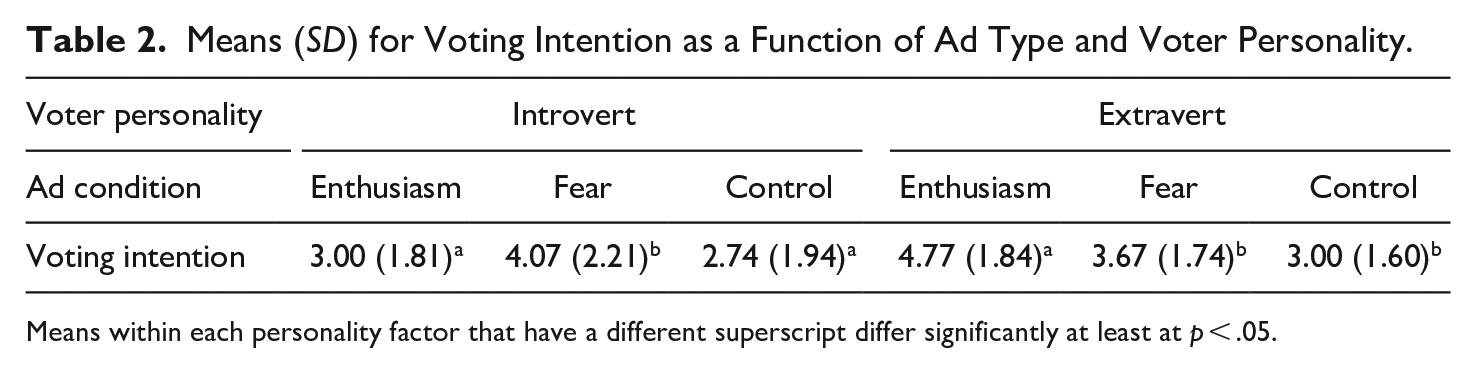
Means within each personality factor that have a different superscript differ significantly at least at p < .05.
Based on this, we decide to further analyze this significant interaction effect on voting intention by performing planned contrast analyses (see earlier). A first planned contrast revealed that introverted people had significant higher voting intention in the fear-eliciting ad condition, compared to the control conditions; (t) = 2,48, p < .05. A second analysis showed that the group of extraverted participants scored significantly higher on voting intentions when the ad was enthusiasm-evoking than the control ads; (t) = 3.39, p < .01.
Based on these results, we conclude that H3 and H4 are partly confirmed: only the interaction effect modeled on vote intention, and not on political attitude, was supported by the data.
Moderated Mediation Analyses
To test H5, we use the macro PROCESS to estimate conditional indirect effects (Model 7 – 5000 bootstrap intervals – BC 95% confidence intervals) (Hayes, 2013). Since the interaction was only significant for the DV voting intention (see earlier), we conducted these analyses only for this particular variable. With an independent variable containing three levels (control, fear and enthusiasm), we used the “multi-categorial approach” in PROCESS (see Hayes & Preacher, 2014). In this procedure, we generated k-1 dummy variables (D1, D2. . . .Dk-1) and inserts them in the moderated mediation model. In the first model, with the fear-based ad as a treatment condition, the analyses revealed a significant index of moderated mediation (b = .66, S.E. = .36; BC 95% CI [.037 to 1.445]). A closer inspection of the conditional indirect effects revealed that there was a positive mediation effect of the fear-based ad on voting intention via message elaboration only for introverted participants (b = .66, S.E. = .25; BC 95% CI [.225 to .1.218]). For extraverted participants, this conditional indirect effect was not significant (b = –.00, S.E. = .29; BC 95% CI [–.569 to .565]). A second model specified the enthusiasm-based ad as the treatment condition, and this generated a significant moderated mediation index as well (b = .58, S.E. = .32; BC 95% CI [.009 to 1.295]). More precisely, conditional indirect effects showed that the mediation effect of the enthusiasm-based ad on voting intention via message elaboration was only significant for extraverted participants (b = .44, S.E. = .24; BC 95% CI [.024 to 0.981]). For introverted participants, this conditional indirect effect was not significant (b = –.06, S.E. = .25; BC 95% CI [–.569 to .436]). Thus, these results establish the predicted moderated mediation relationship for the DV voting intention, as specified in H5 (see Table A3 in the Appendix for more information).
Classifier Agreement with Self-Report
The degree to which the automated classifier scores overlapped with the self-reported extraversion scores was assessed to get a better idea of how these two approaches differ. A logistic regression model was used to test the relationship between the continuous self-reported personality predictor and the binary classifier. The final logistic model (with the personality predictor), as compared to the intercept only model (without the predictor), showed a decrease of –2LogLikelihood from 207.92 to 1996.92 (χ2 = 11.00; p < 0.001; Nagelkerke R2 = 0.94), indicating that self-reported personality is a significant predictor of the classifiers’ binary outcome. More interestingly, classification analyses showed that someone’s self-reported personality is estimated to agree with the automated classification 61% of the time. This means that a self-report measure is able to predict 61% of all personality-classified cases. Since the classifier can instantaneously be applied to very large samples, it can easily lead to a substantive amount of personality predictions that are in agreement with a person’s detailed self-reported personality trait.
General Discussion
The aim of this paper was to look into the causal effects of personality-congruent political microtargeting on citizens’ political attitudes and voting intentions. This particular topic was the subject of heightened academic and public debates after the Cambridge Analytica scandal. In an attempt to provide empirical evidence in this debate, we conducted two experimental studies in which we tested the persuasion effects of personality-tailored political microtargeting. As such, we found causal evidence for the idea that people are more persuaded when they receive a political ad containing a text that is tailored or framed based on data relating to their psychological make-up (in this study, data on whether citizens were introverted or extraverted), as compared to a political ad that is incongruent with their psychometric profile or a generic ad. In addition, we also aimed to test the assumption whether emotionally-charged PMT becomes more effective when being matched with the personality of a voter. As such, Study 2 showed indeed that citizens reacted differently to affect-based political ads based on their psychometric profile: introverted people generated higher voting intentions when they were targeted with a negative fear-based political ad, whereas extraverted citizens had higher voting intentions after receiving a positive enthusiasm-based political ad.
From a theoretical perspective, this contributes to the undeveloped knowledge of how personality traits create heterogeneous effects toward mediated persuasive political messages (Dawkins, 2017; Gerber et al., 2013). This study showed that tailored political media effects are conditional in that they depend on whether the tailoring is aimed at a congruent personality trait. This congruency can be achieved by the framing of the ad text (Study 1) or the use of emotional appeals (Study 2). These insights contribute to our understanding of the interplay between personality traits and ad characteristics in shaping citizens’ receptivity to persuasive political message.
These studies also provide theoretical contributions to self-congruity theory (e.g., Aaker, 1999; DeBono, 2006; Sirgy, 1985; Sirgy & Danes, 1982). First, self-congruity theory in “message-personality matching” studies has almost exclusively been used in the area of commercial advertisements (e.g., Hirsh et al., 2012; Matz et al., 2017; Moon, 2002; Wheeler et al., 2005). As such, very little evidence is available to conclude whether the theoretical assumptions of self-congruity theory also hold in the area of political speech, and more precisely, political microtargeted ads. The results of this research suggest that this theory is definitely applicable to political communication in that congruent message can have an impact on voters’ political attitudes and voting intentions.
Second, Study 2 specifically showed that a congruity effect can also be established when certain emotional appeals are being aligned with people’s personality traits. Findings showed that introverts were increasingly persuaded when being targeted with fear-based political ads, while extraverts were more receptive to the swaying power of enthusiasm-based political ads. These insights go beyond what most previous congruity studies have focused on. Therefore, this congruity effect consisting of the matching of personality and message-induced affect is definitely something to be further explored in future research.
Third, almost all previous research that found support for self-congruity theory did so by measuring personality through self-reports (an exception is Matz et al., 2017). This research is actually the first one to use an algorithm that assesses participants’ personality by means of online text data (digital traces). Based on this algorithmic assessment, we still found evidence for supporting the self-congruity theory. This is an important contribution in that it shows that the tenets of self-congruity theory also hold under the specific condition of an algorithmic measurement of the self.
From a societal point of view, some important reflections have to be made. We have used less than 100 words as input to infer a person’s introversion or extraversion. While the accuracy of the classifier is unlikely to be perfect, the classifications can still be valuable for data brokers to easily enrich individuals’ profiles with inferences about their personality. After all, 100 words of writing can be easily scraped from social media (or Facebook could start to offer the information on the basis of their WhatsApp data). The results of both studies suggest that tailoring political messages to people’s introversion vs. extraversion trait can be an effective tool to persuade citizens. Therefore, this form of personality-congruent targeting raises some serious concerns. Although political advertising has always sought to influence citizens and steer their behavior, this type of tailoring is especially challenging, we argue. It is virtually impossible for citizens to notice when an ad is tailored to their personality. As a result, they cannot defend themselves against the persuasion effort in the same way as they would (try to) resist general political advertisements. In addition to the covertness of the technique, the targeted effort to use citizens’ personalities against themselves is something that was previously (almost) impossible with general advertisements. This covert exploitation of citizens’ deeply-rooted psychological attributes with the sole purpose of more effective persuasion, is a clear form of ‘online manipulation’ (Susser et al., 2019), which ultimately threatens citizens’ ability to take an informed voting decision. We therefore argue that current results necessitate a critical reflection and debate on the impact of personality-congruent PMT on democratic elections.
With regards to policy, we know that current legal framework is ill-equipped to address the potential abuse of personality-tailored PMT (Dobber et al., 2017), there is an urgent need to create protective ethical standards, principles and rules to safeguard fair political targeting practices. Text can be found and processed anywhere, anytime: something a citizen posted on a forum five years ago can be used to classify her personality today. We suggest that psychometric profiles should be labeled a ‘special category’ of data. This means that the processing of data revealing a person’s psychometric profile is only allowed under specific conditions, such as receiving a person’s ‘informed consent’. However, receiving informed consent may not be too big a barrier for companies. A more stringent and more effective option would be to implement an outright ban on psychometric profiling. The manipulative potential of this technique is too great to rely on non-binding guidelines, we would argue.
This study offers important methodological contributions to the emerging field of computational communication science (van Atteveldt et al., 2019). As people’s interactions with online websites and platforms will continue to grow, it will lead to an expansion of their digital footprints (including online text). Therefore, scholars must think about opportunities to leverage these digital traces by means of algorithms in order to assess personality traits and other individual characteristics. Such an algorithmic assessment might serve as an accurate, fast, and valid alternative to some conventional self-report measures.
In this study, we are among the first to illustrate how such method can successfully be embraced and implemented into an experimental media effects study. This study showed how to bridge the gap between two adjacent disciplines by using a computational linguistics tool (the personality profiling algorithm) within a communication science context. Empirical studies complementing their research with this algorithm-based methodology could generate insights that: i) were previously unnoticed and therefore extend our knowledge, ii) challenge previous results, possibly refining/adjusting our knowledge, or iii) reinforce previous results, creating a more robust body of knowledge. As such, this study may serve as a stepping-stone for future research focusing on text as data in the field of communication science.
This study has some limitations that could inspire future research efforts. First, as part of the experimental protocol, all participants were instructed to write some text on the mock social networking site (e.g., short ‘about me’ text, news feed posts, etc.). However, we know from literature that extraversion is positively related to social media activity (e.g., commenting, liking, sharing; Lee et al., 2014). This means that the introverted participants in our sample could have been instructed to do something they might not have done (or to a lesser extent) in a real-life environment. We tried to check for this by including the realism question (which asked whether they found the experimental task to be a representation of a realistic scenario), which turned out to be satisfactory. Still, we argue that our results need to be interpreted in the light of this limitation.
Second, our samples included participants that classify as “persuadables”. In the first study, only left-oriented people were recruited (because we used a political ad for a left-wing green party), and in the second study, right-oriented people participated (because we used a right-wing political ad). This means that we found personality-congruent PMT to yield significant results among those people who are already somewhat in favor of the ideology of the party issuing the ad. This approach might limit the generalizability of the findings. Future research should consider investigating the effects of personality-congruent PMT in more ideologically-balanced research samples.
Finally, although studies have shown that personality can be accurately inferred from language and text on online platforms (Hinds & Johnson, 2019; Matz et al., 2017; Tskhay & Rule, 2014), we have to be vigilant in claiming that text-data offers an undisputed window into someone true personality. Using machine learning modeling to predict an author’s personality revealed many challenges in this study. For instance, it is difficult to truly understand how or why the algorithm reaches its conclusion in classifying an individual as either introvert or extravert. Or, the classifier is binary in nature, while strictly speaking, introversion versus extraversion can be viewed as a trait operating on a single continuum. Or, the fact that we had to work with “short texts,” which typically have a lower accuracy for personality prediction compared to longer, more detailed texts (however, our results were still well above the baseline; Liu, 2016). Despite these pitfalls, we still found a significant relationship with the self-administered personality questionnaire, leaving us to conclude that future research in communication should definitely acknowledge the considerable potential of personality profiling algorithms for the purpose of personality prediction.
In conclusion, we argue that psychometric PMT is a double-edged sword. On the one hand, it can definitely serve as an effective way to deliver relevant information to citizens on issues that they really care about making them more informed and knowledgeable about this range of issues. But on the other, as found in this research, electoral candidates and political parties might adopt this technique as a persuasive tool during electoral campaigns by tapping into citizens’ psychological dispositions with emotionally-charged political content, and subsequently, impact how these people intend to vote. However, we have to stress that the technique used in this study is a very specific form of PMT (i.e., targeting people based on their personality traits by using a predictive algorithm). PMT can occur in different forms (e.g., issue-based PMT, PMT using disinformation, etc.) and can take place in a variety of different environments (e.g., SNSs, search engines, websites, etc.). It is therefore of crucial importance to investigate the potential risks and threats of PMT in a broad sense. This will lead to valuable insights regarding how PMT might undermine our democratic values, while at the same time, offer answers on how to use PMT in a responsible manner to maximize its mobilizing potential.
Supplemental Material
Online_appendix – Supplemental material for Using a Personality-Profiling Algorithm to Investigate Political Microtargeting: Assessing the Persuasion Effects of Personality-Tailored Ads on Social Media
Supplemental material, Online_appendix for Using a Personality-Profiling Algorithm to Investigate Political Microtargeting: Assessing the Persuasion Effects of Personality-Tailored Ads on Social Media by Brahim Zarouali, Tom Dobber, Guy De Pauw and Claes de Vreese in Communication Research
Footnotes
Declaration of Conflicting Interests
The author(s) declared no potential conflicts of interest with respect to the research, authorship, and/or publication of this article.
Funding
The author(s) received no financial support for the research, authorship, and/or publication of this article.

Supplemental Material
Supplemental material for this article is available online.
Author Biographies
References
Supplementary Material
Please find the following supplemental material available below.
For Open Access articles published under a Creative Commons License, all supplemental material carries the same license as the article it is associated with.
For non-Open Access articles published, all supplemental material carries a non-exclusive license, and permission requests for re-use of supplemental material or any part of supplemental material shall be sent directly to the copyright owner as specified in the copyright notice associated with the article.
