




Abstract
This article attempts to (a) investigate the relationship between distinct emotional reactions toward political information and attention toward political news and (b) analyze whether this relationship is dynamic. We use an experience sampling design to assess recipients’ immediate emotional reactions and attention toward news. Participants reported their emotional reactions (anger, fear, happiness, contentment) and attentional focus directly after following a news item for eight days in a row up to five times a day via smartphone. Results indicate that anger is positively and fear negatively correlated with attention toward political news. For positive emotional reactions, happiness is not correlated with attention to news, while contentment is negatively correlated with attention and also shows a negative lagged effect on attention at a later point in time. The study shows promising ways to assess and analyze dynamic processes in everyday media consumption.
While political communication and political psychology have, for a long time, overlooked the importance of emotional processes for political information reception and processing, in the last two decades this picture has changed dramatically. This change is mainly due to the notion that feeling and thinking are so deeply interwoven, that one is not possible without the other (Damasio, 1994). In the aftermath of this “emotional shift” in political communication and psychology (McGraw, 2000), it has almost become a truism that investigating affect is crucial to understand political communication effects in general and interest in and attention toward political information in particular (Brader, Marcus, & Miller, 2011; Marcus, MacKuen, & Neuman, 2011). Despite this notion, we know little about the relationship between certain discrete emotions and elaboration of political information (Nabi, 1999, 2010) and almost nothing about everyday news consumption and the fast and dynamic relationship between affect and attention (Otto, Thomas, & Maier, 2018; Schemer, 2012). This is arguably due to the fact that most research on emotion and attention is either conducted within experimental designs (e.g., Nabi, 2002), leaving the researcher with limited possibilities to test for dynamics, or within large-scale panel surveys, where it is hard to measure emotional reactions and attentional processes immediately after media reception.
Within this article, we attempt to assess the relationship between key negative (anger, fear) and positive emotions (happiness, contentment) and attention toward political news. Second, building on emotion theories like the broaden-and-build theory (BABT; Fredrickson, 2001), we aim at investigating the dynamic longitudinal relationship between emotional reactions and attention when following political information. That means, we do assess not only the contemporaneous and well-established interdependency between emotion and information processing of mediated information but also the development of emotional reactions and attention toward political news within shorter time periods.
By using the Mobile Experience Sampling Method (mESM), we aim at modeling everyday news usage and reactions toward political news in a very detailed and dynamic way. As emotions and attention are by definition rather transient, short-lived, and dynamic variables, they should be measured within or immediately after the emotion-provoking situation (Hamaker, Ceulemans, Grasman, & Tuerlinckx, 2015). We will now first summarize the state of research regarding the relationship between different emotions (fear, anger, happiness, contentment) and information processing, building on three different emotion theories.
Emotions and Attention
Emotions are an outcome of (political) media usage (Brader, 2005; Schemer, 2012) and might affect attention toward political information in the media (Nabi, 2003). Various models and theories in political communication research and political psychology provide explanations for the relationship of emotional reactions and attention toward a (media) stimulus. We use three prominent theories—the affective intelligence theory (AIT) and the cognitive functional model (CFM), as well as the BABT—to form our assumptions about the relationship between negative and positive emotions and attention toward political information in the media.
The AIT (Marcus et al., 2011; Marcus, Neuman, & MacKuen, 2000) assumes that “people use their emotions to help manage their attention in the political world” (Marcus et al., 2011, p. 324). The AIT claims that positive and negative emotions are markers for two emotional systems, the disposition system and the surveillance system. Positive emotions function as markers for the disposition system, which indicates that the environment is safe, and there is no need to raise attention; this, in turn, results in habitual behavior—thus, positive emotions should therefore not lead to high attention toward political information in the media. It is important to notice that AIT does not distinguish discrete positive emotions. Negative emotions like anxiety function as markers for the surveillance system and prepare for action; that is, negative emotions foster attention allocation.
The CFM of discrete emotions describes the relationship between emotional states—or reactions toward communication—and information processing (Nabi, 1999, see also Nabi, 2002, 2010). In contrast to the AIT, the CFM underlines the importance of discrete emotions and the differential effects of positive and negative emotions such as anger and fear, happiness, joy, and contentment. Nabi (1999) connects the model with appraisal theories of emotion (e.g., Lazarus, 1991). In doing so, she assumes emotions to (a) evolve through a pattern of appraisals and—most important for our purposes—(b) provide specific motivations, for example, to process information. Put differently, discrete emotions come with a certain motivation and “action tendency” (Nabi, 1999, p. 296; see also Lerner & Tiedens, 2006). These action tendencies do not only predict a certain behavior but also refer to the activation of cognitive resources. Despite the origin of the CFM in persuasion research, it has been found to be useful to explain how different discrete emotions, elicited, for example, through journalistic framing, affect subsequent attitudes and behavioral intentions (Lecheler, Bos, & Vliegenthart, 2015; Martin, Myrick, & Walker, 2017) or information processing and subsequent judgments about politicians (Otto, 2018).
While negative emotions and especially the distinction between anger and fear are intensively investigated both in communication research and in psychology, positive emotions are sometimes overlooked in communication research (Lecheler et al., 2015). The BABT describes the relationship between positive emotions, attentional processes and learning as well as psychological health and well-being. It puts emphasis on the role of discrete positive emotions and distinguishes emotions such as joy, contentment and hope and is thus a suitable basis for the relationship between positive emotion and attentional processes (Fredrickson, 2013). In contrast to many theories of emotion, the BABT shows that specific positive emotions such as joy can broaden the scope of attention, that is, foster holistic processing and cognitive flexibility and, in turn, increase knowledge and skills (Fredrickson, 2013; Fredrickson & Branigan, 2005).
We will now discuss the assumed relationship for fear, anger, happiness, and contentment with attentional processes, based on the three emotion theories described above.
Fear is the most intensively investigated emotion in communication research (Ruiter, Kessels, Peters, & Kok, 2014). Despite this effort, there are contradictory assumptions and mixed empirical results about the role of fear and its relation to information processing: The AIT assumes that fear, as a marker for the surveillance system, triggers information seeking and attention toward political sources (Brader et al., 2011; Marcus et al., 2011; Marcus et al., 2000). However, for the relationship between anxiety and campaign involvement, Brader (2005) finds only effects for citizens with high political interest, while Marcus and MacKuen (1993) find anxiety and involvement to be uncorrelated. It is, at that point, important to notice that most studies within the AIT rather speak about attention toward political information in a sense of information seeking, that is, media usage behavior and sometimes learning rather than attentional focus.
Quite on the contrary, the CFM and other emotion theories claim that the action tendency of fear is to escape from the threat, that is, to avoid additional information and attention—“fear is an avoidance motive” (Epstein, 1972, p. 311). Consequentially, threat-related information is not deeply elaborated, and therefore, fear responses should lead to less attention toward (political) information (Nabi, 1999). Media effects experiments supported the notion that fear is associated with less elaboration and attention allocation toward potentially threatening information (Nabi, 2002, 2003). Similar to these findings, the biphasic model of affect and motivation states that anger (see below) is rather linked to an approach motivation, while fear triggers avoidance (Lee & Lang, 2009).
Following the contradictory assumptions on fear and attention, we draw on an undirected hypothesis and state that
Different behavioral patterns for anger and fear are often in the focus of research on emotions in general (Lerner & Keltner, 2000; Lerner & Tiedens, 2006), and in communication research in particular (Brader et al., 2011; Nabi, 2002). In contrast to fear, anger is generally found to stimulate information seeking (Brader et al., 2011) and is conceptualized “as a discrete emotion (that) may result in quickened but closer attention to the object of offense” (Nabi, 1999, p. 303), leading to deeper information processing (Nabi, 2002) or, as assumed by the BABT, high, but narrowed attention (Fredrickson & Branigan, 2005). In sum, the emotion is able to “shut down” other cognitive processes and increase attention and approach the emotion-eliciting stimulus (Lerner & Tiedens, 2006). In sum, there is strong evidence that
In contrast to the distinction between anger and fear, positive emotions are often overlooked in communication research or treated as rather homogeneous. While the AIT assumes similar effects for all positive emotions, we are also taking into account the broaden-and-build perspective and investigate the effect of different positive emotions, namely, contentment and happiness. By doing so, we wanted to acknowledge the fact that for some forms of attention, that is, broadening attentional focus, not all positive emotions are the same. Many emotion theories take into account different effects of high- and low-arousal positive emotions like contentment and happiness/joy (Fredrickson, 2001; Frijda, 1986).
Similar to fear, the body of research on happiness/joy and attention is mixed, while the BABT assumes happiness to be related to higher, broadened attention, the vast majority of theories used in communication research like persuasion theories (Chaiken, 1980) as well as appraisal models of emotions and the AIT assume that happiness and joy lead to heuristic processing with low attention (see also Lazarus, 1991). Following this mixed evidence, we assume the following hypothesis 1 :
In contrast to the mixed evidence on happiness, contentment is regarded as an emotion with low arousal, indicating the absence of any threats (following the AIT), inactivity (Frijda, 1986), and saving energy (following the BABT). We, therefore, assume the following hypothesis:
Emotions and Attention—Lagged and Reciprocal Effects
In a nutshell, the literature discussed above suggests interdependencies between positive and negative emotion and attention. However, this relationship might not just be a matter of one moment, quite on the contrary, emotion psychologists as well as communication scientists consider the relationship of emotion and attention to be dynamic; that is, emotions affect attention at a later point in time and vice versa.
The BABT assumes such a reciprocal process. Fredrickson and Joiner (2002), for example, find positive emotions to affect broadened thinking at a later point in time (lagged effect) and, vice versa, broadened thinking and cognitive flexibility to account for positive emotions at a later measurement occasion, thus showing a reciprocal relationship between emotion and information processing over time. Similar to that, but on a day-to-day basis, Cohn, Fredrickson, Brown, Mikels, and Conway (2009) found a lagged effect of positive emotion on life satisfaction. Finally, Fredrickson and Losada (2005) found reciprocal effects for positive affect and mental health. The idea within the BABT is that (positive) emotions first broaden attention and therefore people are able to build knowledge, experience, and coping strategies. Thus, positive emotions trigger a reciprocal dynamic, where emotional processes and attention, learning, or coping affect each other over time in a cascade of emotion and cognition.
However, those lagged effects of emotion and attention can also be found for negative emotions in political communication research: Cho et al. (2003) found in a panel study that negative emotions predict attention of political news consumption and vice versa in the context of news about the 9/11 terror attacks. Schemer (2012) adds to this evidence and shows that interest toward a political information and negative emotion affect each other not only at the same measurement occasion but also at a later point in time. Again, the study assumes that emotion and attention are reciprocal processes in a way that negative emotion triggers attention and puts recipients in an alertness state that goes beyond the current reception situation, but triggers an emotion and attention cascade.
Following these theoretical and empirical considerations, we assume that the effects of attention allocation on emotion, as well as the effect of certain emotions on attention result in a longitudinal relationship. More precisely, we assume on the one side that anger does trigger attention not only at one point in time but also at a later point in time, while positive emotions (contentment) lower the attention in the following point of measurement as the cognitive system is not in alertness but rather saving energy (Fredrickson, 2013, p. 5).
The aforementioned results of Schemer’s (2012) campaign panel study are remarkable as they go beyond the fact that (negative) emotions and attention toward political information show lagged effects. His findings, in fact, also suggest that media effects and attention “perpetuated over time” (Schemer, 2012, p. 427) and negative affect and interest in the campaign showed a dynamic and reinforcing relationship. That means emotion and attention do show not only lagged effects but also linear correlated growth. In other words, the cascading relationship is not only shown by lagged effects of emotion and attention, which could only mark a “temporary shock” instead of a dynamic, but also change of emotion and attention over time. We take these dynamics from the long-term perspective that Schemer (2012) is providing to a short-term, everyday media consumption level assuming that
Thus, taken together, we include two processes when investigating the dynamic relationship between affect and attention—a lagged effect and change over time. While the former is relatively easy to model, for example, within multilevel regression approaches, the latter process needs to be modeled via correlated growth factors (e.g., Moeller & De Vreese, 2015). We will—after introducing the study design—show how to model these growth processes even within short time periods of one day or less. Given the nature of emotion and attention, we focus on short-term dynamics, which means emotions and attention toward political news show (negative or positive) growth within single days. Therefore, emotions affect attention (and vice versa) on a later point in time, an iterative pattern that occurs within seconds, minutes, or hours and eventually leads to daily growth for both variables. As such processes are not able to be measured within a traditional panel survey, we rely on the mESM to capture these processes and gain insight on the relationship between affect and attention.
Measuring Dynamics as They Unfold—The mESM
Experience sampling is also called ambulatory assessment, ecological momentary assessment, diary style data or intensive longitudinal data. Although the names might differ, all of these methods share the idea of repeatedly measuring behavior in a natural setting and in real time or almost in real time (Fahrenberg, Myrtek, Pawlik, & Perrez, 2007).
The reason to test the described relationship and hypothesis above by means of experience sampling are threefold: First, experience sampling is particularly suitable to measure emotional processes in a real-world environment. The first argument to measure emotions by means of experience sampling is the definition of affect. Emotions are defined as dynamic, transient variables that can change from one moment to the next, which makes it necessary to measure them in an intensive longitudinal way (Hamaker et al., 2015). Moreover, emotions are mostly defined as being triggered by a specific object or situation (Frijda, 1986), which makes necessary to assess the characteristics of a situation within an mESM study. Finally, measuring emotions in situ improves the measurement and reduces memory errors and biases. Take as an example assumed gender differences in emotionality and emotion expression, which disappear when men and women are asked about their emotional experiences directly instead of retrospectively (Barrett, Robin, Pietromonaco, & Eyssell, 1998), thus showing that biases and memory errors can be diminished by measuring such variables in situ. In sum, mESM fits perfectly with the nature of affect and reduces measurement errors when assessing emotion.
Besides the fact that mESM is suitable to measure affect and its dynamics, it also provides a valuable opportunity to study media reception. First of all, people receive political information very often via mobile devices, making the measurement of media selection and effects via experience sampling an obvious connection (Ohme, Albaek, & De Vreese, 2016). Second, similar to emotion measures, measuring media usage and effects in situ decreases memory errors and biases (Naab, Karnowski, & Schlütz, 2019) and finally, there is a particular blind spot in research for the combination of mobile (political) communication and emotional reactions, combining the above-mentioned reasons to apply this method (Reinecke & Hofmann, 2016).
Finally, scholars are—similar to our approach—able to test short-term dynamics, for example, between social media usage and gratifications (Wang & Tchernev, 2012; Wang, Tchernev, & Solloway, 2012) over and above panel surveys or experimental designs. mESM is able to capture the short-term dynamic processes, we are interested in. Testing dynamic processes has been largely done by means of “traditional” large-scale survey panels. However, these designs fall short when investigating short-term dynamics unfolding over one day, a few hours, or even minutes. After all, “clearly, the longitudinal design must fit the phenomenon under study” (Slater, 2007, p. 286). Thus, even if scholars have theoretical assumptions about the time lags of dynamic processes, they might not find these relationships because there is no existing panel data on it. Experimental designs, in contrast, while being able to capture effects directly within the reception situation share weaknesses when modeling dynamic processes. Even within multistage experiments, it is hard—if not impossible—to assess dynamics as they unfold over time. Furthermore, of course, experiments usually do not take place in a real-world setting, while the mESM measurement takes place in a natural reception situation.
The experience sampling method (ESM) combines positive characteristics of traditional longitudinal designs (dynamic, no artificial reception environment) with the immediate and short-term effects that we normally assess within media effects experiments. Against this backdrop, we believe that ESM is a useful extension of the communication research methods repertoire.
Method
Procedure and Sample
For this mobile experience sampling study, we invited students from a small German university (44.8%) and nonstudents, recruited by a professional market research institute, to participate in a study about “The news media.” Data were collected with the smartphone survey application movisensXS, Version 0.7.4162 (movisens GmbH, Karlsruhe, Germany). Overall, 96 participants took part in the study. In order to keep N constant for all models, we deleted all participants (/occasions) that did not fill out a specific questionnaire or showed missing values regarding the variables that we included in the analysis. After that, 78 participants remained. These participants’ age ranged from 18 to 70 years (M = 32.18, SD = 14.26). They were highly educated (60.3%, indicating a high school degree or higher) and predominantly female (71.8%). Both groups got incentives (credits for students and money for nonstudents) to participate in the study.
Participants were instructed to upload the political media content they received during the day, that is, upload a photo of the newspaper article they just read, make a screenshot or provide us with the link of the news website they followed, or indicate exactly which news show on television they followed. After they indicated which political media item they received, they answered a short questionnaire about their reaction toward the information in the media (emotion and attention). Thus, in contrast to traditional experience sampling studies, we decided for an event-based design: The mobile questionnaire had to be filled out every time a participant received information about a politician or a political topic in the media. This questionnaire could be completed up to five times a day for eight days in a row. Within this questionnaire, participants were asked about the immediate emotional reactions as well as their attentional focus while receiving the news item. Altogether, there were up to 40 possible measurement occasions (M = 10.03, SD = 8.06, minimum = 1, maximum = 36). 2 The median time lag between each measurement occasion was 7.44 hours (M = 13.44, SD = 18.00). Supplemental Appendix of Table A1 shows the number of measurement occasions for each day. Supplemental Appendix of Table A2 shows the average number of newspaper articles, political television items, as well as online items the participants uploaded during the 8 days. The average number of media items reflects results from representative studies on political news consumption in Germany (Mende, Oehmichen, & Schröter, 2012).
Measures
Emotions
We used a straightforward question to measure emotional reactions. People were asked how angry (M = 2.69, SD = 1.54), content (M = 2.33, SD = 1.26), fearful (M = 1.93, SD = 1.14), or happy (M = 1.99, SD = 1.20) they felt while following the media item they just uploaded. All emotions were measured on a 6-point Likert-type scale ranging from 1 (didn’t feel . . . at all), to 6 (felt very . . .).
Media attention
We used two items to measure media attention (“I followed the news item very closely” and “I was distracted while following the media item”). These items were based on the Attentional Focus subscale of the reading experience scale by Appel, Koch, Schreier, and Groeben (2002). Media attention was also measured on a scale ranging from 1 to 6, where low values indicate low media attention (M = 4.93, SD = 0.88). 3 In order to calculate between-individual as well as within-individual reliability for the media attention items, we rely on an approach by Shrout and Lane (2012). Between-individual reliability was high (RKRN = .96), whereas within-individual reliability was moderate (RCN = .60). As expected for experience sampling studies, these reliability estimates indicate a stable rank order between individuals regarding media attention across time as well as varying media attention scores within individuals across time.
In addition, we included sex, age, education, and a short five-item-scale (Otto & Bacherle, 2011) for political interest (M = 4.03, SD = 1.02, Cronbach’s α = .90) as well as the individual time lag between each measurement occasion as control variables.
Analysis—Multilevel Spline Models
In contrast to earlier studies analyzing the dynamic relationship between two or more variables, we do not assume a growth over the whole period of time (eight days) but rather process within one day. Thus, in order to capture reciprocal relationships as well as mutually reinforcing dynamics between emotions and media attention, we rely on spline models using multilevel regression analysis (Howe et al., 2016; Macdonald-Wallis, Lawlor, Palmer, & Tilling, 2012). Basically, spline models are piecewise linear regression models, also known as “broken stick” (Macdonald-Wallis et al., 2012). While usual growth curve models imply linear growth over a whole period and, thus, are not able to capture fragmented growth rates for such a period, spline models allow to capture such fragmented growth rates by setting knot points. These knot points define the end point of a shorter growth curve and represent the initial starting point for subsequent growth curves, simultaneously. The growth curves between these knots are called splines. By cumulating these splines, the whole period is covered, but with several linear curves instead of a single growth curve for the whole time. Therefore, the spline approach allows to control for different growth rates within the period under investigation.
Regarding the current article, this method might be beneficial for state-like, rather transient variables like emotions and attention (Hamaker et al., 2015). Relying on a constant linear growth curve over the whole period of time for the short-term relationship between media attention and emotional reactions toward political information could lead to rather rough-grained results, and it would be counterintuitive to assume that affect and attention increase over the period of one week. By separating the whole period in smaller fragments (splines), we are, however, able to capture growth for both emotional reactions and media attention for each specific day (or even smaller periods in time).
In order to build a multilevel spline model, we created eight spline variables, which correspond to the 8 days we included in our analysis. Thus, each spline captures the daily growth rate on a specific day for media attention and emotions. The spline variables were modeled by coding every time frame that occurs before the day of interest to 0 and subsequent time frames to 1. Regarding the day of interest itself, the time codes ranged from 0 = 12:00 a.m. to 1 = 12:00 a.m. on the next day. If we, for example, aim to compute a spline variable for the second day (Spline 2), every time coding for the first day is set to 0, the time codes for the second day range from 0 to 1, and the time codes from the third day up to the last day are set to 1. This procedure was repeated for every single day and, thus, allows us to depict piecewise (or daily) linear growth for the dependent variables of interest by adding the eight splines as independent variables.
Basically, the spline models we used are two level growth models with time nested within participants. An unconditional spline model with varying slopes and intercepts (also known as random coefficient model or mixed model) can be written as follows:

where c is the number of knot points and c + 1 describes the maximum number of splines. Thus, sijk represents the spline for individual i at time tk, where k = 1, . . . , c. Furthermore, β00 describes the average intercept and r0j describes the corresponding deviation for individual i. Accordingly, βk0 + rki describes the slope for a spline and the deviation of individual i’s slope at time k (see Howe et al., 2016, for a full explanation of these models).
Building on that model, we added control variables as well as autoregressive, lagged, and contemporaneous effects. In addition, we controlled for each emotion and media attention, respectively. Such a random coefficient model with eight splines, representing 8 days, can be written as follows:
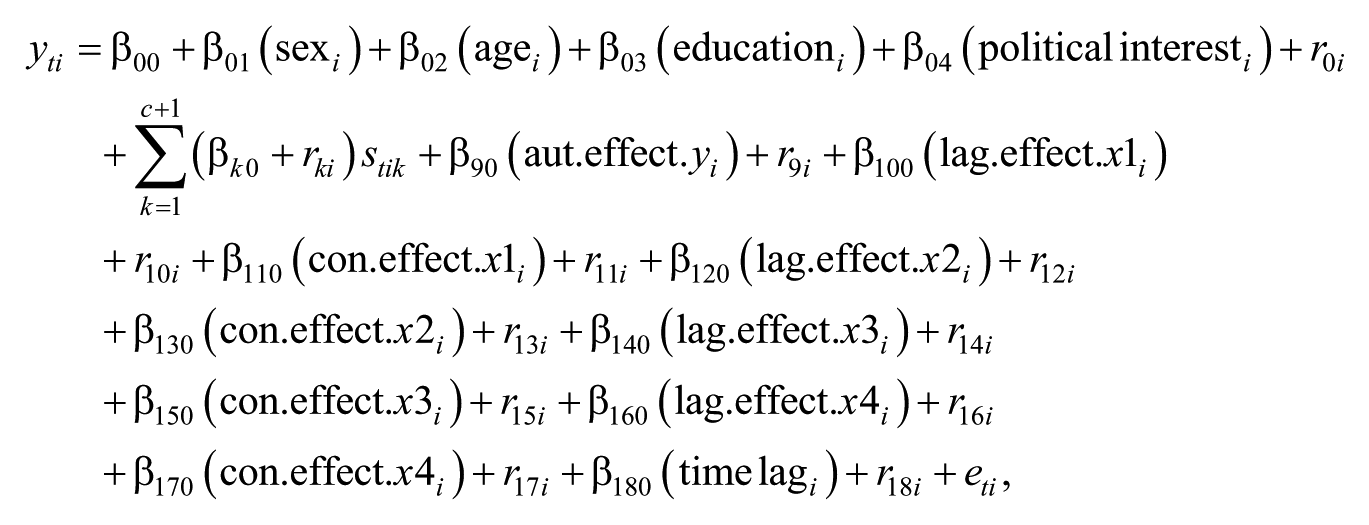
where β90 to β170 represent the slopes of the autoregressive, lagged, and contemporaneous effect, respectively. 4 The corresponding deviations of individual i’s slopes for lagged, autoregressive, and contemporaneous effects are r9i to r17i. Furthermore, β01 to β04 describe the effects of sex, age, education, and political interest, whereas β180 describes the effect of the time lag on the dependent variable with the corresponding deviation r18i. Overall, we built five models, one for each emotion as dependent variable (Models 1-4) and, in turn, we calculated one more model (Model 5) with media attention as dependent variable. 5 Notice, that lagged and contemporaneous effects rely on each other emotion or media attention, represented by x1 to x4.
In order to determine freely varying slopes, we built the models successively. Hence, random intercept models with random slopes were compared with random intercept models with fixed slopes. We repeated this procedure for all emotional reactions and media attention as dependent variables (see Figure 1). If the models with random slopes converged at all, the models with fixed slopes showed better fit indices regarding Bayesian information criterion (BIC) and Akaike information criterion (AIC). Thus, the final models were random intercept models with fixed slopes. All variables at Level 1 were group mean centered, which means that the variables were centered at the individuals’ mean, whereas variables at Level 2 were grand mean centered (see Slater, Henry, Swaim, & Anderson, 2003, for a similar procedure). The R package lme4 (Bates, Mächler, Bolker, & Walker, 2015) was used for the mixed model calculations. Furthermore, the R package lmerTest (Kuznetsova, Brockhoff, & Christensen, 2017) was used to determine the p values and the package MuMIn (Barton, 2018) to determine R². Multilevel reliability was calculated with the R package psych (Revelle & Wilt, 2019).
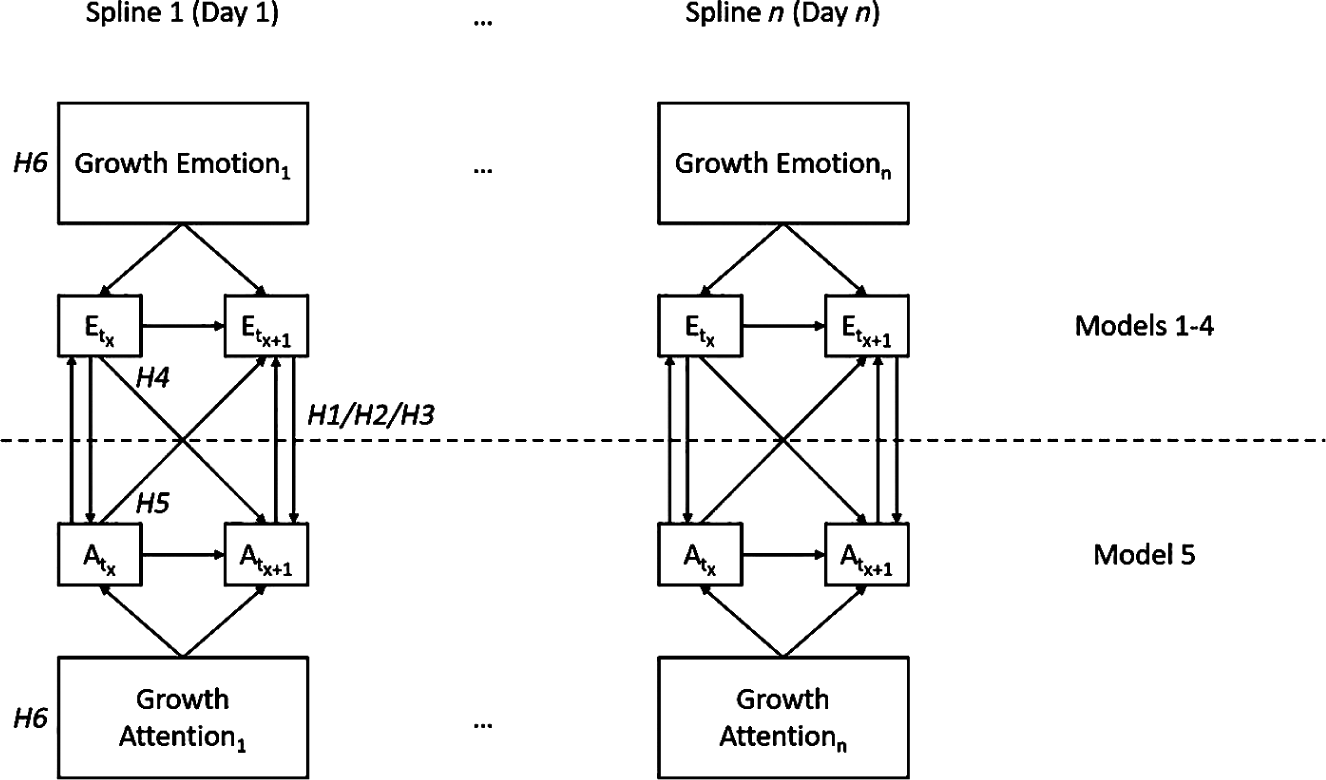
Assumed relationship between emotions and attention.
Results
We will now first describe the relationship of the different emotions with attention toward political news (H1, H2, H3a, H3b) based on the assumptions of the AIT and the CFM. Thereafter, we will investigate the conditions for a reinforcing relationship between the affective states and the attention taking into account lagged effects (H4a-d, H5a-c) and growth of both variables (H6) in a multilevel spline model. 6
Contemporaneous Relationship
In line with the assumptions made above, we found that attention correlates with fear (β110 = −0.11, SE = 0.05, p < .05) and anger (β110 = 0.14, SE = 0.07, p < .05) (see Table 1). Moreover, we found contemporaneous correlations between fear (β130 = −0.08, SE = 0.03, p < .05), anger (β110 = 0.05, SE = 0.02, p < .05), and media attention (see Table 2). These results support H1 and H2: Fear was found to be negatively correlated with media attention, but anger was positively correlated with attention toward political news. We also found a negative and marginal significant contemporaneous relationship (p < .10) between media attention and contentment (see Models 3 and 5) and, rejecting H3a, no relationship between happiness and attention. These results support the assumption that positive emotions with low arousal negatively correlate with attention toward political information (H3b).
Fixed Effects on Emotions.
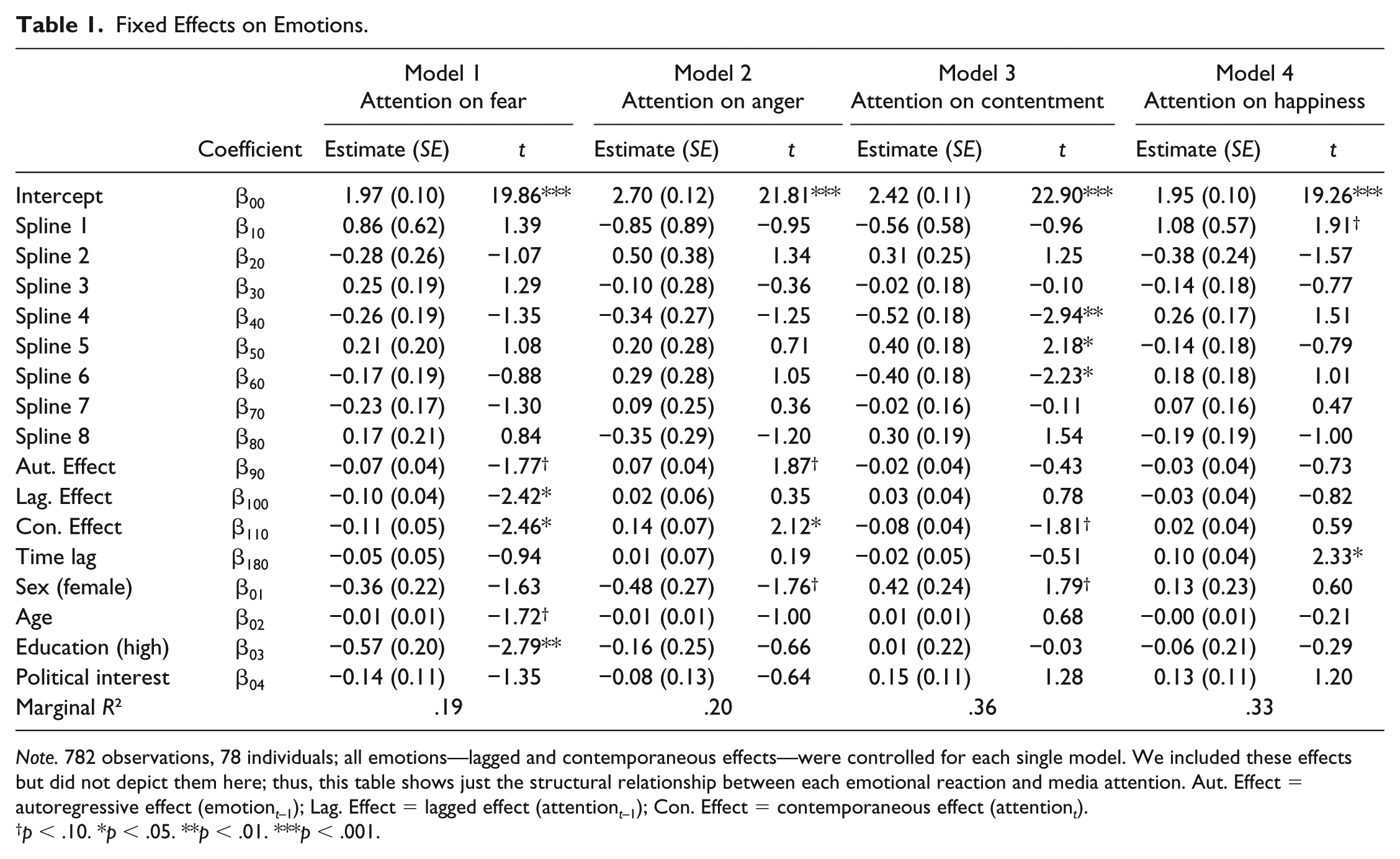
Note. 782 observations, 78 individuals; all emotions—lagged and contemporaneous effects—were controlled for each single model. We included these effects but did not depict them here; thus, this table shows just the structural relationship between each emotional reaction and media attention. Aut. Effect = autoregressive effect (emotiont–1); Lag. Effect = lagged effect (attentiont–1); Con. Effect = contemporaneous effect (attention t ).
p < .10. *p < .05. **p < .01. ***p < .001.
Fixed Effects on Attention.
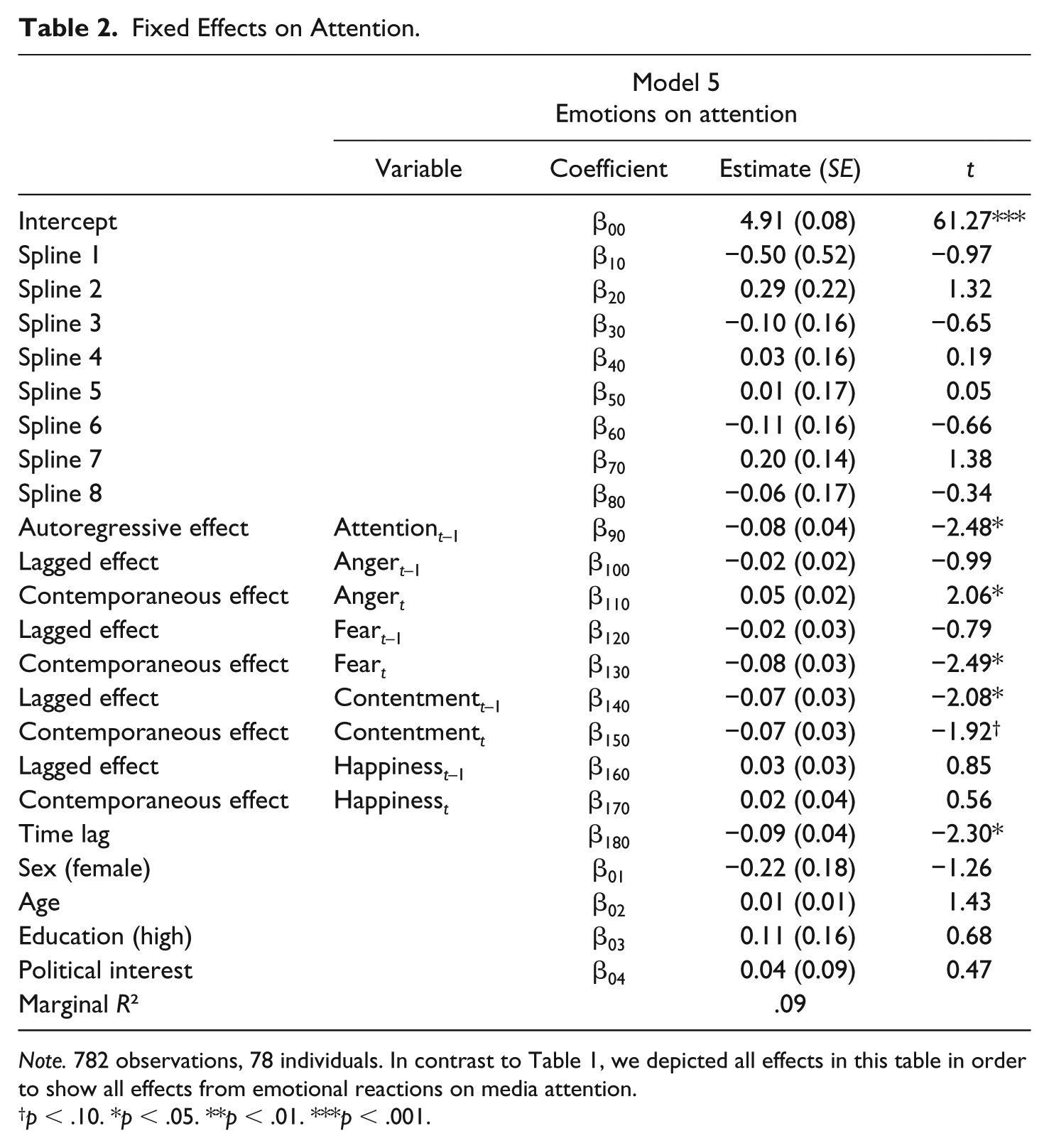
Note. 782 observations, 78 individuals. In contrast to Table 1, we depicted all effects in this table in order to show all effects from emotional reactions on media attention.
p < .10. *p < .05. **p < .01. ***p < .001.
Lagged Effects
Regarding lagged effects on media attention (see Table 2), our assumption about a negative lagged effect from anger and fear on attention toward political news was not supported by the data; there was no such effect, accordingly, H4a and H4b have to be rejected. Contentment, however, showed a negative effect on media attention (β140 = −0.07, SE = 0.03, p < .05), indicating that contentment causes decrease in attention toward political news at a later point in time, giving support for H4c. Regarding the reverse causation, lagged effects from media attention on emotions (see Table 1), media attention negatively affects fear at a later point in time (β100 = −0.10, SE = 0.04, p < .05), indicating that participants which following political news with high attention, become less anxious while following news at a later point in time.
The time lag between each measurement occasions showed that long intervals between each occasion lead to less attention toward media items (β180 = −0.09, SE = 0.04, p < .05, Model 5); it is thus important to include the time lag in these models in order to correctly interpret the findings. Moreover, long intervals lead to higher levels of happiness (β180 = 0.10, SE = 0.04, p < .05, Model 4). We did not find any effects of the time lag for negative emotions or contentment. In further models, not shown in tables here, we also tested whether the time lag conditions the effects from attention on emotional reactions and vice versa. However, neither the interaction between the time lag and media attention, nor the interaction between the time lag and emotional reactions showed significant effects except for the effect from contentment on media attention, which was conditioned on the length of the time lag (β190 = −0.14, SE = 0.06, p < .05); this means that while time lags are important for to interpret the results, they do not moderate the relationship between attention and emotion as reported above.
Growth and Short-Term Dynamics
Besides contemporaneous correlations and lagged effects, the third relationship we attempt to investigate is growth for both variables. However, we did not find growth for fear, anger, and happiness (see Table 1). We found negative as well as positive growth for contentment on some days: There was negative growth on Day 4 (β40 = −0.52, SE = 0.18, p < .01) and Day 6 (β60 = −0.40, SE = 0.18, p < .05). In addition, we found positive growth on Day 5 (β40 = 0.40, SE = 0.19, p < .05). Hence, participants become more discontent within the fourth and sixth day and, in turn, become more content within the fifth day. These results clearly indicate that there are short-term dynamics in emotional reactions at least for contentment. Of course, these growth factors do not necessarily relate to media consumption. Similar to most emotional reactions, there was no growth for media attention within a single day (see Table 2). These results indicate that there is no mutually reinforcing relationship between emotional reactions and media attention; thus, the assumption made in H6 has to be rejected. Growth appeared just for one emotion. Media attention, however, showed no growth at all. In order to capture a mutually reinforcing relationship, growth for both media attention and the corresponding emotional reaction, as well as a reciprocal relationship between media attention and emotional reactions, is required.
Discussion
This study contributes to the existing body of research on emotion and attention during news consumption in two ways—methodologically and substantively. Concerning the substantive relationship between emotion and attention, we (a) clarified the relationship between certain discrete emotions and information processing in a news consumption context; (b) added a dynamic perspective to the investigation of emotion and affect as suggested by research within the BABT (Fredrickson, 2013) and in communication research (Schemer, 2012); and finally, (c) added by providing a research design and modeling approach to short-term dynamic processes as we will discuss in the following.
First, the study puts assumptions of well-known theories in communication research, political psychology, and emotion psychology about the relationship between certain distinct emotions and information processing to the test—within a real-world setting. We found meaningful contemporaneous relationships between affect and attention toward political information. As assumed by the AIT and the CFM, anger showed a positive relationship with attention toward political news. In contrast to that, fear correlated negatively with attention, which supports the assumption of the CFM and other persuasion theories that fear reactions go along with an avoidance tendency and lower elaboration. There are different possible explanations on the side of the recipient as well as on the side of the media stimulus why fear, in our case, rather triggers an avoidance tendency than attention allocation. First, the literature on fear appeals suggests that the relationship between fear and elaboration could be nonlinear, that is, very high levels of fear lead to avoidance, while moderate levels of fear lead to close elaboration (Dillard, Li, Meczkowski, Yang, & Shen, 2017; Nabi, 2002). Second, to explain this finding, it is worthwhile to consider the difference between fear and anxiety. While fear is an immediate reaction to a stimulus and has a strong avoidance tendency, anxiety is a rather constant and long-lasting negative emotion. As we measure the emotion directly after the stimulus, that is, media consumption, it might rather reflect fear than anxiety.
For the positive emotions, we think that it is worthwhile to include a more nuanced perspective to (political) communication research and not to treat all positive emotions equally. After all, contentment and happiness showed clearly different effects in our study: While contentment was negatively correlated with attention, confirming the assumptions of the BABT, and also persuasion and motivation theories (Frijda, 1986; Nabi, 1999), we did not find significant correlations of attention and happiness contradicting both the broaden-and-build perspective and the AIT. Future research, of course, needs to take into account different kinds of attention (narrow vs. broad) and different positive emotions to confirm these findings and transfer the results on the relationship between positive emotions and information processing to the communication context to overcome the positive emotion blind spot (see also Lecheler et al., 2015).
Second, we add to the study of emotions and information processing by providing a dynamic approach, that is, indicating that emotions and attention are not only related at the same moment in time but also affect each other over time. Such a reciprocal relationship has, to our knowledge, never been tested within a short time frame and for everyday news consumption. Concerning the question of lagged or reciprocal relationships, we found an effect of contentment on attention toward political information at a later point in time, indicating that contentment indeed is a marker for the absence of a threat (Marcus et al., 2011) and leads to a low effort state (Fredrickson, 2013). Thus, the negative effect of contentment goes beyond the contemporaneous relationship between cognitive and affective processes.
Finally, we provide a methodological contribution to the investigation of communication, emotion and cognitive processes. While previous studies on these were mostly within an experimental setting, lacking the dynamic perspective (Lang, Dhillon, & Dong, 1995; Nabi, 2002) or sometimes large panel designs, suffering from memory biases and imprecise measurement of media consumption, affect and information processing (Schemer, 2012), we were able to measure emotional reactions of and attention toward real media stimuli almost in real time, directly after media reception. This methodological contribution is especially helpful when investigating political communication reception and effects on mobile devices. After all, digital and mobile communication and today’s hybrid, dynamic media system with recipients being able to obtain information anytime, anywhere, and from many different sources makes it also necessary to develop and adjust research methods. Following this contribution to measurement of short-term dynamic processes and immediate reactions, we show how to analyze intensive longitudinal data by means of multilevel spline models, thus contributing to the methods and statistics repertoire in communication research.
Of course, limitations of the design, measures, and sample of the study should not remain unmentioned. First, experience sampling studies hardly reach the sample sizes of the other panel studies. However, while losing variance between participants, one gains within-person variance, as large-scale panel surveys hardly include up to 40 measurement occasions. Second, this study follows the tradition of “empty exposure” studies in communication research. That means, we do not take into account which media content leads to a specific emotion. Adding to that, the theories that we build upon are also not specific to certain media characteristics of content but rather describe the relationship between emotions and information processing. We expand these theories by also focusing on a dynamic aspect and transfer them to the news consumption context. Put differently, it is not the focus of this study to find out which media content led to the emotional state but rather how different emotions affect information processing, not only at the same reception situation but also for subsequent media reception. In other words, we do not know which political information made the participants angry, fearful, or happy, but we know how anger and fear affect information processing. Going one step further, future research needs to link experience sampling data with media content that is responsible for the emotional and attentional processes in the reception situation. The intensive longitudinal data combined with detailed information about media usage and media content would provide us with the necessary information to analyze these characteristics and come to a sound judgment about emotional reactions toward political information in the news—in real time and in the actual reception situation. To our knowledge, there is no study taking into account dynamic processes and integrating media content data and survey data in a longitudinal way. Studies either focus on the dynamic aspects and treat media content in a very broad manner (on the basis of genres or channels) or do not model media content as a longitudinal variable as in classical linkage analysis (De Vreese et al., 2017).
While the assessment is as close to the real world as it gets and the number of uploaded media items roughly reflects the average time German citizens spend with political media, we are—of course—not able to fully capture media usage of the participants. 7 We furthermore relied on self-measures of both the emotional reactions as well as the attention toward the media stimulus and measured emotions with a single item. This could be problematic for several reasons: measuring discrete emotions via self-report is constantly criticized for as these measures might be post hoc rationalizations of certain emotional states, and it is hard to obtain reliability coefficients for one-item measures. The one-item measure for the discrete emotions is largely due to the experience sampling design; within these designs space for questionnaire items is even more limited than in traditional panel studies as participants have to fill the questionnaire multiple times a day. As for the attention measure, it might be counterintuitive to assume that participants do not devote attention toward a media stimulus when knowing that they are part of an experience sampling study. While we do not find a ceiling effect, high attention toward the media stimulus within this study might be an explanation for the lack of growth for this variable.
Moreover, the decision to test change of the variables over 1 day is also subject to further scrutiny. We assumed a daily news consumption routine, where recipients receive their first political information in the morning and a dynamic may unfold over the course of the day. However, these dynamics could be even faster (only minutes or hours, as our lagged effects suggest). After all, it is absolutely necessary to justify our decision for time lags, number of measurement occasions and assumed growth periods. These decisions need to be based on assumptions about the stability and the dynamic of the processes under investigation. The time lags between media reception occasions are an interesting and promising line of findings themselves. We find that time lags do affect attention and the emotion of happiness in a way that longer time lags, that is, a longer time period between news reception leads to higher happiness scores. This finding could be interpreted along the literature on news consumption and well-being, pointing to the direction that consuming political information may lead to lower levels of mental well-being (Boukes & Vliegenthart, 2017).
Despite the long-standing tradition of investigating dynamic processes in communication research, measuring and analyzing these dynamics properly is still in its infancy and it might be one of the hardest tasks “to model the complex dynamic relations that link two or more constructs together over time” (Curran, Howard, Bainter, Lane, & McGinley, 2014, p. 879). To face this task, we need advances in theoretical foundation, that is, what is the theoretical reasoning behind an assumed dynamic as well as assessment and analysis, that is, which are appropriate designs and analyzing techniques to capture dynamics. After all, describing these dynamics is the only way of approaching the complex “reality” of media selection, reception, and effects research.
Supplemental Material
OnlineAppendixCRfinal – Supplemental material for Only One Moment in Time? Investigating the Dynamic Relationship of Emotions and Attention Toward Political Information With Mobile Experience Sampling
Supplemental material, OnlineAppendixCRfinal for Only One Moment in Time? Investigating the Dynamic Relationship of Emotions and Attention Toward Political Information With Mobile Experience Sampling by Lukas P. Otto, Fabian Thomas, Michaela Maier and Charlotte Ottenstein in Communication Research
Footnotes
Declaration of Conflicting Interests
The author(s) declared no potential conflicts of interest with respect to the research, authorship, and/or publication of this article.
Funding
The author(s) disclosed receipt of the following financial support for the research, authorship, and/or publication of this article: This research was funded by the research cluster “Communication, Media, and Politics,” research initiative Rhineland-Palatinate.

Supplemental Material
Supplemental material for this article is available online.
Notes
Author Biographies
References
Supplementary Material
Please find the following supplemental material available below.
For Open Access articles published under a Creative Commons License, all supplemental material carries the same license as the article it is associated with.
For non-Open Access articles published, all supplemental material carries a non-exclusive license, and permission requests for re-use of supplemental material or any part of supplemental material shall be sent directly to the copyright owner as specified in the copyright notice associated with the article.
