




Abstract
This longitudinal study investigated transactional relationships between violent media use and attention-deficit/hyperactivity disorder (ADHD)–related behaviors among young children (ages 4-8 years). To investigate study hypotheses, we employed a random intercept cross-lagged panel model (RI-CLPM) using structural equation modeling with panel data from 890 children. Results provided evidence in support of a media selection process rather than media effects process, whereby an increase in a child’s ADHD-related behaviors predicted an increase in the child’s violent media use 1 year later. Results indicated that this longitudinal relationship was accounted for by within-child fluctuations over time rather than stable between-child differences. The findings highlight the importance of investigating transactional relationships as well as distinguishing between-person and within-person relationships.
The relationship between children’s screen media use and attention-deficit/hyperactivity disorder (ADHD) has long been a subject of debate. Parents, health practitioners, and scholars have expressed concern that children’s screen media use increases the prevalence of ADHD-related behaviors (i.e., attention problems, hyperactivity, and impulsivity). Yet, although scholars have long speculated about the impact of children’s media use on ADHD-related behaviors (e.g., Anderson & Maguire, 1978; Christakis, Zimmerman, DiGiuseppe, & McCarty, 2004), two recent meta-analyses illustrate that an in-depth understanding of the media use–ADHD relationship is still lacking (Ferguson, 2015; Nikkelen, Valkenburg, Huizinga, & Bushman, 2014).
A first shortcoming in the existing literature is that too few studies have included theoretically-based media use measures (Nikkelen et al., 2014). Studies on the relationship between media use and ADHD-related behaviors have typically relied on measures of overall media use (Nikkelen et al., 2014; Valkenburg & Peter, 2013a). This may partly be due to the fact that many of these studies relied on existing cohorts that typically only include measures of overall media use. Scholars have criticized this approach as it treats media as a monolithic entity that does not account for the fact that children’s preferences for media content vary widely. Related to this point, the major hypotheses about the effects of media use on ADHD-related behaviors do not focus on overall media but instead concern the role of either media violence or fast-paced content as a potential cause of ADHD-related behaviors (Nikkelen et al., 2014). As recent meta-analytic work (Nikkelen et al., 2014) only yielded a convincing effect for media violence and not for fast-paced content, the present study is designed to further explore the role of violent media use in the media use–ADHD relationship by expanding both the medium and audience. Specifically, while a small number of earlier studies have focused on violent media content, most have investigated video games only (Gentile, Swing, Lim, & Khoo, 2012; Hastings et al., 2009; Linebarger, 2015) and relied on samples of older children and adolescents (Kronenberger et al., 2005; Levine & Waite, 2000). The relationship of violent television use and violent game playing with ADHD-related behaviors among younger children remains largely unexplored.
A second gap in the literature is that too few studies recognize transactional relationships between media use and ADHD-related behaviors (Nikkelen et al., 2014). Media effects theories such as the differential susceptibility to media effects model (DSMM; Valkenburg & Peter, 2013b) and the reinforcing spirals model (RSM; Slater, 2007) posit that relationships between media use and media effects are often transactional. That is, media use may be both a cause and function of media outcomes. Although there are a handful of studies that have investigated the relationship between children’s media use and ADHD-behaviors, the majority are correlational in nature (see Nikkelen et al., 2014, for a more complete overview). Moreover, the few studies that have used longitudinal designs did not provide robust evidence about the direction of the relationship or did not investigate transactional processes (Gentile et al., 2012; Johnson, Cohen, Kasen, & Brook, 2007; Stevens, Barnard-Brak, & To, 2009). Thus, it remains unclear as to whether children’s media use is a cause and/or function of ADHD-related behaviors.
A third and final gap in our understanding of the media-ADHD relationship is that all existing longitudinal studies have focused on between-person relationships instead of the more relevant within-person relationships (Ansari & Crosnoe, 2016; Gentile et al., 2012; Johnson et al., 2007; Stevens et al., 2009). While these studies relied on state-of-the-art statistical techniques such as structural equation modeling (SEM) and latent growth trajectories, such techniques do not separate between-subject from within-subject results (see Berry & Willoughby, 2017; Hamaker, Kuiper, & Grasman, 2015). As a result, the statistical relationships in these studies reveal how average media use across children X, Y, and Z affects average ADHD-related behaviors of children X, Y, and Z (and vice versa). However, current theory on the media-ADHD relationship suggests that any causal media-ADHD relationship occurs within a child: Child X’s media use affects child X’s ADHD-related behaviors (and vice versa), child Y’s media use affects child Y’s ADHD-related behaviors (and vice versa), and so on (Nikkelen et al., 2014). Such within-subject hypotheses cannot be addressed by traditional statistical techniques, as these techniques are not able to disentangle between-subject from within-subject variance (Berry & Willoughby, 2017; Hamaker et al., 2015). However, if we truly aim to understand how media use and ADHD may affect each other within a given child, we need to understand within-person relationships.
The current study aims to address these three gaps in the literature by offering a more refined analysis of the relationship between children’s media use and ADHD-related behaviors, focusing on violent media content rather than overall media use, and working with a population of young children. In particular, the study investigates (a) whether children’s violent media use predicts ADHD-related behaviors (media effects), (b) whether children’s ADHD-related behaviors predict children’s violent media use (media selection), or (c) whether children’s violent media use both predicts and is predicted by ADHD-related behaviors (transactional effects). In addition, this study distinguishes within-subject and between-subject relationships to identify whether the relationship between violent media use and ADHD-related behaviors reflects effects within a child (as theory would posit) or differences between children.
Violent Media Use and ADHD-Related Behaviors
Previous studies have typically conceptualized exposure to media violence as a cause of ADHD-related behaviors (Nikkelen et al., 2014). Two hypotheses have been proposed to explain why violent media use may induce ADHD-related behaviors. The violence-induced script hypothesis proposes that exposure to violent media impedes children’s development of self-control (Zimmerman & Christakis, 2007). Exposure to violent media content may provide children with behavioral scripts of aggression and poor self-control (Anderson & Bushman, 2001; Hummer et al., 2010; Kronenberger et al., 2005). As poor self-control may lead to attention problems, hyperactivity, and impulsivity (Barkley, 1997), the activation of these behavioral scripts may result in ADHD-related behaviors. In addition, the violence-induced arousal habituation hypothesis states that frequent exposure to violent media leads to habituation to arousal (Huizinga, Nikkelen, & Valkenburg, 2013) whereby children become accustomed to violence-induced arousal after frequent violent media exposure and, as a result, a desensitization effect occurs. Following this desensitization effect, children’s baseline arousal level declines, creating a state of underarousal (Ballard, Hamby, Panee, & Nivens, 2006). As underarousal is an important component of ADHD (Nigg, 2006; White, 1999), this media-induced underarousal is argued to be the mechanism that may explain the effect of violent media use on ADHD-related behaviors (Huizinga et al., 2013).
Consistent with these hypotheses, the meta-analysis of Nikkelen et al. (2014) yielded a statistically small but significant pooled zero-order correlation between children’s violent media use and ADHD-related behaviors (see also Anderson & Maguire, 1978; Hastings et al., 2009; Kronenberger et al., 2005; Levine & Waite, 2000; Linebarger, 2015). In line with these findings and the theoretical assumptions of the media effects perspective, we hypothesize the following:
Although research has primarily conceptualized media as a cause of ADHD-related behaviors (Nikkelen et al., 2014), some scholars have argued that media use may also be a function of ADHD-related behaviors (Acevedo-Polakovich, Lorch, & Milich, 2005; Miller et al., 2007). This line of thought suggests that ADHD-related behaviors may influence the selection of media content. According to selective exposure models, such as the Selective Exposure Self- and Affect-Management (SESAM) model (Knobloch-Westerwick, 2014, 2015), and media effects models, such as the DSMM (Valkenburg & Peter, 2013b), children (and adults) are likely to select media content that fits within their existing dispositions. While there is certainly a range of content that may be considered dispositionally congruent, scholars have suggested that violent media content may be particularly appealing to children who experience ADHD-related behaviors for two reasons.
First, children with ADHD-related behaviors typically display low baseline arousal levels (Beauchaine, Katkin, Strassberg, & Snarr, 2001; Lazzaro et al., 1999). Because low baseline arousal is conceived as an unpleasant physiological state (Eysenck, 1997), children may try to counterbalance this low baseline arousal level by engaging in arousing activities (Roberti, 2004), such as using violent media. Alternatively, children’s ADHD-related behaviors often elicit conflict among children and their parents (DuPaul, McGoey, Eckert, & VanBrakle, 2001; Gupta, 2007; Pimentel, Vieira-Santos, Santos, & Vale, 2011). In line with the family context hypothesis (Vandewater, Lee, & Shim, 2005), children may seek solace in media, notably violent media, in order to cope with family conflict.
Empirical evidence, although limited to only two studies, does support this selection perspective. In a sample of children and adolescents, Gentile and colleagues (2012) found that attention problems and impulsivity predicted subsequent violent video game playing (as well as overall video game playing). In addition, a more recent study showed that children’s levels of hyperactivity predicted a subsequent increase in television viewing, although these scholars did not distinguish between violent and nonviolent television content (Ansari & Crosnoe, 2016). Based on the existing empirical evidence and the assumptions of the media selection perspective, we hypothesize the following:
While both the media effects and media selection perspective are reasonable explanations for the relationship between violent media use and ADHD-related behaviors, recent media theories, including the DSMM (Valkenburg & Peter, 2013b) and RSM (Slater, 2007), suggest to merge these two perspectives into a transactional effects perspective. In particular, the DSMM and RSM propose that violent media use may generate media effects, which, in turn, may predict subsequent violent media use (Slater, 2007; Valkenburg & Peter, 2013b). This ongoing process of media selection and media effects has also been suggested in the literature on violent media use and ADHD-related behaviors (Gentile et al., 2012; Nikkelen et al., 2014). However, in their meta-analysis of media use and ADHD-related behaviors, Nikkelen and colleagues (2014) point to a lack of studies that have investigated transactional relationships. Most studies rely on concurrent correlational designs to investigate the media-ADHD relationship, and the few longitudinal studies that are available typically investigated media as a cause of ADHD-related behaviors (Nikkelen et al., 2014).
To date, only four studies have examined transactional relationships between children’s media use and ADHD (i.e., Ansari & Crosnoe, 2016; Gentile et al., 2012; Johnson et al., 2007; Stevens et al., 2009). These studies have not provided consistent evidence. In a sample of children aged 4 to 10 years, Stevens and colleagues (2009) did not find evidence for any relationship among overall television viewing, attention problems, and hyperactivity. Johnson and colleagues (2007) found evidence for a relationship between overall television viewing and subsequent attention problems in a sample of 1- to 10-year-olds, but only limited evidence for transactional effects. The study by Gentile and colleagues (2012) is the only study to date that found evidence for a reciprocal relationship among video game playing (both overall and violent), attention problems, and impulsivity in a sample of 8- to 17-year-olds.
Importantly, most of the hypotheses associated with media and ADHD focus on violent media content, not necessarily all media content. As such, it is possible that the null findings reported by Stevens and colleagues (2009) and Johnson and colleagues (2007) may reflect the focus on overall television viewing, instead of violent television content viewing specifically. Moreover, these studies focused on somewhat older children (up to 17 years old), yet scholars suggest that any reciprocal relationship between media and ADHD may have their onset earlier in childhood (Nikkelen et al., 2014). As such, working with a younger population of children, consistent with the DSMM (Valkenburg & Peter, 2013b) and RSM (Slater, 2007), we investigate whether a transactional relationship exists between children’s violent media use and ADHD-related behaviors (hence, both H1 and H2 need to be confirmed).
Distinguishing Between-Person and Within-Person Relationships
The propositions put forward to explain the relationship between violent media use and ADHD-related behaviors assume a within-subject relationship. That is, it is expected that when a child uses more violent media, he or she will subsequently develop more ADHD-related behaviors and vice versa (Nikkelen et al., 2014). However, existing longitudinal studies have not been able to separate relationships at the within-person level from relationships at the between-person level (Ansari & Crosnoe, 2016; Gentile et al., 2012; Johnson et al., 2007; Stevens et al., 2009), which is not surprising given that it is only very recently that statistical techniques to conduct such refined analyses have emerged (e.g., random intercept cross-lagged panel model [RI-CLPM]; Hamaker et al., 2015; Keijsers, 2016). However, given that such techniques are now available, it is a reasonable next step to conduct these more refined analyses, which enable the separation of within- and between-subject relationships to ensure a better match between theoretical proposition and empirical investigation (Berry & Willoughby, 2017). To that end, in this research, we employ such techniques with the expectation that relationships are likely to occur at the within-subject level, not the between-subject level.
Method
Participants and Procedure
Participants were recruited as part of a larger study examining children’s media use through a large, private survey research institute that maintains a nationally representative, online panel of approximately 60,000 families in the Netherlands. This larger study used a sibling design involving two children per family. In total, 521 families having at least two children aged 3 to 7 years old agreed to participate. In each family, two children were recruited, yielding a total of 1,042 children. After receiving ethical approval from the sponsoring institution, a four-wave panel study with 1-year intervals was conducted. Trained interviewers visited the families at home. During these home visits, parents completed surveys using a laptop while children completed tasks with the assistance of the interviewer.
Because children’s preferences for violent media content typically start to develop at around the age of 4 (Valkenburg, 2004), a substantial part of the children in the sample were too young to show developmentally-induced preferences for violent content before the second wave of the larger study (e.g., 20.2% of children from the larger study were 3 years old at baseline and therefore considered too young to show preferences for violent media content). Therefore, data from Wave 2, Wave 3, and Wave 4 from the larger study were used (referred to as Time 1, Time 2, and Time 3 here). At Time 1, complete data were collected for 890 children (47.9% boys, 52.1% girls; Mage = 6.40, SD = 1.40). A total of 830 participants completed the survey at all three waves (6.74% dropout rate), with 92.1% of participants being the same across all waves (i.e., the parent who completed the survey at Time 1 also completed the survey at Time 2 and Time 3). Dropout analyses revealed that children who dropped out at Time 2 and Time 3 (M = 23.47, SD = 16.32) scored slightly higher on ADHD-related behaviors (β = .13, B = 6.59, SE = .04, p = .01) than children who participated in all waves (M = 16.88, SD = 12.65). Dropout analyses indicated no differences in violent media use (β = –.02, B = −0.12, SE = .02, p = .40) and no age differences (β = .00, B = 0.02, SE = .03, p = .93), and indicated that parents of boys and girls were equally likely to complete the survey at all waves (β = –.02, B = −0.04, SE = .04, p = .57).
Measures
Violent media use
Children’s violent media use was measured via parent report using direct estimates that assessed the frequency and duration of children’s exposure to violent television content and violent content in electronic games. This process of measuring media violence has been validated with other samples of youth (Fikkers, Piotrowski, & Valkenburg, 2017). First, parents indicated how often their child watches television programs/plays games that contain violence. Response categories ranged from 0 (never) to 7 (7 days a week). Second, parents indicated how much time (hours and minutes) their child spends watching television programs/playing games that contain violence on the days their child is doing these activities. Violence was described as “all violence (e.g., fighting and shooting) that living beings (e.g., humans and monsters) do to each other.” A violent television exposure time score and violent game exposure time score, in hours per week, were created by multiplying the frequencies with the duration per day. These two products were then summed to produce total violent media use, in hours per week (Time 1: M = 0.52, SD = 1.38; Time 2: M = 0.69, SD = 1.97; Time 3: M = 0.98, SD = 2.57).
Overall media use
To avoid spurious relationships between media violence and ADHD-related behaviors, we controlled for overall media use in all our analyses. Parents reported their children’s overall media use in the same way that they reported violent media use. First, they indicated how often their child watches television programs/plays games. Response categories ranged from 0 (never) to 7 (7 days a week). Second, they indicated how much time (hours and minutes) their child spends watching television programs/playing games on the days their child is doing these activities. For both overall television exposure and game exposure time scores, we multiplied the frequencies with the duration per day. These two products were then summed to produce overall media use, in hours per week (Time 1: M = 10.50, SD = 7.38; Time 2: M = 11.47, SD = 8.10; Time 3: M = 13.15, SD = 8.58).
ADHD-related behaviors
The Dutch ADHD questionnaire (Scholte & Van der Ploeg, 2010), a validated ADHD questionnaire that has been used successfully with other samples of youth (e.g., Poljac et al., 2010) was used to measure children’s ADHD-related behaviors. The questionnaire consists of 18 items which have shown good reliability and validity (Scholte & Van der Ploeg, 2010). These items capture the common three domains of ADHD (i.e., attention problems, hyperactivity, and impulsivity) and closely reflect the criteria for ADHD of the Diagnostic and Statistical Manual of Mental Disorders (DSM; American Psychiatric Association, 2013). Parents rated the items on a 5-point scale including 0 (never), 1 (sometimes), 2 (regularly), 3 (often), and 4 (very often). Responses were summed to create a total ADHD score (Time 1: M = 17.32, SD = 13.02, α = .94; Time 2: M = 16.74, SD = 13.48, α = .95; Time 3: M = 16.83, SD = 13.89, α = .95). Confirmatory factor analysis (CFA) showed that the ADHD construct had an adequate fit at each time point—Time 1: comparative fit index (CFI) = .90, root mean square error approximation (RMSEA) = .08, 90% confidence interval (CI) = [.08, .09], standardized root mean square residual (SRMR) = .05; Time 2: CFI = .91, RMSEA = .08, 90% CI = [.08, .09], SRMR = .05; and Time 3: CFI = .91, RMSEA = .08, 90% CI = [.07, .09], SRMR = .05. The results also showed that a full metric invariance model provided an acceptable fit to the data (CFI = .91, RMSEA = .05, 90% CI = [.05, .05], SRMR = .07). This indicates that the items of the ADHD construct have the same factor loadings across the three waves.
Statistical Analyses
The hypothesized relationships were investigated by testing an autoregressive cross-lagged panel (ARCL) model using SEM using Mplus (Version 7.11, L. K. Muthén & Muthén, 2015). As standard ARCL models are unable to differentiate within-person and between-person variance (Berry & Willoughby, 2017; Hamaker et al., 2015), a RI-CLPM was used instead (Hamaker et al., 2015; Keijsers, 2016). This RI-CLPM allows us to investigate whether fluctuations over time in a child’s violent media use are associated with fluctuations over time in a child’s ADHD-related behaviors (within-subject relationship) or whether (temporally stable) differences between children in their violent media use are associated with (temporally stable) differences between children in their ADHD-related behaviors (between-subject relationship).
The RI-CLPM was specified according to the procedure outlined by Hamaker and colleagues (2015) and Keijsers (2016). First, we examined how much variance was present at the within-person and between-person level by computing the intraclass correlation (ICC). Second, each observed score for violent media use and ADHD-related behaviors was regressed on its own latent factor, with each loading constrained to one. This procedure resulted in six latent factors, which were used in the model. Autoregressive paths across 1-year intervals, cross-lagged paths across 1-year intervals from violent media use to ADHD-related behaviors, and cross-lagged paths from ADHD-related behaviors to violent media use were specified between these latent factors. In addition, Time 1 correlations and correlated error terms for measures at Time 2 and Time 3 were specified. Third, two random intercept factors were added to the model to capture the between-person differences in both violent media use and ADHD-related behaviors. The observed scores were used as indicators of the random intercept factors, with each factor loading constrained to one. A correlation between the two random intercept factors was specified, reflecting the extent to which stable between-person differences in violent media use are associated with stable between-person differences in ADHD-related behaviors. Finally, the measurement error variances of the observed scores were constrained to zero, such that the variation in the observed measures was fully captured by the within-person and between-person latent factor structure (Hamaker et al., 2015).
The model was estimated using full information maximum likelihood (FIML) estimation with robust standard errors (MLR) to account for missing data due to dropout, and nonnormality and nonindependence of the data (Muthén & Satorra, 1995). The robust standard errors were computed using a sandwich estimator (Muthén & Muthén, 2015) and accounted for nonindependence due to clustering within families (i.e., two siblings per family) and clustering within individuals (i.e., repeated measures from each child over time). Since the RI-CLPM controls for time-invariant, trait-like individual differences in the investigated constructs (Hamaker et al., 2015), all interindividual differences in violent media use and ADHD-related behaviors (e.g., gender differences, socioeconomic status [SES] differences) were captured by the model.
Results
Descriptive Statistics
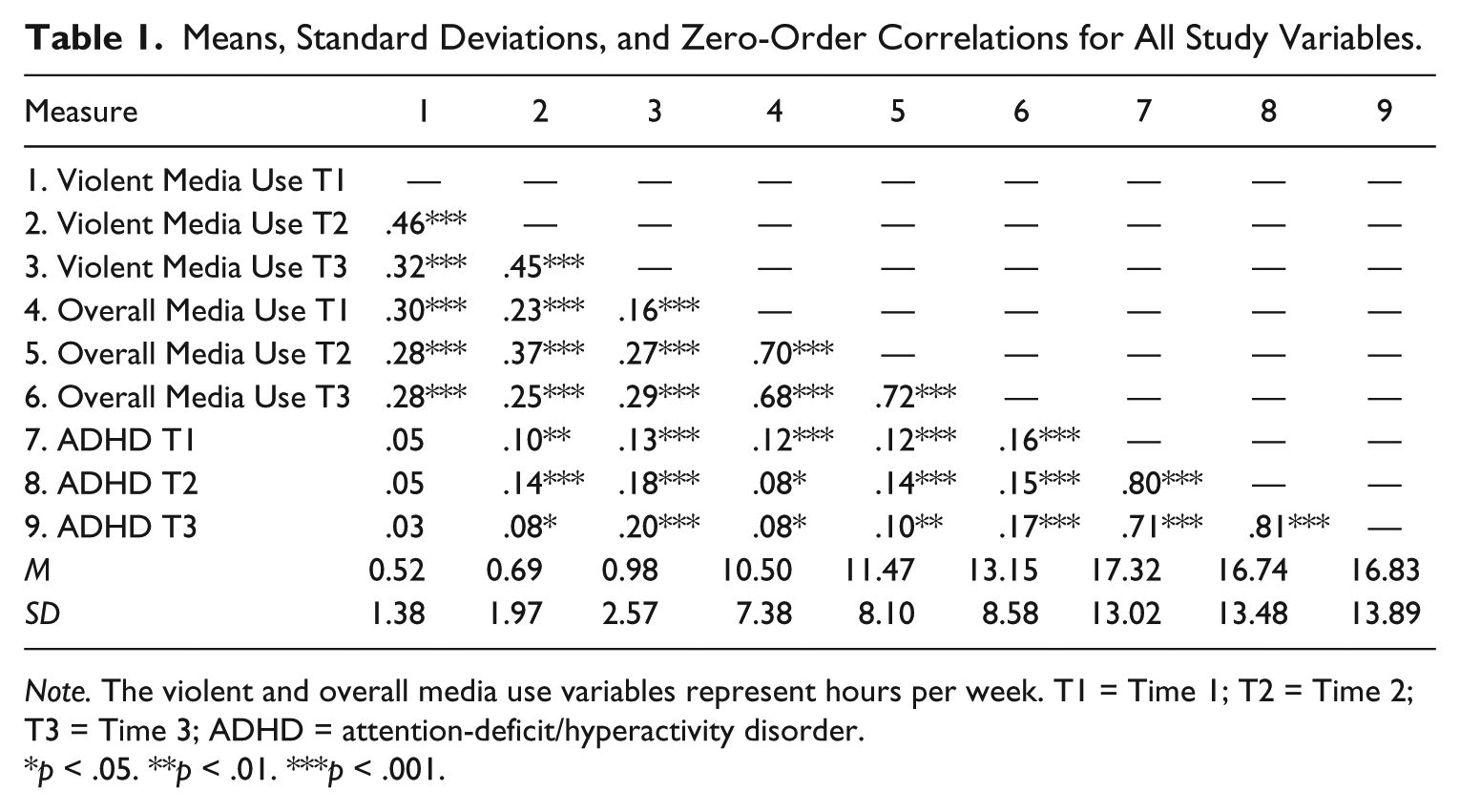
The means, standard deviations, and zero-order correlations for all variables included in the study are presented in Table 1. Children in the sample used little violent media. In fact, 39.9% of all children in the sample never watched any violent television programs or played violent games across the three waves. In addition, an overall positive trend was observed in children’s violent media use showing that at Time 1, they used violent media for 31.2 minutes per week on average (M = 0.52, SD = 1.38), whereas at Time 3 their violent media use had almost doubled (M = 0.98, SD = 2.57). Children’s levels of ADHD-related behaviors (Time 1: M = 17.32, SD = 13.02; Time 2: M = 16.74, SD = 13.48; Time 3: M = 16.83, SD = 13.89) were comparable to those of the general youth population (M = 14.8, SD = 13.1; Scholte & Van der Ploeg, 2010). While, on average, children’s total ADHD scores fell below the clinical cutoff point for DSM-defined ADHD (Scholte & Van der Ploeg, 2010), approximately 6% of the children exhibited subclinical manifestations of ADHD (Time 1: 5.4%; Time 2: 6.3%; Time 3: 6.8%) and approximately 4% exhibited clinical manifestations of ADHD (Time 1: 3.8%; Time 2: 3.8%; Time 3: 4.6%).
Means, Standard Deviations, and Zero-Order Correlations for All Study Variables.
Note. The violent and overall media use variables represent hours per week. T1 = Time 1; T2 = Time 2; T3 = Time 3; ADHD = attention-deficit/hyperactivity disorder.
p < .05. **p < .01. ***p < .001.
Children’s violent media use and ADHD-related behaviors were not significantly correlated at Time 1 (r = .05, p = .11). At Time 2 (r = .14, p < .001) and Time 3 (r = .20, p < .001), children’s violent media use and ADHD-related behaviors were significantly and more strongly related.
Testing the Hypothesized Model
The ICC for violent media use across the three waves was .365, indicating that 36.5% of the variance in the three measures of violent media use was explained by differences between children (i.e., between-person variance) and 63.5% of the variance was explained by fluctuations within a child (i.e., within-person variance). The ICC for ADHD-related behaviors was .780, indicating that a more substantial portion of the variance (78.0%) in the three measures of ADHD-related behaviors was explained by differences between children and a smaller portion (22.0%) of the variance was explained by fluctuations within a child.
The RI-CLPM yielded very good fit (CFI = 1.00; RMSEA = .00, 90% CI = [.00, .05]; SRMR = .01). 1 Hypothesis 1 predicted that an increase in children’s violent media use would result in a subsequent increase in ADHD-related behaviors. The results revealed no significant cross-lagged relationships in which children’s violent media use predicted ADHD-related behaviors (see Figure 1). As such, the media effects hypothesis (H1) was not supported.
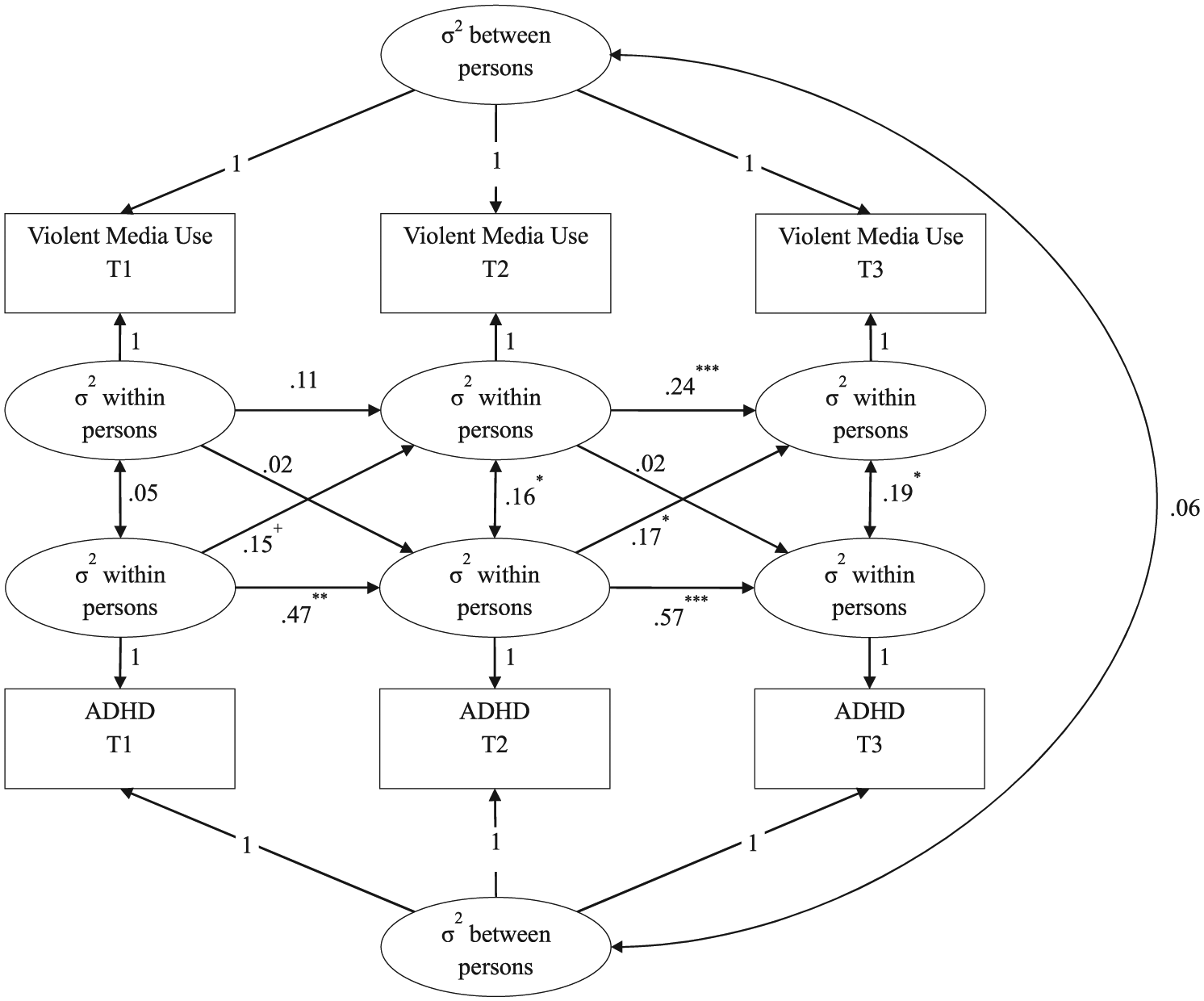
Random intercept cross-lagged panel model linking children’s violent media use (TV and games) with ADHD-related behaviors, differentiating within-person variance and between-person variance (N = 890).
H2 predicted that an increase in children’s ADHD-related behaviors would result in a subsequent increase in violent media use. The results showed that the within-person deviation from the own expected scores in ADHD at Time 2 predicted deviation from one’s own expected scores in violent media use at Time 3 (β = .17, B = 0.46, SE = .20, p = .02), after adjusting for one’s own preceding level of violent media use, one’s own level of overall media use, and potential time-invariant covariates. This means that an increase in a child’s ADHD-related behaviors resulted in an increased use of violent media 1 year later, a finding that supports the media selection hypothesis (H2). In addition, a marginally significant cross-lagged relationship was found between within-person deviation from one’s own expected scores in ADHD at Time 1 and deviation from one’s own expected scores in violent media use at Time 2 (β = .15, B = 0.33, SE = .19, p = .08), which is consistent with the media selection hypothesis (H2). Additional analyses indicated that the results are substantially similar when overall media use is left out of the model.
No significant within-person relationships were found between children’s overall media use and ADHD-related behaviors and between overall media use and violent media use. However, a significant between-person relationship was found between overall media use and ADHD (β = .20, B = 1.35, SE = .52, p = .01), indicating that, on average, children who used more media overall also experienced higher levels of ADHD than children who used less media overall. In addition, a significant between-person relationship was found between violent media use and overall media use (β = .48, B = 3.20, SE = .71, p < .001), such that, on average, children who used more media overall compared to their peers also used more violent media compared to their peers. 2
Discussion
This longitudinal study investigated transactional relationships between violent media use and ADHD-related behaviors among young children. A RI-CLPM using data from 890 children provided evidence for the media selection hypothesis, but not for the media effects hypothesis. Findings provide evidence for a small but significant relationship between ADHD-related behaviors at Time 2 and violent media use at Time 3. In addition, the results showed that the relationship was accounted for by within-child fluctuations over time rather than stable between-child differences. In other words, consistent with expectations, the relationship between ADHD-related behaviors and violent media use reflects effects within a child rather than differences between children, indicating that within-person increases in ADHD-related behaviors predicted within-person increases in violent media use 1 year later.
Importantly, our study is among the first to provide empirical evidence as to the direction of the relationship between young children’s violent media use and ADHD-related behaviors. Although media effects theories, including the DSMM (Valkenburg & Peter, 2013b) and RSM (Slater, 2007), and previous literature on violent media use and ADHD-related behaviors (Gentile et al., 2012; Nikkelen et al., 2014) have pointed to the possibility of an ongoing process of media selection and media effects, the current study did not provide evidence for such transactional relationships. In fact, our findings only provide evidence for a media selection process, supporting the notion that children tend to select media content that is dispositionally congruent (Knobloch-Westerwick, 2014, 2015; Slater, 2007; Valkenburg & Peter, 2013b).
Contrary to expectations, we found no evidence to suggest that young children’s violent media use induces ADHD-related behaviors. Several explanations for this finding are conceivable. First, the two existing meta-analyses have both yielded small correlations between children’s media use and ADHD-related behaviors (Ferguson, 2015: r+ = .10; Nikkelen et al., 2014: r+ = .12). These small effect sizes suggest that, based on probability distributions, at least a proportion of the research that is covered in the meta-analyses likely yielded nonsignificant results. Our study may be one of these studies. Moreover, small or nonsignificant correlations in a general population of children do not necessarily mean that these correlations are small for all children. Indeed, several scholars now argue that overall effect sizes easily overlook subtler individual differences (e.g., Pearce & Field, 2016; Valkenburg, 2015). In fact, it is plausible that for the great majority of young children violent media use is not a predictor of ADHD-related behaviors, but for a small subset, it is a robust one. According to recent studies, this small subset may involve children who experience unresponsive parenting, poor parental well-being, and demographic risks such as low maternal education and single parent status (Ansari & Crosnoe, 2016; Linebarger, 2015). Efforts to investigate individual differences which may elucidate the boundary conditions for potential effects are a crucial next step.
Another explanation for this null finding may be that such effects begin to develop only when children are older. We initially assumed that, based on other research (Christakis, 2009; Swanson et al., 1998), any relationship patterns would emerge early in the developmental life span. And while the media selection process does seem to have its onset in early childhood, a media effects process may have its onset later on. In fact, the zero-order correlations across the three waves support this explanation. As Table 1 shows, the correlation between violent media use and ADHD-related behaviors was nonsignificant at Time 1, but was significant and larger at Time 2 and Time 3. There is a vital need for follow-up research that investigates the media-ADHD relationship with a broader age range of children and/or across a longer period of time.
It is also possible that the duration of effect varies across the selectivity and effects paths. This would imply that the relationship between media use and ADHD-related behaviors reflects a pattern of asymmetric spirals (Slater, 2007). While we found that children’s ADHD-related behaviors have a long-term effect on their violent media use, watching violent media may have a more immediate impact on children’s ADHD-related behaviors. Such differential effects for both cross-lagged paths cannot be captured in a longitudinal study with fixed 1-year measurement intervals. Research has, in fact, shown that media use may have short-term, immediate effects on children’s ADHD-related behaviors (Lillard, Drell, Richey, Boguszewski, & Smith, 2015; Lillard & Peterson, 2011) and thus would support this supposition. Follow-up research which utilizes shorter measurement intervals in order to evaluate both short-term and long-term processes could provide useful insight into this potential asymmetrical spiral process.
Finally, differences in the state-trait nature of violent media use and ADHD may account for the differences in effect sizes between the selectivity and effects paths. Since ADHD is a trait-like variable (Larsson, Anckarsater, Råstam, Chang, & Lichtenstein, 2012), it is a stable construct with high over-time stability coefficients, as evidenced in our model. Due to these high-stability coefficients, ADHD-related behaviors measured at a certain time point are largely explained by prior levels of ADHD-related behaviors (Adachi & Willoughby, 2015). Conversely, violent media use is a state-like variable, with typically lower stability coefficients, as evidenced in our model. As a result, this inevitably leaves more variance left to be explained by other independent variables. This difference in the trait-state nature of concepts in autoregressive cross-lagged models may render it more difficult to find effects from media use to ADHD-like behavior rather than the other way around. To date, the majority of work in this field is correlational—showing that there is a relationship between these constructs but providing no evidence of directionality (Nikkelen et al., 2014). While many scholars and practitioners have opined that the directionality of the causal relationship between media use and ADHD-related behaviors is most likely characterized by an effects paradigm, this may simply be invalid when investigating typically developing children.
Our study focused on violent media use as a cause and consequence of ADHD-related behaviors. This focus of interest was based on the theoretical significance and empirical evidence pointing at the relevance of violent content as a potential cause of ADHD-related behaviors. Nevertheless, it is possible that other types of media use play a role in the media use–ADHD relationship. The two other sets of hypotheses in the literature concern the role of media pacing and overall media use. However, the results on media pacing have been too divergent to act as a basis for a longitudinal study (see Nikkelen et al., 2014). In addition, hypotheses on the effects of general media use are typically indirect, in the sense that they assume that high media exposure leads to a displacement of other activities that are less problematic for the development of ADHD than media use. Our own results indicate that overall media use and ADHD are related, but this relationship is accounted for by stable between-child differences, rather than within-child fluctuations over time All in all, it seems that the exact attributes that may directly or indirectly explain the media use–ADHD relationship are not yet clearly understood. As such, we encourage future researchers to investigate the role of different types and forms of media use to obtain a more refined understanding of the media use–ADHD relationship.
Likewise, we encourage researchers to consider differentiations in the measurement of ADHD. Presently, the ADHD literature, as well as the Diagnostic and Statistical Manual of Mental Disorders (DSM), American Psychiatric Association, 2013 and most contemporary measures of ADHD focus on an ADHD classification that distinguishes three ADHD subtypes: ADHD-Inattentive subtype, ADHD-Hyperactive/Impulsive subtype, and ADHD-Combined subtype (American Psychiatric Association, 2013; Barkley, 1997). Rather than investigating an omnibus composite measure of ADHD, it may be that the linkages between media use and ADHD are particularly robust for one subtype. In fact, recent empirical work suggests that screen media use is related differently to different ADHD subtypes (Linebarger, 2015). As such, theoretical refinement would certainly help highlight the particular pathways that are most relevant for future empirical investigations.
Beyond its theoretical contribution as to the relationship between violent media use and ADHD-related behaviors in early childhood, this study also offers an important methodological contribution. Specifically, it represents one of the first empirical attempts to separate between-subject from within-subject relationships. Previous studies on this topic have relied on between-subject analyses, investigating how average media use across children affects the average level of ADHD-related behaviors across children, and vice versa. However, thanks to recent analytic advances (Hamaker et al., 2015; Keijsers, 2016), our study was able to provide a more refined analysis. Moving forward, we encourage future studies assessing media selection and media effects relationships to employ analytic models which distinguish between-subject and within-subject relationships. Not only will study results be more accurate, but importantly, they will better reflect theoretical expectations.
All told, while our study increased our understanding regarding the direction of the relationship between violent media use and ADHD-related behaviors, it was unable to investigate the processes which underlie this relationship. As such, the field urgently needs empirical efforts which seek to identify why violent media content may be particularly appealing to children when they experience higher levels of ADHD. For example, empirical efforts which test the competing hypotheses (i.e., low baseline arousal hypothesis, family conflict hypothesis) in a longitudinal framework would go a long way toward understanding this relationship. And while theoretically valuable, such findings would offer great practical import as scholars and practitioners reflect on ways to reduce potentially problematic violent media usage among children with ADHD.
Footnotes
Declaration of Conflicting Interests
The authors declared no potential conflicts of interest with respect to the research, authorship, and/or publication of this article.
Funding
The author(s) disclosed receipt of the following financial support for the research, authorship, and/or publication of this article: This article is supported by a grant from the European Research Council under the European Union’s Seventh Framework Programme (FP7/2007-2013)/ERC Grant agreement AdG09 249488-ENTCHILD awarded to P.M.V, and by the Consortium on Individual Development. The Consortium on Individual Development is funded through the Gravitation program of the Dutch Ministry of Education, Culture, and Science and the Netherlands Organization for Scientific Research (NWO Grant 024.001.003).”