




Abstract
This study examined the idea that the rise of broadband Internet has contributed to an aggravation of the divide between those who are politically active and those who are not. It was hypothesized that both access to broadband Internet (as an individual-level characteristic) and broadband penetration (as a country-level characteristic) would strengthen the positive relation between relative preferences for political media content and political participation. Analyses were based on data that were collected in the 2010 wave of the European Social Survey (N = 40,582; 25 countries). Political participation was measured both using a voter turnout variable and using a more general political participation scale. Findings from multilevel analyses provide support to the moderating role of both broadband access and broadband penetration, but only when using the general political participation scale.
Keywords
The rapid penetration of broadband Internet that started from the early 2000s has stimulated public debate and scholarly work on the politically mobilizing capabilities of the Internet (e.g., Boulianne, 2015; Dimitrova, Shehata, Strömbäck, & Nord, 2014; Gil de Zúñiga, Jung, & Valenzuela., 2012; Gil de Zúñiga, Puig-i-Abril, & Rojas, 2009; Graham, Jackson, & Wright, 2015; Groshek, & Al-Rawi, 2015). This work shows that not just the availability of (broadband) Internet is important to stimulate political participation, but rather the way people use the Internet for their political or nonpolitical purposes. Particularly, media preferences for news and political information have been shown to correlate positively with political participation (e.g., Bakker & de Vreese, 2011; Dimitrova et al., 2014; Gil de Zúñiga et al., 2012). These findings suggest that the politically mobilizing potential of the Internet mainly applies for those who are already interested in political content in the first place. As a consequence, concerns may be fueled that the rise of broadband Internet has the effect of reinforcing the so-called “democratic divide” between the politically active and inactive (Min, 2010; Norris, 2001): Access to (at the individual level) as well as the availability of Internet (penetration at the country level) may increase differences in political participation between those who prefer political content versus those who prefer nonpolitical content. This study aims to test whether these concerns are justified. The overarching research question hence is as follows:
Only very few studies addressed this question (though mainly for dial-in Internet) by directly investigating the moderating impact of Internet access on the relation between political media use and political participation; and those that did, showed mixed results. Based on several data sets from the late 1990s and early 2000s, Prior (2005, 2007) observed that preferences for political or nonpolitical media content were more strongly related to political participation when people had access to Internet. However, based on Internet access data from 2002 to 2006, Rittenberg, Tewksbury, and Casey (2012) largely failed to replicate the findings from the Prior studies. The present study contributes to this literature by investigating whether broadband access and broadband penetration moderate the relationship between media preferences and political participation. The study uses data from 25 European countries in 2010. Because these data from different countries show variance on crucial variables, that is, media preferences and political participation, and, moreover, broadband penetration and access, they provide us with the necessary “living laboratory” to test crucial hypotheses.
More specifically, the contribution of the present study is threefold. First, because this study is based on data from 2010, it is the first one to predominantly capture the influence of broadband Internet, 1 whereas earlier studies captured the influence of dial-in Internet (Prior, 2005) or a mixture of dial-in Internet and emerging broadband Internet (Rittenberg et al., 2012). Second, this study investigates not only the moderating role of individual-level Internet access (similar to the earlier studies) but also the moderating role of broadband penetration. Even more so than individual-level Internet access, the contextual level of broadband penetration reflects the idea of a changing media environment that particularly stimulated Prior’s studies (cf. Prior, 2007). Third, the study does not only include voting as a measure of political participation (similar to the earlier studies) but also includes a more general measure of political participation. This measure consists of a number of political acts that can be performed on a more regular basis than the incidental act of voting (cf. Dimitrova et al., 2014; Gil de Zúñiga et al., 2012; Kenski & Stroud, 2006). The presence of this second measure enables us to more fully grasp a wider concept of political participation.
Broadband Access and the Democratic Divide
A number of theories about consequences of the Internet emphasize that gaining access to the Internet should not be considered a transition from “no access” to “access”; rather, it should be considered a process that involves different stages of access (Newhagen & Bucy, 2004; Van Dijk, 2006). Van Dijk (2006) distinguishes between four successive stages in the acquisition of a digital technology: motivational access, material access, skills access, and usage access. Motivational access concerns the wish to obtain material access to the technology, material access concerns physical access to the technology, skills access concerns the ability to use the technology properly, and usage access concerns the various ways in which the technology can be used. At each level, inequalities between categories of the population can emerge, the so-called “digital divides,” referring to differential acquisition of digital technology between different population categories.
The idea of an increased democratic divide, driven by broadband Internet, especially concerns digital divides at the level of usage, and in this study, even more specifically, digital divides at the level of preferences for political versus nonpolitical content. It can be expressed by modeling broadband access as a moderator of the relation between political media preferences and political participation. First, assuming that political media preferences stimulate political participation and vice versa (cf. Norris, 2001, who speaks of a “virtuous circle,” p. 230), the relation between political media preferences and political participation should be generally positive. The more positive the relation, the bigger the extent of the “democratic divide” is. Second, if broadband access reinforces this process, then the relation between political media preferences and political participation should be stronger for those who have access to broadband Internet than for those who do not have access to broadband Internet, and it should become stronger as countries show higher levels of broadband penetration. Below, we summarize theoretical arguments and empirical findings concerning these propositions.
Political Media Preferences and Political Participation
A large body of literature shows that political media preferences positively relate with political participation (e.g., Bakker & de Vreese, 2011; Gil de Zúñiga et al., 2012; Kenski & Stroud, 2006; Prior, 2005, 2007; Rittenberg et al., 2012; Scheufele & Nisbet, 2002; Xenos & Moy, 2007). Some studies have shown that political media preferences have an effect on political participation (e.g., Dimitrova et al., 2014; D. V. Shah, Cho, Eveland, & Kwak, 2005). However, the reversed effect of political participation on political media preferences has not been established using a direct measure of political participation. 2 In all, the literature shows that the relation between political media preferences and political participation is generally positive, and hence, that a democratic divide related to differential media preferences exists.
Access to Broadband Internet as a Moderator
Does access to broadband Internet moderate the relation between political media preferences and political participation? The answer to this question is more difficult. As described earlier in this article, the studies that came closest to answering this question predominantly concerned dial-in Internet, and moreover, provided mixed results (Prior, 2005, 2007; Rittenberg et al., 2012). Still, there are theoretical arguments and some empirical indications for the proposition that access to broadband Internet moderates the relation between political media preferences and political participation. One argument is that particularly in the broadband age, Internet provides far more opportunities for selective media use than traditional media. Even before the broadband age, a number of authors argued that the vast amount of different content, available on the Internet, offered opportunities for people to pursue their preferences for political or nonpolitical media content (e.g., Norris, 2001; Prior, 2005, 2007). When broadband penetration rates grew, the sheer amount of content available to people increased even more dramatically, ranging from highly informative news outlets and political platforms to purely relaxing entertainment outlets. In addition, broadband technology has enabled the rise of personalization technology, recommendation systems, and content recommending and sharing within social networks of (often like-minded) people (Hermida, Fletcher, Korell, & Logan, 2012; Webster, 2010). Each of these developments has made it easier for people to gain access to the content that matches their personal preferences (e.g., Sunstein, 2002). In accordance with this idea, two studies based on survey data from different European countries showed an increasing divide between news seekers versus news avoiders in the period 2002 to 2010 (Elvestad, Blekesaune, & Aalberg, 2014) and a stronger selectivity regarding news consumption in societies where (relatively high-choice) television viewing gained dominance over (low-choice) newspaper reading (Shehata & Strömbäck, 2011).
Another argument for expecting a stronger relation between political media preferences and political participation for those who have access to (broadband) Internet is that the Internet can be used as a means of political participation. Especially, broadband technology enabled the development of new applications that, in many ways, promoted political participation. Nowadays, several acts of political participation can even be performed online, for instance, contacting a political organization, participating in an action group, or signing a petition (e.g., Bakker & de Vreese, 2011; Bennett, 2012; Gil de Zúñiga et al., 2012; Gil de Zúñiga et al., 2009). In addition, as already mentioned earlier, the rise of social media has provided additional opportunities to find or exchange political information through social networks and to mobilize or be mobilized through social networks (e.g., Dimitrova et al., 2014; Gil de Zúñiga et al., 2012; Groshek, & Al-Rawi, 2015). In all, the first hypothesis states the following:
Broadband Internet Penetration as a Moderator
Broadband penetration may be considered indicative of the degree to which a society is saturated with high-speed Internet. In particular, a high degree of broadband Internet penetration in a society provides many opportunities for broadband Internet access inside and outside people’s homes—also for those who themselves do not have broadband connections at their homes. People may access broadband Internet at schools or at work, in train stations, and in restaurants, or simply by using their neighbor’s wireless network. Consequently, the arguments for expecting a moderating impact of Internet access on the individual level also apply to broadband penetration on the contextual level. The second hypothesis states the following:
Method
Data
This study is based on a combination of individual- and country-level data of 25 European countries that were derived from different sources. The individual data were derived from the 2010 round of the European Social Survey (ESS). All country samples were taken by strict random probability sampling methods to achieve maximum representativeness of the samples for persons aged 15 and over. Countries’ response rates ranged from 30.5% in Germany to 81.4% in Bulgaria (ESS, 2014).
Contextual-level data about media broadband penetration rates were derived from the European Audiovisual Observatory (EAO; 2010). The EAO is a special agency set up by the Council of Europe to provide statistical and analytical information on the audiovisual sector in the European Union’s member states. The country-level control variable GDP was derived from the World Bank (2010) database. A single data set was constructed by combining the EAO, World Bank, and ESS data. Respondents who were not eligible to vote or with no media exposure whatsoever were considered out of population. As a result, the total number of respondents in the population was 44,460. Subsequently, listwise deletion was applied, removing all respondents from the analysis with missing values on one or more of the variables included in the models. 3 The final data set comprised 40,582 respondents divided over 25 countries. For the relevant N per country, see Appendix A.
Measures
Dependent variables
Similar to the Prior (2005, 2007) and Rittenberg et al. (2012) studies, voting was included as a measure of political participation. Voting was captured by asking respondents whether or not they voted in the last national election (“yes” or “no”). Those who answered “don’t know” were considered missing values.
As a more general measure of political participation, five items were included that were largely similar to items in past studies (e.g., Dimitrova et al., 2014; Gil de Zúñiga, 2012; Kenski & Stroud, 2006). Respondents were asked whether, during the last 12 months, they engaged in one of the following activities: “worked in a political party or action group,” “worn or displayed a campaign badge/sticker,” “signed a petition,” “taken part in a lawful public demonstration,” and “boycotted certain products.” A Mokken scale was created for these five variables (Mokken, 1971). The scalability of the items was satisfactory (H = .366). Item-specific difficulties and scalability coefficients can be found in Appendix B. Because few respondents engaged in three or more political activities, these categories were merged into one category. The final quasi-metric variable consisted of four categories, whereby 0 represented having engaged in “none of the activities,” 1 in “one of the activities,” 2 in “two of the activities,” and 3 in “more than two of the activities.”
Individual-level predictors
Apart from questions about overall exposure to various media types (newspaper, radio, television, and the Internet), the ESS 2010 questionnaire contained questions on exposure to a specific type of media content: news, politics, and current affairs. Following Prior (2005, 2007) and Rittenberg et al. (2012), the focus was on the relative preference for news versus other (more entertaining) media content. Based on these questions, a measure of Relative Political Preference (RPP) was constructed to indicate individuals’ relative preference for political content as part of their total media diet. Respondents were asked how much time they spend watching news or programs about politics and current affairs on an average weekday on television. The answering categories ranged from 0 = no time at all to 7 = more than 3 hours, resulting in a score from 0 to 7 for each respondent. This question was repeated for radio and for newspapers. Respondents were also asked how much time they spend in total on the three media outlets separately, 4 again answering on a scale from 0 to 7. We created our RPP variable by summing up a person’s total exposure to news, politics, and current affairs in the different media outlets, and dividing this by the total time spent on media. It should be noted that the ESS only offers data on exposure to TV, radio, and newspapers; however, data on exposure time to the Internet are not included. Therefore, the RPP measure was based on exposure time to traditional media only, which is a somewhat limited measurement. However, a number of studies indicate that offline and online news consumption are highly complementary (although particularly among the youngest generation tendencies toward substitution have been observed; for an overview, cf. Mitchelstein & Boczkowski, 2010). Thus, although a measure based on exposure to both traditional and new media would be preferable, the RPP measure can be considered useful to indicate general content preferences.
To indicate individual-level broadband Internet access, we used an item in which respondents were asked how often they use the Internet, the World Wide Web, or email—whether at home or at work—for personal use. They could answer on a seven-point scale ranging from never use to every day, or indicate that they did not have Internet access. Of these categories, only the last one was relevant to our study because conceptually our focus is merely on access to Internet, not on the degree to which the Internet is used. Consequently, this item was recoded into a dichotomous variable marking whether or not respondents had broadband Internet access. 5
Individual-level control variables
A number of control variables were included, particularly education (Curran, Iyengar, Lund, & Salovaara-Moring, 2009; Kam & Palmer, 2008), age 6 (Rubenson, Blais, Fournier, Gidengil, & Nevitte, 2004), and gender (Atkeson & Rapoport, 2003). Respondents also declared whether or not they have a job, belong to a particular religion, have the status of minority in their country, and live together with a partner. They further articulated the type of their living area. Socioeconomic status was taken into account with household income.
Next, the data set contained two items signifying a person’s affinity with politics, which had also been included as controls in the Prior (2005, 2007) studies. For the first item “party ID,” respondents declared whether they feel closer to a particular party than all other parties. For the second item “party closeness,” people answered the question how close they feel to a particular party within the following categories: 1 = not at all close, 2 = not close, 3 = quite close, and 4 = very close. These control variables are largely similar to the control variables included by Prior (2005, 2007) and Rittenberg et al. (2012). A descriptive overview of all individual-level variables is presented in Table 1.
Descriptive Statistics of Individual-Level Variables.
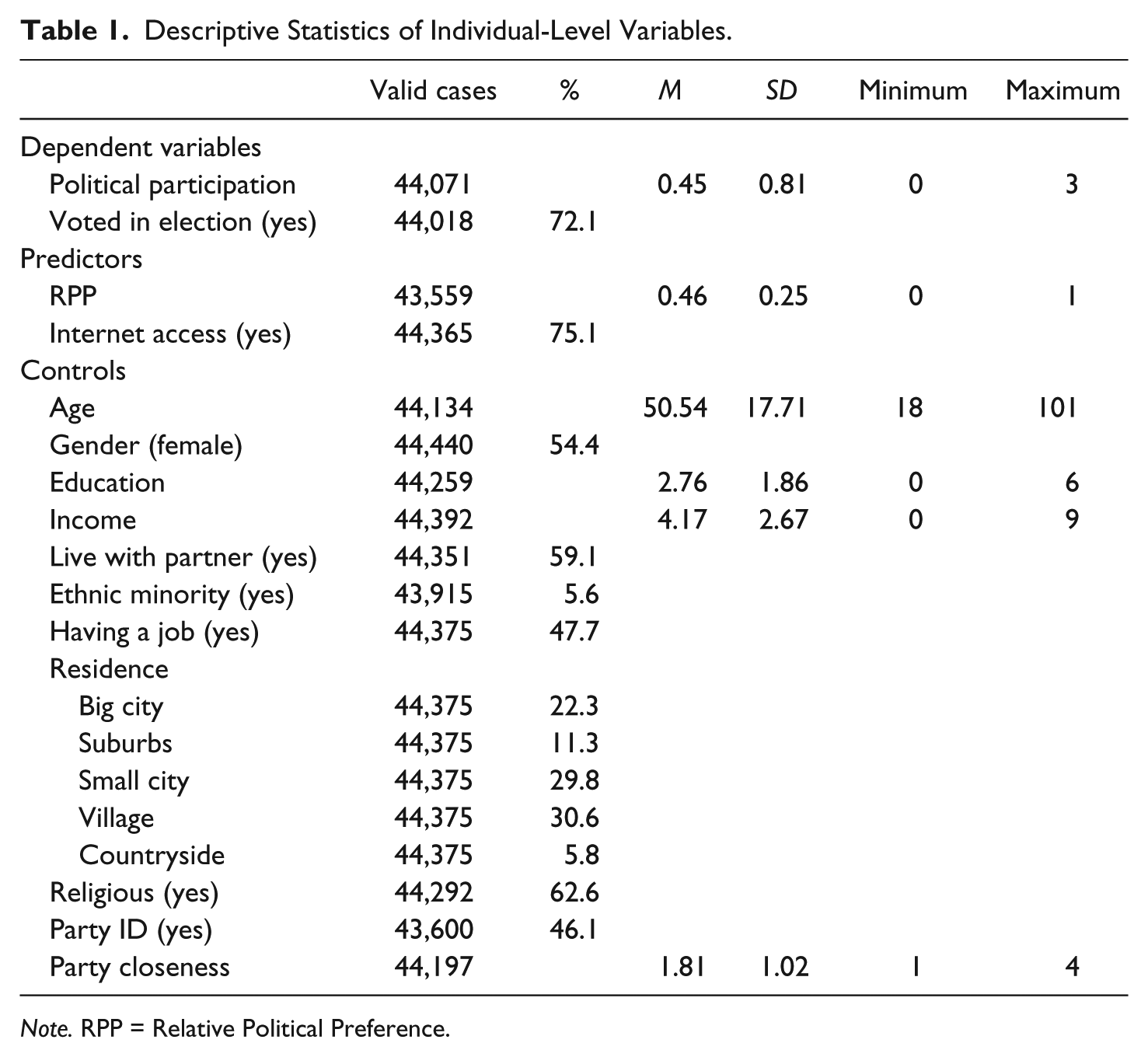
Note. RPP = Relative Political Preference.
Country-level variables
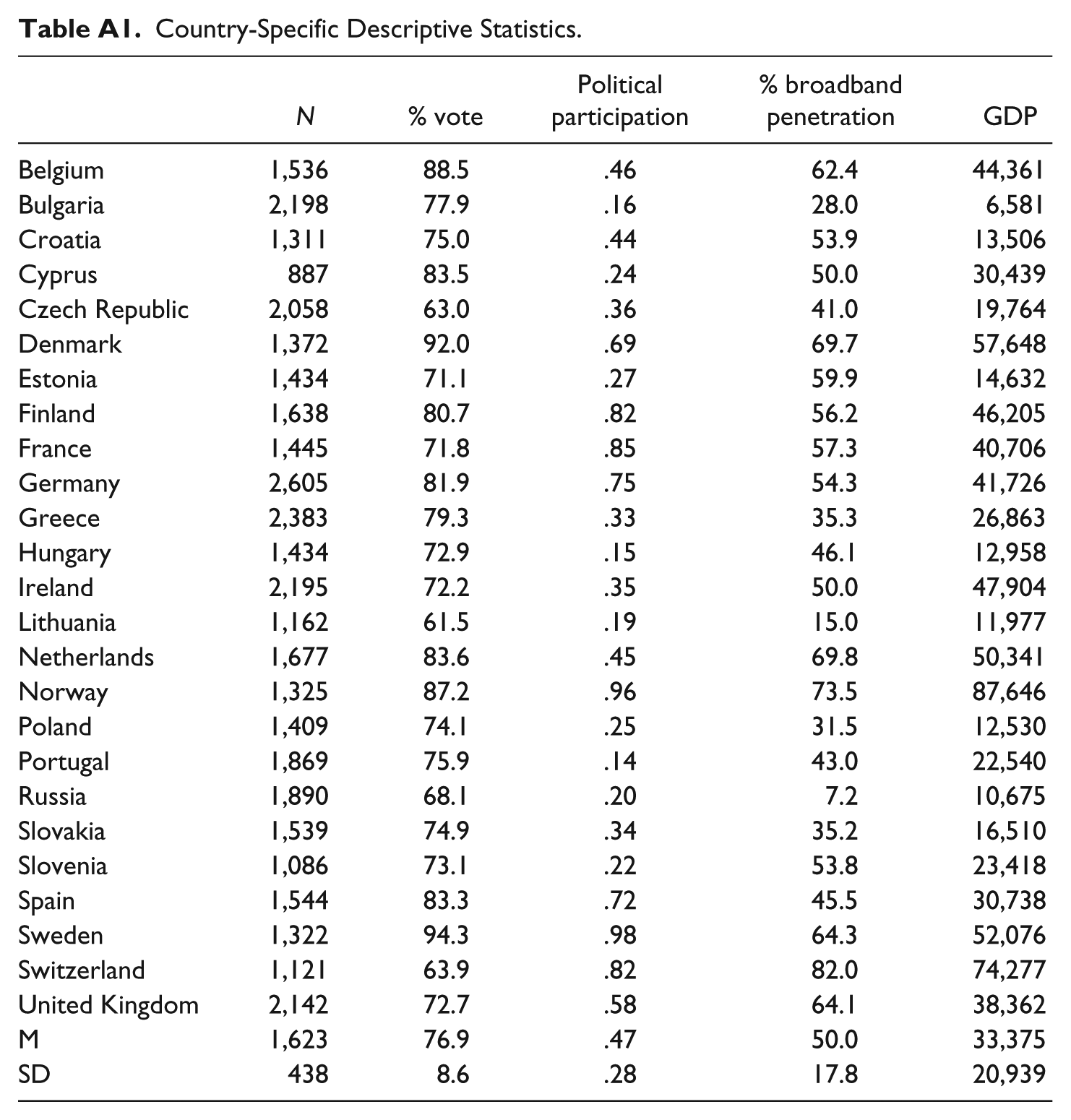
The predictor variable “broadband penetration” was defined as the percentage of households with a broadband connection for each of the 25 countries. This variable shows a considerable variance in broadband Internet penetration (M = 50.0, SD = 17.8, min = 17.2, max = 82.0), all included in Appendix A. The small number of countries severely limited the number of additional variables to be included as controls at the contextual level. However, the control variable “GDP” (M = 33,375; SD = 20,939; min = 6,581; max = 87,646) was included in the analysis. This variable was important because GDP was expected to correlate with both broadband penetration rates (Kiiski & Pohjola, 2002) and with political participation (Inglehart, 1997). All relevant country-level statistics plus the country means of the dependent variables can be found in Appendix A.
Results
Media Access, RPP, and Voting
Given that voting is binomial and given that respondents are nested in countries, multilevel logistic regression was applied for our first analysis. 7 First, a baseline model (Model 1) was estimated that included simultaneously the main effects of all individual-level and country-level variables (Table 2). Looking at the fixed effect of RPP in Model 1, a highly significant effect on voting shows up (B = .561, t = 6.561, p < .001), indicating the positive relationship between political preference and voting. To get a more expressive view of the RPP effect, it is worthwhile to consider the odds ratio (not presented in the table). The odds ratio of RPP equals 1.752, which signifies that—in a country with a mean intercept and a mean average RPP effect—the odds to vote versus the odds not to vote are 1.752 times higher for a person with the maximum score on RPP than for a person with the minimum score on RPP (when all other predictors are kept constant). The random slope of RPP is .098, indicating that the effect of RPP deviates across countries: The standard deviation of the log odd of RPP on the country level amounts to .312 (√.098). Furthermore, the effect of individual-level broadband Internet access on voting is positive and significant (B = .157, t = 4.336, p < .001), indicating a direct, positive effect of this variable on the likelihood of voting. Country-level broadband penetration, however, has no significant effect on voting (B = .002, t = 0.205, p > .05).
Logistic Multilevel Regression on Voting (N = 40,582).
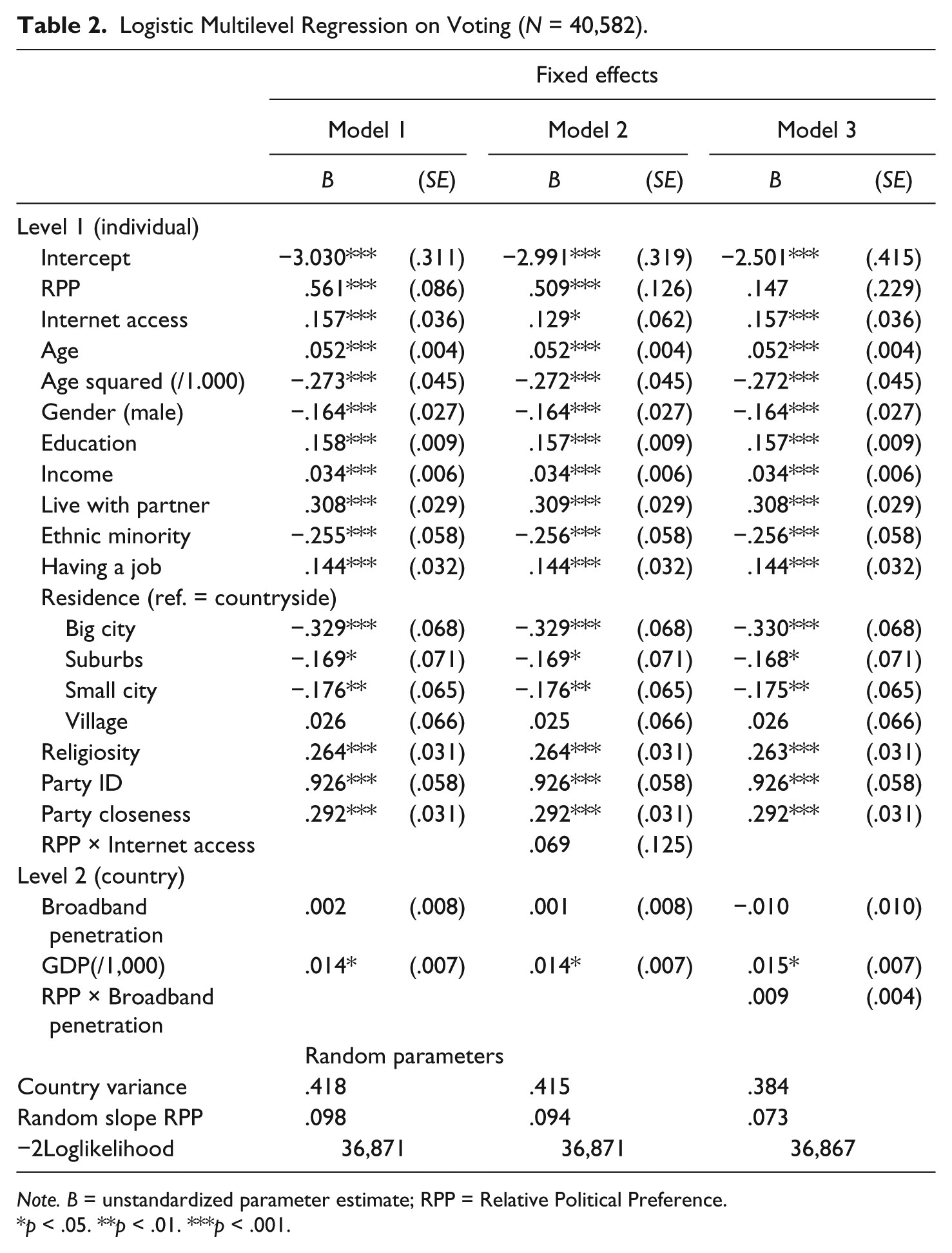
Note. B = unstandardized parameter estimate; RPP = Relative Political Preference.
p < .05. **p < .01. ***p < .001.
The interaction term between RPP and individual-level broadband Internet access was included in Model 2 (Table 2). However, the interaction effect itself is not significant (B = .069, t = 0.553, p > .05), meaning that the effect of RPP on the likelihood of voting is similar for persons with or without broadband Internet access. This finding does not support H1: RPP is not a stronger predictor of voting for people having access to broadband Internet.
The interaction between RPP and broadband penetration was included in Model 3 (Table 3). As can be observed, Model 3 causes a decrease in both the country variance (from .418 to .384; –8%) and the random slope of RPP (from .098 to .073; –26%) compared with Model 1. However, the cross-level interaction effect of RPP with broadband penetration is not significant (B = .009, t = 1.930, p > .05). Therefore, we also do not find support for H2: The degree of broadband penetration in a country does not moderate the relation between RPP and voting.
Ordinary Least Squares Multilevel Regression on Political Participation (N = 40,582).
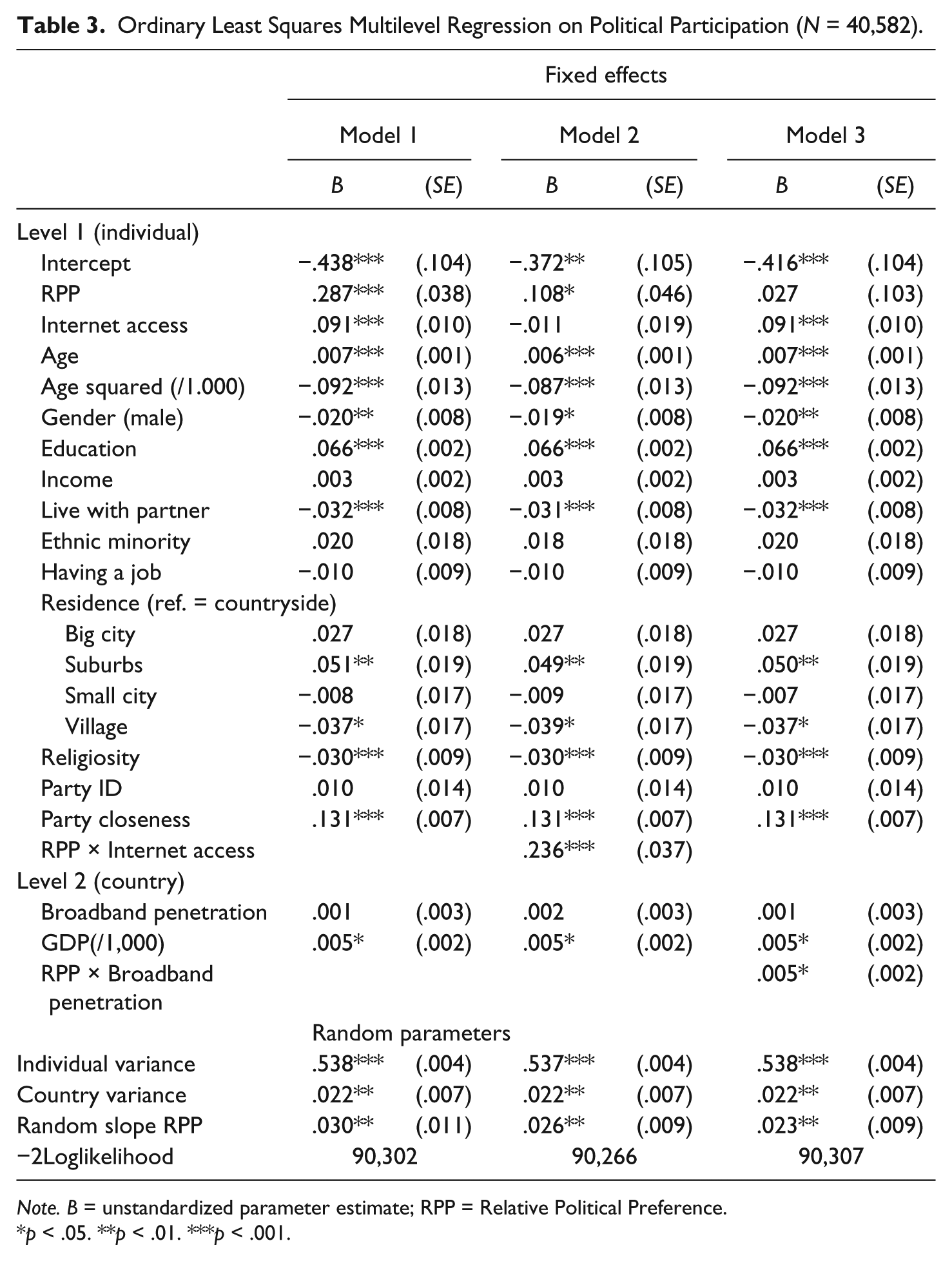
Note. B = unstandardized parameter estimate; RPP = Relative Political Preference.
p < .05. **p < .01. ***p < .001.
Media Access, RPP, and Political Participation
For our second analysis, ordinary least squares (OLS) multilevel regression was applied on the political participation scale, 8 in spite of the fact that this variable is rather skewed, because this type of analysis has been proven to be robust against deviations from normality (Lumley, Diehr, Emerson, & Chen, 2002). Similar to the first analysis, Model 1 encompassed all main effects of all individual-level and country-level variables (Table 3). Again, the main effect for RPP appears highly significant (B = .287, t = 7.485, p < .001). This means that persons who have a maximum preference for politics (RPP = 1) have a score on the political participation scale that is .287 higher than the score of persons who have a minimal preference for political content (RPP = 0). Also similar to the analysis on voting, the direct effect of individual-level broadband Internet access on political participation is significant (B = .091, t = 8.755, p < .001), whereas the effect of country-level broadband penetration is not (B = .001, t = .477, p > .05).
The interaction term between RPP and individual-level broadband Internet access was included in Model 2 (Table 3). This affects the random slope of RPP: It decreases with 13% to .026 (Wald Z = 2.742, p < .01), where it was .030 in Model 1 with only the main effects. Looking at the fixed effects, the interaction term equals .236 (t = 6.450, p < .001). This means that the relation between RPP and political participation is stronger for people with Internet access (.108 + .236 = .344) than for people without Internet access (.108 + .000 = .108). As a result, among persons with a maximum preference for political media content (RPP = 1), those with Internet access participated more politically than those without Internet access (.344 – .108 = .236, on a 0-3 scale), whereas among persons with a minimum preference for political media content (RPP = 0), no such differences in political participation exist. We consider this effect small yet substantial. In all, H1 is supported.
The interaction of RPP with broadband penetration on the country level is included in Model 3 (Table 3). The random slope of RPP drops to .023 (Wald Z = 2.650, p < .01) as opposed to the full model without interaction terms in Model 1. Looking at the fixed effects, the RPP estimate combined with the interaction estimate shows that the RPP effect is .027 if a country’s broadband penetration would be 0%, to increase .005 with each additional percentage point of a country’s broadband penetration (t = 2.690, p < .05). This means that theoretically, the relation between RPP and political participation is .5 stronger in countries that would have a broadband penetration of 100% (.027 + .500 = .527) than in countries that would have a broadband penetration of 0% (.027 + .000 = .027). As a result, persons with a maximum preference for political media content (RPP = 1) in countries with no broadband penetration versus maximum broadband penetration would differ .5 in political participation (on a 0-3 scale), whereas among persons with a minimum preference for political media content (RPP = 0), no such difference would exist. Given the observation that all European countries are currently in the process of growing from 0% broadband penetration at the beginning of the century to very high levels in the near future (albeit in a different stage or at a different pace), we consider this interaction effect small or even moderate. In all, H2 is supported.
Another way to look at the interaction effects in Models 2 and 3 is that the effect of broadband Internet access is moderated by RPP. In Model 2, the interaction term between RPP and individual-level broadband Internet access could be interpreted as a rise of .236 in the effect of broadband Internet access on political participation. Thus, for those with no political preference at all (i.e., RPP = 0), the effect of broadband Internet access is –.011. However, when one consumes only political content (RPP = 1), the effect of broadband Internet access on political participation rises to .225 (–.011 + .236). The same logic could be applied to the cross-level interaction effect of broadband penetration and RPP in Model 3. For those with RPP = 0, the effect of broadband penetration on political participation is a mere .001, while for respondents with RPP = 1, this rises to .006 (.001 + .005). This alternative interpretation of the interaction is in accordance with the core idea of an increased democratic divide resulting from broadband access: It illustrates how only those who already have a preference for political content take advantage of broadband access to further increase their political participation.
Robustness Checks
A number of robustness checks were performed. First, all models were estimated while omitting the three outliers on the variable “broadband penetration” one by one (Bulgaria, Lithuania, and Russia). Second, all models were estimated while omitting the (sole) outlier on the control variable “GDP” (Norway). Third, we omitted Belgium and Cyprus one by one, because in these countries, voting is compulsory and punishment is enforced on those who refrain from voting (International Institute for Democracy and Electoral Assistance [IDEA], 2016). Compulsory voting laws could be expected to affect voting turnout (e.g., Fowler, 2013; Jackman, 2001). All three analyses provided substantially similar results on the five relevant factors in our analyses (RPP, individual-level broadband Internet access, country-level broadband penetration, and the two interaction variables). Only the interaction effect of country-level broadband penetration and RPP on (binomial) voting turned significant when omitting Lithuania (B = .011, p < .05).
As a final robustness check, we reran the analyses while using statistics on broadband penetration derived from the World Bank (2010) database. World Bank statistics indicate the percentage of inhabitants (rather than households, as in the EAO statistics) having subscribed to broadband Internet. Both measures appeared to correlate highly (r = .86, p < .001), and again, all analyses provided substantially similar results. Overall, these outcomes suggest that the results are substantially robust.
Discussion
In this research, we elaborated upon the idea that the rise of high-speed Internet has contributed to deepening the divide between those who are politically involved versus those who are not. More specifically, we tested the idea that individual-level broadband Internet access and contextual-level broadband Internet penetration both would strengthen the positive relation between relative preferences for political media content on the one hand and voting or more general political participation on the other hand. We found support for this idea, but only for general political participation, not for voting. Specifically, we found that those Europeans with preferences for political content show higher levels of political participation. This relation is even stronger when they have Internet access in their homes, and it is also stronger when broadband penetration in their country is more widespread.
The findings on political participation are important because they underline concerns of many scholars that Internet has the effect of deepening the democratic divide (e.g., Min, 2010; Norris, 2001; Prior, 2005, 2007; Xenos & Moy, 2007). If the idea is true that particularly those who are already involved in politics, actually use the opportunities provided by the Internet in a way that stimulates further participation in politics (i.e., the “virtuous circle”—which this study could not test), then the findings suggest that since the broadband age, access to Internet may accelerate this process. However, even apart from methodological limitations (to be discussed below), other findings provide reasons to qualify this conclusion.
First, the support for the “deepening democratic divide” hypothesis is only partial, as the nonsignificance of the interactions on voting implies. The positive main effect of individual-level broadband Internet access on voting even suggests that Internet simply has a positive effect on voting, independent from media content preferences.
Second, it should be noted that, although broadband access increases political participation more when people show more preferences for political content, it does not or hardly decrease political participation, even for those who show the least preference for political content. So, although broadband may increase the political participation gaps, in absolute terms, it has no negative effect on those with little preference for political contents.
A question that arises from our results is why Internet access does not widen the gap in voter turnout between those with low and high preference for political content, while it does widen the gap on the political participation measure. Two methodological explanations may account for this divergence in findings.
First, characteristics of a particular election can heavily influence voter turnout, and indirectly even findings of studies regarding that election (cf. Rittenberg et al., 2012). This general rule applies more to this study that is based on 25 European countries than it applies to the Prior (2005, 2007) and Rittenberg et al. (2012) studies that were based on U.S. data. In contrast to the U.S. studies, this cross-national study includes 25 different elections in different countries with different candidates. Moreover, the countries differ on a number of regulations concerning voting procedures. For instance, in some European countries, casting a vote at general elections has been compulsory for many years, and in others it still was compulsory in 2010. Sanctions for not voting also differed between countries (IDEA, 2016). A final difference between the countries is that in a considerable number of countries, voting takes place on a Sunday, while this is not the case for others. The large number of differences between countries is likely to have introduced a considerable amount of variance in the dependent variable, that is, voting, which makes it more difficult to detect the subtle effects that are represented by the interaction terms in the equations.
A second methodological explanation of the lack of support for the hypotheses on voting is that it is based on a single and rather crude (binary) measure. In contrast, the measurement of political participation is based on five measurements that together constitute a valid and reliable scale. Accordingly, the relative large amount of random variance in voting is likely to have made it more difficult to detect the subtle interaction effects.
A more theoretical explanation of the relative lack of findings on the voting variable concerns the difference between voting and the forms of political participation that were included in the participation scale. As the grand average on the voting variable indicates (72.1%), voting at elections is still quite common. One might ask whether voting is more an expression of ritual or dutiful behavior rather than an expression of active political participation (cf. Green & Shachar, 2000). In contrast, political participation as proposed in this study might tell us a lot more about Europeans’ active involvement in the political process. As already described in the introduction section, broadband technology enabled the development of new applications to enhance political participation. A number of these applications especially concern political participation beyond voting turnout, in particular social networks that mobilize social protest (e.g., Groshek, & Al-Rawi, 2015) and applications that technically facilitate performing certain political acts such as signing a petition on the Internet or being involved in a political party or action group—right from a computer seat (e.g., Bennett, 2012; Gil de Zúñiga et al., 2012; Gil de Zúñiga et al., 2009). For this reason, systematic differences in general political participation are more likely to be empirically related to Internet access than differences in voting are.
In all, for both methodological and theoretical reasons, we consider the support for the hypotheses on political participation more telling than the lack of support on voting. The fact that support for the hypotheses was found not only using the individual-level Internet access measure but also using the contextual-level measure of Internet penetration renders this support even more convincing.
The findings on political participation are in accordance with the idea that the rise of broadband still has aggravated participation gaps. However, one might have speculated that some kind of ceiling effect would be at hand: Because nearly everybody would have at least a certain amount of “basic” access to various media outlets nowadays—and, therefore, enough accessible information to choose the content of one’s own preference for political or nonpolitical content—access to broadband would not have any further impact on participation gaps. A recent longitudinal study by Kim and Webster (2012) provided support for this idea. However, similar to another recent longitudinal study on the relation between political interest and news consumption (Strömbäck, Djerf-Pierre, & Shehata, 2013), our findings show no sign of such a ceiling effect.
Some theoretical and methodological issues have to be kept in mind. First, although political preferences are undoubtedly an important predictor of political participation, other forms of political media use and even some forms of nonpolitical media use may also promote political participation. Examples range from the use of websites that provide a variety of services to participation in a nonpolitical forum (Bakker & de Vreese, 2011; Graham et al., 2015). Thus, general statements about the impact of media use on political participation that are solely based on the role of political content preferences are likely to be somewhat overstated (cf. Shah, Rojas, & Cho, 2009).
Second, one could criticize our analyses on the basis of the small numbers of countries as well as the high numbers of respondents included. The rather small number of countries does somewhat impair our results, which have to be interpreted with care (cf. Hox, 2010). However, to the best of our knowledge, there are no databases containing such relevant valid measurements in more countries than the ESS. The high number of respondents has the effect of providing statistical significance even for effect sizes that are so tiny that they hardly matter in a practical sense. However, as explained in the “Results” section, the main findings of this study (particularly the interactions) are not only significant but also substantial.
Third, although the theoretical model on which this study was based (the increasing democratic divide) proposes a number of causal mechanisms, the cross-sectional data “only” permit the testing of relations (cf. Dimitrova et al., 2014; Shehata & Strömbäck, 2011). Particularly, regarding the role of Internet access, which is of key importance to this study, one should be cautious to take the interaction between (individual-level or contextual-level) broadband access, RPP, and political participation as a final proof of the causal sequence suggested by the theoretical model.
The limitation regarding causality is more than an obligatory remark. Holbert, Garrett, and Gleason (2010) raised the issue to a more general level by warning against technological determinism when discussing the complex relationships between the development of media technologies, adoption of these technologies, and sociopolitical developments. We started this study by referring to concerns that the rise of the Internet, and particularly high-speed Internet, might aggravate the democratic divide. The patterns that were observed in the data do not provide evidence to reject these concerns. However, to get a more detailed insight into the causal relationships between the variables involved in this study, panel studies would be needed, which are, to the best of our knowledge, not available for so many countries simultaneously. Acknowledging the cautionary remarks made by Holbert et al. (2010), we consider these findings to be pieces in a larger puzzle that may ultimately provide a better understanding of the role of media technologies in the democratic process.
Footnotes
Appendix A
Country-Specific Descriptive Statistics.
| N | % vote | Political participation | % broadband penetration | GDP | |
|---|---|---|---|---|---|
| Belgium | 1,536 | 88.5 | .46 | 62.4 | 44,361 |
| Bulgaria | 2,198 | 77.9 | .16 | 28.0 | 6,581 |
| Croatia | 1,311 | 75.0 | .44 | 53.9 | 13,506 |
| Cyprus | 887 | 83.5 | .24 | 50.0 | 30,439 |
| Czech Republic | 2,058 | 63.0 | .36 | 41.0 | 19,764 |
| Denmark | 1,372 | 92.0 | .69 | 69.7 | 57,648 |
| Estonia | 1,434 | 71.1 | .27 | 59.9 | 14,632 |
| Finland | 1,638 | 80.7 | .82 | 56.2 | 46,205 |
| France | 1,445 | 71.8 | .85 | 57.3 | 40,706 |
| Germany | 2,605 | 81.9 | .75 | 54.3 | 41,726 |
| Greece | 2,383 | 79.3 | .33 | 35.3 | 26,863 |
| Hungary | 1,434 | 72.9 | .15 | 46.1 | 12,958 |
| Ireland | 2,195 | 72.2 | .35 | 50.0 | 47,904 |
| Lithuania | 1,162 | 61.5 | .19 | 15.0 | 11,977 |
| Netherlands | 1,677 | 83.6 | .45 | 69.8 | 50,341 |
| Norway | 1,325 | 87.2 | .96 | 73.5 | 87,646 |
| Poland | 1,409 | 74.1 | .25 | 31.5 | 12,530 |
| Portugal | 1,869 | 75.9 | .14 | 43.0 | 22,540 |
| Russia | 1,890 | 68.1 | .20 | 7.2 | 10,675 |
| Slovakia | 1,539 | 74.9 | .34 | 35.2 | 16,510 |
| Slovenia | 1,086 | 73.1 | .22 | 53.8 | 23,418 |
| Spain | 1,544 | 83.3 | .72 | 45.5 | 30,738 |
| Sweden | 1,322 | 94.3 | .98 | 64.3 | 52,076 |
| Switzerland | 1,121 | 63.9 | .82 | 82.0 | 74,277 |
| United Kingdom | 2,142 | 72.7 | .58 | 64.1 | 38,362 |
| M | 1,623 | 76.9 | .47 | 50.0 | 33,375 |
| SD | 438 | 8.6 | .28 | 17.8 | 20,939 |
Appendix B
Mokken Scaling on Political Participation (N = 40,582).
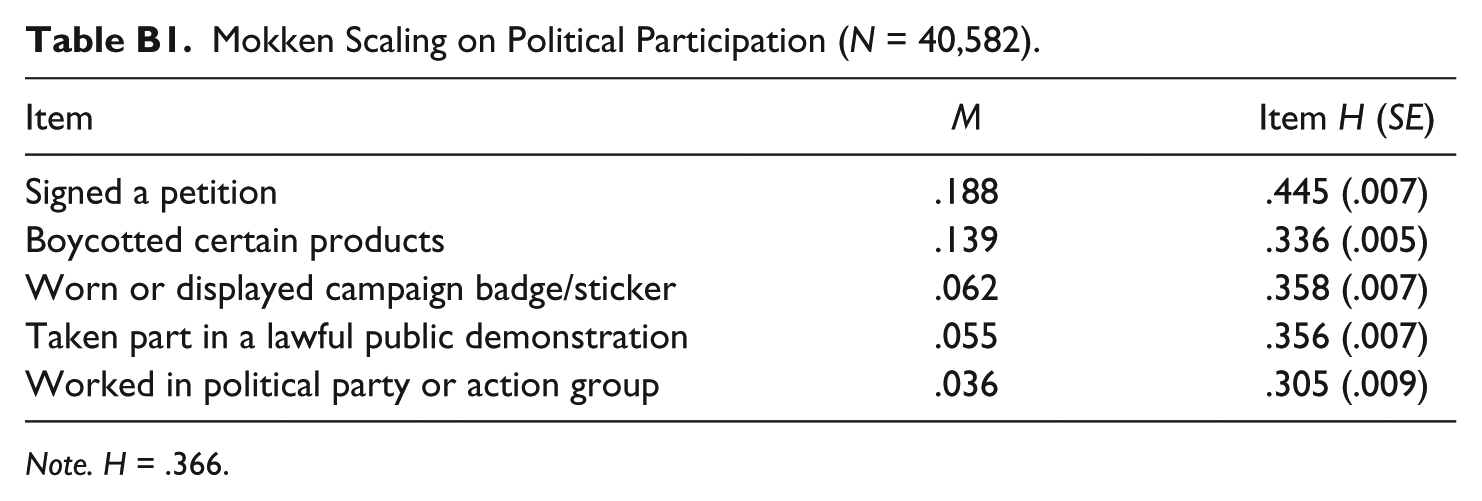
| Item | M | Item H (SE) |
|---|---|---|
| Signed a petition | .188 | .445 (.007) |
| Boycotted certain products | .139 | .336 (.005) |
| Worn or displayed campaign badge/sticker | .062 | .358 (.007) |
| Taken part in a lawful public demonstration | .055 | .356 (.007) |
| Worked in political party or action group | .036 | .305 (.009) |
Note. H = .366.
Declaration of Conflicting Interests
The authors declared no potential conflicts of interest with respect to the research, authorship, and/or publication of this article.
Funding
The authors received no financial support for the research, authorship, and/or publication of this article.