




Abstract
Classical sociological theory courses often present pedagogical challenges due to a “relevance gap,” where students perceive theoretical material as abstract and disconnected from their lived experiences. The article addresses such challenges by reframing theory not as a static canon but as a dynamic toolkit for cultivating transferable skills. Drawing on literature in active learning, dialogic pedagogy, and canon diversification and supported by multisemester evaluations showing high engagement across in-person and online formats, I present a scaffolded instructional model designed to build theoretical fluency. The approach features four interconnected assignments: (1) a low-stakes theorizing activity positioning students as creators of sociological insight, (2) structured debates developing perspective-taking, (3) imagined conversation essays promoting dialogic thinking, and (4) position papers challenging students to apply classical frameworks to contemporary issues. This process-centered approach guides students from intuitive engagement to confident analysis, offering a sustainable framework for bridging historical foundations with contemporary relevance.
Keywords
Classical sociological theory courses face a fundamental “relevance gap”: Students often perceive foundational texts as abstract and disconnected from their lived experiences despite their central importance to sociology’s intellectual identity. How can educators translate “classic” texts into vibrant analytical tools that resonate with contemporary students? This article presents a reimagined pedagogical approach that addresses this challenge by reframing classical theory not as a static canon to be reverentially preserved but as a dynamic toolkit for understanding our social world.
Drawing on research in active learning, dialogic pedagogy, and inclusive curriculum design, I offer a scaffolded instructional model featuring four interconnected assignments: low-stakes theorizing activities, structured debates, imagined conversation essays, and position papers. Each component strategically guides students from initial engagement to confident application of theoretical concepts. Multisemester evaluation data across both in-person and online modalities demonstrate how this approach fosters theoretical fluency and critical agency among diverse student populations, transforming theory from a perceived academic burden into an accessible set of analytical skills with enduring relevance.
The Relevance Challenge in Theory Education
Classical theory courses occupy a central yet often uneasy place in sociology curricula. Although foundational theorists, such as Marx, Weber, and Durkheim, are considered indispensable, students often experience theory courses as dense, antiquated, or only tenuously relevant to modern social realities. Common complaints include the Eurocentric focus on “dead White men,” the difficulty of abstract concepts, and a disconnect between canonical texts and students’ lived experiences. As Abrutyn (2024) observes, sociological theory can feel “disconnected from nearly everything else we teach” in undergraduate programs. This disconnect contributes to what might be called a “relevance gap”: Students struggle to see how classical ideas matter for their own sociological imagination or for addressing current social issues. Belet’s (2018) empirical study confirms this challenge, demonstrating that perceived relevance significantly impacts student engagement and learning outcomes in sociology courses.
Expanding the Theoretical Toolkit
One source of this gap lies in the traditional canon itself. The retrospective construction of a “classical” canon in sociology has centered a narrow set of theorists, leaving early women and non-Western sociologists appearing only marginally. This long-standing marginalization is well documented; for instance, Thomas and Kukulan’s (2004) review of theory syllabi found that writings by women were assigned on just 17 percent of syllabi. This pattern is reinforced by more recent data on Canadian courses, which show the pronounced dominance of Marx, Weber, and Durkheim, who each appear on nearly half of all syllabi, while in contrast, a foundational female theorist, such as Dorothy Smith, is included on just 14 percent of theory syllabi (Guzman and Silver 2018).
As Connell (1997) argues, this canonization process reflects power relations within the discipline rather than intellectual necessity, creating what she terms a founding discourse that claims universality while practicing exclusion. Understanding this historical context helps instructors present theory not as sacred doctrine but as part of an evolving conversation to which students can contribute. This marginalization reflects what Stacey and Thorne (1985) famously identified as the “missing feminist revolution” in sociology, where gender analysis remains compartmentalized rather than integrated throughout the discipline’s core. Such omissions can signal to students that theory is exclusionary and outdated, reinforcing the impression that classical theory offers little insight into diverse contemporary experiences. Expanding beyond traditional boundaries to include figures such as W.E.B. Du Bois, Harriet Martineau, or Anna Julia Cooper not only addresses historical omissions but also provides students with a richer set of analytical tools. As Alatas and Sinha (2017) demonstrate, diverse theoretical perspectives offer complementary lenses that enhance students’ ability to analyze complex social phenomena. Additionally, the sheer volume of “classical” material instructors feel pressured to cover—spanning nineteenth- and early twentieth-century social thought—can overwhelm both teachers and learners. When packed into a single semester, the canon can become a high-speed tour of ideas with insufficient time for depth, application, or critical reflection. The result, too often, is a classroom dynamic of dutiful plodding through difficult readings rather than enthusiastic engagement with sociological thinking.
Active Learning Strategies for Theory Engagement
In response, a growing body of pedagogical scholarship calls for making theory education more student-centered, inclusive, and active. Rather than treating classical theory as a fixed body of knowledge to be transmitted, many educators advocate approaches that invite students to do things with theory. Active learning strategies, from simulations and role-playing to collaborative projects, have been shown to increase student interest and confidence in theory courses. Recent innovations in this vein include Conner and Baxter’s (2021) use of role-playing games to teach symbolic interactionism and Wetcher-Hendricks’s (2021) “flying solidarity” exercise that makes abstract theoretical concepts tangible through embodied practice. For example, Hunter and Frawley (2022) demonstrate that incorporating arts-based activities (film, art, music) into a theory course significantly enhanced students’ ability to understand and remember concepts and even to apply theory to real-world contexts. In a parallel vein, Atkinson and Hunt (2008) show that inquiry-guided learning approaches, where students actively construct knowledge through structured investigation, enhance both theoretical understanding and sociological thinking skills. Research by Green and Klug (1990) provides experimental evidence that structured classroom debates improved students’ critical thinking and writing in sociology courses. Building on these approaches, Bostean and Leitz (2022) demonstrate how using sociological images helps students develop their sociological imagination and connect abstract concepts to concrete visual representations. These findings align with broader evidence that when learners actively grapple with ideas—discussing, debating, creating—they achieve deeper understanding and skill development than through lecture alone.
Student-Centered Approaches to Theory Instruction
Another stream of innovation focuses on dialogic pedagogy and inclusive curricula. Dialogic teaching emphasizes learning through dialogue, not only teacher-student dialogue but also student-to-student and even imaginary dialogues that allow multiple voices to be heard. Drawing inspiration from student-centered approaches to education (Freire 1970; hooks 1994), this pedagogical orientation emphasizes making theory accessible and practical rather than abstract and distant. Fobes and Kaufman (2008) demonstrate how dialogue-based approaches in sociology classrooms can transform student engagement with theoretical material while developing critical thinking skills. In sociology, this can mean foregrounding conversations about race, gender, and power alongside the canonical texts and encouraging students to put different theorists (including marginalized thinkers) in conversation with each other.
Scholars have argued that teaching classical theory requires directly engaging issues of race, ethnicity, and gender rather than treating those dimensions as add-ons. Brunsma, Embrick, and Shin (2017) extend this argument by highlighting how student engagement with diverse theoretical perspectives creates more inclusive learning environments. For example, Reyes and Johnson (2020) document strategies for interrogating the “veil” (the structural invisibility) that has historically obscured women and scholars of color in theory courses. Overall, the literature suggests that an inclusive, dialogic approach can make theory more relatable and meaningful: Dialogic pedagogies encourage students to question ideas and consider new viewpoints, and a diversified canon helps students see themselves and their communities in the theoretical enterprise. Estefan and Seim (2022) frame this approach as teaching theory as “cartography,” giving students maps to navigate theoretical terrain rather than simply transmitting content. They advocate for “radical accessibility” that enables diverse students to engage with complex ideas through student-centered, creative approaches.
From Theory to Practice: Four Scaffolded Assignments as Pedagogical Interventions
Building on these insights, I present an instructional model that reimagines the classical theory course as a student-centered, skills-oriented, and inclusive learning experience. The model was developed over several iterations of an undergraduate classical theory class at a large Canadian university, including adaptations for both in-person and online (synchronous) formats. The online adaptations draw on emerging best practices for virtual sociology education (Gillis and Krull 2020), particularly their emphasis on structured interactions to maintain engagement. At its heart are four scaffolded assignments that replace the traditional term paper or exam-heavy format. This approach aligns with Huisman’s (2010) findings that experiential, methods-based learning deepens students’ sociological imagination by connecting theory to concrete applications.
Each assignment is designed to address specific pedagogical challenges and learning objectives: cultivating student interest and agency in theoretical thinking, fostering critical reading and perspective-taking, practicing dialogic and creative synthesis of ideas, and applying abstract theories to concrete social issues. In the following, I describe each assignment in turn, explaining its rationale and implementation and illustrating how together they form a strategy for transforming classical theory from a burdensome canon into a dynamic toolkit. I then discuss evidence of the model’s impact on student engagement and learning, drawing from course evaluation data and student feedback. Finally, I offer reflections on implementation considerations for instructors who might adapt this approach in diverse institutional contexts.
Assignment 1: “Theorist Hat”— Low-Stakes Theorizing to Empower Students
The first assignment, often introduced in week one or two, is a low-stakes in-class activity called “Put on Your Theorist Hat.” Its purpose is to position students from the outset as active creators of sociological insight rather than passive recipients of canonical “wisdom.” The task typically involves presenting students with a familiar social phenomenon or scenario, such as a trend on social media, a campus policy, or an everyday social interaction, and asking them, in small groups, to generate a mini-explanation or theory for why that phenomenon occurs. In effect, students are invited to theorize in their own words, using logical reasoning and any nascent sociological concepts they may have, as if they themselves were social theorists trying to explain the world.
This exercise serves several functions. First, it demystifies the act of theorizing. Students often enter the course intimidated by the idea of theory. By collaboratively “doing theory” about something familiar, they experience how theory building is a process of asking questions and connecting ideas, a skill they can practice and improve. As Lemert (2004) famously put it, sociological theory can be seen as a “survival skill” and even a source of “uncommon pleasure” once one realizes that everyone theorizes about the social world at some level. Following this spirit, the “Theorist Hat” activity affirms that students already possess the raw materials for theorizing—their observations and curiosity—and that theory is not a reverent archive of someone else’s ideas but a living process they can participate in. Rinehart (1999) argues for “turning theory into theorizing” by treating students as “responsible interpreters” engaged in rigorous inquiry within the classroom community. This assignment puts that principle into action from the start, conveying to students that their own insights and questions matter.
Second, the “Theorist Hat” activity creates buy-in and relevance. Because the phenomena chosen are accessible and often connected to students’ lives (e.g., “Why do students often X on social media?” or “What explains the sense of community in Y situation?”), students are more eager to discuss possible explanations. They draw on personal experience, current events, or prior knowledge from other courses. In doing so, they begin to bridge personal understanding with sociological thinking, which is exactly the leap we want them to make with classical theories. Moreover, by having groups share their mini-theories with the class, we can highlight a variety of perspectives and even introduce basic theoretical distinctions in a nontechnical way. For example, different groups might spontaneously produce explanations that echo conflict versus functionalist views or individual versus structural emphases, which the instructor can then gently tie to upcoming theorists (“One group’s idea sounded a bit like how Marx might see it . . . ”). Students thus see the value of diverse approaches and get a preview that classical theory offers multiple lenses for the same social puzzle.
From an inclusive pedagogy standpoint, this assignment is especially powerful. It validates diverse student voices and experiences as sources of theorizing, counteracting established hierarchies. Students who may feel alienated by canonical content start the course by seeing that their own perspective has theoretical value. In my experience, this early confidence boost pays dividends throughout the term; students refer back to their initial ideas when encountering formal theories, which helps them connect abstract concepts to intuitive understandings.
By adopting the persona of a theorist in an introductory exercise, students can demystify complex theories and are encouraged to engage with the material from a theorist’s perspective. This early activity helps them build confidence in handling theory, see connections between different thinkers, and develop a greater interest in theoretical concepts. By kick-starting the course with “Theorist Hat,” the classroom ethos shifts toward one of cocreation of knowledge. Students are now primed to approach the classical readings not as alien scriptures to be endured but as tools and viewpoints that they might compare with their own nascent theories.
Assignment 2: Structured Theoretical Debates—Dialogue and Critical Thinking
After students have been introduced to several classical theorists and their core ideas (typically by midsemester), the course turns toward active debate as a means to deepen understanding and encourage critical engagement. The “Structured Theoretical Debate” assignment involves dividing the class into teams to argue opposing positions on a sociological question or controversy that can be illuminated by classical theory. For example, we might debate “Does modern society foster anomie (normlessness)?” with one side arguing “Yes, as evidenced by Durkheim’s theory” and the other side arguing “No (or less so), perhaps using Marx or Weber or other reasoning.” Alternatively, debates can put theorists in opposition (e.g., “Marx vs. Weber: What drives social change?”) or have students debate the contemporary applicability of a concept (“Is Gemeinschaft still relevant in the age of social media?”). The key is that students must employ theoretical arguments, not just opinion, to support their side.
Debates in the theory classroom serve multiple pedagogical goals. Primarily, they foster perspective-taking and the ability to compare theories. To debate effectively, students must consider a particular theoretical framework and articulate its view of social reality convincingly. In preparation, teams collaboratively research and rehearse how “their” theorist or perspective would address the question, often finding supporting evidence or examples. This requires students to dig deeper into the readings to extract arguments, definitions, and perhaps critiques of the opposing viewpoint. Even if a student personally disagrees with a theory, adopting it for the debate leads them to consider the ideas on their own terms, a crucial skill in theoretical reasoning. Conversely, hearing the opposing team’s case forces students to confront alternative explanations. This back-and-forth models intellectual debate that sociologists engage in, making the classroom a live arena for theoretical dialogue rather than a one-way lecture about what each theorist said.
Research on classroom debates confirms these benefits: Structured debates can enhance critical thinking, communication skills, and even writing ability in undergraduate courses (Green and Klug 1990; Scannapieco 1997). In this course, I directly observed that debates provide a structured forum where quieter students can participate on their own terms, especially if given specific roles (e.g., one student might open the argument, another responds to counterarguments, and others act as notetakers to build arguments for their groups). The somewhat playful competition energizes the class, and students tend to prepare more diligently because they feel accountable to their teammates. Additionally, debates make abstract ideas concrete by situating them in a clash of ideas format—Durkheim’s and Marx’s differing assumptions become very clear when argued head-to-head.
To ensure educational value, the debates are tightly structured and debriefed. I assign teams in advance, and students then select their own roles within their groups. I also provide guiding questions and require a short group outline or cheat sheet of arguments to be submitted. During the debate, time limits and alternating statements keep it focused. Nondebating students in the audience are tasked with evaluating arguments and posing questions, so everyone is engaged. After each debate, we hold a whole-class reflection: What did we learn about each theory’s strengths and blind spots? In what ways might each theorist respond to the other’s points? This reflection solidifies the comparative analysis and often leads into discussing how contemporary theorists synthesize or move beyond these classical arguments, reinforcing the idea of theory as an evolving conversation.
From an inclusive perspective, debates allow students to bring in examples from diverse contexts to bolster their arguments, and they learn to argue respectfully about sensitive social issues. I emphasize civility and remind students that the goal is understanding, not “winning.” In an online modality, I adapted debates to a written discussion-board format where teams post opening statements and rebuttals over a week’s span, followed by a synchronous lecture summary. Although less spontaneous, the online debates still yield rich exchanges and have the advantage of giving students time to formulate thoughtful responses, which some quieter learners appreciate.
Formal debates on theoretical issues cultivate a dynamic learning environment. Students gain practice in defending viewpoints, critically evaluating opposing theories, and engaging collaboratively. Through this process, they deepen their understanding of theoretical arguments, grow more confident in expressing their ideas, and better retain complex concepts. Through the “Structured Theoretical Debates,” students experience canonical theories not as static doctrines but as lively, sometimes contentious perspectives that they can actively wield and examine. The exercise thus reinforces the course’s student-centered shift: Theory is something students do and debate, not just memorize.
Assignment 3: Conversation Essays—Dialoguing with and between Theorists
The third major assignment asks students to write an imagined conversation essay bringing sociological theorists into dialogue. In this creative writing task, students craft a narrative (usually four to five pages) in which two or more thinkers discuss and debate a particular topic or question. For example, a prompt might be: “Imagine a conversation about the role of religion in society between Émile Durkheim and Karl Marx (and optionally one additional voice of your choice). What would each say, and how might they respond to each other’s views?” Students are expected to draw on the theorists’ actual writings and ideas (accurately representing their viewpoints), but they have freedom over the setting, tone, and progression of the dialogue. Some set the conversation in a café and others at a modern conference or even in a Twitter thread; the format can be flexible as long as the content is grounded in theory.
The conversation essay builds on the dialogic pedagogy concept by literally having students think in dialogue. Unlike a traditional compare-and-contrast essay, this format requires a dynamic comparison: Students must not only explain each theorist’s stance but also envision how the theorists would engage with each other. This deepens understanding in several ways. First, to give each voice authentic substance, students must internalize the arguments and style of each theorist. Students might then “hear” the theorist’s voice in their head, a process that helps them recognize contradictions in their own understanding and prompts them to revisit the texts. In educational terms, this is akin to role-playing on paper, reinforcing knowledge through simulation of a scholarly exchange.
Second, the format encourages critical synthesis. In guiding their chosen interlocutors through a conversation, students inevitably introduce a third voice (their own analytical perspective) as they decide which points each theorist would concede or contest. Crafting a coherent back-and-forth forces students to resolve or highlight tensions between ideas. For instance, if Weber and Du Bois are discussing rationalization and race, students might have Weber lay out his theory of rationalization and then have Du Bois question its applicability across racial divides, which might compel the student to clarify how Weber’s ideas do or do not account for Du Bois’s insights. In doing so, the student is performing analysis and evaluation but in a more engaging manner than the standard essay format. The dialogical nature of the assignment mirrors the way sociological theory itself evolves, through arguments and conversations among thinkers.
This assignment also invites diversification of voices. I allow (and encourage) students to include a third or fourth “character” in the dialogue, which can be another theorist from class or someone not taught formally in the course. Some have taken this opportunity to introduce Anna Julia Cooper speaking with Marx and Weber about gender and labor or to have a present-day activist pose questions on solidarity to Durkheim. Such creative inclusions further the inclusive pedagogy goal of breaking the canon’s confines and validating different perspectives. It signals to students that theory is not a closed conversation among a few nineteenth-century Europeans but an ongoing dialogue that they can extend.
The logistics involve intermediate checkpoints: Students submit a brief conversation outline or key points for each character beforehand to ensure they are on the right track with understanding the theorists. Peer review can also be incorporated. Students can exchange drafts and give feedback on whether the theorists’ portrayals are convincing and whether the dialogue is insightful. This peer aspect adds another layer of dialogue. In effect, students “listen in” on others’ theoretical conversations, which often inspires them to refine their own. In these creative writing assignments, students staged a “conversation” (often between theorists or between student and theory) to explore sociological ideas. The open-ended format encouraged creativity and personal engagement with theory. Despite initial uncertainty, students report learning to devise their own analytical framework, leading to independent thinking and a better grasp of multiple perspectives.
Through imagined dialogues, students practice the skill of thinking theoretically in a conversational mode, which is arguably how real theoretical insight often develops, through discussion and debate. This bridges the gap between student and theorist, making the theorists more approachable and their ideas more malleable in students’ hands.
Assignment 4: Position Papers—Applying Classical Theory to Contemporary Issues
The capstone assignment of the course is the position paper in which students must take a stance on a contemporary social issue or phenomenon using classical theory as an analytic lens. Typically, in the last third of the semester, students write a short paper (around four to five pages) focusing on a theoretical framework. For example, one paper might ask: “Using Marx’s theory of capitalism and class, analyze the gig economy (e.g., Uber, food delivery platforms). What would Marx say about this modern form of work, and do you find his perspective adequate? Why or why not?” Another might prompt: “Drawing on Du Bois’s concept of the ‘color line’ and double consciousness, take a position on how racial inequality is reproduced in today’s education system.” In essence, students are applying a classical theorist’s toolkit to a current issue and crafting an argument (a position) on the usefulness or insight provided by that theory for understanding the issue.
The pedagogical aim of the position papers is to bring everything together: theoretical knowledge, critical thinking, and real-world application. By placing classical theories in dialogue with contemporary realities, students confront the enduring question of “So what?”: How do these old ideas matter now? This challenges them to both explain the theory clearly and evaluate it. For instance, when examining the gig economy through Marx, a strong paper will describe Marx’s concepts of exploitation and alienation and then assess whether gig workers today experience those, perhaps noting what Marx’s nineteenth-century perspective might overlook (e.g., digital surveillance or racial/gender dynamics he did not foreground). This process develops higher-order thinking: analysis (breaking down the theory and the case), application (linking theory to evidence), and evaluation (weighing the theory’s strengths and limits).
From a skills perspective, position papers hone academic writing and argumentation. Students must formulate a thesis that is not simply “Marx is right/wrong” but something nuanced, like “Marx’s theory of capitalism highlights aspects of gig work, such as XYZ, but needs to be extended to account for ABC.” They learn to integrate textual evidence (quotes from classical texts or statistics/news about their contemporary case) and properly cite sources, thus practicing writing conventions in sociology.
Importantly, the choice of contemporary issues can be student-driven to increase personal relevance. I usually provide a list of suggested topics (e.g., economy, education, family, social media, crime) and related prompts, but students may propose their own. As a participation exercise, students can share their chosen position paper topics with the class, and we then collectively brainstorm how various thinkers could help explain or analyze the selected issue. Many choose issues close to their interests or experiences, from climate change activism to immigrant integration, which means they are teaching me about new examples while applying theory. This supports an inclusive classroom where student knowledge and passion drive content to some extent. It also diversifies the range of applications we discuss; classical theory is no longer confined to factory capitalism or Protestant churches (the original contexts of Marx or Weber) but is used to analyze hip-hop culture or online communities or protests, depending on what students bring in. Discussing their paper’s insights in class presentations (an optional creative component) further exposes everyone to a variety of connections between theory and the contemporary world.
Conducting this assignment across modalities has also shown me that online students can equally excel if given clear guidelines. In an online class, for instance, students posted short concept maps linking theory concepts to their chosen issue before writing the paper, which helped mimic the brainstorming that would normally happen in an in-person discussion. As the capstone assignment, position papers require students to take a stance on a theoretical question and support it with evidence. This process helps them formulate clearer arguments, improve their writing skills through iterative feedback, and apply theory in articulate, well-structured ways. By the end of the course, these papers guide students not only to understand classical theories but also to use them and to critically reflect on their usefulness. This is the culmination of the course’s transformation from theory as content to theory as toolkit. Students leave with a sense that they can draw on a repertoire of sociological concepts and perspectives to make sense of the world, which was exactly my overarching goal.
Evidence of Impact
Course evaluations across multiple semesters demonstrate the effectiveness of this scaffolded approach in both in-person and online formats. Data from seven course iterations between summer 2020 and winter 2023 show consistently positive evaluations across key assessment areas (Table 1).
Course Evaluation Data across Seven Semesters (2020–2023).
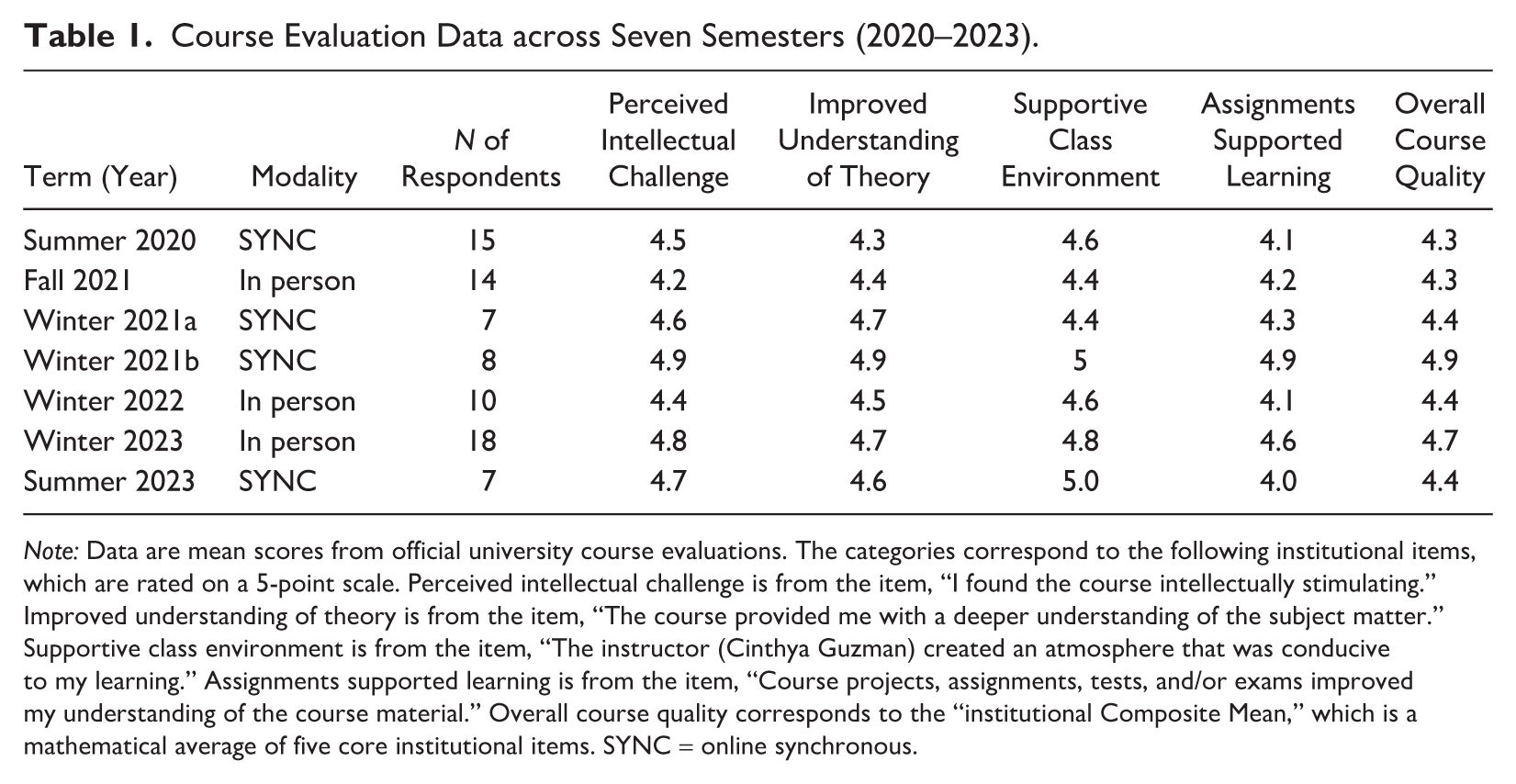
Note: Data are mean scores from official university course evaluations. The categories correspond to the following institutional items, which are rated on a 5-point scale. Perceived intellectual challenge is from the item, “I found the course intellectually stimulating.” Improved understanding of theory is from the item, “The course provided me with a deeper understanding of the subject matter.” Supportive class environment is from the item, “The instructor (Cinthya Guzman) created an atmosphere that was conducive to my learning.” Assignments supported learning is from the item, “Course projects, assignments, tests, and/or exams improved my understanding of the course material.” Overall course quality corresponds to the “institutional Composite Mean,” which is a mathematical average of five core institutional items. SYNC = online synchronous.
These evaluation data demonstrate consistent high student satisfaction and strong learning outcomes across delivery formats and academic years. Ratings for perceived intellectual challenge remained high (4.2–4.9), suggesting students found the course both stimulating and academically rigorous. Similarly, improved understanding of theory scores (4.3–4.9) indicate that students believed they developed genuine comprehension of theoretical content. The supportive class environment consistently scored between 4.3 and 4.9. This affirms that the structure and tone of the course promoted inclusion, engagement, and belonging, which were critical goals in reimagining classical theory as a collaborative and student-centered experience. Assignments supported learning received uniformly strong ratings (4.1–4.9), reinforcing that the course’s core pedagogy was seen as valuable for student learning.
Beyond these quantitative measures, qualitative feedback also demonstrates how specific learning outcomes were met (Table 2). The written feedback highlights how the course structure made dense material manageable and interesting. Students appreciated the clear instruction, with one noting the professor “did a fantastic job at explaining theories and concepts with a high degree of effectiveness” (summer term 2020), whereas another appreciated the “very clear and detailed instruction through the course with equally detailed presentation slides that made it very easy to keep up with and understand the content” (fall term 2021). Students also recognized the value of creating a supportive environment, with one commenting that the instructor “facilitated an environment that encourages learning . . . and facilitating insightful discussions to motivate us further” (winter term 2021).
Student-Reported Learning Outcomes across Seven Semesters (2020–2023).
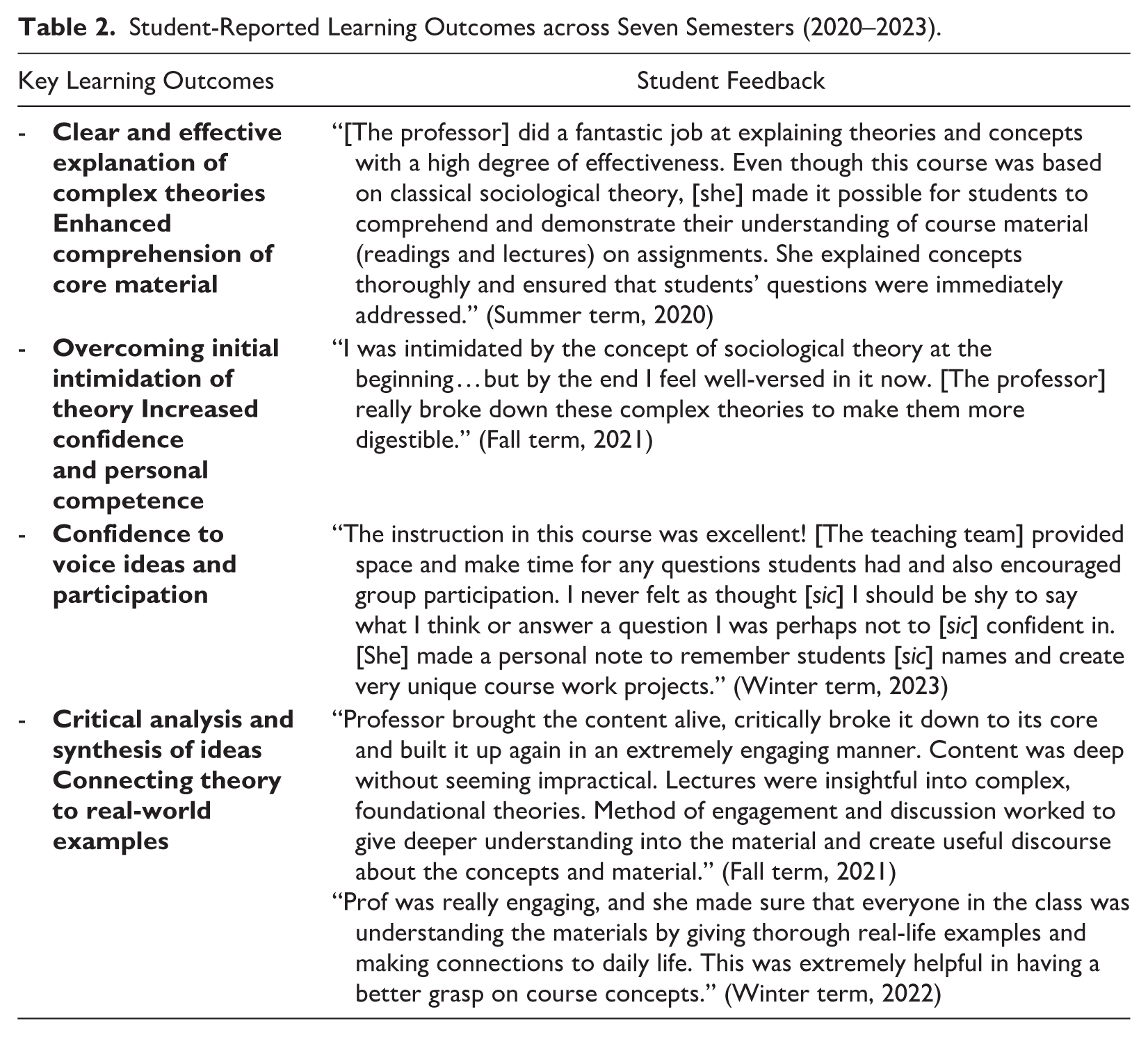
Table 2 distills these themes by pairing the core learning outcomes of the pedagogical model with illustrative student comments.
Implementation Considerations for Instructors
Adopting a scaffolded, interactive model for a theory course requires planning and flexibility, but it can be adapted to a variety of institutional contexts and teaching styles. Here, I outline some considerations and tips for instructors who might want to implement all or part of this approach.
First, it is important to align these assignments with your course learning objectives. In my case, I explicitly reframed my objectives to emphasize skills (e.g., “students will be able to apply theory to analyze social phenomena”) alongside content knowledge. Making this clear in the syllabus helps students understand why they are doing a debate or writing a dialogue; it is not busywork but a method to achieve the stated goals.
This model is adaptable to different structural conditions. I used this model in classes ranging from 18 to 92 students. For classes with more than 100 students, structured debates can be managed by having representative teams perform for the class or having students sign up for one of several debates held throughout the term. Imagined conversation essays could also be adapted into group projects for larger classes. For very small classes, an instructor might condense the number of debate teams or even participate to ensure a lively exchange.
The course has also been taught both 12-week fall/winter terms and condensed 6-week spring/summer terms, in both in-person and online synchronous formats. Although the total instruction time was equivalent, the pacing required specific adjustments to the assignment sequence. In a standard 13-week semester, I implement the entire four-assignment learning arc as designed. The longer time frame allows for ample scaffolding, practice, and reflection between each major assignment. However, in the compressed 6-week format, covering the full arc is challenging. To maintain depth, I found it effective to make the two dialogue assignments, structured debates and conversation essays, an either/or choice. Both teach the core skill of putting theories in conversation, so a condensed course might feature one but not both, allowing sufficient time for the final position paper.
The assignments also translate well to an online synchronous format. The “Theorist Hat” activity and class discussions can use breakout rooms. For the structured debate, rather than a single live event, I adapt it into a weeklong asynchronous discussion-board debate. Teams post opening statements, rebuttals, and concluding thoughts on a schedule, which provides students more time to formulate responses and can benefit quieter learners. I then use synchronous class time for a live debrief of the written exchange.
These assignments ask students to step outside their comfort zone (especially with creative and argumentative tasks), so scaffolding is key. Provide examples or excerpts from past student work if available (with permission) or create a sample dialogue yourself to show what an imagined conversation essay might look like. During the debate prep, giving a worksheet for argument construction can guide teams on how to organize their thoughts. Rubrics that detail what you are looking for (e.g., “accurate representation of theorist’s ideas,” “quality of evidence/examples,” “clarity of argument”) help students focus on the academic expectations even as they get creative. I found that doing a mini practice debate (as part of weekly participation) on a lighter topic early in the term helped students get the hang of it in a low-stakes way.
One of the advantages of this model is that it is modular; you can adopt pieces of it rather than all four assignments, depending on your needs. For instance, an instructor might love the idea of conversation essays but be less comfortable with debates or vice versa. Each assignment can stand alone or complement traditional elements. If time is a constraint, some assignments could be shortened (e.g., conversation “skits” performed in class instead of full written essays or position paper as an oral presentation). I encourage adapting the content to include theorists or topics that fit your syllabus. For instance, if including more noncanonical theorists, debates could feature those voices, too.
Because the assignments are somewhat unconventional, transparency in grading is crucial. I made each major assignment a significant but not overwhelming portion of the grade. You can also allow revisions for the written assignments. For example, students could revise for a higher grade if they wanted, which underscores the learning orientation. In grading creative work, focus on the learning outcomes (Did they demonstrate understanding and analysis?) rather than the flair. However, rewarding creativity even when the theoretical ideas are not perfect is important to ensure students feel the classroom space is a place they can exercise and apply ideas from their developing vantage point. I also collected student feedback specifically on the assignments to improve them. For example, initially, the conversation essay was individual; one semester, I experimented with pairs of students cowriting a dialogue, but students indicated individual work was actually preferred for this given varying writing styles and time commitments.
Instructors might worry about coverage (not “getting through” all canonical theorists in detail). My experience was that students learned fewer theorists’ works in a rote way but gained more in how to think like a theorist. Still, to ensure essential content, I was strategic: Some classes or readings were still run in a more traditional discussion format, and not every class was an activity; the four main assignments were spaced out with breathing room in between. It is also important to prep students for active learning if they are not used to it. I would sometimes explicitly discuss the pedagogy, explaining that “In this class, you won’t just hear me talk about Durkheim, you’ll be doing things with Durkheim’s ideas, and here’s why.” This metacommunication can get buy-in especially in contexts where more traditional lecturing is the norm.
Creating an inclusive environment is integral to this approach. Because students are asked to share ideas and sometimes be vulnerable (e.g., performing a debate or taking a creative leap in writing), they need to feel respected. Setting ground rules for respectful debate, encouraging supportive peer feedback, and being attentive to group dynamics (I occasionally rearranged groups if I sensed imbalances) are important steps. It also helps to incorporate diverse materials in lectures and examples so that when assignments come, students of different backgrounds see that all perspectives are valued. For instance, including readings, mini-lectures, or even videos and podcasts on theorists can enrich the pool of ideas students draw from in their assignments.
Finally, like any pedagogical innovation, this model benefited from reflection and iteration. Each time I taught with this course, I wrote reflective notes on what to tweak. Over time, I adjusted both content and structure, clarifying prompts, rotating thinkers and debate topics, and alternating some course materials, all with the goal of improving student engagement. Eventually, the learning arc outlined here came to life. Engaging with the scholarship of teaching (e.g., reading others’ experiences in Teaching Sociology or attending teaching ASA workshops and conferences) also gave me new ideas to refine the approach. For example, after learning about ungrading approaches, I began incorporating more self-assessment, asking students to evaluate their own learning at the end of the course and where they felt they improved due to these assignments. This not only provides me with feedback but also encourages students to recognize their growth, reinforcing the value of the experience.
In sum, implementing a student-centered, assignment-driven pedagogy for classical theory is highly feasible and rewarding, but it benefits from thoughtful adaptation to one’s context. The key is not to fear breaking away from the “coverage” model and trusting that students learn more deeply when they are actively involved. By focusing on core transferable skills—theorizing, debating, synthesizing, and applying—we equip students with not just knowledge of what Marx or Du Bois said but also the ability to carry those ways of thinking into new problems. That, ultimately, is what keeps classical sociological theory alive and relevant for students today.
Conclusion
Reimagining the classical sociological theory course as a dynamic, student-driven learning experience can transform it from what some see as a burdensome rite of passage into a formative intellectual experience. The scaffolded assignments detailed here—from donning the “theorist hat,” to engaging in debates, to composing dialogues, to staking positions on real-world issues—collectively demonstrate that even the most venerable theoretical ideas gain new life when students engage them actively and creatively. This approach marries theory and practice: Students learn about social theory at the same time as they learn how to think theoretically.
The positive outcomes observed, in terms of heightened engagement, inclusivity, skill development, and sustained interest, suggest that the proposed model offers one viable answer to the perennial question: How do we make classical theory meaningful for today’s students? The proposed approach does so by shifting the focus from what must be covered to what students can do with what they cover. It also treats the classical canon not as an intellectual monument to be admired at a distance but as a workshop of ideas where students and instructor work side by side, taking things apart, testing and reassembling concepts, and building something personally and socially meaningful.
Although this article has drawn from my experiences in a specific setting, the hope is that the underlying principles, active learning, dialogic engagement, inclusivity, and application can inspire adaptations in diverse classrooms. Whether one implements all four assignments or just infuses a traditional syllabus with a more interactive twist, the core message is that teaching theory can be as inventive and vibrant as theory itself. As sociology instructors, we have the opportunity to model the very creativity and critical inquiry we ask of our students. In doing so, we not only teach about Durkheim, Marx, Weber, and others, but we also carry their legacies forward by cultivating new sociological imaginations, perhaps lighting the path for future theorists among our students.
Footnotes
Acknowledgements
This article would not have been possible without the students in the Department of Sociology at the University of Toronto. Classical theory has historically been a required course that sociology majors dreaded. Finding ways to see you all engage with the material was a product of trial and error but also a lot of laughter and a newfound excitement for theory. I would also like to thank Christian Caron, the undergraduate chair at the St. George Campus, who trusted me with teaching this course during my time at the University of Toronto. Lastly, I wish to acknowledge my own theoretical teachers: Dan Silver, Jack Veugelers, and the late Jean-Sébastien Guy, who lit a theoretical curiosity in me. Many examples I used in my own classroom can be traced back to what I learned from you in yours.
