



Abstract
Graduate students face obstacles when attempting to pursue public sociology in general, but specifically when they desire to utilize public sociology as both a research and teaching orientation that fully incorporates undergraduate students. Drawing on a two-year public sociology project on student financial security challenges, the author advocates for graduate students interested in public sociology to engage in campus collaborations, where connections between undergraduate students and campus partners are forged based on relevant campus resources easily accessible to graduate students. Based on the specifics of the author’s campus collaboration, six tips emerge for graduate students interested in replicating this approach to public sociology early in their careers. Gaining familiarity with conducting public sociology that fully incorporates undergraduate students in graduate school, a model that has been shown to benefit students, community partners, and sociology as a discipline, will prepare graduate student instructors to implement the model when they become faculty.
Over the past two decades, there has been considerable focus within higher education in establishing more connections between colleges and universities and their surrounding communities (Berard and Ravelli 2021). Much of this focus has highlighted the need for instructors to engage students through real-world learning opportunities that will simultaneously improve student learning outcomes and benefit society. Such instructional practices that integrate student learning with community engagement have been termed community-based learning (Melaville, Berg, and Blank 2006). Mounting support for community-based learning stems from three objectives: (1) to cultivate the next generation of engaged citizens, (2) to build human capital to equip students for their desired careers, and (3) to tackle the most pressing issues facing humankind (Zlotkowski and Duffy 2010).
Growing interest in community engagement across higher education has coincided with a reinvigorated commitment to a community-facing and change-focused orientation in the discipline of sociology. While sociologists have engaged in recent conversations about community-based learning as a means of introducing the transformative potential of sociology to students, these conversations have mostly remained distinct from conversations about change-oriented research (Greenberg, London, and McKay 2020). While change-oriented research has deeper roots within the history of the discipline, including its early use by sociologists of color, women sociologists, and humanist sociologists, and although practitioners of change-oriented research vary in their perspectives and practices (Kane 2016), for the past two decades, this orientation has commonly been referred to as public sociology: where public sociologists work to improve unequal social conditions by sharing their work with multiple publics beyond academia and/or by conducting research in full collaboration with community partners, including letting them set the agenda for inquiry (Burawoy 2005). Although interest in public sociology has grown, conversations typically revolve around two topics: (1) the construction of public-facing research by faculty and (2) the lack of institutional recognition of such scholarship within the reward structures of higher education (Kane 2016). Given these dominant conversational trends, proponents of public sociology often fail to frame it as an opportunity to engage undergraduate students in community-based learning, while graduate students are often discouraged from pursuing public sociology altogether (Greenberg et al. 2020; Stacey 2007).
Although public sociology has typically revolved around collaborations between faculty members and community partners, with undergraduate students relegated to the status of a “first public” or audience, some faculty have fully incorporated undergraduate students into their community-facing research agendas (Greenberg et al. 2020:14; Kane 2016; Strand 2000). Because these collaborations have highlighted the benefits of public sociology for undergraduate students, community partners, and the discipline itself, it is worth investigating how graduate students, as the next generation of faculty members, can overcome the forces discouraging public sociology to lead the way in promoting the model as both a research and teaching orientation. In the following, I discuss how campus collaboration can serve as an entrance point to such a public sociology. I review my case study of campus collaboration that I engaged in for two years with two campus resource centers, seven undergraduate sociology students, and four other student partners. Through a review of my work, six tips emerge that graduate students can employ across a variety of institutional contexts to help them establish their own public sociology projects.
The Multiple Beneficiaries of Public Sociology
Community-based learning has been shown to improve student outcomes in a variety of ways, including the production of deep knowledge, the construction of valuable skill sets, and the establishment of beneficial social ties (Melaville et al. 2006). In sociology, community-based learning has often taken the form of service learning, where students provide benefit to the local community in the form of volunteerism while acquiring established educational outcomes (Greenberg et al. 2020; Mooney and Edwards 2001). Service learning has been shown to increase student mastery of course content, bolster student commitment to becoming engaged citizens, and hone students’ abilities to reflect on their positionalities (Berard and Ravelli 2021).
While service learning benefits students, community-based learning in sociology has been shown to be particularly effective when it engages students in public sociology (Greenberg et al. 2020; Kane 2016). Engagement with public sociology benefits students in a variety of ways. In addition to replicating the benefits of service learning, participation in public sociology bolsters students’ sense of purpose and agency, pushes students to critically analyze the structural roots of social problems, and teaches students how to effectively collaborate with others in ways that recognize the various strengths and bodies of knowledge of each team member (Greenberg et al. 2020; Strand 2000).
A public sociology that fully incorporates undergraduate students additionally benefits community partners. As Greenberg et al. (2020) discovered, their research with students on housing insecurity in Santa Cruz County gave their community partners, including legal aid organizations and antipoverty groups, greater reach in advertising their services. As students went door-to-door conducting surveys, they told individuals about housing advocates in the region and the services they provide. Additionally, while their findings helped to shape community partners’ services and their research process trained undergraduate students interested in future careers in labor and housing rights, the three-year duration and framing of their study as a dialogic collaboration created deeper trust between all parties involved.
A public sociology that fully incorporates undergraduate students additionally holds the potential to benefit the discipline itself. When Kane (2016) engaged her students in public sociology projects, she discovered that it increased their interest in both the discipline and in pursuing more civic-engagement opportunities. Furthermore, Greenberg et al. (2020) discovered that public sociology opportunities specifically appeal to historically marginalized students who can tap their vast cultural wealth, including their lived experiences and bilingualism, to help solve real-world issues. These are important findings to contemplate as sociology departments grapple with retaining their majors, sustaining their institutional relevance in the face of budget cuts, and building inclusive environments that do not “cool out” low-income students or students of color (Berheide, Chin, and Rome 2002:3; Howery and Levine 2002; Sweet 2016).
Public sociology opportunities additionally hold the potential to increase majors because of their ability to operate as pathways to careers: a factor that has specifically been identified as a conduit to minority student recruitment and retention in sociology departments (Howery and Levine 2002). As mentioned previously, public sociology not only develops skills beneficial for job searching but, as Greenberg et al. (2020) discovered, valuable networks as well (six of their students wound up working for their community partners). These findings are extremely important as debates about the purpose of a college degree—and specific majors like sociology—play out amid rising tuition and fee rates, with historically marginalized students the most likely to suffer the consequences of the increasing costs and ambiguous payouts of higher education (Armstrong and Hamilton 2015; Pike et al. 2017).
Barriers to Public Sociology for Graduate Students
Many graduate students entering programs in the hopes of doing public sociology find themselves up against a hostile environment. Stacey (2007:94) described this as an experience of “muzzling,” where students must undergo years of coursework that are so demanding that it leaves very little time for public engagement. Muzzling also occurs when faculty mentors discourage graduate students from engaging in public-facing work because it is not rewarded within higher education and thus does not fulfill the requirements of sociological professionalization within graduate programs (Kane 2016; Schulman and Silver 2003). While public sociology is not as valued within sociology departments, faculty members at least have access to resources not available to graduate students that bolster their ability to engage with the model. To conduct their public sociology project with undergraduate students, Greenberg et al. (2020) were not only able to utilize their teaching requirements to create class and field-based courses through which to run their project, they were able to use grant funds to hire a research assistant, reimburse students for travel expenses, and offer participants compensation as well as parlay their award into course release, giving them time to focus on their project.
While graduate students are allowed to teach courses for their departments as one avenue of program funding and professional training, because research is far more valued than teaching in annual evaluations, graduate students, who lack the protection of faculty status to successfully advocate for themselves, are not likely to be encouraged to teach public sociology courses for their departments because such undertakings would be time-consuming and would distract them from completing their independent research and writing (Adler and Adler 2005; Schulman and Silver 2003). Furthermore, while grant money is certainly available to graduate students, it is primarily offered to assist them in finishing their programs by supporting the completion of independent research projects and subsequent solo-authored academic journal articles (Schulman and Silver 2003). In other words, there is no course release for graduate students, no chance to take a break from the endeavor of independent academic research and writing to focus on honing public-facing collaborations between undergraduate students and community partners.
Campus Collaboration as a Gateway to Public Sociology
I now discuss how I successfully engaged in a project of public sociology, one that fully incorporated undergraduate students and that centered student financial insecurity (a topic of personal interest for all project teammates) using resources readily available to me as a graduate student. This project was conducted at UC San Diego, a large public university located in San Diego County, an area with a high cost of living and a severe lack of affordable housing (Corporation for Supportive Housing 2019). As a graduate student at this university who studies housing insecurity and homelessness, I am intimately familiar with the regional affordability crisis and the negative consequences of financial insecurity for students. Because of my research and teaching interests and the lived experiences and orientations to public sociology of my teammates, I sought out appropriate campus resources to launch a two-year study of student financial security challenges with a specific focus on housing insecurity (see Table 1 for a complete timeline of this project).
Housing Insecurity Project Timeline.
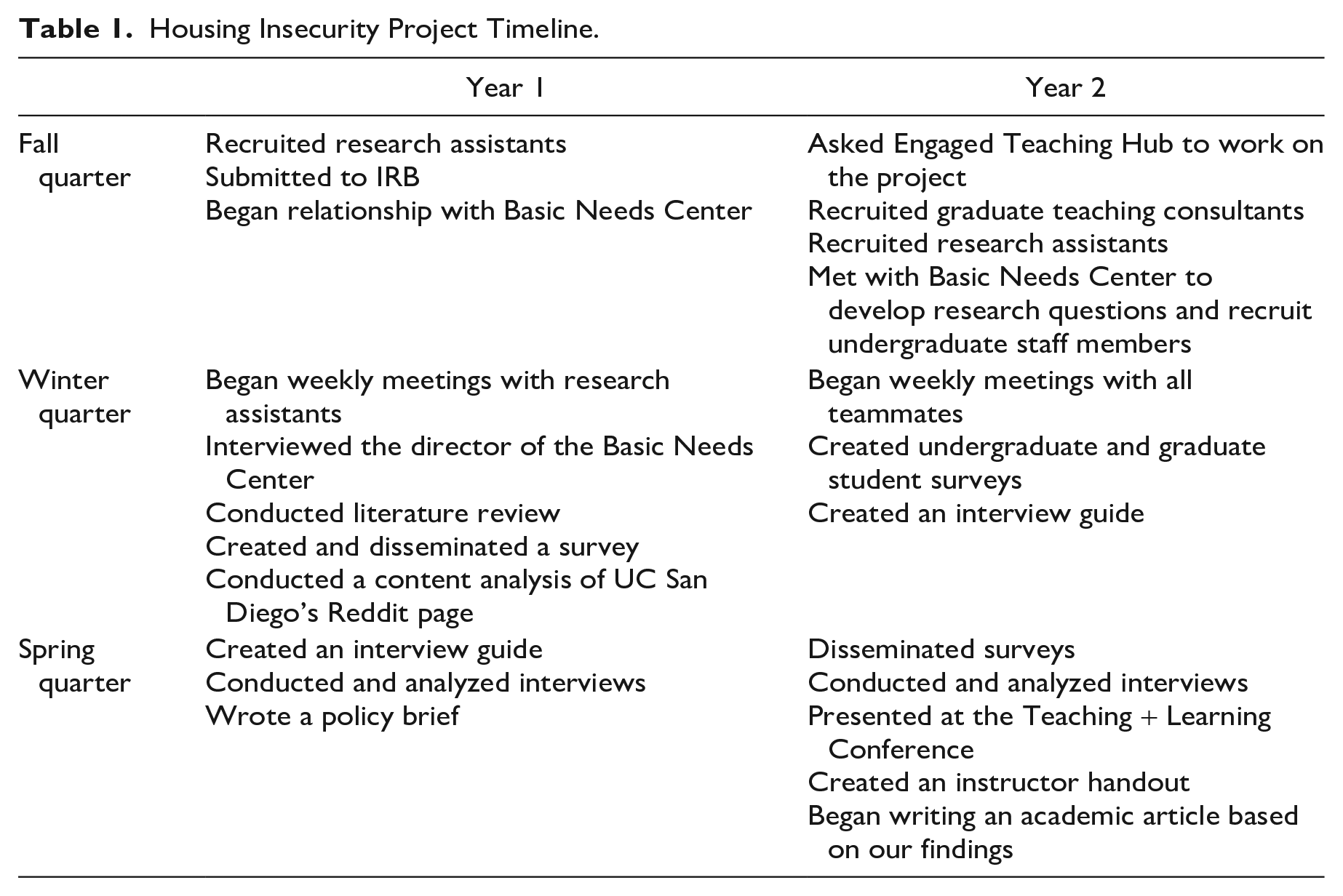
In the end, I made use of department research opportunities, campus organizations, and my own academic student employment to create a two-year campus collaboration comprised of two community partners, seven undergraduate sociology student stakeholders, and four other student partners. In the end, the collaboration, as previously discovered in the literature on public sociology, had multiple beneficiaries, including the teammates, the campus partners, and the greater campus community.
Making Use of Available Campus Resources
Collaborating with undergraduate students through a research apprenticeship
For the past few years, my department has offered undergraduate sociology student majors the chance to acquire research experience by serving as sociology Research Assistants (RAs) for either faculty members or graduate students. While project opportunities are posted, student applications are sent, and interviews are conducted in the fall, selected students may then opt to enroll in either the winter or in both the winter and spring quarters in SOCI 198RA, a four-unit course that may be applied toward the upper division elective requirements of the sociology major. Students who enroll in the program are expected to carry out their responsibilities for 12 hours a week to pass the course. Responsibilities vary and are posted for each opportunity but typically involve conducting literature reviews and organizing and analyzing data. While no monetary compensation is currently available (for either RAs or mentees running SOCI 198RA), my department attempted to make the RA program mutually beneficial for all involved. While faculty members or graduate students get help with their research, RAs in turn receive mentoring through their work on the projects, build new skills associated with research, and create a strong social tie to a professional reference.
I initially signed up for the program in the fall of 2019 to recruit an RA to help me with my own work on housing insecurity and homelessness in the region. In my recruitment message, I was explicit that this project would be an ideal fit for someone interested in learning about public sociology because it was my desire to teach my RA how to conduct research with community partners, write for nonacademic audiences, and pursue avenues for social change based on research findings. When it came time to review the applications, I had 16 students apply to work with me (far and above the typical number of applications most projects receive, which is around three to four). Reviewing the cover letters, I soon realized that all applicants highlighted their dual interests in the topic and in the pursuit of public-facing work. After following my department’s protocol of interviewing the five candidates with the strongest applications, I realized that I could not say no to any of the five. Their personal connections to the topic and their desire to be public sociologists inspired me to use the RA program to assemble an undergraduate research team: one that would work on a public sociology project start to finish in collaboration with the author. My decision to utilize the RA program in this fashion leads me to highlight my first tip for graduate students interested in getting started with public sociology: Generate avenues to collaborate with students. For myself, this entailed making use of an RA program my department offers and tailoring it to my interests in public sociology and undergraduate education. After running this idea—to use the RA program to construct a truly collaborative public sociology project—by the five RAs and confirming their interest in this approach, I and my RAs-turned-teammates then collectively brainstormed a new topic: investigating the breadth of housing insecurity and related student financial security challenges on our campus and its impact on student well-being and academic success. In Year 2 of this project, I decided to recruit only two new RAs because I had no childcare during the pandemic and felt limited in terms of my ability to offer mentorship. As was the case in Year 1, both RAs in Year 2 had personal connections to the topic and a deep interest in public sociology.
When engaging with my RAs, I realized that while I wanted to create an atmosphere of true collaboration (because my teammates were additionally community stakeholders in terms of the project’s topic), I also wanted to create an environment of mentorship. To merge these goals, I developed a course syllabus and weekly team meetings, both of which were used to keep the project on track, foster democratic decision-making, and develop skills. As teammates/stakeholders, RAs across both years engaged in every aspect of the study: from choosing the topic to formulating the research questions to designing the methodology to gathering and analyzing data to disseminating the study’s findings. For instance, while the entire team decided on surveys and interviews as our primary methods of data collection, two RAs from Year 1 came up with the idea to supplement these data with a content analysis of UC San Diego’s Reddit page, reviewing all threads that addressed housing, food, and finances. As students and mentees, RAs learned how to create and disseminate surveys, conduct interviews, analyze interview transcripts, write policy briefs, and construct infographics. Through this approach, I was able to cultivate an atmosphere of collaboration, skills development, and respect for my undergraduate students, the second tip I wish to highlight for graduate students interested in getting started with public sociology done in full collaboration with students. When engaging with this model, be sure to generate a working environment where students’ abilities are centered, where their labor is not exploited for your personal gain, and where they can continue to hone valuable new skills. My use of a syllabus—that highlighted when student input was to be obtained and when students were to learn new skills—helped me to achieve this goal.
Locating and collaborating with campus partners
The third tip I wish to highlight for graduate students interested in conducting public sociology with students is to locate and recruit relevant campus partners. Once our team chose our topic in Year 1, I reached out to the Basic Needs Center (BNC) at UC San Diego to see if they were interested in collaborating. Established in 2018, the BNC supports students facing housing, food, and other financial security challenges. The BNC was enthusiastically willing to partner with our research team. In Year 1, which occurred over the 2019–2020 academic year and coincided with the beginning of the COVID-19 pandemic, the research team was only able to interview the director of the BNC during the winter quarter before the California lockdown, probing her for research questions that would benefit BNC’s mission by closing gaps in their knowledge. Questions that emerged from this session included: “How many students experience housing insecurity on our campus?” “What off-campus services do students use?” and “What students are more likely to experience housing insecurity?”
In Year 2, as the dust settled around remote operation, the BNC was able to expand its collaboration with our research team. In this second year, multiple members of the BNC’s team were able to join the research team for regular meetings, which encompassed brainstorming new research questions that centered the pandemic’s impact on student financial security, deciding on approaches to data collection, and developing strategies for the dissemination of our findings. The BNC was additionally able to and interested in allowing two of their undergraduate student workers to use their paid hours working for the BNC to work on the study: an indication that the myriad benefits of the collaboration—for the BNC, for the campus, for the RAs, and for the BNC’s student workers themselves, who would build new skills through participation in the research—were clear to this campus partner. Likely, this development in Year 2 reflects the advice of Greenberg et al. (2020): Prolonged engagement with community partners and authentic framing of public sociology projects as true collaborations combine to build trust between all parties involved.
In Year 2, I additionally found academic student employment through the Engaged Teaching Hub (ETH) at UC San Diego as a Graduate Teaching Consultant (GTC). Established in 2017, the ETH is a campus resource center that provides university faculty and graduate student educators with a space to experiment with new teaching techniques, analyze their effectiveness, and get feedback from education specialists and graduate student peers. Because the ETH specifically shares best practices in equitable and inclusive teaching and because the research project had, since its inception, focused on the academic impact of financial security challenges, the ETH was a natural addition to the campus collaboration. I got approval from my ETH directors to work on the collaboration during my paid hours and to recruit two fellow GTCs from the ETH interested in working on the study. The addition of this second campus partner not only expanded the human power of our research team, but it also gave the project a host of additional resources, including funding from the ETH to compensate participants and an avenue to disseminate project findings across the campus, because the ETH regularly disseminates instructional tips to campus instructors in the form of handouts, workshops, learning communities, and consultations. These perks in effect replicated what Greenberg et al. (2020) were able to draw on to conduct their public sociology project, including freed up time, increased human power, and funding, and lead me to highlight my fourth and fifth tips for graduate students: Identify sources of funding you can utilize to support your collaboration and platforms to disseminate your findings, the latter of which will be discussed in more detail in the following.
Identifying dissemination channels for our findings
At the end of Year 2, our research team decided to share our findings with the campus community in three ways. First, we decided to enroll to present at a campus-based teaching and learning conference—Teaching + Learning for Justice—which was held in May 2021 over Zoom and hosted by the Dimensions of Culture program on our campus. This opportunity was advertised to our team through the ETH, which received an invitation to participate. Our team decided that this conference was an ideal place to discuss our campus collaboration because it was convened around the topic of teaching as a method of promoting social justice. As such, it was a perfect avenue to share both the campus collaboration model of research and teaching and the recommendations for supporting students facing financial security challenges that emerged from our findings. Through the conference, our team was able to share their work with an audience of over 100 persons, including faculty, lecturers, and students. The second way our team shared our findings was through the creation of an infographic. Constructed using Canva, the infographic was created to quickly capture instructors’ attention to increase the likelihood that they would engage with the study’s findings. The ETH distributed the infographic to all campus departments as part of its routine dissemination of instructional best practices. Finally, our team embedded our infographic into relevant workshops that the ETH runs for campus instructors.
The Multiple Beneficiaries of Campus Collaboration
In line with the literature, this two-year campus collaboration had multiple beneficiaries.
The teammates
A prominent benefit that all teammates derived from this project was a tremendous sense of purpose and agency. Team members regularly expressed their enthusiasm to be able to democratically contribute to a research project that had both direct relevance to their and tangible, local impact. The research team—spanning myself, the RAs, and team members from the BNC and the ETH—consisted of a diversity of graduate and undergraduate student stakeholders, including low-income students; students who identified as Black, Indigenous, or People of Color (BIPOC); students with dependents; and students with disabilities. All teammates were drawn to the topic because of its direct impact on their lives (not only have low-income students, BIPOC students, students with dependents, and students with disabilities been the most likely to experience housing, food, and financial insecurity, but the pandemic additionally hit these students the hardest; Goldrick-Rab et al. 2019; Hallett and Crutchfield 2017; Soria and Horgos 2020; Soria, Horgos, et al. 2020; Soria, McAndrew, et al. 2020; Soria, Roberts, et al. 2020).
For instance, during the presentation at the teaching and learning conference, one teammate from the BNC highlighted that her commitment to disseminating the study’s findings was personally motivated by her intersecting identities as a first-generation student of color and the fact that students like herself are more likely to be impacted by basic needs challenges. It was her personal aim that the study’s findings were distributed to the campus community to ensure that instructors and administrators took those findings to heart and implemented the team’s recommendations. I myself had a personal connection to the topic as a parent who lost her childcare during the pandemic and who worried that she would never finish her PhD and find a stable job. For myself, a similar sense of purpose existed that the study’s findings would be used by the campus community to support all students affected by housing insecurity, food insecurity, and the financial reverberations of the pandemic. Our shared connections to the topic, which emerged during our weekly team meetings, lead me to highlight my sixth and final tip for graduate students interested in getting started with a public sociology that fully incorporates students: Create space for team reflections on positionality. Our team reflections not only highlighted our personal connections to the topic but also allowed us to learn from one another because our connections to financial insecurity during the COVID-19 pandemic varied by our different social identities. Allowing students the chance to reflect on their positionalities will not only grant them space to express their lived experiences that connect them to sociological topics, but it will lead to better learning as they learn from one another’s diverse perspectives (Adams and Love 2009).
In addition to a deep sense of purpose, team members generated valuable skill sets. With respect to the undergraduate team members, both RAs and members of the BNC, they derived many benefits from this work. They honed research skills, including surveying and interviewing skills; presentation skills, including PowerPoint, infographic, and public speaking skills; and interpersonal skills. GTCs from the ETH additionally benefited from the experience through the acquisition of new skills, including interviewing and transcript analysis, because they came from other disciplines where such methods are rare. Wanting this to be a truly beneficial experience for all involved, I used multiple strategies to ensure that both the RAs and the additional teammates yielded such beneficial skills. To ensure this would happen, I held weekly hour-long team meetings. While sometimes these meetings would include all teammates, oftentimes, separate meetings would be held for separate groups (i.e., RAs, BNC teammates, and ETH teammates) to account for the fact that non-RA teammates could engage with this work during their campus position hours. Meetings not only were a time where teammates could discuss and deliberate on what research questions they wanted to ask, how they wanted to recruit for participants, or how they were going to disseminate the project’s findings but were also a time where I could train teammates in effective survey construction, descriptive statistics analysis, interviewing, and transcript coding. In Year 1, when teammates included only myself and five RAs, I developed a syllabus for the project. The syllabus highlighted the knowledge and skills the RAs would acquire week by week, kept the project on track to guarantee that it could be completed in two quarters, and ensured that RAs would never feel compelled to work over the 12 hours a week mandated by enrollment in SOCI 198RA (in the syllabus, I clearly stated that preferred engagement with the project was closer to 6 to 8 hours a week to account for the fact that RAs were not able to be monetarily compensated and to allow RAs the time to derive maximum benefit from the research collaboration in terms of knowledge and skills acquisition). In Year 2, a syllabus was still created and used for RA teammates and adapted into a project schedule for BNC and ETH teammates.
In addition to my teammates benefiting from the study, I myself additionally benefited from this campus collaboration in two important ways. Although I have a history of conducting public sociology, I had never fully incorporated students into the process. As such, I developed new knowledge of how to successfully do so, including how to construct a syllabus that prepares students to engage with community partners and research participants, how to effectively manage a large team through the facilitation of weekly meetings, and how to locate and make use of available resources. I additionally experienced my own personal unmuzzling through this project. In the first few years of my program, I was told explicitly that I would either “publish (in academic journals alone) or perish”: that is, that the world of sociology would not want me if I were not professionalized in this fashion. Such early messaging about professionalization discouraged me and made me consider dropping out of my program. Engagement with this two-year campus collaboration reinvigorated my commitment to sociology and helped me find my niche as a scholar and teacher.
The campus partners
In addition to the project teammates, the BNC and the ETH additionally benefited from this collaboration in two important ways. First, the BNC was able to amplify the advertisement of their services throughout the entire project because team members were trained to share BNC resources with participants and a good portion of the team’s conference presentation focused on what services the BNC provides. Second, both the BNC and the ETH expressed gratitude that they were building campus connections with other like-minded organizations. While BNC staff specifically expressed an interest in continuing to collaborate with the ETH, my directors at the ETH expressed gratitude that this project began what they hoped would be a new tradition of collaborating with other relevant campus centers. The ETH additionally benefited from personal connections with BNC that which allowed them to schedule times where BNC representatives could speak on teaching for equity panels run by the ETH (which in turn allowed the BNC yet another avenue to advertise their resources).
Potential impact on the greater campus community
Although our research team did not attempt to measure the success of this campus collaboration in terms of changing classroom practices or campus-level policies, because our team disseminated our findings in a variety of ways to instructors, there is the possibility that the collaboration benefited the greater campus community. First, it is possible that the collaboration benefited faculty, lecturers, and graduate student instructors who learned how to build equitable and inclusive classroom spaces from the study. Second, it is possible that, as such, students themselves on the campus benefited from increased support. While this is only speculative, the fact that the ETH disseminated project findings and recommendations across all campus departments raises hope that some instructors and some students benefited from the work.
Six Tips for Replicating Campus Collaboration
While my ability to engage in public sociology with seven undergraduate sociology students, four other student collaborators, and two campus partners was contingent upon the specific campus resources at my disposal, the assets that led to my team’s success can be generalized into six tips that graduate students can deploy across varying institutional contexts.
Generate an Avenue for Students to Collaborate
While this project relied on an RA program, not all sociology departments have research apprenticeship opportunities. While graduate students can certainly advocate for the creation of RA programs in their own departments (preferably ones that monetarily compensate both RAs and mentees), there are other possibilities to generate research partnerships between graduate and undergraduate students. Many graduate programs offer students the chance to teach as the instructor of record. Graduate students can use this opportunity to advocate for the development of their own field-based course that will allow them and their undergraduate students to construct and execute a research project. An argument for this opportunity that can help graduate students overcome the possibility of pushback can be explaining to one’s department how such an endeavor advances graduate students in their research, teaching, and campus service and thus ticks off the three important categories of annual evaluations (Greenberg et al. 2020). For instance, the campus collaboration outlined previously not only created innovative teaching and service experiences for the author, but it additionally resulted in the generation of a policy brief and an article. For graduate students who are not able to teach for their departments or who experience pushback against the idea of teaching a field-based course, an alternative suggestion is to seek out summer precollege program teaching opportunities. Summer precollege programs not only rely more heavily on graduate student instructors, but they also typically encourage and finance community-based learning opportunities in the form of guest lectures and field trips and as such could be an excellent site for graduate students to engage in public sociology as both a research and teaching orientation (Academic Connections 2023).
Establish an Atmosphere of Skills Development, Collaboration, and Respect
Because I made use of my department’s RA program, which cannot currently offer monetary compensation to RAs, I was determined to ensure that the experience was nothing but beneficial. Thus, instead of having RAs help me with my own research for course credit, I instead turned the experience into a true two-part course series replete with syllabi. In this way, I tried to ensure that RA labor was not being exploited because RAs were truly enrolled in a course that took their learning outcomes seriously (Greenberg et al. 2020). While this collaboration made use of syllabi—that established weekly meetings and delegated duties to allow RAs to develop skills while also being mindful of their time—there are other ways to ensure the completion of a public sociology project that is equitably beneficial for all involved. One idea is to collectively create a project timeline and establish roles for each teammate. Such an approach can help further breakdown hierarchies between graduate and undergraduate students by framing the project as a team-based study where all investigators have a say in what the weekly objectives should comprise and what is expected of each teammate. An additional benefit to this approach is the ability to have conversations among teammates regarding what skills everyone feels they bring to the project and what skills they wish to develop (Strand 2000). In this fashion, the reciprocal learning environment achieved through campus collaboration could be stretched to the next level because different teammates could take the lead on various aspects of the project and the training of their peers (Greenberg et al. 2020).
To generate an atmosphere of collaboration, I not only made use of weekly meetings to create spaces for democratic decision-making, but I was additionally able to grade all Ras on a pass/no pass basis. By removing grades, I was assisted in framing the project as a collaboration between all RAs, myself, and our community partners. If such an approach to grading is not available, graduate students can use alternative methods to achieve a collaborative mindset within a class setting, including having students collect data in groups and cowrite analytical reports for a collective grade based on effort. Furthermore, while I was able to use my academic student employment in Year 2 to run the project—giving me both compensation for and the time to oversee the collaboration that I did not receive in Year 1—other avenues exist to effectively create “course release” opportunities for graduate students. Summer precollege programs are again an excellent way to hit multiple objectives within limited time because such programs allow graduate students the opportunity for summer funding, teaching practice, and a conduit to public sociology replete with funds for community-based learning opportunities. Making time and receiving compensation for public sociology endeavors could also be achieved by lobbying to run one’s own field-based course within one’s department.
Locate and Recruit Relevant Campus Partners
While I and my RAs partnered with the BNC and the ETH to conduct our study, other student collaborations will necessitate different campus partnerships. When planning a study, graduate students should look around their own campuses. What resource centers, departments, or student groups exist? Do any have mission statements that overlap with graduate students’ research interests? Finding relevant campus partners and then reaching out with a vision of true collaboration—one that asks partners for their input in terms of research questions, project methods, and findings dissemination—will help to establish trust (Greenberg et al. 2020).
Find Flexible Sources of Funding
While the campus collaboration detailed here relied on funding from one of our campus partners, many colleges and universities offer small grants for instructors who desire to “break out of the classroom” (University of Maryland 2022; University of South Carolina 2022). While these grants are mostly limited to faculty, I have direct experience successfully lobbying for them to be broadened to include graduate student instructors at my institution. Seeking out opportunities of this nature can facilitate one’s ability to engage in public sociology as a campus collaboration by allowing for the compensation of participants and possibly even teammates.
Identify Campus Platforms to Share Your Findings
Through our research team’s engagement with the ETH, we not only learned about a campus-based teaching and learning conference but also had an avenue to disseminate our findings in the form of handouts, workshops, and learning communities. Many colleges and universities have their own campus-specific conferences and teaching resource centers that can aid graduate students in promoting their community-based learning projects. Graduate students can additionally rely on their campus partners to help disseminate project findings in the form of handouts and presentations because many operate listservs and hold campus-based events.
Have Teammates Reflect on Their Positionality
Important to the process of the campus collaboration was the fact that all teammates took the time to reflect on their positionalities and how they affected their orientation to the project. While this is always an important educational practice (Adams and Love 2009), it is especially important when one engages in public sociology in full collaboration with undergraduate students because it allows historically marginalized student stakeholders to tap into their cultural wealth while simultaneously helping privileged students to eradicate any misperceptions they may hold (Greenberg et al. 2020; Strand 2000). In the case of this project, while all teammates were in some way impacted by the topic on account of their various identities and could bring that knowledge into the study, all teammates additionally had very different intersectional identities and could thus learn from one another in terms of the ways in which financial security challenges manifest in patterned ways for different groups. Graduate students interested in pursuing public sociology in full collaboration with undergraduate students can make space for reflections on positionality and the ways in which intersecting identities of teammates will shape their projects in a variety of ways, including having their students complete reflection assignments or having team meetings that center lived experience.
Conclusion
Although graduate students face unique obstacles to engaging with public sociology as both a research and teaching orientation, those interested should not shy away from this type of work. The campus collaboration outlined here demonstrates that it is possible for graduate students to engage in public sociology early in their careers by tapping into resources readily available to them on their campuses. By utilizing my department’s RA program, I was able to fully incorporate seven undergraduate sociology students in a public sociology project. By using my paid hours for the ETH, I was not only able to lighten my load but also gained access to monetary compensation for my time, funding for the research collaboration, and additional team members that made the work more manageable. Finally, by collaborating with graduate and undergraduate students and campus staff with a personal connection to the topic, I was able to tap into the unique needs, interests, insights, and desires of an array of stakeholders interested in shedding light on student financial security challenges.
Graduate students interested in public sociology as both a research and teaching orientation arguably need early practice with the model during their programs. Such early practice would facilitate implementation of the model as graduate students become faculty members, to the benefit of sociology students, community partners, and sociology departments. Public sociology not only supports community partners and improves student learning outcomes, but it is also a conduit to future jobs through both skills and social network development. This reality will benefit sociology students in general and historically marginalized students specifically, who are more likely to be impacted by the more ambiguous payout of higher education and who are more likely to engage with public sociology. Faced with this evidence, public sociology is a way for sociology departments to increase majors and bolster diversity.
To garner early practice with this model, I encourage graduate students to seek out campus collaborations by utilizing the aforementioned six tips. Graduate students should additionally utilize their department town halls and bend the ears of their directors of graduate studies to advocate for greater flexibility in annual assessments and degree completion criteria that would allow students to gain recognition for their public sociology. Advocating for official programmatic recognition of such endeavors in graduate school is especially important because sociologists of color and women sociologists, who are more likely to experience hostile departmental environments, are the most likely to engage with public sociology (Kane 2016). One way graduate students can encourage programmatic recognition of public sociology is through the implementation of departmental discussions on the option of a “stapler dissertation” that could include both research results from and teaching reflections on a public sociology project (stapler dissertations, while growing in popularity, are less common in the social sciences; Flaherty 2016). Finally, graduate students should volunteer to sit on departmental hiring committees, using the opportunity to highlight the model’s multiple benefits, including its ability to increase departmental diversity in terms of both undergraduate students and faculty members.
Footnotes
Acknowledgements
I would like to thank the Basic Needs Center for collaborating with our team (specifically, Chelsea Richardson, Alicia Magallanes, Aliyah Annis, and Stephanie Rivas), the Engaged Teaching Hub for supporting this work through both funding and human power (specifically, Erilynn Heinrichsen, Leah Klement, Carolyn Sandoval, Julia Adrian, and Rachel Fox), the undergraduate students from my department’s Research Assistant program (Sayera Jones, Sandra Marqas, Rebecca Lee, Jasmine Kennedy, Sara Hwang, Czarina Dominguez, and Paola Laris-Ramirez), and all of the students who participated in our collaboration by sharing their stories.
Editor’s Note
Reviewers for this manuscript were, in alphabetical order, Laura Krull, Agueda Ortega, and Laura Sanchez.
Funding
The author disclosed receipt of the following financial support for the research, authorship, and/or publication of this article: This project was funded by the Engaged Teaching Hub through the Teaching + Learning Commons at UC San Diego.
