



Abstract
Educators have recently highlighted the importance of social science courses for students entering the medical field. This has led to the inclusion of sociological theories and concepts on the Medical College Admission Test (MCAT), a requirement for any student seeking formal medical training. Using open-ended survey data responses provided by students who recently completed the MCAT, we explore how students perceive that sociology courses prepare them for the MCAT and their lives more generally. We find that students report that their sociology courses introduced them to key concepts and laid a foundation for material assessed on the exam, but those courses could improve by aligning with the MCAT structure by prioritizing application of concepts and critically analyzing case studies. Students also reported that sociology courses helped them develop empathy and inclusivity and use their sociological imaginations, which will ultimately positively impact their careers in the medical field and lives overall.
A group formed by the Association of American Medical Colleges (AAMC) conducted a comprehensive review of the Medical College Admission Test (MCAT), and in 2012, they recommended major changes to the test for the first time since 1991. One notable change was an addition of a section with questions focused on applying concepts and ideas from the social sciences (Kain 2012; Mitchell et al. 2016). This revised version, first administered in 2015, includes the addition of a Psychological, Social, and Biological Foundations of Behavior (PSBB) section, which includes 59 questions and constitutes a quarter of the current exam. The AAMC estimates around 85,000 students sit for the MCAT each year, and before this latest revision, around two thirds of those students were taking an introductory social science class during their undergraduate education (Mitchell et al. 2016; Murphy 2021). This modification to the exam resulted in thousands of additional premedical students across the country enrolling in psychology and sociology courses to help them prepare for entry to medical school (Mitchell et al. 2016:9).
We sought to understand more about the experiences of students early in their medical careers and how they feel sociology courses affect their medical education. Informed by focus groups with students who had recently taken the MCAT, we created a predominantly open-ended online survey focused on students’ experiences taking social sciences courses and their perceptions of how the courses prepared them for the MCAT and their future careers. In this article, we first outline literature describing the importance of social science training for a medical education and how students’ preparation has shifted since the implementation of the social sciences section on the MCAT. Next, we describe our research methods and sample, present our findings from the survey data, and finally describe the implications for educators, medical students, and the medical field.
Literature Review
In recent years, medical educators have shown they recognize the importance of including social science courses in medical education. The AAMC added the PSBB section to address the prevalent critique that physicians need to develop better cultural competence through incorporating the “biopsychosocial model” of illness (Adler 2009; Betancourt 2006; Engel 1977). The introduction of the PSBB section denoted the belief that foundational knowledge in social sciences is important to students’ success in medicine (Schwartzstein et al. 2013). Social science training helps physicians understand the patient as whole person, introduces them to health disparities along sociodemographic characteristics, helps to identify behavioral aspects of health, and cultivates communication skills with patients and colleagues from different social backgrounds than their own (Jenks 2011; Monette and Hemond 2012; Olsen 2016). In an open letter to premedical students regarding the changes to the MCAT, the president of the AAMC wrote that psychological and sociological concepts would be added to the entrance exam because “being a good physician is . . . about understanding people—how they think, interact, and make decisions” (Kirch 2012).
Medical anthropologists have long called for shifting the teaching of “cultural competence” beyond a “list of traits” to produce open-minded health care providers who treat patients from disparate cultural backgrounds as individuals (Jenks 2011:209). Benefits of sociological training include improved communication skills and understanding patients as social beings, which encourages students to become better doctors (Constantinou 2015:182). In a study drawing on the journal entries of 55 premedical students enrolled in a sociology course, Olsen (2016) identified four central reasons students perceive sociology to be beneficial to their future careers, including developing critical thinking skills, offering an alternate account for human behavior, improving interactions with multifaceted patients, and exposing structural problems in the health care system. Students in her sample described how sociology provided them space to practice critical thinking, to develop more complex explanations for human behavior beyond biology, to imagine how to interact with people from diverse backgrounds, and to gain a structural understanding of how health care is administered in the United States (Olsen 2016). These skills all help premedical students become better doctors. In response to Kendall and colleagues’ (2018) article about teaching sociology to undergraduate medical students in the United Kingdom, a group of British medical students wrote, “medical sociology teaching has challenged us to think more about the social aspects of each patient’s life and subsequently develop our clinical practice” (Farooq et al. 2019:1209).
Medical students and those who train them recognize the benefits sociology courses can add to their education. This article adds to this literature with a view from students who are working toward medical school regarding what is gained through their undergraduate sociology courses and what is missing related both specifically to the MCAT and more broadly to their medical careers. Our work adds to the literature on premedical students (e.g., Leigh 2021; Olsen 2016) who have a unique perspective because they are on the cusp of entering the medical field but are not yet fully integrated into the profession.
The Current Study
The inclusion of a new section to the entrance exam for medical school focused on social sciences motivated us to learn about how students who had recently taken the MCAT understood what sociology added to their education. In this article, we ask two primary research questions:
Research Question 1: In what ways do students think their sociology courses prepare them for the MCAT?
Research Question 2: What skills does sociology provide that will help their career in medicine?
By addressing these questions and providing suggestions on ways to improve instruction, this study emphasizes what sociology training can provide students intending to enter the medical field.
Methods
Setting
Many students take the MCAT the summer before their senior year of college as they prepare to apply for medical school. We focused on one comprehensive university in the southeast where many students hope to also attend the associated medical school. The university is ideal for our study because it includes a special program designed to guide them through that transition. In this “BS/MD” program, accepted students pursue a bachelor of science degree in cell and molecular biology to be completed in three years together as a cohort, followed by the three-year program in medicine at the same institution, if both their GPA and MCAT score meet requirements.
We approached students who had recently taken the MCAT, and due to the large number of students enrolled in the BS/MD program who go on to medical school, all but three students in our sample (89 percent) were in this program, although they were not all from the same cohort and had not all taken the same section of Introduction to Sociology. The sociology courses that these students took were taught by a variety of faculty, but in all cases, the courses were designed to meet specific student learning outcomes (SLOs) for the introductory courses. These SLOs included teaching students to “identify and apply sociological theories and key concepts to understand social phenomena,” “critically evaluate explanations of human behavior and social phenomena,” and “use sociological knowledge to inform policy debates and promote public understanding.” This project aims to see how these learning goals in sociology courses were perceived as beneficial for these students who had recently taken the MCAT.
Instrument and Procedure
In August 2020 and 2021, the BS/MD program manager and the biological sciences department chair emailed listservs inviting any student who had recently taken the MCAT to take our online survey. We closed the survey in December 2021 and imported the results into an Excel spreadsheet for initial review and then into the NVivo qualitative software program for further analysis. This study received institututional review board approval.
Data for this study draw on responses to an online survey including both close-ended and open-ended items. 1 Specific to this study, the survey included items related to demographic and educational-related information including age, race, gender, year in school, MCAT completion date and score, and specific sociology courses taken. Students were asked to share open-ended responses to how well their sociology courses prepared them for the MCAT, how sociology courses could better prepare them for the MCAT, and their general reflections about sociology and the MCAT. Students were also asked to provide open-ended responses to questions focusing on the potential benefits of sociology courses in their career and lives.
Sample Descriptives
Twenty-seven students completed the survey, including 13 women, 13 men, and 1 student identifying their gender as other. The majority were Asian or Pacific Islander (70 percent; n = 19), with 26 percent identifying as White (n = 7) and one student identifying as Black. Most students were in their final year of undergraduate studies (81 percent; n = 22), four (14 percent) were in their first year of medical school, and one was not currently enrolled in school. Over two summers, we called for any student who had “recently taken the MCAT” to respond to our questions, which included a majority of respondents who had taken the MCAT in the summer just before we surveyed them (78 percent; N = 21), and the remaining six (22 percent) students had taken the exam in the previous summer. On the survey, we asked the students if they had taken a sociology class to prepare for the MCAT and, if so, which one. All respondents reported taking an “Introduction to Sociology” course at this institution, and two students additionally reported taking “Social Problems” or “Research Methods” courses in preparation for the entrance exam.
We also gathered information from the respondents about how they scored on the MCAT. According to Kaplan Test Prep (2022), a good score on the MCAT is considered to be a 511 or higher, with no section score below 127. Of the 25 respondents who had received their scores back at the time of the survey, the average score was 514 with a range from 493 to 526, and the average score on the PSBB social science section was 129 with a range of 122 to 132. This indicates that the students who responded to our study were generally well prepared for the MCAT and scored well enough for admission into medical school.
Analyses
We used reflective thematic analysis (Braun and Clarke 2006) to analyze this data, which followed four stages: initial review of qualitative data, systematic coding, generating themes, and refining themes. First, all coauthors reviewed the qualitative responses individually and then together discussed shared or recurring patterns and points of interest based on the responses and the key research interests related to the utility of sociology courses in their MCAT preparation, education, career, and views of the medical field. The second author systematically coded and identified initial themes, and all authors refined and finalized the themes presented in the study. The first primary theme was student perceptions of sociology and preparing for the MCAT. Responses to this first theme include reflections on how courses either successfully introduced them to key concepts and provided a foundation for independent exam preparation or offered recommendations for improvement such as better aligning course content to the MCAT structure and prioritizing application and critical analysis practice in class. The second primary theme was student perceptions of the skills sociology provides. Responses focused on the ways that sociology courses helped develop empathy and their sociological imagination, which broadened students’ worldview and deepened their understanding of current events.
Findings
Survey responses largely focused on two topics: how sociology courses (1) prepare students for the MCAT and (2) help develop specific skills. Part 1 describes students’ perceptions of how sociology courses did—and did not—help them to prepare for the MCAT. Part 2 highlights how students understood sociology courses prepared them for their future careers in medicine, particularly by helping them to develop empathy and their sociological imaginations. Premedical students who took courses in sociology reported that the discipline encourages them to develop traits that help them not only perform well on the entrance exam to medical school but also prepare them for their intended careers in medicine.
Table 1 provides a summary of these key themes from the data analysis and the frequency in which these themes appeared in student responses. In terms of preparing for the MCAT, students highlighted that sociology courses are helpful for introducing concepts and providing a foundation, but points of potential improvements would be to align the structure of the courses with exam and to prioritize application and critical analysis in class. In terms of developing skills, students highlighted that their sociology training increased their empathy that could help them understand and relate to others and improve their level of care as future doctors and also developed their sociological imagination, which broadened their worldview and helped them better understand current events.
Summary of Key Themes by Topic.
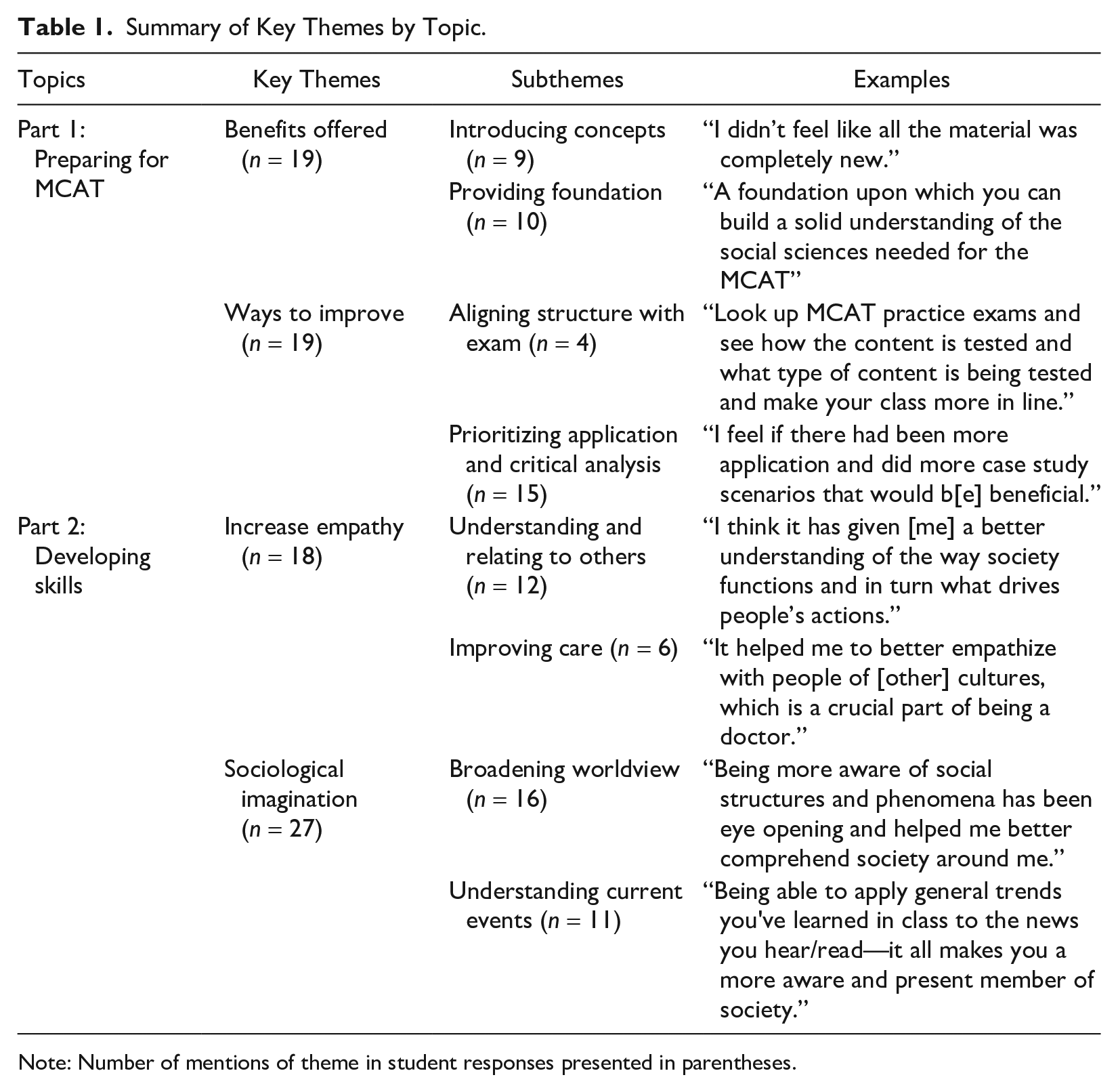
Note: Number of mentions of theme in student responses presented in parentheses.
Part 1: Student Perceptions of Sociology and Preparing for the MCAT
Students reflected on how their sociology courses relate to their experiences with and preparation for the newly designed MCAT. With the addition of the PSBB section in 2015, students are asked to solve problems that combine “knowledge of foundational concepts” in these fields and apply their “scientific inquiry and reasoning skills” to understand how psychological, social, and biological factors work together to influence health behaviors and attitudes (AAMC 2022b). In this section, we outline the advantages students reported gaining from taking sociology in that the courses introduce key concepts and provide a foundation of content. Students also had suggestions for improvement in course structure and wanting more emphasis on application and analysis. Respondents’ unique identification numbers are listed in parentheses following each quotation in the following text.
What Sociology Classes Provide for MCAT Prep
Definitely having an instructor introduce the concepts and vocabulary for the specific phenomena laid a fundamental foundation for MCAT application. (2)
This quote aptly summarizes the two primary subthemes observed in student responses: Introductory sociology courses helped them prepare for the MCAT by (a) introducing core concepts and (b) providing a foundation from which they could prepare independently for the test.
Introducing concepts
Multiple students indicated courses “introduce” them to concepts assessed on the MCAT. One student described familiarity as crucial for preparing for the exam: Introducing the topics was extremely crucial in my opinion because it allows you to not only connect the bigger picture but also see high yield questions. (15)
The familiarity allowed students to review social science material instead of learning the concepts for the first time. However, as discussed in the following section, students also stressed independent study was critical to build on these introductions, saying the courses “gave some information about MCAT content, but I had to learn most of it myself” (6). For students to learn that material on their own, they would use the multiple online and print resources available for independent study—both directly through AAMC and through sources such as Khan Academy, Kaplan Test Prep, and Princeton Review. 2 While students emphasized on our survey that they could not discuss specific questions or disclose information on particular concepts from the MCAT, students can find free full-length (230 questions) practice exams as well as videos describing solutions to practice questions on these websites for independent study.
Providing a foundation
Students felt the introductory courses provided a foundation from which they could prepare independently. One student noted, “The courses did a good job of providing a foundation upon which you can build a solid understanding of the social sciences needed for the MCAT” (3). This familiarity is important for retaining information: “It provided me with a slight foundation to better understand it when I actually studied sociology for the MCAT. I didn’t feel like all the material was completely new” (15).
This familiarity also expedited preparation, “studying went by a lot quicker, since I had seen the vocabulary and concepts before in class” (11), and aided recall, “when I was reading about the topics when studying for the MCAT it was something that I could say, ‘oh, I remember that’” (7). Another indicated how the course made concepts more understandable: “Many of the concepts covered in class were also covered in my prep course review books, so they were very easy to understand” (13). These examples exemplify the role introductory sociology courses played in preparing students when returning to the social science material for the MCAT.
What Sociology Classes Lack for MCAT Prep
While students provided examples of how sociology classes helped prepare them for the MCAT, they also identified what they believed to be shortcomings. When asked if there was anything they would like to share about sociology and the MCAT, one student noted her sociology course was “no[t] very helpful because the MCAT asks very specific questions that are unlikely to be touched upon due to the general/big picture teaching style in the classroom” (5). She went on to explain that “the MCAT has specific topics it covers and unique question formats that is not at all touched upon in university classes” (5). In addition to these observations, students’ suggestions fall into two primary subthemes: (a) align the courses with the structure of the MCAT and (b) prioritize application and critical thinking.
Aligning courses with MCAT structure
In addition to introducing students to sociological concepts, some students suggested aligning course structure and content with the MCAT. One student proposed that instructors could “look up MCAT practice exams and see how the content is tested and what type of content is being tested and make your class more in line” (6). Another requested creating a new course “dedicated to the MCAT because the test requires a synthesis of psychology and sociology topics that most classes don’t cover” (7). A more practical suggestion was the inclusion of a project that links cases with course concepts more directly, “that essentially leads to a large study guide with vocabulary and their applications” (3).
Prioritize application and critical analysis
While the AAMC committee that suggested a MCAT redesign did not intend for professors to alter their curriculum (Mitchell et al. 2016), premedical students in our sample voiced wanting more practice applying concepts to passages as they would do on the MCAT. As one student wrote, “I feel if there had been more application and did more case study scenarios that would b[e] beneficial” (10). Another student requested an opportunity to be assigned more “article type stuff to better prepare us for the MCAT” (15) in the sociology courses.
Similarly, students indicated the need to foster critical thinking and analysis. One student requested that professors “prepare students by incorporating more critical analysis of studies that are involved in the social sciences” (4). Another student directly linked this skill to MCAT success: “I think adding a component of critical thinking and analysis to sociology classes would be beneficial for interpreting passages for the MCAT” (6). Students in our sample highlighted how sociology instructors could better help prepare them for the entrance exam by providing practice with the structure of the types of questions on the MCAT.
Part 2: Student Perceptions of the Skills Sociology Provides
In addition to reflecting on MCAT preparedness, students shared how sociology has enhanced their lives and worldview. This section describes how exposure to a sociological perspective helped students develop empathy necessary for success in the medical profession and how the sociological imagination broadened their worldview and enhanced their understanding of current events.
Developing Empathy through Fostering Inclusion
The sociological perspective advocates understanding differences related to various social demographic characteristics, including race, class, gender, age, sexuality, political affiliation, disability status, and more that helps individuals make sense of the world. The value in this perspective can be observed in the survey responses, where students described how sociology courses helped them deepen their empathy through exposure to a more inclusive perspective of social life. One student reported sociology “makes you more aware of people and their possible reasons for doing what they do” (14). Another wrote, “I think it has given [me] a better understanding of the way society functions and in turn what drives people’s actions” (26). Another student described how understanding oneself helped him when interacting with others: “Sociology taught me how to form my own opinions about the world around me and how to approach others who might not share the same views” (5).
Understanding and relating to others
Multiple students described sociological concepts helped them make sense of others’ actions through understanding the social structural context in which they made their decisions. First, sociology helped them “relate to others different from me” (26). One student shared sociology encouraged her be more of an “open-thinker” who seeks to “view things from different viewpoints” and “has helped make me a more empathetic person” who is more “aware of social interactions” (27) in current society. Another student provided the example of exposure to conversations about racism in the summer of 2020: The biggest concepts in sociology that I would say has applied significantly to my outlook on the world today is racism, prejudice, and discrimination. I never truly understood the depth of effects such terms had on our society until the recent unrest in society. It’s definitely shed some new light on how I view these issues (3).
In reflecting on how sociology has influenced their lives, students repeatedly used the word “empathetic” and highlighted how covering topics such as racial discrimination and prejudice in their classes led to “greater cultural appreciation and exposure [and] allows me to understand things outside of my immediate world” (27) and “take a more educated and inclusive insight towards how I view the world now and I sincerely believe it was a much-needed class” (3).
Improving care
Second, respondents noted that this empathy was particularly useful for them as future doctors who would be working with patients and fellow health care professionals from diverse backgrounds. One student wrote, “it helped me to better empathize with people of [other] cultures, which is a crucial part of being a doctor,” (19) noting the importance of building relationships with fellow providers and patients for successful patient outcomes. Other students highlighted they would be able to provide better service if they can “relate better to patients” and “understand differences” in cultural backgrounds (25). The empathy gained through discussing structural inequalities could lead to more inclusivity in medical settings with both patients and fellow healthcare providers.
Developing a Sociological Imagination
Foundational sociologist C. Wright Mills (1959) defined the sociological imagination as the ability to see the connections between the individual and society by recognizing an individual and his or her situation through their historical and structural context. Through Mills’s illustration, we experience “personal troubles” such as losing a job, but these are actually “public issues” or the result of social problems that affect many in society (Mills 1959). Students in sociology classes are often encouraged (Picca, Starks, and Gunderson 2013) to notice patterns between various social groups (e.g., gender, race, age, socioeconomic status) that can help them separate out individual choices related to health from cumulative disadvantages related to exposure to stressors based on differential structural positions. Student responses to our survey questions fall into two categories that signify how developing a sociological imagination (a) broadens their worldview and (b) contextualizes contemporary events.
Broadening worldview
First, students indicated that using their sociological imagination broadened their worldview. One student (reluctantly) admitted to the benefits of this lens, noting “I wish we focused more on medicine, but I understand that by only focusing on medicine, we lose touch with other critical aspects of developing our knowledge about the world around us” (13). This student also wrote the discipline “provides a scope in which we can view our world differently, and it really helps me look at society and our interactions from a new perspective” (13). Gaining “new perspectives” may include the ability to make informed choices as a doctor because “it helps develop critical thinking skills that are important to making decisions” (3). This critical lens may help students to understand the social world because “being more aware of social structures and phenomena has been eye opening and helped me better comprehend society around me” (25). The theme in these answers is that through using a sociological lens, students could better understand the patterns in human behavior.
Understanding current events
Finally, students explained that developing a sociological imagination helped them understand current social events. For example, one student described how “sociology helped me to get a better understanding of current social and political issues” (16). Another shared that “understanding how society works, being able to apply general trends you’ve learned in class to the news you hear/read—it all makes you a more aware and present member of society” (14). Similarly, developing a sociological imagination allowed one student “to understand things outside my immediate world,” such as “social issues like poverty and medical access” (9) and social movements: I never realized how applicable all the concepts covered in sociology were until recently with everything going on the world at the moment—especially with the Black Lives Matter movement. (3)
Clearly, the students quoted here recognized the potential of sociological discourse for contextualizing historical events and found the concepts helpful for processing current events in our society.
For example, students demonstrated how sociology prepared them to employ their sociological imagination when discussing and understanding the COVID-19 pandemic. “What is happening in society right now can be explained by sociological concepts, such as the effect of the outbreak on those in a lower social (economic) class,” (14) responded one student, accentuating how social factors can affect physical health. This student wrote how the pandemic was a “real-life application about the (social) repercussions of the disease,” highlighting how structural discrimination leads to poorer health outcomes for racial minorities who were more vulnerable to exposure to COVID-19. She further explained, “unequal distribution of resources leading to how the virus disproportionately affects some groups over others, biases in quality of treatment, etc.” (14). This is an example of a student using a sociological lens to make sense of racial disparities in COVID-19 infections and deaths.
COVID-19 also caused considerable disruption to our social systems—such as the delivery of education and medical care—which required students to adapt, and they felt that sociology helped them do that: The pandemic has reinforced the point that knowing facts, although necessary, is not enough to succeed in medicine—the ability to interact with patients and show resilience during tough times is also necessary in a physician. (19)
One student reported that they felt that the outbreak demonstrated the need for “very dynamic healthcare system in order to prepare ourselves for blows like this” and for putting “systems in place that allow change to be more fluid” (5). Another student highlighted the racial disparities in who COVID-19 affects most and how she hoped to play a role in addressing that inequality.
With its disproportionate effects on minority communities, specifically the Black community, I have a new desire in the future to speak up against and directly combat health disparities and healthcare disparities based on race. (15)
Student responses showed that perspectives developed in social science classes make them want to “strive for medical equity in all communities” (19) or address “health disparities, underserved communities, and cycles of poverty” (25) in their future careers in medicine.
Discussion
In this research, we identified what premedical students found helpful in their sociology courses as they prepared to take the MCAT—and what they believed was lacking. Students described how sociology courses helped them study for the MCAT and process current events that helps prepare them for life and their careers in medicine. Students reported that sociology courses introduced them to foundational social science concepts, prepared them for the entrance exam to medical school, and helped them adopt a sociological imagination through which they could better understand current events and their future patients and colleagues from different social backgrounds than their own. While some students indicated critical analysis was lacking in their introductory sociology course, others explained how sociology developed their sociological imagination and encouraged them to see the connections between individuals and society, demonstrating that sociology helped broaden their worldview and provided contextual understanding for contemporary events.
Now that there is a social science section on the MCAT, some social science departments may choose to designate a special health section for an introductory course. Mitchell et al. (2016:9) suggest creating a “single, integrative, introductory psychology and sociology course” but warn this would result in “obvious staffing and source material barriers to overcome.” The American Psychological Association (2014) argued instead that greater “conceptual consistency” across all introductory psychology courses would be more beneficial for both the discipline and premedical students preparing for the MCAT. Our research suggests our standard non-medical-focused sociology courses are helping students. Students describe that their sociology courses helped them to develop empathy and adopt a sociological imagination through which they can better understand how structural inequality affects patient care and health outcomes in our society.
While premedical students are understandably oriented toward what information will help them get into medical school and might prefer their social science professors “teach the test,” the AAMC committee itself has emphasized that they do not expect introductory social science courses adjust to the topics that might be tested on the new entrance exam. In official communication about this social science section, the AAMC states that this section is added because future physicians will be serving an “an increasingly diverse population,” so understanding the human and social issues of medicine and the impact of behavior and beliefs on health is vital (AAMC 2022b). We propose that the proliferation of online resources available to premedical students about the specific content of the MCAT 2 makes it unnecessary for social science professors to directly address detailed MCAT questions in their courses—and note that the AAMC restricts those who have seen practice exam questions from reproducing them.
Our study suggests that faculty time would be better spent introducing foundational sociological theories and concepts to develop students’ critical thinking abilities through assignments, in-class discussion, and group work that encourages them to engage with one another. Specifically, our data suggest that a change that sociology instructors could make would be to assess student application of sociological concepts using short articles or case studies. This approach would be similar to how the students will be evaluated on the MCAT, which uses multiple-choice questions on passages of primary source material. This type of exercise would simultaneously serve all students in developing critical analysis skills and meeting a stated student learning outcome in our program of using sociological knowledge to inform policy debates and promote public understanding. For example, the first author uses an activity in class (available on request) that provides a table and figure of life expectancy by different racial and gender groups and asks students to write true statements explaining the variation by race and gender. While the MCAT is a standardized multiple-choice test, that critical analysis of examining a “primary source” (i.e., a table or a passage on any topic) and then explaining the important points of information would be excellent practice for the types of questions asked on the MCAT.
If these faculty chose to not use case studies to test all students, they could still provide some of these types of questions that they create themselves or links to publicly available MCAT test prep materials in their class online learning management systems for students who are interested in the MCAT but may not be aware of those resources. Furthermore, all students benefit by faculty explicitly outlining the function of their learning by highlighting specific skills they are helping students to build during their coursework such as communication, drawing evidence-based conclusions, interpreting data, and practicing critical thinking abilities. Making learning goals transparent goes a long way in helping students to see what they are learning in their courses and helps them become an active part of the process (Howard and Zoeller 2007).
As premedical students who have recently taken the MCAT exam described, sociology courses teach them empathy and to use their sociological imagination. Based on the timing of our surveys (2020–2021), it is unsurprising that several students discussed the effect of the COVID-19 pandemic and the racial justice movement on their medical education using a sociological lens, highlighting how racial and economic disparities in health care access result in differences in disease rates and outcomes (Hill and Artiga 2022). Incorporating assignments and activities that explicitly require that students adopt the “role of the other” would be a way to both encourage and assess empathy. For example, the first author uses an “Imagine if . . . ” reflection group exercise that asks students to imagine the stress process model (Turner 2010) for fictional individuals with various demographic characteristics, social resources, and personal resources and then write a narrative following their in-class discussion. This assignment helps students build empathy and is available in full on the Teaching Resources and Innovations Library for Sociology (TRAILS) website (Culatta 2023). Future studies should follow up on whether these skills and the inclusion of the social sciences in medical education influence medical practice.
Limitations and Future Research
This research has several limitations. First, our sample size is small and was collected at a single university that has a fairly unique “BS/MD” program, and while in many ways this made it an ideal location for studying students who had recently taken the MCAT, this could also affect our findings. There are only 33 BS/MD programs across the United States (Suneby 2021), making this a somewhat rare path for prospective medical students to take given that there were 154 accredited MD-granting medical schools in the country for the 2020 academic year (AAMC 2022a). Students enrolled in these combined programs typically follow a lockstep curriculum in a set of required classes, often taken together in a cohort model, which could limit their exposure to other fields and students on other educational paths. The program at this institution does not guarantee admission to medical school but does greatly increase the likelihood of matriculation through exclusive opportunities for volunteering, clinical exposure, and research. Many undergraduates who plan to go on to medical school may not have the support or structure of a program designed specifically for premedical students. Future research should study undergraduates from multiple universities, including ones without an associated medical school. Our sample was also predominantly Asian, and this overrepresentation could affect responses.
Second, because we used open-ended survey methodology, we are studying perceptions of preparedness on the MCAT. Future studies could compare test outcomes among those who did or did not take a sociology course in preparation for the MCAT. Nonetheless, because these students recently took the MCAT and many had received their scores, they do have some confirmation that their preparation lead to success.
Finally, because these are premedical students, they may have more idealism at the time we surveyed them than they will have when they are farther along in medical school or practicing medicine (Becker and Geer 1958). Thus, future studies should focus on what medical professionals think about their experience with sociology when they are more fully integrated into the medical field. Limitations aside, our findings suggest important implications for educators of premedical students.
Conclusion
The United States lacks a system where all citizens have access to health insurance and affordable health care, which means understanding how socioeconomic status affects health is particularly important in our unique medical context. In the United States, those seeking to become physicians consistently come from higher socioeconomic backgrounds (AAMC 2018), which means they were themselves less likely to be adversely affected by unequal access to health insurance and affordable health care. As a result, it is particularly important for medical education to help future physicians gain an understanding of how social forces affect health care. The AAMC made the case for a foundational understanding of the social sciences to help improve physician care (Kirch 2012). It would seem, at least with these premedical students, the AAMC was right. The expansion of the MCAT requires students to focus on sociology, and in this article, we show how sociology helps develop these students’ understandings in ways that should help them as physicians and as citizens.
Footnotes
Editor’s Note
Reviewers for this manuscript were, in alphabetical order, Jay Howard, Daniel Menchik, Alexandra Nowakowski, Diane Pike, and Mary Senter.
