




Abstract
There is general agreement among sociologists that teaching social structure is a core component of a sociological curriculum. Despite this agreement, there are few guides for instructors on how to teach this key concept. Using the sociological literacy framework, this research examines the most popular undergraduate Introduction to Sociology textbooks and their supplemental resources. Most texts offer a basic definition, but beyond that, there were few additional resources for helping to clarify the concept. With this in mind, additional resources for supplementing the textbooks are offered.
As any sociology instructor knows, teaching students to see the social structure that surrounds them is challenging. For decades, scholars have talked about this concern and have highlighted a variety of reasons that make this a particularly difficult task (i.e., Coghlan and Huggins 2004; Saunders 1991). For example, Coghlan and Huggins (2004) surmise that the spirit of American individualism may add a barrier to this teaching. Encouraging students to think about the larger societal perspective goes against the foundation of our cultural beliefs. Saunders (1991) argues that students who do not understand the “big picture” become confused about sociological research and other concepts. Despite the challenge, educators must find ways to teach this difficult concept.
Through studies of instructor syllabi and surveys of sociologists, it is clear that sociological educators and scholars believe that social structure is fundamental to a full sociological perspective (Ferguson 2016; Ferguson and Carbonaro 2016; Grauerholz and Gibson 2006; Persell, Pfeiffer, and Syed 2007). Grauerholz and Gibson (2006:13) studied more than 400 course syllabi and found that the majority include three course goals, one of which is for students to “appreciate the concept of structure.” Wagenaar (2004) surveyed sociologists, including members of the American Sociological Association (ASA) and of regional sociological associations, and others and found that the highest-rated core items for an Introduction to Sociology course comprised a few basic concepts, including, of most importance here, social structure. Drawing similar conclusions, Persell et al. (2007) interviewed leaders within the sociological discipline about Introduction to Sociology course goals and found nine major themes across the interviews, including two that focused on social structure. Each of these provides evidence that the concept of social structure is fundamental to a sociology course.
Importantly, the ASA’s task forces have also continually found social structure to be a core component of the sociological curriculum (ASA 1991, 2004; Pike et al. 2017; Wagenaar 1991). Most recently, the ASA Task Force on Liberal Learning and the Sociology Major put forth recommendations for maintaining rich and comprehensive undergraduate sociology programs (Pike et al. 2017). Within its report, the task force discussed the importance of defining the learning goals within sociology. In doing so, it pointed to the sociological literacy framework (SLF) as created by Ferguson and Carbonaro (2016).
The SLF includes five essential concepts that “reflect larger organizing themes that lay the foundation of critical undergraduate knowledge in sociology” (Ferguson and Carbonaro 2016). These concepts “provide an organizational model for what knowledge is expected in the college-level sociology curriculum” (Pike et al. 2017:55). The five concepts include the sociological eye, social structure, socialization, stratification, and social change and social reproduction.
Of particular importance here, the concept of social structure refers to the fact that students of sociology should be able to describe social structure and how structural forces affect human action and social life at the micro, meso, and macro levels of society (Pike et al. 2017:56). More specifically, sociology students should be able to do the following:
(1) Distinguish important social institutions in society that make up the social structure and how they affect individuals and each other
(2) Differentiate the processes through which social roles and statuses, relationships, social groups, formal organizations, and social networks influence human thought and action
(3) Recognize how hierarchy, power, and authority operate across these structural contexts
(4) Provide examples of these concepts related to social structure in multiple historical and cultural settings
Despite the clear consensus on the importance of social structure, there has not been an examination of the means by which we teach the topic. With few additional resources focused on social structure coming from pedagogy and scholarship of teaching and learning literature, it is important to examine the textbooks that many faculty are using, possibly even as their sole source of text and activities. In 2006, researchers found that almost 93 percent of the syllabi in sociology indicated that a book, whether a monograph or textbook, was required for the course, and more recent research indicates that there is still a heavy reliance on textbooks as an education tool (Grauerholz and Gibson 2006; Liu and Szasz 2019; Oyinlade, Christo, and Finch 2020). Given the lack of pedagogical articles and the abundance of textbook use, one may conclude that many students are introduced to the concept of social structure in an introductory sociology textbook. With the lack of additional resources and the abundance of textbook use in Introduction to Sociology courses, it is important to ask how introductory textbooks approach social structure.
Methodology
This project examines how introductory sociology textbooks address social structure, both within the text and with supplementary resources. The SLF is used to examine the following questions:
(1) Does the textbook use the term “social structure,” and what definition is presented? What common themes are found within these definitions?
(2) Does the textbook offer additional examples of social structure as a whole?
(3) Does the explanation of social structure align with the description of social structure offered by the SLF?
(4) Does the textbook’s accompanying material offer any further explanation or resources regarding social structure?
Data
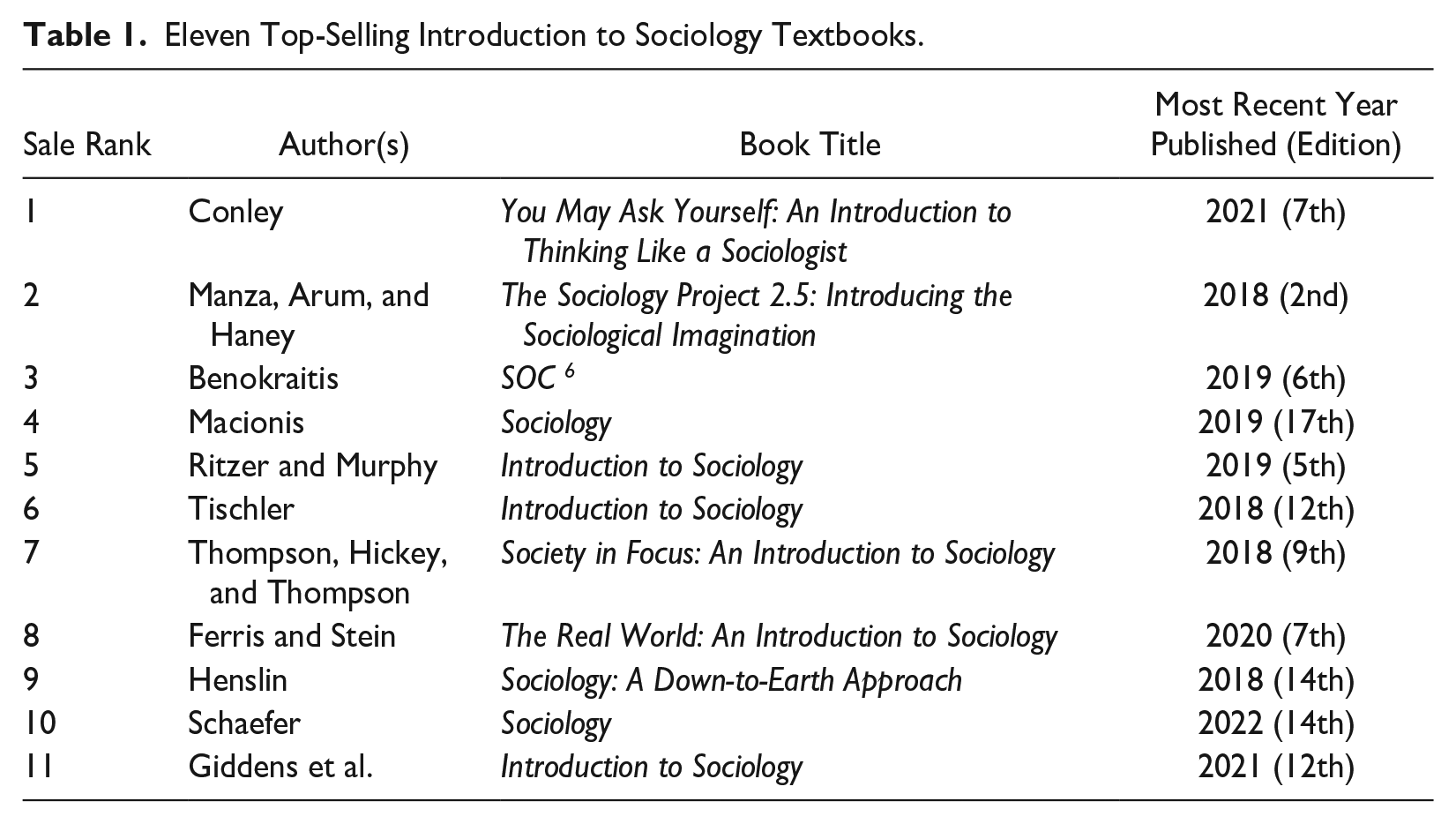
In order to answer these questions, a content analysis of major introductory sociology texts was conducted, using Liu and Szasz’s (2019) article as a guide for choosing textbooks and Oyinlade et al.’s (2020) as a guide for evaluation. Liu and Szasz’s research examines the 11 bestselling Introduction to Sociology textbooks’ coverage of climate change issues (see Table 1). The 11 texts that they use provide a general idea of the most popular texts within introductory sociology courses. Using bestsellers captures books with the largest student exposure. Additionally, introductory textbooks were used because social structure is fundamental to the discipline and therefore should be covered in introductory courses. The textbooks were gathered using an e-book option when available.
Eleven Top-Selling Introduction to Sociology Textbooks.
In addition to the textbook itself, access was also gained to the instructor resources that accompanied each text in order to ensure a full understanding of how each author approached social structure not only in the text but also with accompanying discussion questions, activities, and other resources. This textbook collection aligns with numerous past studies that have examined Introduction to Sociology textbooks’ structure and content (i.e., Carroll 2017; Keith and Ender 2004; Lewis and Humphrey 2005; Puentes and Gougherty 2013).
Analysis
The textbooks’ presentation of content on social structure was examined by reviewing the definitions of “social structure” that were provided as well as the examples given. Most importantly, the alignment between the textbooks’ explanations and the SLF’s explanations of social structure was examined. Last, the accompanying materials were examined for further examples or activities to help students understand the concept. Grounded theory was used as a basis for examining the themes within the books (Glaser and Strauss 2012). After collection of all of the data (as described next), an open coding process was used to examine the common themes found within the definitions provided and the concepts as related to the SLF.
The needed data were collected by using each e-book’s search function to search for “structure” throughout the whole text until the term was found (generally bolded) with a given definition; the term and definition were noted. If the textbook search did not provide a result, the table of contents was then examined for a chapter that likely contained the subject. For example, Tischler (2018) did not use the term “social structure,” but an examination of the table of contents and numerous possible chapters yielded the term “social organization” in a chapter titled “Social Groups and Organizations.”
Following the identification of the concept in the textbook, the name of the chapter and the chapter number were noted. The entire chapter was then read, and the other concepts covered within the chapter were noted. The SLF states the social structure includes the topics of roles, statuses, groups, and so on. If these topics were not included near the definition of “social structure,” the search box was used to look for other locations in the book; this process was repeated with all of the social institutions and with “hierarchy”, “power”, and “authority”. While textbooks were read, note was taken of any provided examples of social structure and its components. For example, did the textbook offer an analogy to further explain the meaning of “social structure”? If not, did it offer examples of any of the components, like role or status? This was important because the SLF contends that it is important to learn the concepts in varying historical and cultural contexts.
After examination of the e-book itself, accompanying instructor and student materials were examined that corresponded to the chapter in which the concept was covered; materials addressing social structure or its components were noted. These resources ranged from discussion questions to writing activities to audio files.
Findings
Definitions
The terminology and definitions provided in textbooks are the basis of a student’s understanding and future application. Because of this, I was interested in the terms and definitions that were used to describe social structure. Sociologists commonly agree upon the importance of social structure to the discipline’s foundations. This significance was reflected when examining the textbooks. For example, 9 of the 11 textbooks invoke the term “social structure.” Interestingly, though, two of the textbooks do not match the rest. Tischler (2019) uses the term “social organization” as opposed to “social structure”; however, upon examination of the provided definition, it is clear that the two terms have the same meaning. Additionally, Conley (2021) focuses only on social institutions and not on structure (see Table 2).
“Social Structure” Definitions Used in Textbooks.
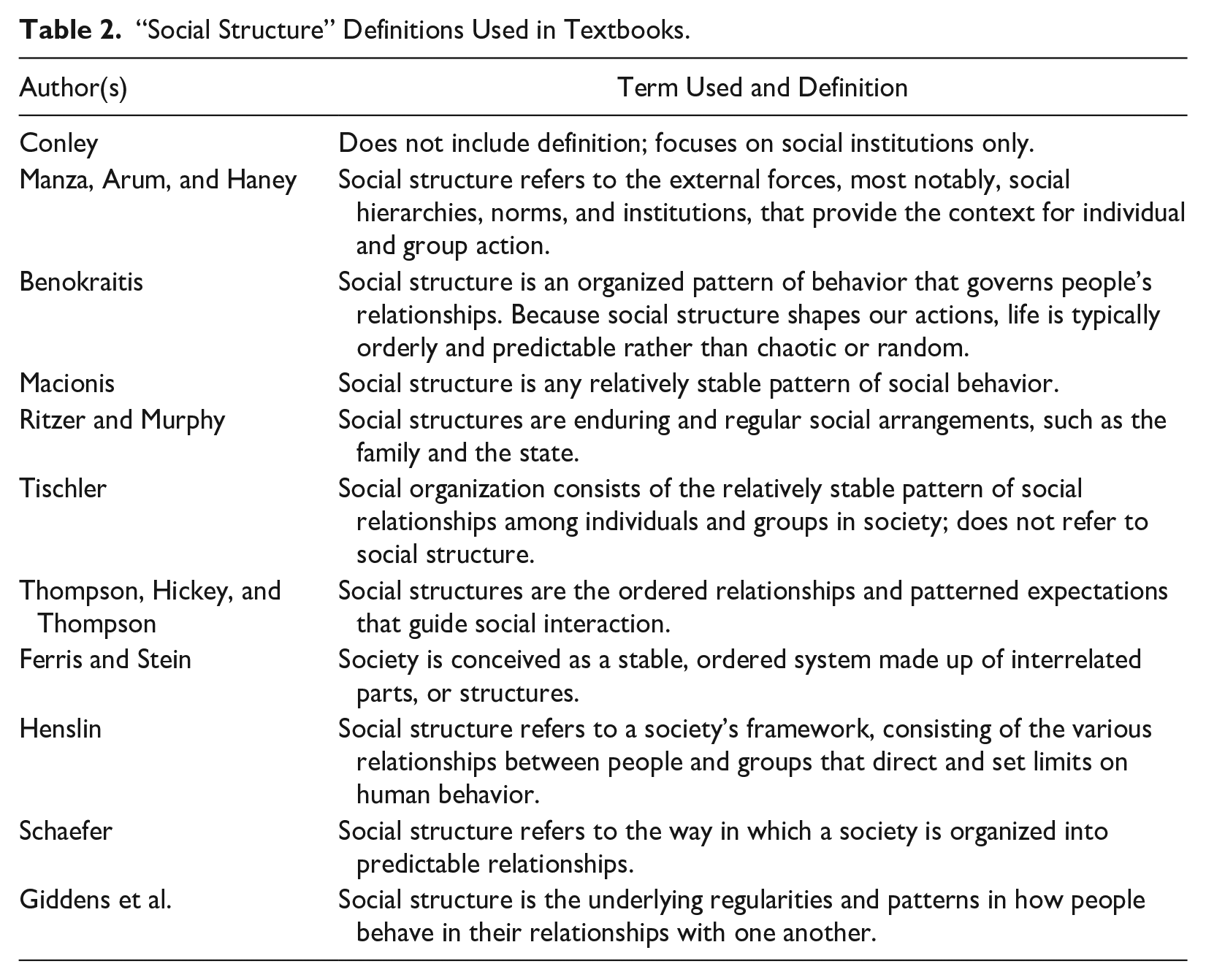
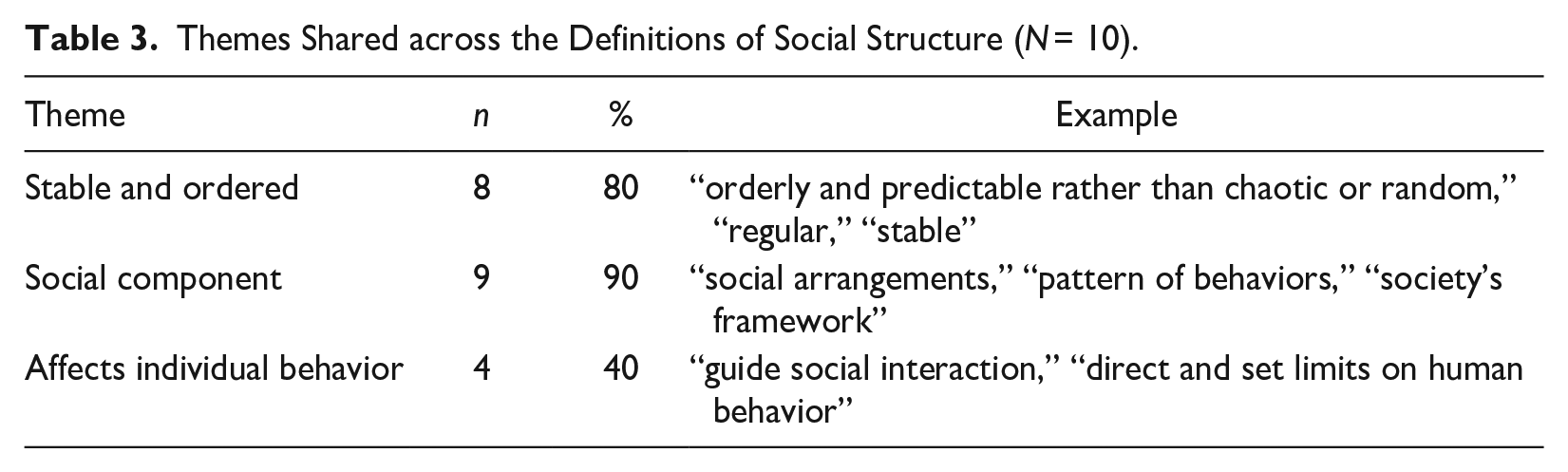
Examining all the given definitions of “social structure” revealed three common components (see Table 3). (For the purpose of this analysis, this includes Tischler’s [2018] definition of “social organization.”) First, 8 of the 10 definitions mention that social structure is ordered and stable. The books used a variety of descriptions, including “organized,” “stability,” “predictable,” “not dynamic,” “patterned,” and “regular.” Second, the definitions indicate that social structure is made up of a social component, defined as “social relationships,” “behavior,” “how people behave,” or “expectations”; this is a component of the definitions in 9 of the 10 textbooks. Last, 4 of the 10 definitions include a component about how social structure affects individual behavior, describing how it “guides social interaction,” “governs people’s relationships,” “regulates our behaviors,” and “provides the context for individual and group action.”
Themes Shared across the Definitions of Social Structure (N = 10).
Although many textbooks do include a definition of social structure, and there are common themes throughout the definitions, they often use abstract concepts. For example, one complete definition is “the way in which a society is organized into predictable relationships” (Schaefer 2022). This leaves the reader with many additional questions. Another example definition is “the external forces, most notably social hierarchies, norms and institutions that provide the context for individual and group action” (Manza et al. 2018). Again, for an introductory sociology student, this definition uses unfamiliar terms to define itself. What is an institution, norm, and so on?
Additional Examples of Social Structure
After the definitions were located, the textbooks were examined for examples to further explain what social structure includes. About half of the books include no examples after their definitions (see Table 4). This is surprising based on the importance of the subject. That said, some of the texts use examples of a changed structure or no structure to show evidence of what social structure does when it is in place. For example, Manza et al. (2018) use zombie apocalypses and Hurricane Katrina as examples of what happens when social structure breaks down. Schaefer (2022) uses Zimbardo’s prison experiment as an example of how behavior changes when the social structure around one changes. Last, Thompson, Hickey, and Thompson (2018) share a narrative about how faculty were enjoying lunch when a tornado alarm went off, which caused an immediate loss of their previous roles and expectations. Each of these examples juxtaposes what happens when structure disappears or changes with what normally occurs.
Examples Provided for Social Structure in Text.
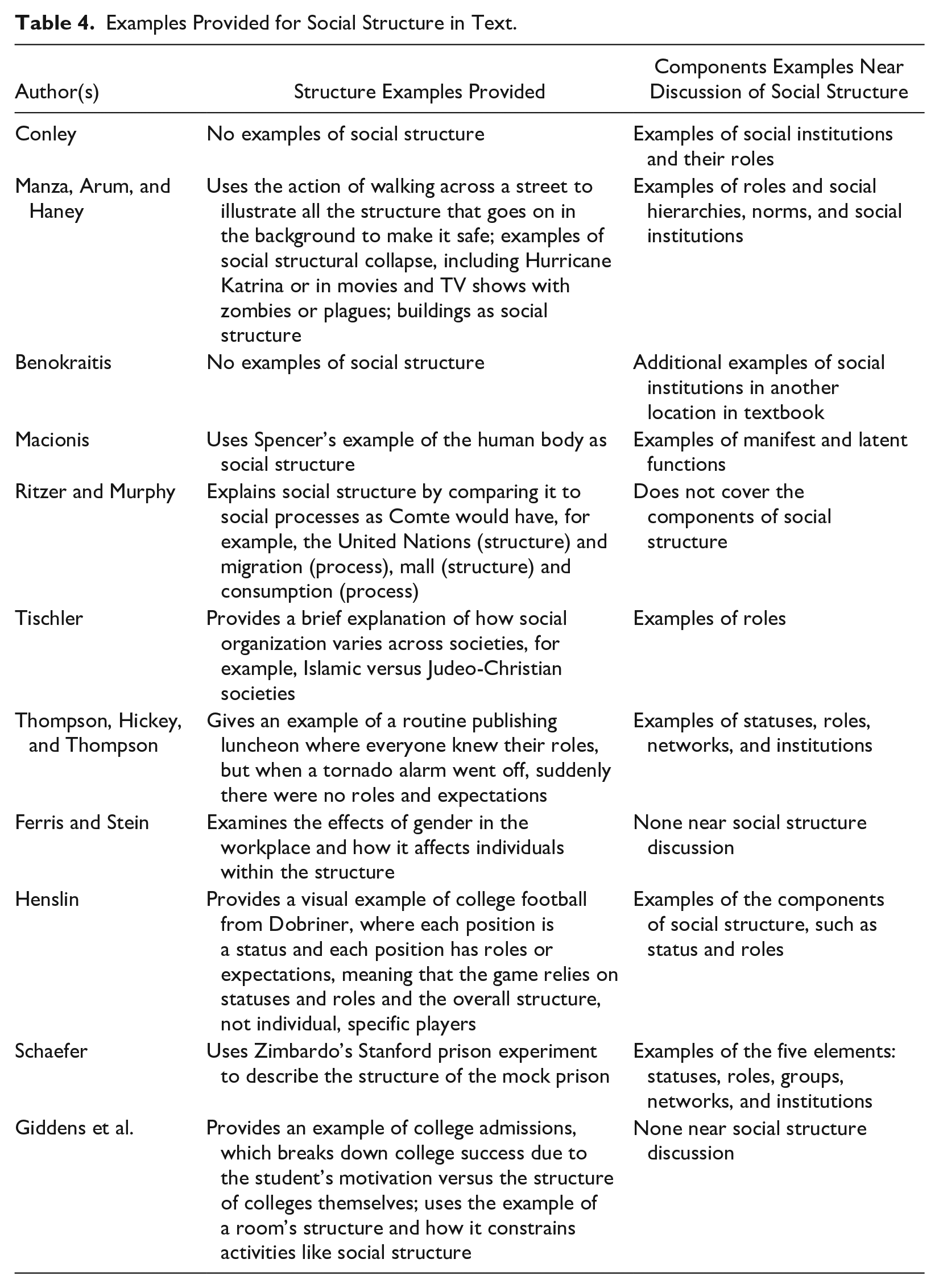
Other texts make comparisons between social structure and various other figures. For example, Giddens et al. (2021) explain that, similar to social structure, a physical room constrains our behaviors and is external to us. Henslin (2018) echoes back to Dobriner by likening social structure and its components, statuses, and roles to an entire football game and each of the player positions. Last, Macionis (2019) draws on Spencer’s comparison between the human body and social structure, noting that all parts of the body work individually to keep the human alive, just as social structures keep society healthy and functioning.
Evaluations of Social Structure via SLF
After examination of the main concept and its definition, alignment was examined between the textbook and the four components that the SLF has determined are key with social structure: (1) social institutions; (2) roles and statuses, relationships, social groups, formal organizations, and social networks; (3) hierarchy, power, and authority; and (4) application in multiple historical and cultural settings (see Table 5).
“Social Structure” Evaluation Using the Sociological Literacy Framework (SLF).
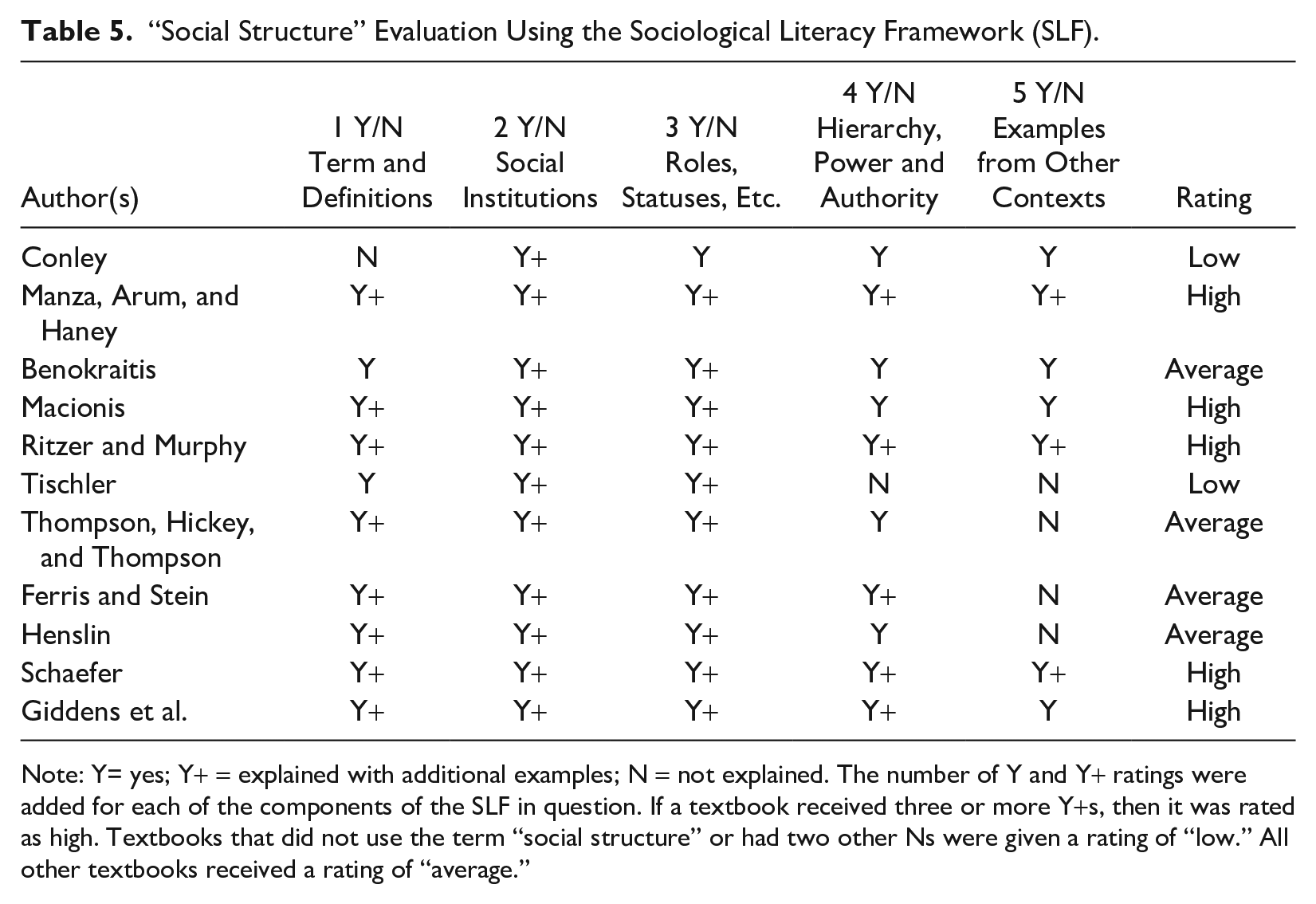
Note: Y= yes; Y+ = explained with additional examples; N = not explained. The number of Y and Y+ ratings were added for each of the components of the SLF in question. If a textbook received three or more Y+s, then it was rated as high. Textbooks that did not use the term “social structure” or had two other Ns were given a rating of “low.” All other textbooks received a rating of “average.”
Social institutions
All of the textbooks include information about social institutions. In some of the books, they are discussed within the context of social structure, while in others they are included in the chapter on theory. For example, Macionis (2019) defines social institutions while describing Marxism. The book then uses the economy as a social institution that Marx says dominates all others and defines the character of the entire society. Giddens et al. (2021) also uses theory, specifically Durkheim’s, to describe how institutions must function together as a whole. Each of the textbooks includes numerous chapters in the second half of the book that focus on specific institutions. The topics vary depending on the book but include religion, education and schools, marriage and the family, politics and government, economy, the body, medicine, and health and health care.
Roles and statuses, relationships, social groups, formal organizations, and social networks
All of the books include at least some of the topics listed in the SLF. Roles and statuses are the most commonly included of the five. Importantly, since these are themes listed as part of the broader concept of social structure, it was important to see whether they are presented together. Generally, each textbook splits the themes in different chapters, so roles and statuses might appear within the discussion of social structure but groups and networks would be in a different chapter (e.g., Giddens et al. 2021; Thompson et al. 2018). Not a single textbook includes social structure with all five topics in one chapter.
Hierarchy, power, and authority
All of the textbooks, except Tischler (2018), provide some variation of descriptions on these three themes. Five of the textbooks include the discussion of power and authority within a chapter focused on the government and politics. For example, Giddens et al. (2021) describe authority within a discussion of leadership types, while Ritzer and Murphy (2019) use examples of political leaders to explain power and authority structures.
Application in multiple historical and cultural settings
Most of the textbooks do not offer both historical and cultural examples. For example, Ritzer and Murphy (2019) and Schaefer (2022) provide global examples from various societies but do not include many historical examples of the concepts. On the other hand, Conley (2021) uses historic examples from the United States, such as Duke University’s historic admissions process and the cigarette company Phillip Morris. While this was the least commonly found theme, authors like Manza et al. (2018) offer a range of examples from Margaret Thatcher’s focus on the individual as opposed to social structure to what happens when a natural disaster like Hurricane Katrina strikes and social structure is broken down.
Supplemental Resources
In order to fully capture the resources available to instructors, any supplemental material available with the textbook was also examined. This included numerous options, including lecture outlines, media applications of concepts, web activities, video resources, review questions, journal prompts, and suggested assignments.
There is quite a range of resources in general, but in regard specifically to extra information about social structure, there is even greater variation (see Table 6). Some texts offer no additional support for teaching social structure, while others include the topic only within chapter outlines. Still others include resources on specific components of social structure but not the concept as a whole. For example, Benokraitis (2019) includes activities and film suggestions related to status and roles, and Conley (2021) offers comparisons between sports teams and social institutions. Two texts provide suggested questions that ask students to examine their own location in the social structure and how it affects their perceptions and behaviors. For example, Henslin (2018:6) suggests that faculty “have your students identify their locations in the social structure in terms of culture, social class, social status, roles, groups, and social institutions. Then, looking at each of these components, ask them to provide at least one example of how these components have influenced their current perceptions, attitudes, and/or behaviors.” These are particularly useful activities to provide. Some books provide video clips; one compares social structure to college football, while another asks students to examine the roles of the U.S. president.
Accompanying Material Covering Social Structure and Its Components.
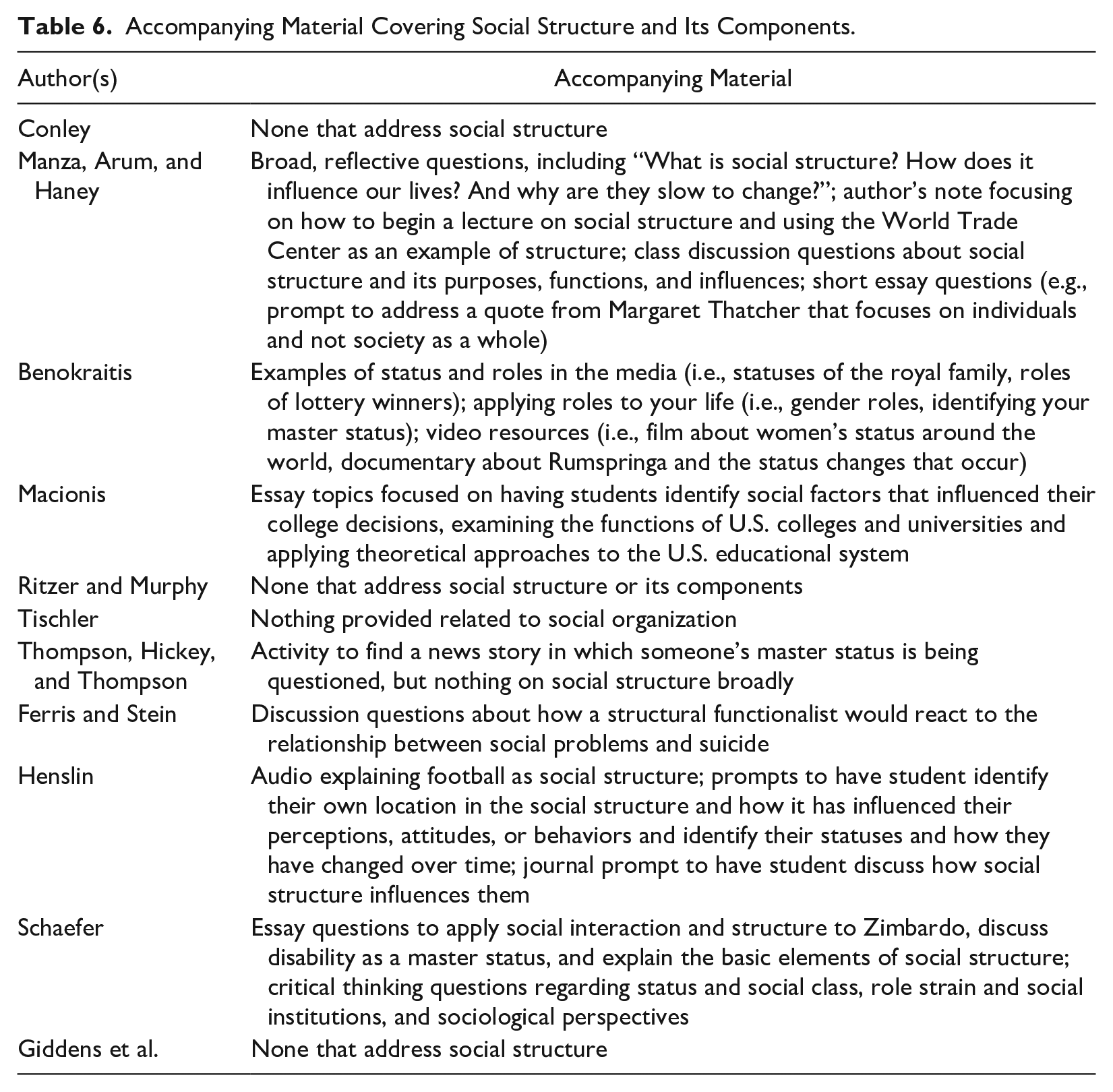
Arguably the most informative resource seems buried in an author’s note in The Sociology Project 2.5’s instructor’s manual, which states that “the concept of social structure is central to sociology, but one that is very difficult to convey to our students effectively” (Manza 2018). It goes on to state that sociologists use the phrase “social structure” in both scholarship and the classroom but do not explain what they mean. The note encourages instructors to ask students to think about free will and all the reasons that they cannot do exactly what they want at all times. By having them consider free will, an instructor can move into discussions about the social constraints that limit us and, thereafter, a conversation about individual agency and social structure. It also cautions instructors about focusing too much on constraint, as social structures also “enable us to act in ways that are interpretable by others, promote efficient interactions, and in general make societies possible in the first place” (Manza 2018). It then gives an example of how a building’s foundation and steel frame are invisible after the building is completed but provide the backbone, just as social structures provide a backbone to social interaction. Last, it provides examples of what happens when there is no structure in interactions, such as during a zombie apocalypse.
Discussion
The findings show that while most of the textbooks offer similar definitions, the information is often nested within a variety of other concepts. Of the 11 textbooks analyzed, 9 include the specific term of “social structure”; importantly, two textbooks do not use the term at all, and one uses the term “social organization” to describe this concept. While strong commonalities exist between the definitions themselves, each is still abstract, causing a lack of understanding; because of this, it was important to examine whether the textbooks offer additional examples. Examination of supplemental resources and instructor’s manuals revealed that a few texts offer additional discussion questions asking students to think of their own location in the social structure; beyond that, few additional resources are provided to help clarify the concept. With the exception of Manza et al. (2018), the textbooks need to further clarify what social structure is, whether through examples or more specific definitions, and even within Manza et al., the discussion of social structure and its complexities is buried in an author’s note in the supplemental materials.
Last, in regard to the alignment between the textbooks and the SLF, it was clear that the texts could make clearer links between the components of social structure and the larger concept itself. Most of the books do offer some combination of the four components, but the components are not found together, and none of the books include a direct link between social structure and each of the four components. If this is how the sociological curriculum should be built, then our textbooks should reflect this.
These findings reflect the greater discussion about standardization across the discipline. Sociologists have been working on streamlining the undergraduate curriculum for decades (ASA 1991, 2004; McKinney et al. 2004; Pike et al. 2017). While this debate will always occur, the SLF offers a useful framework in thinking about a comprehensive sociological education. Importantly, the SLF was only recently published; now that it has determined five essential concepts for a sociological perspective, time must be taken to study how they are taught and to create resources to help instructors.
Conclusion
As a discipline, sociologists have decided that the teaching of social structure is essential to the understanding of what it means to be a sociologist, and yet, textbook authors have been relied upon to do much of the outreach to and educating of students. A closer examination of what is being included in the textbooks makes it clear that there are many opportunities for growth. Therefore, as a discipline, with the leadership of the ASA, it is necessary to continue our support of the teaching and learning efforts already being made as well as to work to broaden the reach of these efforts to all those in the classroom and those not affiliated with the ASA. This could include working with specialized scholars to offer additional resources for teaching concepts that have been determined to be fundamental to sociology, such as social structure.
In order to supplement any shortcomings of the textbooks, exploration of the following resources is suggested. Dobriner (1969), Frye (2000), and Krieg (2021) offer analogies for further explaining social structure, each of which could be used as an example within a larger lecture on social structure. Dobriner discusses the challenges of teaching an intangible concept like social structure. After describing the components and functions of social structure, he states that they “have been admittedly abstract . . . and yet, if what [they] have to say regarding the universal qualities of social structures and social systems are valid . . . then [people] should be able to observe them on the level of everyday experience” (Dobriner 1969:117). In order to do so, he offers the analogy of a football team. First, he points out that football teams exist within the context of created norms. For example, there are two teams that play for 60 minutes on the same-sized field each time. He also notes that each status/role, or in this case, position, has defined norms, that is, the quarterback has extra protections while throwing the ball. Last, he notes that there is social interaction between the two teams that leads to the game play. Overall, a football game is relatively predictable because of these norms, roles, and statuses. No matter which specific player is in a position, the game will go on. The football team can be seen as similar to society’s structure and institutions.
When discussing oppression, Frye (2000:12) invokes the metaphor of a birdcage to represent the experiences of the oppressed and “the forces and barriers that are not accidental or occasional and hence avoidable, but are systematically related to each other in such a way as to . . . restrict or penalize motion.” She notes that by looking at one single wire, one cannot understand why a bird’s movement would be restricted. It is only when one steps back and sees the whole cage and the wires’ relationship to each other that one can see why a bird does not fly away. Similarly, one must see the whole social structure to recognize the challenges faced by the oppressed.
Krieg (2021) uses a Hoberman Sphere to represent social structure and the institutions that compose it. The aid requires the instructor to display the sphere and have students imagine that they live within it. Within a class lecture or discussion, students then must indicate how the sphere is constraining, enduring, pervasive, and invisible. This then opens a discussion of institutions and what happens when someone lives within a society without a stable structure.
Wilkinson and Thomson (2017) and Peretz and Messner (2013) offer class activities for further explaining social structure. Wilkinson and Thomson focus on having students look at structure in relation to agency. They use the poem “Lost Generation” by Jonathan Reed to have students reflect on what structural factors may influence whether someone sees hope and the need for social movements or not. Peretz and Messner also look at structure and agency but do so by contrasting absolute freedom with social determinism. Their activity asks students who chose to take their class to stand. Then the instructor points out all of the other factors that led to someone taking the course, each time requiring students to sit if the statement applies. By the end, all of the students are sitting, and a discussion about choice versus structure can begin. While students think that they chose to take the course, there are a variety of other factors influencing them, such as general education requirements or scheduling.
The aforementioned examples are ways to expand students’ understanding of social structure using a concrete example. Scholars also have developed activities that encourage students to think about specific institutions and their functions. For example, an activity created by Saunders (1991) to accompany a reading and lecture has students work in small groups to fill in a chart that helps relate the social institutions to the moral beliefs and behaviors that support the institution’s structure. The chart is supposed to be filled out throughout the semester as students learn about different institutions.
Footnotes
Editor’s Note
Reviewers for this manuscript were, in alphabetical order, Kathleen Korgen, Julie Pelton, and Diane Pike.
