Abstract
In this study we explore how incorporating an arts-based pedagogical approach, specifically, the use of film, art, and music, into a second-year sociological theory course enhances students’ overall learning experiences. We report on data collected from a survey given to students enrolled in this course in 2020. Findings reveal that employing this arts-based pedagogy helps students to sustain an interest in the course material, understand the theoretical course material, engage in a higher level of thinking/analysis, feel more confident in their abilities to write about theories covered in the course, apply theory in the real world, contextualize historical content, and enhance their memory of theories and concepts. Findings are also compared with data collected from a similar survey conducted in 2009, revealing that the overall favorable responses to arts-based resources have remained consistent over time and that this pedagogy remains an enduring approach that contributes to positive student learning experiences.
Keywords
Instructors of sociological theory have the difficult task of presenting abstract theoretical concepts in ways that keep students engaged and help them better comprehend the theory-based material. Students’ preconceptions that theory-based courses can be boring, and the content inaccessible, make this challenge all the more difficult. These courses often introduce advanced theoretical concepts and utilize primary source material that students can regard as abstract, dense, dated, irrelevant, uninteresting, intimidating, and difficult to understand (Culton and Muñoz 2016; Holtzman 2005; Lowney 1998; McDuff 2012; Pedersen 2010; Pelton 2013; Weber 2010; Windsor and Carroll 2015). These barriers can ultimately lead to a great deal of anxiety for students, in both their understanding of and writing about theory, which can in turn affect their learning experiences (Lowney 1998; Pelton 2013; Windsor and Carroll 2015). There have been several pedagogical strategies suggested to help address these challenges, including the use of film (Andrist et al. 2014; Pelton 2013; Waller 2017), YouTube videos (Belet 2018), art (Barthel 1987; Miller 2000), popular culture (Wilson 2020), music (Culton and Muñoz 2016), poetry (Romero 2020), literary fiction (Weber 2010), collaborative learning approaches (McDuff 2012; Pederson 2010), and experiential activities (Windsor and Carroll 2015).
In this article, we will focus on how incorporating an arts-based pedagogical approach, specifically, the use of period film, art, and music, into the first author’s second-year classical sociological theory course can help overcome the obstacles described and enhance students’ overall learning experiences. We will analyze students’ perceptions of the helpfulness of these arts-based resources through the results of a 2020 survey distributed to the students enrolled in the course. Findings from this survey will be compared with data collected from a similar survey conducted in 2009 with students enrolled in the same course, taught by the same instructor.
Teaching Sociological Theory with an Arts-Based Pedagogical Approach: A Literature Review
Over the years educators from multiple disciplines have suggested that “arts are integral to learning as a method to educate the senses and nurture the imagination” (Rieger and Chernomas 2013:54). The literature provides a wide range of definitions for arts-based pedagogy (ABP) and scholars have defined it as a sound approach that has been successfully used across a number of disciplines (Barone and Eisner 1997, 2006; Leavy 2015; Marshall 2014; Meltzer and Schwencke 2019; Perry, Willson, and Morrissey 2011; Rieger et al. 2015; Rieger and Chernomas 2013; Turner 1996; Wehbi 2015). ABP covers a broad realm of creative, cognitive, and practical processes, including conceptualization, creating, performing, observing, using, integrating, and reflecting on art to understand other areas of knowledge and experience (Leavy 2015; Rieger and Chernomas 2013). This points to two general uses of ABP, whereby the student actively participates in the artistic process or the student observes and reflects on an art form to learn about another discipline (Perry et al. 2011; Rieger and Chernomas 2013).
The approach that most closely aligns with this research is defined by Rieger et al. (2015:102) as “a teaching methodology in which an art form is integrated with another subject matter in order to impact student learning.” This ABP can be particularly characterized by the utilization, integration, observation, reflection, and analysis of arts-based resources to help students engage with and make associations between theoretical concepts and historical examples. In this approach, art is used as a means to engage students and foster understanding as they become active learners in the “reflective observation of an art form” (Rieger and Chernomas 2013:58; Wehbi 2015).
Earlier studies have highlighted the benefits of an ABP when teaching sociological theory and theoretical concepts, specifically with regard to the incorporation of film (Andrist et al. 2014; Caldeira and Ferrante 2012; Collett, Kelly, and Sobolewski 2010; Pelton 2013), art (Barthel 1987; Miller 2000), and music (Ahlkvist 2001; Albers and Bach 2003; Culton and Muñoz 2016; Sawyer 2015). However, in recent years, there has been very little literature in this area, and therefore we hope the results of this study support the continued use of an ABP and further identify exactly how and why this approach is useful.
Using film as a pedagogical tool can spark interest in students and stimulate the sociological imagination, take abstract theoretical ideas and give them new life, create a bridge between the world of academia and the real world by contextualizing abstract concepts through real-life experiences, and help improve one’s critical analysis and observational skills (Andrist et al. 2014; Caldeira and Ferrante 2012). According to Pelton (2013), the use of film in lectures can also greatly reduce the anxiety that students often experience when taking a theory-based course. In particular, the use of film can help students better connect with the course material by providing the means to learn theory through a familiar medium. This can in turn make learning about sociological theory a more pleasant experience.
While there has not been a great deal of literature published on the use of art as a pedagogical resource in theory-based courses, what does exist strongly encourages its inclusion in the curriculum (Barthel 1987; Miller 2000; Wilson 2020). Incorporating images of art into a theory-based lecture can demonstrate theoretical concepts and effectively build on the content being taught. As Barthel (1987) and Miller (2000) contend, art can represent the sociopolitical context of its time, which can lead to a deeper understanding of theory and can assist students in retaining complex theoretical concepts. Examining and discussing art in a lecture setting allows students the opportunity to view the world from a unique and intellectually stimulating perspective. As Miller (2000:213) asserts, critical analysis of art can encourage students to appreciate the “complexity of the world” and can provide a new way for them to understand and interpret the meanings of primary texts.
Incorporating music into lectures has also been lauded as a successful pedagogical strategy for teaching sociology and sociological theory because it has been found to help deepen students’ understanding of the course material and assist them in making connections to more abstract theories (Ahlkvist 2001; Albers and Bach 2003; Culton and Muñoz 2016). Music has the potential to enhance student interest, increase active learning, and reduce anxiety through the use of a familiar medium (Ahlkvist 2001; Culton and Muñoz 2016). Albers and Bach (2003) also found that playing music during lectures can help to create an enjoyable and energizing atmosphere for students and instructors alike.
Arts-Based Pedagogy in Practice
The course being examined for this pedagogical approach explores the origins and development of sociological theory in its classical traditions, covering the works of theorists from the seventeenth century into the early twentieth century. Introducing students to the historical context of the theories covered in this two-semester core course is important, as they will be referring to these theories and concepts throughout their program of study. Also important are the development and practice of critical thinking skills, a learning outcome that is addressed in a variety of intentional ways throughout the course.
When teaching the course for the first time, the first author (instructor) observed that students were not fully engaged in the material and that they found the content dry and abstract. Subsequently, the instructor worked to find ways to make the material more interesting and relatable. In viewing films set within various historical periods, the instructor noted that certain scenes reflected the writings of many sociological theorists, which inspired the integration of film excerpts into the lectures. In addition, the instructor researched artworks and musical compositions of various historical eras and engaged in follow-up discussions with art historians and music scholars. These exciting exchanges inspired the instructor to regularly incorporate art and music into the lectures in the hopes of further enhancing students’ overall learning experiences.
At the beginning of the course, the instructor informed students that carefully curated historical examples from the period in which the theorists lived, and from which the social theories emerged, had been prepared. It was emphasized that these resources offer something tangible that would help open up discussions about the theories. Students were provided with guided applications of film, art, and music in order to help them develop an appreciation and a contextual understanding of the period. Using elements of the arts encouraged students to delve deeper into the theoretical material, enhance their learning experiences, and subsequently, develop their critical thinking skills.
In starting a conversation during class, the instructor typically asked students questions such as “If you were living at that time what concerns would you have about the social and political climate?” “How are social relations and social structures of the period reflected in the film, art, or music?” or “What elements in the art, film, or musical compositions resonate with the theoretical concepts being examined?” Such questions were intended to nudge students toward an understanding of a particular theorist’s concerns with the social issues of their day by showing the social and political environment that existed at the time of theory development. After this, students were asked to engage with each other in smaller groups about their observations in think-pair-share exercises. A spokesperson from each group would then share with the class their observations. The instructor provided feedback on the students’ points and elaborated on them, which would often encourage other students to contribute to the discussion. We will offer a few examples of these carefully curated arts-based teaching and learning resources that have been used in the lectures.
Film: Theory in the Theater
Excerpts selected from period films were incorporated into this sociological theory course. Due to time limitations in class, it was the instructor’s goal to carefully select scenes that would most likely resonate with students and facilitate connections of course concepts and ideas with the visual imagery of the period. For example, the instructor showed an excerpt from the 1995 film adaptation of Jane Austen’s novel Sense and Sensibility, in which well-known actors eloquently express the dynamics of gender and politics of the late eighteenth century. This film provides historical context for the ideas and theories of philosopher and writer Mary Wollstonecraft, an advocate for women’s equality in education and occupation and a major contributor to discussions on property laws (McDonald 1994). The excerpt addresses these particular themes with a poignant moment in which the female lead character candidly comments to a male suitor, “You will inherit your fortune; we cannot even earn ours” (Lee 1995). This line from the film speaks directly to the gender imbalance that existed at the time, which was the foundation for many of Wollstonecraft’s arguments. In showing excerpts from feature films, the instructor encouraged students to make connections to theorists’ works while they engaged with the characters, cinematography, and story line. After viewing a film excerpt, the instructor would initiate a discussion with the students about their interpretations of the scene, exploring together the ways in which it connected to the content of the lecture.
Art: Theory on Canvas
Selections of fine art that related to the theorists or theories being discussed were incorporated into each lecture to help students understand the historical context of the theoretical concepts. Images of paintings from the periods of the Industrial Revolution, the French Enlightenment, the French Revolution, and the early twentieth century were shown in order to illustrate the social conditions, sociopolitical ideology, and social sentiment of these eras. Concepts such as class conflict, alienation, and bureaucracy come to life and are given greater meaning through the use of historical art.
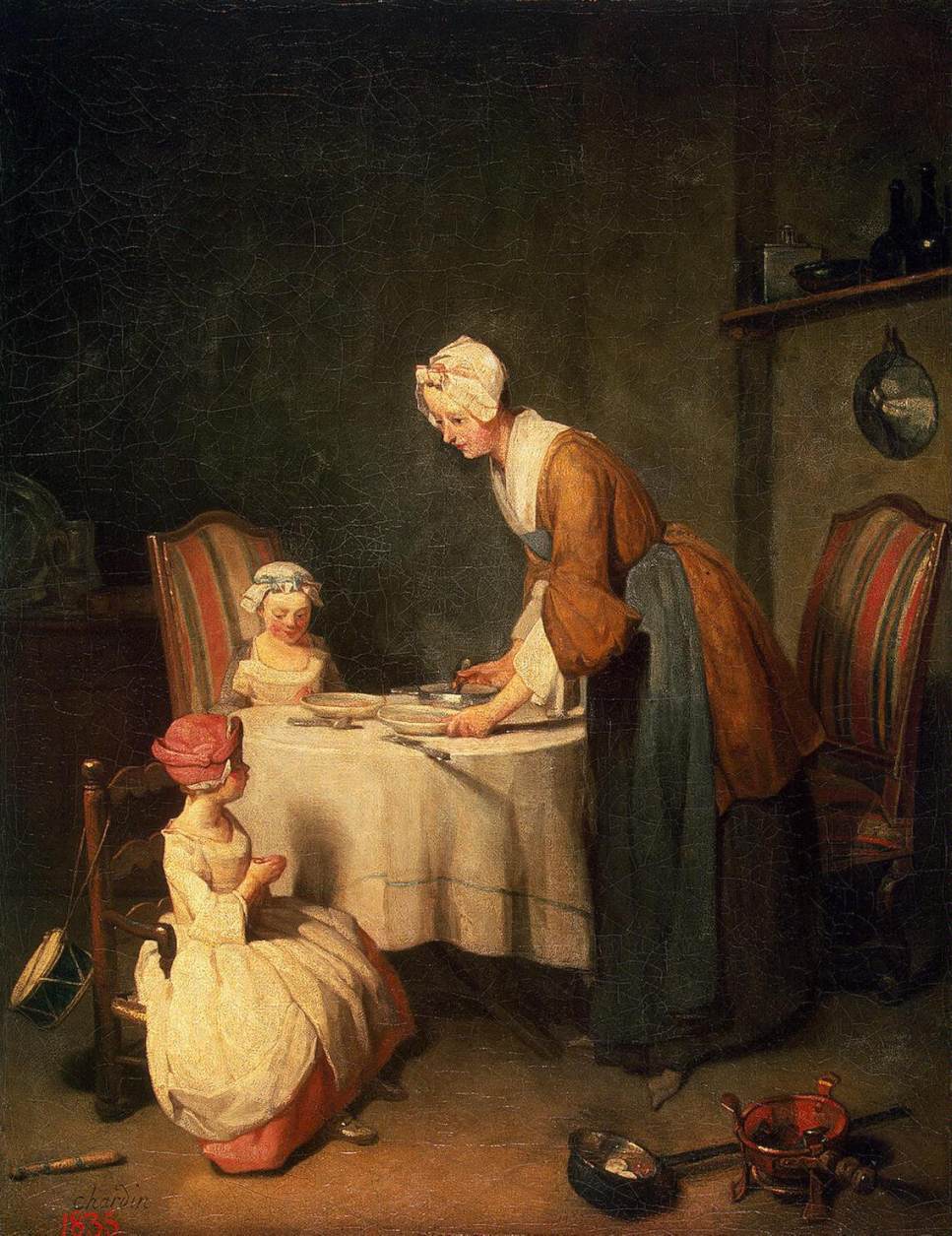
After showing an image of art, the instructor would facilitate a discussion with the students about its visual elements and how they relate to the theoretical material. For example, paintings by Jean-Baptiste-Siméon Chardin prompted discussions on the sociopolitical dynamics during the French Enlightenment and the years prior to the French Revolution, a time when the public’s contempt for the wealth of the aristocracy was heightened and everyday people were fighting for freedom and equality. Chardin’s realist scenes represent the values and virtues of the common people, depicting themes of honest labor and the family circle (Chardin 1738, 1740; Janson and Janson 2001) (see The Washerwoman and The Prayer before Meal). In a lecture on theorist Max Weber, the instructor presented paintings by Ernst Kirchner, a German Expressionist artist who, in his “street scenes,” depicts themes of the isolation within cities, a concept that was of central importance to Weber, who lived during a period of rapid industrialization. Students observed in Kirchner’s (1913) Five Women on the Street that although the women are in close physical proximity, they appear as isolated individuals who are “psychologically distant” and not part of a “tightknit community” (Stokstad 2000:424) (see Five Women on the Street). Weber’s theoretical writings on alienation, depersonalization, and loss of community are reflected in this artwork, where the dehumanized figures appear as “victims of modern urban alienation” (Stokstad 2002:1066).
Music: Welcome to the Period
Music from the period being studied was played at the beginning of lectures, creating a welcoming and comfortable atmosphere for students entering class as well as providing the backdrop for the theory or concept that was to be taught. For example, the instructor played and displayed the lyrics of the song “Do You Hear the People Sing,” from Les Misérables, creating an excellent introduction and atmosphere for the material covering the social and political impact of the French Revolution.
In subsequent lectures, musical compositions of the Romantic era were played, reflecting the ideas of theorists engaged with the spirit of individualism, where emotional depth, self-expression, and one’s imagination were celebrated (Tarnas 1991). As the course content moved into the twentieth century, the instructor played musical compositions of the period, which had shifted from an earlier Romantic “sensuous beauty of tone” to arrangements made of “sterner stuff,” where melody and emotion gave way to rhythm and motion (Machlis 1970:346). In fact, some twentieth-century music is referred to as “machine music,” which alludes to the increasing industrialization of Western society, where the machine “became a symbol of power, motion, energy; a symbol of . . . the ‘dehumanization of art’” (Machlis 1970:347). To exemplify these ideas, the instructor played Igor Stravinsky’s The Rite of Spring, which reflects this modern mechanized society. The pulsing dynamic rhythms and atonality (Janson and Janson 2001) of the piece resonate with Max Weber’s analysis of dehumanized modern bureaucratic organizations, stressing speed, precision, and efficiency (Gerth and Mills 1946).
While using an ABP is not unique, what differentiates this research is twofold. First, the instructor incorporates historical arts-based resources, that is, film, art, and music that was either created during or, in the case of films, set in the time period being studied. The instructor used these historical resources, rather than contemporary examples, with the intention of helping students understand, appreciate, and connect arts-based resources to the historical periods from which sociological theory initially emerged. Second, while the instructor may be teaching one theory or concept, three different arts-based resources are used to enhance the students’ learning experiences. Through the collective use of film, art, and music, the instructor provides a fuller, broader experience for students, demonstrating that theory can be found in various art forms and, by extension, many aspects of society. Inviting students to explore a theoretical concept or idea through three different modalities provides them with more of an opportunity to understand the material, as they may respond more positively to one resource over another, perhaps an art form that they are familiar with or enjoy. That is, some may have difficulty in interpreting and discussing art but have better observational and analytical capabilities with film.
Having provided a background on the utility of arts-based resources and a brief overview of how these can be incorporated into lectures, we now present and discuss our survey method and data results on students’ perceptions of the helpfulness of these approaches.
Methodology
The purpose of this study was to explore the extent to which the use of an ABP, specifically, the incorporation of film, art, and music into a second-year sociological theory course, enhanced students’ overall learning experiences. Both quantitative data (numerical scores) and qualitative data (written comments) were collected through anonymous surveys in both 2009 and 2020. 1
For each of film, art, and music, students were asked a series of questions to which they assigned a quantitative ranking ranging from 1 (did not help at all) to 5 (completely helped) to rate their learning experiences. Specifically, students were asked if these arts-based teaching and learning approaches helped them to sustain an interest in the course material, understand the theoretical course material, engage in a higher level of thinking/analysis, feel more confident in their abilities to write about theories covered in the course, and apply theory in the real world. Students were also asked to provide a written response to each question describing their experiences. These survey questions were designed based on general themes emerging from the instructor’s reflections on previous student course evaluations. The basis for the question on confidence in writing was borrowed from Pelton’s (2013) study and was asked only in the 2020 survey.
Although the 2019–2020 lectures were conducted in person throughout most of the course, due to the COVID-19 pandemic, the last three weeks of lectures and the survey were administered online. The 2020 survey, which was voluntary and available over a one-week period to all 201 students in the course, received a response rate of 31 percent. The quantitative data from this survey were compared with the quantitative data collected from the 2009 survey with 256 students enrolled in the same course, taught by the same instructor. This survey was conducted during class time and received a response rate of 53 percent.
Results
Based on the quantitative and qualitative survey responses, students felt that the use of film and art, and to a lesser extent, music, improved their overall learning experiences and assisted them with respect to all five survey questions being investigated in this study. In the results that follow, we will present the averages of the quantitative responses for all five questions in the 2020 survey for each of film, art, and music. We will also present qualitative data from students’ responses to the five questions set out in the survey, along with comments on two additional themes that emerged upon review of the qualitative data but were not asked in the survey questions: historical contextualization and memory enhancement.
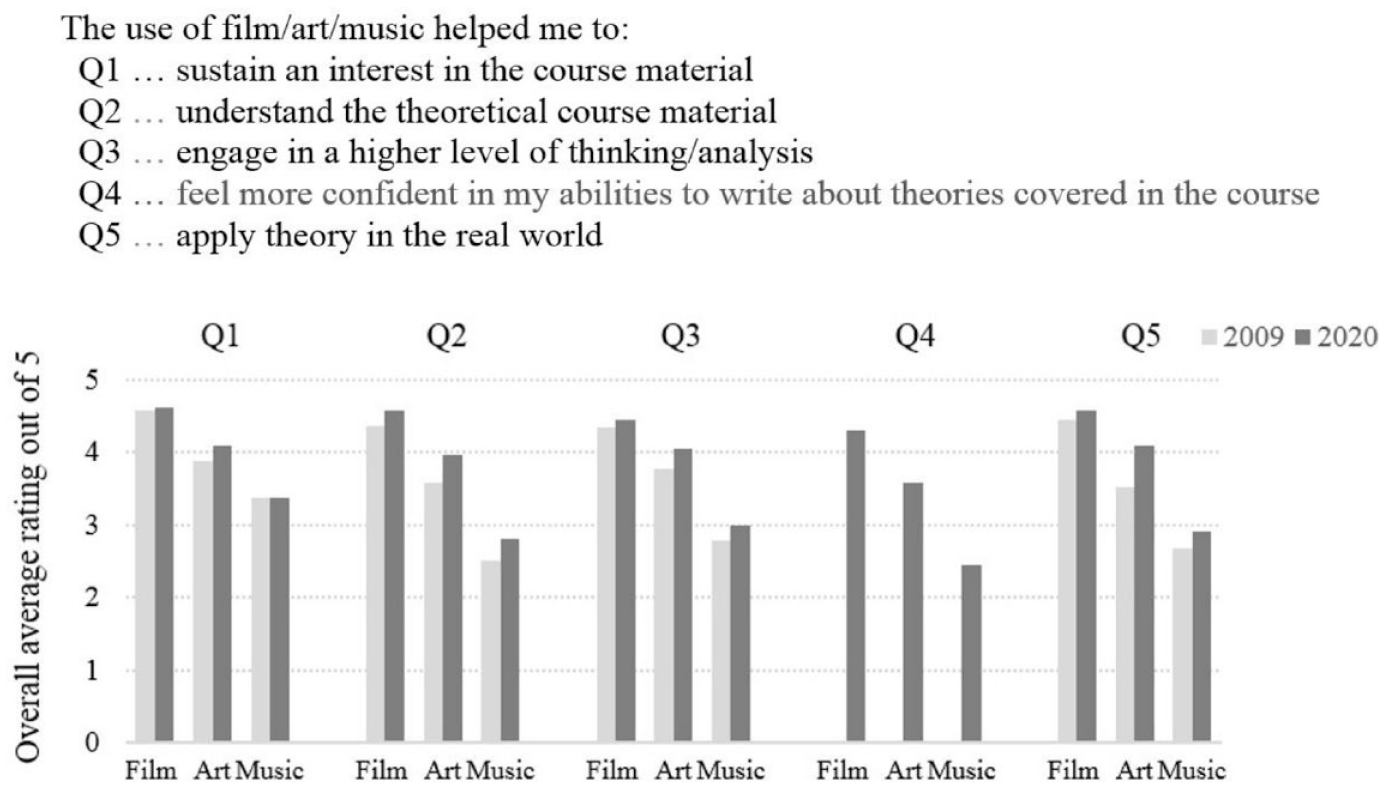
Considering the similarity in the data across all questions and between both surveys, we will focus on the 2020 data but include the 2009 quantitative data alongside in Figure 1 to provide a visual comparison of students’ perceptions of the use of arts-based resources between the two time periods. This will be followed by a comparative analysis of the two surveys at the end of this section.
Student responses to questions regarding film, art, and music
Sustained Interest in Course Material
Students in the 2020 study reported that the incorporation of the arts-based teaching and learning approaches helped them to sustain an interest in the course material, with overall average responses of 4.62, 4.08, and 3.37 out of 5 for the use of film, art, and music, respectively (see Q1 in Figure 1). In addition to these high averages, the data also show 94 percent of students gave a response value of 4 or 5 out of 5 for film, as did 75 percent for the use of art.
Qualitative data provide evidence that the use of these arts-based resources offered unique approaches that helped students to sustain an interest in the course material. As one student remarked, “The use of art slides provided something other than just words on a lecture slide or listening to someone speak. It made the content more interesting.” Another student commented, “The film clips . . . broke up the typical way of learning and maintained interest.” Students found that when the instructor carefully integrated and contextualized arts resources, they were kept interested and engaged.
Understanding Theory
The results of this study reveal that students found the use of film, art, and to a lesser extent, music helped them to understand the theoretical course material. The quantitative data from the 2020 survey show overall average responses of 4.58, 3.95, and 2.80 out of 5 for the use of film, art, and music with respect to this question (see Q2 in Figure 1). The data also show that 89 percent of students gave a response value of 4 or 5 out of 5 for the use of film and 74 percent for the use of art.
The qualitative data reveal that many students identified themselves as visual learners and thus found the incorporation of visual material to be exceptionally beneficial in enhancing their understanding of the course content. Students felt they were able to make more meaningful connections between a given film excerpt or image of art and a theoretical concept. As one student noted, Film clips were useful in helping me understand sociological concepts because they literally represented something we were talking about in class, and visual examples always assist my learning. For example, during the time we were learning about Wollstonecraft and how women were essentially stripped of their creative capacities and were not allowed to express themselves in what was a “man’s world,” watching a clip from a film, which was set in that period and seeing the characters play the part, really deepened my understanding of how female expression was condemned.
In general, using media that were familiar to students motivated and helped them to become more receptive to the theoretical content and more comfortable with learning and understanding the course material.
Engagement in a Higher Level of Thinking/Analysis
In the 2020 survey, students indicated that the arts-based resources helped them to engage in a higher level of thinking and analysis. The overall average responses with respect to this question were 4.44, 4.05, and 3.00 out of 5 for the use of film, art, and music, respectively (see Q3 in Figure 1). Once again, along with these high averages for the use of film and art, 85 percent of students gave a response value of 4 or 5 out of 5 for the use of film, as did 76 percent for the use of art.
Within the qualitative data, students noted that they were able to make connections between a given film clip and a theory or theoretical concept in a way that advanced their understanding of the material. Students also commented on how interpreting and making connections between the chosen art image and the theory or concept it pertained to encouraged them to think more critically and dive deeper into the course material. As one student remarked, “The art slides do require you to make connections between written theory and visual arts, and this requires increased focus and a higher level of thinking.” Another commented that the visuals “provided an opportunity to pause and critically think about what was just said, and then I was better able to associate what I learned to the images.” Again, the qualitative data provide insight into the extent to which this pedagogical approach helps students’ overall learning experiences.
Increased Confidence in Writing about Theories
Survey results indicate that the incorporation of film, art, and to lesser extent, music helped to increase students’ confidence as well as strengthen their ability to write about sociological theory. This was shown to be particularly evident in the use of film clips, where the overall average response to this question was 4.30 out of 5, while the overall average response for the use of art was 3.59 and for the use of music was 2.45 (see Q4 in Figure 1). The data also reveal that 87 percent of students gave a response value of 4 or 5 out of 5 for the use of film.
The qualitative data also reveal that the use of film helped increase students’ confidence in writing about theories, with one student commenting, After viewing films in class, I felt way more confident in my ability to write about theories, whether it be in a paper or on an exam because merely having a visual in my mind from class I was more easily able to remember the underlying assumptions of a theorist or main societal concern of an era.
Application of Theory in the Real World
As previously mentioned, some students tend to think of theory as irrelevant to their own lives and thus not necessarily worth learning. However, this study found that the instructor’s use of film and art in particular helped students go beyond this perceived barrier, as these resources helped them to apply theory in the real world. Quantitative data show high averages of 4.57 and 4.08 out of 5 for the use of film and art, respectively, while the use of music received an overall average response of 2.91 (see Q5 in Figure 1). Along with these high averages for the use of film and art, 90 percent of students gave a response value of 4 or 5 out of 5 for the use of film, as did 76 percent for the use of art.
The qualitative data reveal students’ enthusiasm about how the incorporation of these arts-based resources enhanced their ability to connect and apply the theoretical concepts to the real world, particularly after viewing film excerpts and images of art. These resources helped students to recognize how a given theory could be applied both in the time period in which it was posited as well as in modern times. For one student, “art slides personally helped me apply theory in the ‘real world’ because it opened a creative door to sociological thought which I had never seen before . . . and allowed me to make connections to the real world I would have never made.” The high response values to this survey question, along with the corresponding qualitative data, are encouraging, as students perceive these teaching and learning approaches to be helpful in making connections between the theories and the real world.
Historical Contextualization and Memory Enhancement
While students were not explicitly asked on the surveys to indicate whether an ABP helped with historical contextualization or enhancing their memory of the course content, there were frequent references to these sentiments in the qualitative data. This has inspired us to consider these as two additional themes. The qualitative data indicate that this pedagogical approach provides students with a better understanding of the social, political, and cultural milieu of the time periods in which theorists lived, helping them to understand the motivations behind the development of certain ideas and concepts. As one student remarked, “The use of film clips helped to make sense of the period theorists lived in and the circumstances they were facing that sparked their ideas and observations.” For some students, listening to the music of the era allowed for a deeper understanding of the period in a way that increased their comprehension of the theories.
Students also found that the incorporation of these arts-based resources assisted in the retention of information. The qualitative data indicate that many students found it helpful to have resources that catered to their learning style and memorization strategies. In particular, students reported that during exams, they were able to recall the art images and subsequently the theoretical concepts to which they related. Students also reported that film clips, especially those that included emotional content or an interesting story line, enhanced their ability to remember specific concepts and theoretical ideas.
Comparison of 2009 and 2020 Survey Data
In comparing the 2009 and 2020 survey data, we see some very regular patterns with respect to students’ perceptions of the helpfulness of incorporating arts-based resources, generally with respect to the enhancement of their overall learning experiences and across all questions asked in the surveys (see Figure 1). First, we recognize consistently strong responses to the use of film, followed closely by art. While the data show that some students reported the incorporation of music enhanced their learning experiences, students in both the 2009 and 2020 surveys reported lower overall response values when compared with those of film and art. Second, we notice slightly stronger responses in the 2020 data compared with that of 2009, particularly with respect to art. The overall positive survey results over time speak to the strength, consistency, and reliability of the findings. The survey data from 2009 and 2020 suggests that either year was not the result of a particular period of good teaching or a particular cohort of students who were especially responsive to this approach. That is, despite differences in the composition of the student population in the 11-year gap between the survey data, the overall favorable responses to arts-based resources have remained consistent. ABP remains an enduring approach that contributes to positive student learning experiences.
Additional Insights: Creative Applications of Sociological Theory from Student Exam Responses
Along with the overall positive results from the survey data, we also found that students responded very articulately to an exam question asking them to apply an arts-based resource used in class to a theoretical approach or concept. Students were able to build analytical connections between the arts resources and the theories, as seen in the following examples from students’ exams. In connecting an excerpt from the film The Serpent’s Kiss to theorist Mary Astell, one student wrote, In the film excerpt from The Serpents Kiss we see a garden designer come to the estate with an elegant design that would require the clear cutting of the surrounding green space to erect statues and columns. The daughter of the estate owner finds peace among nature but has no say in this design. During construction, she is forced to sit and watch as her father looks on, very pleased with his use of power in the garden. This clip relates closely to the ideas of Astell. The young woman in this film, loves and values nature, yet has no control over the design plans. Astell was an early environmentalist who recognized the misuse of resources in the time-period. She was also a strong feminist who felt the effects and wanted to change the patriarchal society she lived in.
In relating an excerpt from the film Mansfield Park to theorist John Stuart Mill, one student noted, Fanny Price leaves her life of poverty to live with wealthy relatives. Fanny is a very intelligent young writer and yet she is confined by societies strata so is unable to pursue a career in writing. This relates to Mill’s discussion regarding the subordination of women. Mill would argue that the leaders in society would not consider her work eligible due to her female nature and that men and women need to be treated equally. In the film, Fanny’s uncle states that she must marry the man that he chooses for her. Fanny however is opposed and does not wish to marry. This scene demonstrates how women are viewed as the property of the men in their lives.
In reference to this same scene, another student commented, Fanny’s uncle states that women do not have the luxury to pick and choose interests. Mill would have found this conversation appalling. Mill recognized that women were brought up to believe and know their virtues and place in society however he wanted to change this. Mill believed that it was immoral to stop people from pursuing their interest. Mill fought for change to allow women to pursue their interests, such as Fanny’s interests in writing.
These examples speak to students’ comprehension of the theoretical material and their ability to make connections with the film excerpts, along with providing critical reflection on the period. Other students in their exam responses reflected on the images of art shown in class. Here, too, they were able to make analytical connections between the art and the theoretical concepts. In one student’s words, Frans Hals was a Golden Age painter who produced art that is applicable to the period of the Enlightenment. He depicted poor, everyday people. The work of Hals can be applied to Adam Smith. While Adam Smith’s most important work is often regarded as the Wealth of Nations he also wrote on empathy. The depiction of the poor would certainly have resonated with Smith who is famously quoted as saying ‘at the thought of his situation’, meaning that people would respond emotionally to the feelings of others around them. The smiling faces of the poor could have a humanizing effect causing the observer to empathize with the poor and offer them more support.
In the student’s reflections on Hals’s painting in relation to Smith’s expression, “at the thought of his situation,” we see a connection to Smith’s theories on empathy, sympathy, and the “feelings that arise when one imagines himself in the situation of the other” (Kimmel 2007:47).
Practically speaking, the visual elements of the course allowed students to attribute a particular film excerpt or image of art shown in class to a certain theory or concept, which subsequently made the theory easier to both understand and recall. This in turn enhanced students’ abilities to write about theories and concepts in term papers and examinations where they had the opportunity to express their understanding of the core concepts and the major contributions of sociological theorists.
Discussion
Although students often come to sociological theory courses with a preconception that the content is dry, uninteresting, distant, and irrelevant (McDuff 2012; Weber 2010; Windsor and Carroll 2015), students in this study reported that when arts-based resources were incorporated into lectures, they facilitated interest, engagement, and active class participation. Our findings reveal that employing an ABP helped students to sustain an interest in the course material, better understand the theory-based material, engage in a higher level of thinking/analysis, feel more confident in their abilities to write about theories covered in the course, apply theory in the real world, contextualize historical content, and enhance their memory of theories and concepts.
Our findings support the research of Andrist et al. (2014), Caldeira and Ferrante (2012), Miller (2000), and Pelton (2013), who found that using film and art as pedagogical tools in theory-based courses can enhance student engagement and make the content more intriguing for students who may otherwise be disinterested in, unresponsive to, or anxious about the material. Like Pelton (2013:108), who found that film introduces “an element of the familiar into what can be a daunting list of unfamiliar texts, words, and concepts,” we, too, found that the familiar medium of film helped students in understanding the theory-based readings and lecture material. The use of film helped to quell students’ concerns with learning and writing about theory by fostering a more accessible and engaging classroom environment. Incorporating film into the lecture also provided a “source of rapport between students and the instructor” (Pelton 2013:108) and helped to create a common learning experience for all. Students collectively viewed a film excerpt or an image of art, or listened to a piece of music, and subsequently engaged in a group discussion, which ultimately gave them an avenue to connect and interact with the instructor and to appreciate and understand the material more deeply. A back-and-forth strategy of presenting lecture material and moving on to an arts resource, followed by discussion, and then returning to lecture material kept students (and certainly the instructor) on their toes. Especially in large-enrollment classes, teaching methods that switch between lecturing and showing visuals or playing music may help with maintaining focus (Belet 2018), providing a mental break and an opportunity for students to process, review, and apply the material (Adsit 2013). Interpreting and discussing the theories in this context encouraged students to dive deeper into the course content and connect the ideas emerging from the film and art to the various theories covered in the course in new and interesting ways. When the instructor contextualized the course material and strategically incorporated these resources, it generated collaborative learning, increased class participation, enhanced class discussions, helped to break up the course material, allowed for a well-needed mental break, and provided time to consider the theoretical material. Interestingly, this is a reciprocal process, whereby the instructor, too, gains valuable insights through discussions with students. It is exciting and rewarding for this instructor to see the enthusiasm in the lectures as students embrace this pedagogy.
A Musical Note
While some students did report that the incorporation of music enhanced their learning experiences, overall, students collectively reported lower response values to the survey questions relating to music when compared with those of film and art (see Figure 1). Perhaps the relationship between the arts-based content and the theories were more obvious in the films due to the multimodal nature of sound and visual and the ability to establish a situational context more easily with dialogue and cinematography. With music, the relationships between the content and the theory were not as explicit, so students had to think more critically and analyze more deeply to make the connections. Another possible explanation for the lower response values for music is that many students may not be familiar with the baroque, classical, or romantic style of music that was often played in class. However, music from these eras may have been useful for those students who have had previous exposure to these musical genres and could make connections between the compositions and the time periods being studied. Also, due to time constraints, the instructor did not spend as much time on the musical examples, usually playing only one piece of music per lecture, in contrast to the several film excerpts and art images typically shown throughout. Moreover, since the music was played only at the beginning of the lectures and not integrated throughout, it may have been successful in setting the tone for the class but could have limited the students’ ability to connect it to the theoretical material presented in the lectures. Based on the survey data, it is worth considering if spending more time delving into the music of the various historical periods would be of added benefit or if this should be abandoned for more time spent connecting film and art with the theoretical content.
In order to make music a more useful medium for students, contemporary music could be played in class. Students could then break down specific aspects of the music and lyrics, connecting them to a given theory or theoretical concept. The instructor could also invite students to offer musical selections for upcoming lectures. Students could build a sociological theory playlist for the course website, which would encourage student involvement and engagement with the course material. By contributing songs that they believe exemplify a theory or theoretical concept, students would be given the opportunity to participate and engage more directly with the content. This would also be a useful resource for the instructor, who may find it difficult to stay current with the many genres of popular music.
Limitations and Observations
While the results of our study offer interesting insights into how the incorporation of film, art, and music into a sociological theory course enhances students’ learning experiences, some limitations of the study must be considered. First, the sample size from the 2020 survey was relatively small, with an overall response rate of 31 percent among a total of 201 students in the course. This low response rate was likely due to the fact that the lectures in the last three weeks of the course, and consequently the survey, were abruptly moved to an online format due to the COVID-19 pandemic, and as with any voluntary survey, the results show the thoughts and opinions only of those who are willing to take the time to share them. This study was not designed to adjust for any bias in this regard. Second, the survey was available only to students enrolled in this second-year sociological theory course, so the results of the study cannot necessarily be generalized to all theory courses, other sociology courses, or other disciplines. Third, we did not isolate or group students by their final grade and therefore can only speculate that this pedagogical approach helped students of all academic levels. Fourth, as mentioned in the Methodology, we are examining students’ perceptions of the helpfulness of this pedagogy but were not able to assess improvements in grades. These limitations could be explored in future research.
With respect to the practicality of implementing this pedagogical approach, the set duration of the lecture can present challenges. Shorter lecture periods can limit the types and lengths of film excerpts or music played as well as the time spent analyzing and discussing the chosen resources. The instructor has the difficult task of balancing the time spent on the multimedia content with the time dedicated to traditional lecture material. Another limitation to the practicality of this pedagogical approach is quite simply the time involved in researching and sourcing the material needed to complement the theories being expounded upon. We advise those willing to pursue this approach not to be discouraged, as this is an endeavor that may take years to develop and fully incorporate into lectures. This is an ongoing effort but one that brings great reward to students and instructors alike.
One unexpected outcome of this study is that when the course was abruptly moved to an online format in the last three weeks of the course due to the COVID-19 pandemic, the instructor observed that students continued to benefit from the incorporation of arts-based resources, even in the virtual format. There has been plenty of evidence to suggest that students find it difficult to stay engaged during remote learning, and so incorporating a pedagogical approach such as this may be more important than ever.
There is a tremendous opportunity for educators to meet the challenges and expectations of students in the current context of increasing online learning. With the variety of models for online teaching (hybrid, blended, synchronous, asynchronous), strategies will need to be developed for delivering lecture content in ways that engage students. In most instances, instructors’ existing teaching methods and materials cannot simply be transferred to the online format (Gillis and Krull 2020). What is needed are teaching modalities that can move well between the two realms of face-to-face teaching and online learning. As Kozimor (2020:2) indicates, “Online learning is a carefully crafted and intentional design using instructional techniques and best practices specifically suited for the virtual environment.”
This arts-based pedagogical approach bodes well for an online format because the lecture notes and arts-based content do not have to be viewed synchronously, providing a seamless environment for synchronous and asynchronous delivery of teaching and learning. Instructors can place lecture notes; resources, including film, art, and music; and assessment tools, such as discussion forums, on the course website for students to readily access and review on their own time. By accessing asynchronous content, the students can join the synchronous class time better prepared for a full discussion in small or large groups.
Conclusion
Our study has found that students respond positively to the incorporation of period film and art, and to some extent, music, into sociological theory lectures. This pedagogical approach helped students engage with lecture material and perceive it as interesting and relevant, easier to understand and recall, and applicable to the real world. Teaching sociological theory with a combination of all three resources helped to enhance students’ overall learning experiences by illustrating theoretical concepts, developing and enriching the course content, and generating in-class discussions about the various theories and sociopolitical ideologies of a given time.
In comparing the results of our 2009 and 2020 surveys, it is evident that students continue to perceive benefits from this ABP. Despite differences in the composition of the student population, the overall favorable responses to arts-based resources have remained consistent. ABP remains an enduring approach that contributes to positive student learning experiences.
Although students in this study connected most positively with film, this does not undermine the value of curated art or music when learning about sociological theory. Curated art and music, with visual and aural modalities, respectively, provided additional ways for students to critically engage with the period and theory. However, the use of these examples requires more research and context setting for learners when being introduced as a pedagogical strategy.
Having witnessed the experiences of students through many iterations of this course, we continue to see the benefits of utilizing these arts-based resources in teaching sociological theory. Upon completion of this two-semester sociological theory core course, students overall have a solid understanding of the course material and can discuss and write about it with confidence. This deeper understanding of theoretical content will hopefully enhance students’ understanding and appreciation of academic material in subsequent courses and in the discipline of sociology in particular. We encourage our contemporaries to introduce ABP into lectures on theoretical and historical material and realize the tremendous potential this pedagogical approach has to offer.
Footnotes
Acknowledgements
We would like to thank our students for generously sharing their experiences and making this research possible, along with Devan Hunter for assistance with the research application. We are very grateful to Dale Lackeyram, Emerson LaCroix, Mavis Morton, and David Walters for their insightful comments and helpful feedback on this article. We would also like to extend our thanks to the editor and the three anonymous reviewers for their guidance and valuable suggestions.
Editor’s Note
Reviewers for this manuscript were, in alphabetical order, Michel Estefan, Matthew McLeskey, and Rachel Romero.