




Abstract
This note discusses a class activity that was developed for first-year bachelor students in sociology to understand homogamy theory. Taught in a “classical” deductive way, this theory proved to be difficult to remember and describe on the examination. Starting from inductive learning, and more specifically, (structured) inquiry-guided learning, the aim of the exercise was to transcend passive learning, making students gradually discover the different components of the theory themselves, practicing their sociological imagination. Overall, students evaluated the exercise positively, and they performed much better on the examination.
Keywords
In the course Sociological Themes at Tilburg University, the Netherlands, first-year bachelor students in sociology gain a more in-depth introduction to different topics sociologists traditionally focus on, such as education, families, gender, religion and secularization, migration, and globalization. In the course, students follow three obligatory themes (cities and urban life, globalization, and religion and secularization), which are linked to the three majors they can choose in the second year of their bachelor program (urban and metropolitan issues, social risks in a changing world, and culture in comparative perspective). Besides these three “fixed” themes, students are asked at the beginning of the course to indicate their level of interest in seven other themes, namely, education, migration and ethnicity, families and intimate relationships, the environment, digital society, gender, and politics, government, and social movements. The four topics that are ranked highest by the students are subsequently also covered in the course. This has the (assumed) advantage that students have a feeling of control over their own study program, aligning it as close as possible to their personal interests, which is of key importance to get them engaged (Belet 2018).
The topic families and intimate relationships was chosen by the students in the 2017–2018, 2019–2020, and 2020–2021 academic years. In the lectures on families and intimate relationships, several classical and contemporary sociological perspectives on intimate relationships are included—such as the work of Anthony Giddens (1992) and Ulrich Beck and Elisabeth Beck-Gernsheim (1995). One of the sociological theories that are treated in depth is homogamy theory, which explains the tendency of individuals to engage in romantic relationships with individuals who are similar to them in terms of, for example, age, socioeconomic class, ethnicity, religion, or other social markers (Ferris and Stein 2018; Henslin 2017; Kalmijn 1998), contradicting the popular saying that “opposites attract” (Ferris and Stein 2018:196). Altogether, the theory highlights that people do not randomly choose their partners, drawing attention to both personal preferences and contextual factors that influence individuals’ partner choice. As such, it is a useful theory to get students acquainted with sociological thinking about social dynamics.
In a summarized form, the core of the theory consists of three main components (for an extended explanation of the theory, see Kalmijn 1998). First, individuals have a preference to partner with individuals that are similar because this allows them to pool their economic, cultural, and social capital. This pooling of resources has several advantages: It will lead to less conflict(s) in a relationship, and it can also be used to maintain or improve an individual’s social class position. Second, to meet a partner, individuals also need opportunities to meet them. Simply put, individuals are more likely to find a partner who is close in geographical terms and/or in terms of overlapping social networks. This means that individuals generally have few opportunities to meet people from different socioeconomic, religious, or other backgrounds in their everyday lives (Ferris and Stein 2018). Third, romantic relationships are often theorized as reflecting an increasing individualization tendency in contemporary Western societies whereby individuals are free to select the person they want to establish a romantic relationship with. Homogamy theory, however, underlines the importance of third parties, that is, those who define the “rules of the game.” These third parties can, for example, be individuals’ family, friends, or ethnic or church community, who can disapprove of certain relationships and also sanction them. Church communities, for example, can exclude individuals from (parts of) religious services. As such, there are social pressures from within social circles and communities to adhere to the principles of homogamy (Ferris and Stein 2018).
I noticed that when the theory was taught in a deductive way, many students struggled to cognitively process the theory and adequately describe the theory or certain components in their own words on the final examination. This meant that the principle of constructive alignment (Biggs 2014; Biggs and Tang 2011), key to course design, was violated. This principle indicates that teaching should be designed in such a way that the learning activities optimize students’ chances of achieving the anticipated outcomes, in this case, the learning goal “to describe in their own words the major sociological theories and approaches related to a number of sociological themes.” Because most of the students were not able to reproduce the theory satisfactorily in their own words at the examination, teaching the theory in a deductive way was clearly not the right teaching method for achieving this learning goal. To remedy this problem, I developed an exercise based on inductive learning approaches, more specifically, inquiry-guided learning, appealing to students’ sociological imagination, to help students to better understand, process, remember, and explain the theory in their own words.
An Inquiry-Guided Learning Approach
Sociological theories are traditionally taught deductively: An instructor explains the theory, maybe asks students to apply the theory to specific social situations, and finally tests whether students are able to reproduce the theory (Prince and Felder 2006). Today, however, this passive learning process is often criticized because it has been shown that when students engage in hands-on activities, they retain information and skills for longer (Gross Davis 2009). The latter type of approach to teaching and learning is labeled as inductive. Inductive teaching and learning is thus centered on the student, meaning that students need to analyze a given situation or question and are thereby supported by the instructor to discover the learning material themselves. Within such an approach, instructors facilitate this learning process by “guiding, encouraging, clarifying, mediating, and sometimes even lecturing” (Prince and Felder 2006:124), and instructors are clearly not the owner of the “absolute truth” (Rusche and Jason 2011). One of the inductive learning activities instructors can engage in, which is also used for the exercise presented in this article, is “inquiry-guided learning,” a collection of active learning teaching techniques “that privileges guiding students to increasingly independent questioning and constructing knowledge” (Atkinson and Hunt 2008:6). The advantages of inquiry-based learning methods over traditional instruction have been investigated by several authors (see Colburn 2000; Rubin 1996). These studies indicate, for example, that inquiry-based learning leads to better conceptual and subject learning, reasoning ability, creativity, and understanding of concrete observable phenomena.
Against this background, inquiry-guided learning is embraced “as an exemplar of the social construction of knowledge” among sociologists (Rusche and Jason 2011:340) because it “emphasizes active investigation and knowledge construction rather than passive memorization of content” (Atkinson and Hunt 2008:1). In sociology, it is fundamental to inquiry-guided learning that students learn to “think and act as sociologists” (Atkinson and Hunt 2008). Within inquiry-guided learning approaches, there can be significant variation in terms of the structure that is provided by the instructor. Instructors have the choice to provide clear guidelines and structure the process, or they can also opt for absolute free exploration, whereby the role of lecturer is minimized. As Prince and Felder (2006) indicated, however, it is often considered good practice to offer a relatively structured form of inquiry to first-year undergraduate students and gradually increase the possibility of free exploration in subsequent years. Therefore, a structured approach was adopted for the first-year bachelor students that attended the Sociological Themes course. Through inquiry-guided learning, I jointly constructed an understanding of the theory with the students.
The exercise was designed in such a way that students could train their sociological imagination, which “as a creative act, is best internalized when it is practiced” (Kebede 2009:354). It particularly aimed to make sociological theory relevant for students by connecting and applying sociological thinking to their own daily lives, which is relevant for increasing students’ engagement and achievement in introductory sociological courses (Belet 2018). This approach is also in line with several articles published in Teaching Sociology, which provide examples of the relevance of making connections between students’ individual life worlds and sociological thinking for students’ learning process (see e.g., Eisen 2012; Garoutte 2018; Kebede 2009; Noy 2014). Through reflecting about their own daily lives through a sociological lens, the exercise allowed students to get first-hand experience with the core of sociological thinking, namely, to consider how individual experiences shape and are shaped by larger contextual/structural forces (Garoutte 2018), or in other words, “the ability to see the connections between the individual and society” (Matthewman, Curtis, and Mayeda 2021:3). And most importantly, it clearly helped students to grasp the core elements of homogamy theory and to reproduce the theory in their own words several months after the course ended.
Classroom Description
In the academic year 2019–2020, the course Sociological Themes included 51 students in two groups, who were taught either in Dutch or English. The students that participated in the Dutch classes followed the Dutch Bachelor program in sociology and was composed of first-year sociology students. The students that participated in the English-taught classes followed the international bachelor program in sociology at Tilburg University. This group, however, was more diverse compared to the Dutch group. Besides 17 first-year sociology students from different parts of the world, the lectures were also attended by 10 exchange students from different disciplines, such as language studies, as well as sociology students who were already more advanced in their bachelor’s (second and third year). The make-up of both groups was roughly similar in the first academic year the course was implemented. In that year, 2017–2018, the Dutch group also only consisted of first-year students who followed the Dutch bachelor in sociology, whereas in the English group, six out of 20 students were exchange students from different disciplines or higher years in sociology.
In Sociological Themes, students receive two weekly lectures on a specific subject. First is a lecture at the beginning of the week wherein some of the major theories and tendencies related to the theme of the week were explained by the instructor, relying mainly on lecture-based learning. Inductive learning was applied as well, through, for example, short, two-minute brainstorms; small group discussions; or targeted questions about the social world, but the main focus in this first weekly lecture was on deductive learning. Second, at the end of the week, students attended a lab session whereby the aim is to put students’ sociological imagination at work, using an assigned reading and in-class exercises, to uncover other theories related to the theme of the week. Consequently, the labs in this course were predominantly organized as inductive learning activities, particularly given that students already got acquainted with a number of core sociological theories related to the weekly theme in the first (deductive) lecture of the week.
In the academic year 2017–2018, the first year the course was organized, students chose the theme families and intimate relationships for the first time. As indicated previously, within that theme, homogamy theory is an essential sociological theory to explain why romantic relationships are not happening at random. Most students, however, performed rather poorly on the examination when asked to reproduce the theory in their own words (an average score of 1.5/5; n = 32). Given these poor results, I decided to develop a new exercise when the theme was chosen again in the academic year 2019–2020, to be implemented in the lab session in the second part of the week instead of the lecture at the beginning of the week. With this new exercise—which was strongly inspired by a teaching note of Ellen O’Brien and Lara Foley (1999) as well as a blog post of Hollie Nyseth Brehm (2013)—I aimed to encourage students to discover the theory and its different components themselves, following an inquiry-based learning approach. I was very curious about the results because students took the examination three months later than originally planned because of the COVID-19 pandemic.
The Matchmaking Exercise
The exercise consisted of two parts. The first part of the exercise was devoted to discovering the first component of the theory, preferences. The second part then aimed to let students discover the components of opportunities and third parties.
Part I: Discovering the First Component: Preferences
In the first part of the exercise, students were provided with post-its and were asked “What characteristics should your ideal partner preferably have (think also about characteristics like age difference, education, ethnicity, income, health, previous relationships, etc.)?” and “In case you have a partner: What characteristics does your partner have?” Students had to individually write down one ideal characteristic of their (ideal) partner per post-it. They could use an unlimited number of post-its, depending on the number of characteristics they personally considered important. Once all students were ready, the blackboard was divided into two spaces: one representing similar characteristics and another one representing dissimilar characteristics. Students were subsequently asked to stick each of their post-its within the appropriate space—reflecting on whether the post-it contained a preference for a similarity or difference with their (ideal) partner. Confirming the first component of homogamy theory, the space with similar characteristics was filled with many post-its, whereas the dissimilar characteristics space remained emptier (see Figure 1). During the following—short—classroom discussion, it was clear that students discovered themselves the tendency in the group to report predominantly a preference for similar characteristics. In a next step, students were asked to group the similar characteristics, which resulted in a classification whereby age, socioeconomic status (education and income), and cultural characteristics were indicated by the students as being mentioned most often.
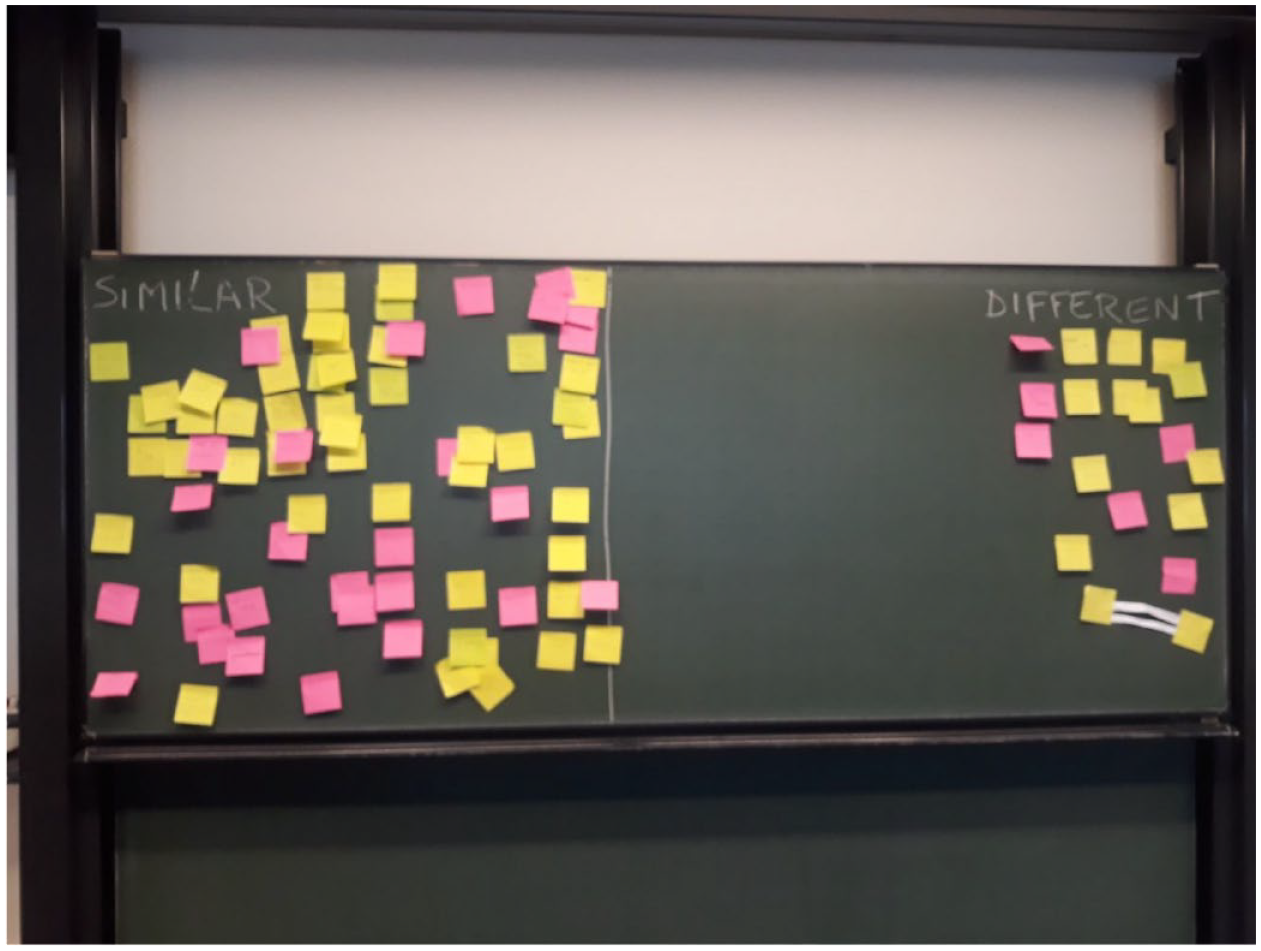
The blackboard where students posted the similar and dissimilar characteristics.
Afterward, I indicated to the students that the first core element of the theory indeed is preferences, explaining that individuals prefer partners with similar characteristics, in terms of socioeconomic and cultural resources, because this helps to better manage pooled resources and leads to less conflict. During the group discussion that followed, students indicated this sounded very logical as they discovered the group’s preference for socioeconomic and cultural similar partners themselves. During the break that followed, many students went again to the blackboard to discuss further what they just discovered, some trying to even refine the categories of similarities. Altogether, this illustrates how visually representing social dynamics of partner preferences on the blackboard really made students actively engage with the sociological content, which helps them also to remember the theory.
Part II: Opportunities and Third Parties
In the second part of the exercise, students were provided with a description of a person they would hypothetically fall in love with within five years (see Table 1). Acknowledging the diversity of sexual orientations that exists within a classroom, there was no explicit indication of the gender of the hypothetical partner. Furthermore, students were instructed to be respectful in their comments on their hypothetical partner to avoid inappropriate, insensitive, offensive, or provocative comments. After reading their hypothetical partners’ profile, they had to reflect on—and write down their answers to—the following questions:
Hypothetical Partner Profiles.
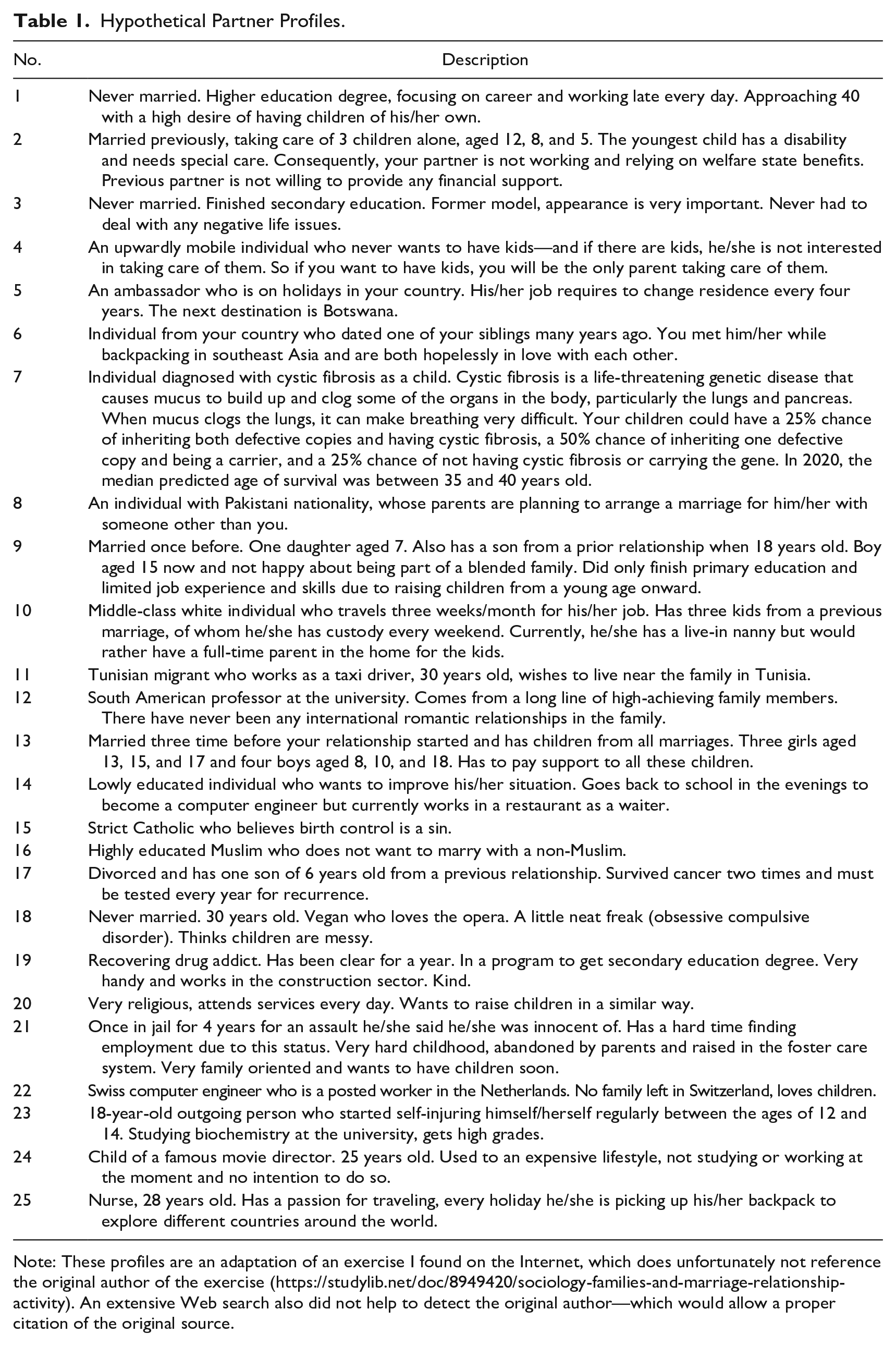
Note: These profiles are an adaptation of an exercise I found on the Internet, which does unfortunately not reference the original author of the exercise (https://studylib.net/doc/8949420/sociology-families-and-marriage-relationship-activity). An extensive Web search also did not help to detect the original author—which would allow a proper citation of the original source.
How would your family react?
What is the likelihood that you would actually meet such person?
Would this relationship lead to more conflict compared to the ideal partner you described earlier?
This part of the exercise led to great hilarity and laughing among the students, particularly for those who were assigned a hypothetical partner that they believed to be very unrealistic. Importantly, however, all comments that were made within this atmosphere adhered to the instruction to be respectful. Based on their answers to the questions, a classroom discussion was organized wherein students had to discover the other two components of the theory, encouraging them to use their sociological imagination. After about 15 minutes, there was agreement among the group that the two other components would be opportunities and social circles, which aligns with the other two components of homogamy, subsequently explained by me.
Students’ Satisfaction with the Exercise
A couple of days after the lecture, I asked students to indicate how useful they found the exercise on a 7-point Likert scale, ranging from extremely useful to extremely useless. As can be observed in Figure 2, the majority of students (82.9 percent) found the exercise useful, supporting the subjective feeling I had during the class given that the class had been very lively and all students seemed very engaged. In the 2020–2021 academic year, the same exercise was also implemented in an online format (see the discussion section of this teaching note), and again, students were very satisfied: 89.7 percent found the exercise useful.
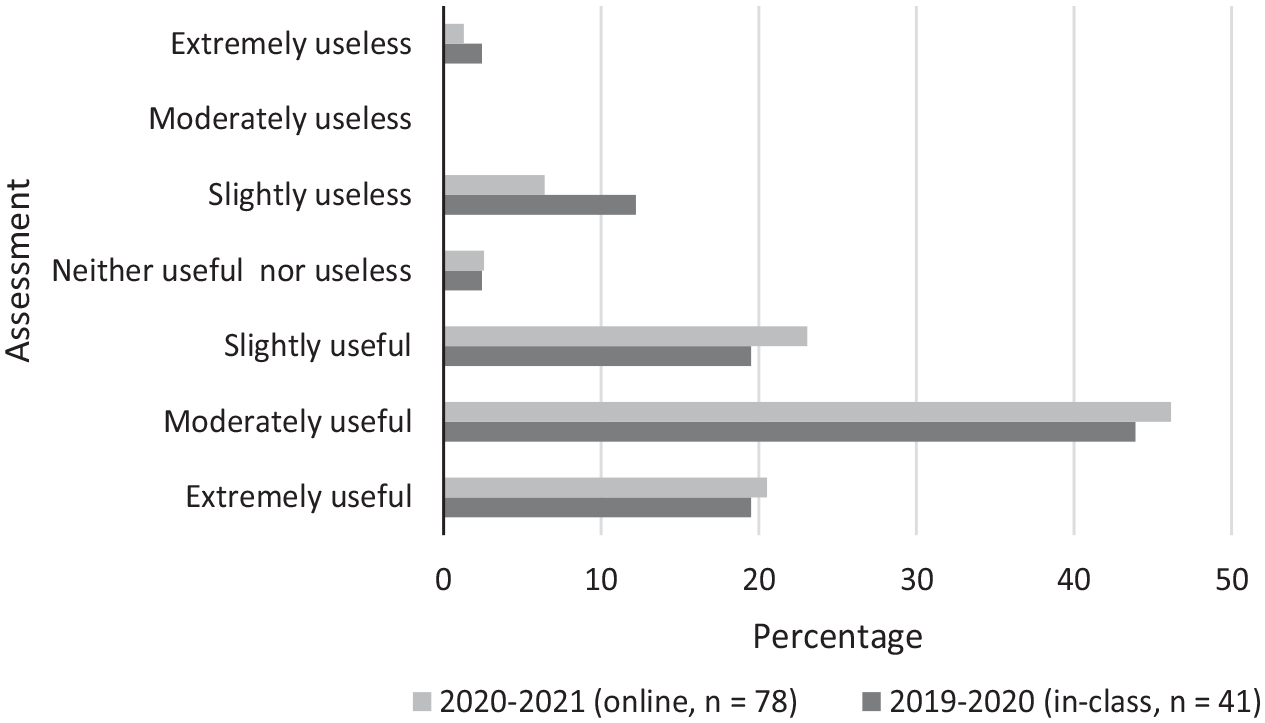
Students’ assessment of the matchmaking exercise in 2019–2020 and 2020–2021, percentages.
Direct Assessment of Learning—The Final Examination
The final examination 1 of the course consisted of 16 essay questions, which all required short answers of between 100 and 200 words. Students could obtain five points for each question. According to Benjamin Bloom’s taxonomy, 10 percent of the questions are knowledge questions, 30 percent are comprehension questions, and 40 percent are application questions. The remaining 20 percent consisted of individual assignments students had to submit each week during the course. Although the wording of the question was different because it is not allowed at Tilburg University to use similar wordings in subsequent examinations, in both academic years, the question on homogamy theory grasped students’ understanding of the theory on the comprehension level of Benjamin Bloom’s taxonomy. In 2018, the question was formulated as follows: “Social homogamy theory indicates that individuals do not establish intimate relationships randomly. (a) Which three main elements does the theory consist of? (b) Explain briefly two of the three main elements.” In 2020, students received the following question: “Matthijs Kalmijn explains Social Homogamy theory in the paper ‘Intermarriage and Homogamy: Causes, Patterns, Trends’. (a) What are the three main components of Social Homogamy Theory? (b) Briefly explain one of these three main components in your own words.” For both academic years, the question aimed to assess the same learning goal, namely, “students can describe in their own words the major sociological theories and approaches related to a number of sociological themes.” Analyzing students’ scores on both examinations, it becomes clear they performed much better on the homogamy question in the 2020 examination. This indicates that they were more able to articulate and explain the core elements of the theory, which suggests the learning activity—inquiry-guided learning—aligned again with the learning goals and examination. The average score in 2019–2020, the academic year the exercise was implemented, was 2.81 out of 5, with only 19 out of 51 students having a grade lower than 2.5 on the question (compared to 1.5 out of 5 in 2017–2018, when the presented in-class exercise was not conducted). An independent samples t test confirmed that the differences between both scores are statistically significant, t(80) = −3.16, p = .002. Altogether, these results suggest this exercise is useful for learning, understanding, and retaining homogamy theory, particularly given that the exam took place several months after the course ended, which suggests that students retain what they learned for a long period.
Discussion and Conclusion
In this teaching note, I presented a classroom exercise that was developed to improve first-year bachelor students’ theory learning, more specifically, on homogamy theory. The exercise illustrated how sociology students’ sociological imagination can be really put into practice when using inductive learning approaches whereby students have to discover (parts of) theories themselves. Because this concerned a cohort of first-year students, it is advisable to guide the students through the process. In later study years, students should be able to discover theories themselves with less guidance, particularly if they already got acquainted with their sociological imagination from the very beginning of their educational trajectory. Inquiry-based learning hence shows to be an engaging way to convey the complexity of social life, which is an important task for sociology instructors (Gillis and Taylor 2019). Through exercises such as the one presented here, first-year students—who might have been exposed a limited extent to sociological approaches and insights—can start to learn and understand complex theories based from their own experiences and social world, highlighting how seemingly individual choices are significantly restrained and enabled by surrounding contexts. Furthermore, the assessment showed that students positively evaluated the exercise. Given the variety in students’ profile, including, for example, higher year sociology exchange students that already knew the theory in the English group, it is encouraging that approximately four out of five students considered the exercise useful. In addition, students also performed better on the questions related to homogamy theory on the final examination. Although the average grade of 2.81 out of 5 for the second examination might not seem high to non-Dutch readers, it is in line with the average scores on examinations in the Dutch higher education system, whereby top grades of 9 and 10 are rarely awarded (Nuffic 2019).
It should be acknowledged that this activity was developed for two groups of students that were relatively small in size, about 25 students per group. This allows, for example, students to walk around in the classroom and use the blackboard for the post-its. Because homogamy theory is expected to be a valid theorization of mate-selection processes across different contexts, I believe the described classroom activity can be applied in most small sociology classrooms across the world. For larger sociology classes, the exercise can be transferred to an online format in which students’ indications of preferences, for example, are posted (anonymously) on a virtual blackboard. Interestingly, the COVID-19 pandemic already forced me to do so in the 2020–2021 academic year. In the 2020–2021 academic year, 41 students were enrolled in each group. For the first part of the exercise, I used the online program Padlet, which allows students to add virtual post-its and rearrange in a similar fashion compared to the in-class exercise with a Blackboard (see Figure 3). Again, the preference among students for a partner with similar characteristics becomes visibly very clear. Similar online post-it programs can be used when implementing the exercise in larger groups on campus, projecting the post-its onto a screen in the classroom.
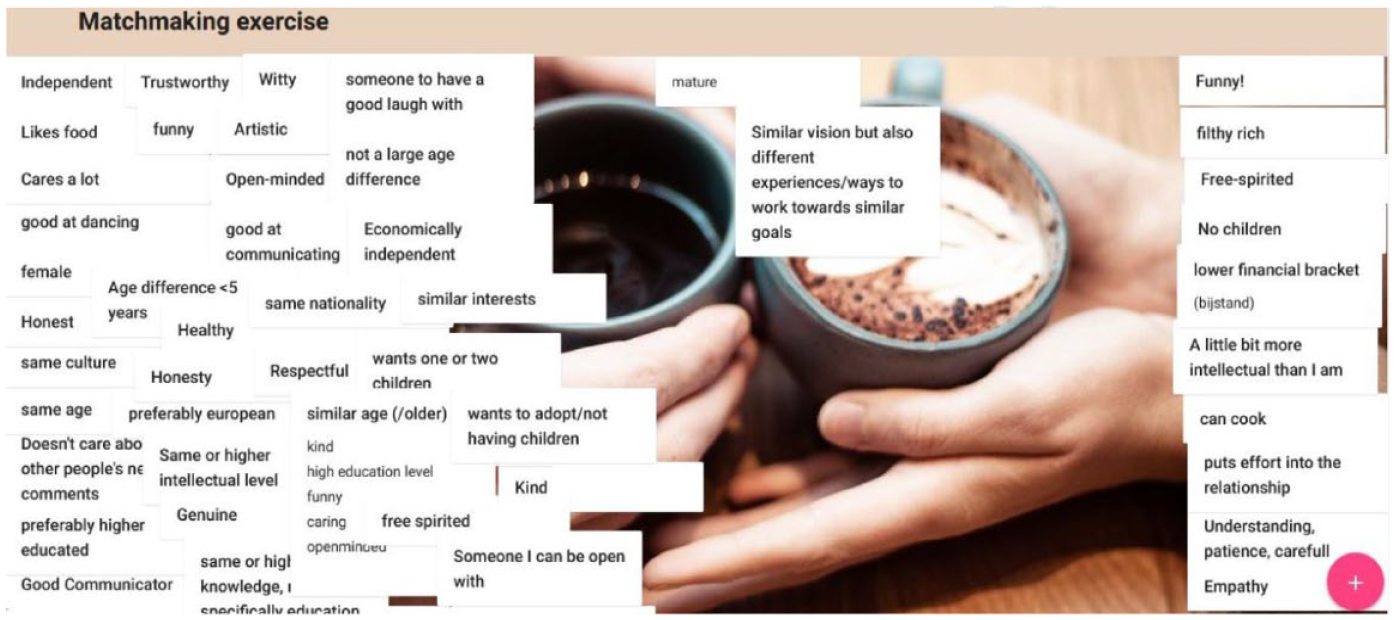
The online padlet where students posted the similar and dissimilar characteristics.
Alternatively, large student groups could be divided into smaller working groups on campus, whereby the categories each working group generates are discussed collectively afterward. Furthermore, learning sociological theories through inquiry-guided learning takes longer compared to traditional lecturing. The time investment both on students’ and instructors’ part can, however, be particularly worthwhile for teaching sociological theories students struggle with on the examination. The principle of constructive alignment is helpful here because it helps to identify—based on the examination—for which sociological theories traditional deductive teaching methods are sufficient for aligning the learning goals and assessment and which ones might need more creative approaches, such as the exercise presented in this article.
In conclusion, the classroom activity presented in this article illustrates the usefulness of inductive learning methods for teaching sociological theories. The classroom activity described here is an example of how students can discover sociological theories by using their sociological imagination when reflecting on their personal experiences as well as the experiences of those in their own social worlds. Although such activities require efforts from the instructor in terms of preparation, organization, and time, it seems they allow to more deeply engrain core sociological theories compared to passive memorization. Or as Atkinson and Hunt (2008:6) indicated, it is in students’ best interest to have them “actively involved with the content of sociology rather than just hearing and reading about it.”
Footnotes
Acknowledgements
I thank my colleagues Inge Sieben and Maaike Adams for their helpful feedback on a first draft of this teaching note.
Editor’s Note
Reviewers for this manuscript were, in alphabetical order, Sadie Pendaz-Foster, Alanna Gillis, and Shiri Noy.
