




Abstract
Recent writings by Emanuel Prinz and Alison Goldhor have sought to develop a ‘blueprint’ for mission trainers on the basis of personality traits and spiritual competencies of movement catalysts. This article re-examines the basis on which such assertions are made, not only in terms of questionable methodology but also in the extent to which Western-based psychological models are relevant for other cultural contexts. It also discusses the dangers of toxic leadership and suggests some biblically based criteria for identifying such people.
Keywords
Hidden ethnocentrisms
A Westerner teaching on a discipleship training course in Africa stresses the importance of punctuality. The teaching sounds reasonable and even ‘Christian’ but it is also an expression of ethnocentric thinking which the missionary is trying to impose on his African audience.
Missionaries trying to avoid imposing Western culture on others often think of this in terms of visible expressions of their faith, such as forms of worship, prayer or baptism (e.g. Watson and Watson, 2014: 9–17). Punctuality lies at a deeper level of Western culture, in terms of social relationships, and is not so obviously ‘Western’. However, in Switzerland, Germany, the Netherlands, and to some extent England and France, an emphasis on punctuality developed after mechanical clocks were put on church towers and other public places, influencing patterns of work, sleep and leisure (Henrich, 2020: 317–325), so that people began to live ‘by the clock’ rather than according to the position of the sun or other ways of marking time. Mechanical clocks also had an influence on Western attitudes to church attendance: perhaps unconsciously, this missionary was regarding the meeting as like a business appointment, with lateness as a sign of disrespect, whereas for the Africans the event was seen as like a family gathering to which people turn up when they can. At a deeper level, their behaviour also reflects differences in thinking whereby most other cultures put an emphasis on relationships to a greater extent than Westerners do (Henrich, 2020: 21, 396–397). Relational or holistic thinking is more characteristic of non-Western, group-oriented cultures in which, for instance, a woman might be seen in terms of being someone else’s daughter, wife or mother, whereas more individualistic Western cultures tend to be characterised to a greater extent by an analytical kind of thinking that tries to put people in ‘boxes’ based on specific features, as if those characteristics ‘define’ the person – e.g.: she’s an accountant (Henrich, 2020: 22, 53, 222, 397) - which can over-simplify complex realities.
Analytical versus relational thinking is not an either/or categorisation, as most cultures have both types of thinking to a certain extent in various contexts. Nevertheless, there tends to be a shift from relational to individualistic attitudes among people from non-Western cultures who have been exposed to Western influence through education. For example, college students both in Kenya and the USA gave responses that were much more similar to each other than to the replies by respondents from the Maasai and Samburu peoples of Kenya; workers employed in Nairobi were intermediate between these groups (Ma and Schoeneman, 1997: 267–268). Psychological studies of non-Western populations have usually taken samples from university students, as they could fill in written questionnaires, but this sampling bias has produced a distorted impression of similarities between their psychological profiles and those of Western populations (Fischer, 2018: 122; Henrich, 2020: xii).
The effects of culture on personality remain debatable because of the wide variations both in cultures and personalities but there is increasing doubt that some of the conventional psychological categories, or scales that have been used for measuring personalities, are universal. This even applies to the five features of personality that are conventionally called the ‘Big Five’ – Openness to Experience, Extraversion, Neuroticism, Agreeableness and Conscientiousness. Although McCrae and Terracciano (2005: 553) found these features among students, their results from some African countries, especially Botswana and Nigeria, were noticeably different from the usual American structure. Laajaj et al. (2019) reported that the ‘Big Five’ structure emerged from internet surveys filled in by young and highly educated respondents from various countries but surveys among local populations in cultures as diverse as those of Ghana, Kenya, Sri Lanka, Colombia, Macedonia, Serbia, the Republic of Georgia, Laos, Vietnam and Yunnan province of China failed to find clear evidence of the ‘Big Five’ structure. In some surveys, the presence of outside researchers might influence the results: the Big Five personalities did not emerge among the Ache people of Paraguay when they administered the surveys themselves but these traits did appear when a Western anthropologist rated them with the same inventory (Bailey et al., 2013). Detailed psychological research among an indigenous ethnic group of Bolivia provided evidence that ‘the Big Five model does not apply to the Tsimane’ people (Gurven et al., 2013: 365). They suggest that ‘Tsimane personality variation may instead be organized along fewer and differently composed dimensions’ (Gurven et al., 2013: 367). The ‘Big Five’ personality domains might be more characteristic of Western, industrialised, educated and relatively wealthy populations than of many other cultures around the world (Henrich, 2020: 382). 1
This casts doubt on most of the conclusions claimed in a recent study by Prinz and Goldhor, who claim that their list of psychological traits and competencies
gives mission trainers a blueprint for their training curricula and points mentors to the areas on which to base their mentoring. Focusing on these traits and competencies in trainees and mentees will increase effectiveness in developing fruitful movement catalysts for the kingdom. (Prinz and Goldhor, 2022a: 48–49)
Categories
Can potential movement catalysts be identified simply by administering psychological tests? This study is impressive because it is based on research involving ‘a sample size of 307 pioneer missionaries, of which 147 had catalyzed a movement and 160 had not’ (Prinz and Goldhor, 2022a: 37). Respondents had completed an online survey containing 95 questions, implying that their respondents were literate and able to access the internet, although this raises questions about their exposure to Western influences.
To determine their list of traits and competencies, Prinz and Goldhor administered a questionnaire asking respondents to rank themselves on a Likert scale with regard to various traits. On page 40 they provide examples of their questions, such as:
Hunger for God: Others would say that I love God passionately Confidence in the Bible: Others would describe me as someone who has a deep confidence in the power of the Bible for discipling and ministry. Assertiveness: I am motivated to influence and bring change, wherever I go. Drive to Achieve: Once I set a goal, I am motivated to work until I have attained it. Inspiring Shared Vision: I articulate a compelling vision of the future.
Two questions on ‘Influencing Beliefs’ are virtually identical:
I regularly talk about my most important values and beliefs. (p. 40) I regularly communicate my most important values and beliefs to others. (p. 45)
Besides these statements quoted above, the word ‘regularly’ occurs in other questions, such as ‘I regularly spend time seeking God’s guidance’ (p. 40 - for ‘Listening to God’) or ‘I regularly think about more effective ways we can share the Gospel’ (p. 40 - for ‘Evangelistic Zeal’). Personality traits are descriptions of behaviour that is regarded as habitual but the answers to such questions depend on how respondents interpret the word ‘regularly’: are they thinking this means daily, weekly, monthly, or some other time period? 2 Other statements, such as ‘I am motivated to influence and bring change, wherever I go’ (p. 40, for ‘Assertiveness’), are intended to be wide enough to apply to anyone but the phrase ‘wherever I go’ is so broad that some respondents may be uncertain how to answer.
Most questions ask for a self-evaluation by the respondent but in certain questions the authors ask their respondents about the opinions of others. However, the answers are still self-reported and it is unclear whom they have in mind regarding these ‘others’. How we appear to some ‘others’ (e.g., at church) might be different from the opinions of a spouse or children who know us better.
Prinz and Goldhor (2022a: 37–38) group their 24 ‘trait and competency constructs’ into three domains, which are reproduced in Table 1.
Prinz and Goldhor’s trait and competency constructs and their groupings.
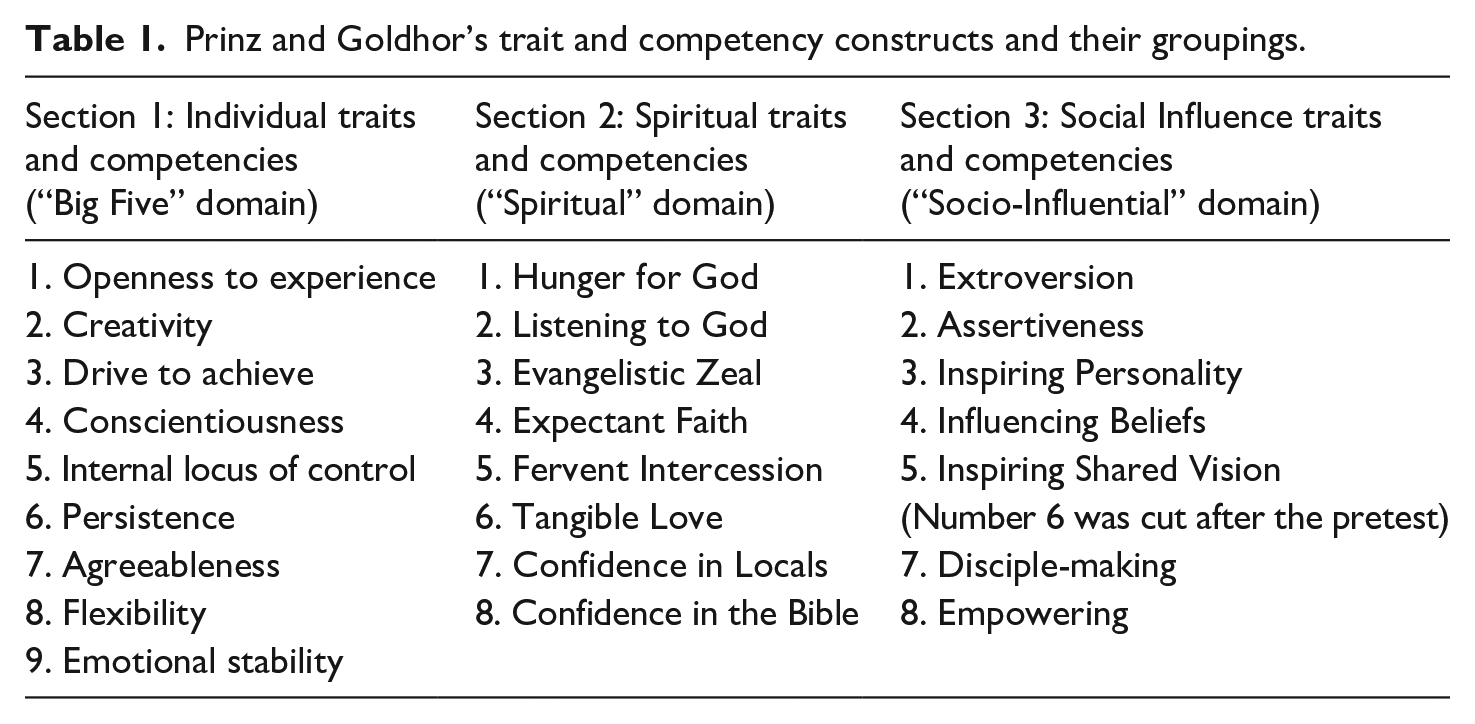
Their first column, labelled as ‘Individual traits and competencies (“Big Five” domain)’ seems to be a misnomer because Creativity, a Drive to Achieve, an Internal locus of control, Persistence and Flexibility are not in the ‘Big Five’. Moreover, they do not include in that column Extroversion, which is one of the ‘Big Five’; instead, it is in their ‘Social Influence Traits and Competencies (“Socio-Influential” domain)’. I shall refer to these three domains by the simpler terms ‘Soul’, ‘Spirit’ and ‘Society’. 3 ‘Emotional stability’ is the inverse of neuroticism so it is acceptable for Prinz and Goldhor to include it in their first column instead of neuroticism, thereby giving each trait a positive ranking. The catalysts ranked lower than the control group in emotional stability (Prinz and Goldhor, 2022a: 39), meaning the catalysts were more neurotic.
Numbers
Prinz and Goldhor base their claims on statistical analyses of questionnaires. 4 In their Appendix B they back up their claim to empiricism by outlining their methodology. After discarding survey questions that did not strongly correlate with other questions, there remained 44 questions with which to study 24 different constructs – their term for traits or competencies such as ‘Openness to experience’, ‘Hunger for God’ or ‘Extroversion’. Those ‘with low inter-item correlations were represented only by a single item’ (Prinz and Goldhor, 2022a: 51). Many of the constructs used by Prinz and Goldhor, such as ‘Evangelistic Zeal’ or ‘Disciple-making’, have not been widely tested elsewhere even in a Western context, let alone non-Western ones. This calls into doubt the extent to which such characteristics can accurately be measured using just one or two questions. By contrast, in secular market research Brace and Bolton (2022: 138) state ‘there must be a sufficient number of statements to address adequately all of the attitudes under consideration. If possible, there should be several statements for each attitudinal dimension to enable the researcher to cross-check responses for consistency within respondents’, so it is unlikely that 24 different constructs can be adequately measured by means of only 44 questions.
The ‘list of traits and competencies. . . characterizing effective catalysts’ (Prinz and Goldhor, 2022a: 49) is apparently their Table 3, which is on pages 39-41, showing those responses ‘where (a) catalysts rated themselves the highest (⩾4.50), (b) catalysts and control group show a statistically significant difference, and (c) that difference amounted to at least 1/3 of a Likert scale point (⩾0.33)’ (Prinz and Goldhor, 2022a: 39). They used a pre-test survey with 125 questions subjected to a Reliability Analysis measuring ‘the internal consistency of each construct through Cronbach’s alpha coefficient’ but later the ‘final survey results were again subjected to a Reliability Analysis, which yielded poor (<.65) Cronbach’s alpha coefficient values for seven constructs’ (Prinz and Goldhor, 2022a: 51). Although the values ‘improved significantly’ after they deleted the responses to certain questions, for four of their constructs ‘Cronbach’s alpha coefficients continued to remain low (between .50 and .60) (Prinz and Goldhor, 2022a: 52)’.
5
They then conducted a subsequent Exploratory Factor Analysis which
yielded a 3-factor solution without clear alignment for any single domain, featuring more problematic cross-loadings than at the pre-test factor analysis. This problematic Analysis constitutes an important limitation for the subsequent multivariate analyses that use constructs or domains (as opposed to individual questions) as dependent variables. (Prinz and Goldhor, 2022a: 52)
These caveats, acknowledged by Prinz and Goldhor, mean that their findings need to be treated with caution.
Social Desirability Bias (Brace and Bolton, 2022: 290–304) is likely to influence Christian leaders with a reputation to maintain as ‘movement catalysts’, including knowing that the researcher has selected the respondent on the basis of being a movement catalyst or involved in pioneer church planting. Another possible influence on answers is Acquiescence Bias (Brace and Bolton, 2022: 94), in which respondents give the answer that they think the questioner is expecting. People may feel that there is an ‘expected’ answer that they ‘ought’ to give, regardless of the extent to which their actual behaviour conforms to that ideal. This can occur when respondents feel that there is a power or status differential between them and the researcher, which can happen if the respondent is given an incentive (financial or otherwise) for filling in their questionnaire, or if the local culture has deferential attitudes towards Westerners or more educated people. Such cultural or economic factors cannot be ignored, especially as many respondents were from India (Prinz and Goldhor, 2022a: 51).
People
Results of surveys are presented in terms of numbers but behind the statistics are real people whose responses can be influenced by factors in their lives which the researcher does not know about. Hopefully idiosyncratic answers cancel each other out in a large enough sample. However, if the researcher is aware of other factors that might influence a large number of respondents it is important to take these into account. One factor is noted by Prinz and Goldhor (2022a: 51), who state:
The final survey was administered using a convenience sample, which yielded highly disproportional shares of pioneers from India, unevenly distributed between effective catalysts and control group members. Consequently, the influence of potentially significant factors on movement catalyzing, such as region, country, ministry network, ministry approach, the religion of the adopted people group, and fluency in their heart language, could not be evaluated.
A convenience sample with a strong weighting from India raises questions about the representativeness of their whole sample and the extent to which meaningful results can be drawn from them. Further information on these Indian respondents is provided in a different paper published in the same issue of the same journal which reports on what is evidently the same survey because the sample is identical (Prinz and Goldhor, 2022b: 12). They state that 85 of the 147 catalysts surveyed ‘came from Victor John’s network’ (Prinz and Goldhor, 2022b: 13) - a movement among speakers of the Bhojpuri language, including many from poorer social strata with lower levels of literacy, as described by John (2019) himself.
The presence of a disproportionately high number of catalysts from just one movement calls into question the validity of the results reported by Prinz and Goldhor. As they were all from the same movement, their replies were all coming out of, or referring to, the same factors. These were both contributing and inhibiting factors. Prinz and Goldhor (2022a: 42) classify eight social, economic or political factors as ‘external’ (which in this case would all be specific to the states of Uttar Pradesh and Bihar in Northern India), and 13 factors as ‘internal’ (which in this case would all be within the same movement, such as relationships with others in their teams, ministry approaches, and so on). It is not surprising that these respondents’ answers to these questions would be identical. If there are few or no Bhojpuri non-catalysts in the control group, it becomes practically impossible to disentangle traits associated with being a catalyst from those derived from their ethnicity and culture.
Moreover, as Bhojpuri speakers, they were not responding to the questions in their heart language. Prinz and Goldhor (2022a: 37) state that their survey was ‘available in French, Swahili, Hindi, Indonesian and Spanish as well as English’ – but they do not mention Bhojpuri. Even if Prinz and Goldhor got back-translations for the other languages as a way of trying to check for possible translation errors, the absence of a professionally checked translation into Bhojpuri might be implied by their comment about the inverted form of certain questions possibly being confusing for ‘non-native speakers’ (Prinz and Goldhor, 2022a: 51–52). No information is given about the extent to which these respondents knew Hindi or English but if they were helped by an interpreter to understand the questions or to input them into the survey it raises the possibility of Social Desirability Bias, as the responses would not be anonymous because the interpreter would know the respondents’ answers. 6
This gives a much more plausible reason why so many respondents must have given more or less identical answers, as an ‘average’ of more than four could only be produced by a preponderance of very high scores (between four and five on the Likert scales). As 85 out of 147 catalysts were from the same movement in India, it also raises questions of these respondents’ perceptions of power differentials between themselves and the Westerners conducting the survey. A classic study of the Indian caste system - Homo Hierarchicus by Dumont (1980) – argues that Indian society is very non-egalitarian and that there is a tendency for lower castes to conform to expectations imposed on them by higher castes. If lower caste Indians also perceive Westerners as higher in the hierarchy, it might reinforce acquiescence bias and encourage them to give the answers they think the Westerners want. 7
Narcissistic leadership
It is notable that 10 of the 22 responses listed by Prinz and Goldhor (2022a) in their third table (pp. 39–41) are from the domain that I call ‘Spirit’, including three questions attempting to measure ‘Hunger for God’, two for ‘Evangelistic Zeal’, two for ‘Listening to God’, one for ‘Fervent Intercession’, one for ‘Confidence in the Bible’ and one for ‘Confidence in Locals’. 8 By contrast, eight of these questions relate to the ‘Society’ domain (i.e., two for ‘Inspiring Shared Vision’, two for ‘Influencing Beliefs ‘ and one each for ‘Assertiveness’, ‘Disciple-making’, ‘Empowering’ and ‘Inspiring Personality’) and only four traits (two for ‘Drive to achieve’ and one each for ‘Persistence’ and ‘Agreeableness’) relate to the domain that I have labelled as ‘Soul’ and which includes traits that have been better tested elsewhere. For extroversion and emotional stability, Prinz and Goldhor failed to find any significant difference between the catalysts and their control group. In other words, the traits that are more highly ranked are predominantly those relating to the ‘Spirit’ and to some extent ‘Society’. However, these questions in the ‘Spirit’ and ‘Society’ domain are those that have been less widely tested in other studies, so the reliability of these questions as adequate markers of these characteristics, particularly in cross-cultural studies, is questionable.
As most of these traits (perhaps with the exception of ‘Assertiveness’) are characteristics that are positively valued among Christians, there is a greater likelihood of some degree of Social Acceptability Bias being present. In the domain of the ‘Spirit’ missionaries and movement catalysts are likely to have a concern for their own reputations – whether promoting or defending it – as spirituality is regarded as essential in their work and can also become mixed with their sense of personal identity. Making claims about one’s own spirituality is harder for others to refute: even the questions posed by Prinz and Goldhor asking what others think about the respondent are still channeled through the person’s own replies on the questionnaire. Subjectivity and distorted images of oneself can potentially yield inflated answers.
However, there are more important issues at stake than simply exaggeration or even image building. A serious issue that is not addressed by Prinz and Goldhor is the fact that many of the traits and competencies that they advocate are also characteristics found among toxic leaders. There is overlap but I do not wish to imply that all movement catalysts are toxic! However, if mission trainers were to adopt uncritically the list proposed by Prinz and Goldhor as a ‘blueprint’ for training potential movement catalysts, there are no safeguards to ensure that those who fit these criteria do not become toxic leaders. A case study by Beck and Dzubinski (2021) highlights this danger in the context of a ‘faith-based nonprofit’ which, following the appointment of a narcissistic CEO, encountered serious problems because of employee dissatisfaction as well as a 40% loss in revenue. As this organisation was ‘founded on a fairly literal interpretation of the Bible with a focus on training and evangelism’ (Beck and Dzubinski, 2021: 114), it stands as a grave warning to other Christian organizations. Narcissism can impair ethical judgement among devout Christians (Cooper and Pullig, 2013).
People with a high degree of narcissism can get promoted more quickly in an organization not because they are more talented than others but because they think highly of themselves, assert themselves as leaders and push themselves forwards, as shown by a study of 172 Italian CEOs, among whom those ranking high in narcissism were likely to get promoted quicker than others who actually had similar competencies (Rovelli and Curnis, 2021). They note that extraversion, authoritarianism, dominance, over-confidence and self-esteem are not only ‘consistent correlates of leadership emergence’ but are also ‘key traits characterizing a narcissistic individual’ (Rovelli and Curnis, 2021:2). Even if the wording (apart from extraversion) is different from the traits studied by Prinz and Goldhor, underlying attitudes may substantially overlap, as the behavioural manifestations of ‘authoritarianism’ and ‘dominance’ may be similar to ‘Assertiveness’ and a ‘Drive to achieve’. The way these traits are expressed might even be described as ‘Inspiring Personality’, ‘Influencing Beliefs’ or ‘Inspiring Shared Vision’ – to use the terminology employed by Prinz and Goldhor. Categories such as ‘Influencing Beliefs’ or ‘Inspiring Shared Vision’ can be seen in some contexts as positive (e.g. Kouzes and Posner, 1995: 89–148) but could also describe the process by which narcissists often filter out or counter negative feedback so that they only receive positive feedback, because ‘inspirational motivation is one of the elements of transformational leadership that helps pseudo-transformational leaders appear transformational’ (Barling et al., 2008: 852).
Pseudo-transformational leaders ‘are dominated by self-interest, create and transmit visions that exclude the best interests of followers, and use positional power to achieve their own ends’ (Christie et al., 2011: 2945). Likewise, narcissists tend to seek positions of leadership partly because it gives them an opportunity to ‘enhance or maintain their grandiose self-views’ (Fehn and Shütz, 2021: 551). Negative character traits associated with narcissists include arrogance, a need for recognition and superiority, hypersensitivity, anger, inflexibility and an inability to understand the perspectives of others (Rosenthal and Pittinsky, 2006: 620–621). Narcissistic leaders tend to endorse leadership theories that focus on personal characteristics which appear to make some individuals superior to others (Steffens and Haslam, 2022), hence bolstering their own aspirations to leadership positions. At first sight, narcissists may come across as attractive because of their appearing to be confident and extraverted (Ong et al., 2016: 237–238; Schmid et al., 2021: 2;) but the negative perceptions of such leadership become more evident over time (Francis, 2020: 13) as their toxic behaviour adversely affects those who suffer under such leadership. Often narcissists are ‘interpersonally difficult’ and after being appointed to leadership positions there is a danger of ‘abusive supervision’ (Gauglitz et al., 2023: 169). Narcissistic leadership may not only seek to ‘stifle comment or complaint’ but also ‘requires blind following and punishes and belittles those who threaten their actions or express opposing views’ (Katz, n.d.: 1–2). What is a problem for large business organizations is potentially disastrous for mission agencies that have difficulty in attracting personnel. A tendency to self-aggrandizement can be exacerbated in some mission circles by the need to justify to one’s supporters that their money is well spent. If, for a narcissist, ‘all I need is a stage to shine’ (Nevicka et al., 2011), then a church planting movement provides a golden opportunity for Christians with narcissist tendencies to promote themselves and rise in the movement – or even become a trainer of others. Their conduct can even be masked to outsiders by the excuse of ‘security issues’ if they are working in contexts of persecution (e.g., among Muslims) or political instability (e.g., war zones) or in ‘restricted access’ areas. 9
The marks of an apostle
There is a danger of ‘throwing the baby out with the bathwater’. Prinz and Goldhor are right in their emphasis that the character of a Christian leader – whether a missionary, movement catalyst, pastor or whatever – is very important. It is their methodology that is questionable - the idea that one can isolate a list of psychological traits and imitate these human examples in order to train others with the same traits. It is a ‘one size fits all’ approach which does not take into account the diversity of cultures among whom people are ministering (Lewis, 2023). Prinz and Goldhor (2022a: 37) state that they developed their list of 24 trait and competency constructs on the basis of ‘a review of the relevant literature on empirical leadership studies and apostolic and movement leadership’ but, apart from mentioning that it included a PhD thesis submitted by Prinz in 2016, they do not specify which literature they consulted. Nevertheless, the categories that they have used are all ones which appear to have been based on Western cultural models or expectancies. This might be an unconscious form of ethnocentrism, as it ignores possible traits that might be important in non-Western contexts. For example, among the Japanese a behaviour trait called amae 甘え does not have a clear Western counterpart (Doi, 1973). Amae is a feeling of dependency, like that of a child towards a parent. It might be regarded as a ‘weakness’ in Western cultures where independence and individualism are promoted; however, from a Christian perspective amae might actually be a trait that God desires for his people to have in their relationship with him. A sense of dependency puts the focus more on God’s power than on human skills, implying that the glory is attributed to God rather than to human traits or competencies.
To delineate appropriate leadership traits, the Bible may be a better guide than modern psychological tests. What could be interpreted as a warning against domineering or even narcissistic types of leadership is contained in 1 Peter 5:2-3 which states that elders should not be greedy for money but eager to serve, ‘not lording it over’ those entrusted to their care. In the pastoral epistles the ‘acid test’ for leadership is the person’s own family, on the principle that ‘if anyone does not know how to manage his own family, how can he take care of God’s church?’ (1 Timothy 3:5). A male leader in Ephesus or Crete (that is, among Gentile converts) was to be ‘the husband of but one wife’ (1 Timothy 3:2, 12; Titus 1:6), referring to divorce and remarriage (‘serial polygyny’) because Greek and Roman society was officially monogamous. 10 However, by the first century AD divorce was common and easy – and usually initiated by the man (Treggiari, 1991: 436–473, 475–482). If a male Christian leader was willing to break his marriage vows, he might easily break other commitments too. In a Christian context, such behaviour is seen in the narcissistic leader described by Beck and Dzubinski (2021: 117) who quickly terminated the employment of someone questioning his way of doing things. Some other biblical criteria for Christian leadership include being ‘self-controlled, upright, holy and disciplined’ (Titus 1:8), and ‘not violent but gentle’ (1 Timothy 3:2-3), as characteristics that should disqualify toxic or abusive leaders. It is important to put in place safeguards against toxic or abusive tendencies and to look for manifestations of the Holy Spirit’s activity not only in terms of ‘Tangible Love’ (however that is measured) but also in character traits such as faithfulness, gentleness and self-control (Galatians 5:22-23). These New Testament criteria for leadership overlap the ‘domains’ demarcated by Prinz and Goldhor: hospitality (1 Timothy 3:2; Titus 1:8) is not only an attribute of the ‘Soul’ but also expresses one’s relationship with Society, while holiness (Titus 1:8) is not only in the God-focussed ‘Spirit’ domain but also relates to ways of thinking in the ‘Soul’ and to one’s conduct in Society. Such New Testament criteria are more relational than analytic, so are more appropriate for many non-Western cultures.
A focus on psychological ‘traits and competencies’ has the danger of giving credit to human beings rather than acknowledging that it is God who is working through us. It may be more important to be sensitive to God’s leading and his agenda than to have a particular combination of personality traits. God has prepared each person uniquely but that process often involves suffering and persecution to refine us. In a refutation of those who claimed to be ‘super apostles’ the apostle Paul listed some of the hardships he had endured (2 Corinthians 11:22-33), implying that the process of making an apostle – and we might extrapolate this also to being a missionary, movement catalyst or any other disciple of Jesus – involves going through a refining process. God fashions this unique training programme for each of us. By going through the fire of persecution, hardship and suffering our characters are refined (1 Peter 1:6-7). This is not on the curriculum of most human training institutions!
Those who have been refined by God may have also learned to be reliant on his power rather than their own. It is then that God can use them as channels for his miraculous power. ‘Signs and wonders’ cannot be humanly manufactured: however, they can happen when we rely on God rather than human personality traits, skills, education or ‘expertise’. This requires humility, not arrogance or pride. God can do miraculous things through us when we are not trying to do things our own way or seeking glory for ourselves. Therefore, the apostle Paul wrote ‘The things that mark an apostle – signs, wonders and miracles – were done among you with great perseverance’ (2 Corinthians 12:12).
Footnotes
Funding
The author received no financial support for the research, authorship, and/or publication of this article.
