




Abstract
Beauty and the horrid have mirroring effects on the conscious and subconscious human gaze and instinctive desires. Beauty may draw human desires to be realised in presence, connection, and relationship. The horrid may draw the primal instinct of disgust to be realised in alienation, disconnection, and annihilation. In the space between the object of desire/disgust and realising of ethics exists imagination – that which we conceive could be. How do these aesthetic instincts impact Christian ethics towards disability and impairment? The first part of this practical theology draws from the social sciences to describe an aesthetic of disability and how, in conjunction with disgust theory, leads to instinctual responses towards markers of impairment. The instinctual responses are described, theorised, and analysed in both secular and Christian settings to tease out an ethics of disgust built on ableism and its impact towards Christian mission and ministry. This ethic is then critiqued and challenged by disability studies, Levinasian theory, and wider Christian ethics. The second part of this paper proposes that the necessary turn for Christian ethics in recultivating love in the midst of disgust is through recapturing affections. Building on the Augustinian tradition, the consideration of beauty is returned from anthropology to trinitarian theology and missio Dei. In so doing, beauty is reconceived as that which participates, reflects, and points towards God’s beauty. Missio Dei is a participation in the beauty of God in creation and redemption, and shapes the Christian ethical imagination, challenging moral, cultural, visual, and ableist prejudices and preferences in ministry and mission. As the people of God, empowered by the Spirit and incorporated into Christ, our desires can be (re)formed to see the beauty of God in Christ ‘play in ten thousand places’.
Keywords
Introduction
Beauty is the last thing which the thinking intellect dares to approach, since only it dances as an uncontained splendour around the double constellation of the true and the good and their inseparable relation to one another. (von Balthasar, 1982: 18)
I was waiting for a flight at Istanbul’s energetic Sabiha Gokcen Airport when, drawn by my curiosity and penchant for bric-à-bracs, I noticed a store at the quiet end of the terminal: inside were photos of models in various poses – a man riding a horse, a woman with a flamingo, another in a roaring stance next to a lion. And all people captured in the photos, filled with liveliness, have Down Syndrome. The sales assistant informed me that the space was rented by an advocacy group as part of a disability awareness campaign. I spoke about my experience with people with disability, bought a few pieces that could squeeze into my handheld luggage, and wandered off in search of the electrical socket.
I experienced mixed emotions afterwards. There were good intentions – these pieces sought to humanise and advocate for a marginal group by depicting disability positively in the public sphere. The photos were beautiful in their sensitivity and deliberate in portraying both strength and vulnerability of each model so that the artworks did not become disability ‘inspirational porn’ (Young, 2012). However, when it came to the question about whether, ‘I would put it on my wall,’ I felt an unease at the well-curated, airbrushed, photoshopped depictions that did not appear ‘real’. Self-chastisement quickly followed: how hypocritical of me! I rarely interrogated the ‘realness’ of curated, airbrushed, photoshopped depictions of able-bodied, neurotypical models. What is a ‘real’ disability or ability? Why was I hermeneutically suspicious of one portrayal, and less so for the other? What defines a ‘beautiful’ portrayal of impairment or able-bodies? Was I comfortable with only one form of imagination for human beings and uncomfortable with alternate forms? What imagination – or whose – of humanity is good, true, and beautiful? These are the questions that I want to explore in this paper.
Aesthetics as practical theological method
I open the discussion on theology, beauty, aesthetics and disability via a narrative to illustrate two things. Firstly, it serves to portray an extemporaneous moment of practical theology, which is the methodology of this paper. In practical theology, after an event is observed, it is critically and theologically described, processed, analysed. The theological reflection in this paper presupposes Sola Scriptura (Calvin, 1960: I.I.; Williamson, 2003: 1.6) and dialogues with other disciplines as a practice of missio Dei – God is at work in all the world (Swinton and Mowat, 2006: 25). Practical theology does not remain theoretical, but seeks to affirm, renew, or reform practice for “faithful participation in the continuing mission of the Triune God” (Swinton and Mowat, 2006: 25, 94-98). This pathway from event, reflection, to action will serve as the basis of this paper.
Second, my experience also illustrates that, as highlighted in the opening quote from von Balthasar (1982), reason was not what drew me to those paintings – it was curiosity. I had not initially interacted with the portrayals of impairment via the intellect but by my senses and desires. Beauty, according to von Balthasar (1982: 18), is not the immediate aspect in which the rational mind inspects, since beauty first interplays with aesthetics. The use of the term aesthetics in this paper does not refer to an appealing or ideal nature such as in art theory (Dewey, 1934), rather I use it neutrally, returning to the root αἴσθησις, as a ‘capability of being affected by external stimuli, perception, sensation [. . .] a capacity of discernment’ (Bauer et al., 2000: 29).
When it comes to aesthetic response to disability and impairment, I draw heavily in this paper from Jasmine E. Harris (2019), a law professor at the University of Pennsylvania who specialises in disability law and antidiscrimination, and her work on Aesthetics of Disability. Having assessed social studies, art theory and phenomenology, Harris (2019: 932) describes people has having aesthetic values, preferences, and judgements that elicit an instinctual ‘aesthetic-affective’ response in the presence of aesthetic markers – things such as skin pigmentation, symmetry, colour of hair, body size. There are three socio-psychological properties to aesthetics:
1) Aesthetics are structural. Preferences are woven in the fabric of our engagement as persons-in-relations within identity, cultures, sub-cultures, beliefs, and nations (Harris, 2019: 932-937).
2) Aesthetics are habitual. From recent studies in neurosciences, social sciences, and humanities our emotional reactions and judgements are learned and reinforced over human development (Harris, 2019: 937-939). We could use the Christian term liturgical.
3) Aesthetics are strongly-held. As our aesthetics are both structural and created via habits, an ‘individual’s aesthetic sensibilities are difficult to shift through cognitive reasoning’ (Harris, 2019: 940).
Whether or not disability and impairments are a Christian’s current experience, there exists structural, habitual and strongly-held aesthetic values, preferences, and judgements formed by various factors that subsequently affect the response to aesthetic markers exhibited in disability and impairment. These could exhibit themselves as shame/internalised shame, pride, pity/self-pity, disgust/self-disgust, ostracisation/self-ostracisation etc. Wholistic Christian maturity considers the transformation of our whole being (Deut 6:4-7; Mk 12:30; 1 Thess 5:23) and does not neglect holding ‘captive [. . .] in obedience to Christ’ (2 Cor 10:5) instinctual aesthetic values, preferences, and judgements. Obedience includes considering how elicited aesthetic-affective responses are not ‘conformed to the pattern of this world, but be transformed by the renewing of [the] mind,‘ (Rom 12:2) having body, mind, and spirit aligned to the ethic of the Holy Spirit and love (Gal 5:22-23; 1 Cor 13:48; Cf. Phil 2:12-13). I begin with reflecting on aesthetic responses towards disability and impairment through the work of Harris (2019), Disgust theory (Rozin et al. 2000), and Moral Foundation theory (Haidt and Joseph, 2004; Haidt, 2013) in relation to Christian virtue.
Aesth(ethics) of disability and impairment
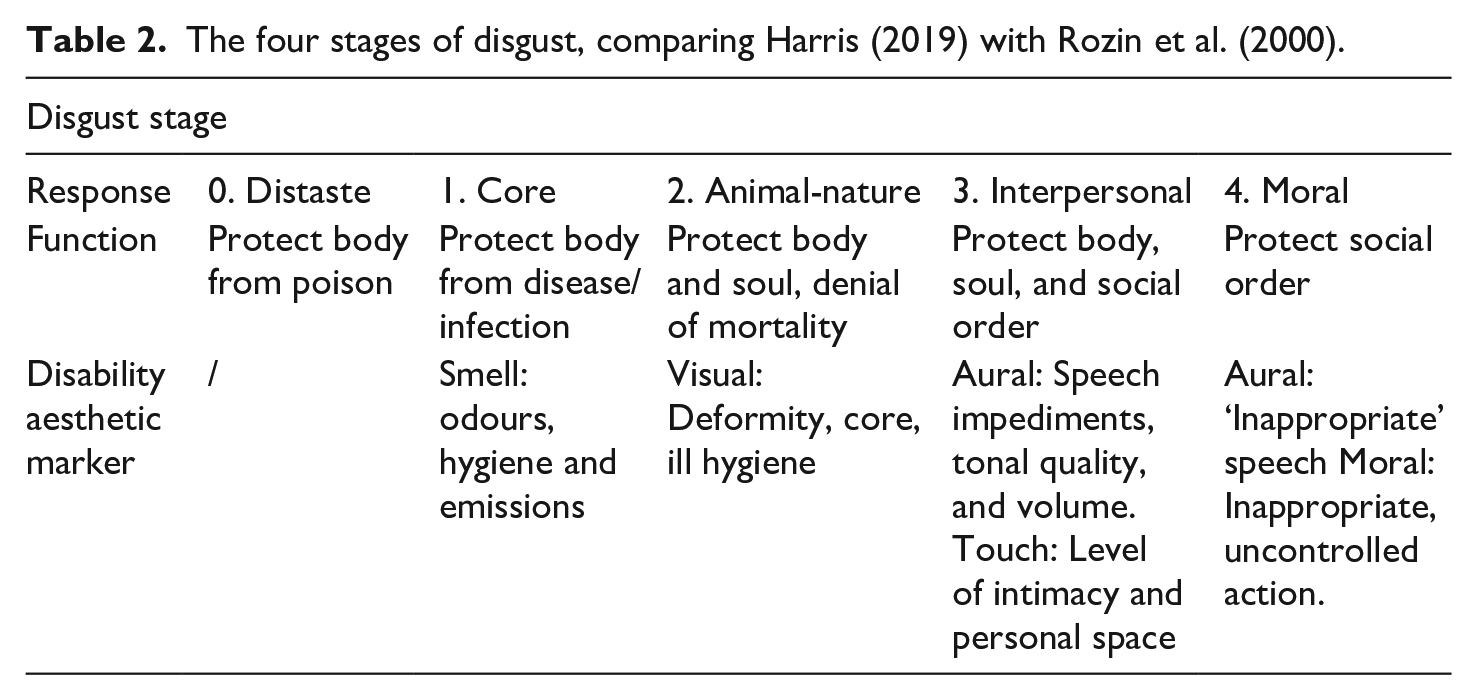
To understand the ethics of aesthetics, I return to the work of Harris (2019: 897), who introduces the term ‘aesthetic markers’ which are ‘visible sensory and behavioural markers that trigger particular aesthetic and affective judgments about marked individuals.’ One example of this is how humans perceive accents: received pronunciation and posh accents (markers) may be attributed to white collar, educated, upper middle-class communities (judgement), whilst a thick, country, or northern UK accent (e.g. a Mancunian accent) may be associated with blue collar, uneducated, lower class communities (Donnelly et al., 2022). The play Educating Rita uses this as a main plot thread: protagonist Rita’s accent changes from scouse (Liverpool) to received pronunciation over the length of the play, as her values and desires also change from working to middle class (Russell, 2013). In Harris’ study (2019: 953-957), she identifies certain disability aesthetic markers related to the sensory domains, visual markers (deformities, blindness, or tics), aural markers (speech impediments, tonal quality, ‘inappropriate’ content and volume), touch (level of intimacy and personal space), and smell (odours, hygiene and emissions).
These markers by themselves are often tied to aesthetic judgements. For instance, a lack of hygiene can be interpreted as irresponsibility or poverty, or inappropriate speech equates to morality or a rebellious nature. Harris (2019: 952) points out that the ‘aesthetics of disability, as markers of corporeal deviation, reflect the ways in which certain bodies disrupt a constructed ideal of an optimal “docile body” and its celebrated set of functional capacities.’ People with disability and impairment who display markers can have negative affective responses from others who are able-bodied and neurotypical (a recent survey of people with disability in the UK showed that 50% of disabled people under 55 experienced negative attitudes. See Moss and Frounks, 2022: 4). Harris (2019: 935) is right to observe that in Western disability politics ‘we have moved from an ideology-based to aesthetics-obsessed body politic. Aesthetic tastes are at the core of aesthetic judgments and present structural challenges, though they are often conceived of as individual preferences.’
Christians are not immune to aesthetic-based politics. Studies have shown people experiencing disability are less likely to be part of a church in Western communities, because of negative attitudes within churches about disabilities (Gill, 2017; Jacober, 2010, 2017; Whitehead, 2018; Whitehouse et al., 2009). Consider the following testimonies from Christian authors from the Global South (Amadhila et al., 2024: 66): It is all too common for clergy to focus solely on their disability, even spotlighting them with undue attention in front of the congregation and offering prayers in the hope of achieving ‘cure’. This perpetuates the negative labelling of disability and assumes that disability is necessarily a ‘sickness’ being ‘endured’ or ‘lived with’, that needs to be ‘fixed’ in some way. Such an approach makes people feel that the ministers and/or communities of faith only see the disability, not the person themselves, and means that the spiritual needs of people with disabilities are often not met.
Otieno (2009) shares: As a wheelchair user due to polio, I have encountered an attitude of outright rejection whereby I am normally the object of pained and evasive glances. I have also experienced sanctimonious and pious tirades as well as judgmental attitudes on the issue of impurity by being asked to repent from some sin.
One could suggest that explicit teaching or producing of theological treatises – reclaiming the imago Dei of all humans, or exegeting Jesus’ call in Matthew 25:31-46 to care for the other – could be the solution. But cognitive preaching, theological treatise, and didactic discipleship risks creating a Cartesian duality between body and mind in Christian formation, particularly when part of aesthetic development engages less with the intellect and more the affections. How are affections, or loves, transformed? Before I consider that, it is important to consider a key visceral affective response that makes cognitive disassociation difficult when confronted with some of the disability aesthetic markers mentioned above: the core emotion of disgust.
Disgust
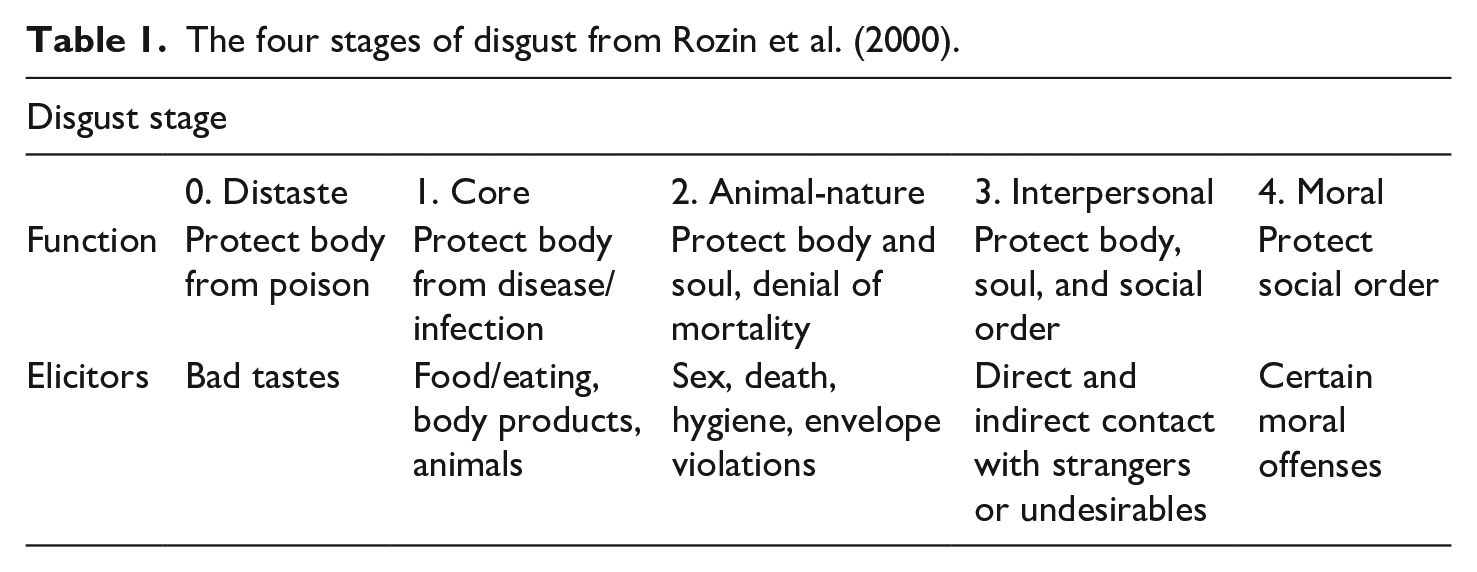
Disgust is theorised by Haidt et al. (1994: 702) as originating from ‘oral defense’ which elicits revulsion at consuming offensive elements, including food, body products, and animals, as the behaviours associated with it are instinctively oral, e.g., nausea, revulsion, and expulsion. Disgust’s range spans into other areas not related to food, including disability (LoBue et al., 2022; Park et al., 2003). 1 Rozin et al. (2000: 645; c.f. Haidt et al., 1994), responsible for producing the key study in disgust theory, describe four stages of disgust (Table 1).
The four stages of disgust from Rozin et al. (2000).
When I compare the disability aesthetic markers described by Harris (2019) with the elicitors described by Rozin et al. (2000) we see the following elements in Table 2.
The four stages of disgust, comparing Harris (2019) with Rozin et al. (2000).
Depending on the stage and type of disgust, it naturally led to ‘a distancing from some object, event, or situation, and can be characterized as a rejection’ (Rozin et al., 2000: 638; c.f. Coneo et al., 2022; LoBue et al., 2022). The nature of disgust extends from the individual to the communal through the social imagination, as communities pass on ‘schemata of core disgust in constructing their [and their children’s moral and social lives’ (Haidt et al. 1997: 124). I shall use the lens of beauty to describe disgust as a phenomenon – innate evolutionary human nature considers markers that cause disgust as ugly/harmful. Beautification in the presence of the ugly may lead to the elimination of the other or that which uglifies.
In a world where ‘dangers, toils, and snares’ exist disgust could be seen as a gift of God’s common grace to enable humankind to survive post-fall. Disgust and its subsets are also a form of ethical demarcating virtue and vice in faith communities. For example, the Apostle Paul exhorts the Christian to have a positive aesthetic preference towards godliness (Phil 4:8; Col 3:12-14), and a negative aesthetic response towards sin (Rom 6:12-13; Eph 4:31; Col 3:5-9). However, the aesthetic response of disgust and pathogen/disease/sin avoidance cannot be the totality of Christian ethics, any ethic solely built on the negative has a penchant towards tribalistic, pharisaic, legalism – beautifying the religious moral exterior but are ‘whitewashed tombs’ (Mtt 23:27). For Christian ethics to be Christian it must be founded in Christ, our humanity exemplar, who displayed virtues contrary to survival, self-preservation, and contamination/suffering free existence but reflect the trinitarian virtues of communion, co-suffering (compassion, from Latin compati: to suffer with), humility, and love (Phil 2:1-11; c.f. Gorman, 2009).
In spite of this, the basic instincts of disgust and distaste in their negative forms impact ministry and missions. Bosch (1991: 297) warned, the gospel always comes to people in cultural robes. There is no such thing as a ‘pure’ gospel, isolated from culture. It was therefore inevitable that western missionaries would not only introduce ‘Christ’ to Africa and Asia, but also ‘civilization.’
The rhetoric of colonialist missions often painted the heathen unbeliever with aesthetic markers of uncivilised helplessness based on colonialist aesthetic values, and champion the anglicisation of the world (Bosch, 1991: 291-292). For example, William Gill, an English missionary in Australia and the South Pacific, wrote in 1848 that the unbelievers are ‘miserable-looking beings, you cannot suppress the emotions of loathing and disgust which involuntary arise in your mind [sic]. Their naked painted forms; their faces besmeared with a pigment of black-lead; their eyes bloodshot with heathen excitement’ (cited in Hitchen, 2002: 466). Today, the tense relationship between Western evangelicals and the LGBTQ+ community can be based on the innate emotional responses of disgust and distaste, painting one-dimensional ideas of one another, caricaturing and cultivating distrust, and short-circuiting meaningful dialogue (Wan and Balogh, 2021).
In the area of disability and impairment, Harris’ research (2019: 897) shows humans innately respond with a level of disgust towards disability aesthetic markers. The testimonies of Amadhila et al. (2024), Kenny (2022), Otieno (2009), and others show that the same occurs for Christians. As Disability theologian Erik Carter’s research (2022: 5) elucidates few congregations would say they intentionally exclude people with intellectual disability. Yet, both long-ago and present-day choices about where and how we gather as a community can inadvertently lead in the very same direction. The ways our buildings and spaces are designed, the expectations we have for behavior and participation, our approaches to preaching and teaching, and the places we gather and go—each speaks volumes about who we truly expect to be part of our faith community. Each makes a theological statement about the boundaries of a body.
The gospel, may be ‘free for all,’ but it has often come to people through ableist robes. When Christians respond to disability with the desire to get rid of impairments (via prayer for healing for example), there lies an underlying belief of an ideal body/mind/experience. However, what – or who – constitutes the ideal human? Ideals change over time and history, it differs between cultures and ethnic groups. Why, asks disability theologian Benjamin Conner (2022), is anyone’s form of able-body or neurotypicality the ideal? Can this ideal driven by ableism and inadvertently discriminate against the inherent humanity, value, and createdness of someone who is deviates from idealistic norms? Social sciences researcher Donna Reeve’s research (2015: 59; c.f. Harris, 2019: 950-952) shows how ableism creates a body that is clean and hygienic, contained and invulnerable, autonomous and independent—free from contamination or reminders of mortality and decay. Even though this corporeal standard is a mirage that lies outside the messiness of real blood-and-flesh bodies, ableism still operates through disgust to separate out those who are ‘fully human’ from those who fail to meet the mark. The failure of non-disabled people to recognise their own mortality, vulnerability, and imperfections results in these fears being projected onto disabled people, who are then identified as monstrous, chaotic, and disgusting.
If Christian desire for the good of people with impairment is driven by ableism, coupled with the powerful innate vehicle of disgust, it can have the potential to dangerously narrow human imagination of what it means to be beautiful – and fully – human.
Christian communities are not exempt from ableist imaginations. The aesthetic markers that Christians value, if left unexamined, may be donned with evolutionary, biological, or cultural robes that are less to do with Scripture and its teachings but ‘aesthetics-obsessed body politic’ (Harris 2019: 935). The ableist aesthetic values of invulnerability, autonomy, and independence, observed by Reeve (2015: 59), can be preferences that drive Christian leadership selection, ministry practice, liturgies, missionary methods, and discipleship pathways. One such example is the existence of the rhetoric of disgust in modern Christian rhetoric when people with disability, impairment, or a mental illness are framed as ‘sufferers,’ or ‘sinful,’ or ‘brave and courageous’. Ultimately, people are totalised as their impairment – they are collapsed into a singular characteristic or a thin description (Geertz, 1973: 6-12). If I am described as ‘the bipolar [name]’, I am totalised in that phrase by my mental illness, subsequently disregarding the potential good health that I may be in and the multiplicity of who I am. In the Western church that values the aesthetic markers of lucid and rational cognition, it may be easy to disregard the discipleship of persons with schizophrenia and dementia, as their inability to control emotions, movements, and recall can lead to affective responses of fear, distaste, and the question of their humanity. In the presence of fear and distaste, totalising provides assurance for the able. Totalising reinforces a power over the unknown other and the ability to dictate the relationship, but can keep compassion and vulnerability at bay. Those who experience disability are stigmatised, unknowingly stripped of their personhood and autonomy, with their creation as ‘non-persons’ (Swinton, 2000: 950-105; 2017: 49-67). The ultimate end of totalising, in the thoughts of Levinas, is the literal or figurative annihilation of the other (Shepherd, 2014: 18-19; c.f. Levinas, 1991: 46-47), and in the case of people with disability and some local churches, missing persons in the pews.
Whitehead reflected on his study that ‘this population [with a disability] is unseen because they never show up, or when they do, they have a negative experience and never return’ (in Briggs, 2018; c.f. Whitehead 2018). Though the disability rights movement, through advocacy and law making, has created crucial public awareness, budgeted structures of support, and much more opportunities for people with disability, there is still much to do to affect ‘the domain of personal intimacy’ (Reinders, 2008: 6) and recreate the sense of community and belonging for many. Swinton’s (2012a: 182) words are haunting and hopeful, ‘The law can legislate for inclusion, but it cannot help people to belong.’ No law can demand love, nor legislation reform people to behold on another as beautiful, worthy, and whose presence brings delight. A church may champion change in external disabling structures, for example, provide sensory rooms, wheelchair ramps, training, funding and curriculums, but it does not necessitate the changing of the internal disabling structures of motives and desires affected by the imaginations of ableism.
Paul’s words in Romans 10:14 call out, ‘the same Lord is Lord of all and richly blesses all who call on him. . . but how can they believe in the one of whom they have not [been reached in neurodivergent and impaired-bodied ways]?’ And how can others love God, without neurodivergent and impaired-bodied means of evangelism? And how can anyone evangelise unless they are sent?
Re-beautification of mission and ministry?
If we agree that our feelings of disgust contribute to an ableist and potentially discriminatory church environment, where do we go? How do we change our structural, habitual, and strongly-held aesthetic values and judgements, especially when they are driven by innate, visceral emotions? Reason cannot alter the changing of one’s aesthetics, in the same way that I cannot reason about the preference of Rouault over Picasso or the taste of tea over coffee. The prior deconstruction of disgust in the Christian life and theological arguments may provoke a change in thinking, but by the end of this article, the relationships the reader may have with people with impairments may not be affected. Tempting as it may to deconstruct discriminatory aesthetic structures, particularly in the fields of disability and critical studies, deconstruction ad infinitum without reconstruction ad infinitum divinum removes the Christian aspect of theology. If we return to the question of how aesthetic preferences can be changed, the Reformed tradition is simply thus: loves are only realigned by another love, desire for one set of beauty is only captured by another beauty. For, as the reformer Thomas Crammer describes anthropology, what the heart loves, the will chooses, and the mind justifies. The mind doesn’t direct the will. The mind is actually captive to what the will wants, and the will itself, in turn, is captive to what the heart wants. (Null, 2001)
2
Aesthetic values, affections, and preferences are transformed by recapturing heart and kindling new affection. For even our desire for the beautiful is not always good or true, according to the theologian David Bentley Hart. Desires themselves ‘must also be cultivated; the beautiful does not always immediately commend itself to every taste’ (Hart, 2003: 20).
Yet, the task of redirecting love cannot begin with desiring (impaired) humanity; for the locus of beauty in a created universe that is contingent in existence (Col 1:17) emanates from the source of creation and beauty: our Triune God. Christian cultivation of renewed desires is primarily a theological turn. Returning to the theological, however, does not mean remaining in the philosophical. Made in God’s image, Christians are to love as God loves and desire as God desires, imbued in all is the God-given task of reflecting and participating in beauty in all its forms (Parkison, 2022: 38) and upholding the role of the cultural mandate by beautifying creation (see Dyrness, 2011: 3-36; Prior, 2023; Smith, 2013). The process from theology to practice is to first turn the gaze towards beauty Divine and beauty incarnate and allow body, mind, and spirit to be renewed and sanctified. Sarah Coakley’s (2013) in-depth work on the renewal and sanctification of desire is helpful; she writes: [A] contemporary trinitarian ontology of desire – a vision of God’s trinitarian nature as both the source and goal of human desires, as God intends them. It indicates how God the ‘Father’, in and through the Spirit, both stirs up, and progressively chastens and purges, the frailer and often misdirected desires of humans, and so forges them, by stages of sometimes painful growth, into the likeness of his son. (Coakley 2013: 6)
Therefore, our turn for renewed aesthetics is akin to the journey from star-gazing to moon landing. To fix our sight upon our transcendent and sublime Trinitarian God, and in the space of slow spiritual reflection, allow every aspect of his beauty to capture us and chasten our personal desires and imaginations. In so doing, we may reconsider whether our current aesthetics values, preferences, and reactions are narrowed, and are in need to be enthralled by the fullness of divine beauty. Then in contemplating how divine beauty is immanent and incarnate in Christ, we can consider how beauty ‘in Christ’ can be captured more fully in our spiritual, liturgical, missional, and ministry habits.
From star-gazing to moon landing
Beauty is difficult to describe. In classical philosophy it is considered an attribute (or ding an sich). It is ‘transrational’ (Parkison, 2022: 36, n.96), that which ‘exceeds beyond the finite boundaries of its perceptible expressions’ (Parkison, 2022: 38). Beauty delights human senses, cultivates human desires, and ‘is not a fiction of desire, nor is its nature exhausted by a phenomenology of pleasure; it can be recognized in despite of desire, or as that toward which desire must be cultivated’ (Hart 2003: 17). Humans recognise beauty in ‘intuitive. . . pre-rational’ ways (Parkison, 2022: 40). Beauty also moves humanity towards the good; von Balthasar (1982: 18-19) posits that without beauty, there is no hope, desire, imagination, or love. ‘We can be sure,’ he writes, ‘that whoever sneers at her [i.e. beauty’s] name [. . .] can no longer pray and soon will no longer be able to love [. . .] In a world without beauty [. . .] the good also loses its attractiveness.’
In Christian thought, God is beauty in its highest form (Augustine, 2.6.12; 3.7.10; c.f. Ps 50:2); the ontology of Father, Son and Spirit is the display of perfect good and true in perichoresis. Beauty also exists as an attribute of God. From eternity past, creation to new creation, God is immanently and economically beautiful, Divine beauty overflows from the internal life of the Trinity to his beautiful actions in creation and redemption. Creation derives beauty in essence and existence via the Triune God (Col 1:17), and remains beautiful when it participates in, reflects, and points towards the beauty of God. Equally, redemption as expressed in God’s saving mission equally ‘derive[s] from the very nature of [our trinitarian] God’ (Bosch, 1991: 390). Missio Dei is beautiful in essence, in its telos of reconciling all to Christ, (2 Cor 5:19), and in mode and practice (via the whole church and the whole gospel). The Church Fathers considered that God is invisible (Rom 1:20; 1 Tim 1:17, 6:16; Heb 11:27) divine beauty is found in divine goodness: moral beauty (Augustine, Exposition of Psalm 65: 8; see Basil the Great in Caspary, 2012: 41). Jonathan Edwards would continue this thought by describing beauty as the ‘self-transcending disposition of benevolent caring’ (Farley, 2001: 118). God’s beauty in benevolent care is revealed in his redemptive act towards humanity by redeeming the imago Dei (c.f. Crisp, 2017: 277).
3
The working definition of theological beauty can be summarised with a paraphrased version of von Balthasar’s (1982: 18) image at the start of this paper: [Beauty] dances as [the perichoretic union of the Trinitarian God, and as an attribute of the Divine, emits] an uncontained splendour around the [divine] constellation of, divine truth and divine good[ness] and their inseparable relation to one another.
By (re)turning beauty towards theology proper, it creates several points of reflection. Firstly, beauty is not limited to any one form of physical, moral or visual beauty, as divine beauty revealed in goodness and truth are headwaters that flow into many different tributaries. In our current 21st century, Christians inhabit communities where the social imagination for beauty has been narrowed to the visual and physical. For example, the vernacular semantic usage of beauty include beauty parlours, beauty salons, beauty products, beauty pageants, or Beauty and the Beast. Visual beauty, particularly of Euro-centric ableist ideals, may become aesthetic preferences that Christians habitually value. Returning beauty to theology allows Christians to begin observing whether structural, habitual, and strongly-held aesthetics have been narrowed by societal norms, and expand the concept of beauty to the manifold ways in which it emanates from God into his creation.
Secondly, returning beauty to theology allows Christians to consider that the real measure of beauty of any form is in light of divine beauty not utilitarian, utopic, nor creaturely standards. Therefore, limitations to certain actions, choices, or shortcomings in capacity or developmental pathways do not immediately lessen or increase a person’s beauty. Limited creaturely reality does not mar beauty; many limits of creation and creaturely reality is because it is purposefully so and ‘it was very good’ (Gen 1:31). As the locus of God’s beauty, argued above, lies in the interplay of divine goodness and truth, the measure of creaturely beauty is weighed on whether it participates in, reflects, and points towards God’s beauty. Mission, therefore, cannot be utilitarian nor utopic, because neither God nor his means and purposes are utilitarian or utopic. The beautiful purpose of reconciling the cosmos in Christ exists hand in hand with the beautiful means through which this occurs, for the being and economy of our Triune God are beautiful, good, and true. A Christian’s participation in missio Dei seeks to be beautiful when it participates in, reflects, and points towards the beauty of God.
Applying the return of beauty to theology recaptures a Christian’s desire for beauty as the redemptive good in the experience of disability and impairment. Even though aesthetic markers may cause distaste activating our pathogen/disease avoidance, Christian affective responses are to be determined by goodness. This goodness is not found in the imagination of a Darwinian self-preservation, free from contamination and suffering,
4
nor in the sublimation of disgust in pity or charity; true divine goodness is found in compassionate, empathetic, cruciform relationships. Invisible divine beauty incarnates in a time and a space, confining himself to creaturely limits, and remains beautiful in situ. Jesus Christ, God incarnate, is birthed in a dirty stable, partakes in communion with sinners, washes the grimy feet of his disciples, sweats blood, and hangs in shame alongside thieves – and is in the midst of all these actions divinely beautiful. The early Christians followed this example of a beautiful life, diving into doing good in times of plague: Many of our brothers, out of great mercy and brotherly love, did not spare themselves, supported each other, visited the sick without fear, served them without fail, cared for them for Christ’s sake, and died together joyfully. (Eusebius, History of Christianity: 7.7)
A Christian’s desire for the beautiful is so otherworldly that it surprises others, like the emperor Julian the Apostate: ‘The impious [Christians] support not only their own poor but ours as well, all men see that our people lack aid from us’ (The Letters of Julian, 22. LOEB).
When Christians enter a moment of disability and impairment, part of participating in God’s reconciliation work begins with aesthetic consideration of the beauty of the situation. This beauty can be discerned by considering how the moment is currently participating in God’s beauty. The narrative of the man born blind in the start of John 9 is a clear example. When the disciples gaze at the man’s visual impairment they make an aesthetic assessment without engaging or speaking with him. The aesthetic marker of blindness is diagnosed as a sign for the presence of inherited or indwelling sin; thereby blindness being connected to divine retribution restricts the man from participating in God’s beauty. The man is depersonalised and totalised in sin and used as a case study for theological enquiry (John 9:2). Jesus, on the other hand, considers the man in a different light. The diminished sight, though an anomaly in God’s world where eyes are created to see, does not diminish the man’s participating in God’s works. Jesus says, ‘this happened so that the works of God might be revealed in him’ (John 9:3). J. Ramsey Michaels (2010: 546; c.f. Poirier 1996) identifies the ‘works of God’ as not so much the miracles of Jesus as the working of God in the man’s life, even before he met Jesus, setting him apart as the Father’s gift to the Son (see, for example, 6:37, 39). As such, they are not fully ‘revealed’ or disclosed in the miracle of restored sight, but only later, when the former blind man finally ‘comes to the Light’ (3:21) by believing in Jesus (see 9:38).
5
Thus, as per Johannine theology, the presence of God’s work and purposes had been eternally at play in the man, but the revelation (φανερωθῇ is in the aorist subjunctive) and fulfillment of these works may be staggered (Keener, 2010: 775). Beauty existed in the man with visual impairment for he never existed outside of God’s purpose; this present beauty was further magnified when his eyes were given sight, healed as per God’s design for eyes. Yet, in the span of this man’s mortal life his eyesight would ultimately decline once more (if death does not take him first). Every healing that Jesus did in his earthly ministry would be naturally reversed in this life by age and death – Lazarus would die once more, limbs and eyes would fail. Part of this, as mentioned above, is the created limits of the current creation. ‘The creaturely reality that limits us and that we cannot (and should not) hope to transcend is a reality dripping with blood, sweat, semen, saliva, and excrement. Life is sloppy. It is dishevelled, untidy, and unkempt’ (Stulac, 2022: 1). Physical healings do not infinitely transcend divinely designed creaturely limits and are only glimpses of the fulfilment of God’s design and purpose for creation.
Optical beautification is not the only outcome of ‘God’s work’ in this scene. The disciples’ mind’s eyes were beautiful in their capacity to imagine the theological state of the man. However, the beauty of their imaginations was further magnified to capture God’s imagination and conceive God’s work. Furthermore, the beauty in the man’s eyes of faith was progressively magnified in the spiritual journey of this scene, which culminated with him truly seeing and believing divine beauty incarnate – Jesus the Messiah (John 9:38). The man’s beauty as imago Dei is magnified when he worships Jesus, thus more fully participating in, reflect, and pointing towards God’s purposes for creation. Healing’s occurrence, or lack thereof, does not make one more beautiful; beauty is revealed and magnified in us depending on our participation in his works. This moment serves as an example for able-bodied, unimpaired, and neurotypical Christians, to self-reflect. In what ways are these things blinded by our capacity and imaginations to see God’s beauty in impaired bodies and neurodivergence? Beauty lies from creation to new creation, for nothing escapes the work of God. For the whole church to hear the whole gospel in the whole world, the eyes of our hearts need to be opened to the ‘works of God,’ the manifold beauty of God that already exists in others, and the spiritual imagination to participate in missio Dei. I will end this this paper on the importance of imagination, but before doing so I want to reflect on one final application.
The objective reality of beauty found in the trinitarian God reveals that beauty does not exist in a Platonist state of stasis for God is ontologically persons-in-relations (Gunton, 1997; Kärkkäinen, 2007: 88-100). Human beauty, in reflecting the imago Dei, is found ontologically in beautiful relationships with others. As humans are bound in the created state of time and space, beautiful relationships are context and situation bound (Karios); there is a Kairos for something to be beautiful and there is a Kairos for the same to be more beautiful. Consider the gospel of John again, it has an emphasis on the theme of Kairos. In the previous narrative of John 9:1-3, Jesus deliberately withholds the healing of the man until after his engagement with the disciples (c.f. Mk 8:22-26) for a purpose. Even though the purpose of the gospel of John, as stated in the author’s statement of intent at the end of the book, is that ‘you may believe that Jesus is the Messiah and the Son of God, and that by believing you may have life in his name’ (Jn 20:31) the revelation of Jesus identity is withheld in the first half of the book because ‘the hour has not come’ (Jn 2:4, 7:6). As miracles and teachings build in the Johannine narrative, they are interspliced with moments of self-revelation when Jesus proclaims ‘I am!’ in seven statements (Jn 4:26; 8:24, 28; 13:19; 18:5, 6, 8); giving the disciples and the readers a partial foretaste of who he is (c.f. Barrett, 1955: 242-243; Ball, 1996; Köstenberger, 2009: 359). The revelation of Jesus as the Messiah and Son of God is objectively true, good, and has eternal salvific significance, yet for the people in the context of Jesus life, and the same can be said for the readers of the gospel, there is a Kairos for the revelation of Jesus’ identity that has greater situational beauty.
Beauty in Kairos has vast importance in Christian communities. Take the example of speech. Christian ethics espouse personal and communal aesthetic preferences towards moral speech (Eph 4:29 and 1 Peter 3:10). If someone who experiences verbal impulsion (e.g. Tourette’s or on the Autism spectrum) entered a faith setting, and spoke involuntarily with words that were offensive, an instinctual aesthetic judgement would be to consider it a potential breach of Christian ethics. Reactions could range from distaste to rebuke, potentially citing the epistle of James (‘The tongue also is a fire . . .Out of the same mouth come praise and cursing. My brothers and sisters, this should not be’ James 3:6, 10). Ableist imagination ascribe godliness to aesthetic markers of reasoned speech with little room for contextualising Christian ethics for the experience of disability and impairment. Though these aesthetic moral judgements may come from good intentions, they may not beautify or benefit the actual morality of the situation or the moral culpability of the person. An attempt to cast out the demonic/spiritual evil from the person with verbal impulsion or hail them as a prophet of God, assumes an ableist aesthetic judgement that uncontrolled utterance is spiritual in origin. Even if the response is to ignore, the adage ‘inaction is an action in itself’ applies; inaction by Christians model the discipleship of all present in the situation. The necessity of a beautified Christian imagination that can consider the beauty of others and the good Kairos of action requires the cultivation of our love through chastened imagination. The final part of this paper will consider how imagination chastened by the spirit draws Christians to visualise beauty in impairment.
Chastened imagination – The telescope for beauty
Imagination is powerful. It is, as Karen Swallow Prior (2023: 7) wrote, ‘large, pervasive, and overwhelming. . . [it] shapes us and our world more than any other human power or ability.’ Akin to aesthetic values and preferences, imagination guides, interprets, and dominates human experience unconsciously (Smith, 2013: 49). In the space of disability and impairment, imagination’s power can be the impulse that either enables, if chastened by the Spirit, or pushes people away from disability, impairments, and human limitations. This is because our response to disgust and fear is partially based on imagination, as the self is projected into the other, in an attempt to perceive, empathise, and understand. Licia Carlson (2010: 191), who specialises in the philosophy, pinpoints this The rational, non-disabled individual imagines the ‘poor wretch’ through the projection of the self: as one who is stripped of certain central human powers. This may account for why this human other inspires such fear, as one imagines oneself in this attenuated human form. When the intellectually disabled simply perform this mirror function, however, there is the potential for a double distortion to occur. not only do I see myself in some disturbing, alien form, but I simultaneously run the risk of distorting the reality of the other precisely because she becomes a manifestation of my own fears as I imagine myself in this condition.
The theologian/ethicist Stanley Hauerwas (1986: 174)
6
warns: We have no right or basis to attribute our assumed unhappiness or suffering to [people with disability]. Ironically, therefore, the policy of preventing suffering is one based on a failure of imagination. Unable to see like the retarded [sic], to hear like the retarded, we attribute to them our suffering.
For Christians who are able-bodied, neurotypical, and yet-to-be-disabled, attending to the experience of impairment and disability can be a complicated journey. Even though constrained by an ethic of other-person-centered love, Christians run the risk of projecting an able self into experiences of impairment, creating thin (or false) narratives and inappropriate, ill-contextualised discipleship of others. The question Christians need to ask as we engage in imagination is akin to the one that Carlson (2010: 187) asks: ‘How can we enlarge our imagination without simultaneously projecting ourselves onto the intellectually disabled?’
Beautiful, true and good imagination of the other occurs when deep attention is given to others and a humble desire to dwell within their reality (Jn 1:14). There may be, at first, great difficulty in empathising in an experience that is incredibly foreign: what does it mean for someone who is neurotypical to perceive the world in neurodiversity? Relations with another occurs in walking the dialectic of recognising the beauty of both similarity and otherness. It seeks to find the divinely-endowed beauty of the common denominators of all humans regardless of experience: the image of God, flesh, blood, existing as flesh and blood, the equal call to participate in God’s creation and missio Dei. The other side of the dialectic is holding the infinity of the other in humble respect – every other cannot be completely understood or totalised (Levinas, 1991). Levinas warns of totalising the other’s infinity through collapsing their complexity, creating thin characters and relationships. Disability ministry and mission can draw from the rich pathways of redemptive relationships in inter-cultural relationships from global missiology. Methods of de-centralising and decolonising global mission, and seeking indigenous theologies and leaders grounded in the retrieving of missio Dei, the works of Lesslie Newbigin (1989, 1996) and Bosch (1991), are examples of beautifying church work in de-ableising and creating local disability theologies and leaders.
Just like global mission, attending to the other is stepping outside one’s hermeneutics and aesthetics, and Christians in the western world the work of disability ministry begins with humbling the self, and being present in the slow participation of another’s life in ‘having the very mindset as Christ Jesus’ (Phil 1:5-8). It is contemplating, as Jesus did in John 9:3, ‘What work of God is being displayed here?’ Especially when the chasm between experiences appears to be impossibly large and the unknowns are inconceivable (in neurotypical minds) embracing the task of trial and error (Brock, 2021: 149), filled with grace, gentleness, humility, seeking forgiveness and self-sacrifice.
Every person is an infinity. That is true regardless of whether they experience impairment Moved by the ethic of trinitarian perichoretic love, Christians can move towards the other, growing in love, knowledge, and insight through relationships. In cultural settings where faith is hyper-cognitive (Swinton, 2020: 187; c.f. Gangemi, 2020), it is recognising that faith in God can occur and be practiced in many different ways that are unfathomable to the cognition. Love can also be expressed in ways that are neurodiverse (Swinton, 2012b). 7 Even when Paul describes the love of Christ it is held in tension as being both comprehensible via the Spirit (Eph 3:18) and a love that ‘surpasses all understanding’ (Eph 3:19). How can western ministry and mission express both the knowable and unknowable love of Christ? What are the beautiful neurodiverse and impaired-bodied ways of receiving the love of Christ and expressing love to Christ? Are Christian liturgies only seeking to form beautiful able-bodied, melodically-coherent, rhythmically cognisant expressions of worship? Are Christian gatherings only providing spaces for neurotypical fellowship, where someone’s sensory needs are not considered? 8 Considering the equal place of brothers and sisters in the body of Christ, what are the beautiful ways in which they have been gifted? How do they manifest the beauty of God within our midst? By attending, what may be perceived as unknowable, it may open different ways of relationships, fellowship, worship, ministry and mission that is beautiful for all.
Finally, part of breaking free from ableism’s grip is to gain a posture that desires for our brothers and sisters who experience impairment and disability to ‘Teach me to other ways to behold God’s beauty!’ Swinton’s ideas (2018) are helpful to put in full, as he describes how neurodivergence and impairments can be hermeneutical methods of growing in knowledge, love, and obedience to God for those who are neurotypical and yet to experience disability.
If you are blind you will never see the Scriptures; if you are deaf, you will never hear the word; if you have no arms, you will never feel what it is like to embrace someone even though you are embraced. To be embraced by the love of God will have a totally different meaning. If you cannot name Jesus, you will never know what it means to proclaim him with your lips. Such embodied ways of being in the world do not provide better or worse experiences of being with God. They are just different: if you can see, you will never know what it is like to encounter God without sight; if you can hear, you will never know what it is like to sign the word and to use your body in ways which a hearing simply cannot grasp; if you can remember everything well, you will never know what it is like to encounter God without remembering God. Likewise, if you can grasp the concept of Jesus with your mind (and, of course, no one fully can), you will never know what it means to encounter him without words and concepts and, like John the Baptist, be dependent on the Holy Spirit and others to reveal what it feels like to be with God. Such embodied ways of being in the world do not provide better or worse experiences. They are just different. (Swinton, 2018: 108, italics in original)
Without the presence of people with disability and impairment in the lives of able-bodied, neurotypical Christians, there can be no fullness of the corporate gathering of the body of Christ in beholding, contemplation or relating to the full measure of God’s beauty.
Conclusion
Perhaps it was divine providence that as I wrote part of this paper in a café with a dog by my chair, a thickly bearded man wearing a Sydney Swans sports jersey, sandals that showed blackened feet and curled nails, and the smell that provoked a sense of disgust, came to greet me and pat the dog. My immediate, visceral aesthetic response was to move away, decline, and disengage. But Gerald Manley Hopkins (n.d) whispered in my ear: . . .for Christ plays in ten thousand places, Lovely in limbs, and lovely in eyes not his To the Father through the features of men’s faces.
So, I paused my writing, introduced Frankie the dog, and beheld another.
In this reflection on aesthetics, I have sought to consider our gaze towards impaired bodies and neurodivergence and reclaim a theological aesthetic that perceives how Christ, indeed, ‘plays in ten thousand places.’ By centering Beauty in our Trinitarian God, our innate aesthetic preferences, values, and judgements are both de-centered and recentered. God’s beauty draws our hearts to love, guides our will to choose good, and chastens our mind to discern truth. In so doing, our hearts, will, and mind become beautiful. We fall in love with beauty and desire it, seeking for ourselves and others to become truly beautiful. 9 De-centered from ableism through the sanctifying work of the Spirit and Scripture; recentered to perceive, in a thick lens, missio Dei in all people and all aesthetic markers. Our desires are chastened to love as God loves and, to paraphrase Hopkins (n.d.), consider ‘lovely in impaired limbs, and lovely in impaired eyes all his/ To the Father through the features of impaired humanity’s faces.’
Footnotes
Funding
The author received no financial support for the research, authorship, and/or publication of this article.
