




Abstract
Jayson Georges’ The Culture Test has over 40,000 respondents from over 200 countries. The test is based on Georges’ three culture types from his book The 3D Gospel: guilt–innocence, shame–honor, and fear–power. Using the discipline of Culturology (also called hologeistic cross-cultural analysis), The Culture Test is analyzed and compared with Hofstede’s cultural dimensions, Minkov and Kaasa’s objective cultural dimensions, and various societal measures. A three-dimensional plot and culture map show how The Culture Test clusters countries and regions. These comparisons, plot, and map highlight the culturological strengths of The Culture Test and The 3D Gospel—correlated to societal measures related to individualism versus collectivism. They also demonstrate the weaknesses of The Culture Test and The 3D Gospel—which measures only one cultural dimension and regions and countries cluster poorly.
Keywords
Introduction
Missions and the secular world have recognized the essential tasks of understanding and quantitatively measuring culture. However, these tasks remain elusive, and there is an absence of consensus among practitioners and scholars. Further, the theories constantly evolve, and researchers are creating new data sets and mining old ones for new insights. What has emerged is a discipline that can evaluate the theories, data, and interpretation of the data. This discipline, in part, uses real-world measures (educational scores, road deaths, Human Development Index, Gross National Income per capita, etc.) as components of its evaluation.
Jayson Georges’ The 3D Gospel (2017) gave the missions community a theory of culture. The Culture Test (TCT) (Georges, 2019) provided the corresponding test and results. This article evaluates the results of TCT using the discipline mentioned above. Since TCT is based on The 3D Gospel, an evaluation of TCT is also an evaluation of The 3D Gospel.
The Abstract states the results in the language of the discipline used. In terms more familiar to the missions community, TCT (Georges, 2019) and The 3D Gospel (Georges, 2017) only measures one thing. While TCT and The 3D Gospel present three aspects of culture, the analysis shows all three are highly related (or correlated). In other words, if you only know one of the three, you can accurately predict the other two. Because of this, TCT and The 3D Gospel do not supply an adequate way of distinguishing certain cultures from others. A cultural map and a three-dimensional plot demonstrate this.
The strength of TCT (Georges, 2019) and The 3D Gospel (Georges, 2017) is that they predict some societal measures. For example, if you know one TCT cultural aspect score for a country, you can reasonably predict the Human Development Index (Conceição, 2020: 343–46) score for that country. Unfortunately, there are other societal measures where TCT has no predictive ability.
The discipline used is Culturology.
Basic principles of Culturology
The discipline of Anthropology is known for ethnographic and comparative studies of two or three cultures that explore those cultures’ structure and internal elements. These ethnographic studies are essential, and culturologists depend on them to validate their theories and data (Hofstede, 2001: 26). However, ethnographic studies by design are emic and do not give a good perspective on the more universal aspects of culture.
The discipline of Culturology 1 (also called hologeistic cross-cultural analysis) “is the predictive, quantitative, empirical, nomothetic, etic and large-scale study of many diverse cultures, societies or nations (ideally with coverage of every continent) at the same time” (Cox, 2018: 24). It uses statistical analysis to compare different cultures via surveys, databases, and societal measures. Culturology focuses on explaining diverse cultures quantitatively. It searches for “the most general and universal descriptions of a culture” (2018: 27).
There are two parts to Culturology (Minkov, 2013: chap. 5). One is a theoretical model that explains worldwide cultural variations. Two is empirical data and the statistical analysis of this data. The data and analysis support and verify the theoretical model. In addition, it should correlate to different societal measures (wealth, development, education, health, etc.) and be able to make quantifiable predictions. The theoretical model and the data are expressed in cultural dimensions.
Within Culturology, there is a debate as to which should come first: the theoretical model or the data. Some culturologists start with a theoretical model and look for or create data to verify the model. Others start with empirical data and work toward a theory to explain the data. It is the age-old argument of which is better: deductive or inductive reasoning.
Cultural dimensions attempt to capture measurable universal categories of culture. Generally, a cultural dimension has two poles, such as individualism versus collectivism or long-term versus short-term orientation. Nations and societies (via surveys or other data) are numerically placed on the spectrum between these two poles. For example, on Hofstede’s 2 (2015) individualism versus collectivism cultural dimension, Ghana scores 15, Argentina scores 46, and Australia scores 90 out of a possible 100. This clearly indicates where each country is located on the cultural dimension spectrum.
The goal is to minimize the number of cultural dimensions while still best accounting for worldwide variations. Most modern culturologists have two (Inglehart and Welzel, 2016; Minkov and Kaasa, 2021) or three (Schwartz, 2009) cultural dimensions. This is a shift from the past, where the number of cultural dimensions varied from four to eight 3 (Hofstede, 1980; House et al., 2004; Trompenaars, 1993). For those of us (author included) who learned—and maybe even taught and argued for—Hofstede’s (or to a lesser extent Trompenaars’ or House’s) cultural dimensions, accepting two or three cultural dimensions can be difficult. The online Supplemental Material contains more information about the transition to two or three cultural dimensions.
In an oversimplification of some complex statistics, suppose there is a cultural theory and data with two cultural aspects: alpha and beta. The natural presumption is cultural aspect alpha statistically measures something different from cultural aspect beta. However (and counter-intuitively), cultural aspect alpha and beta often measure something very statistically similar.
If indeed, cultural aspects alpha and beta measure something statistically different, they will be uncorrelated. This is visually similar to an x–y plot; see Figure 1a. Cultural aspect alpha can be plotted on the x-axis, and cultural aspect beta can be plotted on the y-axis. A scatter plot yields points placed throughout the graph. In this case, cultural aspects alpha and beta are orthogonal.
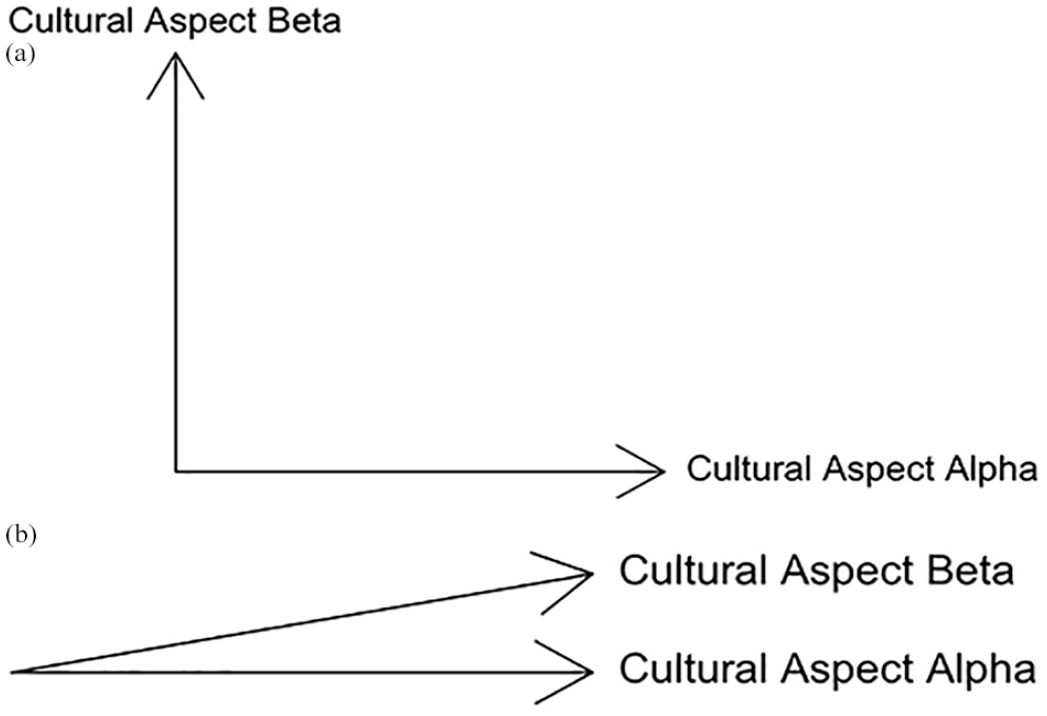
Orthogonal and oblique cultural aspects.
If cultural aspects alpha and beta measure something statistically similar, they will be correlated. The higher the correlation, the greater the indication that they are measuring the same thing. Visually, cultural aspect beta varies from cultural aspect alpha by a few degrees (rather than 90 degrees), reference Figure 1b. A scatter plot yields points in a straight line. In this case, cultural aspects alpha and beta are oblique. 4
Cultural dimensions are (as a general rule) statistically orthogonal. 5 To minimize the number of dimensions, each one has to measure a different thing. Consequently, they provide differentiation between regions and countries.
Culture types (also called cultural typologies) are helpful constructs that aid in understanding cultural dimensions. Similar to a cultural dimension, a culture type usually gives two extreme facets of culture for comparison: thrift versus spending. However, unlike cultural dimensions, there is no minimum number goal, and culture types (with data) can be either orthogonal or oblique. Further, culture types can be purely theoretical without any statistical data. Cultural dimensions have strict rules, while culture types vary from loosely defined ideas without data to elegant constructs with empirical measurements. The main criterion for culture types is helpfulness in understanding.
Within one cultural dimension, there are multiple culture types. For example, self-consistency versus flexibility, spending versus thrift, and universal guidelines for good and evil versus good and evil depends on circumstances are three different culture types within Hofstede’s cultural dimension of long-term versus short-term orientation (Hofstede et al., 2010: 243). “I” versus “we” consciousness, right of privacy versus stress on belonging, and speaking honestly versus maintaining harmony are three culture types from Hofstede’s cultural dimension of individualism versus collectivism (Hofstede, 2011: 11). Culture types are not designed to capture universal categories of culture nor to provide good distinction between regions and countries. 6
Given that Culturology is nomothetic, culturologists understand and accept that their work does not capture the complexity, depth, richness, contradictions, values, traditions, languages, and behaviors of specific cultures. The cardinal sin in Culturology is ecological fallacy. This “fallacy occurs when a researcher concludes that each individual in a subject group has the general characteristics of that subject group” (Wetcher-Hendricks, 2011: 320). Knowing the cultural dimension scores of a nation is no indication of how a particular person (or even a particular group) in that country will think or act. Culturology supplies generalizations about a society in comparison to other societies. If the need is in-depth knowledge of a specific society, then use the tools and skills of Anthropology.
The 3D Gospel model of culture (the theoretical)
The 3D Gospel is written to help those working cross-culturally communicate soteriology. It has three culture types based on “responses to sin in human cultures” (Georges, 2017: 10): guilt–innocence (GI), shame–honor (SH), and fear–power (FP). “The notions of right and wrong are foundational pillars in guilt-innocence cultures.” Each person within a GI culture should know right and wrong: “Guilt-oriented cultures do not simply emphasize rules and laws but socialize people to internalize the codes of conduct. Moral responsibility comes from within” (Georges, 2017: 17). In a GI culture, when a person does right, they feel innocence; when they do wrong, they feel guilt. GI cultures are individualistic.
“Shame–honor societies assume a strong group orientation. Honor is a person’s social worth, one’s value in the eyes of the community.” Honor is when a community values and esteems a person, leading to social harmony. “Shame, on the other hand, is a negative public rating: the community thinks lowly of you. You are disconnected from the group” (Georges, 2017: 20). Shame is “losing face.” SH cultures are collectivistic.
“In fear-based cultures, it is not important to genuinely believe in certain truths or follow ethical standards. Rather, methods that placate the spiritual powers define acceptable human behavior” (Georges, 2017: 25). In FP cultures, people fear making a mistake that would offend someone or something in the unseen realm. Rituals are used to appease the unseen realm so that one will receive help and thus have power. FP cultures strongly believe in three realms: (1) the seen realm (physical items and people); (2) the unseen realm of this world (ancestors, angels, spirits, blessings, curses, etc.); (3) the unseen other realm (heaven, hell, God, etc.) (Georges, 2017: 25).
The Culture Test (the data)
The Culture Test (TCT) has over 40,000 respondents from over 200 countries. It consists of 25 incomplete short statements. Each incomplete statement has three possible choices to complete the statement. The respondent must choose one of the three. Each of the three choices corresponds to one of the three cultural types: GI, SH, or FP. For example, one incomplete statement is “Misdeeds primarily affect the offender’s:” The three possible choices to complete the sentence are: “internal conscience,” “fate,” or “public reputation;” corresponding to GI cultures, FP cultures, or SH cultures, respectively (Georges, 2019). For each statement, the order of the choices’ correspondence to GI, SH, or FP culture types appears random. The statements cover various social topics and problems: illness, marriage, getting directions, money, meals, leaders, the elderly, children, family, business, misdeeds, and infertility.
While the book The 3D Gospel (Georges, 2017) is written from a Christian perspective, TCT (Georges, 2019) is areligious. Statements and choices of a religious nature use terms such as “holy writings,” “religious ritual,” “magical practices,” or “unseen forces.” For these types of statements, there is always a non-religious choice. For example, one statement is, “People read holy writings for:” The choices are “heritage and identity,” “guidance and instruction,” or “protection and blessings.”
Georges (2018) admits that TCT (Georges, 2019) has some measurement shortcomings. Those taking the test are not necessarily a nationally representative sample. Since TCT is an online test, the respondents have technical access and aptitude. This further limits a nationally representative sample, particularly in developing nations. Ideally, all social and demographic groups within a country are proportionately represented (Minkov, 2013: 94). 7 TCT is only available in English and Spanish. There are various problems relating to respondents taking a test in a non-native language. Given that the book The 3D Gospel (Georges, 2017) promotes TCT, it is highly probable that many of the respondents are interested in or connected to Christianity.
TCT (Georges, 2019) and The 3D Gospel (Georges, 2017) have no reliability tests or validity checks. Reliability refers to the consistency of the test to produce the same results. 8 Validity, which has multiple aspects, is the extent to which the conclusions can be regarded as accurate. Without reliability tests and validity checks, the accuracy and dependability of TCT are unknown.
While one must be aware of the measurement shortcomings of TCT (Georges, 2019), they do not invalidate TCT. Culturologists regularly have to accept and work with convenience samples (Minkov, 2013: 125–26).
Critiques of TCT and The 3D Gospel
Merz critiques how a simplistic honor/shame cultural view obscures the complexity of culture.
Honor and shame have become important notions in recent missiology and are popularized by tools like The 3D Gospel, which claim to simplify ‘complexities into categories for the sake of clarity’ (Georges, 2014: 16 ) . . . They are typically weak in justifying their approach beyond the fact that missionaries ‘find it helpful’ (Lienhard, 2001: 131) (Merz, 2020: 138).
Merz (2020: 138) points out that a simplistic view leads to ecological fallacy—the cardinal sin of Culturology—and an approach to culture from one’s own perspective: “It assumes . . . that all humans within one culture behave in a similar uniform way. This makes culture a seemingly easy, concrete, and convenient idea to think with and to understand difference from one’s own perspective.”
Cozens (2018: 327) calls for a review of The 3D Gospel’s (Georges, 2017) “tripartite cultural division . . . To what degree is the phenomenon empirically attested, or to what degree is it a missiological just-so story?” Despite calling for empirical attestation, Cozens only gives empirical data for one country and cites one study that compares two people groups in one country. Cozens suggests that “dividing cultures at the nation-state level into one of three categories is at best clumsy reductionism and at worst cultural stereotyping.” (2018: 327).
Whiteman responded to Cozens’ critiques and concurred with Cozens that culture is far more complex than a simple shame–fear–guilt model. Humans use a combination of shame, guilt, and fear, and missiologists need more empirical research (Whiteman, 2018: 350). Whiteman recognizes that missions practitioners “need to discover the emic (i.e., the insider’s) meaning” (emphasis added). He also sees “strengths in making these distinctions between shame, guilt, and fear, for they can be very helpful categories in cross-cultural ministry” (2018: 353).
Lack of justification and empirical attestation is a similar theme in the critiques. From a culturological point of view, statistical analysis and comparisons to real-world measures are distinctly missing from TCT (Georges, 2019) and The 3D Gospel (Georges, 2017).
An overly simplistic view of culture is another common critique. One reason for this is The 3D Gospel (Georges, 2017) does not adequately delineate the strengths and weaknesses of its approach compared with an anthropological method. This is compounded by the unfamiliarity of Culturology among many in missions. Whiteman (2018) addresses this and tries to show the value of each (although he does not use the language of “Culturology” or “hologeistic cross-cultural analysis”).
Analysis of TCT
TCT database was downloaded from Georges’ Tableau site (2019). To help ensure a more accurate cultural response, those in a host country (non-native) were eliminated from the analysis. This provides a better analysis of a country rather than complicating the measurement with the responses from expatriates. Countries with less than 50 responses were removed (the exception is Cambodia, which has 49 respondents). 9 Table 1 summarizes the countries, the region each country is in, number of respondents, and scores for the GI, SH, and FP culture types (Georges, 2019).
Summary of country data for analysis from TCT.
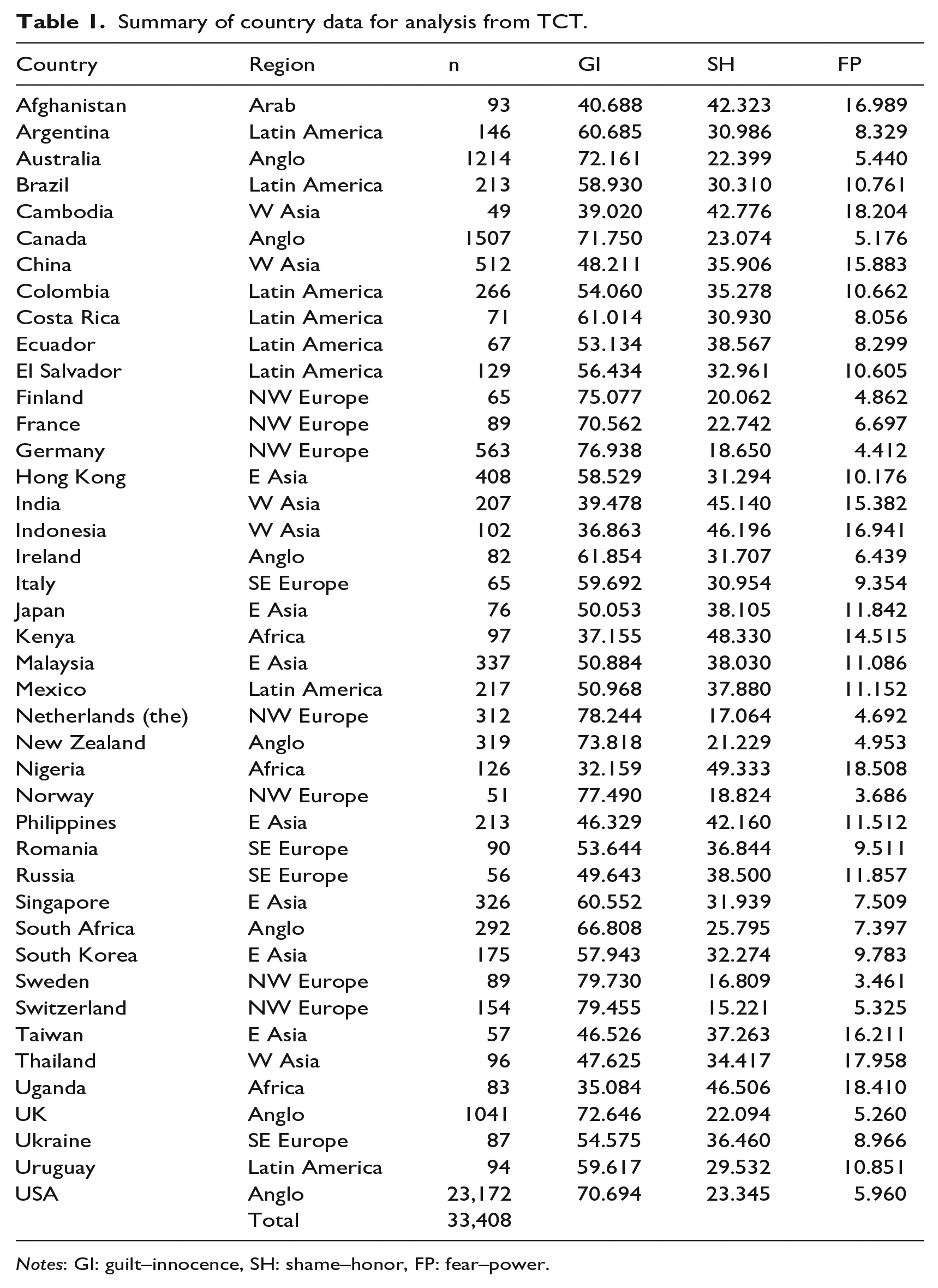
Notes: GI: guilt–innocence, SH: shame–honor, FP: fear–power.
Correlation analysis shows that the SH and FP culture types are strongly related. The GI culture type is markedly and inversely correlated to the SH and FP culture types. TCT (Georges, 2019) is compared with the well-known six Hofstede’s cultural dimensions (Hofstede, 2015; Hofstede et al., 2010). All three (GI, SH, and FP) are correlated to the individualism versus collectivism 10 (IDV) and power distance 11 (PDI) dimensions. There are no correlations to Hofstede’s long-term versus short-term orientation 12 (LTO), masculinity versus femininity 13 (MAS), uncertainty avoidance 14 (UAI), or indulgence versus restraint 15 (IVR) dimensions. Table 2 has the correlations. All analyses in this article are performed using R Statistical Software (R Core Team, 2020).
Correlations between TCT culture types and Hofstede’s cultural dimensions.
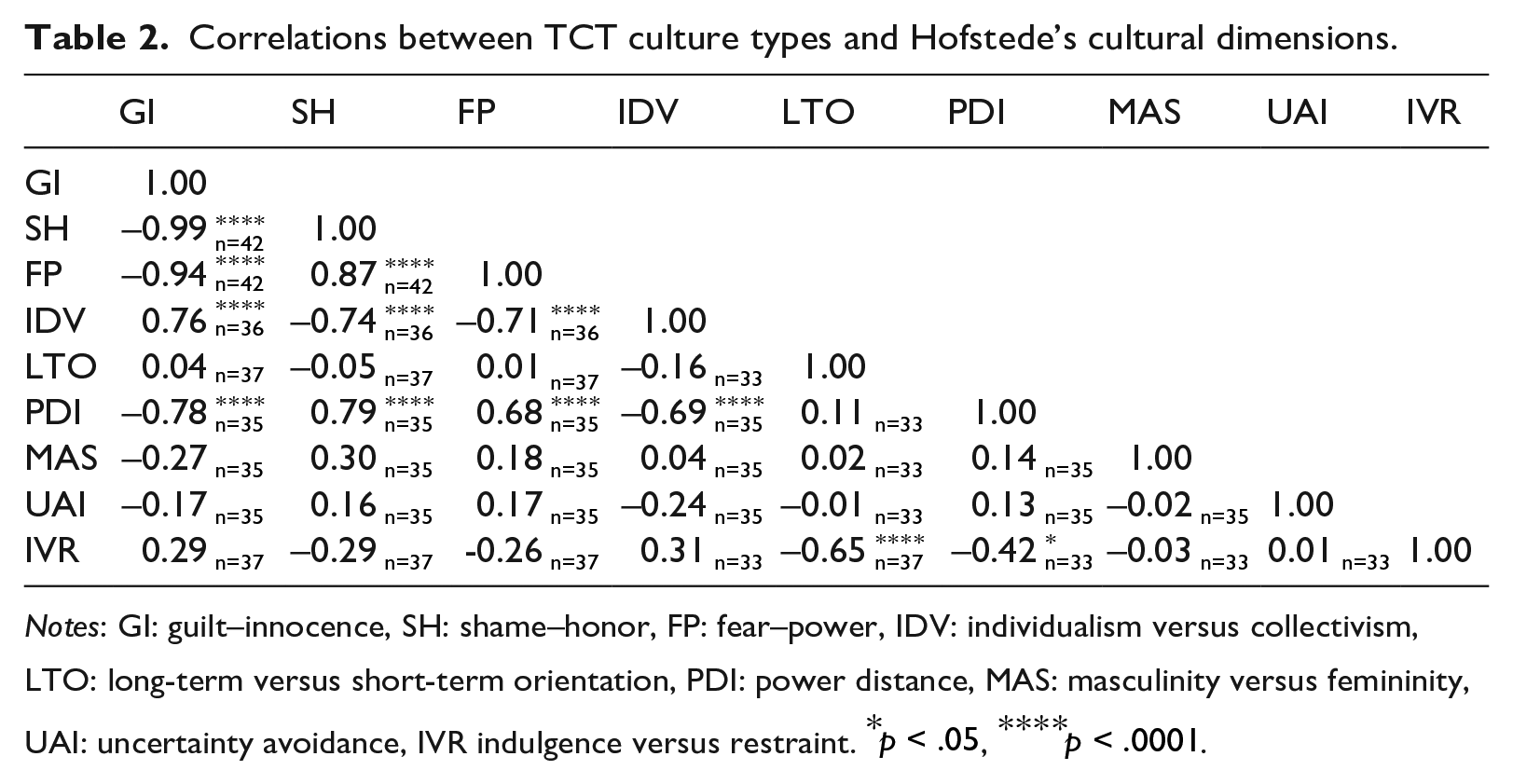
Notes: GI: guilt–innocence, SH: shame–honor, FP: fear–power, IDV: individualism versus collectivism, LTO: long-term versus short-term orientation, PDI: power distance, MAS: masculinity versus femininity, UAI: uncertainty avoidance, IVR indulgence versus restraint. *p < .05, ****p < .0001.
Recent research by Micheal Minkov (2017; Minkov et al., 2017) has suggested a two-dimensional model with individualism versus collectivism (IDV) and a re-conceptualization of long-term versus short-term orientation (LTO) into monumentalism (representing short-term orientation) versus flexibility 16 (representing long-term orientation). Hence Hofstede’s dimensions of individualism versus collectivism (IDV) and long-term versus short-term orientation (LTO) are the only dimensions used in later examinations. For more information, see “Transition to Two or Three Cultural Dimensions” in the online Supplemental Material.
In 2021 Minkov and Kaasa published an objective culture index based on societal measures. Their index has two dimensions. The first is objective culture long-term orientation (OCLTO). It corresponds to Hofstede’s long-term versus short-term orientation (LTO) dimension and the revised Minkov–Hofstede cultural dimension of monumentalism versus flexibility. The second is objective culture emancipation (OCEM). It coincides with Hofstede’s individualism versus collectivism (IDV) and the revised Minkov–Hofstede cultural dimension of individualism versus collectivism (Minkov and Kaasa, 2021). GI, SH, and FP are only correlated to objective culture emancipation (OCEM); see Table 3.
Correlations between TCT and the Minkov and Kaasa objective culture dimensions.
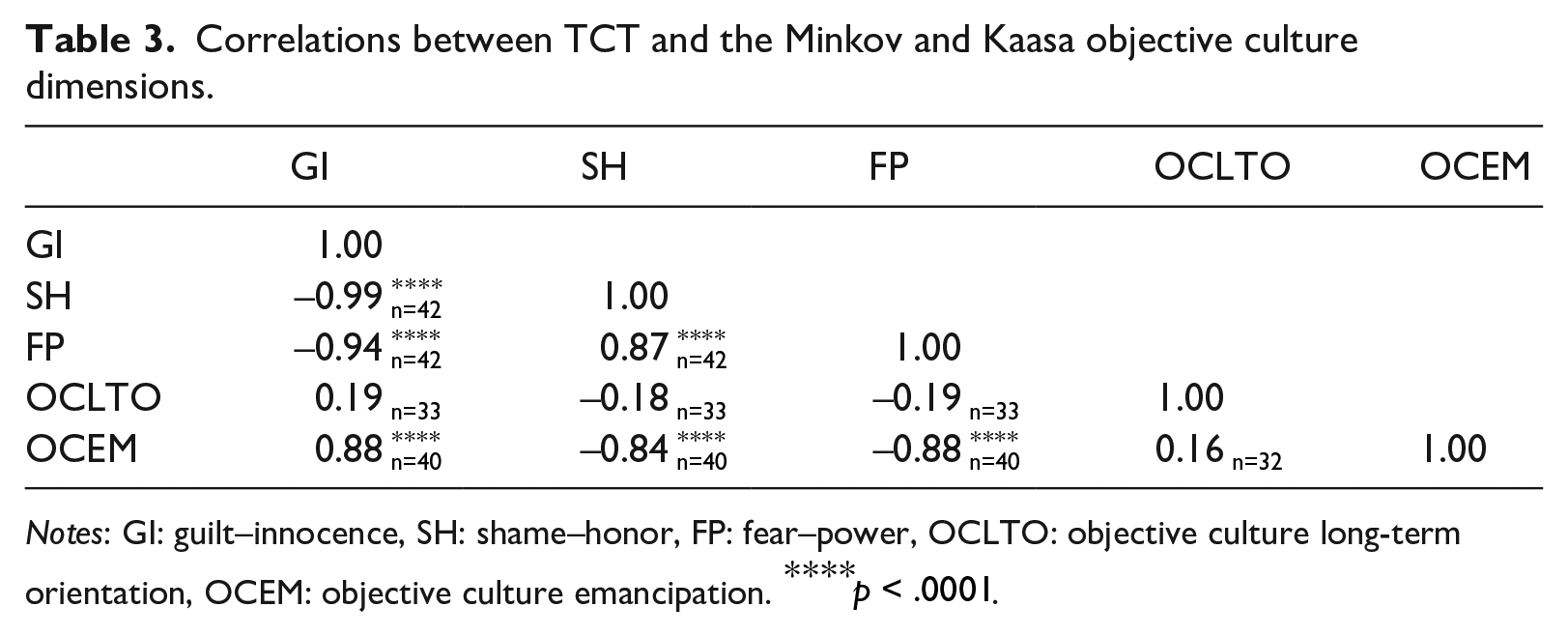
Notes: GI: guilt–innocence, SH: shame–honor, FP: fear–power, OCLTO: objective culture long-term orientation, OCEM: objective culture emancipation. ****p < .0001.
The correlations that follow only use GI. As seen in Tables 2 and 3, the correlations between GI, SH, and FP to other data are very similar. This is expected since GI, SH, and FP are highly correlated. GI is chosen as it has slightly higher correlations in some of the following calculations.
GI, Hofstede’s individualism versus collectivism (IDV), and long-term versus short-term orientation (LTO), along with Minkov and Kaasa’s objective culture long-term orientation (OCLTO) and objective culture emancipation (OCEM) are compared with 13 societal measures. All of these measures are respected and considered valid in the Culturology community. This provides empirical attestation for TCT.
The societal measures are the UN Human Development Index (HDI) (Conceição, 2020: 343–46), the Gross National Income per capita (GNIpc) (Conceição, 2020: 343–46), the homicide rate per 100,000 people (HOM) (Human Development Reports, 2020), the female suicide rate per 100,000 people (FSUID) (Human Development Reports, 2020), the male suicide rate per 100,000 people (MSUID) (Human Development Reports, 2020), estimated road deaths from the Global status report on road safety (ROAD) (World Health Organization, 2018), the 2019 Freedom House (2022) Global Freedom scores (FREE), the 2019 Transparency International (2019) Corruption Perceptions Index (CPI), the Organization for Economic Co-operation and Development Program for International Student Assessment scores of reading, mathematics, and science performance along with the mean of the scores (PISAr, PISAm, PISAs, and PISAmean—respectively) (OECD, 2019: 17–18), and the 2019 Global Innovation Index (GLOBII) (Dutta et al., 2019: xxxiv–xxxv). See Table 4. The online Supplemental Material contains more information about the data sets used.
GI, IDV, LTO, OCLTO, and OCEM are compared with various social measures.
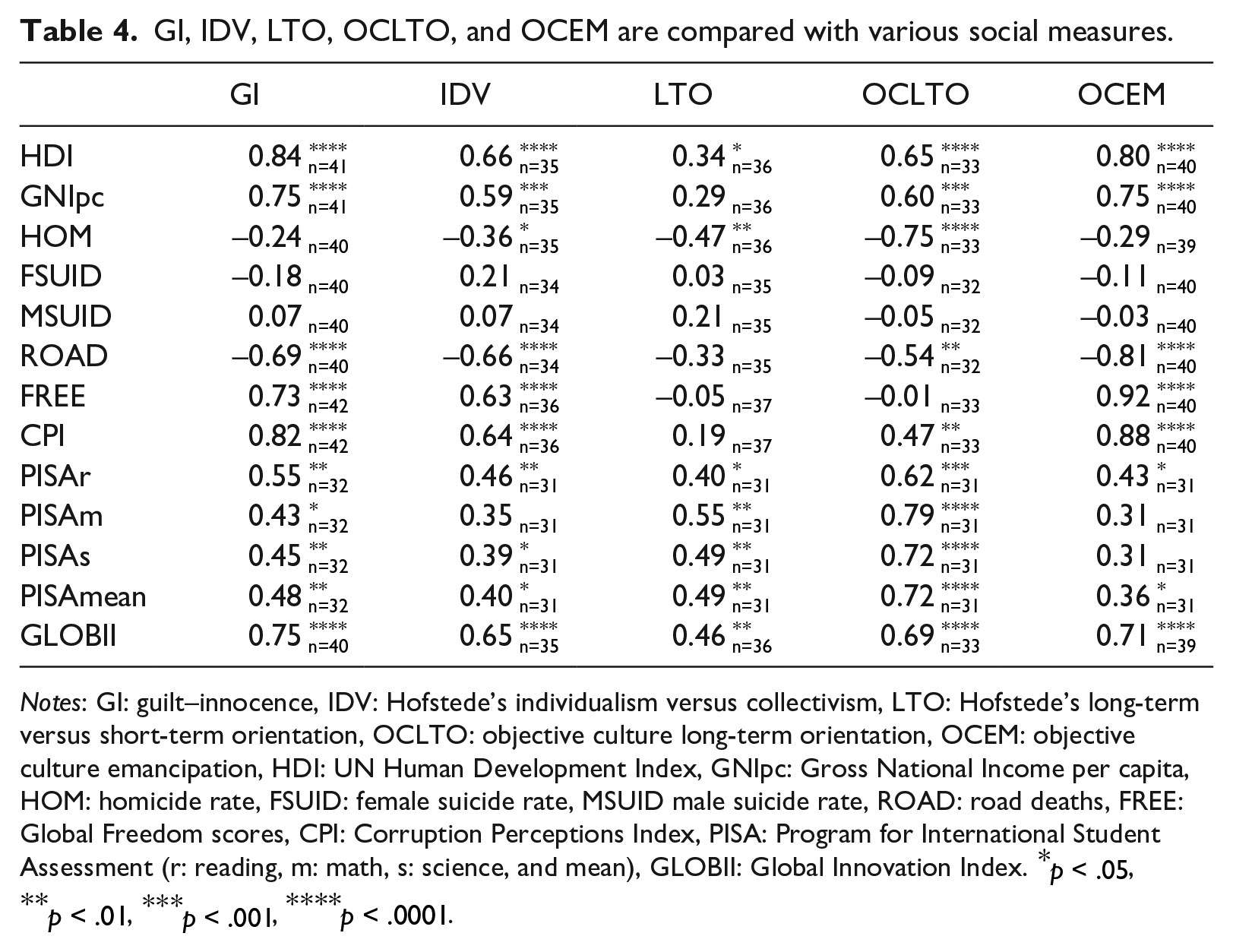
Notes: GI: guilt–innocence, IDV: Hofstede’s individualism versus collectivism, LTO: Hofstede’s long-term versus short-term orientation, OCLTO: objective culture long-term orientation, OCEM: objective culture emancipation, HDI: UN Human Development Index, GNIpc: Gross National Income per capita, HOM: homicide rate, FSUID: female suicide rate, MSUID male suicide rate, ROAD: road deaths, FREE: Global Freedom scores, CPI: Corruption Perceptions Index, PISA: Program for International Student Assessment (r: reading, m: math, s: science, and mean), GLOBII: Global Innovation Index. *p < .05, **p < .01, ***p < .001, ****p < .0001.
Figure 2 is a three-dimensional scatter plot of GI, SH, and FP. As expected, it is almost a straight line because of the correlation between GI, SH, and FP. Figure 3 is a two-dimensional scatter plot of GI versus FP, and it provides a cultural map using TCT (Georges, 2019) data. Different world regions are indicated with varying style points. Since GI, SH, and FP are highly correlated, plotting other combinations of GI, SH, and FP will yield a similar distribution of countries.
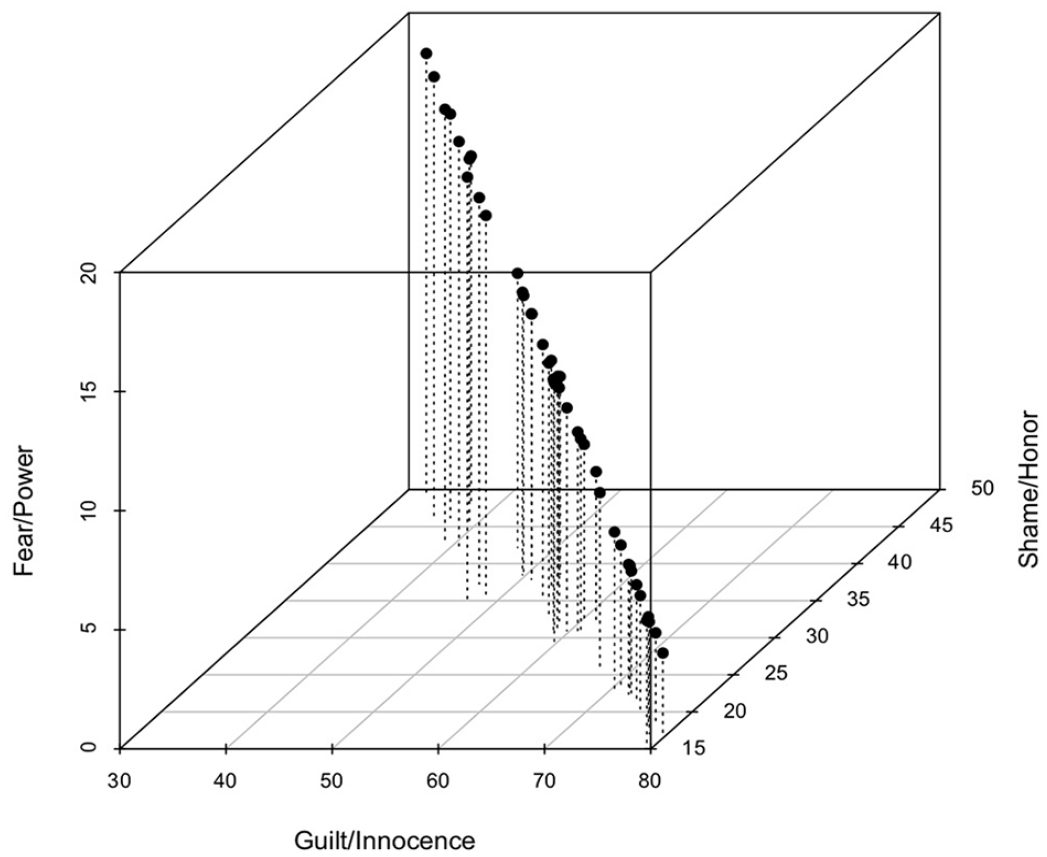
Three-dimensional scatter plot of GI, SH, and FP.
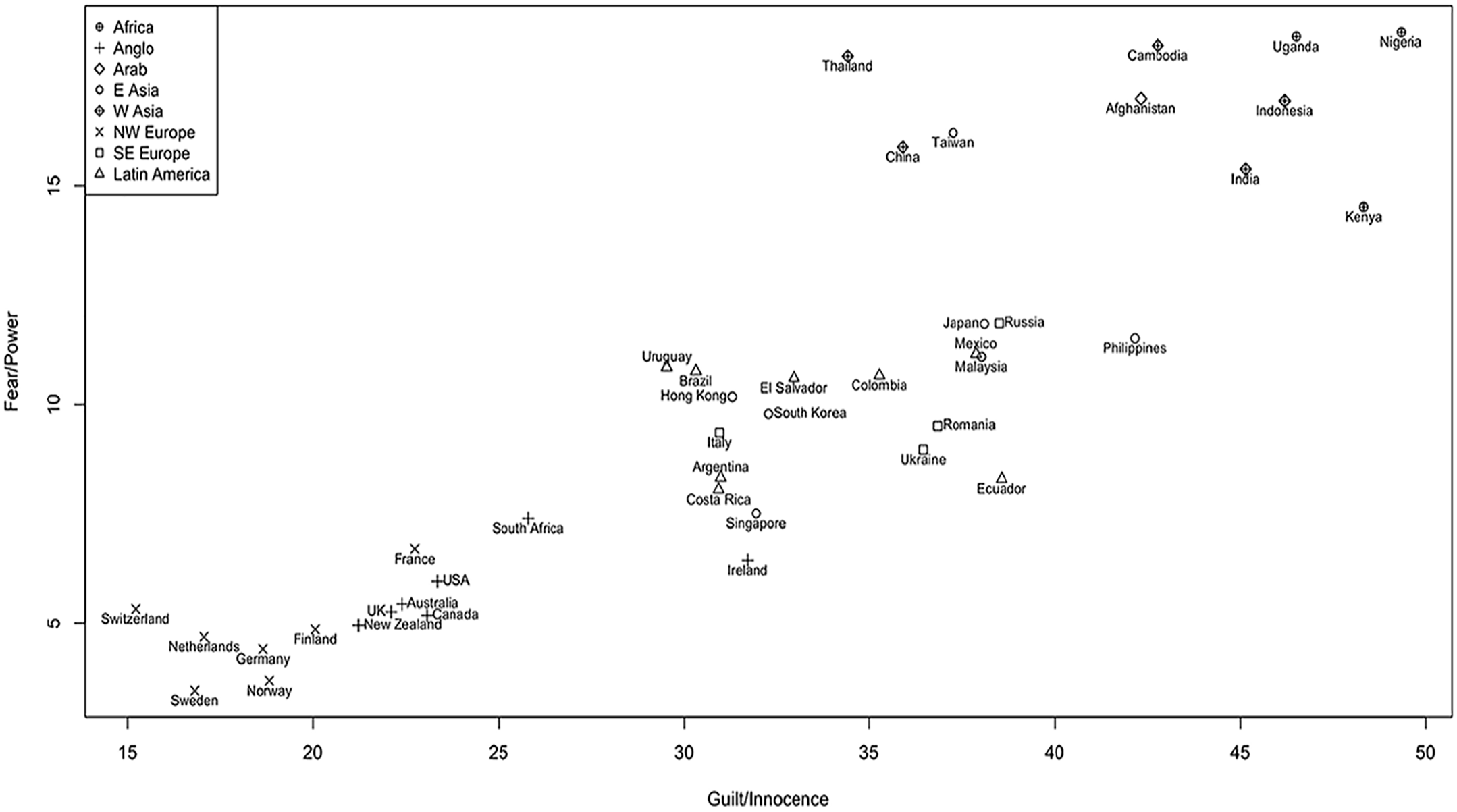
Cultural map using GI versus FP.
Discussion
Before discussing TCT (Georges, 2019), and in fairness to Georges, a few comments are needed. “The ultimate criterion by which a particular study should be judged is not how close it is to a hypothesized absolute truth about the whole world but what practical utility it has for a specific purpose” (Minkov, 2013: 126). Both Flanders (2016: 579) and Wood (2016: 114) consider The 3D Gospel (Georges, 2017) beneficial, and it has a certain appeal. 17 Hence, Georges’ work has practical utility. One strength is helping those from the Anglo world (who represent over half of the people who have taken TCT) understand the cross-cultural facets of guilt, shame, and fear.
Georges has never claimed that TCT (2019) is suitable for cross-cultural research, nor has he designed the test to be a cross-cultural research tool. He correctly uses “culture types” rather than “cultural dimensions.” As it turns out, TCT has some strong correlations to real-world measures. In contrast, TCT, when judged by culturology standards, has deficiencies.
In Table 4, with exception of male and female suicide rates (MSUID and FSUID respectively), if Minkov and Kaasa’s (2021) objective culture long-term orientation (OCLTO) has a low correlation, then their objective culture emancipation (OCEM) has a high correlation (and vice versa). On the societal measures where GI has a low correlation, TCT (2019) has no predictive ability. Objective culture long-term orientation (OCLTO) is high for the measures where GI is low. Hence the objective culture dimensions have predictive ability across societal measures, and TCT has limited predictive capacity.
While TCT (Georges, 2019) consists of three clearly defined culture types, the test only measures one dimension of culture. This is most clearly seen in the straight line in Figure 2 and evident in the strong correlation between GI, SH, and FP. The strong correlations between GI, SH, FP, Hofstede’s individualism versus collectivism (IDV), and objective culture emancipation (OCEM) demonstrate that TCT measures individualism versus collectivism. There is a particular irony with the name “The 3D Gospel” (Georges, 2017) when it only corresponds to one dimension of culture.
The usefulness of TCT (Georges, 2019) to missiologists and culturologists is its correspondence to societal measures that relate to individualism versus collectivism. Table 5 summarizes these correlations (from Table 4) for GI, Hofstede’s individualism versus collectivism (IDV), and objective culture emancipation (OCEM). TCT has better correlations to these measures than Hofstede’s individualism versus collectivism. The period when Hofstede’s individualism versus collectivism data was gathered versus when the other data was collected could account for this. The performance of GI (which is not designed for culturological research) is close to objective culture emancipation (which is designed for this purpose by one of the leading culturologists). On some measures, objective culture emancipation has higher correlations, and on others, GI does. TCT data only has GI, SH, and FP scores. If the data had responses to the questions, then factor analysis and question weighting might improve TCT’s correlations.
Key correlations on societal issues related to individualism versus collectivism for GI, IDV, and OCEM.
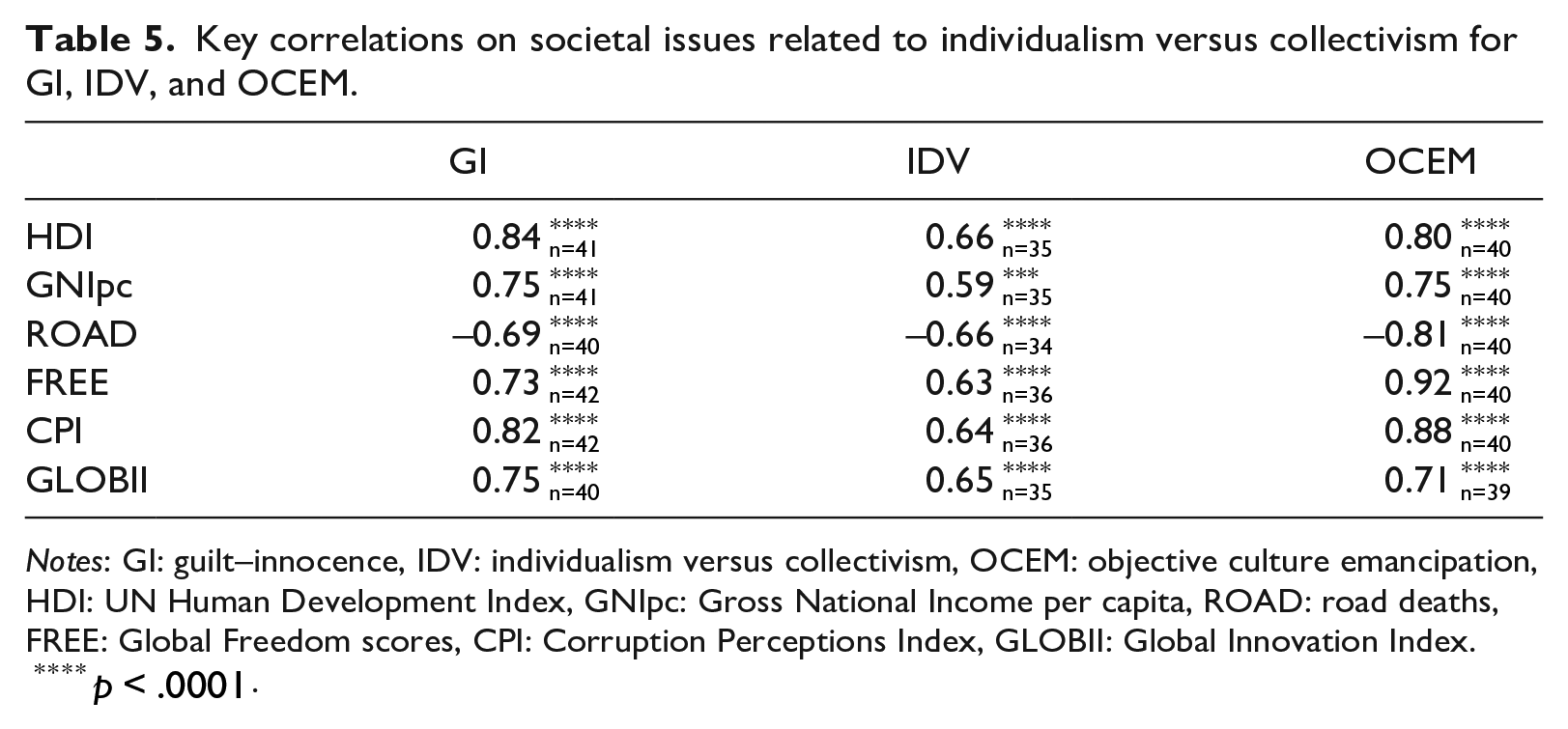
Notes: GI: guilt–innocence, IDV: individualism versus collectivism, OCEM: objective culture emancipation, HDI: UN Human Development Index, GNIpc: Gross National Income per capita, ROAD: road deaths, FREE: Global Freedom scores, CPI: Corruption Perceptions Index, GLOBII: Global Innovation Index. ****p < .0001.
The cultural map in Figure 3 (and to a lesser degree, the three-dimensional plot in Figure 2) helps to clarify that countries in the TCT (Georges, 2019) database are on a continuum. The countries are not merely a GI culture type, SH culture type, or FP culture type. As a reviewer observed, no country is a pure form of SH, GI, or FP, but rather it is a mixture. The map provides a straightforward representation of where a country is on the continuum and how it compares with other countries.
On the cultural map (Figure 3) based on TCT (Georges, 2019), the world regions of East Asia, Southeast Europe, and Latin America are intermingled. The other world regions cluster into somewhat distinct groups. On this map, some countries that are very culturally distinct from each other are side by side: Japan–Russia, Brazil–Hong Kong, and El Salvador–South Korea. Other cultural maps—such as Minkov–Hofstede (Minkov and Kaasa, 2021), Inglehart–Welzel (Inglehart and Welzel, 2016), and Schwartz (Schwartz, 2009)—have (for the most part) distinct world regions corresponding to cultural dimensions and do not have culturally distinct countries side by side.
The straight line in Figure 2, the intermingled world regions, and culturally distinct countries being side by side signify that Georges’ database does not clearly distinguish world regions and differences between countries. This is a drawback to TCT’s (Georges, 2019) usefulness and highlights the difference between using three oblique culture types versus cultural dimensions. Only working with oblique culture types (correlated to one cultural dimension) leads to an incomplete understanding of how culture varies worldwide.
Greater distinction between countries and regions might be achieved by adding other culture types, particularly ones that fit within biblical themes and that capture something along long-term versus short-term orientation or flexibility versus monumentalism. The culture types GI, SH, and FP are responses to sin (Georges, 2017: 10). Perhaps culture types dealing with how people respond toward one another, a key theme in the Bible, would produce more culture types that, alongside GI, SH, and FP, would provide a better measure of different cultures. In addition, it could help missionaries better understand cross-cultural relationships. Possible culture types are pride versus humility, thrift versus generosity, duality versus self consistency, future versus present reward, and control versus indulgence.
Conclusions
In the tasks of comprehending and quantitatively evaluating culture, The 3D Gospel (Georges, 2017) and TCT (Georges, 2019) provided missions with a theory of culture and quantitative data. The data of TCT, and by implication—the theory of The 3D Gospel, was evaluated using the discipline of Culturology. The evaluation showed that TCT, despite presenting three culture types, only measures one thing. All three culture types (GI, SH, and FP) are highly related to each other and cultural dimensions associated with individualism versus collectivism. This implies that TCT (and its three culture types) only measures individualism versus collectivism.
TCT was compared with 13 societal measures. For the measures that relate to individualism versus collectivism, TCT has good predictive properties. Hence, some empirical evidence suggests TCT corresponds to real-world data. However, for all other measures, TCT is a poor predictor. The cultural map based on TCT has intermingled world regions, and culturally distinct countries are side by side. The three-dimensional scatter plot of GI, SH, and FP is a straight line. The poor predictability, inability to distinguish culturally different regions and countries and the straight line three-dimensional plot are significant limitations of TCT. In some areas, the three culture type view of GI, SH, and FP is inadequate and other theories and data sets must complete what is lacking.
In the words of Culturology, TCT (Georges, 2019)—with expatriates excluded and countries with less than 50 responses removed—correlates to societal measures that relate to individualism versus collectivism. Its performance is close to Minkov and Kaasa’s objective culture emancipation (OCEM). This provides empirical evidence that TCT and The 3D Gospel (Georges, 2017) have real-world correspondence making it a usable database for culturologists. The drawback of TCT is it only measures one cultural dimension with three oblique typologies. Owing to this, it does not provide clear distinctions between world regions and countries that are culturally dissimilar.
Supplemental Material
sj-pdf-1-mis-10.1177_00918296231206593 – Supplemental material for Culturological analysis of “The Culture Test” and The 3D Gospel
Supplemental material, sj-pdf-1-mis-10.1177_00918296231206593 for Culturological analysis of “The Culture Test” and The 3D Gospel by Roland Paul Cox in Missiology
Footnotes
Funding
The author received no financial support for the research, authorship, and/or publication of this article.

Supplemental material
Supplemental material for this article is available online.
Notes
Author biography
References
Supplementary Material
Please find the following supplemental material available below.
For Open Access articles published under a Creative Commons License, all supplemental material carries the same license as the article it is associated with.
For non-Open Access articles published, all supplemental material carries a non-exclusive license, and permission requests for re-use of supplemental material or any part of supplemental material shall be sent directly to the copyright owner as specified in the copyright notice associated with the article.

