




Abstract
The growing number of people in global transit are often families, which means that children are greatly impacted as their family moves. Many of these children are known as third culture kids (TCK), who have grown up in multiple countries. This term was coined by Ruth Useem in the 1950s but attracted more attention in the 1970s when David Pollock and Ruth Van Reken conducted seminars and workshops about TCK. They found that TCKs had similar issues such as rootlessness even though the countries they had been to were different. TCKs became a unique people group that breaks the normal boundaries of cultural and ethnic boxes. However, in recent years, children of expatriates from minority communities in the West or the Majority World have been raising concerns that their experiences growing up in global transit are different from the traditional TCK narratives due to classism and racism. This article seeks to examine the different experiences of non-white TCKs growing up and bringing voices to their untold stories as part of the larger set of TCK issues.
TCKs are not a homogenous group. There is a need to have more voices from non-white TCKs to care for this growing trend of global mobile families from the Majority World/Global South. Non-white TCKs face different kinds of complexity in cultural identities as they move between countries. Race, ethnicity, nationality, language/accent, education system, family culture, moving portfolio, and socio-economic status are all factors affecting the TCK experience according to the cultural hierarchy in the locations they are in. International organizations should consider the unique stories of non-white TCKs to help their workers serve effectively in their overseas assignments and return to their countries with smooth re-entry.
Keywords
Introduction
As the number of Christians grows rapidly in the Global South the demographic of Christian mission is also shifting. The direction of mission is no longer “from the West to the rest” but “from everywhere to everywhere.” The mission force is rising in Africa, Asia, and Latin America (Kim and Climenhaga, 2022: 3). The same phenomenon occurs in the global workforce where overseas workers are increasing each year. There are approximately 164 million people who left their home countries to work in 2018. The majority of them come from lower income countries and work in North America and Europe (United Nations, 2018). For my own organization, Operation Mobilization, the goal is to have 80% of our workforce from the Majority World/Global South. 1 There is a great need to research the new expat experience, which is different from the white westerner.
This growing number of people in global transit are often families, which means that children are greatly impacted as their family moves. Many of these children are known as third culture kids (TCK), who have grown up in multiple countries. This term was coined by Ruth Useem in the 1950s but attracted more attention in the 1970s when David Pollock and Ruth Van Reken conducted seminars and workshops about TCK (Tan et al., 2021: 82). They found that TCKs had similar issues such as rootlessness even though the countries they had been to were different. TCKs became a unique people group that breaks the normal boundaries of cultural and ethnic boxes (Pollock et al., 2017: 31–32). However, in recent years, children of expatriates from minority communities in the West or the Majority World have been raising concerns that their experiences growing up in global transit are different from the traditional TCK narratives due to classism and racism (Bassey, 2021; Pollock et al., 2017: 375; Tanu, 2018: Loc 243). This article seeks to examine the different experiences of non-white TCKs growing up and bringing voices to their untold stories as part of the larger set of TCK issues.
Defining the population
This conceptual article focuses on non-white third culture kids. There are two terms that I need to unpack here: non-white and third culture kid. Non-white is used to describe people who are racially considered not white in North America, especially in the USA. 2 White is a relative term in different countries, especially for mixed-race people. A mixed-race person could be seen as white in one country, but as non-white in North America (Cheruiyot Bii, 2011: 26). The concept of non-white that is described here is the same as the term “people of color” in North America. Since the term “people of color” is only known in North America, non-white is a better term to describe this group, who do not all come from or reside in North America (Oxford Advanced Learner’s Dictionary, n.d.).
The most quoted definition of third culture kid is from Third Culture Kids: Growing up among Worlds (Pollock et al., 2017), often referred to as “the TCK Bible” (Tan et al., 2021: 82): A traditional third culture kid (TCK) is a person who spends a significant part of his or her first 18 years of life accompanying parent(s) into a country that is different from at least one of the parent’s passport country(ies) due to a parent’s choice of work or advanced training. (Pollock et al., 2017: 26)
The authors of the book, David Pollock, Michael Pollock, and Ruth Van Reken, developed this definition to distinguish the TCK from the cross-culture kid (CCK), who “is a person who is living or has lived in—or meaningfully interacted with—two or more cultural environments for a significant period of time during childhood (up to age 18)” (Pollock et al., 2017: 45). According to Van Reken, there are four characteristics of a TCK: a cross-culturally patterned lifestyle, a highly mobile lifestyle, temporary stay within host cultures, and a systematic identity with the organization such as a mission organization, international corporation, or military base. She says that the expectation of returning to the first culture is the key difference to the CCK (Tan and Van Reken, 2019). However, some missionary kids who move within a country among different tribes also fit all four characteristics, but they are not TCKs due to not crossing country borders. There are also people who have lived in two different countries with similar cultures, such as the fishing communities of Lake Tanganyika bordering the country of Tanzania and Zambia. Though they have moved across country borders, they are not considered TCKs in this research.
One of the parts of Pollock et al’s (2017: 26) definition that remains amorphous is “a significant part of his or her first 18 years of life.” Hence, much TCK research has not had a standard definition of this for its target group. More recent systematic research on TCK suggests that a TCK should fit all three criteria: “(a) cross-national experiences that occurred before age 18, (b) at least living one continuous year away from one’s home country, and (c) parents’ reason for move specified to reflect that relocation outside of home country indicates a temporary stay” (Tan et al., 2021: 95).
The definition of a TCK in this article builds on both definitions with a few more added elements. First, the move should have a significant impact on the child’s identity formation, and it must be related to a multicultural experience. As a case in point, many young people may have experienced a cross-national move during their infancy or toddlerhood years. However, such moves typically do not affect their identity formation because they do not remember it. But in other cases, this move still impacts them greatly due to their accent, language ability, dual-citizenship, family culture, and so on. Many business expats from China do not move to another country through an international cooperation but through a family-owned company. In most cases, their children remain in China with other relatives. Some children might move to the country where their parents have the business for a year to help their parents without going to school. They might only stay in the shop the whole year while abroad. In these situations, there is almost no interaction with the local culture and the person moves back to China in a community where most of the family has the same business model. In this case, this person would not be counted as a TCK because they are much less likely to have problems identifying with their country of origin when they return.
“Passport country” is not a helpful term because there are many who have more than one passport. For children of transnational marriage, the parents do not share one passport country and their home country might be neither of the passport countries. It also might not be one country for people who are living on a ship. In this research, I am using the term “home country” and the definition of home country is determined by the individual. “Parents” is also a problematic term because not all TCKs have both parents and live with their parents. Here the term guardian will be used rather than parent.
The definition of the population in this research of non-white third culture kid is a person who fits the following criteria: (a) racially not considered white in North America; (b) has had cross-national experiences before age 18; (c) has lived for at least one continuous year away from their home country; (d) their guardian’s indicated reason for relocation outside of the home country is temporary; and (e) their identity formation is significantly impacted by cross-national experiences due to cultural differences.
Growing up with different cultural identity and double consciousness
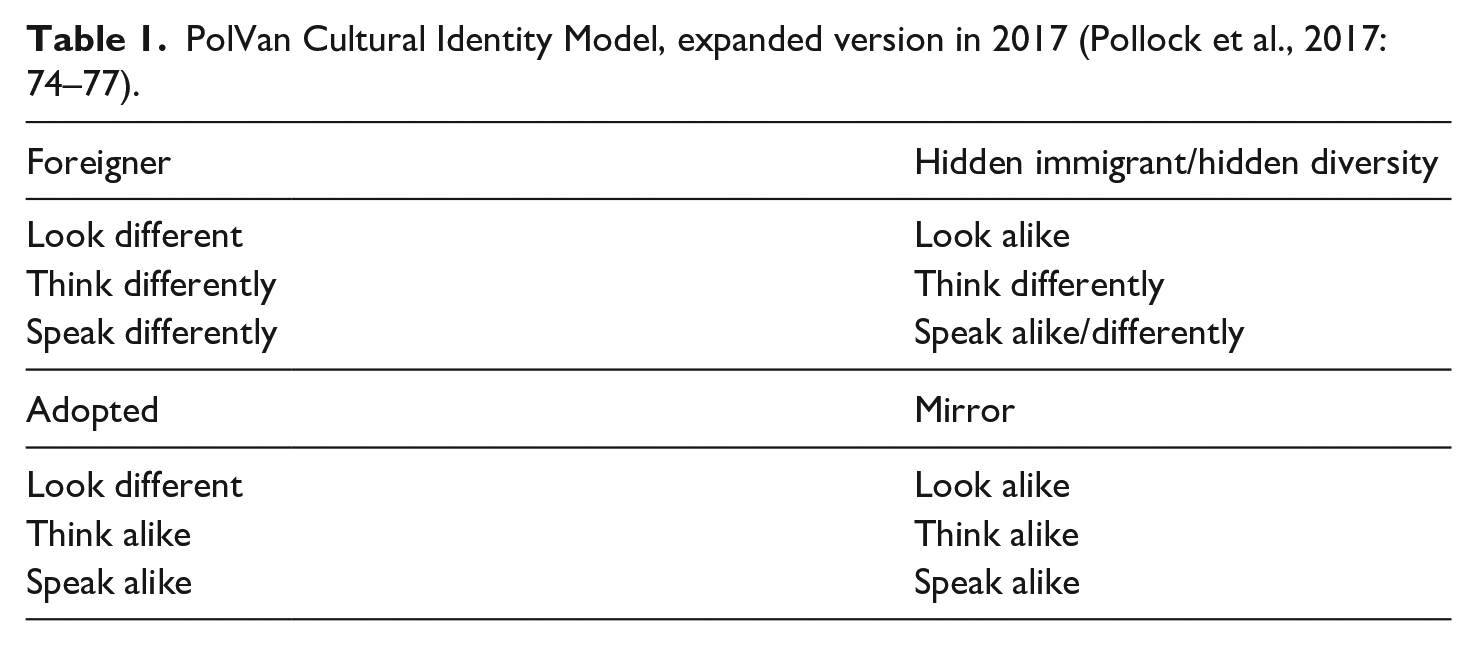
According to Pollock et al. (2017: 74–77), there are four different cultural categories when a third culture kid develops their identity, and it is related to their visible and invisible relationship to the surrounding culture. The appearance and the worldview of a child compared with the local community affect how others perceive them. Cultural identities are highly tied into the interaction between the child and the surrounding culture where the child locates.
When the child looks, sounds and behaves differently from the surrounding culture, the child’s cultural identity is an obvious foreigner. When the child looks similar to others in the surrounding culture but does not follow the local culture norms, the child’s cultural identity is a hidden immigrant or hidden diversity. The people from the surrounding culture might not notice they are an outsider when they only look at the appearance. When the child looks different from the surrounding culture but follows the local culture norms, the child’s culture identity is adopted. The people from the surrounding culture can only realize that the child belongs to the local community when they interact with the children. When the child matches the surrounding culture in every aspect, the child’s culture identity is mirror.
One of the biggest issues that generates confusion for the cultural identities of TCKs is that they change their cultural identities in different situations. For example, the cultural identity of the TCK can be a hidden immigrant in the home country, but the same TCK is a foreigner in the host country. From the PolVan Cultural Identity Model (Table 1), how a person looks and sounds changes how the surrounding culture perceives them. Hence, race is an important factor to discuss. Pollock et al. (2017: 76) admit that the Cultural Identity Model is too simple to describe the emerging TCK and CCK cultural complexity. One of the limitations of the PolVan Cultural Identity Model is that it does not show the power dynamics when different cultures interact. Cultural phenomena can only be correctly “understood as interrelated with socio-political dynamics such as economics, ethnicity, race, class, age, and gender” (Ryan, 2015: 42). For example, there is an updated story of two Canadian children living in China in Third Culture Kid: Growing up among Worlds. Both Canadian kids have minimal fluency in Mandarin. The Canadian who is racially white is praised when she speaks a few words of Mandarin, but the Canadian who is ethnically Chinese is scolded because the people in the surrounding area assume she speaks Mandarin because of her appearance. Pollock et al. (2017: 341) state that this is an issue for the Chinese Canadian child because she is a hidden immigrant in China. However, this might also be the result of racial hierarchy. In a different example, a Filipino/Filipina or Indonesian child in China looks different from a Chinese, so they are not hidden immigrants in China, but they likely face prejudice (Ladegaard, 2022: 113–114). This is because in China, white supremacy and Han Chinese ethnocentricity hold power in the society. Not all expats in the same country are considered the same rank due to the stereotypes, especially with the growing anti-immigrant sentiment toward the workers from the Majority World (Banerjee et al., 2020: 275).
PolVan Cultural Identity Model, expanded version in 2017 (Pollock et al., 2017: 74–77).
Another limitation of the PolVan Cultural Identity Model is that it does not show the complexity of a multicultural and racialized society. With the growing number of overseas workers, immigrants, and refugees, there are few countries that can claim to be homogeneous. The concept of a “standard look” for a citizen of a nation is not a fact for many nations. Most nations are multiethnic (Vince, 2022). However, the mental narrative of the people in the majority ethnic or racial group in a given nation might still exclude other ethnicities, even though these other ethnicities have been part of the fabric of that nation for many decades. For example, Asian Americans in the USA are seen as perpetual foreigners even after generations of living in the country (Lee, 2010: 28). Hence, an Asian American TCK may still be seen as a foreigner in the USA even though they have their official nationality as US citizens and consider the USA as their home country.
There is a social, cultural, and historical context in every society that locates each person in different categories of an existing system. These views of society have a direct correlation for how children come to understand themselves (Tatum, 2003: 19). Most TCKs are minorities in their social circles. For a non-white TCK in many societies, they are not only a minority because of their TCK experience but also because of their racial appearance. A Zambian child moving to South Africa must not only learn about how to navigate their different cultural identities when they move between different countries, but also learn how to live as a black child in a racialized society. Many African or Caribbean blacks move to the USA and have problems navigating their identities because their racial appearance is associated with having a lower social status. On the other hand, many European whites move to the USA and see “their racial identification with whiteness as a confirmation of positiveness” (Rong and Brown, 2002: 258–59).
There are different factors that affect how a person gains access to social influence and power, such as race, socio-economic status, gender, age, religious affiliation, sexual orientation, mental, and physical ability (Tatum, 2003: 12–13). According to Danau Tanu (2018: Loc 14), there is also a cultural hierarchy in the transnational space where TCKs grow up. In the transnational space, how the local and the dominant expat circles perceive the TCK in that context through race/ethnicity, nationality, language, and socio-economic status impacts their childhood experiences and identity formation. These factors significantly shape their experiences by the “so called third culture of a transnational world left behind by a colonial past and modernized by contemporary capitalism” (Tanu, 2018: Loc 564–68). The TCKs who grow up as minorities learn to reconcile the different cultures they are in and perceive themselves through different cultural lenses. They must navigate through “the eyes of the others” to operate in the system they are in, which W.E.B. Du Bois referred to as “double consciousness” (McNeil, 2020: 71–72).
Apart from seeing the world through their own perspective, these minority children must learn how the majority view them and respond to their stereotypes. Hence, they experience a fragmented self-identity (McNeil, 2020: 71–72). The majority of the world associates “international” as western, white, and English-speaking (Tanu, 2018: Loc 2055). Hence, non-white TCKs have more layers in their identity formation because others in different transnational circles might perceive them differently, creating triple or quadruple consciousness (Figure 1). For example, B, a Zambian child, grows up partly in a transnational environment in South Africa. 3 His host country is South Africa and his home country is Zambia. He prefers speaking in English. The local non-black South African might perceive him as a local South African and treat him accordingly. The local black South African might perceive him in two ways: (1) a spoiled black South African who does not know how to speak the local languages; (2) an immigrant child who is trying to steal their resources. If B hangs out in an expat circle that is majority African, he learns to see himself as Zambian or Southern African in this case. If B hangs out in an expat circle that is more racially mixed, and that has more white children, he then learns to perceive himself as a black or African. In the transnational space, he needs to learn the power dynamic between him and the norms of “international” being western, white, and English-speaking. His accent and ability to speak the tribal language affects how the local Zambians in his home country perceive him. According to Pollock et al. (2017: 102), when TCKs are seen as obvious foreigners in the host country, they are often excused from adopting to the local culture. However, in the case of B, he is seen both in his host country and his home country as a hidden immigrant. Even when B is seen as a foreigner in South Africa, the local black South African is not going to give him grace for not adopting the culture like they would do for the white TCK because the black South African is higher in cultural rank than a Zambian in Africa (Line Sidonie Talla Mafotsing, 2019).
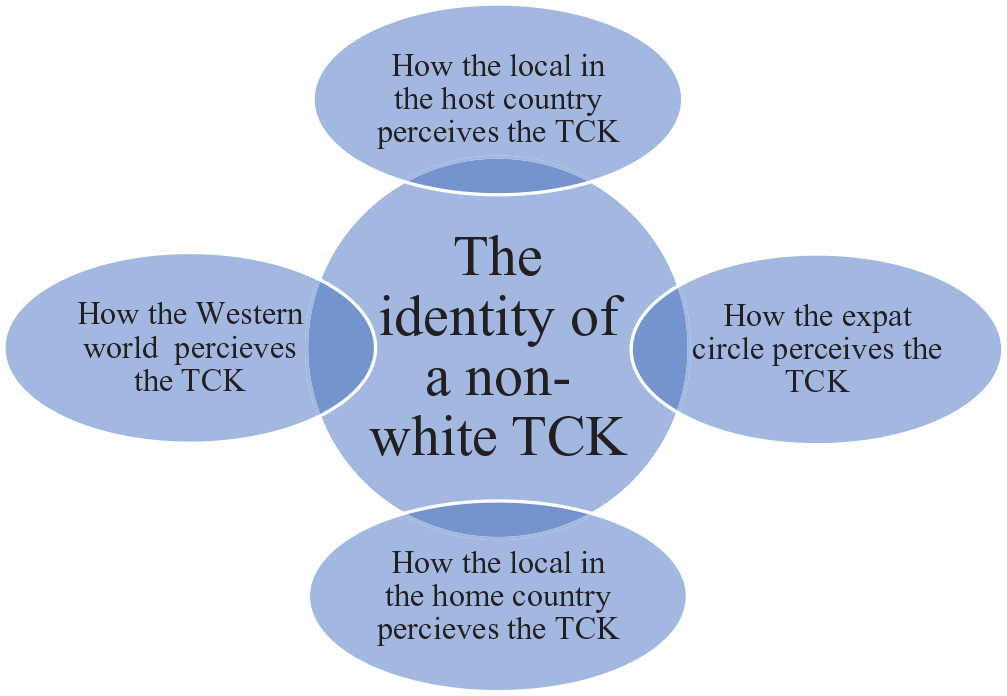
The triple or quadruple consciousness of a non-white TCK.
Factors other than race and ethnicity affecting the non-white TCK experience
Apart from race and ethnicity, there are other factors that the non-white TCK experiences differently from the traditional TCK. According to their nationality, education system they are in, their language/accent, the places they have moved to, their family culture, and their socio-economic status, the non-white TCK is situated differently in the cultural hierarchy in the transnational space.
Nationality
Not every passport holds the same value. The ability to obtain a visa is different based on passport country. A strong passport has more and easier access to go into different countries. There is a growing gap of traveling freedom worldwide. The holder of a stronger passport, such as Germany or the USA, has fewer visa restrictions when traveling overseas; while Iraq or Afghanistan passport holders can hardly apply for visas to move overseas (Steffen, 2022). Nationality then gives power to people with stronger passports because they deal with fewer visa issues and have more choices to choose which countries to stay in (Tanu, 2018: Loc 549). TCKs with weaker passports or different passports than their parents have a greater possibility of experiencing the fear of deportation (Bates, 2020: 1:05:41–1:07:54). The relationship between the host country and home country also affects the experience of the TCK because they might be seen as an enemy, such as Taiwan/Hong Kong/China, Ukraine/Russia, and Japan/South Korea (Doi, 2013: 45).
Education system
The education system is tied to language options and financial status. Most international schools are under the American or British system, which is more difficult for a non-western and non-English-speaking student to adopt (To, 2013: 26; Wilcox, 2013: 157–62). Home schooling is only possible if the home country has available homeschool materials and the family has the capacity to teach. Many TCKs with fewer financial resources have no choice but to stay in the local school (Bassey, 2021). Whether going to a local school or an international school, it is quite difficult for the non-white TCKs to return to their home country to continue school because of language or systemic barriers. Many families must put their TCKs in international schools when they return to their own country or send them to the USA for schooling. However, studying at an international school is more expensive and not every family can afford it. Some families might give extra language lessons so that the TCKs can learn the local language of their home country more quickly and thus, attend the local school. Others may send the TCKs back to their home country to boarding school (Doi, 2013: 123–26). The presence of others who have similar cultural backgrounds in the school helps the non-white TCK to feel more accepted. However, it is less likely for a non-white TCK to find peers that have similar cultural backgrounds than the white TCK. It is harder for them to experience cultural representation (Bates, 2020: 35:27–44:31; Tatum, 2003: 24).
Language and accent
Language and identity are highly connected (Tatum, 2003: 142). Different languages and accents affect power dynamics. Speaking English with a white American or British accent is seen as the global language that has the highest rank (Tanu, 2018: Loc 165). The ability to speak the local language and English disrupts the relations of power within the family because the guardians with less English skill rely on the children to interpret (Tanu, 2018: Loc 169). In the case of the Caribbean children in the USA, losing the Caribbean English accent makes them lose their higher cultural rank because they are now seen as African American, who are considered lower cultural rank in the USA (Tatum, 2003: 71–72). It is common for Asian TCKs to speak the language of their home country with American/British accents even when they can speak it like a national. The locals in the home country then assume they are foreigners from the West and are more willing to help them because westerners have a higher cultural rank (Min et al., 2020). Many countries have a variety of languages and dialects. The family might not be able to teach the tribal or local dialects of the home country. This builds a gap between the TCK and the family members (Liang, 2011: 451).
Moving portfolio/The places they have been
Each place TCKs have moved to gives them a different status. Their birthplace, nationality, and the places they have been create different cultural portfolios that are perceived differently by the host country and the home country. Moving across or within a continent also presents different challenges (Bates, 2020: 15:33–18:13). According to the cultural rank of the host country in the home country, a TCK might take pride or feel shame about their association with the host country (Doi, 2013: 46).
Family culture
The family culture of the non-white TCK is usually not as well known in transnational spaces as compared with white, western culture. For example, a Hong Kong TCK growing up in Zambia eats sushi with chopsticks at school. This is seen as strange both for the white expat and the local Zambian. However, eating pizza is well known because of the influence of Hollywood movies that show more North American food. The cultural representation of the non-white TCKs is less than the white TCKs and leaves them in a more liminal space (Tatum, 2003: 18–19, 25). If the home country has a “high context culture,” there are more demands for the TCKs to maintain the culture sensitivities for the home country. Most non-white TCKs come from countries that have high context culture (Rah, 2010: 73–74). There are more cultural norms and rules for the TCKs to learn both the home country’s culture and host country’s culture. They must learn the white expat culture to survive in the transnational space, too (Tan, 2013: 89).
Socio-economic status
The financial status of the family affects how the TCK experiences their time in different countries. The most common understanding for traditional TCKs is that they feel most at home in the airport (Colomer, 2020: 155). However, there are many TCKs who have never traveled via plane because of the cost. There are many African TCKs and Asian TCKs who only travel by boat, train, and bus within and between continents. The frequency of traveling back and forth between the home country and the host country for a non-white TCK is also not as great as a traditional TCK describes (Bassey, 2021). For TCKs with fewer financial resources there are fewer opportunities for traveling and fewer chances to participate in after-school activities. In fact, the white TCK with a higher financial status is considered normal, but the non-white TCK with a higher financial status might be perceived as illegitimate. For example, in the same international school in Indonesia, the wealthy nationals are called “filthy rich” by the others, while wealthy western expats are considered normal (Tanu, 2018: Loc 2855).
Application and future study
Though TCKs share common issues of cultural identity and rootlessness due to their global mobile childhoods, there is diversity within this group depending on the types of factors discussed in this article (Tanu, 2018: 503). Research is needed on each factor to see how it affects the TCK experience. Owing to the complex cultural identification of the TCK, there is a need to see how non-white TCKs handle the tension of their different cultural, racial, and ethnic identities in the different places they go (Kim et al., 2019: 1883).
For international organizations such as Christian mission agencies and international corporations, there is a need to consider the unique needs of non-white TCKs while they recruit workers. Training and member care must be contextual and suit the needs of non-white families as much as they do white and western families. Unfortunately, most current orientation and member care models are based on the western system. They will struggle to accommodate the unique challenges non-white TCKs face.
Orientation and training should include children when sending families for assignments overseas. The organization must help families understand the racial dynamic of the host country and educate both the guardians and the children on how to navigate the new cultural hierarchy in the host country as well as the home country upon reentry.
Non-white TCKs have more potential to experience prejudice both in their host country and home country. Member care programs must address the common issues that TCKs face and bring special attention for each unique challenge. The Majority World Christians have diverse and rich experience. A cookie cutter member care model is not going to fit all non-white TCKs from different backgrounds (Baker, 2023: 27). Organizations should conduct more research to find out the specific challenges and needs for each TCK group, such as African missionary kids serving in different African countries or mixed-race children in international schools.
Conclusion
TCKs are not a homogenous group. There is a need to have more voices from non-white TCKs to care for this growing trend of global mobile families from the Majority World/Global South. Non-white TCKs face different kinds of complexity in cultural identities as they move between countries. Race, ethnicity, nationality, language/accent, education system, family culture, moving portfolio, and socio-economic status are all factors affecting the TCK experience according to the cultural hierarchy in the locations they are in. International organizations should consider the unique stories of non-white TCKs to help their workers serve effectively in their overseas assignments and return to their countries with smooth reentry.
Footnotes
Acknowledgements
Special thanks to Chris Pachter, Danau Tanu, Dave Scott, Esther Tan, Grace Cai, Joey Baker, Joshua Niyo, Melanie Ngan, Polly Ho, and René Velarde for the input on this project, AJ Fletcher for editing, and all the TCKs from the Majority World for sharing their lives with me.
Funding
The author received no financial support for the research, authorship, and/or publication of this article.
