



Abstract
COVID-19 and its associated restrictions around in-person gatherings fundamentally unsettled routine ways of doing ministry. In this article, we draw on 50 in-depth interviews conducted with United Methodist clergy in the early period of the COVID-19 pandemic (June 2020–January 2021) to examine the sources and types of social support pastors relied on during this time. We found that most clergy reported drawing from a diverse eco-system of social supports and turned to different sources of support—for example, other clergy, local church members, and denominational leaders—for different types of support—for example, informational, instrumental, and/or emotional. This study extends existing research on clergy well-being by examining whether the social support used by clergy during the COVID-19 map onto those identified in previous research and by specifying the types of support that were most salient. In the discussion, we consider the broader implications of our findings for clergy well-being beyond the pandemic period.
Introduction
COVID-19 and its associated restrictions around in-person gatherings fundamentally unsettled routine ways and habits of doing ministry. Because of the unprecedented and rapidly unfolding nature of the pandemic, clergy across denominations were forced to figure out how to “re-do” core aspects of their job—from worship services to pastoral care—quickly and, often, with little explicit guidance (EPIC, 2021a; Johnston et al., 2021). A small but growing body of research has documented the many challenges clergy faced during the early period of the pandemic—from moving services online to managing congregational finances and increased demands for pastoral care (Eagle et al., 2022; EPIC, 2021a; Funchess et al., 2022; Johnston et al., 2021; Osei-Tutu et al., 2021). Other studies have documented the negative impacts of this period on clergy well-being, including increased levels of exhaustion, frustration, fatigue, anxiety, and stress (EPIC, 2021a; Village & Francis, 2021a, 2021b). While some clergy have reported positive impacts or “silver linings” of the pandemic period, such as personal and/or congregant spiritual growth, increased time with family, or starting a new ministry (EPIC, 2021b; Johnston et al., 2021; Miller & Glanz, 2021; Osei-Tutu et al., 2021), the onset of the pandemic was a difficult time for most religious leaders.
To do their jobs effectively, clergy require social, emotional, and instrumental support (Eagle et al., 2022). However, the massive disruptions brought by the COVID-19 pandemic made accessing support more difficult (Szkody et al., 2021). In this study, we asked, “Who did clergy turn to for support and guidance in the early stages of the pandemic? What social supports were the most salient and impactful?” To answer these questions, we draw on 50 in-depth interviews conducted with United Methodist clergy in the early period of the COVID-19 pandemic (June 2020–January 2021) to examine both the sources and types of social support they relied on during this period. 1
This study extends existing research on clergy well-being by examining whether the sources of social support used by clergy during the COVID-19 map onto those identified in previous research (Bloom, 2017; Sielaff et al., 2021). Most existing research on the practices that facilitate clergy well-being was conducted during “normal” periods. This study extends that work by assessing the supports clergy relied on during an “unsettled” cultural period (Johnston et al., 2021; Swidler, 1986). It also contributes to our understanding of clergy well-being by identifying and specifying both common sources and types of social support clergy relied on (see also Bloom, 2019). In doing so, this study integrates insights from studies of clergy well-being and resilience both before and during the pandemic (Francis et al., 2018; Proeschold-Bell & Byassee, 2018; Sielaff et al., 2021; Village & Francis, 2021a, 2021b) with existing research on the vital role of social support in buffering the work-stress relationship in other occupational fields (Etzion, 1984; House, 1981; Langford et al., 1997). In the discussion, we consider the broader implications of our findings for clergy well-being beyond the pandemic period.
Clergy Well-being, Social Support, and the COVID-19 Pandemic
Existing research suggests that clergy experience relatively high levels of job-related stress and burnout (Proeschold-Bell & LeGrand, 2010; Proeschold-Bell & Byassee, 2018; Proeschold-Bell & McDevitt, 2012). These outcomes have been linked to foundational aspects of the clergy position, including role diversity and conflict (DeShon, 2010; Proeschold-Bell & Byassee, 2018), an unpredictable and demanding schedule (Hill et al., 2003; Lee, 1999), the emotional demands of pastoral care (Meek et al., 2003), and the tendency to view one’s work as a calling, all of which may make clergy particularly susceptible to overwork and work-related stress (Bunderson & Thompson, 2009; Proeschold-Bell & Byassee, 2018).
In addition to documenting the health and stress-related impacts of clergy work, existing research has also sought to identify the practices, resources, and policies that reduce the likelihood of burnout, promote resilience, and facilitate clergy well-being. In this study, we generally approach well-being as the ability of a person to stably realize their values (Raibley, 2012). The related concept of resilience we define as the ability to maintain, recover, and/or improve well-being in the face of challenges (Ryff et al., 2012). A recent and comprehensive review by Sielaff et al (2021, p. 313) outlines the “individual and systemic (both bottom-up from congregations and top-down from supervisors) strategies that have been effective in improving resilience of clergy members” (Sielaff et al., 2021). Seilaff and co-authors found that individual-level behaviors such as spiritual practices (e.g., prayer, meditation) and setting intentional boundaries were strongly correlated with clergy well-being. On balance, however, social support is found to be especially vital for clergy resilience (see also, Bloom, 2019; Eagle et al., 2019; Kinman et al., 2011; Miles & Proeschold-Bell, 2013; Wind & Wood, 2008). Effective strategies for facilitating clergy well-being outlined by the authors include peer groups, mentor relationships, counseling, and intra-congregation friendships.
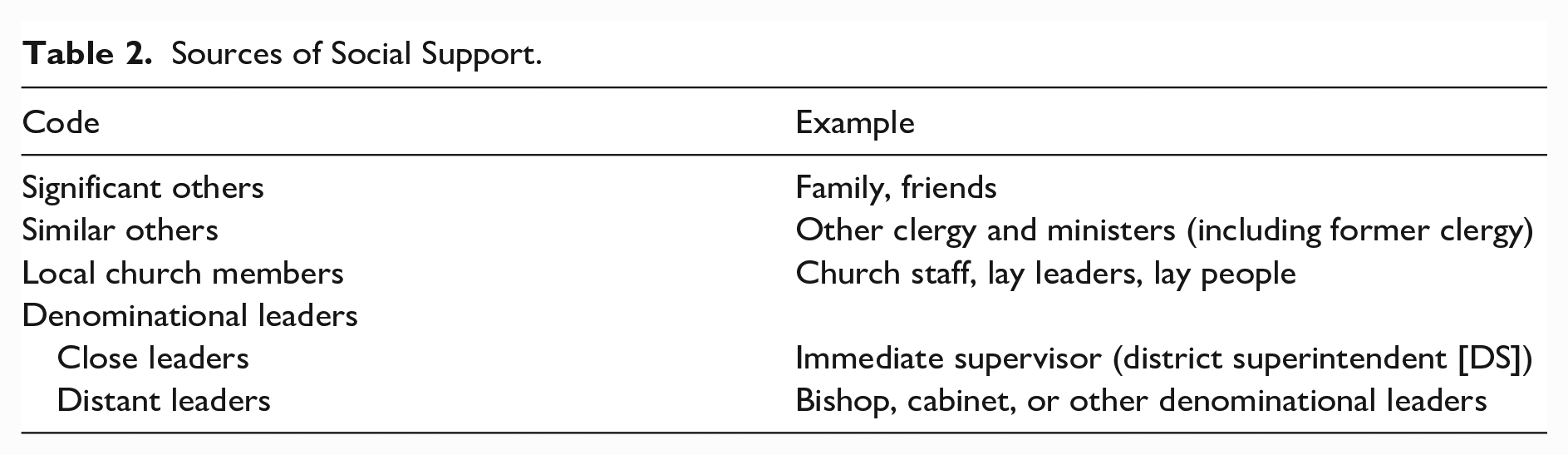
Research by Bloom (2017, 2019) underscores the important role of social support in facilitating clergy well-being and adds clarity to the nature of social support most commonly received by clergy. Bloom (2019) highlights four main sources of social support: (1) significant others such as spouses, parents, and friends; (2) similar others such as other clergy people; (3) members of the local church a clergy person is serving, including staff, lay leaders, and lay members, and (4) denominational leaders. In the latter group, he distinguishes between close leaders (e.g., immediate supervisor) and distant leaders (e.g., senior denominational positions). Bloom (2017, 2019) finds that each group can provide both emotional support and instrumental (or tangible) support. Significant others, for example, “can be present in times of joys and sorrows—a caring person who commiserates and cares.” They can also provide tangible support like “cooking meals, producing financial income and sharing family care responsibilities.” Ultimately, Bloom (2017) argues that social support is vital for flourishing in ministry, that each source of support provides “uniquely important forms of social support,” and that, “All are necessary but no single one is sufficient.”
We know from past research that clergy faced a broad range of challenges in the early period of the pandemic, including disrupted routines and habits of ministry, learning new technologies for online worship, increased demand for pastoral care, financial stress, and declines in membership and volunteer support (Eagle et al., 2022; EPIC, 2021b; Funchess et al., 2022; Johnston et al., 2021; Osei-Tutu et al., 2021). Who did clergy look to for support in navigating these challenges? What forms of support were most salient or effective in facilitating clergy well-being during this period? Mirroring research on clergy well-being pre-pandemic, studies such as those by Village and Francis (2021a, 2021b) have sought to address this question. Drawing on surveys of Church of England clergy, Village and Francis (2021a, 2021b) found that the sources of social support rated most highly by clergy in terms of perceived support were those closer to the clergy person (household members, ministry team, and congregation) while those rated lower were more distant (the national church and the public). They also found that while all sources of social support studied were independently and negatively correlated with disengagement and fatigue (Village and Francis, 2021a) and positively associated with affect balance (Village and Francis, 2021b), support from distant sources had the largest and most significant impact on well-being. Taken together, these studies suggest that clergy were receiving the most support from local sources but that distant support was most impactful for clergy well-being.
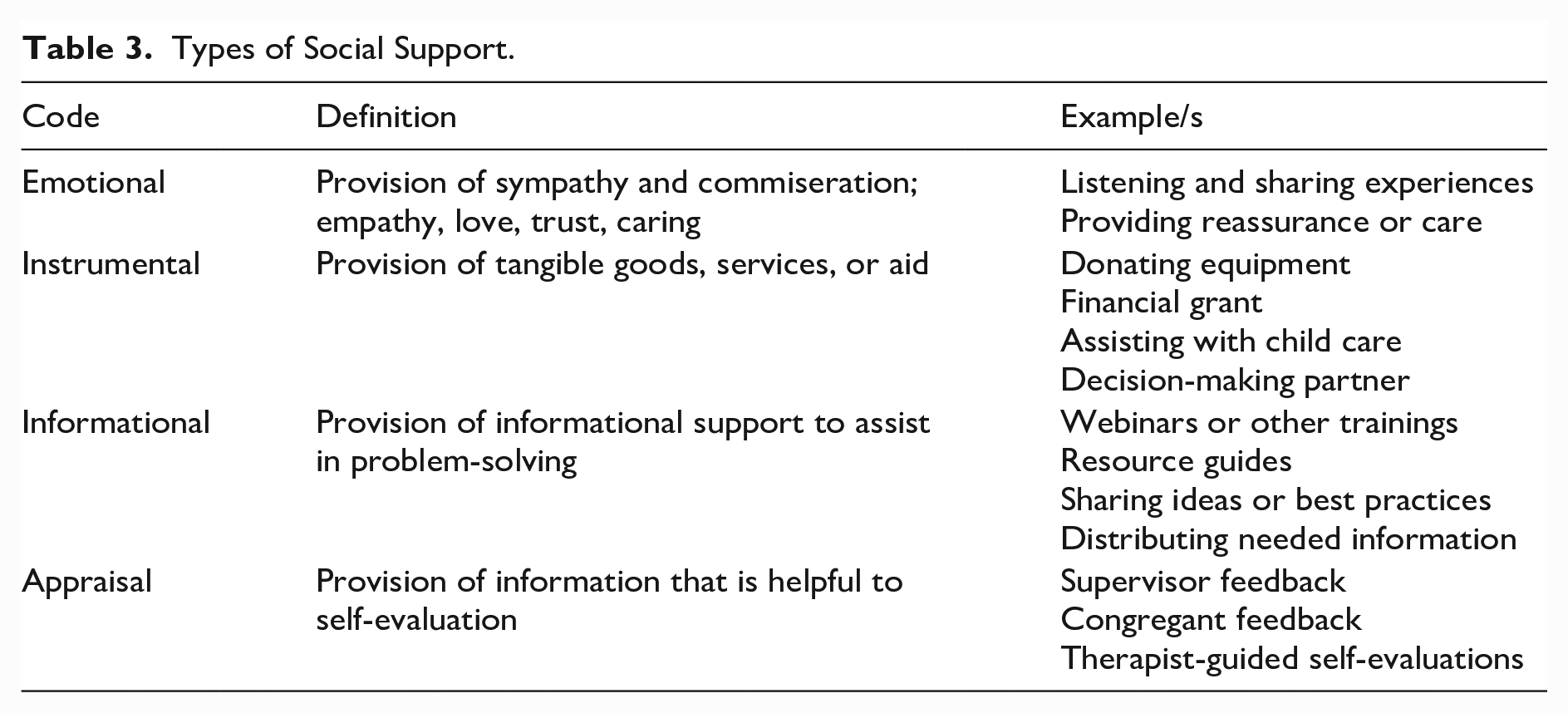
The current study builds on this work in three primary ways. First, we consider clergy in a different denominational and geographic context—in our case, United Methodist clergy in the United States (and more specifically, North Carolina). Second, we use qualitative in-depth interviews rather than survey methods, which allow us to assess what supports and resources were mentioned by clergy spontaneously, suggesting their relative salience during this unsettled period. Qualitative methods also provide space for new sources of support to emerge and to examine how different supports are discussed and described. Finally, we attend to similarities and differences in both the sources and the types of support mentioned by clergy. In doing so, we extend Bloom’s (2017, 2019) typology to consider four types of social support—emotional, instrumental, informational, and appraisal support—as first outlined by House (1981) (see also, Etzion, 1984; Langford et al., 1997; Stroebe, 2000). This typology allows for greater precision in explicating how different sources of support promote resilience and facilitate well-being during periods of upheaval.
Data and Methods
This study draws from in-depth interviews with 50 United Methodist Church (UMC) clergy appointed to serve 70 congregations in either of the two Annual Conferences in North Carolina. Most participants (n = 39, or 78%) were sampled from the 2019 Clergy Health Initiative Statewide Survey of United Methodist Clergy. An additional 11 respondents were recruited by contacting clergy enrolled in continuing education courses at a Methodist-affiliated seminary. To gather a range of ministerial experiences, we purposively sampled clergy based on number of years in ministry (i.e., early career, mid-career, and later career clergy) and appointment status (i.e., ordained and local clergy). From the Statewide Survey, a total of 134 potential participants were identified and invited by email to participate in the study. Potential participants were contacted a maximum of four times before being removed. Of the 84 participants not interviewed, 9 declined participation, 3 were ineligible, 4 were unable to be scheduled, and the remaining 68 did not respond to emails and/or calls. Among those recruited through continuing education courses, a call to participate in our research was distributed to about 150 individuals, 14 of which responded promptly and 11 of which were able to be interviewed.
The 50 clergy in our sample were 84% white, 52% male, and, on average, 49 years old. A little more than half (52%) were ordained elders with the remaining 48% serving as local clergy (i.e., non-ordained clergy licensed to serve a single church or set of churches). About one-third (32%) of these clergy were appointed to serve more than one congregation. Of the 70 congregations served by these clergy, we classified 74% as small, meaning they had fewer than 100 regularly attending participants. In addition, we classified 63% of the congregations as being in rural areas of North Carolina, in accordance with the Rural–Urban Commuting Area Codes of the USDA (USDA Economic Research Service, 2020). Comparing to all UMC clergy in the state, our sample included a larger proportion of women (46% in our sample were clergy women, whereas only 32% of all UMC clergy in NC were women) but was broadly representative in terms of race and age. Because we oversampled local pastors (48% in our sample vs. 30% of clergy statewide are local pastors), a larger proportion served more than one congregation (32% vs. 23%) and were located in rural areas (63% vs. 54%) (Table 1).
Clergy and Congregation Demographics.
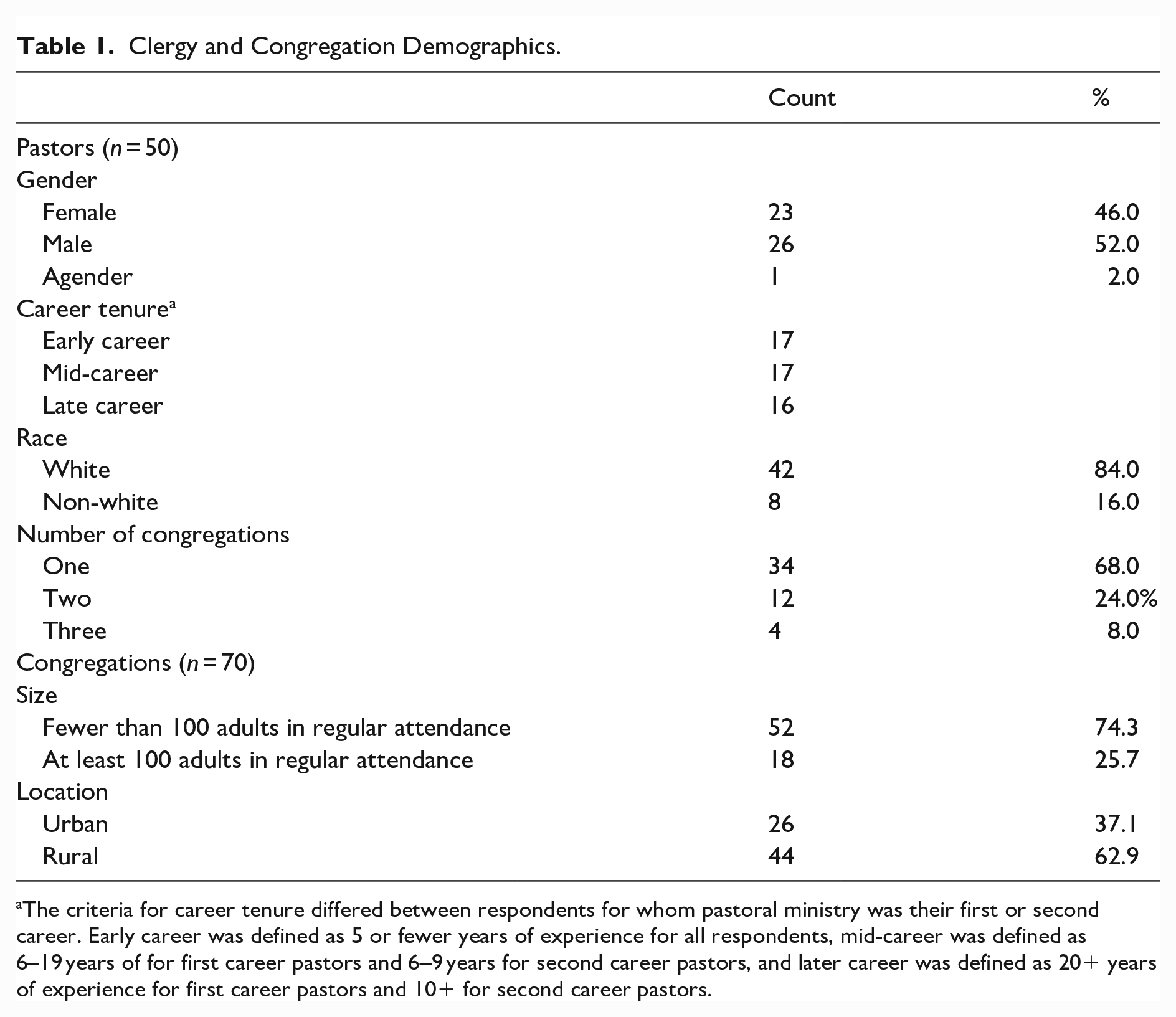
The criteria for career tenure differed between respondents for whom pastoral ministry was their first or second career. Early career was defined as 5 or fewer years of experience for all respondents, mid-career was defined as 6–19 years of for first career pastors and 6–9 years for second career pastors, and later career was defined as 20+ years of experience for first career pastors and 10+ for second career pastors.
The UMC is a useful case study of the pandemic’s impact on clergy for several reasons. First, it is the third largest denomination in the United States, involving nearly 6.5 million members, 30,543 churches, and 38,308 clergy (General Council on Finance and Administration of the United Methodist Church 2018) and representing 9% of all religious congregations in the country (Chaves et al., 2020). Second, UMC denominational leaders encouraged congregations to abide by public health guidelines and UMC congregations, like most churches in the United States, generally did so: they ceased indoor gatherings and moved to a remote, online format when possible (UMC NC Conference, 2020). At the same time, denominational officials left considerable leeway for pastors to modify practices in line with their congregation’s specific needs and available resources. Furthermore, by focusing on pastors in one denomination in a single state, we were able to consider how pastors under similar guidelines and mandates managed the disruptions presented by COVID-19.
Pastors were interviewed between June 2020 and January 2021. Just over half (54%) of the interviews took place during June, July, or August of 2020, coinciding with the second major “spike” of COVID-19 nationally. Another third (34%) of our interviews took place during September and October of 2020, coinciding with a decrease in COVID-19 cases in North Carolina and easing of restrictions. The remaining 12% of our interviews took place between November 2020 and January 2021, coinciding with the third major “spike” of COVID-19. While COVID was a fluid and evolving situation, we did not find major temporal variations in the patterns we identified.
All participants provided informed consent prior to the interview. Interviewers, both of whom identified as women and white, were trained in qualitative interviewing and were not affiliated with the UMC. Interviews were conducted by Zoom or telephone and were audio-recorded. Interviews followed a standard guide that included open-ended questions with specific probes (see Online Supplemental Material) to gather information on pastoral and congregational experiences during COVID-19. As part of the guide, pastors were asked a series of questions about supports used and supports desired. Interviews were transcribed and we removed identifying information prior to analysis. Participants received a US$25 incentive for completing the interview. All study procedures were approved by Duke University’s Campus Institutional Review Board. All names used in this manuscript are pseudonyms.
Transcripts were coded in NVivo 12 using applied thematic analysis (Guest et al., 2011). Analysts, both of whom identify as women and white, were trained in qualitative analysis and were not affiliated with the UMC. First, a structural codebook was deductively generated based on the major themes, questions, and probes covered in the interview guide. For example, structural codes for the first question of the guide included “changes in ministry,” “role as pastor,” and “opportunities created.” Structural codes were applied to relevant question and answer pairings (e.g., “What is your role as pastor in the current reality of COVID?”) as well as any other segments of the transcript in which that theme (e.g., role as pastor) arose. Six transcripts (12%) were reviewed by the three-person analyst team to establish inter-coder reliability. Emergent codes and additional sub-categories of structural codes were incorporated based on discussion and mutual agreement. The remaining transcripts were then individually coded using the revised codebook. Questions that arose while coding were discussed collectively. Analysts wrote cross-case memos to identify and explore emergent themes during structural coding.
The findings outlined in this article are based on further thematic analysis of interview segments structurally coded under themes related to “supports” and “supports desired.” A two-analyst team (first and second author) read through the relevant material and inductively generated emergent themes based on a constant comparison method (Charmaz, 2011). The two analysts then met to discuss common themes and codes across categories. During this initial period, we identified alignment between inductively generated themes and existing research on the sources and types of support identified in previous literature, as reviewed above (Bloom, 2019; Etzion, 1984; House, 1981; Langford et al., 1997). A thematic code book based on these typologies (outlined in Tables 2 and 3) was developed and applied to the transcripts, with one analyst focused on “supports used” and one on “supports desired” for all transcripts. The analysts wrote analytic memos (Deterding & Waters, 2021) and met regularly during thematic coding to discuss code applications and emergent themes.
Sources of Social Support.
Types of Social Support.
Results
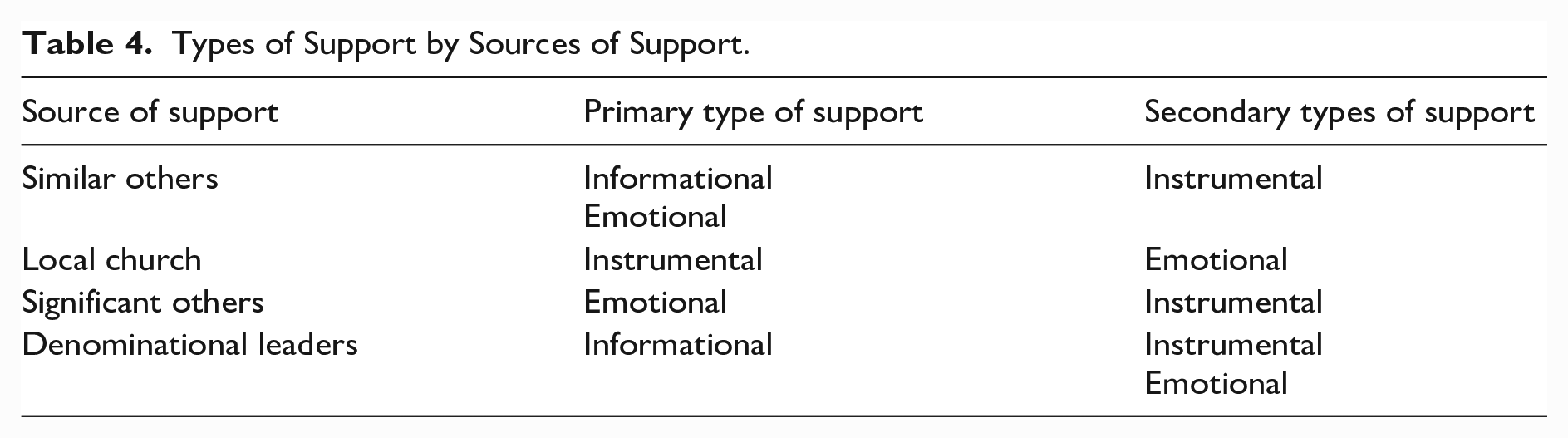
We found that most clergy mentioned multiple sources of social support and many mentioned all four sources at least once during the interview, suggesting that clergy were drawing on a diverse eco-system of social supports to manage this challenging period. However, we also found notable patterns in the types of support associated with each of these sources. Table 4 highlights the primary and secondary types of support associated with each source based on the relative frequency with which each pairing appeared in our data. Significant others, for example, were most often mentioned as providing emotional support, while local church members were most commonly described as providing instrumental support. These patterns suggest that clergy were turning to different sources for different types of support.
Types of Support by Sources of Support.
Our data also suggest that some sources and types of support were more salient and impactful during this period. These sources, including similar others and local church members, were more likely to be mentioned unsolicited (prior to direct questions about supports used) and/or were mentioned first when directly asked about the supports and resources used during this time. Notably, while some types of support such as emotional support from local church members and denominational leaders were mentioned less frequently, when these supports were mentioned, clergy’s responses suggested they were particularly impactful. Below, we organize the findings by sources of social support, starting with the most commonly mentioned: similar others. In each section, we describe the most commonly mentioned types of support and highlight variation in responses by clergy and congregation demographics, where relevant.
Similar others
Fellow clergy were the most commonly mentioned and often the most salient source of social support for the pastors we spoke with. Most frequently, pastors described fellow clergy as offering a combination of informational and emotional support. Pastors told us they met with other clergy to talk about what they were doing, what was working and what was not working, and to consider new means and methods for doing ministry under pandemic-related restrictions. These conversations were also spaces to connect with people who understood the challenges they were facing. Clergy mentioned checking in with others to talk about how they were handling the challenges of COVID-19, both mentally and emotionally. They lamented and grieved together and also shared prayer and words of encouragement.
One clergyperson, Marion, for example, told us that she has been meeting weekly with a group of two other pastors. She told us, . . . even now, we’re meeting once a week to discuss, “Well, what is your sermon about this week?” And oftentimes, we end up talking about other issues. So, it gives us a chance to, “Hey, how are you handling this?” Or “What are you doing?” And getting fresh ideas or just being able to get things off our chest. So that’s been very beneficial to me.
This combination of informational and emotional support came up repeatedly in our interviews with pastors. However, the informational support provided during these conversations, especially about how to do ministry, was of particular importance. As Landon told us, I would say that connecting with other clergy was really helpful as well. To call a pastor down the street and to just bounce ideas off of, hear what you’re doing, hear if this makes sense for us. Let’s talk through a little bit about why might this work. What are our blind spots, too. That was another thing, is talking to clergy and just saying, “What am I not doing that I need to be doing right now?” Was also really helpful.
Conversations with other clergy exposed clergy to new ideas and strategies for doing ministry. Mark, like Landon, told us that he often “talk[ed] with other clergy about best practices” and even began attending services at other churches to “see their practices” and to consider whether they might work for his church. For both Landon and Mark, other clergy were their primary source of informational support related to ministry in the early period of the pandemic.
In some cases, fellow clergy provided direct instrumental support. Some clergy, for example, reported pooling the work of preparing sermons and leading worship with clergy from other congregations. This allowed them to preach less often and/or focus their attention on just one aspect of leading worship online (e.g., technology or music). Beyond being practically useful, however, clergy also reported that collaborating was personally enriching, a blessing or silver lining of the pandemic period. For example, Holly recalled, When the pandemic first happened, I actually partnered with three other clergy . . . We did all our worship services for the first five or six weeks together [. . .] I actually didn’t put very much content together worship wise for weeks, because I was the technology pastor [. . .] so that was really important to me being able to navigate all the uncertainty and all the challenges of trying to just figure it out. And I think collaborating with those three [clergy] was a big deal . . . We recognized that it was time for us to shift back to our individual churches . . . but we were all sad about it because we had gotten so much life out of doing it together and hearing each other preach.
Another clergyperson, Sharon, who also worked collaboratively with “an informal group of Methodist clergy,” and reported that, “Working together has been the biggest blessing I have gotten out of this. The silver lining in the COVID cloud, so to speak.” While less commonly mentioned than informational and emotional support, instrumental support through collaboration with fellow clergy was highly salient and impactful when it did occur.
The peer groups and relationships mentioned by clergy formed in numerous ways and encompassed different kinds of connections. Some pre-dated the pandemic but others, like the informal groups mentioned above, formed in response to it. There were groups that met and interacted entirely online (e.g., an online group for Methodist clergy women mothers) and others that met in-person. Regardless of how the group was formed, an important feature highlighted by several clergy was the ability to talk openly and honestly without fear of judgment or repercussions. Gary, for example, reflected, “What’s helped me most is having colleagues that I can share everything with, that I can bare my soul . . . a place where you can honestly share without sense of fear, of judgment, or anything like that.”
In cases where clergy did not feel comfortable being completely honest, the groups were experienced as less helpful. Marshall, for example, met with a small group of clergy organized by the denomination and described the meetings as “helpful to a degree.” He continued, Of course, one of the struggles with that is that we’re not all on the same page theologically. We realize you can say only so much in this group and keep the peace and the camaraderie [. . .] I guess, if anything, I would love to have a resource, a group like that where I could say anything and not be judged for what I say, but rather be challenged and be able to challenge somebody else . . . That would be probably the biggest resource that I would love to have.
Clergy’s responses suggest that peer groups are only helpful to the extent that clergy feel able to be open and honest about their experiences and views with the other members. Clergy who had pre-existing relationships with fellow clergy and those with relationships that formed organically likely entered the pandemic better equipped to confront the challenges it posed.
Local church members
Local church members were also frequently mentioned by clergy as an important source of social support. This category includes co-pastors and other paid church staff, lay leaders, and congregation members. Clergy most often discussed these individuals as providing instrumental support but emotional support was also mentioned. Clergy of both large and small congregations mentioned the local church as a source of support; however, they did so in divergent ways.
Clergy in larger congregations often mentioned both co-pastors and paid staff as sources of instrumental support during this time. These clergy were aware of and explicit about how being part of a pastoral team made ministry during the pandemic easier. As Landon noted, We have a great pastoral team [. . .] All of us have different strengths and a different skillset. I do think that for weathering something like this, it’s so helpful to work on a team like this. Being a solo pastor would have been so much harder.
Being a part of a team allowed Landon and his colleagues to divide up key tasks and focus their individual attention and efforts more narrowly. Pastoral teams also provided regular encouragement and a space to process the emotional impacts of the pandemic. Claire highlighted this benefit of being on a team, noting, “I’m blessed that I’m on a team, right? I didn’t have to go and look for colleagues to process and grieve with. They were here.”
Other paid staff were also mentioned by clergy at larger congregations. Claire, for example, felt that it was “the provision of God” that the church hired a new staff member just before the pandemic who was then able to take over virtual worship “and made it happen.” Another clergyperson, Todd, told us that a staff member who usually worked in children’s ministry took over all of the technological aspects of worship. Another mentioned that the church assistant “types out the sermon and mails it” to congregants without computers or internet connections (Sherry). In each case, paid staff eased the burden on clergy by dividing up labor, allowing clergy space to focus on other aspects of ministry.
In other cases, especially smaller churches that could not support paid staff, lay leaders and lay people provided similar kinds of support for clergy. Especially early on, clergy talked about relying on lay leaders and lay people to provide instrumental support “in everything from technology to advice” (Mark). Bart, for example, recalled, “We went to someone’s home because they had fast internet, and I recorded the first service from there.” Later, another church member who was interested in learning the technology and passionate about it, took over and helped manage the technological aspects of running worship services. Lay people were also described as providing material resources and other forms of labor. When transitioning to outdoor services, Gary shared that one member “purchased a PA [public address] system that we could use” and “another member had a keyboard that they offered to donate.” In addition to these material resources, Gary recalled lay people helping dig ditches and raise tents to make outdoor services possible. He reflected, “So members, when there has been a need, have been really good about stepping up and covering that.” Others said lay people helped collect tithes, addressed envelopes, or delivered copies of the weekly sermons to other members.
In some cases, lay people also took on the work of pastoral care (cf. Johnston et al., 2021). Francis told us that his “congregational care team,” comprised “62 volunteers,” was able to “call every single church member” in the early weeks of the pandemic. Pam mentioned “a lay team of people that are trying to keep up with our most vulnerable folks.” In other cases, congregants volunteered to be guest preachers, as Jeff recalled, A wonderful, beloved person in our congregation has said, “Jeff, you know what? . . . I’ll be glad to preach if you want me to.” And that’s somebody that I know and love and trust, and he’s somebody who has a lot of capital with the congregation. So, he went ahead and preached two prerecorded sermons that we have on file. [Another staff member] and I are going to do the liturgy and music, and then [other church staff], because he’s the tech guy, is going to stitch all that together, and we’re going to have two prerecorded services the first and second Sunday of July. And both of us will then be taking off for those two Sundays.
As Jeff’s response makes clear, the volunteer work of lay people combined with the efforts of church staff is crucial to enabling clergy to take much needed time off to rest and recuperate.
Finally, local church members—lay people, church staff, and co-pastors—also provided instrumental support in the form of shared decision-making. Making decisions collaboratively with trustees, a leadership team, or church council meant that clergy were not alone in figuring out what to do or in taking the blame if and when some congregants were unhappy with the decisions being made. Pam told us that early on she met with the trustees and “put together a planning committee to talk about how we were going to handle things.” The trustees and planning committee were important conversation partners in talking through how they would approach worship. Another clergyperson, Mark, similarly reflected, Wow, my role as a pastor right now, most days I feel like I’m holding back the floodgates as people demand to get back in church . . . Fortunately, I’ve got some strong, sensible leadership that is helping me hold it back [. . .] They have been very good about taking the weight off the pastor by saying, “Look, it’s not that the pastor doesn’t want to do the service. The fact is part of loving your neighbor is keeping your neighbor safe.” . . . Just having them stand up and say we support the pastor’s decision not to come back has been a big help.
For Mark, the support and backing of church leadership made all the difference, helping him provide justifications for the decision to remain virtual.
While less common, some clergy also reported receiving emotional support from lay leaders and congregation members. Gary, for example, shared, It’s also been kind when people call me and say, “Pastor, how are you doing?” Don’t have a whole lot of those, but I do have some. Occasionally, I’ll get a card in the mail that says, “I know it’s been really hard on you, but we thank you so much for what you’re doing for us and for the community.” Your heart just melts. You’re going, “Aw. It’s so sweet. Okay. I can do it for another week, God.” That’s all I needed. I just needed a little pep talk.
As this quote makes clear, direct expressions of gratitude, encouragement, and care from lay people were particularly impactful, motivating clergy to keep going during a challenging time. In a few cases, lay people offered more personal instrumental support such as cooking meals or encouraging clergy to take time off. Phillip, for example, recalled, Thankfully, the congregation from the outset has been hugely supportive, wonderful in that regard to say, “Phillip, you do whatever you need to do. You know we’re here, we love you, you are doing great. Take time that you need. Your family comes first.” That kind of stuff . . . And that has made a huge difference, that personal relational support of not just the personnel committee but really the whole congregation sees me as a human being first with a family and responsibilities and that has made all the difference.
As Phillip said, being treated like “a human being first,” with acknowledgment of familial obligations makes “a huge difference” in how clergy experienced the pandemic period.
It is important to note, however, that some clergy did not feel supported by their local church during this period and, in a few cases, clergy reported that some of their members were actively hostile and combative. Several told us that they felt lay people’s expectations were unreasonable given the circumstances, or that they found it more difficult than before to establish boundaries or take time off for rest and self-care. Howard, for example, told us he felt like “a lone wolf” and wished for more support from his congregation. Francis told us he would have appreciated “a little more recognition” and “some patience” from congregants around decisions about when and how to re-open. Other clergy reported explicit pushback and direct conflict, which caused clergy considerable stress. One clergyperson reported that a few congregants went behind her back to request that she be fired or switch churches. Clergy with non-supportive congregants could not rely on the laity pick-up parts of ministry, ultimately increasing their workload and contributing to a sense of isolation and burnout relative to their peers on pastoral teams or with supportive and engaged congregations.
Significant others
Significant others, including partners, parents, children, and close friends, were primarily discussed as general sources of support and/or as providing emotional support. Nancy, for example, noted, “My husband is obviously a huge source of support” but did not clarify the nature of the support offered. Another, David, noted that he and his wife “have a strong, close relationship” and that she has “been supportive.” Other clergy discussed time spent interacting with family and close friends was a way to de-stress and manage emotions during a challenging period. Teri, for example, reflected, “My husband is really good at helping me stay grounded. He’ll say, ‘Hey, we need to go for a drive or something, just get out of the house.’” Another, Eloise, told us that she had lunch with her husband every day and noted, That’s a real blessing, so we check in with each other. I remember at the beginning noticing how it was just an emotional rollercoaster of being on house arrest, but neither one of us were both down at the same time.
Spouses, in particular, helped clergy deal with and overcome negative emotions.
Significant others complemented the support provided by other sources. As Simone told us, “being a pastor can be a lonely life,” because “there are limits” to how close a clergyperson can be to parishioners. She continued, “You need someone that you can be who you really are [. . .] you could just be, and that’s important.” For Simone, her mother and her sister played this important role. For another clergyperson, Sherry, a good friend and former parishioner (from a previous placement) played this role in her life. Sherry, like Simone, reflected on the importance of having someone to talk with who is a person of very strong faith that is not in your congregation, that is not related to you, that you can just be yourself with and in your moments of frustration . . . that’s been a tremendous support for me.
These examples point to the importance of social supports outside formal workplace relationships where clergy feel more able to let down their guard and be honest about their experiences.
In other cases, significant others, including spouses, parents, and in-laws, were described as providing instrumental support such as child care or other household labor like cooking, grocery shopping, and pet care. In a few cases, significant others offered instrumental support in the form of job-related assistance, especially with technology. Grace, for example, shared that her and her niece “have been online a lot or texting back and forth” about technology. She recalled, “She set me up with stuff, helped me things, and taught me procedures on stuff on how to do things. She’s been a big help to me [. . .] She’s my technology guru.” For clergy married to other clergy, significant others often played the same roles as “similar others” outlined above—providing a mix of informational, emotional, and instrumental support. Sherry captured the benefits of this spousal relationship well: My husband is a pastor. And that’s great. He’s been in ministry longer than I have [. . .] it’s a beautiful thing sharing careers with someone who understands exactly what your career is. And so, he’s been a tremendous support for me, as I have been for him.
Sharing ideas and best practices, providing practical assistance, and generally being understanding are all ways that clergy spouses can support one another.
Finally, while significant others were often mentioned as sources of emotional support, they also came up, in a few cases, as sources of struggle or difficulty. Clergy with young children, for example, found it difficult to get work done at home. Clergy who were caring for relatives faced additional burdens, as well, and single clergy (who, in our sample, were predominantly women clergy) reported loneliness during the early period of the pandemic.
Denominational leaders
Denominational leaders were another source of social support commonly mentioned by clergy. This category includes both distant leaders (like the bishop) and close leaders (especially, district supervisors [DSs]) as well as resources and information such as webinars and guidelines, provided by the denomination, more generally. Clergy most often discussed the denomination and denominational leaders as providing informational support. This was followed by instrumental and, least commonly, emotional support.
Informational support from the denomination included updates on legislative changes in the state and communications regarding “requirements and suggestions” for whether and how to hold worship safely. Informational support also included webinars and online trainings for how to manage the changing nature of ministry. Many clergy told us they followed conference guidelines closely, looked to the conference for information and suggestions, and attended denomination-provided webinars. As Max recalled, I appreciate that the conference has been working to give us all the best information they’ve got. Any thoughts, suggestions, resources, it’s all available on the website. We get emails on a routine basis. I wouldn’t have survived as well as I have without that.
Others shared similar sentiments. Marty noted that his church “used all of the guidelines that were given out to us by the conference” and regularly took part in the “educational pieces they’ve done for us.” Marty found that this saved time, reflecting, “I didn’t have to go hunt up guidelines or hunt up ideas.” The centralization of information and best practices meant each clergy person did not have to do the research alone, saving time and energy for other demands.
Instrumental support took several forms. Financial support such as small grants to purchase equipment or subscriptions to software programs like Zoom were mentioned by many of the clergy we spoke with, especially those at smaller and less well-resourced congregations. Other clergy mentioned videos, sermons, and/or how-to guides provided by DSs or other denominational leaders as useful resources. One clergyperson, Grace, noted, A lot of it has gone back to my DS. [S/he] has been so helpful, and so open to questions, and available. [S/he] did a bunch of videos and put them on YouTube so that we could use those for worship if we were going to be away or if we wanted a Sunday off just to be off, then said, “These are available to you to use.”
Another, Eloise, mentioned that the conference provided clergy “with some resources on imagining Holy Week a little differently.” These kinds of resources offset the time and labor that went into writing sermons every week, allowing clergy a bit of reprieve during a busy period.
Instrumental support also included making decisions collaboratively or providing directives around whether and how to gather. Most of the clergy we spoke with appreciated receiving direct and specific guidelines on whether, when, and how to hold worship services, as this meant that clergy “didn’t take on the entire responsibility of making these decisions” (Gary). Early on, this allowed clergy to place the “blame” (Marty) for closing the church on denominational leaders, deflecting pushback and conflict. One pastor, Francis, recalled facing pushback from a staff member about shutting down the preschool program. He noted, And then I got an e-blast that came out from the Bishop saying that nobody should be in churches. And I said, “Hey, look, this is out of my hands now. You heard the Bishop.” And again, she wanted to follow the school’s systems lead and I’m like, “Look, we’re in a church, and the Bishop is our authority. It’s not the school system.”
Many clergy appreciated “specific” and “directive” guidelines from denominational leaders; in fact, several told us they would have wanted additional direction and guidance, more explicit guidance, or more explicit communication of guidelines directly to lay people. A few clergy, however, told us they appreciated that denominational leaders were “supportive without being directive” or felt that congregations should have had more freedom to decide what to do.
Emotional support, while less common, was mentioned by some clergy. This form of support included phone calls to “check-in” on clergy as well as more general affirming statements and prayer from denominational leaders. This kind of support was more commonly mentioned as coming from close leaders but distant leaders were also mentioned in some cases. For example, several clergy mentioned receiving a phone call directly from the Bishop and articulated how meaningful this gesture was during a difficult time. Simone, for example, said, “But that’s one of the biggest things . . . blows me away, getting a call from the Bishop. You can’t imagine how that feels, to get a call from the Bishop.” Evan shared a similar sentiment, noting, “Honestly that meant more to me that my Bishop was calling me than any sort of preparatory meeting . . . just checking in like, ‘How are you doing?’’ These comments suggest that direct, one-on-one outreach to clergy from distant leaders was experienced as particularly impactful.
While many clergy mentioned the denomination as a source of support and highlighted the useful resources they provided, several were more critical of the resources and supports provided by the denomination. A few, such as Laura, felt the denomination was doing too much and creating “extra workload” that “became a little bit of a stressor” for already over-burdened clergy. Others felt that the resources provided were simply not relevant to them. Eileen, for example, noted that most of the webinars were geared more to the larger churches and not so much for the churches where you have pre-COVID average attendance of about 15 to 20 [. . .] and many of them not on social media or not on a computer at all.
The most common complaint, however, was that the resources simply came too late: by the time the denomination distributed resources, clergy had already figured out what do to and how. As Todd recalled, I mean, I know the United Methodist Church was throwing a bunch of stuff at us at the beginning, but by the time they were throwing resources out, I guess you could say my worship leader and I worked it out. We took care of what we needed to take care of at the time, and that’s just the . . . That was all we could do.
Another clergyperson, Megan, expressed a similar sentiment. She told us that while the conference distributed “a bazillion webinars,” she “ignored them all. Because at that point, it was just too late . . . I already had to have figured it out . . . I was on to something else.” These comments underscore the importance of similar others as sources of informational and instrumental support in the early period of the pandemic, before denominational resources were ready for distribution.
Discussion
This research suggests that clergy were drawing on a diverse eco-system of social supports to manage the challenges of the early period of the COVID-19 pandemic. The sources and types of social support used by clergy during the pandemic mirror those identified in previous literature as key facilitators of clergy resilience (Bloom, 2017; Sielaff et al., 2021). However, our findings also add nuance to this research by showing that different sources of support provided different types of support during this period. Similar others, especially other clergy, for example, primarily provided a mixture of informational and emotional support. Alternatively, local church members provided instrumental support: donating equipment or time to make services run more smoothly, helping with technology, and/or assisting with the work of pastoral care and congregational outreach. Significant others provided emotional and personal instrumental support, while the denomination supplied information on the state of the pandemic and guidelines for how to safely gather. These findings suggest that clergy who are embedded in diverse networks of support will likely be better able to weather the storm of disruptive events like the COVID-19 pandemic. Below we highlight three more specific takeaways from our findings for the study of clergy well-being during and beyond the pandemic period before turning to practical implications and directions for future research.
First, our findings suggest that during “unsettled periods”—periods in which cultural ideas and practices are in flux (Swidler, 1986)—peer relationships and social networks may be of particular importance. During a period in which the usual, taken-for-granted practices of ministry were upended, clergy looked to each other for suggestions and advice on how to do ministry under the new conditions. While clergy also talked about denominational leaders as a source of informational support, these resources often came too late. It takes time for denominational leaders to create and distribute resources like webinars, grants, and guidelines, but clergy had to act immediately. As a result, religious leaders with existing peer and peer group connections will likely fair better than those without as they have trusted others they can turn to for both practical advice and emotional support. This finding highlights the importance for clergy to build peer relationships and for denominational leaders to promote and facilitate the formation of both formal and informal relationships among clergy. These relationships are more responsive and useful in times of rapid social, organizational, and institutional change. While pandemics are rare, other unforeseen events that may impact religious congregations like natural disasters or civil unrest are more common. This underscores the importance of clergy developing support networks that are responsive to major disruptions.
A second key takeaway is related to differences we observed between clergy of larger and smaller congregations in terms of the people they looked to for instrumental support. In both cases, clergy primarily turned to members of their local church or churches for instrumental support—but in divergent ways. For clergy of larger churches, co-pastors and paid staff were the most frequently mentioned sources of support. Solo clergy of smaller churches, however, had fewer, if any, paid staff to rely on. Instead, these clergy turned to lay leaders and lay people for instrumental support. Some solo clergy also reported turning to fellow clergy in nearby churches for instrumental support—in essence, creating their own pastoral teams. While clergy at larger congregations had a built-in system of instrumental support, solo clergy at smaller congregations had to build their own support networks or face the prospect of navigating the uncertainty of this period alone. Without paid staff, they were left at the whim of congregants’ desire and interest to offer volunteer assistance, which in some cases was provided but in others, was not. There is an advantage to working in a larger staff team, but this is not the reality for most pastors. Most congregations are small and led by single clergy. There is a tendency for clergy to distance themselves from their congregations out of a concern for maintaining ethical counseling relationships. And while it can be important for clergy to maintain professional boundaries, our study suggests inter-dependency between clergy and the members of the congregation plays an important role in clergy well-being, especially during periods of disruption.
A final takeaway from our data is that the secondary types of support listed in Table 4, while less frequently mentioned, were often described as particularly impactful. The most notable examples were emotional support and expressions of direct care from congregation members and distant denominational leaders. While not frequent or ongoing, receiving expressions of emotional support from these sources was memorable and meaningful, bolstering clergy’s inner resources. The salience of this type of support may reflect the fact that clergy are less likely to expect emotional support from these sources. While clergy may expect emotional support from family and friends, they may not see direct, emotional support as part of the normal relational obligations of their ties to parishioners or denominational leaders, especially distant ones. Given this set of expectations, when these forms of support do occur, they may be more meaningful and impactful. This adds nuance to Village and Francis’ (2021a, 2021b) finding regarding the efficacy of support from close and distant sources, suggesting that it may be valuable to consider the types of support that are most expected and/or impactful across sources.
More practically, the typologies of social support (both sources and types) outlined in this paper could be used in programs, trainings, and/or conversations to build clergy well-being and resilience. These programs could not only discuss the importance of social support, but also, more pragmatically, help clergy, on their own and/or in conversation with others, identify gaps in their social support networks. It may be useful for denominational leaders and supervisors, as well as clergy themselves, to consider the full range of clergy support networks and types of support available in an effort to create targeted supports that reflect the needs of clergy situated in different relational, geographic, and congregational contexts.
This study has several important limitations. First, our findings come from one denomination in one state and do not necessarily generalize to churches from other denominations or geographic areas. The UMC emphasizes the connectional nature of the church and intentionally builds support networks among clergy and denominational staff. This likely shaped the way that support was given and received by UMC leadership and clergy. Second, our data come from one moment in time—the early period of the pandemic. Because COVID-19 created a rapidly evolving situation, these interviews cannot capture the entire impact of the pandemic, the full effects of which will not be totally understood for many years to come. It may be the case that the kinds of supports most salient or useful to clergy were different at different points in the pandemic. In addition, in our conversations with clergy, we asked them to reflect on the supports they used during this period and allowed clergy to talk about the people and resources most salient to them. Our data, therefore, may undercount the number of clergy who received a given type or source of support. It is also possible that as conflict over pandemic restrictions increased, that clergy-lay relationships became more fraught with tension and less a source of support.
In addition, not all contacted clergy responded to our invitation to participate in this study. It may be the case that clergy who responded were doing better overall (and hence had more time to dedicate to the study) than the clergy who did not. Past research suggests that social support is strongly correlated with clergy well-being and resilience (Bloom, 2019; Eagle et al., 2019; Meek et al., 2003; Sielaff et al., 2021; Village & Francis, 2021a). Given this, our study may present an overly rosy picture of the support structures of current UMC clergy. In addition, the UMC clergy we spoke to were predominantly white, which may limit the ability to generalize our findings around social support to clergy of other racial and ethnic identities. We attempted to ensure we had voices from racial and ethnic minority clergy to match their population in the denomination, but these clergy were less likely to participate. Of the 35 clergy contacted who did not participate in the study, a third was clergy of color.
In addition, this article focuses on social support; however, clergy also mentioned other forms and practices of support and self-care in our conversation such as prayer, sabbath, and other spiritual practices; entertainment such as television, movies, or books; hobbies (e.g., knitting, painting, or wood working); and exercise (e.g., running or walking). Several respondents also talked about the importance of setting clear boundaries to maintain work-life balance and/or pastor-congregant relationships. These practices, like the social supports described above, map onto previously identified facilitators of clergy well-being (see Sielaff et al., 2021). Additional research on the impact of these practices and strategies, especially in relation to social support, both during and beyond the pandemic period are necessary to identify the most effective combination of supports for clergy resilience.
Finally, the conclusions reached in this study are influenced by the positionality and reflexivity of the researchers. The interviewers and analysts on this project all came from outside the UMC. While we took steps to addresses this distance by engaging in collaborative inter-team discussions about our findings, it is possible that our professional backgrounds could have impacted on participants’ willingness to talk openly about their experiences. However, our team had established research relationships with the study population prior to the interviews and our participants did appear willing to share their experiences. We did not have any instances where clergy refused to answer a question or ended the interview early. Multiple analysts read each transcript, and the analysis was conducted collaboratively, which reduces the likelihood for researcher bias to influence our conclusions.
Conclusion
Our research suggests that clergy drew on a broad eco-system of support during the pandemic period to respond to the challenges imposed by the COVID-19 pandemic. Clergy looked to a range of sources for help, and, in doing so, turned to different sources for different kinds of support. Our findings highlight the importance of peer support for clergy well-being and resilience and suggest that this source of support may be particularly important in periods of rapid change. Future research on clergy stress and well-being should attend to both sources and types of support as doing so will provide additional nuance and precision in our understanding of whether, when, and how social support promotes resilience.
Footnotes
Declaration of Conflicting Interests
The author(s) declared no potential conflicts of interest with respect to the research, authorship, and/or publication of this article.
Funding
The author(s) disclosed receipt of the following financial support for the research, authorship, and/or publication of this article: This research is funded by a grant from the Rural Church Area of The Duke Endowment.

Supplemental Material
Supplemental material for this article is available online.
Notes
Author Biographies
References
Supplementary Material
Please find the following supplemental material available below.
For Open Access articles published under a Creative Commons License, all supplemental material carries the same license as the article it is associated with.
For non-Open Access articles published, all supplemental material carries a non-exclusive license, and permission requests for re-use of supplemental material or any part of supplemental material shall be sent directly to the copyright owner as specified in the copyright notice associated with the article.
