




Abstract
Research on religion and intimate partner violence does not appear to have integrated well the current evidence on religion/spirituality, marital functioning, and mental health and lacks a cross-sectoral perspective that bridges psychology, public health, international development, anthropology, and sociology. A better integration could reveal how religious experience could be leveraged resourcefully in developing faith-based interventions engaging religious leaders and when counseling victims/survivors and perpetrators in religious contexts. The current scoping review explored (a) the influence of religious experience on the rationalizations, behaviors and mental state of victims/survivors and perpetrators, and (b) the approaches and effectiveness of faith-based interventions to respond to domestic violence engaging religious leaders, communities, and psychologists. In pursuing these questions, we aimed to overcome the dominance of Western definitions of intimate partner violence and religion by combining evidence from sectors that are more international-looking and studies from low-and middle-income societies that historically received less attention. The review suggests the need to move toward more diversified and holistic understandings of religion and more context-specific approaches to designing faith-based interventions and counseling responses that are theologically grounded and trauma-informed and embedded in the sociological realities of the individuals and communities they seek to support.
Keywords
Introduction
Research on the relationship between religion, individual mental health, and behaviors and intimate relationships has expanded significantly (Bahnaru et al., 2019; Clayton, 2000; Fattahi & Homabadi, 2017; Gonzalez, 2001; Klestzick, 2018; Lakatos & Martos, 2019; Mahoney et al., 1999; Parker, 2009; Pollard et al., 2014). Previous studies have investigated how religious beliefs and practices—often defined under the concept of “religiosity”—influence individuals’ sense of forgiveness, humility, and loyalty toward partners’ coping and levels of stress, attitudes to conflict resolution, marital competencies and marital adjustment, marital satisfaction and relationship quality, and even the likelihood of intimate partner violence (IPV; Aman et al., 2019; Cooper et al., 2019; Ellison & Anderson, 2001; Fincham & May, 2017; Hatch et al., 2016; Lambert & Dollahite, 2006; Lambert et al., 2010; Reinke, 2006; Roberts, 2018; Stafford, 2016; F. Wang et al., 2017; White et al., 2018). While nuanced, this evidence generally suggests an important effect of religious experience, defined at the level of both beliefs and practices, on individual behaviors in romantic relationships and how individuals experience or respond to challenges associated with marriage and family life, with implications for the deterrence of IPV. Studies have found, inter alia, that religious attendance can inversely relate to IPV perpetration (Ellison & Anderson, 2001), that religious experience can influence how victims rationalize and respond to IPV (Hassouneh-Phillips, 2001), and that spirituality can play a protective function against the negative effect of both childhood and adult violence (Hipolito et al., 2014).
The international scholarship on religion and IPV has yet to systematically integrate this extensive evidence on religion, marital functioning, and mental health and behavior. The discussion so far generally lacks a cross-sectoral perspective, with important insights from counseling psychology and studies on religion and psychology yet to be bridged with evidence from public health, international development, and anthropological and sociological research. A better integration could help to specify in more concrete terms the effects of religious experience on IPV and how these effects could be leveraged resourcefully in faith-based interventions to respond to the problem at community level or during counseling or treatment programs involving IPV victims/survivors and perpetrators, respectively. It would also help to identify, with more precision, what works (and what does not) in faith-based interventions engaging religious leaders and communities and how the effectiveness of such programs could be improved. While research on faith-based interventions has expanded in recent decades, studies that identify mechanisms of effectiveness are noticeably fewer. The current evidence synthesis is the result of a scoping review that was conducted to start to bridge this multi-sectoral evidence to explore the following two questions:
(a) What is the influence of religious experience (encompassing beliefs and practices) on the rationalizations, behaviors, and mental state of IPV victims/survivors and perpetrators?
(b) How has religious experience been integrated in IPV interventions engaging religious leaders, communities, and psychologists and how could this be done effectively in diverse contexts and when engaging differently religious individuals?
The review questions were pursued with the recognition that the dominant evidence on IPV, religion, and mental health and behavior has historically emanated from Western societies. The first author, hailing from Eastern Europe, has worked for over a decade with rural and urban communities in sub-Saharan Africa to de-Westernize and diversify theoretical and practical approaches to IPV in religious societies. The second author, combining British and Pakistani backgrounds, has been exposed to diverse communities internationally and the complex role of religion in IPV. We thus sought to diversify and expand the current theoretical discussion by integrating evidence from more internationally looking sectors and community-grounded studies, such as public health, international development and anthropology, and studies from low- and middle-income societies (LMICs) that had received less attention historically.
Theoretical premises and methodological challenges
This review proceeded with the recognition that the concept of religion has been historically disproportionately defined by Western societies’ legacies with Western Christianity and theological dogmatism, enlightenment struggles, and secularization processes. In Western societies, secularization gradually led to a marginalization of religion to the private sphere and fuelled the emergence of the rigid concept of religion in the 19th century (Asad, 1993). The historical co-option of religion by power in these societies fostered tendencies to see the need to delegate religion to the private sphere and separate it from public life, while extensive Western feminist portrayals of religion as conducive to women’s abuse and oppression had fostered paradigms that have sought to subvert the grip of religious institutions on society (for the full deconstruction of the argument see Istratii, 2020). Within international development and the social sciences and humanities, these legacies often continue today in the form of persistent demarcations between secular and religious spheres, belief and reason, private and public religion, religion and culture, and other conceptualizations of religion that assume a separation of belief from the lived realities of the people (Deneulin & Rakodi, 2011). In religion and psychological studies, similar legacies are visible in conceptualizations of religion as private or public or in definitions of religion as implicit and explicit, which have been predominantly adopted by North American researchers.
Similar ethnocentric tendencies have affected IPV conceptualizations and interventions within public health and international development, dictated mainly by feminist anti-violence campaigns in North America. As a result of this historical influence, the issue of IPV has been most often approached through single-factor feminist theories, which resulted in a consistent neglect for psychological and intergenerational parameters of violence (Center for Women’s Global Leadership, 1994; Green, 1999; Heise, 2011; Le Roux et al., 2016; Terry & Hoare, 2007), and has led theorists to eschew the need to ground the analysis of IPV in a people-centered analysis of local worldviews and lived realities of IPV (Istratii, 2020, 2021). While within industrialized societies feminist theories of IPV have been increasingly integrated with family studies and psychological theories of violence (for an overview, see Lawson, 2013), within LMIC foreign-led research and practice, the assumption has been that IPV is the outcome of gender inequalities, women’s subordination, and culture- or religion-condoned pernicious norms and practices (Bowman, 2003; Jakobsen, 2014, 2015). This has fostered tendencies to appraise cultural and religious institutions and norms as loci of female subordination and abuse (Istratii, 2020; Narayan, 1977; Volpp, 2005), neglecting the influence that religio-cultural parameters have in shaping help-seeking behaviors, as well as their possible resourcefulness in the alleviation of the problem.
Owing to the differences in conceptual and methodological approaches, bridging different scholarships, disciplines, and theoretical frameworks together is not without challenges. For instance, anthropological and sociological studies examining the relationship between religious experience and IPV are often qualitative, while studies in psychology or public health tend to be quantitative cross-sectional studies. Anthropological or sociological studies often employ more nuanced conceptualizations of religion compared with the more definitive or operationable understandings employed within psychological studies. As discussed above, these different disciplines present variable tendencies in dissecting religion into beliefs and practices, separating religion from culture and from wider sociological systems, placing religion at odds to reason, or bounding religion in the private sphere, which continue to reflect predominantly Western experiences with religion. Such conceptualizations can be unhelpful in contexts where religious traditions are salient in public life and are experienced as inextricable from social norms, influencing collective memories, individual identities and value systems. Hence, comparing findings from studies in different societies can be difficult as what is meant by religion can differ significantly across cultural contexts.
It is also important to consider the conceptual link between religion and spirituality, which authors may use interchangeably or with conceptual differentiations. Spirituality has often been defined as a quest for existential meaning and one’s relationship to a higher power, while religion has more directly referred to faith-informed beliefs and practices. Hodge (2005), for example, defined spirituality as an individual’s existential relationship to God/Ultimate Transcendence, seeing religion as flowing from spirituality and being encompassed in beliefs, forms, and practices developed as a result of specific religious traditions. On the contrary, Marterella and Brock (2008) defined spirituality as “the human experience of discovering meaning, purpose, and values, which may or may not include the concept of a God or transcendent being” and religion as “the formal institutional contexts for spiritual beliefs and practices” (p. 64). While such definitions have been mainstreamed in much religion and psychology literature, recent studies have pointed out to a diversity of understandings of religion/spirituality across different cultural contexts. For example, a study in 12 countries that looked at how domestic violence practitioners defined spirituality in their work found that the large majority (45%) spoke of spirituality in conjunction with the values of unity, peace, equity, unconditional love, forgiveness, and letting go (Pandya, 2017). About a third spoke of spirituality in reference to mysticism and transcendence. Importantly, the study found that practitioners from European countries, the United Kingdom, the United States, Canada, and Australia, Christians and those with higher spiritual openness tended to speak of spirituality in terms of mindfulness, peace, and letting go in supporting domestic violence victims and survivors. On the contrary, practitioners from Asian and African countries placed emphasis on the role of spirituality in helping victims and survivors to let go and to achieve empowered reconciliation, where women can negotiate space within a rights framework. Such diverse understandings reflect different socio-cultural realities and need to be considered more carefully in religion and IPV research.
In view of this increased recognition of the need to diversify conceptualizations and theoretical frameworks of religion and IPV, the review sought to distance itself from both rigid understandings of religion and theorizations of IPV to become relevant to more societies and communities in the world. Thus, in the context of this evidence synthesis, IPV was not strictly defined but rather referred to any abuse or violence between intimate romantic partners as perceived by the participants in the different studies that were reviewed. The term “domestic violence” was also employed where the original studies used this term in ways that referred to or encompassed IPV. On the contrary, religion was understood to refer to religious experience as influenced by religious beliefs and practices and was not disassociated from the cultural life of a community or the cultural identity of an individual or group. Thus, religion could refer both to the influence of authoritative norms and standards associated with a religious system in the imaginary and lived experience of a religious community, but it could also capture more personal experiences, interpretations, or relationships to a divine figure or the realm of the sacred. The definition of religion used in this evidence synthesis excluded spiritual realms or experiences that were not associated with a religious belief system or personal faith experiences. Since mainstream conceptualizations of spirituality often move beyond religious experience to focus on experiences of self-exploration and meaning-making that are not specific to religious individuals or linked to a religious system, most studies of spirituality were excluded. Both terms, religion and spirituality, were used in the article within these specifications in an attempt not to limit the review linguistically, since what mattered was how these terms were defined and used in the studies reviewed.
Method
The review employed an Arksey and O’Malley’s (2005) scoping review methodology. This approach is useful for determining the state of evidence on an issue which requires further clarification before more rigorous empirical studies are undertaken (Constand et al., 2014). It is a five-staged process involving defining the research question, identifying relevant studies, study selection, charting the data and collating, summarizing, and reporting the results (Arksey & O’Malley, 2005).
Identifying relevant studies
A literature search using the search engines MEDLINE, PubMed, Web of Science, APA PsycINFO, Scopus, CINAHL, International Bibliography of the Social Sciences (IBSS), and Atla Religion Database was performed. Keywords used in the search included domestic violence, intimate partner violence, spousal violence, wife abuse, religion, domestic violence AND religion, OR religion AND intimate relationships AND psychology, religion, and intimate partner violence. Use of Boolean operators enabled exploration of a combination of terms. A search was also conducted using Google and Google Scholar to identify studies not published in indexed journals. In addition, the reference list of each article was scrutinized to identify studies that have not been listed in the searched databases.
We looked for studies that first explored the relationship between religion and IPV from the victim’s or perpetrator’s perspective and second, presented faith-based interventions with IPV victims/survivors and perpetrators involving religious leaders and clergy, communities, and psychologists. The review was open to studies from any context in the world, focusing on non-Western societies, religious minority communities in secular societies or communities where religious traditions have been publicly prevalent. Included studies had to be based on empirical data, written in English, and published in a peer reviewed journal between 2000 and 2020. Papers such as reports, case series, editorials or commentaries, and master’s or PhD theses were excluded. Literature reviews were excluded, except where papers presented evidence not available otherwise and/or combined the review with primary research data. Studies on spirituality that did not make explicit reference to participants’ religious beliefs and experiences were also excluded.
Selection of studies
The initial search resulted in the identification of 2,381 potentially relevant studies. After the removal of duplicates (659) and irrelevant studies (1,495), a total of 232 articles were identified as relevant to the two questions of interest. A review of title and abstracts of each study resulted in the removal of another 168 studies, which left us with 29 papers under Question 1 and 35 papers under Question 2 for inclusion in the review (presented in Tables 1 and 2, respectively). The full-text for these studies was retrieved and both authors read these articles to determine inclusion as shown in PRISMA chart in Figure 1. The titles and abstracts of the selected studies were independently reviewed by the authors. If articles were representative of the inclusion criteria, the articles went through two full-text independent reviews by the authors.
Studies Reviewed Under Question 1 (Most Recent to Oldest).
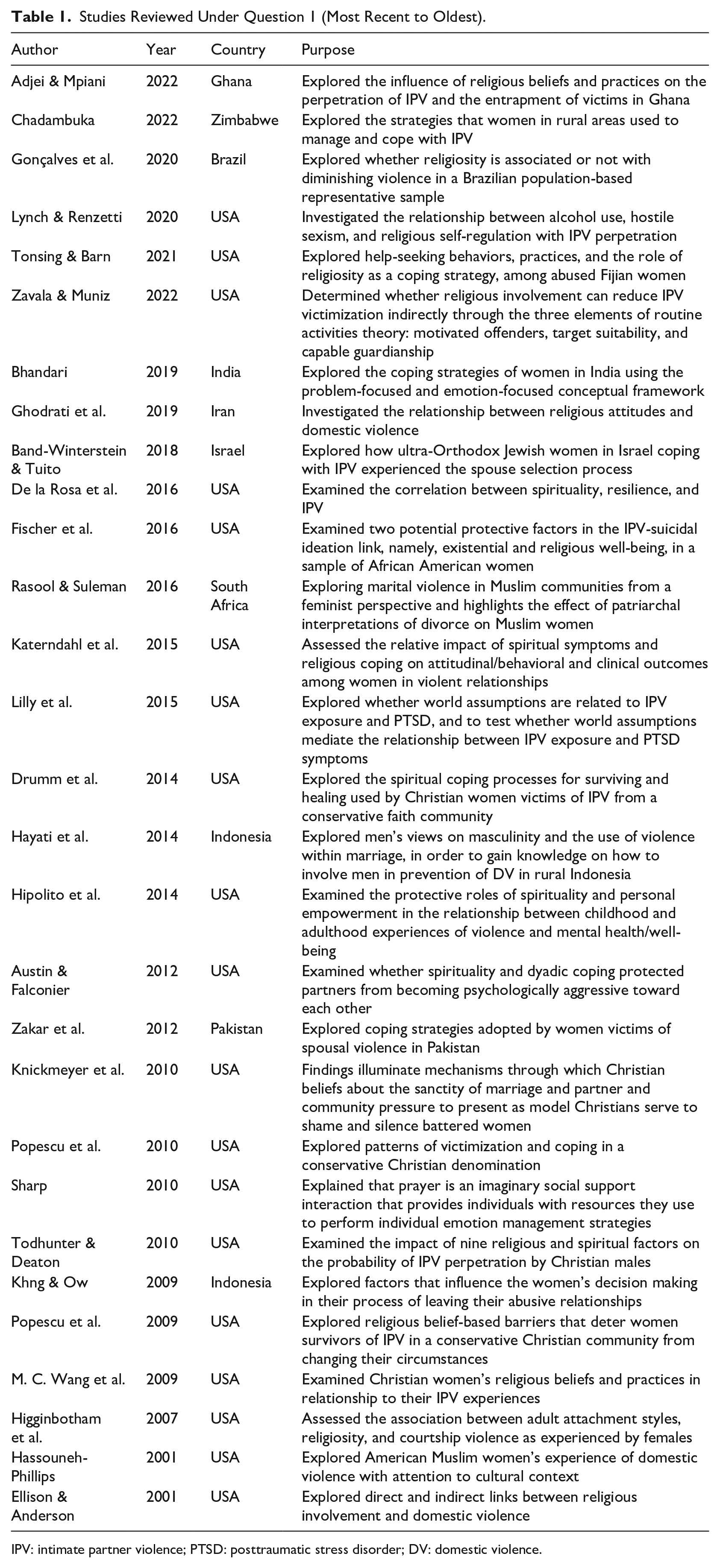
IPV: intimate partner violence; PTSD: posttraumatic stress disorder; DV: domestic violence.
Studies Reviewed Under Question 2 (Most Recent to Oldest).
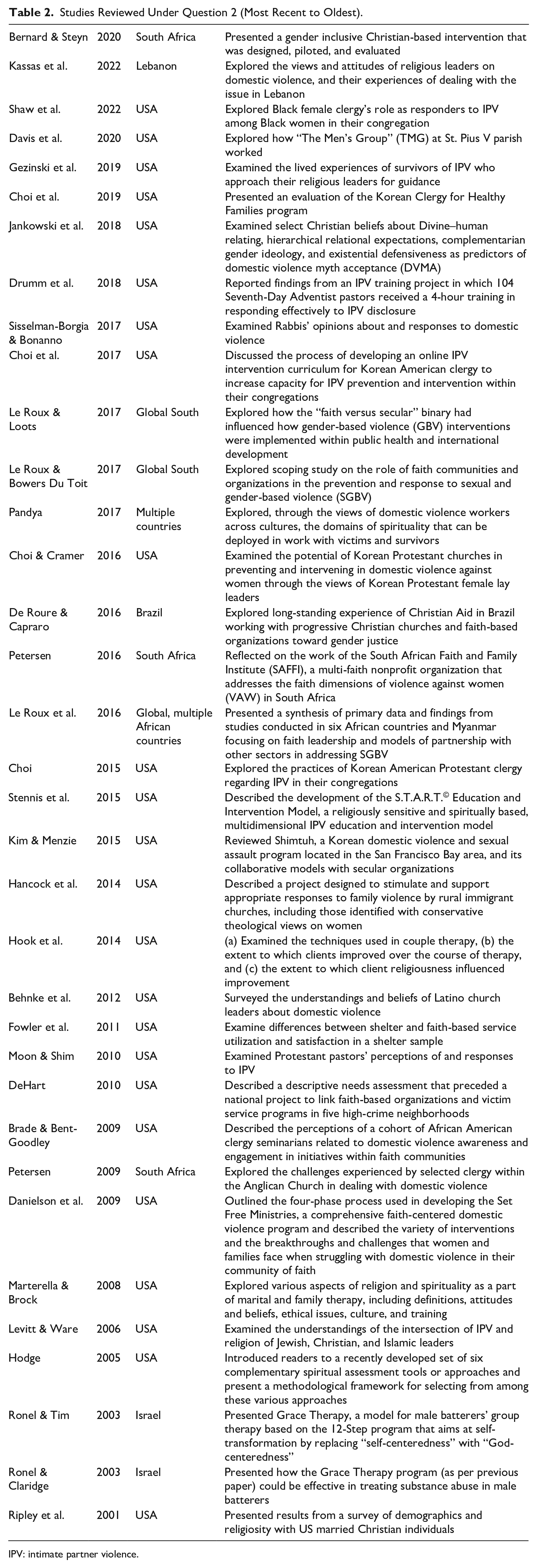
IPV: intimate partner violence.
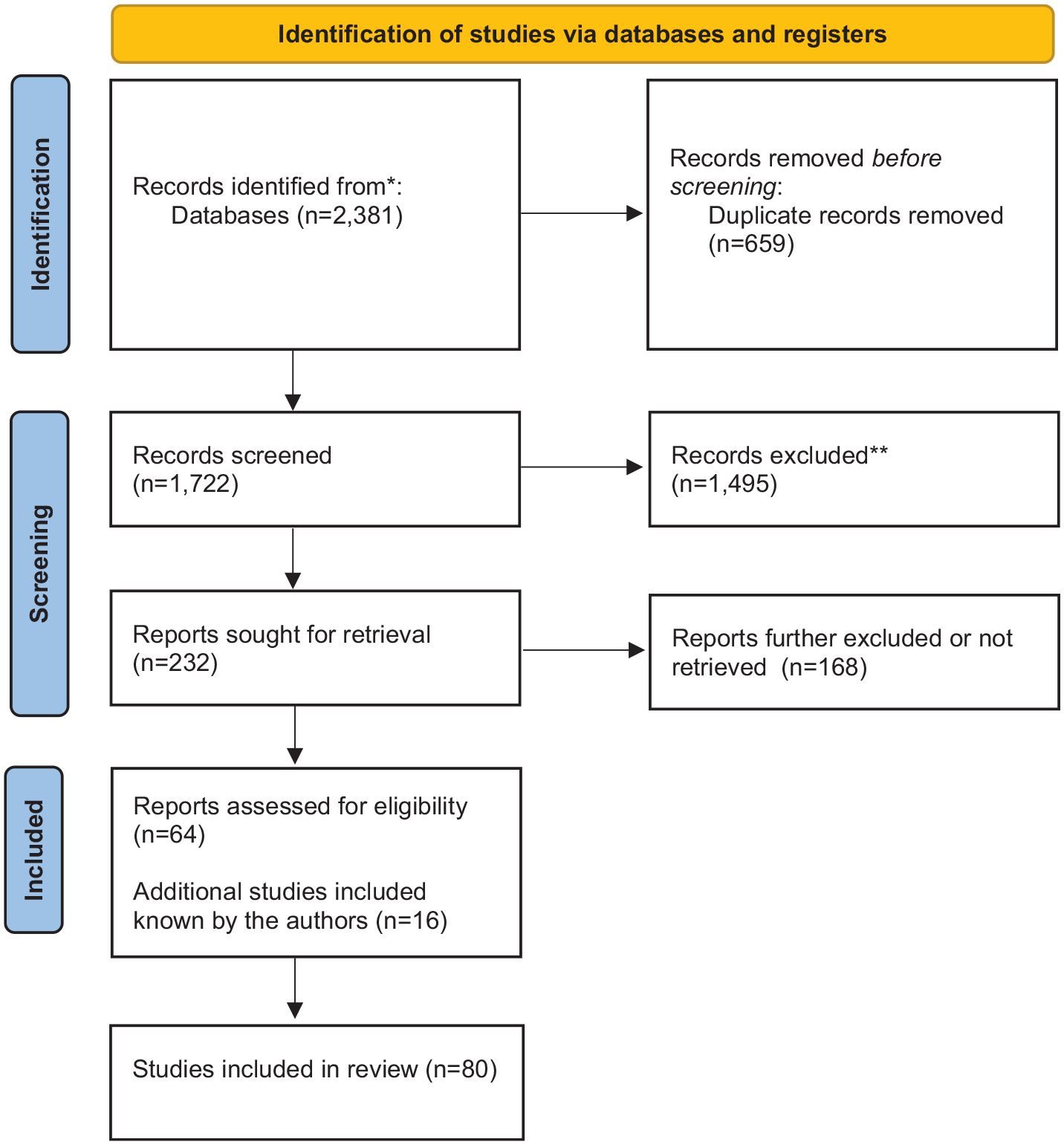
PRISMA flow diagram for systematic review.
Finally, 16 additional studies of diverse methods and approaches were included on the themes of religion and IPV that the authors were aware from psychology, anthropology, sociology, and international development that did not emerge in the search but were known by the authors. Many publications in these disciplines are books and book chapters, reports published as gray literature, or other publications in non-mainstream journals that may not always be indexed. These studies were not presented in tables given their diversity in study scope, research methodology, and methods.
Charting data
A data extraction template was used to record relevant information such as purpose, research design, sampling method, sample characteristics, data collection method, method of data analysis, the results of the study, limitations, and comments.
Collating, summarizing, and reporting results
The data were extracted differently depending on whether they were extracted from qualitative or quantitative studies. The studies were grouped thematically and were summarized under relevant sections in the article using narrative, with emphasis being placed on study objectives, context, key findings, and limitations.
Results
The reviewed studies are presented in two sections, which reflect the two questions driving the review. The first section presents the evidence on the influence of religious beliefs on victim/survivor and perpetrator mental state and behaviors, placing attention on specific mechanisms that related faith to helpful or unhelpful help-seeking and coping responses by victims/survivors and helpful or unhelpful rationalizations by perpetrators. The second section presents the evidence on faith-based interventions that engaged religious leaders in religious spaces and community settings and faith-sensitive approaches in counseling and psychological support, victim services, and perpetrator treatment programs. In presenting these studies, emphasis was placed on the ways in which religious experience has been integrated in interventions, the effectiveness of this integration, and strategies for improving effectiveness.
The influence of religion on victims/survivors and perpetrators of IPV
Types and focus of studies
Studies in this category came from the United States, Brazil, India, Indonesia, Iran, Israel, Pakistan, South Africa, Ghana, and Zimbabwe. A large majority (n = 14) used qualitative methods, another set of studies (n = 12) were quantitative cross-sectional studies, one adapted a mixed-methods case-study approach, and two were based on literature reviews combined with primary evidence, such as anecdotal information or case studies. Most studies took place in a community setting, utilizing purposive or convenience samples and collecting data using questionnaire surveys or individual in-depth or semi-structured interviews.
Studies in this category looked at the influence of religious beliefs and practices on the perpetration of IPV and violent behavior (Adjei & Mpiani, 2022; De Bernardin Gonçalves et al., 2020; Ellison & Anderson, 2001; Ghodrati et al., 2019; Lynch & Renzetti, 2020; Todhunter & Deaton, 2010; Zavala & Muniz, 2022). Another set of studies explored the relationship between spirituality, resilience and IPV (De la Rosa et al., 2015), IPV and suicidal ideation (Fischer et al., 2016), IPV, religiosity and post-traumatic stress disorder (PTSD) (Lilly et al., 2015), and relationship to God or a divine force experience of violence and mental health/well-being (Hipolito et al., 2014). Other papers explored abused females’ rationalizations of IPV (Hassouneh-Phillips, 2001), the effects of patriarchal religious interpretations and religious standards around marriage, divorce and spouse selection on female victims (Knickmeyer et al., 2010; Rasool & Suleman, 2016), faith-related coping strategies, and help-seeking behaviors used by female victims (Bhandari, 2019; Chadambuka, 2022; Drumm et al., 2014; Katerndahl et al., 2015; Popescu et al., 2010; Tonsing & Barn, 2020; Zakar et al., 2012). Only two studies directly engaged with male perpetrators or men in the general population (Adjei & Mpiani, 2022; Lynch & Renzetti, 2020). A group of studies examined the association between adult attachment styles, religiosity and courtship violence (Higginbotham et al., 2007) and spirituality, dyadic coping, and psychological violence (Austin & Falconier, 2012).
Key findings
Effects of religion on how individuals respond to or engage in victimization, violence, or conflict
As early as 2001, a study involving adults in the United States found that regular religious attendance was inversely associated with the perpetration of IPV (Ellison & Anderson, 2001). Among men, this protective effect was evident for weekly attenders, whereas among women, this effect surfaced also for monthly attenders. A later study that explored religious beliefs and practices in relation to IPV among 1,476 Christian women found that women as well as their partners who reported attending church more regularly were less likely to perpetrate or experience IPV (M. C. Wang et al., 2009). Women with abusive partners reported that while their church communities were less accepting of divorce, they had found strength in their faith to leave. More recently, Zavala and Muniz (2022) conducted a study involving 4,126 college students in the United States to determine whether religious involvement could reduce IPV. The authors found that participants with higher levels of religious involvement were less likely to report victimization and concluded that victimization could be reduced using religious counseling or preventive and intervention programs that increase prosocial bonds between partners.
To understand better what aspects of religious experience might serve as a protective or deterrent factor in situations of IPV, researchers have attempted to capture the effects of specific religious practices, such as individual prayer, partners praying together and both partners being religious on the conflict resolution, and coping tactics that couples may engage in. For example, Sharp (2010) conducted a study with 62 current and former victims of IPV from a wide range of religious, socioeconomic, ethnic, racial, and geographical backgrounds in the United States and found that prayer served as imaginary social support interaction that provided individuals with resources to perform individual emotion management strategies. Austin and Falconier (2012), in turn, examined whether spirituality and dyadic coping protected partners from becoming psychologically aggressive toward each other in research with 114 adult Latino partners, the majority of whom were Catholic. Participants’ level of spirituality was assessed using the question, “how important is religion or spirituality to you in your daily life?” on a Likert-type scale that ranged from very important (4) to not at all important (0). The researchers found that each partner’s spirituality had a direct negative effect on their own psychological aggression and a direct positive effect on their own supportive dyadic coping and the couple’s common dyadic coping. Moreover, each partner’s spirituality also had an indirect effect on both partners’ psychological aggression through increases in the couple’s common dyadic coping.
The evidence emerging outside the United States and Europe moves along similar lines, suggesting a potentially positive effect of religious experience on IPV, while evidencing that religious couples do not eschew violence. For example, Ghodrati et al. (2019) investigated the relationship between religious attitudes and IPV against women in Iran by recruiting 210 Muslim participants from health centers in Shiraz. In line with other studies, in cases with high levels of religious attitudes, the violence was reported to be lower, while the most severe violence was observed against participants with moderate religious attitudes. In Brazil, De Bernardin Gonçalves et al. (2020) explored whether religiosity was associated or not with diminishing violence in a Brazilian population-based representative sample. The study seemed to concur an inverse relationship between religiosity and violent outcomes mediated by alcohol consumption. Ultimately, individuals with a religious affiliation or those who considered religion important in their lives were found to be less involved in fights and detention.
Religion has not only been related to a lesser likelihood of violent behavior, but it has also been found to have a remedial or mediating effect on the mental health of individuals experiencing childhood or adult violence and abuse. For example, a study that examined the protective roles of spirituality (defined as a quest to understand the ultimate questions about life, purpose, and comprehend the existence of and one’s relationship to a God or divine force) and personal empowerment in the relationship between childhood and adulthood experiences of violence and mental health/well-being found that spirituality could play a protective function against the negative effect of both childhood and adult violence (Hipolito et al., 2014). Another study found that PTSD symptoms were positively related to religiosity in the sense that individuals experiencing trauma sought coping in religious engagements (Lilly et al., 2015).
The evidence on religion and IPV also refers to attachment theory, which broadly holds that early childhood relations with parents mediate how children create relationships with peers and intimate partners later in life (Ainsworth et al., 1978; Bowlby, 1969, 1980). Adult attachment profiles are often classified as secure and insecure, with insecurity presenting both fearful/anxious and avoidant types. Individuals with anxious attachment types are generally insecure about losing the attachment figure, while individuals with avoidant attachment types consider attachment futile, downplay the importance of intimacy, and prioritize their independence (Li & Chan, 2012). Attachment insecurity has been also related to the development of personality disorders characterized by borderline traits and/or antisocial behavior (Cameranesi, 2016; Dutton & White, 2012). Through personality disorders, avoidant and anxious attachment have also been related to physical and psychological violence (Mauricio et al., 2007).
Importantly, such attachment models may also be influenced by religious experience, which points to possible unexplored connections between religion or spirituality and the manifestation or deterrence of aggression via attachment styles. Two studies have suggested that individual reliance on and appraisal of God as an attachment figure is probably not unrelated to attachment models that individuals develop through relationships with other humans in their life (Birgegard & Granqvist, 2004; Hall et al., 2009). According to these studies, individuals who have developed secure parent-internal working models will tend to display more secure relationships to God as well. Another study found a correlation between less positive religious coping and higher attachment avoidance and more religious coping with attachment anxiety in romantic relationships (Pollard et al., 2014). The implication was that more positive religious coping mediated the negative effects of attachment avoidance in the intimate romantic relationship.
Subsequently, some studies have tried to relate attachment styles to religion and the likelihood of IPV in the same model. Higginbotham et al. (2007), for example, examined the association between adult attachment styles, religiosity, and courtship violence experienced by females in the United States. The participants were in the age group of 18–24 years and were predominantly of a Christian affiliation. Religiosity was defined to include both public and private expressions of religious experience and researchers asked both about individual and relational religiosity, the latter referring to the salience of religious values and practices in the romantic relationship. Overall, the study found that females with low religiosity and insecure attachment (anxious or avoidant) styles reported violence more frequently. Interestingly, and in contradistinction to aforementioned studies that found a negative association between religious attendance and IPV, this study found a positive relationship between religiosity (measured as holistic religious experience) and the frequency of reported IPV. A negative relationship was found only with relational religiosity, which meant that females who looked for certain religious characteristics in their partners reported less victimization.
Effects of religion on victims and survivors of IPV
Studies exploring religious women’s responses to IPV agree on a dual influence of religious beliefs on the help-seeking attitudes and coping mechanisms of victims and survivors. While many victims may hesitate to leave an abusive situation because of what they understand as religious interpretations or standards, many may find support in their faith to cope and to become more resilient and determined to exit the situation.
In a study engaging American Muslim women, Hassouneh-Phillips (2001) found that the women’s faith experience influenced how they rationalized and responded to IPV. Two themes that emerged as central in the women’s interview responses were what the authors called a negation of the self and an expectation that women should submit to and always obey their husbands. A more recent study also with Muslim women in South Africa found that abused women’s access to solutions were often curtailed by patriarchal applications of Islamic law by religious leaders (Rasool & Suleman, 2016).
Two studies involving Christian women in the United States found that religious belief-based barriers deterred IPV victims and survivors from changing their circumstances (Popescu et al., 2009; Knickmeyer et al., 2010). Such beliefs regarded marriage and divorce, stereotypes about Christians, and Christian gender roles. Both studies found that these beliefs were being reinforced by clergy, church members, family members, and partners, which often resulted in holding the women in abusive relationships. Similar tendencies emerged in a recent study from Ghana that found that women constructed their entrapment in abusive relationships in terms of a proscriptive theology of divorce in the Bible (Adjei & Mpiani, 2022).
On the more positive side, Drumm et al. (2014), who explored the spiritual coping processes for surviving and healing used by 41 adult Christian women victims identifying as a current or former Seventh-day Adventist, found that the women moved from coping to building resilience and healing, pointing to a potentially empowering role for faithfulness and religious belief in psychosocial support provision. Similar findings emerge from other country contexts, as well as from research with migrant communities. Zakar et al. (2012), who explored coping strategies among IPV victims in Pakistan involving 21 married Muslim from the lower economic, found that the women used a combination of strategies to cope with the violence, the majority of which were positive and helpful, including increased engagement in individual religious activities. Tonsing and Barn (2021), in turn, explored the role of religiosity as a coping strategy among eight Fijian women in abusive relationships. During the interviews the women not only did not justify the violence by cultural or religious justifications and many reported seeking help first from religious personnel, but also appeared to cope with their situation through their faith and personal relationship with God, by reading the Bible, praying, and having faith in God as main coping strategies. Chadambuka (2022), who explored the strategies that women in rural areas of Zimbabwe used to manage and cope with IPV again identified religious-based coping mechanisms, including resorting to pastoral mediation and prayers.
Khng and Ow (2009) explored factors that influenced women’s decision-making in their process of leaving abusive relationships in Singapore, engaging Muslim, Roman Catholic, and Buddhist believers. The study found that religious faith had an important influence on the women’s process of leaving. Faith helped some of the women, especially the Muslim believers, to process their situations and find strength to face their difficulties. A study that examined the correlation between spirituality, resilience, and IPV with 54 Mexican American women in domestic violence shelters of Roman Catholic (47%) and Evangelical Christian (30%) affiliation found that higher levels of spirituality were correlated with increased resilience (De la Rosa et al., 2015). While in the specific study, spirituality was identified with a profound search for meaning and understanding of one’s place in the world in reference to a transcendental source and not necessarily in relation to a religious belief system, given the women’s religious identities, religious beliefs, and experience would be likely to inform the women’s spirituality. To measure spirituality, the researchers used SIWB, a 12-item instrument that measures one’s perception of one’s spiritual quality of life. The study found that increased time spent in a shelter was associated with an increase in women’s reported spirituality after controlling for education. Higher levels of perception of spirituality were associated with fewer types of abuse experienced by the women after controlling for resilience and education.
On a more negative side, Katerndahl et al. (2015) assessed the impact of spiritual symptoms (lack of reason for living, lack of sense of purpose, lack of harmony and peace, lack of feelings of productivity, and lack of self-comfort) and religious coping measured using the COPE instrument on attitudinal, behavioral, and clinical outcomes among women in violent relationships recruited from the low economic classes and the Hispanic population in the United States and found a consistently negative effect on clinical outcomes, with religious coping being only associated with staying in the relationship. The use of spiritual resources, including going to a spiritualist or healer, however, had variable effects.
A few studies took a more psychologically grounded approach in their assessment. For example, Fischer et al. (2016) examined existential and religious well-being as two potential protective factors in the IPV-suicidal ideation link in a sample of African American women in the United States. The study included 111 African American women of low socioeconomic status between the ages of 18 and 56, who presented to a large public sector hospital for medical or psychiatric reasons. The study confirmed a direct and positive effect of IPV on suicidal ideation and found that existential well-being was a mediator of this relationship. However, religious well-being was not found to serve a similar mediating purpose, pointing to the significant importance of holistic well-being. Bhandari (2019), in turn, examined the coping strategies of abused women (n = 21) recruited from four community-based organizations that work with survivors of domestic violence in Mumbai, India. Study participants were of Hindu (n = 13), Buddhist (n = 5), Muslim (n = 2), and Christian (n = 1) affiliations. The study identified five themes into problem-focused and emotion-focused coping strategies, the latter of which included spirituality/religion, such as belief in God, praying and chanting God’s name, or being involved in rituals.
Other studies examined attitudes about IPV and responses to it by engaging directly with religious communities. For example, Popescu et al. (2010) explored patterns of victimization and coping in a conservative Christian denomination in the United States. This was a cross-sectional study involving 1,823 female and male participants in a community setting, 68% of whom considered themselves conservative in terms of their religious practice. The study found that negative coping was significantly predicted by childhood victimization and current victimization and that religiosity had a small protective effect against negative coping, which disappeared completely when childhood victimization was taken into account. Witnessing parental violence was also a strong predictor for negative coping, with its effect being slightly diminished by current victimization. Still, a study with ultra-Orthodox Jewish women in Israel found that the women did not hold personal or intergenerational violence factors as responsible for their experiences of being in a violent relationship but rather felt that it was the matchmaker and system’s fault that put them in the specific situation (Band-Winterstein & Tuito, 2018).
Evidence from more sociological and anthropological studies of IPV suggest that religious women who experience husband abuse tend to endure and to forgive it, often as a direct result of how they understand and embody religious teachings or vernacular religious traditions (Merry, 2009: 68; Mardsen, 2014; Nason-Clark et al., 2018, chapter 2; Shaikh, 2007). At the same time, female victims may resort to religious beliefs to condemn the abuse and through their ordeals may acquire a more justice-oriented understanding of their faith, helping them to address the harmful situation (Johnson, 2015; Shaikh, 2007). In a recent study in Ethiopia, Istratii (2020) found that women living with difficult or abusive husbands generally resorted to their Christian Orthodox faith to make sense of their situations and find strength to endure. In this case, women were fully aware that the treatment they received was unjust, and never used their religion to justify the men’s behavior, yet their economic dependence on men, fear of divorce due to stigmatization and a genuine hope that their husbands could change generally kept them within their marriages.
Effects of religion on perpetrators and men in the general population
Only two studies that directly involved perpetrators or men in the general population were found in the sample. However, additional insights emerged from studies with abused women through their accounts about men, studies engaging providers and social workers and more sociological and anthological studies.
Among the two was the study by Hayati et al. (2014), which explored men’s views on masculinity and the use of violence within marriage through focused group discussions with 44 male community leaders in Indonesia. The authors identified three different groups of men with different positions of masculinity and thoughts about gender and attitudes toward violence in marriage: the traditionalist (with higher acceptance of partner abuse as a tool to uphold men’s position in marriage), the pragmatist (who believed partner abuse was undesirable but sometime necessary to correct the wife’s behavior), and the egalitarian (who saw men and women as equal and complementary to each other and felt partner abuse was unacceptable). While it was not made clear how these attitudes were distributed among the participants, the different positions taken by men suggested shifting views on masculinity in a changing Indonesian society.
Another study investigated the interactive effects of alcohol use, hostile sexism, and religious self-regulation on male-perpetrated partner violence with 255 males aged 18 or older living in the United States (Lynch & Renzetti, 2020). The authors found that introjected religious self-regulation (when religious behavior is performed because of pressure of others and external influences rather than personal positive motive) was positively associated with hostile sexism and positively associated with perpetrating physical partner violence. Identified religious self-regulation (when religious behavior is freely chosen and internalized) was negatively associated with physical violence perpetration. The implication of the study was that alcohol abuse elevated the risk for physical violence perpetration among men high in introjected religious self-regulation and low in hostile sexism, but reduced the risk for perpetration in men high in identified religious self-regulation and low in hostile sexism. This would suggest a positive mediating effect of religiosity in cases of alcohol abuse for certain types of religious men, but not all.
The aforementioned study by Adjei and Mpiani (2022) in Ghana reported that perpetrators employed a prescriptive theology of male headship and authority in marriage, which was related to IPV. Another aforementioned study, which relied on interviews with 24 social workers in daily contact with Haredi women experiencing partner violence, found that religion was used as a double-edged sword and that women experienced emotional as well as spiritual violence when the husband used religion to not only justify the violence but also to control the woman (Band-Winterstein & Freund, 2018).
More insights emerge from within anthropological and sociological studies from the United States, Canada, South Africa, and other contexts, which suggest that some abusive men may have distorted understandings of religious teachings that they often use to justify their abusiveness (Johnson, 2015; Nason-Clark et al., 2018, chapter 3; Shaikh, 2007). On the contrary, religious morals could have a deterrent effect on abusive behaviors among some men in certain religious contexts. An anthropological study on conjugal abuse that engaged the Ethiopian Orthodox community in Tigray region of Ethiopia reported that some men in the general population invoked religious morality, righteousness, and the fear of sinning to explain to the researcher why they had not engaged in adultery or other harmful behaviors toward their wives, suggesting a possible deterrent or protective effect of religious experience on conjugal abuse (Istratii, 2020).
Faith-based interventions and responses involving religious leaders, communities, and psychologists
Focus of the studies
Thirty-five studies discussed faith-based or faith-sensitive interventions for domestic violence. Most of the studies investigated current understandings, attitudes, and responses to the problem among clergy in different communities, including female clergies, Black Church clergies, clergy in Latino migrant communities, and other contexts. These studies documented the current level of preparedness among clergy to respond to domestic violence in an informed manner, how clergy understood and addressed distorted understandings of religious tenets, their willingness and confidence to collaborate with secular providers, and other parameters (Behnke et al., 2012; Brade & Bent-Goodley, 2009; Choi, 2015; Choi & Cramer, 2016; Gezinski et al., 2019; Kassas et al., 2022; Levitt & Ware, 2006; Moon & Shim, 2010; Petersen, 2009; Shaw et al., 2022; Sisselman-Borgia & Bonanno, 2017).
The most relevant studies to this review presented specific faith-based programs or interventions involving clergy and their congregations (Bernardi & Steyn, 2021; Choi et al., 2017, 2019; Danielson et al., 2009; Davis et al., 2020; Drumm et al., 2018; Hancock et al., 2014; Kim & Menzie, 2015; Stennis et al., 2015), examined impediments and resourcefulness in faith-secular collaborative approaches (DeHart, 2010), and looked at how theological language and teachings could become useful or might need to be specifically challenged in such interventions (Jankowski et al., 2018). Another set of studies emerged primarily from international development and public health practice and presented approaches followed by development or community organizations or faith-based initiatives implemented with religious leaders and communities (De Roure & Capraro, 2016; Le Roux & Bowers Du Toit, 2017; Le Roux et al., 2016, 2020; Le Roux & Loots, 2017; Petersen, 2016).
A final group of studies from the field of counseling psychology presented approaches used by therapists, psychologists, social workers, and other practitioners to engage with their clients’ religious experiences and the integration of religion in victim services and perpetrator treatment programs. Studies presented techniques in individual or marital counseling integrating religious beliefs or spirituality (Hodge, 2005; Hook, 2010; Marterella & Brock, 2008; Pandya, 2017), presented or evaluated a couple therapy approach engaging couples (Hook et al., 2014), examined the receptiveness of religious counseling approaches for religious/highly religious versus non-religious clients (Ripley et al., 2001), discussed the role of religion in how IPV victims respond to services (Fowler et al., 2011), and evaluated a faith-informed perpetrator treatment program (Ronel & Claridge, 2003; Ronel & Tim, 2003).
Key findings
The role of religious leaders and their preparedness to respond to IPV
A common reference for the scholarship that looks at faith-based interventions involving religious leaders and clergy is the understanding that religious personnel, the discourses they use, and their responses to communities can both contribute to the continuation of IPV and serve as a positive influence in efforts to address the problem. While the level of awareness and preparedness among clergy to respond to IPV has improved in the past decades, problems and challenges remain.
Echoing earlier evidence, Levitt and Ware (2006), who examined the perspectives of religious leaders from Jewish, Christian, and Muslim traditions in the United States on marriage, divorce, and IPV, identified tensions between the perceived sacredness of marriage and the need for divorce in cases of IPV. Moreover, while most of the interviewed clergy considered the men responsible for the abuse, they still placed some responsibility on women for inciting the situation or for staying in the relationship, which could hinder effective responsiveness to victims.
Studies in the United States that examined clergy perceptions and responses to domestic violence in their congregations consistently noted shortfalls in the clergy preparedness and the need for more training. For example, a study by Brade and Bent-Goodley (2009) with Protestant religious leaders found that the latter perceived the problem to be salient in their communities and considered that additional training and resources on domestic violence were needed. The study suggested that partnerships between social workers and clergy would be necessary to achieve a more adequate response. A study by Moon and Shim (2010) that examined nine protestant pastors’ perceptions of and responses to IPV found that pastors tried to support victims and even couples together and would not hesitate to support divorce if this was found necessary, but, along similar lines, felt unprepared to respond with confidence due to lacking training or resources.
Sisselman-Borgia and Bonanno (2017), who, in turn, examined Rabbis’ opinions about and responses to domestic violence also found them willing to help, but noted that the Rabbis felt unequipped to provide appropriate counseling support. A 2019 study by Gezinski et al. on the lived experiences of victims of IPV who approached their religious leaders for guidance in a community of Latter-Day Saints in the United States, found again that generally the latter were unprepared to respond to the issue in an informed manner, placing faith first and limiting their support to prayer and to encouraging church attendance. The study highlighted the need for comprehensive training for religious leaders, education that recognizes the impacts of trauma and that teaches religious leaders practical, trauma-informed approaches. A more recent study by Shaw et al. (2022) that explored Black female clergy’s role as responders to partner violence among Black women in their congregation in the United States found that female clergy considered it their responsibility to care for victims and they generally sought to provide holistic, culturally sensitive support. However, they felt that they had limited support from the wider Church they affiliated with and limited external resources to rely on.
Similar results emerged in studies with migrant populations. A study that examined US Latino church lay clergy and pastors’ beliefs about domestic violence found that clergy acted by providing counseling to both victims and perpetrators, offering spiritual guidance, suggesting legal action, referring victims to other community services to protect them from risks, and providing job-related advice (Behnke et al., 2012). While many of their responses were constructive and genuine, some of their actions evidenced the clergy’s limited familiarity with safeguarding risks, as in the case of wanting to advise a perpetrator when they still lived with the victim.
A survey conducted by Choi (2015) with 152 Korean American Protestant clergy in their congregations found that the majority of respondents reported providing counseling support to intimate partner victims, although one-third had never referred victims to additional/external resources. Only 16% felt prepared to respond to IPV in their communities, which suggested the need for more training for clergy to understand how IPV manifests in their specific cultural context and how it might be addressed. Another study by Choi and Cramer (2016) with Korean American lay men and women recruited from Protestant Korean Churches evidenced expectations in the community for the churches to play a central role in addressing domestic violence. The study also interestingly found that theological interpretations among migrants could reflect influences from the host society’s religious tradition and not always or necessarily the effect of the home “culture,” which required a closer look at interactions between home and host cultural and religious contexts.
One of the few studies that took place outside of the United States explored the challenges experienced by selected clergy within the Anglican Church of South Africa in dealing with domestic violence (Petersen, 2009). According to the findings, the clergy felt that they lacked training in addressing real-life domestic violence situations and clear theological guidelines on how to respond to prevalent patriarchal practices or beliefs in their society that contributed to the problem. In another paper, Kassas et al. (2022) conducted in-depth interviews with 13 male religious leaders from various religious denominations in Lebanon. In line with studies from more tradition-oriented religious societies, the authors found that the religious leaders were very much involved in addressing family related problems in their communities and that providing the clergy with proper counseling training and information on referral options could be an effective response to domestic violence.
In a paper published in 2016, Le Roux et al. presented a synthesis of primary data and findings from studies conducted in six African countries and Myanmar focusing on faith leadership and models of partnership with other sectors in addressing sexual and gender-based violence (SGBV). Some of the key findings included communities’ own recognition for the role that faith and religious leaders should play in addressing gender-related issues, the difficulty for faith leaders to separate religious teachings from cultural standards, and the tendency of religious leaders to interpret sacred texts in a rigid manner that could be conducive to the problem and its continuation. The overall evidence suggested that people did not consider faith leaders to be well-disposed or equipped to respond effectively to SGBV victims and pointed to the need for multilevel engagement and integration and equipping clergy with theological knowledge to move toward interpretations that promote gender justice. However, as the authors noted, any such engagement and support for clergy would need to be sustained over time to ensure personal change and to move beyond training approaches based on mere information assimilation.
In another study published in 2017, Le Roux and Bowers Du Toit drew on data collected during a scoping study on the role of faith communities and organizations in the prevention and response to SGBV. The review was accompanied by 20 key stakeholder interviews and an electronic survey involving faith and gender-based violence (GBV) specialists around the world. The findings from the consultations again emphasized the faith leaders’ complicity within the continuation of patriarchal traditions, leading to the misinterpretation of sacred texts, the double role of religion in serving as a support and healing system for victims but also making them vulnerable as a result of certain misplaced beliefs about how a “good” religious person should respond to abuse, and the clergy’s disbelief or lack of awareness of the extent of GBV in their communities. However, the overall evidence confirmed that clergy are often willing to address the problem, but they may feel unequipped to do so and may need continuous training and support to be effective.
Faith-sensitive interventions engaging religious leaders and communities
Many faith-centered interventions to address IPV respond to this evidence and the clergy’s shortfalls, placing emphasis on cultural sensitivity. In a 2009 paper, Danielson et al. presented the Set Free Ministries program, a comprehensive faith-centered domestic violence program initiated by four women attending Moody Church in Chicago, Illinois, who sought to address the issue in their congregation and to support female victims of childhood abuse. The program focused on providing mothers with support in the context of domestic violence, although it recognized the need to work also with perpetrators to reduce the likelihood of intergenerational violence. The program incorporated faith-based healing through prayer, the Bible, support from the wider community, and referral to other community resources. It also included the provision of training to families and pastors to help develop healthy individual identities and relationships.
Hancock et al. (2014) have, in turn, described a project that was designed to stimulate and support appropriate responses to family violence in rural immigrant churches in the United States. The project team implemented a community-based participatory research approach engaging with relevant stakeholders. To achieve cultural sensitivity the program sought to promote women’s protection without undermining the traditional position of the father and husband in the community and by developing a biblically informed approach that held men accountable of the abuse and encouraged behavioral change. As a way of assessing the intervention, the authors enquired about the pastors’ learning before and after the intervention. The survey indicated that most of the pastors had been receptive to the content and that they planned to incorporate it into their church work, but some felt that they needed more training on how to speak to and help abused women.
In another paper, Kim and Menzie (2015) presented and reviewed Shimtuh, a Korean domestic violence and sexual assault program located in the San Francisco Bay area, United States. The program reached primarily Christian and Buddhist communities and comprised direct services and advocacy for affected women and children, and community organizing and engagement to change norms contributing to the problem. Among other activities, the program delivered a 2-day annual domestic violence training to faith leaders, which was bilingual and culturally adapted. Leveraging on their role as social change agents, Shimtuh organized the clergy to participate in campaigns to end domestic violence in their communities. What appears to have worked particularly well in the 12-year program is the flexibility of Shimtuh to adapt to the evolving relationship with faith leaders and faith-based institutions (from outreach, to training and technical assistance to community organizing campaign and shared leadership) and to learn from each phase of the collaboration.
The S.T.A.R.T.© Education and Intervention Model is another important example, comprising a religiously sensitive and spiritually based, multidimensional IPV education and intervention model involving the African American faith community (Stennis et al., 2015). START stands for Shatter the Silence, Talk About It, Alert the Public, Refer, and Train self and others, which reflects the program’s work process to educate African American communities about the issue and to actively prevent and address it. The program was designed both to respect religious and cultural traditions and to be consistent with NASW Code of Ethics and CSWE mandates on cultural competence. The overall feedback and evaluations received were positive, with participants appreciating the religious diversity addressed, the culturally sensitive content, and the ease of using this model for other related topics, such as sexual exploitation.
In 2017, Choi et al. presented the process of developing an online intimate partner intervention curriculum for Korean American clergy to increase their capacity to address IPV in their congregations. The module comprised of three components, the first of which covered definitions of partner violence and why faith matters in addressing the problem, a second looking closely at Korean cultural values surrounding the family and marriage and roadblocks within religious beliefs and practice, and a third dedicated to building bridges with victims and responding to IPV situations with sensitivity and safety concerns in mind. The survey feedback on the 3-month pilot was positive, with participants making suggestions for improving the content by including specific examples of clergy responding to victims. Participants also commented that the module should give more attention to the changes men experience when they move in the host society, such as feeling that their traditional roles are questioned and trying to reaffirm those in the Church. The feedback also suggested the need to incorporate a list of referral services and more legal information on IPV and related options.
A small number of the studies among those reviewed presented robust evaluations of IPV interventions involving clergy. In 2019, Choi et al. described a randomized controlled trial that they conducted to assess the Korean Clergy for Healthy Families program. The evaluation was based on a baseline and a 3-month follow-up assessment completed by the participants. Participants were Korean American faith leaders in a South-eastern state of the United States, with n = 27 being randomized to the intervention group and n = 28 to the control group. The statistical analysis showed that the intervention group significantly improved their knowledge of resources and presented enhanced attitudes against IPV at the 3-month follow-up. Overall, the participants found the online module helpful and convenient, although the authors acknowledged that additional clinical trials would be necessary with a larger number of participants to address some of the design limitations of the trial.
In 2018, Drumm et al. conducted a study that directly sought to address the gap in the research concerning the effectiveness of pastor training for spouse abuse response. The authors reported the findings from a training project in which 104 Seventh-Day Adventist pastors received a 4-hour training that aimed to improve the pastors’ understandings of partner violence, knowledge of available resources and services supporting victims, and their preparedness to intervene to prevent or address the issue in their communities. The assessment approach included a pre-test, a posttest, and a 1-year follow-up questionnaire, which overall found that pastors generally increased their knowledge of the dynamics of partner violence and available resources and services and were more likely to show initiative to address the problem in their congregations. An important insight was the tendency of participants to forget the training content, which pointed to the need for ongoing learning. The results also showed a low likelihood of clergy teaching publicly in a sermon about IPV.
More recently, Bernardi and Steyn (2021) presented results from a gender inclusive Christian-based intervention in South Africa. Relating faith to lower levels of delinquency and crimes; the authors anticipated that a faith-based approach could help to curtail or prevent IPV. In contrast to the historically mainstreamed Duluth model that considered patriarchal hierarchies to be the main cause of violence affecting women, this program placed emphasis on trauma healing, recognizing that abusers often had been abused or seen abuse in their early lives contributing to their abusiveness. Prayer was used as an emotion regulation tool, while the understanding that no person is unacceptable to God was used to foster self-acceptance. The pilot study was evaluated on the basis of a single-group pre–posttest and follow-up quasi-experimental design. The authors used the DASS21 questionnaire to assess typical dysphoria and sadness, physiological arousal and fear, as well as states of tension and stress. Overall, all the scores went down, but not all were statistically significant. The score for depression was statistically significant pre–posttest and the decrease in stress was statistically significant post-follow-up and pre–post-follow-up. The study suggested that the Christian-based approach used by the program could succeed in reducing risk factors of partner violence and should be examined further.
In a more recent paper, Davis et al. (2020) presented a detailed study on “The Men’s Group” (TMG) led by the St. Pius V parish in a predominantly Hispanic area in Chicago, Illinois in the United States. Their assessment of the groups’ work relied on program-related archival material and semi-structured interviews with parish leaders, administrators, and staff in English and focused group discussions with new and senior group participants in Spanish. The study showed that, contrary to widespread practice, the pastor of the parish had often addressed the issue of domestic violence in public sermons. The study also showed that the TMG did not actively recruit participants but that existing members referred new members to the group, who joined voluntarily. Moreover, the group operated under flexible principles, respecting the different circumstances of the participants and creating a safe space for them to share what led them to join the group. The program proved effective as a result of being culturally focused, spirituality-based, and encouraging participants to support each other beyond the group and to engage in service-oriented volunteering activities. The interviews suggested that group members especially appreciated the peer support they received as part of the group.
Other clergy-centered approaches to address IPV have been implemented by international organizations and nongovernmental entities in the context of responding to GBV at the community level. In a 2016 paper, De Roure and Capraro presented the experience of Christian Aid working with so-called progressive Christian churches and faith-based organizations to promote gender justice in Brazil. The paper presented the work of two of Christian Aid’s partner organizations, Koinonia and SADD (Anglican Service of Diakonia and Development). The work of the Koinonia, based in the city of São Paulo, included building the capacity of faith leaders, providing women with information of available public services, and working with communities to raise awareness and with municipalities to inform policymaking. SADD, in turn, a project that provided biblical, theological, and advocacy resources to address GBV offering social, pastoral, and material support to women fleeing abusive situations. The authors reported that the regular work of SADD with clergy and non-ordained religious leaders gradually led the latter to engage more directly with the issue, incorporating it in sermons and responding better to victims and survivors. Given an increasing salience of religious identity in policymaking, especially around gender issues, the paper stressed the need for faith-inclusive approaches and employing theology to denounce violence affecting women.
Another study reflected on the work of the South African Faith and Family Institute (SAFFI), a multifaith nonprofit organization established in 2008 to address the faith dimensions of violence against women (VAW) in South Africa (Petersen, 2016). SAFFI was established to advance a coordinated, multi-sectoral, and culturally competent approach to addressing VAW. The means included providing resources to clergy to support victims/survivors and to hold perpetrators accountable, employing theology-informed discourse to counter “patriarchal traditions” conducive to women’s abuse and using scripture to encourage mutually supportive and fulfilling models of marriage. In its approach, SAFFI employed a theoretical framework drawing from the concept of Ubuntu and the Human Development theory, ultimately aiming to advance the dignity of the human being. One of the program’s main achievements was its interfaith character, bringing together clergy from faith traditions that would not otherwise communicate with each other. Moreover, the program’s respectful engagement with clergy had reportedly brought many to reflect on their own practices and discourses and even to open up about challenges in their own family lives.
In a more recent paper, Le Roux et al. (2020) presented an evaluation of a 3-year intervention that addressed Violence Against Women and Girls (VAWG), and especially sexual violence, by engaging with communities of faith and their leaders in DRC. Two community surveys were conducted, one before and one after the intervention, in three health areas in DRC’s Ituri Province. At both baseline and endline, data were collected from male and female members of randomly selected households in 15 villages (five per health area) in which the intervention was being implemented. At baseline the sample comprised 751 respondents (387 women, 364 men) and at the endline 1,198 respondents (601 women, 597 men). The study showed significantly more equitable gender attitudes and less tolerance for partner violence at the endline. Positive attitudinal change was not limited to those actively engaged within faith communities, with a positive shift being noted across the entire community around gender attitudes, rape myths, and rape stigma scores. This again seemed to point to the influential role of religious discourse in shaping social attitudes and norms, affecting the wider society.
Overall, the evidence reviewed pointed to the need for more collaborative approaches between secular and religious stakeholders and providers to achieve more effective responses. However, numerous factors were identified to stand in the way of such fruitful partnerships. A paper that specifically examined current and envisioned models of faith-secular collaboration and the perceived role that such collaboration could play in the lives of crime victims including faith leaders of Christian, Muslim, Jewish, and Hindu background, victim service providers, and other professionals (DeHart, 2010) showed that collaboration was hindered by numerous factors, including differences in philosophies and misperceptions or stereotypes about each other that hindered constructive engagement with each other. The authors proposed that building mutual understanding of the sources of differences could help to overcome those. In addition, trainings addressing ethical standards, such as confidentiality and appropriate approaches, could help to address concerns about skills and approaches to bring the different stakeholders in alignment in terms of standards of good practice.
In another pertinent paper published in 2017, Le Roux and Loots explored how the “faith versus secular” binary had influenced how GBV interventions were implemented within public health and international development. The analysis, based on a scoping review and key informant interviews, established the existence of what the authors referred to as secularist biases in the post-secular era. Interviewees, for example, spoke about their marginalization in programs involving secular actors or their general and consistent portrayal as negative actors. Others said that there was a widespread underlying view in the sector that faith is backwards, and that religion was often instrumentalized just to tick a box by secular agencies, with tools and resources used by faith organizations being appropriated or used by secular agencies in a non-equitable model of collaboration. Many condoned the critique of religion, explaining that clergy have often taught through a cultural patriarchal lens that maintained women’s abuse, while faith communities as a whole often contributed to stigmatizing and shame silencing victims. Faith leaders also would not work with secular actors to address the problem together and often hesitated to question fundamental beliefs upheld within the faith, or perceived suspiciously other religious traditions, which challenged collaborative interfaith approaches. In parallel, interviewees spoke about a perpetuated myth that secular approaches and discourses were neutral in contrast to what were often presented as biased or value-laden approaches employed by faith-based organizations (FBOs). The authors stressed the importance of overcoming the religion-secular binary as this not only alienated faith stakeholders, but also mistakenly represented faith actors as engaging only in “faith-related” activities as defined by a very rigid mainstream secular discourse.
Faith-sensitive approaches in counseling and psychological support, victim services, and perpetrator treatment programs
Integration of religion/spirituality in family and marriage counseling
The integration of spiritual and religious parameters in psychological approaches was gradual and heavily skewed to reflect the realities of industrialized Western societies. According to Hodge (2005), this integration started to become more visible in 1985, with more counselors being interested in knowing how to engage with spiritual parameters in their practice and the field of psychological counseling in an effort to cater to clients from diverse religio-cultural traditions. Other motivations included the clients’ own interest in having their spiritual or religious experiences incorporated in counseling sessions and new research evidence on the potential positive effects of religious beliefs on family and married life. Writing in 2005, Hodge noted that spiritual and religious parameters had not yet been well integrated in psychological and counseling education, recommending an initial assessment on the importance of spirituality and religious beliefs for the client through approaches that included spiritual histories, spiritual lifemaps, spiritual genograms, spiritual ecomaps, and spiritual ecograms.
A few years later, Marterella and Brock also spoke about the need for therapists to become more educated and confident to engage with spiritual and religious parameters in their counseling practice, but also to challenge those beliefs that can be contrary to the objectives of the therapy, without disrespecting or questioning the importance of religious convictions in their clients’ lives. The authors referred to the challenging task for therapists to not allow their own beliefs to interfere with a productive engagement with their clients’ religious beliefs and stressed the need for self-reflexivity. They argued that cultural sensitivity should not be dissociated from religious beliefs, since in many communities cultural and religious parameters intertwine and influence the identity of the individual in complex ways.
Previous studies have reinforced the need to incorporate religious beliefs within counseling practices, at least for certain types of clients. In a 2014 paper, Hook et al. presented a naturalistic study that examined the role and effects of religion in couple therapy working with 44 therapists and 68 couples entering couple therapy with religious couple therapists. The results showed that religious techniques were related to the clients’ religious commitment and that therapists were adapting to religious clients by taking into consideration the importance of religious beliefs in their clients’ lives. The study also reported that clients expressed improvements in relationship satisfaction over time, which suggested that incorporating religious parameters in couple therapy was effective with such clients. One limitation of the study was that the therapists who were consulted identified as Christian, which meant that the study was less able to indicate what happens when there is a discrepancy between the therapist’s religious commitment (e.g., when a therapist identifies as secular) and a client’s religious commitment.
A study that had been published as early as 2001 had, in turn, presented results from a survey of demographics and religiosity with 211 US married Christian individuals who were asked to rate four marital therapy situations: Christian therapy using Christian practices (e.g., prayer), Christian therapist using psychological techniques only, non-Christian therapist willing to use Christian techniques, and non-Christian therapist using psychological techniques only (Ripley et al., 2001). Those with high Christian beliefs expressed a significant difference between the non-Christian therapist using psychological practices only and all other types of therapy, as well as between the non-Christian therapist and the Christian therapist. This implied that the use of religious techniques and the religiosity of the therapist could influence highly religious couples in their decision to engage in therapy.
Religion/spirituality in victim utilization services
In one of the few studies referring to victim support services, Fowler et al. (2011) examined differences between shelter and faith-based service utilization and satisfaction in a sample of 73 women residing at a domestic violence shelter in central Texas, United States. In the case of this study, focus was placed on spirituality, with religiosity being subsumed within the former. In this study, spirituality was defined as pertaining to a way of being, an awareness of the transcendent, deeper meanings about life and an interaction with a higher power. Participants were asked to complete questionnaires to collect information regarding psychosocial characteristics, intimate partner abuse, spirituality, service utilization, and satisfaction. Overall, the study found that women survivors with higher levels of spirituality were less likely to utilize shelter services despite the level of partner abuse experienced. However, women survivors who reported more partner abuse experiences were less likely to report satisfaction with faith-based resources.
Religion/spirituality in perpetrator treatment programs
Only two studies specifically assessed faith-based perpetrator treatment programs. Those referred to the Grace Therapy program, a model for male batterers’ group therapy based on a 12-Step program, which directly responded to historical barriers in treating male perpetrators of IPV (Ronel & Tim, 2003). Influenced by the model of Alcoholics Anonymous, the program used spirituality language to achieve the men’s self-transformation by replacing self-centeredness with “God-centeredness” and by instilling within the male batterers a win–win principle of partnership that is based on unconditional giving. Spirituality was defined in this case “as the quest for God, as one understands God” (p. 65). The program reportedly differed from cognitive, behavioral or other approaches in its assumptions, such that abuse is both a mental and spiritual imbalance, with the latter being understood as the self-centeredness or selfishness and the result of feeling powerless as a result of attempting to control what one cannot control. As the authors explained, faith in God was not a requirement to be part of the therapy, but a possible outcome as a sign of spiritual development. Like most available programs, the Grace Therapy Program used a group therapy approach informed by evidence that providing therapy in a group format fosters identification with other participants and the development of a cohesiveness in the group that can lead to productive results.
In another article, Ronel and Claridge (2003) presented how the Grace Therapy program could be effective in treating substance abuse in male batterers as a means of reducing the severity and occurrence of the problem. The authors presented the program that was implemented at the Tel Aviv Center for the Treatment of domestic violence involving over 300 men who had participated in ongoing groups between 1994 and 1999. The men’s participation could last from weeks to years and many of the men suffered from substance abuse as well, allowing the current study. The authors mentioned that male batterers spoke of feeling powerless to control their circumstances and to manage their life, leading them to frustration and fostering their abusiveness. Recognizing that they were never in full control and that others were not responsible for their powerlessness was identified as a vital step for participants to work toward recovery.
Discussion
Summary of findings
The current article sought to start to integrate the evidence on religion and IPV from numerous disciplines and sectors, including psychological research, international development and public health, criminology, and anthropological and sociological studies to improve understanding of how religious beliefs and experiences influence victim/survivor and perpetrator rationalizations and behaviors and how they can best be leveraged in IPV interventions involving clergy, religious communities, and psychologists working with religious clients or in religious contexts. The review was particularly interested in diversifying the current scholarship by collecting studies from across the world and in departing from rigid conceptualizations of IPV, religion/spirituality and domestic violence and ethnocentric theorizations of how these relate to cultural systems to account for diversity in the world.
A first important insight that emerged from this preliminary synthesis of the evidence is the dual effect that religious experience could have on IPV victims and perpetrators. On one hand, religious beliefs and standards, especially around marriage and divorce, could feed hesitation among victims to leave their abusive situations (Adjei & Mpiani, 2022; Hassouneh-Phillips, 2001; Katerndahl et al., 2015; Mardsen, 2014; Merry, 2009; Popescu et al., 2009) and could be employed by perpetrators to rationalize or justify the abuse (Adjei & Mpiani, 2022; Band-Winterstein & Freund, 2018; Hayati et al., 2014; Nason-Clark et al., 2018; Shaikh, 2007). On the other hand, religious beliefs and engagement in religious activities, such as prayer and reading sacred texts, were consistently reported to serve as coping mechanisms for victims and survivors that could help them to regulate their emotional states, make sense of their situations, exit abusive relationships, and build resilience or a renewed sense of agency and justice over time (Bhandari, 2019; Chadambuka, 2022; De la Rosa et al., 2015; Drumm et al., 2014; Istratii, 2020; Johnson, 2015; Khng & Ow, 2009; Shaikh, 2007; Tonsing & Barn, 2021; Zakar et al., 2012). Victimized women were also consistently reported to resort to religious counselors for advice and mediation and to find resort in spiritual resources (Chadambuka, 2022; Nason-Clark et al., 2018; Tonsing & Barn, 2021).
Moreover, different levels or types of religiosity or spirituality seemed to be associated with different effects on coping, help-seeking attitudes, or aggression. In some cases a very high degree of religiosity or spirituality could have pernicious effects, as compared with a low or medium level of religiosity. Very spiritual women who were victims of IPV, for example, were found to be less likely to utilize domestic violence services (Fowler et al., 2011). The effects on men, and the more specific group of male perpetrators, were equally nuanced. Some studies found that perpetrators could use religious language or theology to justify their authority over their intimate partners or spouses and some could even abuse their partners spiritually. Other studies reported that men identifying as religious had a lower likelihood of engaging in fights and were more likely to condemn abuse or consider it inappropriate (De Bernardin Gonçalves et al., 2020), that men could invoke religious morals to deter themselves from harmful behavior toward intimate partners (Istratii, 2020) and that in men who were self-motivated in their religious behaviors alcohol abuse negatively correlated with physical violence against a partner (Lynch & Renzetti, 2020). These differences could reflect different relationships to one’s faith, but also variable religious, theological, and exegetical traditions and the diverse religio-cultural contexts in which participants were embedded, resulting in different religious interpretations and influences in lived experience and especially in married life.
It is important to read these results with reflexivity of the different definitions for religiosity/spirituality employed in the studies that were reviewed. These differences could reflect the authors’ subjective views on religion and their own variable conceptualizations, but they could also reveal variable ways of understanding and experiencing one’s faith across different contexts, communities, and groups (victims, perpetrators, counselors, practitioners, etc.), different social structures prevailing in Western and non-Western countries, and different ways of relating religious systems to spirituality, with understandings in Western societies moving toward more secular quests for inward-looking meaning and those in Asian and African countries being more directly related to religious systems and beliefs of justice emanating from within these religious systems. Such differences stress the importance of not only broadening the definition of religion in research on IPV, but also placing such definitions in the wider social and religious systems in which the victims/survivors, perpetrators, and IPV providers are located.
The evidence on faith-based interventions in congregations and communities revealed numerous examples of effective programs and approaches led by a variety of actors, including churches, congregation members, priests, or organizations working in community development (Bernardi & Steyn, 2021; Choi et al., 2017, 2019; Danielson et al., 2009; Davis et al., 2020; DeHart, 2010; De Roure & Capraro, 2016; Drumm et al., 2018; Hancock et al., 2014; Kim & Menzie, 2015; Le Roux et al., 2020; Le Roux & Loots, 2017; Stennis et al., 2015). The common thread of these very diverse approaches seemed to be the importance of cultural sensitivity to ensure that programs were relevant and impactful with those they aimed to support. This cultural sensitivity was equally relevant to those working in LMIC contexts and those supporting migrant populations in more secular societies, with the important insight that religious understandings among migrant communities could reflect newly acquired theological influences encountered in the host society and not solely or necessarily beliefs upheld in the home country. Once again, context becomes important in making a better sense of people’s religious experiences and the effects of the latter on experiences of IPV.
Interventions engaging religious leaders and other clergy evidenced numerous commonalities across geographies, but also some differential needs given the context in which they operated. While the evidence from the United States and other Western societies, including migrant communities, pointed to an increased awareness of IPV among clergy in their communities and even a willingness to help, a lack of trauma-centered training and the need for continuous support from religious institutions to address the problem adequately (Brade & Bent-Goodley, 2009; Choi, 2015; Gezinski et al., 2019; Levitt & Ware, 2006; Moon & Shim, 2010; Shaw et al., 2022; Sisselman-Borgia & Bonanno, 2017), studies from non-Western, tradition-oriented religious communities, or LMIC contexts focused on the central role of religious leaders in addressing marital problems and in mediating IPV situations and how best to leverage on this role. In such contexts, the pervasive nature of religious idiom in social life has meant that religious tenets have often been indistinguishable from cultural practice, reinforcing rigid interpretations among the clergy and the lay community. This has meant that religious leaders might not be perceived to be fully equipped to respond and that their primary need might be theological training (Le Roux & Bowers Du Toit, 2017; Le Roux et al., 2016). On the contrary, the influence of religious leaders in collective and individual life has also placed the latter in a key position to influence collective attitudes and human behaviors, provided that they receive the support and the resources they need to become agents of change (Le Roux & Bowers Du Toit, 2017).
Regardless of geography, it seemed to be agreed that clergy-centered interventions could be more effective if religious leaders and other clergy were better equipped with theological/exegetical knowledge to respond to distorted deployments of religious language in the community, were willing to address the topic of IPV in public sermons, understood how to respond to IPV victims and perpetrators with consideration of their psychological states and likely safeguarding risks facing them, and integrated more substantively with secular systems responding to the problem. In fact, within international development and criminology studies, the divide between secular and faith actors and organizations was identified as a key hurdle to achieving integrated approaches and constructive partnerships (DeHart, 2010; Le Roux & Loots, 2017). The literature review suggests that priority should be given to address biased preconceptions that hinder religious and secular stakeholders to learn from each other and to collaborate constructively. This could be achieved by fostering the understanding that the divide between religious and secular actors and organizations is itself more mythical than realistic, since neither are secular organizations without religious influences, legacies, or motivations, nor are faith-based actors necessarily different in a radical way from their secular counterparts.
In regard to faith-sensitive psychological approaches and counseling, the literature evidenced a well-established family and married life counseling paradigm that engages with clients’ religious beliefs and identities (Hodge, 2005; Hook et al., 2014; Marterella & Brock, 2008; Ripley et al., 2001). The evidence suggests that different clients may relate differently to their faith, which will likely influence their receptiveness to and satisfaction with counselors employing secular psychological methods versus counselors who integrate religio-cultural parameters in their counseling and counselors who themselves identify as religious (Hook et al., 2014; Ripley et al., 2001). The faith-based psychological approaches that seemed to be particularly effective within family and married life counseling were those that understood the need to address religious beliefs within the specific cultural context of the client and were based on the psychologist’s reflexivity about their own beliefs and how these could interfere with counseling their religious clients (Marterella & Brock, 2008). In relation to perpetrators of IPV, findings from faith-informed perpetrator treatment programs suggested that spirituality and a God-centered conscience could help some perpetrators minimize or overcome their abuse (Ronel & Claridge, 2003; Ronel & Tim, 2003).
The evidence analysis revealed also a well-established research field relating attachment models, marital adjustment/dyadic regulation, and religious experience, with some studies implying direct associations between attachment insecurity, religious experience, and IPV (Birgegard & Granqvist, 2004; Hall et al., 2009; Higginbotham et al., 2007; Mauricio et al., 2007; Pollard et al., 2014). If higher attachment insecurity is related to psychological and physical violence and if attachment insecurity is not unrelated to religious experience and coping, religious experience could mediate some manifestation of IPV, a relationship that merits further investigation.
Relating the two group of studies evaluated under each research question leads to the conclusion that faith-sensitive responses to IPV involving religious leaders, communities, and psychologists can become more effective if these recognize and understand that two-way effects that religious beliefs and practices can have on victims/survivors and perpetrators, that these effects will differ depending on how one relates to their faith and understands the premises of the religious tradition they belong to, and that individual religious experience should not be assessed in isolation from the wider religio-cultural context and sociological realities of the individual or target group. The evidence overall points to the need to move toward more diversified and holistic understandings of religion and more context-specific approaches in designing faith-based interventions and responses that are theologically grounded and trauma-informed and consider carefully the sociological and psychological conditions of the individuals and groups that these aim to support.
Evidence gaps and future directions
The review identified studies from within the fields of psychology and to a lesser degree, international development, sociology, and anthropology. Considerably few studies seemed to emerge from the field of religious or theological studies, criminology, or public health. This could reflect the skewed specializations of the authors (primarily health studies, international development, and anthropology), as well as differences in the attention that each of the said disciplines has given to religion and IPV research.
Moreover, while evidence in some topics emerged to be extensive, research in other areas seemed to be scarce. For example, numerous studies discussed clergy-centered or faith-informed intervention programs with congregations and communities, but considerably fewer were found on faith-sensitive psychotherapy or on the relationship between attachment models, religious beliefs, and IPV. More specifically, while the evidence on the effect of faith and religious beliefs on victim and survivor coping was well-established, evidence on faith-sensitive psychological counseling for IPV victims and survivors was almost inexistent in the sample of studies, with only a few presenting on faith-sensitive perpetrator treatment programs. Furthermore, focused systematic reviews and research could be conducted to understand how accounting for the religious beliefs and experiences of IPV victims and survivors within counseling might support or interfere with processes of coping and healing.
In addition, the literature on faith-sensitive psychological approaches and counseling seemed to be missing a discussion of how evidence on attachment models, or dyadic regulation and religious experience (attachment to a religious figure) could be applied in psychological services to survivors and perpetrators of IPV or in counseling with religious couples and how it could be leveraged to support religious clients. Future evidence reviews and studies could aim to identify more systematically how these psychological dynamics might improve the effectiveness of counseling when therapists are aware and leverage on this knowledge. Studies could also present how such an integration could be achieved in currently used therapy techniques and approaches.
The overall insight of this cross-sectoral evidence synthesis is that there is a need for further integrating and comparing findings from religious, psychological, sociological, and criminology studies, as well as from different areas of focus within the same disciplines, such as combining evidence from psychological studies examining attachment insecurity, religion, and IPV with evidence from psychological studies examining religion and IPV victimization and coping strategies. This scoping review could be followed by more focused discipline- or topic-specific reviews, such as evidence reviews on religion and IPV within criminology studies, religion and IPV within counseling studies, and others.
Limitations
While a rigorous search strategy was used to collect evidence from different disciplines and sectors, and important studies were added by the authors as a result of their disciplinary specializations and prior exposure to them, it is possible that other relevant and important studies were missed. It is also significant that the review was limited to studies in English. It is likely that many more relevant studies exist in LMIC contexts in national, regional, or local languages not assessed in this review.
In terms of the studies reviewed, it is important to recognize that difficulty of comparing across study results due to differences in study design, context, and methodologies to assess interventions. Therefore, in presenting the results, emphasis was placed on understanding the individual studies, and relating their findings to each other only where and as feasible. A more robust comparison of studies that have assessed interventions could be undertaken in the future, exploring also the prospect of a meta-analysis where possible.
Supplemental Material
sj-pdf-1-ptj-10.1177_00916471221143440 – Supplemental material for A Scoping Review on the Role of Religion in the Experience of IPV and Faith-Based Responses in Community and Counseling Settings
Supplemental material, sj-pdf-1-ptj-10.1177_00916471221143440 for A Scoping Review on the Role of Religion in the Experience of IPV and Faith-Based Responses in Community and Counseling Settings by Romina Istratii and Parveen Ali in Journal of Psychology and Theology
Footnotes
Acknowledgements
The authors would like to acknowledge the following individuals: Professor Gene Feder at the Bristol Medical School for reviewing the review protocol in its early stages of development and for providing feedback for consideration and improvements. All errors and shortfalls are the responsibility of the authors. Anthea Tucker, Liaison Librarian for Medicine, Dentistry and Health at the University of Sheffield, for generously running the review searches. Moninuola Ifayomi and Dr Salma Rehma for stepping in to help the authors in preparing the tables at the stage of revision, especially the supplementary tables which required revisiting many of the studies to extract missing data.
Declaration of Conflicting Interests
The author(s) declared no potential conflicts of interest with respect to the research, authorship, and/or publication of this article.
Funding
The author(s) disclosed receipt of the following financial support for the research, authorship, and/or publication of this article: The review was completed as part of the UK Research and Innovation-funded Future Leaders Fellowship “Bridging religious studies, gender & development and public health to address domestic violence: A novel approach for Ethiopia, Eritrea and the UK” (Grant Ref: MR/T043350/1).

Supplementary Material
The supplementary material for this article is available online.
Author Biographies
References
Supplementary Material
Please find the following supplemental material available below.
For Open Access articles published under a Creative Commons License, all supplemental material carries the same license as the article it is associated with.
For non-Open Access articles published, all supplemental material carries a non-exclusive license, and permission requests for re-use of supplemental material or any part of supplemental material shall be sent directly to the copyright owner as specified in the copyright notice associated with the article.
