




Abstract
Since Lynn White’s 1967 discussion of Christianity and environmentalism, numerous quantitative sociological studies have attempted to assess whether White’s historical claim is born out in Christians’ current perspectives. These studies do so in large part by assessing Christians’ dominion and stewardship tendencies, about which they make two assumptions: (1) dominion ideology is inherently anti-environmental and (2) dominion and stewardship ideologies are opposed.
Many Christians reject these assumptions, a fact we demonstrate by surveying Roman Catholic, Greek Orthodox, and North American Evangelical sources. Each of these discourses, in clear contradistinction to the quantitative sociological literature, portray dominion as leading to self-sacrificial stewardship of creation, all of which is considered intrinsically valuable.
Taking a 2015 study of Christians in Nigeria as a case-study, we demonstrate that this conflict between a) the perspectives assumed in the quantitative literature and b) the perspectives held by many Christians leads to a forced and distortive portrayal of these Christians’ dominion and stewardship perspectives. Finally, we propose ways of measuring dominion and stewardship perspectives that, while not devoid of assumptions, are flexible enough for Christians to register a variety of competing understandings of these concepts.
Keywords
From the Christian perspective, humans were given the authority to take care of the earth and not to ruin or mismanage it. Dominion over the earth does not mean causing harm to the environment. It is a command to us to look after the earth, as stewards. —An evangelical Christian clergyman in Nigeria (Shehu, 2015, p. 112)
In 1967, historian and self-described “churchman” (p. 1206) Lynn White, Jr contended that “nature has no reason for existence save to serve man” is a Christian axiom (p. 1207). 1 Citing the de-spiritualization of nature brought about by Christianity’s triumph over paganism, he argued that “Especially in its Western form, Christianity is the most anthropocentric religion the world has seen” (p. 1205). These theses produced extensive theological and sociological debates—theologians (e.g., Ecumenical Patriarch Bartholomew, 2019; Moo & Moo, 2018; Pope Francis, 2015; Schaeffer, 1970) have debated whether “nature has no reason for existence save to serve man” (p. 1207) ought to be considered an axiom of the Christian faith, and sociologists (e.g., Taylor et al., 2016b) have attempted to uncover whether Christianity manifests itself anthropocentrically.
White’s seminal article spoke of how, in the Genesis creation narrative, “Man named all the animals, thus establishing his dominance over them” (p. 1205). Within 3 years, theologians countering his anthropocentric characterization of Western Christianity had begun invoking the idea that humans are divinely appointed stewards of creation (Schaeffer, 1970). Thus, when quantitative sociological attempts to test for anthropocentric tendencies among Christians began in the 1980s, these attempts focused on the themes of dominion and stewardship (Konisky, 2018). Hand and Van Liere published the first quantitative attempt to measure Christians’ dominion tendencies in 1984; Eckberg and Blocker did the same for stewardship in 1996. To date, sociologists have conducted dozens of studies that they frame in relation to White’s thesis and Christians’ dominion and stewardship tendencies. Upon a systematic review of this literature, Taylor et al. (2016a, 2016b) conclude that White’s thesis seems to be upheld. Konisky (2018) comes to a similar conclusion. 2
In this article, we document the understanding of dominion and stewardship ideology that dominates the quantitative literature on White’s thesis and demonstrate that three distinct and sociologically significant Christian theological traditions reject this understanding. We then argue that, regardless of what understanding of dominion and stewardship is most theologically accurate, the disconnect between (1) the quantitative literature’s understanding of dominion and stewardship and (2) some Christians’ understandings of these concepts leads to a distorted portrayal of these Christians’ dominion and stewardship tendencies. 3 Finally, we propose more theologically nuanced, and thus more accurate, ways of measuring dominion and stewardship perspectives.
Dominion and Stewardship in the Quantitative Literature on White’s Thesis
Of the dozens of studies framed in relation to White’s thesis, only 10 studies to date purport to measure dominion or stewardship tendencies (or both) directly (Eckberg & Blocker, 1996; Hand & Van Liere, 1984; Leary et al., 2016; Shaiko, 1987; Shehu, 2015; Sherkat & Ellison, 2007; van Bohemen et al., 2012; Wolkomir et al., 1997a, 1997b; Woodrum & Hoban, 1994). We refer to these as our “core studies.” These 10 studies are specially significant because they shape how dominion and stewardship are understood within the scores of articles that mention dominion tendencies or stewardship tendencies without measuring them. Together, these 10 studies both reflect and foster two assumptions that permeate the quantitative literature on White’s thesis: (1) dominion ideology is inherently anti-environmental and (2) dominion and stewardship are mutually exclusive perspectives.
Dominion as inherently anti-environmental
Genesis 1:26 reads, Then God said, “Let us make man in our image, after our likeness. And let them have dominion over the fish of the sea and over the birds of the heavens and over the livestock and over all the earth and over every creeping thing that creeps on the earth.” (English Standard Version)
White (1967) contended that the Genesis creation narrative, of which this verse is a part, endorses anthropocentrism. From its inception, the quantitative literature on White’s thesis has assumed that affirming human dominion (or, in the terminology employed by some of the literature, “mastery” [e.g., Woodrum & Hoban, 1994, p. 194]) over non-human nature is inherently anti-ecological. Schwadel and Johnson (2017) express this pervasive view when they write that “a mastery-over-nature perspective . . . is antithetical to an ecological worldview” (p. 195). Similarly, Preston and Baimel (2021) describe dominion beliefs as “anti-environmental” (p. 145).
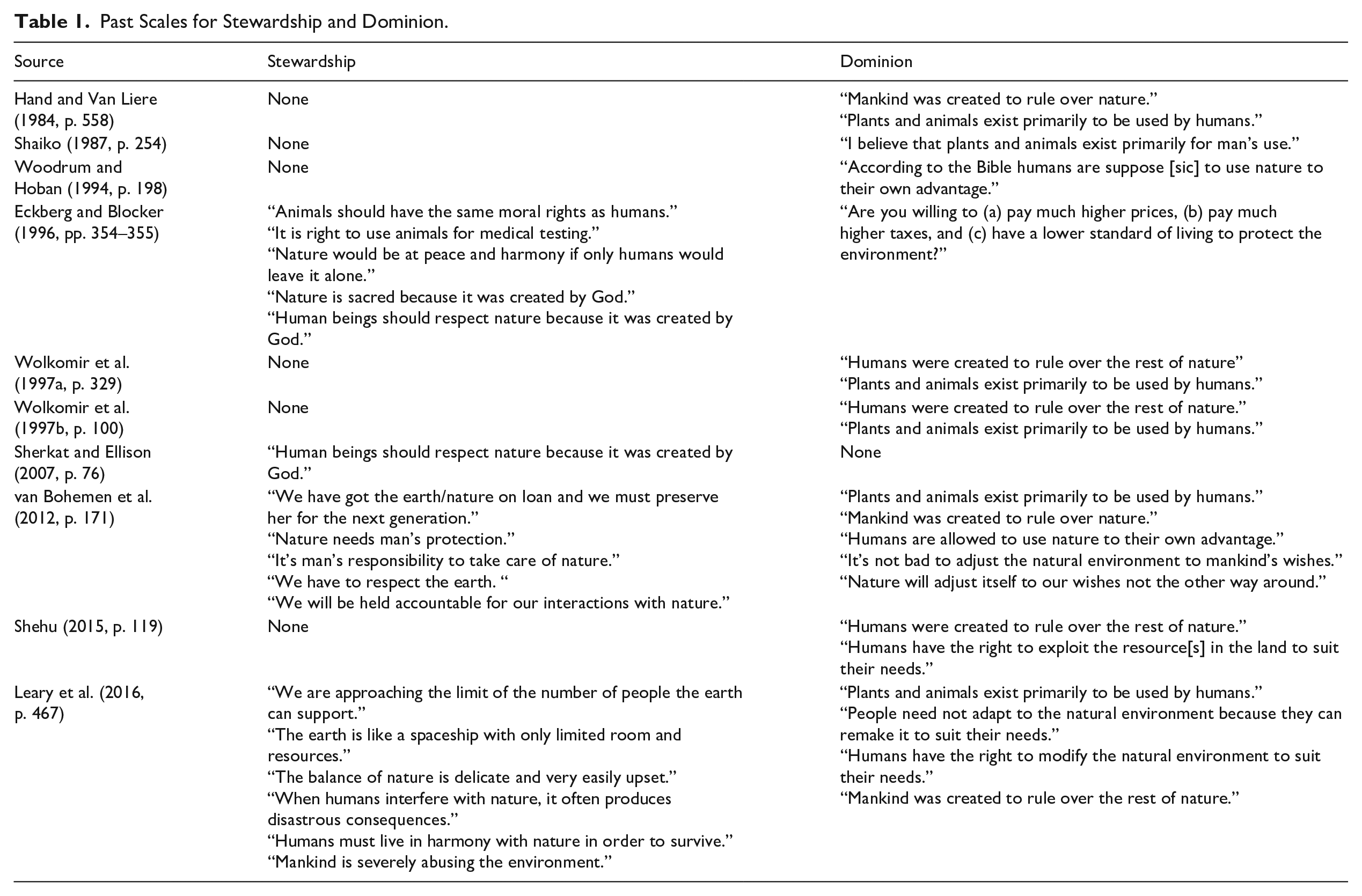
Accordingly, all but one of our core studies measure dominion tendencies by reverse coding items that are primarily used to measure environmentalism. (See Table 1 for the items each core study uses for dominion and stewardship.) This trend goes back to Hand and Van Liere’s decision to measure dominion attitudes using two items drawn from the New Environmental Paradigm (NEP) scale previously developed by Dunlap and Van Liere (1978):
Past Scales for Stewardship and Dominion.
Mankind was created to rule over nature. Plants and animals exist primarily to be used by humans. (Hand & Van Liere, 1984, p. 558)
Agreement with these items, which Hand and Van Liere (1984) take to signify acceptance of a dominion mentality, is taken by Dunlap and Van Liere (1978) to signify a rejection of the NEP. This operationalization of dominion is the most common of those used in the literature discussing White’s thesis (Hand and Van Liere, 1984; Wolkomir et al., 1997a, 1997b); 4 some measures of dominion add other items to these (Leary et al., 2016; van Bohemen et al., 2012), 5 and Shaiko (1987) employs an equivalent of the second item: “I believe that plants and animals exist primarily for man’s use” (p. 254). Shehu (2015), meanwhile, uses items derived from the New Ecological Paradigm (NEcP), which Dunlap and Van Liere, in conjunction with two other researchers, developed as a refinement upon the NEP (Dunlap et al., 2000).
Eckberg and Blocker (1996) do not derive their measures of dominion tendencies from the NEP or NEcP. Rather, their scale employs items that contrast “concern for the environment with concern for the economy” to measure dominion beliefs (p. 347). These items are more frequently used to measure environmentalism (e.g., Boyd, 1999; Clements et al., 2014a, 2014b; Kanagy & Willits, 1993; Sherkat & Ellison, 2007; Tarakeshwar et al., 2001) so that Eckberg and Blocker also define dominion tendencies as the opposite of pro-environmental tendencies.
To date, the only measurement of dominion attitudes in the literature on White’s thesis that does not use items developed to measure environmentalism is Woodrum and Hoban’s (1994) item: “According to the Bible humans are suppose[d] to use nature to their own advantage” (p. 198). In this article, these authors seem careful to avoid affirming that dominion tendencies are inherently anti-environmental; however, they note that this position is prevalent. Twenty-seven years later, this is still true—every other quantitative study of dominion tendencies, both before and after Woodrum and Hoban wrote, has defined these tendencies as anti-environmental through the very items used to identify their presence.
Dominion and stewardship as opposed
Peifer et al. (2014) define “stewardship” as “the belief that everything, (including the earth), belongs to God and humans must take good care of things” (p. 376). 6 In addition to defining dominion ideology as inherently anti-environmental, nine of our core studies also assume that dominion and stewardship perspectives are opposed, placing them in what we will call the opposition framework. 7 This assumption reaches its zenith in Leary et al.’s (2016) article. Here, they split the NEP scale into two portions, assign one portion to dominion and the other to stewardship, and reverse-code the dominion portion. As a unified scale, the NEP purports to measure a single construct—Leary et al.’s approach seems to imply that dominion and stewardship perspectives are opposites or nearly so (Voas, 2007).
Published in the Journal of Macromarketing, this piece presents something of an outside contribution to the quantitative literature on dominion and stewardship. As such, it may lack nuance, but it is also likely to reflect the general drift of this literature. Apparently, these authors came to the same conclusion that Shehu (2015) articulates: “dominion and stewardship were treated in the wider literature as opposing religious environmental schemas” (p. 125). 8
Three other studies attempt to measure stewardship tendencies directly. Eckberg and Blocker (1996) measure a stewardship perspective by examining respondents’ agreement and dissent with statements about animal rights and humans’ duty to God to respect nature. They interpret greater agreement that animals should have the same rights as humans and that humans have a duty to God to respect nature as indicative of a stewardship perspective. Sherkat and Ellison (2007) measure agreement and disagreement with the statement, “Human beings should respect nature because it was created by God” (p. 76). van Bohemen et al. (2012) employ an eclectic scale: We have got the earth/nature on loan and we must preserve her for the next generation. Nature needs man’s protection. It’s man’s responsibility to take care of nature. We have to respect the earth. We will be held accountable for our interactions with nature. (p. 171)
Of these three studies, Eckberg and Blocker (1996) assume, without stated nuance, that dominion and stewardship are opposed. Sherkat and Ellison (2007) and van Bohemen et al. (2012) recognize that dominion and stewardship rely on the same Christian worldview, but they still assume that dominion and stewardship are opposed in effect. Thus, van Bohemen et al. (2012) write, “It is to be expected that Christian[s] . . . adhere to dominion as well as stewardship, with the former detracting from environmental consciousness and the latter adding to it” (p. 166).
The remaining core studies do not measure stewardship directly, but they each discuss it. Hand and Van Liere (1984), Woodrum and Hoban (1994), and Wolkomir et al. (1997b) all, like Eckberg and Blocker (1996), straightforwardly portray dominion and stewardship as in opposition. In a second piece, however, Wolkomir et al. (1997a) articulate a conceptualization closer to that of Sherkat and Ellison (2007) and van Bohemen et al. (2012). Here, while they still contrast dominion and stewardship, they recognize a shared core in these concepts, claiming that “dominion belief implies a use of nature without regard for impact, whereas stewardship implies use of nature with regard for impact” (Wolkomir et al., 1997a, p. 339). Of the core studies considered in this section, Shaiko (1987) provides the most nuanced understanding of the relationship between dominion and stewardship. For him, stewardship is the “middle ground between a mastery-over-nature orientation and a unity-with-nature perspective” (p. 257).
Thus, of the core studies considered in this section, five (Eckberg & Blocker, 1996; Hand & Van Liere, 1984; Leary et al., 2016; Wolkomir et al., 1997b; Woodrum & Hoban, 1994b) assume, without stated nuance, that dominion and stewardship are opposed; three (Sherkat & Ellison, 2007; van Bohemen et al., 2012; Wolkomir et al., 1997a) recognize conceptual similarities between dominion and stewardship but cast them as having opposing environmental outcomes, and one (Shaiko, 1987) presents stewardship as a middle ground between dominion and its opposite. While their precise characterization of the relationship between dominion and stewardship varies, each of these studies assumes that a person must choose between dominion and stewardship if she wishes to avoid holding conflicting ideologies—even Shaiko’s (1987) conceptualization of stewardship as a “middle-ground” assumes one must move away from a full-fledged dominion perspective to affirm stewardship ideology (p. 257).
With our core studies’ portrayal of dominion and stewardship in mind, we turn to three sociologically significant theological articulations of dominion and stewardship ideology.
Three Theological Articulations of Dominion and Stewardship
Robin Gill lays out four tiers at which theology can be analyzed sociologically: (1) academics; (2) preachers; (3) lay, theologically interested persons; and (4) not religiously affiliated, theologically un-interested persons. In Gill’s (2013) schema, there is a probable correspondence between the second and third tiers: preachers preach to lay people. Studies on Christians’ dominion and stewardship tendencies focus on the third tier by examining dominion and stewardship tendencies among those who identify as Christians. Thus, we will review theological works that straddle Gill’s second and third tiers, works that are likely to be read by many clergy and some lay people. To partially account for the diversity of Christian thought, we draw these works from three distinct theological traditions.
As a representative of the Roman Catholic tradition, we survey Pope Francis’s (2015) encyclical on the environment, Laudato Si. Since 1989, the Ecumenical Patriarch of Constantinople has issued yearly encyclicals on the environment, and we take these as representatives of the Orthodox tradition. 9 It is harder to find a spokesperson for the third tradition, North American Evangelicalism, which recognizes no centralized authorities. To partially account for this difficulty, we survey two works written 48 years apart: Francis Schaeffer’s (1970) Pollution and the Death of Man and Douglas and Jonathan Moo’s 2018 Creation Care: A Biblical Theology of the Natural World. We suggest that, where these two works agree, there is an enduring thread of North American Evangelical thinking on the relationship between humans and non-human nature.
The social, political, and ecological significance of each of these traditions is evident in many facets of contemporary environmental discourse and regulation. Throughout the 1990s and 2000s, the Greek Orthodox Patriarch Bartholomew convened environmental symposia featuring dignitaries, such as the United Kingdom’s Prince Philip, presidents of the European Commission, and a Secretary-General of the United Nations (Chryssavgis, 2007). More recently, Pope Francis’s (2015) environmental encyclical, Laudato Si, sparked a vibrant theological and sociological discussion of the relationship between Roman Catholicism and ecology (Maibach et al., 2015). From 2017 to 2018, Scott Pruitt, an avowed evangelical Christian, led the United States Environmental Protection Agency (EPA) in enacting a number of controversial policies, including ending the “war on coal” (The Associated Press, 2017; Atkin, 2018; Brody, 2018; Environmental Protection Agency [EPA], 2017a, 2017b, 2017c; Irfan, 2018; Meyaard-Schaap, 2018; 9th Circuit Court of Appeals, 2018; “Scott Pruitt on Reports of Anti-Trump Environment at EPA,” 2017; United States Department of State, 2017).
Roman Catholicism
In Laudato Si, Pope Francis (2015) affirms human exceptionalism, stating that humans are “endowed with unique dignity” (p. 31). While affirming the value of all life, he reserves a special place for human life: “There is urgent need for politics and economics to enter into a frank dialogue in the service of life, especially human life” (p. 138). Despite this emphasis on human uniqueness, Francis rejects a radical dichotomy between humans and the rest of God’s creation: Nature cannot be regarded as something separate from ourselves or as a mere setting in which we live. We are part of nature. (p. 105)
Like humans, all of God’s creation is intrinsically valuable per its direct relationship with God. This intrinsic value constrains the domain of proper human use of non-human nature. Speaking of ecosystems, Pope Francis writes that We take these systems into account not only to determine how best to use them, but also because they have an intrinsic value independent of their usefulness. Each organism, as a creature of God, is good and admirable in itself. (p. 105)
This dual emphasis on human exceptionalism and the value of the rest of God’s creation leads to the idea that humans have a unique responsibility to care for the rest of creation: We do not understand our superiority as a reason for personal glory or irresponsible dominion, but rather as a different capacity which, in its turn, entails a serious responsibility stemming from our faith. (p. 161)
When humans claim absolute dominion over creation, thinking they have the right to do whatever they please with it, they forget that God “alone owns the world” (p. 55). Rather than implying that we are not accountable for our treatment of God’s creation, “our ‘dominion’ over the universe should be understood more properly in the sense of responsible stewardship” (p. 87). Thus, in Laudato Si it is only an abuse of dominion that is anti-ecological. Dominion finds its proper expression in stewardship, so no one need choose between them.
Greek Orthodoxy
Surprisingly, given the perception that Eastern Orthodoxy is the most ecologically friendly expression of Christianity (Ecumenical Patriarch Bartholomew, 2018; White, 1967), the Patriarchal Encyclicals on the environment are the most anthropocentric discourse of the three we survey. They argue that humans should care for the environment to foster the well-being of creation itself but especially for humankind’s own sake. This emphasis on how the well-being of creation impacts humans is both practical (it is discussed more) and conceptual (it is specifically affirmed). According to Ecumenical Patriarch Bartholomew (1997), the Genesis commands, “Aim, neither solely nor predominantly, at protecting nature in itself, but in preserving the space within which humanity dwells; creation was made for humanity.” Still, nature does have value apart from humanity, for The natural reality cannot be reduced to an object or useful matter to meet the needs of an individual or humanity; by contrast, this reality is considered as an act, deed [sic] the handiwork of a personal God, who calls us to respect and protect it. (Ecumenical Patriarch Bartholomew, 2019)
As in Laudato Si, this dual emphasis on (1) humans’ place as creation’s especially valuable “king” (Ecumenical Patriarch Bartholomew, 1998) and (2) the God-given value of the rest of creation leads to the concept of stewardship: Through such compassion toward the natural creation we shall honor our divine dignity as stewards of creation, concerned with paternal love for all its elements, which will obey us when they discern our benevolent disposition as they realize their won [sic] commission to serve our needs. (Ecumenical Patriarch Bartholomew, 2011)
In light of the quotes above, it seems that “won [sic] commission” indicates a “unified” purpose, not a “sole” purpose. While the Patriarchal Encyclicals, unlike our other discourses, do not explicitly state that that dominion leads to stewardship, this implication is clear: humans’ unique dignity and authority, their dominion, leads to compassionate stewardship (Ecumenical Patriarch Bartholomew, 1998, 2011).
North American Evangelicalism
Our North American Evangelical sources each affirm both human dominion expressed as stewardship and the intrinsic value of non-human nature. While Schaeffer does not explicitly designate humans as the stewards of God’s creation, he affirms this idea. After identifying the stewardship principle in the Parable of the Talents (Matthew 25: 14–30), Schaeffer (1970) continues,
Moo and Moo (2018) are hesitant to use the term “stewardship” because its financial connotations might communicate that non-human nature is valuable only as a resource and not intrinsically. Moreover, “stewardship” is used by some to denote ideas that Moo and Moo reject. Nevertheless, they do employ the term and quote Douglas Hall (1986) with approval when he writes, “‘Dominion’ [sic] as a way of designating the role of Homo sapiens within creation can only mean stewardship, and stewardship ultimately interpreted as love: sacrificial, self-giving love (agape)” (p. 186; Moo and Moo, 2018, p. 184).
More than either Laudato Si or the Patriarchal Encyclicals, the evangelical sources emphasize non-human nature’s intrinsic value. While Patriarch Bartholomew suggests that the primary purpose of non-human nature is found in its relationship to humans, and Pope Francis allows for this position, the evangelical writers actively attack this notion. Schaeffer (1970) emphasizes that, while humans are in some ways distinct from non-human nature, both are intrinsically valuable per their shared identity as creatures of God. More recently, Moo and Moo (2018) argue that “the purpose of creation is, from first to last, to bring glory and praise to the Creator” (p. 56). Thus, nature’s anthropocentric purposes must be secondary at best. Going further, they discuss the Psalmist’s wonder before aspects of creation that do not benefit humans, including those (like predators) that harm humans. They cite this wonder as evidence that the value of much of non-human nature is entirely independent of humans.
Summary and analysis of our three theological voices
Each of these theological discourses, while carrying distinct emphases, largely agrees. They portray humans’ unique dominion over creation as engendering a unique responsibility, stewardship. This stewardship is to promote the sustainable use of creation, but it is also to seek the flourishing of creation in and of itself, for it is valuable in and of itself. By virtue of their unique relationship with God, humans are exceptionally valuable, but this exceptionality does not eliminate the intrinsic value of the rest of God’s creation.
Of course, some theologians would take issue with each of these conclusions. Here, the work of Horrell et al. is informative. While their focus is on the assumptions undergirding ecological interpretations of the Bible, not theological arguments per se, the typology they develop is still useful. They classify discourses that attempt to demonstrate harmony between the ecological import of the Bible (for our purposes, we would include the Christian tradition) and eco-ethical imperatives as recovery readings of these sources. But there are also resistance readings, which see an insurmountable conflict between these sources and eco-ethical imperatives (Horrell et al., 2008, 2010, chapter 1).
While our three theological discourses attempt recovery readings by portraying dominion as leading to self-sacrificial stewardship, other theological voices reject as anti-ecological the authority and management inherent in human stewardship of non-human nature. Thus, Peter van Dyk (2011) articulates a resistance reading when he writes, “Declaring ourselves as ‘responsible stewards’ over the earth may therefore merely be a hidden new way to affirm human dominion, human arrogance and anthropocentrism” (p. 533). A resistance theologian like van Dyk may agree with our core studies that affirming human dominion is inherently anti-environmental. But the fact that certain theological discourses agree with our core studies’ assumptions does not minimize the fact that the three recovery readings surveyed above, which doubtless represent the perspectives of numerous Christians, do not.
Again, we do not claim that the quantitative literature’s understanding of dominion and stewardship is theologically inaccurate, only that it produces a distorted picture of at least some Christians’ dominion and stewardship tendencies. To demonstrate this distorting effect, we present a case study in the interaction between quantitative sociological and theological understandings of dominion and stewardship.
A Case Study in the Interaction Between Conflicting Understandings of Dominion and Stewardship
Shehu’s (2015) mixed-methods discussion of Christian attitudes toward the environment in Northeast Nigeria interweaves theological and quantitative sociological understandings of dominion and stewardship. 10 In the first phase of his research, Shehu interviewed clergy to understand their theological interpretations of environmental degradation, in which the themes of dominion and stewardship featured prominently. In the second phase, he administered a quantitative survey on environmental perspectives to lay Christians drawn from congregations led by the clergy he had interviewed. By taking Shehu’s work as a case study, we can examine what happens when conflicting theological and quantitative sociological understandings of dominion and stewardship encounter each other.
After the first, qualitative phase of his research, Shehu (2015) notes the conflict between the understandings of dominion and stewardship articulated by the Christian clergy he interviewed and those assumed in the sociological literature: In the review of relevant literature, I indicated that dominion theology was often portrayed as one of the major lines of reasoning used by religious fundamentalists to justify continued exploitation of nature. However, in my interviews . . . a majority of the respondents believed that dominion-over-nature can also be interpreted to mean responsibility to exercise stewardship of nature. (p. 109, citations omitted)
This conceptualization of dominion as engendering a stewardship responsibility “involves a recognition of what participants referred to as the ‘rights of other creatures’ to be spared harm and abuse by humans and to be used only in moderation” (p. 113). Shehu reports that the clergy made a point to qualify their affirmation of humans’ right to use nature by emphasizing that this right is not unlimited. At this point, it seems that Shehu’s interviews with Christian clergy might lead him to reject or qualify the assumptions about dominion and stewardship that dominate the quantitative sociological literature.
But, in the second, quantitative and lay-person focused phase of his research, Shehu adopts these very assumptions, defining dominion ideology as inherently anti-environmental and casting dominion and stewardship as opposed. Shehu (2015) used two NEcP (Dunlap et al., 2000) items to measure dominion ideology: “Humans were created to rule over the rest of nature” and “Humans have the right to exploit the resource[s] in the land to suit their needs” (p. 119). 11 Through this measure, Shehu assumes, contra the clergy he interviewed, that dominion ideology is inherently anti-environmental. Imposing this assumption on his data leads him to two interpretive conclusions.
First, Shehu (2015) finds an inconsistency within the perspectives of the many lay people who affirmed the NEcP dominion items and a third, pro-ecological item: “Plants, [and] animals are supposed to be treated kindly because they are also created by God” (p. 119). Second, he sees an inconsistency between the clergy’s ecologically friendly perspectives and the laity’s embrace of the purported NEcP dominion items. He suggests that clergy were more “empowered” with religious knowledge and thus able to arrive at a more ecologically friendly position, while laity were not so “empowered” and thus were unable to do so (p. 123): assuming that stewardship is contrary to the plain understanding of dominion, he hypothesizes that clergy, unlike lay people, “reinterpret and transpose religious and environmental principles” to emphasize “stewardship instead of mastery of nature” (p. 123).
While Shehu may have some unarticulated rationale for these interpretations, they appear unjustified and distortive. It seems that Shehu sees a dual inconsistency within the laity’s perspectives and between the laity and their clergy’s perspectives only because he rejects their clergy’s theological positions in favor of the perspectives current in the quantitative sociological literature. In reality, the careful, coherent positions expressed by the clergy in the first, qualitative phase of his study seem entirely consonant with the perspectives indicated by their congregants in the second, quantitative phase—according to Shehu’s summary of the clergymen’s position, Dominion theology was built on three basic and interrelated premises, namely the belief that God primarily created nature in order to be used by humans, the belief that humans were created to exercise dominion over earth and the idea that human dominion-over-nature is meant to be a responsibility to look after (“take care”) of [sic] nature. (p. 109)
These positions are mirrored almost exactly in the laity’s simultaneous affirmation of both the two NEcP dominion items (which discuss human use of non-human nature and human rule over non-human nature) and human kindness toward non-human nature. While it is always dangerous to read between the lines of another’s work, it seems that Shehu sees an inconsistency within the laity’s perspectives and between the laity and their clergy’s positions only because he imports understandings of dominion and stewardship that are native to the quantitative sociological literature but foreign to these Christians’ theological frameworks.
Implications of this case study
Shehu’s work, which incorporates both theological and sociological voices, reveals two entangled themes. First, Shehu recognizes that the extant quantitative measures do not accommodate the nuances present in Christians’ ecological perspectives. Shehu realizes that quantitative researchers are studying Christians’ dominion and stewardship tendencies with understandings of dominion and stewardship ideology that are different from, and opposed to, how many Christians understand them. Second, despite recognizing this fact, Shehu seems unable to cast off the assumptions that dominate the quantitative sociological literature. Thus, Shehu’s own work evidences his conclusion that “Due to reliance on statistical measures of environmental attitudes and behaviour, much of the existing literature does not pay sufficient attention to the way religious individuals interpret theologies” (p. 180, emphasis added).
As Jeppe Jensen (2009) writes, “No data are model-free, no model is theory-free” (pp. 250–251). The data derived from extant measures of Christians’ dominion and stewardship tendencies presuppose particular models of how these two themes relate to ecological values and to each other. In turn, these models rely on contested theories about the nature of dominion and stewardship theology. Shehu’s work reveals that the data-gathering instruments employed in our core studies, together with the models and theories that lie behind them, lead quantitative sociology to impose its presuppositions on Christians’ beliefs. It also reveals that this sociological failure to listen carefully to Christians’ articulations of their dominion and stewardship theology produces a predictably forced, distortive picture of some Nigerian Christians’ dominion and stewardship perspectives.
While Shehu (2015) seems to be suggesting a move away from “statistical measures of environmental attitudes and behavior” (p. 180), we are not convinced that quantitative studies of Christians’ dominion and stewardship tendencies are useless—they cannot provide a complete or fully nuanced picture of respondents’ dominion and stewardship perspectives, but they can provide insight that would otherwise be absent. Thus, we hope to develop measures that are more sensitive to Christians’ varied understandings of the doctrines of dominion and stewardship.
Toward Theologically Sensitive Measures of Dominion and Stewardship Perspectives
Despite variation in how Christians understand the concepts of dominion and stewardship, there is some level of agreement. According to all of the theological discourses surveyed above and our core studies, adhering to dominion ideology involves affirming human differentiation from non-human nature, and the focal point of this differentiation is human authority over non-human nature. If this differentiation is taken in the direction of human exceptionalism, it potentially links dominion ideology to anthropocentrism. Likewise, there is broad agreement that stewardship ideology qualifies human relations with non-human nature by emphasizing our accountability to God, our accountability to other people, or our accountability to non-human nature itself.
These distinctions correspond to theocentric, anthropocentric, and ecocentric senses of stewardship, respectively. A theocentric sense sees non-human nature as deriving its value from God, an anthropocentric sense sees non-human nature’s value as stemming from its usefulness to humans, and an ecocentric sense of stewardship sees non-human nature’s value as inherent. Thus, the three variables at play in both dominion and stewardship perspectives seem to be (1) human differentiation from non-human nature, (2) human authority over non-human nature, and (3) (non)anthropocentrism in its various forms.
Below, we develop survey items to measure these three variables. In doing so, we obviously do not work from a place of neutrality, devoid of assumptions about the nature of dominion and stewardship ideology. But, we do believe that the instruments we develop are less distortive than those employed in our core studies because our instruments rely on assumptions that are more widely shared among Christians. Our core studies and chosen theological discourses agree about what factors are involved in dominion and stewardship perspectives—they disagree about where a Christian who affirms these perspectives will fall on the spectrums that correspond to these factors.
In the items proposed below, we measure respondent’s agreement with both explicitly theological articulations of dominion and stewardship ideology and non-theological articulations of the factors that underlie this ideology. In addition to helping disentangle theological dominion and stewardship from other confounding variables, whether they be theological or non-theological, this approach also accommodates competing definitions of dominion and stewardship. By both measuring the underlying factors that all agree are involved in these perspectives and employing items that contain the language of “dominion” (or “rule”) and “stewardship,” we allow participants who affirm “rule” and “stewardship” to register a variety of competing understandings of these terms.
Human differentiation from non-human nature
Two of our core studies contain items that touch on human unity-with and distinctness-from nature (1, above). Eckberg and Blocker’s (1996) measure of stewardship includes participants’ level of agreement with the statement that, “Animals should have the same moral rights as humans” (p. 355). Shehu (2015) views the item, “Plants, [and] animals are supposed to be treated kindly because they are also created by God” as relevant to Christians’ dominion beliefs (p. 119, italics ours).
Eckberg and Blocker (1996) themselves recognize that their item introduces unnecessary confounding variables. Shehu’s item, while beneficial, is double-barreled because it discusses both plants and animals. We propose to split this statement into one that discusses plants and one that discusses animals and to measure participants’ agreement and disagreement with these statements on an 11-point scale:

We shift from “kindly” in the first set of items to “with kindness” in the second to help avoid a situation where participants respond to the two sets of items in the same way simply because their wording is similar.
To measure participants’ perception of human unity-with and differentiation-from non-human nature more directly, we propose six further items:
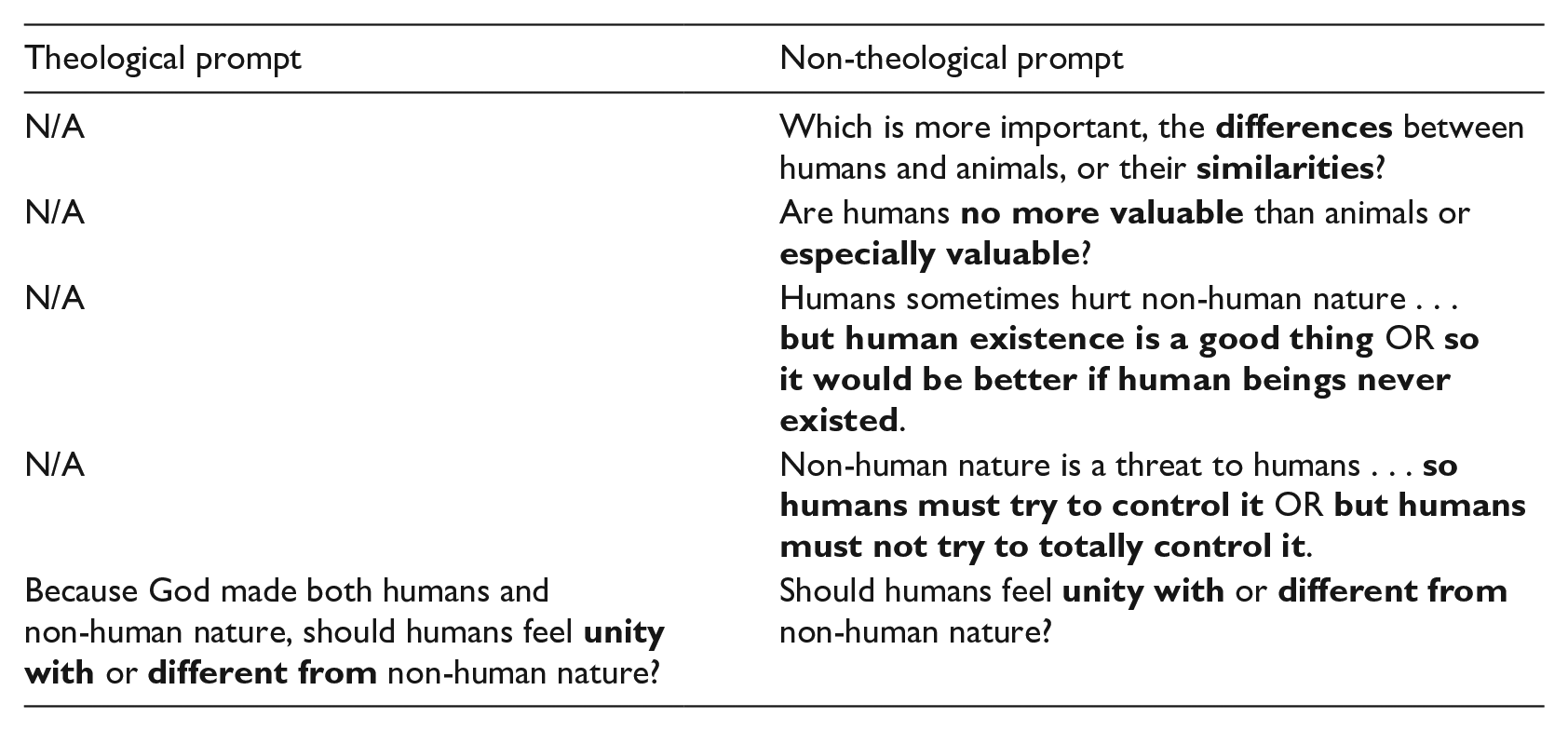
For each of the above questions, respondents will be able to indicate where, on an 11-point scale, they fall on the spectrum between the two responses provided in bold. For each of the above statements, respondents will be able to indicate where, on an 11-point scale, they fall on the spectrum created by the alternate versions of the sentence. To avoid unwarranted assumptions about the nature of dominion and stewardship, these semantic differential items allow participants who affirm human differentiation from non-human nature to affirm either a positive or a negative view of (1) humans in relation to non-human nature and (2) non-human nature in relation to humans.
Human authority over non-human nature
The two items most frequently used to measure human authority over non-human nature (2, above) are “Mankind was created to rule over nature” (Hand & Van Liere, 1984, p. 558; Leary et al., 2016, p. 467; van Bohemen et al., 2012, p. 171) and “Humans were created to rule over the rest of nature” (Shehu, 2015, p. 119; Wolkomir et al., 1997a, p. 329, 1997b, p. 100). While each of these items does measure participants’ perception of human authority over non-human nature, they are problematic for several reasons. Most significantly, these items are drawn from the NEP and NEcP, respectively. Thus, any data about dominion ideology derived from these items are automatically and inextricably placed in a framework that sets dominion ideology against an environmentally friendly perspective. Continuing to use these items would be to continue to allow sociology to impose its presuppositions on theology, to allow investigations of Christians’ lived beliefs to disregard their self-professed doctrinal positions. It would be to perpetuate the hyper-moralistic tendencies within sociology that Martin (1999) contemplates when he critiques the “immediate rush to judgement against whatever does not conform to the strictest exemplification of Franciscan or ecological ideals” (p. 16).
There are two more problems with these items. First, the language of “created to rule” implies that ruling is humans’ purpose. Second, the discrepancy between “nature” and “the rest of nature” reveals that each item invokes a particular understanding of the level of unity between humans and non-human nature. While the first item portrays humans as distinct from nature, the second item portrays humans as part of nature. Moreover, both items’ use of “over” elevates humans above non-human nature. To avoid these confounding variables, we suggest measuring respondents’ level of agreement with the following statements on a 5-point scale:

While the ideas of rule and manage are not identical, they both invoke the idea of authority. Moreover, we feel that, taken in a non-theological context, human rule of nature is a concept that is likely to be largely unintelligible to most study participants.
According to our theological discourses, stewardship ideology also invokes some level of human authority over non-human nature. To identify assent to stewardship terminology and to help assess participants’ understanding of the relationship between dominion and stewardship ideology, we suggest two parallel items:

Again, the concepts of stewardship and preservation are not identical, but “preserve” does invoke the idea of intentional involvement with, perhaps even management of, non-human nature. It also communicates that this management is limited by something—that it ought to be directed toward preservation.
Two more sets of items are necessary to identify why humans have a duty to preserve non-human nature. These items differentiate between theocentric, anthropocentric, and ecocentric understandings of stewardship.
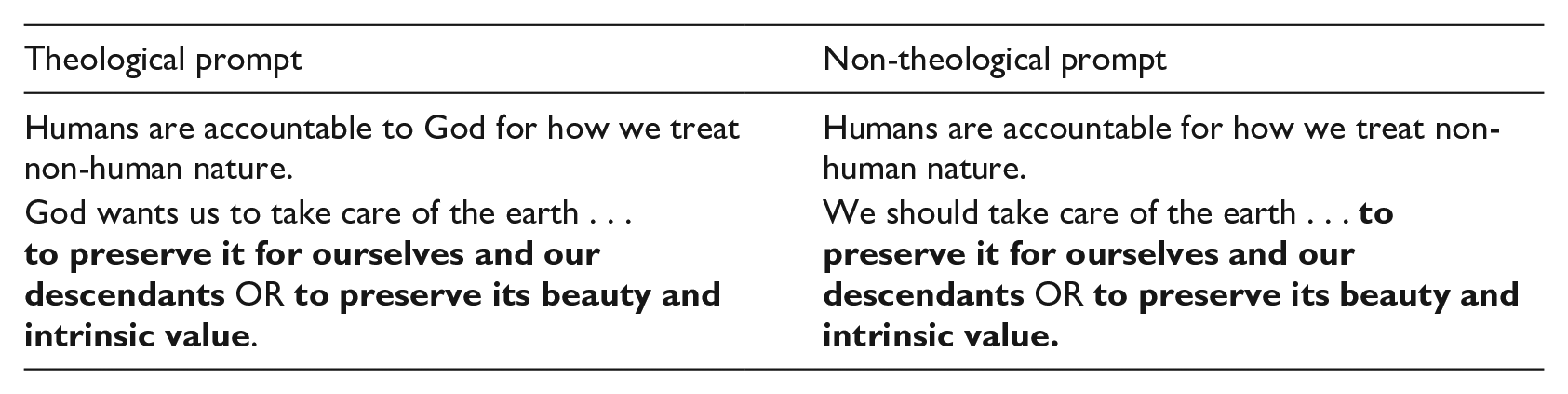
The first set of items will be assessed on 5-point, level of agreement scales; the second on 11-point semantic differential scales. These items are designed to assess respondents’ perspectives on human authority over non-human nature, but they also touch on anthropocentrism. Still, it is necessary to measure anthropocentrism directly.
Anthropocentrism
Eight of the nine core studies that attempt to measure dominion use at least one item that discusses human use of non-human nature. The most common item is, “Plants and animals exist primarily to be used by humans” (Hand & Van Liere, 1984, p. 558; Leary et al., 2016, p. 467; van Bohemen et al., 2012, p. 171; Wolkomir et al., 1997a, p. 329, 1997b, p. 100). The ninth study employs three items that contrast “concern for the environment with concern for the economy” (Eckberg & Blocker, 1996, p. 347). This approach implicitly invokes human use of non-human nature.
While the most common “use” item measures anthropocentrism (3, above), it lacks nuance. Before proposing our own items, we must clarify that we think it is mistaken to portray every affirmation of human use of non-human nature as inherently and negatively anthropocentric. An ecosystem is a system because its members rely upon, use, each other. To assume that human use of non-human nature is abusive is to assume that there is something peculiar about human use, that humans are not legitimate members of an ecosystem (Bauckham, 2010). In this way, to assume that human use of non-human nature is abusive is to assume a high level of differentiation between humans and non-humans. Differentiation is the purview of items proposed above, not those being developed in this section. Thus, rather than measure mere acceptance of human use of non-human nature, our anthropocentrism items contemplate human use in comparison with other purposes non-human nature may have.
For the first item, respondents will be asked to select which of the following statements comes closest to their own perspective:
“Human use is the only purpose of non-human nature; there are no other purposes.”
“Human use is the primary purpose of non-human nature, but there are other, less important, purposes.”
“Human use is one purpose of non-human nature, but there are other purposes that are at least as important.”
“Humans should not use non-human nature.”
Per the survey of theological discourses above, all three would reject the first and fourth positions. While Moo and Moo (2018) would clearly select the third, and it seems Schaeffer (1970) would too, the other discourses are harder to classify. Pope Francis (2015) seems to fall somewhere between the second and third response options, and the Patriarchal Encyclicals seem closest to affirming the second.
To help describe perspectives that may fall between the four statements given above, we also propose a semantic differential item:

Conclusion
In this article, we have documented that quantitative sociology’s understanding of dominion and stewardship conflicts with that of three, sociologically significant Christian traditions: Roman Catholicism, Greek Orthodoxy, and North American Evangelicalism. By analyzing Shehu’s (2015) study of Christians in Northeast Nigeria, we demonstrated that this conflict has, in at least one instance, had a distortive effect on sociological portrayals of Christians’ dominion and stewardship tendencies.
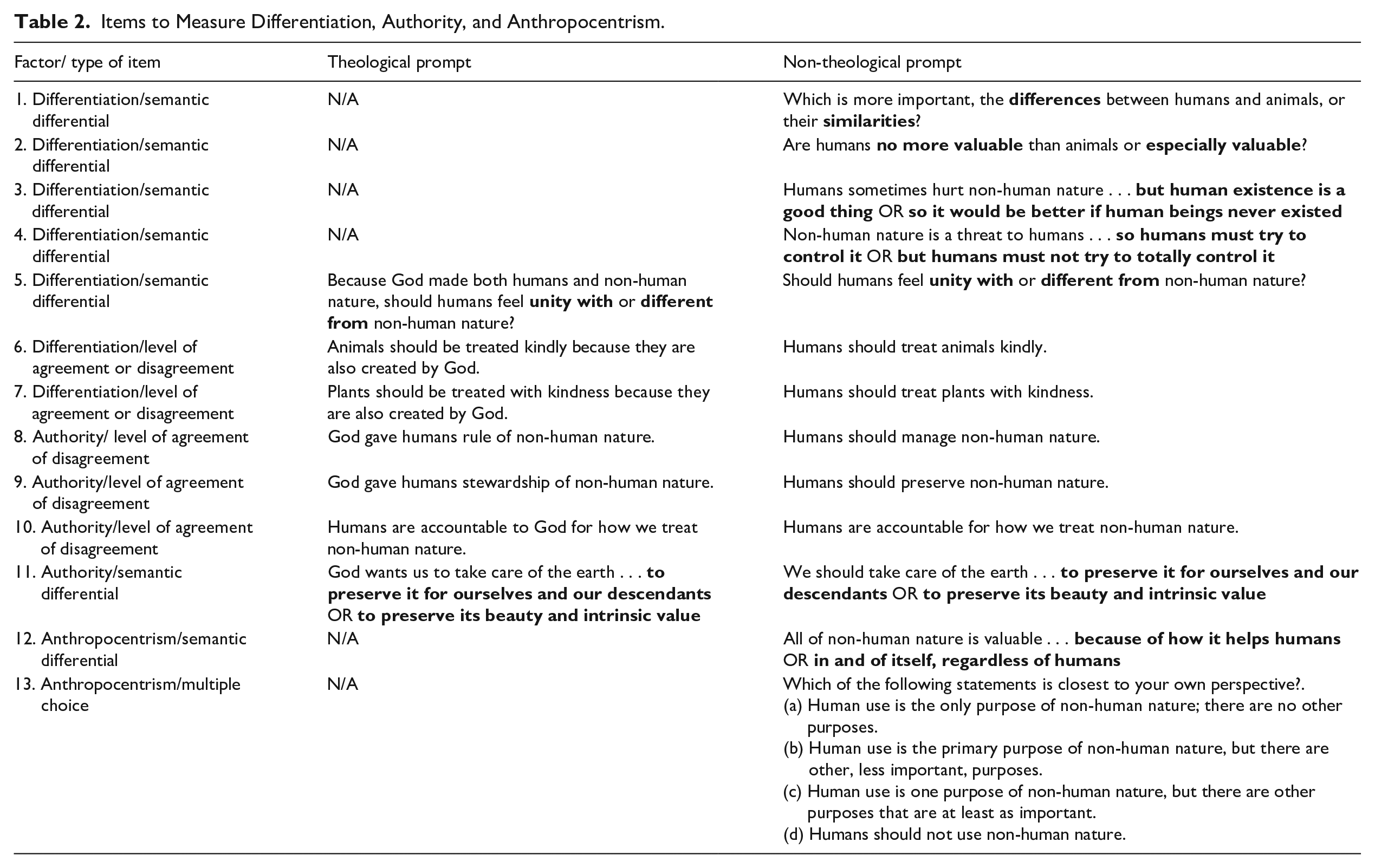
To help redress this situation, we propose the items developed above and presented collectively in Table 2. We believe these items will enable diverse understandings and uses of dominion and stewardship ideology to be heard more clearly in quantitative sociological attempts to describe Christians’ dominion and stewardship tendencies. We contend that the face and content validity of these items are clearly stronger than those of items used in past scales for dominion and stewardship, but this does not mean our items are beyond improvement. Other forms of validity remain to be examined. Moreover, per the approach outlined above, these items measure the factors involved in dominion and stewardship perspectives; we have not, at this point, proposed scales for dominion and stewardship. To develop scales for dominion and stewardship from these items, they must be administered to survey participants and the resulting data must be subjected to correlation and factor-structure analyses. 12
Items to Measure Differentiation, Authority, and Anthropocentrism.
Footnotes
Declaration of Conflicting Interests
The author(s) declared no potential conflicts of interest with respect to the research, authorship, and/or publication of this article.
Funding
The author(s) disclosed receipt of the following financial support for the research, authorship, and/or publication of this article: Some of the research reported in this article was conducted with funding from Liberty University and Regent’s Park College, the University of Oxford.
