




Abstract
Keywords
Introduction
Students seeking to transfer between a community college and university must navigate multiple complex systems to achieve the goal of earning a bachelor’s degree as cost- and time-efficient as possible (D’Amico et al., 2014; Hodara et al., 2017; LaSota & Zumeta, 2016). All too often there are cracks in the transfer credit infrastructure that lead to inefficiencies in credit transfer, penalizing students with lost credits, credits that do not count toward their degree, and delayed time to graduation (Giani, 2019; Hodara et al., 2017; Roksa & Keith, 2008; Weldon, 2013). Articulation agreements are prominent policy solutions aimed to remedy issues with vertical credit transfer. The evidence of their efficacy in doing so, however, is mixed. There is evidence that transfer articulation agreements have reduced credit loss in some states and some institutional partnerships (Kisker et al., 2011), yet there is also evidence of underwhelming impacts of these agreements on resolving transfer credit issues (Roksa & Keith, 2008). A notable limitation of articulation agreements is that they fall short of articulating major-specific courses (Taylor & Jain, 2017). In programs that boast complex curricula, major-specific courses are highly sequential; missing a course could significantly delay a transfer student’s degree progress. Such gaps in articulation agreements leads transfer students to seek other sources of information and build their transfer student capital (TSC)—the knowledge, skills, and abilities to navigate the transfer process successfully (Laanan, 2004)—which has been shown to be a key indicator of success for vertical transfer students (Laanan et al., 2010; Moser, 2012).
Students’ accrual of TSC depends largely on the quality and quantity of information networks and infrastructure. These information networks are particularly critical for students who enter into rigid, sequenced curricular pathways like engineering, where credit loss, credit waste (i.e., accumulation of credits that are not pertinent to a major), and delayed time-to-degree are highly prevalent (Hodara et al., 2017; Roksa & Keith, 2008; Weldon, 2013). Using interview data from stakeholders who support transfer students (i.e., professional academic advisors, academic administrators, and engineering faculty) at one research university and two community college partners, we apply a methodology that combines qualitative coding techniques (i.e., descriptive, process, and evaluative coding) with network and pathway analyses to explore an information network for coursework transfer in engineering. Network analysis provides a means to better explain a social phenomenon by analyzing the relationship between entities (Chiesi, 2015).
We address how information on coursework transfer to a research university is disseminated or distributed to community college students from the perspective of stakeholders who support transfer students by asking the following:
From what sources do institutions provide information to students on coursework transfer?
What processes do institutions use to guide students between different sources of information on coursework transfer?
How effective is the network of information sources and processes in disseminating information to prospective transfer students?
Specifically, we investigate sources from which students receive information on coursework transfer, the processes that guide students between information sources, and the perceived quality of the information network. This analytical method provides a new way to visualize and evaluate relationships between information sources.
Literature Review and Theoretical Underpinnings
Our analysis is grounded theoretically by Laanan’s (1996, 2000, 2001, 2004, 2007) Transfer Student Capital (TSC) framework as well as the concept of information asymmetry in the postsecondary education marketplace (Dunn, 2015). TSC helps conceptualize why and how access to information relates to transfer students’ success, but students’ accrual of course transfer knowledge is a function of the quality and consistency of information within and across those sources. By leveraging insights from stakeholders who support transfer students and who manage these information sources and processes, we can better understand the information pathways for course transfer and their efficacy. Information asymmetry grounds our analyses of the different information sources and information pathways that transfer students must navigate. Further, we summarize recent research that has explored the ecology of transfer and the complexity of and misalignments between information sources and systems for coursework transfer (e.g., Schudde, 2021b).
Transfer Student Capital Theory
TSC highlights how students acquire knowledge, skills, and abilities to navigate the transfer process from a sending institution to a receiving institution and has been widely used to ground qualitative exploration of transfer students’ experiences and quantitative analyses that relate experiences to student outcomes (e.g., Laanan et al., 2010; Moser, 2012). Understanding articulation agreements, credit transfer agreements, requirements for admission to a specific major, and course prerequisites are examples of TSC. Students with high levels of TSC will recognize the importance of navigating websites, advising offices, and faculty office hours to accrue knowledge on course transfer. Institutions that provide more assistance can help students acquire additional TSC, which is associated with a higher probability of successful transfer to a different institution (Laanan, 2007).
To build TSC, transfer students rely on academic advising to create an efficient, clear plan for transfer (Hayes et al., 2020). For engineering programs, specifically, course selection is particularly crucial as curricula are complex and major-specific courses are highly sequential (Heileman et al., 2019). Choosing courses that meet a community college degree requirement while also satisfying a major-specific degree requirement at a university can be complicated. Lukszo and Hayes (2020) interviewed community college students prior to transfer and found that students used pre-transfer advising along with websites and other documents to navigate the transfer process. The quality and consistency of the information within and across both sending and receiving institutions has a direct impact on students’ ability to make a clear plan to transfer.
In this study, we focus on one key facet of TSC: the accrual of knowledge about the processes, policies, and systems for transferring courses vertically from a community college to a university. Prior studies note that academic advising can negatively impact TSC if the information the student received was inaccurate or incomplete (Hayes et al., 2020; Laanan et al., 2010). By leveraging insights from stakeholders who support transfer students and who manage information sources and processes in engineering, we can better understand the information pathways for course transfer and their efficacy.
Information Asymmetry
Information asymmetry occurs any time one party has better or more information than another party (Milgrom & Roberts, 1992). When there is a mismatch in information held by two parties, there is potential for one or both to be misinformed. The theory of information asymmetry was developed in the 1970s by Akerlof and his colleagues as a plausible explanation for market failure. In Akerlof’s (1970) preeminent example of used car salesmanship, he posits that a used car seller has access to records of a car’s prior ownership and history that may not be readily available to the buyer. When the seller neglects to disclose problems with a car, there exists an asymmetry between information held between the buying and selling parties—from the perspective of the buyer, such a sale would be viewed as a failure that could have been avoided had the buyer been able to access all available information. The same concept can be applied in any industry or communication in which information is exchanged.
Dunn (2015) translated this theory into a higher education context, suggesting that students are synonymous to buyers and institutions are synonymous to sellers. Examples of such asymmetries can be seen across the higher education literature (e.g., Dill & Soo, 2004; Kivistö & Hölttä, 2008), especially with regard to how institutions and their stakeholders interact with one another in the ecological system of transfer (Schudde, 2021b). In examining the rules and norms of coursework transfer in Texas, Schudde (2021b) found that university administrators, faculty, and staff seem largely in control of setting rules and norms for credit transfer and application, leading to a largely decentralized system of transfer rules and regulations that are specific and unique to each institution. As a result, transfer students become implementers in the transfer ecosystem and “bear the primary responsibility for gathering transfer information” (Schudde, 2021b, p. 74). They found that students’ approaches to navigating accrual of transfer information, which they characterized into four types (i.e., resource curator, hesitant advisee, system truster, and disconnected), played a significant role in their successful transfer to a university. Transfer students are also left to make sense of transfer policies—their approaches to understanding and responding to policy signals related to their ability to transfer as well as their particular transfer pathway (Schudde, 2021a). Prior research suggests that the onus is largely placed on students in the transfer ecosystem who “must navigate an array of asymmetries, perhaps even more so than first-time-in-college students, as they must navigate how to bridge two different university environments” (D. P. Reeping, 2019, p. 2).
Prior work exploring information asymmetry as experienced by transfer students operationalized the concept as two constructs: fragmentation asymmetry and language asymmetry (Reeping & Knight, 2021). Fragmentation happens when information is dispersed across multiple sources (e.g., webpages, individuals, documents) that can often vary in quality or quantity and be conflicting across sources. Language asymmetry occurs when there is a problem with the quality or quantity of information that can be attributed to vocabulary, sentence structure, or communicative strategy employed by one or more stakeholders.
Fragmentation and language asymmetry can both occur along two trajectories. Jones (2004) describes two axes along which information can be distorted or lost. Vertical differentiation concerns the loss of information as it travels down the organizational hierarchy (e.g., information given from the Provost’s Office at a 4-year university to an academic college and then a department). Horizontal differentiation concerns loss of information within or between units (e.g., an engineering advising office to a first-year advising office). When differentiation happens, transfer students can face barriers to accruing TSC, thereby perpetuating the equity gap for students in the transfer pathway to engineering. And, in any transfer of knowledge, some information may be lost or distorted. We explore these forms of differentiation in our paper.
Data and Methods
Using interview data from stakeholders who support transfer students at one research university and two community college partners, we apply a novel methodology that combines descriptive, process, and evaluative coding techniques with network and pathway analyses to explore an information network for coursework transfer in engineering.
Positionality of Research Team Members
Collectively, the research team has significant knowledge and experience in vertical transfer, particularly in engineering and STEM. The research team included seven individuals associated with the university of focus in the study. At the time of the study, two of those members were faculty within a department in the college of engineering. Another research team member spent six years as a full-time administrator at a community college and ten years of experience as an administrator and researcher within community college transfer spaces. A fourth team member has been involved in vertical transfer research for more than 10 years, including several large grant-funded transfer projects in STEM. The fifth research team member has served as a faculty member in engineering at 2-year institutions for 14 years, developing expertise in issues of coursework transfer in engineering. The final two research team members were also familiar with vertical transfer, one of whom is a former vertical transfer student themselves. This breadth of experience undoubtedly influenced the ways in which we designed data collection and our interpretations of findings. We provide detailed descriptions of our coding processes and sample quotations to provide readers with evidence justifying our interpretations.
Institutional Contexts and Participants
The university in our study is a more selective, research-intensive, land-grant institution. Classified as a “lower transfer-in” university, around 17% of all new enrollments annually are transfer students, with a lower percentage (14%) of transfer students entering engineering (Grote, 2020). The College of Engineering (COE) houses the largest percentage of undergraduate enrollments at the university, with 14 engineering departments that enroll around 8,000 total undergraduate students annually. The COE admits around 300 transfer students annually, the majority of whom come from the state’s community college system. The two community colleges where faculty were interviewed for this study are part of a state community college system (SCCS) and are the largest feeders of vertical transfer students institution-wide and within engineering.
The university has both a university-level transfer agreement with the SCCS and another agreement specific to the COE. The COE agreement specifies that transfer students need to earn the associate degree in engineering or an engineering specialization within a science degree and have a minimum 3.2 grade-point average. There are several articulated courses between the SCCS and state universities. To help disseminate transfer information, the COE visits SCCS schools annually to meet with students and also hosts an articulation conference inviting representatives from each SCCS institution.
The advising structures at both the community colleges and university are multi-layered with several hand-offs between departments as depicted in Figure 1. When a student starts at community college, they are assigned a generalist advisor. After reaching prescribed progression metrics, students are then assigned to a faculty advisor within the engineering department at the community college. The faculty member not only interacts with students in the classroom, but also serves as students’ academic advisor through transfer to their desired receiving institution. University transfer advisors make themselves available to students pre-transfer to answer questions and provide guidance on coursework and application process. As students transition to the university, they interact with a staff member in the administrative office of the COE. One of the responsibilities of this person is to recruit community college students from the statewide system and address pre-transfer advising questions. Upon acceptance to the university students must pay their matriculation fee to be assigned to a professional transitional advisor housed within the COE’s administrative office or a professional academic advisor within the general engineering program. Once students fulfill the requirements set forth by the enrollment management policy, students are then handed off to an academic advisor within a degree-granting discipline based on their major (note: this advising process was in place at the time data were collected, but the COE is piloting a model that places transfer students with advisors housed in degree-granting disciplines upon matriculation)). In this paper we refer to all participants as “advisors” conjoined with a more specific term (e.g., faculty) to differentiate their roles within the transfer system.
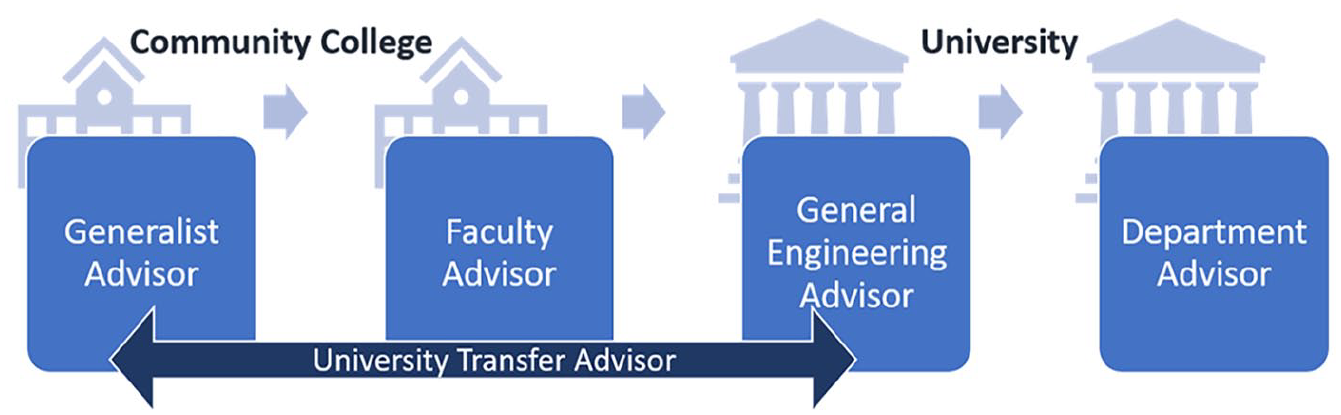
Advising path for engineering transfer student.
Data Collection
In total, we conducted 26 interviews with stakeholders who interface regularly with transfer students in some version of advising capacity: 21 with university faculty and academic advisors, and 5 with community college faculty. We felt it important to talk with stakeholders at both sending and receiving institutions to understand, holistically, the information network for coursework transfer. Interviews explored five primary areas of the course transfer process: (1) how students receive information on course transfer prior to transfer, (2) the role of academic advisors in the course transfer process, (3) the application of transfer articulation agreements in practice, (4) perceived sufficiency of academic preparedness for incoming transfer students, and (5) how transfer of courses and academic programs impact transfer student success.
Data Analysis and Quality
Data analysis was conducted in four phases. We first used iterative descriptive coding to catalog information sources for transfer of coursework. In this stage we first focused explicitly on identifying mentions of people, offices, departments, web resources, and programs that participants described as information sources about coursework transfer. We then iterated that process but focused on purposefully grouping that list into categories based on the source type (e.g., advising faculty/staff; web resources) and more specific sub-groups within each of those categories. For example, a description of a student visiting an advisor in a university engineering department was coded specifically as Department Advisors, whereas mentions of interactions with engineering faculty at a community college were coded as Engineering Faculty Advisors as the information source. Table 1 summarizes these codes and frequencies. Then, using process coding techniques, we identified processes that were used to guide students between information sources. This step usually involved identifying words that included a gerund (i.e., words ending in ing), which indicated some kind of action or process that occurred (Saldana, 2021). A common example code across participants was “referring,” which indicated a process of referral to another information source. Next, we used evaluative coding to convey advisors’ perceptions of the efficacy of information sources and processes. To do this we combed through each process and information source code for evaluative commentary, or instances where participants described the process or source positively or negatively or assigned some judgment of merit or quality to that process or information source.
Information Sources and Frequency of Mentions.
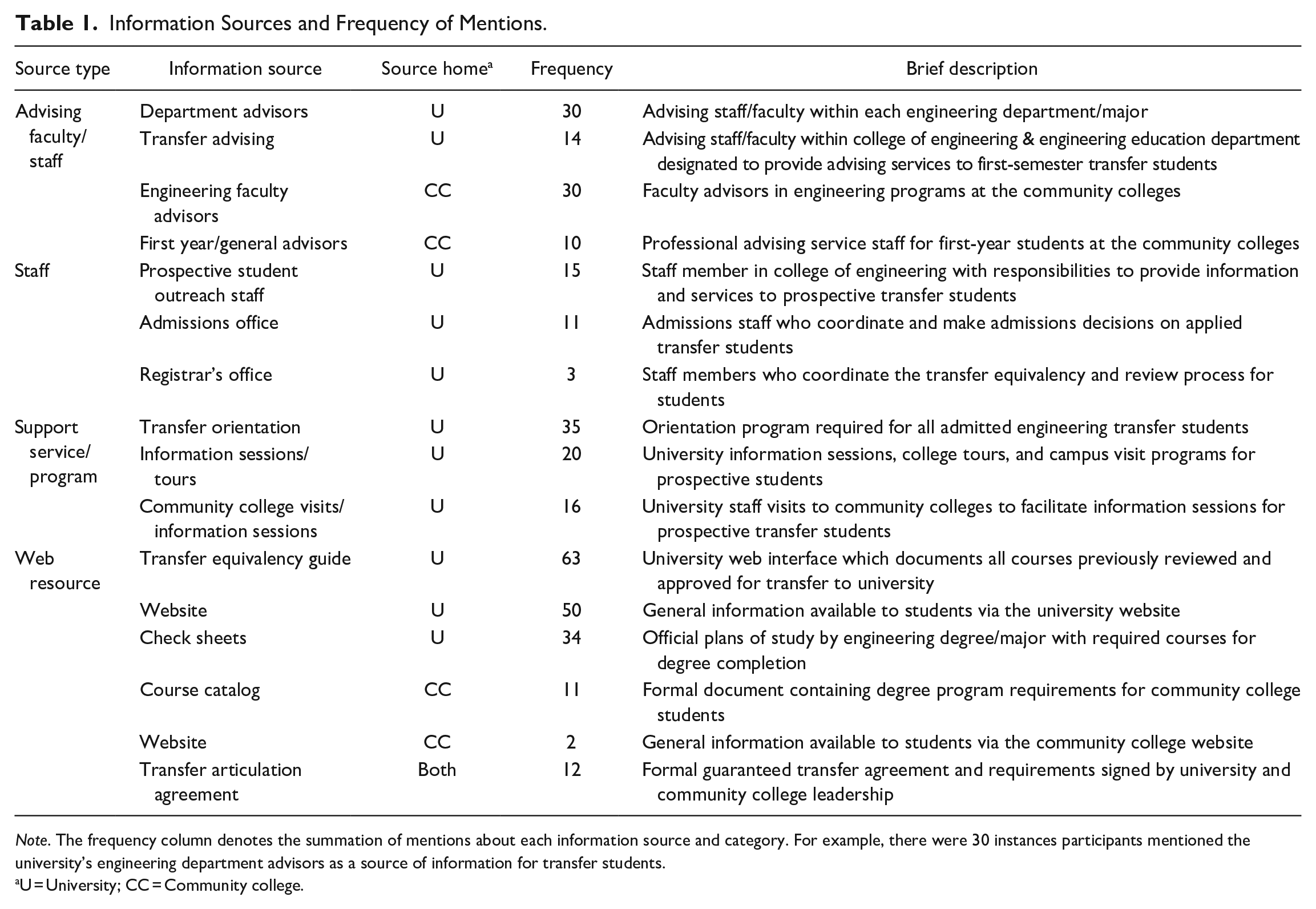
Note. The frequency column denotes the summation of mentions about each information source and category. For example, there were 30 instances participants mentioned the university’s engineering department advisors as a source of information for transfer students.
U = University; CC = Community college.
To illustrate we provide an example. A community college engineering advisor was reflecting on meeting with prospective transfer students who were awaiting important information from the University about their transfer coursework and described that: “all we do is tell the students we’re still waiting. ‘I’m really sorry’. That gets really hard and frustrating to them. If they’re frustrated in their classes . . . and they’re frustrated because they’re not getting answers, then that’s not going to lead them to success in any part of it.” This process code received a negative evaluation code, as reflected by the participant’s commentary about the process. Instances where a process or information source code was descriptive in nature (i.e., simply stating factual information about it without any evaluative judgment attached to it), were coded as a neutral evaluations.
The first three phases (i.e., information source, process, and evaluation) of coding were completed by two research team members with expertise and experience with vertical transfer pathways—both members used NVivo coding software to complete the descriptive, process, and evaluative coding processes. To ensure consistency and reliability of coding between the coders, both participants’ transcripts were coded by each coder, followed by a meeting to compare and contrast codes. Any discrepancies in coding were clarified so that each coder had clarity in the coding process for each stage (i.e., information source, process, and evaluation) of coding. Further, at each stage, the larger research team engaged in peer auditing of codes, which helped to refine all codes across the phases.
Finally, we generated information networks using network analysis. Network analysis is a useful method for visualizing networks (e.g., D. Reeping & Knight, 2021) that enabled us to visualize the network of information sources and processes that form an information network for transfer students. Specifically, a visualized information network (e.g., Figures 3–7) helped us to better understand how different information pathways may support or hinder students’ accrual of TSC. We input the information source and process codes into R to generate nodes (i.e., circles; information sources) and connections (i.e., arrows; processes linking information sources). We then used evaluative code frequencies to distinguish connections (i.e., arrows; processes linking information sources) that were, in aggregate, positively or negatively evaluated, received mixed evaluations, or were coded as neutral evaluations. Figures 3 to 7 are results of the network analysis and helped us derive the themes we highlight next in the Results section.
Results
We begin by discussing the information sources we identified through the coding process and the associated evaluation codes of those information sources. Next, we discuss the mechanisms connecting different information sources identified via process coding as well as the associated evaluation codes of those processes. Then, we present the complete information network where information sources are linked together through processes. We spotlight prominent themes that we discovered when examining the information network as a whole.
Identifying and Evaluating Information Sources for Transfer of Coursework
In addressing the first research question pertaining to information sources, we find that advisors identified 16 different sources where students can get information about coursework transfer. Table 1 provides the type and description of each information source. Information sources grouped into four main types: 1) web resources (n = 172 mentions), 2) advising faculty/staff (n = 84), 3) support programs (n = 71), and 4) non-advising staff (n = 29). The vast majority of discussion about information centered around sources maintained by the university (U) (80%, n = 291). CC Engineering Advising Faculty (n = 30) were the most frequently mentioned community college (CC) resource.
Next, by linking evaluative codes to information sources, we captured stakeholders’ perceptions of the quality of information sources. Figure 2 shows how each of the information sources listed in Table 1 were evaluated to convey advisors’ perceptions of the efficacy of information sources. We found that most web resources were evaluated positively (Figure 2). Stakeholders generally felt that if students ended up on the U Website, U Transfer Equivalency Guide, or U Check sheets, they would find quality information about transfer of courses from the community college to university. A notable exception was the CC Course Catalog; a majority of those evaluations were negative. This comment from one advisor captured the concerns with relying on the CC Course Catalog as a resource for transfer of coursework information: I think the thing that [students] look at is the degree requirements and then the notes that are associated with that . . . that’s a big problem. . . The only footnote associated with our engineering elective is “[Engineering 9000] is required at [University], desired everywhere else,” and that’s not really true. [Engineering 9000] is really only good for a couple of disciplines at [University], but that’s what our footnote says. So we have a lot of students take that class because that’s the information they have.
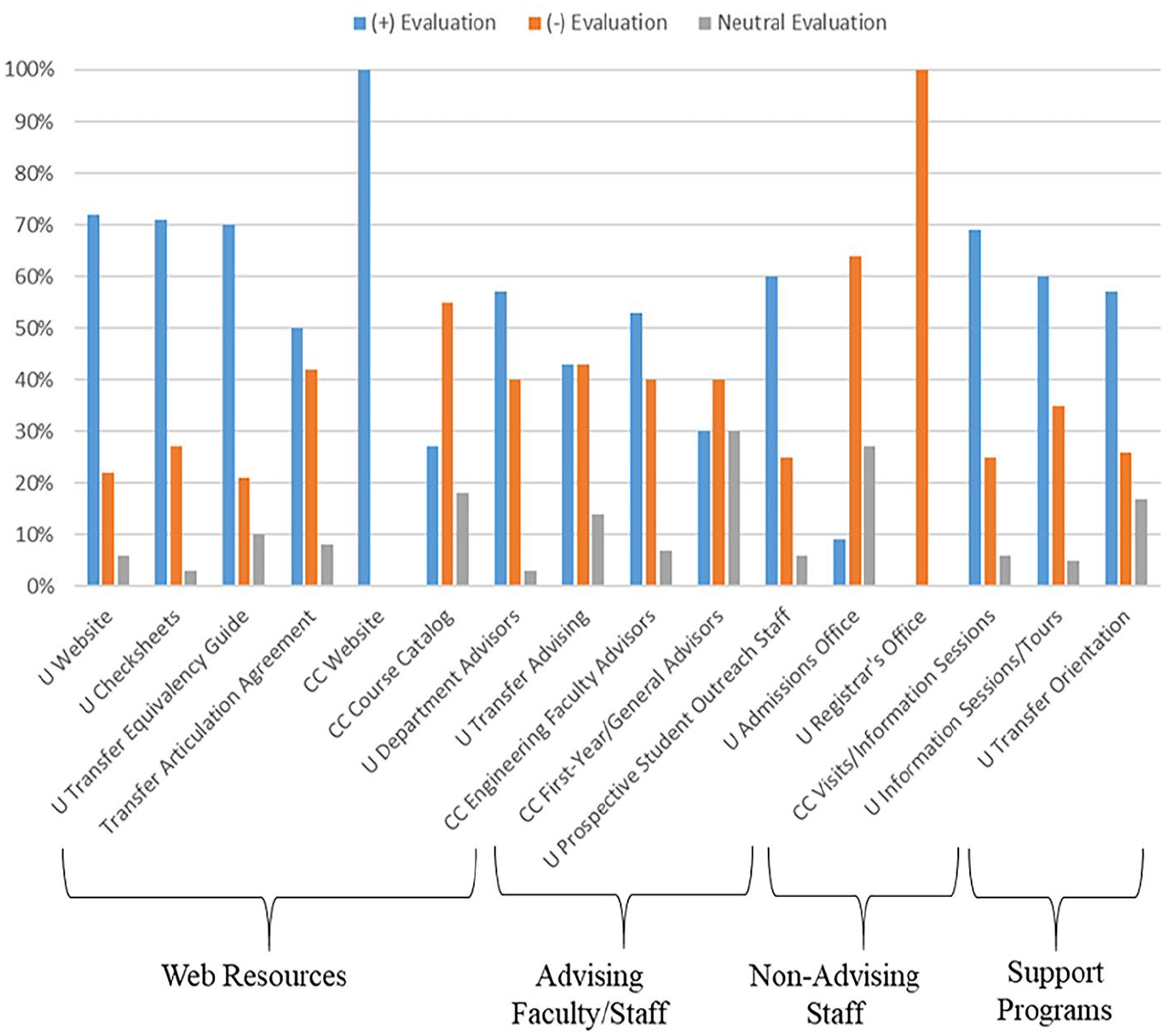
Evaluative codes by information source.
Students who rely solely on the CC Course Catalog may be misled by the footnote for the elective when transferring and end up taking a course that does not transfer at all or transfers in only as an elective at the university.
The Transfer Articulation Agreement, which is housed on both community colleges’ websites and the university’s website, received mixed reviews. In particular, stakeholders cited the static nature of the Transfer Articulation Agreement as well as its generalized, non-specific language around what and how courses transfer. Another stakeholder acknowledged that the legalese type language of the document may also be challenging for prospective transfer students and families. Although the CC Website received positive evaluations, we note the small frequency of mentions (n = 2) as a limitation—the other CC web resources with more frequent mentions were negatively evaluated, so it is hard to draw conclusions about the quality of transfer information on the CC Website.
Advising Offices received mixed evaluations regardless of organizational unit or institution. The mixed reviews are reflective of stakeholders feeling that advising offices across and within institutions may not consistently provide reliable or accurate information on how courses transfer between institutions or count towards degree. Many of these comments reflected the challenges stakeholders faced with addressing unique situations of each student, as one participant detailed: Anecdotally, students that come to me don’t seem to have questions about “how do I apply, and what do I need to do, and do I qualify” . . . The questions that I get are harder questions. “I got a C in Calc I, should I retake it? Do I stay here and finish the degree or go in the fall without the degree because I only have one semester’s worth of credit—but they only accept students in the Fall,” those types of questions. Those, I think, are harder for the general academic advisors, and for faculty advisors that aren’t familiar with the program.
The dynamic nature of academic plans at the university and complexity of sequencing courses in a way that benefits students’ timely transfer and degree completion are complicated tasks for advisors to manage. In this case, because students navigate multiple levels of advising offices throughout their transfer process, advisors at each level shared concerns for how disconnects could lead to misinformation and misadvising of students.
When looking at evaluation codes for other non-advising staff as sources of information for transfer, the U Prospective Student Outreach Staff were mostly positively evaluated (Figure 2). In contrast, both the U Admissions Office and U Registrar’s Office were overwhelmingly negatively evaluated. Multiple stakeholders complained particularly about the credit evaluation process where students are not able to have their community college transcripts formally evaluated before being accepted to the university and paying a non-refundable deposit. One participant wondered, “Are we penalizing these students by waiting to do a credit eval until they pay [their $500 deposit]? I think that’s completely unacceptable. That delayed evaluation of transfer credits impacts every piece of the student’s time at [University].”
The evaluative codes for support services and programs offered to transfer students were overwhelmingly positive (Figure 2). One advisor explained that “[The staff] have done such a fantastic job with transfer orientation. Very good info . . . many [students] elect not to [visit our advising office] because it seems like they’re getting what they need over there.” We note that such information sources have a predominant mission to support transfer students, whereas transfer students are only one of many areas of focus for the non-advising staff information sources, which likely explains the differences in evaluative codes.
Identifying and Evaluating Processes Within and Between Information Sources
To address the second research question, we combined process and evaluative coding techniques to identify and evaluate the efficacies of processes for transmitting information about vertical coursework transfer. We found two distinct types of processes: 1) those that provide students information directly from the source (i.e., “within a source”), and 2) those that connect students from one information source to another information source (i.e., “between sources”).
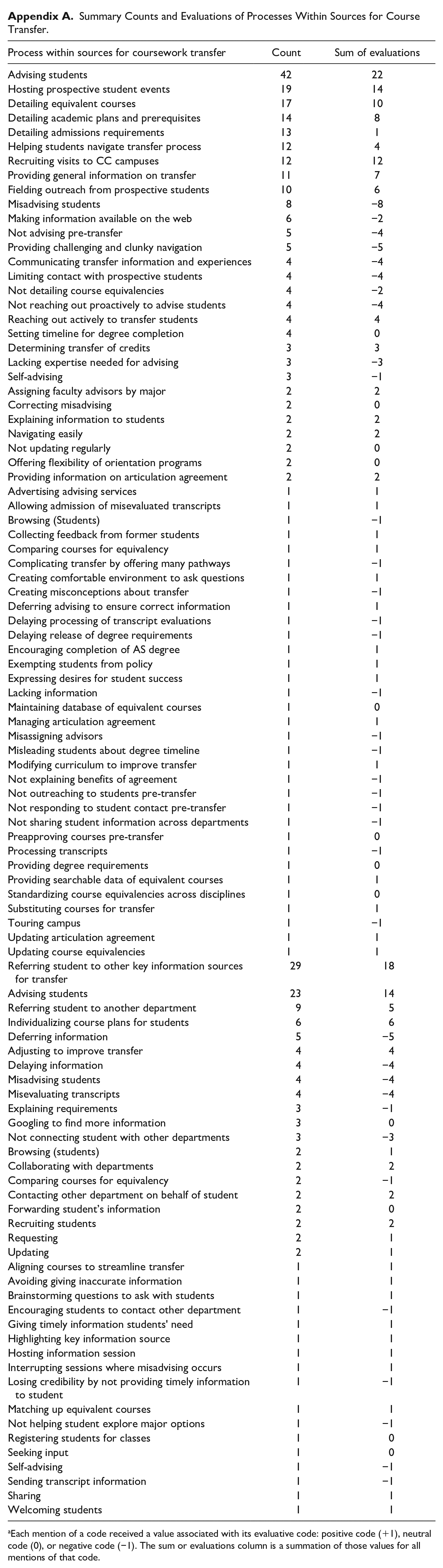
A summary of processes that provide information directly to students from within information sources as well as a summary evaluation count of each source are included in Appendix A. Evaluation scores give a general sense of how well each process provided information on transfer of coursework to students. Each mention that positively evaluated the process received a score of 1; each neutral mention received a 0; and each negative mention received a −1. Thus, scores above zero were, overall, evaluated positively, and scores below zero were negatively evaluated processes.
The most frequently mentioned process within information sources was advising students on coursework transfer (n = 42), which was positively evaluated (+22) in aggregate across all information sources (note: stakeholders were largely comprised of individuals with heavy advising responsibilities). Stakeholders also spoke about the benefits of hosting prospective student events, conducting recruiting visits to community college campuses, and detailing equivalent courses, academic plans, prerequisites, and admissions requirements. The nine most frequently discussed internal processes to support transfer students with transfer of coursework were all positively evaluated. Less frequently, advisors described processes that existed within information sources from a negative perspective, including misadvising students, failing to make information available on the web or providing challenging navigation to other information sources, and not offering to advise students or provide them with detailed course equivalency information pre-transfer. Notably, only one process involved active outreach to transfer students prior to their matriculation at the university (Reaching out actively to transfer students, n = 4, evaluation = +4), indicating that the onus to find information from the university was placed on students.
Appendix B summarizes processes connecting students between information sources along with evaluative codes for each. The two most prominent processes linking students between information sources were referrals to other key information sources for transfer and actively advising students on coursework transfer by referring them to another information source. We differentiate the latter from other advising processes because students received advising along with another information source. The most common example of this process was when advisors described information sources during U Orientation—this event served as the initial information source that then connects students with advising offices through advising processes, which is an important distinction from the previously described “within source” processes because it required subsequent action by students. Several other processes between information sources were negatively evaluated by advisors, including processes that deferred students to other information sources, delayed transmission of information between sources related to transfer courses, misevaluated transcripts delivered between information sources, and not connecting students at all to other information sources.
Examining the Information Network for Information Asymmetry in Coursework Transfer
To address our last research question, we use network analysis to connect findings from our analysis of information sources and processes. Through this analysis, we identify information pathways that may be fraught with misinformation, information asymmetry, and prohibit accrual of TSC for coursework transfer. Figure 3 displays the whole information network. Each circle, or node, in the figure depicts an information source. These sources are then connected with directional lines which represent processes between sources. The line type indicates the aggregate evaluation of the processes linking the two information sources with a solid line indicating a positive evaluation, a dashed line indicating a negative cumulative negative evaluation, and a dotted line indicating a summative mixed or neutral evaluation of the processes. The latter case includes advisors’ descriptions of a process that did not have an evaluation code attached to the process code. Given the robust complexity of examining the network as a whole, we focus on a few notable themes from the network analysis.
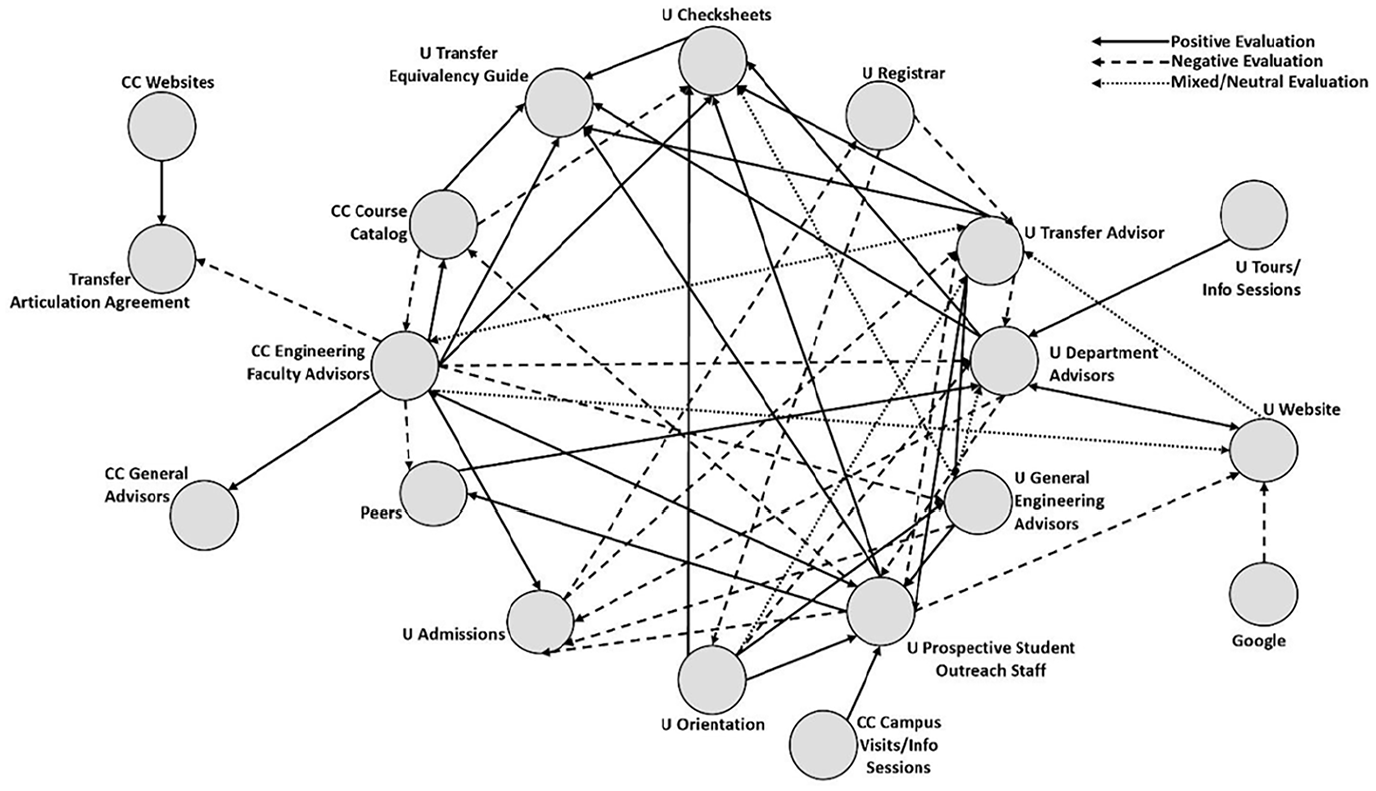
Information network for engineering transfer students.
CC Websites and Transfer Articulation Agreement Relative to the Information Network
First, students who utilize the CC Websites as the starting point for information about coursework transfer may not connect easily to other key information sources, as indicated by its presence on the outer portions of the network (Figure 4). Advisors described only a negative process that linked students from community college websites to community college engineering faculty advisors via the Transfer Articulation Agreement. Students who begin their postsecondary pathways at the community college may logically begin their search on the CC Website, however our analysis indicates that there are no positive processes to connect these students with more critical information sources for transfer. Similarly, stakeholders cited multiple concerns with the Transfer Articulation Agreement as a source of information for prospective transfer students because of its static nature and generalized statements around transfer of coursework policies and requirements, particularly around how courses will transfer and count towards students’ degrees. This disconnect is problematic for students who lack the knowledge or awareness to look elsewhere for information in the network—it represents a manifestation of information asymmetry in the network.
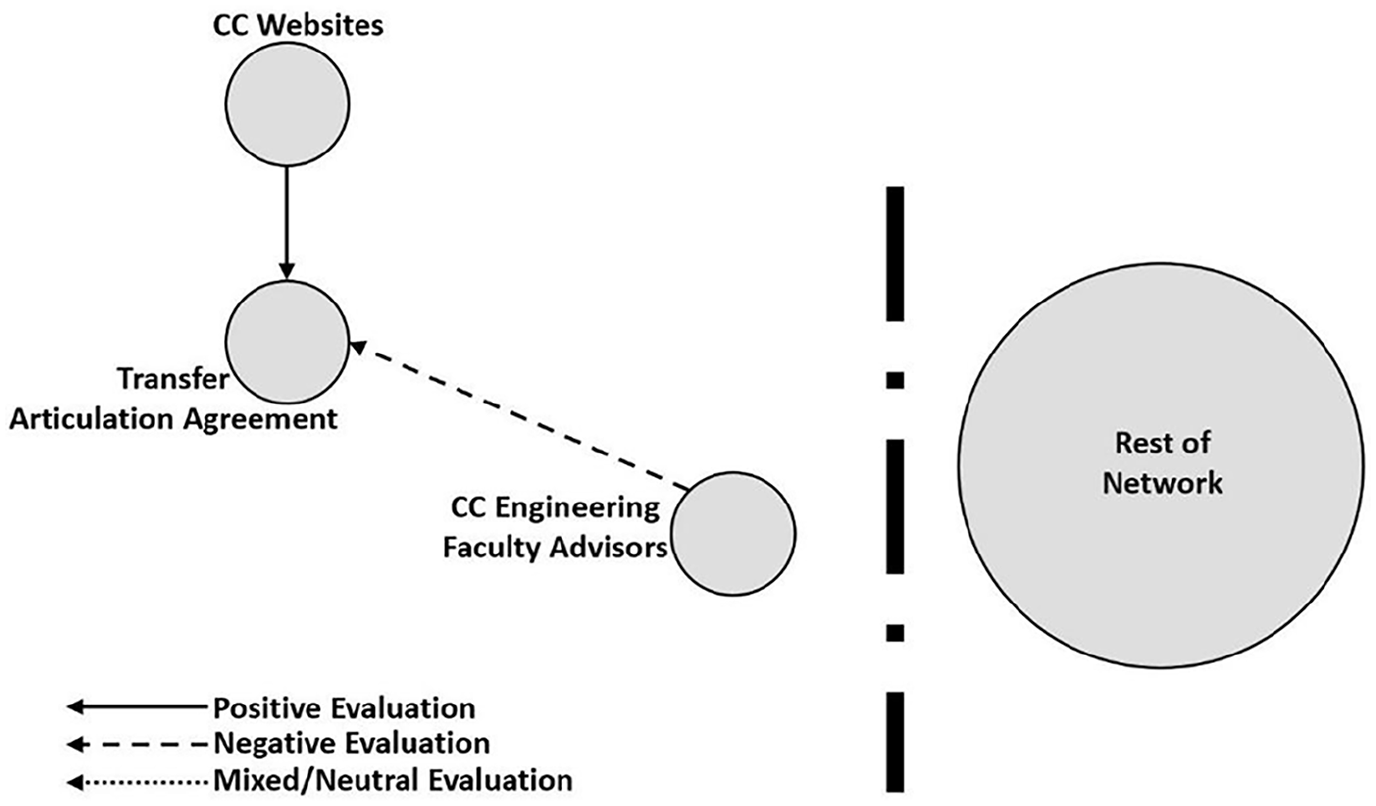
Information sub-network–disconnected from rest of network.
Information Asymmetry Can Compound as Students Traverse the Information Network
A second pertinent finding from examining the network is that as students navigate the processes between information sources, information asymmetry can compound. Figure 5 showcases one example. In this case, a student would begin by connecting with a CC Engineering Faculty Advisor to inquire about the process of transferring courses. If the advisor and student have a question about the student’s transcript that requires help from a U Transfer Advisor, the process must go through a review process from U Admissions. If the student and U Transfer Advisor are persistent, which in and of itself requires a certain amount of TSC, they may be able to persuade a member of U Admissions to review the student’s transcript provisionally to make well-informed decisions about course plans. Unfortunately, the provisional review by U Admissions, who are not fully trained to review transcripts, can still be misaligned with the transcript processing that takes place via the U Registrar staffing, which can result in misinformation being provided to the student during U Orientation. As this example illuminates, as students navigate multiple information sources with respect to their course planning, each step along the way compounds information asymmetry. Despite best efforts to plan with their CC Engineering Faculty Advisor, the information network with imperfect processes and sources could result in tangible impacts on students’ timely degree progress.
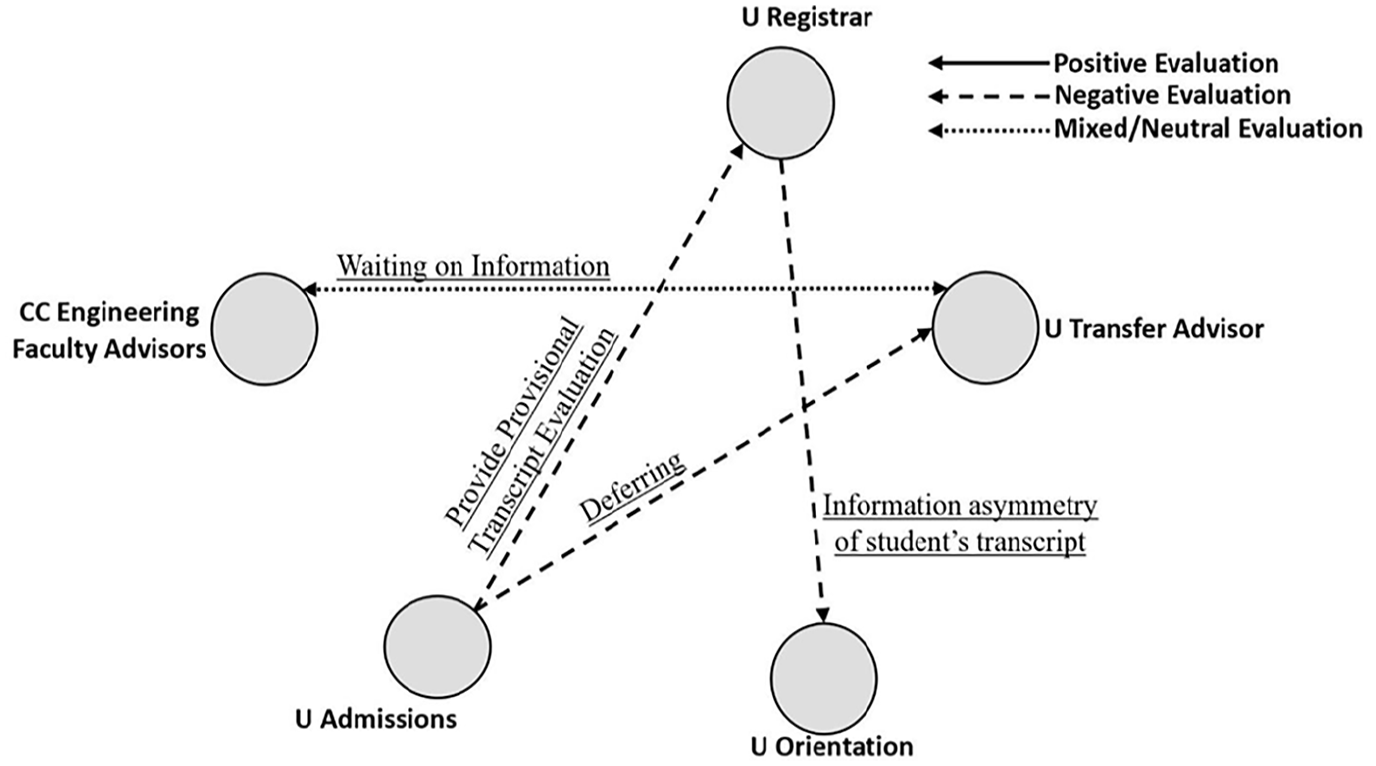
An example of compounding information asymmetry in coursework transfer.
Multiple Levels of Advising Increases Likelihood of Information Asymmetry and Misadvising
Another prominent finding was the potential for misadvising as students navigate multiple levels of advising from when they start at the community college to when they arrive in the degree-granting discipline with a U Department Advisor. Figure 6 visualizes this portion of the network. A student who follows the advising information pathway by design will interact with five different advising entities during their vertical transfer process. Even for well-designed and evaluated processes, this multi-stage organization structure can lead students to experience information asymmetry. As one stakeholder describes, “[Students] were put in classes they didn’t need to be in. They were told wrong information. For an incoming student, they need two classes. They were only put in one of the two.”
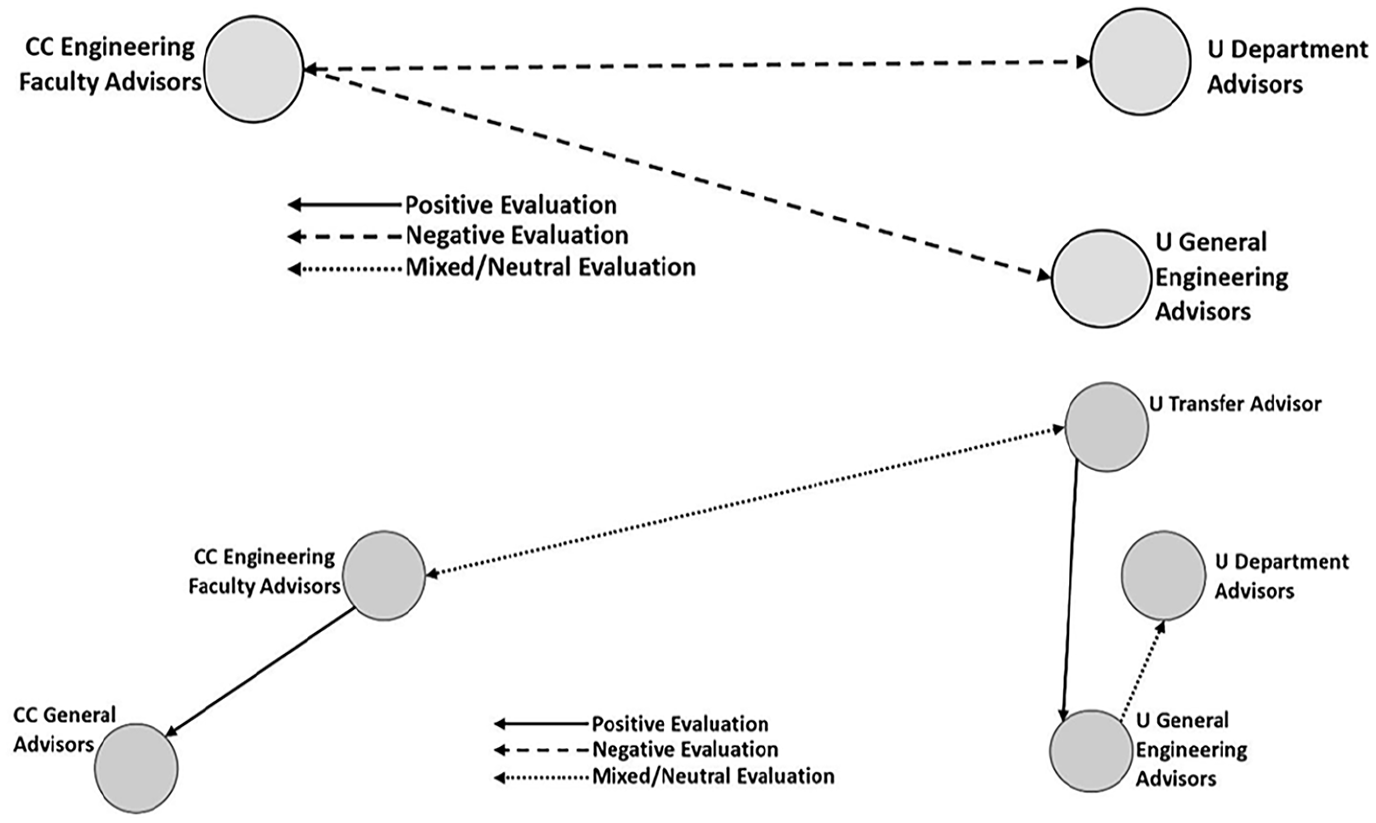
Multiple levels of advising may lead to information asymmetry and misadvising.
Beyond this specific example, we found multiple processes that linked advising offices more directly. Stakeholders talked about processes that directly linked CC Engineering Faculty Advisors with U Department Advisors or U General Engineering Advisors (Figure 6), but they were, in aggregate, poorly evaluated. CC Engineering Faculty Advisors received conflicting information about what courses to advise students to take based on whom they ask at the university. U Department Advisors can do specific course substitutions that are not in the official transfer equivalency tables intended to help students on a case-by-case basis. Since these substitutions are not consistent with the equivalency, this disconnect leads to multiple course recommendations. We are not suggesting that a more centralized, consolidated advising structure may be a better model for supporting transfer students navigate transfer of coursework, but instead our findings suggest that having multiple advising flows within the same system can lead to confusion and further information asymmetry.
Hope Renewed: A Strong Network of Web Resources and Processes Linking Them
Our final theme restores some hope for transfer students that navigate this information network as they attempt to transfer credits vertically in engineering. The most frequently discussed processes between sources linked CC Engineering Faculty Advisors and U Department Advisors to well-evaluated web resources including the U Transfer Equivalency Guide and U Check sheets (Figure 7). Thus, even if there are not quality processes in place to link students directly between CC Engineering Faculty Advisors and U Department Advisors, both students and community college faculty advisors have a breadth of quality processes through web-based resources. Additionally, once students arrive at U Orientation, they seem to have robust and quality access to U General Engineering Advising. These linkages in the information network give promise to students’ ability to accrue TSC and successfully navigate transfer of coursework from the community college to university.
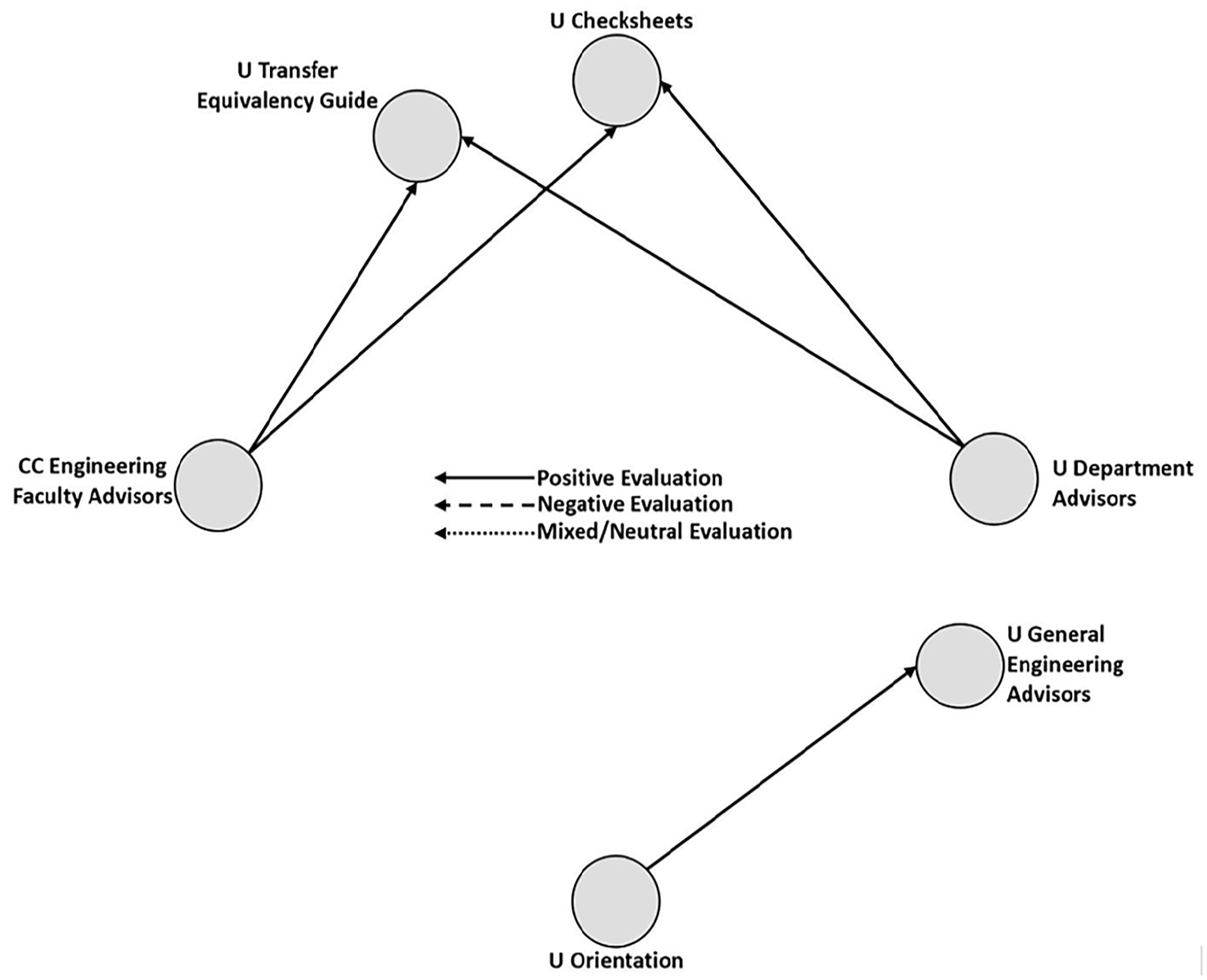
Well-evaluated processes between sources for coursework transfer.
In summary, these visualizations and analyses demonstrate the volatility in information gathering for transfer students seeking to transfer credits between a community college and university. Where students first seek out information on the course transfer process could impact their ability to accrue TSC and successfully matriculate and make decisions that preserve their credits in transfer and reduce their chances of extending time to degree. As the last example illustrates, there is some promise that students, if they find the right information sources initially, can avoid information asymmetry and successfully transfer courses vertically. Highlighting those “promising” information paths can be critical as institutions seek to bolster their support of transfer students.
Concluding Discussion
Our findings suggest that information sources and processes regarding engineering transfer students are numerous and disjointed. Because we know that transfer students largely bear the responsibility of navigating transfer ecosystems and transfer policies (Schudde, 2021b) to accrue TSC, this study closely examines a network of information that students have access to on their transfer journey. We extend prior research that has investigated the quality of online resources for transfer students (e.g., D. Reeping & Knight, 2021; Schudde et al., 2019), the quality and impacts of transfer guides (e.g., Spencer, 2018), and the influence of statewide articulation policies on transfer outcomes and time to degree completion (e.g., Boatman & Soliz, 2018). These studies have focused mostly on the quality of transfer information sources; our investigation broadens the scope to consider the processes that link students between those information sources and also visualizes the network to better understand how students might navigate within and between information sources.
The findings from this study provide insights into how information asymmetry can relate to the accrual of TSC in the transfer process of engineering students. Our study supports Laanan et al. (2010) and Moser’s (2012) conceptualization of TSC while shedding light on how these sources are related. The structure of transfer resources as depicted in Figure 3 illustrates the complex web of information sources that transfer students may use to accrue TSC. However, the network (Figure 3) shows that not all sources were evaluated positively–having an abundance of information sources and paths does not equate to a better transfer system, as having bad information can be even more harmful than having no information in supporting transfer students’ decision making.
Paths between information sources vary in quality and leads to fragmentation asymmetry, which creates barriers to acquiring TSC (Reeping & Knight, 2021). Fragmentation asymmetry occurs when information is dispersed across multiple sources and the quality and quantity are conflicting, as represented in Figures 5 and 6. Prior research also indicates that the lack of coordination between transfer sources has a negative impact on transfer students (Hayes et al., 2020; Schudde, 2021b). Our findings support these prior studies by depicting the variety of transfer sources and the processes that link them (Figure 3). Interviewees provided examples of students and advisors navigating these sources resulting in misinformation. This misinformation could lead to decisions that result in credit loss and lengthened time to degree.
Both community colleges and bachelor’s granting universities should focus on reinforcing the highest quality information paths for students to avoid distorted or lost information on course transfer. We recognize the challenges inherent in the current ecosystem of transfer, wherein university actors largely wield the decision-making power to shape the policies and standards of transfer, which often leads to decentralized, institution-specific transfer articulation policies and processes that send clear signals to transfer students (Schudde, 2021b). However, for institutions that seek to establish enrolling transfer students as a priority, our findings would lead us to recommend that such institutions promote communication and collaboration around sources that have a positive evaluation and potentially adjust or eliminate sources and paths with negative evaluations. In this case, the web resources, check sheets, and transfer equivalency guide provided a link between community college engineering advisors and university department advisors, and these resources can be a starting point for conversations between institutions that can potentially lead to a direct path between the two sets of advisors. Our analyses suggest that this direct link between advisors can aid in reducing information asymmetry in the transfer of coursework. Institutions could also adopt our methodology to investigate their own information networks for transfer students to assess for quality sources and processes.
By using network analysis of interview data, we were able to depict relationships between information sources and evaluate them. The descriptive, process, and evaluative codes from interview data were combined to generate a network depicting the information sources for engineering transfer students. This visualization of interview data provides a unique tool to investigate how transfer students gain information on transfer. The network provides a means for identifying relationships between sources to find paths of quality information and bottlenecks where students may get stuck, frustrated, lost, or confused. This visual is helpful in communicating the complexity of transfer to those who are not familiar with the idiosyncrasies involved. It also allows those who are involved in one portion of the process to see how they fit into the larger network.
This paper advances prior research on TSC by detailing how students access information about course transfer and demonstrates how information asymmetry occurring from how institutions provide information to students can be a barrier to the successful accrual of TSC. Utilizing network analysis to visualize and evaluate information sources and processes provides an additional method for evaluating information systems for transfer. From a policy perspective, this research highlights the need for institutions and state systems to consider how information is presented to prospective transfer students. Consolidating information sources or improving processes linking information sources could improve inefficiencies in transfer students’ transitions. Practitioners can benefit from this research by understanding their role within the larger system in providing accurate, consistent information to students who seek to attain a bachelor’s degree through vertical transfer. Additionally, institutions could adopt this approach as a way to identify, evaluate, and visualize how students receive information on coursework transfer in their contexts. We shed light on the complexities of information sharing in the coursework transfer and the critical role institutions play in reducing asymmetries in transfer.
Appendices
Summary Counts and Evaluations of Processes Within Sources for Course Transfer.
Summary Counts and Evaluations of Processes Between Sources.
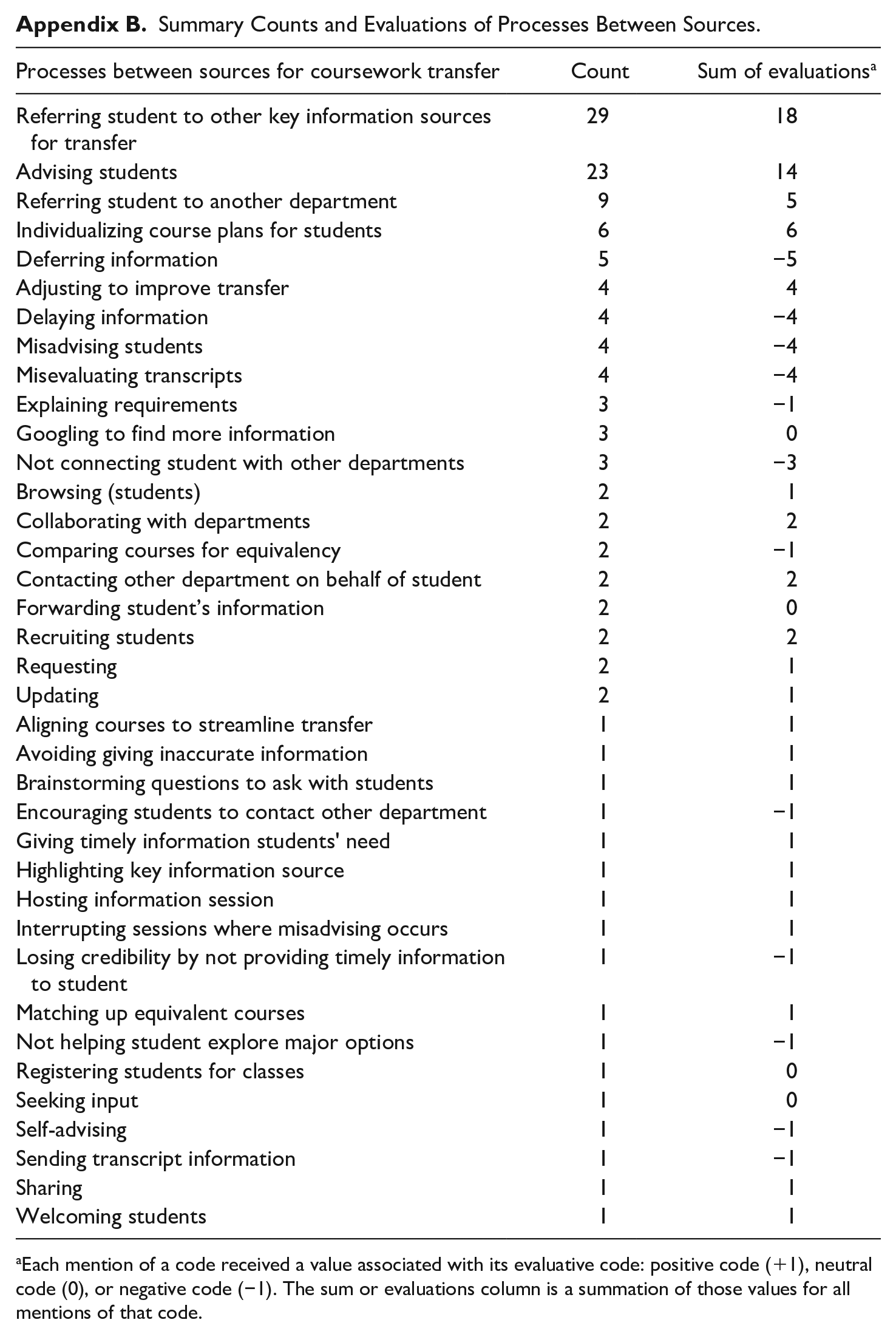
Each mention of a code received a value associated with its evaluative code: positive code (+1), neutral code (0), or negative code (−1). The sum or evaluations column is a summation of those values for all mentions of that code.
Footnotes
Declaration of Conflicting Interests
The author(s) declared no potential conflicts of interest with respect to the research, authorship, and/or publication of this article.
Funding
The author(s) disclosed receipt of the following financial support for the research, authorship, and/or publication of this article: This material is based on work supported by the National Science Foundation Engineering Education and Centers under grant number DUE-1644138. Any opinions, findings, and conclusions or recommendations expressed in this material are those of the author(s) and do not necessarily reflect the view of the National Science Foundation.
