




Abstract
Keywords
The Importance of Early Childhood Educators’ Access to Teacher Education
The COVID-19 pandemic resulted in dramatic changes in teacher education, including a shift to more remote learning (Ellis et al., 2020; Quezada et al., 2020). For some early childhood (EC) professionals, this has increased access to teacher education coursework. At Metro College, 1 a community college in a small New England city serving predominantly bilingual students who immigrated to the U.S., course enrollment directly increased after the shift to online learning. In June 2020, Metro College had a 36% increase in the number of student registrations, as compared to registration averages over the previous five summer semesters. In light of this increased enrollment amidst the challenges of the COVID-19 pandemic, a team of faculty and students collaborated to design a study to investigate degree candidates’ 2 persistence in teacher education during the pandemic. We sought to understand candidates’ motivation for pursuing a degree, the ways the pandemic changed candidates’ educational pursuits, and the sources of support they drew on as they navigated their college coursework.
Understanding the experiences of early childhood candidates is crucial because access to college degrees in education is still relatively limited for many early childhood professionals. Whereas approximately 61% of K12 teachers not only have a bachelor’s degree but also hold a postbaccalaureate degree (U.S. Department of Education, 2023a), less than half of home-based and center-based providers of children ages 0 to 5 years have any college degree at all (U.S. Department of Health and Human Services, 2013, 2016). Increasing the proportion of early childhood educators who can access and complete degrees in education holds promise for improving their students’ educational opportunities and addressing persistent structural inequities in the teacher workforce. Because educational experiences during early childhood have important implications for students’ academic and social development (e.g., Burger, 2010; Epstein et al., 2016; Gormley et al., 2011), it is crucial that early childhood educators have the intensive training and support needed to provide high-quality instructional opportunities to their students. Research demonstrates that higher levels of teacher education are associated with improved instructional quality in early childhood settings (Manning et al., 2019; Mims et al., 2008), and policy makers in an increasing number of states have set minimum educational qualifications for early childhood educators (Whitebook et al., 2018).
Increasing access to college degrees in early childhood education is also crucial for addressing demographic inequalities in the teacher workforce. For example, in the fall of 2021 White students only comprised 45% of the enrolled preK-12 public school student population, whereas 80 of teachers were White (U.S. Department of Education, 2023b). However, compared to elementary and secondary teachers, teachers in U.S. preschool classrooms and daycare centers already mirror their students—ethnically, racially, and linguistically—more closely (Hill et al., 2021; Paschall et al., 2020a; Whitebook et al., 2018). For example, as of 2017, the Center for the Study of Child Care Employment estimated that approximately 31% of early care teachers identified as Black or Hispanic, as compared to only 15% of K12 teachers.
While this proportionality indicates that many members of the early childhood workforce may hold “funds of knowledge” (Moll et al., 1992) relevant to serving an increasingly diverse student population, this representation masks deep structural inequities within the organizational and economic structures of early childhood classrooms. Most program directors are White, U.S.-born, and speak only English (Paschall et al., 2020b), and EC classroom assistants are more likely to be multilingual than the lead teachers in their classrooms (Whitebook et al., 2018). Thus, within many EC classrooms and programs, Teachers of Color, multilingual teachers, and teachers born outside the U.S. hold positions with low power and agency, and with lower remuneration for their services (Gould, 2015; McDonald et al., 2018).
Teacher education allows early childhood workers to increase their confidence, power, and agency within their classrooms (Nolan & Molla, 2017). Unlike K12 education, a bachelor’s degree is not universally required for employment as an early childhood educator (Center for the Study of Child Care Employment, 2017). However, a bachelor’s degree may raise educators’ earnings by an estimated $17,000/year (Whitebook et al., 2018) and help them qualify for higher positions within their organizations. Because most EC educators are women (U.S. Bureau of Labor Statistics, 2022), opportunities for increased earnings are crucial for disrupting the gender pay gap, and for changing broader societal norms about the value of women’s work (Schieder & Gould, 2016). As such, increasing access to teacher education degrees among early childhood educators is not only beneficial to their own students, but is an important aspect of dismantling the structural inequities which persist within our educational system.
The Promise of Community College as a Point of Access
Community colleges, such as Metro College, are important points of access to college coursework for many early childhood professionals (Kaplan, 2018). Students who are not able to access teacher education coursework at a four-year institution may be able to access equally high-quality preparation at a community college (Locklear et al., 2009). In addition, many community colleges provide prerequisite courses to students who, during prior educational opportunities, have experienced challenges which resulted in gaps in their education (Community College Research Center [CCRC], 2021). Because of their accessibility, community colleges are often able to serve a socioeconomically and linguistically diverse student population (American Association of Community Colleges, 2022; Malcom, 2013). Given disproportionately low college completion rates among students of color compared to White students (U.S. Department of Education, 2017), community colleges play a crucial role in addressing educational inequities within higher education access in the U.S.
Despite these accessibility features, however, successful completion of a teacher education degree at any institution is not just a function of access to a teacher education program but is also a function of each candidate’s experiences within the program. Prior research provides many examples of isolation, erasure, and/or silencing experienced within teacher education programs by candidates holding marginalized racial, ethnic, and linguistic identities (e.g., Cheruvu et al., 2015; Rodriguez-Mojica et al., 2020). For the field to make progress toward recruiting and retaining a diverse and well-equipped teacher workforce, more research addressing candidates’ experiences within community college teacher education is needed, including both the barriers teacher candidates holding marginalized identities face and their motivations for persisting in their programs.
Considering the effects of the COVID-19 pandemic, such research is urgent. Survey research demonstrates that COVID-19 not only created new challenges for college students, but also exacerbated existing barriers to completion of degree programs (e.g., Lederer et al., 2021). COVID-19 disproportionately impacted marginalized communities (Laurencin & McClinton, 2020; Vargas & Sanchez, 2020), including teacher education candidates of marginalized identities (Molock & Parchem, 2022). Although leaders at community colleges are actively working to evolve their institutions in response to COVID-19 (Floyd, 2021), to our knowledge, researchers have only begun to explore how degree candidates at community colleges make sense of the college’s policy shift to online learning during the pandemic. To meet this gap in the literature, we drew on sensemaking theory to conduct an exploratory qualitative study of teacher education candidates’ experiences within one community college in a New England city. Our research questions were as follows:
RQ1: How did students within one community college teacher education program experience the shift to online learning due to COVID-19?
RQ2: How did students make sense of their persistence within their degree programs during the COVID-19 pandemic?
Exploring Candidates’ Sensemaking of Teacher Education During the Pandemic
To frame our analysis of candidates’ experiences of persistence toward college graduation during the COVID-19 pandemic, we drew on sensemaking theory (Weick et al., 2005). Maitlis and Christianson (2014) define sensemaking as “the process through which people work to understand issues or events that are novel, ambiguous, confusing, or in some other way violate expectation” (p. 57). The COVID-19 pandemic certainly qualified as such an event, as it fundamentally changed the policies guiding delivery of college coursework for the teacher candidates in our study: in March 2020, the institution shifted from 100% in-person courses to 100% virtual courses.
Sensemaking theory conceptualizes the outcomes of policy changes within an organization (such as the move to virtual learning enacted in response to COVID-19) as a function of how members of the organization make sense of and implement the policy, not just the nature of the policy itself (Weick et al., 2005). While much of the existing educational research grounded in sensemaking theory has addressed implementation in response to a planned change in policy (e.g., Coburn, 2005; Spillane et al., 2002), in this study, we draw on sensemaking theory to examine candidates’ responses to policy changes enacted in response to a crisis. We were interested in how participants made sense of the unexpected shift to virtual learning, and how they made sense of their own decisions to persist in their pathway of obtaining a college degree, even amidst a global pandemic.
Sensemaking is a useful theory through which to examine candidates’ experiences within a community college because it acknowledges the importance of both individual appraisals and the role of the cultural and organizational contexts in which those appraisals are made. Previous research regarding the experiences of minoritized students within higher education institutions has used sensemaking frameworks to understand student retention or attrition. For example, Harper and Newman (2016) examined how Black men successfully completing their later years of college made sense of the first year of their transition to college from high school. Suspitsyna (2013) also drew on sensemaking theory in an examination of how international graduate students made sense of socialization experiences within a university in the United States.
In the past few years, scholars across many disciplines have described the utility and potential of sensemaking frameworks for research regarding the effects of the pandemic (Christianson & Barton, 2021; Stephens et al., 2020). Although sensemaking theory has been used to examine responses to COVID-19 among a variety of populations, including the leaders of educational institutions (Grooms & Childs, 2021; Yeomans & Bowman, 2021), at the time of this writing, we could not locate any articles exploring how community college students made sense of the changes to their education caused by COVID-19. In this research, we extended previous sensemaking literature by exploring the meanings teacher candidates constructed about the importance of college and the nature of their experiences during the pandemic.
Method
Setting and Research Team Positionality
This research was conducted within the context of a small, private community college in a city in the Northeastern United States. Metro College is a commuter school that serves approximately 1,400 students, grants three types of associate degrees, and offers seven certificate programs. Metro College provides an accessible pathway toward professional careers in education to students, holding partnerships with local four-year colleges as well as statewide early childhood professional organizations. The college offers courses in English, Spanish, Mandarin, Haitian-Creole, and Portuguese. The student body is ethnically and racially diverse; in 2018 to 2019, 65% of students identified as Hispanic or Latinx, 3 15% as Black or African American, 14% as Asian, 4% as White, and 2% as another race or ethnicity. The college does not offer student loans because it is committed to ensuring that all students can earn an education without incurring educational debt that often has long-term repercussions. Typically, 70% of students qualify for Federal Pell Grants, and approximately 80% of the students are enrolled in early childhood education programs and are often already working in some capacity within the field. Approximately 95% of candidates pursuing a degree in early childhood education are students of color, 80% immigrated to the US, and over 75% speak a language other than English at home (predominantly Spanish or Mandarin).
During the spring of 2020, given the sudden onset of the pandemic, many students at Metro College struggled to complete coursework due to a family member becoming sick, loss of employment, or challenges with mental health. However, most students persisted and completed the semester successfully, and Metro had a surge in summer enrollment. Considering this increase, we designed this exploratory study to investigate students’ experiences of persistence, exploring challenges they faced, the strategies used to address these challenges, and the types of support needed to continue meeting their goals.
In a recent review of the research on teacher education, Cochran-Smith et al. (2015) explored the ways in which existing research often failed to “challenge current structures of power and privilege,” noting that, “few [studies] raised questions about who does and does not have access in the first place, why and how systems of inequality are perpetuated, under what circumstances and for whom access makes a difference” (p. 118). In designing our study, we acknowledge that systematic racism and classism informs not only which early childhood workers advance professionally, but also informs which education professionals participate in the construction of research as scholars (not just as study participants). In particular, we recognize that Scholars of Color and bilingual scholars often face barriers to participation in education research. Many teacher education programs have cultures of White supremacy (Souto-Manning & Rabadi-Raol, 2018) and exclusionary epistemologies regarding “whose expertise counts” (Zeichner et al., 2015, p. 123). One step toward reducing these barriers to scholarship is by increasing under-represented students’ exposure to and participation in research teams during their teacher education programs. Thus, research assistantships honoring the voices and expertise of teacher candidates with marginalized identities are one way to begin democratizing teacher education and dismantling systems of inequity within the field. Research assistantships allow students to gain insight into the research process and gain tools to inform their own future work.
Drawing on the scholarship of Ocean et al. (2018), the first author, a White woman employed as an adjunct writing instructor at Metro College, proposed the development of a research assistantship program at Metro, which was met with support from the administration. The second and third authors, both of whom are Latina and were current students at Metro during the study data collection and analysis, were selected as paid research assistants by the first author via an interview process. This process considered their interest in conducting research, ability to speak both Spanish and English, and confidence using the technology (Zoom, Gmail, and Google Docs) necessary to participate in data collection. The fourth author, a South Asian woman, joined the team after data collection was complete, supporting data analysis and the contextualization of the study within the broader teacher education literature.
Given our diverse cultural, educational, and professional backgrounds, each author brought valued “funds of identity”—including practical, cultural, and institutional “funds of identity”—to the development of this manuscript (Esteban-Guitart & Moll, 2014). For example, the second and third authors had cultural knowledge that helped them catch subtle cues during interviews and identify interview questions that might be appropriate for their peers. The first and fourth authors had knowledge of how to obtain research approval, propose a study, and analyze data. Although there was an inherent power dynamic within the author team due to the mentoring component of research assistantships, all authors learned from each other and developed new knowledge and skills during this project.
Instrumentation
Our analysis draws on interview data from 19 students at Metro College. The interview protocol was informed by a preliminary survey distributed to all students at Metro during the fall semester of 2020. At that time, the college was beginning its second season of COVID-19-induced online learning (Spring 2020 was disrupted; the first fully remote courses were offered during Summer 2020 and Fall 2020).
Prior to Spring 2020, the college offered no online courses, so faculty and students were still adjusting to the shift to online learning at this time. Developed by the first author, the goal of the survey was to identify areas of focus for the interviews, and to get a broad sense of the students’ experiences within the university. The survey was distributed to students via a link in the college’s newsletter, and Google Classroom announcements from faculty. Informed by descriptive analysis of survey results, the first author developed an initial interview protocol, which was then improved in collaboration with the second and third authors; see Appendix A for the interview protocol. The interview protocol and study were approved by the IRB.
Data Collection and Analysis
Prior to collecting interview data, the first three authors met approximately biweekly during the fall and early winter of 2020 to 2021. During these meetings, the first author drew on her training as a researcher to provide insight regarding the process of IRB-approved and peer-reviewed research, while the second and third authors drew on their own experiences as students at Metro and their professional experiences in early childhood teaching and leadership to provide insight regarding instrument content.
Participants for the interviews were recruited during the first 2 weeks of January via an IRB-approved message in the college newsletter and emails from faculty. All students majoring in early childhood education were invited to participate and interviews were scheduled with all students who expressed interest. Interviews took place between January and February 2021. Based on each participant’s preference, interviews were conducted in either English or Spanish; in total, 12 interviews were conducted in Spanish and 7 in English. Participants were provided study info in their preferred language, and all participants provided consent prior to beginning the interviews. All interviews were conducted and recorded on Zoom and lasted up to 1 hour. All interviews were translated into English before coding began. Please see Table 1 for sample demographics. Most participants were currently employed as assistant teachers in early childhood settings; a few were directors of childcare programs or were not currently working in an early childhood educational setting.
Sample Demographics.
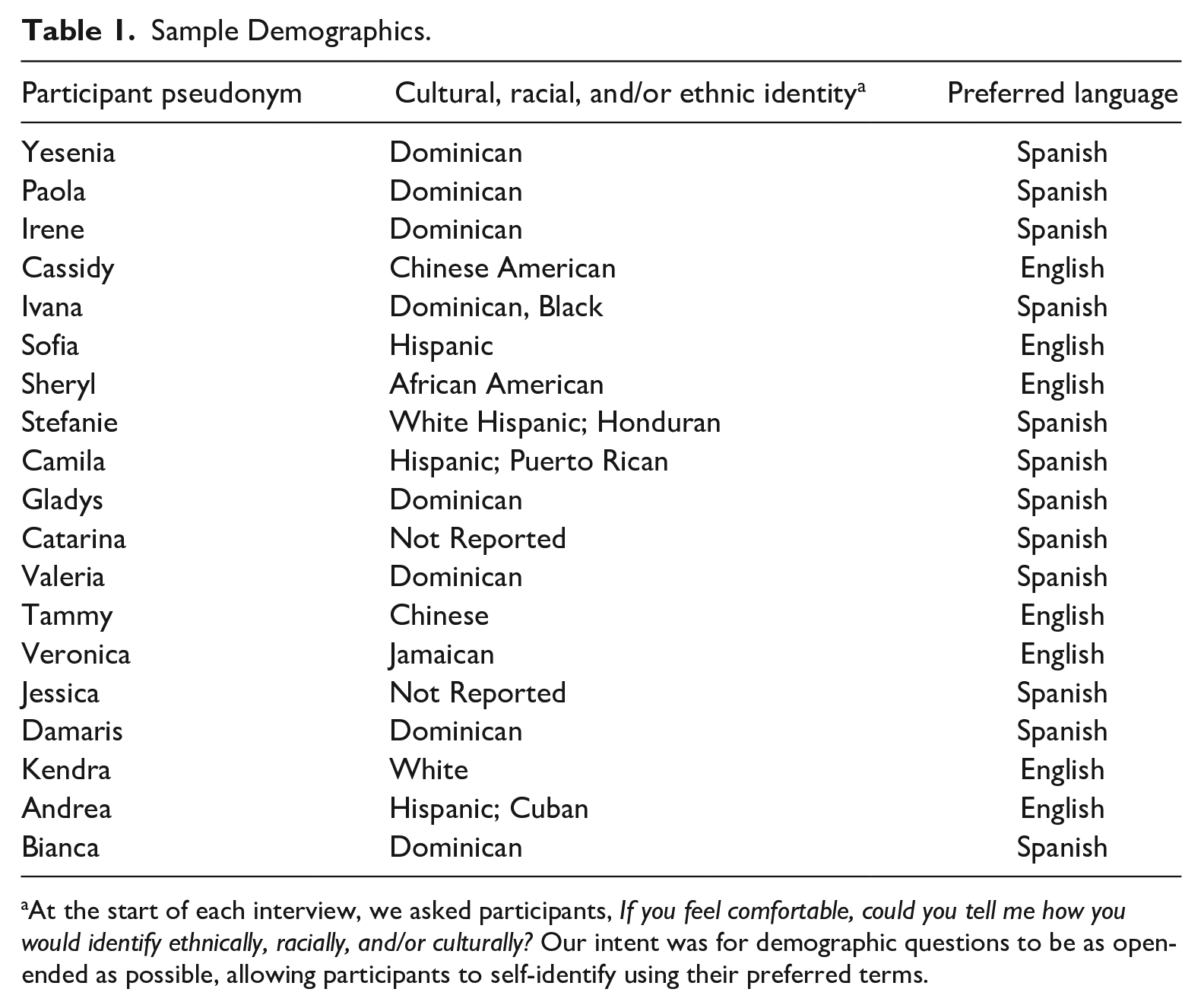
At the start of each interview, we asked participants, If you feel comfortable, could you tell me how you would identify ethnically, racially, and/or culturally? Our intent was for demographic questions to be as open-ended as possible, allowing participants to self-identify using their preferred terms.
During data collection, each of the first three authors conducted some of the interviews. Because the second and third authors are both native Spanish speakers, they conducted all the interviews in which participants preferred to speak in Spanish, and the first author, as a native English speaker, conducted all interviews in which participants preferred to speak in English. Throughout the data collection period, the first three authors met approximately weekly to discuss questions and concerns, emerging insights, and logistical aspects of the process.
After data collection was complete, all team members participated in transcribing interviews. The interviews were then analyzed using iterative stages of coding; all interviews were translated into English prior to analysis. The first author developed first-level codes to categorize the data (Miles & Huberman, 1994), such as motivations for college; challenges of the pandemic; sources of support. Using these codes, she created an interview summary template, and discussed it with the second and third authors. The first three authors then used this template to summarize each interview and met to discuss emerging themes and any additional elements that needed to be added to the template. Guided by these discussions, the first author then created pattern codes to designate emerging subthemes within each category and identified quotes relevant to each of these subthemes (Miles & Huberman, 1994).
To increase the trustworthiness and credibility of the findings, each member of the author team reviewed the thematic findings with a separate lens. The first author checked to ensure that each participant’s voice was represented via multiple quotes in the findings, and that no voices dominated the narrative. The second and third authors reviewed the findings to explore whether the themes resonated with their own lived experiences within the program, as well as their anecdotal observations of their peers’ experiences. As an external auditor, the fourth author reviewed the findings from the perspective of someone unaffiliated with Metro College, observing what was taken for granted within the narrative due to the other authors’ familiarity with the institution—for example, what was initially inaccessible to readers less familiar with Metro College.
Findings
Degree candidates 4 made sense of the pandemic and the resulting shift to online learning as both a barrier and promoter to their educational progress. When asked to explain their persistence within degree programs during the COVID-19 pandemic, participants described being motivated by both external support from peers and family, and by internal motivation to pursue their goals. Candidates’ motivational goals included financial advantages, career advancement, skill development, and being a role model.
The Pandemic as a Challenge to Degree Obtainment
First, candidates experienced the pandemic as creating unexpected challenges and barriers to their educational pursuits. Specifically, they made sense of the shift to online learning resulting from the pandemic as changing three aspects of their education: (1) the boundaries of work, home, and school; (2) the pedagogical structure of coursework; and (3) access to peer support and socialization.
Shifts in Boundaries Among Work, Home, and School
Candidates described how the pandemic challenged their educational pursuits by shifting the boundaries they had established amongst work, home, and school. Many candidates were currently working as early childhood educators; at the time of interviews, some were working in-person, and some were providing instruction online. During the pandemic, the boundaries between home and work constantly changed, as many candidates had to fluctuate between working virtually and working in person. These changes to their work setting impacted their psychological states, which meant they had less emotional resources available to put into their coursework. Kendra explained how shifts in policies at her job occurred,
Daily–not even weekly–daily! You never know what you’re walking into; you’re trying to plan a yearly budget. . . How am I planning a yearly budget? You’re not telling me when they go into school now?
Ivana described the challenges of shifting to virtual classrooms overnight: “At first it affected me a lot, it shocked me a lot. I think that like everyone else, I can say that I got a lot of anxiety not knowing what was going to happen.” In light of the emotional costs of trying to communicate with and engage young children online or trying to get little children to wear a mask, it was challenging to find the energy to engage in coursework. Because both work and school were online and there was therefore no separation between work and school, many participants had a hard time transitioning directly to school after work. Sheryl explained,
[Online learning] did take a toll because being home. . .you get very tired, very sleepy and you’re like, Can I focus? Can I be upbeat? Especially sometimes. . .you get off work [and you think,] Oh, now I gotta be on class! It does take a toll on you.
Participants described the lack of boundaries between home and school life as a challenge off the screen as well. Yesenia, a single mother, shared how hard it was to complete coursework, hold a job, and parent her kids during a pandemic, explaining, “I make a supernatural effort to be able to take the time and dedicate it to the university, [but] balance is difficult.” Some participants specifically mentioned the challenge of having to balance their children’s education at home with their own education, describing having to monitor their kids’ computer use, share computers with their kids, or share internet bandwidth with their kids. Camila, who was sharing a computer with one of her daughters, explained, “I have three children who are in school, so I have to be like a guard going around, [ensuring] that they are connected to the computer.” Irene also described navigating technological challenges, explaining,
I have two school children [who are] also taking computer classes. That is a lot of machines connected to the house today at home. . .[sometimes] the internet gets a bit lazy, a bit slow, and sometimes you have to stop connecting everything and reset it.
Reduced Academic Social Support
A second major challenge of the pandemic was the lack of social interaction in general, and specifically, the lack of interaction with college classmates. At Metro College, classes are small, and candidates often develop close friendships with their peers, which they missed during online learning. They experienced the shift to virtual coursework as impacting their education by changing their social networks. For example, highlighted the importance of social networks developed through her college coursework, prior to the pandemic:
Before [the pandemic], of course, you make friends with [your classmates]. . .you were there, once a week with these people, and you ask for help, or you know you got to know these people for a few weeks and at the end, we would. . . have little parties, you know, we did it! Parties . . . . like celebrating and meeting new people. But it’s really not the same as in person [on] Zoom, because you just see the people [on screen] and you’re just like. . .okay.
Because the student body at Metro is so culturally diverse, candidates mentioned how in-person discussions prior to the pandemic often fostered significant cross-cultural knowledge exchange and rich discussion; participants stated how this was much less common during online learning. For example, Andrea explained, “I missed having those debates in class. . .when you would. . .read assignments, when you have those discussions . . . [now] you’re . . .self-teaching yourself.” Tammy, who immigrated to the US from China, shared,
That’s the thing I miss. . . I do remember the first two courses I did in person, and . . . .it was just [a] very interesting experience for me to get to know people from different places. . .I got to meet people from Mexico and Puerto Rico. . .when I found this out, I was so excited.
Similarly, Ivana explained, “Socializing is not the same on a screen. . .for example, I have had to take courses with people who have been with me before personally, and when they see me on the screen, the feeling is different. . . there was no personal connection.”
The loss of face-to-face interactions with peers negatively impacted candidates’ motivation to participate in classes, as this socialization was something they looked forward to. For example, Jessica explained how prior to the pandemic,
I planned to go to school, go to the institution physically and meet with all my friends, because it is the only way to socialize. [Now, with the pandemic,] when you have a job and you leave work, you only come home. So, I planned how to have a more social life, and [losing] that affected me a lot.
In addition, prior to the pandemic, candidates often relied on each other for academic support. Camila said, “Yes, yes, [the pandemic] made [coursework] challenging, because at least each of us had a partner. . .we helped each other, mostly [on] hard tasks.” Damaris shared how, during online learning,
You have to have such discipline to do the homework. . .[Before the pandemic], at least [when] I was leaving work, I went to [Metro], I socialized with my friends. . .if I did not understand something, I would ask [a friend] or whoever it is; I would start doing my homework right there.
Adapting to Computer-Based Pedagogical Structures
Another challenge that many candidates experienced because of the pandemic was the changes in pedagogical structures resulting from the shift to online learning. Candidates described how virtual instruction was challenging due to the lack of accountability and the lack of in-person interaction with the professor. For example, Cassidy said,
I feel like I’ve had a harder time motivating myself for these online classes. . . [because] I really didn’t need to do anything except for submit things in a timely manner, so it was like, Eh do I really need to do this early, do I really need to put in effort?
Many participants struggled with the lack of in-person interaction with a professor. For example, Sheryl said,
I’m so used to having a teacher right there in my face [from whom] I can ask for help [whereas] on Zoom you gotta really press the button to raise your hand to get the help and get the attention like, I need help! or I just need something verified, and [on Zoom] it’s kind of like. . . she’s still talking, so I can’t really interrupt her. . .
For some candidates, the level of challenge arose from whether the online work was synchronous or asynchronous. At Metro College, asynchronous instruction referred to online courses for which there was no required weekly class time, for example, virtual classes with self-paced modules which students are expected to access independently, rather than during a scheduled video call with the professor and other students. For example, Stefanie explained that asynchronous online learning was difficult for her, but that “if the teacher is applying [the concept] in front of me. . . I can understand it very well, on the other side of the camera.” Bianca shared how the “rhythm” of the class had shifted during online learning, explaining,
It’s a big challenge, because it’s not the same when you have your classes face-to-face, then the teacher can explain to you, and you are taking notes; now you have to search on the internet a lot and there are errors that confuse you.
Some candidates described how their peers’ lack of technological competency sometimes challenged their own learning. Camila explained how because some peers in her class did not understand how to use the mute button, “It could be loud, and the room would be full of noise. . .we could not listen well to the instructor.”
The Pandemic as a Facilitator of Degree Obtainment
Despite these challenges, candidates also experienced the changes associated with the pandemic as having benefited them in the pursuit of their college degree. They made sense of the effects of the pandemic as having three major benefits: reduced travel and childcare costs, pedagogical benefits and new learning opportunities, and increased motivation and support to graduate.
Reduced Travel
Many candidates described the benefits of not having to travel to class, which included savings of time and money, and reduction of safety concerns. Because Metro College’s offerings of coursework in multiple languages are relatively unique in the region, many candidates were commuting for over an hour each way to get to in-person classes, pre-pandemic. For example, Paola recalled how, prior to the pandemic, she sat in traffic for 45 to 90 minutes each time she drove to class. Not having to travel during the pandemic saved Paola and other candidates’ precious time. In addition, because the campus is located downtown, participants who drove from the suburbs had to pay for parking during each course they took. Taking classes from home saved candidates the costs of gas, parking, and/or public transport.
Prior to the pandemic, many Metro College classes ran from 6 to 9 p.m. in the evenings to accommodate teacher candidates’ work schedules. Several participants explained that when classes were in person, they experienced anxiety regarding their own safety when traveling home late at night, and that they felt safer taking courses from home. Camila shared,
You are safer at home, since as you move from home to college, a lot can happen. . .When you go [to class] on public transport you don’t know what might happen on that path. . .it is more dangerous for you as a woman . . .the bus drops me off a bit far away, and I have to walk.
Similarly, Sofia explained, “[Online learning has] been better for me, personally, because I don’t have to travel all the way over there at night. That was a big concern for me . . .to be leaving at nine o’clock at night from downtown.”
In addition, some participants felt that studying at home allowed for increased concentration and focus. For example, Catarina explained, “Although [the pandemic] was chaotic, at the end, this was truly what I need: to stay at home and study [on] the computer.” As winter weather in the city where Metro is located can be very extreme, candidates also appreciated the peace of mind that working from home provided during inclement weather. For example, Valeria explained, “I am calm in my house. I can find a corner where there is no noise and I can concentrate there [and] take my class. . .if it is snowing or if it is very cold, I am in my warm house.” Yesenia also noted that during online learning, her studies were less likely to be interrupted by weather, explaining, “It’s almost better that you don’t leave your house, because for example, [if] it snows, you take the advantages of seeing [the lecture] remotely. You study and there’s no impediment.”
Reduced Childcare Costs
Candidates recognized that the shift to online learning benefited their educational pursuits because it reduced their childcare costs. For example, Irene said,
The pandemic, for me, has resulted in something almost positive on this side, because I have been able to take materials to my house peacefully, to watch my kids, to not have to move all around. For me, it has worked out okay.
Catarina explained that the shift to online learning had “been a blessing” because arranging transportation and childcare was so challenging and time consuming during in-person classes. She reflected, “Before [online learning], I was tense. . .I was leaving [my daughter for] so many hours. . .if [COVID-19] had not happened, I would not be able to finish [my degree].”
Pedagogical Benefits and New Learning
Candidates offered ways in which virtual learning benefited their educational development. For example, Sofia explained how she felt much more comfortable giving speeches from home rather than in person, and that completing public speaking assignments over Zoom helped her develop her confidence. Other candidates shared that being able to complete the work whenever their schedules allowed, rather than within the mandated hours of an in-person class, helped them invest in their coursework more. For example, Tammy explained, “I like [how online learning is] flexible, because [for example,] my teacher just posted the homework and lectures on Monday, and then. . . it’s there, so whenever I can, I can do it. . . I can use my time, you know, whenever I need.”
Several candidates described how one of the benefits of online learning was the opportunity to learn about technological tools; Yesenia, for example, explained the shift to online learning as a process of “learning new things every day.” Candidates felt that they learned things about technology that they never would have had the shift to online learning not occurred. Several candidates expressed pride or accomplishment regarding their new expertise in Zoom, Go to Meeting, Google Classroom, or other online learning applications. For example, Veronica explained, “At the end of the day, having the hands-on experience. . .helped me to learn. . .everything that there was about Google Classroom. . . it was a good learning experience.”
Experiencing Increased Motivation
Given these benefits of online learning, some participants felt that they experienced increased motivation to persist in their teacher education program and graduate due to the pandemic. Sofia, for example, said the pandemic has “actually pushed me to try to finish.” Irene explained how the flexibility of online coursework allowed her to take classes that didn’t fit within her schedule when they were only offered in person: “Because it’s harder for me to get to [the city] to take the class [than to take it online], if it’s easy now, I have to take it. I have to take the opportunity.” Valeria explained, “When I started, I only took one subject or two subjects, but I continued my studies inside my house, so this has helped me to take various subjects in accelerated courses and has advantaged me a lot.”
Despite the social challenges of the pandemic, participants described how they received motivational support from their peers to stay in school. Yesenia explained how she “relied on the guidance of some [peers] who have already spent more time than me. . .and they really supported me in the remote classes.” Valeria described starting a group chat with peers in her class and inviting new friends to join the chat so that they could support each other with questions regarding online learning. Stefanie shared how she and her peers motivated each other during the pandemic, explaining, “We talked to each other: No, look, we are going to continue, we are going, we are going! . . .We try to get into the same class and help each other to move forward.”
Many candidates also described how their families noticed their motivation to persist in college and supported them in meeting their goals. Candidates received intergenerational support from their families, including from partners and siblings, parents, and children. Ultimately, however, candidates characterized their internal motivation as the key to their college persistence. As Ivana explained, “To keep myself in college, my [main] support is indisputably me, because I want to be in college.”
Making Sense of Motivation Amidst a Pandemic
Given candidates’ increased motivation to graduate, we were interested in understanding how they made sense of the shift to online learning in regard to their underlying goals for degree completion. When asked to explain their persistence in college during a pandemic, degree candidates described four overarching goals driving their internal motivation: financial advantages, career advancement, skill development, and being a role model.
Financial Advantages
For almost all candidates, the financial benefits of having a degree were a key motivator for persisting in college during a pandemic. Candidates observed that holding an associate degree meant that they could earn a higher salary for their current roles and would have the opportunity to apply for higher-paying jobs. In addition to being paid more for their work, several candidates explained that their current employers were providing them with scholarships to cover part of their college tuition, so there was a financial incentive to get their degree completed. As an example, Sofia, who was currently employed as a teacher assistant, explained, “I’m really motivated because there’s a scholarship and my job would also pay for it. . . they provided me a little chance. . .[so] why not? Now is the time.”
Career Advancement
Financial advantages aside, candidates were also motivated to persist in obtaining their degree during the COVID-19 pandemic because they felt that the title itself would allow them to advance in their careers, giving them an advantage when applying for jobs and allowing them to progress toward greater levels of professional responsibility. Some candidates described career goals they wanted to reach; for example, Kendra, who currently directs a small center, was motivated to take classes to advance her administrator credentials. Other candidates who were not yet administrators described obtaining a college degree as a step toward owning and directing early childhood centers of their own. Gladys explained, “I want to have my own business, to be my own boss. I want to have a better future.” Similarly, Stefanie shared, “What I’m thinking about and dreaming, with God, is to have my own daycare in my house. I want to work for myself.”
Candidates expressed a belief that having the degree would improve their job security and stability. For example, Ivana said, “I want the degree because it’s a job you can do that’s not seasonal, it’s a job you can have the whole year, compared to other jobs that close for the season and things like that.” Camila added,
I would like to have the degree because you never know where you will end up. If I need to return to [Puerto Rico] or something, it’s a really good opportunity on the island. It doesn’t pay as well as here, but there’s more chances there.
With a degree, some candidates felt they would have more agency to choose and remain in a specific type of classroom. At her current job, Catarina was often pulled into different classrooms to support various teachers, so she was pursuing a degree because it would allow her to have her own classroom. She explained, “I need a specialty; I want to stay with the kids in one classroom and to be competent to take care of the kids.”
Although many of the courses at Metro are offered in both English and Spanish, EC candidates are required to pass at least two college-level writing classes in English. Some candidates, including Tammy and Bianca, observed that developing their English proficiency via these courses helped advance their careers in early childhood education. Valeria explained that she originally enrolled in Metro College for English courses, but then committed to a degree in early childhood because,
I started to think that to prosper in this country [I needed] to have a degree in hand, a certificate, a degree to be able to climb to higher positions. I said Well, if I do not have a certificate in hand. . .what comes out is a factory [job]. I do not want to work in the factory. I want to work in a place where I can develop as a professional. . .that motivated me.
Overall, many candidates were motivated to get their degree by the belief that it would open up a variety of job opportunities. Jessica, who had immigrated to the US, shared,
Well, when I came to this country, my first job was in a childcare center, and I realized that I had arrived empty-handed. I had no training. Then someone spoke to me and said, If you are afraid of English, you can take classes in Spanish at [Metro College]. And I was also able to take some courses that were paid for by the state, and I was there at [Metro College]. There is a door that is open: I have to enter if it is open.
Sheryl also described her pursuit of a degree to “open the door.” Bianca observed that completing an associate degree would allow her to transfer to a four-year college, since the initial degree would demonstrate that she was prepared for a bachelor’s level workload.
Several candidates expressed the belief that if they continued to develop themselves through college coursework, job opportunities would come to them. For example, Ivana said, “Definitely, when you’re prepared you have a lot better opportunities.” Andrea explained,
I decided to keep [taking classes] because there’s so many more avenues that you can go, especially once you get a degree. Maybe if I wanted to do . . . higher education teaching and learning, I can do that as well. So this is . . . a stepping stone for myself.
Interested in eventually pursuing licensure as a social worker, Veronica shared,
The road goes on in early childhood. . . it’s a wide sector. . .there’s so many different areas of study you can do in early childhood that will allow you to be in the school system working with the kids.
Some teacher candidates described how important it was to both have a vision for the future and to be open to the opportunities that present themselves along the way. As Jessica explained,
My dream job . . . is to be in charge of all the schools in [the state], making decisions about how schools should function. This is the highest point to which I aspire. . .my expectations are very high. . .When you want to improve yourself, you reach high, even if you don’t know the pathway. . . I may arrive at the opportunity one day, and if I’m not prepared, I’m not going to get it.
Thus, whether candidates had a specific career goal in mind or not, persisting in their college coursework during the pandemic increased their potential for advancing in their careers.
Developing Professional Competencies
Candidates were motivated to persist in college coursework during the COVID-19 pandemic in order to better serve the students in their current classrooms. Across candidates, a passion for and commitment to the education of young children and their future success was evident. Gladys stated, “I have to help these children have a good future, a good education.” Kendra explained, “[I’m] just trying to be there for the kids because, if I give up, then who’s going to do it?. . .It’s really just the love for kids. . .wanting to help them through difficult times.” Bianca shared that through her coursework, she was able to develop tools to identify students’ needs and make sure she provided the appropriate support. Likewise, Ivana offered, “The more training I feel that I have, the better I am able to serve the students,” and Paola added, “[Taking classes] helps me to help them . . . the university gives me the material so that I can educate the children, so that I can get the tools.” Candidates shared that coursework allowed them to stay up to date with current EC policies, as Sofia observed, “The ECE guidelines are changing all the time, so you have to be on top of all that.”
Finally, some candidates stated a systemic need for more well-trained early childhood teachers and expressed a desire to develop their own skills to meet these gaps. For example, Camila recognized that there were not many preschools in her neighborhood, and she wanted to develop her own skills so more students could get an education. She explained, “I think that if there were more teachers or there were more schools, there would be more educational opportunities for the kids.”
Being a Role Model
In addition to the financial advantages, opportunities for career advancement, and opportunities for skill development, serving as a role model for their own children was an important motivator for many candidates. Even amidst a global pandemic, candidates were committed to their educational pursuits to set a strong educational example. Andrea explained,
I have two younger kids too, so I feel like you have to be a role model for your children. [They] can always say, Well, you didn’t do it, why do I have to do it?. . .If I learn more and I’m educated then I can help them be more educated as well.
Bianca shared, “[Getting my degree] is an example for my children that whatever they want can be done. And when you want to improve, no matter where in the world you are, it can be achieved.”
Veronica, who immigrated from Jamaica, explained that it was important to get her degree because she wanted to demonstrate to her daughter, who received special education services, that she could persist and be successful in school. She explained,
I tell myself that I’m going to make use of, you know, the opportunity that I have, and I told myself that I’m going to make myself proud, [and] my daughter also. . .I do it and I encourage her, I say to her, You can do it! I said, Your mom used to be worse than you. . .when I was small like you. . .back home [in Jamaica] before we came here. . .I made it my point of duty to work just for you! I support her.
A few candidates expressed how their children preferred to speak in English, and that pursuing a degree ensured that they could maintain communication with their children. Tammy, whose first language was Mandarin, explained, “As they get older. . . I have to talk [about] something, you know, deeper with them. . .so I feel I really have to improve my English. . .it’s important for me and for my relationship with my own kids and my family.” For some candidates, it was particularly important to complete their teacher training within the United States; for example, Stefanie explained, “I want to progress more in this country. I also want them to see that as a Hispanic, one can achieve many things.”
Discussion
In this research, we found that candidates conceptualized the shift to online learning which occurred in response to COVID-19 as both a challenge and a benefit. In their review of the literature on the use of sensemaking theory to investigate organizational crisis and change, Maitlis and Sonenshein (2010) noted that “commitment serves as the foundation for sensemaking” (p. 562). During a crisis, having a strong commitment to the organization, or the organization’s goals, helps individuals process the changes they have experienced and re-establish their vision for engaging with the institution (Maitlis & Sonenshein, 2010). In our study, we found strong evidence that degree candidates remained highly committed to completing their degrees, citing financial advantages, career advancement, the opportunity to be a role model for their children and communities, and the opportunity to develop their professional skills as motivators for their persistence.
This research demonstrates how deeply these early childhood professionals valued obtaining a college degree, yet our findings also highlight the dualities of the continued effects of COVID-19 on community college students. As institutions poised to promote accessibility and inclusion within the higher education landscape (Dowd, 2007), understanding that students may experience the pandemic as both an opportunity and a barrier can help leaders and faculty respond to their students strategically and effectively.
Implications for Community College Leaders and Policy Makers
Our study provides community college leaders and policy makers with several insights regarding how to support students’ degree completion, while schools continue to evolve as a result of COVID-19. First, our study affirms the importance of peer social networks in facilitating degree completion. Previous research demonstrates that a sense of belonging, even among commuter college students, is crucial for students’ perceptions of their academic success (Wiseman et al., 2004), and that peer social support can moderate the relationship between the experience of acculturating to U.S. college culture and students’ mental health (Crockett et al., 2007). In a study of English learners’ experiences in community colleges, Garza et al. (2021) found that sense of belonging had a significant effect on re-enrollment decisions. Thus, community college leaders and faculty should consider creative ways to facilitate social support among students even in virtual settings, such as Whatsapp group chats, lively discussion boards, meet-and-greet video meetings, or online affinity events. The benefits of such efforts have already been demonstrated in some emerging research; for example, in a study of candidates’ use of WhatsApp within three teacher education programs in Ireland, Stone and Logan (2018) found that students’ social connections via WhatsApp helped them stay engaged in coursework, ask questions they did not want to ask their teacher, and build empathy with other students. Similarly, Evans et al. (2016) found that participating in online networks was related with positive academic outcomes for community college students. Opportunities to develop peer networks allow degree candidates to ask each other questions and encourage each other’s progress, invite new participants into the program, and encourage peers to persist in their degrees.
Second, our study affirms the importance of recognizing and supporting students’ internal motivation, goal setting, and visions for degree completion. Previous research suggests that having clear goals is an important facilitator of degree completion for community college students (Martin et al., 2014), and it was evident from our participants that a clear vision supported them in making sense of the changes to their education brought on by COVID-19. To this end, community college leaders could consider offering workshops that align with students’ larger goals such as developing professional competencies, financial literacy, and knowledge of professional pathways within early childhood.
Third, our findings demonstrate the importance of offering differentiated technology support for community college students. As community college leaders make decisions about the future of online learning, it is important to consider how courses are made as accessible as possible for a wide range of students. Our findings show that while some students felt completely comfortable with the technological demands of the shift to online learning, others experienced a steep learning curve; while some students appreciated the independence fostered by asynchronous online learning, others craved the explicit instruction provided during in-person courses before the pandemic. Colleges should consider developing a continuum of online and in-person learning opportunities within their courses, to support students’ learning needs and preferences, and provide differentiated resources for increasing their technological competencies. Technological competencies are invaluable for both educational and professional pursuits.
Implications for Future Research
As researchers and policy makers explore ways to increase college access among early childhood professionals through community college coursework, we urge continued data gathering regarding candidates’ sensemaking of their experiences. In doing so, it is important to include the voices of current candidates in both the research process and in any subsequent decisions and recommendations regarding the future of early childhood teacher education programs. Due to the professional and cultural diversity of our research team, we were able to obtain and analyze rich data regarding candidates’ sensemaking of their experiences at Metro College. By creating a research team with different types of institutional and social knowledge and power, we aimed to capture different dimensions of this social environment in which sensemaking occurs. However, our study did not include any administrators; in future research, scholars might consider comparing the perspectives of community college leaders and community college students in how they experienced and made sense of the shifts to online learning from their relative positions of power.
There were several additional limitations of our study that could be important areas of future research. All participants identified as female, and so were not able to explore male or non-binary candidates’ perspectives or experiences. Future research could address the experiences of candidates holding other genders, as there is a need for gender diversity within the field (Cole et al., 2019). In addition, we did not disaggregate participant data to look for trends in experiences related to race, ethnicity, work status, or other personal identifiers. For example, many Asian college students experienced unique forms of anxiety and discrimination during the pandemic (Haft & Zhou, 2021), but we did not examine whether there were racialized differences in degree candidates’ experiences in our research. In future research, scholars could explore the distinct ways in which the pandemic impacted specific subpopulations of teacher candidates. Within immigrant and refugee student populations, differences in socioeconomic and educational backgrounds result in wide variability in their experiences within community colleges (Leo, 2021), so it is important for future researchers to disaggregate student experiences to identify differentiated support needs.
In addition, we deliberately chose to conduct a single interview with each participant due to capacity, funding, and respect for our participants’ schedules. Although single interviews provided us with sufficiently rich and saturated data for an exploratory qualitative study, future researchers might consider longitudinal designs in which they conduct multiple interviews over several years. Because sensemaking of the pandemic is new, a longitudinal study exploring teacher candidates’ motivation over the years would help researchers track the effects of the pandemic on education over time. Continued research regarding students’ sensemaking will be an essential aspect of ensuring that community colleges fulfill their potential for increasing access to higher education in this country, especially as community colleges continue to evolve in light of the COVID-19 pandemic.
Footnotes
Declaration of Conflicting Interests
There were no potential conflicts of interest with respect to the research, authorship, and/or publication of this article.
Funding
The author(s) disclosed receipt of the following financial support for the research, authorship, and/or publication of this article: The authors received financial support from American Educational Research Association for the development of this article.
