




Abstract
Lesbian and gay faculty members in higher education are often faced with the dilemma of whether to be open with students about their sexuality (Griffith & Hebl, 2002). Some argue that faculty members who remain closeted may be threatening their own mental health or personal relationships (Drescher, 2004; Rankin, 2003). Others contend that gay and lesbian faculty would be more effective if they were forthcoming with their students because a deeper sense of trust is fostered. At the same time, however, these faculty members incur risks that those who remain closeted may not. For example, studies have shown that revealing or discussing one’s sexual orientation caused students to focus on that trait above all others (Anderson & Kanner, 2011; Batten et al., 2020; Ripley et al., 2012), and students believed lesbian and gay instructors had an agenda in disclosing their sexuality (Anderson & Kanner, 2011; Russ et al., 2002). Another study showed that, after revealing his own sexuality to students, a gay instructor’s perceived credibility was adversely impacted on student evaluations (Russ et al., 2002). This is troubling, given that researchers have argued that such biased student evaluations could pose an “occupational hazard,” negatively affecting hiring, promotion, and tenure for gay and lesbian faculty members (Rankin, 2003; Russ et al., 2002; Weiler-Timmins, 2011).
This potential for bias on student evaluations may be especially problematic for community college faculty for whom teaching, rather than conducting research, is the primary responsibility (Campbell & Bozeman, 2008; Schuck & Larson, 2003; Shattuck et al., 2018). Given this, lesbian and gay community college faculty members may be at greater risk for negative student evaluations of credibility due to their sexuality, and these negative student evaluations pose a heightened threat due to the centrality of teaching in their positions. Consequently, the purpose of our study was to determine how community college students’ perceptions of a male teacher’s credibility were influenced by the instructor being open about a gay or straight sexual orientation. We posed two research questions, inspired by Russ et al. (2002):
What is the relationship between students’ perceptions of the teacher credibility dimensions of character, competence, and caring and a male instructor’s sexual orientation?
What is the relationship between credibility and perceived student learning among students experiencing a gay or straight instructor?
Like Russ et al. (2002) and other aforementioned studies, the theoretical framework for our study is teacher credibility, which is an attitude held by a student at a given time about an instructor (McCroskey, 1972). It includes three dimensions: character (trustworthiness), competence (intelligence), and caring (goodwill) (McCroskey, 1972; Teven & Katt, 2016). Credibility has been described as a “super-variable” (Teven & Katt, 2016, p. 184) because of its relationship to many facets of classroom dynamics and teacher-student relationships (McCroskey et al., 1974; Nadler & Nadler, 2001), including what students believe they learn (Gili, 2013; Myers & Martin, 2006; Russ et al., 2002; Teven & McCroskey, 1997), and student evaluations of instructors (Boren & McPherson, 2018; DeSouza & Olson, 2018; Russ et al., 2002; Teven & McCroskey, 1997). Further, students who do not trust an instructor are unlikely to invest in learning (Teven & Katt, 2016); yet, students who perceive an instructor to be highly credible are likely to recommend that faculty member to a friend and register for another course taught by the same instructor (McCroskey et al., 1974; Nadler & Nadler, 2001).
Another factor that relates to increased credibility ratings is high instructor immediacy—including behaviors such as smiling, eye contact, gesturing, and using humor (Glascock & Ruggiero, 2006; Johnson & Miller, 2002; Patton, 1999; Teven & Katt, 2016; Thweatt & McCroskey, 1998). Credibility ratings have also been shown to be affected by instructor traits including speech rate (Simonds et al., 2006), dialect (McGillis, 2017), attire (Morris et al., 1996), or culture or nationality (Johnson & Miller, 2002; Zhang et al., 2011).
Regarding demographics, older instructors have been perceived as more credible than their younger counterparts (Semlak & Pearson, 2008), White instructors were rated higher than Hispanic instructors (Glascock & Ruggiero, 2006), and Black instructors were shown to be held to a higher standard than their White colleagues (Hendrix, 1997). Male teachers have been rated as more competent than female teachers (Nadler & Nadler, 2001), and students focused more on the caring attitudes of female instructors—perhaps attributable to societal notions about caring attitudes of women (Freeman, 2011).
Related to instructor sexual orientation and credibility, Russ et al. (2002) asked a male guest lecturer to express a gay or straight sexual orientation by mentioning the name of a romantic partner in two quasi-experimental conditions. They found students in the gay instructor condition provided significantly lower credibility ratings than those in the straight instructor condition on the tested dimensions of character and competence. In addition, students in the gay lecturer condition perceived they learned significantly less than participants in the straight lecturer condition. Open-ended response data demonstrated a similar imbalance, with students in the straight instructor condition providing more positive comments than those in the gay instructor condition.
In a more recent study, DeSouza and Olson (2018) found similar results: Students in the straight instructor condition provided more favorable character ratings than those in the gay instructor condition, and students rated the gay instructor significantly lower on two of six prompts related to competence. In contrast, Boren and McPherson (2018) found students rated a gay instructor higher, but only for the caring dimension. Although these three studies provide some context regarding student perceptions of gay instructors, it is noteworthy that they span nearly two decades, offer inconsistent findings, and all were conducted on university campuses. No study has investigated teacher credibility as it relates to instructor sexual orientation in the context of a community college, wherein teaching is particularly vital to the retention and professional advancement of instructors.
Methods
Unlike other studies relating to teacher credibility and sexual orientation (Boren & McPherson, 2018; DeSouza & Olson, 2018; Russ et al., 2002), we conducted this study using mixed methods with the hope of gleaning more about students’ perceptions than survey data alone might uncover. Rather than adopt Pragmatism, a common philosophical foundation for mixing (Tashakkori & Teddlie, 2003; Teddlie & Tashakkori, 2003), we conducted this study from the standpoint of Critical Realism (CR), due to its closer alignment with our own views regarding ontology and epistemology.
Critical realists hold ontological beliefs rooted in realism and subjectivist epistemological notions similar to constructivism (Bhaskar, 2008; Dansereau, 2018; Fletcher, 2017; Maxwell, 2012; Maxwell & Mittapalli, 2010; McEvoy & Richards, 2006; Sayer, 2000; Zachariadis et al., 2013). They describe a real world that exists independently of our observations and assert that our understanding of that world is socially constructed from our unique perspectives (Bhaskar, 2008; Maxwell & Mittapalli, 2010). Consequently, all scientific theories and claims are tied to individual perspectives and are therefore, fallible (Fletcher, 2017; Maxwell & Mittapalli, 2010; Olsen, 2004; Sayer, 2000).
CR’s realist ontology and relativist epistemology are particularly appropriate for mixing methods within a study (Sayer, 2000), because each kind of data may lead the researcher to consider alternate explanations (Olsen, 2004; Zachariadis et al., 2013). CR allows for communication and cooperation (Maxwell & Mittapalli, 2010) between quantitative and qualitative data in a mixed-methods study: “The methods complement each other, providing richness or detail that would be unavailable from one method alone” (Risjord et al., 2002, p. 269). In CR research, quantitative data help researchers identify patterns that might otherwise be masked (McEvoy & Richards, 2006), and use these patterns to help define the causes of an observed phenomenon (Zachariadis et al., 2013). Qualitative data are useful because they allow for multiple and emergent interpretations (McEvoy & Richards, 2006), and “illuminate complex concepts and relationships that are unlikely to be captured by predetermined response categories or quantitative measures” (McEvoy & Richards, 2006, p. 70). Within CR, qualitative data allow the researcher to uncover the causal mechanisms and social context of the phenomenon under study (Zachariadis et al., 2013).
Mixing methods can be helpful because each kind of data may lead the CR researcher to consider alternate explanations of the same phenomenon, and these conflicting explanations are crucial to the CR analytical process (Olsen, 2004; Zachariadis et al., 2013). We employed a sequential mixed-methods design utilizing questionnaires and semi-structured interviews (Creswell et al., 2003). Data were mixed using an integrated—or coherence—approach to triangulation (Risjord et al., 2002): We initially analyzed the two types of data independently and then compared and mixed the data for completeness and confirmation.
Study Site
The study took place in eight course sections of Music Appreciation at a large community college in an urban area of the Mid-Atlantic United States. The Music Appreciation course was selected for three reasons: Firstly, the course is aligned with both authors’ teaching and research specializations, though neither author was the instructor of the course nor had a relationship with the participants. Secondly, it was deemed especially appropriate due to the broad availability of related humanities courses at community colleges in the United States. Finally, these music courses typically draw students seeking university transfer from a range of areas and majors.
Procedures
We randomly assigned the eight course sections to experience one of two quasi-experimental conditions in which a guest lecturer identified as gay or straight by mentioning the first name of either his husband, “Jerry,” or wife, “Jennifer,” 3 times. The otherwise identical 20-minute lectures pertained to the physiology of the human voice.
The guest lecturer was a White man in his early 60s who had experience teaching classroom music, but no connection to the college or its students. Because high levels of immediacy have been shown to increase credibility ratings (Glascock & Ruggiero, 2006; Johnson & Miller, 2002; Patton, 1999; Teven & Katt, 2016; Thweatt & McCroskey, 1998), we asked the lecturer to maintain consistency regarding immediacy cues, attire, and style of delivery across lectures. The first author was present for each lecture to ensure consistent delivery.
Because competence is a component of teacher credibility (Gili, 2013; Hendrix, 1993; McCroskey et al., 1974; Pornpitakpan, 2004; Teven & Katt, 2016), we sought to establish the lecturer’s subject-matter expertise by having him perform a musical work during the lecture. Promoting the highest possible credibility scores for a lecturer is in keeping with the procedures used by other credibility researchers (Boren & McPherson, 2018; DeSouza & Olson, 2018; Russ et al., 2002).
Data Collection
Upon enrolling in the study, participants completed the College Student Survey (CSS), adapted from Russ et al. (2002) (Appendix A). This instrument consisted of demographic questions and open-ended prompts. We updated the demographic questions and altered them to elicit responses consistently in the form of categorical data. The original measure contained four open-ended prompts. One of these prompts was relevant to the inquiry and was designed to determine participants’ initial tolerance of gay instructors; the other prompts were designed to prevent participants from determining the true nature of the study. We omitted one of these because it centered around a dated concept regarding HIV/AIDS and the gay community. We altered the two remaining prompts to suit a community college environment lacking on-campus housing.
Immediately after the lecture, participants completed McCroskey and Teven’s (1999) Source Credibility Measure (SCM) (Appendix B), which includes 6 items for each of the three dimensions (character, competence, and caring), for a total of 18 items. Participants recorded their responses to the lecturer on a 7-point semantic differential scale containing two bimodal adjectives for each item. The bimodal adjective pairs for competence were intelligent/unintelligent, trained/untrained, expert/inexpert, informed/uninformed, competent/incompetent, and bright/stupid. The adjective pairs related to character were honest/dishonest, trustworthy/untrustworthy, honorable/dishonorable, moral/immoral, ethical/unethical, and genuine/phony. The following pairs related to the caring dimension: cares about me/doesn’t care about me, has my interests at heart/doesn’t have my interests at heart, self-centered/not self-centered, concerned with me/unconcerned with me, sensitive/insensitive, and understanding/not understanding.
Prior factor analytic studies established the construct validity of both the dimensionality of teacher credibility and the prompts on the SCM (McCroskey & Teven, 1999; Teven & McCroskey, 1997). Following the procedure used by Russ et al. (2002), we included an item on the SCM asking participants to indicate how much they perceived they learned from the guest lecturer on a 10-point scale, with “10” indicating “learned a great deal,” and “1” representing “learned nothing.” We added open-ended questions about the guest lecturer and his instruction to the SCM. These questions asked students to (a) list three adjectives they would use to describe the instructor, (b) indicate whether they would recommend the institution hire him and why, (c) reflect on similarities between the instructor and other great teachers they had in the past, and (d) note differences between this instructor and other great teachers.
The first author conducted individual semi-structured follow-up interviews about 1 week after the guest lecture. One volunteer from each class was selected at random to participate, for a total of eight interview participants. These interviews took place in a faculty office or a group study room on campus and were audio-recorded and transcribed. Each interview was about 20 minutes in length and participants were given a $10 gift card for their participation. Interviews consisted of pre-determined questions that fell into three general categories: (a) what students remembered about the guest lecturer, (b) students’ personal responses to the lecture(r), and (c) how participants thought a gay lecturer would be perceived by community college students. In addition, the first author engaged in follow-up questioning and conversation with the interview participants. The study and procedures were approved by the authors’ university Institutional Review Board.
Participants
At the onset of the study, 100 students elected to enroll. Due to absences or revocations of consent (see Ethics), data from 82 students were included in the quantitative phase of the study (Table 1). Due to insufficient numbers of participants in some subgroups to allow for analysis, we collapsed the categories “Transgender,” “Bisexual,” and “Gay” into a larger category, “LGBT.” In addition, the categories “Ages 24–29,” “Ages 30–39,” and “Age 40 or older” were collapsed into “24 and older.” Pertaining to the prompt asking if participants had gay, lesbian, or bisexual friends or family members, we combined data from the category “none” with “a few gay acquaintances.”
Demographic Characteristics of Study Participants.
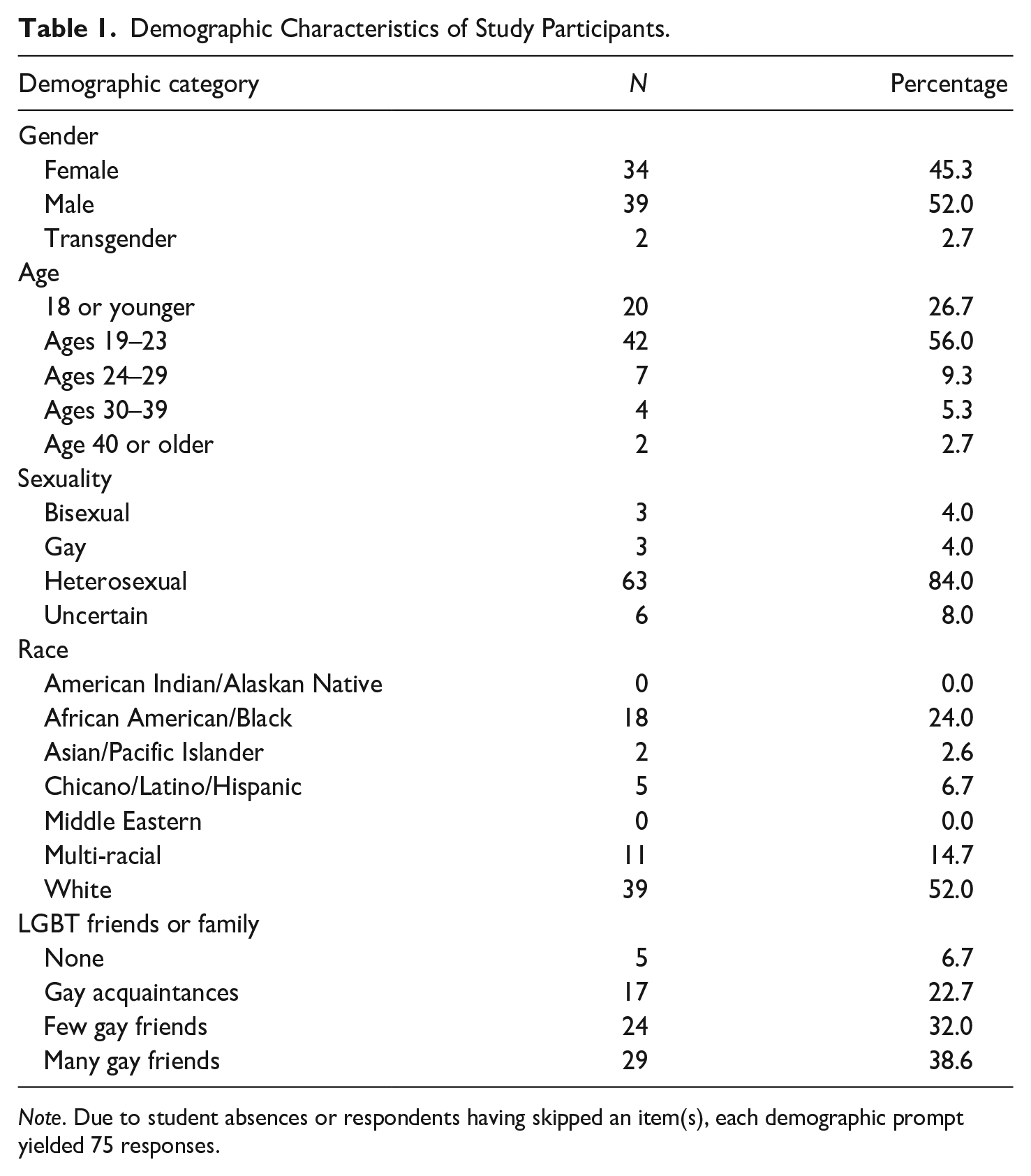
Note. Due to student absences or respondents having skipped an item(s), each demographic prompt yielded 75 responses.
Fifty participants experienced the straight lecturer condition and 32 experienced the gay lecturer condition. In terms of the interviewees, five (three women, two men) experienced the gay lecturer condition and three (one man, two women) were in the straight lecturer condition. In accordance with IRB protocol, and to ensure that interview data and questionnaire data could not be linked, we did not collect additional demographic data for the interview participants.
Data Analysis
We used magnitude coding (Saldaña, 2016) to analyze open-ended data from the CSS. We assigned a score to each response using a 5-point scale (1 represented a very homophobic response and 5 indicated a very accepting response). Then, we conducted analyses of variance on these scores to check for initial differences in tolerance of gay instructors between groups.
To address Research Question 1, we summed responses to the 6 SCM items in each dimension, creating three scores per participant (McCroskey, 2007). We then conducted analyses of variance on these scores to determine whether there were significant differences according to condition.
For Research Question 2, we computed Pearson r to check for correlations between SCM scores and scores on the additional SCM item gauging perceived learning. To test for differences between groups on this question, we employed an independent samples t-test as was done by Russ et al. (2002) and Boren and McPherson (2018).
We sought to determine reasons for, and clarifications of, the statistical results through analysis of the qualitative data. We used qualitative content analysis and directed coding (Hsieh & Shannon, 2005) to do this because of a strong alignment with the epistemological and ontological assumptions of CR (Fletcher, 2017; Hoddy, 2019). We drew a priori codes from extant teacher credibility literature as well as from the study we replicated (Russ et al., 2002) to focus the analysis. These codes were competence, character, caring, learning, and immediacy. After analyzing according to these a priori codes, we coded across the corpus of qualitative data to highlight similarities among responses, and separated responses by condition to reveal differences. Data that did not fit the a priori codes were used to create new codes (Hsieh & Shannon, 2005).
Ethics
As required by the authors’ Institutional Review Board, the first author returned to each class after data collection had ended to inform participants that the topic of the investigation pertained to student responses to gay and straight lecturers. Participants were then offered the opportunity to revoke consent for the use of their data, and 34.1% (n = 28) did so. Of these, 20.5% (n = 15) withdrew from the straight lecturer condition and 28.9% (n = 13) withdrew from the gay lecturer condition.
Results
Quantitative
Participants in the two conditions did not differ significantly in terms of gender [χ2(2) = 3.2, p = .206], age [χ2(2) = 2.2, p = .331], sexuality [χ2(2) = 0.4, p = .881], race [χ2(4) = 7.7, p = .102], or number of gay, lesbian, or bisexual friends or family members [χ2(2) = 4.4, p = .110]. Responses to the open-ended prompt on the CSS regarding participants’ initial tolerance of gay instructors showed moderately high inter-coder agreement [r(81) = 0.870, p = .01] and revealed no initial differences between groups [F(1) = 0.08, p = .79, Mstraight = 3.3, Mgay = 3.4]. Data from the SCM were shown to be highly reliable [α = .93].
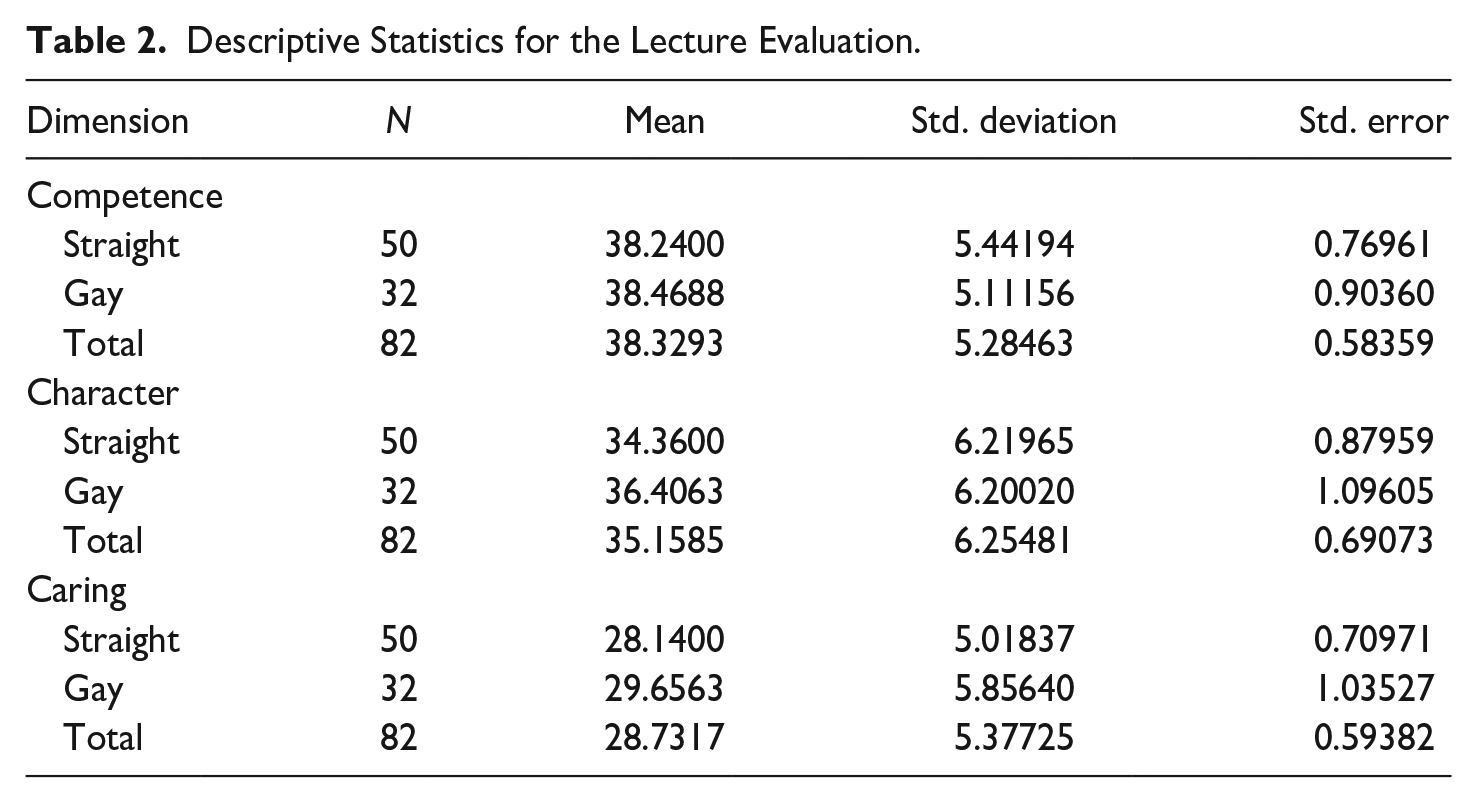
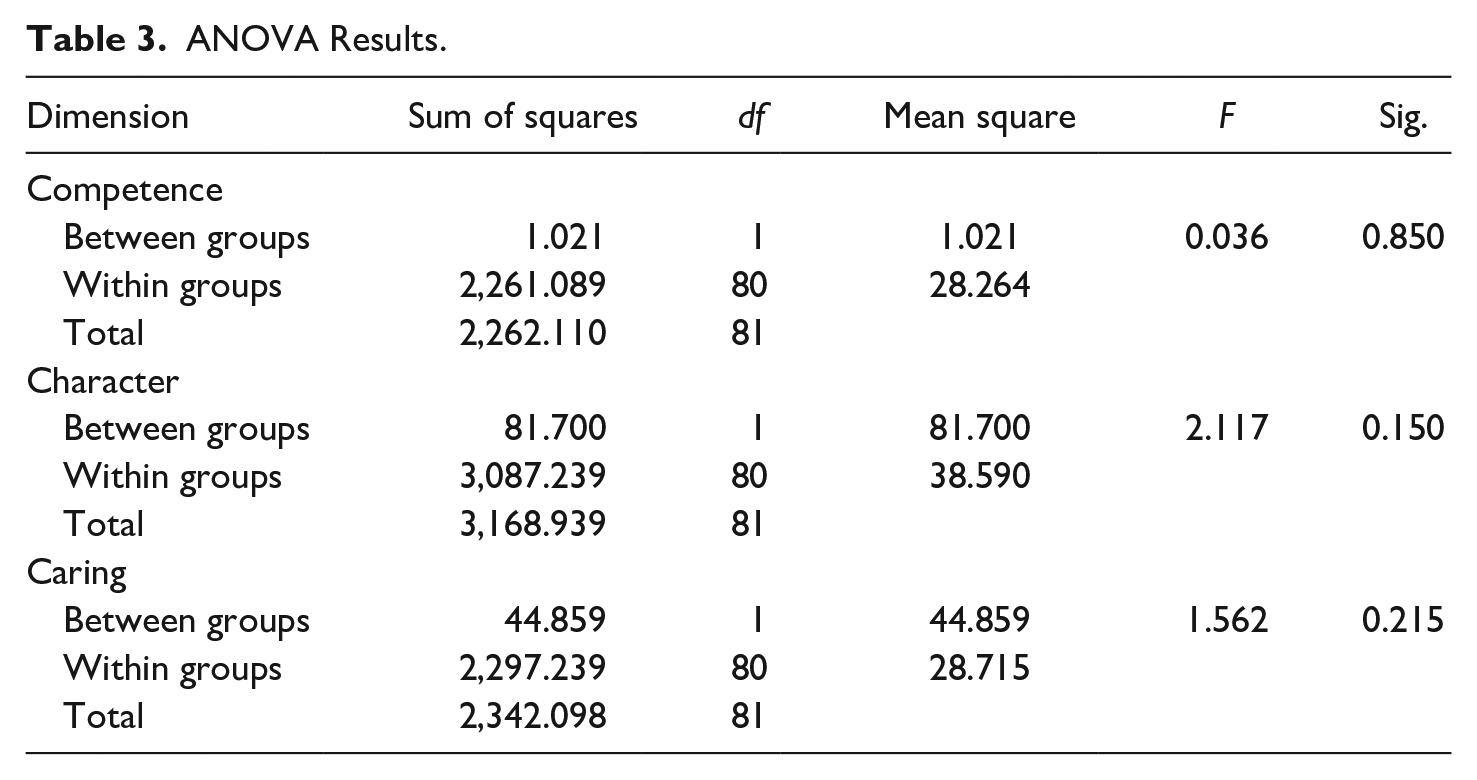
Pertaining to Research Question 1 (“What is the relationship between students’ perceptions of the teacher credibility dimensions of character, competence, and caring and a male music instructor’s sexual identity?”), analysis of the summed credibility dimension scores from the SCM showed no significant differences by condition for competence [F(1) = 0.036, p = .850, d = 0.04], character [F(1) = 2.117, p = .150, d = 0.33], or caring [F(1) = 1.562, p = .215, d = 0.28]. In addition, participants in the two conditions were also not significantly different in their likelihood to recommend hiring the instructor [χ2 (2, N = 82) = 0.542, p = .76]. No significant differences in credibility ratings by participant demographic categories were found across conditions (Tables 2 and 3).
Descriptive Statistics for the Lecture Evaluation.
ANOVA Results.
Regarding Research Question 2 (“What is the relationship between credibility and perceived student learning among students experiencing a gay or straight music instructor?”), participant perceptions in the gay lecturer condition (M = 7.3, SD = 2.1) and straight lecturer condition (M = 7.0, SD = 1.8) were not significantly different [F(1) = 0.300, p = .585]. Within the gay lecturer condition, there was a significant, moderately strong, positive correlation between participants’ perceptions of learning and character [r(32) = 0.52, p = .002]; however, within the straight lecturer condition, all three dimensions of credibility (competence [r(50) = 0.37, p = .009), character [r(50) = 0.53, p = .00006], and caring [r(50) = 0.56, p = .00004]) were significantly and positively correlated with students’ perceived learning. Strengths of these coefficients ranged from moderately weak (0.37) to moderately strong (0.56).
Qualitative Data: Open-Ended Responses
In keeping with the tradition of CR and mixed-methods research (Maxwell & Mittapalli, 2010), the qualitative data gleaned from open-ended questions and interviews allowed us to look for possible explanations for the statistical findings and focus on particular cases that may have diverged from or clarified those findings. The a priori codes we established based on related literature were competence, character, caring, learning, and immediacy.
Competence
Participant responses that fell under the competence code were often documented within both conditions, such as “interesting,” “trained,” “talented,” and “well-spoken.” Others, such as “brilliant,” “competent,” “effective,” “informed,” and “organized” were unique to the straight lecturer condition. Eleven participants described the straight lecturer as “smart,” but only one participant described the gay lecturer as such. Similarly, “intelligent” and “trained” were recurring in the straight lecturer condition, but not in the gay lecturer condition.
Character
In terms of character, the lecturer was described as a “confident,” “enthusiastic,” “friendly,” “very open,” “warm” person who was “kind and personable,” and able “to connect with people.” Some negative responses such as “average,” “boring,” and “vanilla,” were unique to the gay lecturer condition, and in the straight lecturer condition, negative comments included “impersonal,” “high-up academic,” “dull,” “rigid,” and “stiff.”
Caring
Regarding caring, students commented that the lecturer was “caring,” “devoted,” “good-hearted,” “inspiring,” “kind,” “nice,” “non-judgmental,” “respectful,” or “understanding.” Participants who provided comments regarding the straight instructor’s caring noted his care for his teaching discipline rather than being a caring individual as did those in the gay lecturer condition.
Learning
Participants in both conditions provided few comments related to learning (most comments were focused on teaching), and in fairly even proportions (19% of total comments in the gay lecturer condition and 16% in the straight lecturer condition.) Interestingly, in the gay lecturer condition, all comments were neutral or positive, while in the straight lecturer condition, half of the comments were negative. Among the positive comments, students wrote that it was an “educational lecture,” that the lecturer helped students to “understand the material,” and one wrote that “I learned a bunch.” The negative comments in the straight lecturer condition included “If I [were] quizzed, I would not do well”; that students would not be able to “understand the material fully”; and one student wrote “I don’t feel I took anything away from it.”
Immediacy
Many student comments were focused on the lecturer’s immediacy behaviors. Students’ positive reactions included finding him to be “articulate,” with “good public speaking skills.” Students described him as “easy to understand,” “easy to relate to,” “engaging,” or a “good speaker,” and remarked positively on his use of humor. Other less common responses were not as positive, and included that he was “dry,” “long-winded,” “loud,” “rushed,” “scripted,” or “tense.” We did not observe differences in the comments supplied by participants in the two conditions.
Quantitizing
After noticing that the codes pertaining to credibility (competence, character, and caring) were appearing within the conditions with varying frequency, we opted to take an analytical step consistent with mixed-methods research and quantitized these data. Specifically, we coded responses to the four open-ended prompts on the SCM according to whether they pertained to the lecturer’s competence, character, or caring. We then calculated the proportion of responses within each condition that focused on a particular credibility dimension. We ran chi-square analyses on these proportions to check for significant differences by condition. Regarding competence, responses to one of the four prompts (“Think about great teachers you have had in the past. How is this speaker similar?”) were significantly different [χ2(1) = 6.4, p < .05], with 38% of participants in the gay lecturer condition and 63% of participants in the straight lecturer condition providing competence responses. For character, responses to two of the four prompts were significantly different between conditions. One prompt asked students to list similarities between the lecturer and other great teachers; 41% of participants in the gay lecturer condition and 13% of participants in the straight lecturer condition provided character responses [χ2(1) = 11.9, p < .001]. The next prompt asked participants to list differences between the lecturer and other great teachers, and 17% of participants offered comments about the straight lecturer’s character and only 1.3% of participants in the gay lecturer condition wrote comments related to character [χ2(1) = 6.9, p < .01]. We found no significant differences for the caring dimension by condition. To sum, theses analyses provided partial support for our observation that competence was more salient for participants in the straight lecturer condition and character was more salient for participants in the gay lecturer condition.
Qualitative Data: Interviews
Interview participants (n = 8) largely provided responses that corroborated the data from the survey (both quantitative and open-ended prompts). For example, one participant in the gay lecturer condition seemed confident that her classmates would be indifferent to the lecturer’s sexuality. She said, “I don’t think anyone cared too much [about the lecturer mentioning his husband], and if any did, I don’t think they cared enough to say anything.” Similarly, participants in the straight lecturer condition described hearing the instructor mention a wife as a normal experience: For example, one participant said, “It was just kind of natural to hear.”
Half of the interview participants attributed this indifference regarding the lecturer’s sexuality to the community college environment and offered three reasons: a more pragmatic focus among students toward course completion, transactional and brief relationships with faculty, and greater diversity on these campuses. One student said, “There’s a whole bunch of different people from different walks of life and we’re just all coming together and just sitting here going to school getting our credits and enjoying it . . . [Students] are just here to get their credits.” Another said, “No one’s really paying attention here on what’s going on in the professor’s life. They’re just here to get their credits.”
Other participants expressed positive and enthusiastic reactions to hearing the lecturer mention his husband. One said, “I enjoyed that he kind of just subtly dropped that he had a husband—that was cool! It wasn’t a big thing,” and another said, “When he mentioned his husband, I was like, ‘Oh that’s sweet! We love that’.”
In contrast, some interview participants anticipated that bias would have been detected in our quantitative data. One participant said,
Well, in this country, there is still some prejudice against, you know, gay people, you know. So, I think it’s probably going to stick in someone’s mind. You know, I mean, there’s no way around it. Some people are just gonna be prejudiced against it and think less of the professor for it.
Similarly, a student who self-identified as a member of the LGBTQ community suggested the presence of bias based on previous experiences: There’s definitely going to be some people that are obviously not very happy with the whole situation. So, they’re going to rate the professors that are LGBTQ lower, because it’s against their religion, or they just don’t like it, because some people think it’s nasty. And then you’re going to have the people that really don’t care and they’re just noticing that you’re living you to the fullest and so good for you.
Some participant responses diverged from the quantitative data and offered nuance. One participant expressed surprise that the lecturer mentioned his husband in class and suggested that it was an inappropriate disclosure: “None of my other professors have mentioned whether they’re in a same-sex marriage. I was just like, ‘okay, that’s interesting’, but not really my business. I think I'm surprised that he was forthcoming about it.” Another participant averred her tolerance for the gay community yet stated that a gay instructor revealing his sexual orientation could be seen as pushing an agenda: Students are there to learn, okay? When you start pushing your perspective and your beliefs and your religion, racism, sexual orientation upon them: That’s when [students] are going to start to shut down. I don’t think it matters until a teacher makes it matter.
The same participant shared that student reactions to a gay instructor might depend on the teaching discipline, especially in a music course: “50% of the musical world is gay. They just are! So long as they’re not performing sexual acts while I’m trying to learn, I really don’t care!” When asked to elaborate, she said, “You know, you don’t hear [of] a lot of gay scientists. When have you ever heard of a gay scientist? I don’t think I’ve heard of a single one of them.”
Mixing
We mixed the quantitative and qualitative data for the purpose of triangulation. Analysis across the corpus of data confirmed the findings from each method, namely that participants as a collective neither evaluated nor described the lecturer differently in either condition. We employed the mixing strategy of quantitization of open-ended response data on the SCM, and this process revealed that participants focused more on the competence of the straight lecturer and more on positive character traits of the gay instructor for some prompts. Although the interview data largely corroborated the finding that students did not evaluate the lecturer differently in the two conditions, analysis also revealed indications of discomfort, allyship, and indifference regarding the instructor’s sexuality.
Discussion
Our overall quantitative finding, that students did not rate the gay and straight instructor differently, is inconsistent with earlier research (DeSouza & Olson, 2018; Russ et al., 2002) wherein gay instructors were rated significantly lower. Participants in these studies were rather homogenous in terms of age, race, and sexuality, and the findings from those studies, another recent study (Boren & McPherson, 2018), and our own findings could suggest that greater diversity among student populations may translate to higher scores for gay instructors. This may bode well for community college instructors given that community colleges tend to be more diverse than the average university in the United States (American Association of Community Colleges [AACC], 2018; National Center for Education Statistics [NCES], 2017).
Attention to Dimensionality
The lecturer’s expressed sexual orientation may have caused participants to attend differently to the dimensions of credibility, with competence being more salient for participants in the straight lecturer condition and character being more salient in the gay condition. DeJean (2007) wrote that when a gay educator is authentic in the classroom it is an act of radical honesty that can establish a sense of trust or realness with students. Consequently, participants may have viewed the gay instructor as open and honest because he was forthright, leading to high character ratings. Stereotypes that straight men are competent and authoritative and gay men are feminine (Blashill & Powlishta, 2009; Falomir-Pichastor et al., 2019; Hunt et al., 2016; Kite & Deaux, 1987) and therefore, nurturing and warm, suggest a possible cause for the finding.
The large number of responses related to competence that participants in the straight lecturer condition supplied is misaligned with McCroskey and Teven’s (1999) results, which showed caring and character to be most salient for university students. The comparative lack of attention to competence within the gay lecturer condition is potentially hazardous for gay and lesbian instructors if promotion and tenure decisions are based on teaching evaluations that gauge student perceptions of instructor competence.
Given that community college administrators have indicated that “providing examples and clear explanations,” “providing detailed and meaningful feedback,” and “responding to students’ questions well” are the most important characteristics of effective teaching (Channing, 2017, p. 758), it may be concluded that such indicators of competence are indeed included on student evaluations. Community college faculty have indicated that relationship building with students is a key focus of their teaching (Channing, 2017; Hamblin et al., 2020); however, instructors of non-major courses may have less opportunity to build relationships over multiple semesters with students, and adjunct instructors may have limited opportunities to engage with students outside of the classroom (Schuetz, 2002). Community college faculty often teach large numbers of students (Schuetz, 2002), and nearly two-thirds (63%) of U.S. community college students attend classes part-time (AACC, 2018). These characteristics related to engagement further reduce opportunities for interaction and may increase the risk of bias related to competency evaluations.
Context: Discipline, Gender, Employment Status
Earlier related studies conducted in communication (Boren & McPherson, 2018) and behavioral science courses (DeSouza & Olson, 2018) suggested that the discipline of a course may affect student ratings of gay and straight instructors. In our study, participants attended more to the straight lecturer’s musicianship and a lack of a similar proportion of comments in the gay lecturer condition is conspicuous. The stereotype that classical music—especially singing—is an activity pursued by gay men (Brett, 2006; Gould, 2012; Morton, 1996) may have led to this finding. Male music instructors, regardless of sexual orientation, may face additional credibility threats because music and music teaching are stereotyped as feminine (Brett, 2006; Gould, 2012) or even homosexual pursuits (Brett, 2006; Gould, 2012; Morton, 1996).
Any bias toward these instructors due to their sexuality might compound existing status differentials between full- and part-time faculty. This is particularly relevant in community colleges given that more than 65% of faculty positions are part-time (American Association of University Professors [AAUP], 2018). Further, according to Townsend and LaPaglia (2000), “two-year college faculty are implicitly marginalized and devalued within academe” (p. 42). Moorhead (2015) and colleagues offered specific examples of this devaluation, which include a lack of tenure, a living wage, and job security, as well as poor working conditions. The characteristics of part-time status, devaluation of community college faculty, music as a feminized pursuit being taught by a male instructor, and bias toward a gay instructor may combine to place instructors at further risk for poor job evaluation and security.
Discomfort or Allyship
Upon learning that sexual orientation was the focus of the study, 34% of all participants withdrew their data, suggesting discomfort with the topic. A higher proportion of these individuals were in the gay lecturer condition (29%) than the straight lecturer condition (21%)—potentially indicating concern that their evaluations were biased. Further, discomfort was apparent within the interview data from those participants who remained in the study, including suggestions that gay instructors should not discuss their personal lives in class. One participant, in stating “so long as they’re not performing sexual acts while I’m trying to learn, I really don’t care” presumes an instructor who is open about his same-sex marriage would be inclined to demonstrate morally reprehensible behavior. In addition, this quote may signal a reduction of gay relationships to sexual acts, demonstrate fear of encountering gay individuals, and indicate a student’s willingness to not care about or erase a key aspect of an instructor’s identity. Data such as these are indicative of a heterosexist (Bergonzi, 2014) or even heterosupremacist (Morrison, 2007) belief that the same expectations do not apply for straight and gay teachers.
Conversely, interview participants who experienced the gay instructor’s lecture seemed eager to express support for him and be—or be seen as—allies. These participants volunteered unprompted comments about the lecturer’s sexuality, which may indeed point to allyship or it might signal “novelty attachment,” which occurs when new information—in this case, the instructor’s sexual orientation—remains salient in the minds of students (Batten et al., 2020; Ripley et al., 2012).
Either reaction—discomfort or allyship—could be attributed to what has been described as “subtle prejudice” (Anderson & Kanner, 2011) or “benign bigotry” (Anderson, 2010), in which people who hold prejudicial views may try to appear unbiased by providing responses that differ from their true feelings. Subtle prejudice may also explain why a large number of participants removed their data after learning that sexual orientation was the focus of the study.
Implications for Research
Research is needed to understand the role demographics play in teacher credibility ratings. In particular, studies that include representation of various demographic groups would be helpful. Specific to the community college context, it would be useful to understand how students in career-technical education programs evaluate the credibility of instructors from historically marginalized backgrounds.
Research is also needed to address potential problems inherent in using one lecturer to present both straight and gay lectures. One interview participant remarked that she thought the lecturer was gay before he mentioned his husband. Having a gay lecturer identify as straight—or the reverse—may be problematic if participants suspect dishonesty.
As mentioned, a relatively large number of participants withdrew consent late in the study. It is notable that this large withdrawal of consent occurred immediately after the study topic was revealed to participants. This step may have elevated the perceived risk of participating in a study regarding sexuality. Research is needed to determine whether the attrition rate within our study is consistent with other studies situated in community colleges or pertaining to sexuality.
Caring was the least salient of the three credibility dimensions for our participants. It is possible that students enrolled in community colleges have high expectations for caring or emotional labor, due to the normalization of this type of labor in the community college environment (Gonzales & Ayers, 2018; Hamblin et al., 2020). The lack of salience of the caring dimension among participant responses may indicate community college students’ assumption that this dimension will be in place among instructors, due to prior experience. Other authors may wish to further interrogate student perceptions of caring in the community college environment in which work conditions have positioned faculty members “not only as instructors, but as laborers expected to be more available, to stretch further, to give more, all in the name of fostering student success” (Gonzales & Ayers, 2018, p. 10).
Implications for Practice
Most studies focused on student evaluations of teaching pertain to 4-year university faculty (Miller, et. al, 2000; Shattuck et al., 2018); however, there are limited studies indicating that—despite variation in faculty evaluation procedures across community colleges (Glenn, 2001)—student evaluations are also commonly used in community colleges (Campbell & Bozeman, 2008; Channing, 2017; Ecklund, 2015). Some have suggested that an overreliance on student evaluation within community colleges is cause for concern as such evaluations do not always accurately reflect performance across all areas of teacher effectiveness (Channing, 2017). Given this, and the results of our study, we suggest that faculty evaluations should be holistic in terms of the three dimensions of Teacher Credibility (competence, character, and caring); Student evaluations that lack prompts related to character or caring may create space for incomplete or even biased evaluations of gay instructors, for example.
Conclusions
We conclude that participants in this study as a collective evaluated and supplied similar terms to describe the gay and straight lecturers; however, analysis of interview data, as well as quantitization of open-ended responses, revealed subtle differences in attention to, discomfort with, or support for instructors being open about their sexuality. These indications of bias may lead gay instructors to feel ambivalent about disclosing their sexuality in the classroom; yet, we note that coming out has been associated with improvements to personal well-being for instructors (Drescher, 2004), and being authentic with students “humanizes the classroom” (Russ et al., 2002, p. 321), potentially reducing heteronormative bias and gay prejudice (Batten et al., 2020). Further, LGBTQ+ students who have LGBTQ+ role models are more likely to come out and avoid the detrimental effects of staying closeted, such as poorer academic performance and declines in mental health (Leider, 2000; Rankin, 2003; Wolf, 2018).
The findings of this study regarding competency evaluations, as well as the larger body of literature regarding evaluation of LGBTQ+ instructors, would be useful to administrators who seek to implement equitable evaluations of faculty. Equity may be improved through the implementation of faculty performance measures that allow for reflection and guidance, including coaching from administrators, self-reflection, peer-review, and collaboration among full- and part-time faculty (Channing, 2017; Shattuck et al., 2018). Accounting for the possibility that students may hold gay and straight faculty to different standards and attend to varied credibility dimensions, may lead to nuanced readings of student evaluations, more holistic measures of teaching, and just conclusions regarding faculty performance.
Footnotes
Appendix A
Research Code: ____________________
SECTION TWO
Appendix B
Please indicate your impression of the guest lecturer by placing an X in one blank on each line between the pairs of adjectives. The closer the number is to an adjective, the more certain you are of your evaluation. The number four can be considered neutral.
Indicate how much you have learned from this speaker’s lecture by circling a number on the line below:
Indicate how much you have learned from this speaker’s lecture by circling a number on the line below:
Authors’ Note
This study is based on the dissertation by Sundblad (2020).
Declaration of Conflicting Interests
The author(s) declared no potential conflicts of interest with respect to the research, authorship, and/or publication of this article.
Funding
The author(s) received no financial support for the research, authorship, and/or publication of this article.
