




Abstract
Much sociological research on young people's drug consumption seeks to push past the narrow public health focus on risk and harm by centering pleasure as a key dynamic shaping the motivations and outcomes of these practices. This scholarship demonstrates the limits of a myopic focus on danger by examining, for example, meaningful forms of intimacy, social connection, and generative embodied pleasures that form alongside drug consumption. This often relies on examinations of acute forms of intoxication and ecstatic pleasures, extraordinary consumption possibilities that, by positively transforming everyday life, starkly contrast with narratives of risk and harm. In this article, we ask whether focusing on ecstatic pleasures contributes inadvertently to reproducing boundaries between the ordinary and extraordinary in ways that position drug consumption as exceptional—outside the realms of ordinary life or the “everyday.” Combining insights from the sociology of the everyday as the site of the mundane and the exceptional with conceptualizations of intoxication as without fixed meaning or consequence, we analyze how more mundane aspects of alcohol and other drug consumption are articulated in interviews with 40 young Australians aged 16–20. Although alcohol and other drug consumption was not an everyday practice for most of these young people in the temporal sense, we examine how they articulate it as part of everyday life by emphasizing: (1) less florid forms of intoxication; (2) routine intoxicated sociality; and (3) solitary pleasures that form part of the fabric of everyday life. We argue that these accounts trouble boundaries between the ordinary and extraordinary and offer an account of youth alcohol and other drug consumption and intoxication that grapples with its potential to be considered an uncontroversial aspect of the everyday.
Introduction
Young people are a routine, even habitual, concern for alcohol and other drug policymakers, researchers, and educators. Despite decreases in alcohol consumption in Australia and other Western nations leading researchers to ponder a potential shift in the ways that contemporary young people or “generation sensible” relate to risk (Burgess et al., 2022; Pennay et al., 2024), youth intoxication remains a primary policy concern. The current Australian National Drug Strategy 2017–2026, for example, identifies young people aged 10–24 as a “core priority” (Commonwealth Government of Australia, 2017) and concerns about their welfare are routinely used to justify responses to alcohol and other drugs such as, most recently in Australia, restrictions to vaping products (Brookfield et al., 2024). Relatedly, public health research on young people's alcohol and other drug consumption is generally concerned with investigating and addressing its risks and harms. Seeking to complicate this narrow focus, much sociological research on youth consumption centers pleasure as a key dynamic shaping the motivations and outcomes of these practices. Directly criticizing public health approaches, this literature often examines acute forms of intoxication and ecstatic pleasures, extraordinary consumption possibilities that by positively and meaningfully transforming everyday life, starkly contrast with narratives of risk and harm.
In this analysis, we also question narrow approaches to young people's alcohol and other drug consumption as uncontrolled and harmful (Moore, 2010). However, rather than examining ecstatic pleasures, we draw on insights from the sociology of “everyday life” as the site of the mundane and the exceptional (Highmore, 2001), alongside Keane's (2020) conceptualization of intoxication as without fixed meaning to examine alcohol and drug consumption as part of everyday life. We ask how more mundane aspects of alcohol and other drug use and intoxication are articulated in interviews with 40 young people aged between 16 and 20. We also discuss whether the primary focus in much of the previous research on risk or pleasure inadvertently reproduces boundaries between the ordinary and extraordinary in ways that position this consumption and intoxication as exceptional and outside the realms of ordinary life or the “everyday.” We address participant accounts of social and individual consumption events that are not markedly distinct from other aspects of life, and their descriptions of intoxications that are neither considered exceptionally pleasurable nor harmful.
Pleasure and Young People's Alcohol and Other Drug Consumption
While youth alcohol and other drug research remains largely saturated by public health efforts to measure, explain and reduce consumption and harm, pleasure is certainly not the “great unmentionable” (Hunt & Evans, 2008) it once was (see, e.g., two special issues on drug pleasures; Dennis and Farrugia, 2017; Holt and Treloar, 2008). Seeking to address the preoccupation with risk and harm, sociological research often offers evocative explorations of intense embodied pleasures and highly meaningful forms of intoxicated sociality. In this sense, the literature on the pleasures of young people's alcohol and other drug consumption seeks to emphasize the “good” in order to balance the more common focus on the “bad.” This scholarship examines, for example, “radically transformative,” “transcendental” (Hunt & Evans, 2008), deeply pleasurable consumption practices—intoxications that allow for a “relocation to a new dimension and different form of subjectivity” (MacLean, 2005, p. 302). Further, this literature describes new affective capacities that “[re]shape the possibilities of contemporary social life” (Farrugia, 2015, p. 253), producing novel corporeal senses (Cañedo & Moral, 2017) and forms of embodiment (Duff, 2008). Together, such studies have offered an important corrective to the preoccupation with risk and harm that struggles to account for the appeal and value of these practices for many young people. Yet, much of their significance rests on an implicit comparison with a notion of everyday or normal life at least partly defined by a presumed sobriety. By focusing on consumption events and drug effects characterized by intense pleasures, this literature tends to present an account of intoxication as extraordinary, positioned within the realms of the carnival that, like a focus on risk and harm, places them outside the realms of everyday life.
The Normalization of Young People's Alcohol and Other Drug Consumption
Inspired by the publication of Illegal leisure: The normalization of adolescent recreational drug use (Parker et al., 1998), another highly productive area of scholarship de-pathologizing youth alcohol and other drug use concerns whether and how these practices have become “normalized” in Western contexts (see also Aldridge et al., [2011] and Pennay and Measham, [2016]). Critiquing approaches that examine consumption as a subcultural or deviant practice, the normalization thesis suggests that drugs have moved from the margins to the center and become a “normalized” aspect of contemporary life for many young people (Aldridge et al., 2011). The thesis has inspired a myriad of studies on youth alcohol and other drug consumption that often work to position young people as agential, “reasonable,” and “responsible” in their alcohol and other drug use (Aldridge et al., 2011; for uses of the approach see, for example, Caluzzi et al., 2022; Measham et al., 2016; Measham & Shiner, 2009; Pennay & Moore, 2010; Shildrick, 2002). While we share some of the goals of this literature, our approach to the relationship between substance consumption and daily life differs to that found in normalization scholarship. Certainly, the notion of normality gestures towards a concern for the “everyday,” however, it is not directly conceptualized, and, instead, consumption is addressed as a “time out,” break from or self-medication for the stresses and strains of daily life (Aldridge et al., 2011, p. 202). In this way, the notion of everyday is addressed via taken-for-granted expectations related to, for example, family and work, which positions substance consumption as exceptional and outside these realms, even if “normalized.” While the normalization thesis has proven highly generative, our analysis differs in that we are not concerned with if or how drug consumption has become normalized. We do not examine these practices as a discrete “time out” from, “self-medication” for or form of leisure that needs to be “balanced with” everyday life because this would approach consumption as distinct from it. Instead, we are interested in how alcohol and other drugs intertwine with the everyday in youth accounts that present consumption events and intoxications as mundane.
The “Everyday” in Alcohol and Other Drug Research
A concern with the everyday is not new in this context. Anthropological research, for example, has a history of examining cultural logics of drinking, including socially integrated practices and notions of “normal” drinking (e.g., Dietler, 2020; Douglas, 1987; Heath, 1987). Emphasizing the political stakes of orienting to everyday alcohol and other drug consumption practices, this focus has been the subject of debate, at times attracting criticisms that it downplays the harms implicated in drinking (e.g., see Room [1984] and responses). Decades later, related discussions continue among public health alcohol researchers, in which the merits of examining positive drinking experiences remain contentious (e.g., see Nicholls and Hunt [2025] and responses). The notion of the “everyday” has also been used in recent drug research to examine, for instance, the position of drugs in consumer capitalism (Ayres, 2023) and the relationship between drug trade economics and daily life in the Global South (see special issue, Ghiabi, 2022; Dumbili et al., 2023 for analysis of drug use in Nigeria). While the use of the everyday as an analytical concept in alcohol and other drug research is far-reaching, our analysis most directly builds on research examining young people's drug consumption in Western settings. Engaging with the normalization thesis, South (1999) draws on the everyday to examine the cultural accommodation of drugs in contemporary youth cultures. Questioning the quantitative data used to support the thesis (see Shiner & Newburn, 1999), South (1999, pp. 4–7) nonetheless argues that by the 1990s drug consumption formed a part of the “‘paramount reality’ of everyday life” in many Western contexts. In this way, it had become, if not a “true norm” in a quantitative sense, then an (un)exceptional part of everyday life. Like researchers studying normalization, Olsen (2009) found subculture theories inadequate for understanding ecstasy's role in young people's lives, arguing instead that its energizing qualities reflect the enhancement sought from many other legal commodities. Bengtsson and Ravn (2018) examine how young people's cannabis consumption can come to form a “part of the mundane” and, by no longer constituting a break from everyday life, “become everyday life” in a disruptive sense (Bengtsson & Ravn, 2018, p. 68, original emphasis). Relatedly, recent research addresses non-medical pharmaceutical drug consumption, not solely as a break from everyday life but as a strategy to achieve daily responsibilities and manage its constitutive rhythms and habits (Dertadian, 2019, 2023; Vrecko, 2015).
Previous research has mainly been attentive to the “everyday” through a focus on “routine” and “normality”, presenting a site in which both socially integrated adult alcohol consumption (involving benefits in daily life) and extraordinary youth drug consumption (involving carnal pleasures, disruption, time out, etc.) can occur. In this study, we extend this scholarship by arguing that attempts to de-pathologize young people's alcohol and other drug consumption—through highlighting pleasure and meaning—are stymied by simultaneously reproducing intoxication experiences as essentially extraordinary. We seek, instead, to examine how alcohol and other drug consumption may be accommodated into young people's daily lives, and how the notion of the everyday is articulated through their accounts of less extravagant intoxication. This approach ensures that we do not understand alcohol and drug consumption as a discrete, standalone behavior and instead examine its enmeshment with other practices, at times uncontroversially thought to make up the everyday (Colebrook, 2002). We argue that such accounts trouble boundaries between ordinary and extraordinary used to categorize youth alcohol and other drug consumption, and grapple with its potential to be considered an unremarkable aspect of the everyday. In thus approaching a phenomenon that tends to slip from view in most contemporary research on youth alcohol and other drug use, our ambition is to offer insights into consumption practices that can inform efforts to help young people navigate living in cultures infused with many different forms of consumption and intoxication.
Approach: An Everyday Analysis of Intoxication
The “everyday” is a slippery concept. As social theorists such as Ben Highmore (2001, 2002) and Rita Felski (2000) argue, categorizing certain social phenomena as part of the “everyday” is a political intervention, a value statement about their social status rather than a straightforward observation about their ubiquity. While often synonymous with the habitual, ordinary and mundane, the everyday is especially elusive given the process of critical scrutiny strips it of its take for granted quality (Felski, 2000, p. 78). In this sense, the process of inquiry intervenes in the boundaries of everyday life in order to constitute some phenomena as part of the mundane in ways that call for closer attention (Jacobsen, 2009; Highmore, 2001). In contrast to related approaches such as the normalization thesis, using the everyday as an analytic tool reflects a perspective on the world rather than an empirical claim 1 . However, despite the unwieldy character of the concept itself, research on everyday life is often concerned with what could be considered the more immediate examples of daily existence, such as commuting, working, shopping, or even eating and drinking—routine parts of life usually thought of as less remarkable or, at least, less remarked upon (Scott, 2009). Yet, the process of examination reveals daily life to be characterized by contradictions, paradoxes, and novelty even when it seems defined by habit and repetition 2 (Felski, 2000; Neal & Murji, 2015). Given this dynamic, the boundaries of the everyday are hard to pin down and need to be interrogated and reconfigured through investigation.
Given the slippery character of the everyday, our approach does not ask whether a practice such as youth drug use is or has become normal (as opposed to a previous state of abnormal or deviance) but examines the shifting and contested character of distinctions between extraordinary and ordinary, asking whether this dynamic can itself be a relatively routine part of life: Rather than thinking about defining the everyday in terms of phenomena that can be categorised by things that happen every day, things that happen routinely, it would be about a perspective on all aspects of life […] including death, birth, as well as those more routine things like commuting or dealing with emails […] things that have become routine. (Highmore in Simi [2018], p. 114)
For researchers of everyday life, drawing certain issues into their remit is a political move to make the unremarkable remarkable and create an opportunity to examine the maintenance of broader social arrangements through mundane practices: The banal and the familiar are co-constitutive of the wider complexities, structures and processes of historical and contemporary social worlds […] Everyday life can be thought of as providing the sites and moments of translation and adaption. It is the landscape in which the social gets to be made – and unmade. (Neal & Murji, 2015, p. 812)
Of course, some forms of alcohol and other drug consumption are already understood as unremarkable and “everyday.” Commentators seeking to highlight the contradictions that inform prohibition and stigmatization of illicit drugs, for example, can be quick to remind that drinking coffee is extremely common despite being thought of as a dependence forming stimulant drug. Other forms of consumption that adhere to the expectations of “polite” middle-class decorum, such as drinking wine with a meal, are also considered relatively ordinary (although public health alcohol research seems to have an irrepressible urge to problematize new populations and practices, including relatively mundane ones, see Keane [2023a]). With such examples in mind, we mobilize the notion of the everyday in order to experiment with examining young people's alcohol and other drug consumption as a routine part of life. By focusing on experiences that are neither articulated by our participants as highly pleasurable nor harmful, our analysis constitutes a social life in which alcohol and other drug consumption does not necessarily sit in tension with or reflect a break from the “everyday”, but is potentially constitutive of it.
By addressing youth alcohol and other drug consumption outside the extraordinary, we also draw on recent efforts to examine intoxication beyond its pathologizing connection to disorder and chaos (Fraser et al., 2023; Keane, 2020). In a 2020 piece, Helen Keane uses nicotine to interrogate definitions of intoxication that mark it as a state of disinhibition, compromised agency, and impaired judgment. Drawing on Bancroft's (2009) assertion that various drugs such as tobacco, alcohol, and coffee are a relatively mundane part of contemporary life, Keane approaches intoxication as a routine experience that often includes “subtle” and less “florid” manifestations not necessarily visible to observers (2020, p. 47). Via Hughes (2003), Keane discusses, for example, the former position of tobacco smoking as a broadly uncontroversial way to cope with stress, boredom, and fatigue, a practice able to support productivity by acting as a minor stimulant that aids concentration and enhances sociability. This brief example offers an account of intoxication demonstrating that it need not be “other” to normality (Keane, 2020, pp. 53–54). Further, Keane discusses how the forms of intoxication generated by tobacco smoking and, more recently, nicotine vaping, take shape in relation to other social practices. Importantly, it is the relationship between these practices that generates the character of intoxication, often producing subtle shifts in mood and perception.
Building on this intervention, recent scholarship demonstrates how this approach can be used to productively examine other practices, such as employing naloxone to reverse opioid overdose or the use of performance and image-enhancing drugs (Fraser et al., 2023). As Fraser et al. (2023) argue, this approach disrupts accounts that equate intoxication with harm and enables us to examine how it “may coexist with, rather than simply contradict, reason, control, agency and sense” (355). Understood in relation to established insights about the co-productive relationship between drugs effects and consumption contexts (e.g., Zinberg, 1984; Duff, 2014), this orientation enables us to examine intoxication as a “shift in one's relationship to the world, with no fixed meaning or inevitable consequences, either negative or positive” (Keane, 2020, p. 51, emphasis added). Working with this approach, our analysis does not rely on categorical distinctions between degrees of intoxication or the effects of different substances (alcohol vs cannabis, for instance) to understand its position in daily life. Rather, we focus on how the shift in one's relations associated with intoxication is articulated and positioned within other practices that, together, are constituted as part of the “everyday.”
We find this approach especially useful given our research concerns consumption practices that are often addressed as especially concerning, because (a) young people themselves are pathologized as risky and uncontrolled and (b) MDMA (3,4-Methylenedioxymethamphetamine), cannabis, and “binge drinking” of alcohol are primarily associated with acute, even florid, forms of intoxication. These dynamics are significant given that much of Keane's arguments, which we draw on here, stem from nicotine's association with minor forms of intoxication, a drug that is perhaps more straightforwardly examined in this way. Yet, as we argue, substances and their effects need not be considered minor to see how intoxication can sit alongside rather than in opposition to the notion of the everyday, irrespective of whether it is considered a “normal” part of the day or night.
Method
This analysis stems from research conducted for an Australian Research Council-funded project on young people's experiences of alcohol and other drug consumption and their relationship to formal drug education. Approved by the human research ethics committee at La Trobe University (Approval Number HEC22188), the project includes three data sets: a corpus of drug education resources; 40 interviews with young people aged 16–20; and 20 interviews with drug education professionals. In this article, we analyze data generated from in-depth, semi-structured interviews with young people living in four of Australia's most populous states: New South Wales (NSW), Queensland (QLD), Victoria (Vic.), and Western Australia (WA). Experience of alcohol and other drugs varied considerably among our participants. The dataset included young people who did not consume alcohol and other drugs or had limited experience of drinking alongside those who regularly consume a range of drugs such as cannabis, MDMA, cocaine, ketamine, and psychedelics. Overall, our participants most commonly reported alcohol, cannabis, MDMA and cocaine consumption (further details of participant demographics are included in the Appendix). Most participants were studying or had completed the expected level of formal education according to their age and/or were currently employed. Generally, most of these participants would be understood as “recreational” drug users who did not encounter the kinds of marginalization experienced by participants in much youth alcohol and other drug research. Recruitment was conducted through social media promotion on several platforms and snowball referral.
All participants were provided with a plain language statement explaining the project, and their consent was recorded orally at the start of the interview. Depending on participant preference and geographic location, interviews were either conducted in person or online and ranged from 30 to 70 min in length. Participants were reimbursed with AUD$50 for their time and contribution to the research. The interviews addressed: sources of drug-related information; experiences of drug education; experiences of consumption; concerns about alcohol and other drugs; motivations for consumption; and understandings of youth consumption. Interviews were audio-recorded, transcribed verbatim, and checked for accuracy. All participants were assigned a pseudonym, and identifying material was removed from the transcripts. The de-identified transcripts were coded using NVivo12 data management software. Using an iterative inductive approach, codes were developed based on themes emerging from the data, relevant literature, and the aims of the project. Coding documented similarities, differences, and tensions across the data set.
When quoting from the data in the analysis that follows, we include basic demographic details (e.g., gender, age, and location) in parentheses after each quote.
Analysis
The young people who participated in this research offered narratives and perspectives that downplayed the novelty of alcohol and other drug consumption and intoxication. These young people emphasized that intoxication could be a relatively routine part of their lives, not something that they construed as especially controversial. Articulating alcohol, drugs, and everyday life together, they described less florid forms of intoxication, usual forms of sociality, and solitary leisure in the context of consumption. In this sense, participants generally discussed social and individual experiences separately, distinctions that are also common to notions of everyday life (for example, seeing friends / “having time to myself”). The organization of our analysis reflects both participant emphasis and our conceptual approach, and it brings into view youth alcohol and other drug consumption practices and forms of intoxication that may go undetected with a focus on the extraordinary.
Everyday Intoxications
Many of the young people in this research refrained from addressing intoxication as synonymous with harm and loss of control and instead offered accounts of mundane activities that also included consumption or described these events in relation to other uncontroversial aspects of everyday life. Importantly, these accounts often included, for example, MDMA, alcohol, and cannabis, drugs commonly associated with ostentatious forms of intoxication, especially when consumed by young people. Speaking to perhaps one of the most routine aspects of daily life, Year 11 student Adam compared the intoxicating effect of MDMA to feeling warm in bed: You just like feel really good, I guess, like your body just feels really like nice and everything is like really comfortable […] if you’re, like, in bed and you’re really warm and you’re really comfortable and you can kind of just like go to sleep. I guess, like, you’re just really, really comfortable. (M, 18, Vic.) I think that we just get like a little bit more open with each other […] I think when you’re sober, there's, like, a level of kind of thinking where it's, like, “I’m not sure if I can say this” […] I think you’re just more concerned about, like, what you’re going to tell someone. Whereas normally when my mates are drunk, we’ll talk more openly about stuff that we normally would tell each other anyway, but it might just not come as fluent or as fluid in the conversation. (M, 20, Vic.)
Several participant accounts of cannabis consumption similarly emphasized shifts in consciousness and sociality that were neither considered ordinary nor extraordinary. Although she used to consume several different drugs, philosophy student Steph, for instance, explained that she prefers cannabis these days, partly because it can be enjoyed “impromptu” and does not need to be “scheduled”: It doesn’t require, like, a lot of preparation […] Everyone just gets a little bit silly and then you go home […] I think, yeah, maybe just less preparation needed. (F, 20, NSW) We were all doing it [smoking cannabis], and we ended up, like, just lying under the stars just listening to music. Then we were sitting in the tent and playing, like, a card game and everything was just, yeah, like everything was funny, or even just staring up into the stars was, like, really cool. (F, 20, WA)
Everyday Intoxicated Sociality
As these accounts already touch on, young people's alcohol and other drug consumption is often motivated by the sociality that emerges in conjunction with intoxication (Farrugia, 2015; MacLean, 2016; Nicholls, 2019). This focus suggests that the social dynamics of these events can constitute it as part of the everyday even during acute intoxication experiences. Arkady, a music student studying drums, offered an example as part of a story about taking MDMA (“caps”) and doing an impromptu music performance at an open-air bar. Even in a crowded bar with live bands and DJs, getting on stage to play drums unplanned would easily be considered a remarkable experience co-produced by acute MDMA intoxication and other forces such as the atmosphere and sociality of the venue (e.g., Bøhling, 2014). However, while Arkady enjoyed performing and described intoxicating effects such as “heightened senses” and “everything feel[ing] interesting to talk about,” much of the narrative centered on socializing afterwards: Conversations with other people in the band and, I guess, networking is the word for it. It's easy to talk about yourself and talk about other people's lives. So, yeah, probably stayed there till close at, like, two or three a.m. It was a good night […] I mean like it feels more genuine as well. I always think, like, you want to compliment someone on something and get the conversation rolling and it was very easy to do that on caps. (M, 20, Vic.) The conversation is normal. It's just we’re all a bit more happier and more likely to laugh at things, and more plans are made. A lot more plans are made. […] They’ll be like, “Oh, what are you doing next weekend?” And I’d say, “Oh, like, I’m free.” Next thing you know, I’m going bowling with them next weekend. (F, 19, WA) We’re all English literature nerds, so […] talking about books and philosophy […] Pretty normal conversations that we have on a day-to-day basis and […] gossip about that person that we don’t like […] just pretty standard. (F, 17, NSW) I remember those times very, very fondly. I think it might have something to do with – I had a breakup of the family recently, so, you know, when I can think back to us all sitting at a table together laughing and being happy; I remember it very, very fondly. I don’t think it was the drugs that made it enjoyable, I think it was purely just the fact that we were all doing something together and in – not a state of euphoria – but a little bit, you know, a little bit happier, makes you a bit more sentimental towards it. (F, 19, NSW)
Each in specific ways, these accounts address intoxication as part of everyday forms of sociality: networking, friendships, and family life. Of course, such dynamics could be interpreted or constituted as extraordinary, especially within health initiatives that address youth intoxication as intrinsically harmful. However, by positioning intoxication not as a separate issue that can or cannot be incorporated into or balanced with normal life (Bengtsson & Ravn, 2018), but as potentially woven through the mundane, these accounts dislodge the association of youth drug consumption from both disorder and chaos and from hedonistic pleasures. By disrupting the binary that often defines intoxication as a state of impairment, our analysis also complicates the boundaries between ordinary/extraordinary that might usually position such practices as outside daily life more generally.
Everyday Solitary Intoxication
Alongside descriptions of socializing with family and friends, these young people discussed solitary activities that include various forms of intoxication. Like the earlier section, these accounts often emphasize subtle, even routine, shifts in one's relationship with the world (Keane, 2020). Dinesh, for example, described how the intoxicating effects of cannabis enabled him to “savor the time,” “focus on the world around” him, and “enjoy what's happening in the moment.” He contrasted these experiences with a sense of time passing “pretty quickly” when he is “distracted” by “technology” like his mobile phone. When spending time in this way, he generally likes to smoke cannabis alone and spend time outside walking or swimming. Importantly, he described the fun of cannabis intoxication through a discussion of the other less controversial pleasures offered by nature: I would say probably like walking or just spending time in nature. I enjoy, like, taking photos […] with my phone. Yeah. I think that's probably the thing that I like to do the most [when smoking cannabis], yeah, whether that be like walking or swimming or like just being outside […] So, like a route that I enjoy taking is I’ll walk down to the beach and at the end of the beach, there's rocks that kind of join up to a hill […] I’ll go up the hill and maybe just sit there for a little bit, maybe about an hour, and then I’ll just walk back the same route […] Like, no one really goes there or goes close to there, and so there is a bit of a feeling of solitude that I like […] I like the ocean, so, yeah, sometimes from there, I can see, like, turtles and dolphins and stuff. (M, 19, QLD) It's just kind of like you just enter a very relaxed state, I mean, and you just kind of put on an appropriate, I guess, whatever I deem to be an appropriate band or something like that and then just kind of relax to that. It's more just like sitting there in air conditioning and you’ve got this nice soothing music playing over the top, and obviously the [pain medications] uplift your mood a little bit […] It's just an enjoyable experience. (M, 20, QLD) So, when I smoke by myself, I normally like to, you know, like, I will sometimes get out my journal or, you know, put on a good movie or I will have a nice shower and like just relax a lot. (F, 18, WA) As soon as my day is done, I am like, “fuck it. I am just going to go home, like, have a cone [smoke cannabis] and just like unwind”. I also have chronic pain [because I have] endometriosis, so if my endo[metriosis] does flare-up, it's like what am I going to do? (non-binary, 20, NSW)
Orienting to the Everyday
The image of intoxicated youth often causes significant anxiety for public health practitioners, educators, and others invested in young people's wellbeing. Such concerns at least partly emerge from popular understandings of intoxication as a state of impairment and young people as especially unrestrained. As we have argued, this perspective informs public health research and responses to young people's alcohol and other drug consumption premised on the idea that these practices are intrinsically dangerous, nonsensical and harmful. In response, much critical sociological research examines the extraordinary pleasures and meanings that stem from youth alcohol and other drug consumption and, in this sense, attempt to de-pathologize these practices (e.g., Cañedo & Moral, 2017; Farrugia, 2015; Hunt & Evans, 2008). While the young people in this research at times offered similarly evocative examples of pleasure and fun (e.g., Farrugia et al., 2025), making sense of their experiences required detailed engagement with more mundane accounts of intoxication. Our theorization of young people's various consumption practices and experiences of intoxication (and other effects) foregrounds them as one part of their experience of the everyday rather than as novel, extravagant, or controversial.
Given the self-evident character of some intoxications for these young people, our analysis questions the utility of notions such as “generation sensible” (Burgess et al., 2022; Pennay et al., 2024). Even in a context where young people may consume alcohol or other drugs less frequently and, in less volume, an array of intoxications may still be considered not just as desirable, but part of an uncontroversial interplay of the ordinary and the extraordinary that shapes everyday life. Our study highlights this dynamic and encourages future research to broaden beyond settings conventionally associated with alcohol and other drugs like bars, clubs, and festivals (e.g., Cañedo & Moral, 2017; Demant & Landolt, 2014; Dilkes-Frayne, 2016; Pennay, 2015). Given the established relationship between the spaces and times of consumption and how drug effects take shape (see also Zinberg, 1984), a broadening beyond these settings is likely to offer new insights into how young people conceptualize and experience intoxication. While these settings are conspicuous and convenient research concerns, this focus may inadvertently reproduce notions of intoxication as necessarily extraordinary and therefore superfluous to an ordinary or healthy life in ways that reflect the public health overemphasis on harm.
Intoxication is by no means anti-establishment. This is evident from the legalization and medicalization of previously illicit drugs in Australia and many other nations and emerging practices regularly featured in media reporting such as enhancement drug use among powerful business executives, parents, and within counseling (e.g., Ducharme, 2023; Freedman, 2025; Krishnan, 2023; Stanley, 2023). Not only do these shifts reflect the continued relevance of thinking beyond subculture and deviance (Parker et al., 1998), they emphasize the need to examine how intoxication forms part of rhythms and routines that exert an enormous influence on daily life. In drawing these issues into view, a focus on the relationship between intoxication and the everyday offers a way to understand alcohol and other drug consumption in this dynamic context, including, but not limited to, that of young people.
Our analysis raises several questions for future exploration of contemporary youth consumption practices, including and beyond the pleasure-harm nexus. While our data addressed broadly positive experiences, it remains to be seen what might be achieved by using this approach to examine less dramatic or everyday experiences of displeasure, discomfort or uneasiness that emerge in conjunction with intoxication—issues often obscured in expansive conceptualizations of “drug-related harm.” Additionally, we wonder how the investments in ostensibly less “disruptive” forms of intoxication reported in this study relate to what some scholars have understood as the “de-normalization” of alcohol and other drug consumption (e.g., Caluzzi et al., 2022; Measham et al., 2016)? And, correspondingly, are such accounts of undisruptive intoxications related to young people's desire for activities less likely to interfere with normative investments in health and individual economic and social goals (e.g., Pennay et al., 2024)?
Cognisant of the way categorizations of drug consumption (e.g., “recreational” vs “problematic”) can delegitimize pleasure for especially stigmatized substance use practices (valentine & Fraser, 2008), we also ask what this approach might offer research on marginalized young people. We are keenly aware that their everyday lives and the place of alcohol and other drugs within them will likely contrast with those of our participants. And finally, how does this desire for less dramatic forms of intoxication relate to young people in settings not considered to have experienced “normalization”, where drug consumption is primarily understood through narratives of addiction, disruption and despair (e.g., Dennermalm, 2024). Outside the remit of our analysis, we suggest that approaching intoxication as we have done here has much potential to address these and related questions.
Conclusion
In turning to the everyday, we sought to extend research approaches to the pleasures of young people's alcohol and other drug consumption. Most broadly, turning our attention to more mundane consumption narratives demonstrated that these practices can coexist with daily life in ways that are not routinely visible as a loss of control or experienced as dramatic disruptions to the everyday (Keane, 2020). In contrast to common notions of youthfulness as intrinsically unruly, the intoxication these young people sought through alcohol and other drugs was as “legible through notions of moderation as through notions of excess” (Fraser et al., 2023, p. 355). This orientation emphasizes the need for responses to youth alcohol and other drug consumption that, in thinking beyond disruption and disorder, are open to the many ways it can be co-productive of other practices thought to constitute unremarkable parts of life. When examining this dynamic, it is clear that the exact substance consumed is only one force shaping how intoxication manifests. Where Keane (2020) interrogated the connection between intoxication and loss of control by focusing on the subtle shifts produced through nicotine use, our analysis suggests that such an orientation can be extended to other substances more commonly associated with “florid” drug effects such as MDMA and large amounts of alcohol. However, a primary research focus on extraordinary risks or pleasures may not only obfuscate the possibilities we examined but contribute to a sense in which young people's consumption is exceptional to everyday life and, as such, necessarily calls for similarly extraordinary forms of intervention regardless of how these practices have (or have not) impacted other parts of life.
While many interrogations of the everyday are motivated to make the unremarkable remarkable, we were inspired to make visible what is usually understood as extraordinary (youth intoxication) as routine; that is to make the supposedly remarkable, unremarkable. In so disrupting the distinction between ordinary and extraordinary, we offer the groundwork for new policy, education, and other responses to young people's alcohol and other drug consumption. Along with acknowledging pleasure (Farrugia, 2014, 2020), these responses should, perhaps more challengingly, also begin to address these practices not as extraordinary—in positive or negative terms—but as a potentially mundane part of many young people's everyday lives.
Footnotes
Acknowledgments
We would like to thank the research participants who so enthusiastically offered their time, insights and experiences. We would also like to thank the expert advisory panel guiding aspects of this project and express our gratitude to Steven Angelides for his suggestions that helped refine elements of the analysis. Interviews were conducted by Adrian Farrugia and Gemma Nourse. This article also benefited from the insights of anonymous peer reviewers. We acknowledge that this research was conducted on the unceded lands of the Wurundjeri People of the Kulin Nation.

Ethical Approval and Informed Consent Statements
The research received approval from the human research ethics committee at La Trobe University (Approval Number HEC22188), and all participants provided audio-recorded informed consent to be interviewed.
Funding
The authors disclosed receipt of the following financial support for the research, authorship, and/ or publication of this article: This work was funded by the Australian Research Council (DE220100028).
Declaration of Conflicting Interests
The authors declared no potential conflicts of interest with respect to the research, authorship, and/or publication of this article.
Notes
Author Biographies
Appendix: Demographic Characteristics of Participants
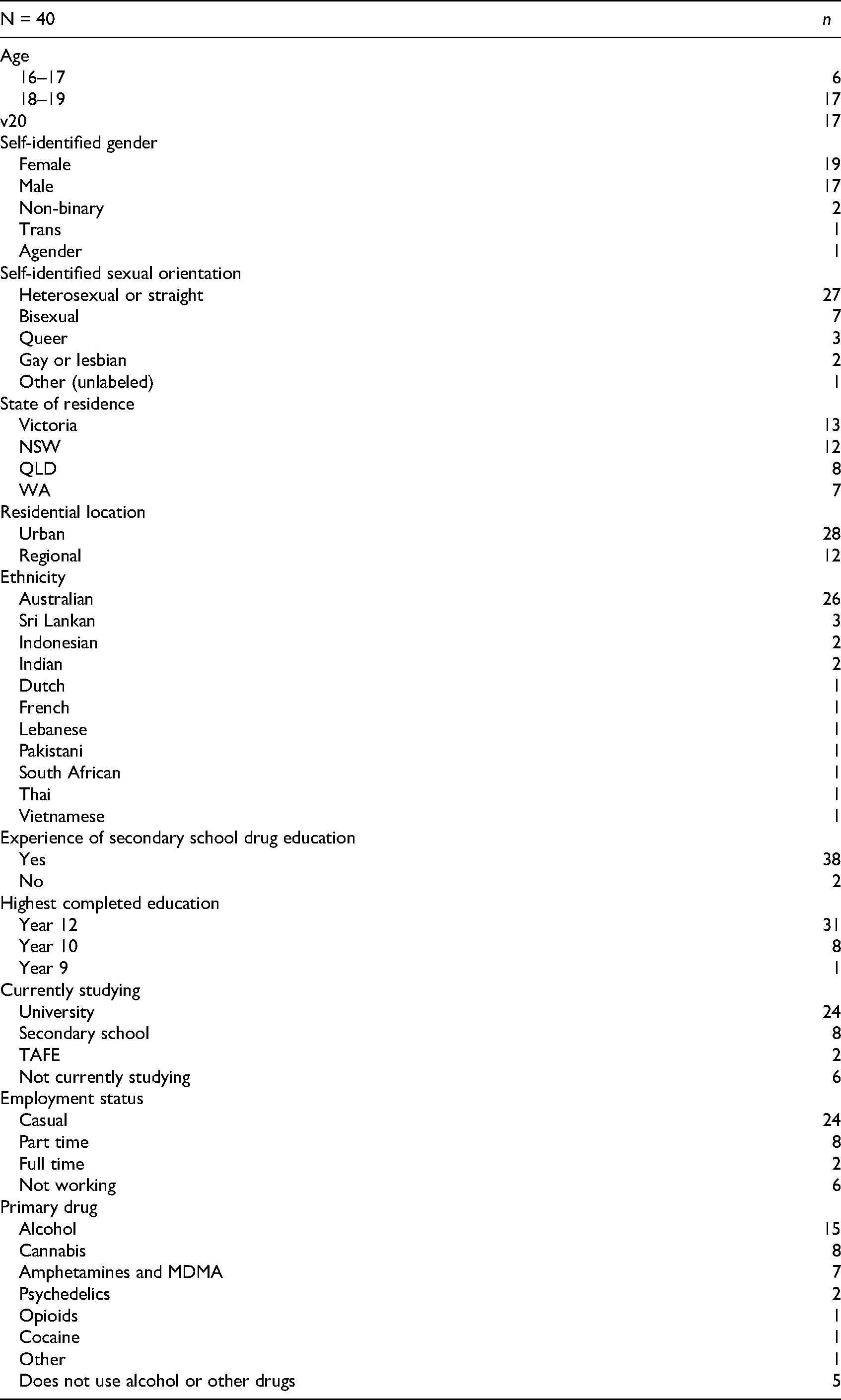
| N = 40 | n |
|---|---|
| Age | |
| 16–17 | 6 |
| 18–19 | 17 |
| v20 | 17 |
| Self-identified gender | |
| Female | 19 |
| Male | 17 |
| Non-binary | 2 |
| Trans | 1 |
| Agender | 1 |
| Self-identified sexual orientation | |
| Heterosexual or straight | 27 |
| Bisexual | 7 |
| Queer | 3 |
| Gay or lesbian | 2 |
| Other (unlabeled) | 1 |
| State of residence | |
| Victoria | 13 |
| NSW | 12 |
| QLD | 8 |
| WA | 7 |
| Residential location | |
| Urban | 28 |
| Regional | 12 |
| Ethnicity | |
| Australian | 26 |
| Sri Lankan | 3 |
| Indonesian | 2 |
| Indian | 2 |
| Dutch | 1 |
| French | 1 |
| Lebanese | 1 |
| Pakistani | 1 |
| South African | 1 |
| Thai | 1 |
| Vietnamese | 1 |
| Experience of secondary school drug education | |
| Yes | 38 |
| No | 2 |
| Highest completed education | |
| Year 12 | 31 |
| Year 10 | 8 |
| Year 9 | 1 |
| Currently studying | |
| University | 24 |
| Secondary school | 8 |
| TAFE | 2 |
| Not currently studying | 6 |
| Employment status | |
| Casual | 24 |
| Part time | 8 |
| Full time | 2 |
| Not working | 6 |
| Primary drug | |
| Alcohol | 15 |
| Cannabis | 8 |
| Amphetamines and MDMA | 7 |
| Psychedelics | 2 |
| Opioids | 1 |
| Cocaine | 1 |
| Other | 1 |
| Does not use alcohol or other drugs | 5 |