




Abstract
While extensive research has examined alcohol-related harms in university residences, few studies have explored how specific drinking contexts—such as physical location, policies, and broader socio-cultural factors—shape student alcohol use. This qualitative study utilized semi-structured interviews with 25 first-year residential students and 16 staff across two Canadian universities (University of Calgary, Alberta, and Dalhousie University, Nova Scotia) to investigate how intersecting social, physical, economic, and policy environments contribute to university residences as risk and/or enabling environments. Drawing on Rhodes's risk environment framework, the analysis identified three themes: (1) Navigating tensions between policies and the physical and economic environments; (2) Shaping alcohol experiences through social influences; and (3) Co-creating cultures of care. This research highlights how student residences can reduce alcohol-related harms while fostering cultures of care, health, and well-being. These findings provide deeper insights into peer influence, the promotion of enabling environments, and integrating restorative justice as part of harm reduction strategies.
Introduction
Alcohol consumption among university and college students is an ongoing concern in Canada and other high-income countries (Chang et al., 2022; Griffin et al., 2018; Hutter et al., 2015; Johnston et al., 2023; Supski & Lindsay, 2017; Tarrant et al., 2019). According to Canadian data, in the past 30 days, 60% of postsecondary students aged 17–25 consumed alcohol in a pattern consistent with heavy drinking, with 74% reporting having felt drunk in the past month (Health Canada, 2021). Among Canadian post-secondary students who drank alcohol within the past 12 months, 56% experienced at least one alcohol-related harm in the past month, including minor outcomes such as embarrassing oneself, feeling nauseous, or vomiting, and more severe outcomes, including drunk driving, physical and sexual assault (Health Canada, 2021).
While alcohol culture, social norms, and geographic location are strong predictors of drinking behavior in post-secondary students (Merrill et al., 2023), the normalization of drinking, often to excess, is embedded in the university and college experience (Burns et al., 2021; Hill et al., 2018; Romo, 2018). Universities and colleges are micro-contexts of alcohol normalization, and heavy drinking is often seen as a rite of passage into student and subsequently adult life (Burns et al., 2021; Davidson et al., 2022; Leontini & Corney, 2023). University contexts may introduce new social norms and traditions, including orientation events and sports rituals, many of which position drinking as central to belonging and building friendships (Fenton et al., 2024).
While overall consumption rates between on- and off-campus students may not differ (Johnston et al., 2023), campus residences are a distinct social context where alcohol is prevalent and drinking can become routine (Davidson et al., 2022; Leontini & Corney, 2023). Despite policies and regulations governing students living in residences, heavy drinking is prevalent among first-year residence dwelling students (FYRDS) as they discover newfound freedoms, coupled with academic pressures and a desire to belong (Bewick et al., 2008; Hennessy et al., 2021; Tarrant et al., 2019). While drinking in collective settings, such as university residence, has been shown to facilitate peer bonding (Davidson et al., 2022), being a non-drinker in a culture “where everything is telling you to drink” (Hill et al., 2018; p. 457), can be exclusionary for students who opt to abstain for a variety of reasons (e.g., history of problematic use/recovery, health, personal and/or religious beliefs).
Recent declines in youth drinking suggest a shift in cultural and societal norms (Huỳnh et al., 2022; Kraus et al., 2018; Zhu et al., 2022), potentially reducing the symbolic role that alcohol has played as a marker of adulthood (Burgess et al., 2022). Increased health consciousness, economic pressure, and having less free time have led young people to prioritize well-being and responsibility over alcohol consumption (Caluzzi et al., 2020, 2022). Additionally, generational changes and the availability of alternative leisure activities have contributed to a cultural landscape where heavy drinking is increasingly denormalized (Burgess et al., 2022; Pennay et al., 2024). These shifting trends suggest that although non-drinking students still face exclusionary experiences, they are part of a growing cohort for whom abstaining is becoming an increasingly normalized choice.
Despite an overall decline in alcohol consumption among youth in high-income countries, it remains the most prevalent substance used among post-secondary students (Health Canada, 2021; Substance Abuse and Mental Health Services Administration, 2023), with minimal differences in consumption rates between students living on- or off-residence (Johnston et al., 2023). In line with Canadian policies focused on reducing substance-related harms and risks, particularly related to the drug toxicity syndemic (Health Canada, 2023), Canadian post-secondary institutions (including the two study sites) have embraced harm reduction policies and practices. These include staff and student training about safer substance use (e.g., Canada's alcohol and health guidelines), restrictions on university-endorsed pub crawls, stricter regulations for on-campus use and marketing, as well as post-alcohol support spaces and peer-driven campus recovery programs (Burns et al., 2021; Ford et al., 2021). Harm reduction approaches aim to reduce the negative consequences of substance use without requiring abstinence, emphasizing principles of justice, autonomy, and pragmatism (Hawk et al., 2017; Health Canada, 2023).
Within university residence, harm reduction policies focus on education and support to lessen personal harm, community disruption, and property damage (Dalhousie University, 2017; University of Calgary, 2022). Some universities have introduced elements of restorative justice as part of policy enforcement. Restorative justice is a democratic and participatory approach to mediate harmful situations and consider the interests of individuals directly impacted. These processes are aimed at creating lasting change by repairing relationships, acknowledging accountability for harms, and building safe, respectful communities. (Dalhousie University, n.d.d.; Karp, 2004). Groups work collaboratively to understand why the harm occurred, its impacts, and strategies to move forward. Within a restorative justice framework, supports are offered to those who have committed violations to reduce the risk of future occurrences and to reintegrate individuals into the community (Dalhousie University, n.d.c; Karp, 2004). Research on alcohol consumption among first-year residential students (FYRDS) has primarily emphasized the social factors that encourage drinking in university settings (Corney & du Plessis, 2022; Henderson et al., 2018; Herrero-Montes et al., 2022; Leontini & Corney, 2023). The influence of micro-level policy (e.g., residence rules) and physical space factors is seldom integrated into analyses.
Rhodes’ (2002, 2009) “risk environment” framework highlights how social, physical, economic, and policy factors interact to produce drug-related harm. Complementing this, Rhodes introduced the concept of the “enabling environment,” emphasizing social and structural changes to reduce harm and improve health outcomes. This ecological approach shifts focus from individual blame to the creation of supportive environments. Applied to university residences, this framework underscores the need to address environmental factors shaping alcohol use among first-year residential students (FYRDS), fostering healthier conditions and reducing risks associated with substance use. The intersecting and reciprocal risk and enabling characteristics of student alcohol consumption are rarely examined in research. To address this gap, we asked: How do intersecting social, physical, economic, and policy environments shape university residences as risk and/or enabling environments? This question highlights the potential for informing harm reduction strategies and advancing post-secondary health and well-being policies and practices.
Methods
Data was collected as part of a larger pan-Canadian study involving five universities (University of Alberta, University of Calgary, University of Waterloo, Queen's University, Dalhousie University). The full study was designed as institutional ethnography to explore how drinking culture affects first-year students’ alcohol consumption in university residences. This article uses a risk environment framework and reflexive thematic analysis to explore the findings from two of these universities, led by authors Kiepek (NK) and Burns (VB). This full project received ethics approval at the University of Calgary (REB # 22-1335) and Dalhousie University (REB # 2022-6370).
Study Settings
University of Calgary
The University of Calgary, a large public institution in Alberta, houses 3,000 students in residences, including 1,200 FYRDS; about 40% of residents are international students. The residences are mainly mixed-gender, with some gender-specific areas. First-year housing options include dormitory-style Rundle and Kananaskis Halls, each housing 800 students, and the smaller International House and Yamnuska Hall, which accommodate 200 FYRDS each. Substance-free housing is available for students who do not use substances for various reasons (e.g., in recovery, health, religion) (University of Calgary, n.d.).
Dalhousie University
A large public institution, Dalhousie University, has campuses in Halifax and Truro, Nova Scotia. While Dalhousie residences house students of various ages and academic stages, first-year undergraduate students predominate. Halifax’s six traditional residences vary significantly in size and layout, from Howe Hall, housing over 700 students and known for frequent alcohol-related property damage, to Mini Res, a small cluster of converted street houses accommodating 45 students (Dalhousie University, n.d.a).
Truro's three residences are similar in size, at around 100 students each (Dalhousie University, n.d.b). Mixed-gender residences predominate, with some gender-specific options available at both locations. Substance-free housing is available for students who do not use substances for various reasons (e.g., in recovery, health, religion).
Site Comparison
Both study sites implement harm reduction policies aimed at managing alcohol consumption on campus, prioritizing student safety and reducing risks such as property damage, injuries, and disturbances. For example, policies at both universities prohibit open alcohol in public areas like hallways and lounges and restrict drinking games or paraphernalia that encourage excessive consumption. During periods of historically high alcohol use, such as holidays, stricter measures are enforced, including limitations on guest access. Additionally, several policies indirectly influence alcohol-related outcomes, addressing issues such as disturbances, personal injuries, property damage, noise complaints, and room capacity (Dalhousie University, 2023; University of Calgary, 2021, 2022).
A key difference between the two study sites is the provincial drinking age. Alberta, where the University of Calgary is located, the legal drinking age is 18, allowing most first-year residential students (FYRDS) to legally consume alcohol at the start of their studies. In contrast, Nova Scotia, home to Dalhousie University, has a legal drinking age of 19, meaning many FYRDS only gain this privilege later in their first year or even during their second year of studies. Another difference is the physical location of the campuses within the community. University of Calgary's campus is located far from Calgary's downtown and its drinking establishments, which limits students’ access to alcohol-related venues. By contrast, Dalhousie University's main Halifax campus is located within walking distance of downtown and drinking establishments are readily accessible.
Recruitment
We recruited FYRDS and university staff. All FYRDS were eligible, regardless of alcohol consumption, while staff were eligible if they worked directly with FYRDS (e.g., residence managers, conduct investigators, student staff, and safety officers). Students were recruited through posters in residences, institutional social media channels, and at Dalhousie to direct emails to students who had opted in to be informed of research opportunities. Dalhousie staff were invited via email by the student health promotion manager. UCalgary staff received email invitations from the residence life manager and AM shared information at a staff training session. Snowball sampling was later used to increase representation of non-drinking students.
Both AL and AM utilized a pre-screening questionnaire to ensure diverse representation of student participants. The questionnaire asked potential student participants questions about their gender, student status (i.e., domestic or international), how often they drink, and where they lived prior to entering university.
Data Collection
Data collection occurred in 2022 (January-February at Dalhousie; January-April at UCalgary). Semi-structured interview guides were developed collaboratively for the larger pan-Canadian project. Student interviews (30–90 min) explored personal alcohol consumption(s) (frequency, locations, changes, pros/cons) and residence drinking culture (policies, alcohol-related activities). Staff interviews (30–90 min) focused on alcohol policies and initiatives, perceptions of student drinking culture, behaviors, motivations, and personal experiences (policy enforcement, student interactions). At Dalhousie, AL, NK, and a research assistant conducted in-person interviews at private locations (e.g., library study rooms) using a digital voice recorder. At UCalgary, AM and VB conducted interviews in-person or virtually via Zoom (version 5.15) or a digital voice recorder. At both universities, students were remunerated CAD$30 in the form of electronic gift card. At Dalhousie, participants were invited to engage in member checking (Birt et al., 2016), which involved reviewing a summary of the preliminary analysis and providing feedback, with remuneration of CAD$15. At UCalgary, member checking was offered to both staff and student participants; however, there was no participant uptake.
Data Analysis
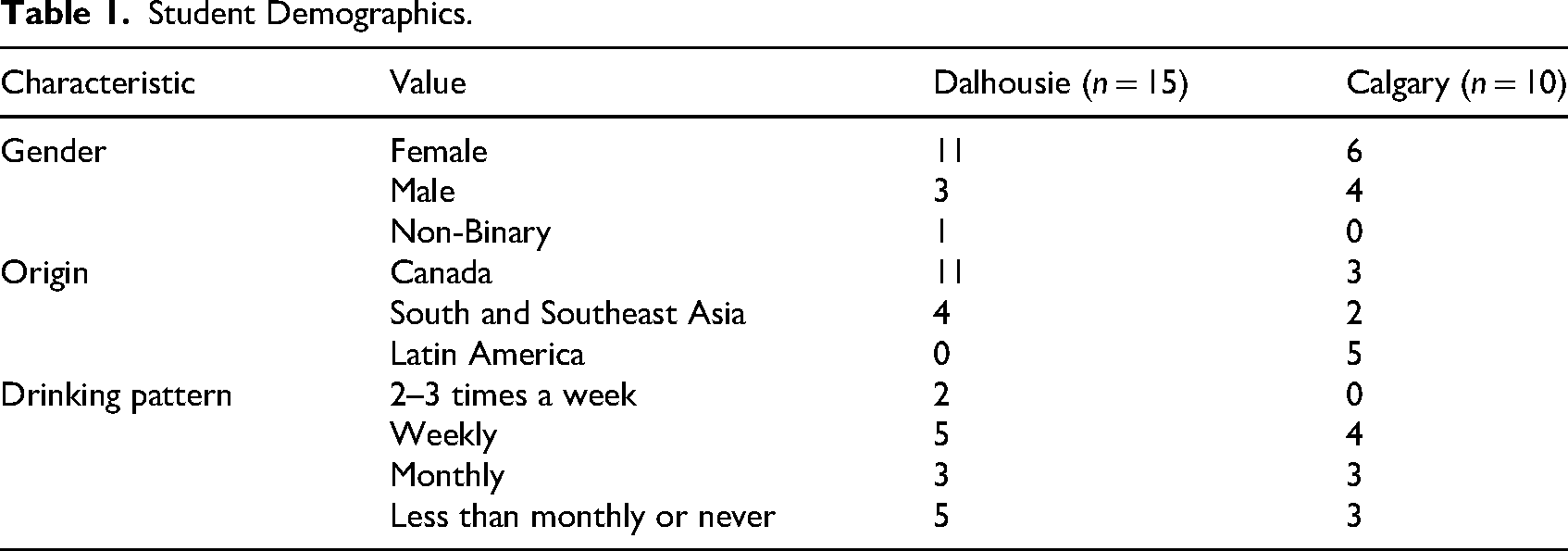
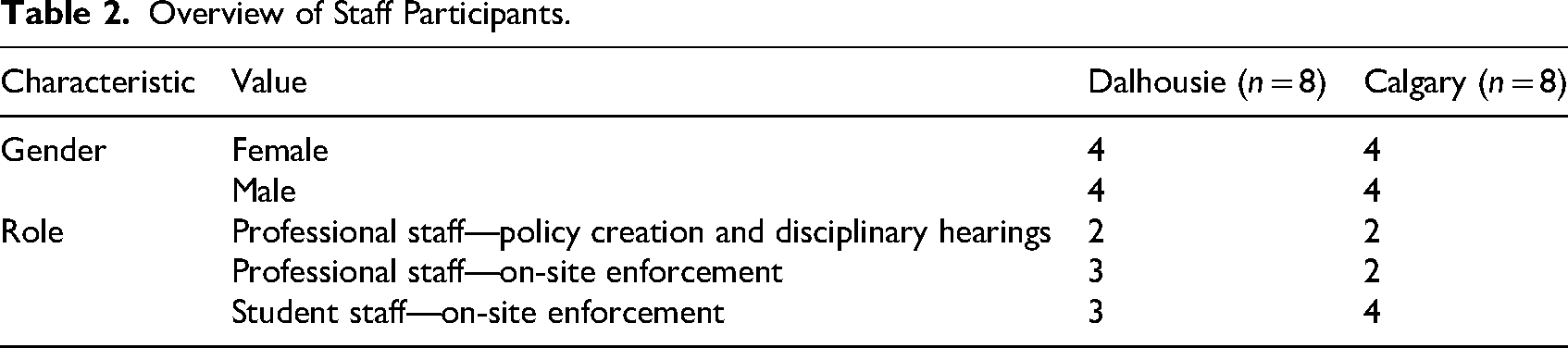
Interviews were recorded and transcribed verbatim, then uploaded to NVivo (Lumivero, 2023), a software tool used for organizing data during analysis. Data was deidentified, and participants were assigned identifiers. Identifiers are designated to distinguish university and participant group: Student participants as DalStudent1-15 and CalStudent1-10; staff participants as DalStaff1-8 and CalStaff1-8. To maintain confidentiality given the small sample size, no individual demographic details (such as age and gender) are linked to identifiers. As per ethics protocols, participant characteristics are reported in aggregate (see Tables 1 and 2). Given restrictions around data privacy, only the lead author, AL, had access to all data across both universities and read all transcripts. NK, RW, and CS reviewed Dalhousie data, while VB and AM reviewed Calgary data.
Student Demographics.
Overview of Staff Participants.
Braun and Clarke's (2022) six-step process of thematic analysis provided an adaptable method for identifying, analyzing, and reporting themes. In Step 1, AL and AM familiarized themselves with the data by reading transcripts, listening to recorded interviews related to the respective universities, and took reflexive field notes. Field notes included interview summaries based on each question, initial impressions, what stood out, and why. In Step 2, a combination of deductive and inductive approaches was used. Deductively, the four dimensions of Rhode's risk environment (physical, social, economic, and policy environments) were used to organize and guide code and theme development. AL and AM reviewed transcripts and independently coded details describing residence policy, physical, social, and economic environments; only AL had access to Dalhousie data. Details were then categorized within each topic as contributing to the risk or enabling environments, or both. Inductively, the two authors then organized codes into initial themes. In Steps 3 and 4, the authors met several times to review codes, combine initial themes, compare and contrast data across sites, and come to consensus. Thematic maps were created with the four authors to identify and further review potential themes and subthemes. This step involved authors using visual tools such as schematics on paper and in Microsoft PowerPoint to organize the main themes and subthemes emerging from the data (Braun & Clarke, 2022). In Step 5, authors 1, 2, 3, and 6 came together to further refine, define, and name themes. The sixth and final step, all six authors compared and contrasted themes with existing literature and theory, culminating in the writing of the results.
Findings
Demographics
Participants included 25 FYRDS (Dalhousie, n = 15; Calgary, n = 10) and 16 staff (Dalhousie, n = 8; Calgary, n = 8). Most students identified as female (17/25), Canadian (14/25), and drank alcohol at least monthly (17/25). Many, 11/25, were international students (7/10 for Calgary, 4/15 for Dal). Few students reported drinking more than once per week (2/25), while approximately one third (8/25) drank less than monthly or abstained entirely (Tables 1 and 2).
Themes
The analysis generated three main themes: (1) Navigating tensions between policies and the physical and economic environments; (2) Understanding contextually situated social influences; and (3) Co-creating cultures of care.
Navigating Tensions Between Policies and the Physical and Economic Environments
Residence policies aimed at reducing harm sometimes produced unintended consequences that increased alcohol-related risks. For instance, at Dalhousie, alcohol consumption was restricted to private rooms with gathering limits of people per room.
Contravening policies could lead to acquiring penalty points and potential eviction. Although UCalgary did not limit number of people allowed in private rooms, the small physical size of rooms effectively restricted capacity. At both universities, these constraints contributed to student preference for off-campus drinking locations when they wanted to socialize in larger groups. DalStudent2 explained, “You kind of have no choice. If you wanna hang out in a group more than five […] where do you expect us to go to hang out?” Similarly, CalStudent1 referenced restrictive policies around alcohol as influencing drinking location “there's like, rules for alcohol in the residence. So, it definitely is easier for some people to just go out.” DalStudent13 described how drinking off campus allowed them the freedom to drink more alcohol without the risk of penalties, “If I was trying to drink, get more intoxicated, I would be leaving residence … Just ’cause you’re gonna get in trouble.”
Students and staff at both universities recognized that strict on-campus alcohol policies in residence—whether targeting alcohol consumption specifically or broader conduct—often unintentionally increased risks. Many students and staff voiced concern about the dangers students faced when leaving campus to drink. At Dalhousie, where the legal drinking age is 19, some students used falsified IDs or frequented establishments known for to be lax in ID verification, exposing them to legal risks. Several students also highlighted added dangers of off-campus drinking at unregulated locations, such as fraternity houses. As DalStudent1 explained: A lot of people go to frats really drunk and stuff, you always hear that a lot of people get groped, and a lot of people have sexual assault experiences […] because so many students are underage there's no safe clubs to go to.
Dalhousie staff also noted that off-campus drinking a posed significant risk due to lack of oversight and safety measures. As DalStaff8 observed, I think these policies lead people being forced to drink in a less safe environment […] instead of like, going somewhere on campus where students can be with each other and some Dal security there […] now they’re just like going to a random off-campus party where there's nobody around.
In contrast, Alberta's lower drinking age (18 years old) provided UCalgary students access to venues where alcohol consumption was officially sanctioned and some safety measures (e.g., security staff), thus being perceived as safer. Dalhousie's higher drinking age (19 years old) meant that many first-year students were underage, restricting their options to off-campus spaces that overlooked drinking age violations, which students identified as carrying higher risks. Underage students at Dalhousie who chose to stay in residence faced lower personal risks, but higher policy violation risks. In the UCalgary context, off-campus venues typically included licensed venues, whereas in the Dalhousie context, off-campus venues were often private and unsupervised.
Staff at both universities emphasized that, from a harm reduction perspective, they preferred students to drink on-campus (in a supervised setting) than off-campus. They pointed to protective elements of the residence environment, such as on-site security and access to trained staff for medical help. As DalStaff1 explained: And you know, as much as some people would say “I want [students] to be off campus or not in residence,” I actually want them to be in residence, because then they know where to go get help, if something goes bad. (DalStaff1)
Several staff also noted a lack of protective spaces for students to consume alcohol on campus, and overall lack of non-alcohol-related activities, particularly later in the evening and on weekends, when students tend to socialize. Some advocated for the development of more supervised spaces where alcohol consumption could occur safely could be consumed, as CalStaff1 described: But I think that there are things that we can do to make safe drinking more possible. So, I mean, it's kind of almost one of those like supervised consumptions because right now we don't allow community ambassadors to program around alcohol, although sometimes they are allowed to, let's say, go for wings at a bar. If a resident purchases a drink, that's okay. So maybe having more opportunities where we can supervise people and provide that level of safe consumption [in residence]. This highlights the importance of harm reduction strategies and creating supervised, supportive environments for students to mitigate risks associated with alcohol consumption.
Decisions about how much to drink, and whether to do so on-campus or off-campus were also shaped by the economic environment—which created both risk and enabling factors. The high costs of tuition and alcohol were reported by several students to reduce their alcohol consumption. DalStudent2 expressed, “I’m paying for school myself, I, like, it's a lot for me to take that extra, like, fifty dollars and go spend it on liquor.” Similarly, CalStudent2 shared, I mean, most of us like to drink wine because it's cheap and it gets the job done and it's tasty… I wouldn't say we have like a preference for any liquor, like any type of liquor. It's just that we just look for what's cheaper. Because we have international student budgets and everything's more expensive now. So, trying to get the best bang for your buck is important.
Other social leisure activities were inaccessible due to financial constraints, as DalStudent4 noted: “I like the idea of … going to a movie or going bowling. The only problem is none of us have any money [laugh].”
From a risk environment perspective, the high cost of alcohol in licensed establishments combined with penalties associated with on-campus gatherings, has contributed to the popularity of pre-gaming (also called pre-drinking), which can potentially increase alcohol-related harms (Calhoun & Maggs, 2022; Ford, Zamboanga & Ham, 2022; George, Zamboanga & Scholz, 2023; Pedersen et al., 2022). Pre-gaming involves consuming alcohol quickly and in large amounts before heading to off-campus venues, such as bars, clubs, or restaurants, as CalStaff5 described: People tend to [do] what they call pre-drink at the residence and then go out. What I’ve noticed in some of my shifts is that they tend to have a lot of alcohol before they leave so when they get to the bar, they[’re] already drunk and they don't have to, you know, purchase alcohol in the bars.
Pre-gaming was particularly common among Dalhousie students. A major motivation for pre-drinking at Dalhousie was the inability to legally consume alcohol outside of residences due to provincial age restrictions, as DalStudent1 observed: In residence especially, it's like, you can’t go out and drink because you’re underage, so you have to drink in residence […] it becomes like a little event in itself […] we’ll take a couple shots together or something and there’ll be music playing or whatever. And then, we’ll get ready to go.
Both students and staff identified a need for low-cost, accessible activities as alternatives to alcohol, and for spaces that promote safer alcohol consumption. However, challenges included limited resources and ensuring broad appeal. Several staff advocated for increased access to alcohol-free social spaces and activities for students who abstain. CalStaff1 suggested, “I think it is really helpful to have [alcohol-free] rooms set aside, with dedicate substance recovering or abstaining for other reasons. I do think that that has a place on campus.” Similarly, DalStaff2 emphasized the importance of better supporting students in substance-free housing: “you know there's substance-free floors? People are not keeping up with the substance-free thing … students who really want to be in the substance-free area are not supported enough. I think something else should be done.”
Overall, students and staff opined that residence policies can fail to act as protective forces, despite the intended outcome of reducing alcohol-related harms. Instead, the policies can unintentionally contribute to risk (e.g., restricting where alcohol can be consumed, room capacity and layout, campus location). We found a disconnect between policy intentions (protection from harm) and students’ lived experiences (increased risk).
Navigating Contextually Situated Social Influences
Many students and staff discussed the role of social norms and discourses from multiple sources (e.g., media, family, other students) in shaping FYRDS’s alcohol experiences. Several students described heavy alcohol consumption while attending university as a “rite of passage,” viewed as sociable, fun, and a way to fit in. Positive messaging around alcohol in mainstream media reinforced these perceptions. DalStudent6 remarked “if you watch any university movie, you’re going to see massive parties … some could say it’s toxic, or you’d say it’s fun, or I want to be a part of what Hollywood or people made university out to be.”
Social influences extend outside the physical and temporal bounds of the residence context and emerged as uniquely pertinent at Dalhousie, where there is often a generational legacy of living on a specific residence during the first year. Some students appear to strive to emulate older family relatives’ university drinking experiences, some students sought to avoid emulating what they thought were negative examples of older relatives, while others were guided by a desire to be a positive example for younger relatives. DalStaff4 noted that some students wanted to live up to stories passed down from parents about their experiences while living on residence, saying, “[alcohol consumption serves] to prove something … to say ‘This is what dad did. So, this is what I did.’” At the same time, students often desired to hide alcohol consumption from parents, especially in incidents involving staff. DalStaff4 estimated that “seven or eight times out of ten, they’re saying ‘Don’t call my parents.’”
Cultural differences further influenced choices around drinking, especially among international students. Some observed that alcohol was more pervasive in Canadian university settings than in their home countries. As CalStudent6 noted, Back [home] I used to go out a lot, so I was really familiar with all the drinking environment and everything related. However, since I’ve arrived to Calgary, I think it's been like more parties, more social encounters and everything, and well obviously like more alcohol around everywhere. So, yeah, that’s kind of like something. I’ve seen that people drink way more here. It’s just like alcohol is always present.
In social contexts that promote and normalize alcohol consumption, both students and staff noted that students without previous exposure to alcohol might encounter greater risks in the first-year residence environment. It's people not knowing what their limits are when they’re drinking. So, they just kind of drink, drink, drink until they’re passed out perhaps. (CalStudent2) I grew up in a religious family … wasn’t really exposed to drinking at all. Um, and therefore, like, when I did start to drink, for the first time, like, I also went pretty overboard. (DalStudent1) When we look at where do we see our challenges with alcohol drinking, it generally is first years more than others. It's rare we have graduate students or, kind of fourth years that are involved in that behaviour. It happens, but not near to the degree that it's happening with first years who are away from home for the first time and with their friends. And that's always a lot of social pressure on individuals in in those situations. (CalStaff7)
Experiences with peer influence surrounding alcohol were complex and diverse. Students’ descriptions of peer dynamics ranged from highly supportive to subtly exclusionary. Some described enticement occurring in friendly manner that respected boundaries: At least my group of friends when I say I don’t want to do something two to three times and then it's a personal decision. Like if you don’t want to do it, you just let them don’t. Like if you really don’t want to do it, you just say straight up no, and they won’t stop bothering you anymore. (CalStudent5)
However, other students shared that if they did not consume alcohol, they would be excluded from certain social activities, or would feel out-of-place and exclude themselves: Missing out or just not being included … it's a culture; it's a social thing. That's how you get a group of people that likes partying on the weekends, it ’cause they all like partying on the weekends. And the people that don’t will either be along by themselves [laughs], or find other people. (DalStudent11)
Many students resisted the term “peer pressure,” viewing it in a negative light with connotations of disrespect and coercion. They instead described peer influence as supportive, such as friendly check-ins and benign but meaningful questions. Decisions around drinking were largely framed in relation to a desire to fit in, rather than external pressure to drink alcohol: I feel like, in, all of my friendships, it's not like peer pressure. It's just like “Oh, we’re doing this, something fun, do you want to join us?” Just as good friends would. (DalStudent13) There's not really pressure from other people. It's maybe like FoMO [fear of missing out], like people don’t want to miss out. (CalStudent10)
Some students did endorse the term “pressure,” and reported undesired social repercussions associated with not drinking, as described by DalStudent 14, “I guess for a lot of people, like me? It would just be easier to have the goddamn drink than to get interrogated about why they made this life choice.” Such experiences indicate that while over peer pressure was rare, non-drinking students sometimes experienced subtle pressure in the form of repeated questioning or the need to justify themselves.
Some students chose to consume alcohol infrequently or not at all (“monthly or less,” n = 8). These students were the most likely to face negative social repercussions for not consuming alcohol, and the most likely to describe peer influence in a negative way. These students reported sometimes avoiding certain social groups/events or choosing alternative intoxicants, such as marijuana, to avoid questioning. However, this was not true of all non-drinking students; some still described this influence in positive terms, and most were ultimately able to find acceptance among drinking peers: Most of the people are like, OK, you do your thing. We do our thing. But then some of my friends do ask some questions. They’re like, why don’t you drink? You should try it. You should. So, it's not questions. It's more like they’re pursuing me to try it because they feel it's good and they’re my friends, so they want me to feel that it's good because they want company. So, it's so and I usually in those situations I’m like, I’ll give you company, I’ll just not drink alcohol, that’s all. (CalStudent7) I participate in, like the social events. I really liked hanging out with people and like kind of partying. I didn’t really see a need for alcohol. I was able to have a good time without it. And you know not having to be hungover the morning after is pretty nice as well. (CalStudent8)
Students who chose to avoid or moderate alcohol consumption associated moderation with pride, maturity, and studiousness. For some, making a choice to moderate or abstain from drinking was not just a health choice, but an expression of personal identity and adherence to an image of a responsible student or mature, confident adult. I really have come to terms with like, I don’t care, what like, other people think about me. Like, I don’t care about, like if a person's like “Oh my god, [they don’t] drink.” Like, I know people appreciate, like, who I am sober. Like, they like who I am sober. Like, they think I’m funny, whatever, and, like, I’m [a] pretty outgoing person. (DalStudent2)
These findings highlight that peer and social influences in residence operate in nuanced ways. Few students experience direct, overt peer pressure. Instead, the influence of peers was contextual and largely intrinsic—driven by social expectations and the desire to belong. From a risk environment perspective, the residence social environment contained both risk and enabling elements: prevailing peer norms could encourage drinking, but peer support and acceptance could also mitigate harms.
Co-creating Cultures of Care
The final theme highlights the informal personal and professional practices that promoted an enabling environment within university residences. These practices, which aimed to counter restrictive and punitive policies that could inadvertently increase harm, fostered cultures of care where the social environment became a supportive space for students’ safety and well-being.
Students frequently intervened to protect peers during alcohol-related events. Friends often curtailed their own drinking to monitor others: I just don’t drink with people I don’t know about but with people I feel safe with because it's always important if anything happens or if anything goes wrong. I always, if I don't feel safe, I just don't do it because I want to. Or sometimes I would just don't drink to like, make sure everyone's safe. We try and we we’re like a small family. We try to like take care of each other and make sure nothing happens. (CalStudent3) We’ll spend the night with a friend, make sure they have everything they need, water, Tylenol, make sure that they’re okay. I really love my friends and we’re all very supportive of one another. (DalStudent3)
Such protective actions were especially common for peers with less alcohol experience. Students valued the mentorship of more experienced friends during experimentation: Other experienced people can definitely help out [when peers are trying alcohol for the first time]. I’ve had unexperienced friends and taken care of them the entire night. Reassuring that this happens to everyone. (DalStudent2) [Consuming alcohol] was a new experience, and I am glad that I did it the way that I did it, because I [drank] with friends, who I felt comfortable and safe with, so that was definitely a factor that played into why I [experimented with alcohol]. (DalStudent9)
Due to fear of penalties, students often avoided staff when intoxicated, preferring to rely on friends as first-line responders, as DalStudent8 stated, “that wouldn’t be [students’] first thing, to call an RA [residence assistant] for help … I’d just call more friends.” However, some students encouraged peers to seek help in emergencies, citing harm reduction messaging like Dalhousie's campaign: “Intoxication is not a violation.”
Cultures of care to create an enabling environment extended to staff. Many staff went beyond and sometimes even against university policies to build trusting relationships with students, which they perceived to be enabling to students seeking help from staff in emergencies. While novice staff—particularly limited-term student staff—tended to be more rigid in the enforcement of policies and in applying penalties, more experienced, permanent staff acknowledged that strict enforcement of policies could inadvertently pose harms. These staff found ways to largely work within the parameters of policies, while supporting the immediate and longer-term needs of the students. For instance, at both Calgary and Dalhousie, intoxication does not contravene any policy and is not a reason for penalties. CalStaff1 explained thresholds for addressing alcohol consumption as a consideration related to student conduct: We actually don’t penalize students for over consuming. They don’t get into trouble unless it becomes a pretty strong trend. And if ambulances are constantly being called, then that's something that we might address through conduct, but very rare. And it hasn’t really happened so far.
Experienced staff explained that building trust with students was more effective in promoting rule adherence and safety among students than strict rule enforcement and assignment of punishments. While novice staff tended to enforce rules more rigidly, experienced staff emphasized harm reduction and restorative justice principles, which in this context involve close dialogue with students and attempts to reform students who break rules rather than only punish. CalStaff3 reported, “We aren’t necessarily a restorative justice school … however, we do try to ground our sanctions. We’re not going to fine you $50 for drinking games. That's not super effective, we found.” DalStaff1 described this balance as, “I am also trying to work with ‘the man,’ right? If this is the system they [university decision-makers] want, how can we work within the system, to be restorative?”
Along similar lines, through the development of trusting relationships, students were able to access spaces where drinking was prohibited, as long as they were not infringing on other policies that would warrant penalty. DalStaff3 recounted a specific conversation with students: I said “if it comes to [drinking] in the lounges, I am willing to unlock them for you, if you can promise me that you will meet in there, enjoy yourselves, without causing any hazard or damage to property or to anyone.” And they were happy. For that particular evening, we had no damages in there.
Both students and staff observed that overtly strict enforcement of policies can push students to consume alcohol in more dangerous ways, such as drinking quickly or in unsafe spaces to avoid being seen by staff. Staff emphasized the importance of building mutual understanding with students, which could be leveraged to increase policy compliance and reduce risk of alcohol consumption. To maintain this relationship, staff described avoiding reporting certain violations in favor of holding dialogues with students about safer alcohol consumption practices. CalStaff5 described: They do train us of it on how to approach the situation, how to not chuck the blame onto the person but rather make them understand what they’re doing is wrong. Actually, try to have a conversation rather than a screaming match and they do train us on that.
Similarly, DalSf3 described a shift in their personal approach which came from experience: I went back and reflected, and asked myself, “What was it that I was trying to achieve?” It dawned on me, that all what I was trying to achieve is the safety of the student. Is it worth taking that much risk of get into a fight [to seize alcohol]? No. I think that was a mistake. And that changed my entire approach.
Several students reported valuing these types of collaborative conversations about rules, such as “Hey, let's fix this. Like, let's get to the point of trying to get this better, so we don't have to keep having this conversation” (DalStudent2).
Several staff noted that certain patterns of alcohol consumption could be indicative of other issues going on the student's life, with alcohol serving as a coping strategy. Requirements to meet with conduct officers were not viewed as a place to punish, but as an opportunity to meet students and offer support for remediation and make connection to counseling and other services.
Staff at both universities mentioned restorative justice approaches as ideal for both students and staff. Such approaches were seen to hold the potential to reduce policy violations while supporting student wellness and academic success. Experienced staff reported informally integrating restorative justice approaches. These staff try to support students who may want to reduce their alcohol consumption, describing conversations with students who accrued multiple alcohol-related violations offering additional support and trying to jointly figure out why a certain student may be “drinking so much” (DalStaff4). Staff were also sometimes put in positions of needing to advocate for the interests of students. DalStaff3 describes an interaction with a student who was grateful for efforts to protect them from eviction: “One night … the student said ‘Remember me? You saved me. If it were not for you, I would have been evicted. And I was going to cause a lot of trouble before I leave.’”
Informal cultures of care among students and staff, flexible policy enforcement, and respectful relationships helped mitigate the unintended negative consequences of punitive policies. These approaches fostered trust, improved compliance with rules, and created space for meaningful conversations about student well-being, highlighting the potential of restorative justice and harm reduction strategies to enhance residence life.
Notably, we found high congruence between perspectives shared by staff and students. While we cannot determine whether the perspective of staff or students is representative of the broader population at each university, staff participants largely endorsed principles of harm reduction and restorative justice, routinely engaged in dialogue with students, and held critical perspectives about the suitability of existing policies. They demonstrated an acute awareness of student experiences and perspectives.
Discussion
Based on interviews with 25 FYRDS and 16 staff across two Canadian university residences (UCalgary and Dalhousie), this study explored how intersecting social, physical, economic, and policy environments contribute to university residences as risk environments and/or enabling environments. Our analysis generated three main themes: (1) Navigating tensions between policies and the physical and economic environments; (2) Shaping alcohol experiences through social influences; and (3) Co-creating cultures of care.
The findings emphasize that student residence housing can be structured to foster cultures of care while supporting health and well-being. These insights highlight the importance to social influence, the promotion of enabling environments, and transitioning from punitive, inflexible policies to more restorative flexible approaches.
Peer Influence and Care
We found peer influence to be complex and diverse. The transition to university often brings increased reliance on peers and peer interactions, particularly for first-year students (Johnston et al., 2010). These interactions are crucial as students are learning to navigate the newfound freedoms and responsibilities of being away from home for the first time (Teese & Bradley, 2008). The proximity of peers in residence settings can amplify perceptions of peer influence. Santor et al. (2000) describe peer pressure as the “subjective experience of feeling pressured, urge, or dared by others to do certain things or actually doing particular things because others have pressured, urged, or dared you to” (p. 166). In line with this definition, peer influence that encouraged alcohol consumption often appeared subtle, involving unspoken alternatives: students could either engage in social activities likely involving alcohol, remain home alone, or socialize in smaller, more isolated networks. These findings also align with previous research that conceptualizes social and peer influence as subtle, relational, and situational (Farrugia, 2023), highlighting the nuanced ways in which peer dynamics shape first-year students’ choices and behaviors.
Consistent with past research, we found that alcohol consumption was ubiquitous at most social events. As a result, non-drinking students tended to withdraw from social interactions and reported feelings of social isolation, a lack of belonging, and a sense of missing out on elements of university life (Burns, Walsh & Smith, 2021; Davies et al., 2018). Similarly, Fenton et al. (2024) found that heavy drinking at university often facilitates belonging and social bonding, especially in the early months. Together, these findings highlight that students who abstain, or drink lightly, may face challenges in navigating alcohol-centric social spaces, leading to feelings of exclusion. While opportunities exist to socialize without alcohol exist, in our study, several students found that alcohol consumption made the process easier. This was due to both the social events surrounding alcohol consumption and the intoxicating effects. Alcohol was especially important early in the academic year, when new social groups were forming, and the frequency of social occasions was at their peak.
While incidents of direct peer pressure to drink were rare, subtle influences were evident, such as internalized social expectations and the “fear of missing out” (FoMO) of a sense that “…others might be having rewarding experiences from which one is absent” (Przybylski et al., 2013, p. 1841). Consistent with Conroy and de Visser's (2014) observations, some non-drinking students in our study even pretended to drink (e.g., by holding a cup at parties) or found it easier to have a drink than to face questions about abstaining; such experiences underscore the deep normalization of campus drinking culture (Burns et al., 2021; Romo, 2018).
While the notion of peer pressure is often invoked to explain risky drinking behavior, Farrugia (2023) argues that this term oversimplifies social dynamics by implying one-way coercion and overlooking how peer influence can also encourage positive behaviors. In line with this critique, participants in our study described peer influence as a nuanced, relational process of subtle encouragement, mutual support, and individual agency within broader social norms—rather than overt coercion. These implicit pressures and expectations contribute to the campus risk environment by tacitly encouraging students to confirm to prevailing drinking norms and social expectations. Students described how social norms of responsibility and safety can shape protective behaviors. Notably, the sample was predominantly female, and this gender composition may have heightened the emphasis on protective practices, as women often navigate campus social settings with greater vigilance due to threats like sexual assault (Jaffe et al., 2022). Some male students at UCalgary expressed an increased sense of duty to look after their female peers, recognizing the disproportionate risks (e.g., sexual harassment and assault) women face while drinking, especially in off-campus spaces. Such peer interventions and protective attitudes constitute informal harm reduction practices within the student community, effectively making the social environment more enabling.
Promoting Enabling Environments
Universities face a dual responsibility of supporting students as autonomous adults while ensuring their safety and well-being. This balance can create tensions, particularly when harm reduction principles conflict with liability-driven policies. For example, restrictions on alcohol in communal spaces may inadvertently drive students to off-campus settings, increasing exposure to unsafe environments and reducing access to support. However, as we saw, these rules can inadvertently drive students to off-campus settings where there is less oversight and potentially increased risks. This is particularly true for underage students who cannot utilize licensed drinking establishments. In such cases, well-intentioned policies (keep residence common areas alcohol-free) may increase overall risk by pushing drinking into an “invisible” zone. This underscores the need to better align harm reduction goals with policy enforcement so that students aren’t unintentionally being put in harm's way.
Student residences present unique challenges, requiring institutions to go beyond standard landlord-tenant obligations. Our findings highlight these tensions, with students viewed as both independent adults and members of a community whose welfare is a shared institutional concern. Residence staff often adopt nurturing, protective approaches and demonstrate significant care, fostering a culture of support where navigating institutional policies takes precedence over strict enforcement. However, a disconnect emerges between harm reduction principles and liability concerns underpinning policy enforcement. While harm reduction policies aim to minimize risks associated with alcohol use, punitive elements—such as restrictions on communal alcohol consumption—can inadvertently heighten risks. These policies may encourage behaviors such as off-campus drinking, where supervision is lacking, and consumption is potentially higher. This tension underscores the need to align harm reduction goals with liability considerations to better support students’ safety and well-being.
As universities navigate these blended roles within social contexts, our findings lend to several recommendation to promote enabling environments. A concern arises that restricting group alcohol consumption activities on residences in effort to combat a “party culture” may have unintended consequences of disrupting peer-driven caring cultures, with students dispersing into community settings. Data provided by both FYRDS who consume alcohol and staff lend to arguments for more protective spaces to consume alcohol on campus, in places that are not disruptive to or excluding of students who choose to not drink alcohol. To better align with espoused harm reduction principles, policies need to better mitigate punitive responses that deter students from socializing on campus. While not in the context of college residence, recent research focusing on supportive housing for substance using older adults found that non-punitive harm reduction policies led to feelings of empowerment, more controlled use, and housing stability for residents (Nixon & Burns, 2022). Shifting policies to allow students to consume alcohol in lounges and larger event rooms may create enabling environments where students have more ready access to campus supports and less exposure to unpredictable risks that arise in the community (Andrade et al., 2024; Harris et al., n.d.; Jernigan et al., 2019).
In contexts with significant economic constraints, students need access to affordable, appealing social opportunities that do not center on alcohol consumption. Participants identified low-cost, accessible activities that provide alternatives to drinking, such as late-night recreational events or substance-free social spaces, as key areas for improvement. The inclusion of high-quality non-alcoholic beverages at events and venues could further support students who are part of the growing “sober curious” movement (Lunnay et al., 2022; Siconolfi et al., 2024; Warrington, 2019). While university residences reflect broader societal norms where alcohol consumption is highly normalized (Burns et al., 2021), there has been cultural shift toward the sober curious and positive sobriety movement, especially among Gen-Z (born between 1997 and 2012) (Carnegie, 2022). This movement has popularized quality non-alcoholic beverages and emphasized sober socializing.
Collegiate recovery programs (CRPs) have also expanded rapidly over the past decade in the United States and Canada, offering peer support, drop-in spaces, substance-free events, and recovery-focused housing for students and staff struggling with substance use or other addictive behaviors (Burns et al., 2024; Vest et al., 2021). Despite their benefits in building community and reducing stigma, CRPs remain rare, especially in Canada, highlighting the need for greater support for students opting out of the dominant campus “intoxication culture” (Romo, 2018; Vest et al., 2021; Warrington, 2019).
Integrating Restorative Justice Within Harm Reduction Frameworks
The research highlighted the positive impact of policies that reflect a restorative justice approach (Karp & Conrad, 2005). Restorative justice was identified as a promising way to address unintended negative consequences of existing harm reduction policies. It offers a framework to better align with the principle that intoxication should not be penalized, while providing remedies for policy violations that cause harm to others or property damage.
Restorative justice complements harm reduction principles by emphasizing accountability, community-building, and support, addressing the broader impacts of alcohol-related behaviors. Together, these approaches create enabling environments that prioritize student safety, well-being, and personal growth while mitigating the unintended harms of punitive policies.
Indeed, in Fall 2023, after data collection, Dalhousie adopted a restorative justice approach to residence violations. A collaborative resolution plan is developed by the student transgressor and staff, which guides students to ideally remedy the outcomes of their conduct and learn from the violation (Dalhousie University, 2023). Since many students are likely to face violations of policy, a restorative justice approach allows them to not only learn but also give them a chance to make restorations for the effects of their violations.
Restorative justice approaches can reduce the unintended consequences of punitive policies, such as the concealment of alcohol consumption or reluctance to seek help. Like Good Samaritan laws (see Good Samaritan Drug Overdose Act, SC, 2017), amnesty policies could further encourage students to seek support in emergencies without fear of disciplinary action. Research indicates that medical amnesty policies increase the likelihood of students calling for emergency assistance, suggesting a promising avenue for harm reduction on campuses (Monahan et al., 2019).
Conclusion
Our study explored how university residence policies shaped the alcohol consumption behaviors of first-year residence-dwelling students (FYRDS). By including a diverse range of student perspectives, including those who abstain from alcohol, our findings extended the risk environment framework to incorporate enabling environments (Kiepek et al., 2019; Rhodes, 2002, 2009). We found that policies aimed at reducing harm could inadvertently increase risks when punitive measures pushed students to drink in less regulated, off-campus settings. While staff viewed their roles as protective, students often relied on peer support, engaging with staff only when risks exceeded their capacity to manage.
The interplay between students’ harm mitigation strategies and staff efforts to foster a culture of care highlighted the need for policies that integrated harm reduction with restorative justice principles. This integration could enhance safety, accountability, and community well-being within residences, while addressing societal norms that normalize alcohol consumption. Institutional differences, such as legal drinking age and access to off-campus establishments, further emphasized the importance of tailoring policies to local contexts to effectively support student safety and well-being.
By incorporating diverse student perspectives and a risk/enabling environment lens, this study underscores the connection between harm reduction, restorative justice principles, and institutional policies, offering a foundation for strategies that better support student well-being and safety while addressing alcohol norms.
This study makes important contributions to research and practice by examining how specific drinking contexts—including physical location, policies, and broader socio-cultural factors—influence first-year student's alcohol use. These findings provide actionable insights for developing policies and practices that foster safer, more inclusive environments in university residences.
However, our findings are shaped by certain limitations. The sample size was small and drawn from two universities. The high representation of international students, particularly at the University of Calgary, may reflect differences tied to cultural norms, financial pressures (e.g., international fees), and unfamiliarity with Canadian drinking laws. Additionally, our participants predominantly identified as female. Recognizing alcohol consumption as a largely gendered experience, it will be important to expand examination of gender as an influencing factor within risk and enabling environments. While qualitative research does not aim to generalize, these limitations highlight opportunities for future studies to explore more diverse experiences and institutional contexts.
Footnotes
Acknowledgments
We extend our appreciation to the students and staff who shared their perspectives with us and enriched our understanding. We are indebted to Jonnie-Lyn Baron, knowledge user on the broader study, who informed all stages of the Dalhousie arm of the project and contributed to interpretations and analysis. The Principal Investigator for this study was Dr. Shu-Ping Chen at the University of Alberta.

Ethical Approval
This project received ethics approval at Calgary (REB# 22-1335) and Dalhousie (REB# 2022-6370).
Funding
The authors disclosed receipt of the following financial support for the research, authorship, and/or publication of this article: This project is funded in part by the Canadian Institutes of Health Research (grant number CGARIHPI 180915).
Declaration of Conflicting Interests
The authors declared no potential conflicts of interest with respect to the research, authorship, and/or publication of this article.