



Abstract
Introduction
Housing accessibility, suitability, and affordability, experiences of violence, the COVID-19 pandemic, political disruptions, globalization, and trauma all influence individuals’ sense of ontological security (Agius, 2022; Brown et al., 2022; Harel-Shalev & Kook, 2021; Padgett, 2007). Originally coined by R.D. Laing, the concept of ontological security speaks to individuals’ “sense of continuity and order in events, including those not directly within the(ir) perceptional environment” (Giddens, 1991, p. 243). The concept has been advanced over the years in fields of study, including sociology (Dupuis & Thorns, 1998), political studies (Agius, 2022), and security studies (Harel-Shalev & Kook, 2021). To achieve ontological security, individuals must have a sense of stability within their lives, a firm understanding of their presence in the world, and be autonomous (Giddens, 1984, 1991; Laing, 1960). Therefore, achieving ontological security relates closely to whether individuals can be their true selves, hold agency over their actions, and maintain healthy, productive, and trustful relationships (Giddens, 1984, 1991; Laing, 1960). Those who achieve true ontological security have mental and physical bodily cohesiveness and are “real, alive, and whole” (Laing, 1960, p. 180).
Although research on ontological security is growing, limited work has focused on ontological insecurity in relation to gender, housing, or substance use. As described by Laing, an ontologically insecure individual does not have a “stable sense of being,” remains “differentiated” from their social world, has a lack of “inner consistency, substantiality, genuineness, and worth,” lacks a sense of autonomy, and has their sense of self consistently in question (Laing, 1960; Rossdale, 2015). When in a state of ontological insecurity, an individual’s everyday world becomes one of threat, anxiety, and fear (Laing, 1960; Rossdale, 2015). To cope with the constant instability that drives ontological insecurity, individuals must adapt and respond to mechanisms of existential anxiety, which results in a false representation of the self. As put by Rossdale, “the ontologically insecure individual retreats into herself, or attempts to depersonalise others so as to neutralise their existential threat” (Rossdale, 2015, p. 3). Further explored by Kinnvall, the state of ontological insecurity is said to lead individuals to repeated processes of “securitizing subjectivity,” relating to attempts to formalize routines and assert multiple identities at the expense of one’s true inner self (Kinnvall & Mitzen, 2017).
Experiences of housing insecurity and substance use promote anxiety, physical and social threats, and a sense of emotional displacement for women (Azim et al., 2019; Collins et al., 2019; Schwan et al., 2020). Despite facilitating feelings associated with ontological insecurity, as described above, limited research has explored the relationship between substance use, housing insecurity, and ontological insecurity for women specifically. Experiences of homelessness and substance use are increasing rapidly across Canada for women. A pan-Canadian study conducted in 2021 with 500 women, girls, and gender-diverse people demonstrated that over 90% of families using emergency shelters in Canada are headed by single women (Schwan et al., 2021). Women who are unhoused are 5 to 14 times more likely to use substances compared to those who are housed (Upshur et al., 2015). Women who experience housing insecurity engage in substance use for a variety of reasons, including to cope with trauma and grief, for protection, or to build a sense of community (Schwan et al., 2021; Upshur et al., 2015). Insight must, therefore, be gathered on how experiences of housing insecurity and substance use influence the ontological insecurity of women. Exploring the ways in which experiences of housing insecurity and substance use facilitate perceptions of ontological insecurity can help inform program development and implementation. The concept of ontological insecurity can be leveraged across housing and substance use programming and research to understand the ways in which existing processes designed for support mediate or, perhaps, promote ontological insecurity. For example, the operation of overdose prevention sites as gender neutral (e.g., all people of diverse genders attend program sessions at the same time) has been shown to perpetuate harassment, violence, and trauma for women—all of which can influence perceptions of ontological insecurity (Collins et al., 2020). Considering ontological insecurity in this work can therefore support the development of gender-responsive supports for women who use drugs and/or face housing insecurity.
This paper explores dimensions of ontological insecurity for women as they relate to experiences of housing insecurity and substance use. In our analysis, we examine the connection between ontological insecurity and broader forms of structural violence for women who use drugs and experience housing insecurity. Further, we provide insight into future considerations for leveraging the concept of ontological insecurity when examining the realities of women’s lives.
Theoretical Framework: Feminist Re-Reading of Ontological Insecurity
Limited studies of ontological insecurity have explored socio-political and structural forces (e.g., colonialism, patriarchy, capitalism, sexism, racism) that guide identity creation and experiences of stability for people. Understanding how socio-political and structural factors relate to ontological insecurity is particularly relevant for women, given the gendered structuring of society and the lack of consideration of gender in the theorization of ontological (in)security. The “gendered structuring of society” and “institutionalized divisions of affect, labour, and leisure” shape the everyday realities of women (Campbell & Herzberg, 2017, p. 11). Gender categories and their associated forms of power intersect with other forms of identity (e.g., race and sexuality) and inform social order, relations, and feelings of continuity (Collins, 2000; Hansen, 2017). These categories are not stagnant and produce “new gendered opportunities and constraints” (Campbell & Herzberg, 2017, p. 11). Gendered constraints are uniquely relevant for women who are deemed to be “immoral” or “unhuman” according to societal standards, such as women who use drugs or women who experience housing precarity (Campbell & Ettore, 2011; Campbell & Herzberg, 2017; Hansen, 2017; Hansen & Roberts, 2012).
Medical and societal ideologies which are influenced by patriarchy construct the bodies of women who use drugs as toxic, inhibiting their ability to reproduce without facing criminalization, stigmatization, or traumatization. For women, the use of unregulated drugs, often referred to as illegal or illicit drug use, has been associated with deviance and corruption and is socially unacceptable (Walker, 2020). Women who use drugs have been constructed as “failures as women” and are othered in public policies and societal structures (Ettorre, 2004; Walker, 2020). The bodies, types of drugs used, relationships held, reproductive rights, and identities of women who use drugs have been controlled and conditioned for decades by societal norms and standards (Campbell & Ettorre, 2011; Chang, 2020). This control influences how women use drugs, what relationships they maintain, what identities they are labeled with or label themselves with, and whether it is deemed appropriate if they reproduce (Chang, 2020). As explained by Ettorre, the “adaptation” to drug routines (e.g., quantity of drugs used, frequency of use, drug type used, methods of consumption, acceptability of drug use) across systems of inequalities such as gender, leads to unique regulation and representation of women’s drug use (i.e., toxic bodies) (Ettorre, 2015). One notable example of this is the associated conditions set surrounding reproduction for women who use drugs. The bodies of women who use drugs are “viewed as lethal fetal containers” (Ettorre, 2015, p. 796). Experiences of motherhood for women who use drugs are entrenched in societal views on being a “fit mother,” which leads to processes and continual fears of child apprehension (Wolfson et al., 2020). This constant fear of apprehension shapes women’s sense of security, stability, and safety (e.g., women do not access harm reduction services due to fear of child apprehension) (Shirley-Beavan et al., 2020). This governing of women who use drugs remains true for aspects of life beyond reproduction, including the rationality for drug use (e.g., illness vs. deviance), the processes of drug use (e.g., women are often second on the needle, increasing the risk of HIV, HCV, or other blood-borne infections; Falk et al., 2020; Gibson & Hutton, 2021), and agency when using (e.g., relying on intimate partners for access). All these factors influence women’s broader sense of safety, security, stability, and identity.
Gendered constraints are also present for women when navigating housing insecurity or absolute homelessness. The construction of “home” is strongly associated with gender-associated activities (Saugeres, 2009; Thebaud et al., 2019). As indicated by societal standards, women’s value is closely related to their ability to “be in the home” and participate in stereotypical labour such as caring for families, maintaining living standards within a home, and reproducing (Watson, 2016). When women lose access to the physical entity of a “home,” they are stripped of this worth and deemed less than “normal” women (Earle-Brown, 2022; Watson, 2016). Experiences of homelessness inhibit women from being able to perform normative gendered tasks, which influences their sense of “being” and worth (Earle-Brown, 2022; Reppond & Bullock, 2019). Women who experience homelessness are disproportionately at risk for experiencing violence, human trafficking, and engaging in survival sex (Schwan et al., 2021). Navigating these experiences, in addition to housing support systems that do not consider unique gendered needs, influences women’s ability to maintain cohesion and stability within their lives.
To date, no research has explored the dimensions of ontological insecurity for women who find themselves at the intersections of homelessness and substance use. The development of ontological insecurity, as a theoretical construct, remained absent in considering how the gendered structuring of society (e.g., patriarchal systems and practices) influences the realities of women. To its core, the concept of ontological insecurity relates to perceptions of the “self” which given the structuring of society is associated with the dominant identity of a white, cisgender, heterosexual, upper-class man. Existing theorizations of ontological insecurity therefore relate to the realities and experiences of these dominant identities and not women of diverse social locations and identities. Forms of oppression which are uniquely experienced by women such as patriarchy and sexism are amplified when women navigate experiences of poverty, homelessness, or substance use. Due to this, existing applications of ontological insecurity have not comprehensively portrayed how daily experiences influence women’s perceptions of ontological insecurity. This gap further limits our understanding of the experiences of women who use drugs and face homelessness given how gendered these experiences are. Similarly, the limited attention to gender in existing theorizations of ontological insecurity undermines our ability to understand whether ontological (in)security, as proposed, truly captures the realities of women. Our study aims to advance this understanding by exploring the relationship between housing, substance use, and ontological insecurity for women. To account for this, we incorporate a feminist re-reading of the concept of ontological (in)security, which will account for how the broader gendered experiences engrained within society shape women’s everyday lives. This feminist re-reading was guided by feminist standpoint theory given its understanding of situated knowledge and reality as influenced by power (Collins, 2000; Harding, 2004; Harnois, 2010).
Methods
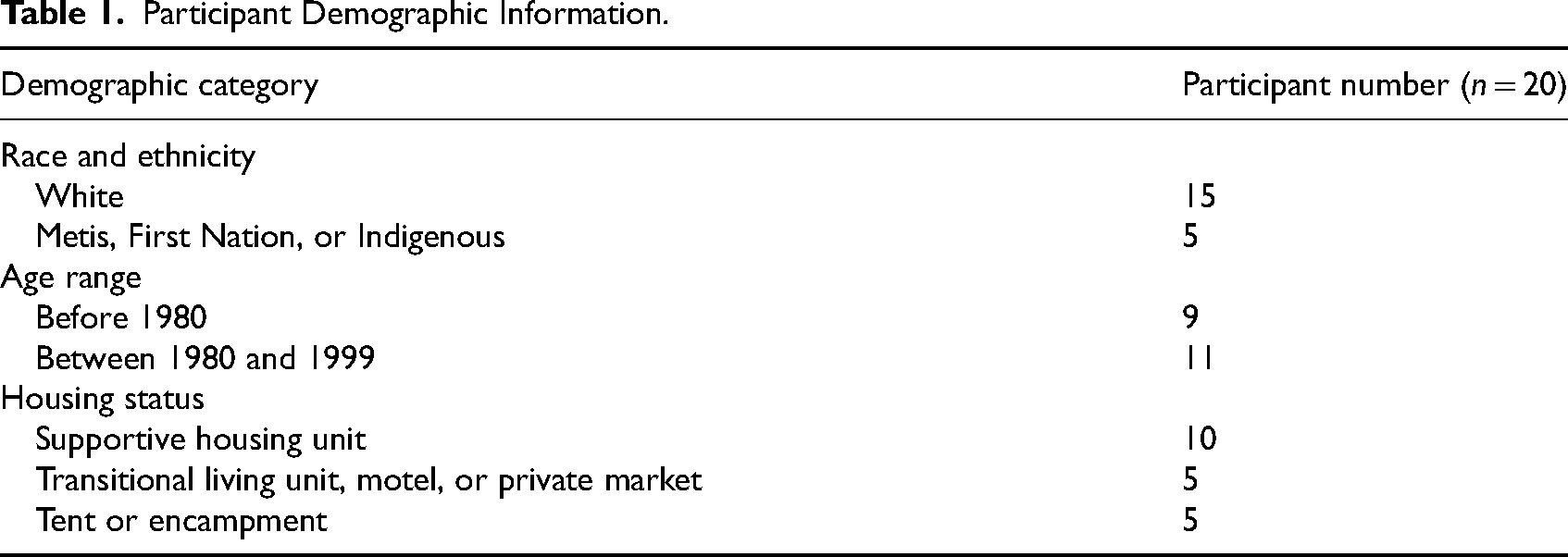
This study was driven by a critical narrative inquiry methodology (Clandinin et al., 2007; Hickson, 2016; Mertova & Webster, 2020), which works to understand how individuals’ life course narratives interact with ongoing power imbalances they navigate. The setting of this study was a safer supply program located in Kitchener-Waterloo, Ontario, which is a program that provides individuals with opioid use disorders who use unregulated opioids and those who are at risk of experiencing an overdose prescriptions pharmaceutical-grade opioids (Reissman, 1993, 2008; Sonday et al., 2020). We conducted feminist-informed interviews with 20 women (DeVault & Gross, 2006) all of whom were clients of the safer supply program. An overview of women’s demographic characteristics can be seen in Table 1.
Participant Demographic Information.
Staff were informed about the eligibility criteria and asked to connect potential clients with the research coordinator (MP), who described the study in detail and, using purposeful sampling, recruited those who were interested and eligible. Flyers were also disseminated within partnering community agencies which women frequently engaged with. Women were recruited to account for varied housing experiences (absolute homelessness, encampments, motels, transitional housing, supportive housing, private market). All interviews were conducted in person at the safer supply program site or a supportive housing unit in the community. Interviews lasted between 30 and 90 minutes, were audio-recorded, and transcribed. Interview questions focused on women’s experiences of housing insecurity, substance use, relationships, perceptions of their sense of identity, and aspirations for the future. Women who participated received a $40 cash honoraria, beverages, and snacks. All women also completed a demographic questionnaire.
All transcripts were reviewed, checked for accuracy, and corrected as necessary. Transcripts were managed using NVivo 12. The data analysis for this project drew on a feminist re-reading of the concept of ontological (in)security, with a particular focus on elements of insecurity as they relate to housing and substance use. Data analysis was guided by the work of Mauthner and Doucet (1998). During the analysis process, we reviewed transcripts to identify broad narratives, relationships, and social structures. Data analysis was guided by feminist standpoint theory and critical narrative inquiry which allowed for a focus on identifying structural elements which were driven by gendered oppression and informed the narratives shared among women. These narratives were assessed and theorized using the theoretical construct of ontological insecurity.
Approaching the analysis in this manner allowed for an acknowledgement of the role broader systems of power played in influencing women’s narratives surrounding their experiences of insecurity. All women were given pseudonyms for the analysis. The codebook, informed by this re-reading, was developed by the research team. The lead author completed the coding of all transcripts. All demographic data was managed and analyzed using Qualtrics.
Results
Demographics
Among the 20 women interviewed for this study, the majority were aged between 22 and 43 (n = 11), with nine being over 44. Most women identified as white (n = 15), with five identifying as Metis, First Nation, or Indigenous. Women were residing in diverse spaces at the time of the interview, with 10 living in a supportive housing unit, five living in a transitional housing unit, social service agency run motel, or in the private market, and five living within tents or encampments.
Dimensions of Ontological Insecurity for Women
Women described gendered experiences of housing insecurity and substance use, which contributed to perceptions of their ontological insecurity. Women shared experiences that corresponded to aspects of ontological insecurity including disrupted sense of being, inhibited stability, social and personal threats and anxiety, and reduced sense of autonomy. Most women we engaged with explained how their experiences of substance use and housing insecurity were unique to them due to their gender. Below, we expand on these themes and demonstrate how grounded ontological insecurity is in the gendered structuring of society.
Unstable Sense of Self
Women described how experiences of housing insecurity and substance use disrupted their sense of being. A lack of stable housing and engagement in substance use left women with altered perceptions of their femininity and connection to womanhood. It resulted in what Kinnvall & Mitzen (Kinnvall & Mitzen, 2017) describe as securing subjectivity. Women secured their subjectivity by developing external identities for themselves as ways to protect their internal sense of self. For example, when using substances and experiencing housing insecurity, women were forced to shed their internal sense of femininity and develop external “strong,” “skeptical,” “rough” identities. Women felt that they needed to shed their internal sense of self due to the oppressive and masculine dominant culture of substance use and homelessness. Women described self-negating and self-silencing when navigating experiences relating to housing insecurity and substance use, such as withdrawal, exploitation, abuse, or stigmatization. These experiences contributed to the creation of “untrue” identities, a rise in anxiety, and the destruction of women’s sense of self, which all represent dimensions of ontological insecurity: I feel like I’m a little colder or somewhat void. I guess void would be a good word. And I’m not that kind of person. Even though I still care inside, I don’t show it like I used to, to people. Relationships suffer for it because I look like I don’t care, and it’s the voidness that the fentanyl gives you. That’s what people see. They don’t see the inside of what I’m thinking, or… people see the change in people, and you don’t see it yourself. You think you’re still that person. I know I’m not. I’ve accepted that because people point it out. (P4)
Women were surprised when reflecting on how their sense of being changed so quickly after losing access to stable housing. Women who explained that they adapted to the harsh realities posed by housing insecurity described themselves as “not normal”: Because I… never thought I’d be able to manage how a homeless person lives. Like it’s just, it always looked like so scary, people become street, but growing up, it seemed too easy—it looks easy? I don’t know, I just adapted. I didn’t understand that. I didn’t think it was something someone should adapt to so quickly. Not normal. (P12)
Women often reflected on the need to rely on or “be exploited” by men in the community to access drugs or housing. This exploitation was a product of gendered expectations engrained within the substance use and housing insecure communities. Needing to rely on men or being exploited left women feeling detached from their true sense of inner selves. They needed to “act the part” and engage in unwanted sexual relations to stay alive. During these experiences, women shared that they negotiated their self-perception of their inner selves and went into “survival mode.” Survival mode for women included negating their sense of identity and, at times, their physical and mental health and well-being (e.g., engaging in activities they found to be morally wrong, which put their safety at risk): You get in a rut. You forget how to interact with people, you forget what you’re good at, you forget… so used to just survival mode. (P3)
Women shared having to “go numb” and detach from their sense of self to cope with the harsh realities of housing insecurity and substance use, which were intertwined with sexual exploitation. To survive, women engaged in sex work and/or theft, which some labeled as immoral and unjust and left them feeling disassociated with who they once were: Interviewer: Do you mind sharing with me a little bit about yourself. How would you describe yourself to someone today? Danielle: I think I’m still trying to figure that out as like things have changed a lot for me over the years. I used to know who I was without a doubt. But with all the changes over the past years, it’s kind of hard to say who I am anymore. (P13)
The sexualization and commodification of women’s bodies driven by unequal power held by men in these environments were prominently discussed as influencing women’s sense of self. Within these environments, women needed to commodify their bodies which often resorted to them detaching from their sense of self to survive. Gendered expectations associated with womanhood (e.g., sexual expectations, being caregivers) were exaggerated in these environments, influencing access to housing, drugs, and overall health and well-being (Watson, 2016). Janet, for example, reflected on gendered expectations relating to housing insecurity and substance use in her interview. Experiencing the death of both her husband and son contributed to Janet’s entry into homelessness, where she faced varying forms of violence and sexual exploitation from men in the community in exchange for access to shelter, food, or warmth. She shared that women are often forced to choose between unsafe environments, either facing absolute homelessness or navigating sexual violence and pressure from peers, in exchange for a place to stay. When describing her experiences of homelessness, Janet explained how she was forced to silence her sense of self to comply to the expectations put on her as a woman. She said: Beatings, and… it was just hell. Every little thing you have to beg for, sleeping on different people’s couches and them having expectations, sometimes unrealistic expectations, wanting you to sleep with them—you know, they promise you the couch, but they want your soul. Sometimes you’re so exhausted, you just give up whatever, just to get a good night’s sleep. You just get numb, and you just get high. (P1)
For many women, a sense of identity was closely connected to being mothers and to their ability to care for their children. Having and caring for children remains a uniquely gendered experience for women who use drugs and experience homelessness. Histories of navigating child apprehension left women with deep-rooted trauma, anxiety, and a de-sensitized sense of who they were. Given societal notions of motherhood being a core aspect of women’s identity, the lack of control over how and/or where the women we spoke with cared for or engaged with their children strongly influenced their sense of self. Almost all the women we spoke with discussed having their relationships with their children controlled by family members or health and social service providers. This inability to care for their children often spearheaded a myriad of factors that promoted ontological insecurity, such as removing their identity as mothers, disconnecting with family members, and losing their homes and income which fostered perceptions of impermanence: Because there was that being a mom and then not being a mom. And he [father] told you have to be, do certain things to be clean and do this and that and get better. But not to have that in your life anymore. So, like how am I supposed to get better when the one thing that makes me happy and I know how to do, is gone. And it was just like spiral point from there on out. Like things got worse. Child tax gets taken away. Like you lose your job. You now have no money to pay for the apartment. (P20)
Lack of Stability in Women’s Lives
All women described difficulty accessing safe and stable housing throughout their lives. The constant transiency associated with housing insecurity led to chaos in the lives of women and created ongoing barriers to maintaining a sense of permanence. Women faced unique forms of “hidden homelessness” which often included being forced to stay with men to maintain or attain shelter. Housing insecurity contributed to their inability to meet societal expectations placed on women surrounding maintaining households or acting as caregivers and facilitated a sense of instability in their lives. When perceived by men as less physically able to protect themselves and their belongings, many women explained having to stay up for days to avoid getting attacked or needing to carry belongings with them to avoid getting items stolen. Jessica spoke about her experiences of impermanence as she explained what her day-to-day life looks like as a woman living in a tent who uses fentanyl: I can’t only have one bag when I leave the house, and I have three of these. For two weeks straight, I didn’t sleep every day. From night to first thing in the morning, I just walk around. Sit down and, I have all these bags now. I’m like, how did I get all these bags? It’s just really rough to figure out where I’m going to put it all, how I’m going to get it from point A to B, where can I take it all now. (P12)
Women described being in constant movement from “couch to couch or, you know, street corner to street corner, sleeping outside” (P13) when experiencing housing insecurity. Regardless of where women found themselves, they could never develop a sense of stability. They described being continuously displaced from public spaces by police officers, harassed by men for sexual favors, or being stigmatized by members of the public as a person who was perceived to lack housing and use drugs (e.g., verbally harassed). Women explained how they faced unique forms of harassment because of their gender. Participants perceived that they were treated with more contempt than men in similar circumstances by their peers, service providers, and members of the public because of their substance use or experiences of housing insecurity. Contempt exacerbated experiences of instability and therefore ontological insecurity for women: If I were downtown, being single and nowhere to go, people would think I’m a prostitute. It doesn’t make sense. Just a woman walking downtown. Some people are really ignorant. But, it’s still—makes it dangerous for women. (P10)
Many reflected that maintaining their personal hygiene while living in a tent, sleeping outside, or residing in an overflow shelter with infestations of cockroaches, bed bugs, or rodents was more challenging for women than men because of gendered expectations of cleanliness for women and also because they required access to private bathrooms and personal hygiene products. They faced many challenges to keep their spaces, clothes, and bodies clean, which contributed to feelings of impermanence. Susan, currently living in a tent in an encampment, spoke about waiting two years to get into a safe, gender-responsive housing accommodation. She reflected closely on the physical elements of the encampment, such as the material of the tent and exposure to rats, which fostered anxiety and impermanence for her. Living within these conditions contributed to Susan’s impermanence as she was always “on edge” to try and protect herself from men attempting to attack her or rob her of belongings: I used to have a cot, like this little cot that took me like 2, 2 1/2 inches off the ground. And I had two, think about an inch, and 1/2 mattress on top, and I could actually sleep and wake up and not feel like I couldn’t move my legs. Or you know, like I would wake up bawling my eyes out for the amount of pain that just from laying on the ground in an um, I don’t know what kind of material that is. But you know, with tarps creating this like musky like, not musky, that’s a smell. But like just like this sticky atmosphere because there was hardly any air flow. Um, it’s still like that, but, um, it’s kind of scary. Even when things were fine, I didn’t have any issues with anyone, um, everything was fine, but, um, there are so many rats. And it just tears, it tears me up because like I don’t know how much I’m going to get to take with me that doesn’t smell like crappy. You know, or it’s not going to have like rat turds in it. (P15)
Women also discussed the gender-related violence prevalent within encampments, which fostered feelings of impermanence. Exposed to ongoing harassment by men in these spaces, women felt at risk, anxious, and unstable regardless of what they did. Olive, an Indigenous woman, spoke to the multi-faceted forms of violence experienced residing in encampments: And I just needed a break because I just couldn’t do it anymore because I’m not, I’m not safe. I’m on my third tent now in the last month. First, in the last two months the first, the first one got cut up by somebody, lost everything. And then the second tent also got cut up and didn’t quite lose everything, but it was still traumatizing because I was inside the tent when it happened. And they, they we’re trying to, they were telling me, they were going to tell me like putting gas on the tent. But it was just water, and they were saying that they were going to light it up with me inside. (P16)
In this region, women did not feel that they were a priority for housing support and that this lack of availability contributed to their feelings of impermanence. Many housing programs are developed with minimal consideration of unique gendered needs which inhibited women’s ability to “settle down” and gain a sense of stability. Some women said that “guys get favouritism, it’s sickening” (P16) when reflecting on their interactions with housing and harm reduction services in the community. This favoritism included men having increased accessibility to and availability of shelter beds, long-term housing accommodations, and increased support from service providers at various agencies. Women reflected on how agency spaces and programs were designed for men, decreasing women’s accessibility to necessary services: The men, they can come in and sit down, relax, and watch TV, they have common areas a lot better than women, and the men. […] More shelters and supportive housing for men. (P12)
The lack of gendered considerations in the design of housing programming created environments of impermanence for women. Most of the housing accommodations which were available to women were not gender-specific, which meant that they were required to reside with cis men after facing decades of abuse or trauma from these same groups. Women reflected that most accommodations to which they had access had: “A lot of drugs there. And there’s fights […] and total drama” (P11). Women described being more vulnerable than men when exposed to violence, substance use, harassment, and robbery in numerous emergency or acute shelter accommodations or transitional housing units they had access to. Jessica described the violence and theft she experienced in co-ed shelters, which made her feel unsafe, unstable, and at risk. She felt unsupported and stigmatized by the shelter workers, which fostered her sense of anxiety: Everybody stole my fentanyl and stuff, um, they [workers] were very prejudiced against me. Like they [workers] didn’t treat the girls there, they have their favourites and stuff, and you sit back and watch them, and it’s really harsh how they [workers] treat little girls there. Like girls get beat up really bad there, and they [workers] knew about it, they knew it was coming, the workers knew it happened, it’s crazy. (P12)
The unequal access to housing services contributed to women’s feelings of impermanence as they described waiting for extended periods (upwards of 5 years) before getting into housing, having a lack of communication from providers, and getting opportunities “snatched” from them at the last minute. The limited number of housing services that were designed for and available to women increased challenges for them in attaining a sense of permanence. This created high sources of anxiety and insecurity for women: Well, it was almost May and I got angry because they [supportive housing program] weren’t communicating with us. I sent the lady a message and I said, if we’re not moving, just tell us. So I can fucking rent a room, I don’t care what, just something, I’m at my wits’ end, I can’t take one more day of being homeless. I’m going crazy. I need my life to start again. I feel like it was on standstill. (P3)
Women’s feelings of impermanence were also driven by the stringent eligibility criteria of most regional housing programs. Many women were ineligible for housing, which influenced their perceptions of their current and future stability: Just trying to contact people to get into housing, and I had given up. Like because I went to [housing provider] and they, the lady didn’t want to refer me to [housing program]. And I went why aren’t you referring me, and she said like I wasn’t homeless long enough. I’m like, I’m in danger. Like people have tried to kill me. Like how come you’re not referring me. (P16)
Women living in transitional or supportive housing programs also described a feeling of impermanence. Many shared that they were unsure what would be next for them as there were “time limits” associated with how long they could stay. These time limits created an ongoing source of anxiety for women as many had spent years trying to get into that very unit. In addition, women shared that having to leave their current accommodation would significantly influence their overall life goals and substance use practices. Many discussed how, without stable housing, they would no longer be able to maintain their daily routine, engage with family members or children, or manage their overdose risk. These fears also contributed to women’s perceptions of ontological insecurity. As Natalia shared, the timeline proposed by the supportive housing unit she is currently staying in created discomfort for her and inhibited her ability to settle and remain stable: Um… I don’t know. Like I said, I don’t even know. […] We’re expected to move on from here. Did they tell you that? Is there a time limit? I think loosely, around 2–5 years, but yeah. How does that timeline feel for you? Is that comfortable for you? No. You’d like it longer. Yeah. I’m getting old. I don’t want to keep moving. (P5)
Loss of Autonomy
A central dimension of ontological insecurity for women driven by substance use and housing instability was the deterioration of their autonomy. Women related their sense of autonomy to their perceptions of control over their lives. Most women shared how substance use influenced their ability to maintain control and self-govern their bodies and daily lives, either due to the pain, intense withdrawal, or the stigma they faced for using drugs and experiencing housing insecurity. The physiological hold that drugs had over women’s bodies inhibited their ability to maintain a sense of freedom, autonomy, or control over their day to day lives. This hold created a lack of autonomy for women daily as they were dependent on drugs to survive: It’s [withdrawal] the worst thing ever. It’s like, it’s like having the flu multiplied by like a couple hundred. It’s horrible. Like your whole body just aches, and you’re so tired. But everything hurts so, like deep bone aching. Like it’s fucking horrible. And you sweat profusely, but you’re freezing cold, and you’re sick to your stomach. You get nauseous. You shit yourself. Like if you get into full blown withdrawals yeah, it’s fucking horrible. (P14)
Experiences of housing insecurity also influenced women’s sense of autonomy. The harsh realities and expectations faced by women when experiencing housing insecurity constrained women’s ability to be autonomous agents. The constraints placed on women when facing housing insecurity inhibited their ability to control their daily lives, which included deciding how they managed their daily income, activities, food security, or even personal belongings: You know because having to upkeep the tent and going around collecting scraps, going around and collecting food and stuff on a daily basis and then having people break in and steal our stuff and steal all the copper, food. Starting all over again it’s very time consuming. (P17)
All women reflected on the unique context their substance use and housing insecurity created for their respective lives, which influenced their sense of ontological insecurity. Women shared how engagement in substance use over their lives created cycles of instability and fostered a life where finding substances was the main objective of their daily routine. These experiences led to periods of constant panic and angst, surrounding if and when they would be able to get their needed supply and what they would need to do to get it. These feelings inhibited women’s autonomy to decide what they wanted to do, when, and how they wanted to do it: Before it was wake up feeling like shit and automatically have to go find a way to make money and then find somebody who had drugs. Find somewhere, just need to go to them and then run that process all over again until I went back to bed. Most of the time, I didn’t want to go to bed because you knew you’d wake up sick. (P13)
Discussion
In this article, we have demonstrated how housing insecurity, withdrawal, gendered expectations, and the daily hustle associated with substance use drive perceptions of ontological insecurity for women. Navigating the realities created by housing insecurity and substance use led women to have an unstable sense of being, instability in their lives, a lack of autonomy, and created environmental contexts that put women in states of constant threat and anxiety. In this analysis, we have demonstrated how the structuring of society, which is driven by patriarchy, results in unique experiences for women which influence their perceptions of ontological insecurity. Societal standards surrounding levels of deviance, morality, reproduction, femininity, and responsibilities were unique for women and contributed to their gendered experiences of ontological insecurity. This work demonstrates the close connection between substance use and housing insecurity and the need for comprehensive structural-level interventions to support women who use drugs (e.g., affordable housing, income supports).
Understanding perspectives of ontological insecurity among women who use drugs challenges how these groups have been characterized across research and society for decades. In sharing women’s reflections, we demonstrate how experiences of substance use and housing are shaped by patriarchal norms, embodied, and influence the overall being of women. The bodies of women who use drugs have been pathologized with reductive narratives focusing on criminality, infectious disease rates, and overdose events (Chang, 2020; Dennis et al., 2023). Similarly, their bodies have been framed as objects that are judged based on their ability to be “feminine” or “reproduce” (Campbell & Ettore, 2011; Ettore, 1992, 2004, 2012) and at the same time as unsuitable or dangerous mothers (Campbell & Ettorre, 2011; Stone, 2015). Focusing on perceptions of ontological insecurity challenges such perceptions and allows for insight into women’s sense of self. This work advances existing research which often assesses physical health outcomes relating to substance use and homelessness such as overdose events or hospitalizations.
Assessing the perceptions of ontological insecurity among women has also illustrated the ways in which experiences of housing insecurity and homelessness are gendered. The realities shared by women demonstrated how experiences of housing insecurity were associated with violence, stigmatization, harassment, and trauma. Women’s bodies were weaponized against them and sexualized by members of their communities when they attempted to access shelter, food, or drugs. These environmental conditions were imposed on women through the power given to cis men from the patriarchal order of society. Our work underscores the impacts of not offering gender-responsive acute and chronic housing solutions. The harms associated with gender-absent programming presented here move beyond the housing system. It has been established how women who experience housing insecurity disproportionately face challenges in gaining sufficient social assistance, stable employment, and accessing legal advice or support when navigating evictions (Schwan et al., 2021). The analysis presented here also offers opportunity for the development of future housing programs to better support the needs of women. Understanding women’s perceptions of ontological insecurity enables program and policy developers to more comprehensively tailor services to better meet these groups unique needs (i.e., safety concerns, ensuring autonomy, supporting with children).
Consideration of gendered structural violence has been limited to date in research that leverages ontological insecurity. Although the role of structures in influencing ontological security has begun to be explored (Harel-Shalev & Kook, 2021), there needs to be more theorization surrounding ontological insecurity for women specifically. This lack of consideration inhibits an understanding of whether this concept truly speaks to the realities of women and can, therefore, further harm. The analysis presented in this paper begins to address this gap. We demonstrate through this analysis the ways in which patriarchy creates externally imposed contexts for women that foster perceptions of ontological insecurity. For example, patriarchy facilitated the constant exposure to exploitation, abuse, and stigma for women which forced them to create “untrue” identities to protect themselves. Similarly, women were forced to be controlled by men in the community for access to drugs or shelter which influenced their sense of autonomy and stability. This work pushes beyond conceptualizations of ontological (in)security as an individualized level phenomenon and demonstrates how it in fact is strongly influenced by structural forms of violence—such as patriarchy.
The continued absence of gendered considerations in the development and implementation of theories, programs, and policies is grounded in the hegemonic and patriarchal structuring of society. The patriarchal order of society “allows men to maintain positions of power, privilege, and leadership in society” (DeKeseredy, 2020, p. 3). As discussed by DeKeseredy, to address the absent consideration of gender in the development of health and social policies, theories, and research, scholars must “resurrect the concept of patriarchy” (DeKeseredy, 2020, p. 10). An example of this is the analysis presented in this paper. Beyond leveraging feminist standpoint theories, radical and intersectional forms of feminism or other critical theory (i.e., critical race theory), can be used to critique and elevate the use of theories and concepts such as ontological (in)security. Utilizing these forms of critical theory within future analyses relating to ontological (in)security will allow for a structural acknowledgment of the intersections and impacts of gender and other forms of oppression (e.g., racism, colonialism) on women (Collins, 2000; Lugones, 2010).
Similar calls have been made internationally for the integration of gender-transformative ideologies to inform the ways we identify and solve health and social disparities (Bartel et al., 2022; Hillenbrand et al., 2015; Perri et al., 2021; Perri & O'Campo, 2021, 2023; Phillips, 2005; Robinson et al., 2019). Gender-transformative approaches redistribute resources and address power inequities associated with gender (Bartel et al., 2022). These approaches encourage critical examination of gender norms and dynamics, which drive experiences for women such as ontological insecurity. Moving forward, we argue that attention to gender is needed when leveraging the concept of ontological (in)security in work relating not only to housing and substance use but to broader health and social systems. Future research must continue to examine the gendered nature of ontological (in)security and must consider how to elevate the use of this theory better to capture the realities of women of varying identities.
Conclusion
The gendered makeup of society, housing insecurity, and substance use environments create unique experiences of ontological insecurity for women. This paper argues that experiences of ontological insecurity are gendered and result in an unstable sense of being, a loss of autonomy, instability, and ongoing anxiety for women. The lack of attention to gender in developing and applying ontological (in)security creates barriers to understanding complete mechanisms that promote security or insecurity for women. Future work that leverages the theory of ontological (in)security must acknowledge the gendered structuring of society and engage in theory that works to resist and eliminate this ordering.
Footnotes
Declaration of Conflicting Interests
The authors declared no potential conflicts of interest with respect to the research, authorship, and/or publication of this article.
Funding
The authors disclosed receipt of the following financial support for the research, authorship, and/or publication of this article: This work was supported by the Health Canada (Substance Use and Addiction Program).
