




Abstract
Background
In the early 2020s, Australian media and public health organizations described the rapid rise in youth e-cigarette uptake, portraying this as a “peer pressure” problem wherein vulnerable young people were being led or bullied into vaping by the “cool” kids. Yet, the peer pressure framing of vaping fails to account for young people's rituals of nicotine consumption and ways social drug economies are organized.
Methods
In 2023, we conducted qualitative interviews and ethnographic research with 24 young people ages 17 to 25, both vapers and nonvapers, in New South Wales, Australia. We investigated their embodied experiences of vaping, observations of peers’ vaping practices, and beliefs about vaping policy. We analyzed their accounts for themes and here report our findings, illustrated with participants’ quotes and an ethnographic portrait of a Sydney high school vape seller.
Results
The notion that young people are “pressured” into vaping lacked emic meaning for our participants. Their accounts reveal three ways that vaping is social beyond “pressure.” First, social vape market offers entrepreneurial teens money-earning opportunities, mediated by social networks and markers of peer esteem, prestige, and trust. Second, vapes are exchanged as both gifts and commodities in sharing economies, offering social opportunities and scripts for recreational interactions. Third, e-cigarettes as material objects provide esthetic and gustatory pleasures that are both individually enjoyed and socially performed in rituals of taste and display.
Discussion
These three perspectives on the sociality of vaping help nuance our understanding of how and why young people vape, and also suggest why public health outreach efforts may not be effective when they reduce youth vaping uptake to peer pressure. As youth vape use is on the rise in Australia, these perspectives matter for understanding this important social phenomenon and may help policy development move beyond simplifications of youth cultural motivations.
A Portrait of a High School Vape Dealer
When L.L. Wynn first interviewed “Francois” about his vaping history, he was a student in a public secondary school in northwest Sydney. This high school (grades 7–12) was highly diverse: most students had been born outside Australia, like Francois; according to state demographic data, most immigrants came from China, followed by India, Korea, and England.
Francois’ high school had a reputation for strictness; the principal held a firm conviction that strict adherence to school uniform policy both produced and reflected discipline, respect, and school spirit. Francois had served many detentions for violating the uniform code, mainly because he wore socks from Target instead of the school's uniform socks. They lacked the school colors at the cuffs, a detail only detectable if teachers asked him to tug up his pants legs. The school socks cost twice as much.
For Francois, wearing generic socks was partly a matter of principle: defying the dress code was a marker of solidarity with peers who struggled to afford the school uniform. Mostly it was rebellion and a test of which teachers fixated on conformity. He gravitated toward teachers who ignored his socks, interpreting this as evidence that they were more interested in substantive learning than rules. He was near the top of his class in two subjects, and in the top third in all the others. Even as many friends were dropping out of high school to pursue trade apprenticeships, Francois never wavered in his ambition to attend university.
Battles over uniform socks reflected his complex relationship with authority, dating to kindergarten. Some teachers considered him a delinquent; many were frustrated when he disrupted lessons. A few enjoyed his humor and harnessed his charisma and leadership to manage their classroom. He had a mischievous smile and quick wit, and one quip during lessons could capture the whole class' attention.
This mix of rebelliousness, charisma, and entrepreneurial spirit made him a successful vape seller in high school.
Wynn and Francois had known each other since he was a small child and Wynn was the parent of a player on Francois’ sports team. Now they sat together, a computer on Wynn's lap as she typed notes. She periodically asked him to pause while she finished typing his words verbatim. Both Francois and his mother had agreed to the interview, but given the subject matter's sensitivity, they had decided not to audio record. Francois later reviewed the interview transcript and this ethnographic sketch to confirm they accurately presented his experiences.
Right away Francois overturned any “gateway” assumptions about the typical progression of drug use by telling Wynn that he had first used cannabis, in year 8, before transitioning to nicotine. By year 9, he had started vaping, and halfway through the year, he started selling—or, in his own words, “pushing”—disposable vapes. He was 14.
But that wasn’t his first foray into “drug” selling, if our definition of drugs expands to include the licit substances of sugar and caffeine. In 2007, New South Wales (NSW) had banned the sale of soft drinks in school canteens. In year 8, Francois and some friends started selling Coca-Cola on the sports oval before class. After 2 weeks, a fellow student reported them to a teacher, who confiscated their Coke and that day's earnings. When Francois’ parents found out, they were outraged that the teacher had pocketed the boys’ money, but also teased Francois, saying that if he wanted to be “a proper drug dealer,” he should have been storing the money and the product in different locations.
A year later, Francois had started using vapes after an older friend offered him a drag. He still remembered that first flavor: pineapple. By then, he had observed a lot of students were vaping, and vapes were shared widely in social rituals of connection, generosity, and reciprocity. People took turns buying their own; as soon as boys saw a friend had a “stig” (a disposable vape), everyone would crowd about and pass it around.
When the fashion for vaping first swept through the school, students shared knowledge about which shops would sell to kids. Then, several children started ordering vapes online to sell. Francois explained, They order them in bulk from China, sometimes Russia, and then they basically sell them at either the same rate you would get from the stores or a bit cheaper … [then] they would get other people to push the stigs for them.
Francois approached one of these entrepreneurs. A close mate in my same year told me he was pushing for someone, and I saw the amount of cash he made. So I asked the same person … “Can I push?” Year 9 was the first year I did it. He was in year 11.
He described a complex economy of trust and reciprocity: They won’t let you push if they don’t know you, they know you’re not a flop or a dropkick, because they have to trust you because you don’t pay them in advance. It's a way you can make money if you have no money. So, they give you the vapes, you sell them at the price they tell you to, and you give them a cut.
Despite the term “pushing,” Francois resisted the label “drug dealer.” Nobody saw it as drug dealing. I still don’t see it as drug dealing. Because everyone uses; nobody has a problem with [vapes]. Their mates are already going to use them. And anyway, it's not really illegal. You can vape once you’re 18. So, it's like a grownup candy bar.
Wynn asked, “You don’t see it as hooking people? You never introduced someone to vaping for the first time?” Certain people I wouldn’t sell to … Like, if someone was a nerd that shouldn’t be doing it, or isn’t a complete dropkick, or in year seven, year eight, I’d say—or if anyone asks me if it's good, I’d say, “You shouldn’t use them.”
Wynn asked him to define “dropkick.” A complete dropkick: you’re a flop, you’re not smart. I wouldn’t sell to people who aren’t dropkicks. It's a fine line. It's just something that, you know, you decide … Most people just don’t even want to buy them, but if they would, and they do, then I would sell them If they shouldn’t vape, but they want to, I wouldn’t sell to them.
There were many paradoxes in the language he used: only someone who wasn’t a “dropkick” could “push” vapes, and Francois claimed he would only sell to “complete dropkicks,” and yet Francois himself vaped. He “pushed” the vapes, yet withheld them from younger kids and “nerds”; even though he was a high achieving student and vaper, he saw himself as neither a nerd nor a dropkick. The labels clearly sought to delineate and apply values to the identities of vape users and vape rejecters; those who did not vape—contrary to popular portrayals of vape users applying pressure to kids to “be cool” by trying vapes—were portrayed as having as much or more social worth than vape users.
Ways That Youth Vaping is Social Beyond “Peer Pressure”
Francois’ description of the social norms and rituals of youth vaping and selling is a complex and rich account of individuals’ decisions to take up vaping, the sociocultural rituals of use, norms that shape how it is sold, and the identities that coalesce around vaping—and around not vaping. In its complexity, it offers a corrective to simplistic narratives of teen drug use as the result of peer pressure.
In the 2020s, a wave of hysteria about vaping in high schools flooded Australian media, with headlines such as, “Principals sound alarms as students take up vaping, become black market ‘dealers’” (Sydney Morning Herald, July 5, 2020); “Children importing vapes from China to sell at school” (Daily Telegraph, March 3, 2022); and “Vape stores opening near Australian schools to ‘recruit new generation to nicotine’, Mark Butler says” (The Guardian, September 20, 2023). All these headlines are, to varying degrees, substantiated by Francois’ account.
At the same time, public health discourses framed teen vaping as a “peer pressure” problem. For example, the Australian Medical Association's report, Unpacking Vaping in Schools, said, “Peer influence was the main sub-theme that emerged, including peer pressure, a desire to belong, and to ‘look cool’,” while the Victorian government's Better Health Channel stated that “children entering their teenage years are experimental, curious and vulnerable to peer pressure.” NSW Health offered a cliché portrait: “They may use peer pressure saying things such as ‘Come on, it's really cool’, or ‘Don’t be a baby, just try it!’.” 1
In a culture that so values individualism, Australians tell stories that portray youth decision making as if their agency is removed by their peers and can only be restored through adult intervention (Rasmussen, 2011; Farrugia, 2023). Young people are depicted as desperately vulnerable beings, following the lead of—or bullied by—the “cool” kids. The solution, in this framing, is to educate and potentiate these weak individuals with fact-based information fed to them by knowledgeable adult health authorities. This strategy, while claiming to empower young people, simultaneously places adult experts in the powerful role of advisors and decision makers (Collins, 2005, p. 302). It assumes that children are inexplicably naïve and vulnerable to “the penetration of their unconscious by mass media commodification and its sensorium” (Feldman, 2012, p. 286). But it is also a hologrammatic concern. These same public health sources only frame peer influences on behavior as “peer pressure” when the influence contravened public health ideals, but not when youth influenced their peers to conform to public health guidelines. For example, the NSW Health guide continues: A “friend” should not put that kind of pressure on you, so we hope this never happens. But just in case, you should be prepared. How will you respond to your friend? Convince your friend that vaping is a terrible idea. Use facts and information from the article to help give reasons and evidence for why you won’t be trying it an [sic] why they should stop … We hope you feel confident now saying no to vaping as it's far from cool.
In this portrayal, it isn’t “peer pressure” if you pressure your friends not to vape.
For decades now, social science research on drug use has challenged normative accounts of a unidirectional chronology whereby peer pressure elicits drug use. Ethnographic accounts of drug sanctions and rituals demonstrated how peer influences and more broadly the social norms around drug use limited the times and extent of drug use while putting in place harm-minimization mechanisms—such as “gurus” who supervised psychedelic consumption (Zinberg et al., 1975). Peer influence can equally elicit harmful drug consumption practices, such as binge drinking. Lunnay et al. (2011), for example, offer a complex analysis of how social influences co-exist that both encourage and discourage drug consumption.
Analyses of drug using communities have pointed out that peer relationships may follow, rather than prompt, an interest in drug use (Bauman & Ennett, 1996; Foster & Spencer, 2013), troubling the causality assumed in accounts of peer influence on drug use: young people interested in drugs may seek like-minded peers, rather than being pressured by existing peers to use drugs. In the field of vaping studies, two recent reviews of the qualitative research on vaping describe a broad field of research where peers both encourage and discourage vape use: some young people see vaping as cool, aspirational, and an opportunity to fit in socially, while others described it as uncool, embarrassing, and a trend on its way out (Ranjit et al., 2021; Smith et al., 2021; see also Tokle, 2020 for empirical research with similar findings). These two review articles also found that the social world of vaping is influenced by the “technological affordances” of vape devices (Barron & Wynn, 2024), including the variety of flavors, colors, and sleek devices; the ability to hone skills (e.g., by creating vapor rings and performing other vaping tricks); and the perceived acceptability of using the devices where combustible cigarettes are banned (Amin et al., 2021; Barron & Wynn, 2024; Harrell et al., 2019; Robertson et al., 2022). 2
More broadly, social scientists have described rich and complex social relationships around vaping and other drug use that are affective and aspirational: where vaping foments shared hedonic pleasure and social bonding (Robertson et al., 2022); where peers not only influence others to use or not use (Amin et al., 2021; Smith et al., 2021), but also use drugs together to inculcate intimacy and trust (Foster & Spencer, 2013), and to disrupt and create new (gendered) modes of relationality, communication, and touch (Farrugia, 2015, 2023). Drug sharing and selling is intimately bound with social networks and friendship norms (Belackova & Vaccaro, 2013, p. 297), and drug reciprocation embodies ethics of exchange, honor, and obligation (Coomber & Turnbull, 2007).
As Hilary Pilkington points out, rather than understanding collective drug use practices as “peer pressure” that persuade people to use, we should understand friendship groups as “providing a set of reference points underpinned by bonds of emotionality and mutual accountability about acceptable and unacceptable drug use and a secure and supportive environment in which to enact the ensuing drug decisions” (2007, p. 222).
Despite these nuanced and critical social science perspectives on peer influences in drug use, the characterization of “peer pressure” as a negative force eliciting dangerous drug use practices informs much vape policy and drug education approaches in Australia, which consequently assumes that education can and is necessary to counter peer influence. As authors such as Rasmussen (2011), Farrugia (2014, 2023), Mold (2021), and others have pointed out, this assumption proposes replacing one form of peer pressure (the drug user who invites and seduces their peers to try drugs) with another (the responsible adult who pressures youth to “just say no to drugs”), without recognizing the latter as likewise a form of peer pressure. These critical analyses point out that such a framing of peer pressure and how to counteract it constructs a paradoxical world where the young person can only demonstrate autonomy by rejecting one form of peer influence and submitting to another (Farrugia, 2014).
Francois’ account is interesting because it gives us insight into the perspective of a drug seller, a figure often portrayed in popular accounts as the quintessential source of peer pressure. His account subverts the conventional peer pressure narrative in several ways. A friend invited him to try vapes but did not exert overt pressure or tell him it was “cool.” Francois later actively sought the opportunity to sell vapes for an entrepreneurial friend. Despite his use of the term “pushing,” he claimed he never pressured anyone to vape and refused to sell to certain groups who “shouldn’t be doing it” (a tactic that, consciously or not, may effectively lure users). In these accounts, vaping is certainly social, and motivated by logics of peer inclusion and exclusion.
Many of our participants spoke of peer influences on vaping, yet only one, a nonvaper, conceptualized the social enticements of vaping in terms of the pressure their peers might exert. Many were actively skeptical of the term. For example, Francois’ older brother—who only sampled friends’ vapes occasionally in social situations, but never possessed his own—commented, I never really felt pressured to try vapes. It's more that your friends are doing it and they’re like “do you want to have some?” and you’re like, “oh sure.” It depends on how you categorize peer pressure. If you categorize it as an aggressive thing, then that doesn’t really happen. It's more like a passive thing, I’d say.
The stereotypical portrayal of peer pressure as someone saying “You won’t be cool if you don’t try this” did not resonate with our participants.
The concept of “peer pressure” may be useful as an educational tool that can help reframe young people's understanding of how drug use is social; by teaching people to conceptualize sociality through the lens of coercion, whether tacit or overt, it may empower them to resist the lure of a social drug experience. It authorizes the education-oriented interventions governmental services are pre-oriented to deliver. Yet, as an analytical tool, it leaves much to be desired. Its disempowering framing of youth as inherently vulnerable and weak does not speak meaningfully to many young people, which limits the peer pressure framing's impact as an educational tool. Its appearance in accounts of what motivates behavior speaks more of widespread socialization in the conventions of question-answer social diagnoses in the surveys which repeatedly confirm “peer pressure” than the inhabited complexities of relational decision making. As an analytical framework it can blind researchers and policymakers to other ways young people conceptualize their drug use, reasons for using and selling, meanings they attribute to social rituals of use beyond “pressure,” and ways social drug economies are organized.
Methods and Participants
Borneman and Hammoudi (2009) call for anthropologists to start with rich, complex, ethnographic data in order to build theory, even when the ethnographic data spills messily beyond the theoretical aims. We have therefore begun with this extended account from Francois to suggest the ways that youth experiences of vaping are, and are not, captured by narratives of peer pressure. Francois was one of 24 people aged 17 to 25 whom we interviewed between January and December 2023. Like Francois, about half of the participants were previously known to one of the researchers, and for those, we were able to ethnographically situate interview statements in the broader context of their lives. There were four clusters of participants who knew other participants (one group of four, one group of three, and two groups of two), and the remaining 13 did not know any of the others. Where participants knew each other and were thus part of a shared social network, we note this in the text when each participant is first mentioned, unless doing so would risk identifying a participant. For those participants whose experiences that might have been recognizable to other participants, we gave them the opportunity to review a draft of this article and obtained additional consent to describe them in the way we have. All participant names are self-chosen pseudonyms, and some potentially identifying details have been omitted or slightly changed, in consultation with participants, to provide confidentiality. This research project was approved by Macquarie University's human research ethics committee.
Our multimodal recruitment strategy entailed respondent-driven and snowball sampling from multiple starting points, advertising the research on social media and through our own social networks. Some participants were current friends or acquaintances of the researchers; others were friends of friends. Snowball sampling involves this “tapping into” connections for the purpose of recruitment; thus there was a degree of familiarity between researchers and participants, as mutual connections were shared and the researchers were in a sense “vouched for” by participants closer to them. However, to ensure privacy, the researchers emphasized that they would not disclose anything said during interviews to mutual acquaintances.
Both researchers discussed their own nicotine use or nonuse in interviews. The researchers’ knowledge or naivete about the substances elicited different disclosures from participants: participants who knew that Wynn did not use nicotine sought to educate her about the social rituals of vaping and smoking, while participants who knew that Barron used both cigarettes and vapes may have felt more comfortable discussing their own nicotine consumption behaviors. The researchers therefore worked against these tendencies; Wynn sought to reassure participants of her lack of judgment of their nicotine use, while Barron invited participants to talk her through their own use rituals as if she did not have shared knowledge and experiences.
Thirteen participants identified as male and 11 as female; none identified as nonbinary. Twelve were current vape users (vapers), six had never vaped, and six formerly vaped but were not current users. Our participants included high school students and dropouts, people who attended technical college (TAFE NSW), university students, and recent university graduates—in all, participants had attended 23 different educational institutions, including 18 high schools, 4 universities, and TAFE NSW. Participants talked about current use and memories of past use, often recalling secondary school settings, perhaps reflecting the context where vaping first became a covetable experience. While their accounts sometimes mentioned educational institutional settings of vape and cigarette use, they also reflected on use in social settings, and they had friendship groups that spanned university, high school, and neither. In short, their reflections suggest trajectories and social networks that spanned school and university but also went beyond these institutions.
We did not specifically ask participants about class. To our knowledge, none came from extremely wealthy or very poor backgrounds. We observed that differences in wealth did not easily map onto friendship networks; many friendship groups crossed markers of class difference (e.g., participants who attended private schools had friends in public schools and vice versa), and note that in Australia, unlike in some other countries, working in manual trades such as plumbing or carpentry is not a clear signifier of class since these are well-remunerated professions. For all these reasons, we do not attempt to describe our participants in terms of simple class categories but, rather, offer details about their social backgrounds, such as whether they went to public or private schools and what jobs they held, in terms vague enough to protect participants from being identified.
We conducted 26 interviews (two participants were interviewed twice), and recorded voices but not images of participants, then deleted recordings after transcription. To protect participants, given our wide-ranging discussions of illicit drug use, we obtained oral consent and never recorded their names. Most interviews ranged from 30 to 45 minutes; some lasted an hour. Our phenomenological framework sought to understand participants’ own embodied experiences of vaping, as well as their observations and beliefs about vape policy and practice. The in-depth interviews began with a set of questions but allowed space for participants to discuss their own interests and concerns and tell stories.
Wynn and Barron both conducted interviews, with Barron conducting the majority. Wynn and Barron coded three interviews independently and then discussed together, in order to develop the coding document and to achieve intercoder reliability in applying it. Barron transcribed and coded most of the interviews for her master's degree research. Wynn and Barron iteratively analyzed the interview transcripts for content and themes, informed by regular study team meetings, and both authors individually and separately coded several interviews and then compared coding results to resolve differences and develop a shared code book. We felt we had reached thematic saturation after 20 interviews but conducted additional interviews as confirmation. We used Excel to manage our data. Wynn took the lead in drafting this article, and Barron and Lea contributed to the analytical interpretation and writing.
Starting from this ethnographic portrait of a teen vaper and vape seller, we explore other participants’ narratives of vaping in NSW. Their accounts reveal three key ways that vaping is social that offer more useful perspectives on the enticements of vaping than “peer pressure,” thus contributing to our understanding of the sociality of drug use, and what is different and same in this new technology. First, the vape market offers entrepreneurial teens opportunities to earn money, mediated by social networks and markers of peer esteem, prestige, and trust. Second, vapes are exchanged as both gifts and commodities and constitute sharing economies, inculcating cultural ideals of generational solidarity where even nonvapers keep the secrets of their vaping friends. Third, vape flavors and colorful devices are material objects that offer individuals esthetic and gustatory pleasures, and also allow young people to cultivate and perform taste and distinction in social contexts. These three perspectives on the sociality of vaping help nuance our understanding of how and why young people vape, and suggest why public health outreach efforts may not be effective when they reduce youth vaping uptake to peer pressure.
Entrepreneurial Opportunities
In Francois’ account of the mechanisms of advertising and selling “stigs,” social media was key. “You put it on your story, Instagram or Snapchat, that you have them available. And then people message you on social media telling you they want one and then you bring it to them.”
Several other participants also described using social media to find a seller who would deliver. The other way they found vape sellers was through friend networks, particularly in schools. “S,” a 20-year-old friend of the boy who had introduced Francois to vapes, commented, “There would be people that would sell them, like, kind of like drug dealers. You could also get them at stores, but that's not as common, to be honest.” Although S never bought his own vapes (only occasionally puffing on others’ devices in social contexts), he observed a large market at his school, explaining this in terms of structural opportunity: It's easier to buy from school than anywhere else. People are a lot closer. You’re going to run into more different people, and it's a lot easier to buy than when you have to specifically set a time and date to meet up and kind of go out of your way, whereas just at a lunchtime you could be like, “Yo. Meet here,” and you’d walk a minute, and you’d buy it, and it's done.
Francois’ and S's mutual friend Bruce, age 17, a public high school dropout and former vape user who had recently quit, commented that in shops you couldn’t be sure whether you would be getting a nicotine or a non-nicotine one, but school sellers reliably sold nicotine vapes. Mitchell, a 19-year-old nonvaper with asthma who had recently graduated from a prestigious private boys’ school in North Sydney and was working an entry-level white-collar job in downtown Sydney while taking a year off between high school and university, explained, It works the same as if you were trying to sell ice cream. Word gets around that one guy has, or buys vapes, and you can then ask them, and they will be like, “Yeah, sure, I’ve got some,” or “No, I don’t.” And then it's just, “Give me the cash, I’ll give you that.” There we go. Bit of an exchange.
Most participants listed several physical locations where they could buy vapes, including convenience stores and tobacconists. Both vapers and nonvapers knew which shops would sell to children (sometimes marveling that they weren’t asked about age or ID), but Francois, like S, found buying from friends more convenient, appropriating the language of the “shop local” movement: If the shop's cheaper I’ll go to the shop, though if my friend's more convenient I’ll go to my friend. But if everything is the same, I’ll go to the friend, of course, to support him and his local business.
Yet, intriguingly, none of our participants described buying vapes legally from pharmacies. Studies of social sources of cigarettes prior to the development of e-cigarettes have described similar phenomena. These are relevant for predicting the impact of Australia's new laws in 2024, which seek to restrict vape access, with more money allocated to policing illicit vape selling, and individuals no longer legally allowed to purchase online for individual use. For example, Croghan et al. (2003) describe how, when law enforcement made it harder for young people to purchase cigarettes in shops, sales halved, yet young people's smoking did not halve. Instead, what they describe as “social markets” filled the gap. However, despite doomsaying predictions about social cigarette markets (e.g., that they would be associated with coercive power relations and would divert students’ funds away from healthy expenditures like food), Croghan and colleagues found little evidence of any of these. They found that social markets were convenient for smokers, sources of income for sellers, and used more by smokers who were doing well at school than by “rebels” and truants. Only time will tell whether the new laws in Australia will reduce rates of vaping (and whether vapers will turn to other sources of nicotine, including cigarettes, or if they will obtain prescriptions when vapes become harder to access). However, if the past is a predictor, illicit contraband suppliers may fill the gap, including in schools.
Instead of starting from deficit assumptions, other theorists have considered social drug markets in terms of opportunities, agency, and sociability. For example, Thirlway, describing how low-income participants in the UK sourced inexpensive e-cigarettes from social networks, argues that these “tactics” were not only rational economic decisions but also about “recovering agency, choosing to spend less and thereby also demonstrating moral worth in relation to the moral problems of addiction and expenditure on the self” (2016, p. 111). In our study, we only found one vape seller who was willing to speak with us, so the conclusions we can draw are necessarily limited, but in the rich account Francois provided of his entry into vape selling, it is clear that he was also driven by the prospect of opportunities to make money (in a context where job opportunities for someone his age were limited) and to fund his own vape consumption, but also to develop himself as an entrepreneur and social leader.
Francois’ vape selling career was short-lived. Reinforcing Lippert, Corsi, and Venechuk's (2019) argument that the “chronosystem”—both users’ life stage as well as the “sociohistorical context within which ecological systems are embedded and experienced” (p. 285)—is important for understanding drug markets, Francois described how vape markets shifted during the COVID-19 pandemic. When schools closed during lockdowns, social media, particularly Snapchat, became the medium of choice for selling and buying vapes, and Francois reported that some of his dealers were students from the authors’ own university. Now mostly it's twenty-year-old uni students dealing. They drive around and drop off and they make lots of money. They’ll deliver to wherever you want … They can cover a big distance with a car. Selling for other people wholesale is down now because so many people sell who have a car and Snapchats and those are more convenient than a kid from a school, because with a car they can drop anywhere. If a kid doesn’t have a car then it's like you have to meet them at a [train] station or something.
Between the pressures of being an entrepreneur and the pandemic, Francois stopped selling vapes in less than a year. “It was just too much work … Even though I could make five, ten dollars a sale, still. You have to spend a lot of time finding customers. You know how it is for a drug dealer. You have to be always on call, always available. Too much effort. I had better things to do.”
Gifts, Reciprocity, and Social Markets
Analytical tools developed to examine the sharing economies of cannabis are useful for thinking through nonmarket aspects of vape exchanges. The concept of social drug supply, defined by Hough et al. (2003) as “the non-commercial (or non-profitmaking) distribution of cannabis to non-strangers” (p. 36), has since been elaborated to consider the many ways that drugs can be both commodities and gifts, and their transactions both commercial and social.
Hough and colleagues used the concept to explore how people in England and Wales were growing their own cannabis products and gifting or exchanging these. They found a broad continuum of practices with diverse financial and social motivations and logics, from people who grew their own cannabis to those who sourced or supplied cannabis from or to friends to avoid “drug dealers” (i.e., people who sold multiple drug products) to small-scale growers who sold to friends to make money. What they all had in common was exchange through personal social networks and outside of established international drug distribution networks.
Our participants described powerful social norms governing vape selling and use, including norms of generational solidarity created through rituals of sharing, gifting, and reciprocity, which were described by both vaping and nonvaping participants alike. Cannabis culture has long been analyzed by social scientists in terms of its sharing logics and social rituals of use: relationships of sharing and mutual obligation, and cultures of favors and reciprocity, that may be separate from or coexist with transactional exchanges of drugs for money (for a range of example see Zimmerman & Wieder, 1977 and Bræmer & Søgaard, 2023). We heard many of the same sharing logics in our participants’ accounts of how vapes were shared between friends, both at weekend social events and at schools. Bruce said, When it started everyone was sort of like seagulls if they didn’t have a vape and wanted one. And in the bathrooms in the mornings, you’d find a lot of people without vapes who went there because they’d know that vapes would be there, to use [other students’] vapes.
Bruce's vivid metaphor of hungry seagulls circling around someone who has food would be familiar to beachgoers. Karen, a 21-year-old white woman who had attended a private high school, recently completed a 3-year degree in health sciences, and had an entry level job working in a hospital, painted a similar picture of avid communal sharing at gatherings beyond high school: Usually we’d all be sitting around at a table, just having a few drinks, and someone will pull out their vape and everyone … it's like opening up a pack of gum, everyone will want to have a go … People are always really happy to share unless they’re super stingy … They’ll usually ask the person with the vape, and then it gets passed around the table … people just grab it off each other really, it gets to that point, after that first person's asked and then people just grab it off each other.
While Francois, S, and others described high school student entrepreneurs importing “stigs” from China and Russia to sell at school, Hamlet, a 24-year-old of South Asian descent who had graduated from public school in northwest Sydney, attended a sandstone university (Australia's equivalent of the Ivy League or Russell Group, i.e., one of Australia's oldest and most prestigious universities), and then gotten a job as a data scientist downtown, described a friend who had bought a large quantity of vapes online and shared them rather than selling. He actually imported like 500 disposable vapes from like China or something like that. And he just had those and was handing them around and puffing on those for a while. That was one of the more rare places I seen vapes coming from.
While some participants described cultures of freely sharing without expectations of return, others described powerful expectations of reciprocity. This resonates with an older anthropological concept of “demand sharing,” which indexes a relational quality to material exchanges (Peterson, 1993). This was the domain where we most clearly saw what could be described as peer pressure: the pressure not to try or buy, but to return a “hit.” S said, It was definitely strong with people in my friend group who would frequently vape, because they would say things like, “Hit for hit.” But often people would argue, they would be like “Oh nah I gave you a hit last month but you didn’t give me a hit back, so give me a hit now.”
He described sharing cultures that emerged around trying new flavors when one classmate brought in a blackberry-flavored vape: People hadn’t had that before, it was a new flavor. And it got a little bit hyped up. It was a good flavor, relatively, and people knew that, so they often wanted to try. So then you’d give the person a hit, and the guy who brought it in would say “hit for hit” and right then, someone would give a hit on their own vape. If a person didn’t have a vape that day, then it would be expected in the future, that you’d return the flavor—I mean, the favor. Freudian slip!
Flavors and Colors, Taste and Distinction
S's comment about exchanging “hits” of different flavors points to another aspect of vape use that is simultaneously individual and social. Device variety allows individuals to cultivate personal tastes and distinction, similar to the ways people use particular clothing styles and brands to consolidate personal identity, signal subcultural belonging, and mark connections to peers through material objects (Miller, 2012). Device variety also allows people to perform these personal tastes in social rituals of sharing and exchange. These rituals consolidated and signaled group identity, with some participants asserting that certain young women coordinated their vapes. Karen said, “younger girls … say they’re at the beach or something, they’ve got their vape with them, they’ve got matching-colored vapes,” and Carla, a 24-year-old university graduate who was working as a property manager when we interviewed her, described seeing displays of colorful vape pens in communal spaces, as when she visited her cousins and “there were at least four vape pens just on the table during dinner.”
Carla was not a vaper, though she had “tried it, like, once,” yet she nevertheless found the variety of flavors enticing: “If someone's got a vape and it's a color or a flavor I haven’t seen before I’m just like intrigued to what it tastes like.” Most participants portrayed the variety of flavors as both individual enticement and mode of social sharing, describing social gatherings where everyone inspects and wishes to sample each other's vape flavors. Samuel, a 25-year-old man who had attended technical college and become a chef, said, “You’ll be with a couple mates and they’ll be like, ‘Oh, which one's that, bubble-gum? Oh, I got the blueberry, you gotta try it,’” while Harley, a 24-year-old man, said, And flavors, I’d say most of us just switch it up every time … I feel like you can’t really get the same flavor twice, though that might just be me. But there's so many to choose from and I love different tastes and food and everything, so that might play a role in me wanting to experiment all the time. But the main flavors for people in general I feel like are strawberry watermelon, kiwi strawberry—strawberry kiwi? What is it? Hold on, let me just open my drawer full of them … strawberry kiwi, lush ice, watermelon, like those are the big ones. Cherry pomegranate …
(See Figure 1). Hamlet identified the many flavors of vapes as both what initiated him into using them and also as something that connected people through shared gustatory rituals. Initially what made me wanna try vaping was probably the curiosity around it … you’re like “wow there's like ten different flavors I can try right now” kind of thing, and there was a lot of appeal in the curiosity for me … [Sharing vapes] happens a lot more than when people used to smoke. And I think a big reason for that is that everyone's vape is a different flavor, so everyone wants to try out a different flavor … I might be out with my friend, and he’ll have, like, strawberry or some shit, and I’ll have grape on me, and I’ll be smoking mine for a bit and I’ll be like oh I’m sick of it, let me have some strawberry for a while.
Carla described conversations about flavors as a kind of social lubricant: When I’ve seen them share vapes, they talk about the flavors, where they got it from … the expense included in the habit, and it sort of starts a conversation. Cause you know they’re all different flavors and they share each other's.
While commercially produced and marketed disposable vapes are not legally available for sale in Australia, Australians are exposed to international marketing of these products, which portray them as “sleek, stylish and sexy” (Bara et al., 2023). Australians could, until 2024, legally purchase vapes from international online sellers (if they had a prescription), and many shops sold them illegally, providing menus of flavors at the counter. The sheer variety of colors and flavors, shapes and styles stands in sharp contrast with conventional combustion cigarettes which, in Australia, are subject to plain packaging regulations that require every brand to use the same drab (as determined by market research) color and identical large font declaring that “Smoking Kills” accompanied by a gory photograph portraying the possible medical consequences of cigarette use.
While Dennis (2013) and other anthropologists have critiqued the assumptions about rational decision making that underpin the cigarette plain packaging legislation, our participants’ accounts make clear that the color, flavor, and variety of the devices are part of their appeal, a materiality that is at once sensory, tactile, and esthetic (Zhu et al., 2014). But beyond the tactile and esthetic pleasures of holding and displaying are other social pleasures and enticements: displaying stigs on a table, matching with friends, choosing a sleek device, collecting multiple flavors and colors—what Collins (2005) calls “elegance rituals”—and connecting with friends and new acquaintances. Bevan (2016), studying e-cigarettes in France, has argued that much of their appeal lies the way they “provide occasions for social bonding [and] gustatory pleasure” (p. 228). Indeed, our participants’ accounts make clear how social bonding and individual gustatory pleasure are intertwined: the variety of flavors and colors please individuals; their collectability and sleek lines allow people to perform taste and elegance before their peers; the endless new flavors are lures to social connection, conversation, and sharing.
Discussion: Deconstructing “Peer Pressure”
Numerous public health research projects have identified “peer pressure” as a key driver in youth vaping (e.g., Sainsbury et al., 2022). For example, a study commissioned by Queensland Department of Health reported that first time vaping is “nearly always socially motivated by internalised peer pressure” and that young people lack “the ready excuses and confidence to reject a vape as it is shared within a group” (Queensland Health, 2023). In these framings, peer pressure is a nefarious force that co-opts unsuspecting youth into problematic behaviors, with public health campaigns seeking to communicate strategies that will empower young people to resist it. These projects are often interventionist in focus; they seek to understand youth vaping primarily in order to combat it.
Emerging evidence does indeed suggest that, like smoking, vaping uptake is strongly influenced by young people's social environment. As Keane et al. (2017) have pointed out, vaping is a social practice that is shaped by, and slots into, other social practices. This reframing away from an individualizing, “neoliberal responsibilisation” (Trnka & Trundle, 2014) of health behavior, and of drug use as neurochemical addiction, draws our attention to the ways vaping, like other drug use practices, is both structured by and enacted in social contexts. For example, studies have found that students are more likely to vape if they attend schools where vaping is common (Corsi & Lippert, 2016), that vaping attitudes and behavior are influenced by peers’ attitudes and behavior (Lippert et al., 2019) and not by school policies (Coppo et al., 2014), and that younger students vape to emulate, fit in, and appear “cool” to older students (Fairman et al., 2021). Our participants recognized this and often spoke about how their vaping and smoking were influenced by friends.
But the category of “pressure” was not meaningful to most of our participants, a finding consistent with other studies of youth vaping, such as Fairman et al.’s (2021) research which found that the framing of peer influence in terms of negative pressure was meaningful to parents but not to young people themselves. Rugkåsa et al. (2001, p. 139) also argue that “peer pressure” is an “adultist construction assumed to be relevant for the children without necessarily being so.” Fairman et al.’s (2021) study found that youth see peer influence in terms of what the researchers summarize as “behavioral display and modeling and structural opportunities,” the latter of which includes, for example, environmental settings or opportunities that encourage or merely facilitate vaping, such as bathrooms, which in our study were similarly found to be key places for vapers to congregate, especially in high schools.
For most participants, portrayals of peer pressure in educational interventions (“don’t be a baby”) were at best not relatable and at worst seen as caricatures. One recent Australian intervention—the “OurFutures” e-Health educational resources—consisted of cartoon young people who “impart knowledge, skills and values related to alcohol and other drug use,” which the researchers asserted constituted “peer-led education” (Gardner et al., 2023, p. 3). This portrayal of youth was metaphorically and literally cartoonish.
In portrayals such as OurFutures, the peer pressure dynamic is depicted as a young person being invited or pressured to vape, whereupon one of two outcomes transpires: they accept, or (equipped with the appropriate strategies) they reject the device. Framing youth vaping in this way obscures young people's agency and ability to make considered decisions surrounding drug consumption through more complicated social relations. Such framing also describes young people as having agency only when they reject drugs and not when they use them (Farrugia, 2014, 2023; Rasmussen, 2011). It further oversimplifies the complicated realities of young people's everyday lives, collapsing these realities into reductionistic motivations for drug use, such as a desire to “look cool” or “fit in.” While these words are echoed by young people themselves, reflecting the ready availability of the peer pressure trope as an interpolated cultural effect, our research also demonstrates more complex ways social environments shape vape use and meaning.
While many young people, including some of our participants, do not vape and express distaste toward vaping, the public health literature tends to solely invoke the concept of peer pressure as an incitement for vaping uptake rather than as influencing cessation or rejection. However, in Rugkåsa et al.’s (2001) research on smoking behavior among children, they found multiple different views on smoking within peer groups where the direction of pressure was generally to not smoke.
As a critical reading of Laursen and Veenstra's (2021) synthesis of the evidence for “peer pressure” reveals, the “evidence” itself is speculative and replete with assumptions, but presented as it is a confirmed fact (thus meeting Latour and Woolgar's [1986] definition of facts in cultural becoming). Qualitative studies of youth drug use have suggested other dynamics and reasons why young people might be influenced by the behavior of peers other than “pressure.” Ungar (2000) argues that they may emulate peers as a “consciously employed strategy to enhance personal and social power” (p. 167). Nichter's (2003) research on adolescent smoking similarly views smoking as a form of culture play. His observation that young people's smoking is an “ongoing project subject to the identity needs of youth” (2003, p. 139) brings agency to the forefront, with relevance for the more recent youth uptake of vaping, where young people are similarly actively negotiating their identities in relation to their cultural context. Baillie et al. (2005) see smoking as a “script” for engaging socially with peers and navigating a social world, a perspective echoed in our participants’ observations that vape flavors offer a conversational gambit that lubricates social interactions. Rugkåsa et al. (2001) also argue that “instead of viewing the smoking children as communicating with the adult world,” they need to be understood within the terms of their own cultural worlds (p. 131). In that vein, Cullen's (2010) study of young women's smoking culture described the gift-giving of cigarettes as part of what structures and maintains friendships, social alliances, and the negotiation of gendered identities. Similarly, Bræmer and Søgaard's (2023) study of social cannabis supply showed how drug exchanges are both structured by social norms of reciprocity and create pressure on those who provide drugs to give and share—essentially the opposite of the classic portrayal of what “peer pressure” is, and a perspective that aligns well with our participants’ descriptions of the pressures not to try vapes for the first time but rather to share in their relational economy.
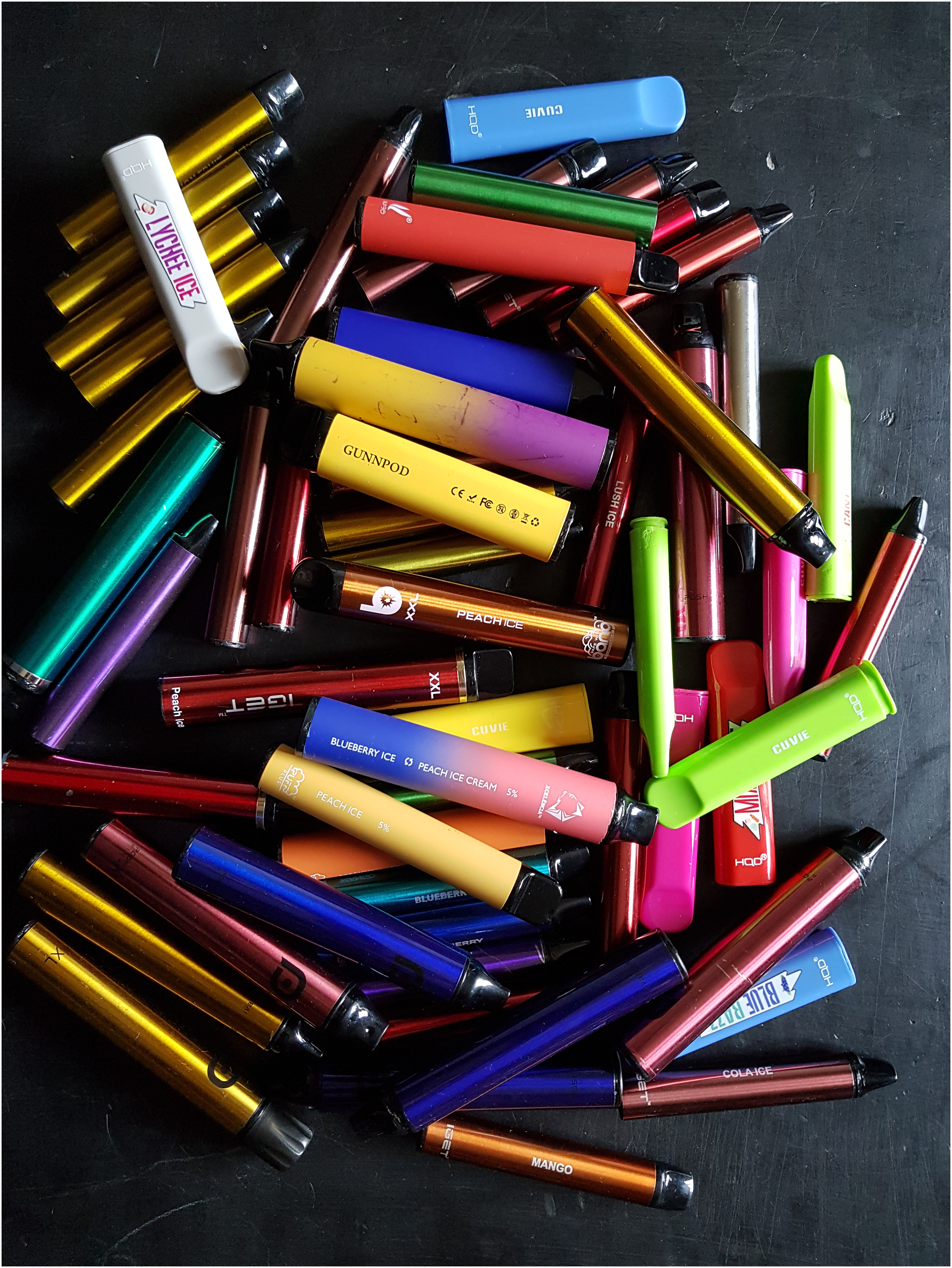
An assortment of used vapes from one participant's drawer.
Conclusions
Dwyer and Moore's (2010) analysis of the Australian literature on illicit drug use argued that it was characterized by “surveillance” research based on neoclassical economic models of drug markets, was static in time (focusing on single-moment glimpses rather than perspectives on how markets change over time), and neglected both human agency and the sociocultural processes that re/produce drug markets. This approach, they argued, dominated both research funding and policy. Their argument for more ethnographic data on drug markets was part of a shift in the research landscape, one that this research project contributes to. Yet much recent research on young Australians’ (mostly illicit) use of e-cigarettes remains interventionist in orientation, oriented by a framework of health risk and the dangers of addiction, and dominated by a discourse on peer pressure.
That approach, which paints drug use as inherently dangerous—even when the identified health dangers are minimal, and the primary “danger” identified is that of “addiction” (chemical dependency) itself—in turn shapes social science research. Much of the literature on the social worlds of vaping, for example, begins by asserting that it is necessary to understand social influences on vaping in order to design interventions to counter peer pressure, and asserts that no matter how minimal the health risks of nicotine, it is never zero (e.g., Robertson et al., 2022). In other words, the ontopolitical approach of much drug research revolves around the assumption that addiction is intrinsically problematic, and that discouraging e-cigarette (and other drug) use is a public health imperative; this foundational orientation then drags our attention away from other meaningful and positive social aspects of drug use (Fraser, 2020, 2024).
Our phenomenological investigation into youth attitudes toward vaping found that, while vaping is very social and peer influenced, the notion that people are “pressured” into vaping lacked emic meaning for our participants. Moving beyond the caricature of agency-less teens being pressured into vaping, we see a far more complex range of ways that vaping is social for young people. Social vape markets offer entrepreneurial prospects where buyers and sellers and nonvapers together build networks of generational solidarity structured by sharing, reciprocity, keeping secrets from authorities and even a concern about income differentials. Vapes offer social opportunities and scripts for recreational interactions. They also provide esthetic and gustatory pleasures that are both individually enjoyed and socially performed in rituals of taste and elegance, where the wide range of flavors underpin social exchanges of reciprocity. As youth vape use is on the rise in Australia, these perspectives are of critical importance for understanding this important social phenomenon and may help policy development move beyond a “just say no” simplification of youth cultural motivations, which mostly failed to gain traction despite widescale implementation attempts (c.f. Mold, 2021).
CRediT Author Statement
LLW contributed to conceptualization, methodology, investigation, data curation, and writing—original draft. CB was involved in conceptualization, methodology, investigation, data curation, and writing—reviewing and editing. TL was involved in writing—reviewing and editing.
Footnotes
Declaration of Conflicting Interests
The authors declared no potential conflicts of interest with respect to the research, authorship, and/or publication of this article.
Funding
The authors received no financial support for the research, authorship, and/or publication of this article.

Research Data for This Article
Due to the sensitive nature of the questions asked in this study, potential disclosure of illicit activity, and small sample size, participants were assured raw data would remain confidential and would not be shared.