Abstract
The aim of this research was to explore how the concept of harm is constituted in case law judicial decisions pertaining to the importation, production, possession, and trafficking of drugs in Canada using critical discourse analysis methodology. The research was designed to uncover taken-for-granted assumptions about drugs and associated harms. The data source for this study is judicial decisions. These are published texts where judge(s) summarize details about the factors considered, provide a reasoned interpretation of sentencing principles relevant to the judicial decision, and explain the rationale for their decision. Initially, codes were identified deductively, using words related to drugs and harm. Codes were added when incidents of moralization language were observed to be high. Moralization language was defined as “the usage of language cues referencing moral values”. The selection process resulted in n = 129 judicial decisions meeting the inclusion criteria. Discourse analysis was guided by four tools described by
Gee’s study: the
Introduction
This paper presents the findings of a study undertaken as part of a Master of Laws degree (Kiepek, 2024). The aim of the research is to explore how harm is constituted in case law judicial decisions pertaining to the importation, production, possession, and trafficking of drugs in Canada. The research was designed to uncover taken-for-granted assumptions about drugs and associated harms. Judicial decisions are published document where judges present information about the case (court, parties, lawyers, judges, and date), an overview of the decision, facts, and other evidence (e.g., documents and reports), circumstances of the offence, positions of the parties, general sentencing principles, objectives of sentencing in the judicial decision, aggravating and mitigating factors, joint recommendations, available dispositions, discussion on appropriate sentencing, ancillary orders, and a conclusion (Criminal Law Notebook, 2023). Judicial decisions form a distinct discursive genre (van Leeuwen, 2018), suitable for analysis using critical discourse analysis (CDA) methodology. CDA is a methodology that allows examination of the law as socially, culturally, politically, or and pragmatically situated; “It is concerned less with what the law is and more with what it does, how it works, and its effects” (Mitchell, 2023, p. 104).
In the introduction, I present an overview of drug laws in Canada and introduce key sentencing principles relevant to the analysis. I briefly elaborate on judicial decisions as socially embedded discourse. In the methodology section, I describe the CDA methods used for data selection and analysis. Themes explored in the findings are: (1) trafficking as an immoral enterprise; (2) scourge to society, (3) fentanyl and harm, and (4) constructing gravity. I conclude with a discussion about implications for enactments of institutionalized stigmatization and discursive constructions of harm. To situate myself as a researcher, I am a university educated professor and am a White, female, able-bodied, economically secure, second-generation Canadian from working class background. I do not personally use controlled substances and have not been the subject of prosecution under criminal law.
Drugs and Drug Laws
The criminalization, decriminalization, and legal regulation of drugs in Canada today evolved in response to national and international social, political, and economic influences over the past two centuries (see Boyd, 2017; Boyd & Carter, 2018; Boyd et al., 2016; Carstairs, 2017; Dyck, 2021; Malleck, 2015; Montigny, 2017; Valverde, 2003). Governance of most drugs known today fall under one of the four federal Acts. The Controlled Drugs and Substances Act (CDSA) defines penalties associated with the production, possession, and distribution of specific “controlled substances” (such as cocaine, methamphetamine, and heroin). Controlled substances are classified into different schedules, with specific sanctions for infringements attributed to each schedule. There is little to no government transparency about what criteria historically informed the classification of drugs, nor the type of evidence used to make these decisions. The Cannabis Act came into force in October 2018, defining criminal activity and penalties associated with the production, possession, and distribution of cannabis. The Cannabis Act is espoused to protect public health and safety by providing a supply of cannabis subject to quality control. The Food and Drug Act (FDA) outlines expectations around the manufacturing, packaging, labeling, storage, importation, distribution, and sales of foods, prescription drugs, and non-prescription drugs, such as alcohol. Health Canada is the federal regulator that determines which drugs are approved under the FDA. Many alcohol laws are regulated under provincial Liquor Control Acts. Finally, the Tobacco and Vaping Products Act (TVPA) regulates the manufacture and sales of tobacco. The purpose of the TVPA is to protect the health of Canadians in the face of “conclusive evidence” that tobacco use is a causal factor of many debilitating illnesses and fatal diseases (p. 4). Under this Act, trafficking and possession of “contraband tobacco” is illegal.
Seddon contends, “The principal conceptual difference between, say alcohol and heroin is that they are regulated under completely separate regimes, rather than that they are substances of a fundamentally different kind from one another” (Seddon, 2010, p. 132). Regardless of the therapeutic value of a drug or the legal status, drugs have properties that are variably perceived as desirable/beneficial or adverse/harmful, with advantageous and disadvantageous effects often co-occurring. For instance, legally regulated drugs, such as alcohol and tobacco, are associated with benefits around pleasure, sociability, belonging, and relaxation (Kersey et al., 2022; van der Sterren et al., 2016). These drugs are also associated high mortality rates, societal impacts, and economic costs (Canadian Centre on Substance Use and Addiction, 2022; Canadian Substance Use Costs and Harms Scientific Working Group, 2023; Government of Canada, 2023a; Mayo Clinic, 2021; Stockwell et al., 2020). 4-Methylenedioxy-methamphetamine (MDMA, ecstasy, molly) is associated with pleasure, social connectedness, aesthetic appreciation, and enhanced perspectives on life, alongside few adverse effects, such as concentration and memory deficits associated with long-term use (Elsey et al., 2023).
There are a number of lingering questions about the regulation of drugs that cannot be fully explored in this paper. It is worth noting that many legal theorists view the criminal law as a “last resort” (Husak, 2004) and question the suitability of criminal law for the regulation of drugs. The Government of Canada (1982) noted: Restraint should be used in employing the criminal law because the basic nature of criminal law sanctions is punitive and coercive, and, since freedom and humanity are valued so highly, the use of other non-coercive, less formal, and more positive approaches is to be preferred whenever possible and appropriate … if the law if used indiscriminately to deal with a vast range of social problems of widely varying seriousness to the public, then the authority, credibility and legitimacy of the criminal law is eroded and deprecated. (p. 42)
With respect to criminal prosecution of the possession of a controlled substance, the Public Prosecution Service of Canada (2020) outlines alternatives to criminal law responses under circumstances when the accused person's needs will be better served through health services, when conduct relates to bail conditions, or when restorative justice approaches are suitable.
Public Prosecution Service of Canada guidelines state, “criminal prosecution of the possession of a controlled substance contrary to s. 4(1) CDSA should generally be reserved for the most serious manifestations of the offence” (para. 7). Serious manifestations include risk to children and young persons, public risks (such as driving while intoxicated), risks to rural or remote communities, involvement in trafficking, occurrences in custodial contexts, and involvement of peace officers or public officers in the offence (Public Prosecution Service of Canada, 2020). While enforcement practices vary by jurisdiction, the Vancouver Police Department in British Columbia instituted de facto decriminalization of simple possession in 2006 (Hayashi et al., 2023), reflecting national prioritizations related to trafficking, production, and importation.
Sentencing Principles
While importation, production, possession, and trafficking of drugs remain a criminal matter, it is important to understand sentencing principles. The fundamental purpose of sentencing is defined in Section 718 of the Criminal Code and Section 10 CDSA. The objectives of sentencing are to: (a) denounce unlawful conduct and the harm done to victims or to the community that is caused by unlawful conduct; (b) deter the offender and other persons from committing offences; (c) separate offenders from society, where necessary; (d) assist in rehabilitating offenders; (e) to provide reparations for harm done to victims or to the community; and (f) to promote a sense of responsibility in offenders, and acknowledgment of the harm done to victims or to the community. Note that (a), (e), and (f) each mention “harm done to victims or to the community.” Sentencing principles of greatest pertinence to this study are denunciation, deterrence, and rehabilitation. I briefly discuss select aggravating and mitigating factors including gravity, sophistication of the offence, responsibility, moral culpability of the offender, and addiction and mental health.
Denunciation reflects the intent to convey societal condemnation of conduct through a suitably severe penalty for infringement of a law. The severity of a sentence is also expected to act as a deterrence (Roach, 2022). Specific deterrence means dissuading a person from re-offending and general deterrence means dissuading others from offending. Claims that severity of sentences effectively serve as a deterrence contrasts with the position of the Public Prosecution Service of Canada, which notes that criminal sanctions have limited effectiveness to effect specific or general deterrence or protect public safety (Public Prosecution Services of Canada, 2020). Indeed, research over the past half century consistently disproves claims that severity of sentences prevents crime (Doob & Webster, 2003; Guan & Lo, 2021).
In law, rehabilitation refers to steps taken by the accused toward becoming law-abiding. For people facing drug charges, this can include attending counseling, engaging in education, employment, or volunteer work, developing supportive relationships, volunteering, and disengaging from criminal conduct (Cole & Roberts, 2020). Evidence of rehabilitation can result in a less severe sentence (see Shallow; Johnson; Knott).
Relevant aggravating and mitigating factors are outlined here. Gravity relates to the perceived seriousness of the offence. Seriousness of drug-related crimes may include how long the person was engaged in the conduct, the quantity of drugs, the type of drug(s), dangerousness of the drug, sophistication of operations, potential for profit, and the role of the accused within a criminal network (Oates). The sophistication of drug offences pertains to the production, distribution, and/or importation of drugs. Commercial level distribution is typically associated with longer carceral sentences (see Oates; Debrowney; Lepine; White). Responsibility and moral culpability relates to perceived personally accountability for engaging in conduct. The term moral blameworthiness shares a similar connotation of accountability. Mental health and addiction factors generally have a mitigating value in sentencing. As well, when a person with a history of addiction demonstrates evidence of “good prospects for rehabilitation,” this is considered a mitigating factor (Hendi; Do; MacFarlane et al., 2015).
Judicial Decisions as Socially Embedded Discourse
It has been argued that “law is, fundamentally, a discursive phenomenon (Durant & Leung, 2016). Furthermore, law cannot be separated from legal discourse because it is generated, enforced, contested, reproduced, and transformed centrally through language” (Mitchell, 2023, p. 108). Values and ideologies of judges are discursively embedded in law in countless ways. Of relevance to this paper is how concepts are constructed through the use of language. Coyle (2013) articulates the centrality of legal discourse in creating perceptions and meaning, stating: In our social and ‘criminal’ justice discourse, language choices have considerable ramification. For example, when we define others as ‘evil,’ as ‘innocent victims’ or as ‘criminals,’ we justify the liberal application of social control upon selected others in our community. (p. 54)
A factor of considerable relevance for this paper is the observation that, “the legal ideological stances that judges take… are implicit and hidden partly because of the intertextual and indexical nature of the construction of meaning in discourse” (Philips, 1998, p. 80). Through use of citations (largely of past judicial decisions), judges are more likely to be perceived as neutral and unbiased, with their standpoints portrayed as abiding legal precedent, not expressions of personal opinion. This practice can mask the deliberateness with which decisions are made about which information and interpretations to cite. Correspondingly, deliberate decisions are made about what to exclude, potentially silencing legitimate counter-positions. Bernstein (2023) observes, “What may seem like an inert text—law on the books—turns out to be a sociocultural microcosm” (p. 16).
Engaging in a deeper analysis of what is said by judges and how it is said reveals explicit and implicit values and ideologies. Coyle (2013) cautions, “when we do not pay attention to how we talk about justice we often surrender ourselves to a justice system already determined by the rhetoric of moral entrepreneurs (public discourse leaders), whose language can conceal justice agendas” (p. xiii).
Methods
The methodological framework of this study was informed, in part, by Mitchell (2023), who outlines key principles for integrating critical legal theory and qualitative social science and humanities approaches. He presents formal legal texts as “qualitative artefacts” with CDA serving a means to “interrogate both the possible meanings that a legal text might generate and the political investments and consequences that might follow from the dominant meanings associated with or arising from those texts” (Mitchell, 2023, pp. 103, 107). Examples of legal discursive texts include acts, bills, transcripts of legislative debates, and national and international reports.
Mitchell (2023) asserts language “is the central medium through which law is created and expressed” (p. 102). CDA is used to focus “on the ways discourse structures enact, confirm, legitimate, reproduce, or challenge relations of power and dominance in society” (Denzin, 2003, p. 141) with a recognition that “few words are actually value free” (Hodgson et al., 2005, p. 416). Meaning is discursively created through decisions such as word selection, word ordering, tone of voice, inclusion and exclusion of certain perspectives (or “voices”), rules governing who can talk and when, and so on. For example, a legal professional may refer to the subject of a criminal case by their name or as “the accused,” “the defendant,” a “parent,” a “contributing member of society,” a “victim,” a “predator,” a “monster,” or another term. Decisions about which word(s) to use construct meanings and convey value judgments.
Research Question
The primary research question informing data collection was: How is the concept of harm constituted in case law pertaining to the importation, production, possession, and trafficking of drugs in Canada?
Search Strategy
To ensure a systematic process, the search strategy largely aligned with methods of scoping reviews (Arksey & O'Malley, 2005). In January 2023, I searched Westlaw, Lexis Nexis, and CanLII databases and the Supreme Court of Canada website for Canadian judicial decisions related to the importation, possession, production, and/or trafficking of drugs, where the concept of harm was discussed in relation to drugs. An initial search of the keywords “harm” AND “drugs” in CanLII resulted in >36,600 cases. The keyword “substance” resulted in a plethora of unrelated judicial decisions, as it tends to refer to the “substance” of law, so this term proved ineffective. To narrow the search, I used the search terms [“harm principle” AND “drugs”] and [“harm to society” AND “drugs”] in the Westlaw, Lexis Nexis, and CanLII databases. This was too narrow for the Supreme Court of Canada website, so only the search term “drugs” was used. This resulted in n = 1,245 judicial decisions (see Figure 1). Following the selection process, it was determined these keywords resulted in sufficient breadth of cases pertaining to types of drugs, types of charges, level of court, jurisdiction, and so on, to contribute to a rich, sufficiently representative, analysis. In Canadian law, alcohol is not considered a drug, so the search terms functioned to exclude alcohol from this analysis. The search did include one case related to tobacco.
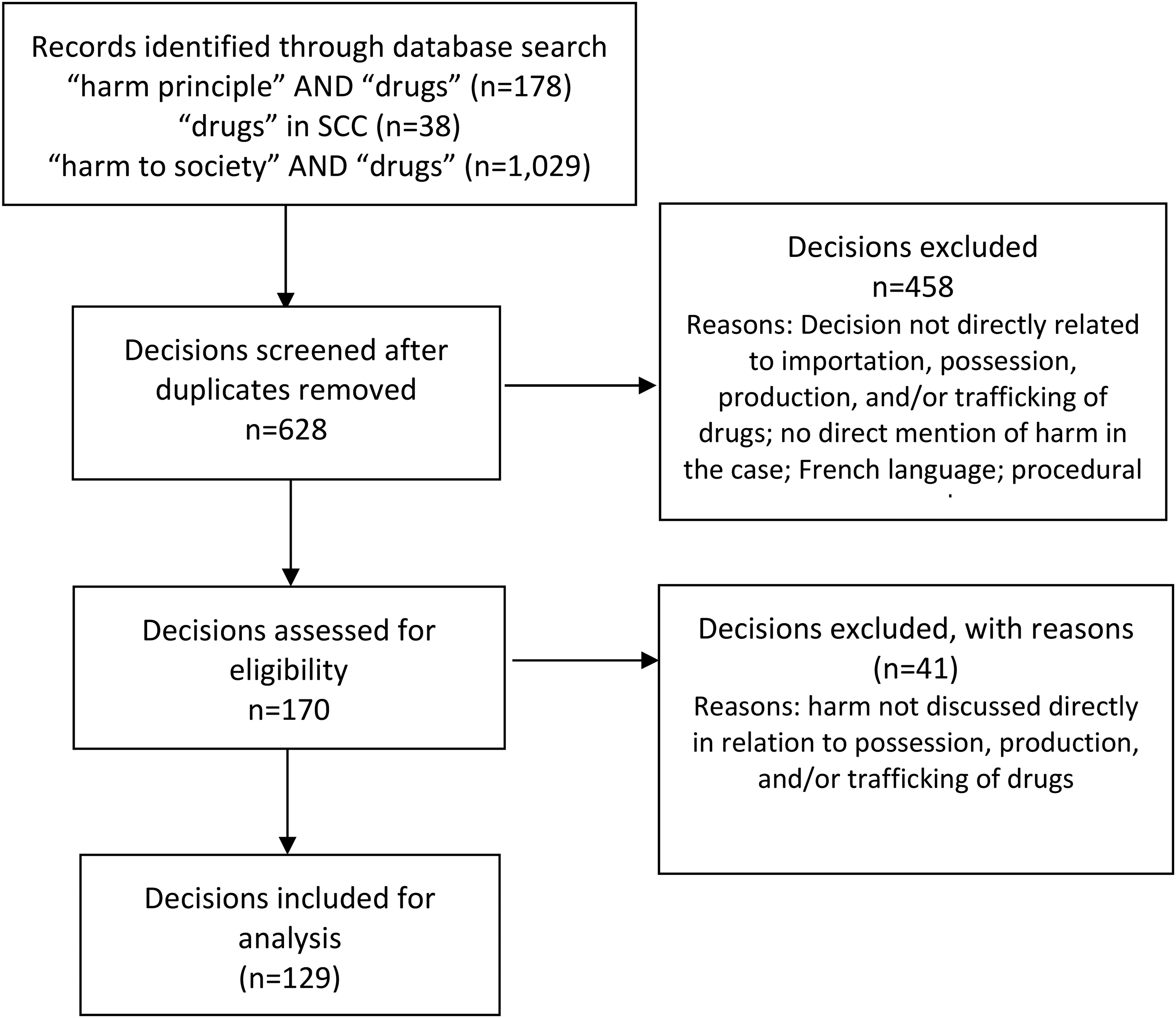
Data selection process.
Case Selection
Following the initial search, duplicate judicial decisions were removed. Remaining judicial decisions were screened and removed if they did not directly relate to importation, possession, production, and/or trafficking of drugs, did not directly mention harm, or were published in French language only. Following the screening, the remaining judicial decisions were read in full. At the stage of full review, cases were excluded if harm was not discussed directly in relation to importation, possession, production (also referred to as manufacturing), and/or trafficking of drugs (i.e., mentioned in relation to sentencing principles or organized crime). Figure 1 outlines the selection process, which resulted in n = 129 judicial decisions.
Data Extraction
Of the 170 cases assessed for eligibility, 65 were selected for preliminarily analysis. Atlas.ti 23 software was used to facilitate data extraction. Initially, codes were identified deductively, using words related to drugs (e.g., cocaine; cannabis) and harm (harm* to society; harm principle; death; children). Additional terms were added to identify harm when the word was not explicitly used, such as “overdose,” “notorious,” “danger*,” and “destructive.” Codes were then added when an incidence of moralization language was observed to be high. Moralization language is defined as “the usage of language cues referencing moral values” (Malik et al., 2021, p. 656)], marked by words such as “heinous,” “pernicious,” “scourge,” “abhorrence,” “reprehensible,” “blight,” and “greed.”
During full review, an additional n = 41 cases were excluded. The final data extraction table included: name of case; sex and age of accused (when relevant and when provided); drug-related issue; sentence (or decision); types of drug-related harm; primary sentencing principles (or legal theories) considered; moralization language. I read each judicial decision in full and manually completed the data extraction tables. When reporting data, I added markers to indicate which extracted data was (a) a citation from another judicial decision, (b) reference to a secondary source, and/or (c) information provided by an expert. The full completed data extraction for the final n = 129 cased is published in the thesis (Kiepek, 2024).
Analysis
Among the many methodological approaches possible when using CDA, I selected four tools described by Gee (2011a, 2011b). The
The
The
Findings
A majority of decisions (n = 125) involved sentencing for charges related to the importation, possession, production, and/or trafficking of drugs. With the exception of n = 2 decisions, all instances of charges for possession also included charges related to trafficking, possession for the purpose of trafficking, production, and/or importation. Only three decisions were written before 2001.
Themes to be explored in this paper are: (1) trafficking as an immoral enterprise; (2) scourge to society, (3) fentanyl and harm, and (4) constructing gravity.
Trafficking as an Immoral Enterprise
In n = 55 (43%) of the judicial decisions, conduct of the accused was described as profit-driven and/or motivated by greed (Agecoutay; Alcantara; Andrews; Beaven; Berry; Brown; Burke; Choi; Cobb; Cook; Cormier; Etmanskie; Feser; Fleming; Friesen; Gill; Grant; Guilbride; Jordan; Harmes; Hassall; Howard; Kim; Khosravi; Lapointe; Legerton; Malt; Marshall; Maruska; Massey; Mazerolle; McArthur; Millar; Nelson; Noseworthy; Nguyen; Oraha; Parranto; Potts; Providence Health Care Society v Canada (Attorney General); Rider; Roufosse; Rosales; Schmok; Sentes; Shaw; Sidhu; Simmonds; Switucka; Szucs; Tran; Truax; Ursino and Dracea; Vezina A.L. (Private); White; Yoshikawa).
The notion of greed was referred to directly and indirectly, often used rhetorically and without elaboration. For instance:
“selfish need to make quick money” (Roufosse) “He did not want to legally earn the money” (Malt) “profit from the misery” of others (White; Simmonds; Cobb; Harmes; Kim) “sole purpose [of commercial tobacco sales] is to promote the use of a product that is harmful and often fatal to the consumer by sophisticated advertising campaigns often specifically aimed at the young and most vulnerable” (RJR-MacDonald) “motivated by greed” (Schmock)
Greed was commonly referred to as an aggravating factor when considered during sentencing, conveying
In many instances, language around greed could only be interpreted as conveying negative judgment due to the nature of charge. Language used to describe production and distribution processes might otherwise be interpreted as positive and socially valued in capitalist economies. However, within the context of these drug-related judicial decisions, discourses of profitability, planning, and coordinated action lend A burgeoning business (Lapointe) A sophisticated operation for profit (Shaw; Berry) “carefully and meticulously planned and carried out their project so as to obtain maximum production and immense personal gain” (Agecoutay) Lucrative (Cook; Tran) “production requires planning, capital outlay and financial investment” (Nguyen) “A large amount of money stands to be made with minimal effort” (Roufosse) “commercial operation … a money-making mission” (Roufosse) Monetary personal gain (Switucka) commercial enterprise (Massey; Beaven; Khosravi) “purely mercantile motivation” (Rosales) “lucrative, hard to detect, easy to operate enterprises” (Sentes) If a significant number of middle-aged, otherwise employable adults in British Columbia, or elsewhere in Canada for that matter, opted for engaging in activities that provided illegal incomes instead of legal and taxable ones, the quality of life in this province as we know it would substantially deteriorate. (Guilbride, para. 155)
Not participating in the legitimate workforce was portrayed as an immoral threat to Canadian society:
Participating in drug trafficking was largely portrayed in judicial decisions as serving personal financial gain and demonstrating callous disregard for others. People charged with trafficking were frequently described as “preying on” or “exploiting” vulnerable members of society (Shaw; Rider; Massey; Brown; White; Parranto; Simmonds; Cobb; Harmes; Kim). People who traffic drugs were referred to as “merchants of misery” (Harmes), “merchant(s) of destruction and death” (Ursino and Dracea), and “retailer(s) of poison” (Etmanskie; Morrison). Outside one judicial decision (Chesshire), there were no identifiable victims. Thus discursive “preyed on the weak and the vulnerable with his toxic wares” (Richard Quast) “prepared to do significant damage to others so that they could make money” (Cook) “care little or not at all about the harm they are potentially seeding in the community” (Roufosse) “trafficking … is one of the most heinous of all crimes” (Burke) “committed by persons with no conscience” (Grant) “anyone who engages in the drug trade spreads misery” (Bacchus) “[the offender's] role in spreading this ‘disease’” (Massey; Jordan) “parasitic profit-making” (Alcantara) “Trafficking in fentanyl is almost the equivalent of putting multiple bullets in the chambers of a revolver and playing Russian roulette” (Frazer; analogy of Russian roulette also referred to in Gill; Parranto; Kim; Frazer) “front line of spreading those terrors and tragedies to others” (Frazer) “preying on users’ addiction and misery” (Cobb; Nelson) “spreading the misery of addiction” (Choi) “spread the plague of illicit hard drugs” (Choi; metaphor of plague also referred to in Song; Nelson; Parranto) “pursuit of profit at the expense of violence, death, and the perpetuation of a public health crisis” (Parranto) “customers’ addictions as a ‘road to riches’” (Harmes) “willingness to exploit at-risk populations and communities” (Kim) “reckless disregard for human life” (Harmes; Kim) “personally “responsible for the gradual but inexorable degeneration of many of their fellow human beings” (Mazerolle)
Trafficking was portrayed as inherently connected with organized crime, violence, weapons, and risk to the “innocent” public (see Begon). There was a lack of empirical evidence provided in the judicial decisions to support these claims and connections. Discursive
The discursive choices made in the judicial decisions conveyed opinions as rhetorical, taken-for-granted truths. Consumers of drugs are constructed as vulnerable and lacking in volition, persons accused are villainized, and the perceived seriousness of the crime is magnified. Using the
Scourge to Society
One term that stood out during preliminary analysis was “scourge,” which appeared in 26 judicial decisions (Aeichele; Babineau; Beaven; Burke; Campbell; Chesshire; Choi; Cobb; Derycke; Ellis, 2022; Frazer; Friesen; Grant; Guilbride; Harmes; Hendrickson; Hulshof; Jablonski; Khan; Kim; Mazerolle; Mitchell; Nelson; Potts; Simmonds; White) and related to both drugs and trafficking. Drawing on the
The use of moralization language, particularly through intertextual citations, appears intended to reinforce the
An alternative to using metaphors like “scourge” to substantiate claims of harm are to provide evidence-informed information about prevalence of use, incidence, harms, impact within society, and underlying societal factors that influence the degree of harm for specific populations. This information would then be considered in relation to the specific facts of the case, rather than generalized speculation of potential or assumed harms. This type of approach is modeled in many of the included decisions that contain little to no occurrence of moralization language.
Fentanyl and Harm
In the included decisions, judges tended to conflate harms associated with drugs and harms associated with trafficking drugs, which created frequent unwarranted
In the full thesis, I explore discursive constructions of harm related to fentanyl, cannabis, and MDMA. In this paper, for feasibility, I focus solely on fentanyl, which offers a unique opportunity to explore a newly emerged drug of interest in criminal law. First produced in 1960, illicit fentanyl became an important medical analgesic (Stanley, 2014). In Canada, fentanyl was first reported in British Columbia and Alberta in 2011 (Belzak & Halverson, 2018). Among the included judicial decisions, n = 26 related to fentanyl all published between 2015 and 2018. Between 2019 and 2022, more than 50% of the decisions involved fentanyl. Prior to this, the majority of judicial decisions pertained to cocaine, crack cocaine, or methamphetamine.
Among included judicial decisions, Frazer is the first to explicate the harms of fentanyl and to embed extensive legal tropes and moralization language (note: Frazer cited Aujla for evidence from an Alberta Chief Toxicologist report and Feser for descriptions of harm). In Frazer, Justice Mason used words like “death and destruction wrought by the scourge,” “ripples of tragedy,” and “insidious and insatiable monster” (para. 48). He claimed that “Trafficking in fentanyl is almost the equivalent of putting multiple bullets in the chambers of a revolver and playing Russian roulette” (para. 11). The accused is said to have “joined the front line of spreading those terrors and tragedies to others” (para. 51). Such discursive decisions create
Friesen later broadened the summary of potential harms, citing a report from the British Columbia Coroner Services, which listed rapidly increasing annual fentanyl-detected deaths between 2012 and 2018. Justice Ker reified moralization language, such as portraying fentanyl as a “notorious Grim Reaper stalking the streets of Canada's cities and towns” (citing Toth, para. 45). Such language conveys evil, darkness, and death. However, in Friesen, Justice Ker emphasizes principles rehabilitation, emphasizing the exceptionality of the accused's “miraculous transformation since his arrest” (para. 78). Fentanyl is portrayed as a harmful drug, where the “most vulnerable members of our communities—the homeless, drug-addicted, and impoverished—are disproportionately represented in these grim statistics of death and addiction” (para. 42). In this judicial decision, the
A more recent judicial decision about fentanyl is Parranto, a Supreme Court of Canada appeal of sentence from the Alberta Court of Appeal pertaining to trafficking fentanyl at the wholesale commercial level. As of May 2023, it was cited 473 times. This judgment introduces a swath of moralization language that is later cited in numerous judicial decisions. A key principle addressed in this judicial decision was gravity. It was stated that “Appellate courts must sometimes set a new direction that reflects a contemporary understanding of the gravity of the offence” (p. 9) and “The time has come for the perception of the gravity of large-scale trafficking in fentanyl to accord with the gravity of the crisis it has caused” (p. 11). Moralization language is directed more toward the person involved in trafficking than fentanyl itself. As a drug, fentanyl is said to be “public enemy number one” (para. 93). However, the real threat to society, and the
While it is unquestionably imperative to prevent avoidable deaths, occurring predominantly among marginalized populations in Canada, a problem with relying on tropes as a figurative form of discourse is that tropes convey only partial understandings (Foeglin, 1986). Several judicial decisions, including Parranto, do acknowledge that fentanyl has therapeutic benefits. Risks associated with non-medical fentanyl are higher among naïve users and when surreptitiously added to other drugs. However, discursively constructing fentanyl as public enemy number one and those who traffic it as principally responsible for the high rates of opioid toxicity deaths in Canada renders invisible the more complex societal factors that perpetuate the use of drugs and the failure of current social, health, and legal approaches to improve lives and mitigate risk, such as through access to drug testing (Kennedy & Coelho, 2020). In this way,
Constructing Gravity
The preceding analysis demonstrates that moralization language served to emphasize the
At the same, in some judicial decisions, discursive
Gravity of the offence, as related to harmfulness, was often discussed in
When the term moral blameworthiness was used, language tended to be more compassionate and judges tended to emphasize prospects for rehabilitation, mitigating the
Discussion
In this section, I touch on two main implications of the findings. The first is an emergent finding of institutionalized stigma. The second responds to the research question pertaining to the discursive construction of harm.
Institutionalized Stigma
Moralization language was found to be entrenched and normalized through repeated citation. Subtle selection of words and tropes results in judicial decisions that cannot be interpreted as purely impartial. Decisions about what words to use, even when citing a previous judicial decision, conveys the ideological stance and personal opinions of the judge. Bosmajian (1974) writes about the “language of oppression”; namely, “the inhumane uses of language, the ‘silly words and expressions’ which have been used to justify the unjustifiable, to make palatable the unpalatable, to make reasonable the unreasonable” (p. 9). Such words that produce and reproduce stigmatization were regrettably validated through intertextual repetition are given force in many of the reviewed judicial decisions, even at the level of the Supreme Court of Canada.
The Government of Canada (2023b) identified a need to reduce drug-related stigma in Canada's justice system, with a focus on a need to adopt non-stigmatizing language. Judges hold privileged social positions of power and their words are attributed legitimacy and authority. What a judge says is persuasive and influences how the public thinks about certain topics and subsequently how they respond to others. Research indicates that judicial decisions are influenced by the political ideology and personal beliefs of the judge, which are often covert and without their own awareness (Cahill-O'Callaghan, 2013). When scrutinized, it can be understood that language “betrays and bolsters the oppressive ways of thinking about and responding to” lived experiences of the citizens judges serve (Sullivan, 2017). Judicial discourses that demonstrate disrespect and dehumanization can legitimize inequitable treatment of some citizens.
These findings align with research undertaken by Seear (2020) in Canada and Australia. In her study, lawyers described deliberate decisions about discursive framings of drug use and addiction as skillful legal strategy. To present a compelling argument, a lawyer might reinforce social stereotypes, as described by an Australian lawyer: … so in a plea in mitigation you're, it's often unfortunate, I guess, [you are] presenting your client in the – not the most helpless light possible – but you're playing up the challenges they're facing and all the things going wrong in their life, and how terrible it is for them and if they’ve got a disability, going on about their disability and so on. It's very – it's not a great model, and it's not great for clients. (pp. 150–151)
Seear (2020) found that framing drug use as an addiction, even in the absence of indications of dependence or harm aligns with a disability framework and serves as a “means to an end: a way of ensuring access to basic health care rights and harm reduction services for people who use drugs, but who are not, by virtue of conservative political approaches to drugs, otherwise able to access them” (pp. 73–74).
Language also holds the potential to be progressive, protective, and emancipatory. Ferencz (2020) advocates for law professionals to advance strategic arguments that create “new ideas in legal discourse about people who use and supply drugs that are rooted in harm reduction and the autonomy of people who use drugs” (p. 229). Avoiding the use of stigmatizing tropes requires one to convey facts clearly and accuracy, so the quality of the argument is not based on rhetoric masquerading as defensible, evidence-informed knowledge.
While law professionals should mitigate reinforcing and creating stigma in their personal practices, institutionalized stigma is a process of normalization, where stigma becomes entrenched, condoned, and accepted. Transformation requires systems level reform. There are excellent examples of judicial decisions that do not include moralization language or use of judicial tropes. McWhirter, Maruska, Murphy, Clay, and Malmo-Levine are examples of Supreme Court of Canada judicial decisions that effectively draw on evidence-informed knowledge, cite judicial decisions with the purpose of informing judicial interpretation, and refrain from moralization language.
Evidence-Informed Representations of Harm
Harm was predominantly discussed in three ways: harm attributed to a drug, harm attributed to trafficking, and harm associated with citizen involvement in the criminal law system. In the judicial decisions, there was minimal use of evidence-informed law (citing research) and some involvement of experts. Harm was generally intuited to be based on the classification of the drug according to the CDSA. However, constructions of harm largely relied on citation of past judicial decisions as precedent, often reproducing judicial tropes like “profit from the misery of others,” “preying on the weak and the vulnerable,” “most heinous of all crimes,” “scourge to society,” “parasitic profit-making,” “the equivalent of putting multiple bullets in the chambers of a revolver and playing Russian roulette,” “spreading the misery of addiction,” and “preying on users’ addiction and misery.” Bosmajian (1992) confronts tropes embedded in law that perpetuate injustices, citing Carmichael (1967): When the courts speak through their opinions, they speak as ‘people in power’ and ‘master,’ and as such they have the power to define and impose their tropes, directly and indirectly. Through the reliance on precedents, the repetitive citation of legal tropes becomes increasingly influential. The written and published opinion, relying on precedents, repeats the tropological arguments, further institutionalizing figuratively expressed principles, doctrines, standards, and premises. The reliance increasingly embeds the repeated tropes in the legal landscape … therefore for a long time cease to provoke further analysis.
Reliance on tropes overshadows the need to substantiate knowledge claims about harm. Yet, it is inappropriate to rely on past cases as sources of evidence-informed knowledge, unless the credibility has been ascertained. As stated by Judge Berger in Bengert, “The doctrine of precedent does not apply to evidence. There is no justification for following a judgment which is shown to be based on expert testimony which cannot be supported” (Bengert, p. 29, emphasis added).
The potential for evidence-based law is gaining prominence, influenced, in part, by an increased number of legal scholars engaged in empirical legal research (Epstein & Martin, 2014). Evidence-based law can involve conducting research about the effectiveness of laws and the legal system. For instance, it is observed that the efficacy of drugs laws to protect the public from harm is not substantiated by contemporary research (Global Commission on Drug Policy, 2021). Evidence-based law can also involve drawing effectively on research to substantiate knowledge claims in judicial decisions. One common claim in the judicial decisions was a link between organized crime and violence. While this may be accurate—particularly in certain regions internationally—links between organized crime arising from drug trafficking and societal harms in Canada is not well substantiated (Desroches, 2005). To strengthen the validity (or refute) of this argument, Canadian data about relationships between drug trafficking and societal harms need to be systematically analyzed and findings made available.
Excluded from this paper, though included in the thesis, are judicial decisions related to harms associated with to cannabis, where the medical benefits and increased social acceptability are elaborated. Such nuanced discussions were not present in judicial decisions related to opioids, cocaine, crack cocaine, or methamphetamine. Opioids, particularly fentanyl and carfentanil, were framed as a social crisis, heightening the perception of risk for harm.
Efforts to compare criminalized drugs to legally regulated drugs were routinely dismissed by the Court. Under the CDSA, the relative harms of controlled substances are subject to consideration; however, it was consistently argued that because alcohol is not governed under criminal law, any comparisons to the harms of alcohol would not be considered. Neglecting to consider and compare harms associated with government-endorsed, commercialized, profit-driven enterprises of alcohol, tobacco, cannabis, and pharmaceutical industries functions to condone and reinforce the criminalization of controlled substances based on perceptions of severity of harm, while silencing relative risks of harm from legally regulated drugs. In addition, there is an increasing body of knowledge grounded in non-stigmatizing and non-problematizing approaches to advance nuanced understandings about drug use. Failing to understanding the complexities of drug use contributes to incomplete and partial understanding of drug-related harm and its place in society (Boyd et al., 2016) and “generate[s] and exacerbate[s] harms by producing and reproducing disordered, marginalised and devalued versions of subjecthood (in the form of the ‘sick’/’addicted’ victim)” (Seear & Fraser, 2014, p. 833).
Research indicates problems associated with drugs arise from “social, historical, and political systemic forces (including colonisation, social inequity, and racism) and inadequate policies (such as criminalization of simple possession, an extremely toxic unregulated illegal drug market, and inadequate regulation of alcohol) [which] are the fundamental drivers behind toxicity deaths and many other substance use harms” (Health Canada Expert Task Force Report #2, p. 4). Harms associated with drugs laws disproportionately impact “people who are poor and/or homeless, people with mental health and/or substance use issues, youth, children of parents imprisoned for drug crimes, Indigenous people, racialized groups, and women” (Toronto Public Health, 2018). Not all Canadians experience the same degrees of privilege or social capital, which result in inequitable access to resources, supports, and opportunities or risk of drug-related harm (Kay, 2022). Discourses that portray drugs as inherently harmful, without considering factors like frequency of use, amount of use, underlying predisposition to mental and physical health conditions, financial security, social support networks, intergenerational trauma, and so on, invite partial understandings.
Stigmatization discourses are in conflict with the principle of diversion, which entered the CDSA in 2022 “to protect the health, dignity and human rights of individuals who use drugs and to reduce harm to those individuals, their families and their communities” [CDSA, s 10.1(b)]. The principle of diversion is meant to acknowledge the importance of responding to “problematic substance use” as a “health and social issue” (p. 13). Peace officers can determine whether it would be preferable, to take no further action, to warn the individual or, with the consent of the individual, refer to a program or to an agency or other service provider in the community [CDSA, s 10.2(1)]. Despite the importance of understanding drug use as conduct better responded to outside criminal law, Canada faces a number of inadequacies in health and social systems. In Canada, a shameful lack of timely access to culturally appropriate mental health and addiction services presents an ongoing barrier to rehabilitation (Jackson et al., 2022; Lauzière et al., 2021). People who use drugs report stigmatization and marginalization when accessing health and social services, resulting in disengagement, distrust, and poorer outcomes (McNeil et al., 2014). Harm reduction services, such as needle distribution programs, safe injection sites, and managed alcohol programs, are not universally available (Russell et al., 2022; Wild et al., 2017), and hospitals generally lack harm reduction policies. Many Canadians engage in the informal economy, including panhandling, bottle collecting, and drug distribution (Homeless Hub, 2021), as Canada's social benefits are insufficient to ensure a living wage and affordable housing (Evans et al., 2021). These types of inequities contribute to disproportionate challenges associated with drug use and trafficking. Unstable living circumstances infringe on opportunities for education and work, impacting judicial interpretations about prospects for rehabilitation.
When considering mitigating factors and moral culpability in sentencing, it is important for judges to better understand that individual “choices” are constrained by societal factors like timely access to resources and culturally appropriate, trauma-informed, non-stigmatizing services delivered with respect and kindness. Ellis does include some details around the “social context,” which can be used to determine the “rehabilitative prospects of the offender” (para. 76). It is important to understand the rehabilitative prospects of a person are not contingent solely on individual choice, with such choices being a product of social systems, structure, and relationships.
A final point for discussion is the adequacy of drug law and policy. Concerns have been raised that continually framing a social issue as a crisis dulls the severity, normalizes the phenomenon, and functions as a “substitute for action” (Guan & Lo, 2021, p. 451). Research indicates that the criminalization of drugs has not reduced supply and has given rise to a number of undesired consequences, including limited access to harm reduction approaches leading to increased transmission of blood-borne infections, lack of access to medicinal use of illicit drugs, perpetuation of untaxed and unregulated financial markets, constrained experimental research, increased prevalence of drug adulteration, and increased violence (Nutt, 2020). In the absence of a safe, regulated supply, people who use drugs are exposed to adulterated and potentially toxic supplies, obtained at inflated costs, through criminal channels (Bonn et al., 2020). Criminalization acts as a further deterrent from voluntary access to health and social services (Bonn et al., 2020).
While legally regulated drugs are subject to regulations about maximum strength and accurate labeling, the illicit nature of producing many of the commonly distributed controlled substances results in uncertain and inconsistent potency and purity (Bonn et al., 2023; Gagnon et al., 2023; Ivsins et al., 2020). Having the option to purchase a regulated product of known composition and strength, as is available with alcohol, tobacco, cannabis, and pharmaceutical drugs, is an effective harm reduction strategy available for only select drugs.
To conclude, high reliance on legal tropes about drug harms, harms of trafficking, moral culpability associated with distribution about some drugs, by some people, in some ways, and a lack of contextual awareness of social inequities that influence the lives of Canadians perpetuates legal interpretations that support rationales for sentencing predicated on denunciation and deterrence.
Methodological limitations influence the generalizability of the findings. The majority of judicial decisions reviewed in this study related to trafficking. Simple possession judicial decisions or those that do not come before the court may construct the harms of drugs in different ways. Concepts relating to harm may be addressed in judicial decisions, but without using the word “harm” (e.g., “injury,” “overdose,” “cost”) these judicial decisions would not have been identified or included. While the availability of written judicial decisions presents many advantages, CDA can be enriched through analysis of verbal discourse, including features such as tone of voice, eye contact, and body language (Mann et al., 2014). There is opportunity for deeper exploration of values, ideology, and power through ethnographic methodologies that include direct observation in courts where sentences are delivered.
This study uncovers opportunities for deliberate systemic changes to redress institutionalized stigma. Lawyers and judges are urged to critically reflect on how values are (re)presented and (re)produced through their use of language and the quality of legal arguments when stigmatizing tropes, with may not be empirically substantiated, are eliminated.
Footnotes
Declaration of Conflicting Interests
The author declared no potential conflicts of interest with respect to the research, authorship, and/or publication of this article.
Funding
The author received no financial support for the research, authorship, and/or publication of this article.