



Abstract
Opioid-related overdose death continues to be a public health crisis in the United States, reaching a new peak in 2021 with more than 100,000 people dying of drug overdose; 75% of these deaths involved an opioid. Naloxone, often known by the brand name Narcan®, can be easily administered to prevent opioid overdose death. While naloxone is a central harm reduction tool, it has generated controversy as discussions of its use have been framed by longstanding stigmas associated with drug use. Critics have framed it as a “moral hazard” that encourages drug use, stigmatizing its distribution and uptake. Harm reductionists have responded by countering misinformation about drug use and harm reduction and humanizing people who use drugs. Social media platforms have become key sites for these debates. These are digital social spaces in which individuals may fuel stigma and/or build community with others by enacting identities, exchanging knowledge, and bonding over shared experiences. TikTok, a video-based platform, has become an active space for community-building around harm reduction. This article examines the experiences of people who post about naloxone on TikTok. We draw on thematic analyses of semistructured, open-ended interviews with 13 TikTok users who tagged posts with #naloxonesaveslives or #narcansaveslives hashtags from June 2020 to April 2023. Specifically, we explore how these individuals understand and leverage TikTok's association, creative, and interactive affordances as “doors” to build harm reduction community and to educate others about drug use and harm reduction. We also explore how they navigate the “traps” of visibility on TikTok that pose challenges to using the platform for harm reduction activism: stigma, burnout, mental distress, and digital silencing. Finally, we consider the implications of our findings for future research and practice related to digital harm reduction activism.
Introduction
Opioid-related overdose death is now a decades-long crisis in the United States (U.S.) (Ciccarone, 2019). Provisional data indicate that 107,081 drug overdose deaths occurred in 2022, with more than two-thirds involving synthetic opioids other than methadone (Kariisa et al., 2023). Naloxone—often known in the U.S. by the brand name Narcan® in nasal spray form—is a medication that can be easily administered to prevent opioid overdose death (McDonald & Strang, 2016). While naloxone is a central harm reduction tool and has been deemed an essential medicine by the World Health Organization (WHO, 2021), discussions of its use have been shaped by longstanding stigmas associated with drug use. Most prominently, critics frame its availability as a “moral hazard” that reduces the perceived negative consequences of drug use and thereby encourages drug use (Tse et al., 2022). Although research does not support these beliefs, these discourses limit the distribution and uptake of naloxone (Bazazi et al., 2010; Ellis et al., 2021; Fomiatti et al., 2022; Tse et al., 2022).
Additionally, the high cost of Narcan creates a significant structural barrier to accessing it, further generating controversy. Naloxone was first patented in 1961 to counter side effects of opioid medication use and was approved by the U.S. Food and Drug Administration (FDA) for opioid overdose reversal in 1971 (Campbell, 2020). The original patent for naloxone has long expired, and its generic version costs approximately 20 to 40 USD per dose (Campbell, 2020). In 2015, the FDA approved Emergent BioSolutions’ Narcan nasal spray, yet it is far more expensive than other naloxone products at around 20 times the cost (Bowman, 2023). Many hoped that the approval of generic naloxone nasal spray would lower its cost and increase access, yet when the FDA approved two generic nasal spray naloxone products in 2022, these products were priced at only 5% lower than Narcan (Stoltman & Terplan, 2023). While some overdose prevention and education programs and public health departments distribute Narcan for free, its high cost continues to limit its availability for the most socioeconomically marginalized individuals at risk of opioid overdose (Messinger et al., 2023). As opioid-related overdose deaths continue to rise, there is an urgent need to expand naloxone access (Irvine et al., 2022). In March 2023, the FDA approved Narcan for over-the-counter, nonprescription sales beginning in Fall 2023 (FDA, 2023). It is estimated to cost 45 USD for a two-dose package, leaving significant concerns that it will be too expensive for the people who need it most: people who use drugs who are most likely to witness an overdose (Becker, 2023; Messinger et al., 2023).
Harm reductionist activists who seek to reduce the negative consequences of drug use and build communities of care among people who use drugs challenge these stigmas and structural access issues (Campbell, 2020; Zigon, 2018). Such harm reduction activism is increasingly occurring on social media platforms such as TikTok, a video-sharing social media network (Breen, 2022). Since 2018, TikTok has rapidly grown in popularity and is the leading video streaming and mobile application worldwide (Ceci, 2023). TikTok's association, creative, and interactive affordances make it especially fertile ground for individuals to enact identities, build communities, bond over shared experiences, and engage in activism (Lee & Abidin, 2023). Social media platforms are also social spaces in which misinformation, stigmatizing discourses, and structural inequalities related to drug use and “addiction” may be both challenged and reproduced (Dwyer & Fraser, 2016). However, we know little about how people engage in digital harm reduction activism on this increasingly popular social media platform. This article fills this gap by exploring how people experience digital harm reduction activism on TikTok.
Literature Review
Harm Reduction: Stigma, Social Connection, and Visibility
People who use drugs have long faced multiple, intertwined stigmas, including public stigma rooted in stereotypes about people who use drugs as dangerous and morally flawed (Tsai et al., 2019) and structural stigma rooted in social institutions and practices that limit the opportunities, resources, and wellbeing of people who use drugs (Hatzenbuehler & Link, 2014). These stigmas often limit public support for harm reduction approaches to addressing the drug overdose crisis, such as naloxone distribution (Tsai et al., 2019). Stigmas related to opioid use have intensified as fentanyl, the highly potent opioid that now dominates the illicit opioid supply in the U.S., has fueled what Beletsky et al. (2020) call “fentanyl panic.” The spread of misinformation on social media, such as the supposed risk of opioid overdose from casual tactile and respiratory exposure to fentanyl, intensifies fentanyl panic and may promote hyper-punitive, counterproductive policies (Beletsky et al., 2020).
Harm reduction as a social movement aims to counter stigmas associated with drug use by centering the lived experiences of people who use drugs and privileging peer support (Campbell, 2020; Zigon, 2018). Thus, social connection is central to this approach. This also applies to efforts to promote peer-delivered naloxone. Faulkner-Gurstein (2017) stresses the “social logic” of naloxone as its success as an overdose prevention strategy is dependent on the experiences, expertise, and social connections of people who use drugs. Furthermore, scholars and activists have framed peer-delivered naloxone as a “technology of solidarity” that people who use drugs use to resist stigmatization and dehumanization (Campbell, 2020). In these ways, peer-delivered naloxone is part of the broader harm reduction movement's strategy to position people who use drugs as active political actors rather than passive subjects of intervention (Faulkner-Gurstein, 2017; Friedman et al., 2004; Henman et al., 1998).
Community and visibility are also critical to harm reduction as a social justice movement. Anthropologist Jarrett Zigon's ethnographic research on drug user unions highlights the importance of “community for those without community” for harm reduction activists (Zigon, 2018). Rather than being identity driven, this approach to community is open to whomever arrives, however they present themselves. Zigon also found that members of drug user unions counter their positioning as “Other” in Drug War ideology through their visibility: a “disclosive tactic of showing” that involves making themselves visible as persons who use drugs and are valuable members of communities. Moreover, harm reductionists have adopted the slogan “nothing about us without us” from the disability rights movement, reflecting the demand for the visibility and direct participation of people who use drugs in drug policy reform and intervention (Szalavitz, 2021). This emphasis on visibility is present not only in harm reduction activism in face-to-face settings, but also on social media.
Social Media and Activism
Social media platforms such as TikTok are increasingly used to enhance the visibility of and community-building among marginalized groups such as people who are transgender (DeVito, 2022), and, increasingly, harm reductionists (Breen, 2022). Social media platforms may facilitate multiple forms of peer social support, including informational, emotional, and instrumental support (Berkman et al., 2000). These platforms also have potential to connect individuals to like-minded communities across geographic boundaries (Abbas et al., 2022). The affordances of social media platforms—that is, the possibilities for action provided by the platform when actors engage with it under specific conditions—significantly shape digital activism (Faraj & Azad, 2012). In particular, affordances that cultivate association and interaction by potentializing the creation and maintenance of relationships between individuals and content are particularly useful for digital activism (Lin & Kishore, 2021; Treem & Leonardi, 2013). These affordances are shaped by TikTok's features—“what users can do with a technology” (Markus & Silver, 2008, p. 612)—including hashtags; green screen, “duet,” and “stitch” post formats; and the platform's “For You Page” (FYP) based on its algorithm.
The hashtag, a word or phrase used to identify digital content with a particular topic, is a social media feature often used in digital activism to support a particular cause (Tombleson & Wolf, 2017). Hashtags can provide quick access to subject-specific content and associated social media users (Hon, 2016). They also support political activism by facilitating visibility, connection, and coordination (Abbas et al., 2022). In these ways, hashtags enable the action possibility of association that is central to digital activism.
TikTok allows for several post formats. For example, the green screen feature enables a creator to overlay footage of themself in front of a background that is different from their actual background, affording creativity in content communication. Duet and stitch post formats facilitate creator interaction and association. A duet is a post in which one user posts a video side-by-side with another user's post, and a stitch is a post in which a TikTok user merges their content with another user's. These features promote the replication and “spreadability” of content since each post has the potential to prompt the creation of another (Abbas et al., 2022). Like hashtags, duet and stitch posts create potential for connection and coordination between creators engaged in digital activism.
TikTok delivers content to its users via a FYP, the main page that one sees when opening the application. While the exact nature of the algorithm that determines FYP content is opaque, many believe that it is informed by the TikTok user's unique interests, tastes, and identity (Schellewald, 2023). This contrasts with other social media platforms, like Facebook or Instagram, that present content to their users based on “friend” or “follower” networks (Munger, 2020). Social media scholars argue that TikTok's algorithmic structure “enables self-making not just in the form of introspection but also by means of identifying the self within the various TikTok communities and aesthetic styles exposed to on the For You Page” (Schellewald, 2023, p. 3). Bhandari and Bimo (2022) note that platform user awareness of its algorithmic structure is one of the distinct dynamics of engagement with TikTok. Moreover, social media scholars have found that some TikTok users believe that the platform's algorithmic content delivery systems “cluster users in a way that encourages the formation of communities” (DeVito, 2022, p. 13). Thus, TikTok's FYP and the algorithmic structure underpinning it potentialize association and interaction.
These association, creative, interactive affordances, and TikTok's features that make them possible, have potential to increase the visibility of individuals, groups, and ideas that may be made invisible or difficult to see due to social marginalization (Treem & Leonardi, 2013), enabling digital harm reduction community-building and activism.
Possibilities and Limits of TikTok Activism
While TikTok offers possibilities for increasing the visibility central to harm reduction activism, its ability to serve as an activist platform has limits. TikTok's affordances and features described above create what DeVito calls “algorithmic doors” to visibility: “algorithmically-driven platform affordances and features which are perceived to offer increased content and individual visibility of marginalized identity if used” (DeVito 2022, p. 3). Algorithmic doors to visibility may bolster digital activism via association affordances that offer potential for social recognition, normalization, and connection among activists. DeVito (2022) found that participants generally found TikTok's basic tools and overall environment amenable to their pursuit of educational and social goals of clarifying or correcting depictions of transfeminine people online. They particularly appreciated the low barrier to entry and the potential for broad visibility aided by TikTok's algorithmically formed communities.
Yet, as DeVito's (2022) research on the experiences of TikTok activism among transgender people attests, there are also “traps” to visibility: “system design decisions, policy decisions, and practical enforcement realities that bound acceptable uses of and reactions to uses of algorithmic doors to visibility along identity and behavioral lines, limiting the ongoing safety and effectiveness of said doors” (p. 4). Traps of visibility highlight the risks associated with being seen on social media for people from marginalized groups, such as harassment. To avoid these traps, DeVito (2022) found that transfeminine people deliberately restricted their visibility on TikTok to protect against online harassment, despite this challenging their goals of social recognition and normalization of transgender people. For example, some limited their use of topical hashtags that could generate wide visibility and instead used identity-focused hashtags to reach a smaller group of individuals less likely to respond to them antagonistically. This presents a contradiction for those whose activist goals, such as social recognition and normalization, require visibility. Do they pursue visibility to advance their cause, or do they limit visibility to avoid potential harassment? Visibility through digital activism on TikTok thus presents both “doors” and “traps” that shape engagement with the platform for activist ends.
While harm reductionists are increasingly taking to TikTok to promote naloxone distribution, counter stigmatizing narratives about naloxone use, and challenge structural barriers to accessing the lifesaving medication, research has yet to explore how individuals experience the doors and traps of such digital harm reduction activism.
Methods
In this study, we draw on semistructured, in-depth interviews conducted with 13 individuals who posted TikTok videos containing the #Narcansaveslives and/or #naloxonesaveslives hashtags to fill this urgent gap. Individuals were eligible to participate if they were adults (age 19 or older) and had posted with either of these hashtags at least once from June 2020 to April 2023. Eligible individuals were identified based on data scraped from TikTok using the paid version of TikTok Scraper through Apify (TikTok Scraper, 2023), which we used to search for all TikTok videos that used the #Narcansaveslives and/or #naloxonesaveslives hashtags since June 2020. Apify is a cloud platform that allows web scraping. Its TikTok Scraper uses an API (Application Programming Interface) to extract TikTok data. Users of the platform can enter a TikTok hashtag and receive a spreadsheet of data (e.g., the video creator's username, timestamp of the video creation, number of video likes, other hashtags on the video, etc.) for each TikTok video tagged with the hashtag. Because Apify only allows videos to be scraped since June 2020, individuals who used these hashtags before this date were not included in our analysis.
We prioritized recruiting individuals who posted most frequently and most recently with #Narcansaveslives and/or #naloxonesaveslives hashtags and who included contact information in their TikTok or other social media profiles (e.g., Instagram, Facebook, or X, the platform formerly known as Twitter). We attempted to contact a total of 72 people. The majority of this contact occurred through direct messages on TikTok or another social media platform associated with the individual, or via email. Additionally, we attempted to contact eligible individuals by commenting on their TikTok videos since we could not direct message anyone on TikTok who was not following one of the researchers. Finally, we attempted contact by filling out contact forms on websites associated with the eligible individual, such as their personal or professional website.
Once we made contact with eligible individuals, we sent them a summary of the study by email or social media direct message and offered to answer their questions about it. If they expressed interest in participating, a member of our research team scheduled a Zoom video conferencing meeting with them to further describe the study and to obtain their verbal consent for participation. A one-time confidential interview was then conducted using Zoom. To protect participant confidentiality, we only saved the audio portion of the Zoom meeting and not the video portion. All names used in this article are pseudonyms, which we invited participants to choose for themselves, to protect their confidentiality. The University of Nebraska-Lincoln Institutional Review Board approved this study (IRB Approval # 20220822136EX).
Interviews took place from January to May 2023. They were conducted with the aid of an interview guide and aimed to understand how and why individuals post about naloxone and/or Narcan on social media. Interview topics included relevant lived experiences related to naloxone/Narcan, motivations for posting about naloxone/Narcan on TikTok, knowledge and attitudes about naloxone/Narcan, factors influencing the construction of a TikTok post about naloxone/Narcan (e.g., selection of text, images, and sound), choice to post about naloxone/Narcan on TikTok rather than other social media platforms, audience's online and offline responses to posts, perceptions of the impact of posts on audiences, and demographic information. Interviews lasted from 10 to 90 min. One interview lasted only 10 min due to the participant's limited availability; the average interview length was 62 min.
All interview audio recordings were transcribed using Otter.ai software. Otter.ai uses artificial intelligence and machine learning to create voice-to-text text transcriptions (Otter.ai, 2024). A member of our research team verified transcripts for accuracy by listening to each of the recorded interviews and comparing them to the AI-generated transcripts. After interviews were transcribed, three members of our research team engaged in a group thematic analytic process using MAXQDA 2022 software to organize the data (VERBI Software, 2021). We coded data based on iterative deductive and inductive categories (Braun & Clarke, 2006). First, a list of 53 deductive codes was developed based on the interview questions. We then coded the transcripts using these deductive codes while also adding inductive codes (e.g., “Community without Community”: A sense of community among people who post about naloxone/Narcan online when their abilities to find such supportive community offline is limited). During the coding process, the three members of the research team met regularly to discuss themes, discuss coding choices, clarify code names and definitions, and resolve coding discrepancies. Iterative and inductive codes were organized into themes: technological affordances for community-building; open community and solidarity; correcting misinformation; harm reduction as social justice; stigma, burnout, and mental distress; and digital silencing.
Participants range in age from 22 to 46, are a mix of men and women (5 men and 8 women), predominantly self-identify as White (11 White, 1 Asian American, and 1 Hispanic), and reside across the U.S. Eight participants identify as either being in recovery, currently using drugs, having used drugs in the past, and/or having family or friends who use drugs, are in recovery, or have died from an overdose. Five participants have professional roles in harm reduction or overdose prevention, often as peer overdose prevention educators (see Table 1: Participant Characteristics).
Participant Characteristics.
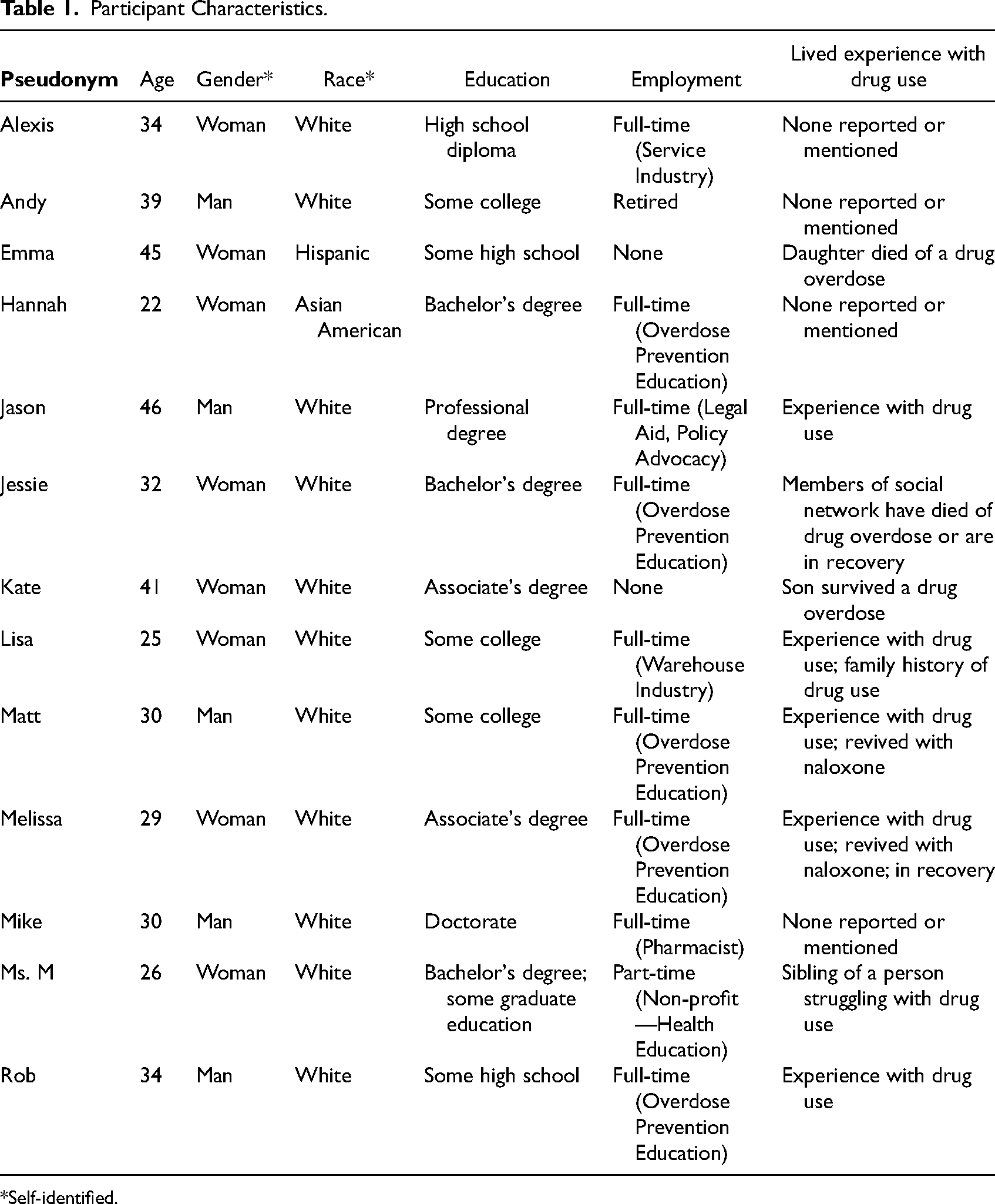
*Self-identified.
Findings
Participants described multiple ways they use TikTok for harm reduction activism. They understood and leveraged the affordances of TikTok as “doors” to build digital harm reduction community and to educate others on drug use and harm reduction. Yet they also described the need to navigate TikTok's “traps” that pose challenges to using the platform for harm reduction activism: stigma and harassment, burnout and mental health difficulties, and digital silencing.
TikTok's Doors to Harm Reduction Community-Building
Participants described several “doors” to harm reduction activism on TikTok, including leveraging the platform's association and interactive affordances and related features to build harm reduction community and cultivate solidarity with others who promote harm reduction online.
Affordances for Community-Building
I was kind of posting my own story and my own experiences. And then I saw all these harm reduction creators and how they were promoting Narcan and promoting all these other harm reduction tips. And I really gravitated towards that … So then my page kind of switched gears to harm reduction instead of just about my own recovery story.
It's amazing that we have this social media platform to spread this education to use these hashtags, because then you have a hashtag, and it becomes popular, people click on it, and they sit there and scroll and watch 81 videos before they know it. And then they’ve been on TikTok for 13 hours, but now they're educated about Narcan.
Melissa has since become active in TikTok's harm reduction community, which she describes as a movement of “people that care about other people and want to be heard … We definitely can't do it alone.” She has also become an overdose prevention specialist at a nonprofit organization in her community. This transition from personal harm reduction activism on TikTok to a professional harm reduction role is one that several participants experienced.
Jessie, a White woman in her early 30s who lost multiple members of her community to opioid overdose, now works for an overdose prevention program. Like Lisa, Jessie identified the #naloxonesaveslives hashtag and TikTok's algorithm as features that helped to introduce her to TikTok's harm reduction community: I was posting a little bit about my own journey, and TikTok kind of figured it out and was showing me the right people. And then I was clicking on their videos, and I kept seeing that hashtag [#naloxonesaveslives] … Obviously with the TikTok algorithm, I think just my For You Page started developing more of a harm reduction focus. And so, I would see all these really cool TikToks, and read through the comments and see that there is definitely a space where harm reduction is being talked about in a really positive way.
Participants also described advantages of being part of the harm reduction algorithmic community. Some believe they experience less stigma and harassment on TikTok compared to other, less algorithm-focused, social media platforms because their TikTok content is viewed largely by a curated audience of like-minded individuals. Alexis, a White woman in her mid-30s who identifies as in recovery, describes this protective “echo chamber”: “I don't really see a lot of the stigma on TikTok specifically because of the algorithms—because I'm in an echo chamber of everybody who agrees with me.” She compares her experience of little stigma on TikTok to Facebook, where she believes her harm reduction content is more controversial because it is “just going out to so many people trying to figure out things” about drug use and harm reduction with little to no prior education. Lisa similarly observes that Facebook and Instagram are just so random, but TikTok is more curated, and I've had way more success on TikTok … [Instagram and Facebook] just kind of put your stuff out there and hope the right people see it. With TikTok, I feel like I know the right people are seeing it. With social media, I don’t get that negative body language in front of me, I don't get the back talk while I'm trying to present information to you. So social media, it feels more—like kind of comforting, it's that people can hear you if they want to hear you, but it's like they're listening … And, you know, it's a sense of safety for me.
Many participants similarly articulated their aim to cultivate this “sense of safety” in discussing harm reduction on TikTok as part of their participation in this online community.
I did a duet, where it was a girl who was going out and she had a purse—like, her necessities before going to the club. And so, one of them was Narcan. I think I responded like, “Oh, that's great.”
In these ways, participants leveraged TikTok's algorithmic community and features affording interaction to contribute to harm reduction activist content, often building relationships with other harm reductionists on TikTok and in the process.
Alexis attributes her comfort in developing supportive relationships with harm reductionists on TikTok to her ability to observe how they interact with others using the platform's visual and interactive features. Like other participants, this led to some of Alexis's online harm reduction relationships developing into in-person ones: Some of my TikTok friends I've met in real life from different places. And there's a girl that does harm reduction in Philadelphia … I go up there now, like every couple of months, and do [harm reduction] outreach with her and see how they're doing there. But yeah, I grew up with my mom saying, like, don’t talk to strangers on the internet [laughing]. So, growing up, I didn't talk to people on the internet that I didn't know. And I guess I felt more comfortable with it on TikTok because I could actually see you—like, it wasn’t just a picture, I could see you, I can see how you interacted with other people.
Open Community and Solidarity
As participants leveraged TikTok's features that afford association and interaction to build harm reduction community, they aimed to cultivate solidarity and an open community for people struggling with drug problems and advocates for harm reduction. This reflects Jarrett Zigon's (2018) “community for those without community”; an effort to establish nonjudgmental community. Zigon observes that this type of community often forms in response to (near) death stemming from the Drug War, such as losing friends, family, and acquaintances to drug overdose and/or surviving drug overdose oneself. Participants frequently recounted such experiences, which motivated them to create community on TikTok with others who share trauma related to drug use.
Participants described several approaches to building open harm reduction community on TikTok. Melissa and Lisa aim to support people who do not conform to normative models of “addiction” and “recovery.” Melissa sees TikTok as a “safe place” for “people to start speaking up about other paths to recovery” beyond the 12 Step model. Lisa focuses on supporting people who are “in-between” chaotic drug use and abstinence: It's either like you're in active addiction, like problematic, chaotic use, or you’re completely clean and sober … The main message that I want to put out there is that I'm here for people who are in the in-between, who, like, traditional recovery paths haven't worked, 12 Step meetings and rehab and things like that, they haven't worked, but they feel like a failure, because everyone's telling them they’re a failure.
Participants also use TikTok to build open community beyond geographic constraints. Rob, a White man in his 30s who identifies as a person who uses drugs and works in harm reduction, hopes to make others feel less alone in supporting harm reduction, especially those in rural areas where harm reduction may be less familiar: To see other people in support of what you think you should be supporting is validating, and it feels nice to know that other people are on the same page. You know, we see people, especially in rural areas, that don’t have access to the education that us city folk do or aren’t in the same circumstances. And so, if you're a kid in, or a person in rural Iowa who supports harm reduction, or has an idea of what harm reduction is, and then you see other people on the internet reaffirming that support, maybe it makes people feel less lonely in their beliefs.
While many participants expressed the general desire to cultivate open community around harm reduction on TikTok, a few focused specifically on building solidarity around shared affects related to experiences of drug use and harm reduction, such as stigma and shame. In particular, women described this orientation to solidarity-building. Melissa's approach exemplifies this orientation. She identifies as “a creator sharing personal, vulnerable experiences.” Her target audience is mothers struggling with drug use because, “I know how hopeless it feels to be pregnant and on drugs.” In addition to posting educational videos about naloxone, she posts videos in which she shares her emotional experiences as a mother who struggles with chaotic drug use and stigma. In reflecting on her overall goal in posting on TikTok, Melissa explained, [My goal is] creating that safe place. We like to feel like we have this experience of life that nobody else in the world has, like, we're all alone, nobody's ever gone through this, this is the worst thing ever. And being able to share that vulnerability with someone, and someone else saying, you know, thank you for sharing that, I've been struggling today … sharing those human experiences with other people. That's the biggest part of it for me.
TikTok for Harm Reduction Education
While Melissa and others shared their personal experiences related to harm reduction, other participants concentrated on using TikTok to provide education on harm reduction. Specifically, they focused on correcting misinformation about drug use and harm reduction and framing harm reduction as a social justice movement.
Correcting Misinformation
Participants frequently lamented the large amount of misinformation related to drug use and harm reduction online. In responding to misinformation, participants often focused on presenting scientific data. While many participants combine their lived experiences of drug use with scientific information, some described a tension between the two forms of expertise. Kate describes “heart-driven” versus “head-driven” approaches to education: I think those of us with the loud voices … the ones that are followed … seem to be the ones that do have a little bit of hesitation in posting stuff that is just heart-driven versus head-driven. You got to sometimes wait a minute in today's society, if we were going to tell wrong information, not on purpose, but [we will] probably end up giving some wrong information down the road. But it's very important to myself to not.
Lived experience will only take you so far [in correcting misinformation]. But if we’re talking drugs and stuff like that, you have to talk about science and, like, how it affects the body and things of that nature and, like, in data, you know what I mean?
Jason, a White man in his 40 s who identifies as in recovery and works in drug policy reform, takes an even stronger stance in focusing on “facts” versus his lived experiences with drug use, which he sees as “irrelevant”: I've never really gone into my story. I just share facts about what's happening now. Or facts about the history of harm reduction … facts about systemic racism, about Black communities, about all those things … I mean, there's actual real information that we need to get out there. My personal experiences are irrelevant.
To integrate science when correcting misinformation about naloxone, and often harm reduction, drug use, and “addiction” more broadly, participants leverage TikTok's features that enable creativity and interaction such as green screens, duets, and stitches. Matt first started posting about naloxone a year and a half ago after being revived with it. In his current work as a harm reduction educator, he uses TikTok as his preferred social media platform for harm reduction education. He prefers TikTok because it allows him to post longer videos compared to other platforms, giving him more time to flesh out educational posts. “I’m a big fan of peer-reviewed studies and scientific literature,” he says, which he integrates into his posts, often using the green screen feature to place images of journal articles in the background as he discusses research on harm reduction and debunks myths about drug use commonly circulated on social media, such as the myth that touching fentanyl will result in a drug overdose. Similarly, Lisa posts a periodic “myth-busting series” that counters, “all of these myths that the Drug War has created against substances and the people that use substances.” She explains her post format: “It's just me, talking to the camera, and then I'll have the captions on and most of my stuff will be from books or from articles to prove that it's wrong.”
Jason also presents scientific support for harm reduction by sharing peer-reviewed journal articles. He finds that he spends most of his TikTok activity creating stitch posts using research to correct misinformation: There's a good majority where I was having to constantly stitch other people's videos to correct misinformation around drug policy, around overdose readiness, around naloxone laws … because people really don’t know anything. But they act like they do. It depends on, like, if somebody is spreading misinformation that I know has killed people. Like touching fentanyl can cause an overdose. I know people have been left to die because they believe that—I will rip them apart. Other people, I can kind of feel their motives. If I feel like their heart's in a good place. They’ve just been misinformed.
Kate also considers the motivation and tone of others when correcting misinformation. For example, she countered another TikTok user's assertion that one should not give cardiopulmonary resuscitation (CPR) in the event of an opioid overdose because any opioid in the system of the person experiencing the overdose would place the person giving CPR at risk of overdose. Kate noted that the individual's comment “wasn't necessarily negative. It was just kind of like misinformation,” stressing that correcting misinformation on TikTok is especially important because social media is “where we get our news, whether it be correct or incorrect.” With this understanding, she attempts to “correct it in a loving way.” This earnest and compassionate perspective was commonly articulated by participants: they expressed frustration with misinformation and emphasized the urgent need to correct it, but also understood that spreading misinformation may result from lack of education and not malicious intent.
This compassionate approach to correcting misinformation is also reflected in some participants’ interactions with other harm reductionists on TikTok. Jason sees his role as a mentor to other harm reductionists who may unknowingly spread misinformation and stigma: There's a bunch of other people on TikTok, they look up to me like little mentees … And if they put out [misinformation], I’ll correct them privately. I’ll send them information; I'll help them develop a better understanding of the issue. Because it's my responsibility to help bring it. I mean, I don't want to say I'm an O.G. [Original Gangster] but I am at this point. It's my responsibility to educate the next generation properly.
Several other participants, like Matt, described being mentored by Jason, and, in turn, mentoring other harm reduction activists on TikTok. In these ways, participants leveraged TikTok's harm reduction activist community in their efforts to support one another in providing correct information on drug use and harm reduction that fights stigma.
Harm Reduction as Social Justice
In addition to using TikTok to respond to misinformation about drug use and harm reduction, some participants emphasized their efforts to use the platform to re-frame the very meaning of “harm reduction” from a narrow public health-orientated approach to a broader social justice movement centering the right to bodily autonomy, privileging the voices of people who use drugs, and fighting the Drug War. This is consistent with what Hassan (2022) and other harm reduction activists call “liberatory harm reduction.”
Matt, for example, distinguishes what he calls “principle-based harm reduction” from “watered-down harm reduction”: There's principle-based harm reduction, which is real harm reduction, and there's watered-down, socially acceptable, what they call “harm reduction,” but really isn’t harm reduction … If you're not centered around the drug users being subject matter experts, and involving them, if you’re not willing to encompass everything that is around drug use, you’re just watered-down harm reduction—talking about socially acceptable forms of it … Essentially, it's like, for lack of better word, we understand that people use drugs and how it's a social justice movement, you know what I mean? Nobody really talks about that, especially on the internet due to fear of backlash and what people think or say to them and negative comments. My goal is to hopefully get some people to see what has been done to disenfranchised communities, to see the prison industrial complex as it is, to understand that addiction is normal … And kind of make it a conversation that people are able to have instead of not wanting to talk about it. There's so much that can be done on social media for creating a safe space for those conversations.
While not all participants articulated harm reduction as social justice with the same level of clarity as Matt and Jason, multiple aspects of the orientation, such as the harms of the Drug War and the need to center voices of people who use drugs, were prominent in most participants’ descriptions of their use of TikTok for harm reduction education.
Traps of Visibility: Challenges to Harm Reduction on TikTok
While TikTok provides opportunities for people to promote naloxone and to build harm reduction community, it requires individuals to make themselves visible online. Yet this visibility made participants vulnerable to stigma, burnout, and mental distress. Attempts at online visibility also made participants vulnerable to digital silencing, undercutting their goal to educate others about drug use and harm reduction.
Stigma, Burnout, and Mental Distress
While most participants focused on their positive interactions with others in building harm reduction community on TikTok, many also described stigmatizing comments from others. Such comments were often made in response to participants’ posts about their experiences of drug use or the drug-related experiences of their loved ones. When Alexis encountered negative comments on TikTok, she felt they were rooted in pervasive stigma associated with drug use and recovery. “People don’t like people in recovery,” she observed, adding, “I could be Mother Teresa now, but because I did heroin, you know, four years ago, I’m just a dirty junkie, that. They're mean!” However, as she focused her TikTok use on harm reduction, she noted that these reactions subsided. She attributed this shift to TikTok's algorithmic community: “Now it's leveled out to where it's just pushing it out to people that watch my content, so it's getting better, but I was like, oh my God!”
Kate, who posted about her son's overdose reversal with naloxone, stressed her support from other mothers on TikTok whose children experienced overdose. However, she also received cruel comments: The biggest thing, and I—honest to God—there were very few, but the worst thing I saw was, someone said, “You should've let them die.” I mean, that was just highly inappropriate. I just deleted it. I didn't entertain. It's not there for that.
Yet participants often experienced support from others in their harm reduction TikTok community in response to such negative comments. Alexis describes support she receives from her TikTok community in response to harassing comments, even describing these instances as learning opportunities: If they come after me in my comment section, my friends will like, swarm them and be like, “No, you’re not going to talk to her like that!” We have each other's back. And I think there's a lot of growth and learning that goes on because of that, because we’re so willing to call people out. And a lot of us are willing to take the feedback.
Some participants reported burnout associated with their TikTok harm reduction activism. Matt described his dedication to correcting misinformation about drug use and harm reduction on TikTok because “misinformation kills,” but added that this is a “full-time job.” “I get burnout about talking about it,” he observes, yet he feels compelled to continue because of the limited harm reduction education available to people due to lack of funding for harm reduction. Matt stresses that social media activism fills this gap. He responds to negative comments about drug use and harm reduction even when he is pessimistic that it will make a difference: There's definitely instances where I just know that I’m fighting a losing battle and that they’re not open to hear like anything or, like, [won’t] look at it. Some people just don't believe science … And so, I try to pick and choose my battles. But honestly, a lot of times I get so caught up in it, it's just like, I get absolutely lost in it. After five years, I get a little tired of repeating the same thing over and over again. And then when I speak on a topic and somebody says, “Who do you think you are?” … It's just like, it's frustrating sometimes where I just, I don’t want to invest the emotional energy into some individuals. But at the same time, I want to arm other people with proper information so they can do it instead of me … After a while, sometimes I’m just, like, I need a break. I can’t talk about this over and over and over and over and over again—it gets very frustrating.
Other participants also reported the need to take a break from posting about harm reduction on TikTok. Andy and Melissa use TikTok breaks to focus on their in-person harm reduction communities, which include some people they initially met on TikTok. Andy notes that, “it's good to unplug and step away [from TikTok] every now and then and sit, but still be connected with these people.” Yet both emphasize the continued importance of their TikTok harm reduction communities. After describing the need to take TikTok breaks, Andy adds: “You know, I’ve made some pretty dear friends on there that this stupid app has brought into my life, so I’m thankful. I’m thankful to TikTok for that.” Melissa observes that her posts about mothers struggling with drug use tend to generate negative comments, but she believes the value of the posts outweighs the harms of negative reactions: It normally brings a lot of people out of the woodwork. I don't even care about that—it creates a safe place for people who are experiencing that now, or that's something that they’ve gone through, and they may be struggling in their own recovery. And that's the point.
Although only reported by a few participants, it is notable that engagement with the TikTok harm reduction community may exacerbate mental health problems. Alexis, who felt stigmatized as a “junkie” by some on TikTok, struggled to manage her mood disorder as she became more involved with TikTok: I did good for a little while on [TikTok]. And then I went through like a mental breakdown for a month or so [laughing]. And it's not that bad. I go through—I have manic depression, so I’ll go through like depressive phases and always come back out. But I took a break [from TikTok]. I think what happened was I was getting so into the views and the likes and stuff. And I saw how it was affecting my mood. So, I was like, I’m gonna take a break from TikTok for a little bit. And then when I went back on, I kind of had my head on a little more straight. And I was like, okay, I came on here for this to be a creative outlet, and to find community, and so let's keep it at that.
Digital Silencing
Some participants expressed the belief that their TikTok accounts were flagged for “inappropriate content” and may have even been banned by TikTok because they posted harm reduction-related content. Matt says his TikTok account was “shadow banned”; his content was restricted from view without TikTok notifying him. He believes that banning harm reduction content occurs across social media platforms, not just TikTok, limiting the usefulness of social media for harm reduction activism: I don’t really reach as many people as I used to, because you can’t really talk about harm reduction on social media—like certain aspects of it—without getting, like, flagged for harmful content. And so, it kind of limits us with what we do. My accounts have been shadow banned for months now. No, longer. Which means they don’t show my content to people.
Participants described several approaches to avoid being flagged or banned. Emma and Kate, who both post harm reduction information related to their experiences of having a family member overdose, alter the language and images they use. Emma, a Hispanic woman who lost her daughter to drug overdose, believes that her TikTok content is scrutinized more than others because she posts about overdose death. She explains this surveillance and her attempts to subvert it: [I will write] “unalive,” or I'll put different symbols instead of saying “fentanyl,” you know, writing it out. Because they are very strict on TikTok, believe it or not, which is crazy. I do tend to kind of get screened a little bit more. In doing my TikTok research, trying to find other videos of fentanyl, certain words, they won’t allow you to use them. So, if I put an overdose video, [TikTok] blocks it from being posted—we can’t put that, you know?
Kate attempts to avoid being banned on TikTok for these posts by using the #OnePillCanKill hashtag to reference fentanyl-related overdose instead of the words “overdose” or “fentanyl.”
Resistance at the Cost of Visibility
Multiple participants described a dilemma of visibility related to their choice of the word Narcan or naloxone, including in hashtags, on TikTok. Participants articulated awareness of the structural barriers to access Narcan due to its higher cost compared to other forms of naloxone. In response, some avoid using the word “Narcan” and the hashtag #Narcansaveslives in their posts.
For example, part of Matt's practice of “real harm reduction” has been to avoid referring to the Narcan brand, preferring to use the #naloxonesaveslives hashtag over #Narcansaveslives to protest the limited accessibility of Narcan. He explains this choice: I got educated on the history of naloxone and Narcan, and kind of how, I don’t want to say that the company is profiteering off it, but Narcan is name brand … this company is making a lot of money off this product. But there's places in the U.S. where there's no resources for [people to get Narcan]. And they have to go to the pharmacy, and, like, out here without insurance, it can be upwards of over 100 dollars. So, I really stopped using [#Narcansaveslives], for the most part, and I usually just talk about naloxone, because naloxone is cheaper, it's more accessible now than it ever has been.
Yet participants were also keenly aware that “Narcan” is far more recognizable than “naloxone” due to its brand recognition. Alexis recognizes, “Now you have to say the word Narcan, because it's kind of like Band-Aid. Like, you know, Scotch Tape.” Participants also noted that using the more popular #Narcansaveslives hashtag over #naloxonesaveslives on TikTok would increase the visibility of their harm reduction content. Emma stressed the greater reach of certain hashtags: When you hashtag something, [TikTok will] show you how many times [the hashtag has] been used. So clearly, now I understand, if I’m going to use the one [hashtag], I'm going to pick the one that has a billion over, you know, just 300.
Jason emphasized the need to “move towards” using the word “naloxone” instead of “Narcan” as a social justice effort but recognized the difficulty in doing so due to visibility concerns and, sometimes, lack of awareness of the broader structural access issue: “It's naloxone hydrochloride, and that's what we’re trying to move towards. But so many people [think], ‘I have to hashtag Narcan' just because it's the only way some people will see it, because they haven’t been presented with this information.” Although he would like to, Matt has not completely stopped using #Narcansaveslives due to its greater visibility. Still, he feels the need to “take a stand” against barriers to Narcan accessibility by limiting his use of the brand name, despite the potential for this to limit the reach of his harm reduction content on TikTok. These dilemmas of visibility challenged participants’ central goal to educate others about drug use and harm reduction on TikTok.
Discussion
Our findings reveal how individuals leverage TikTok's “doors” to visibility to build harm reduction community and educate others about naloxone: a key tool to prevent opioid-related overdose death. Participants intentionally used TikTok's features that afford association and interaction, such as hashtags, duets, and stitches, to build community and solidarity with others supportive of harm reduction. Importantly, participants also utilized TikTok's features to correct misinformation about drug use and harm reduction online. This is an urgent task in the context of “fentanyl panic” and rampant health misinformation circulated online (Beletsky et al., 2020). Participants also used TikTok to voice their vision of harm reduction as a social justice movement centered on lived experiences of people who use drugs, bodily autonomy, and the need to challenge the social and economic structures that underpin the Drug War.
Yet our findings also underscore TikTok's “traps” of visibility that challenge its use for harm reduction activism. By making themselves visible as harm reductionists promoting naloxone distribution and use, participants were subject to stigmatizing reactions. Some also suffered from burnout when constantly correcting misinformation about harm reduction online. Others experienced mental distress related to their engagement with TikTok. Moreover, participants feared digital silencing when refusing to refer to naloxone by the brand name Narcan to protest its relatively high cost or when using words and images related to drug use and harm reduction that may get them “shadow banned” or removed from the platform.
This study deepens our understanding of agency related to harm reduction activism. This is a particularly challenging form of activism. Harm reduction activists like the participants in this study often have lived experience with drug use and overdose. These experiences carry significant social stigmas that often silence discussions of harm reduction. Furthermore, people who advocate for harm reduction may be geographically and/or socially isolated from others who promote this approach, limiting their social support and ability to engage in harm reduction activism in their local communities. For some, TikTok is a rare venue through which to participate in harm reduction community beyond geographic and social boundaries, facilitating agency among an often-marginalized population.
The “traps” of visibility on TikTok, however, underscore the limits of agency for harm reduction activism on this platform. Our study reinforces and extends related social media scholarship. For example, our findings echo DeVito's (2022) research on the contradictions of visibility for transfeminine creators on TikTok. In addition to similar challenges connected to the risks of visibility, our participants struggled to protest structural barriers to naloxone access at the cost of visibility, complicating their agency. Participants’ fears and experiences of loss of visibility by being “shadow banned” or removed from TikTok underscore the danger of “algorithmic exclusion” (Simpson & Semaan, 2021). Such exclusion may significantly limit the agency of harm reduction activists on TikTok by perpetuating “algorithmic representational harm”: harms resulting from platform users being silenced by the algorithm when they challenge dominant social structures and norms (Karizat et al., 2021). Future research on how digital harm reduction activists circumnavigate algorithmic exclusion is needed to better understand their agency online.
Moreover, there is a need to better understand how Black, Indigenous, and People of Color (BIPOC) experience harm reduction activism on TikTok. Our sample included largely White-identifying individuals. Yet there is a pressing need for the voices of BIPOC individuals to be included in harm reduction activism, as drug overdose and other consequences of the Drug War disproportionately impact these populations (Hughes et al., 2022). DeVito (2022) explored how TikTok users theorize its algorithm in relation to their identities, noting that for platform users with marginalized identities, the algorithms appear to “understand identity but not multiplicity of identity,” limiting, “acceptable presentations of identity in a way that requires singular identity” (DeVito, 2022, p. 13). Additionally, BIPOC individuals who have lived experience with drug use face greater consequences of online visibility for harm reduction because their multiply-marginalized identities may lead to greater stigma and discrimination. Additional research on how BIPOC individuals experience TikTok activism for harm reduction, or inclusion from this activism, is greatly needed.
Finally, our research has practice implications for harm reduction activism on social media. While TikTok offers great potential to reach a large audience, the risks of burnout and stress when using this platform for harm reduction activism highlight the need for guidance and support for reducing harms that might result from using social media for harm reduction activism. Experts have recommended practices to reduce the harms of social media use, such as taking breaks and pruning contacts, as the negative consequences of social media for mental health have drawn increasing attention (e.g., Kecmanovic, 2019). Many of our participants described using at least some of these strategies. However, there is a need to better understand the particular needs and strategies of harm reduction activists for reducing the negative consequences of social media use associated with their activism. Additional research should focus on these needs and strategies to develop support for digital harm reduction activists.
Strengths and Limitations
To our knowledge, this study is the first to use in-depth interviews to explore lived experiences of harm reduction activism on TikTok. These experiences are crucial to understand as health communication and activism increasingly occur on social media (CharityRX, 2022; Lee & Abidin, 2023). Our qualitative interview approach adds depth and nuance to research on social media activism, much of which examines the content of posts but does not interview the creators. Although interviews add depth and nuance to our knowledge of harm reduction activism on TikTok, our sample is small and not necessarily representative of all people who post about naloxone/Narcan on TikTok. Our sample is also largely White, which limits our ability to understand BIPOC experiences of harm reduction activism on TikTok. Finally, we chose to focus on identifying participants via their use of the #naloxonesaveslives and #Narcansaveslives hashtags on TikTok since they are commonly used, focus on a key harm reduction tool, and clearly communicate that the creator of the content was in favor of naloxone. This approach, however, excludes relevant content tagged with other harm reduction-related hashtags (e.g., #harmreductionsaveslives). Finally, this study involved one-time interviews with participants. Longer-term research on the experiences of harm reduction activists on TikTok has potential to provide valuable insights on how experiences of this digital activism shift over time.
Conclusion
Our findings fill a critical gap in the social media and critical drug studies scholarship by exploring how harm reductionists experience their activism on TikTok, an increasingly popular social media site with potential to reach over a billion platform users. We highlight how TikTok features that potentialize association and interaction create unique “doors” to harm reduction community-building and education but also introduce “traps” that challenge harm reduction activism due to the threat of stigma, burnout, mental distress, and digital silencing. Further, we consider the implications of these findings for future research and practice to better understand and support harm reductionists using TikTok to promote naloxone in the context of the ongoing drug overdose crisis in the U.S. As drug overdose deaths continue to rise in the U.S. and globally, a better understanding of the possibilities and limits of harm reduction activism online is critical.
Footnotes
Declaration of Conflicting Interests
The authors declared no potential conflicts of interest with respect to the research, authorship, and/or publication of this article.
Funding
The authors disclosed receipt of the following financial support for the research, authorship, and/or publication of this article: This work was supported by the University of Nebraska System - Nebraska Research Initiative.
