



Abstract
Drug-related harms continue to increase globally and governments struggle in search of effective and legitimate countermeasures. The choice between policy options is intertwined with the arguments that dominate drug policy discussions, which in turn are closely related to who has access to the policy debate. In this study, we examine stakeholders’ visibility and moral justifications of argumentation in the Swedish drug policy debate in the media (2015–2021). Justification analysis (JA) is used as a methodological and theoretical tool to illustrate the moral principles behind the claims by the stakeholders. The results show that the most visible stakeholders were politicians, government agencies and molders of public opinion. Furthermore, the stakeholders with successful active attempts to participate in the debate were molders of public opinion, NGOs, and politicians. The silent stakeholders in the media were people who use drugs and significant others. Stakeholders generally revolve around a dividing line regarding the restrictive features of Swedish drug policy, and were divided into proponents, opponents and neutral ones. All stakeholder groups included all three sides, hence reflecting the ingroup dissonance that may explain the continuing deadlock in Swedish drug policy. Justifications that value evidence-based policymaking (industrial worth) was used in the argumentation by the majority of the stakeholder groups, often combined with other moral justifications. This notion challenges the dichotomy of evidence and values in drug policy debates. Proponents relied more on the justifications that value paternalism (domestic worth), while opponents leaned toward the justifications valuing civil rights and social justice (civic worth). The development of Swedish drug policy may depend on the relative strength of these two value positions (domestic versus civic worth) in society and among stakeholders in power. This study continues the discussion of making contesting values explicit in the drug policy, serving a riveting case for international comparison.
Introduction
Drug use and drug-related harms continue to constitute major challenges to public health, crime prevention and welfare (Babor et al., 2018; Das et al., 2016). Governments and communities struggle to find effective and legitimate policy measures for combating illegal drug use and reducing harms (Babor et al., 2018). Different stakeholders have been found to play key roles in such policy formulation and implementation processes (Houborg et al., 2016). Therefore, analyzing the dynamics of stakeholder involvement in the policymaking is crucial for understanding policy responses (Asmussen Frank et al., 2015).
Drug policy is often categorized as a so-called morality policy in which “policy [is] concerned with issues deemed to involve right and wrong […] that may have distinctive politics and policy processes” (Ritter, 2021, p. 71). This perception has been challenged by an alternative viewpoint that particular policy topics become moral due to policy actors’ arguments (Kreitzer et al., 2019; Mucciaroni, 2011). Ritter (2021) has argued that all drug policies are associated with ethical reasoning, representing different value positions, and because values represent guiding principles and shape attitudes and behaviors, they are essential to policy debate. Ritter has suggested that researchers should reveal “the usually implicit, unspoken values inherent within policy, engage with normative philosophy when examining the ethical justifications for policies, and conduct analyses of the way values play out in policy development and debate” (Ritter, 2022, online conference abstract).
Given that drug policy is a delineated policy area with a plethora of interested, affected, weak and powerful actors with different ideological and political approaches, ideas and interests, it is important to ask who has the opportunity to participate in such policymaking processes, whose voice gets heard in the drug policy debates and what kind of knowledge and understanding is regarded as relevant (Bjerge et al., 2016). These questions make it essential to analyze if and how different stakeholders participate in and influence the discourse on drug policy issues.
Therefore, this study aims to examine contemporary public drug policy debates in Sweden by identifying different types of stakeholders visible in the drug policy debates in the media and analyzing moral principles underlying their argumentation. For this purpose, stakeholders are defined as policy actors that are active or passive players on the policy scene and/or affected by the policy (Brugha & Varasovsky, 2000). While some active players deliberately seek and are allowed to participate in the debate, others may appear more passive or are even excluded from the debate. According to Houborg et al. (2016), a stakeholder analysis helps reveal strategies in which different actor groups strive to position themselves favorably within a policy arena and gain legitimacy for their preferred policy options.
This article presents the debate from a Swedish perspective. With its long tradition of a restrictive drug policy in combination with the recent potential for change outlined below, Sweden serves as a worthwhile case to study. For decades in Swedish society, drug use has been constructed as a problem and has been actively debated among politicians (e.g., Edman, 2013; Eriksson & Edman, 2017) and in public, for example, in the media (e.g., Månsson, 2016). The media mirrors the policy debate and is a vital arena for attempts to influence policy (Lancaster et al., 2011; Tieberghien, 2014).
The present qualitative analysis of media texts (N = 370), published in 2015–2021 and collected from four national newspapers, aims to answer the following questions: Which stakeholders are represented in the public debate on Swedish drug policy, and what kind of moral principles underlie their argumentation? The analysis is guided by a justification analysis (JA) framework (Ylä-Anttila & Luhtakallio, 2016), a methodological and theoretical tool based on justification theory (Boltanski & Thévenot, 2006). By analyzing the stakeholders’ moral justifications in Swedish drug policy, we offer a contemporary example of how stakeholders draw upon universal moral principles for the common good, as identified by justification theory (Boltanski & Thévenot, 2006) in a highly value-loaded and polarized debate (see also Tieberghien, 2014). With its theoretical and methodological framework, we argue that this study serves as a riveting case for international comparison.
Previous research on stakeholders and drug policy has mainly concentrated on particular stakeholders, for example, people who use drugs (PWUDs) in drug policy processes (Bjerge et al., 2016) or a specific drug policy area, such as substance use treatment (e.g., Perälä et al., 2013), needle exchange programs (e.g., Eriksson & Edman, 2017) or harm reduction (Zampini, 2018). The present study expands on previous knowledge by offering a comprehensive perspective on the views of various stakeholder groups in one national drug policy context. Focusing on the broad array of stakeholders and drug policy topics in the media debate provides a new angle to explore which stakeholders are represented in the debate arena—who gets access to the national media debate (cf. Bjerge et al., 2016)—and which moral principles justify their argumentation, shedding light on the competing values within the drug policy field (cf. Ritter, 2021).
Public Drug Policy Debates and Morality
Drug policy debates occur in various forums, particularly in political or parliamentary debates (e.g., Curchin et al., 2022; Eriksson & Edman, 2017; Tieberghien & Decorte, 2013) and in the media (e.g., Månsson, 2016; Ritter, 2020; Tieberghien, 2014). Previous research shows that media has often represented drug-related issues in an exaggerated and sensationalized way (e.g., Coomber et al., 2000; Taylor, 2008). For example, the studies provided in the USA show that the role of the media has been described through its way to frame drugs as a threat and therefore starting national panics (Jenkins, 1999) and to spread drug scares (Reinarman & Levine, 1989). In his study of media debates on the War on Drugs, Rosino (2021) has argued that analyzing how the media frames the drug policy debate helps understanding the effects of agenda setting within the media.
Media can be a powerful player with multiple roles when it comes to drug policymaking processes; media is involved in agenda setting, framing issues through selection and salience, influencing attitudes, feeding into political debate and decision-making (Lancaster et al., 2011; Tieberghien, 2014). For example, the study by Tieberghien (2014) shows how the media strongly influenced the publics’ and policy-makers’ understanding as well as the content of the Belgian drug policy debate. In addition, a study by McArthur (1999) demonstrates the remarkable role of the media in drug policymaking when it comes to the expansion of the methadone program in Australia in the mid-1980s. In the present study, the role of media is critical, especially regarding stakeholders’ access to the public drug policy debate.
Stakeholders with different vested interests argue for solutions to the drug issue in policymaking processes. According to Ritter (2021), drug policy fields can be characterized by goal conflicts since drug policy often has conflicting and strong normative dimensions. These dimensions build the basis for different proposals. Analyzing media texts and stakeholders’ arguments on Swedish drug policy helps understand their goals concerning drug policy and the associated value positions underlying those goals (cf. Ritter, 2021).
Values are connected to morality, together with beliefs, emotions, experiences, principles and deliberations (Ritter, 2021; Zampini, 2018). Previous research on drug policy debates and stakeholders shows that morality, values and emotions underpin stakeholders’ views; for example, in her study, Zampini (2018) examined stakeholders’ views on evidence and morality in drug policy debates. By analyzing interviews with stakeholders who have actively been involved in drug policy and harm reduction debates in England and New South Wales, Zampini asked whether evidence can affect individuals’ existing moral positions as neutralizing morality. The results reveal that evidence can move the discussion away from values and principles but does not necessarily change stakeholders’ views. Considering the latter, the study concludes that evidence-based policy advocates might benefit from trying to morally and emotionally engage audiences (Zampini, 2018).
Previous research on morality and stakeholders in drug policy debates has often focused on moral framings of drug policy in different countries (e.g., Curchin et al., 2022; Euchner et al., 2013; Ferraiolo, 2014). Euchner et al. (2013) examined the morality framing of gambling and drug policies in Germany and the Netherlands and whether shifts in morality framing have consequences for regulation. The authors identified four types of frames in varying combinations: the morality frame; the health and social frame; the security and public order frame; and the economic and fiscal frame. All frames except the morality frame (“drug use and gambling are wrong”) were considered less value-based. The analysis reveals that the once prominent morality framing has lost its importance over time. In addition, a close connection between frame shifts and policy output was identified, but the development was not uniform and did not concern all policy cases (Euchner et al., 2013). Another example by Ferraiolo (2014) focuses on the moral framing of cannabis debates by cannabis opponents in the US. Based on the results, the opponents used moral (decriminalization sends the wrong message to youth, decreases risk perception and promotes “normalization”), mixed (decriminalization has adverse effects for families, communities and society), and non-moral (decriminalization negatively impacts individuals vis-à-vis physical, mental and social health) arguments (Ferraiolo, 2014).
Considering these examples, we see that the authors only interpreted certain arguments as “value-based” (Euchner et al., 2013), and even some of the arguments were called non-moral (Ferraiolo, 2014). These interpretations refer to the idea of morality framing capturing the notion of drugs and drug use as something bad and sinful (e.g., see Ritter, 2021). However, in the present study, we have interpreted that several value positions—moral principles—underlie stakeholders’ argumentation when debating drug policy.
Taking into account value positions, Ritter (2020) has examined the public debate on the availability of drug-checking services at festivals in Australia. The results show that despite sharing the same goal of saving lives, pill-testing opponents and proponents varied in their individual approaches, reflecting differing value positions concerning drug use. In this study, Ritter refers to the theoretical orientation that challenges the dichotomy between evidence and values, that “[…] all evidence, facts and knowledge are ethically, socially and politically situated” (Ritter, 2020, p. 19). In other words, drug policy debates involve values even when discussing evidence; making these value positions more explicit may encourage more effective policy dialogue (Ritter, 2020; see also Buchanan et al., 2003; Curchin et al., 2022; Zampini, 2018).
In the study by Curchin et al. (2022), the authors analyzed the moral framings of Australian parliamentary debates on drug testing of welfare recipients. In this analysis, the authors adapted six normative lenses from Watts and Fitzpatrick’s framework for ethical analysis: communitarianism, consequentialism, contractualism, rights, paternalism and social justice (Watts & Fitzpatrick, 2018, cited in Curchin et al., 2022). While the proponents of drug testing favored consequentialism (referring to drug trial court evidence when arguing that mandatory drug treatment can be effective) and paternalism (PWUDs’ need for coercive intervention), the opponents, in turn, favored consequentialism (insufficient evidence that compulsory drug testing would succeed in ensuring more people received the drug treatment they need) and social justice (drug testing as punitive or cruel). The study shows how all moral frames were adopted by both sides and overlapped with one another.
In the present study concerning Sweden, the moral principles of stakeholders’ argumentation are analyzed based on justification analysis (JA), helping to illustrate similar disparities of moral framings as in the study by Curchin et al. (2022) when analyzing the moral principles that underlie stakeholders’ argumentation. Ritter (2021) has also discussed the values and ethics that are often connected to drug policy and may be the most common principles—paternalism, for instance, referring to the idea that “the community […] knows what is best for its members and is responsible for providing the necessary care and support” (Ritter, 2021, p. 9) and principles emphasizing human rights or social justice. As in the study by Curchin et al. (2022), this division between opponents and proponents can be observed in several other previous drug policy debates (e.g., parliamentary debates on NEPs in Sweden; Eriksson & Edman, 2017; Tryggvesson, 2012). In the present study, with the help of the justification theory, we explore the possible diversity of stakeholders’ moral and value positions in the drug policy debate.
The Swedish Context
Sweden’s restrictive drug policy has been based on a vision of a drug-free society since the 1980s (Tham, 2021). In practice, Swedish drug policy has meant an orientation toward control measures and increasingly harsher punishments (Tham, 2021), although prevention and treatment are considered equally important (Eriksson & Edman, 2017). History demonstrates that drug use and drug-related problems have long been established as serious societal problems in Sweden. Since the late 1960s, demands for harsher punishments have been ongoing. However, the vision of Sweden as a drug-free society was crystallized in the 1980s, which, in practice, led to even more severe punishment and, in 1988, to a veritable criminalization of non-prescribed drug use (Tham, 2021). Drugs became seen as an external threat, alien to Swedish society and in conflict with Swedish values (Tham, 1992).
Advocates of the restrictive Swedish drug policy have emphasized the low prevalence of use among citizens and low levels of drug experimentation among Swedish youngsters compared to other European countries (Edman, 2019; for statistics, see Public Health Agency of Sweden, 2022b; Sundin, 2022). Unsurprisingly, Swedish drug policy has also been internally and externally criticized. Most notably, the United Nations (UN) criticized Sweden for not upholding human rights in its drug policy (Edman, 2019). Furthermore, between the early 1980s until about 2010, the polarization became strikingly evident in Swedish drug policy discussions as the opposite sides became labeled as either prohibitionists or liberalists in a very black-and-white debate climate (e.g., Edman, 2013; Eriksson & Edman, 2017; Tham, 1992).
Notwithstanding, recent years indicate a slightly more nuanced discussion. The policy area appears more open for debate, which has motivated many stakeholders to seek a reframing of the problem and its solutions. For instance, the NEP political debates in Sweden show how the NEPs initially emerged, even though opposing views were discernable (Eriksson & Edman, 2017; Tryggvesson, 2012). Two previous analyses of Swedish parliamentary debates between 1988–2006 and 2000–2015 illustrate two ways of understanding the NEP and have dominated the Swedish debate: a public health perspective (NEP give PWUDs infection control) and a drug policy perspective (NEP is seen as a threat to the restrictive drug policy; it might legitimate use, thus potentially increasing harms). In the debates between the years 2000 and 2015, advocates of NEP also underlined the importance of research-based knowledge and studying development (Eriksson & Edman, 2017).
Evidence-based policy and practices have been promoted worldwide, as well as in Sweden since the late twentieth century (Tieberghien & Decorte, 2013). The stronger demands for evidence-based practice, medicalization and individualized substance use treatment substantiate the idea that politicians should relinquish the problem and its potential solutions to experts in the field (Olsson, 2011). Although it has been argued that this kind of policy reflects accurate factual knowledge rather than political biases, research also questions such claims. Roumeliotis (2014) has argued that knowledge is not objectively produced by individual researchers, but rather ideological and connected to governance by an expert system. This viewpoint challenges the dichotomy between evidence and values (Ritter, 2020; Zampini, 2018). In addition, (scientific) knowledge may fuel misconceptions and uncertainty and be used politically strategically (Tieberghien & Decorte, 2013).
Despite Sweden’s restrictive drug policy, drug problems have increased in recent decades (The Swedish Council for Information on Alcohol and Other Drugs, 2019). However, the prevalence of drug use and the proportion of those dependent have remained fairly stagnant since 2017 (Sundin, 2022), while cannabis use increased between 2006–2021 (Public Health Agency of Sweden, 2022a) and the restrictive views on drug use among adolescents decreased between 2003–2019 (Gripe, 2020). One of most pressing issues is drug-related mortality, which has increased during the last few decades (Edman, 2019; Leifman, 2016; Tham, 2021). The death rate has been reported to be among the highest in Europe (The European Monitoring Centre for Drugs and Drug Addiction, 2021).
The tragic leading death rate position exemplifies a crack in Sweden’s previous solid resistance toward harm reduction measures in the drug policy. Even though methadone maintenance treatment was introduced in Sweden as early as 1966, it was soon after regarded as controversial and was acutely restricted until the end of the 1980s, when it gained new legitimacy (Johnson, 2003). In 2006, NEP were launched as infection-control measures after two trials in Skåne County, operating since the late 1980s, proved successful. However, it was not until a legislative change in 2017 that NEPs spread beyond three of Sweden’s 21 regions. The government’s request for measures for lowering the mortality rate also facilitated the introduction of take-home Naloxone to counter opioid overdoses in 2018. Hence, Sweden has gradually accepted harm reduction as an important component of drug policy.
Recently, national agencies have questioned the restrictive foundation and control preponderance. In 2020, the Swedish Parliament accepted a proposal from its social committee indicating that the government should evaluate its largely unchanged 30-year drug policy (Riksdagen, 2020). Similar calls were presented by the Public Health Agency of Sweden (2020) and the Swedish Association of Local Authorities and Regions (2018)—both had previously opposed such a reorientation. Nevertheless, the Ministry of Health and Social Affairs has refused to evaluate the Penal Law on Narcotics (1968, p. 64) or decriminalize drug use, resulting in critiques from different stakeholders. The disagreements are also reflected by the Parliament voting down the government’s bill for an updated ANDTG strategy in 2021 (Riksdagen, 2021). Despite the Parliament’s critique, in 2022, the Swedish government announced a revised Alcohol, Narcotics, Doping, Tobacco and Gambling (ANDTG) strategy (Ministry of Health and Social Affairs, 2022a). In addition, it was not until March 2022 before the requested, but limited, inquiry was commissioned by the government to evaluate how a continued restrictive drug policy can be combined with effective and evidence-based treatment and prevention, harm-reducing interventions and drug-overdose combative measures (Ministry of Health and Social Affairs, 2022b). Looking ahead, it cannot be ruled out that the inquiry’s directives may be altered by the new liberal-conservative government that took office in October 2022. The drug policy development is thus uncertain.
Against this backdrop, the analyzed media debate takes place in a time of potential change following a long deadlock, high polarization and conflicting perspectives.
Methodological and Theoretical Framework: Justification Analysis (JA)
Competing claims in the public sphere may be justified based on a set of moral principles and provide legitimate answers to questions, such as “how does the solution you propose contribute to the common good?” (Ylä-Anttila & Luhtakallio, 2016, p. 1). Ritter (2021) has argued that values necessarily shape much of the deliberation around drug policy, referring to the sense of beliefs about standards and what is important in life. Considering the question of values connected to moral principles in the context of this paper, the analytical framework justification analysis (JA) is used as a methodological tool to illustrate the moral principles behind the argumentation of stakeholders in the public debate on the Swedish drug policy.
Justification analysis, proposed by Ylä-Anttila and Luhtakallio (2016), is based on the typology of moral justifications by Boltanski and Thévenot (2006). Justification theory posits different orders of worth through which actors may justify their arguments. These orders of worth represent the different ideas of the common good and are based on different philosophical foundations concerning moral worth. Boltanski and Thévenot (2006) initially categorized six principles of worthiness for building justification for arguments:
Inspired worth: Something/someone is worthy because they cannot be controlled or measured and, instead, are not afraid of expressing themselves in their own way. The emphasis is put on inspiration, uniqueness, passion and emotions.
1
Domestic worth: Something/someone is worthy based on hierarchy, tradition and generational position. The worth is a function of the position one occupies in chains of personal dependence. Thus, the so-called worthier beings have duties related to those in their entourage and for whom they are consequently responsible.
The worth of fame: Something/someone is worthy because they are famous, highly appreciated in the public sphere, recognized and visible.
Civic worth: Something/someone is worthy based on collective good, solidarity, civil rights and democracy. The so-called worthy beings are the masses and the collectives, aiming to unify people and emphasizing collective power and interest.
Market worth: Something/someone is worthy given competition and money. The emphasis is put on goods, transactions, business and value.
Industrial worth: Something/someone is deemed worthy according to the rationale of science and technology. Problems are to be solved with the help of calculations, technology and science.
This typology aims to create a framework that helps “to analyze the critical operations that people carry out when they want to show their disagreement without resorting to violence, and the ways they construct, display, and conclude more or less lasting agreements” (Boltanski & Thévenot, 2006, p. 25). Ylä-Anttila and Luhtakallio (2016) have called this framework an institutionalized cultural toolkit that can offer “shared coordinates for actors, and therefore operating as means for reaching an agreement. Thus, in any given non-violent conflict situation, all parties would be to some extent forced to acknowledge this variety of conceptions of common good, even if there was disagreement over which justification prevailed or how” (Ylä-Anttila & Luhtakallio, 2016, p. 3). This point resonates with the suggestion that a values-led policy dialogue can “make explicit the values that underpin particular policy solutions and/or the policy problem as constructed” (Ritter, 2021, p. 118).
Justification theory, and the JA adaptation, have been applied in many research contexts. For example, in their study, Perälä et al. (2013) examined the justifications for Opioid Maintenance Treatment (OMT) in Finland and different stakeholders’ roles in its development. The authors identified from which orders of worth the arguments for and against OMT originated, how the arguments based on contrasting orders of worth differed and which orders of worth dominated the arguments for and against OMT. The authors adapted justification theory since it challenges the emphasized role of medical professions and medicalization while it takes into account the perspectives and actions of different actors, allowing for “[…] an analysis of the negotiations and disputes surrounding OMT and of the efforts that have been made to find solutions and resolve conflicts” (Perälä et al., 2013, p. 956). The analysis shows that the justifications of medical professions’ arguments concerning OMT have not only been medical but also based on civic justifications (emphasis on improving the social conditions of PWUDs). The study also shows that the in the 1990s, the OMT debates were dominated by justifications of civic and industrial worth (OMT is evidence-based, and it possibly reduces the negative and costly consequences of drug use), whereas, more recently, dominating justifications have been based on market worth (emphasis on the cost-effectiveness of OMT) as well as civic worth (whether PWUDs receive sufficient treatment given the scarce resources). Thus, the analysis reveals how OMT’s development in Finland seems connected to the neoliberalization trend (Perälä et al., 2013). This result resonates with the findings from Euchner et al. (2013): changing values that could result in policy reshaping.
Through JA, political claims in public sphere can be systematically analyzed (Ylä-Anttila & Luhtakallio, 2016; see Huikuri, 2011; Kukkonen et al., 2020; Meriluoto & Kuokkanen, 2021). In the present study, JA helps identify stakeholders’ claims justified by different moral principles permeating society. Analyzing arguments and strategies in the drug policy debate provides a deeper understanding of stakeholders’ ideas of the common good and its values.
The use of JA framework in this paper can be described as a deductive way of identifying competing values; JA aims to make evident the battle of values in the debate as an analysis is conducted on different stakeholders’ justifications—and not only the ones that dominate the debate (Ylä-Anttila & Luhtakallio, 2016). Ylä-Anttila and Luhtakallio have argued that with JA, analysis “[…] becomes more nuanced when (also the dominating) arguments are analyzed as subject to tests between different moral values” and “[…] avoids the risk of neutralizing the dominant discourse that is often portrayed as apolitical in mainstream public sphere, and, instead, can fully incorporate the power dynamics of public debates” (Ylä-Anttila & Luhtakallio, 2016, p. 9).
Ylä-Anttila and Luhtakallio (2016) have also discussed that starting the analysis with a relatively stable set of moral principles encourages transparency regarding how contemporary debates are related to more general moral principle discussions. In addition, using a theoretically constructed set of categories also enables comparisons among cases across national political cultures or debates within the same national context (Ylä-Anttila & Luhtakallio, 2016). With the framework of JA, this study contributes to the existing drug policy, morality and values literature by contributing new insights into researching stakeholders’ moral principles in the Swedish drug policy debate.
Material and Method
Since this study focuses on the national-level stakeholders, we analyzed media texts (N = 370) published in four Swedish national newspapers from January 1, 2015, to June 30, 2021. By analyzing a recent six-year period, it is possible to identify stakeholder groups who have participated in the contemporary public drug policy debates. Media texts were collected via the media archive (Mediearkivet by Retriever) using several drug policy-related keywords. 2 Choosing these keywords was based on previous research and literature concerning Swedish drug policy. The media texts were published either in the printed press or online and represent disparate political views: Dagens Nyheter (DN; independent liberal), Svenska Dagbladet (SvD; independent moderate/liberal-conservative), Aftonbladet (independent social-democrat) and Expressen (independent liberal). Furthermore, we chose these newspapers because of their wide circulation: they are the primary morning and evening papers, reaching throughout the entire country. This allows for analyzing those accessing the national-level policy debate (cf. Bjerge et al., 2016).
The data includes different kinds of media texts (e.g., news, editorials, columns and debate articles). The first data extraction yielded 2,229 independent media texts. Next, media texts were selected as a sample if they included one or more stakeholders that took a stand, criticized or argued for or against a certain drug policy option or element. Purely descriptive news reporting (e.g., concerning the opening of NEP in a city or a person dying from an overdose) was excluded. During the data collection, we noticed six relevant debate articles concerning the inclusion criteria that did not originally appear in the media archive search, probably due to a delay in the database management. These six articles were included in the material. In addition, the research includes five news articles with almost identical content that were published in different newspapers. We decided to include these since the topics, views and stakeholders apparently were considered so crucial that they were given such broad media attention. The analyzed sample consists of 370 texts. Table 1 shows that most data consists of news and debate articles.
The Media Material of the Study.
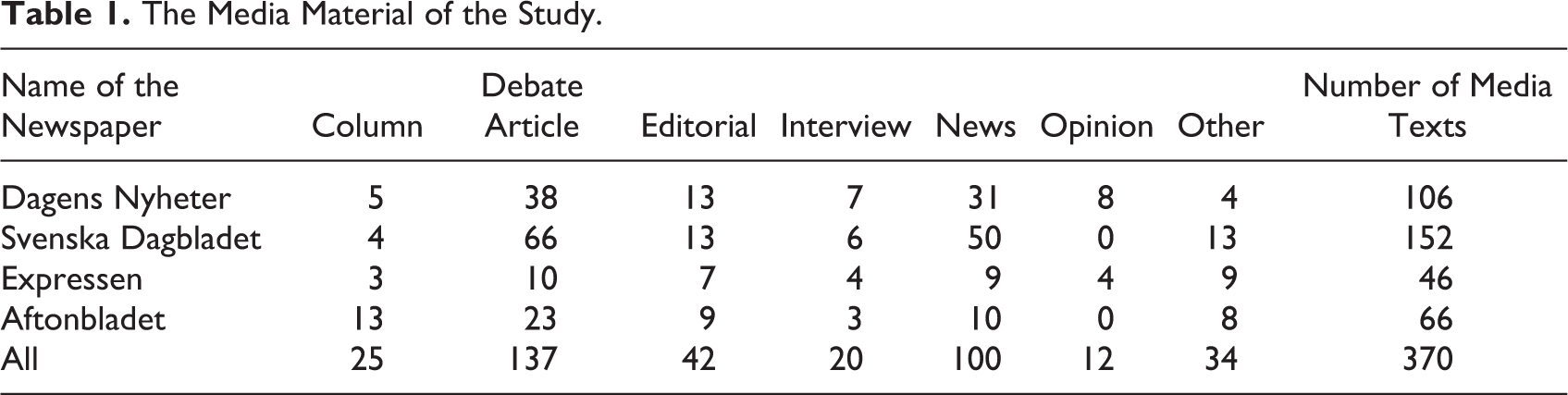
After collecting the data, Lerkkanen read the material several times and imported the media texts to the qualitative data software QSR NVivo. Based on the material, Lerkkanen and Storbjörk jointly created the following coding schema that Lerkkanen used for coding the data: Drug policy topics (e.g., NEP, drug-related mortality, drug-use decriminalization) Stakeholders (e.g., politicians, NGOs, PWUDs) Stakeholders as proponents, opponents or neutral regarding the current predominantly restrictive drug policy The six orders of worth, which allows for scrutinizing of the potential combinations of different justifications (Boltanski & Thévenot, 2006; Ylä-Anttila & Luhtakallio, 2016).
Codes 1 to 3 were identified inductively from the data. The third category of proponents, opponents or neutral stakeholders vis-à-vis the current restrictive drug policy was chosen and coded after identifying that throughout the data, Swedish drug policy was via the different topics, independently of stakeholder group, discussed more generally by either criticizing or supporting the restrictive features of Swedish drug policy. Thus, organizing the actors based on their explicit or implicit attitudes toward the current state of affairs helped clarify the patterns in the data. Notably, these basic understandings underpinned all proposals and applied to all policy topics.
In coding the justifications, the codes were based on the more-or-less fixed set of moral principles presented above (Boltanski & Thévenot, 2006; Ylä-Anttila & Luhtakallio, 2016). In the JA approach, the unit of analysis is an explicit public claim. A claim can be a statement to a reporter but also, for instance, a letter to an editor (Ylä-Anttila & Luhtakallio, 2016). Therefore, a typical newspaper article may embody numerous claims by different stakeholders. The claims found in the data were coded when the claim included a speaker/actor (i.e., a stakeholder) and an argument reasoning with the claim. Through this procedure, the claims could be coded using the logic of JA. For example, a debate article by the representatives of the right-wing political student organization Fria Moderata Studentförbundet argued for legalizing cannabis in Sweden because it would conserve police resources (DN_49). This claim is justified by market worth since the authors emphasize the possible economic benefit of cannabis legalization. While some claims may not include any justifications, others include multiple. For instance, in this same text, the authors argue that: Not only could it [cannabis legalization] save lives but also free up resources. Politics is about prioritizing, and resources are needed right now to solve violent crimes and property rights violations that worry people today. It would also effectively help combat organized crime and the financing of terrorism. If drugs, such as marijuana, were to be legalized, organized crime would lose a significant portion of its source of revenue. (DN_49) [authors’ translations of quotes originally published in Swedish]
Results
Visibility of Stakeholders in the Drug Policy Media Debate
Various stakeholders participated in the media discussion of Swedish drug policy. In all four newspapers, they were represented: interviewed, named, quoted or as authors. The chart in Figure 1 illustrates that the most prominent stakeholders were politicians, government agencies and “molders” of public opinion.
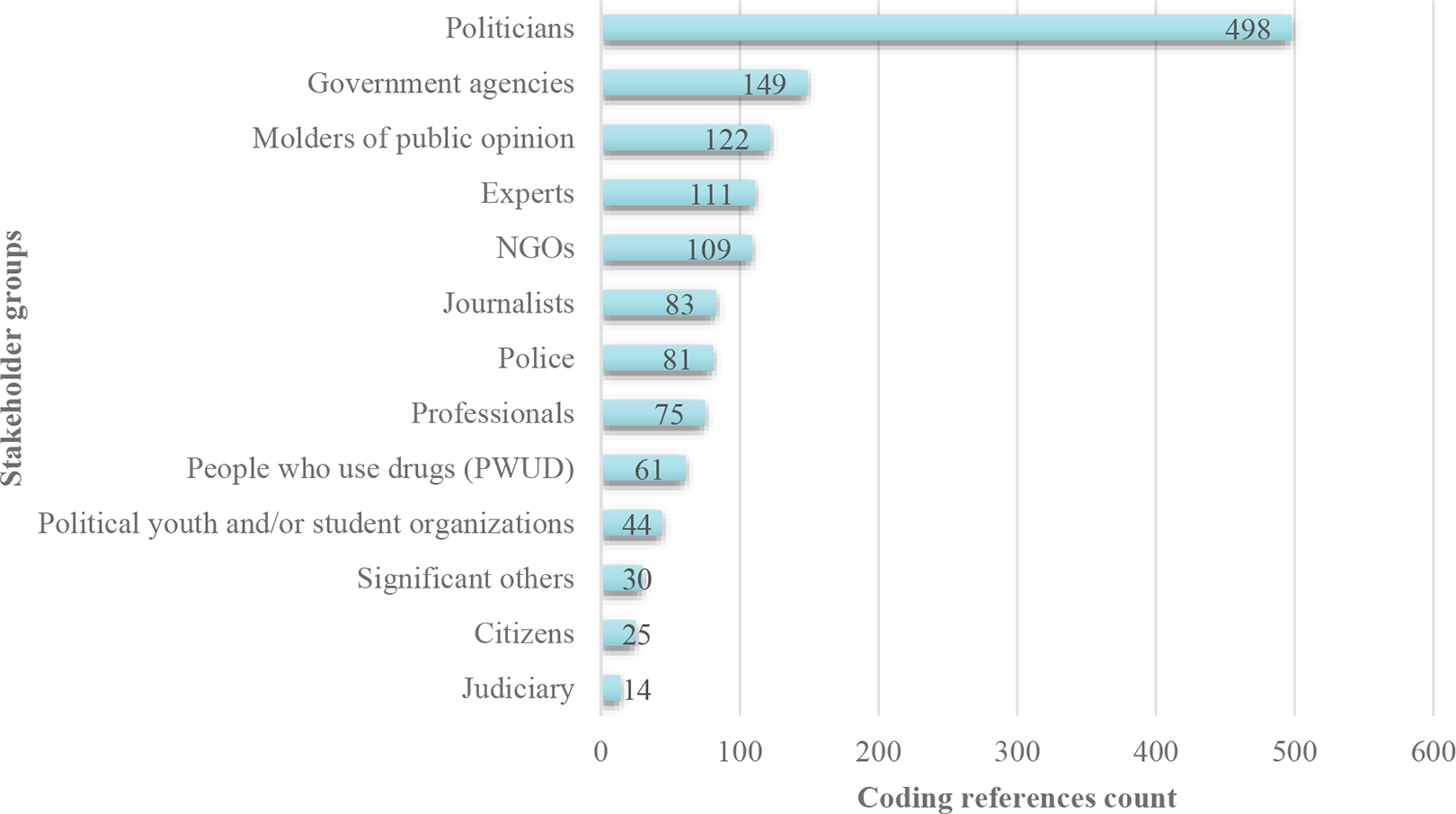
Stakeholder groups represented in the drug policy debate (Swedish media data 2015–2021). If a stakeholder appeared in one media text, it was coded once.
Based on data codification, the most visible stakeholder group, politicians, included representatives of political parties, as well as the Parliament and other forms of government (Minister of Health and Social Affairs, Prime Minister, Minister of Interior and Minister of Justice). Most prominent actor was the Minister of Health and Social Affairs, whose position changed hands once during the studied time period. The most visible political parties included the Swedish Social Democratic Party, the Moderate Party, the Left Party and the Green Party.
Regarding the second most visible stakeholder group, government agencies, the most prominent representatives were Sweden’s Public Health Agency (Folkhälsomyndigheten) and Sweden’s National Board of Health and Welfare (NBHW; Socialstyrelsen). The third most prominent group, molders of public opinion, refers to individuals who previously held positions or worked in the drug policymaking field. The representatives of this stakeholder group consisted mainly of former civil servants and politicians with clear interests and opinions regarding drug policy.
The next most visible stakeholder group includes experts, primarily academic researchers with a background in social sciences and a few in medicine. The expert group also included representatives from fields other than research, for example, a traffic safety officer, bureaucratic experts and economists.
NGOs, professionals (e.g., treatment staff, doctors and social workers), journalists and the police were the next most visible stakeholder groups. The participating journalists summarized drug policy discussions and gave voice to particular drug policy topics by sharing their viewpoints through columns and editorials.
Some stakeholders were not actively involved in the discussions themselves but were mainly represented by others who mentioned or referred to them in their claims. These silent stakeholders included PWUDs and their significant others. PWUDs represented in the data can be described as a diverse group. On the one hand, PWUDs were discussed through stories of individuals (e.g., those living with dependence or seeking treatment, homeless or victims of fatal overdose), portrayed predominantly by journalists or significant others. On the other hand, this group also included recreational users, also criticized by stakeholders. One example includes when Sweden’s Prime Minister argued that middle-class people who use cocaine when partying support criminal gangs with their behavior (Expressen_27). Another example of the diversity of PWUDs includes an interview with a small group of adolescents who argued that they want to normalize drug use in Sweden (SvD_135). Except for these adolescents and a few others who wrote about or openly discussed their cannabis use, PWUDs represented in the media were given fictitious names.
Media Debate Logic and Successful Active Attempts at Participation
The motive behind the reporting and drug policy debates in the media was often that a politician, the Swedish government, the Parliament or a national government agency announced a decision, suggestion or report. Next, the discussion continued in debate articles, editorials and columns. For example, when the Swedish Parliament decided that the government must evaluate Sweden’s present drug policy (see above; SvD_113), the debate proliferated as several stakeholders engaged in the media discussion (e.g., Aftonbladet_50; DN_91; SvD_120). However, the analysis also reveals that the drug policy debate can be sparked by stakeholders in the debate article section, which leads to responses from other stakeholders. Media in Sweden, thereby, serves as an important arena for formulating drug policy, sharing one’s views and arguments and augmenting the discussion (cf. Lancaster et al., 2011).
Figure 2 demonstrates stakeholders’ successful active attempts to participate in the drug policy debate in the media. It shows that during this time, certain stakeholders—molders of public opinion, NGOs and politicians—have actively participated in the debate by writing opinion texts and publishing them in the four major Swedish newspapers mentioned above.
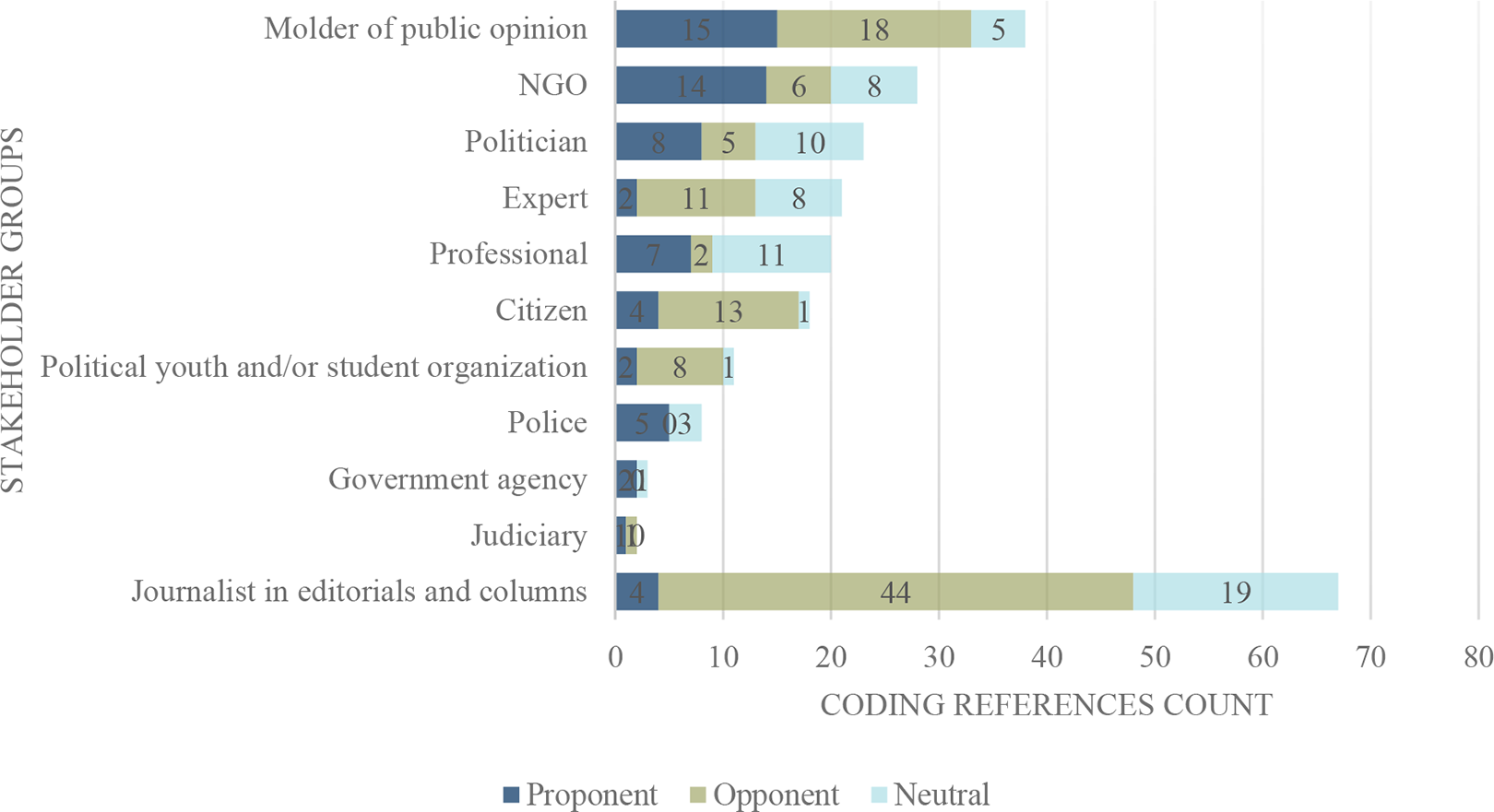
The authorship of the debate articles and letters to the editor (N = 150) and the division between three sides among stakeholders and journalists in editorials and columns. N = 149 but since one media text included both opponent and proponent, it was counted twice, thus N = 150. There were 37 media texts with molders as an author but since one of the debate articles included both opponent and opponent sides as authors, this debate article was counted twice.
Comparing Figure 1 with Figure 2 shows that some stakeholders had no written debate articles during this time. Furthermore, the comparison further demonstrates how particular stakeholder groups, such as PWUDs and their significant others, can be understood as silent stakeholders in the media debate. Previous research has also identified PWUDs’ silence as concerning less access to media representation than to other stakeholders (e.g., Jauffret-Roustide & Cailbault, 2018). However, Figure 2 does not illustrate the activity of certain stakeholders; there may be more actors trying to participate in the media debate, but the newspapers’ editorial staff ultimately decide to publish or reject stakeholders’ opinion texts. In addition, Figure 2 demonstrates how the attitudes towards the present restrictive drug policy—the division of proponents, opponents and neutral—traverse the different stakeholder groups when considering opinion texts and also journalists considering editorials and columns.
The Topics and Three Sides of the Drug Policy Debate
The media data encompassed multiple drug policy-related topics, including drug-related criminality, drug-use decriminalization, cannabis legalization, NEP and treatment. Particular topics often occurred more frequently during specific periods. For example, NEP was more salient at the beginning of the six-year period (2015–2016). The most discussed drug policy topic throughout this period was drug-related mortality, pressuring the development of a more effective drug policy.
Furthermore, these different topics were typically intertwined with the more general discussion of Swedish drug policy in which its restrictive features were either criticized or supported by different stakeholders. This idea of whether or not the drug policy is too restrictive divided the stakeholders into three categories: proponents, opponents and seemingly neutral. All the stakeholder groups represented the three sides, meaning that while some NGOs, politicians and experts support the present restrictive drug policy, other NGOs, politicians and experts object to this restrictive feature. Based on the media data codification and regardless of the topic in question, this restrictive feature serves as a clear dividing line both across and within stakeholder groups.
None of the stakeholders were completely satisfied with the present drug policy: Everyone argued for a change, but the ideas on how to develop drug policy varied. Inherent in the claims was an explicit but implicit meta-discussion on Swedish drug policy: Specific drug policy topics, such as decriminalization of drug use and cannabis legalization, were either seen as solutions to current policy problems among opponents or understood as current policy threats among proponents.
To further illustrate how the topics overlapped and were linked to the frequent meta-discussion of Swedish drug policy’s restrictive features, we analyzed stakeholders’ moral justifications for or against the present drug policy. In the next section, we more specifically outline these three sides (proponent, opponent and neutral) of the drug policy debate, the stakeholders’ concerns and arguments, and the stakeholders’ moral principles for their arguments.
Moral Justifications of the Stakeholders Defending the Restrictive Drug Policy
Proponents of the current drug policy argued that Sweden should continue to aim for a drug-free society. All stakeholder groups included proponents, but several debaters were regularly represented in defending the restrictive Swedish drug policy; for example, the Minister of Health and Social Affairs, the Minister of Justice, the Minister of Interior, particular NGOs, doctors (as professionals) and molders of public opinion.
In their argumentation, the proponents referred to several moral justifications. One of the most referenced moral justification claims was domestic worth as it reflects security, the importance of protecting children and young adults and society’s responsibility to citizens. The following debate article quote from the prosecutor illustrates this moral principle and its use in proponents’ claims: Sweden must resist the strong global forces trying to change the Swedish drug policy. Fundamentally, Swedish drug control is about social responsibility. We must not let our children fall into the hands of the very powerful forces that want to make money from them. Decriminalizing drug use would predestine many weak and already vulnerable youth to social exclusion and rob them of their future before it begins. (SvD_125)
Another frequent moral justification of the proponents’ claims was the worth of fame. This was the case when proponents lauded the success of the Swedish drug policy; the proponents argued that the drug policy has succeeded because drug use prevalence and youth experimentation in Sweden have been low compared to other countries. These two justifications (the domestic worth and the worth of fame) were often combined in the proponents’ defense of the policy.
In many cases, the proponents joined the debate to defend the drug policy when they saw it criticized in earlier debate articles. In these earlier critical texts, it was often suggested that Sweden should either decriminalize drug use or legalize cannabis, likely compelling the proponents to express defensive responses. For example, two proponents among “molders of public opinion” wrote in their debate article: In some debate posts in Sweden, it has been vaguely suggested that criminalized drug use could be one of the factors leading to high death rates among drug users. However, it is unlikely that there is such a correlation. In fact, the death rate is largely related to the legal prescribing of opioids in healthcare and the illegal “import” of drugs. To reduce the high death rate, a combination of many measures is needed, including restrictions on legal use and stricter measures against illegal import and distribution of Naloxone […]. Current legislation allows police early detection and intervention, primarily in cases of young people. This is also the intention of the law: Instead of decriminalizing or legalizing drug misuse, governments should increase the possibility of effectively intervening to prevent it. To increase the motivation for treatment and drug abstention, sanctions must be made more effective, and treatment must always be the main option. The system should aim for and motivate drug abstention, thereby benefiting the individual and society at large. Punitive measures do not conflict with treatment, if properly designed, they may even serve as support. Most importantly, treatment resources must be strengthened. (SvD_76)
A similar kind of paternalism (cf. Ritter, 2021) can be identified from the proponents’ claims when arguing that both cannabis legalization and drug-use decriminalization would support organized crime. This was mentioned repeatedly, most notably when debating the requested drug policy inquiry. For example, the Minister of Justice commented on the decriminalization idea by stating that it would be “a gift to the criminal gangs,” thereby normalizing drug use, and, thus, escalating drug use and drug-related harm in Sweden (SvD_160).
Furthermore, in several cases, the proponents justified their claims with a combination of domestic worth and industrial worth when emphasizing both paternalistic viewpoints and the importance of evidence-based policies grounded in scientific knowledge in their argumentation. Industrial worth as a moral justification occurred when the proponents referred to previous research and reports from other countries that decriminalized drug use or legalized cannabis without a subsequent decrease in drug-related harm. Many proponents argued that drug policy should be evidence-based, which also refers to industrial worth. This particular moral justification resembles utilitarianism as it also leans on how “evidence of the benefits and evidence of the harms are weighed up to facilitate a policy decision” (Ritter, 2021, p. 55).
Occasionally, some proponents based their claims on the justification of civic worth that emphasizes civil rights and social justice. For example, in commenting on the requested drug policy evaluation, the chairperson of the Swedish drug police association elaborated on how evaluating drug-use decriminalization and its relation to drug-related deaths would be like “heavily missing the target” and mentioned how Sweden should maintain the restrictive view on drugs and drug use (SvD_145). He also argued for improving treatment since the current treatment system does not function well. In his work, he has met many “drug misusers” who “fall between the cracks” of the region’s and municipality’s services: “When we meet with broken-down substance users, we ask them to seek treatment, but they often say that there is no point in doing that” (SvD_145). This idea of developing the treatment system, justified by civic worth, underlines the importance of supporting people needing help.
Some proponents supported the restrictive drug policy but wanted to include drug-use criminalization in the requested evaluation. One such proponent was the Christian Democrat Party, which has changed its mind concerning this question. They came to argue that drug misuse is a disease and should be treated as such. Therefore, social services and healthcare must be evaluated—including personal drug-use decriminalization (DN_87). This argumentation emphasizing the need for treatment for those with a disease, as opposed to stigmatization or moralization (SvD_107), is justified by civic worth. Their argumentation was combined with the justification of industrial worth when they also contended that despite the party not wanting to support the idea of legalizing or decriminalizing drug use, they think it would be strange to exclude this question from the evaluation: “We are prepared that this issue could also be investigated in a broader evaluation, even though we do not currently think that we should decriminalize drug use. I feel confident that it will continue to be criminalized” (DN_87).
Moral Justifications of the Stakeholders Criticizing the Restrictive Drug Policy
In media material, several stakeholders actively criticized the Swedish drug policy concerning its restrictive characteristics. According to the opponents, Swedish drug policy has been unsuccessful in that chasing and stigmatizing PWUDs serve as barriers to treatment. The opponents also argued that the restrictive features have led to an increase in drug-related deaths. Instead of punishing PWUDs and aiming for a drug-free society, many stakeholders argued for increasing treatment resources, improving treatment access and implementing harm-reduction measures (e.g., availability of NEPs and Naloxone).
Similar to the proponents, all stakeholder groups included opponents, but particularly notable actors were Left Party and Green Party politicians, political youth, student organizations and molders of public opinion (including former civil servants), but also certain experts (mainly social science researchers) and certain NGOs. Interestingly, most journalists in the data questioned the current drug policy in their columns and editorials (see Figure 2).
The moral justifications of the opponents were mainly based on civic worth, since the opponents underlined the importance of human lives and how PWUDs should be supported and helped instead of punished and stigmatized. Several opponents also defined “drug use problems” as a disease that should not be criminalized. Thus, many opponents suggested decriminalization of drug use. According to the opponents, decriminalization would decrease the stigma attached to PWUDs and encourage them to seek help. For example, in a debate article, a researcher, categorized as an expert, wrote: Decriminalizing drug use, and, in particular, halting compulsory [blood/urine] testing, would be part of a change in drug policy in a more humane and pragmatic direction. By abandoning the motto “Sweden, a drug-free society,” various proposals could be openly discussed and attempted without ideological blinders. This could also positively effect Sweden’s current high drug-related mortality in the long run. (DN_93)
Like the proponents, the opponents, too, emphasized that drug policy should be implemented by relying on evidence-based knowledge, referring to the moral justification of industrial worth. One example is from 2020 when it was reported that the Swedish government would evaluate the national drug policy. A couple of months later, the Minister of Health and Social Affairs announced that (de-)criminalization of drug use would not be part of the evaluation. “[T]hat is just out of the question,” she said (SvD_116). Several opponents from different stakeholder groups criticized this decision and questioned the government’s refusal to base drug policy on scientific-based knowledge, as would have been the case if the evaluation did not include all parts of the drug policy, including criminalization.
The combination of civic and industrial worth was typical in the opponents’ arguments: They argued for changing the drug policy by underlining how it is essential to help and support PWUDs without stigmatizing and punishing them (civic worth) and for relying on evidence-based policymaking (industrial worth).
In addition, several opponents justified their arguments, for example, concerning the decriminalization of drug use, by referring to international organizations, such as the WHO and the UN and its conventions. For instance, in his debate article, one molder of public opinion wrote that Human Rights Watch, the UN and the WHO have recommended drug-use decriminalization (Expressen_6). These claims were justified by the worth of fame when regarding the viewpoints from prominent international organizations.
Some opponents, such as citizens, political youth or student organization representatives and one cannabis user, argued for cannabis legalization in the media. For example, they argued that legalization would offer better chances to control the black market of drugs. One cannabis user commented: Even if cannabis is not legal today, everyone can get it. It is the second most commonly used drug after alcohol. By legalizing cannabis, there would be opportunities to get it off the streets. Then you can keep track of what is sold and where. One of the major problems with drug laws is that they are not particularly effective. (Expressen_17)
Moral Justifications of the “Neutral” Stakeholders
The term “neutral” refers to actors of different stakeholder groups who typically discussed or commented on one part of a drug policy in the media without directly questioning or supporting the current drug policy. This was particularly true regarding its restrictive features. All stakeholder groups included some neutral representatives, but this category most often referred to representatives of professionals and government agencies.
One concrete example of neutral stakeholder representatives is news reporting on NEP and Naloxone in Sweden. For instance, in 2015, Expressen published a piece of news concerning a fresh report by Sweden’s Public Health Agency suggesting that NEP should be introduced throughout the country to reduce the risk of “drug misusers” contracting hepatitis C. The director-general argued that we need to protect the health of “drug misusers,” recognize strong scientific support for NEP and acknowledge that the WHO is urging its member states to embrace this method (Expressen_1).
Later, in 2021, SvD reported that NEP have spread throughout Sweden, with almost all regions now with their own NEPs and Sweden offering access to over-the-counter Naloxone (SvD_152). Furthermore, the latest NBHW statistics show that drug-related deaths have decreased in Sweden. An NBHW coordinator commented that it is impossible to demonstrate causality between reduced deaths and increased access to clean needles and Naloxone. She argued that several factors such as Naloxone, overdose information material and NEPs may significantly contribute to the decrease, but only time will tell what exactly has influenced the change.
Both representatives of these governmental agencies justified their argumentations through industrial worth while emphasizing the scientific evidence and systematic follow-ups of policy changes. The director-general also justified the need for increased access to NEP through civic worth when she mentioned how we should protect the health of PWUDs, and through the worth of fame when she commented that the WHO has also requested its member states employ this method. However, it is first and foremost industrial justifications that permeate the neutral stakeholder claims.
Discussion
In this article, we examined stakeholders’ visibility and moral justifications of argumentation in the Swedish drug policy debate in the media between 2015–2021. Regarding the representation of stakeholders, the most visible stakeholders were politicians, government agencies and molders of public opinion. Furthermore, the stakeholders with successful active attempts to participate in the debate were molders of public opinion, NGOs, and politicians.
Media seeks to create juxtapositions by stimulating conflicting interests (Tieberghien, 2014), hence mostly opponents among journalists (see Figure 2), while also embodying a more or less public forum for these debates (Ylä-Anttila & Luhtakallio, 2016). The present study thereby supports the notion that drug policy debate in media can be seen as the representation of the conflicts that both report on the ongoing debate and create and modify it; the media texts are carefully structured, including the inclusive and exclusive arguments and perspectives (Luhtakallio & Ylä-Anttila, 2011). For example, PWUDs and their significant others can be seen as silent stakeholders in the media debate: they were less represented than many other stakeholders. If they were indeed represented, their viewpoints were mainly portrayed by someone else (e.g., a journalist). Considering the minor representation of PWUDs in the media, this point has also been identified in previous research (e.g., Jauffret-Roustide & Cailbault, 2018). This illustrates the media’s powerful role in its capability to frame issues through selection and salience, as well as agenda-setting (Lancaster et al., 2011; Rosino, 2021). The results of this study demonstrate that stakeholder analysis can clarify how particular stakeholders have achieved more visibility in the media debates while other stakeholders may have been marginalized or excluded from the public sphere (cf. Bjerge et al., 2016; Houborg et al., 2016).
All discussed topics and proposed issues tended to center on the foundation of the prevailing restrictive drug policy. This meta-discussion focused, above all, on whether or not it has been successful, whether criminalizing personal use is advantageous and how PWUDs are understood in Swedish drug policy. These three sides (proponents, opponents, neutral) of the policy debate ran throughout all stakeholder groups, demonstrating a variety of opinions throughout the different stakeholder groups. One tentative conclusion from the study is that this lack of unity among stakeholder groups and in-group dissonance may explain the long-term and remaining deadlock in Swedish drug policy. There has not been a single or united group strong enough to challenge the prevailing preference for a restrictive policy evident in the government and the Parliament with the ultimate power to generate or prevent an evaluation or potential policy shift.
Considering these disputes, with the framework based on JA, this study sheds light on the contesting values of the Swedish drug policy debate that resonates with the previous research considering morality and drug policy debate (Curchin et al., 2022; Euchner et al., 2013; Ferraiolo, 2014; Ritter, 2020, 2021, 2022; Zampini, 2018). In Table 2, we summarize the main claims and the moral justifications of proponent, opponent, and neutral stakeholders, how the orders of worth were applied in the Swedish drug policy context and in relation to previous research.
Summary of the Views and Suggestions, and Main Moral Justifications for the Claims, by Proponent, Opponent, and Neutral Stakeholders.
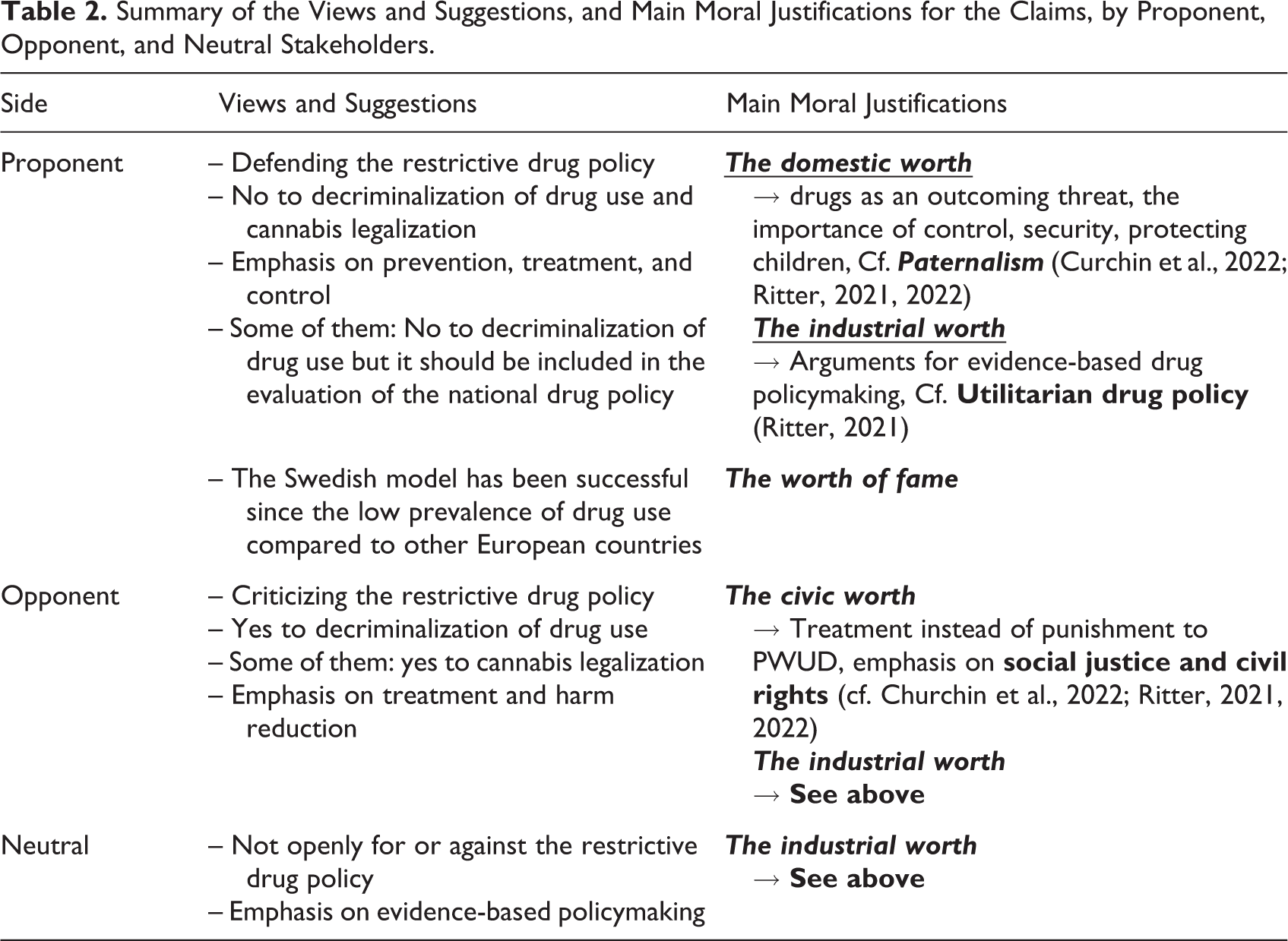
The most frequent justifications of the claims of all stakeholders were based on industrial worth, civic worth and domestic worth, adopted by all three sides (cf. Curchin et al., 2022, see also Table 2). The way of how stakeholders combine the support for evidenced-based drug policymaking (industrial worth) with other moral justifications in their argumentation supports the notion made by previous research that dichotomy of evidence and values can be challenged: nothing is purely value-free, not even referring evidence (Ritter, 2020; Roumeliotis, 2014; Tieberghien & Decorte, 2013; Zampini, 2018).
Drug-use decriminalization, together with cannabis legalization, was one of the essential subtopics in the meta-discussion of the current drug policy and its restrictive characteristics. In several media articles, the stakeholders suggested that drug-use decriminalization would shift the responsibility for the “drug problem” from the judiciary to the healthcare system. In media debates, the Portuguese model 3 was the most referenced example, mentioned by stakeholders on all three sides. However, the design features of such drug-use decriminalization were rarely brought up and sometimes the term “decriminalization” was confused with “legalization” in the media. Considering several examples of implemented alternatives to criminal penalties for the personal possession of drugs, scholars have underlined that the details of the design features matter (Greer et al., 2022). Nevertheless, multiple stakeholders, representing all three sides, argued for the recommendation that drug-use decriminalization should be included in the national drug policy inquiry. They justified this argumentation with industrial worth.
Notably, multiple justifications were mentioned in the claims by different stakeholder types. That the same moral values, to some extent, underpin the claims by both the proponents and opponents may suggest that the deadlock remains. On the other hand, civic worth justifications may have gained ground as they have proven useful in introducing harm reduction measures (e.g., NEP and Naloxone; Eriksson & Edman, 2017; Tryggvesson, 2012). Considering the upcoming requested evaluations and potential drug policy reforms, the near future will tell whether these moral values serve the opponents well. It could, however, be discerned that while the proponents relied more on paternalistic domestic worth, the opponents tended more toward civic worth leaning on civil rights and social justice (cf. Ritter, 2021). Therefore, the development of Swedish drug policy may depend on the relative strength of these two value positions (domestic versus civic worth) in society and among stakeholders in power. The extent to which different moral justifications are successfully used in polarized drug policy debates may also be relevant for other policy areas in different countries.
This study shows that the three sides and the justifications appeared most salient in the debate—and are applied to all drug policy-related topics brought into the debate. The underlying values appear most important. In this study, since values shape the deliberation around drug policy (Ritter, 2021), we aimed to follow the suggestion by Ritter (2022) to reveal the underlying values inherent within a policy. Making these values explicit in the drug policy debate may lead to more successful policy dialogue (Ritter, 2020, 2021). Furthermore, the JA framework has previously been applied especially in comparative research (Ylä-Anttila & Luhtakallio, 2014) and in the future, it would be relevant to compare this Swedish case with other national cases.
Limitations
Other data sources must be used to further disentangle the role of stakeholders, whether or not they have disappeared from the policy arena or were never granted proper access in the first place, and why (see Houborg et al., 2016). That will be done in an interview study following this media analysis. Analyzing social media debates can also be seen as one avenue for future research since these platforms are better available for everyone, to join than newspapers’ debate sections.
Based on the problem definitions and agenda settings visible in this media material, our future research will relate the views and justifications of different stakeholders to actual drug policy development as it evolves with the current inquiry and its aftermath. Taken together, these studies will demonstrate who has the power and position to influence drug policy in Sweden. When it comes to our suggestion to compare the Swedish case with other national cases, it would require paying attention to different political, social and cultural contexts (cf. Ritter, 2021).
Footnotes
Acknowledgment
The authors would like to thank Therese Reitan for commenting on an earlier version of the manuscript and Jukka Törrönen for discussions on justification theory and its applications.
Declaration of Conflicting Interests
The author(s) declared no potential conflicts of interest with respect to the research, authorship, and/or publication of this article.
Funding
The author(s) disclosed receipt of the following financial support for the research, authorship, and/or publication of this article: This work, Lerkkanen’s research and the supervision by Storbjörk, was funded by the program for doctoral studies in public health sciences, at the Department of Public Health Sciences, Stockholm University, and further supported by Storbjörk’s position as a senior lecturer at the department.

Notes
Media Material References
Aftonbladet_50. Aftonbladet. (2020, October 18). Narkotikadöden den största men utredning dröjer [The number of drug deaths the highest but evaluation is delayed]. Aftonbladet. https://www.aftonbladet.se/nyheter/a/Vqb8LV/narkotikadoden-den-storsta-men-utredning-drojer
DN_49. Selling, H., & Fritz Englund, A. (2017, September 20). DN Debatt Repliker. “Legalisering kan bromsa organiserad brottslighet” [DN Debate Reply. “Legalization can slow down organized crime”]. Dagens Nyheter. https://www.dn.se/debatt/repliker/legalisering-kan-bromsa-organiserad-brottslighet/
DN_52. Larsson, M. J. (2017, November 9). Politiker vill öppna för laglig cannabis [Politicians want to open up to legal cannabis]. Dagens Nyheter. https://www.dn.se/nyheter/sverige/mp-topp-dodsskjutningar-gor-att-cannabis-bor-legaliseras/
DN_87. Flores, J. (2019, December 29). “Drogbruk förblir säkerligen kriminellt” [“Drug use will certainly remain a criminal offense”]. Dagens Nyheter. https://www.dn.se/nyheter/sverige/kd-vill-inte-avkriminalisera-drogbruk-men-utreda-fragan/
DN_91. Heilig, M., Andréasson, S., Guterstam, J., & Magnusson, Å. (2020, February 22). “Misstag av Hallengren att inte utreda avkriminalisering” [“A mistake by Hallengren not to evaluate decriminalization”]. Dagens Nyheter. https://www.dn.se/debatt/misstag-av-hallengren-att-inte-utreda-avkriminalisering/
DN_93. Tham, H. (2020, March 2). DN Debatt Repliker. “Humant att avkriminalisera bruk och sluta med tvångstestning” [DN Debate Reply. “Humane to decriminalize use and stop compulsory testing”]. Dagens Nyheter. https://www.dn.se/debatt/humant-att-avkriminalisera-bruk-och-sluta-med-tvangstestning/
DN_109. Hübinette, S., & Moilanen, P. (2021, May 10). DN Debatt. “Legalisering av cannabis ökar konsumtionen och skadorna” [DN Debate. “Legalization of cannabis increases consumption and harms”]. Dagens Nyheter. https://www.dn.se/debatt/legalisering-av-cannabis-okar-konsumtionen-och-skadorna/
DN_110. Andevall, A., Bustos, E., & Lager, N. (2021, May 10). DN Debatt Repliker. “Rapporten ger inget stöd för att kriminalisering av cannabis är rätt väg” [DN Debate Reply. “The report does not support that the criminalization of cannabis is the right way”]. Dagens Nyheter. https://www.dn.se/debatt/rapporten-ger-inget-stod-for-att-kriminalisering-av-cannabis-ar-ratt-vag/
Expressen_1. Canoilas, V. (2015, January 29). Förslag: Inför Sprututbyte [Suggestion: Introduce Needle Exchange]. Expressen. https://www.expressen.se/nyheter/myndighet-sprut-utbyte-bor-inforas/
Expressen_6. Eriksson, A. (2015, August 28). Ett viktigt steg mot att legalisera cannabis [An important step toward legalizing cannabis]. Expressen. https://www.expressen.se/debatt/ett-viktigt-steg-mot-att-legalisera-cannabis/
Expressen_17. Lagerström Dyrssen, E. (2017, September 24). Wally, 34, vill göra cannabis lagligt [Wally, 24, wants to legalize cannabis]. Expressen. https://www.expressen.se/kvallsposten/wally-34-vill-gora-cannabis-lagligt/
Expressen_20. Wigh, H. (2018, January 23). Legalisera cannabis och stryp gängens inkomster [Legalize cannabis and smother the gangs’ income]. Expressen. https://www.expressen.se/debatt/legalisera-cannabis-och-stryp-gangens-inkomster/
Expressen_27. Bråstedt, M. (2019, August 13). Löfven: “Rikas drogvanor göder gängkriminaliteten” [Löfven: Drug use of the rich feeds the organized criminality]. Expressen. https://www.expressen.se/nyheter/lofven-rikas-drogvanor-goder-gangkriminaliteten/
Expressen_39. Adamik, J., Bravin Karlsson, M., & Lausevic, V. (2020, October 4). Legalisering är ett måste för att bekämpa gängen [Legalization is a must for fighting the gangs]. Expressen. https://www.expressen.se/debatt/legalisering-ar-ett-maste-for-att-bekampa-gangen/
Expressen_45. Falkirk, J. (2021, May 9). Ministern pressas om narkotikapolitiken i SVT [The Minister is pressured about drug policy in SVT (the Swedish public service television company)]. Expressen. https://www.expressen.se/nyheter/ministern-pressas-om-narkotikapolitiken-i-svt/
SvD_34. Henriksson, L., Eberhard, J., Roslund, M., Johansson, T., Attefjord, N., Leijerstam, F., Rydell, J., Karlsson, N., Okojevoh, T., Berger, M., & Elf, P. (2017, May 22). Miljöpartister: Fixrum kan bromsa narkotikadöden [Green party candidates: Consumption room can slow down drug deaths]. Svenska Dagbladet. https://www.svd.se/a/VAvQl/miljopartister-fixrum-kan-bromsa-narkotikadoden
SvD_53. Mellgren, F. (2018, January 21). “Avkriminalisera narkotika är inte svaret på problemen” [“Decriminalizing drugs is not the answer to the problems”]. Svenska Dagbladet. https://www.svd.se/a/213jLB/ministern-svensk-drogpolitik-ligger-fast-foljer-inte-norge
SvD_76. Westerberg, B., & Carlsson, S. O. (2019, May 13). Fel att göra narkotikabruk tillåtet [Wrong to make drug use allowed]. Svenska Dagbladet. https://www.svd.se/a/xPe1PR/fel-att-gora-bruk-av-narkotika-tillatet
SvD_80. Knudsen, K., Alm, S., & Karlsson, L. (2019, June 1). Drogpolitiken har preventiv effekt [Drug policy has a preventive effect]. Svenska Dagbladet. https://www.svd.se/a/MRdK1m/sveriges-drogpolitik-har-en-preventiv-effekt
SvD_92. Peterson, D. (2019, October 12). L-förslag: Injektionsrum för narkomaner [Liberals’ suggestion: Consumption rooms for addicts]. Svenska Dagbladet. https://www.svd.se/a/e80yqg/l-forslaget-injektionsrum-for-narkomaner
SvD_107. Reuterskiöld, A. (2020, January 1). Polis: “Folk drar sig för att ringa efter hjälp vid överdoser” [Police: “People are reluctant to call for help in case of an overdose”]. Svenska Dagbladet. https://www.svd.se/a/50vmkO/dodfott-arbete-nar-man-riktar-in-sig-pa-brukare
SvD_113. Standar, D. (2020, December 12). Kravet på regeringen: utred narkotikapolitiken [The demand on the government: Evaluate the drug policy]. Svenska Dagbladet. https://www.svd.se/a/2GkBv4/kravet-pa-regeringen-utred-narkotikapolitiken
SvD_116. Thurfjell, K. (2020, February 14). Partierna helt överens: Svensk narkotikapolitik måste ses över [The parties completely agree: Swedish drug policy must be reviewed]. Svenska Dagbladet. https://www.svd.se/a/rA1PBl/s-ministern-inte-aktuellt-med-avkriminalisering
SvD_120. Paarup-Petersen, N. (2020, February 14). C-politiker: Socialministern sviker sitt uppdrag [C-politician: The minister of social affairs betrays her assignment]. Svenska Dagbladet. https://www.svd.se/a/rA1Myw/c-politiker-socialministern-sviker-sitt-uppdrag
SvD_125. Olofsson, P. (2020, February 20). “Måtte ministrarna stå emot narkotikaliberalerna!” [May the ministers resist the drug liberals!]. Svenska Dagbladet. https://www.svd.se/a/VbM7lV/matte-ministrarna-sta-emot-narkotikaliberalerna
SvD_126. Fries, B., & Gynnå Oguz, C. (2020, March 4). “Stort behov av fakta i narkotikafrågan” [“Great need for facts on the drug issue”]. Svenska Dagbladet. https://www.svd.se/a/6j7keQ/stort-behov-av-fakta-i-narkotikafragan
SvD_135. Lundblad-Joons, M. (2020, June 28). “Vi vill normalisera knark i debatten” [“We want to normalize drugs in the debate”]. Svenska Dagbladet. https://www.svd.se/a/3JvnEM/vi-vill-normalisera-knark-i-debatten
SvD_145. Uebel, P. (2020, October 18). Narkotikadöden den största men utredning dröjer [The number of drug deaths the highest but investigation is delayed]. Svenska Dagbladet. https://www.svd.se/a/aPwQkA/narkotikadoden-den-storsta-men-utredning-drojer
SvD_152. Nordensson, B. (2021, April 16). Sprutbyte och naloxon tillgängligt för fler [Needle exchange and Naloxone available for more people]. Svenska Dagbladet. https://www.svd.se/a/0K8BeG/sprutbyte-och-naloxon-tillgangligt-for-fler
SvD_160. Nilsson, E. (2021, May 30). Knarkbråk i riksdagen: “En hämndaktion” [Drug quarrel in the Riksdag: “An act of revenge”]. Svenska Dagbladet. https://www.svd.se/a/39vmy0/knarkbrak-i-riksdagen-hamndaktion