



Abstract
This article describes the harms caused by the criminalization of cannabis in Jamaica and the outcomes of the decriminalization and legalization processes that started in 2015. It argues that the current framework does not promote social justice for actors historically engaged in the cannabis trade and suggests that it should be revised and aligned with policies geared towards reparations. It focuses on the historical entanglements between Rastafarians, law enforcement, and criminal justice once the prohibition has been weaponized against these actors. I discuss the involvement of the US in the attempt to eradicate cannabis in Jamaica, the massive investment in militarization, and the state violence embodied in the war against cannabis to then unpack the issues with the process of decriminalization and legalization. It concludes by suggesting that the Cannabis Licensing Authority and the Jamaican government must develop deeper engagement with traditional farmers to design and implement policies that will allow them to enjoy the benefits of the current legal cannabis market.
Introduction
“Ganja man, weed legalized dem nuh wan you fi nyam Yet ah you bring di most money pon di island Johnny slap weh deh ah prison fi ganja how long? Run come mek we organize a plan”
On February 6, 2015, the Jamaican Senate passed the Dangerous Drugs Amendment Act (DDAA). This piece of legislation, assented by the governor-general on March 20 of that same year, modified the penalties for the possession and use of cannabis. It also sketched out a scheme for granting permits and authorizations for cultivating, studying, and trading the plant (Parliament of Jamaica, 2015). Cannabis was legalized for medical purposes and decriminalized for other uses. The new law transformed the possession of up to 56 grams of cannabis?—or ganja, the Hindi name by which it is widely known in Jamaica?—a ticketable offence for the general population and exempted Rastas from any criminal charges if found in possession of the herb for religious purpose?—granted they are issued and authorization by the Ministry of Justice. The DDAA does not make any special provisions for other traditional groups that have a historical relationship with ganja like the Maroons, for instance (Goffe, 2018). The amendments came into effect on April 15, 2015. Over half a decade after its enactment, however, the new “ganja law,” as the DDAA is popularly referred to, is still a source of controversy, uncertainty, and suspicion for many social actors.
Before I continue, it is important to dwell on the differences between decriminalization and legalization. As the late Jamaican anthropologist Barry Chevannes, a key member of a government-appointed commission to review the ganja law in 2000, explained, “Legalization of ganja would encompass the repeal of all laws pertaining to the proscription of this substance, its cultivation, possession, trafficking, and use, whereas decriminalization refers to a limited legalization, to wit the use of the substance under prescribed conditions” (Chevannes, 2004, p. 74). Since the DDAA came into effect, it is not any longer a crime to possess up to 56 grams of ganja, but it is left to the discretion of police constables to fine or not a person who is found in possession of the legal threshold amount in J$500,00. The possession of more than 56 grams of ganja remains a criminal offence, and a person can be criminally charged and tried for it. If found guilty, they are liable to a prison sentence, a fine, or both, and will have it written in a criminal record. Ganja is legal for Rastafarians, who can use it for religious purposes and also carry indefinite amounts of the herb when heading to an event authorized by the Ministry of Justice. Having to request permission to a Minister in order to carry any amount of ganja larger than 56 grams is something that many of my interlocutors understand as a patronizing gesture.
This article aims to unpack how the decriminalization and legalization of ganja have impacted Rastafarians since it started being rolled out 7 years ago. It is well known that Rastas have been historically persecuted and victimized for dealing with ganja (Nettleford, 1998; Niaah, 2016; Thomas, 2011, 2017, 2019). Since the 1940s, the Jamaican state has systematically used force and the legislation against ganja to intimidate and incarcerate Rastas (Aïnouche, 2022; Dunkley, 2012, 2013, 2018; Hill, 1983, 2001; Hutton et al., 2015). Recent literature and conversations with informants show that Rastas, as well as other people historically involved in the cultivation, uses, and commerce of the plant are being excluded from the profits and benefits brought by the new policy (Goffe, 2018; Klein et al., 2022). Foreign and local wealthy investors are seizing the market, a trend that has been observed and criticized in other contexts of decriminalization and legalization as well (Bandosz & Wilczek, 2021; Ejeckam, 2019; Harris & Martin, 2021; Siebert, 2020; Title, 2022; Vélez-Torres et al., 2021) and which, in Jamaica, makes the transition of traditional farmers to the legal market a distant or impossible reality.
In the first part of the article, I will go through a historical analysis of how policy and legislation related to ganja have negatively impacted the Rastafarian Movement and how they were mobilized as a tool to persecute individuals and collectivities for their political stance?—namely, their criticism of colonialism, their Afrocentricity, and their endeavors to achieve sovereignty. In the second part I present some informants and their narratives on how they and their families were hurt by the “war on ganja” (Niaah, 2016).
The article concludes that the state violence embedded in the historical ganja laws and policies in Jamaica should not be forgotten in the ongoing process of decriminalization. So far, the DDAA brought “some social justice gains at the grassroots and cannabis consumer level (i.e., decriminalization) and economic profits for the Jamaican business class (and overseas investors),” with the state benefiting from revenue and saving with criminal justice system costs (Klein et al., 2022, p. 14). Small and traditional ganja farmers are being left out of this green wave of profit, when the DDAA could be mobilized to focus on social justice and reparations for those harmed by one century of prohibitionist drug policies. Policymakers should revise the policies of the Cannabis Licensing Authority to facilitate the engagement of these actors in the legal market.
Method
The data for this article comes from varied sources. I conducted ethnographic fieldwork in Kingston between March 2015 and March 2016 and returned for a month in November 2017. During that time, I observed and participated in the secular and liturgical lives of many men associated with different Rastafarian traditions. Most of my interlocutors were born between the mid-1930s and the late 1940s and experienced the escalation of state violence embodied in the enforcement of ganja prohibition between the 1960s and the 1990s. Most of the Rastas experienced prison sentences for the (alleged) possession of ganja and the usual aftermath of incarceration: stigma, financial bankruptcy, and difficulties to find employment having a criminal record.
As it is widely known, there are many implications when one conducts anthropological research with living people. By spending a long time in the field, researchers will usually establish bonds with at least a few informants. They might become close acquaintances, allies, and even friends. This brings a crucial ethical implication: the responsibility for the relationship built. A researcher should not vanish from the lives of the people that allowed them into their daily affairs and who established affectional bonds with them. Returning to the field and sharing the results of the research with the people who participated in it—when funding and travelling conditions allow it—must be part of a researcher’s ethical agenda.
During my time in Jamaica, I met a total of 17 ganja farmers. I relied on the snowball technique, i.e. I met one Rastaman in Kingston who used to be a ganja farmer in Westmoreland until the late 1990s. He got interested in my work and started trusting me enough, so he introduced me to some friends, acquaintances, and relatives who were still engaged in ganja farming. I shall name him Ras Blacka, a pseudonym, to protect his privacy, and will use pseudonyms for the other interlocutors that I will introduce in the next pages due to this ethical consideration. The snowball technique brings with it advantages and disadvantages alike. At the same time that having the trust from an elderly Rastaman like Ras Blacka has allowed me to meet many other Rastas, my network, in the end, was his own network. This network was comprised of mostly elderly Rastas, all men between their late 60s and mid-80s. I met younger Rastas, no doubt, but those with whom I lived and learned were the elderly men.
During the time I spent in Jamaica, I managed to build a stronger relationship with three of the 17 ganja farmers I met. I had designed open ended questions that I wanted to ask all of them, and at first, I aimed to use either a voice recorder or a camera to register their answer and then transcribe it. Since the first Rasta I tried to interview did not want to have his image or voice recorded, I decided to change the strategy and ask him how he would feel comfortable to interact with me. He said he had no problem with me asking questions and taking notes, and I then asked if I could do that while he showed me his plantation, his storage place, and the building where he manicured and cured the ganja flowers. As he responded positively to that request, I decided to use the same approach with the other 16 Rastafarian ganja farmers.
With 14 of my interlocutors, I managed to spend a few days or a maximum of 2 weeks. With three of them, however, I established and cultivated a stronger relationship, and they would allow me and often invite me to return to their farms and spend several weeks in their company, helping with the chores, attending ritual events, and mingling with their families and surrounding communities. With all of them I was talking about how they had gotten involved in the cultivation of ganja, their strategies for remaining undetected, their experiences with law enforcement, how policy and legislation had affected their personal lives and the Rastafarian movement more broadly, and what were their concerns and expectations regarding the transformations that would be brought by the Dangerous Drugs Amendment Act of 2015. I tried to note down as much as possible from their answers, but at times I realized or felt that the note taking process seemed to annoy some of them, and in more than one occasion I was asked why I had to write down everything when I would be able to remember the important parts. When this happened, I would put down my pen and pad and would get back to them as soon as I could. As I kept a field journal, I transcribe all the interviews and dialogues to it, and, together with more general fieldnotes, these form my dataset. This data was later manually coded and analyzed thematically, with a focus on my interlocutors’ narratives and reflections on their experience in ganja farming, the impacts of prohibition and law enforcement on their lives, and their expectations regarding the outcomes of the DDAA 2015.
I must also underscore that due to the strong androcentric orientation of the Rastafari Movement, Ras Blacka introduced me only to men who, in their turn, introduced me to other men. In Rastafarian public life, within Rastafarian households, and in Rastafarian camps and communities there is a strong division between the male and female roles and activities. Being a man, I spent most of my time among men. The biblical framing of the Rastafarian liturgical life also contributes to the androcentrism of the movement, which is translated in their use of language as well. It is not unusual, for instance, to hear from Rasta men and Rasta women alike that secular laws are “the laws of man” or “the laws of men,” in contrast to the divine law that derives from God—or Jah, as Rastas prefer, based on the nomenclature presented in the Psalms translated into English and present in the King James Version of the Bible. Jah, for Rastas, is a male God embodied in the flesh of the late Ethiopian emperor Haile Selassie I.
With the aid of current technology, nowadays it is easier to keep contact with interlocutors. Wi-fi, mobile data, and applications like WhatsApp, LinkedIn, Skype, and Facebook allow me to keep in touch with many of my interlocutors in Jamaica, and some of the data I present here comes from chats and phone calls that I constantly have with them. The ethnographic method—being in the “field” observing and participating in people’s daily lives; establishing and maintaining relationships with informants; informal interviews and conversations—is a critical toolkit for unpacking the impact of cannabis policy in the lives of Rastafarians. It allows us to understand the impacts and consequences of old and new policies and politics “from a bottom-up perspective” (Klein et al., 2022).
I also recur to secondary sources to present the historical context of cannabis laws and policies in Jamaica and draw on ethnographic registers present in the most recent literature on decriminalization and legalization and how it has been impacting small ganja farmers. This study received ethical clearance from the Postgraduate Programme Board, Department of Social Anthropology, Federal University of Santa Catarina.
Ganja, Rastas, and the Law in Jamaica
Although ganja has been cultivated and used for diverse purposes in Jamaica since long before the emergence of the Rastafari Movement, it gained more prominence in Jamaican society after the Rastafarians incorporated it in their cosmopolitics. References to the use of ganja among Rastas date to the very beginnings of the Rastafari Movement. When Sir Edward Denham arrived in Jamaica as governor of the colony, by the end of 1934, he recorded in his diary the following entry: “Ras Tafari or Rasta people—a sect in St. Thomas—round Morant Bay…ganja smoking among this sect” (Post, 1978, p. 166). That note was registered in the same year that Leonard Howell, the pioneer of the Movement, also known as “The First Rasta,” was arrested and convicted for sedition in Morant Bay. Some researchers suggest that the sacramental use of ganja among Rastafarians began with Howell and his followers (Bilby & Leib, 1986; Dunkley, 2012, but see Chevannes, 2001). In Pinnacle, the autonomous community that they established in 1940 in St. Catherine Parish, ganja was also an important cash crop, and the Jamaican Constabulary Forces, knowing that, raided the compound in different occasions along the 1940s and 1950s (Aïnouche, 2022; Dunkley, 2013). Chevannes points out that after World War II the enforcement of Ganja Law escalated and became “a good pretext for imprisoning Rastafari” (Chevannes, 1994, p. 157).
The leaders of the Youth Black Faith, a Rastafarian collective established in Trench Town, Kingston, in the late 1940s, instructed the members of the congregation not to possess ganja during official gatherings. Years before the Youth of Black Faith has taken this stance regarding the use of ganja, Robert Hinds?—Leonard Howell’s lieutenant, also arrested and convicted in the 1934 sedition case?—had already banned the use of ganja during his own congregation’s meetings. Hinds’s congregation had a cabinet to adjudicate the misconducts of its members, and among the types of offenses judged were the possession and use of ganja during liturgical events. Chevannes argues that “Hinds was not against using ganja, but he demanded that whoever used it must do so in the privacy of his own home.” The objective of this measure was “to give the colonial authorities as few pretexts as possible for harassing the Mission” (Chevannes, 1994, p. 131). George Eaton (Simpson, 1985, p. 287) also remarked that “ganja…was not smoked during Rastafari meetings” when he conducted fieldwork in West Kingston in the early 1950s. Perhaps this was due to the violent enforcement of the prohibition by the Jamaican Constabulary Force.
If up to the late 1950s ganja was regulated by Rastafarian leaders, in the 1960s the Dreadlocks, a radical section of the Youth Black Faith that would give origin to the Nyabinghi House, transformed that picture. The Dreadlocks elaborated the cosmological discourse that ritualized and sacralized ganja and developed their own theological justification for its use. They claimed that it first appeared on the grave of the sacred King Solomon, as a gift from God for man’s healing. It became integral to their circle of reasoning, in which after praying over it they pass the huka, now dubbed a chalice or cup, in simulation of Christian communion worship, until each has partaken. (Chevannes, 2001, p. 33) the government also began a campaign to eradicate the cultivation of ganja in Jamaica and conducted raids against those suspected of growing and distributing ganja. The government also initiated a policy of eighteen-month minimum mandatory sentencing for anyone using or possessing ganja. (Thomas, 2011, pp. 191–192)
The 1970s saw the internationalization of the Rastafari Movement through the power of music. Roots Reggae, the musical genre created by Rastas like Lee “Scratch” Perry, was a powerful tool to disseminate Jamaican Rastafarian cosmopolitics throughout and influence the African Diaspora in struggles for rights, memory, and identity in Jamaica and abroad (Brodber, 1987; Chambers, 2019; Reckord, 1982). By that time, ganja started to be “much serenaded”—to use Niaah’s expression (Niaah, 2016, p. 227). Singer-songwriters like Clancy Eccles, Linval Thompson, Prince Buster, Dillinger, Jah Woosh, Peter Tosh, Bob Marley, and Bunny Livingston, among others, composed and recorded several songs hailing the physical and spiritual therapeutic potentials of the herb, denouncing the violence of the law enforcement, and demanding its full legalization.
In the second half of the 1970s, a campaign for the revision of the ganja law gained momentum. After the election of Michael Manley for his second term as Prime Minister (1976–1980), the People’s National Party (PNP) had “declared its intention to review the laws concerning the use of ganja…and to grant pardons to those serving unjustly severe prison terms for its use” (Yawney, 1977, p. 235). In 1977, the Jamaican Government set up a Joint Select Committee to consider the criminality, legislation, uses, abuses, and possible medicinal properties of ganja, and to make appropriate recommendations. While rejecting legalization, the Committee, on account of Jamaica’s obligation to the 1961 Convention, unanimously concluded that there was, however, a significant case for decriminalizing the personal use of ganja. It recommended specific amendment of the law, and that there should be no punishment prescribed for the personal use of ganja up to a quantity of 2 oz. by persons on private premises. It further recommended that ganja be lawfully prescribed for medicinal use. This proposal—clearly way too early within the global politics of ganja—was shelved and only resurrected almost 3 decades later. (Niaah, 2016, p. 238)
As Jahlani Niaah (2016) points out, This period ended with the 1988 Convention Against Illicit Traffic in Narcotic Drugs and Psychotropic Substances, to which Jamaica was a signatory. The complicity within this new framework meant a crackdown on Jamaican gang activity in the US and a backlash at home among law enforcement forces, with a massive campaign waged against the cultural use and cultivation of ganja. The police used the herb as a decoy to engage Rastafari and working-class youths and made arrests in the face of public outrage and Rastafari advocacy for decriminalization. (p. 239)
Nevertheless, the outcome of the eradication process was not successful. Throughout the 1990s and the early 2000s, arrests for possession of ganja in Jamaica escalated (Harriott & Jones, 2004) and the cultivation of the herb continued, translated in the high amounts of the plant seized at Kingston Wharves (Jones, 2002). At the same time, the lobby for legalization of ganja grew in Jamaica, and Prime Minister P. J. Patterson (PNP) “appointed a commission in September 2000 to consider and recommend whether government should decriminalize ganja for personal use in private” (Chevannes, 2001, p. 34). Even though the members of the commission concluded that the herb should be decriminalized for the private and personal use of adults, no further measures were taken by the government in order to implement the recommendations. In 2014, 1 year prior to the passing of the Ganja Act, “per capita arrests for cannabis possession in Jamaica were more than double the United States (500 versus 200 per 100,000)” (Davenport & Pardo, 2016). The decriminalization of ganja took place in 2015; 102 years after the enactment of the first law that prohibited it in Jamaica.
Dangerous Drugs Amendment Act: Social Justice or Gentrification?
State violence for ganja-related practices was a major topic in the dialogues I had with my interlocutors, as well as the relief brought by the decriminalization process. Some brethren see an opportunity for profit without fear of harassment in the national and international ganja markets. Others criticize those who want to articulate themselves with the government and investors in the name of profit only. Brethren from different orders and backgrounds speak of the need to articulate the legalization process with reflections and practices related to the health, economy, spirituality, and autonomy of the Rastafarian community. Many of them question why the state and certain scientists and investors have denied for so long the benefits of ganja historically claimed by the Rastas. Now, most of my interlocutors say, they want to profit from Rastafarian knowledge on ganja as if this knowledge somehow belonged to them. As Jahlani Niaah explains, the 2015 Ganja Act is a clear attempt of the Jamaican government to come to grips with the legal status of the herb, But not before securely placing its reintroduction within frameworks that ensure the government’s control of its expected high revenues. Thus, there is now within the national climate surrounding ganja liberation an emergent concern that the future industry shall preference big new foreign investors to the exclusion of those who had for years defended and sustained the assertion of the herb’s importance with their illicit crops. (Niaah, 2016, p. 228)
These questions are articulated to claims for redress on account of the state violence directed at the Rastafarian community during the decades of war against ganja. On a hot September afternoon, in 2015, I was discussing the decriminalization problems with elderly Rastas in Seaview Gardens, West Kingston. Some of them were smoking ganja in a water pipe. Others were smoking spliffs. Jah Eyes, whose long, grey dreadlocks and beards indexed his 50 years of engagement with the Rastafarian Movement, recollected the days when a small spliff could land a citizen in a Jamaican prison for a long time. He sat up on his hammock, where he had been lying before, and raised his spliff in front of his eyes, placing it upright with the ember up. With his right hand he pointed at the spliff and said: “A few years ago, a small spliff like that could send me straight to jail for years.”
Jah Eyes had served a long sentence in Kingston’s General Penitentiary for international drug trafficking in the 1980s, when he and his brothers were engaged in the trade between Jamaica and the US. They cultivated ganja in Southern Jamaica between the 1950s and the mid-1980s, until they all got arrested, tried, and convicted. Jah Eyes also served a few short sentences for possessions of small amounts of herb in the 1970s. While incarcerated, he went on a hunger strike because, being an observant Rastafarian, he is a vegan, and the correctional officers, knowing that, would make sure to offer him only meat in every meal. When his health deteriorated, officers moved him to a more crowded cell where he had to stand up for most of the day. The prisoners would take 2-hr sleep turns and had arranged a system so that everyone would have the right to sleep twice within 24 hr. When he was released from the penitentiary, in the early 1990s, he found himself homeless and bankrupt, and had to rely on his network of Rastafarian friends and acquaintances to find food and shelter for years. I asked Jah Eyes many times if he was interested in engaging with the emerging legal ganja market. The question seemed to annoy him somehow; most of the times he would say that he is and old man without money or land and ask me how I thought that poor people with criminal records would be treated by the government.
The Jamaican Government has recognized the inequalities embedded in the process of becoming a legal ganja farmer. In 2017, after consulting with stakeholders, the Cannabis Licensing Authority developed a pilot government program aimed to facilitate the access of small farmers to the medicinal ganja trade (Bewley-Taylor et al., 2020). Informed by the Authority’s initiative, between 2017 and 2020, the Ministry of Industry Agriculture and Fisheries rolled out a program called “Alternative Development Project: Including the Small Traditional Ganja Farmers in the Regulated Space.” In 2020, the CLA started to draft new policy for including small traditional farmers in the legal medical ganja market. The Cultivator’s (Transitional) Special Permit would grant a farmer the right to cultivate ganja for 24 months while they prepare themselves to apply for a regular license at a reduced price. The license would also alleviate some of the infrastructural and security requirements the add up to the high costs of becoming a legal farmer (Jamaican Cannabis Licensing Authority, 2020). These policies are articulated as forms of reparations to those affected by previous prohibitionist policies. As of June 2022, the new policy was still in the works and had not been put in place (Jamaican Observer, 2022; Linton, 2022).
It is important to note that these policies do not provide specific rights to Rastafarians, but to small farmers in general. More research on how Rastafarians have been impacted by these policies would be welcome, especially in the future, after the first 24 months of implementation of the Cultivator’s (Transitional) Special Permit, to evaluate if there were positive impacts that have actually helped Rastafarians to transition to the legal market. A hint of Rastafarians’ disappointment with these policies, however, can be already seen. Ras Iyah V’s has recently criticized the government’s stance regarding Rastafarians and the legal market. Ras Iyah V is one of the most prominent voices of the Rastafarian Movement in these last decades. He is a historical activist for ganja legalization and reparation for Rastafarians affected by prohibition and is currently the chairman Westmoreland Hemp and Ganja Growers Association. After Olivia “Babsy” Grange, Minister of Culture, Gender, Entertainment and Sports manifested her discontent with the current treatment of Rasta ganja farmers ( The Gleaner, n.d.), Ras Iyah V questioned the government’s commitment to the Rastafarian community. The elder said: “I don’t appreciate lip service. Yes, we give thanks that Babsy Grange has said that, but what is the Government doing to ensure and guarantee that Rastafari is not harassed for having herb in their possession and that we can participate and benefit meaningfully from the cannabis industry?” ( The Gleaner, 2022).
The main challenges for traditional farmers to transition to the legal market are the requirements that they need to observe in order to comply with the rules for farming medical cannabis, which are very strict and onerous (Rychert et al., 2021). It is important to bear in mind that the Jamaican state legalied cannabis only for therapeutic and scientific ends. The cultivation of ganja for any other use remains a crime, and those who want to transition to the legal market are transitioning to the medical cannabis market, and not to the so-called “recreational” market. The other alternative is to grow cannabis for the national religious market, but that would be a very small market, and would not bring the same level of profit and, thus, economic improvement.
As Jones (2016, p. 154) noted, the new legislation provided many options to both established and prospective ganja farmers, and keeping or starting illegal ganja production remain among them. For people like Jah Eyes, though, small farmers who used to cultivate ganja in small hidden plots of land to export for the international market, having the option of moving into the legal market does not equal having the opportunity to transition.
Between November 2015 and February 2016, I interviewed and conducted participant observation with Rastafarian ganja farmers in Western Jamaica, a historical region of ganja farming. Ras Solomon, an elderly Rastafarian farmer who has been growing ganja for decades told me about many episodes in which the military and the police have extorted him. On a certain occasion, a Jamaica Defence Force vehicle parked in front of his humble wooden one-room house. A high-ranking military officer got out of the vehicle accompanied by three privates while Ras Solomon watched through the window. The Rastaman then opened the front door and greeted the officers with a “Highly High. Blesses in the name of The Most High,” a traditional Rastafarian way of greeting. The high-ranking officer smiled and greeted him with a “Night, sir,” and, after a pause, went on: “Boy, I heard about an old man who grows enough ganja to land him in jail for a long, long time. Have you also heard about this citizen?” The intention to extort the Rastafarian elder was laid bare. Ras Solomon handed the small amount of money he had on him to a soldier, but the military did not leave. They got deep into the woods behind the Rastaman’s residence and burned down a good part of his ganja crops, as well as some other edible vegetables he was growing to feed himself and his family.
Even with the risks of growing cannabis illegally, Ras Solomon was not keen to move into the legal ganja business. “Where do I get the money to pay for all the taxes and permits and fences and camera and who knows what else?” Two other elderly ganja farmers I met were anxious about this historical moment and were wondering if law enforcement would be keener to target illegal farmers to protect the legal business. If that would be the case, they were thinking to sell their smalls pieces of land and move in with family members who live in Kingston. As Klein and colleagues (2022, p. 2703) concluded from their more recent fieldwork with Jamaican ganja farmers, “The structural barriers, financial costs and regulatory hurdles perceived by farmers in transitioning from illegal to legal enterprise may undermine their interest in the legal scheme in the long run. Hence, the question for the future implementation of DDAA remains how to make the legal scheme an attractive alternative to the business-as-usual practice of farming ganja for the illegal recreational market.”
Between 2019 and 2020, a team of researchers from the University of West Indies, in Kingston, and the University of Swansea conducted interviews and field observations with legal and illegal farmers in different locations of Jamaica. They find out that the biggest concerns of small farmers with regards to entering or transitioning to the legal market were 1) expensive security measures required by the Cannabis Licencing Authority (cameras and fences); 2) land titles (legal possession of land or written authorization of the landowner for the purpose of cultivating cannabis); 3) access to funds (Klein & Hanson, 2020, pp. 11–12). They also found out that many farmers were suspicious of forming cooperatives to dilute individual costs due to fears of being cheated by potential partners. Capital seems to be a major impediment for entering or transitioning to the legal market.
There is also the perception that the Jamaican state has organized the process of decriminalization within a framework that deliberately excludes Rastafarians from entering or transitioning to the legal trade. Three elders of a Rastafarian Order who have been advocating for the legalization of ganja since the 1960s through the organization of marches, events, and filing of petitions to the government were concerned about the use of bureaucracy, prohibitive fees (see Figures 1 and 2), and unattainable standards as a governmental strategy for hindering traditional ganja farmers to engage in the legal market. The elders had been charged and incarcerated for possession of ganja multiple times, and one of them spent over 6 years in Kingston’s General Penitentiary on drug trafficking charges. From their point of view, the DDAA and all the policies around it could also be used to continue the historical discrimination against Rastafarians. When I first heard it from them, back in 2015, I asked them what the rationale behind that argument was, since the DDAA explicitly states that Rastafarians are allowed to use ganja in their rituals, and they can legally be in possession of bigger amounts than other non-Rastafarian citizens provided it is meant for liturgical services. Bongo Shepherd, the eldest among the three, then an 85-year-old man, said: I have to ask permission to a minister to carry one pound of ganja to a service. I must ask the government for a permit if I want to grow a plant created by the Almighty. How come they claim to be Christian, and they want to tell a man he needs another man’s authorization to grow, carry, or smoke ganja? Read the Book of Genesis. You see, my youth, a Rastaman abides by the law of the creator. Rasta do not abide by the laws of men.
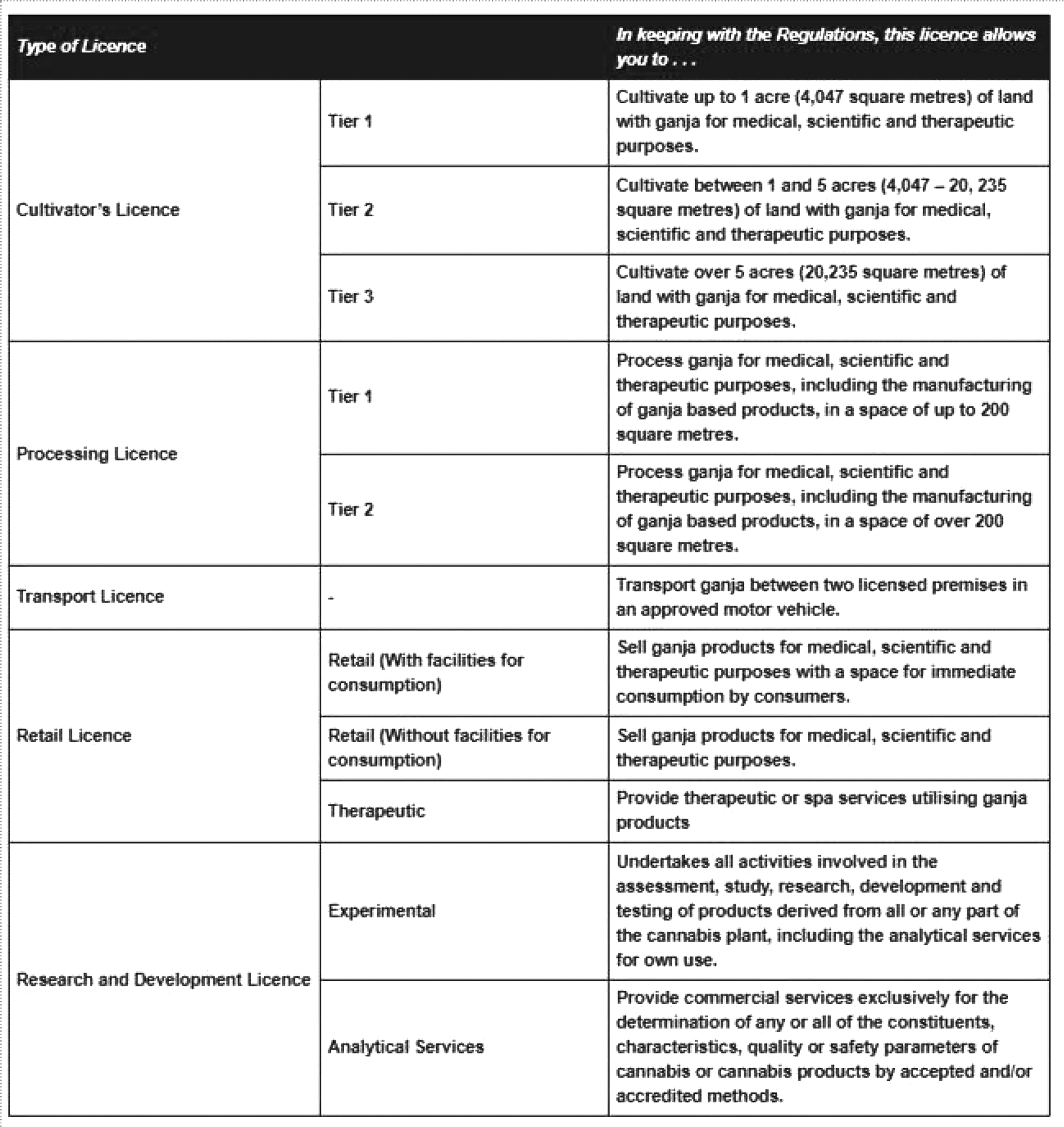
Types of license. Source: Cannabis Licensing Authority.
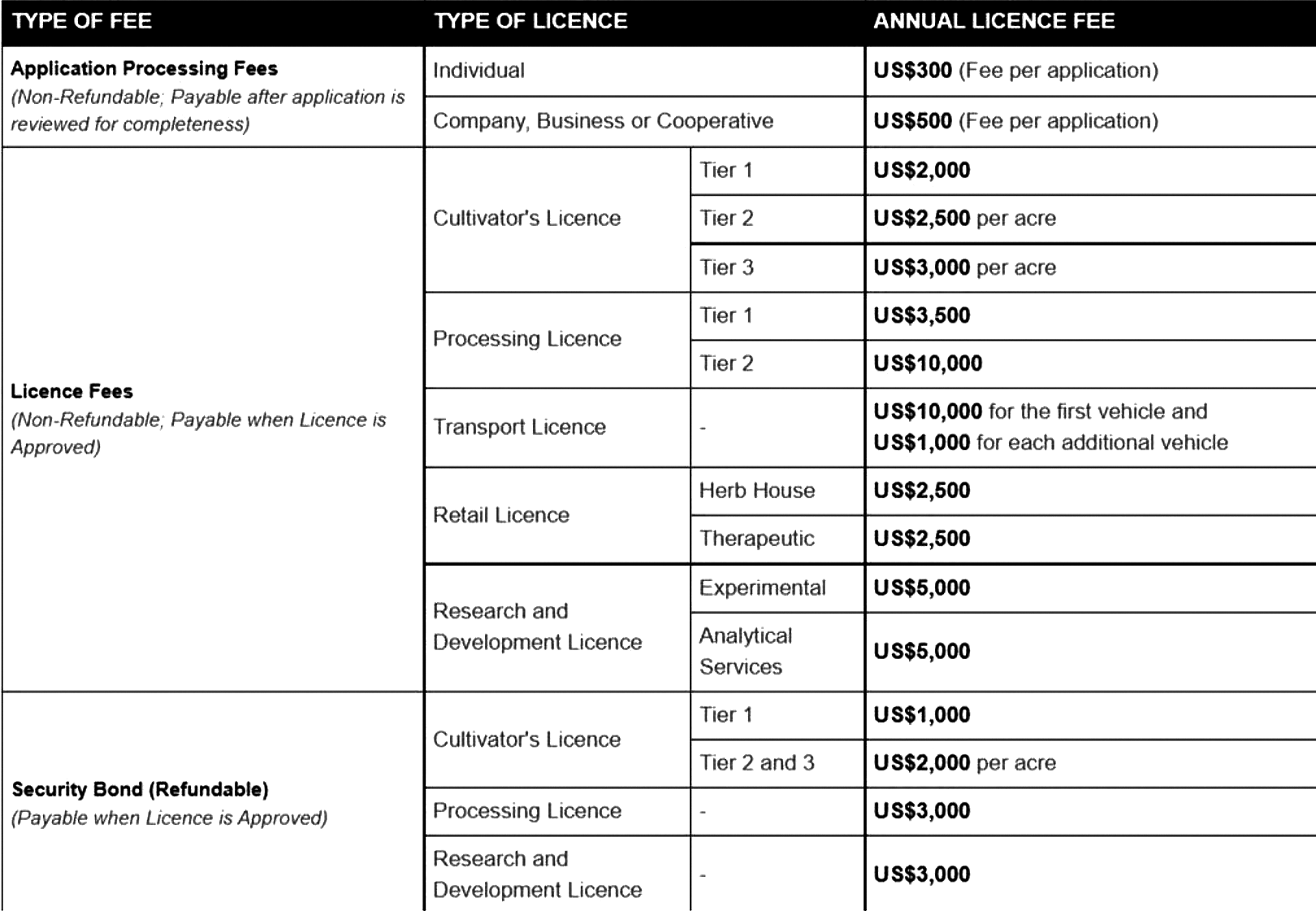
License fees. Source: Cannabis Licensing Authority.
Bongo Shepherd’s statement translates the suspicion of a citizen who saw himself and his peers persecuted and victimized by the Jamaican state for decades. He never travelled beyond the borders of Jamaica like the ganja he grew and sold between the 1950s and 1980s did. His life, though, like those of thousands of other Rastas and non-Rastas in Jamaica, were torn apart dues to drug policies strongly influenced by international treaties, like the 1961 UN Single Convention on Narcotic Drugs, and imperialist foreign policy that aimed to eradicate the demand for drugs by investing in militarization and incarceration.
Conclusion
It is imperative that Jamaican policymakers engage with Rastafarian farmers as stakeholders and gather evidence about how they can be included in the economic opportunities brought by the DDAA. As Rychert and colleagues (2020) rightly observed, the early experience of the DDAA offers a valuable lesson for other countries, that is, a process of decriminalization and legalization must take into account the social, cultural, and economic history of the country instead of allowing the emergent legal market to be captured by corporations and powerful investors. The model that is being implemented in New York (McKinley & Ashford, 2022), where people formerly convicted for cannabis-related offences will be prioritized in the cannabis retail license scheme, could be adapted for Rastafarian farmers in Jamaica.
A license scheme targeting social justice and redress for small farmers could benefit from policies that facilitate bank loans and alleviate the current high costs for implementing a legal cannabis farming business in Jamaica. There are, however, restrictions that undermine the possibility of easing the access to bank loans for cannabis farmers in Jamaica. Jamaican banks have long relied on the US for its correspondent banking services, and these relationships “are subject to the regulatory oversight of the US Department of the Treasury and federal banking agencies, as well as to federal [anti-money laundering, counter-terrorism financing] and drug control laws” (Clarke, 2022, p. 565). Without the possibility to acquire a loan, Jamaican farmers who do not dispose of the capital to start a legal cannabis business are left with the option of partnering up with foreign investors. This modality of partnership proved to be beneficial in some respects. In a recent studies with 22 stakeholders, Rychert and colleagues (2021) found out that joining established company brands, exchanging expertise, accessing larger export markets and established logistic systems perceived as positive outcomes of partnerships with foreign investors. On the other hand, some stakeholders are concerned with the imbalance of power in the relationships with foreign investors, which might lead to predatory partnerships. Another factor for concern is that the insistence of foreign investors to cultivate internationally acclaimed strains “may threaten the genetic diversity of Jamaican sativa dominant strains” (Rychert et al., 2021, p. 6).
Finally, it is important to notice that there is a strong urge among the Rastafarian community for the articulation of the ganja decriminalization process with reparations for those who suffered state violence due to drug policy-related offences. This is an important discussion to have in a moment when the debates on reparations for the violence and inhumanity of slavery and the post-emancipation period are gaining momentum (Beckles, 2013; Rauhut, 2018a, 2018b; Thomas, 2019). There will be no social justice without effective reparation measures for the harms cause by the prohibition of ganja, a plant that has been criminalized for one whole century while legislation and policy were weaponized to incarcerate thousands of impoverished citizens.
Strengths and Limitations
This study focused on the impacts of cannabis policy and legislation on Jamaican Rastafarians, who have been historically persecuted for their association with cannabis. Its main contribution is to show that the processes of decriminalization and legalization have not had a positive impact for these social actors in terms of historical reparations and social justice for the symbolic, political, and physical violence that they have suffered since the 1940s. It also brings first-hand accounts of Rastafarian perspectives on the processes of decriminalization and legalization; their expectations, desires, and skepticism regarding the roll-out of new policy, legislation, and practices.
I must emphasize, however, that the timing of research is an important limitation of this study. The fieldwork and interviews that form my dataset were conducted in the early stages of implementation of the DDAA 2015, and it would be important to return to the field and conduct new research with these social actors to understand a) whether, after more than half a decade of the implementation of the DDAA, they are being benefitted by it in any way; b) what they understand as flaws and positive points of the new legislation now that it has been implemented; c) what are their perspectives, needs, and demands regarding possible further developments in policy and legislation.
Since I carried out my own research, a number of researchers have conducted studies in Jamaica (e.g., Hanson, 2020; Klein & Hanson, 2020; Klein et al., 2022; Rychert et al., 2020) even though their focus were not Rastafarian ganja farmers specifically, and further research among Rastas would contribute to expand our knowledge of the impacts of the DDAA 2015 on traditional populations.
Footnotes
Declaration of Conflicting Interests
The author(s) declared no potential conflicts of interest with respect to the research, authorship, and/or publication of this article.
Funding
The author(s) received no financial support for the research, authorship, and/or publication of this article.
