



Abstract
Notions of masculinity have played a central role in social and cultural research on men’s drinking events. Within this context, masculinity is regularly called on to explain the problematic disparities that mark men’s alcohol consumption, including men’s disproportionate involvement in drinking and a range of alcohol-related harms. More recently, however, researchers have begun to emphasize men’s drinking events as sites of care and support, leading some to suggest that men’s drinking masculinities are evolving in affirmative and health promoting ways. While unsettling the tendency of scholars to problematize men’s drinking masculinities, foregrounding the possibilities of men’s care potentially obscures its complexities and constraints. In this paper, we are concerned to critically re-examine the relationship between masculinity, care, and events of men’s alcohol consumption. Where some authors have positioned men’s care as an innate or uncomplicated good, we draw on a feminist ethics of care approach to explore its complexities, constraints, and exclusions. Through focus group discussions with 101 men, our analysis describes how ideals of masculine autonomy emerged through men’s accounts of drinking events, fundamentally shaping the constitution, practice, and possibilities of care. For the men in our study, the valorization of autonomy fostered ambivalence and tension around care, hindering their capacity as care givers and receivers. In turn, opportunities and accountability for care were overlooked, avoided, or displaced onto women. By highlighting the complexity of men’s care, our account complicates existing scholarship on men’s drinking while also gesturing toward new avenues for public health practice. We conclude by outlining how a more concerted focus on care may be integrated into public health policy, research, and programming and, in the process, contribute to the promotion of more health affirming and ethical modes of masculinity.
Introduction
Men’s disproportionate involvement in alcohol consumption is now firmly established. As Australian Household Drug Survey data consistently demonstrates, men drink at both a higher frequency and volume than women (Australian Institute of Health and Welfare [AIHW], 2017). Indeed, despite the alcohol consumption gap between men and women narrowing (Livingston et al., 2018), men remain more likely than women to drink in excess of nationally prescribed alcohol guidelines and less likely to be lifetime abstainers from alcohol (AIHW, 2017).
Beyond consumption, men contribute disproportionately to many “alcohol-related” harms. Compared to women, for example, men are: more likely to report having verbally or physically abused someone while under the influence of alcohol (AIHW, 2017; Hyder et al., 2018); overrepresented as perpetrators of alcohol-related assaults and intimate partner violence (Taft et al., 2019); and more likely to drink and drive (AIHW, 2017). Further, while men are more likely to be subject to physical violence by strangers—overwhelmingly at the hands of other men (Taft et al., 2019)—women shoulder a substantial and diverse burden of alcohol-related harms. For example, studies of “harm from others' drinking” report that women are more likely to experience unwanted sexual attention, be sexually assaulted, harassed or feel unsafe in public spaces (Bellis et al., 2015; Hallett et al., 2012; Lam et al., 2019).
In an effort to make sense of the gendered disparities that adhere through men’s drinking, social and cultural researchers have frequently drawn on notions of masculinity. 1 This work calls attention to the varied and problematic ways in which men attempt to approximate ideals of masculinity through drinking events, for example, by engaging in risk taking, “disorderly” drinking, and displays of aggression and intimidation (e.g., Campbell, 2000; Lemle & Mishkind, 1989; Tomsen, 2005). More recent research exploring masculinity and its relationship to men’s drinking has sought to nuance such accounts by highlighting the more inclusive, supportive, and caring practices undertaken by men on a night out (e.g., Emslie et al., 2013; Wilkinson & Wilkinson, 2020). Such observations have led scholars to suggest that the masculinities that emerge through men’s drinking events are perhaps diversifying, progressing in ways that challenge conventional configurations of manhood and, in doing so, producing more healthy encounters with alcohol (Lyons & Kersey, 2020).
While these works have helped illuminate the complex relationship between masculinity and men’s drinking behavior, this complexity can be further rendered through a critical consideration of care. Indeed, existing accounts tend to treat observations of men’s caring practices as a taken-for-granted good, as an innately positive and relatively uncomplicated component of men’s drinking events. By critically interrogating men’s care on a night out, we can center the constraints, exclusions, and power dynamics that characterize it. Given the burden and harms that continue to be produced through men’s drinking, we contend that such an approach to understanding men’s care on a night out is necessary.
In this paper, we draw on feminist theorizations of an ethics of care to re-think how care circulates throughout men’s drinking events. An ethics of care approach enables us to critically explore how care is constituted and enacted through men’s narratives of a night out. This includes closer attention to what men’s care encompasses or tends toward, but also what it excludes or neglects. As we map these configurations of care, we examine the ways that masculinity variably shapes men’s caring interventions, producing ambivalence and tensions around who ought to care and how. Our analysis thus illuminates more of the conditions, constraints, and complexities of men’s care and, in doing so, considers how this care may be amplified or operationalized in the interest of promoting more ethical and positive relationships between men, masculinity, and alcohol. We begin by positioning our inquiry alongside the key analytical and theoretical threads that comprise the study of masculinity and alcohol consumption.
Contemporary Approaches to Understanding Men’s Alcohol Consumption
The relationship between men’s drinking and masculinity has been of long-standing interest to social and cultural researchers. As Lemle and Mishkind (1989) suggested over three decades ago, the relevance of this connection seems “so obvious as to appear a truism” (p. 214). Indeed, there is now considerable research that outwardly positions masculinity as bound up with men’s drinking practices (e.g., Mullen et al., 2007; Peralta, 2007). Across this scholarship, men’s drinking—and the interactions, practices, and routines that comprise it—has emerged as a key site in the performative expression of masculinity (de Visser & Smith, 2007). Regular, heavy, and disorderly consumption, for example, has been described as a resource in the social construction of male identity, such that “the more a male consumes, the more masculine he appears” (Dempster, 2011; Lemle & Mishkind, 1989, p. 215).
Within Australia, men’s drinking has been historically elevated as a marker of “authentic” Australian masculinity (Wadds, 2020; Waling, 2019). Beer consumption, a “prodigious thirst” for alcohol (Dingle, 1980, p. 227) and working-class pub culture pervade popular depictions of what it means to be an Australian male (Kapferer, 2011; Kirkby, 2003). Here, men’s drinking assumes a near mythological status, celebrated as a mateship ritual emblematic of Australian values of egalitarianism and reciprocity (Kapferer, 2011; Kirkby & Luckins, 2006). While such romanticized associations obscure the gendered and racialized exclusions that underscore men’s drinking, they nonetheless endure; as Fomiatti and colleagues (2020) recently argued, they inform how some Australian men account for their drinking practices and, in turn, “come to confirm themselves as particular kinds of men” (p. 8).
In unpacking the relationship between masculinity and alcohol, scholars have drawn on Connell’s (1995) concept of hegemonic masculinity, referring to a culturally ascendant mode of masculinity. Deployed in relation to men’s alcohol consumption, scholars have catalogued the ways men approximate and navigate the ideals of hegemonic masculinity through their drinking. In combination with several other situated elements, a range of drinking behaviors and competencies have been designated as means through which men shore up their masculinity and affirm homosocial solidarity and hierarchy. These include—but are not limited to—maintaining bodily control, risk taking, competing in drinking games, and engaging in an array of exclusionary and violent practices (such as fighting, homophobic and misogynistic banter, and displays of intimidation; Dempster, 2011; Gough & Edwards, 1998; Peralta, 2007; Thurnell-Read, 2013; Tomsen, 1997, 2005). As scholars such as Lindsay (2012) and Tomsen (2005) have observed, for example, minority performances of “aggressive” masculinities underscore alcohol-related violence and can be situated, in some instances as a “key element in a fragmented night shaped around risk-taking, disorder and unpredictability” (p. 294). Such works thus help emphasize the role of masculinity in facilitating or “co-constituting” men’s problematic drinking behaviors and their consequences (Moore, 2020).
Importantly, scholars deploying the concept of hegemonic masculinity do not attempt to essentialize or fix the relationship between masculinity and alcohol consumption. Rather, they understand the practices, meanings, functions, and masculinities through which men’s drinking is realized as contingent and dynamic—varying across space, time, and socio-cultural context. Thus, far from condemning masculinity as an innately problematic driver of men’s drinking, scholars have highlighted how particular formulations of masculinity may contribute to the expression of particular drinking practices and harms.
Building on this pluralistic approach to masculinity, scholars have recently emphasized more varied images of men’s drinking events. This work continues to map men’s drinking behaviors against ideals of hegemonic masculinity, but increasingly points toward an array of “non-hegemonic” or “transgressive” practices that emerge through men’s alcohol consumption (Emslie et al., 2013). Evidencing these “alternative doings of masculinity” (Wilkinson & Wilkinson, 2020, p. 7), research highlights how men express emotion and vulnerability together, undertake emotional labor, and engage in practices of support and care (see Creighton et al., 2016; Emslie et al., 2013; Mullen et al., 2007; Peralta, 2008; Ralph & Roberts, 2020). Emslie and colleagues (2013), for example, report that male drinking events furnished an acceptable and unthreatening medium for men to demonstrate their concern for, and support, one another. In the context of young men’s grief, Creighton and colleagues (2016) similarly argue that alcohol consumption constitutes a “masculine practice” that allowed men to emotionally connect with and support each other in ways that were unacceptable when they were sober. Such analysis has led to suggestions that drinking may foster a mode of “masculine protection, an allowance for masculine bonding that may not otherwise have been possible” (Lyons & Gough, 2017; Lyons & Kersey, 2020, p. 30).
Wilkinson and Wilkinson (2020) further advance that while drinking, some men perform “inclusive masculinities” that allow for displays of care. Care is situated here as a “fundamental constituent” (p. 7) in men’s nights out together, and encompasses, for example, encouraging friends to drink water and assisting friends to be safe. The presence of these caring practices, the authors argue, supports “that there is a shift away from the conventional hegemonic masculinity” and that men’s drinking may enable health-promoting behaviors and thereby “safeguard” psychological wellbeing (Wilkinson & Wilkinson, 2020, p. 7).
Such accounts present new ways of thinking about the relationship between men’s drinking and masculinity. They have, however, tended to present men’s caring practices as a relatively uncomplicated and unproblematic component of a night out. Accordingly, men’s care is depicted as an innately positive element or outcome of men’s drinking events, one that can be designated as a transgressive gendered performance (uniquely permitted in the space-times of drinking events) and/or as an exemplar of contemporary, progressive or “healthier” (Ralph et al., 2020) masculinities. Missing here is a more concerted attempt to address the dynamics and complexities of men’s care. This includes, for example, the conditions that sustain or cut off this care, and the limits, exclusions, and tensions that comprise it.
By overlooking the dynamics that shape men’s care on a night out, existing approaches might foster an overly optimistic sense about the prospect of, or natural progression toward, positive change in men’s encounters with alcohol. In a context where men’s alcohol consumption continues to play a disproportionate role in producing harm among men and to others, a more critical approach to understanding men’s care on a night out is warranted.
Attempting to extend existing scholarship and attend pragmatically to the problems that emerge through men’s drinking, we draw on a feminist ethics of care to critically (re)examine men’s care on a night out. Such an approach resists accounts—or even observations—of men’s caring practices as necessarily indicative of a broader, positive shift in masculinities. Rather, it allows an interrogation of the complexity of men’s care—to consider how care is enacted and constrained in drinking events, what this care encompasses and excludes, and, importantly, how ideals of masculinity are variably implicated in these caring processes. This leads us to complicate recent assumptions about the significance of inclusive masculinities and think through the significance of “caring masculinities” (Elliott, 2016) for public health policy spheres. In the section that follows, we introduce our reading of a feminist ethics of care before describing how this reading informs our research method and analysis.
Toward an Analytic of Care
Feminist theorizations of care have long identified care as an essential “doing,” a fundamental yet often undervalued practice that enables and sustains human existence (Fisher & Tronto, 1990; Puig de la Bellacassa, 2017). An inevitable requirement of our interdependent life-worlds, care is always situated and contingent—it emerges as a response to the demands, needs, and obligations of local circumstances (Puig de la Bellacasa, 2012). Such an approach refuses to essentialize care by defining it according to abstract principles. Rather, care is understood to capture “everything that we do to maintain, continue, and repair our ‘world’ so that we can live in it as well as possible” (Fisher & Tronto, 1990, p. 40). It follows that if we wish to understand and assess what constitutes care, then so too must we examine the social arrangements, situations, and relations through which care unfolds.
Critically, an ethics of care approach envisages care as an “ethically and politically charged practice” (Puig de la Bellacasa, 2011, p. 90, emphasis in original). Care is imbued with relations of gendered power, relations that variably determine the conditions of possibility for what counts as care, who cares, and whether and how care ought to be practiced (Gill et al., 2017; Martin et al., 2015). Such an approach has enabled scholars to explore the racialized, classed, and gendered dimensions of care, including the manner in which care has been and is “feminized, devalued, overlooked, or rendered invisible” (Martin et al., 2015, p. 628).
Far from idealizing care as an unproblematic good, an ethics of care approach urges us to consider its non-innocence (Murphy, 2015). Care inevitably tends to some things while excluding or neglecting others (Gill et al., 2017). Just as importantly, it enrolls, compels, or obligates particular actors, while giving others an “out” (Tronto, 2013). Thus, care work within heterosexual family configurations has traditionally fallen primarily to women and has been seen as something in which men lack competence or are unfit for (Elliott, 2016).
While feminist theorizations of care have been productively employed in an emerging body of critical scholarship on alcohol and other drugs (e.g., Barnett et al., 2020; Duncan et al., 2021; Farrugia et al., 2019), a feminist ethics of care has also emerged in discussions of masculinity. Notably, Elliott (2016, 2020) has advanced this agenda through her work on “caring masculinities,” arguing that these “reject domination and its associated traits and embrace value of care, such as positive emotion, interdependence and relationality” (2016, p. 240). Caring masculinities involves a refiguring of masculinities toward care and a revaluing of the critical work of care more broadly. While Elliott’s (2020) framework advocates that caring masculinities “offer key potentials for working toward social change” (p. 182), it also stresses that practices of care do not necessarily lead to change or to greater equality.
Rather than idealize men’s caring as an unproblematic good, or position it as illustrative of a broader shift in contemporary masculinities, considering masculinity and men’s drinking through an ethics of care lens enables a critical examination of the “imperfect work” of men’s caring on a night out (Gill et al., 2017, p. 14). Accordingly, using focus groups with Australian men, we explore how care is constituted through accounts of a night out: Who and what is made subject to care? Who enacts care and how is the need for care recognized? What is included as care, and what is excluded or avoided as care? (Mol et al., 2009) And how are ideals or notions of masculinity implicated in these logics and practices of care? Asking such questions, an ethics of care enables us to carefully scrutinize how elements of responsibility, attentiveness, and responsiveness are composed or neglected through men’s drinking (Tronto, 2013). Doing so gestures toward new avenues for intervening in and operationalizing men’s care on a night out.
Method
Data was drawn from a project concerning men’s risky drinking cultures (Roberts et al., 2019). Specifically, we analyzed material generated through 22 focus groups with 101 men in established friendship clusters from five “social worlds” (MacLean et al., 2020): six groups of regional sport spectators (n = 3, 4, 6, 4, 4, 7), four groups of regional sports players (n = 4, 5, 4, 8), five groups of metropolitan sports players (n = 3, 5, 5, 4, 5), four groups of metropolitan corporate workers (n = 4, 4, 5, 5), and three groups of metropolitan hospitality workers (n = 3, 5, 4; Table 1).
Focus Group Details.
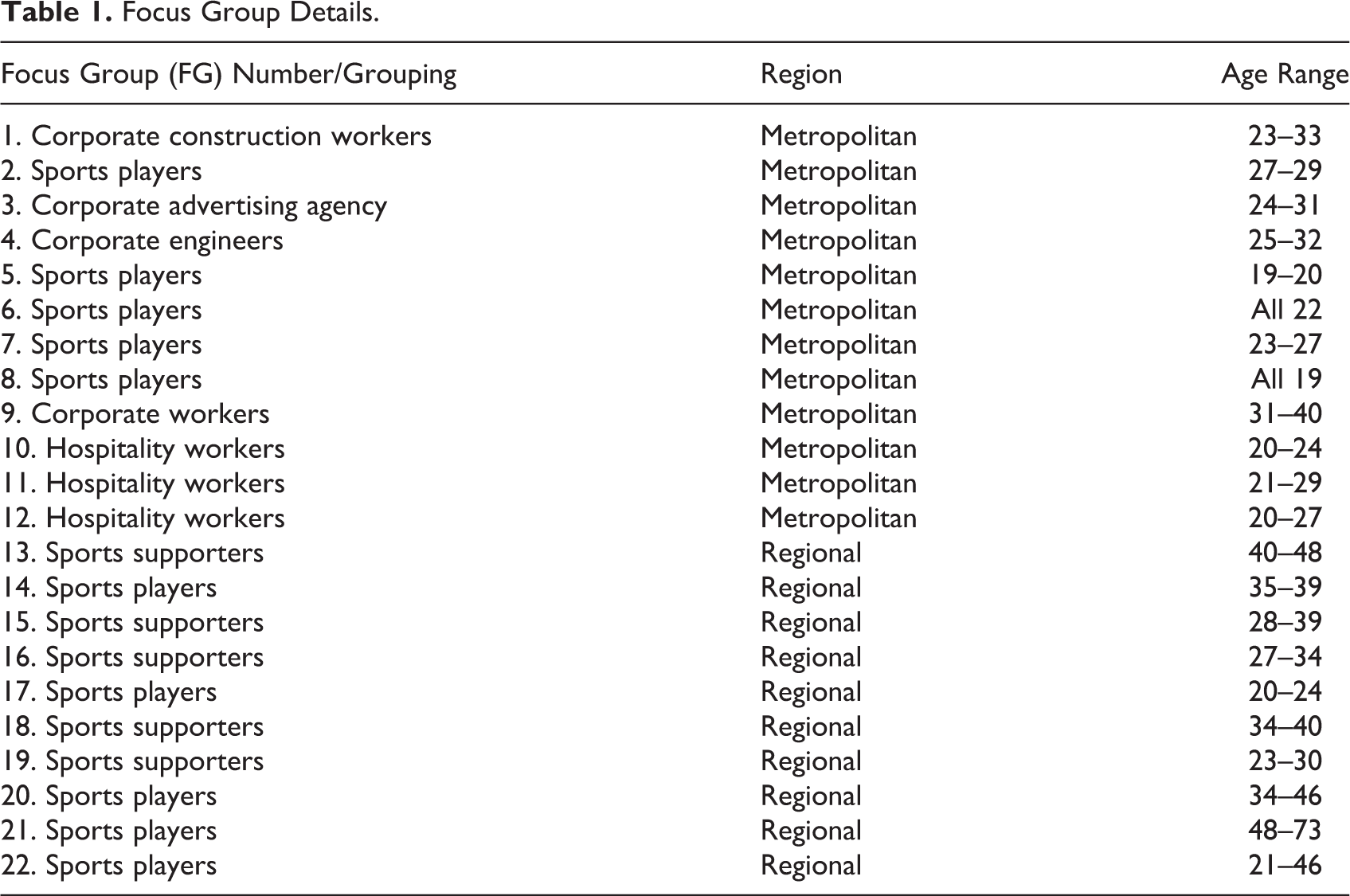
These groupings were chosen because they have been identified as potentially involving heavy alcohol consumption practices (Roberts et al., 2019). In particular, past research also cites Australian sporting clubs and rural areas as contexts in which the link between masculinity and drinking practices is pronounced and problematic (see, e.g., Allan et al., 2012; Carrington et al., 2016; Thompson et al., 2011). Given observations that men in these settings may be adopting “new norms of masculinity” (Campbell et al., 2006; Hart, 2016, p. 306), these participant groups provide an opportunity to explore the complexities and contradictions of newly emergent and ostensibly progressive modes of masculinity.
Participants were aged from 19 to 73, with an average age of 28 (Table 1). Anyone who identified as a man was invited to participate in the research. No participants identified as transgender or non-binary. Five participants identified as Aboriginal or Torres Strait Islander (Table 2). Fifty-one participants were in regional or rural areas, and 49 in metropolitan areas. Most participants were heterosexual; five identified as gay, and one as bisexual. Given the majority of our participants were heterosexual-identifying, non-First Nations men, their accounts comprise the majority of the data presented. Data from bisexual and gay-identifying men and Aboriginal or Torres Strait Islander is also included in our analysis. Ethics approval for the research was granted by the Monash University Human Research Ethics Committee (project number 12218).
Participant Characteristics.
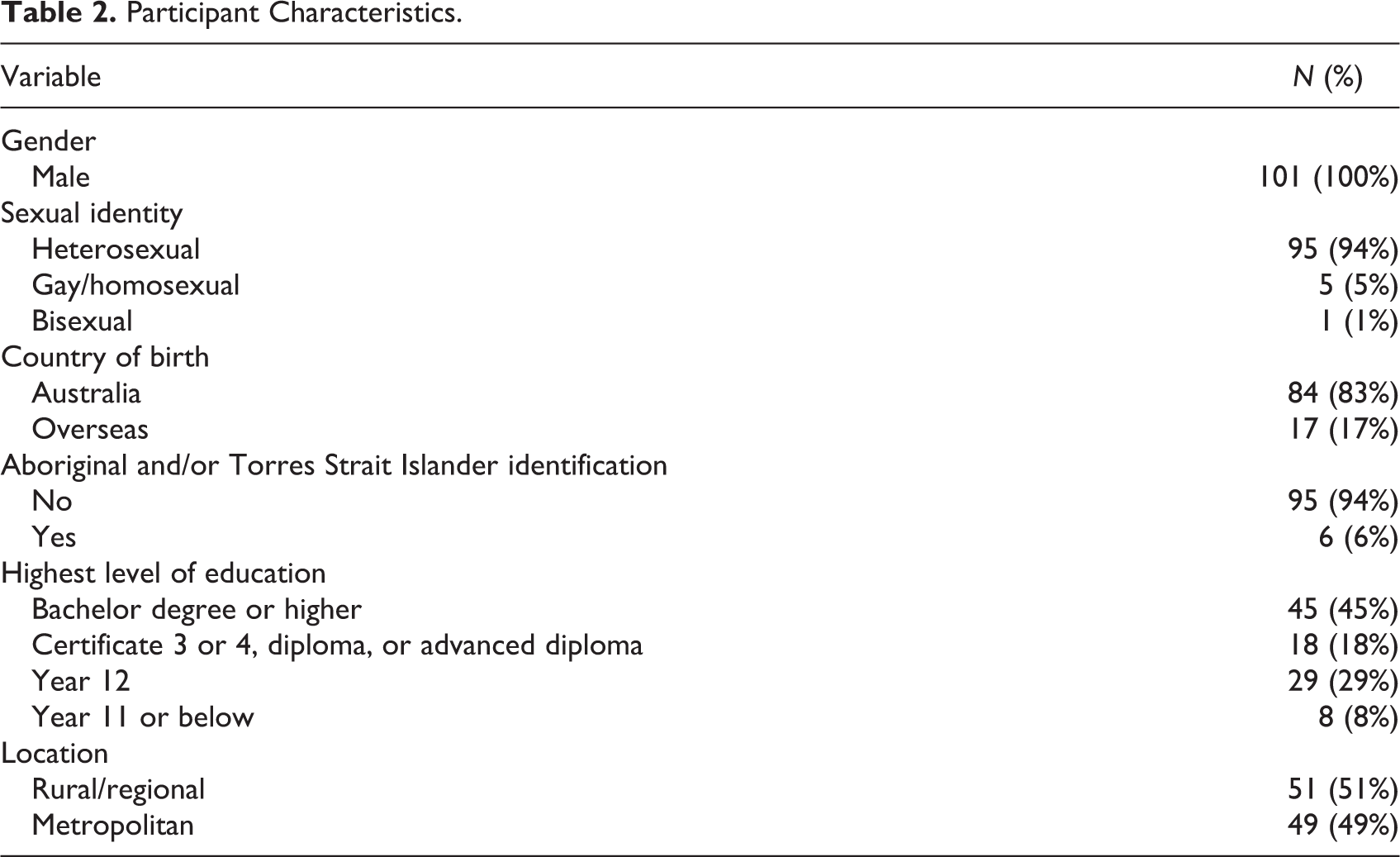
Focus groups lasted between 75 and 120 min, addressing topics such as: drink choice, pace and volume of consumption in different settings; perceptions of risky drinking; drinking practices, including rounds and shots; the involvement of women in drinking practices; and approaches to care, including how men looked after friends who were intoxicated, aggressive, or about to drink drive. Focus groups were audio-recorded, transcribed verbatim, then coded in NVivo. We generated themes based upon participants’ accounts as well as our reading of the literature and the aforementioned theory on care. Specifically, our analysis attended to how participants discursively constructed enactments of care and the kinds of logics, performances, and contingencies that underpin it. We also examined the possibilities that men’s care afforded or constrained during a night out.
Conducting focus groups with groups of friends allowed access to established social networks that provide cultural scripting for male-to-male, or “homosocial,” drinking practices. They also offered the benefit of established trust and social bonds between participants, and insight into how men collectively negotiate and articulate the norms that underpin their everyday practices. We nonetheless recognize that our methods are intrinsically performative, that is, that they actively constitute the objects of their study (Fraser, 2020). Thus, rather than providing impartial access to men’s drinking events or a singular truth, our methods inevitably foreground particular realities while silencing or obscuring others (Fraser & Seear, 2011; Law, 2004). Indeed, comprised as they were of all-male-cisgender configurations of friends, colleagues, and/ or associates, our focus groups may have served to cultivate and amplify normative enactments of masculinity and care. In consequence, the emergence and articulation of more marginal and contested accounts may have been limited. Yet such may be considered the strength and politics of our approach—by serving to produce particular (normative) enactments of masculinity through our focus groups, we are pushed to consider “how the real might be better enacted” (Law, 2009, p. 242). We thus weave men’s collectively narrated accounts together with an analytic of care to engender alternative kinds of knowledge, realities, and stories. Given the enduring and consequential effects of men’s drinking and a lack of policy attention directed toward masculinity within Australia (Manton & Moore, 2016), such an approach ought to be understood as a mode of intervention; by helping to cultivate more pluralistic understandings of men’s care on a night out, we look to establish novel ways of acting upon men’s drinking events and amplifying the practices of care embedded therein.
Analysis
Our analysis is distributed across three key themes. First, we briefly discuss men’s drinking events as potential sites of care, communication, and support. Next, we assess the emergence of the autonomous ideal and its relevance for shaping men’s sense of responsibility and accountability. Finally, we consider how autonomy shaped the conditions of possibility for men’s care on a night out.
Men’s Drinking as a Novel Site of Intimacy, Connection, and Care?
For the men in our focus groups, drinking events were repeatedly framed as unique and important sites of sociality and bonding. Drinking “with the boys” (Peter, sports player, FG 14) furnished opportunities to “get outside your shell” (John, sports player, FG 5) and “break those barriers down” (Steve, corporate worker, FG 3), which could otherwise constrain men’s interactions and possibilities for connection. In this sense, drinking events could facilitate “deeper” (Andrew, corporate worker, FG 3) modes of communicating, enhancing men’s capacities to “open up” and practice homosocial intimacy and emotional support: Like blokes don’t really open up and they need sometimes an excuse to—and beer is that sort of thing that brings them together and helps them to. (Dave, sports supporter, FG 18)
At first glance, then, drinking may be understood to facilitate practices of care, support, and connection otherwise under- or un-articulated in other space-times among men. Such findings appear to resonate with accounts depicting the emergence of more empathetic, and caring practices through men’s drinking (e.g., Emslie et al., 2013; Wilkinson & Wilkinson, 2020). Nonetheless, while these ostensibly progressive potentials are important, we caution against celebrating men’s events of consumption as sites of uninhibited and innately positive homosociality and care. Despite furnishing opportunities for novel, valued, and even liberating modes of intimacy and connection, our analysis indicates that men’s capacities—to both enact and receive care—were mediated by a series of expectations and norms tied to the ideal of masculine autonomy, as we now demonstrate.
The Autonomous Ideal: “Looking After Yourself Is Self-Respect”
While most participants described themselves as regular and capable drinkers, the heavy consumption of alcohol was rarely celebrated, at least with us in the context of our focus groups. Indeed, participants dismissed many of the conventional, hegemonically masculine competencies described in existing accounts of masculinity and men’s drinking. Accordingly, drinking “feminine” cocktails, abstaining from alcohol or being “lightweight” posed little threat to male subjectivities (cf. Peralta, 2007). Rather, what mattered, in terms of enacting an appropriate model of adult masculinity through one‘s drinking, was the capacity to retain agency and autonomy. Across focus groups of geographic and occupational diversity, autonomy was consistently characterized in terms of self-direction and self-determination. For example, Rex, a member of a gay men’s metropolitan sports club (FG 12), stated that “I don’t try to keep up or anything, you don’t have to have a drink to drink, it’s not a competition, just you do you sort of thing.” Similarly, Brent, as part of a focus group of regional sports supporters (FG 13), extended this logic to other male friends in his circle, noting “if they don’t want to drink that night, they don’t want to drink that night, you don’t think any less or more of them, that’s their choice…”
In practice, autonomy was a matter of being “your own man,” of being accountable and responsible for carving out your “own way” (Brent, sports supporters, FG 13). As one focus group emphasized through their description of a friend’s “fruit tingle” drink choice:
He doesn’t really care, he’s good like that. He’s sort of set in his ways and, you know, other people’s opinions don’t really matter in that sort of sense. Other things get to him, but…
The other thing is, if it tastes good, drink it. If you like it, drink it, who cares.
Yeah, you’re not drinking it for them. (Sports players, FG 14)
Resisting peer pressure, controlling one’s drinking pace and drink choice, and “not being governed by someone else” (Lawson, sports player, FG 20) were each positioned as key in the constitution and performative enactment of autonomy on a night out. Alongside stoic resistance to external pressures, the maintenance of autonomy also required men to “know [their] limits” (Andy, sports player, FG 2) in respect to drinking. Consistent with Zajdow and MacLean’s (2014; see also Roberts et al., 2019) analysis, this practice self-governance was sensed through affective states rather than reference to risky drinking guidelines. Accordingly, notions of safe and risky alcohol consumption were closely tied to one’s capacity to effectively monitor and manage one’s comportment and remain in control: Me personally, I think even at five pints, you can obviously feel like you’re drunk but I feel like I’m still in control of situations, just not spatial awareness or anything. So, at that point I don’t see any major risks. (Rob, cooperate worker, FG 1) I work with one of my best mates, and after work…we’ll drive back to my house and we might have a few knock-off beers, literally, just to really chill out, and then he’ll drive home…like it’s his choice, I’ve never pressured him to do that, it’s his choice to drive home, but I know he’s not drunk, so it’s like if he gets dicked [caught by the police] then that’s his issue. (Ross, sports player, FG 5)
“As Long as You’re Not Being a Fuckhead, I Don’t Care How Much You Drink”: Constraints on Care
While a night out with male friends seemingly demanded self-governance and self-care, practices of care from and for others remained present. Yet, the conditions of autonomy transformed how this care was constituted and enacted, what care looked like, who performed it and, just as importantly, when and whether care was carried out.
The imperative to look after oneself meant that care for others was deemed necessary only after a certain threshold. As long as another man’s drinking behavior did not threaten to shift drinking events in undesirable ways, or to impede on one’s own autonomy by “getting you arrested or bashed” or “hassled” (Sports supporters, FG 13), for example, it remained of little concern. As participants relate below, the need for care from others thus warrantable only when things got “really bad”:
No, I think we’re pretty sort of, you know, like you said, we don’t monitor each other’s drinking, no one really—I mean we, yeah, if anyone’s really bad, people look out for them but generally it’s sort of a—
They’d have to be pretty bad.
Yeah, you know, you should be able to look after yourself. And if it gets bad everyone helps you out. But no one’s really saying you’ve got to drink fast, nothing like that. (Sports players, FG 7)
Prior to the emergence of these kinds of care needs, participants denied being attentive to others’ drinking. While participants might playfully comment on the slow rate of a male friend’s drinking, monitoring or observing another’s drinking in the interest of their wellbeing was described as unnecessary and inappropriate: As they say, it’s like—if someone’s obviously not a problem drinker, you telling anybody how much they should or shouldn’t be drinking is kind of like unnecessary, unwarranted, intrusive…(Sam, sports player, FG 6)
If someone is over the legal limit but they drove to the venue, we…take a cab typically.
Discourage them not to do that, typically, it would be pretty highly discouraged.
It’s hard to know whether they’re over the limit though [group agrees].
I wouldn’t be grabbing the keys off them.
Unless you can visibly see that they’re like…[group agrees].
Yeah, if they’ve had a few drinks and they thought they’d be fine to drive that’s their choice.
Again, I think all of us are pretty reasonable, I think if it ever got to that point we’d make our own decisions and we wouldn’t do it.
So unless they are falling off their chair you wouldn’t intervene?
Yeah, you’d still never physically grab anything off them—you’d just order them a cab instead, maybe? I don’t know, because you always want to avoid confrontation. If they’re adamant that they’re gonna do it, I’m not gonna, yeah, physically stop them from doing it. (Corporate workers, FG 1)
As the men here suggest, negotiating whether or not to intervene was an uncertain process. Rather than impinge on another man’s autonomy and risk confrontation by addressing the matter directly, the men deferred to a logic of individual choice and personal responsibility: “[if I] thought they’d be fine to drive that’s their choice” (Warren).
An aversion to practicing care for fear of confrontation was not uncommon. At several points across our focus group discussions, participants reflected on the potential conflict or aggression that might emerge if one was to express concern for, or intervene in, another man’s drinking behavior:
If I had a friend that said, “Oh you know you look like you’ve had a couple too many, maybe you shouldn’t drive,” I won’t drive. Of course, if someone is nice enough to put their opinion in.
Yeah. How would that opinion be taken? Would you be like, you would welcome—
I think it’s a sign of a good friend that can say that, and if you can cop it, if you can take it, other people if they’re drunk they might get snappy about it. (Sports supporters, FG 13)
As this participant shared, care is something men in his estimation have to “cop,” an act imposed on a reluctant recipient who in turn may be liable to negatively react. Through these frames, the delivery of care—such as expressing concern around drink driving—could be fraught with tension and a latent potential for conflict. While this potential could encourage an aversion to care, as described above, it also transformed the way care was practiced. For these participants, care emerged as a more discrete and indirect practice that navigated the tensions of men’s autonomy. Men described, for instance, giving a “subtle hint” (Kevin, corporate worker, FG 9) to those whose drinking behavior was disruptive or aggressive, sequestering an “at-risk” friend outside the pub for a cigarette, distracting a friend who was harassing women, or subtly encouraging water consumption: It’s a small thing like going to the bar and maybe getting a jug of water and a few fresh glasses and just throwing them around the table and giving them the option to have, you know—you pour it and you just put it in their direction without even asking them, you know. And that way they—the water is supposed to be in lieu of their drinking. (Will, corporate engineer, FG 4) Well, I always try and break up fights, I’m not one to get into fights. But if I saw one of my mates getting hit I’d obviously probably help him out. (Jeff, sports player, FG 7)
A kind of gendered dichotomy was thus observed between “looking out for” and “looking after” a mate. While looking out for mates—through discrete or protective practices of care—was a regular and commonly touted aspect of a night out, looking after friends was coded as feminine, a more sustained and involved task that was devalued as both a burden and, in some instances, something to be avoided:
I’m selfish, like I don’t really want to look after you. That sounds dog but like—
Bullshit, you look after everyone.
Thanks [group laughs]. But yeah I wouldn’t really know like, what to do…For some reason I do always assume the role of like—
Mother.
Yeah, literally I always look after people and one time I cracked it and I was like “I’m sick of looking after people.” (Sports players, FG 8)
Situating nurturing, involved practices of care as feminine corresponds with work highlighting the disproportionate involvement of women in care work. As Zajdow (1998) has argued, women are regularly called upon (and expected) to respond to the needs that emerge through men’s drinking. In our sample, the sparse availability of, and aversion to, particular modes of care meant that men often diverted the responsibility for certain care practices onto women. Most frequently, this involved calling on women—the sister, mother, or “the missus” (Matt)—to pick up those who had drank too much to drive or who had become too intoxicated:
If one of us starts getting too rowdy or aggressive we…usually tell ‘em to go home or take ‘em home, or I’ll just go to bed [group laughs].
Why’s everyone looking at me [laughs].
Or we ring the missus and say “hey, come and get him” [laughs].
Yeah, definitely. (Sports players, FG 14)
Beyond responding to the emergent care needs of a night out, however, women may also be expected to tend to, and express concern for, the less immediate effects of men’s drinking practices. This includes, for example, the effects of men’s drinking on children or the long-term consequences of alcohol consumption:
And who tells you that you’re not allowed to [drink]?
The women.
Yeah usually the wives or the girlfriends attempt to.
But they know now not to even put that horrible thought in their heads, or our heads.
Why do you think they say that? Why do they not want to drink in certain—?
Well I think they’ve learnt their lesson now, it’s been a few years since that’s happened, hey?
Yeah [partner] tries to tell me a fair bit, just mainly for the health, she says that, which of course—smoking and drinking—if you are drinking a lot, you’re not going to live forever. Yeah but she’s sort of one to go, “oh you know you should try and slow down a little bit,” but yeah it’s hard to listen, I suppose, all the time. (Sports supporters, FG 13)
Despite the absence of certain forms of care, the need for care does not disappear. Our analysis rather suggests that care needs may remain unfulfilled or are outsourced—fulfilled by women to support men’s sense of autonomy and compensate for men’s unwillingness to provide care.
Discussion
In this article, we have sought to extend how we think about men’s care practices on a night out. Consistent with prior accounts of men’s alcohol consumption, our analysis suggests that drinking events may serve as a novel site of emotional support, connection, and bonding between men (Emslie et al., 2013; Peralta, 2008; Wilkinson & Wilkinson, 2020). As a frequent and valued component of men’s sociality, drinking was reported to furnish a space-time where particular forms of emotional expression, care, and sociality were rendered permissible and possible. Beyond the pleasures of alcohol consumption itself, these distinctive social and affective affordances speak to the appeal and health promoting potentials of men’s drinking events.
However, while men may be practicing more empathetic or “inclusive” drinking masculinities (e.g., Wilkinson & Wilkinson, 2020), our data complicates such conclusions. In mapping the emergence of masculinity on a night out, our analysis surfaces the contours and mediatory force of masculine autonomy. For our participants, autonomy was valorized as an ideal and individual capacity, a mode of self-determination and self-governance that men were expected to perform on a night out. This imperative underscored a highly individualized understanding of drinking events; drinking was a behavior that the mature, respectable adult man was understood as needing to control or “handle” themselves.
According to these narratives of the course of a night out, autonomy profoundly shaped the possibilities of men’s care. By individualizing drinking practices and encouraging expectations of self-management, autonomy threatened to undermine men’s sense of wider accountability and responsibility on a night out. It enabled men to dismiss their potential contribution to the emergence of alcohol-related harms (including, for example, their role in peer pressuring a friend into intoxication), just as it obscured their obligation to respond to the emergent care needs of others. Autonomy was thus observed to absolve men from providing care, affording them a “pass out” of certain caring practices (Tronto, 2013).
Yet approached through a logic of autonomy, it was sometimes unclear to men whether one ought to intervene or provide care, even when the need for care was apparent. This ambivalence was exacerbated by the perceived fraught potentials of caring. The need to respect another man’s autonomy, and avoid infringing upon it, produced an air of uncertainty and tension. As MacLean (2016) has similarly observed in drinking events, even well-intentioned caring acts could be met with conflict, resistance, or frustration on behalf of the care recipient. As a perceived threat to autonomy, our data suggests that “too much” care was readily avoided.
While adherence to the autonomous ideal convoluted the practice of care, we do not suggest that autonomy completely overrides men’s care or caring intentions. Rather, our analysis indicates that notions of autonomy can constrain the repertoires of care available to men. Accordingly, care was more often channeled into subtle or concealed practices or, where featuring more openly, enacted as an unavoidable and masculinized form of protection. Confined to these logics, other doings of care were devalued, avoided, feminized, and/or displaced onto women.
These findings point to the broader ways that masculinity acts in harmful consumption events. By circumscribing men’s caring practices, ideals of masculine autonomy may limit important opportunities to prevent or mitigate harms as they emerge on a night out. Such understandings may help explain, for example, why men report lower levels of awareness, responsibility and intervention in instances of sexual assault and violence in drinking contexts when compared to women (see, e.g., Baillie et al., 2021). Our analysis thus complicates the kinds of causality advocated in contemporary alcohol and other drug policy and research (Manton & Moore, 2016); rather than reify alcohol-related harms as a failing of the individual, or as an unavoidable by-product of men’s drinking, we suggest that men’s lack of care and collective responsibility may be a key force in harmful consumption events. What remains to be understood, however, is just how pervasive and rigid notions of autonomy are. Indeed, although autonomy emerged through our data with consistency—seemingly unaffected by, for example, geography or age—we do not suggest that autonomy is an essential, determining, or omnipresent feature of contemporary masculinities. Our analysis instead highlights the relevance and force of autonomy across a large sample of men. To this extent, we believe it necessary to probe how and whether autonomy is enacted among different groups (with sensitivity to sexuality, race, and ethnicity) in real-time events of alcohol consumption and the conditions and contingencies (spatial, material, atmospheric etc.) that sustain these enactments.
The ideal of autonomy invoked by our participants is not unfamiliar; discourses of self-governance, personal responsibility, and individual autonomy have long permeated Australia’s public health landscape (Lupton, 1995). Whether expressed through Australian alcohol and other drug policy, school-based drug education, health promotion initiatives, or industry-led “responsible drinking” campaigns, these discursive frames have reified drinking as a rational and individual behavioral practice, driven by the agentic human subject (Hernandez et al., 2013; Zajdow & MacLean, 2014). Such approaches sit comfortably amid our participants’ accounts, reinforcing men’s desire for and expectations of self-regulation. Yet, by obscuring their interdependence, these approaches may promote an exaggerated impression of individual agency (Tomsen, 2005). In turn, such approaches threaten to diminish men’s sense of responsibility and care to those around them.
Our analysis thus indicates the need to critically rethink the discourses, assumptions, and messaging that comprise public health policy and practice. In doing so, we gesture toward potential productive avenues for policy intervention. While it is necessary to critique the caring practices observed through our account as potentially falling short, we believe they offer a hopeful starting point for re-shaping how men engage with alcohol and with others. As Elliott (2016) suggests, by fostering men’s nascent care practices, we might begin to embolden and extend them.
A clear starting point would be to infuse public health approaches with a greater emphasis on care for others. As per Dunstone et al. (2017) recent review of alcohol-related health promotion campaigns, approaches emphasizing broader practices of care are marginal; the vast majority of identified campaigns (n = 110) perpetuated an individualized logic of (self)care, encouraging audiences to reduce their alcohol consumption (38%) or to behave responsibly and/or not get drunk when drinking (33%). Contrastingly, a minority of campaigns focused on behaviors related to others, such as looking after others when they are drinking (5%) or talking to others about their drinking (3%).
There is, then, considerable scope to reorient the messaging and targets of health promotion campaigns and policy initiatives. Rather than define and promote a specific set of caring practices, however, an ethics of care urges us to cultivate an ethos or orientation toward care. Such an approach requires we challenge notions of individualized autonomy as an essential, sustainable, and productive feature of male subjectivity. This is not to reject personal responsibility on a night out but to reconstitute the notion as relational, distributed, and collective (e.g., as sustained through multiple actors). Men are embedded in networks of mutual and shifting dependencies (Elliott, 2016); by emphasizing this inherent interdependence, by cultivating a collective sense of care and responsibility, men may be better positioned to apprehend and respond to care needs as they emerge on a night out. As an alternative public health intervention, care establishes a means to prevent or mitigate violence, aggression, and harassment on a night out, just as it can promote safety, belonging, and connection. This points to prospective gendered interventions that strengthen men’s capacity as care givers and receivers and that subsequently emphasize a broader sense of accountability.
Conclusion
By approaching men’s drinking through an ethics of care, our analysis describes the complex ways in which masculinity shapes men’s care on a night out. The way men collectively narrate their drinking events suggests such nights out are replete with opportunities for connection, intimacy, and care, yet these affordances are not unhindered. Imperatives to autonomy and personal responsibility pervade men’s narratives of drinking events, potentially limiting how men interact with and respond to one another. In turn, opportunities and accountability for care can become overlooked, avoided, or displaced onto women. Although our analysis argues that masculine ideals of autonomy may currently limit the possibilities for care on a night out, they also indicate how these ideals may be productively re-worked. By weaving values of care and interdependence through our public health policy and practice, we may be better positioned to positively transform men’s drinking encounters and the harms that emerge through them.
Footnotes
Acknowledgments
The authors acknowledge and thank Jo Lindsay, Dan Lubman, and Kerry O’Brien, for their advice and guidance with parts of the wider “Men’s Risky Drinking” project.
Declaration of Conflicting Interests
The authors(s) declared no potential conflicts of interest with respect to the research, authorship, and/or publication of this article.
Funding
The author(s) disclosed receipt of the following financial support for the research, authorship, and/or publication of this article: This work was supported by the Victorian Health Promotion Foundation (VicHealth, grant number: IPRS#1573).
