



Abstract
The concepts of identity and recovery capital are recognized as being an embedded part of moving away from a life dominated by drug use. However, the link between these two concepts and the effect of broader social structures, and the normative assumptions underpinning the condition of recovery, is less explored. This article focuses on the social practices of everyday life in the foreground of identity formation, meaning that “who I am” is an inseparable part of “what I do.” A narrative approach was employed to analyze qualitative follow-up data extracted from 48 in-depth interviews with 17 males and females with drug-using experience that were conducted posttreatment on three separate occasions over a period of 2.5 years. Theories of identity formation were employed to analyze the interdependent dynamic between social structure, persona and social resources, and way of life and identity. The analyses identified four narratives related to how people present themselves through the process of changing practices. Following the work of Honneth, we argue that the positive identity formation revealed in these narratives is best understood as a struggle for recognition via the principle of achievement. However, the participants’ self-narratives reflected cultural stories—specified as formula stories—of “normality,” “addiction,” and the “addict,” which work into the concepts of self and confine options of storying experiences during the recovery process. This study demonstrate that the process of recovery is culturally embedded and constitutes a process of adaption to conventional social positions and roles. We suggest challenging dominant discourses related to “addiction as a disease” and “normality” in order to prevent stigma related to drug use and recovery. In so doing, it may contribute to broaden conditions for identity (trans)formation for people in recovery.
Moving away from a life dominated by drug use is a complex and multifaceted process phenomenon. Identity and recovery capital (RC) are two well-established concepts within the field of addiction and recovery. The concept of identity is recognized as being central to understanding the processes involved (Biernacki, 1986; McIntosh & McKeganey, 2000, 2001). Biernacki (1986) argued that the key to the process of recovery lies in modifying identity by restoring conflicting identities and establishing new ones. Building on symbolic interactionist perspectives, McIntosh and McKeganey (2000, 2001) draw attention to spoiled identity and the notion of self in understanding addiction and recovery. Along with other researchers, they argue that the experience of “hitting bottom” which is associated with loss or decrease of persona and social resources, evokes a process of acknowledging a spoiled identity, which in turn creates a desire to rebuild one’s life in accordance with acceptable social roles (Chen, 2018; McIntosh & McKeganey, 2000, 2002).
Best et al. (2016) advanced the idea of identity transformation by developing the Social Identity Model of Recovery (SIMOR), arguing that recovery is characterized by change in the social network and thereby change in social identity, avoiding the term of spoiledness, which they criticized for being moralistic. Best et al. (2016) emphasize that belonging to social groups and networks acts as resources that support life transformation and identity. Such resources relate to the concept of RC, which accounts for the process of rebuilding one’s life and has been widely used (Cloud & Granfield, 2008; Granfield & Cloud, 2001; Hennessy, 2017). The concept of RC was first introduced by Granfield and Cloud, founded on the work of Bourdieu (2000, 2011), and refers to internal and external resources and opportunities that can be drawn upon in the process of recovery (Cloud & Granfield, 2008). According to Bourdieu’s thinking, all forms of capital take on a symbolic and relational dimension that is conditioned through a socially recognized symbolic transformation, and thus has no value outside the contextual conditions of which it is a part (Bourdieu, 2000, 2011). Our understanding is that this also applies to the concept of RC.
The literature on identity and RC has made valuable contributions toward understanding the process of recovery. Nevertheless, it is critiqued for focusing mainly on individual-level factors, leaving power relations, the effect of broader social structures and the normative assumptions underpinning the condition of recovery unexplored (Boeri et al., 2016; Fomiatti et al., 2017, 2019; Hennessy, 2017; Lancaster, 2017; Lancaster et al., 2015; McKeganey, 2014; Price-Robertson et al., 2017). For example, various studies demonstrate how positive or high levels of RC are associated with sustainable long-term recovery (Bathish et al., 2017; Bliuc et al., 2017; Hennessy, 2017). However, why some capital (and social networks) is regarded as positive, beneficial, and worth pursuing remains unclear, as does how RC acts as a mechanism for accessing social networks, and how it is linked to identity transformation in the process of recovery (Boeri et al., 2016; Zschau et al., 2016). Fomiatti et al. (2019, p. 528) claim that both SIMOR and RC make simplistic assumptions and enact the sociality and material conditions to be manageable problems, and thus “erase the political, economic, legal and cultural relations that shape the lives of people who use drugs.”
Knowledge is lacking around how identity formation intersects with, and is a relational part of the process of changing practices, which includes the building of personal and social resources (RC), the contextual settings in which it takes place, and discursive resources available for narrating the experiences. Although changes in everyday living practices as well as contextual forces are recognized aspects of identities and self-narratives, the social dynamic and the normative assumptions that underpin these aspects remain unclear (Fomiatti et al., 2019; Neale et al., 2011). Thus, elucidating the social dynamic of how identity evolves and potentially transforms over the course of changing practices can provide valuable insights into to relational and normative aspects of the processes of moving away from a life dominated by drug use.
In this article we seek to contribute to this field of knowledge by exploring self-conception and identity embedded in the process of changing practices among people who have sought out treatment with the goal of moving away from a life dominated by drug use. By examining in-depth data obtained from follow-up interviews with male and female participants who were or are currently involved in drug-using practices, we explore how they present themselves and how their self-presentations relate to changing practices and the intersecting context in which they take place. We aim to provide additional knowledge about how self-conception and identity are embedded in and linked to the stories of changing practices, situated in relational processes and normative contextual settings.
Identity, Recovery, and Recognition
Hughes (2007) used the concept of migrating identities, claiming that identity relates to practices and discourses and goes beyond a cognitive narrative reconstruction. Research consistent with a Social Practice approach (Price-Robertson et al., 2017; Reckwitz, 2002) argues that identity incorporates the embodied dimensions of recovery as processes of social practices when linking the internal environment of the body and the external environment of the social context. Consecutively, this give rise to actions, experiences, and identity (Hughes, 2007; Nettleton & Green, 2014; Nettleton et al., 2011; Weinberg, 2002). Furthermore, identity practices were understood by Hughes (2007) to be fundamentally linked to the means by which people produce the conditions for a particular existence; that is, any resources needed to make use of opportunities and possibilities circumscribed by a socioeconomic context, which can be said to correspond with the understanding of RC. In line with Hughes, Neale et al. (2011) claim that there are only situational and relational identities. By revisiting the work of Goffman (1968) on stigma, Neale et al. (2011) outline some problems with the idea of linking recovery from drug-use problems to repairing a spoiled identity. Of relevance to the aim of this paper, these authors point to how labeling drug users as “spoiled” upholds stigma; how the totality of a spoiled identity is easily invoked in treatment and policy discourses that simplify problems and solutions; how simplistic accounts of identity change might narrow the narratives on life events, experiences, and different pathway to recovery; and how foregrounding of an individual focus conceals structural dimensions and power relations.
Our point of departure from the aforementioned studies is to link recovery and identity as a process of ongoing performance and achievements, accumulation of RC, and making use of available context-specific discursive resources within the specifics of normative cultural contexts (Hughes, 2007; Neale et al., 2011; Pienaar & Dilkes-Frayne, 2017). In developing this understanding further, we provide an understanding of the normative assumptions underpinning the identity change recognized as fundamental to recovery processes by drawing on the work of Honneth (1995).
At the core of Axel Honneth’s theory of recognition (Honneth, 1995) lies the importance of socially recognized performance and achievements in the ongoing formation of self and identity. Honneth (1995) takes a normative stand and claims that the social foundation for an individual to experience dignity and belonging, and thereby a positive self-relationship and identity, is reliant on the social grammar of recognition. Honneth relies on three modes of recognition relations, which are love, rights, and solidarity, and their corresponding forms of self-realization, which are confidence, respect, and esteem. For the purpose of the present study, we consider the mode of solidarity and self-esteem. Within the domain of civil society, the conditions for self-esteem are determined by the prevailing sense of what should count as a worthwhile contribution within a shared framework of orientation (Honneth, 1995; Moyaert, 2011). Self-esteem is then based on the values of a particular culture, and relies on the persistent recognition of a person’s contributions, traits, and abilities through the principle of achievement (Honneth, 1995).
The struggle of transforming achievements into personal merits is relationally bound to making use of relevant individual and social resources within diverse social networks (Honneth, 1995). According to Honneth, the labor market is one of the most important spheres enabling transforming achievements into personal merits. This correspond with what is recognized as an essential part of recovery processes (Bathish et al., 2017; Best et al., 2016, 2017; Nettleton et al., 2011). According to Honneth, it is within diverse social networks, including the organization of the labor market, that our individual actions and abilities can be recognized as valuable and where our contribution is socially approved or rejected. However, only those social networks with the potential to translate individual achievements into a contribution to a shared horizon of societal goals and values hold the capacity to promote self-realization and social esteem. On the basis of the above assumptions, the normative dimension of identity change linked to recovery is accounted for.
By applying Honneth’s perspective on recognition, we draw attention to the social and relational dynamic underlying identity formation, and the values in a particular cultural context in which recovery takes place. The sensation of meaning and social integration recognized by individuals in recovery allows them to transform themselves based on certain normative criteria and values (Honneth, 2004; Hughes, 2007). In addition, Honneth (1995, p. 131) claims empirically that a sense of integrity or disrespect is inherent in our everyday use of language, allowing us to understand self-description as indications of both recognition and misrecognition. Thus, the close relationship between identity formation and patterns of social recognition revealed in narratives can be accounted for.
Using the above observations to obtain a better understanding of how identities are performed and achieved over the course of changing practices, we adopt a critical approach to recovery identities by taking two theoretical standpoints. First, we expand on the theoretical claim underpinning the central feature of identity as socially situated and relational, and incorporating the theoretical assumption of identity (trans)formation as continuous relational accomplishments intersecting with multiple social practices, accessible resources, and opportunities in everyday life (Hughes, 2007; Reckwitz, 2002). Second, we draw on Honneth to illuminate the normative aspect of identity formation and argue that the struggle to move away from a life dominated by drug use constitutes a struggle for recognition (Honneth, 1995; Moyaert, 2011).
Identity and Narratives
Recovery involves a process of identity transformation, which McIntosh and McKeganey (2000) demonstrated first and foremost to be a process of biographical work on the part of the “addict,” drawing on contextual discourses surrounding drug use and recovery. Although Hughes (2007) criticizes their work for focusing on biographical work at the expense of practice, it does demonstrate the importance of reworked self-narratives in the process of recovery. The stories we tell and the narrative construction of self-identity constitute inseparable parts of what we do and the lives we live. Recognizing what determines and under which conditions we as individuals answer the question of “who am I?” provides an understanding of the relationships between identity and narratives and the sociocultural context in which they are embedded (Loseke, 2019). We produce and reproduce meaning and identity in complex ways by engaging in multiple communities involving manifold activities, and tell different stories about them (Gubrium & Holstein, 1998). In the social and cultural landscape in which this takes place, the narrator draws on a myriad of available resources, discourses, and cultural codes of conduct (Gubrium & Holstein, 1998; Loseke, 2007, 2019; Riessman, 2008).
Socially circulating stories offer resources to make sense of self and experiences in an understandable and believable manner within the specific local social settings (Gubrium & Holstein, 1998; Loseke, 2007). Formula stories have been defined as socially circulating narratives of “typical actors engaging in typical behaviors within typical plots leading to expectable moral evaluations” (Loseke, 2007, p. 664). Formula stories play an important role in producing and sharing the cultural systems of ideas that self-narratives are based on. Furthermore, the stories we tell to answer the question “who am I?” incorporate references to the life lived in the past and the orientations toward the future. The frames of reference employed to explain the present are integrated into the framing of the past as well as the aspirations and expectations for the future (Järvinen & Ravn, 2015; Loseke, 2007; Riessman, 2015). Moreover, the past is always perceived in light of the present (Loseke, 2019; Riessman, 2015).
In the foreground for this study is the social dynamic between “who I am” and “what I do.” We combine an approach based on social practice, the social grammar of recognition, and deploy a narrative approach to explore how self-conception and identity formation are socially and culturally embedded in and linked to the stories of doing recovery, as a process of changing practices. By analyzing stories told by people who sought out treatment with the goal of moving away from a life dominated by drug use about “who they are now,” the aim of this study was to increase the processual and contextual knowledge about identity formation in the process of changing practices. In this article we explore the following research questions: how do people with experiences of a way of a life dominated by drug use present themselves; and how is their self-presentation related to the contextual settings in which it takes place, and the discursive resources available for narrating the experiences?
Method
Study Design and Participants
This work is based on in-depth interviews collected in a follow-up qualitative study. The participants comprise a subpopulation of an ongoing naturalistic follow-along substance-use disorder study of change trajectories in Norway called The Stayer Study (a detailed description of the recruitment process is available in Hagen et al. (2016).
Our study participants consisted of 12 males and 5females who had all received outpatient or residential treatment based on problems related to drug use. 1 These 17 participants were selected based on their self-reported experience of making positive lifestyle changes. They had all experienced at least five years or more of severe alcohol or illicit drug use, with a range of adverse outcomes in areas such as health, housing, education, employment, finances, social networks, and family relationships. It was therefore reasonable to assume that the participants in this study had experienced social marginalization. The interviews were carried out on three occasions spanning a period of 2.5 years. The first block of interviews with the 17 individuals was held during autumn 2013, the second during spring 2014, and the third during autumn 2015 and early spring 2016. One participant had dropped out of the study by the second interview, and another had dropped out by the final interview. Therefore, the study data were obtained from 48 individual interviews (Table 1).
Overview of Study Participants and Interviews.
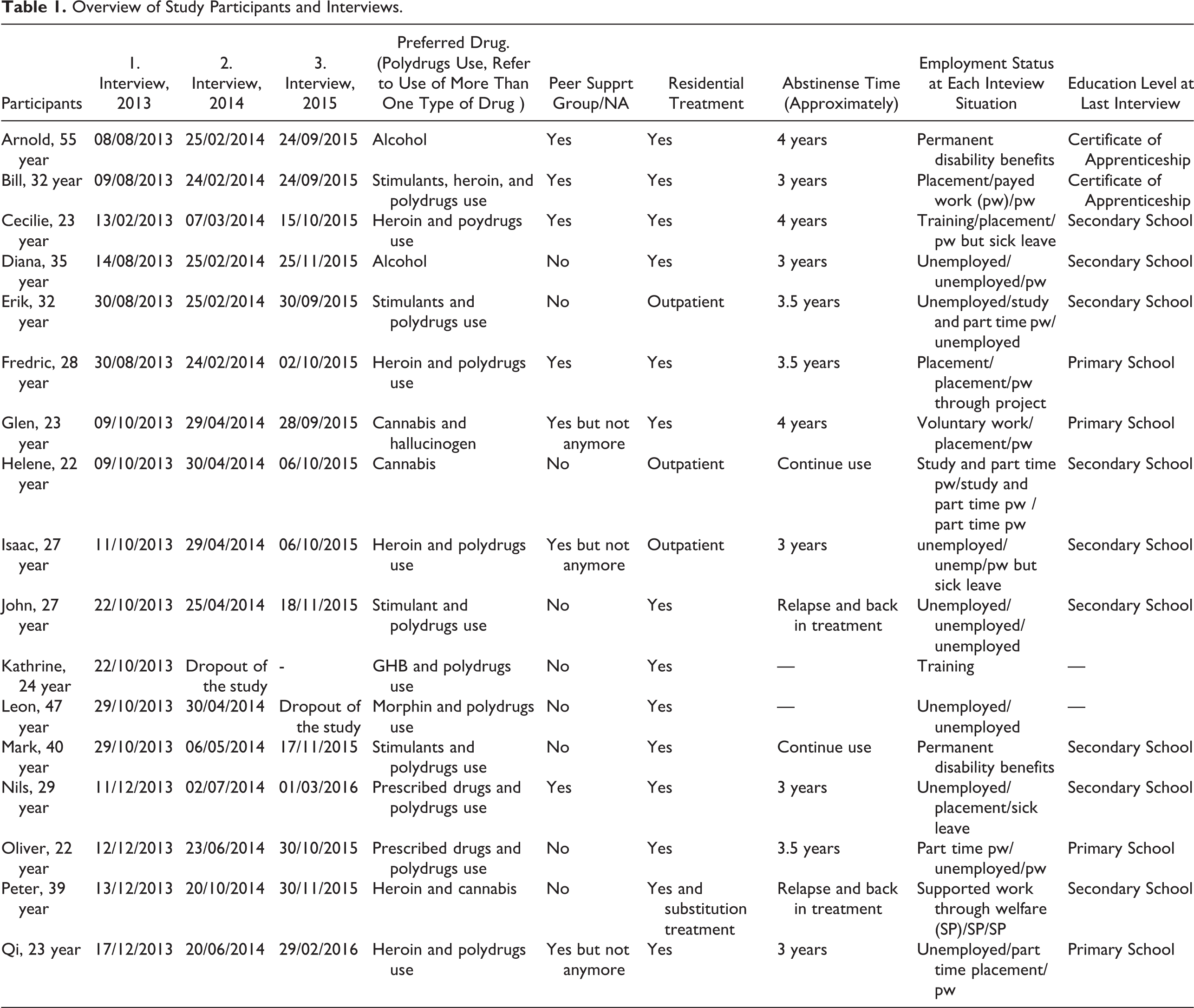
At the first interview, all but two of the participants reported that they had abstained for a minimum of 6 months (although this was not an inclusion criterion). Moreover, three participants were still enrolled in residential treatment and one was receiving outpatient treatment, from which they had all been discharged by the second interview. At the final interview, two participants reported continuous drug use, two reported relapses with subsequent treatment readmission, and eleven reported continuous abstinence, which by then totaled between 3 and 4 years. Some of the participants had attended self-help groups, peer-support activities, activation programs, or other welfare services at some point during the course of this study (Table 1).
The study received ethical approval from the Regional Committee for Medical and Health Research Ethics (approval no. 2013/559/REK) in spring 2013. Prior to the interviews, the participants were given written and oral information about the study, including that they could withdraw from the study at any time without any consequences for them, after which they provided written consents.
Interviews and Analyses
The interviews were conducted at a medical center, other treatment facilities, or at the participant’s home or workplace, according to their preference. All of the interviews were conducted by the first author. A performative narrative approach on life stories (Gubrium & Holstein, 1998; Loseke, 2007; Riessman, 2008) guided the commencement of the interviews and subsequent analysis. Themes covered in the interviews included their experiences with drug use and related circumstances, escalation of drug use, education trajectories, transitions into and out of employment, and the social circumstances surrounding these transitions. The issues covered were those related to attempts to stop drug use, family, social networks and friendships, relapses, involvement in treatments, and future aspirations and challenges that the participant found valuable. Inspired by Honneth’s theory of recognition, attempts were also made to determine the sense of dignity, shame, self-respect, identity, belonging, or other self-concepts and emotional sensations accompanying the different life phases and transitions.
In the two follow-up interviews, the participants were encouraged to describe ongoing and new aspects of their recovery process. They were also asked to elaborate on themes expressed in their previous interviews as being experienced as important to them. This procedure maintained an open and exploring approach to determine how the participants narrated their ongoing process of moving away from a life dominated by drug use. The design of the follow-up interview framed the current and ongoing experiences of changing practices of the participants within the contexts of past constraints and opportunities (Gubrium & Holstein, 1998; Järvinen & Ravn, 2015). All of the participants had experienced involvement in treatment, peer-support groups, or a variety of other recovery-oriented activities. Informed by a narrative approach, it is reasonable to assume that these contextual settings constitute an important source of influence on the participant’s storytelling in making sense of their experiences of addiction and recovery.
All interviews were recorded digitally, and transcribed while being anonymized with respect to names, places, and other identifiable markers. Each interview was considered to be a collaborative attempt between the interviewer and interviewee to find meaning in the situations and events in the participant’s life, linking their past, present, and future (Gubrium & Holstein, 1998; Riessman, 2008).
We coded all accounts in the transcribed text from each interview that were relevant to answering the question “who am I?” and its related emotions, activities, and circumstances. The coding and organization were performed using the Nvivo12 software program for qualitative analyses. We then examined how the coded accounts and connected events linked together to produce a narrative of self-presentation. A narrative approach inspired by the reflexive model of narrative identity of Loseke (2007) was applied to explore how the identified narratives intersect with living practices. Thus, in the final step of our analyses we explored how each identified narrative answered the following questions: (1) Which social position does it allow for? (2) Which emotions does it activate? (3) Which formula stories does it relate to? (4) What social practices does it relate to?
Findings
After several rounds of analysis we identified four distinct narratives related to how the respondents answered the question “who am I now?” We labeled them as follows: (1) “a person with a shameful past,” (2) “I am new in this life,” (3) “I am a responsible and productive citizen,” and (4) “addiction will always be part of me.” The selected narratives do not include the richness and complexity of the participants’ individual stories, but they do exemplify the aim and key arguments that were developed in this study. The following analysis presents a detailed examination of the content of each narrative. The participants have been given pseudonyms, and the quoted excerpts have been translated from Norwegian.
“A Person With a Shameful Past”
The participants throughout narrated their experience of a life dominated by drug use using a degrading self-description of who they were and the life they lived. In this prominent narrative, they positioned themselves within a negative framework as someone who had been full of flaws, having a weakness of character and morals, a shameful life. For example, 23-year-old Cecilie said: And I would argue that nobody likes to admit that they are arrogant, that they are liars, that they are thieves (1).
2
Yes, and the worst thing is actually looking at myself in the mirror. To think about what kind of manipulative lying asshole you are, because you don’t live according to morals and stuff (1). I would argue that you’re almost not a human [when doing drugs], that’s what I would say (1). No, I don’t want to be associated with it […] So I’m thinking, oh my God, I just can’t stand it—I’m so totally done with it! I’m just so embarrassed of my own past […] I’m totally ashamed […] And you know, it’s not cool to stand on the street corner and sell Asfalt (street magazine) (3). I didn’t move forward, I actually moved backwards every time I used. […] I didn’t learn to develop as a human being (2). Yes, […] You have to admit and acknowledge your addiction. Then you have to be willing to receive treatment, because you can’t do it on your own when you are blinded, and don’t see what’s going on […] and what’s really difficult […] is when you’ve given up everything […] when you’re left with nothing—no identity (1).
“I am New in This Life”
The second narrative identified in the participants’ accounts focused on how they were inexperienced and new in the life they were going to live when not using drugs. It is striking that many participants in the first interview used phrases such as “I am new in this life,” “I don’t know how to do anything,” or “you need to learn everything” when they were asked to elaborate on their recovery process. In this narrative they positioned themselves as new, as someone who does not know how to do things, someone who needs to learn, and someone who had never lived the life they now aspired to live.
By positioning themselves as being “new in this life,” the narrative activated emotions of pain related to being new, as illustrated by 28-year-old Fredric: It hurts to live again, when you never lived before (1). You know, I don’t really know what normal means—really […], because I’ve never lived a normal adult life (1). When times are tough, then I stop and think to myself—oh well, I just got started, it takes at least 2–5 years (1).
Embedded in the stories of the process of rebuilding the traits and abilities needed in new social arenas, the “I am new in this life” narrative positioned the narrator in a process of personal development and growth. Cecilie highlighted: […] to get employed and hold a job is so much more than getting your finances in place, it’s about developing as a human being (1).
Bill’s process of recovery was described in terms of social practices related to gaining accomplishments and recognition, and a gradual sense of positive self-relation: I feel that my identity slowly comes back; the longer I’ve been in the job I have, the longer I hang out with my new friends, the more I feel that I start to become myself again, become a person that I can like. […] Yes, you get some recognition of how you are, that you are okay, […] you become a part of a bigger circle, you know, and then you find yourself eventually […] you know, you get pleased with what you find (1).
“I am a Responsible and Productive Citizen”
The position of being “new in this life” characterized the narratives covering the participants’ experiences during the early phase of recovery. However, the stories changed over the subsequent two interviews in terms of circumstances, practices, and life situation. The narratives told at this point transformed the position of being “new in this life”—being in a process of learning, accompanied with patience and tolerance—into a position of being a responsible citizen with expectations of achievements. As the participants gained access to conventional social arenas, they increasingly expected to fulfill roles of normality that entailed more responsibility and independence. Fredric elaborated his process as follows: Year two (being off drugs), that’s when you’re going out there to live, that’s when you’re suddenly in new arenas […] with a totally new name of the game. Very suddenly it is expected of you to be responsible and people don’t necessarily praise you just for being sober. You know, because the expectations increase […] Now you’re supposed to go out there and have a job, a partner, stuff like that, and participate in activities. You’re supposed to have all those things, have a rich life. It’s expected that you know what profession you prefer, and all that, and not least have a social network and be familiar with it, and find your place in it (3).
The “I am a responsible and productive citizen” narrative draws on a formula story based on the normative idea of normality being characterized by a person holding a job, paying taxes, and owning a place to live, accompanied by the self-presentation of dignity and pride suggesting an experience of recognition. Kathrine described their notion of “normal” as follows: […] it’s like, everybody got their driving license, everybody got a car, an apartment, a good job, and education (2). It means a lot, you know, that feeling of contributing something to society […] you know, to be part of reality (1).
The possibility of finding and maintaining paid employment in the primary labor market was highlighted in the narrative as being the only pathway to becoming an independent and responsible citizen. The “I am a responsible and productive citizen” narrative draws on a formula story in which employment is a key element toward being able to position oneself as a responsible and productive citizen, as exemplified by the following statements made by 30-year-old Nils: I pay taxes on my earned money, money I made, not money from the welfare system. You know, to go to work every day, that’s the definition of a responsible and productive member of society […] If you have a job then you are independent and you pay your own bills (2). I gotta do what’s morallyl right, you know […] yes, that I’m actually a good person and do the right things (2).
Yet another aspect embedded in the narrative of being a responsible and productive citizen emphasized the intellectual and emotional dimensions. Cecilie elaborated on the process of changing practices and recovery as follows: You know, to get a job and become a worker is about so much more than getting paid. It’s about developing as a human being […] to get to know oneself […], I mean, it’s a real buzz for the self-confidence of course […] Have a meaningful life, as simple as that, have a job and go to work—being and feeling useful (2).
“Addiction Will Always be a Part of Me”
In parallel with the process of becoming contributors in mainstream sociocultural practices, the participants provided information about the position of being an addict. Most of the participants described themselves as being “chronically diseased.” In this narrative, which we labeled “addiction will always be a part of me,” the participants spoke about how they took full self-responsibility for the “malfunction” of this disease. The condition of being “diseased” framed “who am I?” in terms of weakness of character, which we saw as part of the narrative of “a person with a shameful past.” Positioning themselves as being diseased required ongoing self-governance, Cecilie said: You never recover from drug addiction. […] You have to work on your weaknesses and flaws, and you have to develop as a human being (2). You know, I’m really good at putting things on hold, delaying things. It’s a weakness that is typical for us addicts (2). I accept it’s a part of me, that’s okay […] but that’s not how the world should see me (1). Because I’ve built a new identity, I’ve become so much more now (3). I really struggle with that, to say I have a disease, then I feel really pitiful (3).
Discussion
The narratives identified in this study provide some answers to the research question “who am I now?” aimed at illuminating aspects of the experiences of identity (trans)formation when moving away from a life dominated by drug use. The identified narratives provide insight into the interrelated social dynamic between self-concepts and identities, changing everyday practices, available cultural stories and the normative sociocultural context in which this dynamic takes place. There should be no doubt about the hardships associated with these processes: moving away from a life dominated by drug use was described as being so much more than “simply” stopping/reducing drug use. It was better recognized as a process of moving away from what was acknowledged as a marginalized and disadvantaged position with regard to most aspects of life. To be able to do this, the study participants told stories of a demanding process of self-surveillance and everyday discipline to be able to assess their mainstream roles and positions in providing recognition and thereby a positive self-relation. In addition, the stories portrayed a process of accumulating capital carrying the symbolic power to produce conditions recognized as a valuable way of life. The analyses show how being recognized as a responsible and productive citizen requires living a life according to what is recognized as such within the specific social and cultural landscape in which that life takes place (Honneth, 2012; Nettleton et al., 2013).
The narrative of “a person with a shameful past” undoubtedly echoes empirical data supporting the notion of a “spoiled” identity (McIntosh & McKeganey, 2000, 2001), “loss of the self” (Reith & Dobbie, 2012), the classic addiction narrative (Pienaar & Dilkes-Frayne, 2017), and the well-documented narratives that are commonly seen in Alcoholics Anonymous and Narcotics Anonymous (Strobbe & Kurtz, 2012). However, by drawing on the social grammar of recognition and the principle of accomplishment (Honneth, 1995), our intention was to broaden the perspectives on recovery and identity (trans)formation.
It is evident both from the present study and previous research that the narrative of a “spoiled identity” is accompanied by stories of hitting bottom (McIntosh & McKeganey, 2000). A hitting-bottom story involves degrading self-descriptions in parallel with experience of a range of adverse social and material consequences, and loss of personal recourses and social positions (Biernacki, 1986; Gibson et al., 2004; McIntosh & McKeganey, 2000, 2001; Neale et al., 2013; Årstad et al., 2018). Alternatively, the hitting-bottom experience can be understood through the lenses of Honneth’s theory of recognition. The dynamic of misrecognition and the loss of opportunities to use ones’ traits and abilities to contribute something that is considered valuable by entire communities jeopardize the condition needed for identity formation and a positive self-relation (Barry, 2016; Honneth, 1995). Hence, identity (trans)formation and recovery can be understood as a socially negotiated process that involves changing practices and the rebuilding of RC, including skills and qualifications, which allow access to valued mainstream social arenas and possibilities. For example, the participants in the present study moved from being long-term unemployed to having gained employment over the course of the study. Thus, embedded in the process of moving away from a life dominated by drug use and the accompanying identity (trans)formations could be understood as a struggle for recognition. In turn, this struggle for recognition may be understood as a struggle to convey to contemporary norms and values with the inherent normative expectations of a citizen. The normative assumption underpinning “recovery,” and the RC needed, rests within the shared perspectives of a common social vision that values autonomous, responsible citizens who are capable of keeping healthy and happy, and who strive toward constant self-improvement. This argument both corresponds and add to a growing critique of the conceptualization and policy of recovery (Fomiatti et al., 2019; Lancaster, 2017; Lancaster et al., 2015; Neale et al., 2011).
The participants in this study emphasized the importance of gaining access to employment as part of their recovery, as identified in the narratives of “I am new in this life” and “I am a responsible and productive citizen.” The analyzed formula stories provide insight into how socially circulating stories are resources that people draw on to make sense of their changing practices. For example, the importance of gaining employment, which would allow individuals moving away from a life dominated by drug use to position themselves as being responsible and productive citizens, shows how the dominant cultural stories of normality create conditions for recognition. Many studies have identified the importance of gaining employment for generating new conceptions of self (Duffy & Baldwin, 2013; Reith & Dobbie, 2012). The impact of employment on concepts of self is consistent with the value of employment as a system of mutual recognition via the principle of achievements (Honneth, 1995). In general, the division of labor serves as an organizing system in which individuals can be recognized for their contributions by applying their unique abilities and traits, which promote identity formation (Connolly, 2016; Honneth, 2004). The division of labor represents a shared project whose “members” can contribute to what is considered valuable for society as a whole. In the narrative of “I am a responsible and productive citizen,” the narrator draws on a formula story based on the ideology of having a paid job, paying taxes, and not needing welfare support. We suggest that these findings reveal the normative assumptions underlying RC. In addition, the struggle to accumulate RC is fundamentally linked to and embedded within in the struggle for recognition. Our findings mirror recovery identities constructed and constituted by discourses embodied in the capitalist or neoliberal world on paid work and the work ethic (Honneth, 2004; Nettleton et al., 2013).
The social struggle for recognition that is evident in the narratives presented here demonstrates the interdependent dynamic between structural forces, cultural context, way of life, and identity. In addition, the narratives of “a person with a shameful past” and “addiction will always be a part of me” complicate the claim that “what I do” cannot be divorced from “who I am.” As described above, these two narratives are permeated by a formula story that positions the “addict” as being diseased and the “addiction” as a moral malfunctioning that needs to be repaired, corresponding with dominating conceptualization of “addiction” (Fomiatti et al., 2017; Fraser et al., 2017; Pienaar & Dilkes-Frayne, 2017). Based on the findings of the present study, we suggest that the formula story that people use to make sense of their experiences upholds the stigma related to “addiction” and “addict” being categorized as a moral character of weaknesses. It also demonstrates that “identity” is not necessarily uniform and coherent. The position of “always being an addict” appeared to be associated mainly with deviant self-concepts, and with any practices outside the boundaries that define mainstream society, in addition to mobilizing feelings of shame, humiliation, and self-blaming. These findings strengthen the conclusions from research challenging culture-embedded discourses and formula stories portraying “addiction” and the “addicted” self in a way that upholds stigma and restricts the scope for action and future possibilities (Fomiatti et al., 2017; Pienaar & Dilkes-Frayne, 2017; Pienaar et al., 2015; Radcliffe & Stevens, 2008; Selseng, 2017; Selseng & Ulvik, 2018). Although the present participants narrated the sensation of feeling normal and being productive and responsible citizens during their recovery process, their perception of being diseased and morally degenerate continued to influence their self-conception and self-understanding, as well as fuelling self-surveillance, which placed extra burdens and strains upon the everyday challenges that they faced.
Conclusions
The participants in this study, whose goal was to move away from a life dominated by drug use, narrated the experience of being at the edge of identity collapse. Within that narrative they told stories of a slow process of rebuilding skills (RC) and establishing new activities by gaining access to social arenas that allow for the recognition of achievements. We identified stories describing the struggle to gain access to conventional social settings and positions that would make it possible for these individuals to narrate a self-story corresponding to dominating discourses of “normality,” which in turn become the “the self to live by” (with references to Holstein & Gubrium, 2000). We found that the principle of that “who I am now” relates to that of “what I do,” (Hughes, 2007) have shown how these processes follow narrow scripts of “recovery,” demonstrating how the available cultural stories constitute particular choices, preferences, and future aspirations.
Our analyses have further revealed how the participants used socially circulating stories as a template for what they wished to achieve during their recovery process. In so doing, we have demonstrated that the social dynamic of moving away from a life dominated by drug use goes beyond biographical work and available discourses, and is made possible by confinement to conventional everyday practices and the social grammar of recognition. From this point of view, the process of recovery by restoring conflicting identities and establishing new ones, as pointed out by McIntosh and McKeganey (2000, 2001), can be better understood as a process of identity transformation based on certain normative criteria and values, which gives rise to the sensation of meaning and social integration recognized by individuals in recovery (Honneth, 2004; Hughes, 2007).
A society that predominantly recognizes individual achievements within the labor market in the overall categorization of valuable citizens creates challenging conditions for people who are recovering from lives dominated by drug use. Our analyses demonstrate that the participants in this study drew upon stereotypical cultural codes and discourses of normality to create positive self-identification. Following Moyaert (2011), these ideological discourses execute symbolic violence in marginalizing and excluding people with present or past experience of drug use practice. In meeting this challenge, perhaps counter-narratives should be created (Moyaert, 2011) to broaden the framework of orientating how we understand addiction and recovery. The required response is to challenge the constellations of expectation and evaluations associated with the narratives identified in these analyses by looking for alternative stories to make sense of the experience of drug use and recovery. In addition, we suggest that it is always necessary to challenge communities to reduce access barriers for people in marginalized positions by providing them with opportunities to contribute their personal traits and achievements within diverse social arenas, which make up the social condition for positive identity formation.
Footnotes
Declaration of Conflicting Interests
The author(s) declared no potential conflicts of interest with respect to the research, authorship, and/or publication of this article.
Funding
The author(s) disclosed receipt of the following financial support for the research and/or authorship of this article: This study was funded by Stavanger University Hospital, Stavanger, Norway, and Rogaland A-Center, Stavanger, Norway.
