




Abstract
The relationship between drug use and sexual practice is complex. Significant focus has been placed on risky practices, yet the broader associations between drug use and sexual activities remain elusive outside such contexts. This is despite similar trends of liberalizing attitudes and practices being identified in each area, theorized as the normalization of recreational drug use and the liberalization of consensual sexual practice. In this article, we draw on convenience sample surveys of 966 festival-goers at an English music festival in 2016 and 2019 to assess prevalence of polydrug use and to examine whether people who consume illicit drugs are more likely to engage in sexual behaviors considered more liberal than the traditional norm. We show that people who reported polydrug use in the last 12 months were significantly more likely to engage in non-traditional sexual behaviors, including sex with a friend and anal sex, in that same time period. In combining and comparing two usually distinct discourses, this exploratory study suggests that the normalization of drugs and the liberalization of consensual sexual practices are related and can be conceptualized as part of a broader societal acceptance and cultural accommodation of illicit drug use and particular sexual practices as leisure activities, despite markedly different policy and legal contexts for each activity. We conclude that the concept of “normalization” may be more appropriate to understanding changes in sexuality than “liberalization” in the context of “leisure sex” and call for further cross-disciplinary research on drugs and sex using this approach.
While there have been parallel debates in academia in recent years regarding the normalization of recreational drug use and the liberalization of sexual behaviors as mainstream leisure-time pursuits, there has been little consideration of the interface between the two aside from through the lenses of risk and harm (see also Moyle et al., 2020). The normalization thesis of recreational drug use has conceptualized a change in drug-related behaviors and associated attitudes, arguing that non-participants as well as participants have become less critical or judgmental of those who partake. Conversely, research on the liberalization of sexuality has focused mostly on attitudes, with less consideration given to increased participation in liberal sexual behaviors by the general population.
This study examines the empirical evidence for a relationship between a range of self-reported drug taking and sexual practices—utilizing convenience sample surveys with 966 festival-goers in 2016 and 2019 at one English music festival—against a backdrop of attitudinal and behavioral change in relation to both sex and drugs in contemporary England. We provide information about the self reported prevalence of drug use and sexual behaviors by respondents and examine for associations between them, as well as contextualizing this sub-sample’s findings within the broader annual English Festival Survey (EFS), with a total of 2,631 respondents in its 2016 and 2019 tranches. We argue that the concept of “normalization” may be more appropriate to understanding changes in sexuality than “liberalization” in the context of “leisure sex.”
Literature Review: Normalization and Liberalization
The Normalization of Recreational Drug Use
Use of psychoactive drugs has increased in recent decades, along with increased access and availability associated with the globalization of illicit as well as licit consumer products. For example, household surveys indicate that self-reported past year cocaine use by adults more than quadrupled from 0.6% to 2.9% in 1996–2018/9 in the UK (Home Office, 2019), and past year cannabis use by adults doubled from 6.7% to 12.9% in the 10-year period 2004/5–2014/5 in the US (Kerr et al., 2018). Alongside increased levels of drug use are changes to drug policy, with some countries diverting drug users away from criminal justice and toward public health: for example, with a “drift to decriminalization” in many countries (Eastwood et al., 2016); all drug possession decriminalized in some countries (e.g., Portugal from 2001, see Stevens & Hughes, 2012); cannabis legalized for both medicinal and recreational purposes in many countries (Seddon & Floodgate, 2020); and more broadly, a perceived fracturing of the 20th century global drug prohibition regime (Bewley-Taylor, 2012) alongside a decline in narratives of a “drug free world” (Rolles, 2020).
These changes in drug policy and associated attitudes and behaviors have led to new ways of understanding and explaining illicit drug use, one of which has been the normalization thesis (Measham et al., 1994; Parker et al., 1998). While originally developed to help explain the changes seen among large numbers of adolescent recreational drug users in the UK in the 1990s, the academic thesis has subsequently been appraised, contested and adopted in whole or in part across the world (Aldridge et al., 2011).
The central argument in the normalization thesis is that the use of illicit drugs (particularly cannabis and, to a lesser extent, party drugs) has become increasingly tolerated by both drug users and non-drug users, leading not only to a change in drug-related behaviors (such as increased prevalence of use, frequency and recency) but also a growing societal acceptance and cultural accommodation of illicit drug use evident across society from the press to politics and the arts (Parker et al., 1998). More broadly, the idea of intoxication as a leisure-time pursuit has expanded from centuries of alcohol consumption and psychedelic experimentation to weekend use of a growing range of “party drugs” in leisure settings. Since the 1980s, raves, dance clubs and electronic dance music (EDM) festivals have been characterized by DJs playing high intensity music for extended periods of time with audiences consuming stimulant drugs to help maintain and enhance the intensity and duration of their dancing activities (e.g., Malbon, 1999). Surveys suggest that prevalence of drug use is substantially higher among more frequent club and bar customers, reported by national household surveys (e.g., Home Office, 2019) and convenience sample surveys conducted in bars (Measham & Brain, 2005), dance clubs (Measham et al., 2001; Measham & Moore, 2009), and music festivals in the UK (Turner & Measham, 2019) and internationally (Hesse & Tutenges, 2012).
The normalization thesis argued that changes in drug-related attitudes and behaviors identified in recent years required new ways of understanding and explaining them and thus drugs discourses have moved from medical, risk and harm-focused models to a reconceptualization around individual agency, reasoned behavior and embodied (p)leisure. This was characterized as a paradigm shift from the classical to the postmodern by Ettorre (2007) and subsequently as concurrent classical and postclassical paradigms by Campbell and Ettorre (2011, p. 4) (see also Hunt et al., 2010; Measham, 2002, 2004).
The normalization thesis of illicit drug use has its limits, however. While the normalization of “sensible” recreational drug use is accepted to an extent in the UK in relation to young adults, the thesis is considered less applicable to daily, dependent or otherwise problematic use of drugs in non-recreational settings (Aldridge et al., 2011; Blackman, 2004; Parker et al., 2002). There is a recognition of considerable ongoing stigma that exists in cultural discourse toward certain drugs and the behaviors associated with them, such as “addiction,” injecting, and the use of heroin, crack, and synthetic cannabinoids known as “spice” (Alexandrescu, 2020; Reinarman, 2005; Reinarman & Levine, 1989). Whereas the normalization thesis focused on youth and young adult party-goers and their weekend recreational leisure time pursuits as a “barometer” of social change (Parker, 2005), problem drug use is persistently associated with multiple deprivation, marginalization and poverty, and by contrast is represented as an indicator of continuing social exclusion and structural inequalities (Seddon, 2006; Stevens, 2011).
Furthermore, both advocates and critics of normalization recognize that drugs, drug policy and the enforcement of the laws that control their sale, use and wider drug cultural context remain bounded by the structural determinants and stratum that affect all societal interaction including race/ethnicity, gender, sexual identity, social class and age (Measham & Shiner, 2009; Williams, 2016), often so that the drugs used by working class people and people of color are policed far more harshly than those used by rich white people (Manderson, 1999; Palamar et al., 2015).
Liberalizing Attitudes to Sex
Contemporaneous with the above discussions about a growing normalization of recreational drug use, similar debates about social change related to sexual activity have occurred: specifically, the liberalization of attitudes to various forms of consensual sexual activity (Frank & McEneaney, 1999; Giddens, 1992; Loftus, 2001; Scott, 1998), away from a traditional norm of sexual intercourse oriented toward reproduction within monogamous marriage (Rubin, 1984). For example, while General Social Survey (GSS) data shows that 29% of Americans stated that non-marital sex was acceptable in the 1950s, this had increased to 58% by 2012 (Twenge et al., 2015). In the UK, the 2018 data from the British Social Attitudes (BSA) survey finds 74% of people saying premarital sex is “not wrong at all” compared with 42% in 1983 (Albakri et al., 2019). Increased prevalence of and tolerance toward casual sex were spurred on by modern methods of contraception, particularly the contraceptive pill, which greatly reduced the possibility of unintended pregnancy. In this context, sex moved from the reproductive arena of marriage toward a recreational and pleasurable activity between consenting adults (Twenge, 2014).
Attitudes toward same-sex sexuality have also liberalized (Frank & McEneaney, 1999; Loftus, 2001). In the US, statistical analysis of GSS data shows that the proportion of the population condemning homosexuality has steadily declined since 1987 (Twenge et al., 2016). Analysis of BSA survey data similarly demonstrates that after peaking in the late 1980s, a sustained decline in homophobic attitudes has occurred in the UK (McCormack, 2012). The 2018 survey shows two thirds (66%) of people say same-sex sexual activity is “not wrong at all,” compared with 11% of respondents who said this in 1987 (Albakri et al., 2019). There has also been a notable shift in lesbian, gay and bisexual people’s experiences as society has become more inclusive of diverse sexualities (Anderson & McCormack, 2016; Weeks, 2007), with parallel progressive legal and policy changes including the decriminalization of homosexuality in the UK in 1967, the equal age of consent in 2001, equal adoption rights in 2009, and anti-discrimination laws making sexuality a protected characteristic in 2010.
While non-marital sex and same-sex sex are the most notable shifts in sex beyond the traditional norm, research also documents the growth and broader cultural acceptance of particular sexual behaviors, including oral and anal sex among heterosexuals (Habel et al., 2018; Wignall, Scoats, et al., 2020) and sex with friends and acquaintances among sexually active people (Bogle, 2008). The commercial successes of the “50 Shades of Grey” franchise and Ann Summers high street retail outlets speak to the growing interest in bondage, domination, sadism, and masochism (commonly referred to as BDSM or kink) (Evans & Riley, 2015), although there is mixed evidence regarding how they are viewed by the general public (Wignall, in press).
The trend of sexual liberalization away from a norm of monogamous reproductive sex also has its limits, not least the sizable minority of people who think some consensual sexual activities are morally wrong. Furthermore, the liberalization of sexual attitudes is circumscribed by a set of values based around consent and safety, with behaviors outside these norms, such as cheating, exchange of money for sex and polyamory, still quite stigmatized (Anderson, 2012; Rubin, 1984; Weitzer, 2009). The use of illicit drugs in sexual contexts also remains subject to critical scrutiny, often in alarmist ways that suggest a lack of public support for such practices (Moyle et al., 2020). Evidence remains limited regarding how consensual behaviors such as BDSM are perceived by the general public or, indeed, the extent to which they are engaged in by the general public (Wignall, in press). A further limit to sexual liberalization is the continued perpetration of sexual violence (Webster et al., 2018) and the persistence of sexual double standards, where women are stigmatized for engaging in casual sex while men are praised (Thompson et al., 2018). Thus, even as consent becomes increasingly central to moral norms of sexuality in Western societies, there remain significant issues with how it is discussed (Wignall, Stirling, & Scoats, 2020) and areas where it is not practiced which point to the limits of liberalization.
With these social trends, new approaches to theorizing contemporary sexual practices are needed. One way is through thinking of sex, like drugs, as a leisure activity. This involves moving away from viewing sex through a moral lens and a medicalized framework of risk and harm to viewing it as “part of a complex social structure in which pleasure and risk are balanced” (Wignall & McCormack, 2017, p. 802) and there is a growing body of research that adopts this framework. Understanding sex as a form of leisure is particularly helpful when considering the prevalence of casual sex and “hook ups,” the visibility of sexually explicit entertainment and media, and the accessibility of pornography (Mullholland, 2013). The leisure sex model, rooted in the liberalization of attitudes toward consensual sex, discusses diverse forms of sexual desire and identity that have recently become highly visible, including various sexual communities and kink activities (Attwood & Smith, 2013; Berdychevsky & Carr, 2020; McCormack & Wignall, 2017; Wignall, in press). It also connects with the argument that sexuality has become increasingly separated from reproduction, with an increased focus on pleasure as a constituent component of one’s broader identity (Giddens, 1992). In this context, the liberalization of sexual activity is part of a broader individualization of society, one that is still circumscribed by structural issues such as class, gender, age and ethnicity (Jamieson, 1999).
The leisure sex framework does not hold that all sexual activity is pleasurable, positive or beneficial: just as traditional leisure activities can be damaging (e.g., through the harm caused by regular concussions in contact sport [e.g., Kirkwood et al., 2015]), the leisure model seeks a sophisticated approach to sexuality that recognizes benefits alongside harms, and how such benefits are experienced unequally based on intersecting structural forces. It thus facilitates investigations into the complexities of sexual practice, not least understanding how constraints on sexuality are associated with race/ethnicity, gender, sexual identity, social class, age and other factors. For example, a leisure sex approach can consider sexual violence experienced by solo female travelers (Su & Wu, 2020) or at music festivals (Bows et al., 2020), as well as how people with disabilities engage in sex (Christian et al., 2020).
The leisure sex approach also helps understand the trend of young people having less sex in comparison with previous generations, particularly among young men (Ueda et al., 2020). Evidence suggests this is attributable to the increased availability of pornography and the declining stigmatization of masturbation, meaning sexual satisfaction can be gained outside the traditional model of monogamous, dyadic sexual intercourse (Anderson, 2012), rather than this decrease being the result of more restrictive sexual norms. Anderson and Magrath (2019) also contend that changes in masculinity among young men include less stigmatization of virginity in recent years, so the decrease in sexual activity may also be an artifact of fewer men lying about not having sex.
Method
The Festival Site
From their development in the 1960s and 1970s, UK music festivals have been characterized as sites of “bohemian” behaviors including sex and drugs, as noted in Clarke’s history of UK festivals written nearly 40 years ago: The invasion of large numbers of young people into the pleasanter parts of the countryside for a weekend or a week in the summer, to camp in the open, listen to music, usually loud, sometimes to consume drugs, and in the context of an espousal of overtly bohemian values, involving attitudes to property and sexuality, for example, that are at gross variance with those of the local population. (Clarke, 1982, p. 11)
Given the considerably higher levels of drug-experienced young adults at festivals than in the general population, therefore, festivals are useful recruiting grounds for studies exploring drug use and associated activities. Furthermore, in the case of this study, a pre-existing research partnership already existed between the researchers, festival management and other stakeholders in the fieldwork festivals utilized for this study, established since before 2010, which facilitated access and co-operation with both festival management and festival-goers. This longstanding relationship was particularly significant for the festival chosen to pilot a question on sexual activities, given the additional sensitivities, ethical and practical considerations surrounding asking such questions of strangers in a field.
The Study Festival
The data discussed here were obtained as part of a wider ongoing research project that includes annual surveys of festival drinking, drug use and associated behaviors at summer music festivals from 2010 to 2019: the annual EFS. While data on drug use is drawn from the full sample from 2016 and 2019, when the survey was delivered at three and five contrasting English music festivals respectively; data on sexual activities reported here were obtained from a subsample at one of the fieldwork festivals in the summers of 2016 and 2019.
These 2 years are chosen for this study because an additional question was added to the survey at one festival asking about a range of sexual activities. This question was piloted at just one festival each year for practical reasons: to limit the completion time (the survey is necessarily short) and to reduce the overall risk to the wider project. Given the sensitivities involved in piloting this question, the authors did not want to jeopardize successful completion of the full survey if the rates of refusals or aborted surveys were too high. There was no evidence of this occurring, and the research team decided to keep the focus on one festival for comparison purposes.
The fieldwork festival under consideration is a medium sized family-friendly music festival located in a rural area, spread across 4 days with camping facilities and catering to a wide age range. The broad spectrum of mainstream entertainment at the festival includes headline acts (performing across the UK that summer), live bands, EDM, jazz and comedy, which is reflected in the demographic of its customer base. An indicator of the festival’s popularity is that it sells out relatively early in the festival calendar each year due to its regular returning attendees, whereas many other festivals fail to sell all their tickets until very close to show days, if at all.
Survey Design and Delivery
The annual EFS (2010–) includes a convenience sample survey conducted each year with festival-goers and containing questions about respondent demographics, past and current alcohol and other drug use, and experiences of festival policing and security. The festival survey takes approximately 5–10 minutes to complete, depending on responses. Anonymity is emphasized to participants and details are provided for onsite support services including paramedics, welfare, harm reduction and sexual health.
The annual survey is conducted by a team of researchers under the direction of Fiona Measham. In 2016 and 2019 the survey was delivered by six trained postgraduate and postdoctoral researchers across the 4 days of the festivals, including by the authors, predominantly during afternoons 12–4 p.m. each day to capture festival-goers during their most awake but least inebriated state. Researchers had access to all areas and were encouraged to recruit participants from across the whole festival site, including in entertainment, drinking, food and camping areas. Researchers had received training to be alert to diversity in recruitment including regarding age, gender and ethnicity, and aware of unconscious bias, and also to discontinue conversations if festival-goers were intoxicated or otherwise unable to give informed consent (see also Measham et al., 2001). Samples across cohorts and festival sites were monitored for age, gender and ethnicity outliers and discrepancies, with variations in sample demographic characteristics reflecting the festivals’ customer base, music and entertainment genres, as well as residents within that county. For example, the lower levels of BAME festival-goers at the fieldwork festival reflects its location in a county with 2.5% BAME residents at that time.
Researchers asked survey questions to respondents and recorded answers (on paper in 2016 and on electronic tablets in 2019), facilitating opportunities to answer queries and clarifications from respondents as they arose, as well as direct assurances of confidentiality. A sister study conducted in some of the same UK festivals at overlapping times and with overlapping researchers compared face-to-face convenience sample surveys with online surveys regarding prevalence of drug use and found overall reassuringly similar levels of self-reported drug use (Waldron et al., 2020). Slightly lower self-reported prevalence of drug use in the online surveys by comparison with the onsite surveys may relate to concerns about digital privacy, security and hacking, mentioned by some festival respondents.
The added value of face-to-face surveying over online or written surveys is that it facilitates an opportunity to clarify or explain any questions and also to gauge reactions, hear experiences and give respondents an opportunity to talk beyond the confines of the survey itself. A respondent’s anecdote will likely not be recorded by a researcher but it helps to build trust and rapport between researcher and researched and may lead to a greater willingness to engage with questions on sensitive, personal or illicit topics. Sometimes this extends the survey completion time beyond the usual 5–10 minutes but with UK music festivals often lasting 4 or more days in length and festival-goers having considerable free time at their disposal, they can more easily facilitate this possibility than in everyday life. Also, given the sensitivities that surround asking respondents about illicit drug use and sexual practices face-to-face at a festival site and with little forewarning, for this study, particular care was taken in researcher positioning onsite, in order to maximize potential privacy for respondents when conducting surveys, by being less likely to be overheard by friends, relatives or passing strangers.
Participants were informed that the permission for the research was granted by the festival organizers but that the research was independent of both organizers and police. Ethical approval was received from Durham University. No payment was made to participants.
Results
Demographic Characteristics of Samples
Table 1 summarizes the demographic details of the festival sub samples in 2016 and 2019 alongside the samples in the full EFS for comparison purposes. In 2016, there were 530 respondents, about one in 50 of the approximately 25,000 attendees at the chosen festival, drawn from a wider survey population of 1,192 festival-goers in total at three EFS festivals. Of the sample at this festival, two respondents did not complete the questions about sexual behaviors. In 2019, there were 436 respondents, again about one in 50 of approximately 25,000 attendees in total at this festival, drawn from a wider survey population of 1,439 respondents in total at five EFS festivals. All fully completed the survey.
Sample and Sub Sample Demographic Characteristics, 2016 and 2019.
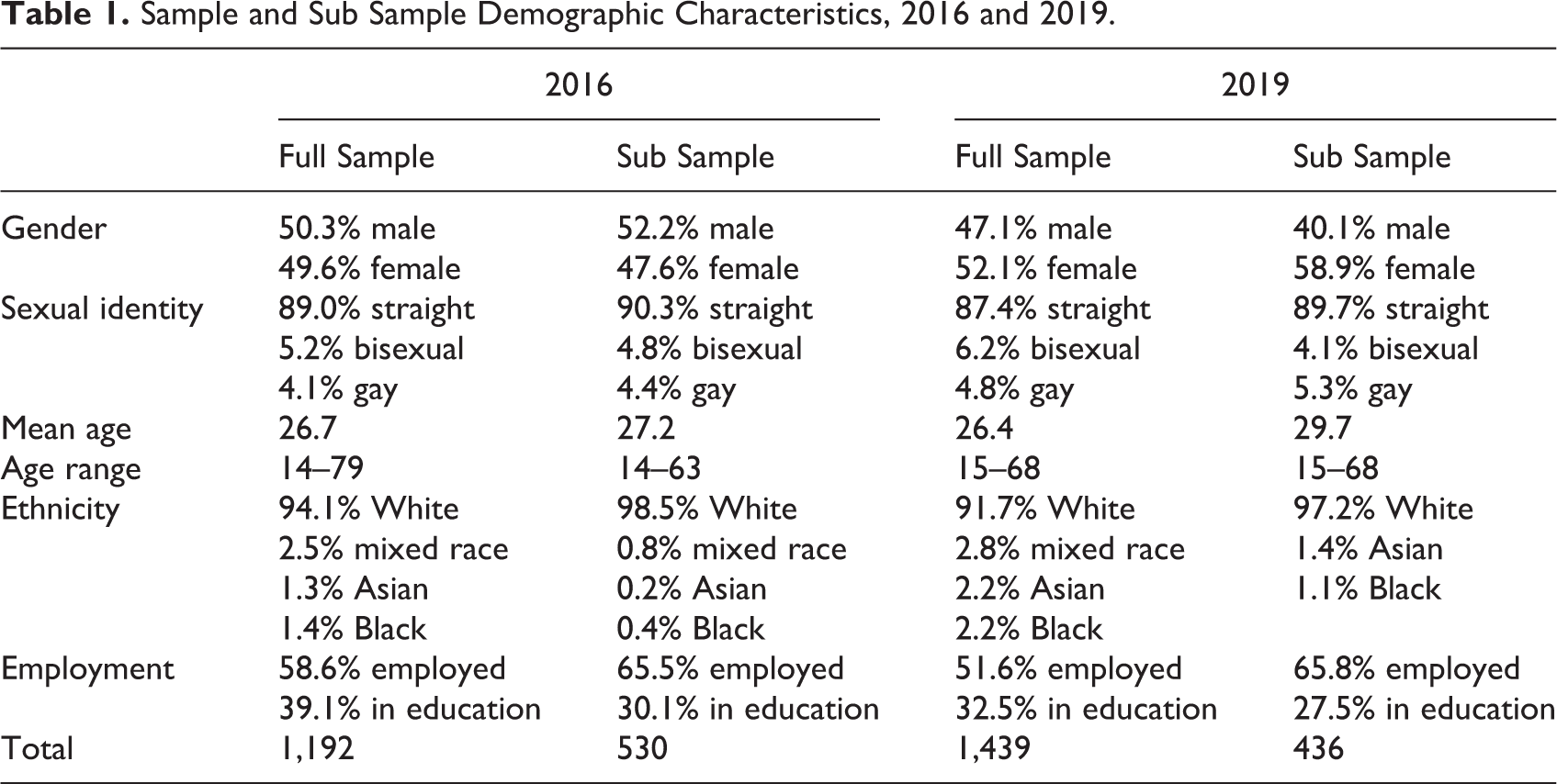
Looking in more detail at the sub sample at one festival, in 2016, 52.2% of respondents were male (N = 274), 47.6% were female (N = 250) with one individual identifying as transgender and two not stating their gender. In 2019, there were 58.9% female respondents (N = 257), 40.1% male respondents (N = 175) and one individual identifying as transgender.
In 2016 and 2019 most respondents identified as White: 98.5% (N = 520) and 97.2% (N = 424) respectively. Nine in 10 respondents identified as straight (90.3%, N = 474, in 2016 and 89.7%, N = 391, in 2019), with 4.4% (N = 23) identifying as gay in 2016 and 5.3% (N = 23) identifying as gay in 2019, and 4.8% (N = 25) identifying as bisexual in 2016 and 4.1% (N = 18) identifying as bisexual in 2019.
Two thirds of respondents were in employment both years: in 2016, 65.5% were employed and 30.1% were in education; in 2019, 65.8% were employed and 27.5% were in education. In 2016 the age range of respondents was 14–63 and the mean was 27.2 years. In 2019 the age range of respondents was 15–68 and the mean was 29.7 years.
Measuring Liberalization and Normalization: The Polydrug and “Liberal Sexual Behaviors” Indicators
This study reports on self-reported drug taking and sexual behaviors within the past 12 months and the associations between the two for respondents at the chosen study festival. The “past 12-month” time frame for these behaviors was chosen as best suited to gauging concurrent general behaviors and for direct comparison between the sex and drugs measures.
Polydrug use refers to the purposeful consumption of multiple psychoactive substances. Definitions of polydrug use vary depending on the minimum number of drugs included in a drug-taking session; the legal status of each drug; the route(s) of ingestion; the combinations involved; the time frame and sequence of consumption; and the potential effects. Multiple drugs may be taken at the same time, known as simultaneous polydrug use; drugs may be taken individually across the course of a single drug-taking session known as consecutive polydrug use; or they may be one of several drugs taken across a longer time frame and consumed simultaneously, consecutively or on separate drug-taking sessions and known as concurrent polydrug use.
Concurrent polydrug use focuses on multiple drug use across a period of a drug-taking career by contrast with multiple simultaneous drug use within a single drug-taking session, with past 12 months utilized as a key time period (e.g., McCabe et al., 2006; Smith & Flatley, 2011). A concurrent rather than simultaneous polydrug use measure is more useful for exploring trends in drug-taking careers and associated behaviors across a broader time frame. A shorter time frame, by contrast, focuses on the multiple drugs experience such as the consumption of two or more drugs consumed within one episode and is most useful for measuring acute impact such as drug-related health and social problems including overdose, toxicity, violence or disorder. This study was not focused on the acute effects of polydrug use and therefore this paper does not discuss recent polydrug use measures, although they were collected.
Therefore, this study utilized the measure of polydrug use as the self-reported consumption of two or more illegal drugs within the last 12 months. Polysubstance use was also included for comparison, to check whether alcohol played a significant part in polydrug repertoires and to allow for comparisons with studies that include alcohol in their polysubstance use definitions, defined as the self-reported consumption of two or more illegal drugs and alcohol within the last 12 months.
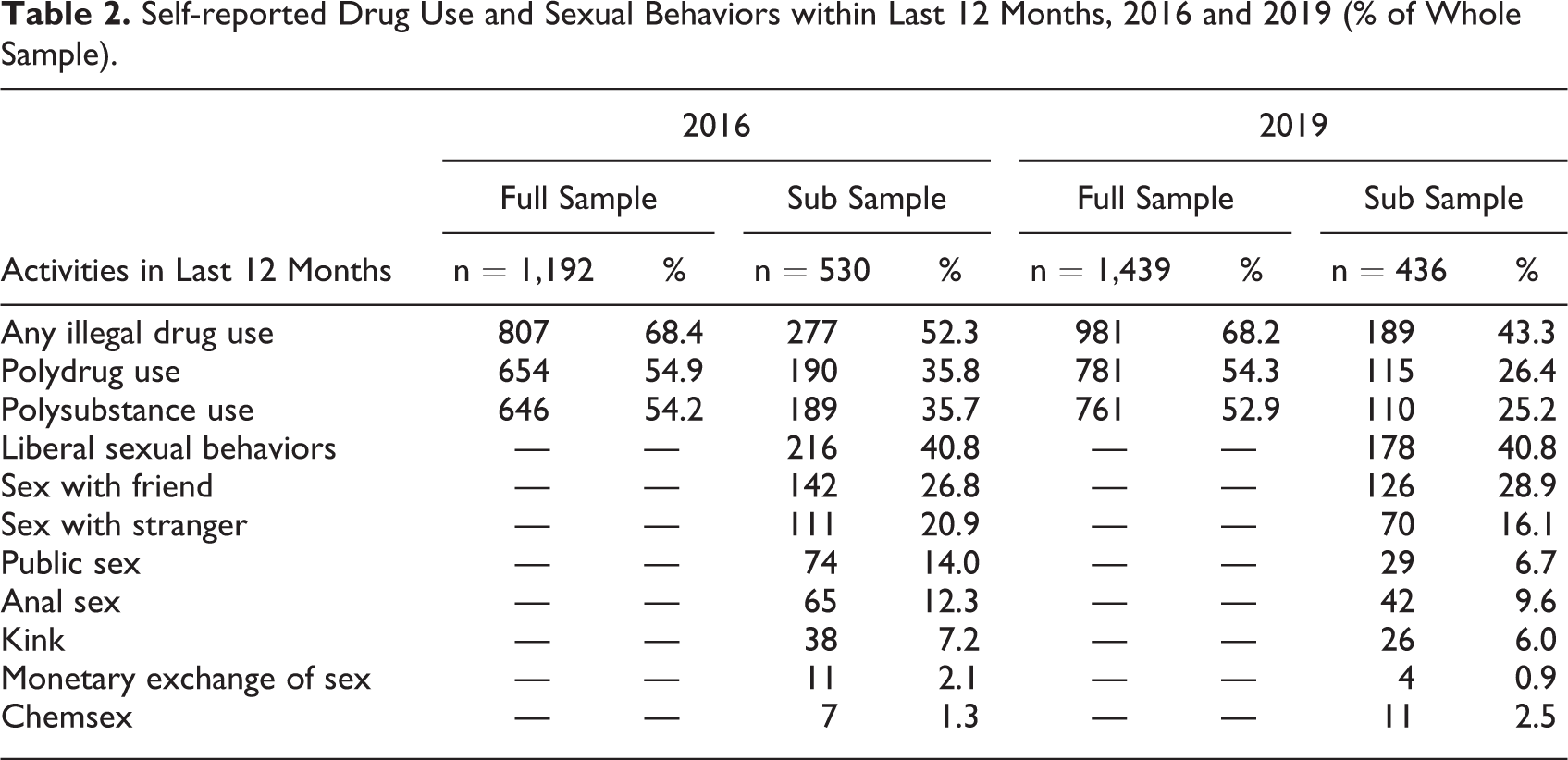
In 2016, half of respondents reported having taken any illegal drug in the past 12 months (52.3%), and this was slightly lower in 2019 (43.3%). Polydrug and polysubstance use were both engaged in by just over a third of respondents in 2016 (35.8% and 35.7% respectively), and just over a quarter in 2019 (26.4% and 25.2% respectively).
Data were collected on which sexual activities respondents had engaged in within the past 12 months, for both years. To consider engagement in more liberal sexual activities, we created the measure “Liberal Sexual Behaviors” (LSB) which consisted of having engaged in at least one of the following in the last 12 months: anal sex, kink, public sex, sex with a friend, and sex with a stranger. These activities were chosen because, as posited by the liberalization thesis, they are sexual behaviors that are in contradiction to the traditional norm of reproduction-oriented sexual intercourse within a monogamous relationship and for which there is evidence of increased practice in society (Bogle, 2008; Habel et al., 2018; Twenge et al., 2015, 2016). The list is not intended to be exhaustive of all sexual activities that have become more accepted in recent years (e.g., we did not ask about oral sex or threesomes [Scoats, 2019]), but as a selection of the broader population of possible sexual behaviors, to make asking the question in a short survey practicable. Monetary exchange for sex and chemsex were asked but were not included in the LSB measure because research suggests that these are still often considered illicit activities (Drysdale et al., 2020; Weitzer, 2009), with cultural discourses sometimes positioning them as non-consensual.
Table 2 reports prevalence of LSB in the past 12 months (both individually and for the composite LSB variable), as well as past 12 months drug use for any illegal drug, polydrug use and polysubstance use. This excludes, therefore, psychoactive substances controlled under the UK Psychoactive Substances Act 2016 that are illegal to supply but not illegal to possess in the UK such as poppers and nitrous oxide. For both years, the most frequent LSB was sex with a friend (26.8% in 2016 and 28.9% in 2019) closely followed by sex with a stranger, while monetary exchange of sex and chemsex were practiced by fewest participants in both years.
Self-reported Drug Use and Sexual Behaviors within Last 12 Months, 2016 and 2019 (% of Whole Sample).
In order to explore whether there might be a relationship between illicit drug use and a set of consensual sexual behaviors classified as part of a trend in societal acceptance of sexual behaviors away from a monogamous missionary norm, we examined for association between polydrug use and our LSB measure, all self-reported within the last 12 months for purposes of comparability. Polydrug use was used as the main drug variable and LSB was used as the main measure of sexual behaviors with associations explored between the two.
A χ2 test of association was performed and a significant relationship was found between engagement in LSB and polydrug use, for both 2016, X 2 (1, N = 528) = 55.163, p < .001, and for 2019, X 2 (1, N = 436) = 65.539, p < .001. Cramer’s V was 0.335 for 2016, and 0.382 for 2019, showing a medium effect size for both years. A Fisher’s Exact Test also yields a significant result of p < .001 for both years. See Table 3 for details of the χ2 tests of association.
χ2 Tests of Association (Past 12 Months).
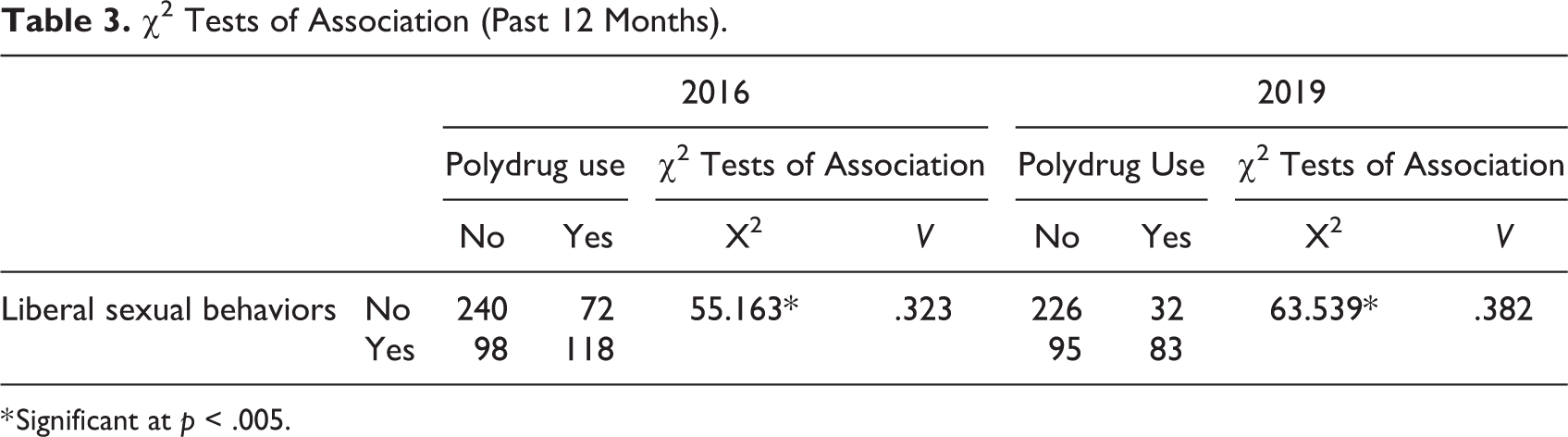
* Significant at p < .005.
Interface Between Illicit Drug Use and Liberal Sexual Behaviors
Given the association between self-reported past 12-month engagement in polydrug use and LSB, a series of χ2s were performed to explore the relation between polydrug use and sexual activities more generally. Numbers of participants for both chemsex and monetary exchange of sex were too low to undertake separate χ2 analyses.
A series of χ2s were performed to explore the relation between drug consumptive behaviors and sexual activities (see Table 4). There was a significant correlation between polydrug use and having sex with a friend for both years: X 2(1, N = 528) = 48.061, p < .001, with a medium effect size of V = .302 in 2016 and X 2(1, N = 436) = 29.792, p < .001, with a medium effect size of V = .261 in 2019. There was a significant correlation between polydrug use and sex with a stranger for both years: X 2(1, N = 528) = 41.809, p < .001, with a medium effect size of V = .281 in 2016, and X 2(1, N = 436) = 33.449, p < .001, with a medium effect size of V = .277 in 2019. There was a significant correlation between polydrug use and engagement in public sex for both years: X 2(1, N = 528) = 10.442, p < .001, with a small effect size of V = .141 in 2016, and X 2(1, N = 436) = 7.673, p < .05, with a small effect size of V = .133. Finally, there was a significant correlation between polydrug use and engagement in anal sex for both years: X 2(1, N = 528) = 16.257, p < .001, with a small effect size of V = .175 in 2016 and X 2(1, N = 436) = 6.501, p < .05, with a small effect size of V = .122 in 2019. The relationship between polydrug use and engagement in kink behaviors was not significant in either year: 2016, X 2(1, N = 528) = 1.362, p = .243 and 2019, X 2(1, N = 436) = 2.080, p = .149.
χ2 Tests of Association for Self-reported Polydrug Use and Selected Liberal Sexual Behaviors in Past 12 Months, 2016 (n = 528) and 2019 (n = 436).
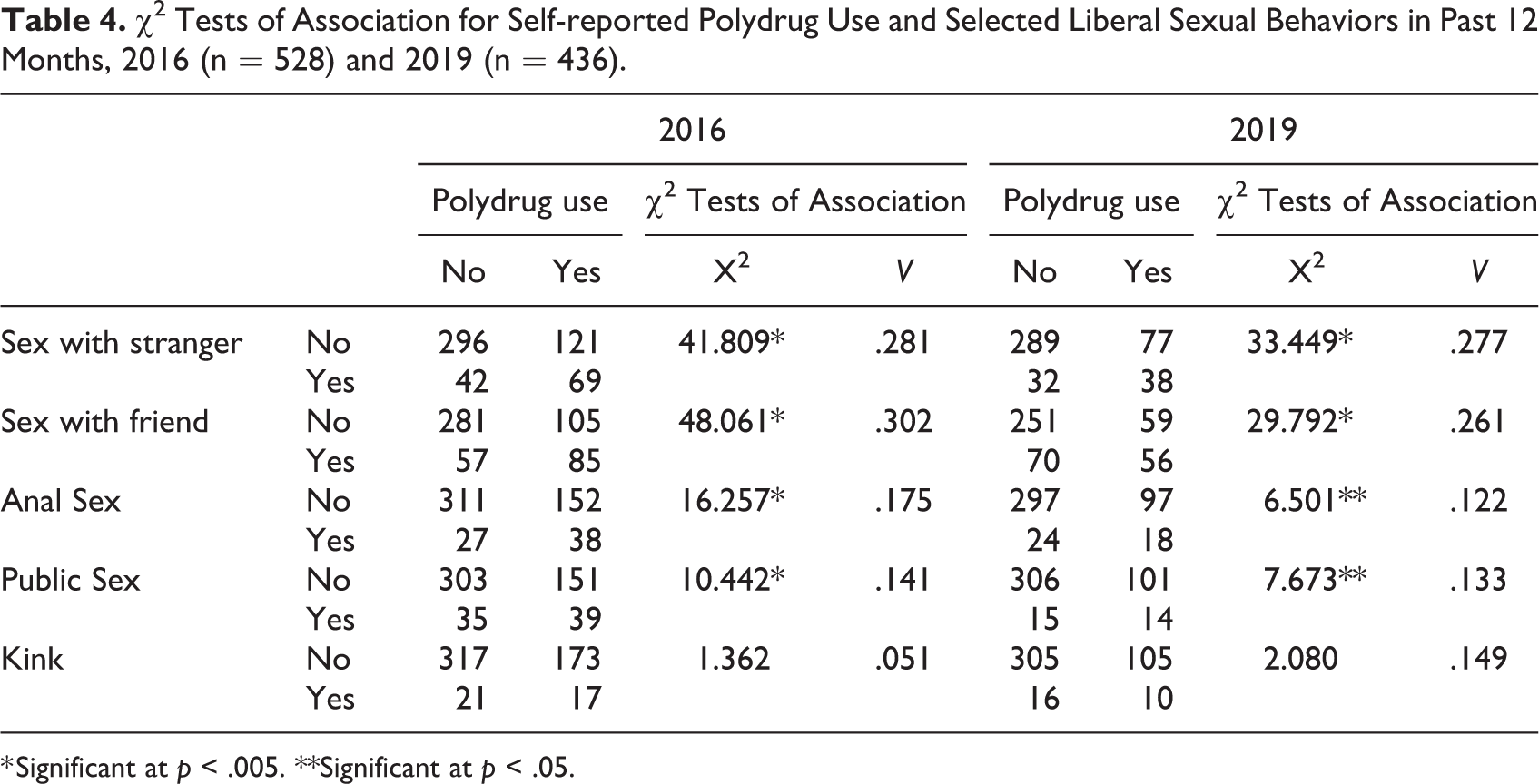
* Significant at p < .005. **Significant at p < .05.
Discussion
This study has presented empirical data on the association between self-reported polydrug use and a range of sexual activities collected at an English medium-sized festival in 2016 and repeated in 2019, to explore potential connections between recreational drug use and leisure sex, a focus of recent academic debates regarding normalization and liberalization. While recreational drug use is an established area of study and festival-goers’ drug use is an emergent topic, scant research on the sexual activities of mainstream festival-goers exists and none explores the relationship between drug use and sexual activity. By comparing self-reported polydrug use in the past 12 months with a group of sexual activities we classify as LSBs, we find a significant association for festival-goers in both 2016 and 2019. This shows that people who consume drugs are more likely to also report sexual behaviors outside of traditional practices of monogamy and reproductive sex, supporting the hypothesis that the normalization of drugs and the liberalization of consensual sexual practices are related and part of a broader societal acceptance and cultural accommodation of behaviors and activities that are increasingly seen as freely chosen. This is not to downplay the areas where such behavior is not consensual, such as dependent drug use or sexual violence, but to argue for an increasingly central role of consent in societal attitudes toward drug use and sexual practice.
This study also found significant associations between polydrug use and various forms of sexual activity; namely, anal sex, public sex, sex with a friend, and sex with a stranger. No association was found between polydrug use and kink activities, suggesting that kink remains more stigmatized in heterosexual cultures compared with the other activities or that it remains at the level of fantasy and media consumption rather than widespread practice (Khan, 2014). It may also be an effect of construct validity, whereby respondents do not consider items such as handcuffs purchased in high street shops like Ann Summers to be participation in BDSM but rather being “kinky” or “a bit of fun” (Wignall, in press). This highlights the limits of liberalization—sexual practice (and indeed the research on this subject) does not float free of social and moral values about sexuality (Rubin, 1984)—without contradicting the move away from the monogamous, reproductive, married values of traditional sexuality. In this sense, rather than “liberalization” as the term to understand changes in sexual behaviors, “normalization” may be better language and theory to conceptualize changes in sexual behaviors and cultural values. The central argument of the normalization thesis—that the use of illicit drugs has become increasingly tolerated and this has led to a change in drug related behaviors and broader social and cultural acceptance—fits the changes in sexual practice more clearly than the language of liberalization.
This application of the normalization thesis to sexual practice is significant because it provides a conceptual account of shifting norms of sexuality that recognizes the increasing prevalence and growing acceptance of some sexual practices (such as non-marital and same-sex sexual activity) while also accounting for the structural limitations of these changes and the continuation of harmful sexual practices (e.g., Jamieson, 1999; Thompson et al., 2018; Webster et al., 2018), as the normalization thesis has previously provided for changes in attitudes and practices surrounding recreational drug use. That is, while liberalization is a persuasive explanation for some social trends, it does not account for some of the substantive critiques regarding the limits of positive social trends in other aspects of sexual life (e.g., Jackson & Scott, 2004; van Hoof, 2016)—an issue the normalization thesis has accounted for in relation to problematic drug use. Applying the normalization thesis to sexual practices, particularly in the context of drug use, can foster further theoretical development and nuance in empirical studies that explore the sex-drugs interface beyond a risk framework. This could include examining the relationship between attitudinal and behavioral change pertaining to drug use and sexuality in surveys of the general population.
One interesting distinction between social trends related to drugs and sex is the shifts in legislation around them. Despite the trend toward the normalization of drug use, UK drug policy up to now has been characterized as a ratchet where emergent psychoactive substances tend to face increasingly strict legislative controls (Stevens & Measham, 2014). The UK Misuse of Drugs Act has received no significant reform in the 50 years since it became law. The prohibition of cannabis in the UK remains resilient to trends to decriminalization of possession and even legalization of supply elsewhere in the world, including in the Americas, Australasia, continental Europe and most recently, by the United Nations. Yet this is in contradistinction to the liberalizing trends of attitudes toward consensual sexual activity, where laws regarding marriage have become significantly less controlling, with divorce laws loosening and marriage being expanded to include same-sex couples, and a gradual decriminalization of same-sex sexual practices over several decades. Thus, UK law appears to have changed to reflect prevailing attitudes and behaviors more effectively related to sexual practices than it has illicit drug use, even as significant issues persist with the law and sexuality, particularly around the regulation of pornography (e.g., McGlynn & Bows, 2019).
There are several limitations with this study. First, the non-random nature of the sampling means that the findings cannot be generalized and there may be biases related to response rates. Secondly, there are challenges to asking strangers about their drug use and sexual practices in a short convenience sample survey without the preparations and preambles that would occur in a more traditional interview situation. Thirdly, there may be challenges to ensuring privacy and comfort for respondents if their partners or families are standing nearby and only just out of earshot, especially when asking questions such as experiences of sex with a stranger within the last 12 months and more stigmatized forms of drug use. Fourthly, there may have been a selection bias in that the respondents who were more willing to discuss their sexual history may have been more likely to have engaged in non-normative sexual practices. Nevertheless, only two of 1,000 participants refused to answer the sex question which is in itself an indication of a relaxed attitude toward discussing personal experience of liberal sexual practices. The researchers reflected that most respondents, particularly younger people, were equally relaxed discussing drug use and sexual practice. Given that the two data sets were 3 years apart, it is notable that the rank orders and overall findings regarding the sexual practices were similar in 2016 and 2019, and also that demographic data remained broadly similar. This study supports the option of face to face surveying regarding sexual practices, with just under 1,000 participants stopped in a field willing to disclose to a stranger their sexual experiences surrounding subjects including anal sex and payment for sex. This suggests there is potential in further exploration of normalization at conceptual and empirical level, in relation to the associations between the attitudes and behaviors related to recreational drug use and leisure sex.
In conclusion, this study shows that people who engaged in polydrug use in the last 12 months were significantly more likely to engage in liberal sexual behaviors, such as anal sex, public sex and sex with a friend. This suggests that the normalization of recreational drug use may be associated with the liberalization of sexual practice, and that both can be understood through the frameworks of leisure and an expanded conceptualization of normalization—shifting focus from “risky” practices to the more common ways drug use and sexual behavior are combined. Future cross disciplinary research could explore further possible relationships between trends in drug-related and sexual practices and attitudes, the potential socio-cultural drivers for such proposed alignments, and the utility of expanding the contemporary conceptualization of normalization from drugs to sex.
Footnotes
Declaration of Conflicting Interests
The author(s) declared no potential conflicts of interest with respect to the research, authorship, and/or publication of this article.
Funding
The author(s) received no financial support for the research, authorship, and/or publication of this article.
