




Abstract
In 2003, the UK Advisory Council on the Misuse of Drugs published Hidden Harm, the product of an inquiry that exposed the “problems” of parental drug use and its neglect by professionals. It outlined an extensive program of reforms designed to protect children from harm. Despite its far-reaching influence, it has rarely been subject to scrutiny, with analyses focusing on its impact instead. Drawing on Bacchi’s post-structuralist “What’s the Problem Represented to be” approach, we examine problematizations within Hidden Harm and their implications for the governance of family life. We illustrate how Hidden Harm produced a simplified version of parenting and child welfare within the context of drug use by largely equating drug use with “bad” parenting and child maltreatment and by ignoring the social determinants of health and the wider social ecology of family life. Using a tried-and-tested driver of policy change, Hidden Harm created a “scandal” about the lack of intervention by professionals that was used to justify and legitimize increased state intervention into the lives of parents who use drugs. Hidden Harm proposed simplistic “solutions” that centered on drug treatment, child protection and the responsibilization of professionals to govern “risky” parents. We argue these rationalities, subjectivities and strategies serve to marginalize and stigmatize families further and hide alternative approaches to understanding, representing and responding to the complex needs of children and families who are disproportionately affected by health and social inequalities. By uncovering what is hidden in Hidden Harm, we aim to stimulate further research and theoretically informed debate about policy and practice related to child welfare, parenting and family life within the context of drug use. We conclude with some ideas about how to reframe public discourse on parents who use drugs and their children, in tandem with collaborative responses to alleviate child poverty and inequalities.
Keywords
Introduction
In 2003, the UK Advisory Council on the Misuse of Drugs (ACMD, 2003) published a highly influential governmental report entitled “Hidden Harm: Responding to The Needs of Children of Problem Drug Users.” It aimed to expose the hidden “problems” of parental drug use and its negative impact on children and propose “solutions.” Hailed as a ground-breaking report (Shapiro, 2013) with extensive reach (ACMD, 2007), its impact in the UK has been long-lasting. The report, often cited as an authoritative source on the consequences of parental drug use, has shaped both drug and child protection policy (e.g., Bosk et al., 2017), with successive drug strategies treating risk to children from parents’ drug use as a taken-for-granted policy concern (Flacks, 2018).
While its impact has been considerable, the report itself has received little scrutiny and its recommendations remain largely unchallenged. Research instead has focused on uncovering further the “problem” of parental drug use or evaluating interventions for drug-using families (Barnard & McKeganey, 2004; Forrester & Harwin, 2008; Neger & Prinz, 2015). The limited literature available has begun to expose the assumptions and epistemological foundations of the Hidden Harm agenda. Bancroft and Wilson (2007) argue, for example, that the report exemplifies a tendency within UK policy and practice to represent young children of parents who use drugs as “vulnerable” and “in need of protection,” while older children are often framed as inherently “damaged” and “risky”; thereby ignoring children’s potential resilience. Flacks’ (2018) recent analysis considers the ways in which Hidden Harm framed parenting—particularly mothering—as the cause of drug-related harms. Drawing attention to the ways in which moral and political anxieties about women, class and the family have long shaped attitudes toward alcohol and other drug use, Flacks argues that representations of the “problem” of parental drug use in Hidden Harm reflect particular contemporary ideologies of gender, parental responsibility and individualism.
Our aim is to extend these critical analyses by uncovering what is hidden in Hidden Harm. We argue that discursive strategies deployed in the document situate drug use as inherently harmful, downplaying the social determinants of family life and the lived experience of parents, particularly mothers, who use drugs. It is not our intention to deny that some children experience abuse and neglect in families where drug use is present, but rather to advocate that models of care require a more complex understanding of the social ecology of parenting, child welfare and family functioning, leading to solutions that extend far beyond risk governance and individual behavior change strategies.
We utilized Bacchi’s (2009, 2017) “What’s the problem represented to be?” (WPR) post-structural analytic strategy to examine the discursive and interpretative aspects of Hidden Harm in order to highlight its ideological and practical constraints. Commonly, attempts to create policy targeting marginalized populations isolate particular behaviors as “problems” rather than understanding the “problem” as one interpretation within the nexus of social constructs, cultural beliefs and socioeconomic structures. Using a critical lens to approach policy analysis permits elucidation of the role of discourse and power in constructing a “problem” and formulating strategies to deal with a “problem.” We begin by situating our analysis of Hidden Harm within the wider socio-political context wherein the report emerged.
Background to the Hidden Harm Report
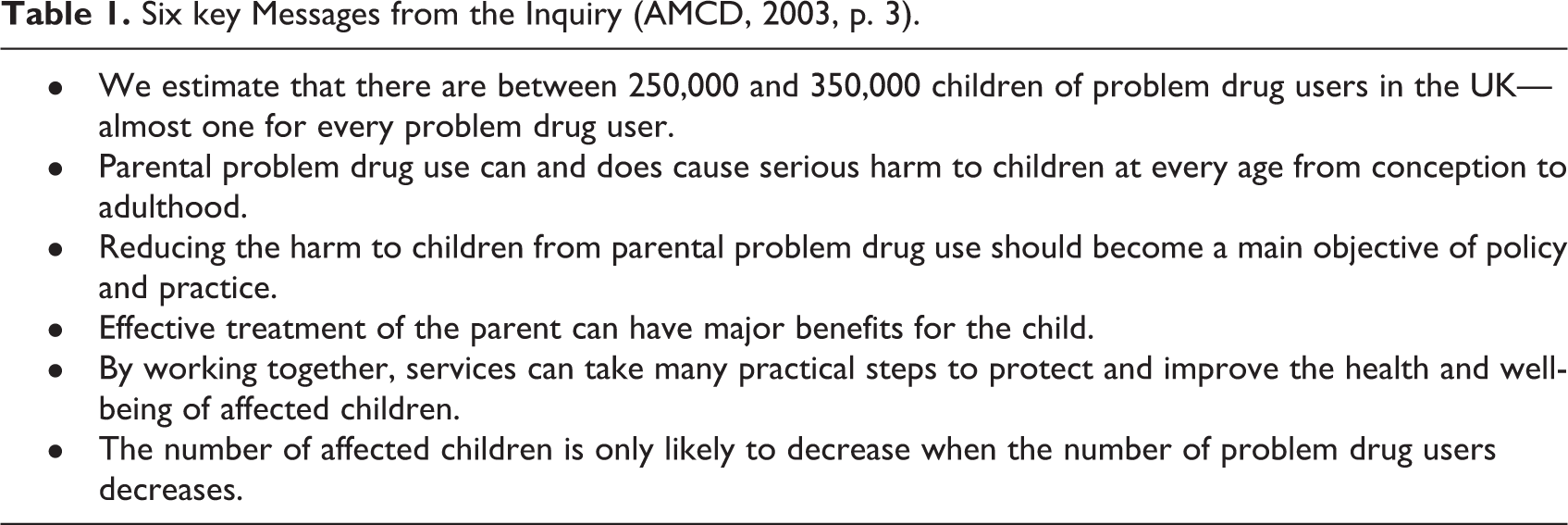
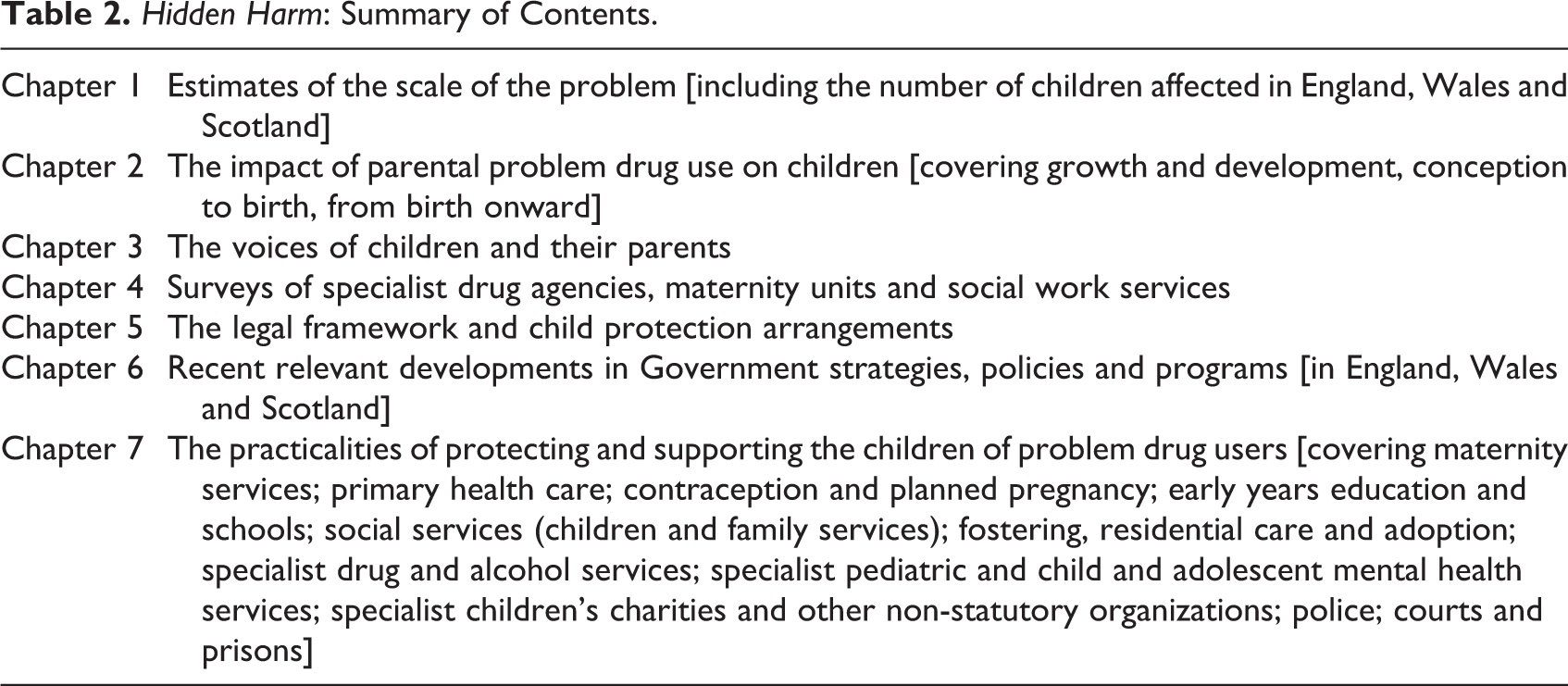
Hidden Harm was produced by the ACMD, an expert body whose role is to “carry out in-depth inquiries into aspects of drug use that are causing particular concern […] with the aim of producing considered reports that will be helpful to policy makers, service providers and others” (ACMD, 2003, p. 7). Created by the UK Misuse of Drugs Act 1971, the ACMD comprises individuals appointed by the Secretary of State for their expertise in the drugs field (Monaghan et al., 2018). Members of the ACMD form a small number of sub-committees that focus on contemporary issues and publish their findings. Hidden Harm was the product of a substantial 31-month inquiry, produced by 29 members of the ACMD Prevention Working group. Membership of this group was diverse and drawn from across Great Britain. It included government and academic researchers; policymakers; representatives of third sector organizations, drug agencies, and children and family services; and criminal justice, education and health professionals. Between July 2000 and July 2003, the group held 15 all-day meetings; carried out an extensive literature review and considered statistical and other forms of evidence, including a commissioned survey of specialist drug agencies, maternity units and social services. Overall, an additional 40 experts served on associated subgroups (education, primary care), represented non-statutory agencies working with children and families, gave oral presentations, or provided research expertise or monitoring data. Twenty-one government officials from eight governmental agencies were also involved. The final report was lengthy at 91 pages but it distilled its findings into six key messages (see Table 1). Across seven detailed chapters (see outline of chapter contents in Table 2), it proposed 48 policy and practice recommendations that can be viewed as “proposals about how things should be” (Bacchi, 2017, p. 5).
Six key Messages from the Inquiry (AMCD, 2003, p. 3).
Hidden Harm: Summary of Contents.
The Hidden Harm inquiry was conducted under a New Labour Government (1997–2010) that pursued “an ambitious agenda to raise outcomes overall, narrow socioeconomic gaps and modernize public services” (Lupton et al., 2013, p. 7). As this agenda became more embedded, it targeted “at risk” populations with an emphasis on children and young people, who “moved from the margins to the heart of social policy” (Lister, 2006, p. 315). Indeed, Every Child Matters (DfES, 2003), published in the same year as Hidden Harm, focused on extreme examples of “at risk” families (e.g., child deaths). There was significant investment in preschool provision in disadvantaged neighborhoods, including the flagship Sure Start early years program. Adopting a “carrot-and-stick” approach, the provision of family support was accompanied by clear expectations of the responsibilities of parents, with a willingness to intervene in the otherwise “private” sphere of the family, to discipline parents (mostly mothers) who were deemed to be neglecting their parental obligations in ways that had public consequences (see Gillies, 2005).
At the time Hidden Harm was published, a harm reduction approach was firmly established in UK drug policy and services (Monaghan, 2012). It was argued that drug treatment, typically methadone maintenance, was an effective means of reducing public health and wider harms associated with drug use. However, support for harm reduction was not universal in the UK, and in the early 2000s research on the effects of parental drug use on children started to emerge that questioned whether parents, even if engaged in opioid substitution therapy (OST) programs, could care adequately for their children (see Barnard & Barlow, 2003; McKeganey et al., 2002).
Hidden Harm’s most enduring effect was the creation of a scandal, founded on a simple but powerful message about the harmful effects of parental drug use on children and the failure of professionals to adequately govern the “problem.” Scandals are important drivers of policy change (Butler & Drakeford, 2003), and the Hidden Harm inquiry coincided with a number of high profile tragic deaths of children in the UK, murdered by their parents/caregivers (e.g., O’Brien et al., 2003). The primary effect of producing a scandal about parental drug use is that the claims and recommendations in Hidden Harm have gone largely unchallenged. Flacks (2018) charts the influence of Hidden Harm on subsequent drug strategies, including all four national drug strategies in Scotland, England, Wales and Northern Ireland. This embedding of the Hidden Harm agenda in policy across the UK has greatly influenced practice (Bosk et al., 2017). Indeed, after Hidden Harm was published, the ACMD took the unusual step of appointing a Hidden Harm working group to oversee the implementation of the report’s recommendations and to report on their progress (ACMD, 2007).
Arguably, the making of a scandal was also necessary to build sufficient leverage, and to a certain extent, moral outrage, to justify and legitimize the forms of governance invoked in the report recommendations. This is an important point, since none of these so-called “problems” were unknown at the time. Clearly, there were many children and families and pregnant women already involved in child protection and drug treatment systems (Harwin & Forrester, 2002; Klee et al., 2002), and limited public resources designed to provide comprehensive health and social care for the many thousands of families who were, and still are, the subject of Hidden Harm (Broadhurst & Mason, 2013; Morris & Featherstone, 2010).
We will now look in more detail at the WPR approach we used as the analytical framework to answer our research questions: How did Hidden Harm create a scandal in relation to parental drug use? What solutions did Hidden Harm advocate to address the “problem” of parental drug use? What was hidden from Hidden Harm’s analysis of parental drug use and proposed solutions to it?
Analytic Approach
Bacchi’s WPR approach is a well-established analytic method for interrogating drug policy with studies across the globe interrogating the ways in which influential high-level policy documents like Hidden Harm represent problems rather than simply addressing them (see for example, Brown & Wincup, 2019; Fraser & Moore, 2011a; Lancaster et al., 2017). It has also been used to explore parenting policy (e.g., Cook et al., 2015; Widding, 2011). WPR challenges the tendency for policies to operate as “taken-for-granted descriptions of conditions that ought to be rectified and/or eliminated” (Bacchi, 2017, p. 2). It departs from traditional forms of policy analysis that presume the “problems” that policies address are uncontentious by recognizing the role of policy development in the creation of problems with “particular parameters, causes, effects, and remedies” (Bacchi, 2017, p. 3), how policies produce “subjects” through problematization (Bacchi & Goodwin, 2016), and how problematizations become “part of how governing takes place” (Bacchi, 2017, p. 4). For Bacchi (2017, p. 7), policy analysis serves “to establish a critical distance from “objects” [such as addiction…] as fixed essences.” This Foucauldian influenced post-structuralist stance has the capacity to transform normative thinking about a topic, expose realities that diverge from dominant discourses, and highlight the ways in which society could approach issues differently.
The WPR approach involves a meticulous analysis of policy documents to deconstruct representations of highly complex “problems.” To aid in such an analysis, Bacchi suggests asking several analytic questions (see Bacchi, 2017, p. 3). Doing justice to each of these within one paper is challenging, so we focused on four key WPR questions to interrogate the core problem constructions that form the basis of recommendations advanced in Hidden Harm:
▪ What is the problem represented to be in the policy? ▪ What effects are produced by representations of the “problem?” ▪ What is left unproblematic? Where are the silences? ▪ Can the “problem” be conceptualized, and responded to, differently?
We adopted a two-stage analytic process, initially focusing on coding the “Introduction” and “Summary/Recommendations” sections of the text (pages 1–18). This was done independently by all four authors. Following an exchange of analytic notes, we progressed to detailed coding of the entire report (Chapters 1-8), in order to further interrogate key problem representations and solutions. We noted discursive strategies used (for example, terminology, metaphor, generalizations, simplifications, persuasion and rationalities), as well as subjectivities produced. We compared results and agreed on key problematizations in the report that formed a narrative about “what the problem is,” “who/what’s causing it” and “what should be done about it.” We reflected on issues and concepts that were disregarded or rendered peripheral and probed excerpts and/or the context in which they occurred. The effects of what was problematized, and un-problematized, in Hidden Harm were then interrogated, with a view to questioning the proposed “solutions” and generating alternative understandings and responses.
Findings
We identified two central problem representations in Hidden Harm: “problem parents” and “problem professionals and services.” We deconstruct these problematizations below and demonstrate how they became an integral part of the report’s governing solutions.
Constructing “Problem” Drugs and “Problem” Parents
From the outset, Hidden Harm frames the “problem” in a particular way and is explicit about its agenda: [To focus] squarely on parental problem drug use and its actual and potential effect on children […] with the aim of illuminating an aspect of the harm caused by drug use that until now has remained largely hidden. By highlighting both the size and seriousness of the problem, we hope we can stimulate vigorous efforts by both policy makers and service providers to address the needs of some of this country’s most vulnerable children. (Introduction, p. 7, italics added)
Caveats are employed to temper what might appear to be extreme positions—for example, that all drug use is harmful and all parents who use drugs are bad (harmful) parents: The effects of drugs are complex and vary enormously, depending on both the drug and the user. While there is probably no drug that is entirely harmless in all circumstances, the Working Group accepts that not all drug use is incompatible with being a good parent. (p. 7, italics added)
Producing the Drug-Parent Nexus
Moreover, by representing the “effects” of drugs as a process dependent upon “the drug” and “the user” (i.e., the parent), Hidden Harm suggests that the consequences of drug use (i.e., harm to children) are located in, and produced by, the drug-parent nexus. As a result, only drugs and parents are implicated in the “complex” and varied effects of drugs, and by inference, the causal pathway to child maltreatment. The context in which drug use and parenting takes place, and the wider caregiving environment in which children grow up, is largely ignored or rendered peripheral to the drug-parent nexus—the focal point of the “problem.” This creates a discourse around drug use, parenting and harm to children, which is divorced from alternate understandings of drug-taking (Fraser & Moore, 2011b), including long-standing interactional models (see for example, Zinberg’s (1986) “drug, set and setting”), and well-known ecological models of parenting, family life, child development and child maltreatment (see Belsky, 1993; Bronfenbrenner, 1979). Complexities are circumvented, such as the social, economic, legal, political, cultural, structural and relational issues that play a role in the way drug use is made more risky/harmful or safer/benign (Rhodes, 2002), and parenting more challenging/compromised, or easier/more supported (Belsky, 1984; Cicchetti & Toth, 1993).
More often, Hidden Harm constructs these wider issues either as a direct consequence of parental drug use itself, or as distal factors that just make “bad parenting” worse, as demonstrated by the following three excerpts from the “Summary and Recommendations” section (p. 10, italics added): Problem drug use […] is strongly associated with socioeconomic deprivation and other factors that may affect parenting capacity. […] Parental problem drug use can and often does compromise children’s health and development at every stage from conception onwards.
Maternal drug use during pregnancy can seriously affect fetal growth, but assessing the impact is usually impossible, with multiple drugs being taken in various doses against a background of other unfavorable circumstances. […] Heroin and other opiates, cocaine and benzodiazepines can all cause severe neonatal withdrawal symptoms. […] Maternal drug injecting carries the risk of transmission to the baby of HIV and viral hepatitis. Maternal nutrition may be poor. The child may be exposed to many sustained or intermittent hazards as a result of parental problem drug use. These include poverty; […] inadequate accommodation and frequent changes in residence; […] interrupted or otherwise unsatisfactory education and socialisation; […] and social isolation.
Simplifying the Problem
The effect of these discourses, representations and positioning of “other factors” as a by-product of parental drug use, or as less central to an understanding of child welfare and family life, is that “harm” to children (and how to respond to it) can be portrayed as relatively simple and straightforward (i.e., limited to the need to “treat” the parents and/or safeguard the children). Foucault called these “organized practices” (Baumgarten & Ullric, 2016) whereby certain forms of knowledge are constituted through a set of rationalities, subjectivities and technologies to produce a particular kind of “terrain,” and the exercise of power can be invoked and legitimized. In Hidden Harm, the “problem” is largely constructed as linear and fixed (with “problem drugs/parents” as the starting point), and one-directional and predictable (one thing leads to another, and it all leads to the same outcome—risk and harm to children). The exercise of power invoked and sanctioned in Hidden Harm (through its recommendations) primarily relates to the governing of parents and the responsibilization of parents themselves as well as professionals to enact this governing.
Constructing Drug-Induced Adversities
Further examples of this problem representation, as fixed, one-directional and predictable, can be found in chapters 2–3. These are dedicated to describing the “actual and potential” effects of parental drug use on the health, development and welfare of children. In these chapters, the “seriousness” and “severity” of the problem, and level of “concern” about harm to children is repeatedly emphasized, and by implication, the level of concern that professionals ought to feel as well. For example, the section on “growth and development” (p. 30) lists “common features” of problem drug use, including “chronic or intermittent poverty,” “homelessness” and housing instability, “loss of employment,” “post-traumatic stress disorder,” “chronic anxiety,” “depression,” “suicidal behavior,” and “financial” and “legal” problems. The assumption is that because people who use drugs often experience such adversities, this is largely a result of their drug use (i.e., if they did not take drugs they would not experience such multiple adversities). In turn, these (drug-induced) adversities are portrayed as contributing to the harmful effects on children: In order to understand the potential impact of parental drug use on the child, the complexity of the process of growth and development needs to be recognised […] A child’s needs and capabilities change over time, as do the potentially harmful experiences to which it is exposed and the consequent harm. (pp. 30–31, italics added)
Problematizing the “Stable” and “Normal” Parent
One way Hidden Harm minimizes broader understandings of child welfare within the context of drug use is by discursively positioning parents who use drugs as problem parents in more subtle ways, where their potential for being viewed as unproblematic is questioned. For instance, in the following excerpt, drug-using parents are initially likened to “any parent,” but the narrative then dismantles this notion: There is no doubt that many problem drug users have as strong feelings of love for their children as any parent and strive to do the best they can for them. Some manage to sustain family lives that are outwardly remarkably normal. However, the testimony from some children in relatively stable families shows that the drug related behaviour of even the best-intentioned parents often generates deep feelings of rejection, shame and anger. (p. 90, italics added)
Making a Case for the Need to “Act”
These persuasive, and sometimes emotive, narratives persist throughout Hidden Harm. In Chapter 3, for example, first-hand accounts of children and parents’ experience of “living with problem drug use” are presented in order to “provide a greater sense of the impact of drugs on family life and on children in particular” (p. 46). Although these accounts are derived from a “small number of existing qualitative studies” (p. 50), the chapter concludes with authoritative statements about the “all-pervasive” nature of harm to children caused by drugs and parents who use drugs: What it shows is the all-pervasive nature of problem drug use seeping into almost every aspect of these children’s lives. Parents could and did try to control their drug problem: some were successful, and their children were not especially tainted by the problems so often brought in the wake of uncontrolled use […] As these parents and children so movingly testify, drugs could and did have the capacity to deprive children of many of the normal and valued aspects of childhood. Listening to these voices underlines our responsibility both to help parents find a way through their drug problems and to find urgent means of protecting and enabling children living in family environments stressed by drugs. (p. 50, italics added)
Revealing and Obscuring Particular Voices and Realities
Chapter 3 of Hidden Harm fails to contend with other perspectives on family life within the context of drug use. For example, accounts from qualitative studies involving parents (mostly pregnant women and mothers) who are active drug users provide inconsistent and contradictory narratives to those presented in Chapter 3 (see Boyd, 1999; Kearney et al., 1994; Klee et al., 2002; Murphy & Rosenbaum, 1999; Richter & Bammer, 2000; Taylor, 1993). These studies draw attention to parents’ strengths, stressors, and unmet parental needs, and highlight the lack of access to supportive family-orientated health and social care. They also document the stigma faced by mothers and the strategies they employ to minimize drug-related harm and safeguard their children’s welfare. Similarly, the voices of frontline practitioners who work with families are largely missing from Hidden Harm, both in terms of the evidence contained within it, and the practice implications of the recommendations. Indeed, research referenced in Chapter 3 (Hogan & Higgins, 2001; Klee et al., 2002) provides considerable insight in this respect and draws conclusions that distinctly diverge from those presented in Hidden Harm, particularly in relation to how to respond to the needs of children and families, and pregnant women. These other (obscured) realities and understandings of parenting and family life at the margins of society reveal complexity and diversity within the field and, arguably, unsettle the problem representations contained in Hidden Harm and the “compelling picture” it paints.
Constructing “Problem” Professionals and Services
Likewise, problem representations of agents of the state are carefully crafted in Hidden Harm, with Chapters 4–7 dedicated to providing evidence on agency responses to the “problem,” describing shortfalls in professional practice, limitations in the quality of services, and mobilizing professionals to “rise to the challenge” of responding to the needs of “vulnerable children” affected by parental drug use: With greater recognition of these children’s needs should come a determination to act. Effective treatment and support for their parents can help greatly but will often not be enough. Children deserve to be helped as individuals in their own right. Many services have a part to play: can they now rise to the challenge? (p. 18, italics added)
Legitimizing Increased Scrutiny and Surveillance
While the report states that “assessing and meeting the needs of children” should be core business for professionals in contact with families, the emphasis is clearly on the former. In the absence of “information,” the authors argue, it is “all too easy for agencies to be unaware of the issues and hence to avoid facing up to them” (p. 55, italics added). This portrayal of professionals and services with their “heads in the sand,” so to speak, is an important one since it provides a plausible argument for “vigorous” reforms in the way professionals and services respond to the “problem.” Moreover, it invokes a rationality (and legitimacy) for instituting a more systematic, procedural and interventionist approach to governing families, and one that makes professionals and services more responsible and accountable in the process. Correspondingly, several recommendations focus on implementing routine procedures, “tools” for screening (“information-gathering”), “information sharing” (for child protection purposes primarily), “assessment,” and improved “training,” so that professionals “better understand” the impact of parental substance use on children.
The key actors whom the authors wish to enlist in this task are specialist drug treatment workers and the report calls for relevant bodies, such as the National Treatment Agency, to ensure that services for adult substance users:
Identify and record the existence of clients’ dependent children and contribute actively to meeting their needs […] This should include protocols that set out arrangements between drug and alcohol services and child protection services. (p. 70, italics added)
Constructing Rival Subjects
Other key actors identified in the report are child protection services, which are frequently referred to as the main agency with whom other professionals should share information and “liaise.” In fact, the report dedicates an entire chapter to making a case for revising child protection policies and procedures to take “full account” of the “particular challenges” posed by parental drug use (p. 61). Child protection workers are said to require education and training “to enable them to understand parental substance misuse and its impact on children,” as well as “appropriate assessment procedures” (p. 62). They are advised to “liaise closely” with drug services to “control the parent’s substance misuse” and to “provide support for the children themselves that is primarily in his or her interests rather than their parents” (p. 62, italics added). This splitting of the needs, interests, rights and care of the child from that of their parent/s, and indeed the family as a whole, is a recurring discourse in Hidden Harm. Evidently, the report sought to portray the child not only as a separate and justly independent subject in need of care and protection (from parent/s), but also as a rival subject for intervention from the (implicitly incompatible) needs, interests, rights and treatment of the parent/s: The Inquiry recognises that there are numerous obstacles that have to be overcome if the best of intentions are to be translated into effective action [referring to role of professionals/services]. (p. 80, italics added)
In the above excerpt, “effective action” by professionals involves overcoming “numerous obstacles” and changing “intentions” and “actions” so that children’s needs and interests are prioritized rather than those of parents, who are portrayed as one of the obstacles that must be overcome. The idea that support for both parents and children, or indeed the whole family, could be, or should be, a focus for “effective action” is rarely invoked in Hidden Harm. For example, family-focused interventions do not feature in any of the recommendations despite the report noting that “only 24% of Drug Action Teams said they were investing in family support” services (p. 64). Indeed, “family-friendly” services are only mentioned once in the report (p. 17), with the suggestion that specialist drug and alcohol services should “become family friendly with an emphasis on meeting the needs of women and children […and] gathering basic information about clients’ children is an essential first step.” Exactly how this “first step” of questioning stigmatized and marginalized drug-using mothers about the personal details of their children (e.g., name, age, gender, and whereabouts) would constitute a “family-friendly” approach in drug treatment services is not explained (or evidenced).
Formulating Gendered Practice
Further, the absence of any recommendations regarding fathers, fatherhood, and father-child relationships in Hidden Harm portrays fathers as largely irrelevant to the parenting and child welfare agenda. Critics have argued that this approach simply reinforces a systemic culture of gendered practice and “mother blaming” in child welfare services (Maxwell et al., 2012; Scourfield, 2003). Flacks’ (2018) analysis of Hidden Harm troubled these gendered representations and the resulting focus on the governing of women and mothers. Indeed, 11 out of the 48 recommendations in Hidden Harm pertain specifically to the treatment of women who use drugs, pregnant women and mothers. None specifically target men, fathers, or fathers-to-be. Most references to the “family” simply erase fathers from the picture (e.g., “taking a holistic family approach, focusing on the child and mother together”; p. 84), or else represent them as a risk (e.g., as violent). Strategies to support mother-father relationships, co-parenting, and the increased involvement of fathers in providing childcare and maternal support are entirely missing. This has the effect of both reinforcing stereotypes of absent, uninvolved and irresponsible fathers (McMahon & Giannini, 2003), and responsibilizing mothers and mothering (Flacks, 2018).
Making Child Protection Interventions Plausible
In many respects, the central problem constructed in Hidden Harm is that children and parents (mothers primarily) go unidentified (Flacks, 2018), and professionals fail to assess “risk” and “harm.” Put differently, the main purpose of Hidden Harm is to make a case for greater child protection intervention in the lives of people who use drugs. On this matter, the report’s conclusion is clear: If we now better understand the scale and nature of the problem, what can we do about it? We have highlighted the importance of the child protection system. Recent reviews have identified its shortcomings and we strongly support the efforts now being made to improve its effectiveness. Enabling the professionals involved to identify and respond appropriately to parental drug or alcohol misuse will be an important part of that task. (p. 90, italics added) Only a small proportion of children of problem drug users come to the attention of social services […] Others may be at risk but they have not been recognised. For many others, their parents’ drug problem may not expose them to such risk that warrants social services’ intervention yet amounts to a pernicious lack of attention, care and interest that undermines these children’s wellbeing and development. The needs of these children may be less acute than those of the children at risk but may just as easily translate into damaged childhoods and poor adult outcomes. (p. 46, italics added)
Discussion
Our analysis of Hidden Harm identified two central problem representations: “problem parents” (mainly mothers) and “problem professionals and services.” We demonstrate how these were created through an assemblage of seemingly indisputable and interrelated “harms” linked to drug use, parenting, child welfare, professional practice and service responses. By drawing attention to the use of authoritative, persuasive and emotive language, as well as discursive strategies employed to produce particular kinds of realities, subjectivities and rationalities (and not others), we identify how Hidden Harm formulates a simplified version of the “problem” of harm to children, and consequently, simplistic solutions. We question the logic of the problematizations and policy solutions that center on the responsibilization of parents to engage with, and benefit from, drug treatment, and the responsibilization of professionals and services to enact greater regulation and governance of families with parents who use drugs. We reveal how Hidden Harm fails to engage with well-established theories about the social ecology of drug use, child welfare, parenting and family life, and the broader politics of health and social care. We suggest that attending to these complexities is essential if we are to develop a more theoretically informed understanding of child and family welfare within the context of drug use, and a more nuanced and compassionate “whole family” and “whole systems” approach.
Bacchi’s (2009, 2017) analytic approach calls for an examination of the rationalities and subjectivities that underpin problem representations in policy. In Hidden Harm, the “problem” of parental drug use is largely framed as the failings of parents (mostly mothers) to adequately care for and protect their children, alongside the failure of professionals and services to recognize the harm to children caused by parents, and do something about it. This simplistic view of “vulnerable” children being maltreated by dangerously unfit parents not only absolves society of any responsibility for child abuse and neglect, but also leads to approaches that focus primarily on the governance of “risky” parents (mainly mothers), with little attention paid to effective interventions for children and the family as a whole. Furthermore, the myriad of contextual influences—socioeconomic (e.g., poverty, worklessness, homelessness), cultural (e.g., stigmatization of people who use drugs, gendered practice); political (e.g., reduced access to support services, policies designed to limit welfare dependency) and legal (e.g., criminalization of drug use)—are either largely ignored in Hidden Harm, deemed to be extraneous “background” factors, or portrayed as the result of parental drug use itself. Despite emphasizing the intergenerational nature of harm, the focus of the report is on harm to children. The report evades the issue of parents having a history of trauma themselves, or being a product of the care system, prison system, or indeed the drug treatment system; all of which affect life course trajectories (Broadhurst & Mason, 2013). Particularly noteworthy is the absence of recommendations within Hidden Harm that address these broader individual, relational, social and structural complexities of life at the margins of society (including race, gender, class and culture) that generate and perpetuate disproportionate disadvantages and inequalities (Bywaters et al., 2016).
Scholars have argued that rationalities specifically designed to erode welfare-based social policies result in a focus on “individualized risk” and the “responsibilization” of citizens (Goddard, 2012; Lupton, 2012). Inherent in the language, intention and meaning of Hidden Harm is risk governance, in which social welfare approaches are superseded by self-regulation, surveillance and expected reform (Morris & Featherstone, 2010). In these risk-based models of care, the apparent dangers of parents who use drugs centre on their “lifestyle choices,” drug consumption and “drug-related behavior” as opposed to understanding child and family welfare from a broader perspective. This disavowal of the social determinants of health and wellbeing, and the needs of the whole family (not just the children), leaves little room for strengths-based, relational, ecological and welfare-orientated models of care as a component of the policy response (Featherstone et al., 2012; Morris & Featherstone, 2010). For example, a social-ecological-developmental approach (Belsky, 1984, 1993; Bronfenbrenner, 1979; Cicchetti & Toth, 1993; Department of Health, 2000), available at the time Hidden Harm was published, provides a more nuanced and theoretically informed understanding of the interrelations between individual, family, community and societal factors that shape child welfare, opening up different ways of responding to the multiple and complex needs of families (for an example of a program based on this perspective, see Dawe and Harnett’s (2007) Parents Under Pressure (PuP)).
Our analysis of Hidden Harm reveals that despite extensive evidence of the social determinants of drug use (see for example, ACMD, 1998; Stevens, 2011), there was limited recognition of the role that societal factors such as poverty and inequality play in shaping pathways into and out of drug use for parents who use drugs. Instead, Hidden Harm reinforces a cultural model that views drug use as the outcomes of parents making poor choices and consequently seeking recovery (viewed predominantly in terms of abstinence), as requiring parents to be “motivated” to make better choices and sustain them over time. Adopting an “ecological” rather than “individualistic” model (see Elwell-Sutton et al., 2019) would allow drug use to be viewed, at least in part, as a product of social and environmental influences, building support for policies that move beyond offering drug treatment to parents to more holistic forms of family and community support. It also offers the promise of a less stigmatizing approach that encourages both mothers and fathers who use drugs to reach out for the support that they need and to receive help that is non-discriminatory and empathic (Benoit et al., 2015).
Likewise, critical scholars in child protection (Broadhurst & Mason, 2013; Bywaters et al., 2016; Featherstone et al., 2012, 2019; Morris & Featherstone, 2010) have been calling for a paradigm shift in the way child welfare and child protection are conceptualized, and responded to, in the context of widening inequalities, child poverty and the “inverse intervention law” in child protection—a concept that parallels Hart’s (1971) “inverse care law” in health. This shift would require reframing the conversation on the causes of child maltreatment—including difficult family circumstances such as parental mental health, substance use and domestic abuse issues–from an individualized risk-based model to a public health and social model of child care and protection. In order to reframe policy and practice in relation to parental drug use, this paradigm shift would require close collaboration between critical scholars and practitioners in the field of drug use, child welfare, public health and social policy, as well as genuine collaboration with parents who use drugs and their families. Elwell-Sutton et al.’s (2019) work on changing public discourses on the social determinants of health suggests that the media and other key stakeholders may also be instrumental in reflecting and shaping new conversations and narratives on parental drug use. Together, this could lead to policy change and a systems approach with greater focus on wider societal factors such as housing, education, employment, welfare and criminal justice. However, as Featherstone et al. (2019) point out, these approaches are currently marginal in contemporary policy and practice debates. Hidden Harm not only created a scandal but it left a legacy. It could be superseded, but it would not be easy to replace. Our analysis of Hidden Harm aims to stimulate continued discussion and debate on the way parental drug use is represented and responded to within policy and practice, both in the UK and elsewhere, and importantly, calls for further research on the impact of such policies on the lives of families.
Footnotes
Declaration of Conflicting Interests
The author(s) declared no potential conflicts of interest with respect to the research, authorship, and/or publication of this article.
Funding
The author(s) received no financial support for the research, authorship, and/or publication of this article.
