




Abstract
This study aims to test the hypothesis that the association between aging anxiety and ageism will be enhanced by age differently in the United States and in Japan. Data were obtained from online surveys in the United States (Mage = 40.44, SD = 14.98; 39.7% women; n = 886) and in Japan (Mage = 50.32, SD = 16.38; 52.7% women; n = 556). Our findings illuminate that the levels of aging anxiety in the Japanese participants were positively associated with their levels of ageism regardless of their age. On the other hand, for the American participants, the level of aging anxiety was positively associated with higher ageism only among older adults, and not among younger adults. Differences in lifespan or traditional values are thought to have alleviated the strength of the association between aging anxiety and ageism.
Introduction
Even though the population of older adults has increased significantly, there is still quite a bit of ageism in many societies. The term of ageism was first proposed by Butler, and subsequently, Palmore (1999, p. 4) defined it as “any prejudice or discrimination against or in favor of an age group.” In other words, ageism is not directed only to older adults, but can also be directed to other age groups, such as young adults. In gerontological research, however, it is common to refer to prejudice and discrimination against older adults, so this study focuses on ageism toward older adults by other age groups.
Ageism has a profound impact on individuals and societies. Older adults can experience ageism on many occasions such as the workplace (Palmore, 1999) and medical care (Monsees, 2002). These may lower the self-evaluation and self-esteem of older adults. In addition, it is suggested that ageism against older adults also adversely affects those who are ageist. Stereotype embodiment theory (Levy, 2009) provides a framework for explaining that ageism has a negative impact on health and wellbeing. Age stereotypes, which people have internalized throughout their lives, daily and unconsciously influence people's attitudes and values toward older people (Levy et al., 2000). When a self-definition as an older adult is activated and a self-relevance with the age stereotypes becomes significant, beliefs about old age may influence one's health and wellbeing via psychological, behavioral, and physiological pathways. This impact has been suggested to extend to cognitive function (Levy & Langer, 1994), life satisfaction (Brothers et al., 2017), social support (Menkin et al., 2016), healthcare cost (Levy et al., 2020), and life expectancy (Nakagawa & Yasumoto, 2019). Therefore, it is important to study ageism in all generations.
Previous research has shown that ageism is reinforced by a variety of factors. First, personal factors are thought to influence the level of ageism. Bodner et al. (2012) examined age and gender differences in ageism among Israeli participants and found that ageism was more prevalent among middle-aged (40–67 years old) than young (18–39) and old (68–98) and among men than women. Rupp et al. (2005) also examined age and gender differences in ageism among American participants and showed that younger individuals and men had significantly higher ageism scores than older individuals and women. In addition, Bodner et al. (2015) showed that lower educational level and poor health (the amount of chronic medical conditions) were associated with higher levels of ageism.
Second, social environmental factors are also thought to influence ageism. Harris and Dollinger (2001) compared attitudes toward older adults between a group taking an upper-level psychology course on adulthood and aging and a group taking an introductory psychology course. The results showed that only the former group showed improvements in their knowledge and attitudes toward older adults. In addition, Allan and Johnson (2008) examined the influence of interaction with older adults on ageism focusing on the interaction settings (home or workplace). The results showed that people who have social interactions at home show higher ageism levels than those who do not have those interactions, whereas those who have social interactions at work show lower ageism levels than those who do not have those interactions.
In addition to examining related factors mentioned above, there is a need for the development of theoretical considerations regarding why ageism exists. Furthermore, it is required to reconsider ageism not only as a problem from young people to older people, but also as within older people. That is because the average life expectancy is extended and the old age period is also being prolonged. In other words, there is a need to focus on ageism from “younger” older people to “older” older people. Therefore, it is necessary to conduct theoretical research of ageism and to accumulate survey research targeting all ages, not only young adults.
Theoretical Framework: Social Identity Theory
Social identity theory (SIT; Tajfel, 1978) is focusing on the relationship between personal identity and group identity, and this is thought to be one of the frameworks for explaining the psychological mechanism of ageism. In SIT, it is suggested that people tend to define their in-group positively and their out-group negatively. This allows in-group members to associate themselves with positive attributes and thus acquire a better self-identity and a higher self-esteem.
When interpreting ageism from young people to older people based on SIT's framework, it can be said that younger individuals identify more strongly with their in-group (other younger people) to promote self-esteem and consequently push away out-group members (older people) (Kite & Wagner, 2004).
However, we grow old. This means that individuals experience a transition from their in-group to their out-group. Therefore, as people get older, it is thought that they should become more anxious about moving into their out-group and people distinguish more clearly the out-group members and negatively assess older adults (Chonody & Teater, 2016). This suggests that “aging anxiety” is supposed to be the causal factor of ageism and to be an important psychological factor when considering ageism from all ages.
The Age Difference in a Causal Factor of Ageism
As discussed above, it is thought that the relationship between aging anxiety and ageism differs by age. Bodner (2009) reviewed studies which examined the mechanism of ageism based on the theoretical frameworks and suggested that aging anxiety might be the main mechanism behind ageism among older adults. The reason why the SIT framework focusing on aging anxiety was considered suitable to explain ageism among older people is that older adults face the transition to the out-group (older group) and try to maintain their self-esteem by evaluating people older than themselves more negatively.
Some studies have examined ageism in specific age groups focusing on the SIT framework or aging anxiety (Bodner et al., 2015; Chonody & Teater, 2016; Garstka et al., 2004; Garstka et al., 2005; Jonson, 2013). In general, previous studies demonstrated that higher anxiety about aging contributes to higher levels of age stereotypes and greater ageist attitudes (Allan & Johnson, 2008; Cooney et al., 2021; Donizzetti, 2019; Harris & Dollinger, 2001). However, there are few studies focusing on older adults, and cross-age studies have not been sufficiently conducted. The characteristics of ageism among older adults compared to other age groups are not yet fully clarified. Therefore, to proceed with a theoretical investigation into the psychological mechanisms behind the existence of ageism, it is necessary to examine the differences in the effects of aging anxiety across a wide range of age groups, from the young to the older adults.
Cultural Differences as a Causal Factor of Ageism
Few studies have attempted to generalize theoretical considerations across countries and cultures. In addition, there has been little quantitative analysis of cultural difference in the levels of ageism itself. Therefore, this study set out to explore the level of aging anxiety and ageism and the relationship between them in two different countries: the first country was the United States which has developed research on ageism and accumulated knowledge, and the second country was Japan which has the highest aging rate in the world but lack of theoretical research on ageism.
It is possible that the relationships between aging anxiety and ageism may differ across cultures. Cultural and social differences between Japan and the United States include the following points.
Firstly, a case can be made from the perspective of cultural values. Hofstede et al. (2010) proposed six cultural values, one of which is “individualism / collectivism” focusing on people's identities. An individualist society refers to a society in which the interests of the individual take precedence over those of the in-group, and a collectivist society refers to a society in which the interests of the in-group take precedence over the interests of the individual. The United States has the world's highest level of individualism as a national characteristic, on the other hand, Japan ranks in the middle of the world (Hofstede et al., 2010). Therefore, it is thought that the tendency to emphasize individual independence without dependence on a group or others is higher in the United States than in Japan.
In addition to the above, people in cultures such as the United States tend to want to feel young forever (Ackerman & Chopik, 2020). In other words, people in individualistic culture are particularly concerned about being associated with negative age stereotypes as they get older because their cultural contexts are youth-oriented and hold widespread negative stereotypes of older adults. On the other hand, Japanese people are said to have a culture of respect for older people. Levy (2022) described the cultural difference between Japan and the United States in the attitudes toward aging and older person that American people say negative things about the older adults, but Japanese people always act with respect for the older adults in their lives, as exemplified by “Respect for the Aged Day.”
Secondly, the difference in life span between Japan and the United States should be noted. Life expectancy at birth in Japan (84.3 years) is longer than in the United States (78.5 years) (WHO, 2023), and the aging rate is also higher in Japan (29.8%) than in the United States (16.7%) (United Nations, 2022). Under these circumstances in Japan, the retirement age has been extended in recent years and active participation of older adults in society is being promoted. Therefore, Japanese people can actively interact with older adults in daily life, so that they may think that their aging is more natural and better than American people think, and their level of aging anxiety may be low.
Thirdly, the differences in social structures and social systems can play a role. In American society, there are communities called “retirement community,” where older people gather after their retirement and form a town and live together. A certain number of older people live apart from the working generation. On the other hand, in Japan, older people are everywhere when you turn on the TV or walk down the street, and it can be said that older people are very familiar to younger generations. This difference of the distance from older people in daily life may determine a weaker association between aging anxiety and ageism in Japan than in the United States.
Considering the above, the impact of aging anxiety on ageism is thought to be greater in the United States than in Japan. In other words, there can be cultural differences in the strength of the association between aging anxiety and ageism.
However, negative information about aging has been widespread in Japan in recent years. Through media and education, people know that the declining birthrate and the aging population are serious problems in Japan and the burden on the working generation to support each older person is increasing. In addition, as the older population continues to increase, there is ongoing debate about the distribution of the national budget, and older people are often cited as the cause of increasing the burden on society and the economy. Therefore, it is possible that the relationship between aging anxiety and ageism will be stronger than expected, that is, the same levels as in the United States.
The Current Study
The purpose of this study was to assess the following hypotheses to investigate age and cultural differences as causal factors of ageism. First, there is a cultural difference in the score of ageism and it will be higher in the United States than in Japan (hypothesis 1). Second, there is a cultural difference in the score of aging anxiety and it will be higher in the United States than in Japan (hypothesis 2). Third, the association between aging anxiety and ageism will be enhanced by age differently in the United States and in Japan, such that while in the United States older adults will demonstrate a stronger association between aging anxiety and ageism than younger adults, in Japan no age differences between younger and older adults will emerge (hypothesis 3).
Methods
Participants and Procedure
All registrants received an explanation of the survey and gave their consent before responding. The study complied with APA ethical standards and was ethically approved by Research Ethics Committee of Psychological and Behavioral Sciences, Graduate School of Human Sciences, Osaka University (No. HB020-089, Japan and the U.S. survey on factors causing ageism (エイジズムの生起要因に関する日米調査)).
The sample size was determined by power analysis. Respondents who did not properly answer Directed Questions Scale (Maniaci & Rogge, 2014) were excluded from the analysis.
The United States Survey
An online survey was conducted with Amazon's Mechanical Turk (MTurk: https://www.mturk.com) on March 29 to 30, 2021. Respondents aged 18 to 84 (n = 1046) completed the survey. The analytical sample consisted of 886 participants who had full information on all the study variables and answered the questions appropriately.
Japan Survey
Another survey was conducted with a Japanese crowdsourcing service (Freeasy: https://freeasy24.research-plus.net) on October 15, 2021. Respondents aged 20 to 75 (n = 1000) completed the survey. The analytical sample consisted of 556 participants who had full information on all variables and answered the questions appropriately.
Measures
To make cross-cultural comparisons, existing Japanese-English scales were adopted for the ageism scale. Regarding the aging anxiety scale, as there was no corresponding scale available, the most common English version was translated into Japanese and used. Respondents first answered sociodemographic characteristics, then ageism, and aging anxiety scales.
Ageism
All participants answered The Fraboni Scale of Ageism (α = .86; Fraboni et al., 1990). In this survey, people 80 years and older were considered as older adults in the scale. The response options ranged from 1 (“Strongly disagree”) to 5 (“Strongly agree”). In the Japanese survey, a Japanese short version of the Fraboni Scale of Ageism (α = .85; Harada et al., 2004) was used. The total score of 14 items of the short version was used as the ageism score in analyses. The score was calculated so that a higher score indicates stronger ageism.
Aging Anxiety
The anxiety about aging scale (α = .82; Lasher & Faulkender, 1993) was included in both surveys and translated into Japanese (α = .85) in Japan survey. The responses ranged from 1 (“Strongly disagree”) to 5 (“Strongly agree”), and the score was calculated so that a higher score indicates higher anxiety.
Social Demographics
Sociodemographic characteristics including age, gender, marital status, and whether they have children were reported by respondents themselves in the United States. In the case of Japan, the research company provided this information. As other background information, participants were asked whether they have learned about aging from lectures or books (learning experience). Regarding the status of interaction with older adults, both quantitative and qualitative aspects were asked. For the frequency of interaction, participants were asked to rate on a 10-point scale from 1 (“Very few”) to 10 (“Very many”). Regarding the content of interaction, the balance between giving and receiving in interaction with older adults was asked. Participants’ answers were selected from the following three, “more giving to older adults,” “more receiving from older adults,” and “equal giving and receiving balance.” Subjective health was asked with the responses ranged from 1 (“Not healthy”) to 5 (“Healthy”).
Statistical Analyses
Hierarchical multiple regression analysis was conducted. The dependent variable was the score of ageism, and the independent variables were age, country, and the score of aging anxiety. In step 1, the sociodemographic variables (excluding age) were added to the analytical model. Next, in step 2, the three separate independent variables (aging anxiety, country, and age) were added. Then, the three two-way interactions were added in step 3, and finally the three-way interaction was added in step 4. IBM SPSS statistics version 27 (IBM Corp, 2020) and R version 4.2.1 (R Core Team, 2022) were used for the analyses.
Age and the score of aging anxiety were mean centered. Dummy variables were created for country (1 = the United States), gender (1 = men), marital status (1 = currently married), learning experience of gerontology (1 = yes), and quality of interaction with older adults (give: 1 = more giving, take: 1 = more receiving).
Results
Descriptive Statistics
Descriptive statistics for all variables are presented in Table 1. The average age of the participants from the United States was 40.44 (SD = 14.98) and 39.7% were women. The average age of the participants from Japan was 50.32 (SD = 16.38) and 52.7% were women.
Demographic and Psychological Data for All Participants and by Country.
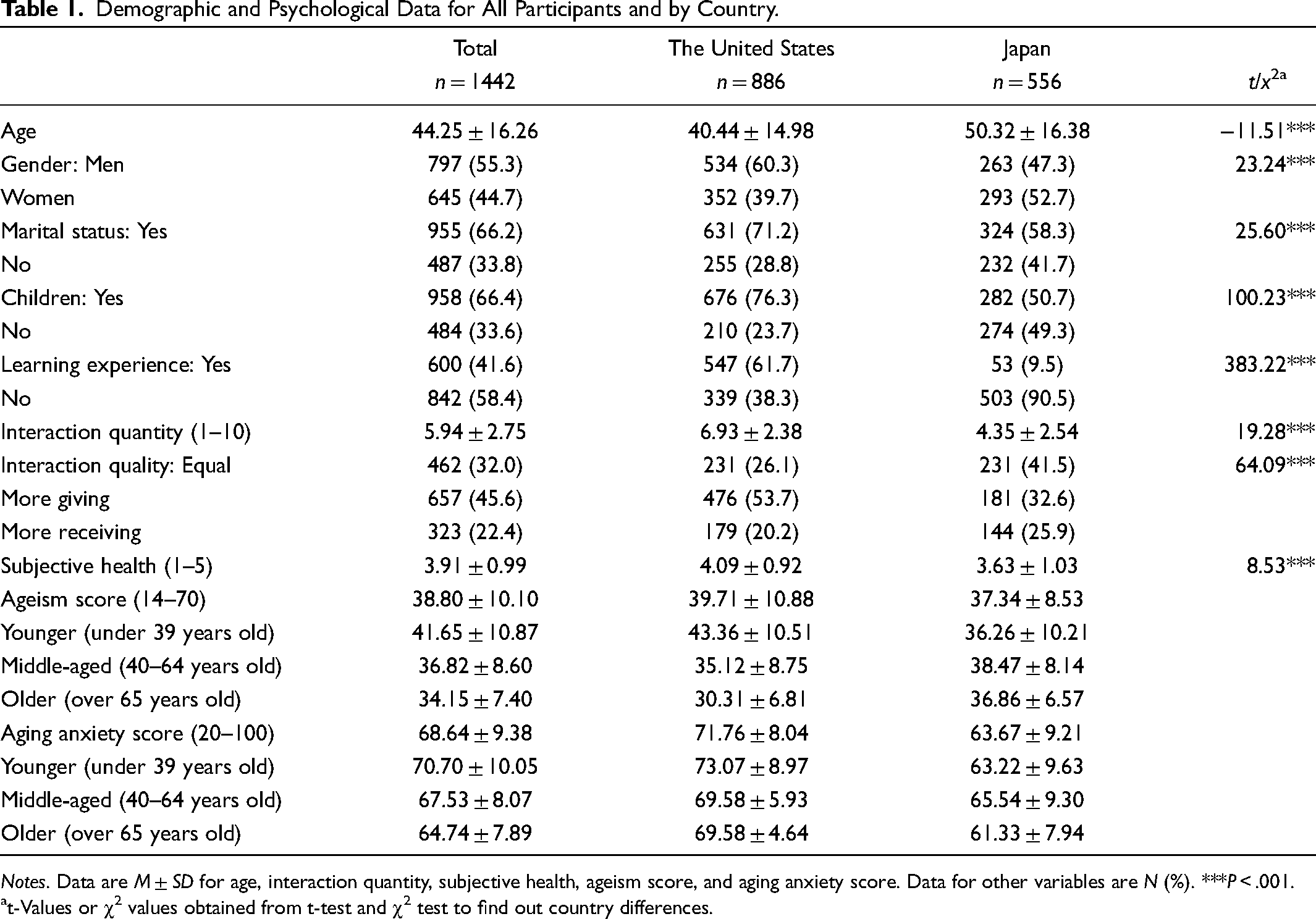
Notes. Data are M ± SD for age, interaction quantity, subjective health, ageism score, and aging anxiety score. Data for other variables are N (%). ***P < .001.
t-Values or χ2 values obtained from t-test and χ2 test to find out country differences.
A two-way ANOVA on the score of ageism showed the interaction effect was significant, F (2, 1436) = 61.70, p < .001. The simple main effects of age group were significant in American participants (the older group < the middle-aged group < the younger group, p < .001) but were not significant in Japanese participants. And the simple main effects of country were significant in the younger group (Japan < the United States, p < .001), the middle-aged group (the United States < Japan, p < .001), and the older group (the United States < Japan, p < .001).
A two-way analysis of variance (ANOVA) on the score of aging anxiety showed the interaction effect was significant, F (2, 1436) = 15.34, p < .001. The simple main effects of age group were significant in both Japan (the younger group and the older group < the middle-aged group, p < .05) and America (the older group and the middle-aged group < the younger group, p < .001). And the simple main effects of country were significant in the younger group (Japan < the United States, p < .001), the middle-aged group (Japan < the United States, p < .001), and the older group (Japan < the United States, p < .001).
Bivariate Correlations
Bivariate correlations for all variables are presented by country in Table 2. The upper right part shows the results of the United States, and the lower left part shows the results of Japan. For American participants, ageism was positively correlated with aging anxiety, r (886) = .48, p < .01, gender, r (886) = .12, p < .01, marital status, r (886) = .35, p < .01, whether they had children, r (886) = .25, p < .01, learning experience of gerontology, r (886) = .39, p < .01, interaction quantity, r (886) = .26, p < .01, interaction quality (more receiving), r (886) = .22, p < .01, and subjective health, r (886) = .09, p < .05, and negatively correlated with age, r (886) = −.48, p < .01. For Japanese participants, ageism was positively correlated with aging anxiety, r (556) = .36, p < .01, and negatively correlated with learning experience of gerontology, r (556) = −.10, p < .05, interaction quantity, r (556) = −.18, p < .01, and interaction quality (more receiving), r (556) = −.11, p < .01.
Bivariate Correlations of All Variables by Country.
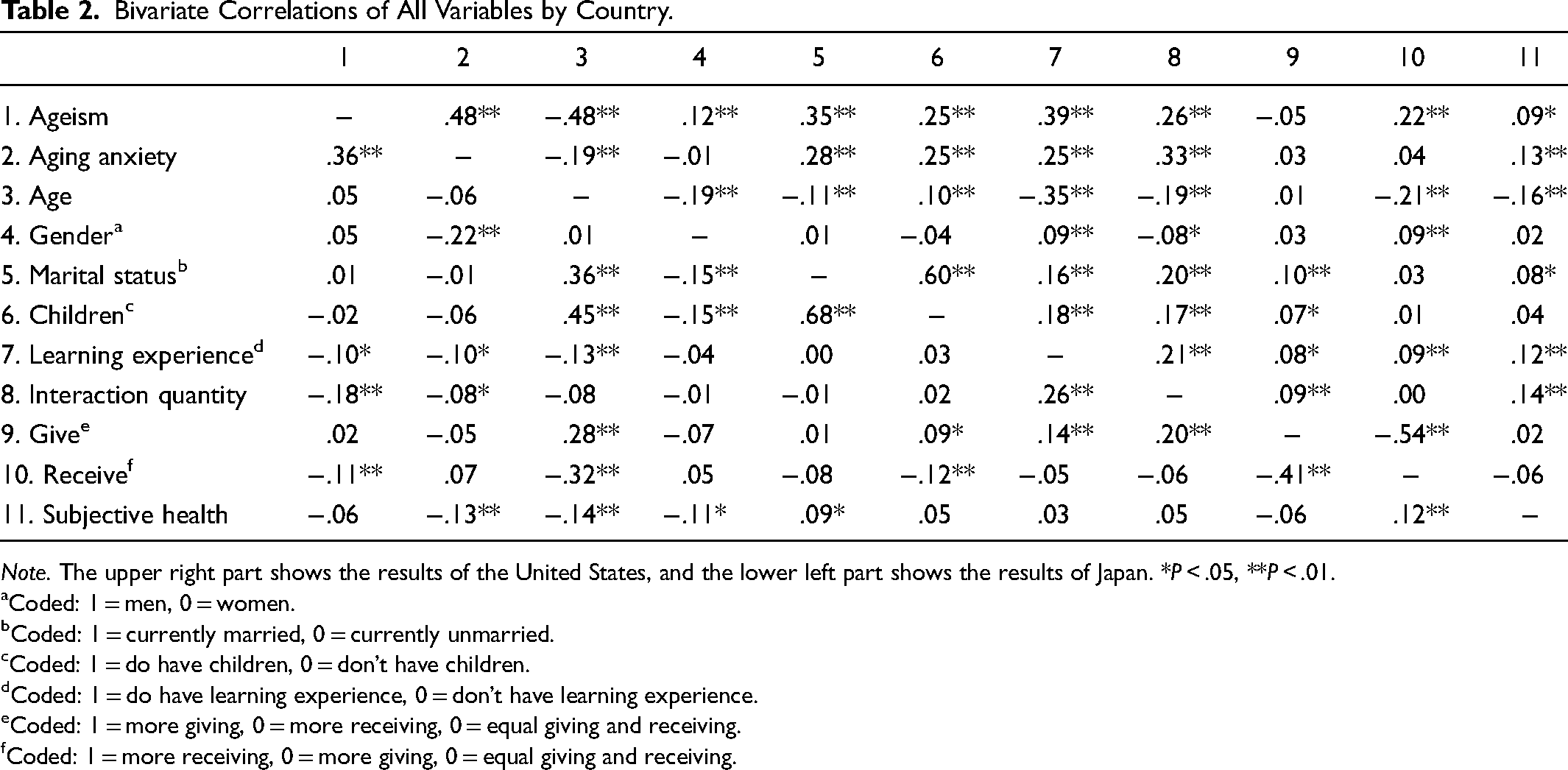
Note. The upper right part shows the results of the United States, and the lower left part shows the results of Japan. *P < .05, **P < .01.
Coded: 1 = men, 0 = women.
Coded: 1 = currently married, 0 = currently unmarried.
Coded: 1 = do have children, 0 = don’t have children.
Coded: 1 = do have learning experience, 0 = don’t have learning experience.
Coded: 1 = more giving, 0 = more receiving, 0 = equal giving and receiving.
Coded: 1 = more receiving, 0 = more giving, 0 = equal giving and receiving.
Hierarchical Multiple Regression Analysis
Table 3 presents the results of multiple regression analysis. After ageism was regressed on background variables and control variables, three main effects were significant—that is, aging anxiety, β = .40, p < .001, country, β = −.24, p < .001, and age, β = −.23, p < .001. Out of the three respective two-way interactions (between aging anxiety and country; between aging anxiety and age; between country and age), the aging anxiety by age interaction, β = −.07, p < .05, and country by age interaction, β = −.27, p < .001 were significant. These two-way interactions were qualified by a three-way interaction of aging anxiety, country, and age, β = −.16, p < .001.
The Results of the Hierarchical Multiple Regression Analysis Predicting Ageism Score (N = 1442).
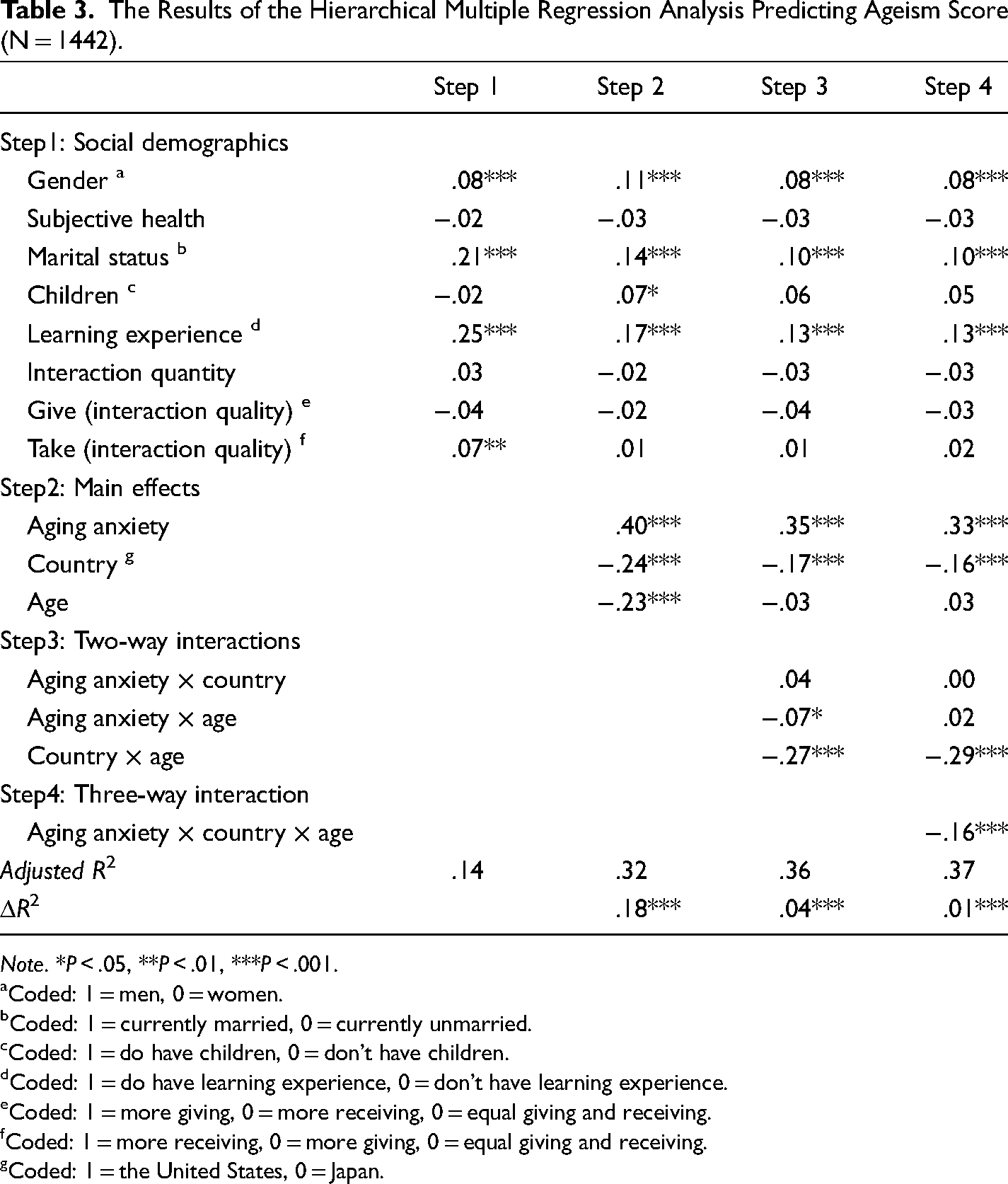
Note. *P < .05, **P < .01, ***P < .001.
Coded: 1 = men, 0 = women.
Coded: 1 = currently married, 0 = currently unmarried.
Coded: 1 = do have children, 0 = don’t have children.
Coded: 1 = do have learning experience, 0 = don’t have learning experience.
Coded: 1 = more giving, 0 = more receiving, 0 = equal giving and receiving.
Coded: 1 = more receiving, 0 = more giving, 0 = equal giving and receiving.
Coded: 1 = the United States, 0 = Japan.
Figure 1 presents the results of the simple slope effects. The figure shows that for older participants in the United States, B = 0.52, p < .001 (the continuous line using square markers), for younger participants in Japan, B = 0.39, p < .001 (the dashed line using triangular markers), and for older participants in Japan, B = 0.33, p < .001 (the continuous line using round markers), high levels of aging anxiety were associated with increased ageism. However, this association did not occur among younger adults in the United States, B = 0.08, p = .34 (the dashed line using diamond markers), as they generally reported similar levels of ageism, irrespective of aging anxiety.
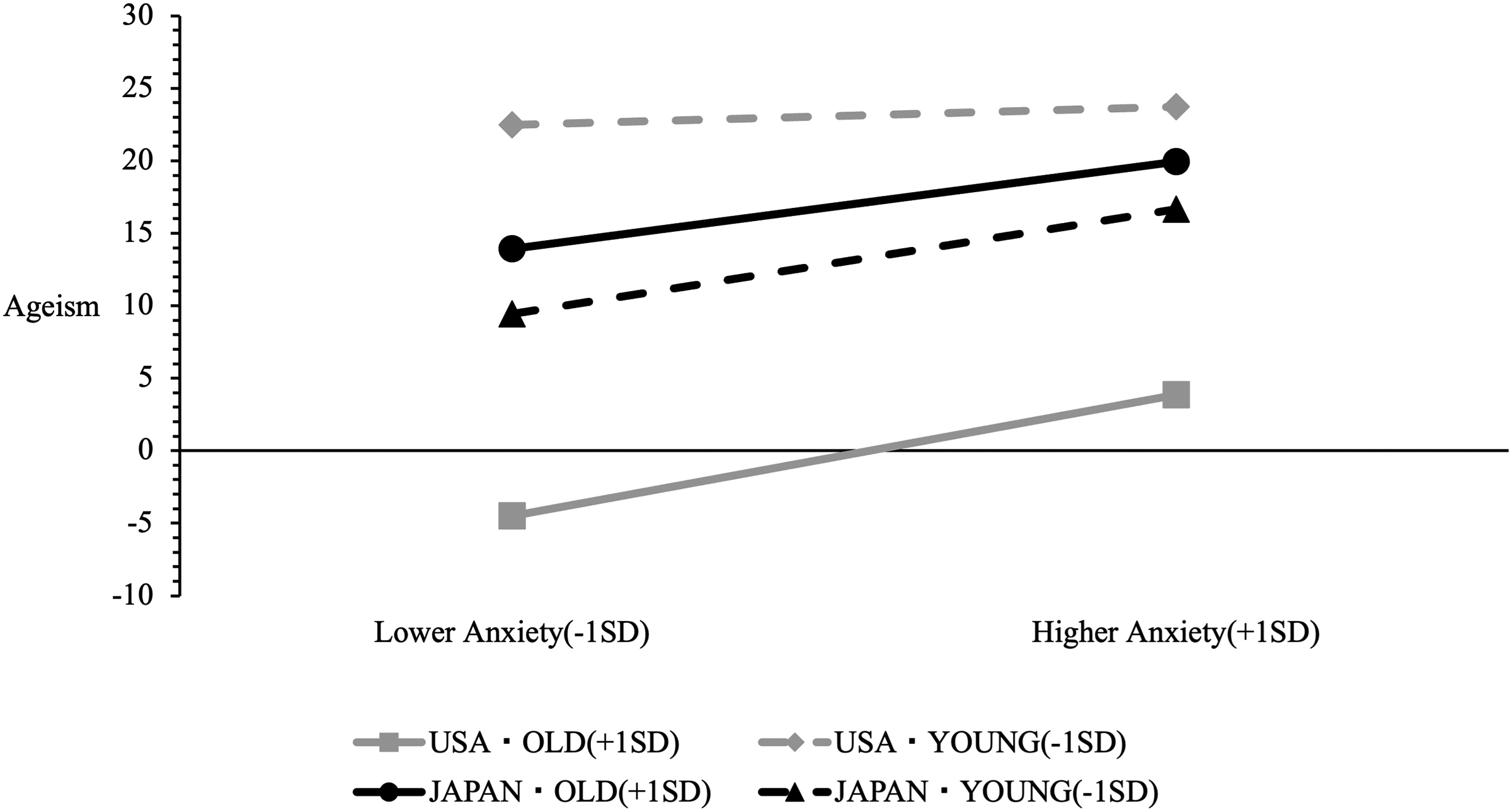
The three-way interaction between aging anxiety, country, and age predicting ageism score (N = 1442).
The value of adjusted R2 increased significantly after each addition of independent variables and interaction terms, reaching .37 in step 4. It should also be noted that potential multicollinearity between the predicting variables was rejected, as the variance inflation factor range was 1.08–4.38.
Discussion
In this investigation, it was examined how age and country enhance the association between aging anxiety and ageism. The findings of this study suggest that age and cultural differences may exist in that relationship.
Cultural Differences in the Levels of Ageism and Aging Anxiety
Ageism
Regarding the cultural difference in the level of ageism, the results of the two-way ANOVA showed that the main effect of country on the scores of ageism was not significant. In other words, hypothesis 1 that there is a cultural difference in the score of ageism and it would be higher in the United States than in Japan was not supported. The analysis results revealed that there was no age difference in the ageism score in Japan. On the other hand, in the United States, ageism was characterized by higher levels among the younger age group, and lower levels among the older age group. These findings supported the results of previous studies in the Americas (Rupp et al., 2005).
The first reason for these results is thought to be due to America's strong youth-oriented culture. This can cause young people to view old age as negative, and that their rejection of older people has become more pronounced to strengthen their identification with the in-group.
The second reason may be the difference in how to perceive subjective age. It has been reported that the subjective age of older adults in the United States is younger than their chronological age, but in Japan there is not much of a difference and they feel that their age is appropriate (Barnes-Farrell et al., 2002; Peluso et al., 2021; Sato et al., 1997). Our data also supported these results (in preparation). In other words, Japanese older adults feel their age just how they image it to be, but older adults in the United States perceive their condition better than their age-related image. Also, looking at the relationship between subjective older age and ageism from the data we collected, it was demonstrated that there was no correlation in Japan, but a positive correlation in the United States. In other words, people who perceive themselves as older than they actually are have stronger ageism, but people who perceive themselves as younger have weaker ageism perspectives. Therefore, in the case of the United States, it is possible that ageism may be alleviated by the subjective youthfulness of older adults.
The third reason may be the difference in average life expectancy between Japan and the United States. In Japan, where the average life expectancy is long, people still have further developmental stages even after they become older adults, so ageism does not decrease. On the other hand, in the case of the United States, it seems that individuals are not thinking that far ahead. The relationship between life expectancy and ageism should be an issue for future consideration.
Aging Anxiety
For the cultural difference in the level of aging anxiety, the main effect of country on the scores of aging anxiety was significant and it was higher in the United States than in Japan. In other words, hypothesis 2 that there is a cultural difference in the score of aging anxiety and it would be higher in the United States than in Japan was supported. The analysis results revealed that aging anxiety was characterized by higher levels among the younger age group, and lower levels among the older age group in the United States. On the other hand, in Japan, aging anxiety had a mountain-shaped characteristic, with the highest levels among middle-aged people.
The first reason why Americans had higher levels of aging anxiety overall could be due to differences in how they perceive aging. Because Americans are youth-oriented, they see value in being young, and they focus only on the negative aspects of old age. This can be interpreted as the reason that only in the US data there was an association between having more contact with older people and higher aging anxiety. In other words, older Americans feel that their aging conditions are good, so ageism is not high, however, in contrast, anxiety about future aging is influenced by contact with other older adults and is thought to be less likely to decline as people get older.
The second reason may be the difference in social structure. In Japan, unlike in the United States, more contact with older people was associated with lower aging anxiety. Japanese people have many opportunities for daily contact with older adults and they may view aging as more natural and positive.
The third reason refers to be qualitative differences in aging anxiety. In the case of Japan, where the population is more rapidly aging and people are living longer, the main concerns about old age are likely to be concerns about frailty and being bedridden, as well as concerns about finances and nursing care. On the other hand, in the case of the United States anxiety may be related to the mental, social, and physical aspects of retirement. In addition, although this study used a Japanese translation of the English scale, the cross-cultural equivalence of the scores has not been sufficiently examined, which should be done in future studies.
Cultural Differences in the Relationship Between Aging Anxiety and Ageism
Regarding the effect of age and country on the association between aging anxiety and ageism, it was hypothesized that the association would be enhanced by age differently in the United States and in Japan. It was expected that whereas in the United States older adults would demonstrate a stronger association between aging anxiety and ageism than younger adults, in Japan no age differences between younger and older adults would emerge. Our findings illuminated that the levels of aging anxiety in the Japanese participants were positively associated with their levels of ageism regardless of their age. On the other hand, for the American participants, the level of aging anxiety was positively associated with higher ageism only among older adults, and not among younger adults. Therefore, the hypothesis was supported.
The relationship between aging anxiety and ageism in the United States differs depending on age, and a positive relationship between aging anxiety and ageism was observed only among older people. In contrast, young people had high levels of ageism, regardless of their levels of aging anxiety. These results corroborate the idea of Bodner (2009), who suggested that aging anxiety is the main mechanism of ageism among older adults. In the case of young people, the level of ageism is generally high regardless of the level of aging anxiety, because ageism occurs as a result of reinforcing in-group identity to promote self-esteem. On the other hand, in the case of older people, aging anxiety is strengthened when they are conscious of transitioning to out-group and ageism occurs as a result of promoting a clearer distinction between themselves and the out-group. Consequently, the level of anxiety and ageism are significantly related.
On the other hand, in Japan, a positive correlation between aging anxiety and ageism was shown regardless of age. This is thought to be because the number of older adults is rapidly increasing in Japanese society, and members of society, regardless of their age, interact with older people to the same extent and are beginning to accept them and their aging. Another possible explanation is the changing structure of ageism in Japan. In Japan, the world's oldest society, ageism is no longer confined to the composition of “older people” versus “young people,” but it is possible that a composition of “even older and frail people” versus “other generations” has become conspicuous. In other words, it is thought that the participants of this study, who are classified into “other generations” here, had similar psychological mechanisms regardless of their age.
However, among Japanese participants, scores for both aging anxiety and ageism were highest for middle-aged people compared to younger and older people. Therefore, it is possible that a different and stronger association between aging anxiety and ageism could be observed in the middle-aged group. Further studies should be conducted regarding the role of aging anxiety for middle-aged people.
Limitation
Finally, several important limitations need to be considered. First, other variables should be included in the analysis, such as whether they have family members or close relatives who are bedridden. Being bedridden can give the most negative impression in the aging process and is thought to be reminiscent of death. This variable can be related to more opportunities to think about their aging and more negative thoughts and attitudes toward aging.
Next, the results of this study may change hereafter. In the future, the aging situation is expected to change and new systems will be introduced to society. Additionally, as the Japanese population declines, the number of foreign workers is increasing, and there is a strong possibility that typical Japanese cultural characteristics will fade.
Finally, online surveys have potential weaknesses such as the biased attributes of respondents (Evans & Mathur, 2005). A limitation of this study is that there was a difference in age between the American and Japanese samples. To generalize the findings of this study, it is necessary to expand the subject to a wider variety of samples and conduct further investigations. Furthermore, MTurk, which was used for the survey in the United States, is a crowdsourcing service that is mainly used in the United States, but it does not mean that only Americans are registered. Accordingly, it is possible that not only Americans responded to this survey, but also people with various other cultural backgrounds. Therefore, the results should be interpreted with caution because it is not possible to make a rigorous comparison between Americans and Japanese people.
Conclusion
This study set out to examine age and cultural differences in the relationship between aging anxiety and ageism. This study has shown that age difference in the positive association between aging anxiety and ageism was found only in the United States, not in Japan. These results imply that it is important to understand the psychological mechanisms that cause ageism considering social and cultural backgrounds. However, the current study did not include the variables that represent potential factors for cultural differences. Accordingly, future research should explore structural models among the factors to substantiate the previous discussion. When a structural model is established, the research can be expanded to other cultural areas using that model. That can make it possible to understand in more detail the causal mechanisms of ageism.
Footnotes
Declaration of Conflicting Interests
The authors declared no potential conflicts of interest with respect to the research, authorship, and/or publication of this article.
Funding
The authors disclosed receipt of the following financial support for the research, authorship, and/or publication of this article: This work was supported by the JST SPRING, gerontology research grant 2020 from SOMPO WELFARE FOUNDATION (grant number JPMJSP2138), and MEXT KAKENHI Grant-in-Aid for Transformative Research Areas (A) “Lifelong Sciences” (JP23H03888, JP20H05800).

Data availability
De-identified data and analysis code are available (Kikuchi, 2024). The study design, hypotheses, and analytic plan were not pre-registered.