




Abstract
A large body of research indicates that self-perceptions of aging (SPA) play an important role for health in later life. Hence, more research on SPA and correlates is needed, especially in old age and poor health, where negative SPA tend to prevail. Recent studies identified personality as an important correlate of SPA in young-old and relatively healthy samples. Thus, we investigated cross-sectional associations of agency and communion with two SPA domains in a sample of old-old adults in poor health (n = 154; Mage = 81.55, SD = 4.56, 58.4% women). In multiple regression analyses, agency and communion were associated with SPA related to ongoing development beyond health. In contrast, only health as a covariate was significantly associated with SPA related to physical losses. Thus, personality may be a resource associated with gain-related SPA, at least for those in poor health and old age.
In recent years, self-perceptions of aging (SPA), that is, what people think about their own age and aging, have emerged as an important concept in research on health in later life (for an overview, see e.g. Wurm et al., 2017). Thus, it is important to better understand which constructs are associated with SPA. Recent studies have suggested that SPA is related to personality (e.g., Kornadt et al., 2019, 2020; Rupprecht et al., 2019), which is defined as characteristic ways of thinking, feeling and behaving that distinguish people from one another (Kandler et al., 2014). However, these studies have focused almost exclusively on the Big Five personality traits and mostly considered young-old samples in relatively good health (e.g., O'Shea et al., 2017; Rupprecht et al., 2019). Yet, investigating correlates of SPA is especially important in situations where positive SPA are challenged and negative SPA are confirmed; this is particularly the case in old age and poor health, where people tend to associate their aging more strongly with physical losses and less with ongoing psychological development (Diehl et al., 2021; Wurm et al., 2020). To advance understanding of the relationship between personality and SPA in this setting, the present study explored associations of the “Big Two” meta-traits of personality, namely agency and communion (Martin & Slepian, 2020), with SPA in a sample of old-old adults in poor health.
SPA in Old Age
The concept of SPA gained in interest in the 1970s with the development of the Attitudes Toward Own Aging Scale (ATOA; Lawton, 1975), a unidimensional measure ranging from negative to positive SPA. Since then, the number of studies on the role of SPA in later life has increased immensely (cf. Westerhof et al., 2014; Wurm et al., 2017), suggesting that SPA may constitute an indicator of health and wellbeing, adjustment to age-related changes and overall successful aging across the second half of life up to old age (Baltes & Smith, 2003; Kleinspehn-Ammerlahn et al., 2008; Levy, 2003).
More recent measures like the Attitudes to Aging Questionnaire (Laidlaw et al., 2007), the Expectations Regarding Aging Scale (Sarkisian et al., 2002) and the AgeCog Scale (Steverink et al., 2001; Wurm et al., 2007) differentially assess perceptions of age-related gains and losses, thus acknowledging the multidimensional and multidirectional nature of adult development (Baltes, 1987; Kornadt et al., 2019, 2020). Two domains that have been found to be relevant for health in later life are the SPA domains of physical losses (i.e., declining health and fitness) and ongoing development (i.e., expanding capabilities and pursuing plans) as assessed by the well-established Agecog Scale (Diehl et al., 2021; Westerhof et al., 2014; Wolff et al., 2014; Wurm et al., 2017).
With advancing age, individuals perceive their aging more strongly as associated with physical losses and less with ongoing development (Diehl et al., 2021). This change in subjective perceptions of aging reflects, in part, objective age-related changes: The likelihood of experiencing disease, physical losses and limitations in one's activities increases in old age (Baltes & Smith, 2003). Yet, older adults can simultaneously perceive their aging as associated with ongoing development. It is thus important to shed light on factors that help to explain interindividual differences in the way people perceive their own aging.
Personality and SPA
Several studies point to associations of personality and SPA. A study on personality and subjective age, a construct related to SPA, found that this association seems to become stronger with age (Stephan et al., 2012), making the investigation of the relationship between personality and SPA in old age even more important. However, studies investigating personality and SPA have been mostly conducted in young-old, relatively healthy samples or large surveys of the general population. Such survey samples are known to be biased in terms of health, age, and socioeconomic status (Enzenbach et al., 2019).
A further conceptual limitation of previous studies on personality and SPA is that they primarily endorsed personality on the level of the Big Five traits. In these studies, neuroticism seems to be consistently associated with negative or loss-related SPA (e.g., Loi et al., 2015; Moor et al., 2006). Regarding the other traits, however, findings are inconsistent across studies and measures of SPA (e.g., Moor et al., 2006; Rupprecht et al., 2019). To add to the conceptual understanding of associations of personality and SPA, we thus examined the most basic level of personality, namely, the meta-traits of agency and communion. These two meta-traits emerge as higher-order factors of different personality levels such as the Big Five traits and personal values (e.g., Vecchione et al., 2011; for an overview see e.g., Blawert & Wurm, 2019).
Since the 1970s, agency and communion were first investigated as gender-related traits labeled masculinity and femininity (Bem, 1974; Spence et al., 1974), later as instrumental and expressive traits or agency and communion in order to overcome the strong focus on gender of earlier work on these traits. Agency (or masculine/instrumental traits) reflects a focus on the self and is associated with qualities such as dominance, decisiveness, and pursuing one's own goals. Communion (or feminine/expressive traits) reflects a focus on others and is associated with qualities such as warmth, the ability to build up and sustain positive social relationships, and helping others.
Despite their diverging focus, agency and communion are not mutually exclusive; a person can be highly agentic and at the same time highly communal, while another person might score low on both traits or high on one and low on the other. Agency and communion are inherently positive qualities and ideally, a person incorporates both agentic and communal traits, thus caring for the well-being of others without losing sight of personal needs (Bakan, 1966).
In early studies mainly conducted in young adults, this was expressed in the androgyny hypothesis suggesting that those high in both agency and communion (termed androgynous) could adapt most flexibly and successfully to situational demands (Bem & Lewis, 1975). However, some initial studies found agency (but not communion) to be associated with successful adaptation as reflected in mental health outcomes (masculinity model; for an overview, see Lefkowitz & Zeldow, 2006). In contrast, several more recent studies suggest that in later life, higher agency and communion are both associated with higher well-being (Helgeson, 1994; Matud et al., 2020) and life satisfaction (Dean-Church & Gilroy, 1993; Welzel & Inglehart, 2010). In addition, androgynous individuals report lower scores of depressive symptoms (Vafaei et al., 2016). High agency and communion may thus represent a prerequisite for successful aging (Perrig-Chiello & Hutchison, 2010). The integration of agency and communion is also considered a central component of generativity (Ackerman et al., 2000; Mansfield & McAdams, 1996; McAdams & de St Aubin, 1992), which might be perceived as a positive part of the aging experience. Moreover, the finding that agentic and communal themes in autobiographical memories foster optimism for the future (Austin & Costabile, 2017) might further translate into the perception of age-related ongoing development, given that optimism is associated with more positive SPA (Turner & Hooker, 2020).
Finally, agency is associated with positive self-evaluation (Abele & Hauke, 2020) and both agentic and communal themes emerge when older adults are asked to describe themselves freely (Diehl et al., 2004), pointing to the relevance of both meta-traits for the perception of the self (Paulhus & Trapnell, 2008). While, to our knowledge, associations of SPA with agentic and communal traits have never been examined, we found associations with agentic and communal personal values in an earlier study. Using population-based, longitudinal data of adults aged 40 + from Germany, that study demonstrated that agentic and communal personal values are differentially related to change in SPA domains (Blawert & Wurm, 2021): The growth-related agentic value of openness to change as well as the growth-related communal value of self-transcendence were found to predict increases in SPA related to ongoing development over the course of three years, while self-transcendence additionally predicted decreases in SPA related to social losses during the same period. These findings suggest domain-specific associations of agency and communion with SPA.
The Present Study: Agency, Communion and SPA in Old-Old Adults in Poor Health
In this study, we considered domain-specific associations of agentic and communal traits with SPA related to ongoing development and SPA related to physical losses. Given the findings reviewed above, we expected agency and communion to be related to SPA ongoing development beyond health. Regarding SPA physical losses, we hypothesized that – due to its more explicit focus on physical decline – agency and communion are not associated with this SPA domain when controlling for health.
Methods
Participants and Procedure
Data came from the intervention study TIGER (Transsectoral Intervention Program to Improve Geriatric Care in Regensburg). This study took place in the city of Regensburg in Southern Germany. Two hundred and forty-four older adults were recruited in a hospital and randomized into intervention and control groups. Starting in hospital, participants of the intervention group were supported by specialized nurses to prevent readmission to hospital over the course of one year. Details of the intervention are presented in Rimmele et al. (2021). For the present analyses, we combined data from the intervention and control groups that was collected one month after discharge from hospital using self-report questionnaires.
Inclusion criteria for the study were a minimum age of 75, living in a radius of 50 km from the city of Regensburg, a Mini-Mental State Examination (MMSE) result of at least 22 points, insurance by the statutory health insurance AOK Bavaria, admission to the hospital Barmherzige Brüder in Regensburg, and discharge to their own homes.
Exclusion criteria were planned discharge to a nursing home, palliative care situation, and planned readmission to the hospital within the next four weeks.
Measures
Agency and communion were measured with two subscales of the German Extended Personal Attributes Questionnaire (Runge et al., 1981). Participants were asked to rate how they would describe themselves in terms of eight agentic (e.g., independent, active) and eight communal (e.g., helpful, friendly) adjectives on a five-point Likert-scale (0 = not at all to 4 = very much). Item scores of the respective subscales were averaged and higher scores reflected higher agency or communion.
Self-perceptions of aging were measured with the AgeCog Scales (Steverink et al., 2001; Wurm et al., 2007). We used the two subscales of SPA ongoing development and SPA physical losses, each comprised of four items starting with the item stem “Aging means to me…”. An example item for SPA ongoing development is “Aging means to me that I continue to make plans”. An example item for SPA physical losses is “Aging means to me that I am less vital and fit”. Participants reported their agreement with each item on a four-point Likert-scale (0 = not at all to 3 = very much). Scores were averaged over the respective subscale. A higher score reflects higher agreement that aging is associated with ongoing development or physical losses.
As covariates we included emotional and physical health as assessed with the 12-item Short-Form Health Survey (Ware et al., 1996) to account for health status after a hospital stay and its known association with SPA. Item examples are “Does your health now limit you in climbing several flights of stairs?” (physical health; three-point Likert-scale; yes, limited a lot, yes, limited a little and no, not limited at all), and “How much of the time during the past four weeks did you have a lot of energy?” (emotional health; 7-point Likert-scale from all of the time to none of the time). Scores were coded so that a higher score indicates better health. All analyses were additionally controlled for age in years, sex (male or female), and education according to the International Standard Classification of Education (ISCED; UNESCO, 1997).
Analytical Procedure
All analyses were conducted using RStudio (R Core Team, 2019) and the lavaan package (Rosseel, 2012). We conducted t-tests for independent samples to compare study variables between our study sample and participants who did not provide sufficient data to be included in our analyses as well as between treatment and control group. To investigate bivariate associations between agency, communion, SPA, physical and mental health, we conducted zero-order correlation analyses. To examine unique relationships between agency, communion, SPA and emotional and physical health, we conducted multiple regression analyses. Multicollinearity was assessed using Variance Inflation Factors (VIF), with VIF ≥ 10 indicating multicollinearity between predictors (O’brien, 2007). For missing data, we used multiple imputations based on the packages mice (van Buuren & Groothuis-Oudshoorn, 2011) and miceadds (Robitzsch & Grund, 2021) for R. Following recommendations (Van Buuren, 2018; Zhang, 2016), 20 datasets were imputed based on the study variables. Pooled results from these datasets are presented as results of the regression and correlation analyses. For post-hoc power analyses, G*Power version 3.1 (Faul et al., 2009) was used.
Results
Sample Characteristics
Participants were included in the analyses if they provided information on at least one of the variables of interest, that is, agency, communion, SPA ongoing development and SPA physical losses. We thus included data of 154 older adults (58.4% women) with a mean age of 81.67 years (SD = 4.55) in our analysis. Respondents reported relatively low physical health (M = 31.71, SD = 9.86) compared with normative values from the German general population (Wirtz et al., 2018), t(110) = −8.94, p < .001, while not differing in emotional health (M = 45.29, SD = 11.69), p = .610. As expected for a sample of old-old adults in poor health, the dropout rate was relatively high in this study: Of the initially recruited 244 participants, 208 took part in the assessment one month after discharge from hospital and only 154 of these (63.11%) provided data for the cross-sectional statistical models of interest in this study. Of those n = 36 participants who did not take part in the T1 assessment, three (8.3%) died, five (13.9%) moved into a nursing home and thus discontinued the study and two (5.6%) reported a momentary break from the study. The remaining 26 (72.2%) participants did not return questionnaires, thus also counting as non-participants in the T1 assessment. However, participants who dropped out did not differ from our study sample in age, t(242) = 1.18, p = .241, sex, χ2(1) = 0.19, p = .660, and educational level, t(188) = −0.15, p = .880. Moreover, the treatment and control groups did not differ in variables of interest, p ≥ .071. Therefore, participants of both groups were included in our analyses.
Multiple Imputations
Multiple imputations were used to handle missing data (see Table 1 for percentages of missing data per variable) to ensure sufficient statistical power (Zha & Harel, 2021). We assumed missing data to be completely at random, which was supported by a non-significant Little's MCAR Test, χ2(99) = 108.00, p = .258. Thus, results of multiple imputations have a low risk of bias.
Pooled Bivariate Pearson Correlations of Study Variables.
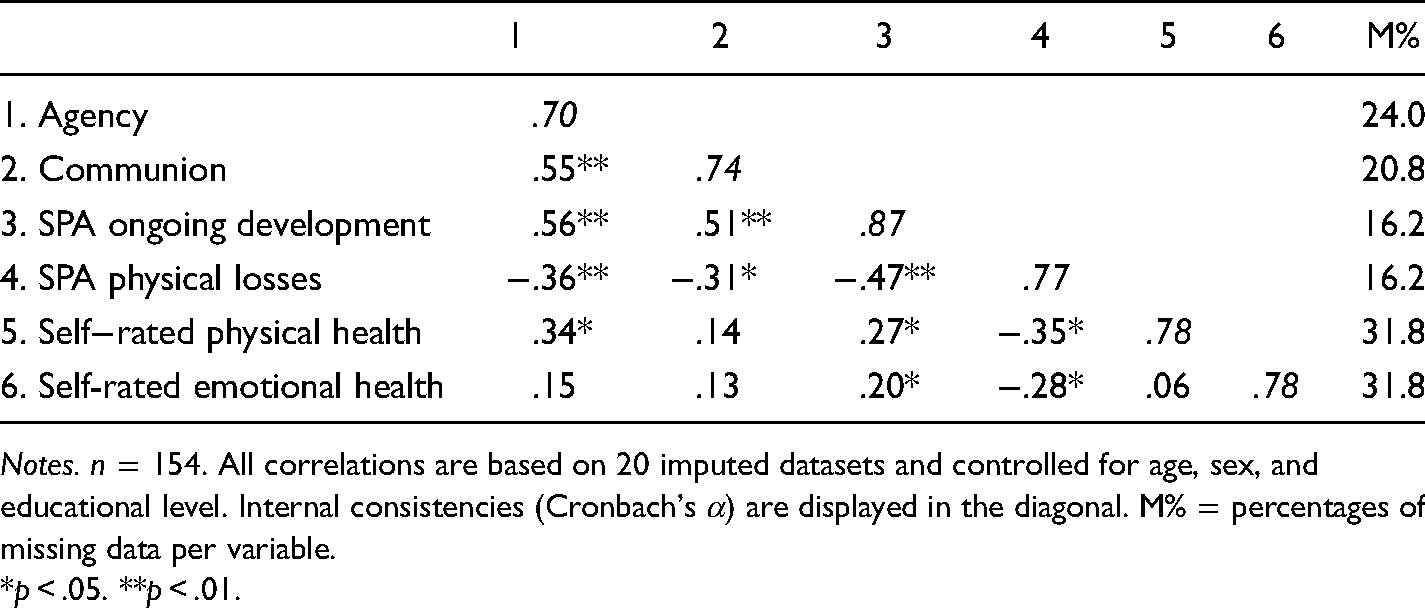
Notes. n = 154. All correlations are based on 20 imputed datasets and controlled for age, sex, and educational level. Internal consistencies (Cronbach's α) are displayed in the diagonal. M% = percentages of missing data per variable.
*p < .05. **p < .01.
Relationship Between Study Variables
Table 1 displays pooled intercorrelations of study variables based on 20 imputed data sets. On a bivariate level, agency and communion were highly correlated, r = .55, p < .001, and both were significantly associated with SPA ongoing development, ragency = .56, p < .001, rcommunion = .51, p < .001, and SPA physical losses, ragency = -.36, p < .001, rcommunion = -.31, p = .001. However, only agency (but not communion) was found to correlate significantly with self-rated physical health, ragency = .34, p = .003, while correlations of agency or communion with self-reported emotional health were not significant, p ≥ .157.
Associations of Agency and Communion with SPA Domains
Multiple regression analyses based on imputed data were conducted to investigate the relationship of the two SPA domains ongoing development and physical losses with agency and communion as well as self-rated physical and emotional health (see Table 2). All analyses were controlled for sex, age, and educational level, and inspection of VIF did not reveal collinearity (VIF ≤ 1.74).
Regression Models for SPA Ongoing Development and SPA Physical Losses.
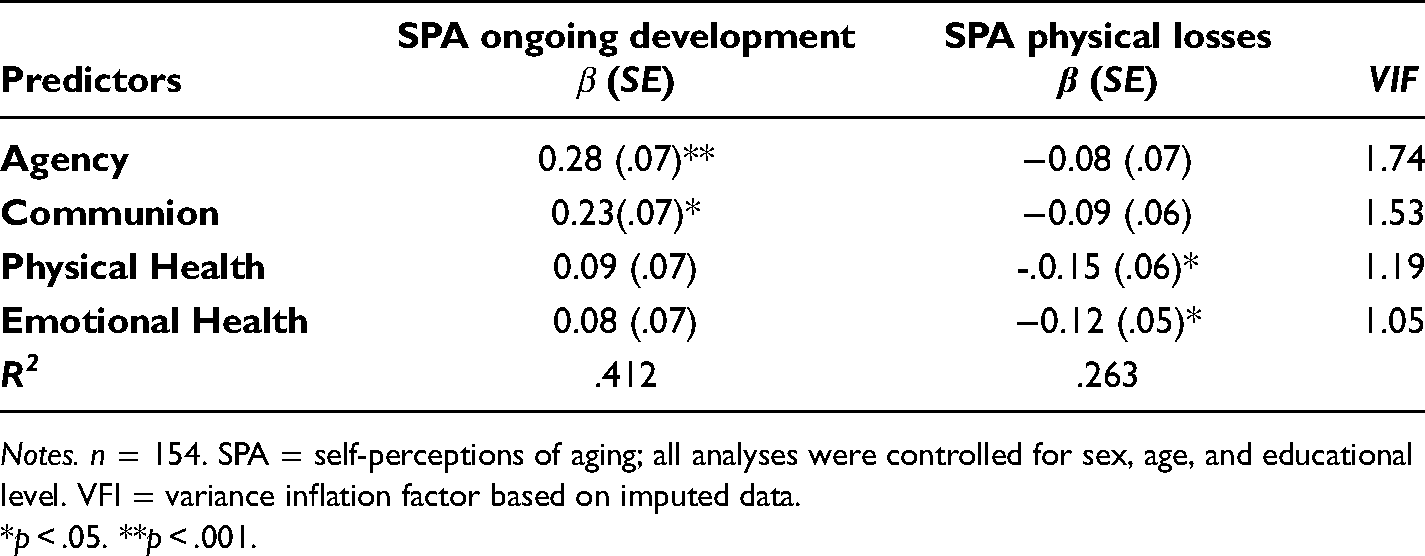
Notes. n = 154. SPA = self-perceptions of aging; all analyses were controlled for sex, age, and educational level. VFI = variance inflation factor based on imputed data.
*p < .05. **p < .001.
SPA Ongoing Development
SPA ongoing development were significantly associated with agency, communion, self-rated physical and emotional health, F(4, 516.10) = 15.24, p < .001. Taken together, they accounted for 41.2% of the variance (R2adjusted = .40) in SPA ongoing development. However, only agency, β = 0.28, t(516.10) = 3.90, p < .001, and communion, β = 0.23, t(516.10) = 3.37, p = .001, but not self-reported physical and emotional health accounted for significant unique proportions of variance in SPA ongoing development, p ≥ .239.
SPA Physical Losses
SPA physical losses were significantly associated with agency, communion, self-rated physical and emotional health, accounting for 26.3% of the variance (R2adjusted = .24) in SPA physical losses, F(4, 397.30) = 7.75, p < .001. However, while self-rated physical, β = −0.15, t(397.30) = −2.68, p = .009, and emotional health, β = −0.12, t(397.30) = -2.35, p = .020 accounted for significant unique amounts of variance in SPA physical losses, agency and communion did not share significant unique amounts of variance with SPA physical losses, p ≥ .116.
Post-Hoc Power Analyses
Our study represents a secondary analysis of the TIGER study. Thus, sample size was not planned to be sufficiently powered for the current analyses. Since power analyses for multiple imputed data and single regression coefficients are not yet well established (Zha & Harel, 2021), we based our post-hoc power analysis on complete cases (n = 80) and calculated the statistical power (α = .05) to detect an at least small effect (d = .20, Cohen (1992)) of agency, communion, physical or emotional health on SPA ongoing development or SPA physical losses. Results indicate that analyses based on complete data would have been sufficiently powered, β – 1 = .80. Thus, based on simulation studies (Kontopantelis et al., 2017; Zha & Harel, 2021), it is plausible to assume that the achieved power using multiple imputations is considerably higher and that our analyses are sufficiently powered.
Discussion
In this study, we investigated associations of agency and communion as meta-traits of personality with SPA related to ongoing development and physical losses in a sample of old-old adults in poor health. We hypothesized that higher levels of agency and communion are related to higher SPA ongoing development. Regarding SPA physical losses, we hypothesized that agency and communion are not related to this SPA domain when controlling for health. Results supported our hypotheses.
Associations of Agency and Communion with SPA Domains
Results on SPA Ongoing Development
In our study, agency and communion were significantly associated with higher SPA ongoing development. This suggests that old-old adults with a stronger agentic focus on the self as well as those with a stronger communal focus on others perceive their aging more as associated with making plans and learning new things. This finding might be due to the rather general nature of development that is addressed by the items: Making many plans and putting ideas into action can refer to agentic and communal development. For instance, a person high in agency might keep up a hobby like painting even when it becomes more difficult and experience ongoing development through maintenance of or even increasing artistic capabilities. A very communal person may invest effort in contact with family and friends and gain a sense of ongoing development through focusing on social contacts.
Interestingly, physical and emotional health were only associated with SPA ongoing development on a bivariate level, but not in the regression analysis. This suggests that health does not explain unique proportions of variance beyond personality in this SPA domain, indicating that the aspect of health that is associated with SPA ongoing development is accounted for by agency and communion.
Results on SPA Physical Losses
On a bivariate level, agency and communion were both negatively correlated to the perception of aging-related physical losses. These associations disappeared, however, when controlling for health in the regression analysis. This finding was in line with our hypothesis and suggests that personality does not account for a unique amount of variance beyond health in SPA related to physical losses, at least in this sample of old-old adults in poor health.
Our study corroborates findings from prior studies by indicating that personality and domain-specific SPA are clearly related cross-sectionally. Past research was mostly based on the Big Five approach and yielded inconsistent results on the relationship between specific Big Five personality traits and SPA. Thus, by examining the higher-order factors of agency and communion, our study provides a more general understanding of personality and SPA, which may also be useful to further explore the relationship between the two constructs. Furthermore, our study indicates that agency and communion as fundamental dimensions of personality relate to SPA not only on the level of personal values (Blawert & Wurm, 2021), but also on the level of traits. In addition, our findings add to studies pointing to the role of agency and communion for overall adaptation (i.e., successfully and flexibly meeting situational demands) and well-being in later life by showing that these traits also relate to the way old-old adults perceive their own aging.
In late life, personality and health are closely intertwined (Mueller et al., 2018). Thus, our study helps to disentangle the effects of personality and health for SPA by showing domain-specific associations with SPA in a sample of old-old adults in poor health.
The importance of agency for goal pursuit is also stressed in the motivational theory of life-span development (e.g., Heckhausen et al., 2010). This theory posits that individuals strive to exert control over their environment to reach their goals (primary control/agency), which is increasingly impeded by accumulating health problems in old age (Heckhausen et al., 2019). Our findings on the association of agency and communion with SPA ongoing development might be a sign of successful adaptation to changing health status in old age.
Limitations and Strengths
This study has several limitations. First, the sample is rather small and from the initial sample of 244 participants, we were only able to include data from 154 (63.11%) participants, due to drop-out and a high amount of missing data. However, data was missing completely at random, and dropouts did not differ from those who were included in our analyses in age or educational level. Second, TIGER is an intervention study, which may have affected results; however, intervention and control groups did not differ in study variables. Third, the present study was cross-sectional in design, so we cannot determine whether agency and communion affect SPA or vice versa. Furthermore, given the relatively high bivariate correlations between agency, communion and SPA, we cannot exclude the possibility that these variables are influenced by a third variable and that there is no causal relationship between them. In this regard, the investigation of self-efficacy and resilience factors as internal resources would be of interest. Self-efficacy as the perceived capability to shape one's life and environment is a central component of agency and also highly relevant in social relationships (Bandura, 2018), and higher self-efficacy is also related to more positive SPA (Tovel et al., 2019). In a similar vein, resilience as the capability to adapt successfully when faced with stressors is related to personality on the level of the Big Five traits (Oshio et al., 2018), and recent studies have found associations of resilience with SPA and attitudes towards aging (Kunuroglu & Yuzbasi, 2021; Losada-Baltar et al., 2021). A further limitation is that we cannot determine the role that the experience of hospitalization might have played in our analysis. Hospitalization could have increased the salience of health-related losses and thus could have masked a potential association of agency and communion with SPA physical losses that might emerge in another setting, survey period or population. Furthermore, we were not able to consider the type of health issue that led to hospitalization, as due to the study design, participants varied greatly in these health issues. It has to be noted that many old-old adults suffer from multiple health issues comorbidly, which makes disentangling effects of specific health issues (e.g., chronic vs. acute) difficult. In the current study, this is further complicated by the fact that chronic conditions could also have resulted in acute health events that led to hospitalization. In general, people are more likely to attribute chronic conditions to aging, while acute conditions are more likely to be attributed to illness (Stewart et al., 2012). For this reason, it would be interesting to investigate in future studies a potential moderating role of acute versus chronic health issues in the relationship of SPA with personality. Such studies should assess larger samples and include patients of a larger age range and from inpatient and outpatient settings as such samples would allow for an appropriate comparison between acute and chronic conditions.
Yet there are also several strengths to our approach. Our findings advance the understanding of the relationship between personality and SPA by first investigating the meta-traits of agency and communion. In addition, we were able to recruit an old-old sample in poor health; people in this group are usually less represented in larger studies and hence our findings give valuable insights on personality and SPA in a population in which positive SPA may be particularly threatened.
Implications for Future Research
Our findings provide starting points for a variety of research questions. For instance, future studies should investigate the relationship between agentic and communal traits and SPA domains longitudinally to examine the nature of a potential causal relationship. It might also be of interest to investigate the role of agency and communion for SPA domains other than the ones considered in this study, e.g., SPA related to family or working life (Kornadt & Rothermund, 2012), but also subjective age or other SPA measures (for an overview of measures, see Klusmann et al. (2020) in future studies. Furthermore, these studies could investigate potential mediators or moderators of the association of agency and communion with SPA. For instance, agency and communion might pose predispositions for differential behaviors that foster the perception of ongoing development. Regarding potential moderators, investigating the role of work and family transitions, e.g., prolonged paid work or premature spousal death, but also sociodemographic factors like gender and social class indicators such as education or income might well be advantageous. Such studies should use large-scale population-based surveys to allow for valid conclusions on the general population. In addition, including physical activity as a moderator or mediator might help clarify the lack of results for SPA physical losses. It might also be of interest to investigate the role of social activities and social engagement. Moreover, agency and communion might themselves serve as mediators or moderators in the association of health and SPA (Wurm et al., 2017), given the bidirectional associations of personality and health in old and very old age (Mueller et al., 2018). It might also be interesting to investigate associations of agency and communion with SPA in healthier or younger populations to examine whether the association varies by age and/or cohort. Future studies should also investigate associations of SPA with personality traits that relate to negative outcomes, such as unmitigated agency (i.e., a focus on the self to the exclusion of others, e.g., hostility) and unmitigated communion (i.e., a focus on others to the exclusion of the self, e.g., overinvolvement with other's problems and neglect of own needs). Moreover, our findings stress the necessity of investigating multiple domains of SPA, since constructs of interest might be associated with one domain, but not with another (Boeder & Tse, 2020). Using measures of general SPA might thus mask potential associations of important factors with specific SPA domains.
Conclusion
In this study, we advanced the understanding of SPA by showing that the “Big Two” of personality, namely agency and communion, are differentially associated with two SPA domains in a sample of old-old adults in poor health. Higher agency and communion were associated with higher SPA related to ongoing development. Conversely, neither agency nor communion were related to SPA related to physical losses when controlling for physical and emotional health. Our findings suggest that the investigation of agency and communion is effective in examining the relationship between personality traits and SPA domains. Moreover, our study showed that even in very old age and poor health, people still perceive aging-related gains in terms of ongoing development that are associated with their personality.
Footnotes

Declaration of Conflicting Interests
The author(s) declared no potential conflicts of interest with respect to the research, authorship, and/or publication of this article.
Funding
The author(s) disclosed receipt of the following financial support for the research, authorship, and/or publication of this article: This work was supported by the Innovation Fund at the Federal Joint Committee of Germany (grant number 01NVF17005).