




Abstract
Although dementia may affect the reliability of autobiographical memories, the psychological properties of nostalgic memories may be preserved. We compared the content of nostalgic (n = 36) and ordinary (n = 31) narratives of 67 participants living with dementia. Narratives were rated according to their self-oriented, social, and existential properties, as well as their affective content. Social properties and affective content were assessed using a linguistic word count procedure. Compared to the ordinary narratives described in the control condition, nostalgic narratives described a typical events, expressed more positive affect, and had more expressions of self-esteem and self-continuity. They were also rated higher on companionship, connectedness and the closeness of relationships, and reflected life as being meaningful. Despite their cognitive impairment, people living with dementia experience nostalgia in similar ways to cognitively healthy adults, with their nostalgic narratives containing self-oriented, social, and existential properties.
Keywords
Introduction
Nostalgia is defined as a “sentimental longing or wistful affection for the past” (The New Oxford Dictionary of English, 1998, p. 1266). Nostalgic recollections refer to momentous and atypical events in one’s life, such as anniversary celebrations, graduations, or holidays. These events are personally meaningful and almost always shared with close others (e.g., family members, friends, romantic partners). When nostalgizing, a person feels content, comforted, and often joyful, but also experiences a tinge of yearning or sadness for the irrevocability of the valued events; as such nostalgia is a bittersweet emotion, albeit more sweet than bitter (Leunissen et al., 2021; Sedikides & Wildschut, 2016). The emotion occurs frequently (e.g., several times a week; Hepper et al., 2021; Wildschut et al., 2006), across all age groups (Hepper et al., 2021; Juhl et al., 2020), and across cultures (Hepper et al., 2014; Sedikides et al., 2016).
In all, nostalgia is a self-relevant and social emotion, with existential overtones (Sedikides & Wildschut, 2018, 2019; Sedikides et al., 2015). Research on healthy adults has relied, in part, on coding narratives of nostalgic events and narratives of ordinary autobiographical (control) events to demonstrate this tripartite structure (i.e., being self-oriented, social, and existential). The self-oriented property is captured by the relatively high presence of references to self-esteem (Brown & Humphreys, 2002; Wildschut et al., 2006), self-continuity (i.e., sense of continuity between one’s past and present selves; Milligan, 2003), and optimism (Cheung et al., 2013) in nostalgic narratives. The social property is captured by the greater presence in nostalgia narratives of first-person plural pronouns (e.g., “we,” “us,” “ours”) and social words representing figures from one’s past (e.g., “mother,” “father,” “friend”), as well as more references to interacting with these figures, to being connected with them, and to companionship or belongingness (Abeyta et al., 2015; Madoglou et al., 2017; Wildschut et al., 2006, 2018). The existential property is captured by more frequent references to meaning in life in nostalgia narratives (Davis, 1979; Wilson, 2005). We note that coding also captures the ambivalent, albeit mostly positive, character of nostalgia. When juxtaposed to control narratives, nostalgic narratives contain more references to positive than to negative affect (Madoglou et al., 2017; Stephan et al., 2012; Wildschut et al., 2006, 2018). In this article we ask whether nostalgia’s tripartite structure is also evident among people living with dementia.
Nostalgia and Dementia
The term ‘dementia’ describes a neurodegenerative syndrome caused by a disease to the brain such as Alzheimer’s disease, vascular dementia, and frontal-temporal dementia. The consequences of dementia are predominantly psychological (British Psychological Society, 2016; Livingston et al., 2005), and involve the disturbance of multiple higher cortical functions, including comprehension, learning capacity, language and judgment (World Health Organization, 1992). Although the precise neurological profile may vary, most forms of dementia progressively reduce a person’s ability to recall autobiographical memories accurately and reliably. For example, at some point in their condition, people with dementia will experience a combination of anterograde amnesia (i.e., inability to form new memories) and retrograde amnesia (i.e., difficulty in recalling old memories), as a result of damage to the hippocampus and temporal lobes. These structural changes limit access to autobiographical memories (Morris & Mograbi, 2013), decrease a person’s capacity to update their self-knowledge (Addis & Tippett, 2004; Klein et al., 2003), and, by implication, diminish their sense of self (El Haj, Antoine, Nandrino, et al., 2015). Additionally, this neurological damage progressively confounds a person’s abilities to define themselves in relation to important others (El Haj, Antoine, Nandrino, et al., 2015), to maintain a sense of connection between their past and present (Ben Malek et al., 2019; El Haj, Antoine, Nandrino, et al., 2015), and to anchor themselves within their life history.
This neurological damage, then, may weaken those cognitive abilities that are involved in the construction of autobiographical memories (Conway et al., 2004; Singer et al., 2013) and point toward the possibility that the tripartite structure of nostalgia is diminished among people living with dementia. However, autobiographical memories still appear to have an important function for people living with dementia. For example, people with Alzheimer’s disease value reliving autobiographical memories (El Haj & Antoine, 2017), are able to retrieve such memories when they need to confirm that they are the same person they were before the dementia (El Haj et al., 2019), and experience the same emotions associated with these intrinsically personal memories (El Haj et al., 2016). These findings, then, are consistent with the possibility that the tripartite structure of nostalgic autobiographical memories continues to function for people living with dementia.
The Current Research
Although the neurological deterioration inherent in dementia inevitably impacts on cognitive functions that underpin autobiographical memory, it is unclear whether this impact degrades either the properties or the content of nostalgic autobiographical memories. We therefore tested whether the basic structure of nostalgia (i.e., being self-oriented, social, and existential) continues to be reflected in the narratives of individuals living with dementia. Specifically, we examined whether their nostalgic (vs. control) narratives would manifest more frequent references to (1) self-esteem, optimism, self-continuity (the self-oriented property), (2) companionship, connectedness to others, and relationship closeness (the social property), and (3) meaning in life (the existential property). We also examined whether the nostalgic and control narratives would differ on the relative presence of positive affect and negative affect. As a secondary objective, we attempted to delineate other aspects of the content of nostalgic (vs. control) narratives (as per research on healthy adults; Wildschut et al., 2006, 2018). In particular, we wanted to know whether nostalgic narratives were more or less likely than control narratives to describe a specific event, a period in the narrator’s life, a place, or a person, refer to atypical events, and reflect an emotional episode.
Methodology
Participants
Participants were recruited from three sites: the RICE memory clinic in Bath; memory services under the Avon and Wiltshire Mental Health Partnership NHS Trust; and the Join Dementia Research Register. All participants had: (1) a diagnosis of either probable Alzheimer’s disease (McKhann et al., 1984), probable vascular dementia (Román et al., 1993), dementia with Lewy bodies (McKeith, 2002), or a mixed form of these, with the diagnosis being made by a consultant psychiatrist or geriatrician within the previous 18 months; (2) mild or moderate levels of cognitive impairment as demonstrated, for example, by a score over 12 on the Montreal Cognitive Assessment (Nasreddine et al., 2005) screening tool; (3) the capacity to consent to be part of the research; and (4) sufficient communication skills to be able to take part. Participants were excluded if they had a history of pre-morbid psychiatric problems or a diagnosis of frontotemporal dementia (Snowden et al., 2002).
Design
We analyzed nostalgic and control narratives that were generated in two studies previously reported in Ismail et al. (2018, Studies 1 and 3), which used identical procedures. The protocols for both studies were registered, and all necessary ethical and site approvals obtained 1 . Both studies were parallel randomized controlled trials with two conditions (nostalgia, control) and an allocation ratio of 1:1. A sealed opaque envelope containing the case record form ensured that the experimenter was unaware of allocation until testing.
Experimental Manipulation
Following procedures validated with healthy adults (Sedikides et al., 2015), participants were instructed to recall either a nostalgic or an ordinary event from their lives. In the nostalgia condition, participants received the following instructions:
“According to the New Oxford English Dictionary, nostalgia is defined as a ‘sentimental longing for the past.’ Please bring to mind a nostalgic event in your life. Specifically, try to think of a past event that makes you feel most nostalgic. Bring this nostalgic experience to mind. Immerse yourself in the nostalgic experience. How does it make you feel? Please spend a couple of minutes thinking about how it makes you feel. Please describe this nostalgic event (i.e., describe the experience).”
In the control condition, participants received the following instructions:
“According to the New Oxford English Dictionary, an ordinary event is ‘an event with no special or distinctive features’. Please bring to mind an ordinary event in your life. Specifically, try to think of a past event that is ordinary. Bring this ordinary experience to mind. Immerse yourself in the ordinary experience. How does it make you feel? Please spend a couple of minutes thinking about how it makes you feel. Please describe this ordinary event (i.e., describe the experience)”.
Nostalgia manipulation Check
To test whether the experimental manipulation had been effective in inducing higher levels of nostalgia in the nostalgia (than control) condition, participants were asked to respond to three statements (Ismail et al., 2018; Wildschut et al., 2006): “Right now, I am feeling quite nostalgic,” “Right now, I am having nostalgic feelings,” “I feel nostalgic at the moment” (1 = strongly disagree, 6 = strongly agree). Mean levels of nostalgia were significantly higher in the nostalgia (M = 5.62, SD = 0.49) than control (M = 2.56, SD = 1.14) condition, t(39.34) = 13.94, p < .001, d = 3.42. The experimental manipulation of nostalgia was therefore successful.
Cognitive Functioning, Anxiety, and Depression
Cognitive functioning was assessed with either the Clinical Dementia Rating Scale (CDR; Hughes et al., 1982) or the Addenbrooke Cognitive Evaluation or ACE III (Noone, 2015). Anxiety was assessed with the Geriatric Anxiety Inventory (GAI; Pachana et al., 2007), and depression with the 15-item version of the Geriatric Depression Scale (GDS; van Marwijk et al., 1995).
Data Collection, Recording and Transcription
Data were collected in face-to-face interviews between participants and either the first author, or a research assistant. After screening, 38 participants were randomized to the control condition and 41 to the nostalgia condition. One participant in each condition was then excluded, because they scored below the cut-off for cognitive functioning. Five participants in the control condition and four in the nostalgia condition declined to give consent for their memories to be recorded, while the recording of one participant in the control condition failed. Digital recordings were uploaded to a secure site before they were transcribed by a researcher and subsequently erased. The researcher transcribing the sessions was unaware of which condition each participant had been randomized.
Data Coding and Analytical Strategy
Descriptive data. In total we analyzed 31 narratives from the control condition, and 36 narratives from the nostalgia condition. We compared the nostalgia and control conditions on participant age, gender, anxiety, depression, cognitive functioning, diagnosis, and narrative word length. We analyzed categorical data using chi-square tests, and continuous ratings using independent samples t-tests.
Content of nostalgic and control narratives. Narratives were analyzed using a coding scheme developed by Wildschut et al. (2018). We coded whether the narratives described (1) a specific event (e.g., “it was at my daughter’s wedding”), (2) a period in the narrator’s life (e.g., “I found that work very interesting”), (3) a place (e.g., “we used to go to a beach in Cornwall”), (4) or a person (e.g., “my father … used to have a kind of game in the evening when he and I would play ball.”). We further coded whether the narratives (1) involved atypical (e.g., weddings, holidays) versus routine (e.g., shopping, commuting) events, and (2) described an emotional (e.g., graduation, death of father) versus neutral (e.g., catching the bus, attending a Rotary lunch) event. More importantly, we coded the narratives in relation to their self-oriented, social, and existential properties (Table 1).
Coding of Narratives for Self-Oriented, Social and Existential Properties for Control and Nostalgic Narratives.
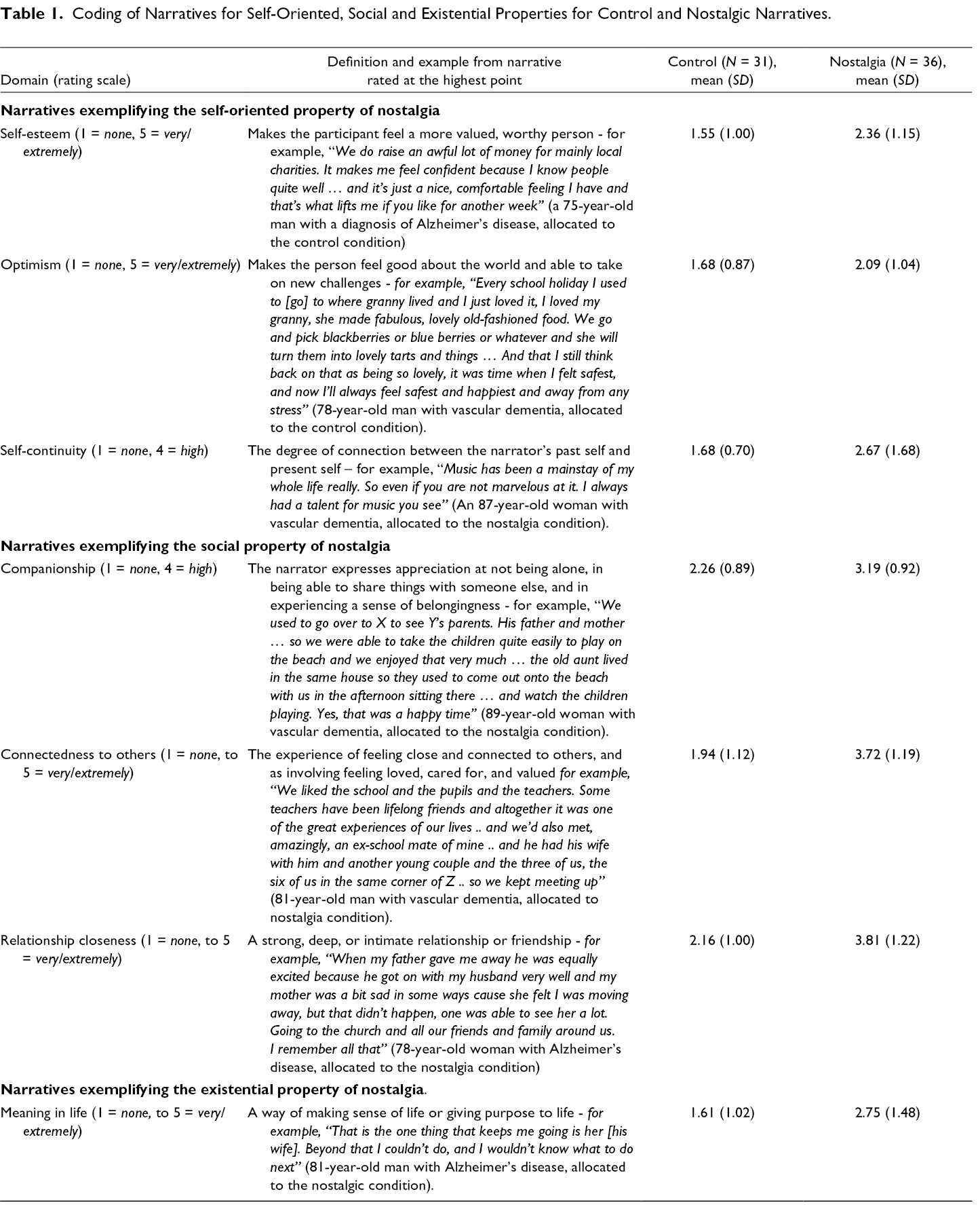
Two coders with experience in qualitative methods, who were unaware of participant allocation to conditions, independently rated all the transcripts. Coders made global ratings of narrative content while attempting to account for context and linguistic devices such as colloquial language, sarcasm, and homonyms. Inter-rater reliability, assessed with Cohen’s kappa, ranged from 0.55 to 0.94. The coders resolved disagreements through discussion.
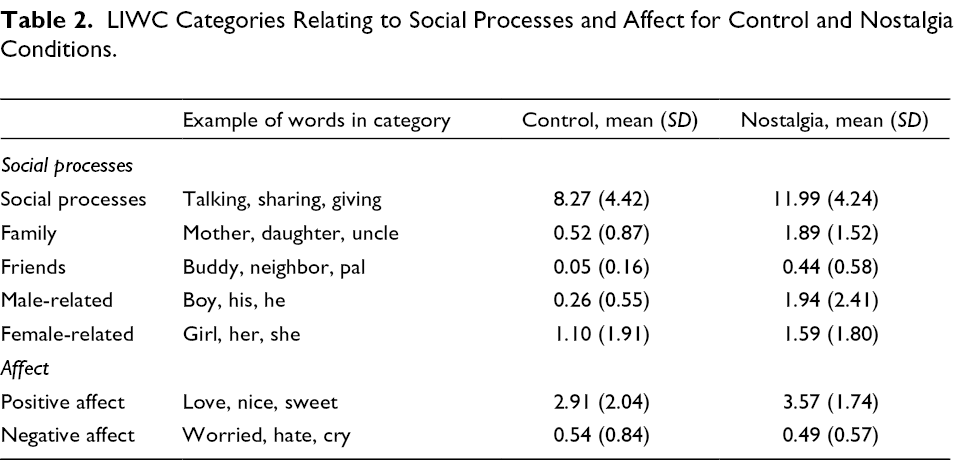
In addition to manually coding the narratives, we also examined their social property by subjecting transcripts to the Linguistic Inquiry and Word Count (LIWC; Pennebaker et al., 2015), an efficient and flexible method for studying the social content of verbal reports that has been used previously in the analyses of nostalgic narratives (Stephan et al., 2012; Wildschut et al., 2018). LIWC assigns the words in a text file to predefined linguistic categories, and then reports the frequency of each category as a percentage of the total words. For each narrative, up to 90 output variables can be produced. As well as taking into consideration the presence of verbs that suggest human interaction (e.g., talking, sharing), the social processes variable of LIWC includes four sub-categories, namely words relating to family (e.g., daughter, uncle), friends (e.g., buddy, neighbor), females (e.g., girl, her), and males (e.g., boy, his).
Further, we assessed the affective signature of nostalgic (compared to control) memories in two ways. First, following the procedure adopted by Wildschut et al. (2006, 2018), two coders rated the narratives along the 20 affective adjectives of the Positive and Negative Affect Schedule or PANAS (Watson et al., 1988), 10 of which express positive affect (e.g., “excited,” “enthusiastic”) and 10 negative affect (e.g., “distressed,” “upset”). We excluded from the analyses three positive affect adjectives (attentive, interested, alert) and three negative affect adjectives (hostile, ashamed, afraid), due to low inter-coder reliability. Each narrative was rated for the remaining seven positive affect adjectives (α = 0.79) and seven negative affect adjectives (α = 0.64), on a 5-point scale (1 = very slightly or not at all, 5 = extremely). We combined ratings for positive affect and negative affect items into two corresponding indices. Secondly, we examined differences between the nostalgia and control conditions in the LIWC category of affective processes (Table 2). This includes words relating to positive emotions and negative emotions.Thus, each narrative was assigned both PANAS-derived and LIWC-derived positive and negative emotion scores (four scores total).
LIWC Categories Relating to Social Processes and Affect for Control and Nostalgia Conditions.
We analyzed the ratings and LIWC data using independent samples t-tests. When testing the effect of nostalgia (vs. control) on measures within a broader outcome category (e.g., self-oriented property), we adjusted the level of significance using the Bonferroni correction (i.e.,,dividing the significance level of .05 by the number of comparisons) to account for multiple comparisons.
Results
Descriptive Data
We provide demographic data in Table 3. All participants identified themselves as White British, except for one participant in the nostalgia condition, who identified themselves as Chinese, and a participant in the control condition, who identified themselves as a member of another, white, community. There was no difference between participants in the nostalgia versus control condition on age, anxiety, depression, cognitive functioning, or diagnosis. However, the distribution of participants in the two conditions was uneven in terms of gender: there were more women (22) than men (14) in the nostalgia condition, and more men (20) than women (11) in the control condition, χ2(1) =4.38, p = 0.036, Ψ = 0.26. Also, nostalgic narratives (M = 213.78, SD = 130.26) contained more words than control narratives (M = 137.77, SD = 74.81), t(65) =2.87, p = 0.006, d = 1.05.
Demographic and Clinical Characteristics of Participants.
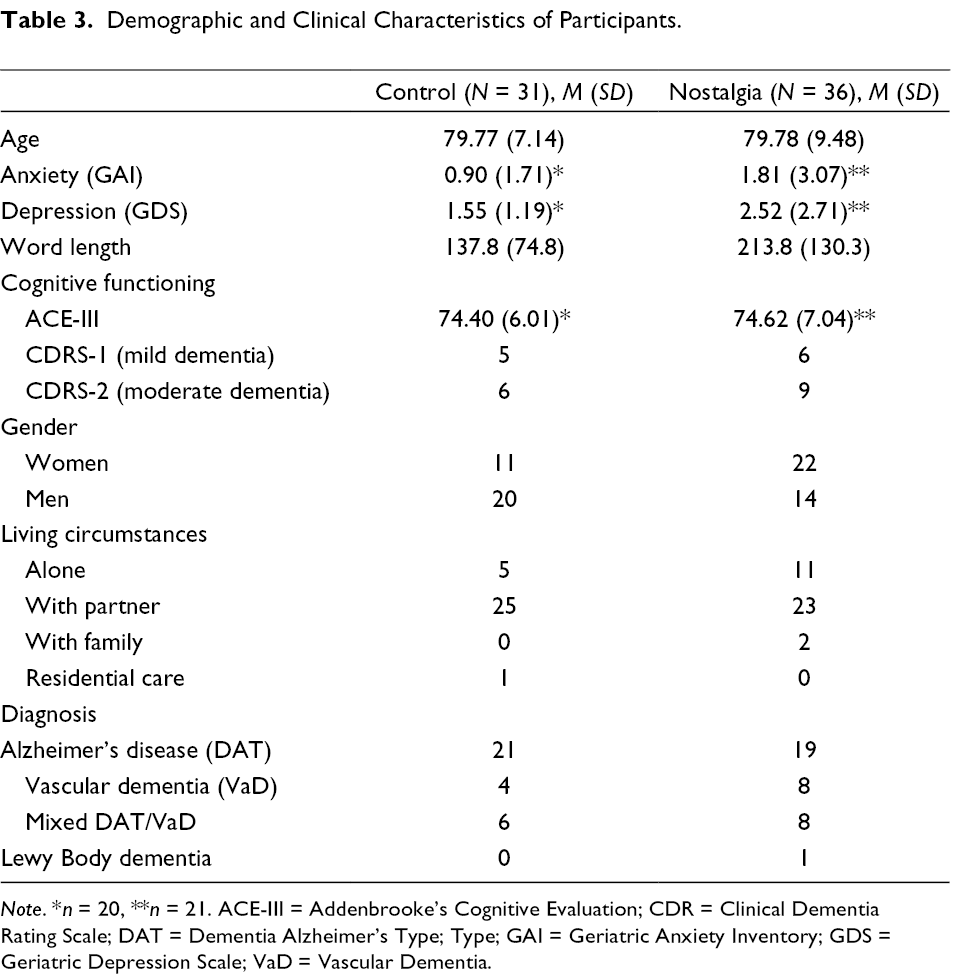
Note. *n = 20, **n = 21. ACE-III = Addenbrooke’s Cognitive Evaluation; CDR = Clinical Dementia Rating Scale; DAT = Dementia Alzheimer’s Type; Type; GAI = Geriatric Anxiety Inventory; GDS = Geriatric Depression Scale; VaD = Vascular Dementia.
Content of Nostalgic and Control Narratives
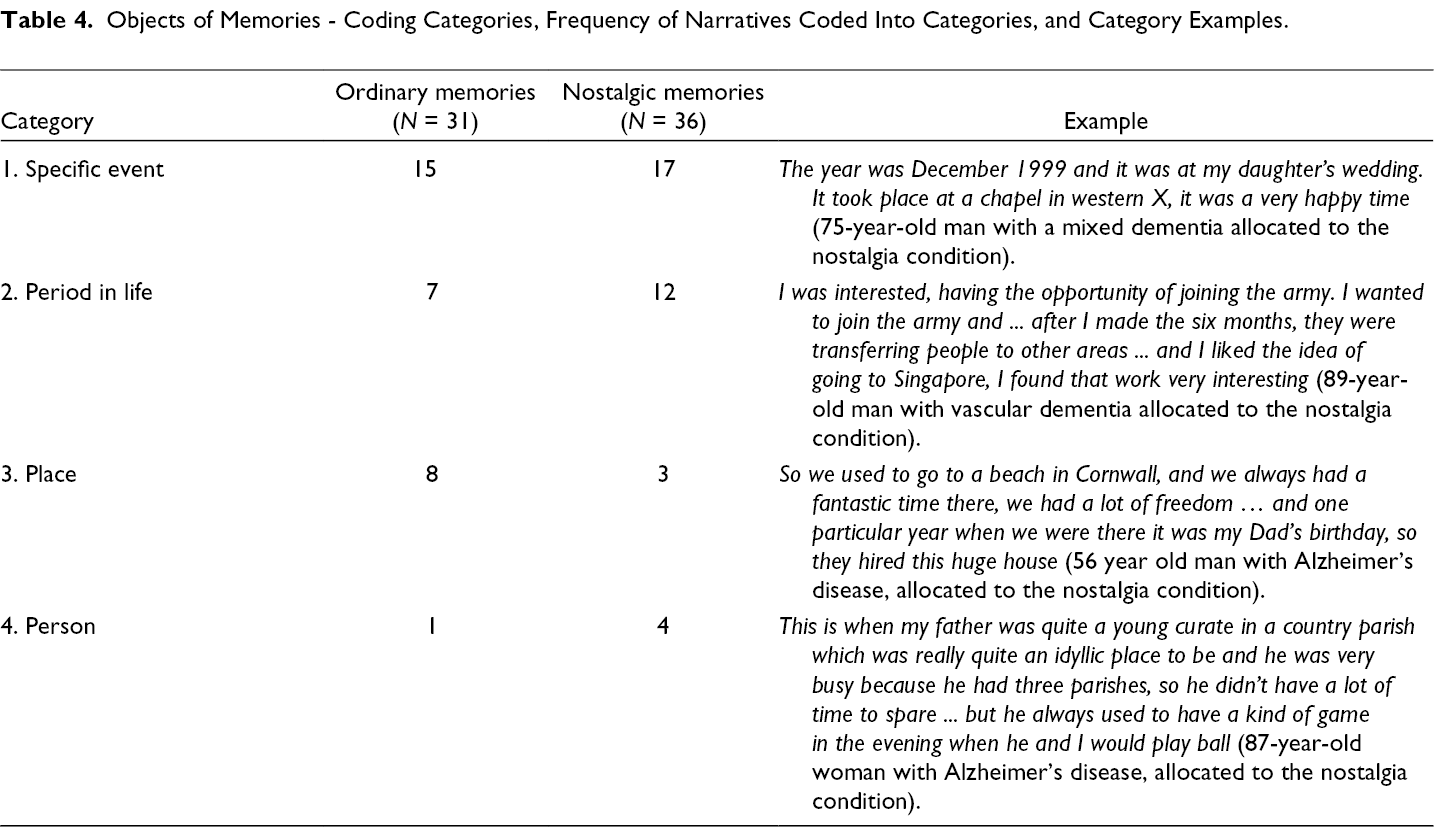
Table 4 details the frequency with which nostalgic and control narratives referred to specific events, periods, places, and people. The table also provides examples of each category. The two conditions did not differ in the extent to which they referred to each category. However, there were two differences between nostalgic and control narratives. First, all 17 nostalgic narratives which referred to a specific event were rated as reflecting atypical events. However, the 15 control narratives that related to a specific event were more likely to reflect routine events (9) and less likely to reflect atypical events (6). Thus, nostalgic (compared to control) narratives where more likely to describe atypical (relative to routine) events, χ2(1) =14.19, p < .001, Ψ = 0.67. Secondly, coders rated all 17 nostalgic narratives that related to a specific event as including an emotional component (e.g., graduation, death of a parent). In contrast, only one of the 15 control narratives that related to a specific event was rated as including an emotional component, with the remaining 14 being rated as emotionally neutral. Thus, nostalgic (compared to control) narratives were more likely to describe emotional (relative to neutral) events, χ2(1) =28.21, p < .001, Ψ = 0.94.
Objects of Memories - Coding Categories, Frequency of Narratives Coded Into Categories, and Category Examples.
Properties of Nostalgia
Self–oriented Property
In relevant analyses (all involving manual coding), we adopted a Bonferroni-adjusted significance level of p = .017. Nostalgic narratives contained more expressions of high self-esteem (t[65] =3.07, p = .003, d = 0.7) and self-continuity (t[65] =4.67, p < 0.001, d = 1.15) than control narratives. However, nostalgic narratives did not contain more expressions of optimism than control narratives (t[65] =1.72, p = .091, d = 0.43).
Social Property
We assessed the social property of nostalgia in terms of social processes (derived from LIWC word-text analysis) and social dimensions (derived from manual coding). In regard to the four LIWCsub-categories of social processes, we used a Bonferroni-adjusted significance level of p = .0125. For the three social dimensions, we used a Bonferroni-adjusted significance level of p = .017.
Social Processes
Nostalgic narratives featured a higher proportion of social processes words than control narratives (t[65] =3.50, p = .001, d = 0.86). Separate tests for each of the LIWC social processes subcategories revealed that nostalgic (compared to control) narratives contained a greater proportion of words relating to family (t[65] =4.40, p < .001, d = 1.11) and friends (t[65] =3.56, p = .001, d = 0.92). Nostalgic narratives also contained more male-related words than did control narratives (t[65] =3.79, p < .001, d = 0.96). However, nostalgic and control narratives did not differ significantly on female-related words (t[65] =1.09, p = .281, d = 0.26).
Social Dimensions
Nostalgic (compared to control) narratives contained higher levels of companionship (t[65] =4.21, p < .001, d = 1.03), connectedness (t[65] =6.30, p < .001, d = 1.54), and close relationships (t[65] =5.98, p < .001, d = 1.47).
Existential Property
Nostalgic narratives contained more references to meaning in life than control narratives (t[62] =3.70, p < .001, d = 0.90).
Positive affect and Negative Affect
Using the PANAS-derived ratings, we carried out a 2 (affect: positive, negative) × 2 (condition: nostalgia, control) mixed Analysis of Variance (ANOVA), treating affect as a within-subjects variable. The interaction was significant, F(1, 65) =13.86, p < .001, η2 = 0.18. Nostalgic narratives (M = 15.03, SD = 4.95) were characterized by more positive affect than control narratives (M = 10.48, SD = 3.66), t(65) = 4.31, p < .001, d = 1.06. However, nostalgic (M = 8.00, SD = 2.06) and control (M = 7.45, SD = 0.96) narratives did not differ significantly on negative affect, t(65) = 1.43, p = .16, d = 0.34.
We proceeded to test for differences on the LIWC-derived positive and negative affect scores. Again, we carried out a 2 (affect: positive, negative) × 2 (condition: nostalgia, control) mixed ANOVA, treating affect as a within-subjects variable. There was a strong main effect of affect, with both types of narrative expressing significantly higher levels of positive (M = 3.27, SD = 1.90) than negative (M = 0.51, SD = 0.70) affect, F(1, 65) =108.27, p < .001, η2 = 0.63. However, the interaction between emotion and condition was not significant, F(1, 65) =1.85, p = .179, η2 = 0.03.
Gender Differences
The higher number of women in the nostalgia compared to the control condition raises the possibility that the condition effect was confounded with gender. To control for this, we conducted a series of 2 (condition: nostalgia, control) × 2 (gender: male, female) ANOVAs on all dependent variables, using the same adjusted levels of significance reported above. These analyses did not reveal any significant gender main effects or Condition × Gender interactions. Importantly, all previously significant effects of condition (nostalgia vs. control) remained significant when we included gender in the model.
Discussion
Summary of Findings
We explored the nature of nostalgic narratives in people with dementia and examined whether these narratives’ key features resemble those seen in studies with healthy older adults. We established that both nostalgic and control narratives pertained to specific events, although nostalgic ones were longer, more likely to have a strong affective element, and more often referred to a typical than to routine experiences. In terms of the self-oriented property, nostalgic narratives contained more expressions of self-esteem and self-continuity, but not more expressions of optimism, than control narratives. In terms of the social property, nostalgic narratives featured a higher proportion of social processes words, especially words referring to family and to friends. Further, nostalgic narratives contained more references to companionship, connectedness, and close relationships. In terms of the existentialproperty, nostalgic narratives entailed more references to meaning in life.
Finally, results revealed higher levels of PANAS-derived positive, but not negative, affect in nostalgic than control narratives. However, there were no differences between conditions on the LIWC-derived affect measures. Importantly, these two ways in which we analyzed the affectivecontent of the narratives (i.e., PANAS and LIWC) tap into slightly different aspects. LIWC is a word-level text analysis programme that classifies and counts words into specific categories but does not take the meaning or context of the entire narrative into account, as it codes each word independently of all the others. By contrast, the PANAS scores were based on content analysis, where coders made global ratings of the content and meaning of the narratives while accounting for context and linguistic devices, such as humor and colloquial language (Wildschut et al., 2018). As such the results are not necessarily contradictory; rather, they point towards nostalgia increasing positive affect when measured as a gestalt (PANAS) as opposed to within specific words (LIWC).
Nostalgic and Ordinary Memories
Results indicated that the content of nostalgic autobiographical memories of people living with dementia differ from the content of their ordinary memories. Specifically, nostalgic (vs. ordinary) narratives are more self-oriented, social, and meaningful.
The findings pertaining to the self-oriented property of nostalgia are consistent with those of healthy adults (Brown & Humphreys, 2002; Milligan, 2003; Wildschut et al., 2006). Although autobiographical memories degrade in factual reliability among persons living with dementia, these memories may continue to facilitate self-functioning (El Haj, Antoine, Nandrino, et al., 2015; Morris & Mograbi, 2013). As mentioned above, nostalgic (compared to ordinary) memories were more likely to reflect events associated with higher self-esteem and self-continuity. Older adults, both with and without dementia, show a peak in the recollection of events from middle childhood, adolescence, and early adulthood (Kirk & Berntsen, 2018), a phenomenon that has been labelled the reminiscence bump. Although we did not examine the time period during which narratives were formed, many of the nostalgic events pertained to wedding days, family holidays, or graduations, and so they likely occurred within the time frame of the reminiscence bump. Such events, which tend to signify core characteristics of identity (Buchanan & Middleton, 1995), help to sustain the integrity of the self.
The findings pertaining to the social property of nostalgia are consistent with those of Wildschut et al. (2018), who, in a sample of healthy older adults, showed that nostalgic narratives contained a higher proportion of words relating to social processes and family. The social property of nostalgia may be especially important. Given that the lives of people living with dementia are framed within the context of a limited future time perspective, they may increasingly value positive social relationships (Carstensen et al., 1999). Under these circumstances, nostalgia may play a key role in establishing at least a symbolic connection with significant others across the lifespan (Mills & Coleman, 1994; Sedikides et al., 2004).
Lastly, the findings pertaining to the existential property of nostalgia are also consistent with those of healthy adults (Davis, 1979; Wilson, 2005). Meaning in life may be a subjective sense derived from the self-oriented property of nostalgia, as both self-esteem (Schlegel et al., 2009) and self-continuity (Van Tilburg et al., 2019) are positively related to meaning. Alternatively, meaning in life may be based on the social property of nostalgia, as sociality is positivity related to meaning (Routledge et al., 2011).
Potential Differences Between Nostalgic Memories of People Living with Dementia and Healthy Adults
Our findings are largely consistent with those produced by studies into the role of nostalgia in healthy adults. Yet, there are some inconsistencies. For example, nostalgic narratives contained more expressions of self-esteem and self-continuity than control narratives, but, unlike relevant findings among healthy adults (Cheung et al., 2013), they did not contain significantly more expressions of optimism (although there was a trend in that direction). Optimism concerns a projection of the self into the future. Although some people living with dementia report being optimistic and hopeful (Wolverson Radbourne et al., 2010), people living with dementia are generally less oriented to the future and more oriented to the present than cognitively healthy older adults (El Haj et al., 2020). Our findings align with this pattern.
Nostalgic (vs. ordinary) memories of people living with dementia were social: they featured a higher proportion of social processes words (especially ones describing family and friends), and contained higher levels of companionship, connectedness, and close relationships. These patterns concur with those from healthy adults (Sedikides & Wildschut, 2019; Wildschut et al., 2006) and specifically from older healthy adults (Wildschut et al., 2018). Additionally, nostalgic narratives were more likely to include affective elements, especially more positive emotions, but, broadly consistent with research with healthy adults (Leunissen et al., 2021), there was no difference between nostalgic and ordinary memories on negative affect.
Limitations
Although the key features of nostalgia narratives of people living with dementia are similar to those documented in studies with cognitively healthy older adults, we did not directly compare the memories of the two populations. Thus, it is possible that people living with dementia find it more difficult to recall nostalgic memories, and that these memories are less detailed or differ in other respects from those of their cognitively healthy peers. Subsequent research should, therefore, seek to map these contrasts directly.
The nostalgia condition included a higher number of women, and the control condition a higher number of men, creating a potential confound between condition and gender. However, when we repeated the analyses using gender as a between-subjects’ variable, the significant differences between nostalgic and control narratives remained intact. Furthermore, the relevant literature on healthy adults rarely finds differences in the nostalgic experiences of women and men (Sedikides et al., 2015). We therefore consider it unlikely that the between-conditions gender imbalance impacted substantially on the results. Nevertheless, our results need to be replicated with larger samples from different sites to determine the extent and relevance of gender differences.
Given that we focused on the content of nostalgic narratives, a question arises as to whether this content is linked to nostalgia’s functions. We derived the narratives from work by Ismail et al. (2018). In one experiment, people living with dementia who recalled a nostalgic (relative to an ordinary) event subsequently rated themselves higher on self-esteem, self-continuity, optimism, social connectedness/sense of belonging, meaning in life, and positive affect. These findings were then replicated in a follow-up experiment, in which nostalgia was induced with music. It seems, then, that the distinctive content of nostalgic narratives conduces to specific and distinctive psychological functions as well.
Implications and Conclusion
The three properties of nostalgia echo important themes within the dementia care literature: self-functioning (El Haj et al., 2019; Sabat, 2018), social relationships (Kitwood & Brooker, 2019), and meaning in life (Cheston et al., 2015; Mackinlay & Trevitt, 2010). Our findings indicate that nostalgia has a key role to play among persons living with dementia. We further note that nostalgia acts as a buffer against distress arising from threats to the self. Put otherwise, nostalgia provides a form of self-protection against events or circumstances that undermine a person’s core beliefs about who they are (Sedikides et al., 2015; Wildschut & Sedikides, 2020). This is relevant to dementia care, given the existential threat that dementia poses (Cheston & Christopher, 2019). Understanding the differences between nostalgic and ordinary autobiographical memories may, therefore, hold promise for interventions that not only enhance personhood, but also facilitate adjustment to the illness.
The distinction between nostalgic and ordinary autobiographical memories has implications for the design of interventions for people living with dementia and their families, such as reminiscence therapy (Woods et al., 2016). Given the substantive benefits that accrue from nostalgic reflection, reminiscence without nostalgia is likely to be relatively ineffective (Charlesworth & Wenborn, 2017). However, reminiscence therapy typically pays little, if any, attention to either the quality or the form of memories that are brought to mind. Instead, it is the act of recollection that is thought to be important. This act of remembering often occurs within a group context, in which the memories of one participant stimulate and trigger others in the group to reminisce themselves (Schweitzer & Bruce, 2008). Nostalgia by contrast, refers to the evocation of personally-relevant and emotionally poignant memories in which the self plays a prominent role within a social context. Consequently, the most effective method to evoke nostalgia is likely to be within small conversational pairs, such as couples or families who are able to draw on a repository of collective, shared memories (Dodd et al., in press). Although a person can reminisce without being nostalgic, they cannot be nostalgic without remembering (Batcho, 2007).
Not all autobiographical memories are equal. Compared to ordinary narratives, nostalgic ones are characterized by self-oriented, social, and existential properties. Capitalizing on these properties, recent studies have begun to explore nostalgia’s beneficial effects for well-being among students (Layous et al., in press) and older people (Bong et al., 2020). Despite often severe cognitive impairment, people who live with dementia engage in nostalgic reverie in similar ways to the wider population, and so are also likely to be receptive to the psychological benefits that nostalgia confers. It is vital, then, that dementia clinicians and researchers rise to the challenge of harnessing the potential of nostalgia.
Footnotes
Acknowledgments
We thank participants for volunteering in this research. We also thank the staff at the RICE memory clinic, and the Research and Development unit of Avon and Wiltshire Mental Health Partnership NHS Trust, who supported this project - particularly Lauren Buckley, Charlotte Godwin, India Hart, Tom Ingram, Abbie Jones, and Michelle Phillips.
Declaration of Conflicting Interests
The author(s) declared no potential conflicts of interest with respect to the research, authorship, and/or publication of this article.
Funding
The author(s) disclosed receipt of the following financial support for the research, authorship, and/or publication of this article: This work was supported by a bursary from the University of the West of England and a grant from Alzheimer’s Research UK (UWE ref: HAS-HSS-15-033).
Note
Author Biographies