




Abstract
Contrary to a longstanding scholarly view that Rousseau’s Second Discourse, or Discourse on the Origin and the Foundations of Inequality Among Men (1755), is a merely critical text, I argue that this work provides readers with a positive model for exit from corrupt, unequal political society. In the engraved frontispiece illustration, the central figure is an indigenous Hottentot raised by Europeans. He ultimately exits from European civilized society, liberating himself and recovering equality. Yet he retains two European items, a cutlass and a necklace. In correspondence, Rousseau praised this illustration for aligning with his theoretical vision. Yet scholars haven’t fully investigated its significance. Taking into account, for the first time, an overlooked detail—the Hottentot’s so-called “necklace” is actually a constraining chain—I offer a new reading that highlights liberation from inequality. I explain the caption and historically contextualize Rousseau’s Hottentot compared to Rousseau’s European sources. The frontispiece story illustrates both the psychological basis for pernicious political inequality and civil society’s inferiority to “sauvage” life. Further, my reading exposes a novel theoretical aspect of the Discourse: Rousseau’s constructive insight on how civilized eighteenth-century readers should respond to his critique of civilization. Rejecting unequal political arrangements and “returning” to sauvage freedom is a difficult but real option that courageous individuals might freely choose and take pride in. What I call Rousseau’s emancipatory authorship engages readers’ pride or amour-propre and challenges them to seek freedom and equality, or at least gain critical awareness of the pernicious political conditions around them.
Introduction
When political theory isn’t attempting to identify a good society, it considers how to respond to a bad one. Rejecting corruption can take various forms: protest, rebellion, reform, revolution—and exit. 1 Jean-Jacques Rousseau’s Second Discourse, the Discourse on the Origin and the Foundations of Inequality Among Men (1755), begins with an exit. In the frontispiece illustration, an indigenous man from the Cape of Good Hope, raised by Europeans and called only “the Hottentot,” 2 stands between a hulking Dutch fort and a little Hottentot village. Poised assertively like an orator or teacher, he declares to the watching Dutchmen that he’ll return to his ancestral way of life. But he’ll keep his cutlass and “collier,” or necklace.
Scholars from Kant to Rawls have read Rousseau’s early political works, including the Second Discourse, as critical texts that diagnose society without offering remedies. 3 Rousseau complained that readers didn’t understand the Discourse (Confessions, 389). In this article, I show that the frontispiece illustration in particular hasn’t been understood. It must be studied anew in order to grasp Rousseau’s critique of society, and the Discourse’s position on how readers might escape to a better life when their psychology traps them in civilized political misery.
Even when scholars focus on Rousseau’s Discourse, the frontispiece story often goes unmentioned. 4 It hasn’t received the attention devoted to other famous engravings in the history of political thought, foremost, the Leviathan frontispiece. 5 When scholars do analyze Rousseau’s Hottentots, it’s often alongside other case studies illustrating eighteenth-century European thinking about race, development, and colonialism. 6 However, this valuable scholarship doesn’t elaborate on the Hottentot’s role within Rousseau’s theory.
Only two sustained frontispiece interpretations exist. Using the frontispiece to defend “a fugitive conception of political freedom in Rousseau,” Klausen focuses in this discussion on the consequences of literal emancipation in colonial contexts. 7 He doesn’t use the frontispiece to interrogate the means to liberation, including liberation from metaphorical “moral slavery,” which he recognizes is Rousseau’s surface focus. 8 Meanwhile, Scott centers first the frontispiece’s role in the Discourse’s structure, and second, Rousseau’s affinity with the Hottentot. 9 Neither author fully interrogates the frontispiece caption nor contextualizes Rousseau’s Hottentot compared to Rousseau’s sources.
Furthermore, neither Scott nor Klausen elaborates on what I argue readers should glean from the frontispiece. My new interpretation integrates a detail commentators have overlooked, apparently since the Discourse’s publication: the Hottentot’s collier isn’t jewelry. Rather, it’s a constraining chain that’s been broken. It resembles a chain at first glance and only becomes intriguing after the explanatory note calls it a collier. Why would the Hottentot call a constraining chain a “necklace”? And why would he want to keep it? In the Discourse, Rousseau explicitly challenges readers to think critically alongside his text (186/191–192). 10 I argue that interplay between the collier’s name and its appearance invites just such thinking. By playing picture and text off one another, Rousseau creates the conditions for readers to contemplate new ideas without feeling oppressed by heavy-handed authorial didacticism. As the text unfurls, it allows readers to consider emancipation on an individual basis.
Thus, the Second Discourse frontispiece and its story clarify the terms of Rousseau’s pessimism. Becoming “civilized” means being unfree, unequal, depraved, and miserable; yet wholesale atavism is neither possible nor desirable. At the same time, I argue against the over-strong conclusion that “there is no ‘return’ for Rousseau.” 11 I demonstrate that for Rousseau, under specific circumstances, individuals can willingly exit unfree, unequal political society and “return” to a simpler sauvage state. 12 Scholars remark that Rousseau’s Émile (1762) and Reveries (1782) offer individual solutions to collective problems: ways to tolerate, or withdraw from, bad political systems. 13 A fresh frontispiece reading reveals Rousseau already theorizing related issues in 1755. Thus this article firmly situates Rousseau as an early “state evasion” theorist, 14 and the Second Discourse as a text that depicts, and provokes, liberation from civilized inequality. One response to bad politics is simply to leave.
How can civilized individuals, even Europeans without available ancestral free communities to return to, reject pernicious political circumstances and choose simpler, better lives? By historically contextualizing Rousseau’s Hottentot in comparison to Rousseau’s European sources, I show that Rousseau’s Hottentot is depicted as racially indistinct; “otherness” doesn’t hinder Europeans from emulating him. If readers consider both image and text, they can refine insufficiently nuanced first impressions. They can think along with the Hottentot story: grasping civilized society’s ills makes it possible to leverage the causal power of pride or amour-propre against psychological drives that trap us in pernicious circumstances. Thus even the pessimistic Second Discourse may offer a positive use for amour-propre. 15 We can take pride in ceasing to depend on misguided opinions for our self-worth. This can lead us to freely choose liberty and equality over habitual comforts, and uproot ourselves from modern civilization entirely; or we might merely gain a clear-sighted, critical outlook upon it. A good reputation among bad people is a worthless thing.
The Discourse challenges readers to consider the possibility of liberation and to free at least their minds, if not their bodies.
Author & Illustration
In this section, I introduce and contextualize the frontispiece, establishing both Rousseau’s involvement in its composition and its importance for the Discourse. The story comes from Abbé Prévost’s 1748 travelogue collection, Histoire Générale des Voyages.
16
Simon Van der Stel, governor of the Dutch colony at the Cape of Good Hope, “takes” the young Hottentot. It’s unclear whether he’s an infant or a child, unclear whether he’s kidnapped or saved from exposure, as apparently often happened (HG 160–61). The Hottentot assimilates well to a European education and eventually works with a commissioner for the Dutch East India Company or VOC, in India (220/221). After the commissioner dies, the Hottentot visits “some Hottentot relatives.” The text doesn’t suggest he knew more about them than their identities. Nevertheless, after visiting them, he abandons European society. Returning his European attire to the governor, the Hottentot says: Have the goodness, Sir, to note that I forever renounce these trappings. I also renounce the Christian Religion for the rest of my life; my resolution is to live and die in the Religion, the ways, and the customs of my Ancestors. The one favor I ask of you is to leave me the Necklace [Collier] and the Cutlass I’m wearing. I’ll keep them for love of you (220–221/221).
He doesn’t wait for the “favor” to be granted: “Straightaway, without awaiting Van der Stel’s reply, he ran off, and was never again seen at the Cape.”
The engraving (see Figure 1) depicts the moment before the Hottentot’s departure. Newly dressed in sheepskin, he addresses five Europeans. One, seated in the middle, hand held to his face, may be the governor. The others react differently: hands splayed and mouth open; finger to the lips, perhaps in confusion; a blank, neutral expression, as though still absorbing the new development; a skeptical side-eye, peering from behind the crowd. None move to prevent the Hottentot’s departure. The Hottentot gestures out toward the seashore and the little mobile village where Hottentots crouch among their huts. In the foreground sits the discarded European garb, 17 including a feathered hat like the Dutchmen’s. The caption reads, “He returns to his Equals.”
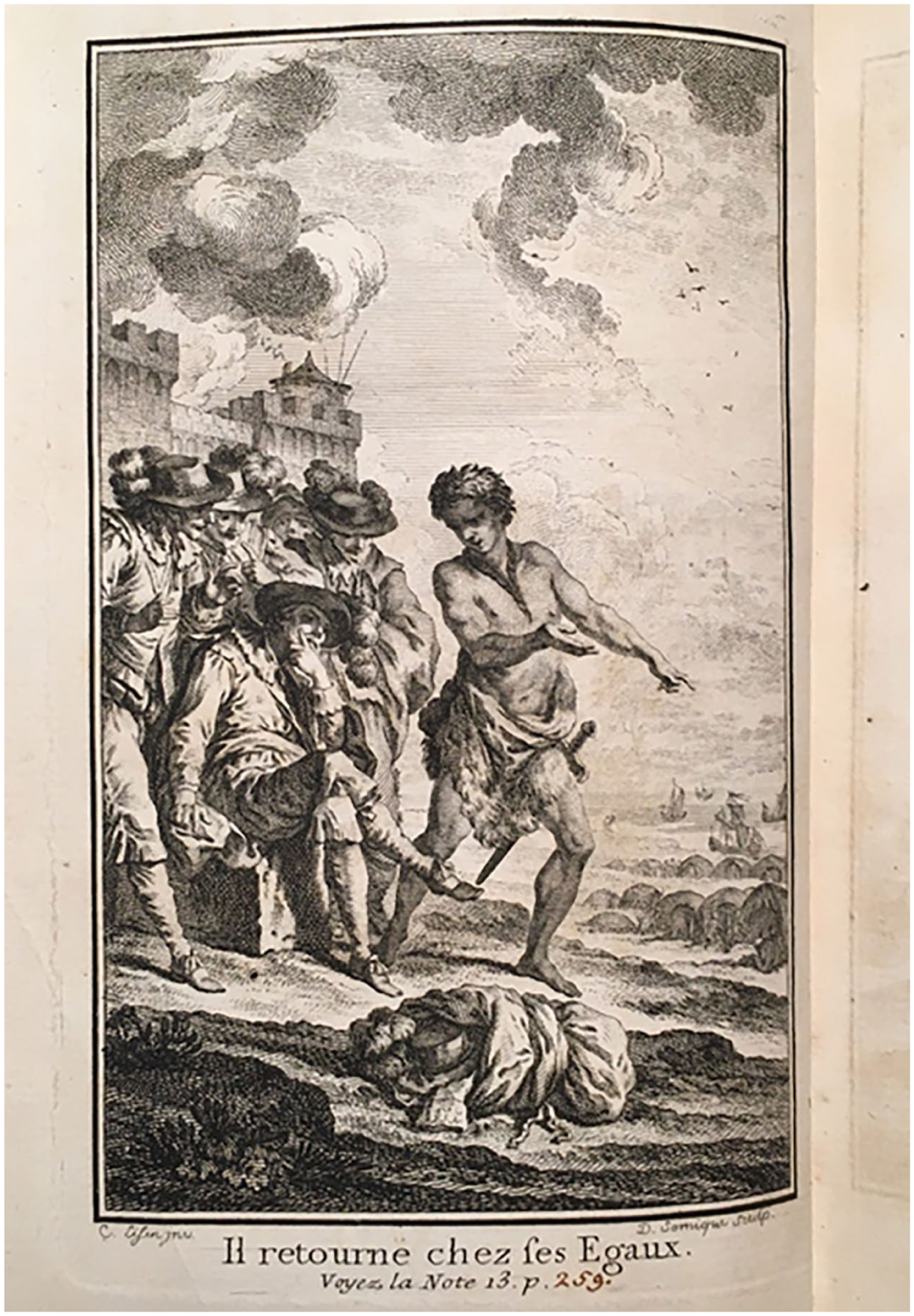
Frontispiece engraving. Source: Fisher R68-D58-1755 cop. 1.
Rousseau commissioned the illustration from Charles Eisen and later praised it for aligning with his theoretical vision. In 1757, he writes that what matters isn’t “what the draftsman must render, but what he must know in order to conform his work to it as much as possible. All that I described must be in his head in order to put into his engraving all that can go there and not to put anything that opposes it.” 18 Rousseau then praises the Hottentot frontispiece’s draftsman. Rousseau also indicated approval for Eisen’s work by commissioning him again, to illustrate the original Émile (1762).
Rousseau’s precise attention to his illustrations, which Scherf calls “without equivalent in the eighteenth century,” 19 is unsurprising. The teenage Rousseau trained as an engraver. 20 Later, he remained intellectually occupied with images’ pedagogical and rhetorical power (Origin of Languages 376–77; Émile 647–78).
Rousseau took paratext seriously, using it to structure his work. He warns his editor Marc-Michel Rey, “Don’t forget [in the endnote] to mark exactly the frontispiece’s location, and in the frontispiece to [mark the endnote’s location].” 21 Even before the Discourse’s title page, readers encounter the frontispiece. Its caption points to an endnote—technically the Discourse’s first substantive text—that uses the Hottentot to prove sauvage life’s superiority over civilized life. Halfway through the main text, readers are redirected to the same endnote, which appears among the work’s final pages. Except for the last three short endnotes, the entire text is literally between the illustration and its story. The frontispiece frames the Discourse. Its themes echo throughout. 22
When readers encounter the Hottentot endnote, they’re directed to look again: “voy. le frontispiece” (220/221). In his First Discourse, Rousseau explains that frontispiece’s metaphors (16/17; New Refutation, 90/102). Only in the Second Discourse does he direct readers to look at—to see—the frontispiece. 23 He doesn’t spoon-feed them its meaning. Rousseau’s instructions for readers, his later evaluation of the illustration, and its placement all urge serious interpreters to consider the frontispiece closely. 24
Liberation
The Discourse’s other illustration, the title image by Pierre Soubeyran, displays freedom images: liberty cap, snapped yoke, cat, broken chains, a bird escaping its cage, and Liberté personified. 25 Four of six symbols specifically represent liberation or emancipation, not liberty itself. In this section, I show how the Hottentot frontispiece, too, and especially the collier, emphasizes the transition from freedom to unfreedom as a key theme in the Discourse.
The narrative tells us the Hottentot’s destination is the Hottentot village, on the right. Only this side shows birds flying free over a sea dotted with ships. Overall, the picture is divided on a descending diagonal from left to right. The darker, ink-heavy, left-hand side features the Dutch fort and cluster of Dutchmen. Meanwhile, the airy, lighter, right-hand side exhibits a cloudy sky and the Hottentot village below. The spacious promise of natural living is juxtaposed with the ornate, oppressive clutter of European civilization. The illustration captures the Hottentot literally half-in and half-out of the side that represents modern civilized society. But he won’t remain long. The description tells us he’s travelling from an atmosphere of cramped constraint to one of greater freedom, never to return. When we see the frontispiece and title juxtaposed in situ as a two-page spread (Figure 2), the Hottentot points to the village with one hand. With the other, he almost gestures at Liberté herself.
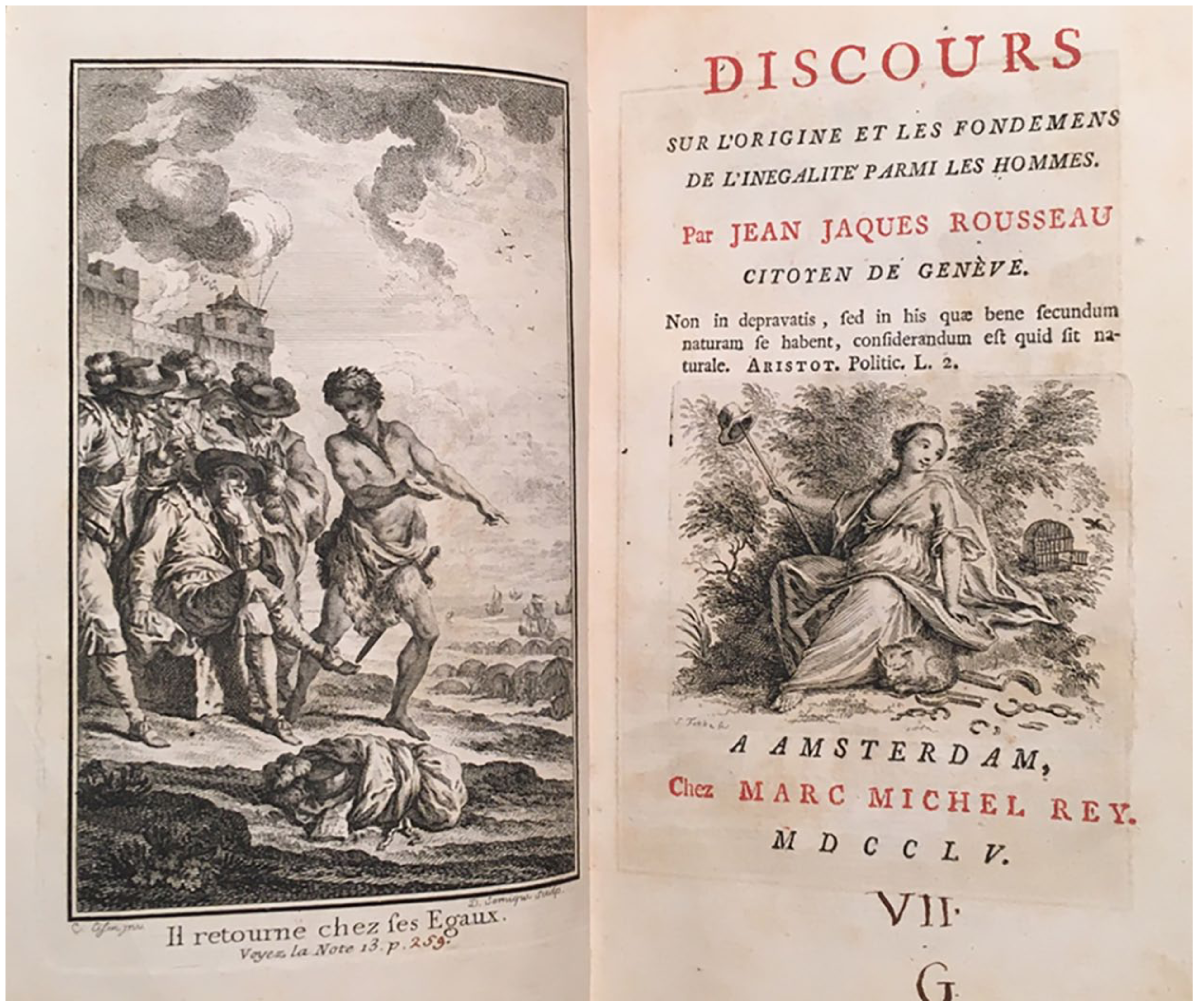
Frontispiece and title. Source: Fisher R68-D58-1755 cop. 1.
Previous commentators haven’t remarked upon another indication that the frontispiece depicts liberation: in the picture, the so-called collier around the Hottentot’s neck is actually a broken-off chain. While collier has various meanings in French, “necklace” is the obvious English translation, as mid-eighteenth-century dictionaries confirm. 26 Collier calls jewelry to mind, especially a short, tight-fitting necklace like a choker. Yet the Hottentot’s collier resembles a constraining chain, not a decorative one (Figure 3): 27
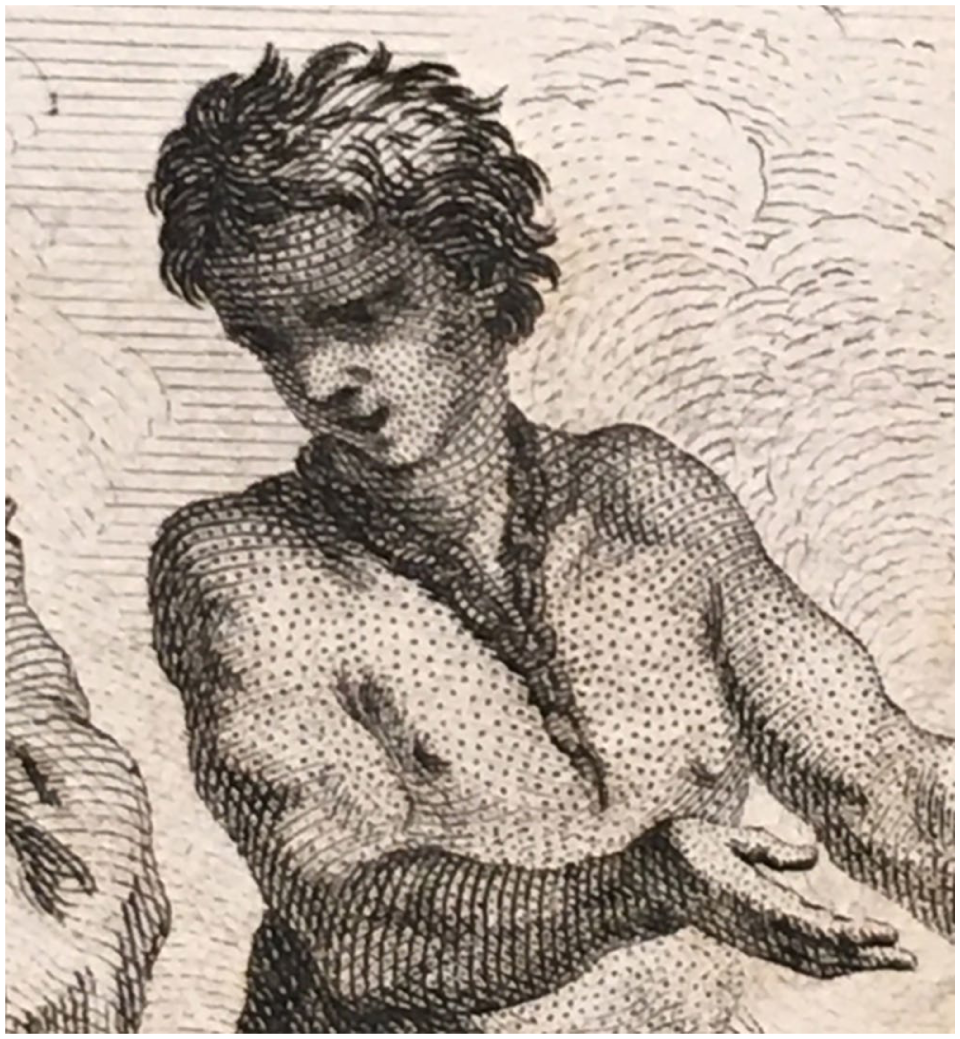
Frontispiece detail. Source: Fisher R68-D58-1755 cop. 1.
Even Klausen’s detailed examination of the frontispiece as a liberation image misses this detail. 28 The Hottentot’s plain chain lacks the Namejs-style twisting embellishments seen on all comparable decorative chains, and it’s worn closer about the neck. Its dark iron hardly resembles golden “money chains” from shipwrecks like the Atocha. Contra Kolben’s original German account, 29 in Rousseau’s illustration, the thing around the Hottentot’s neck isn’t jewelry.
The story indicates the Hottentot wasn’t a slave; yet the chain suggests his time among Europeans was akin to imprisonment. Rousseau consistently describes civilized society and its denizens as unfree, dependent, and miserable (151/153; 182/187; 197–98/20), often using chains or irons (“fers”) and slavery as representative symbols: “Man is born free, and everywhere he is in chains” (SC, 41/351). 30 Like everyone raised in civilized political systems, Rousseau’s Hottentot is enchained.
But his chain is broken at the bottom, a snapped link seemingly still dangling from the end. Once it was affixed to a wall or fetters, or held in a master’s fist. Now, it hangs severed.
The anonymous artist who plagiarized the frontispiece for the 1755 Dresden counterfeit 31 —a copy so perfect that for a century scholars have treated it as interchangeable with the original—also interprets the collier as a broken chain (see Figure 4). Among other differences previously unremarked upon, this artist fixes physically impossible links in the original, standardizes their sizes, and renders the dangling link more clearly.
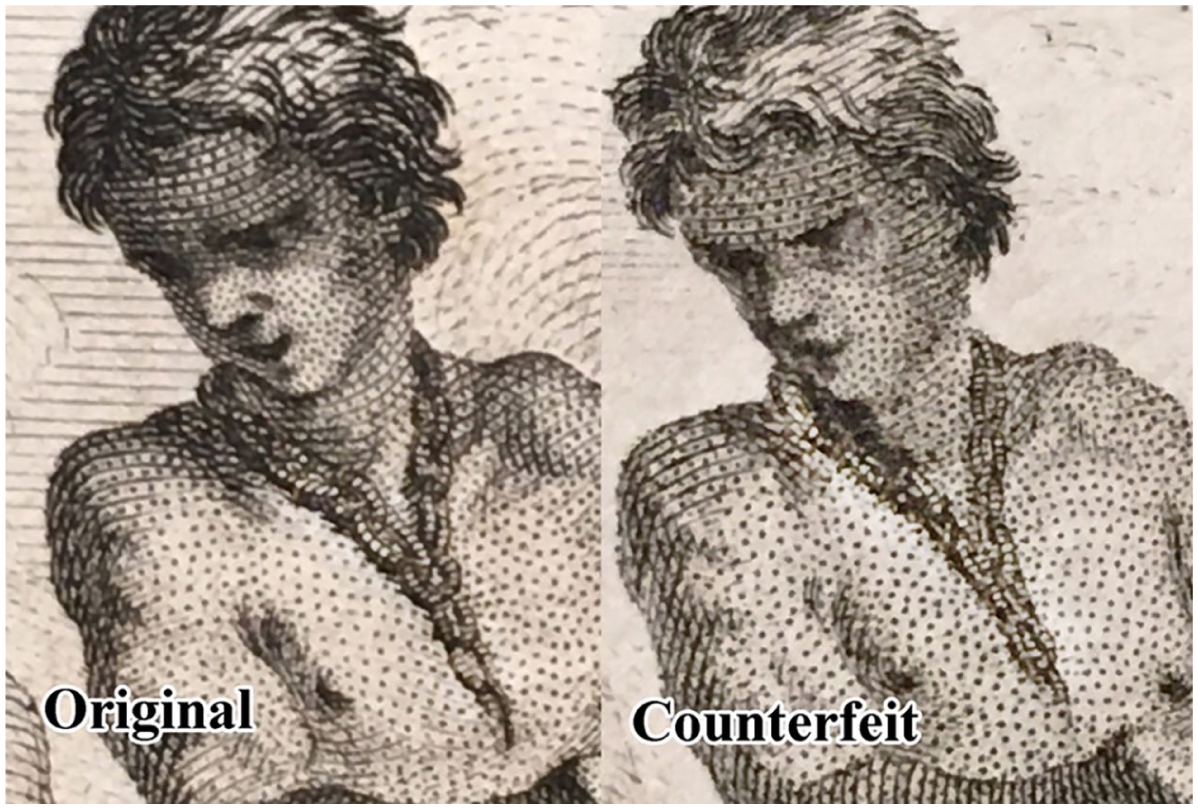
Original and counterfiet details compared. Original source: Fisher R68-D58-1755 cop. 1. Counterfeit source: Fisher R68-D58-1755aa. An even clearer version of the counterfeit can be found in Cambridge’s copy, Leigh.d.3.56.
The Hottentot’s broken chain symbolizes former bondage and current freedom, casting his move from civilization to sauvage life as emancipatory.
Overall, Rousseau creates a disjunction between the collier’s appearance and label. In seventeenth- and eighteenth-century dictionaries, collier “sometimes means a [metal] circle . . . around the neck of slaves, or Moors, or dogs to stop them, to hold them.” 32 Such collars abound in eighteenth-century depictions of slaves. Consider the representative example in Figure 5.
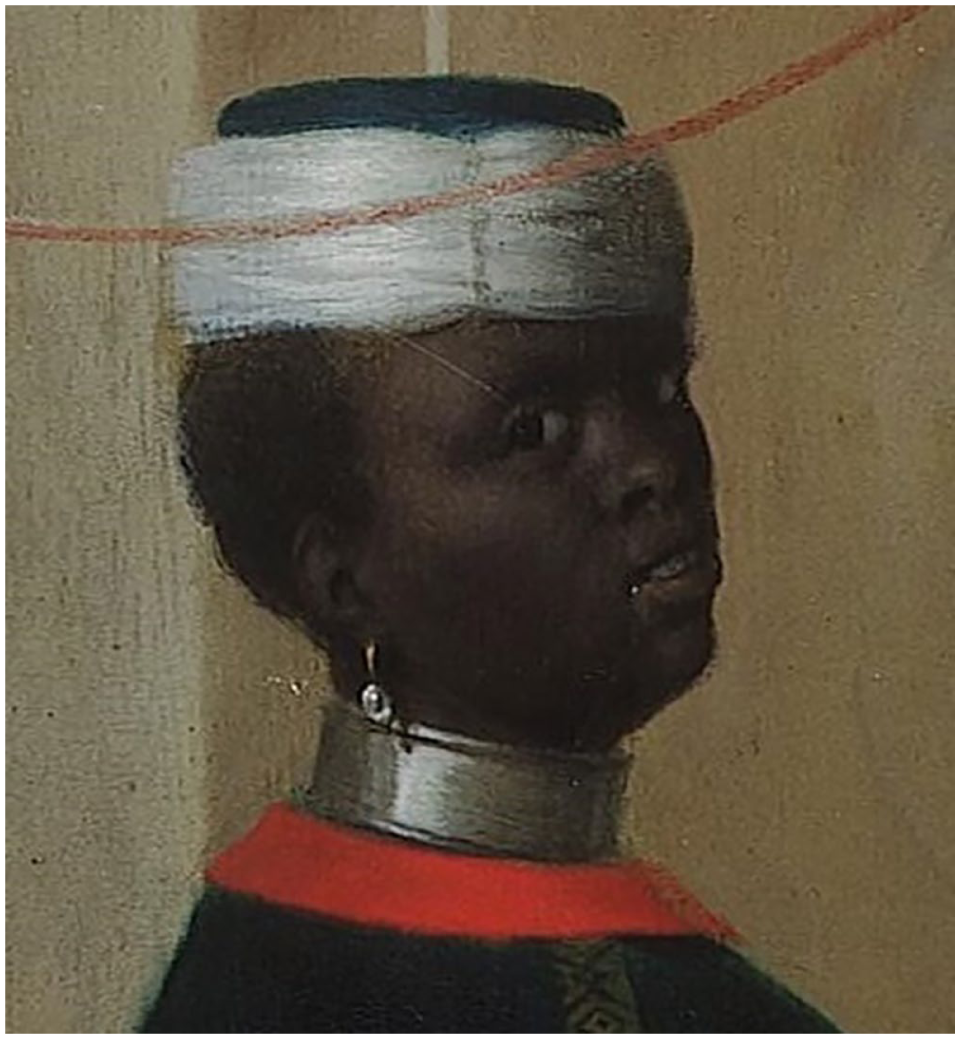
Slave collar. Source: Philip van Dijk, Portrait of the van Friesheim family, met een bediende, 1739. Detail. https://commons.wikimedia.org/wiki/File:Philip_van_Dijk_-_Family_portrait.jpg.
In the engraving, the Hottentot’s collier isn’t such a slave collar. But it also isn’t jewelry, despite what the word collier might suggest.
Let’s be clear: contextual evidence shows that the frontispiece collier is decisively odd as a visual representation of a “collier.” And Rousseau was a perfectionist. 33 Eager to ensure that illustrations for other works upheld his authorial vision, he demanded corrections to details, including geographic features, character positioning, costume, facial expressions, posture, and female characters’ breast size; that’s in one letter alone. 34 No correspondence regarding the Second Discourse frontispiece’s composition is extant, but Rousseau wouldn’t have praised the illustration’s artist years later—“très bien”—had he not been satisfied with it. 35 Between the illustration and collier’s various meanings, Rousseau has the Hottentot’s collier invoke ornamentation, bondage, and liberation, all at once.
This polysemous collier has received virtually no published analysis. Pire forgets it, 36 describing the Hottentot as “only wearing” a loincloth and sword. Arguing that the frontispiece depicts renunciation of frivolity, Zerilli mentions the Hottentot’s “long V-shaped necklace” but doesn’t explain why he keeps it. 37 Other scholars presumably prioritize text and hence interpret the collier straightforwardly as jewelry, not as the problematic object it is. One might argue that the cutlass represents violence, and the necklace, luxury. 38 This reading misses how the image both drives home the liberatory nature of rejecting civilized life, and makes the Hottentot’s choice to keep the collier so puzzling. Readers must ask not why a self-selected exile from civilization would nostalgically retain some jewelry, but why a freedman would keep his chains.
Equality
The frontispiece caption says the Hottentot “returns to his equals”; he liberates himself from inequality. It’s beyond this article’s scope to fully draw out Rousseau’s views on inequality, but note his distinction between two types: “natural or Physical” and “moral, or political.” The latter, on which the Second Discourse focuses, “depends on a sort of covenant, and is established, or at least authorized, by Men’s consent. It consists in the different Privileges which some enjoy to the prejudice of the others” (131/131). Rousseau calls it “instituted inequality” (158/161) and suggests it’s “authorized by positive law [droit] alone” (188/193). This political inequality is social, 39 relative or hierarchical, and instantiated in psychology. Rousseau’s examples are wealth, honor, power, and the ability to wield others’ obedience. These are privileges only if others accept their legitimacy. Political inequality—when untethered from personal qualities, as it usually is in civilized society (188/193–94)—depends on psychology and shared beliefs.
In this section, I elaborate the Hottentot’s liberation from inequality. Noting how the illustration separates Dutchmen and Hottentots, Klausen concludes prematurely that the image discourages mixing between peoples. 40 I show not only that the frontispiece story isn’t against mixing, but also that it flattens racial difference; in the relevant respects, Rousseau’s Hottentot resembles Europeans, “civilized” people who could do as he does. The caption’s phrasing highlights how civilized political societies are not only more unequal than sauvage communities, like the one the Hottentot escapes to, but are also more permeated with the “hierarchical thinking” that characterizes amour-propre and political inequality. In civilized European society, psychology makes equality impossible, even among those who share a formal rank. Legal equality doesn’t guarantee that people think of or treat one another as equals. 41
Amour-propre, explained in the endnote directly preceding the Hottentot story, is a “factitious sentiment” responsible for feelings of shame and pride; 42 it “brings every individual to set greater store by himself than by anyone else” and thus causes conflict; it inspires “all” the harm people commit against one another (218/219). Originally absent, amour-propre drives and exemplifies civilized society’s problems (170/174).
Political inequality comes into being over time alongside amour-propre (159/162; 184/189). Sauvage life, in Rousseau’s account, an earlier developmental stage, is less hierarchical than European society (157–58/160–61, 181/186), though not perfectly egalitarian. 43 In the Histoire Générale, wealth affects Hottentot society (HG 158, 161, 166), but the “main distinction between rich & poor” is how much, and what quality, grease they rub on their bodies (HG 151). Crucially, rich Hottentots don’t escape punishment for crimes (HG 159, 177), whereas in Rousseau’s world, “a man with a hundred thousand crowns at his disposal [cannot] get hanged” (221/222). The frontispiece illustrates this hierarchical difference. The left-hand Dutch side shows greater vertical variation, from the fort’s peaks down to the sloped, rocky ground and the bundled clothing discarded there. Even the assembled Dutchmen are positioned on different levels, one seated and the rest upright as though attending on him. This European world is stratified throughout. Meanwhile, the Hottentots crouch in similar positions among uniform huts lined up along flat, even ground.
The Hottentot’s liberation is also equalizing. He even dons the attire of common, not rich, Hottentots (HG 149). For Rousseau, inequality creates dependence, which is unfreedom (150–51/152–53; see also SC, 78/391, Émile, 856). 44 Accordingly, the Hottentot illustration shows that being free means being among equals.
Interpreters must consider why the caption says the Hottentot returns to “his equals,” ses égaux, not simply to “equals,” les égaux. While indicating the overall equality and inequality in Dutch and Hottentot life, the caption’s phrasing stresses this particular Hottentot’s status relative to other individuals within each group. The emphasis on his equals draws readers to consider not only the overall spectrum of stratification but also individual relations within that spectrum. The caption also discloses that in Hottentot society, equals exist.
The Hottentot “returns” to equals by joining Hottentot society. Nobody can “return” to a circumstance he never left. Apparently, among Europeans, the Hottentot wasn’t among equals. Why? In the rest of this section, I contend that for Rousseau, the Hottentot is among equals only in sauvage society because in civilized life, equality is impossible. The caption centers the Hottentot’s individual relations, helping readers understand, first, that inequality is based in psychology as well as on formal rank divisions, and second, that individuals, not only collectives, may achieve liberation. Thinking through this problem also reveals how Rousseau sets up the Hottentot as a model for European readers by downplaying racial difference.
Readers may suspect that Rousseau calls the Hottentot and Europeans unequal for racist reasons, but in both illustration and text, Rousseau modifies his source material to present the Hottentot not as exotic but as similar to European audiences. In the Histoire Générale, Kolben writes: “It seems [Hottentots] have from birth a veritable antipathy for all Religions that aren’t those of their [own] Country” (175). This biological-determinist explanation makes Hottentots equal to one another, different from Europeans, due to shared inborn dispositions. But Rousseau cuts off his quotation before that line. He isn’t concerned here with innate dispositions or biological race. In the Discourse, indigenous peoples are simply proxies for an older, better stage of human development (156/158).
For Klausen, Rousseau’s Hottentot, visually speaking, is “scarcely Africanized”; 45 I contend that he’s actually been deliberately made ethnically ambiguous, or whitewashed. Hottentots in the Histoire Générale (Figure 6) have darker skin, darker “short and woolly” hair (HG 145), 46 and different noses. They immediately read as African—whether accurate or stereotyped—in a way Rousseau’s Hottentot doesn’t.
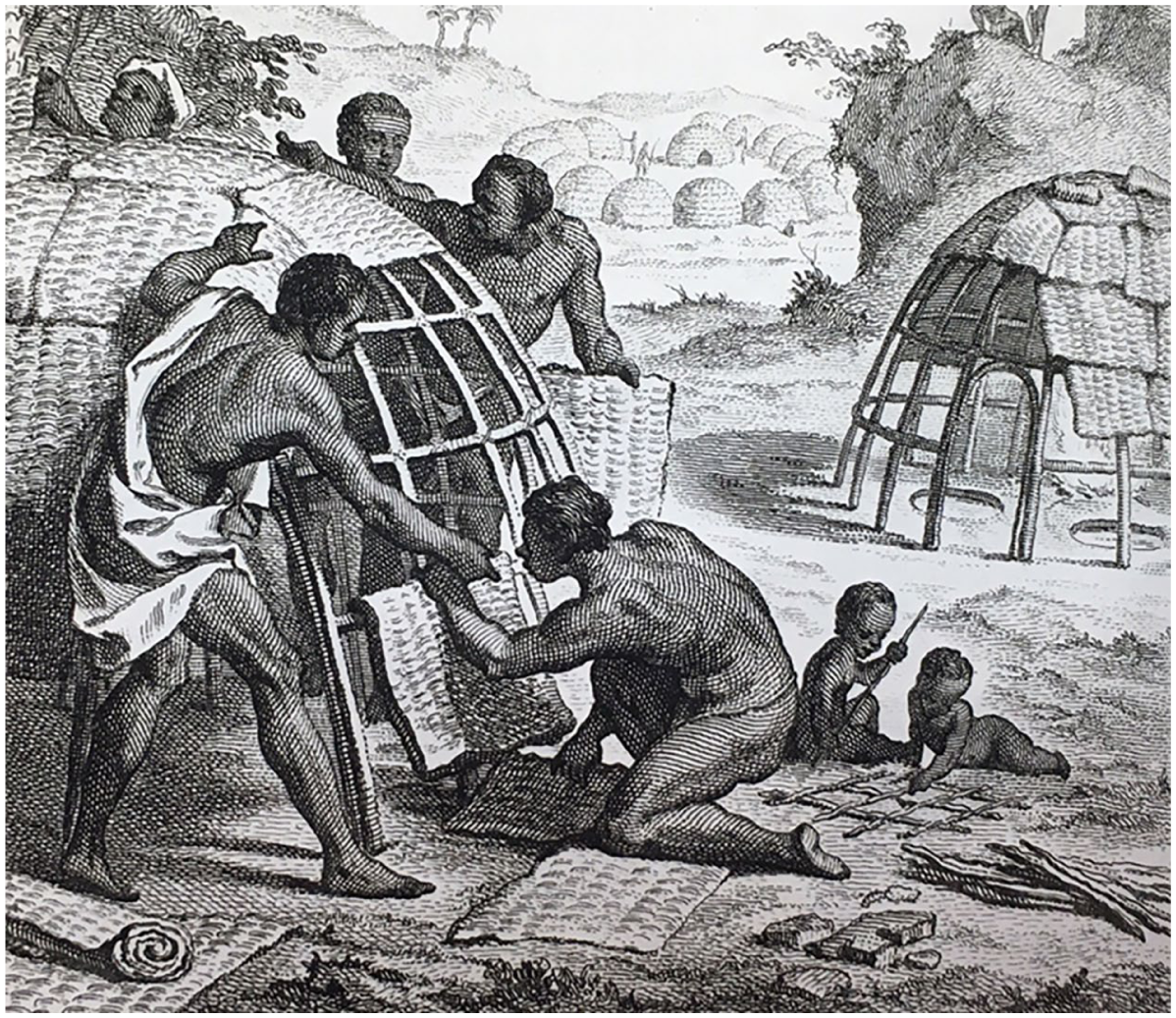
Hottentots in the Histoire Générale. Source: Fisher E-10 08423, vol. 5, RB320741 c.1.
Identical domed huts in both illustrations suggest Rousseau instructed his illustrator, Eisen, to consult the Histoire as a visual reference. By comparing with Rousseau’s sources, we see that the assignment he gave Eisen apparently wasn’t to imitate Hottentots “accurately” with respect to phenotypes in the Histoire. It’s no accident that Rousseau’s Hottentot is an “ethnological reverie.” 47
In contrast to sensationalized, oft-derogatory Hottentot depictions, 48 Rousseau’s Hottentot isn’t a racial oddity to gawk at. Even the frontispiece caption uses the generic male pronoun, il, rather than specifying textually that it’s a Hottentot—an “other”—who returns to his equals. My point is neither to blame Rousseau’s racism nor to exonerate him from the charge. My point is that the reason the Hottentot is equal among Hottentots but not among Europeans isn’t his race. Rather, racial difference is suppressed overall.
Note that Rousseau never suggests the Hottentot has deep cultural knowledge of Hottentots or has spent significant time with them. As far as a reader knows, that community is “his” to return to only in a thin biographical sense. Contrast Rousseau’s description of Geneva as an ideal community where one lives “peacefully in the sweet society of [one’s] Fellow-Citizens, practicing toward them, and at their example . . . all the virtues” (117/115).
Indeed, even those born in unfree, unequal societies may exit them and arguably “return” to sauvagerie: “One reads in a thousand places that Frenchmen and other Europeans have voluntarily taken refuge among [sauvage] Nations, spent their entire lives there, unable any longer to leave such a strange way of life . . .” (219/220). Even though Europeans can’t free themselves by literally returning to a more egalitarian place and culture of birth, they can metaphorically “return” to a previous stage of cultural development. The Hottentot’s speech, quoted from the Histoire Générale, may be read as emphasizing his affinity for ancestral customs. But Rousseau’s own version, in both text and illustration, suggests that in the decisive respects, the Hottentot isn’t different from other civilized people. Thus, European readers can do more than imagine their distant ancestors as living like him. They can also personally identify with him. To exchange civilized society for sauvage life, there must be some free and equal life to “return” to. But it needn’t be one’s own in anything but choice.
As for the Hottentot’s personal qualities, he “was richly dressed, taught several languages, and his progress fully corresponded to the care taken with his education”; in the VOC job, he comports himself “usefully” (220/221). The illustration proves he’s strong and handsome enough, too. He isn’t inferior to the Dutch by personal metrics. Why is he only among “his equals” with Hottentots?
In civilized political society, equality doesn’t exist. Where active amour-propre causes compulsive reputation-consciousness, fine gradations of status abound. Even among equals by law, judgment creates stratification. Others are always placed above us, or below, never on the same level (183/188–89; 187/192). 49 Scholars recognize how inequality saturates Rousseau’s world down to individual interactions. 50 But they miss how the frontispiece caption’s distinctive phrasing reinforces this central idea. By writing ses instead of les égaux, Rousseau draws readers to consider individual relations within overall society and hence to notice inequality’s depth and pervasiveness. Baked into our psychology, amour-propre colors all interactions, not just interactions across formal rank divisions. Where concern for reputation runs rampant and political inequality reigns, our attitudes make equality functionally impossible.
Among sauvage peoples, amour-propre’s worst effects are only nascent. The caption tells us amour-propre hasn’t yet undermined equality among Hottentots. Overall, both caption and image convey that the Hottentot isn’t so different from European readers, and that in choosing sauvagerie, he transitions to greater freedom and equality.
The Good Life
I draw out two tensions in Rousseau’s argument. First, he unequivocally says sauvagerie is better for us. But once people are civilized, sauvage circumstances make them miserable. Misery isn’t choiceworthy. Second, Rousseau implies atavism is impossible, at least for civilized Europeans (133/133, 203–4/207). But he also provides empirical examples of civilized people—Hottentot and European—who do “return” to sauvage ways. Both tensions resolve if we consider that civilized people suffer in the sauvage state because of how their psychology has developed, especially amour-propre. Therefore, if and insofar as their psychology can change, happiness can become compatible with a better sauvage life. This explains how the Hottentot, despite civilized habits, can reject civilization.
On the one hand, Rousseau holds that the objective best state for mankind is the simple sauvage state between the “pure” state of nature and civilized political society, often called Rousseau’s “golden age”: “This period in the development of human faculties, occupying a just mean between the indolence of the primitive state and the petulant activity of our amour-propre, must have been the happiest and the most durable epoch. [. . .] the least subject to revolutions, the best for man (XVI)” (167/171). The frontispiece illustrates this: the Hottentot side, choiceworthy according to the illustration’s protagonist, is less hierarchical and less constrained than the Dutch side.
Endnote XVI, where the Hottentot story appears, elaborates the claim that sauvagerie is best. Europeans try and fail to convince sauvages otherwise. 51 The note includes examples of sauvages and Europeans who choose, and sometimes die seeking, sauvage freedom after encountering and rejecting the glittering alternative (219–20/220–21), “as though there were, albeit buried, a universal nostalgia” for what’s really best. 52
Rousseau addresses a counter-argument: sauvages reject civil society because of habit; their preferences are parochial, not considered. (This is Kolben’s position.) Rousseau responds with the Hottentot story, which he claims speaks for itself (220/221). The Hottentot was habituated to Dutch life, not Hottentot life. Nevertheless, he relinquishes what he knows best, the ways of an educated, India-trading, cap-feather-sporting adopted Dutchman. He chooses sauvagerie despite his civilized habits. Therefore, habit isn’t the reason sauvages prefer sauvage life. Citing the Histoire Générale, Rousseau concludes the note and leaves readers to ruminate. If persuaded, they’ll decide Rousseau, and the Hottentot, are right: Sauvage life is best.
On the other hand, Rousseau acknowledges that for civilized Europeans, sauvage ways generally aren’t choiceworthy even though they’re better (186–87/192). The Discourse doesn’t advocate simple atavism (203/207). Indeed, “Nothing . . . would have been as miserable as” civilized man in sauvage circumstances (150/152). Moving from civilized to sauvage life is possible but impracticable and usually harmful.
New contexts don’t erase the problems civilized people carry within. Europeans can’t abide the good life because human nature or “constitution” has changed over time (125/123; 133/133; 170/174; 186–88/192–93; 197/202; see also Émile 764). Materially, it’s difficult to renounce habitual conveniences and pleasures (164–65/168; 182/187). Psychologically, civilized people “buy in”; they “do nothing but incessantly boast of the peace and quiet they enjoy in their chains” (177/181). Mental shackles hold securely. Without reasons to remain, freedom is only a sprint away, but once we depend on others, our own psychology impedes liberty (159–60/161–62; 176/181).
It’s amour-propre that shackles us to unfreedom by fostering a prideful desire for hierarchy: “Citizens [as opposed to sauvages] let themselves be oppressed only so far as they are swept up by blind ambition and, looking below more than above themselves, come to hold Domination dearer than independence, and consent to bear chains so that they might impose chains [on others] in turn” (183/188). From Holland to the Cape to India and back, we carry our chains with us. No matter how harmful, we want inequality.
Civilized conditions are miserable (133/133; 150/152). Nobody escapes the web of dependence (170–71/174–75). Rousseau occasionally blames colonialism and chattel slavery, 53 but the downtrodden have no monopoly on pain. Colonizers and overlords, though privileged, still depend on others, including others’ good opinions. Dependence is unpleasant: amour-propre makes each demand that everyone else recognize his superiority. Hence no one’s amour-propre is satisfied; not everyone can be the best. 54 Nevertheless, we’re trapped. Denied the compulsive, fruitless hope of hierarchical ascendancy, we experience real discomfort (164–65/168; 212/214). There’s little incentive to undergo the painful psychic purgation required for simpler lives. Hence Rousseau calls return impossible. Once civilized, people can’t shed all they’ve accrued in the process (124/122). We might as well unlearn how to read.
But the Hottentot’s choice indicates that a qualified return is possible for civilized people. Without turning back time or regressing, they can and do choose a new, simpler sauvage life. Once we realize that individual psychology helps create and cement inequality and unfreedom, we know it’s likely that if psychology can be adjusted, bad conditions can be rejected. The Hottentot, and Europeans who prefer sauvagerie, show that psychological adjustment is possible, though such examples’ rarity reminds us it’s difficult.
Interplay between frontispiece and caption also suggests that individual “return” to sauvagerie comprises a psychological return. The caption says the Hottentot “returns to his equals,” but it doesn’t depict him entering his village or fleeing the Dutch. Rather, it shows him explaining his decision to return. It’s personal rejection of civilized society that marks the crucial moment of ‘return.’
Thus the Hottentot’s return to sauvagerie initiates a new, mixed way of life, 55 which can accommodate psychological changes accrued over time, while mitigating their pernicious effects. The Hottentot returns to his sauvage starting place after a long sojourn and much learning.
The cutlass reinforces this reading. Rousseau’s Hottentot eschews the deadliest European weapon on offer, retaining only a blade, sufficient for defense but not for domination. 56 Newly among equals, he aims to preserve equality. If firearms exemplify civilized violence, and Hottentot weapons exemplify the sauvage state, the Hottentot chooses a weapon that sits metaphorically between these two extremes, as suits a new way of life sauvage via civilization.
My interpretation also explains the Hottentot’s professed reason for keeping the collier and the cutlass: “for love of” the governor (221/221). Knowing the Hottentot was enchained, this love is puzzling. But the Discourse is ambivalent toward love (154–55/157, 165/169). The Hottentot’s “love” could be tinged with hurt and bitterness, but still affectionate rather than simply ironic. Thanks to European interference, the Hottentot experiences civilized misery. Bondage leads him eventually to realize how civilization lacks freedom. Even if we read the chain metaphorically, it still invokes literal violent domination and represents domination of other kinds: psychological, political, economic. Thus, as the “literal” chain in the picture, the chain-qua-collier suggests the Hottentot was constrained, subjugated, and dominated. Meanwhile, as a metaphor, the collier represents how even the powerful and educated are somehow enchained. Thus, the Hottentot realizes the painful, but salutary and liberating, truth that civilized life is misery. He chooses a better life for himself. Autonomy and free choice: if the Governor provided the occasion for acquiring these, ambivalent love makes sense.
Klausen reads the frontispiece’s distant ships as colonialism’s looming influence, 57 but these ships appear on the illustration’s spacious “freedom” side, beyond the Hottentot village. They can be read positively, in line with Rousseau’s high hopes for self-knowledge through global travel (211/213–14). Real sauvages’ parochial freedom-by-default is purer, but the Hottentot has known civilized temptations, accepted them, and then broken free. His sauvage freedom and equality maintain a drop of civilization: ships in full sail on the open, wild sea.
But if in the Discourse self-liberation stems from individual psychological transformation and individual choice, it makes sense that it might liberate individuals, not collectives. Consider another Histoire Générale Hottentot who experiences and relinquishes European life, an example available to Rousseau. Returning from Europe, Nomoa (also called Doman) “revealed . . . the intentions of the Dutch,” taught his fellows to use firearms, and led a retributive anticolonial offensive (HG 142). Fauvelle-Aymar argues that Nomoa inspired the character who becomes Rousseau’s Hottentot. 58 But in fact Rousseau foregrounds, as the whole Discourse’s representative character, someone who effects a quick, dignified withdrawal from European civilization. Nomoa is passed over as an example. Rousseau’s Hottentot doesn’t lead a collective uprising.
Civilized individuals, including the Hottentot but also ethnic Europeans, can adopt a simpler sauvage life without succumbing to misery (219/220). For Rousseau, choosing sauvagerie is a good choice, but a rare one.
Reading Liberation
Returning to sauvagerie, the Hottentot succeeds in what Rousseau proposes his European readers might want: “to be able to go backwards” (133/135). In this section, I argue that the apparent disjunction between the collier’s label and its appearance opens up space for critical thinking. The illustration, and the process of examining it with successive readings, can help readers to realize, with the Hottentot, that developed psychology, and amour-propre, make civilized life miserable.
For Klausen, the frontispiece’s meaning is “triangulated” between the illustration, note XVI, and the “golden age” passage. 59 I’d lengthen this list by including the illustration multiple times. It reads differently during a reader’s initial encounter and upon further consideration. Following instructions literally, readers encounter the illustration five times (Figure 7):
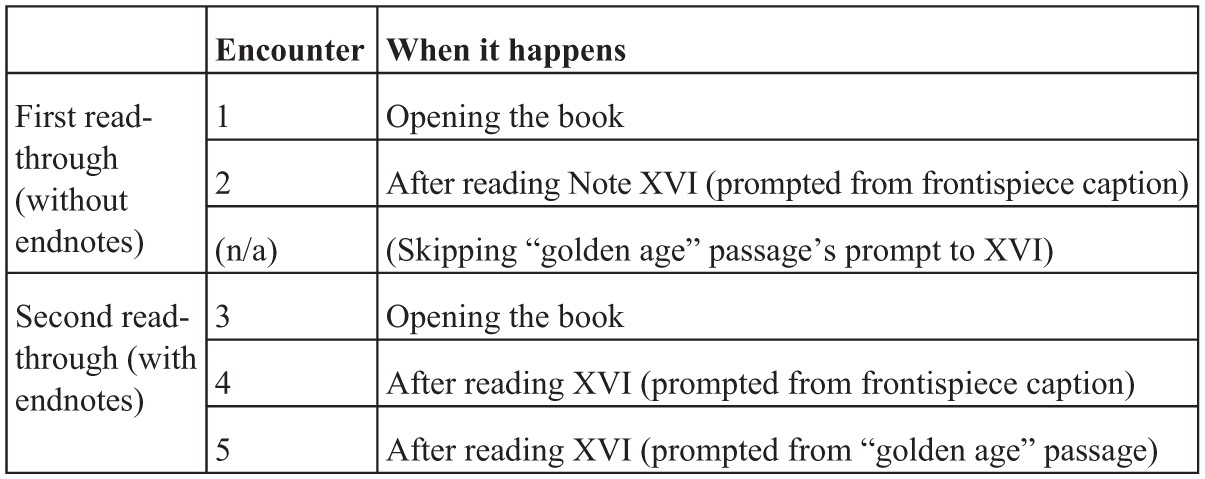
A reader’s sequential encounters with the frontispiece.
Each encounter might reveal different facets of the illustration. For now, I simply distinguish between naive and considered readings of the image.
In correspondence, Rousseau says he wrote the Discourse “for a very small number of Readers,” by whom alone “it must be read to become useful to all.” 60 The question of Rousseau’s target audience requires more attention than I can give here, but let’s briefly specify the following. First, he dedicated the work to Genevans (114/111), for whom he expected it to be useful. 61 Second, he knew it would be read beyond Geneva and thought it could (perhaps) be useful for these other readers, too. 62 Third, he also saw himself addressing audiences beyond his own time and place: “my subject concerning man in general, I’ll adopt language suited to all Nations, or rather, forgetting times and Places, in order to think only about the [wise] Men to whom I speak, I’ll suppose myself in the Lyceum of Athens . . . with the likes of Plato and of Xenocrates as my Judges, and Mankind as my Audience” (132–33/133). 63
Whatever reader uptake Rousseau wanted for the Discourse, he later complained he didn’t get it: “In all Europe [the Discourse] found but few readers who could understand it, and none of them wanted to talk about it” (Confessions, 389). A lack of uptake, however, doesn’t change that he apparently wanted his text to sculpt active readers and facilitate an educative reading experience. Between the preface and Discourse proper, he explains that readers with “the courage to start over again” can read the endnotes (129/128). He puts this choice in terms of boldness; note-reading is predicated on a reader’s amour-propre. Furthermore, near the Discourse’s end Rousseau writes that “in thus discovering and retracing” the historical account and “restoring” omitted parts, “any attentive reader” will reach new conclusions (186/191–92). The Discourse explicitly poses questions and invites readers to think for themselves elsewhere, too (125/123–24; 149/151). This is what I call Rousseau’s emancipatory authorship; readers must freely choose for themselves whether to follow the instructions, absorb the details, and continue to ponder. 64
When first seeing the frontispiece, readers who notice the broken-off chain would assume the figure is an escaped slave. After reading the Discourse (or even Note XVI alone), they realize he’s no slave but an educated ward of the governor, a VOC officer. Yet after puzzling over the “collier” word choice and contextualizing the Hottentot’s story within Rousseau’s argument that even privileged people are degraded in unfree, unequal conditions, readers can realize the Hottentot was a slave, not in the way they originally supposed but as everyone in civilized society is metaphorically slavish: slaves to habits, fashions, others’ opinions. Readers reverse their perspective on the engraving. The Hottentot’s visible chain announces his freedom, while the Dutch in the illustration, richly attired, fail to see the invisible chains binding them. The collier becomes polysemous once readers attend to both illustration and text. Thus, Rousseau sets up the Discourse, and the frontispiece, so that readers might exploit ambiguities for their own edification.
If they read actively, readers can compare themselves to the Hottentot and vicariously ponder his liberation. They haven’t been fettered or sold as chattel. But aren’t they constrained and miserable, stuck in a system that, with Rousseau’s guidance, they’re realizing is corrupt, harmful even to the most powerful, and worth rejecting? It’s possible for readers to consider how to emulate the Hottentot’s emancipation. In text, he simply pronounces his intentions. In the engraving, the sweeping gesture as he points out toward the village resembles instruction, 65 and an invitation, to the astounded Dutchmen but perhaps also to readers: You could do this, too.
Collier’s multivalent meaning both prompts and represents the realization that in civilized societies, we’re dependent and worse: unequal, unfree, unhappy. The interplay between text and image allows readers to think along with Rousseau and discover that return is desirable.
Rousseau’s examples of liberation, including those of regular Europeans, show that many who experience sauvage life, even briefly, choose it. But Rousseau also refers to Christian missionaries who look back fondly on and “miss” their time among sauvages (218–20/220–21); loving sauvagerie, they still return to civilized European life. Furthermore, insofar as Rousseau grasps sauvagerie’s superiority without renouncing civilization, he himself shows that knowledge doesn’t proceed necessarily to action. The Hottentot is the Discourse’s representative and most prominent example of a civilized person who liberates himself from civilized misery. Readers shouldn’t assume his decision is easy. The collier complicates the Hottentot’s story and invites us to consider how he achieves freedom despite the steep barriers thereto. What distinguishes civilized people who don’t or can’t tolerate a better life from those like the Hottentot, who choose it? How can civilized people break bad habits and rewrite their own psychology?
Pride
The parting favor the Hottentot asks is to keep his chain, not to have it removed. Interpreters must explain why. The story also prompts us to wonder how civilized habits can be broken and liberty recovered. Though neither text nor illustration offers the resources to resolve these questions definitively, I propose a speculative response to both at once.
In this section, I argue that the Hottentot exemplifies a surprising means to liberation: pride. Where amour-propre helps create the problem, harnessing and transforming amour-propre may allow liberation and return to sauvage life. Rousseau assigns key causal power to pride and amour-propre. He also associates pride with sauvage attachment to freedom. Putting these pieces together and reading the Hottentot’s chain-qua-collier as a boast, we see how pride and a concern for reputation can be leveraged against comfortable, depraved, civilized subjection. Once we adjust which good opinions we care about, taking a discriminating perspective, and once we refine what we should take pride in—namely, choosing free and equal life–amour-propre can become positive and constructive. The same ambivalent force that constrains us can set us free.
Evaluating civilized versus sauvage life, Rousseau demands: “judge with less pride [orgueil] on which side genuine misery lies” (150/152). This suggests it’s pride that must be changed in order to judge aright. Furthermore, he writes, “It’s to this ardor to be talked about, to this frenzy to achieve distinction which almost always keeps us outside ourselves, that we owe what’s best and what’s worst among men, our virtues and our vices, our Sciences and our errors, our Conquerors and our Philosophers” (184/189). 66 Pride or amour-propre accomplishes things.
Meanwhile, Rousseau casts the pursuit of freedom as prideful: sauvages “won’t bend”; they “scorn” their enemies, “brave” hardship; pride appears as a means to preserve “nothing but their independence” (177/181–82). 67 Rousseau suggests both that pride is a power source for resisting domination, and that freedom and independence are so precious to the free partially because they take pride in collective freedom. Freedom and pride are mutually reinforcing: freedom breeds pride, and pride helps the free defend their freedom.
Raised among powerful Europeans, Rousseau’s Hottentot must have plentiful amour-propre. In this way, too, he’s like Rousseau’s audience. And pride seems to play a role in his liberation. Consider how the Hottentot’s collier, despite looking like a constraining chain, straddles both available meanings. A chain, worn willingly, can be necklace-like insofar as it’s for display. It says, Look, I was chained, and now I’m free. The chain can be both a reminder of bondage and an emblem of liberation. In the eighteenth century, the word collier could be associated with honor. Consider one Encyclopédie entry: “This ornament . . . is only used by military orders, to which it’s given as a mark of distinction & of the honor they have by being admitted to their order.” 68 Rousseau himself uses collier this way in correspondence with the Marquise de Verdelin. 69 The collier marks members of a distinguished, honorable community.
So why would the Hottentot keep his collier if it’s a chain? For Rousseau, freedom is worth dying for and worth boasting of. The chain is a vaunt, symbolizing the Hottentot’s acquired freedom and the rightful pride he has in it. 70
The text’s structure also keeps amour-propre in mind as readers consider the Hottentot’s informed-choice sauvagerie. The “golden age” section that directs to the Hottentot Note XVI comes just two paragraphs after where Rousseau presents the historical advent of amour-propre (though he doesn’t use the term): from the “first preferences arose vanity and contempt on the one hand, shame and envy on the other” (166/170). Moreover, when readers turn to Note XVI to read the Hottentot story, they’re confronted anew with Note XV, which explains amour-propre. Rousseau pronounced to his editor that having footnotes at the bottom of each page would “ruin everything.” 71 Rousseau could have wanted these endnotes side-by-side. The text’s main body doesn’t juxtapose the Hottentot and amour-propre. But the notes do. The complete Discourse does.
In all these ways—suggestive but not decisive—Rousseau associates his Hottentot with amour-propre. We also saw that achieving liberty is worth boasting about, that pride is a means to liberty, and that amour-propre contributes to greatness. Hence Rousseau’s Hottentot, civilized, with ample pride, has both the means to make the difficult choice to eschew civilized living and the motive to pronounce his newfound freedom by boldly continuing to wear the chain. Connections between the Hottentot and amour-propre push us to interpret his collier as boastful. Rejecting what’s bad and choosing sauvage life is a good use for pride.
How could pride bring the Hottentot to sauvagerie? Recall that to act well in a corrupt context, Rousseau imagines an ideal audience for the Discourse and speaks accordingly (133/133). Rousseau still considers his reputation, but he avoids catering to bad opinions. Amour-propre demands recognition, but once the Hottentot realizes the Europeans around him are inferior—vain, frivolous, misguided—he can realize that recognition from such people is worthless.
Whether or not he seeks fame, the Hottentot acts in accordance with pride. He courageously resists the siren call of daily comforts and parochial reputation. He attracts interest, becomes a story, told to and by Kolben, collected into English, translated into French, adapted by Rousseau, drawn by Eisen, and considered by readers for centuries. The governor might think the Hottentot a fool for rejecting a flourishing career to wear sheepskin. But better people know better. This seemingly humble strategy pays the ego back with interest.
The Hottentot reclaims the chain around his neck. Seizing liberty despite the costs, he owns the chain and thus redefines it: lo, the chain is a collier, after all, though not in the way we’d naively assume from text alone. It’s neither a lady’s necklace nor a slave’s collar. It’s a mark of honor, a decorative vaunt, a look what I did—and a provocative invitation to readers.
Conclusion
Provocation isn’t action. Even if the Discourse converts readers’ beliefs, Rousseau couldn’t expect them to crawl into the forest (203/207). Still, the reading process has the potential to echo the Hottentot’s emancipation and produce other, more moderate, transformative effects on readers.
The Hottentot example, and Rousseau’s examples of Europeans who eschew civilized living, demonstrate that it’s possible for civilized people to recover freedom and equality by rejecting civilized society and returning to sauvagerie (though this freedom differs from the freedom of sauvages who were never civilized). Exit, return, is a real possibility. Yet Rousseau is clear that most won’t ever choose sauvage life. The barriers are too high.
The constructive upshot for Rousseau’s audience, then, is two-tiered. The first solution, which can address civilization’s endemic misery and actually bring freedom and equality, consists in rejecting and exiting civilized society—while retaining, like the Hottentot, something civilized.
I suggest this exit solution is a limit case that provokes readers, even if it doesn’t elicit life-changing action. The Discourse also offers a less radical fallback position available to those with only secondhand accounts, not real-life exposure, to sauvage life. The compromise solution, which Rousseau surely hoped some readers would adopt: a new critical understanding. Readers can lead a civilized European life without “buying in.” Those convinced by Rousseau’s argument, but not convinced enough to flee for Cape or forest, can still become critics of—and for—the society they inhabit. Where Scott argues that Rousseau identifies himself with the Hottentot, 72 my reading stresses a key difference between Rousseau and his character. Both gesture toward emancipation, but in very different ways. The Hottentot runs. Framing the picture, Rousseau remains, propagates the truth, and props open the door.
Critiquing society doesn’t bring absolute freedom. But the Second Discourse offers readers the chance to see that some freedom can be recovered piecemeal by understanding society’s faults. For instance, like the Hottentot, readers can realize some people aren’t worth pleasing and that money, status, and learnedness don’t bring health or satisfaction. The Discourse can show readers that they’re dependent on certain opinions, that their twisted standards make them pursue pointless decadent distractions, both material and social. It also shows readers that liberation from this dependence is difficult but possible. Thus, even the Discourse’s critical project is constructive: making more critics. Rousseau is a missionary against society.
Klausen bemoans that Rousseau doesn’t adequately “articulate a coherent theory of rebellion.” 73 He urges that we must look outside the Discourse for Rousseau’s thoughts on what it takes even for individuals, let alone collectives, to “come to consciousness of suffering illegitimate dependence enough to resist it.” 74 I have cast doubt on this reading. But at the same time, the Discourse isn’t a revolutionary manual. Despite offering a model political society—an idealized Geneva—in the Epistle Dedicatory, Rousseau emphasizes not the promise but the hazards involved in collective political liberation: “Once Peoples are accustomed to Masters . . . if they attempt to shake off the yoke, they move all the farther away from freedom . . . their revolutions almost always deliver them up to seducers who only increase their chains” (115/113). So despite his radical critique, Rousseau is cautious, even conservative, regarding political revolution.
Yet his text does offer the resources for another kind of liberation: personal, limited, and less risky. If one attends to the frontispiece, the reading experience can reflect the Hottentot’s experience of discovering sauvage life’s superiority and adjusting accordingly. Adjustment can be drastic or moderate. Individual liberation from unfree, unequal social conditions is hard to achieve, but if we leverage the power of pride, it’s not impossible. Even readers who don’t reject civilized society entirely may still refine their amour-propre to limit dependence on others’ unworthy judgments.
Feathered caps and fine jerkins aren’t better than sheepskin, especially in the Cape’s climate. But Europeans are better than Hottentots at cutlasses and colliers—violence and bondage, both literal and spiritual. This is what the Hottentot wants from Europeans: the collier, to remind himself how dangerous and comfortable subjection can be and to warn others that he knows how to break free, and the cutlass, to defend himself from those who don’t heed that warning.
Footnotes
Acknowledgements
My thanks to John T. Scott, Daniel Lee, Kinch Hoekstra, Jonah Levy, Geneviève Rousselière, Eero Arum, Gio Maria Tessarolo, Aaron Zielinski, an anonymous reviewer at APSR and at Political Theory, and, especially, Victoria Kahn, for helpful feedback on drafts. For a keen eye and other help comparing physical copies of the Second Discourse to identify counterfeit illustrations, I’m grateful to Tess Alksnis; for help with eighteenth-century jewelry, Derek Content and Rachel King; for help with Schwabacher and German, Aaron Zielinski; for translation discussion, Anna Closas. Finally, I’m grateful to my writing seminar colleagues and to all commenters at the two conferences at which I presented this piece.
In memory of Ozzie, a housecat both fierce and genteel.
Declaration of Conflicting Interests
The author declared no potential conflicts of interest with respect to the research, authorship, and/or publication of this article.
Funding
The author received no financial support for the research, authorship, and/or publication of this article.

