




Abstract
Religious individuals often assume that their beliefs promote strong romantic relationships. Yet the empirical evidence is mixed. To better understand this association, this study examined religious orientation as a moderator within the investment model of commitment. A community sample of 84 couples completed measures on religious orientation and commitment as part of a larger study on romantic relationships. The findings indicate that although both religious motivations promote commitment, they do so differently. Specifically, intrinsic religious orientation buffered the negative effects of dissatisfaction in a relationship; whereas an extrinsic religious orientation attenuated the extent to which alternatives to the relationship influenced commitment. Future research in this area should consider religious orientation, rather than overall religiosity, and examine specific predictors of relationship commitment to provide greater clarity on how religiosity influences romantic relationships. Implications for counseling individuals with religious beliefs are also discussed.
It is common advice to avoid discussing religion on a first date. Yet relationships, and especially marriage, are an important element of many religions (Bhattacharyya, 2019; Marks, 2005). Marriage is often considered sanctified, or as more than physical or societal, but spiritually significant (Mahoney et al., 1999). Across religions, these beliefs highlight the importance of committed romantic relationships with the notion that marriage is intended to be a lifelong union, with dissolution frequently discouraged and sometimes considered unpardonable (Bell et al., 2018; Lauer, 1985; Marks, 2005). This view of relationships is reinforced by religious institutions and communities (Bhattacharyya, 2019; Mahoney et al., 2001; Marks, 2005). Despite this emphasis, the research on the extent to which religion truly promotes strong, committed relationships is mixed. This research seeks to elucidate prior findings by exploring the influence of religious orientation on the antecedents of commitment.
Religion and relationships
Religious teachings emphasize romantic relationships as more than a societal construct and instead a way to become closer to experiencing God’s love, in both literal and figurative senses (Lauer, 1985). As such, the belief in these teachings is thought to strengthen relationships and promote positive relationship outcomes (Bhattacharyya, 2019; Marks, 2005). Indeed, some previous research has offered support for the idea that religious beliefs promote strong relationships. Specifically, a meta-analysis (Mahoney et al., 2001) of 94 studies found that personal religiosity and regular church attendance were positively associated with relationship satisfaction and commitment and negatively correlated with the risk of divorce. Likewise, qualitative studies found people from a variety of religions feel this is the case (Bhattacharyya, 2019; Marks, 2005).
Yet other research raises questions as to the influence of religion on relationships. Sullivan’s (2001) longitudinal couple study found that religiosity was not associated with relationship persistence and had an inconsistent association with satisfaction. More recently, a large, international study found no differences in marital satisfaction between religious individuals (i.e., Christians and Muslims) and atheists (Sorokowski et al., 2019). We suggest that one explanation for these discrepant findings may be religious orientation.
In an attempt to better understand similarly mixed findings on religiosity and prejudice, Allport and Ross (1967) identified two motivations for participating in religious activities: intrinsic and extrinsic. Individuals with a strong intrinsic motivation embrace their religion’s creed and values and attempt to fully apply these within their lives. In contrast, individuals with a strong extrinsic orientation toward religion use religion as a tool to gain social status, security, self-justification, and other self-serving ends. Subsequent theorists and researchers have debated the precise conceptualization of these orientations (e.g., Batson, 1976; Donahue, 1985; Genia, 1993; Ventis, 1995), but the findings are generally consistent.
Although not mutually exclusive, these two orientations tend to be differently associated with various views and beliefs. Specific to relationships, those high in intrinsic religiosity tend to have sexually conservative attitudes and behaviors (Leak, 1993; Njus & Bane, 2009; Reed & Meyers, 1991; Rowatt & Schmitt, 2003), as their lifestyle and chosen beliefs align with adopted religious messages. Greater intrinsic religiosity has also been associated with greater constructive communication in relationships (Hughes & Dickson, 2005; Lambert & Dollahite, 2008a), relationship satisfaction (Brimhall & Butler, 2007), and adjustment (Mirghafourvand et al., 2019; Yeganeh & Shaikhmahmoodi, 2013). In contrast, extrinsic religious motivations tend to be associated with more liberal sexual beliefs (Reed & Meyers, 1991), including not only less sexual restrain and less negative views on cheating (Rowatt & Schmitt, 2003) but also less satisfaction with sexual relationships (Reed & Meyers, 1991). However, some studies that found effects for intrinsic religious orientation report null effects for extrinsic religious orientation (Njus & Bane, 2009; Yeganeh & Shaikhmahmoodi, 2013). This indicates that these are independent orientations, at least within the context of romantic relationships. In addition, these findings suggest the utility of examining religious orientation to better understand the association between religiosity and commitment.
In addition, not present in much of the previous research on the association between religiosity and relationships is a strong relationship-oriented theory. We suggest that the investment model of commitment (Rusbult, 1980, 1983), derived from interdependence theory (Kelley & Thibaut, 1978), may provide a useful framework for better understanding the effects of religiosity on romantic relationships.
Interdependence theory and the investment model
Relationship researchers have long sought to understand why some relationships persist but others dissolve, with a particular focus on commitment. Commitment is thought to be the subjective experience of dependence on a relationship for the rewards received relative to costs incurred (Drigotas & Rusbult, 1992; Kelley & Thibaut, 1978). Commitment is characterized by feelings of emotional attachment to the relationship, the intent to persist in the relationship, and a long-term orientation (Rusbult et al., 2001). More than love or trust, commitment was found to be one of the best predictors of individuals remaining in relationships in a meta-analysis reviewing decades of relationship research (Le et al., 2010). Commitment also predicts pro-relationship behaviors such as forgiving partners (Rusbult et al., 1991), derogating alternative partners (Johnson & Rusbult, 1989), and sacrificing for the relationship (Van Lange et al., 1997). Moreover, researchers have determined that commitment is predicted by three key antecedents—relationship satisfaction, investments, and alternatives—a model that is known as the investment model of commitment (Le & Agnew, 2003).
Conceptually, satisfaction is the discrepancy between the perceived value of the current relationship relative to the individual’s generalized expectations for what they should expect from relationships (Rusbult, 1980). Such expectations may be based on past relationship experiences (Rusbult & Buunk, 1993), observations of others’ relationships (Broemer & Diehl, 2003), and societal expectations of relationships (Thibaut & Kelley, 1959). As such, satisfaction is considered a critical aspect of romantic relationships as it indicates that the person is receiving the benefits expected from the relationship. Greater satisfaction is associated with greater commitment to the relationship and, ultimately, persistence (Le & Agnew, 2003; Rusbult, 1980).
A second determinant of commitment is alternatives; conceptualized as the difference between the outcomes received in the present relationship and the perception of what could be received in other, alternative, relationships (Kelley & Thibaut, 1978; Rusbult, 1980, 1983). Potential alternatives are not limited to a single other romantic attachment but may also include friendships, family, or even remaining single. When an individual feels they have relatively few or poor alternatives, they are dependent upon the current relationship for the outcomes received and experience higher levels of commitment (Drigotas & Rusbult, 1992). Logically people should leave a relationship in which they are not satisfied and to which they have quality alternatives. However, it is all too common for people to remain in unhappy relationships regardless of attractive alternatives. Investments help explain this contradiction.
Investments are anything associated with the relationship (e.g., time, money, and sacrifice) that would be lost should the relationship terminate (Rusbult, 1980, 1983). These differ from the costs (and rewards) associated with satisfaction which may be expected from any relationship, whereas investments are unique to the functioning of the current relationship. Such investments may be tangible (e.g., money and house) or intangible (e.g., secrets and time), with the latter being a particularly strong predictor of commitment (Goodfriend & Agnew, 2008). Thus, greater investment in a relationship is associated with higher levels of commitment to the relationship (Rusbult et al., 1998).
A meta-analysis confirmed that alternatives, satisfaction, and investments are significantly correlated with commitment across a variety of relationships and moderators (e.g., sex; ethnicity) and, in turn, commitment predicts relationship persistence (Le & Agnew, 2003). However, only more recently has research begun to explore psychological moderators of these associations (e.g., narcissism, Foster, 2008; self-determined relationship motivation, Hadden et al., 2015). Given the emphasis placed on relationship commitment by many religions (Bell et al., 2018), we suggest religious orientation may moderate the associations within the investment model of commitment.
Religious orientation and the investment model
In addition to relationship-oriented factors, research has found other reasons people remain in a committed relationship—including internal beliefs and social pressure from a religious community (Bell et al., 2018; Lambert & Dollahite, 2008b; Marks, 2005). As previously noted, intrinsically motivated individuals, who internalize and try to live their life according to their religious beliefs, may feel separation or divorce conflicts with their beliefs and would be a sacred loss or desecration (Krumrei et al., 2009). When individuals view something as sacred, they are likely to invest more into it and feel that it is more important, a dominant priority, to feel more committed to it, and to receive more social support for its pursuit (Mahoney et al., 2005). As such, marital longevity is a common striving imbued with spiritual and sacred significance. This commitment may be seen as a net positive, but blindly committing to a goal because it is “sacred” may lead to rigidity and persistence in unsatisfying circumstances. Since the sacredness of a goal is predictive of intrinsic motivations, it is likely to interact with the antecedents in the prediction of commitment.
Although we know of no research that has been done on the relationship between religious orientations and investments or alternatives, one study has explored the association with satisfaction. Brimhall and Butler (2007) found that husbands’ level of intrinsic religiosity was significantly predictive of marital satisfaction for both husbands and wives, and wives’ level of extrinsic religiosity significantly predicted their own satisfaction. This provides initial evidence that exploring the role of religious orientation may provide a better understanding of relationships and capturing other aspects of the investment model may further clarify these associations.
Given the previous findings, it appears that intrinsic religious orientation, which involves “living” one’s religion, may predict commitment due to feelings that dissolving relationships may be immoral or because of internalized religious beliefs regarding forgiveness and acceptance. Thus, for those high in intrinsic religious motivation, satisfaction with the relationship, investment in the relationship, and the presence or absence of attractive alternatives may not be as influential as their decision to act in a holy way—in this case, maintaining a committed relationship. In contrast, those low in intrinsic religious motivation, who do not view relationships and marriage as sacred, would not feel these same pressures and would therefore have stronger associations between the antecedents and commitment.
This is different from the pressures felt by individuals with high extrinsic religious motivation who would avoid the dissolution of romantic relationships due to repercussions from their community, including disdain or even ostracism (Allport & Ross, 1967; Bell et al., 2018). In a qualitative study investigating feelings surrounding divorce, one participant said their religious community would sooner accept that they committed robbery than that they divorced their spouse, and another that it would be difficult to maintain community connections with a divorced couple (Bell et al., 2018). Thus, appearance and standing are key factors for extrinsically oriented individuals.
These statements illustrate that someone who relies on their religion for social connections may be more heavily influenced by their investments, which include shared relationships (Goodfriend & Agnew, 2008), and alternatives, since leaving the relationship would risk losing both their partner and their community. However, it is less clear if satisfaction would be similarly affected as this is a more internal and private judgment and may therefore be less affected by extrinsic motivations.
Current research
Given previous contradictory findings on the association between religious belief and relationship outcomes, this research seeks to more fully elucidate the effect of religion by examining religious orientation. This work also extends previous research by exploring these effects within the well-established framework of the investment model of commitment. Specifically, we explore if different religious motivations moderate the associations between the antecedents (i.e., investments, alternatives, and satisfaction) and commitment. Specifically, we predict an interaction between intrinsic orientation and the antecedents such that those with higher intrinsic orientation will show weaker associations between the antecedents and commitment; whereas those with lower intrinsic religious orientation will show stronger associations between the antecedents and commitment. Put differently, those who report high intrinsic religious orientation will not rely on the antecedents as determining factors for their level of commitment. In addition, we predict an interaction between extrinsic religious orientation and the antecedents such that those with higher extrinsic orientation will show stronger associations between the antecedents and commitment, especially investments and alternatives, whereas those with lower extrinsic motivation will show weaker associations between the antecedents and commitment.
Methods
Participants
Following approval by the institution’s institutional review board, the study enrolled 84 couples (168 participants) recruited using local social media groups (e.g., yard sale; “what’s going on”) in the Sarasota, Florida, metro area to take part in a larger study on romantic partnerships. This study was a secondary interest within the larger study, and the sample size was based on typical samples using basic actor–partner interdependence models as the primary statistical analysis at the time of collection. Both partners were given the opportunity to review a consent form (which was also described verbally by the researcher) and ask questions prior to the start of the study. Nearly the same number of couples reported being married (39%, n = 64) as reported they were dating exclusively 37% (n = 61), and 18% (n = 30) were engaged, 2 individuals reported dating casually, and 7 identified their status as another type of committed relationship. Overall, the median relationship length was 4 years. Although a majority were in mixed-sex relationships, four couples reported being in a same-sex relationship, and four other individuals elected not to identify. Most participants (73%; n = 123) were Caucasian (10% Hispanic/Latino/a; 6% Asian American, and 11% other or unreported), and the average age was 30.86 years old (range 18–65 years). In terms of religion, 38% reported being Christian (Protestant/Evangelical/Catholic/Non-Denominational) and 33% reported being atheist/agnostic, with the remaining participants reporting as Jewish (n = 3), Buddhist (n = 5), Hindu (n = 2), Muslim (n = 2), and other religions or belief systems (n = 33). Both partners received $20 gift cards for completing the portion of the study from which these data are taken.
Measures
Religious orientation
We measured religious orientation using Allport and Ross’s (1967) measure of extrinsic and intrinsic religious orientation. Extrinsic orientation, using religions as a means of obtaining personal goals, was measured using 12 items (e.g., “The church is most important as a place to formulate good social relationships” and “The primary purpose of prayer is to gain relief and protection.”). Intrinsic orientation, or internalizing religious teachings and using them to guide one’s life, was measured using nine items (e.g., “I try hard to carry my religion over into all my other dealings in life” and “My religious beliefs are really what lie behind my whole approach to life.”). Both were measured on a 5-point scale (1 = strongly disagree; 5 = strongly agree).
Investment model of commitment
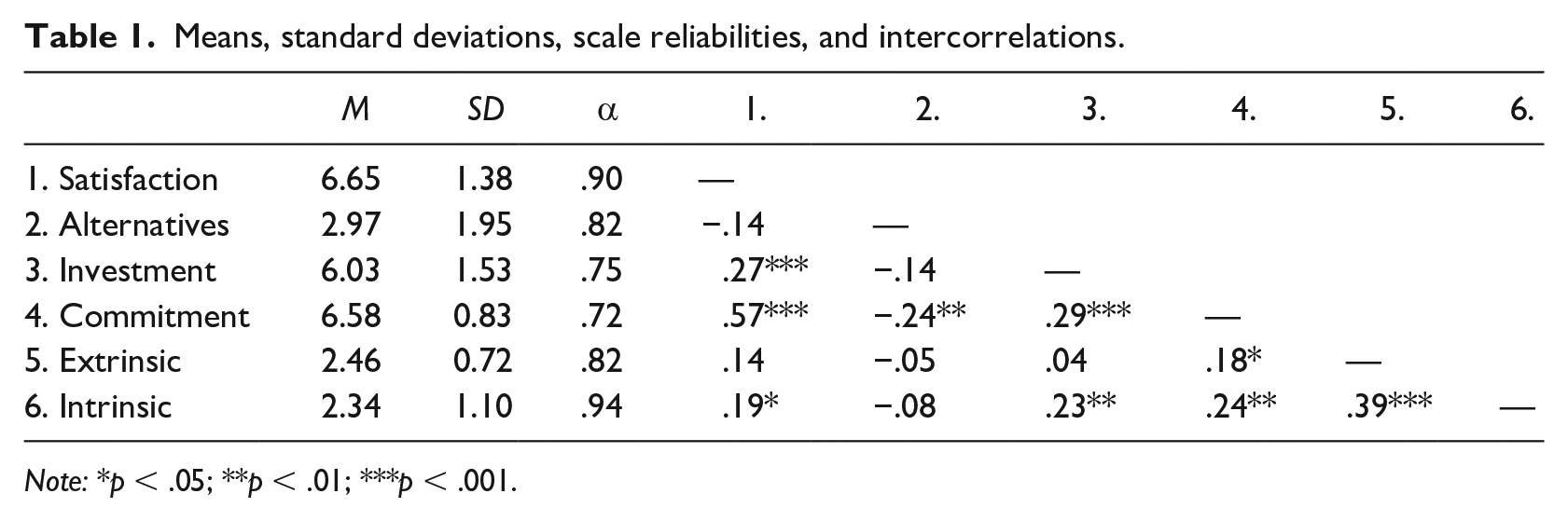
We measured commitment and its antecedents using Rusbult and colleagues’ (1998) scales. Seven items measured commitment to the relationship (e.g., “I want our relationship to last a very long time”) and five items measured each antecedent: satisfaction with the relationship (e.g., “Our relationship is close to ideal”), investments in the relationship (e.g., “I have invested a great deal in our relationship, in both material and nonmaterial ways”), and alternatives to the relationship (e.g., “I have acceptable alternatives to our relationship (seeing another person, spending time with friends or on my own)”), on a 9-point scale (0 = do not agree at all; 8 = agree completely). Table 1 shows means, standard deviations, reliability coefficients, and intercorrelations between all measures.
Means, standard deviations, scale reliabilities, and intercorrelations.
Note: *p < .05; **p < .01; ***p < .001.
Results
To test the hypothesis that aspects of religious orientation would moderate the association between the antecedents within the investment model (i.e., satisfaction, investments, and alternatives) and commitment, a multilevel model was used to control for the dyadic, and thus non-independent, nature of the data, in the multilevel package in R (Bliese, 2016; R Core Team, 2018). The model included the investment model predictors of satisfaction, investments, and alternatives, extrinsic and intrinsic religious orientation, and the interactions between the investment model and religious orientation measures (e.g., satisfaction and intrinsic; satisfaction and extrinsic) as predictors of commitment. Data, syntax, and results will be posted on the Open Science Framework to allow for replication. Despite significant basic correlations between both intrinsic and extrinsic orientations (see Table 1), the results indicate that an intrinsic orientation was not a significant predictor of commitment, t = 1.41, p = .16, but moderated the effect of satisfaction on commitment, t = −2.98, p = .003. Similarly, an extrinsic orientation lacked a main effect, t = 0.38, p = .71, but moderated the relationship between alternatives and commitment, t = 1.99, p = .049 (see Table 2 for complete results).1 Overall, the model explained 61% of the variance in commitment. We provide a breakdown of these interactions by examining simple slopes at one standard deviation above and below the mean for each variable.
Religiosity as a moderator of the investment model predicting commitment.
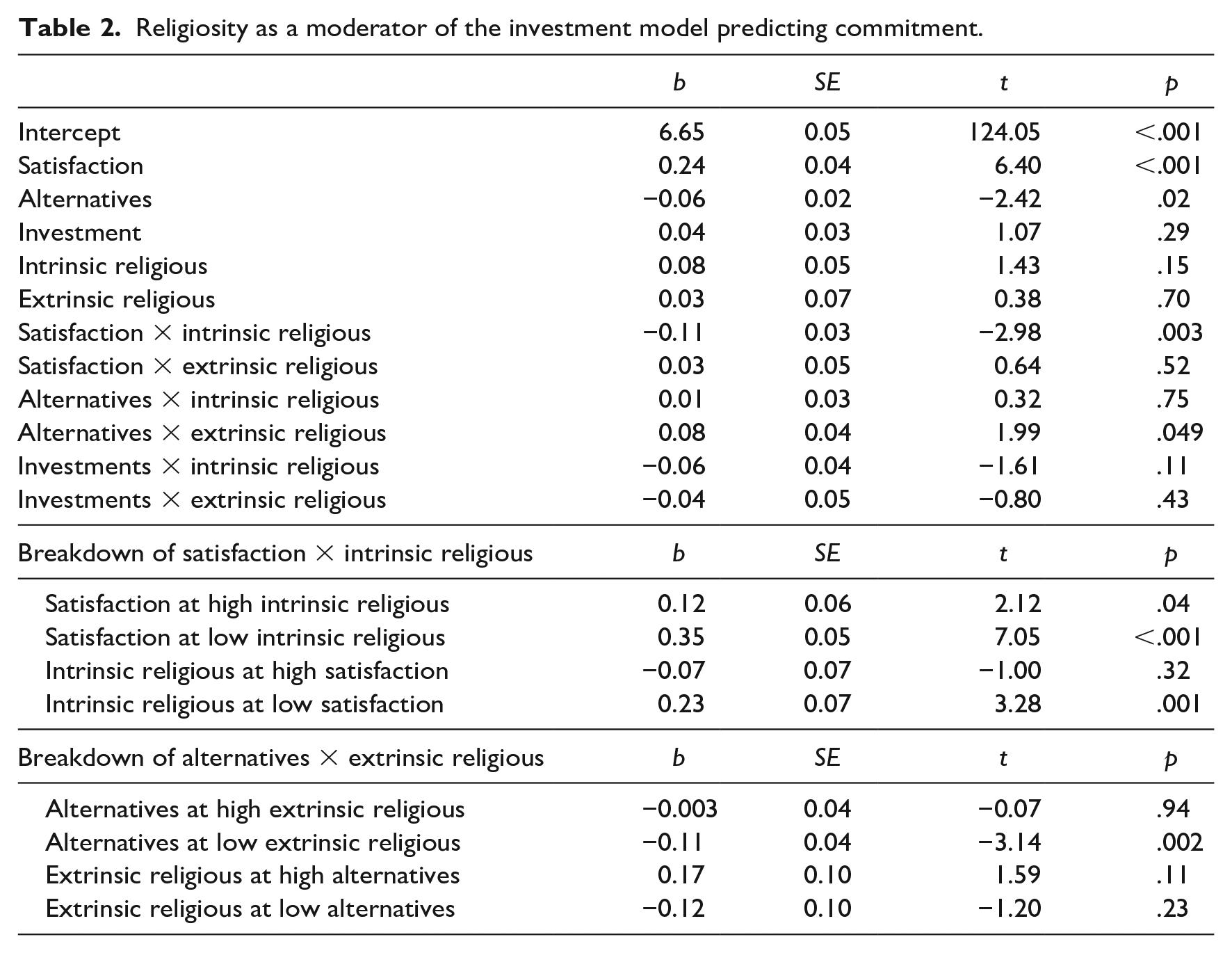
Satisfaction was moderated by intrinsic orientation (see Figure 1). Specifically, satisfaction was less strongly related to commitment when intrinsic orientation was high, t = 2.11, p = .04, but more strongly related when intrinsic orientation was low, t = 7.05, p < .001. Furthermore, intrinsic orientation had an effect on commitment at low, t = 3.28, p = .001, but not high, t = −0.99, p = .33, levels of satisfaction. This finding is consistent with our prediction for intrinsic orientation.
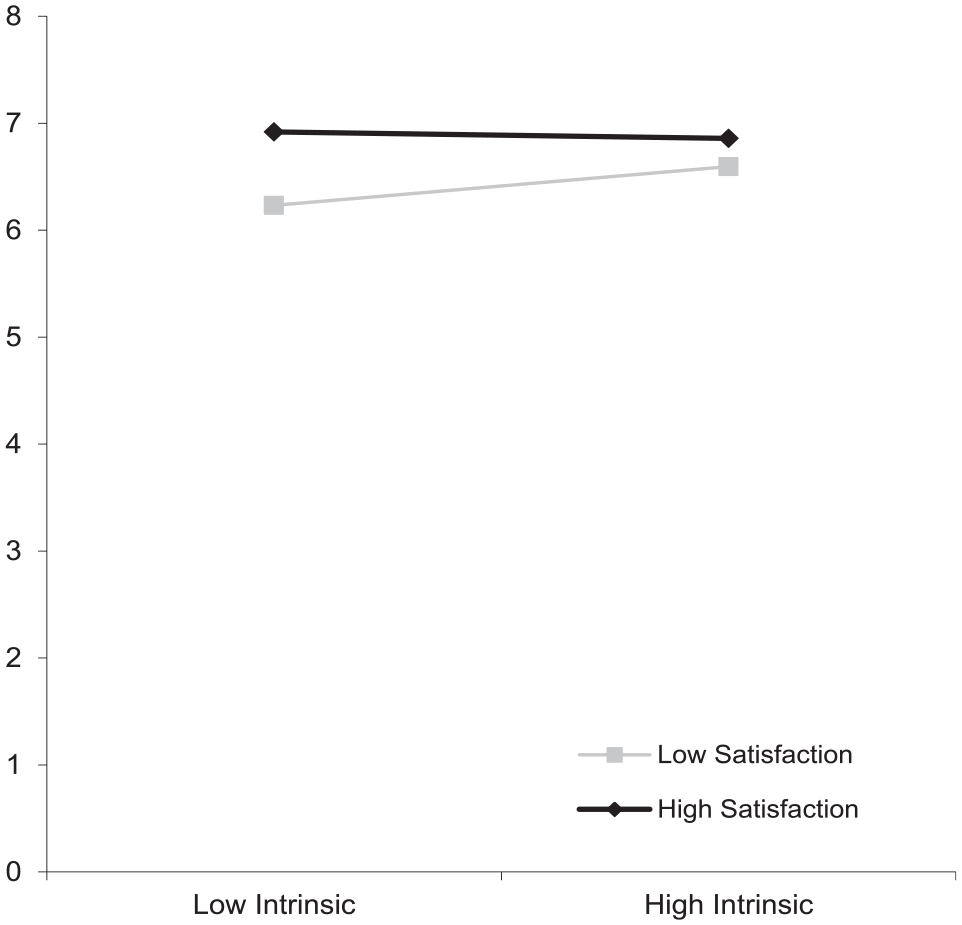
Interaction between satisfaction and intrinsic religiosity.
Alternatives was moderated by an extrinsic orientation (see Figure 2). Specifically, alternatives was not a significant predictor of commitment when extrinsic orientation was high, t = −0.07, p = .94, but alternatives did significantly predict of commitment at low levels of extrinsic orientation, t = −3.14, p = .002. However, an extrinsic orientation was unrelated to commitment at both high, t = 1.59, p = .11, and low levels of alternatives, t = −1.20, p = .23. This finding conflicts with our prediction for extrinsic orientation.
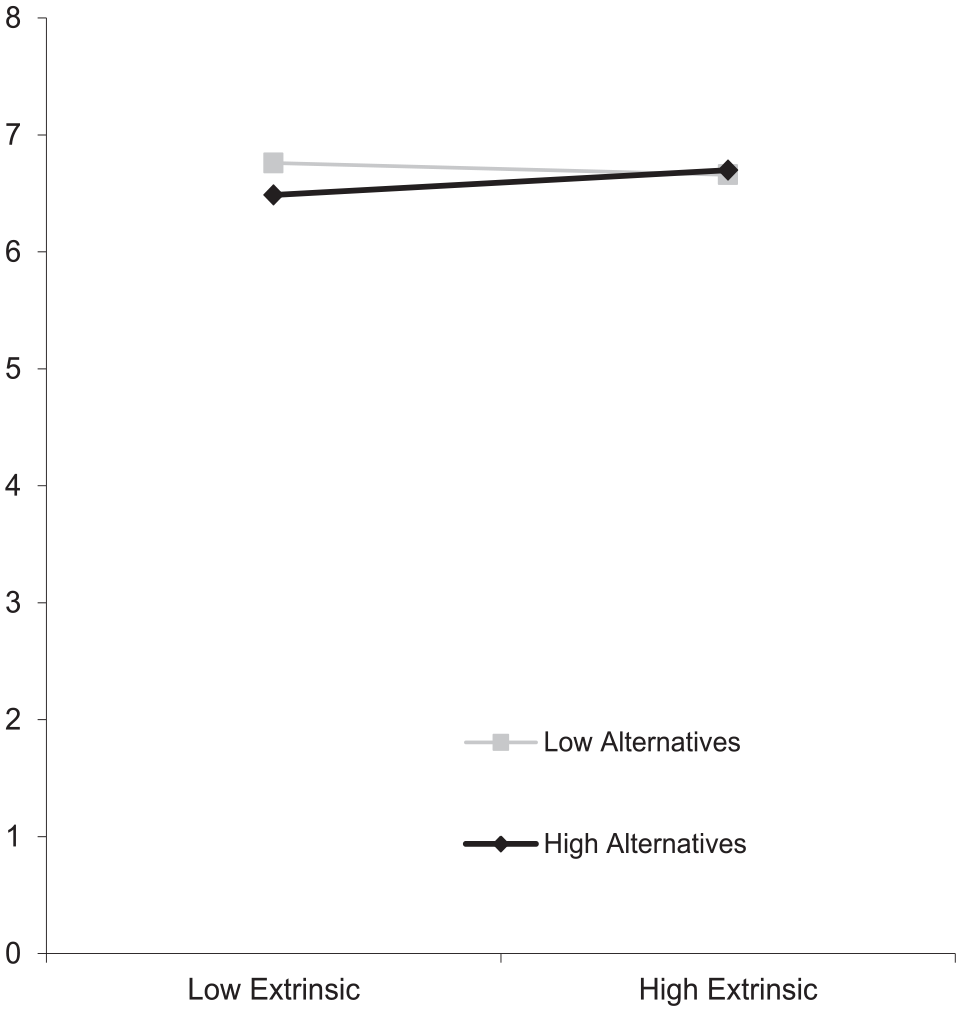
Interaction between alternatives and extrinsic religiosity.
Exploratory analysis
The findings were consistent when controlling for religious affiliation, though the interaction between alternatives and extrinsic religiosity was only a trending relationship (p = .08). Interestingly, this analysis also revealed two additional trending interactions between intrinsic religiosity and both investments (p = .06) and alternatives (p = .07). However, our exploratory analyses revealed patterns may differ between religious and non-religious individuals. Furthermore, given that the interpretation of the religiosity scales may be uncertain for the agnostic and atheist individuals who comprised approximately a third of our sample (see Section “Discussion” for additional considerations), we conducted an exploratory analysis with only individuals who expressed a religious affiliation. Consistent with our full sample, the effect of satisfaction on commitment was moderated by intrinsic religious orientation, t = −3.35, p = .002, with the same pattern of moderation. However, extrinsic religious orientation no longer moderated the effects of alternatives on commitment, t = −1.25, p = .22. However, alternatives was moderated by intrinsic religiosity when analyzing only religious couples, t = −2.28, p = .03. We subsequently replicated these findings using a subset of individuals who all identify as Christians. Given these were small samples (all religious n = 54; Christian-only n = 46), the results should be interpreted with caution. However, a complete summary of these analyses, including a breakdown of the additional moderation, is available in the OSF documentation for the study (https://osf.io/u2ejn/?view_only=4467976ea4664ccfa96e7ce2ecdc72cd).
Finally, we examined a model controlling for relationship status in response to reviewer comments. In this model, the interaction between alternatives and extrinsic religiosity failed to reach significance (p = .30), though the interaction between satisfaction and intrinsic religiosity was still significant (p = .02). However, we note that relationship status is conceptually related to commitment and follow-up analyses indicated that the non-significant interaction occurred due to relationship status being multicollinear with the investment model variables, indicating that it may be an inappropriate control variable, and not the religiosity variables.
Discussion
Partially consistent with our expectation that religious orientation would moderate the effects of the antecedents within the investment model of commitment, we found two significant moderations in our full sample. Specifically, an intrinsic orientation—or having internalized religious beliefs—buoyed commitment for those who were less satisfied with their relationship. However, as an intrinsic orientation had no effect for those who were highly satisfied with their relationship, it appears to act primarily as a protective factor against the deleterious effects of low satisfaction. In addition, individuals high in an extrinsic orientation—who use religion as a means of personal gain—reported similar levels of commitment regardless of how many or few alternatives to the relationship were thought to be available. Put differently, an extrinsic orientation appears to attenuate the effect of having many alternatives, as individuals reporting lower levels of extrinsic religious orientation were more strongly influenced by potential alternatives. Taken together, the results indicate that religious beliefs do appear to support commitment, though the way that this support occurs depends on a person’s religious orientation.
To the best of our knowledge, this is the first study to examine the influence of religious orientation on the predictors of the investment model of commitment. That said, the finding for intrinsic religious orientation appears to be consistent with prior findings for individuals who view marriage as sanctified reporting stronger relationship outcomes (Mahoney et al., 1999; Marks, 2005). This alignment makes sense as viewing marriage as sanctified is likely one core element of an intrinsic religious orientation. We note that the other antecedents—investments and alternatives—did not show moderation in the current sample, contrary to our predictions. Specifically, we thought those high in intrinsic religious motivation may invest more in their relationship and neglect potential alternatives to a greater extent, given their view of the relationship as sacred. However, we note that our exploratory analysis of only religious individuals did find the expected moderation for alternatives. For religious individuals, especially Christians, intrinsic religious orientation buffered the deleterious effect of having greater alternatives on commitment. Future studies should explore these associations more directly, and a systematic review or meta-analysis requesting null effects may provide a more complete understanding as to if religious orientation influences these factors.
One entirely novel finding of the current research is the moderating effect of extrinsic religious orientation on alternatives. For those low in extrinsic religiosity having better perceived alternatives resulted in less commitment, as would be expected within the investment model. The non-significant effect for those high in extrinsic religiosity appears to indicate that extrinsic religiosity buffers against the risk of having alternatives to the relationship. This could be due to the fact that these perceived alternatives are within the community that may ostracize them should they terminate their existing relationship (Bell et al., 2018). In addition, as extrinsic orientation is associated with using religion as a means of obtaining personal goals, those high in an extrinsic orientation may be highly sensitive to the social norms to maintain their appearance and standing within their religious group. Indeed, those with an extrinsic orientation are more likely to conform to social pressure (e.g., Gordon et al., 2008; Rodriguez & Henderson, 2010). It is also worth noting that this finding only occurred with our full sample and was not found when excluding atheist/agnostic individuals. Thus, it is possible atheist/agnostics only view participation in religion as a way to meet particular needs. We note that neither satisfaction nor investments were moderated by extrinsic religious orientation. Although we were uncertain if satisfaction would be, we did predict that extrinsic religious motivation would moderate investments. It is possible that investments are too internal to the relationship to be influenced by outside social pressures, but additional research on these relationships is needed to more fully understand the effect (or lack thereof). Overall, the findings provide support for examining religious orientation to clarify the discrepant findings on how religious beliefs influence romantic relationships.
Beyond advancing the understanding of how religion influences romantic relationships, the current findings also provide a more complete understanding of the investment model of commitment. Specifically, the current research supports two mechanisms through which religious individuals maintain commitment to their relationships, despite being dissatisfied or having many alternatives. Although this may produce longer-lasting relationships, we note that may also mean religious individuals remain in less satisfying or even abusive relationships—either because they truly believe that is what God intends or because leaving the relationship may be frowned upon by members of their religious community. It is also worth noting that, although we utilized a widely used and supported theory and measure of relationship commitment (Rusbult, 1980), future research could explore other perspectives of commitment. For example, Stanley and Markman (1992) proposed two different types of relationship commitment—personal/prosocial dedication and constraint commitment—that may be similar to intrinsic and extrinsic religiosity. Exploring the effects of religiosity from these alternative conceptualizations may provide a stronger understanding on the relationship between religiosity and commitment.
As previously noted, the current sample has some religious diversity, though largely consisted of Christians, atheist/agnostic individuals, and those who identify with other religious or spiritual beliefs. Notably, previous findings indicated that people from a variety of religious groups (i.e., Christian, Jewish, Mormon, and Muslims; Marks, 2005; Hindus; Bhattacharyya, 2019) had similar perspectives on the role of religion in their marriage. In addition, the investment model of commitment has been examined in a number of countries (i.e., United States, the United Kingdom, the Netherlands, Israel, and Taiwan; Le & Agnew, 2003) demonstrating a degree of international relevance. Combined, this suggests that the findings noted here should generalize to other religions and cultures. However, as our sample included primarily Abrahamic religions and western individuals, future research may seek to investigate the association between religious orientation and close relationships in non-Abrahamic religions. A call for this specific investigation combined with a replication with a more globally representative sample in terms of religion would further strengthen the findings. However, preliminarily, we see no reason why the buffering effects of an intrinsic and extrinsic orientation should not apply in other cultures and contexts.
Although these findings are both novel and beneficial, it is important that we note some limitations to the current research, including the cross-sectional nature of the data and the inherent limitations when using such data, including concerns regarding causality and directionality. We note that the causal direction within the investment model has been well established (Le & Agnew, 2003), but the same cannot be said for religious orientation and commitment. In addition, one potential critique of the models is that partners who are married may simply be more religiously homogeneous than those partners who identified other types of relationships (i.e., dating, engaged, or other). However, follow-up analyses indicated that neither relationship status nor length were associated with partner similarity in either intrinsic or extrinsic religious motivations. In addition, the couples in the sample generally reported seemingly high relationship satisfaction and commitment. This is relatively common within relationships research due to the voluntary nature of most studies. However, if couples in this sample are truly more satisfied and committed than the average couple, it likely means the effects are stronger in the population at large than those reported here. This may also be one explanation for the relatively small effects when it comes to the moderation. That is, for those who are less satisfied than participants in the current sample, the effect of intrinsic religiosity may be greater. Similarly, for those who report more alternatives, they may be more strongly constrained if they are high in extrinsic orientation. A second explanation may be the religious orientation is just one of several factors that contribute to commitment and therefore truly has a relatively small effect. In addition, it is also worth noting that our measure of commitment had somewhat lower levels of reliability (α = .72), despite being a particularly widely used measure of commitment (Le & Agnew, 2003). This may have constrained the size of the effects as relationships between variables are limited based on internal consistency of each measure.
A final limitation worth noting is the religious breakdown of the sample with approximately a third identifying as Christian, a third as atheist/agnostic, and the remaining as another belief system. Although this religious diversity is a strength of this research, it does raise the question of how atheist/agonist individuals respond to measures of religiosity. Follow-up analyses found that there was greater variation within the Christian affiliations on both the intrinsic and extrinsic religiosity scales than there was between Christians and atheists/agnostics. Thus, atheists/agnostics report some degree of religious orientation despite not identifying a religion. It is possible that these individuals maintain some religious beliefs, perhaps based on their upbringing, or they simply choose not to identify with a particular group. In addition, a need to maintain beneficial relationships (e.g., friends and family) that were based on this upbringing could explain why the effects of extrinsic religiosity were found when atheist/agnostic individuals were included in the sample but not when they were excluded. Future research may seek to better understand how these individuals respond to these scales.
In summary, this research merges two largely distinct yet prevalent aspects of life—relationships and religious beliefs—advancing the understanding of each and providing evidence regarding how they intersect. Religious orientation appears to act as a buffer by moderating the effects of satisfaction (via intrinsic orientation) and alternatives (via extrinsic orientation) and promotes the longevity of romantic relationships. We note that, while persistence within romantic relationships is generally viewed as a positive outcome, it may mean religious individuals are more likely to remain in less satisfying, or even potentially abusive relationships, than less religious individuals. Researchers should continue to explore how religious beliefs influence romantic relationships and counselors may seek to evaluate religious orientation to gain a more complete picture of the factors at play in troubled romantic relationships.
