



Abstract
The Dimensions of Spirituality Inventory (DSI) is a 50-item quantitative assessment of spirituality. Whereas “spirituality” has seemed to some to be too vague for research purposes, the DSI follows earlier qualitative research in showing that usage of the word points to an intelligible conceptual structure. Instead of defining spirituality and then operationalizing it, as most extant instruments do, the DSI defines and operationalizes 21 relatively uncontroversial elemental components of spirituality, so the overall interpretation of spirituality can only emerge after factor analysis. Just as an alphabet flexibly expresses words and sentences, so the 21 DSI dimensions permit the discovery of latent constructs corresponding to cultural packages of spirituality at the present time. The DSI avoids culturally parochial formulations of items, thanks to intense multidisciplinary engagement among social scientists, scholars of religion, and psychologists of religion, and thus is suitable for cross-cultural application. This paper reports on a study based on a participant pool recruited for ExploringMyReligion.org, in part from Prolific (N = 820, after culling unreliable responses). The DSI is interpreted and validated in relation to several other relevant measures, and the factor analysis is strongly resonant with prior qualitative studies. The psychometric properties of the DSI make it usable as an overall spirituality scale as well as a sensitive inventory of types and configurations of spirituality.
Introduction
Is “spirituality” a tractable concept for research purposes? Does it not bear such a flurry of discordant meanings that attempting to measure it is futile? Despite several major attempts to review the state of research in spirituality and stabilize the concept (e.g. Miller, 2012; Pargament et al., 2013; Zinnbauer et al., 1997; Zinnbauer et al. 1999), we began the Dimensions of Spirituality Project open to the possibility that our findings would confirm the intractability of “spirituality” as a concept for quantitative research. We did conclude that any single high-level definition of spirituality, regardless of its operationalization, is problematic. But we also discovered a way to navigate the definitional and measurement challenges.
The Dimensions of Spirituality Inventory (DSI) demonstrates that “spirituality” is a complex but tractable concept for researchers, particularly in the scientific study of religion and in spirituality-and-health research. The DSI is a rare collaboration between experts in social science, psychology of religion, academic religious studies, and psychometrics, aiming to overcome culturally parochial formulations and thereby achieve some degree of cross-cultural relevance, a point of growing concern within psychology of religion (see Ai et al., 2021).
History of scientific measurement of spirituality
The emergence of “spirituality,” and especially of people identifying as spiritual but not religious, is a cultural phenomenon that has sparked much scholarly interest. Historians have traced the roots in American culture of modern spiritualities back as far as the Puritans (Schmidt, 2005). Much attention has been paid to the rapid period of cultural transition that began after World War II (WWII) (Wuthnow, 1998), defined by the baby boomer generation (Roof, 1993, 1999). Other scholars have studied the nascent spiritualities developing among diverse populations: baby boomers (Hoge et al., 1994), Presbyterian women (Davie, 1995), spiritual seekers in Cambridge, Massachusetts (Bender, 2010), emerging adults in the United States (Smith, 2009), and Italian Catholics (Palmisano, 2010). Analysis of data from the National Survey of American Life, Chatters et al. (2008) showed that understandings of spirituality and its relation to religiosity vary considerably between different American populations, with African Americans and Caribbean blacks being significantly more likely to identify as both religious and spiritual than non-Hispanic whites. Marler & Hadaway (2002) showed that religiosity and spirituality are distinct yet overlapping concepts and that the contrast between the two has been exaggerated by surveys that force respondents to choose either one or other.
In addition to numerous measures of religiosity, including multidimensional measures (see Hill & Hood, 1999, and note that a second and greatly expanded edition of Measures of Religiosity is in progress), there are several quantitative multidimensional measures for spirituality. In the late 1990s, the Fetzer Institute worked with the National Institute on Aging in the United States to develop a multidimensional measure of religiousness and spirituality for use in spirituality-and-health research (the Brief Multidimensional Measure of Religiousness and Spirituality, or BMMRS; see Abeles et al., 1999). This measure—or segments of it deemed most useful—achieved wide usage, especially by spirituality-and-health researchers. The BMMRS has distinctive advantages that the DSI does not attempt to replicate. Most importantly, perhaps, the BMMRS collects frequency data related to concrete religious or spiritual practices and explicit data on social support, which are critical considerations in spirituality-and-health research. However, the BMMRS is limited in its cultural scope, biased—despite its attempts to avoid this—in the direction of personal theistic beliefs and practices, and (based on the meanings of spirituality in diverse religious texts) lacking in its coverage of distinct dimensions of spirituality. The DSI addresses these problems.
Several religiosity scales helpfully touch on spirituality, even though their primary intention is to measure religiosity or mysticism. The RiTE measure offers three 10-item subscales for Ritualistic, Theistic, and Existential Spirituality (see Webb et al., 2014). The Mysticism Scale (Hood, 1975), the Inspirit survey (Kass et al., 1991), the Mystical Orientation Scale (Francis & Louden, 2000), and the Extrinsic-Intrinsic-Quest spiritual style survey (Batson & Schoenrade, 1991a, 1991b) can be noted in this connection. There are also numerous scales that measure religiosity or religious experience that bear only tangentially upon spirituality (see Dittrich et al., 2010; Edwards, 1976; Francis & Louden, 2004; Griffiths et al., 2006; Hall & Edwards, 2002; Hanley et al., 2018; Hood, 1970; Hsieh, 1981; Idler et al., 2003; Lange et al., 2000; MacLean et al., 2012; Pahnke, 1963; Piedmont, 1999; Rosegrant, 1976; Stark, 1965; Taves et al., 2019; Thalbourne, 1998; Underwood & Teresi, 2002; Wildman & McNamara, 2010; Yao & Badham, 2007). Work on the DSI included reviewing all these measures and identifying elemental subdimensions of spirituality that should be included in a more comprehensive measurement tool.
In recent years, researchers have developed scales designed explicitly to measure spirituality or closely related constructs. One thoughtfully developed multidimensional measure of spirituality is the Expressions of Spirituality Inventory (ESI; MacDonald, 2000). Recognizing the proliferation of measures of spirituality, MacDonald began by performing an exploratory factor analysis based on the results of administering to 534 students 11 instruments with satisfactory reliability and validity that covered a broad range of possible elements of spirituality. This analysis generated seven factors, one of which was dropped due to its correspondence with only 1 of the 11 instruments. MacDonald next generated 218 items aimed at capturing the remaining 6 factors and administered this instrument, along with a battery of other measures, to 928 participants. Subjecting the results to factor analysis, MacDonald determined that five factors proved most stable: Experiential/Phenomenological Dimension, Cognitive Orientation to Spirituality, Paranormal Beliefs, Religiousness, and Existential Well-Being. Next, MacDonald further winnowed items based upon their factor loadings, contributions to intra-dimensional factor structure, item-to-scale correlations, and effects upon scale reliability of the overall instrument, ultimately reducing 218 items to the 98 items in the ESI. Finally, the ESI dimensions were validated by showing statistically significant correlations between ESI dimensions and eight measures of spirituality aimed at measuring similar constructs. We believe MacDonald’s dual strategy of not defining spirituality before operationalizing it and trying to identify elemental aspects of spirituality was a creative advance. Unfortunately, the ESI items still ultimately depend on measures that were constrained by questionably narrow or idiosyncratic definitions of spirituality, and the result is dimensions of spirituality that are not sufficiently low-level and discriminating. By contrast, though inspired by the ESI’s advance, DSI items are generated from scratch to operationalize numerous elemental of subdimensions of spirituality.
The Assessment of Spirituality and Religious Sentiments (ASPIRES) Scale (Piedmont, 1999, 2007, 2010; Piedmont et al., 2008) benefits from impressive systematic development and validation. ASPIRES defines spirituality as a universal motivational drive to develop personal meaning in light of human mortality. Understood as such, spirituality does explain variance over and above what can be explained using five-factor personality models, suggesting that perhaps spirituality is a motivational element in human life that could be treated as a distinctive dimension of personality (Piedmont, 1999). But we see here a reversion to a narrow definition of spirituality in advance of operationalization—for example, while some aspects of spirituality may be related to personal meaning in light of human mortality, others seem not to be so related. Nevertheless, the psychometric approach is valuable. Many of the ASPIRES items were initially developed in consultation with religious experts representing Buddhism, Catholicism, Hinduism, Judaism, Lutheranism, and Quakerism who were asked to identify qualities of spirituality shared between their religious traditions. After simplifying esoteric language and culling unreliable items during several rounds of piloting, the resulting ASPIRES scale is composed of 35 items and two subscales: the motivationally based Spiritual Transcendence scale (23 items) and the behaviorally based Religious Sentiments scale (12 items). The validity of the ASPIRES Scale has been demonstrated in several ways. The measure includes an observer rating form, allowing self-reported answers to be compared to answers reported by close friends or relatives. Developed in close connection with the empirically robust Five Factor Model (FFM) of personality, the ASPIRES Scale’s incremental validity was demonstrated through hierarchical multiple regression analyses showing that ASPIRES significantly predicted variance in a variety of psychosocial variables over and above the variance explained by the FFM (Piedmont, 2013). Finally, the scale’s validity has been confirmed in several cross-cultural studies: among conservative, reformed, and orthodox Jews (Goodman, 2002); Hindus, Muslims, and Christians in India (Piedmont & Leach, 2002); predominantly Catholic adults in the Philippines (Piedmont, 2007); largely atheistic undergraduates in the Czech Republic (Rícan et al., 2010); and a religiously and demographically diverse sample of Polish people (Piotrowski et al., 2021). The DSI follows the ASPIRES development process by engaging experts in philosophy of religion and religious studies, but the DSI greatly expands the range of religious and spiritual traditions considered. We think the ASPIRES focus on shared territory across traditions was a missed opportunity because differences across traditions are as informative as similarities; the DSI permits measurement of both similarities and differences.
Though developed in a less systematic way, another important precursor of the DSI is the Spiritual Orientation Inventory (SOI; Elkins et al., 1988; also see Lazar, 2021). Seeking to develop a measure of humanistic spirituality, David N. Elkins and colleagues began by reviewing classic works describing spirituality from a phenomenological perspective, including those by William James, Carl Jung, Abraham Maslow, Rudolph Otto, John Dewey, Gordon Allport, Mircea Eliade, Martin Buber, Erich Fromm, and Victor Frankl—a creative approach lamentably emphasizing western thinkers, by contrast with the ASPIRES measure, which attempted to include a few non-Western perspectives. Having compiled a list of components of spirituality based on this review, Elkins and colleagues interviewed five representatives of Buddhist, Catholic, Protestant, and Jewish traditions that they regarded as “highly spiritual.” These informal consultants expressed basic agreement with nine components of spirituality: transcendent dimension, meaning and purpose in life, mission in life, sacredness of life, material values, altruism, idealism, awareness of the tragic, and fruits of spirituality. The team then developed 200 items representing these components of spirituality, pared the list down to 157 items based on item ratings by experts in psychology and spirituality, and finally winnowed this down to 85 items based upon (vaguely described) “statistical studies.” While over 20 subsequent studies have employed the SOI, as Lazar points out, “no published studies have focused on the measure itself” (Lazar, 2021, p. 253). From our perspective, the focus on humanistic spirituality is unduly narrow, the range of spiritual ideas considered is culturally limited, and the constructs of some elements of spirituality are rather too high-level, but the consultative method of development is a good model.
In addition to these scales seeking to measure spirituality directly, several important scales measure constructs closely related to spirituality. The Multidimensional Existential Meaning Scale (MEMS), a 15-item self-report questionnaire, seeks to measure three distinct dimensions of existential meaning: comprehension (making sense of one’s life and the world), purpose (feeling that one is pursuing valuable goals), and mattering (a sense that one’s life is significant in the wider scheme of things) (George & Park, 2017). The Religious and Spiritual Struggles Scale (RSS), a 27-item self-report scale, measures degrees of religious or spiritual distress (Exline et al., 2014). The Reverence in Religious and Secular Contexts (RRSC) measures the emotion of reverence as it occurs in both religious (relying on traditional religious resources for spiritual support, assuming an afterlife with rewards) and secular (drawing on non-traditional resources for spiritual support, assuming death marks the end of personal existence) contexts (Ai et al., 2009). The Post-Christian Spirituality Scale (PCSS) is a 7-item self-report scale that measures seven dimensions that typify the spirituality of those for whom traditional Christian authority (e.g. the Bible as the sole authoritative revelation of God, Christian ministers as inspired mediators) has broken down, largely due to knowledge of other religions (Houtman & Tromp, 2021). Finally, the Spiritual Well-Being Scale (SWBS), a 20-item self-report scale, employs two subscales to measure spiritual well-being understood in traditional religious terms and in secular, existential terms (Paloutzian & Ellison, 1982; Paloutzian et al., 2012). Because these scales measure constructs that are closely related to spirituality and that are likely to be present in both traditionally religious and more secular people, they are highly relevant to the DSI. We reused aspects of spirituality present in these measures within the DSI, when they were sufficiently low-level and cross-culturally relevant. In future research, we intend to investigate correlations between the DSI subdimensions and the dimensions of these instruments.
The Post-Critical Belief scale (PCB; Hutsebaut, 1996) illustrates the way in which the DSI does not attempt to engage cognitive attitudes to the conceptual content of spiritual beliefs. The PCB assesses attitudes to religion on a 2 × 2 schema (the Wulff Quadrant; see Wulff, 1991), with belief versus non-belief in the transcendent on one axis, and non-literal symbolic versus literal style of belief on a second axis. These are important issues for evaluating cognitive attitudes toward the conceptual content of spirituality, but the DSI aims to characterize aspects of spirituality at a lower level. When the DSI is combined with analysis of the content of spiritual beliefs, however, the PCB would enter forcefully into the picture as an asset, though it should be used with care (see Szydłowski et al., 2023).
Finally, David Wulff’s application of q-sort methodology to religion and spirituality (Wulff, 2019) bears some resemblance to what we are trying to achieve with the DSI, in several ways: it is designed to capture subjective feelings and opinions, to work across cultures, to capture both shared and non-shared patterns in religious and spiritual belief and practice, and to achieve high sensitivity to subtle variations. The Q-sort method involves arranging a universe of statements about a target subject on a spectrum from strong disagreement to strong agreement, with ambivalent or neutral responses located somewhere in between. Then a factor analysis is used to identify characteristic prototypes, with rich descriptions based on the distribution of the statements. Q-methodology treats the selection of the universe of statements, and its reduction to a group of representatives that can be used with participants in the sorting procedure, something like tagging in qualitative research: generate statements until you get nothing new, and then eliminate redundancy. The Q-method’s procedure for identifying the universe of statements relevant to spirituality is similar to that of the DSI, but the culling of items to produce the set for use in research is more rigorous in the development of the DSI, because the latter excludes culturally parochial items and employs statistical analysis of responses to items to determine whether they should be retained or dropped. The factor analysis part of the Q-sort method is very similar to that of the DSI. In short, where the Q-sort method leaves the generation of statements more to chance, the DSI systematically works across disciplines to eliminate cultural bias and perspectival limitations.
Spirituality in cross-cultural perspective
This brief history of the scientific measurement of spirituality indicates that spirituality (in a wide variety of meanings and aspects) is measurable, and also confirms the complex contours of contemporary spirituality that resist convenient operationalization. Intimately related to the search for existential meaning, an impetus for pursuing moral excellence and social justice, frequently including the search for and cultivation of intense and deeply meaningful experiences, typically involving relations to purportedly transcendent realities of one kind or another, and various other things besides—spirituality, if it is one thing, is a very complex thing, woven into the fabric of spiritual people’s personal, social, moral, and intellectual lives.
Despite this evident complexity, many of the creators of the instruments discussed above hypothesize that spirituality is a singular reality, often positing its universality among human beings across diverse cultures. For instance, Piedmont contrasts spiritual transcendence to culturally and temporally variable sentiments, saying, Sentiments can be very powerful motivators for individuals and have very direct effects on behavior. However, sentiments, like love, gratitude, and patriotism, do not represent innate, genotypic qualities like spirituality. That is why the expression of sentiments can and does vary across cultures and time periods . . . Spiritual Transcendence, on the other hand, is hypothesized to represent a fundamental, inherent quality of the individual. (Piedmont, 2013)
Similarly, Elkins and colleagues list among their foundational assumptions that “There is a dimension of human experience . . . which can best be described as a ‘spiritual dimension’ or ‘spirituality’” and “Spirituality is a human phenomenon and exists, at least potentially, in all persons” (Elkins et al., 1988, p. 8).
While it is certainly plausible that some elements of spirituality—the search for existential meaning, self-improvement, communal connection, supernatural beliefs, and so on—are human universals, it is also likely that those common elements give rise, in diverse social and cultural contexts, to different understandings of spirituality and, ultimately, different ways of being spiritual. This thesis is supported by qualitative research by the sociologist of religion, Nancy Ammerman, which reveals the diverse ways people use the term “spirituality” and think of themselves as spiritual people (Ammerman, 2013a). Ammerman’s hypothesis was that the term “spirituality” and its cognates are used in diverse ways that call for a multidimensional construct, and that these dimensions of meaning cluster in four intelligible cultural packages (theistic spirituality, extra-theistic spirituality, ethical spirituality, and belief-and-belonging spirituality, discussed under the Factor Analysis, below; see Ammerman, 2013b, and also see Saroglou et al., 2020, which demonstrates the cross-cultural validity of key categories used in Ammerman’s cultural packages). This tells us a lot about spirituality and demonstrates that the semantic action surrounding the word is not as baffling as it sometimes seems.
Similarly, Brian Steensland’s team analyzed a single open-ended question in a nationally representative survey, coding responses and creating a quantitative dataset to support analysis of factors that influence styles of spirituality (Steensland et al., 2018). They uncovered seven distinctive understandings of spirituality: Organized religion, Belief in God, Relationship with God, Belief in a higher being, Belief in something beyond, Holistic connection, and Ethical action.
Rather than seeking to measure spirituality as a single construct defined in advance, we designed the DSI to elicit from respondents the meaning of spirituality for them, thereby making it possible to discern the distinct packages of spirituality reported by Ammerman, and the types of spirituality noticed by Steensland et al. and other studies. In terms of operationalization technique, the DSI has most in common with the ESI, as both use an array of relatively uncontroversial, low-level aspects of spirituality to map out meanings of spirituality in practice, which might well vary depending on the pool of participants, though the DSI aims for more elemental subdimensions. In terms of its multidisciplinary developmental strategy, the DSI has most in common with ASPIRES and the SOI, involving intensive engagement with experts and texts in the history of religion and spirituality.
The 21 subdimensions of the DSI derive from our own research on religious and spiritual experiences (see Wildman, 2011), qualitative analysis of hundreds of hours of interviews (Ammerman, 2013b), analysis of open-ended survey items (Steensland et al., 2018), review of prior quantitative surveys (above), and extensive analysis of key texts from the world’s spiritual traditions, as interpreted by experts in the academic study of religion (including the authors considered in developing the SOI, and many others from diverse cultures; see the “Philosophical and Conceptual Research” section under “Methods,” below). We aimed for low-level clarity and simplicity rather than completeness in articulating aspects of spirituality, on the grounds that this would make the DSI more cross-culturally adaptable. For example, medieval Daoist spiritual practices famously include a kind of inner alchemy aimed at achieving immortality in this life, which bears common features with medieval western alchemical practices and even a weak resonance with the aspirational ventures of today’s transhumanists who are trying to develop life-extension technologies. We see this aspect of spirituality as a blend of science, art, and mysticism having little relevance for understanding spiritual formations today, and also as too conceptually complex to include in the DSI. The DSI defines and operationalizes the simplest aspects of spirituality, having the most relevance across cultures and periods. Thus, we would expect people for whom Daoist inner alchemy is a critical element of their spiritual lives to display a distinctive signature consisting of a combination of other elemental aspects of spirituality.
The triple purpose of articulating so many simple, elemental aspects of spirituality is to steer clear of culturally parochial formulations of items, to avoid dependence on preset high-level definitions of spirituality, and to make the DSI properly responsive to the diversity of religious and spiritual formations and practices at any given time and place. This approach renders the DSI useful for researchers who intend to study spirituality across diverse cultures, and perhaps even across eras based on expert coding of texts rather than soliciting surveys from living participants. The DSI loses something valuable by not specifying and operationalizing a high-level definition of spirituality but it gains something, too: it offers a more nuanced mapping of the spirituality of study participants than instruments presupposing a high-level definition of spirituality can. The DSI’s multidisciplinary collaboration with the academic study of religion, much like ASPIRES and the SOI, is critical to achieving these virtues. Naturally, other experts should evaluate our interpretation of key ideas and texts from the world’s spiritual traditions, as well as our judgments about what count as low-level, elemental aspects of spirituality (and thus are included in the DSI) as opposed to higher-level spirituality constructs that risk cultural parochialism and historical idiosyncrasy.
Methods
Philosophical and conceptual research
We began with intensive study of existing attempts to define and map spirituality in ways suitable for quantitative research. We took as our starting point the 11 subdimensions of meaning unearthed in Ammerman’s research—spirituality is: a religious tradition, ethics, God, practices, mystery, meaning, belief, connection, ritual, awe, and self (see Ammerman, 2013b); and the seven subdimensions identified by Steensland’s team—organized religion, belief in God, relationship with God, belief in a higher being, belief in something beyond, holistic connection, and ethical action. We also identified the most elemental aspects of spirituality articulated within existing quantitative measures.
Next, we activated our team’s expertise in the sacred texts, beliefs, and practices of the world’s religious and spiritual traditions. In particular, we reviewed the bibliography for the year-long “Core Texts and Motifs of the World’s Religions” course that some of the team had been involved in as students or instructors. On the basis of these texts, which represent the richness and diversity of the world’s religions, both living and dead, we added new subdimensions and drew distinctions within existing categories where religious-studies understandings seemed to indicate that a lower-level, more elemental category was available. As noted above, we did not include some dimensions of spirituality—such as inner alchemy—that seemed to be a high-level composite of other elements or culturally specific.
What emerged was a long but manageable list: 21 elemental aspects or subdimensions of spirituality (see the DSI Dimensional Structure at the end of the Methods section). We endeavored to define each of the elemental aspects clearly enough for operationalization in a survey instrument. The philosophical-conceptual research effort left us more determined to resist defining spirituality as such, or spirituality as a whole, because some understandings of spirituality do not emphasize some of the elemental aspects that we identified, yet all of the elemental aspects were present in at least some understandings of spirituality. This awareness increased our confidence that the most prominent understandings of spirituality, past and present, could be captured within the 21-dimensional net in ways that adequately distinguish them from one another, even as we realized that the net would fail to capture every aspect of any given cultural packages of spirituality. In particular, the 21-dimensional net focuses on elemental aspects of spirituality rather than the full-bodied meanings that cultural packages of spirituality acquire in concrete times and places. The DSI helps to discriminate and compare cultural packages of spirituality, therefore, but needs to be complemented by qualitative study of conceptual content to retrieve a fuller appreciation of the meaning of a form of spirituality for the people who claim it as their own.
The philosophical-conceptual research effort made clear that the elemental aspects or subdimensions of spirituality tend to cluster in groups based on conceptual affinities. For example, the three dimensions most closely related to supernatural beings—deceased forebears who are active in the world, divine beings, and powerful spiritual beings who are more than human yet less than divine—naturally cluster together, from a philosophical or conceptual perspective. But it is also clear that some living configurations of spirituality explicitly eliminate one or more of these three supernatural elemental subdimensions of spirituality. For example, non-theistic spiritualities rule out divine beings, many spiritualities do not acknowledge active dead ancestors, some spiritualities demythologize traditional beliefs about spiritual beings such as angels or demons or jinns, and naturalist spiritualities reject all three supernatural dimensions of spirituality.
This underlines the usefulness, indeed, the necessity, of the elemental approach to spirituality. It also shows that two perspectives on subdimensional clustering are instructive for interpreting spirituality and suggests that we should retain both. One is conceptual or philosophical clustering, which represents insights from religious wisdom traditions reflecting thousands of years of sacred texts and attention to special experiences. The other is empirical clustering relationships among the 21 dimensions, which expresses the way complex formations of spirituality take shape in our time within a specific range of cultures (see the exploratory factor analysis in the Results section). As cultural perspectives vary with region and time, the specific formations of spirituality may well change, and empirical studies would tell us how. Meanwhile, the conceptual groupings of subdimensions remain intelligible and useful for presenting the DSI’s various subdimensions. These 21 elemental aspects of spirituality are relatively more fundamental to human nature and more likely to remain relevant within the movement of history and the buffeting of diverse cultures, thereby facilitating the cross-cultural and even the comparative historical study of spirituality.
Reliability
The DSI employs two strategies to evaluate the sincerity and consistency of respondents.
First, three Catch & Calibration (CC) items force respondents to use extreme ends of the scale, and also identify careless or problematic responses. They are as follows:
[dsi_cc1] “Under ordinary circumstances, and all things being equal, rich people should be considered spiritually superior to poor people,” which should produce Strongly Disagree;
[dsi_cc2] “Under ordinary circumstances, and all things being equal, it is better to be kind than cruel,” which should produce Strongly Agree; and
[dsi_cc3] “Under ordinary circumstances, and all things being equal, physically attractive people should be considered spiritually superior to unattractive people,” which should produce Strongly Disagree.
Second, a Reliability Item Pair (RIP) consists of two versions of the same item, one having the reverse polarity of the other, so that an attentive respondent will supply opposite responses on these items. The DSI contains five RIPs, indicated in the appendix’s listing of DSI items. For example, one RIP consists of [dsi_co2_rip1] “Connection to my spiritual community is essential to my spiritual fulfillment” and [dsi_co3_rip1_r] “Connection to my spiritual community is irrelevant to my spiritual fulfillment.” There is a significant literature about measurement reliability using negatively worded items (e.g. Suárez-Álvarez et al., 2018 directly questions the use of RIPs). To mitigate the documented problems associated with the increased cognitive difficulty of negatively worded items, and thus with using RIPs in the DSI, we evaluated numerous possible RIPs during piloting. We first analyzed each pair of items, looking for semantic and syntactic ambiguity as well as the amplification of conceptual complexity in negative formulations, which is a serious concern for negatively worded items. We rejected RIP candidates with such characteristics. We then measured RIP reliability individually and compared RIPs quantitatively. We found significant variation in performance, as the literature warns we might, and we rejected RIPs that yielded low measures of reliability, on the assumption that the negatively worded pair in each item was producing confusion and lowering respondents’ reliability. The result was five high-performance RIPs.
As we point out below, we improved scale reliability (Cronbach’s alpha) using RIPs and CCs to eliminate unreliable respondents, despite shrinking N, which damages alphas. This is a strong indication that culled respondents were in fact unreliable in general, not just in relation to the RIP and CC items, and therefore evidence that the RIPs and CCs are doing precisely what they are designed to do.
Piloting
We ran four rounds of preliminary piloting to identify the best-performing items and the best-performing scales for each subdimension. We began piloting with only 19 subdimensions identified, testing 250 items. Along the way, we found that we needed to split two subdimensions, which harbored unnoticed internal vagueness, and thus were not sufficiently elemental for the purposes of the DSI. The result was 21 dimensions in total (not counting catch-and-calibration items, explained above) measured using 50 items. Following these four rounds of preliminary piloting, we ran the main study, described below.
The criteria for retaining or excluding items during the preliminary piloting process were as follows. We excluded items that did not yield close-to-monotonic response curves (these show the proportion of item responses plotted against total scores achieved for the entire DSI), that had means too far from the center of the scale (all item responses range from “Strongly Disagree” (1) to “Strongly Agree” (5), with midpoint 3), or that had standard deviation, kurtosis, or skewness unhelpfully small or large. Then we used scale-reliability analysis (Cronbach’s alpha) on the usable items to identify the best-performing subset, paying close attention to items’ semantic content to ensure adequate coverage of the underlying construct. We found that we could reduce the number of items to two or three for each of the 21 subdimensions of the DSI and still maintain satisfactory alphas.
We ran the four preliminary pilot studies of the DSI on the instant feedback survey sites www.ExploringMyReligion.org and www.FaithInDepth.org, which were built by the Center for Mind and Culture’s Institute for the Bio-Cultural Study of Religion (IBCSR; the survey sites were created by Ravi Iyer and Wesley Wildman; also see mindandculture.org and ibcsr.org). After registering on one of these sites, which involves completing a brief demographics survey, participants take the DSI and then receive feedback comparing their results to the average of others who previously took the survey. The sites offer many surveys, resulting in complex, cross-cutting datasets, linking DSI results to many other measures. DSI items were randomized in presentation.
The four preliminary pilot versions of the DSI were conducted on the same platform and in the same manner as the main study (described below). We promoted the four pilots on Facebook (using the Facebook page for IBCSR’s www.ScienceOnReligion.org outreach site), at www.SpectrumsProject.org, and with acquaintances. Most participants were brought in by word of mouth, as those who appreciated the informative post-survey feedback told others about their experience. The piloting samples generally resembled the participant pool for the main study (described below), and thus leaned in a WEIRD (western, educated, industrialized, rich, democratic) direction, despite representing diverse nations and cultural backgrounds.
The research was conducted, and the sites operate, under approval from the Boston University Institutional Review Board (Charles River Campus, Study 2495X). Statistics were run on IBM’s SPSS statistical software, version 26.
Recruitment for the main study
After the four rounds of preliminary piloting, we moved to the main study of the DSI. We recruited a mixed sample, blending English-language advertisements to drive willing respondents to ExploringMyReligion.org with direct recruitment through Prolific (prolific.co). Prolific allowed us to filter invitations so they were received only by participants who were proficient in English and who expressed interest in spirituality, to any degree. The result was a pool drawn mostly from the United States, United Kingdom, and European nations. We also invited respondents from Prolific who passed reliability tests to retake the DSI approximately 1 month after they took it the first time. The purpose of the mixed sample was to evaluate participants associated with the two streams of recruitment and to give us access both to a test–retest sample (through Prolific) and to validation survey data (through direct recruitment).
The preliminary subject pool was N = 1329. We excluded 44 records (3.3%) having incomplete data, leaving N = 1285. We applied the strict CC1 criterion for all three catch-and-calibration items (meaning that answers had to be within one point of the ideal) to both the testing pool and the retesting pool, so that all surviving respondents were reliable on both the test and the retest. This culled a total of 355 records (26.7% of the original 1329), leaving N = 930. Finally, we applied the “loose” RIP2 criterion for the five RIP items, rejecting respondents who answered any of the RIPs more than two points away from ideal. We used the loose criterion to compensate for the potential increase in cognitive complexity associated with the negatively worded items in RIPs. This culled a further 110 records (8.3% of the original 1329) leaving N = 820 records. We analyzed scale reliability at the level of subdimensions and dimensions before and after each round of culling, exploring different degrees of strictness. We tested CC0 and RIP0 (meaning answers matched perfectly), CC1 and RIP1 (within one point of ideal), CC2 and RIP2 (within two points of ideal), as well as imposing no reliability requirements at all—in various combinations. Applying CC1 and RIP2 produced the best balance of scale reliability and size of respondent pool for both testing and retesting.
The total culled for failing completeness and reliability testing was 509 (38.3% of the original pool of 1329). In all, 996 participants were recruited through Prolific and 571 survived reliability tests. In all, 333 participants were recruited outside of Prolific and 249 survived reliability tests. Thus, applying the CC1 and RIP2 criteria, the unreliability cull rate for Prolific respondents was 42.7% while the unreliability cull rate for people recruited outside of Prolific was 25.5%. This underlines how critical it is to create surveys with rigorous built-in checks on reliability, especially when recruiting from convenient survey platforms.
Of 699 people who responded to the invitation to participate in the retest of the DSI, 463 passed the CC1 and RIP2 reliability tests, yielding an unreliability cull rate of 39.5% which is only marginally better than the 42.7% unreliability cull rate for the entire group of Prolific respondents. This underlines how perilous it is to assume that one round of reliability checks guarantees a consistently reliable subject pool on Prolific.
Sample
The pool of N = 820, who are all proficient in English, skews a little high in education completed (median = 16 years vs under 14 years in the United States and around 13 years in the United Kingdom). We suspect this reflects the recruitment process, as Prolific focuses on people who are comfortable with computers and thus tend to be well educated. Similarly, people reached by our direct recruitment and advertising efforts were Facebook users connected to outreach information about the scientific study of religion—another sign of higher education. The sample is more interested in spirituality than most; this was an explicit recruitment filter on Prolific and a likely consideration in whether people responded to Facebook advertisements. The sample is fairly representative on race (74% white versus about 72% in the United States in 2019) and gender (47% female). Demographic characteristics of our sample (N = 820) are as follows.
Gender: Female = 384 (46.8%), Male = 408 (49.8%), Other = 13 (1.6%), Refused = 15 (1.8%)
Year of birth: median = 1991, mean = 1986.5 (SD = 13.7), range from 1932 to 2004
Years of education completed: median = 16, mean = 16.29 (SD = 3.35), range from 1 to 29
Self-assessed affluence: median = 6, mean = 5.97 (SD = 0.86) on a scale from 1 (least) to 10 (most)
Country of residence: United States = 238 (29.0%), United Kingdom = 149 (18.2%), Portugal = 85 (10.4%), Poland = 77 (9.4%), Italy = 40 (4.9%), Greece = 34 (4.1%), Mexico = 32 (3.9%), Canada = 27 (3.3%), Spain = 19 (2.3%), Hungary = 13 (1.6%), Australia = 10 (1.2%), 71 people with fewer than 10 people from 27 other countries, Refused = 23 (3.0%)
Region of US residents: Northeast = 110 (46.0% of US residents), South = 54 (22.6%), Midwest = 34 (14.2%), West = 32 (13.4%), Refused = 8 (3.3%)
Race: White = 606 (73.9%), Hispanic = 47 (5.7%), African = 27 (3.3%), East Asian = 26 (3.2%), South Asian = 23 (2.8%), Middle Eastern = 11 (1.3%), Southeast Asian = 5 (0.6%), Native American = 3 (0.4%), Multiracial = 32 (3.9%), Other = 6 (0.7%), Refused = 34 (4.1%)
Importance of religion: Not at all important = 94 (11.5%), Not too important = 163 (19.9%), Somewhat important = 267 (32.6%), Very important = 266 (32.4%), Refused = 30 (3.7%)
Religious orthodoxy self-rating: mean = 3.38 (SD = 1.79) on a scale from 1 (extremely liberal) to 7 (extremely conservative), with midpoint at 4.0
Religious service frequency: Never = 158 (19.3%), Once a year or less = 172 (21.0%), A few times a year = 184 (22.4%), Once or twice a month = 75 (9.1%), Almost every week = 95 (11.6%), Every week or more than once a week = 117 (14.3%), Refused = 19 (2.3%)
Religious self-identification: Christian = 558 (68.0%), Agnostic = 49 (6.0%), None = 35 (4.3%), Other = 33 (4.0%), Atheist = 27 (3.3%), Muslim = 26 (3.2%), Buddhist = 17 (2.1%), Jewish = 14 (1.7%), Humanist = 14 (1.7%), Neopagan = 13 (1.6%), Hindu = 11 (1.3%), Other = 8 (1.0%), Refused = 13 (1.6%); cumulatively across categories, Nonreligious = 125 (15.2%)
Political interest: mean = 3.12 (SD = 0.68) on a 1–4 scale; not at all interested = 0, not much interested = 140 (17.1%), somewhat interested = 422 (51.5%), very much interested = 233 (28.4%), Refused = 25 (3.0%)
Political ideology self-identification (inviting people, regardless of country of residence, whether they were closer to Republicans, Democrats, or Independents in the United States): Closer to Democrats = 510 (62.2%), Closer to Republicans = 137 (16.7%), Closer to Independents = 71 (8.7%), Refused = 102 (12.4%)
Political ideology self-rating overall: mean = 3.16 (SD = 1.49) on a 1–7 scale; Very Liberal = 88 (10.7%), Liberal = 212 (25.9%), Slightly Liberal = 121 (14.8%), Moderate = 166 (20.2%), Slightly Conservative = 78 (9.5%), Conservative = 48 (5.9%), Very Conservative = 9 (1.1%), Refused = 98 (12.0%)
Political ideology self-rating regarding economics: mean = 3.52 (SD = 1.64) on a 1–7 scale; Very Liberal = 83 (10.1%), Liberal = 153 (18.7%), Slightly Liberal = 118 (14.4%), Moderate = 164 (20.0%), Slightly Conservative = 101 (12.3%), Conservative = 73 (8.9%), Very Conservative = 26 (3.2%), Refused = 102 (12.4%)
Political ideology self-rating regarding social issues: mean = 2.91 (SD = 1.55) on a 1–7 scale; Very Liberal = 142 (17.3%), Liberal = 206 (25.1%), Slightly Liberal = 144 (17.6%), Moderate = 128 (15.6%), Slightly Conservative = 50 (6.1%), Conservative = 45 (5.5%), Very Conservative = 16 (2.0%), Refused = 89 (10.9%)
The DSI’s dimensional structure
Recall that we cluster the DSI’s 21 elemental subdimensions in two ways. First, they can be grouped according to the way religious and other wisdom traditions have tended to conceive spirituality. This leads to five groups, which are presented immediately below. This is valuable for noticing conceptual affinities between elemental subdimensions of spirituality but not helpful for investigating cultural packages of spirituality, which often affirm one subdimension while rejecting another in the same dimensional grouping. Second, an exploratory factor analysis applied to the 21 elemental subdimensions can disclose latent constructs that reflect the way spirituality is conceived in specific subcultural settings at the present time. The four factors that emerge from this process resonate strongly with existing qualitative research, and also generate new insights that add to the existing qualitative research. The exploratory factor analysis appears in the Results section.
The
Appreciating Beauty (AB): This is a dimension of spirituality defined by (1) cultivating awareness of the complexity and harmonious order expressed in the natural world and in human cultural products, and (2) a desire for the beauty encountered in spiritual experiences.
Axiological Sensitivity (AS): This is a dimension of spirituality defined by cultivating awareness of the dense value that pervades reality, often resulting in a heightened sense of gratitude for the little things, and indeed all things, in life.
Ethical Growth (EG): This is a dimension of spirituality defined by the centrality of efforts to cultivate moral thought and action.
Kinesthetic (KI): This is a dimension of spirituality defined by cultivation of focused bodily awareness or bodily movements that are practiced and mastered such that artful execution flows effortlessly and spontaneously.
Truth-Seeking (TR): This is a dimension of spirituality defined by the quest for intellectual understanding, which is often understood to be an essential part of a larger quest for God or ultimate reality.
The
Belief (BE): A dimension of spirituality defined by assent to certain religious propositions and organization of one’s life around those propositions.
Ritual (RI): A dimension of spirituality defined by participation in established ceremonies, sacraments, liturgies, and sacred music combined with working confidence in their value and power.
Religious Tradition (RT): A dimension of spirituality defined by the guiding and stabilizing effects provided by a religious tradition, meaning a historical heritage of institutions, offices, buildings, liturgies, and intellectual systems.
The
Awe (AW): A dimension of spirituality defined by “a feeling of reverential respect mixed with fear or wonder” (Oxford American Dictionary) and often associated with realities whose immense scale overwhelms or realities that are existentially overwhelming.
Mystery (MY): A dimension of spirituality defined by an emphasis upon the importance of what cannot be exhaustively and clearly known.
Oneness-Unity (ON): A dimension of spirituality defined by a sense that the true self is one with all things including God or ultimate reality.
Oneness-Transcendence (OT): A dimension of spirituality defined by potent experiences of transcendence in which one perceives reality from a perspective seemingly beyond one’s normal self.
The
Connection (CO): A dimension of spirituality defined by a sense of bondedness or belonging within a spiritual community and the practical commitments that follow from that sense of belonging.
Meaning (ME): A dimension of spirituality defined by a sense that one’s life is endowed with significance and purpose.
Nonattachment (NA): A dimension of spirituality defined by recognition of the transience of all temporal things and a corresponding effort not to cling to or value too highly that which is passing away.
Practices (PR): A dimension of spirituality defined by the performance of various techniques believed to produce or increase spiritual health and vitality.
Self-Discovery (SE): A dimension of spirituality defined by reflection on the nature of the self, usually including a notion that recognizing the true nature of the self is necessary for spiritual transformation.
Self-Transformation (ST): A dimension of spirituality defined by efforts to better oneself and increase spiritual vitality via spiritual practices.
The
Dead Active (DA): A dimension of spirituality defined by a sense that deceased forebears, especially spiritual exemplars, continue to exist in a way that permits mutual interaction between the living and the dead.
Divine Beings (DB): A dimension of spirituality defined by sensing the presence of and relating rightly with some form of divine being.
Spiritual Beings (SB): A dimension of spirituality defined by orientation toward powerful spiritual beings that are believed to be more than human, yet less than divine.
The items used to measure the DSI’s 21 elemental subdimensions are presented in the Appendix 1.
Results
We first present a factor analysis to see how the DSI’s 21 dimensions cluster into latent factors and consider that in relation to Ammerman’s (2013b) existing qualitative research. We focus on Ammerman’s findings because her conceptuality of cultural packages is particularly apt for grasping how elemental aspects of spirituality combine in complex and creative ways, which lies at the heart of the DSI’s measurement strategy. We then present analyses most relevant for a new scale, focusing on item performance, scale reliability, test–retest reliability, and construct validity. The examination of validity includes correlations between the DSI and other survey instruments.
Factor analysis
The DSI was created with a research-based dimensional structure that gathered the 21 subdimensions into 5 conceptually grounded dimensions. This has heuristic value but, given that cultural packages of spirituality frequently affirm one subdimension while rejecting another in the very same conceptual grouping, we concluded that there was no point in running a confirmatory factor analysis to confirm the conceptual dimensional structure. Rather, we wanted to look for possible latent factors, hoping for additional insight into the way the subdimensions align with and against one another. To that end, we ran an exploratory factor analysis on the 21 elemental subdimensions.
With 820 cases and 21 subdimensions, the ratio is much higher than the minimum recommended for exploratory factor analysis. Moreover, the Kaiser-Meyer-Olkin Measure of Sampling Adequacy was 0.909, which is very high, and Bartlett’s Test of Sphericity had significance p < 0.000, indicating that an exploratory factor analysis is well warranted. Using principal components analysis as the extraction method, we discovered four latent factors with eigenvalues greater than 1, cumulatively explaining 56.4% of the variance. We rotated the solution using the Varimax method, which is an orthogonal method designed to maximize contrast among the latent factors. Table 1 presents the component matrix, showing how the 21 subdimensions load on the 4 factors.
Rotated component matrix, disclosing four latent factors, named based on analysis of loadings.
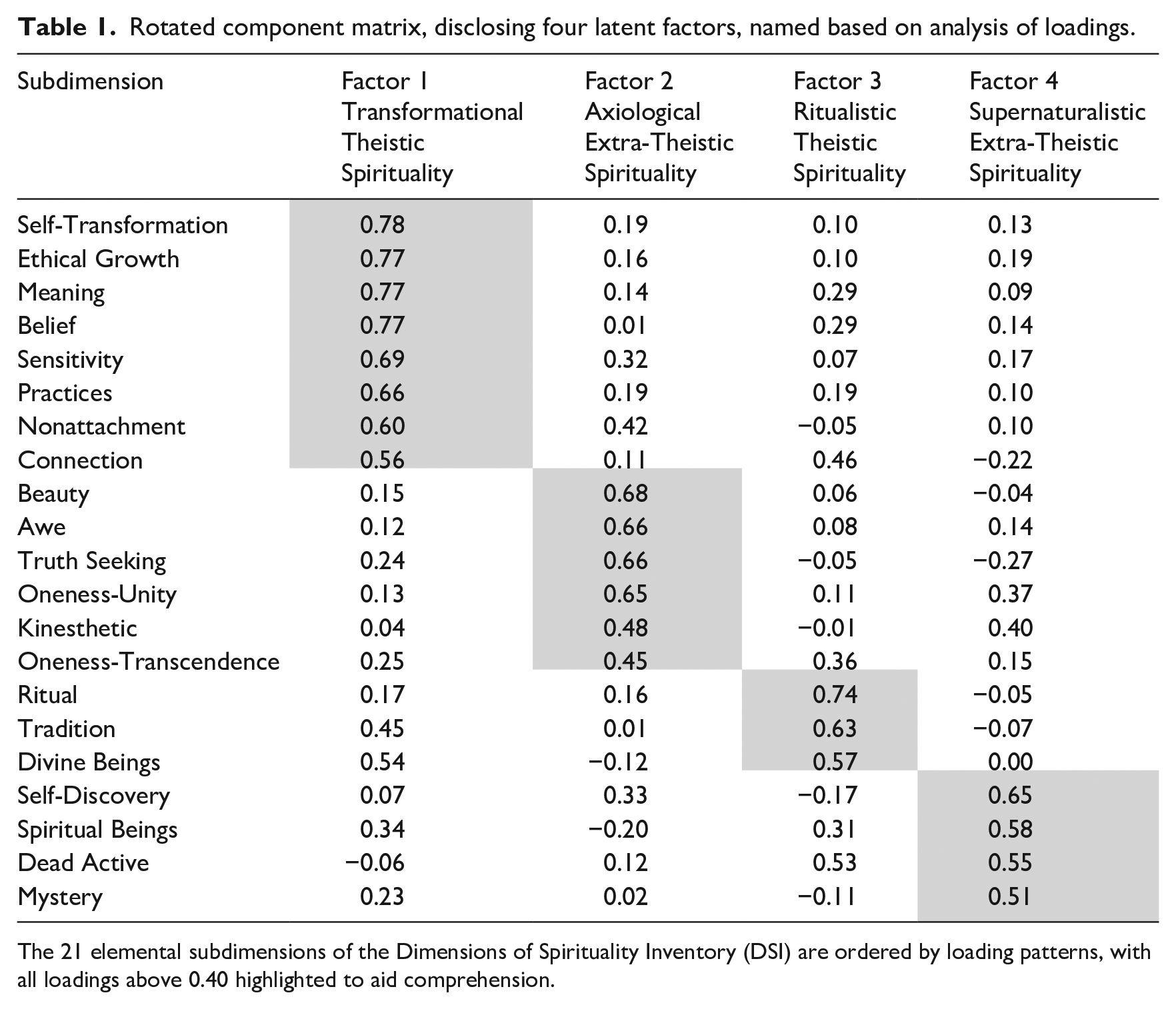
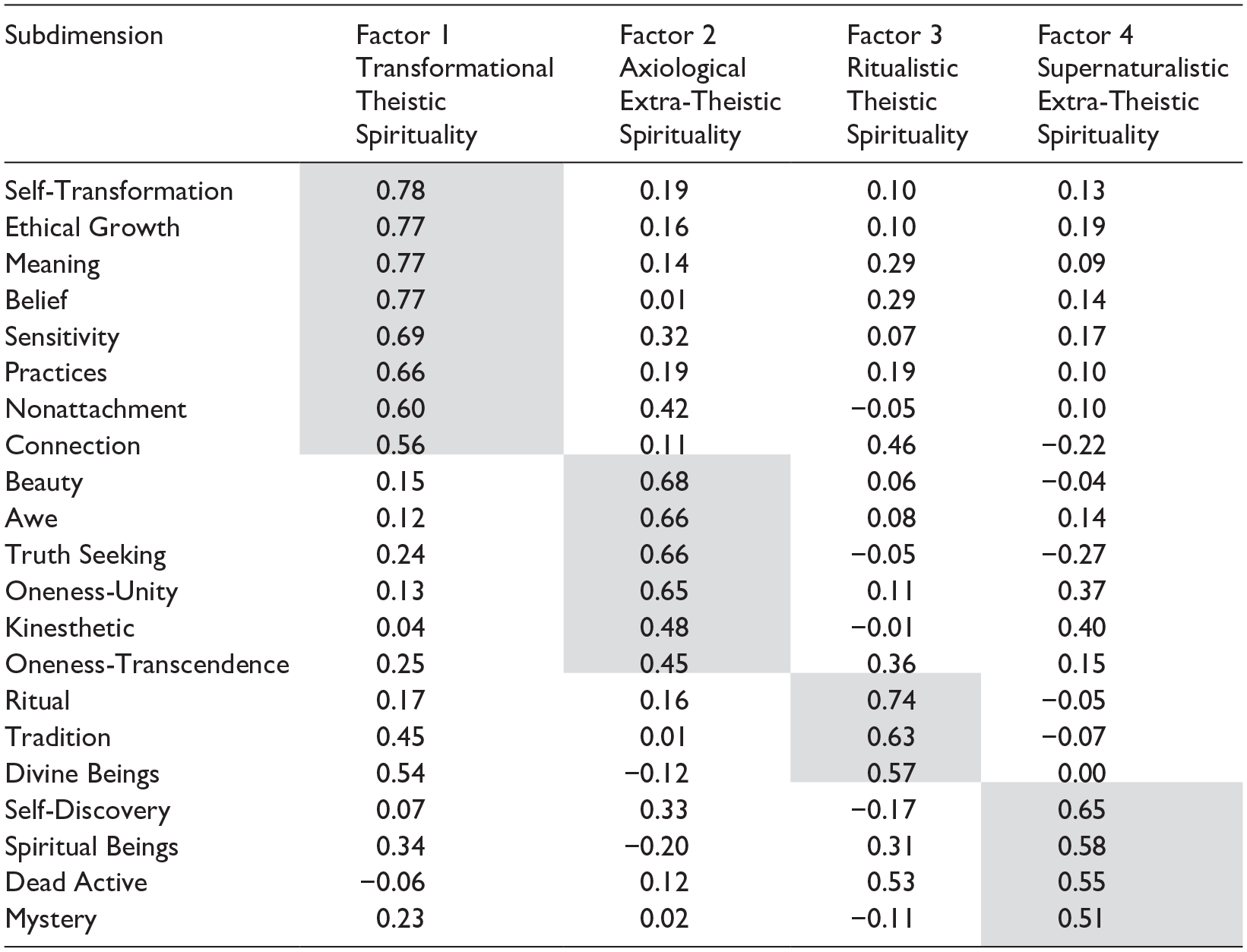
The 21 elemental subdimensions of the Dimensions of Spirituality Inventory (DSI) are ordered by loading patterns, with all loadings above 0.40 highlighted to aid comprehension.
Comparing these factors to Ammerman’s qualitatively derived meanings of spirituality is instructive. Ammerman identifies four distinct yet complexly interwoven cultural packages or discursively constructed meanings of spirituality in the United States.
The first is a “theistic” package which construes spirituality as fundamentally about God and relating properly with God. Robustly supported by American religious traditions, especially Christianity, this theistic spirituality was articulated by a large majority of Ammerman’s interviewees (71%).
The second is an “extra-theistic” spirituality which is not focused on God or gods but draws upon a plethora of profound but relatively common experiences of transcendence, beauty, connection within a wider community, awe before the natural world, and the struggle to discover or construct a meaning and purpose for one’s life. Importantly, the extra-theistic package of cultural discourse is employed by both theists and non-theists, those who attend religious services and those who do not; a full 57% of Ammerman’s interviewees articulated this meaning of spirituality.
The third cultural package is “ethical spirituality” which defines spirituality in terms of doing good—living a moral life, treating others with kindness and respect, and helping to foster a flourishing community. Users of both the theistic and extra-theistic cultural packages also tend to speak of spirituality in these ethical terms.
Ammerman’s fourth cultural package is two-sided, indicating a marked divide in American discourse about spirituality: on one side, more traditionally religious people speak of their belonging to and belief in the doctrines of their particular religious tradition as central to their spirituality; on the other side, the SBNR crowd define their spirituality over against this “belief and belonging” spirituality, which they regard as uncritical acceptance of dogma and community bought at the price of conformity.
The resonance between Ammerman’s qualitative research on “cultural packages” for spirituality and these four latent factors supports the validity and usefulness of the DSI, and also suggests that quantitative research using the DSI should be able to complement qualitative research rather well. We present a detailed comparative analysis in the Discussion section, below.
Item performance
In accordance with item-response theory (Embretson & Reise, 2000), we seek items with monotonic response curves (showing the proportion of item responses plotted against total scores achieved for the entire DSI), neither too easy (low means) nor difficult (high means), and with neither very low (like a straight line) nor very high discrimination (like a step function). Preliminary measures of items with good response curves are means not far from the midpoint of the item scale (3 on a 1–5 scale), standard deviations not far from 1.0 (for a 1–5 scale), and skewness and kurtosis not extreme in either direction. Table 2 displays these characteristics for the 50 DSI items (omitting the three catch-and-calibration items). The table indicates that all items are relatively healthy. Further analysis shows that all items are reasonably well behaved with close-to-monotonic response curves. The average of mean responses for the 50 items is 3.4 out of 5.0, which is above the scale midpoint of 3.0, reflecting the general spiritual interest of our respondent pool. This accounts for average skewness of -0.44 but even that number is still within the usual standard for fair symmetry (-0.5 to +0.5). Kurtosis is also acceptably small, indicating close-to-normal weight in the tails of the response distributions.
Statistics for the 50 DSI items (N = 820).
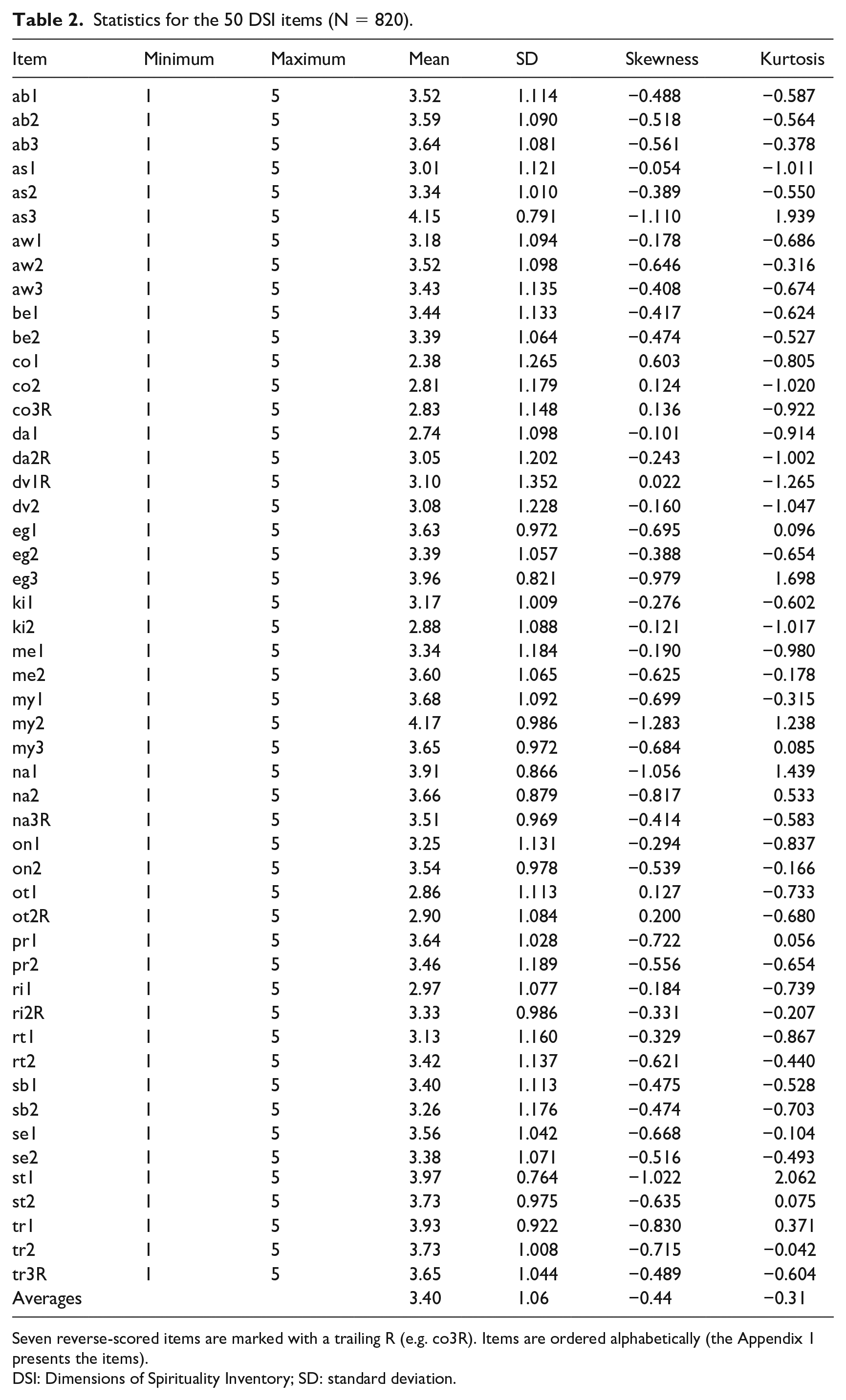
Seven reverse-scored items are marked with a trailing R (e.g. co3R). Items are ordered alphabetically (the Appendix 1 presents the items).
DSI: Dimensions of Spirituality Inventory; SD: standard deviation.
Scale reliability
We found that scale reliability (Cronbach’s alpha) for the sample before response-reliability restrictions were imposed was inferior to the sample after quality restrictions were imposed, indicating that the higher quality of responses more than compensates for the smaller number of responses. As noted earlier, the best balance of scale performance and respondent pool size involved imposing the CC1 and RIP2 criteria for evaluating respondent reliability (yielding N = 820). Table 3 shows the results for the 21 subdimensions, the 5 dimensions, and the total score of the DSI.
Scale reliability statistics (Cronbach’s alpha) for the 21 subdimensions, the 5 dimensions, and the total score of the DSI (N = 820).
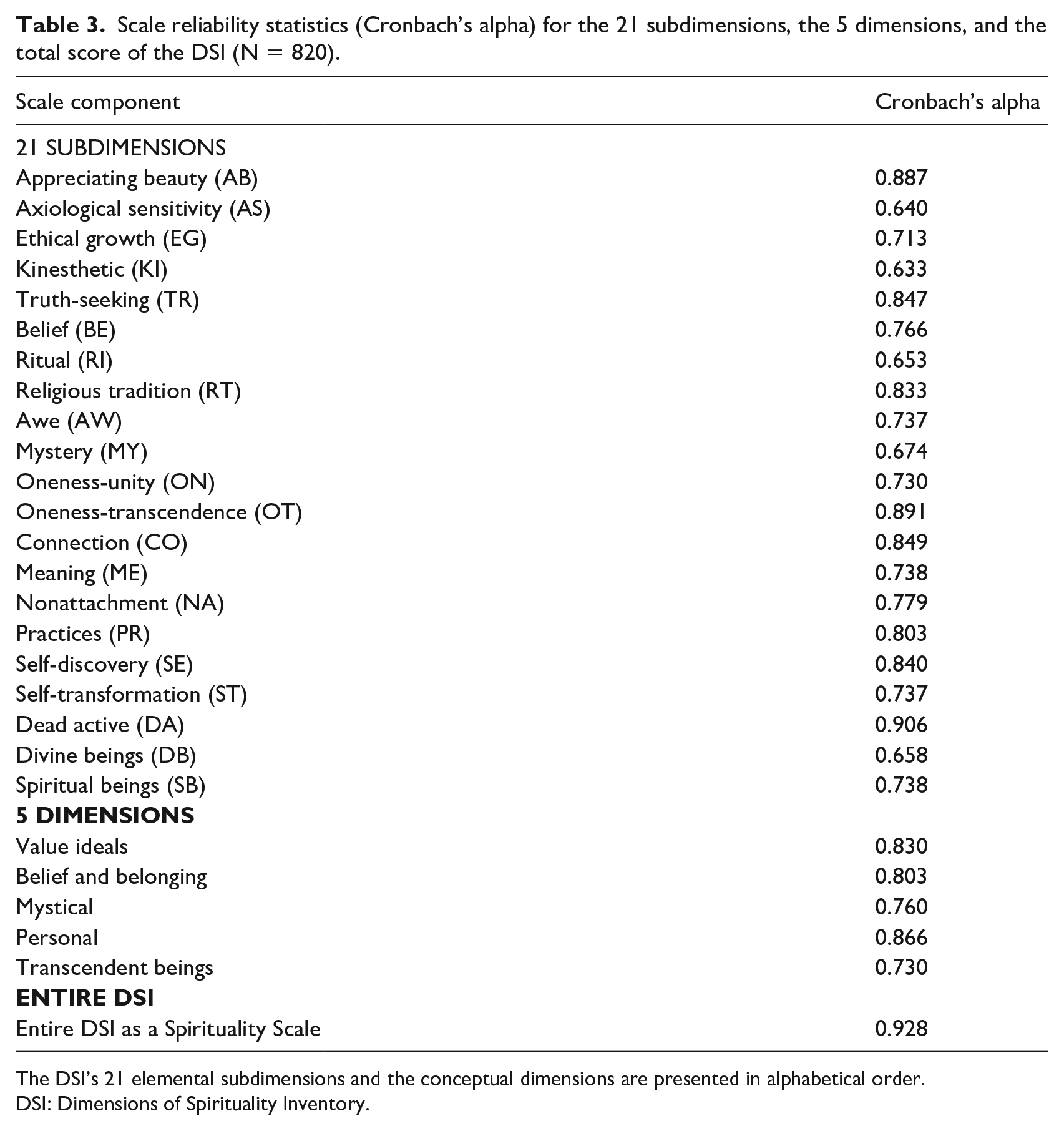
The DSI’s 21 elemental subdimensions and the conceptual dimensions are presented in alphabetical order.
DSI: Dimensions of Spirituality Inventory.
Test–retest reliability
We invited reliable respondents among the Prolific portion of the sample to retake the DSI about a month after they first took it. A sample of N = 463 survived imposing the same reliability requirements we used for the first take of the DSI (i.e. fully complete responses satisfying the CC1 and RIP2 reliability criteria). We then ran Pearson correlations between the test and retest responses for the 50 items, the 21 subdimensions, and the 5 conceptual dimensions. The average correlation was 0.608 and all correlations were significant with p < 0.000.
We then ran the more demanding paired-samples t-test for the 50 items, the 21 subdimensions, and the 5 conceptual dimensions of the DSI. A significant t-test result indicates a test–retest difference that is significantly far away from the ideal of zero. The percentage of the range gives a measure of the magnitude of the difference. Findings were as follows.
6 out of 50 items had significant differences (at the p < 0.05 level). The average test–retest difference for these six items was only 2.3% of the response range, which is very small. The average test–retest difference for all 50 items was 0.6%.
5 of the 21 subdimensions had significant differences (at the p < 0.05 level). The average test–retest difference for these five subdimensions was only 1.8% of the response range. The average test–retest difference for all 21 subdimensions was 0.9% for all 21 subdimensions.
2 of the 5 dimensions had significant differences (at the p < 0.05 level). The average test–retest difference for these two dimensions was only 1.2% of the response range. The average test–retest difference for all 5 dimensions was 1.0%.
Our conclusion is that the DSI displays good test–retest reliability.
Construct validity
The validity of the constructs expressed in the 21 subdimensions and 5 conceptual dimensions of the DSI is based largely on the interdisciplinary research process used to construct the DSI (we described this under “Philosophical and Conceptual Research” in the “Methods” section and the strategic motivation in the Introduction). Particularly important here is the strategy to define and measure not spirituality as such but relatively non-controversial, elemental aspects of spirituality, which greatly simplifies the question of construct validity. Another key consideration pertaining to construct validity is the replication of previous qualitative research, which is discussed in relation to Ammerman’s research on cultural packages of spirituality under “Factor Analysis” above.
To validate the DSI’s key constructs empirically, we also ran the DSI against some key measures, as follows.
The self-rating of
The self-rating of
Frequency of
The ExploringMyReligion.org and FaithInDepth.org sites, where we ran the DSI study, include many surveys. This leads to a richly cross-cutting dataset, which is relevant to the subset of 333 participants recruited directly through advertising (that is, not through Prolific), 249 of whom proved to be reliable applying the CC1 and RIP2 criteria to the DSI. While we did not require these 249 participants to fill out additional spirituality surveys, some did, yielding insights into DSI construct validity, albeit sometimes with low N (see Table 4).
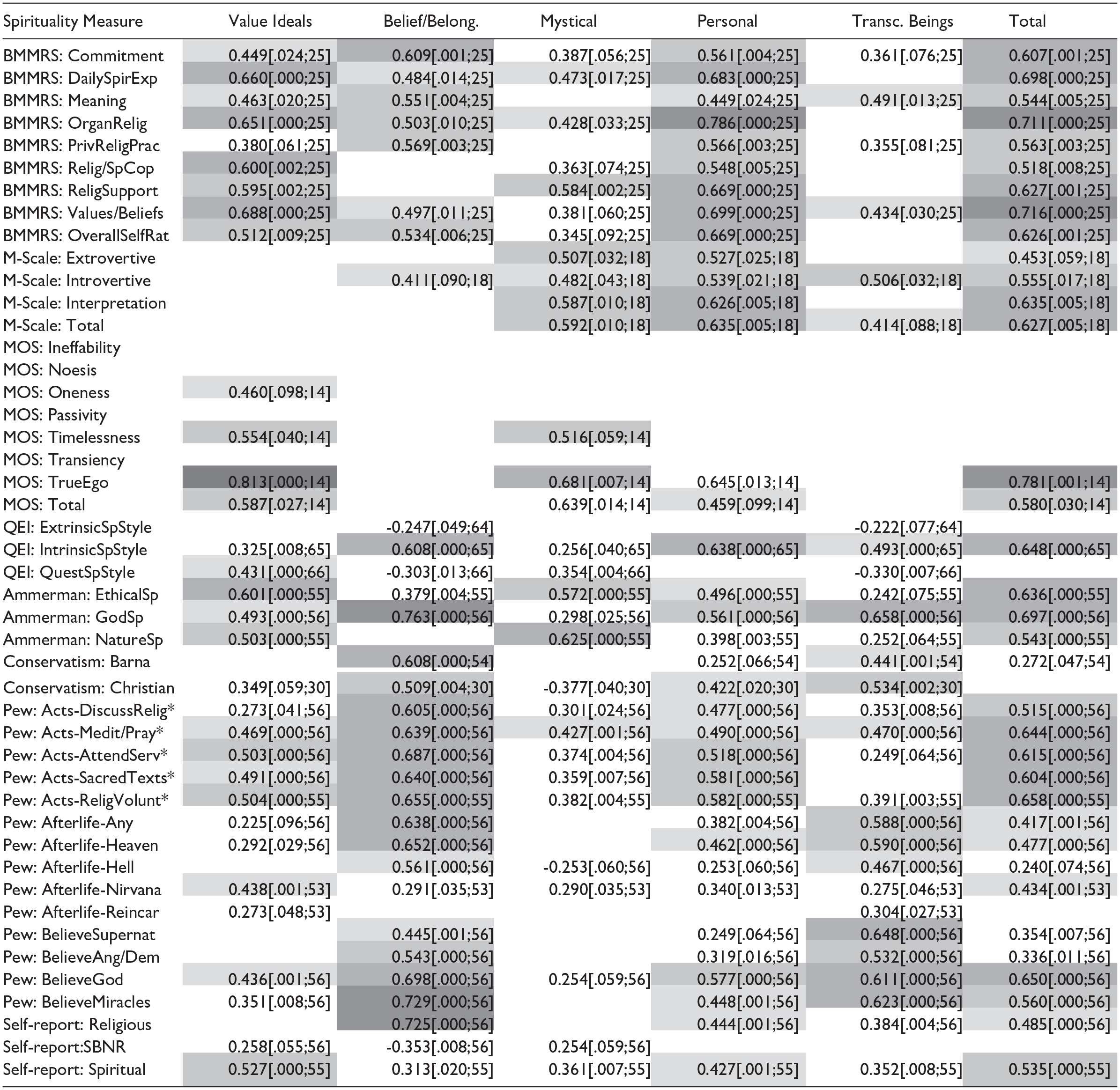
Pearson correlations for DSI dimensions and DSI total against a variety of spirituality measures.
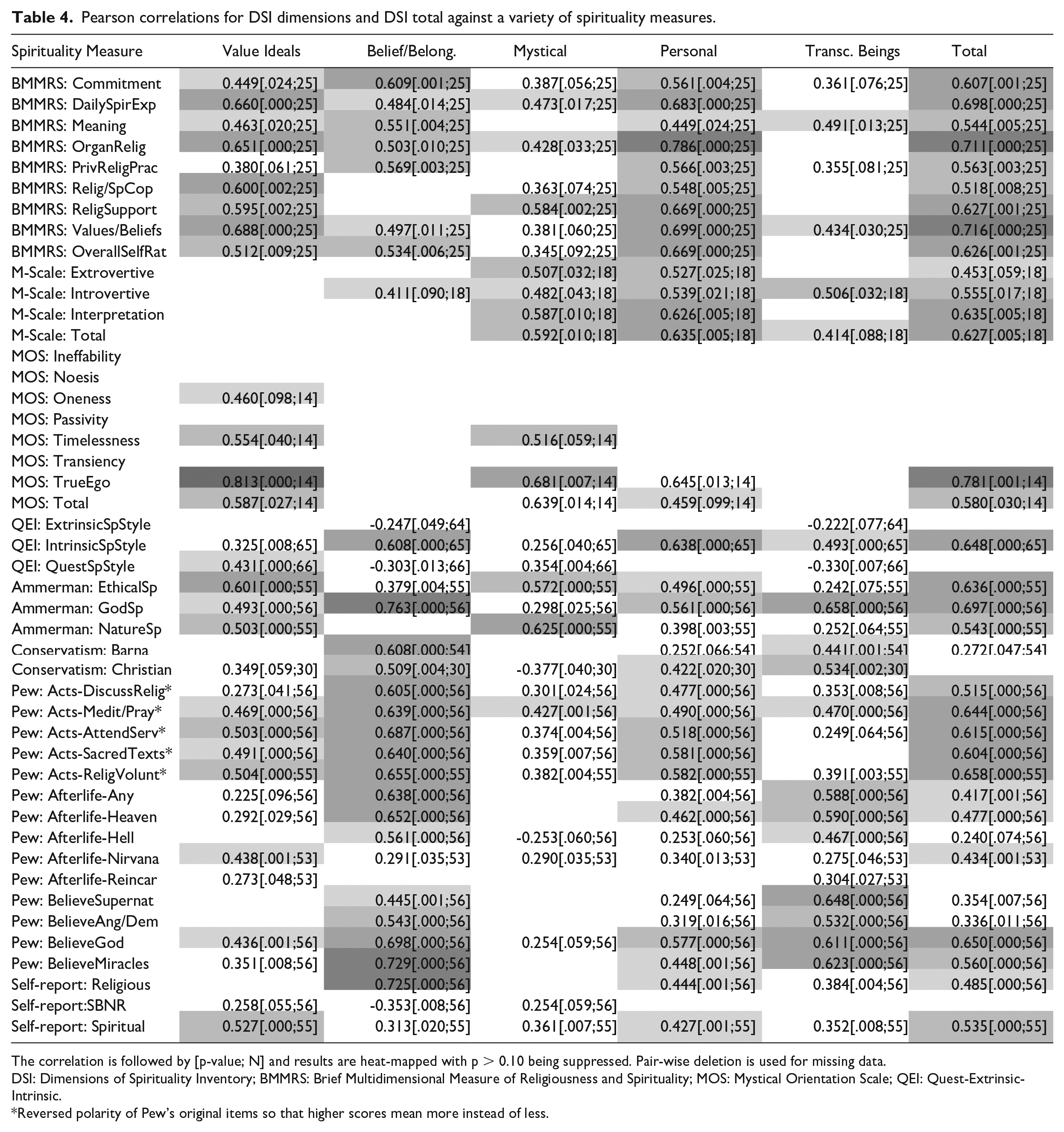
The correlation is followed by [p-value; N] and results are heat-mapped with p > 0.10 being suppressed. Pair-wise deletion is used for missing data.
DSI: Dimensions of Spirituality Inventory; BMMRS: Brief Multidimensional Measure of Religiousness and Spirituality; MOS: Mystical Orientation Scale; QEI: Quest-Extrinsic-Intrinsic.
Reversed polarity of Pew’s original items so that higher scores mean more instead of less.
The
The
The
The
Some of our participants also responded to a number of other items that can generate further insight into the DSI.
We asked for self-ratings in relation to three styles of spirituality from Nancy Ammerman’s qualitative research: Ethical (“My spirituality is about living a good life, overcoming selfishness, and caring for others”), God (“My spirituality is about God and striving to become closer to God (as I understand God)”), and Nature/Community (“My spirituality is about experiences of awe and beauty in nature and community”). The resulting correlations with the DSI make good sense, particularly no significant correlations between the Nature/Community style and more conventional aspects of spirituality, Belief & Belonging and Transcendent Beings.
30 Christian respondents completed a Christian Conservatism measure, which focuses on traditional doctrinal beliefs, and 65 filled out the Barna Conservatism survey, which focuses on hot-button moral issues. The Barna moral conservatism results had no relation with the less conventionally religious aspects of spirituality (Value Ideals, Mystical) but were strongly correlated with the more conventional aspects (Belief & Belonging, Transcendent Beings), which fits with the general fact that traditional religion and spirituality lean strongly conservative on social and political issues. The Christian conservatism scale was strongly positively correlated with the more conventional aspects of spirituality and marginally positively (for Value Ideals, r = 0.349, p = 0.059) or strongly negatively (for Mystical, r = –0.377, p = 0.40) correlated with the less conventional aspects of spirituality.
Respondents numbering in the mid-50s answered a battery of items used in the Pew Religious Landscape Survey (Pew Forum on Religion & Public Life, 2008) about religious actions, afterlife beliefs, and supernatural beliefs. With predictable exceptions (e.g. Christians tend to disbelieve reincarnation), these items correlated strongly with the more conventional aspects of spirituality and bear a complex relation to the less conventional aspects of spirituality (Value Ideals, Mystical). The same group of respondents told us the degree to which they consider themselves religious, spiritual, and spiritual but not religious (SBNR). While people comfortable calling themselves “religious” showed positive correlations with the religiously traditional DSI dimensions (Belief & Belonging, Personal, Transcendent Beings), those who embraced the label “spiritual” showed positive correlations across the board. Meanwhile, SBNRs showed no significant or strongly negative correlations with the more conventionally religious aspects of spirituality, and marginally positive correlations with the less conventionally religious aspects.
This investigation shows that the constructs measured in the DSI make good sense against other established measures of religiosity and spirituality.
Discussion
The semantic web surrounding “spirituality” has structure
If it is not already clear from the plethora of uses of the term that “spirituality” conjures a complicated semantic web, then the DSI makes it transparent. But the DSI also shows that this web has structure—identifiable elemental aspects that can be combined in a variety of ways to draw out dimensions of meaning and varied spiritual configurations. This finding resonates with the earlier qualitative research that inspired the development of the DSI (especially Ammerman,2013b; Steensland et al., 2018), as well as with results of the ESI (MacDonald, 2000), which employs a related psychometric strategy.
The four factors derived from the exploratory factory analysis using Principal Components extraction with Varimax rotation offer insights into the latent conceptual structure of spirituality in relation to contemporary people exhibiting diverse styles of spirituality. Those factors bear a fascinating relationship to the existing qualitative research on cultural packages of spirituality (Ammerman, 2013b).
The four factors we identified can be interpreted as two variant strains each of both theistic and extra-theistic spiritualities, picking up on elements of Ammerman’s third and fourth cultural packages. Factors 1 and 3 are theistic spiritualities in that both are significantly positively correlated with DSI subdimensions Divine Beings (.537 and .574, respectively) and Spiritual Beings (.344 and .309, respectively), meaning that relating to the divine is central and belief in supernatural powers and spirits is common to both.
Despite these important similarities, there are also four major contrasts between these two theistic spiritualities. First and foremost, factor 1 spirituality is predominantly concerned with becoming a more ethical and axiologically sensitive person in a way that factor 3 spirituality is not. Whereas factor 1 is very strongly positively correlated with the Self-Transformation (.779), Ethical Growth (.766), and Axiological Sensitivity (.693) subdimensions, factor 3 is negligibly correlated with the same subdimensions (.102, .102, and .066, respectively). Though both are strongly correlated with Connection (.555 and .461, listing factor 1 first), a second difference is that factor 1 is much more strongly correlated than factor 3 to other subdimensions relating to what Ammerman labels “Belief and Belonging” spirituality: Meaning (.775 vs .285), Belief (.767 vs .286), and Practices (.659 vs .193). Third, despite being less invested in “Belief and Belonging” spirituality, factor 3 spirituality is more inclined to see spirituality as inextricably intertwined with a Religious Tradition (.445 vs .628), much more likely to regard traditional rituals as enhancing rather than hindering (Ritual: .170 vs .741), and far more likely to affirm that deceased people directly influence the living (Dead Active: –.056 vs .527). Finally, factor 3 is slightly negatively correlated with several subdimensions with which factor 1 is significantly positively correlated: Nonattachment (.604 vs –.047), Mystery (.231 vs –.109), and Truth-Seeking (.237 vs –.052). This implies that, relative to factor 1 spirituality, factor 3 spirituality is less inclined to identify the acceptance of unavoidable change as important to spirituality, to admit that reality is fundamentally mysterious, or to identify the quest for intellectual understanding as central to spirituality.
In sum, the theistic spirituality reflected in factor 1 emphasizes personal flourishing and communal belonging—becoming a better person, finding meaning through one’s religious beliefs, and anchoring oneself in community through established religious traditions and practices. It is a practical, results-oriented spirituality that embraces the inevitability of change and the need to remain flexible, even while being solidly conservative, working to perpetuate established religious beliefs and practices. It might be thought of as personal flourishing through communal belonging theistic spirituality, and we will label it “Transformational Theistic Spirituality.” The theistic spirituality reflected in factor 3 is similarly conservative, concerned to secure communal belonging, and guided by established traditions and beliefs. However, it is not particularly concerned with personal axiological growth, and it is less open to viewing reality as fundamentally mysterious and less inclined to associate spirituality with open-ended quests for intellectual understanding. Factor 3 spirituality also depends more heavily upon established religious rituals and traditions to steady the spiritual journey, and it tends to regard, not only relations with the divine, but also relations with deceased persons as spiritually and practically important. This theistic spirituality is firmly oriented toward the local, heavily reliant upon tried-and-true rituals and traditions, and rather suspicious of mystery generally and of heroic personal quests, whether intellectual or ethical in nature. Factor 3 spirituality is aptly if clumsily thought of as security through ritual, stability through tradition theistic spirituality, and we will label it “Ritualistic Theistic Spirituality.”
Factors 2 and 4 point toward two variants of Ammerman’s extra-theistic spirituality. While they differ dramatically in terms of their positive emphases, what is most striking about these extra-theistic spiritualities is what does not matter to them: factors 2 and 4 are both negatively correlated with the Divine Beings subdimension (-.125 vs -.004, respectively) and weakly or negatively correlated with the Ritual (.155 vs -.046), Belief (.014 vs .136), Religious Tradition (.010 vs -.067), Meaning (.139 vs .094), and Connection (.114 vs -.219) subdimensions. Here we see the clear rejection of “Belief and Belonging” spirituality, a rejection that Ammerman identifies as characteristic of SBNR people. Though positive, these factors’ weak correlation with Ethical Growth (.162 vs .195) and Self-Transformation (.189 vs .127) suggests that these spiritualities developing outside established religious traditions, while helpful in the struggle to become a better person, lack the axiologically transformative power of Factor 1 spirituality. Interestingly, unlike the theistic spiritualities reviewed above, both of these extra-theistic spiritualities are strongly positively correlated with the Kinesthetic (.477 vs .403) subdimension, which connects spirituality with the attempt to cultivate focused awareness of one’s physical body.
Despite these notable similarities, factors 2 and 4 also differ profoundly. Perhaps most striking, factor 2 spirituality adds to its rejection of orientation toward divine beings a deep skepticism regarding Spiritual Beings (-.202) more generally, while factor 4 spirituality is strongly positively correlated (.580) with belief in invisible powers and good and evil spirits. Similarly, factor 2 spirituality is lukewarm at best regarding belief in deceased people’s capacity to influence the living, while factor 4 is strongly positively correlated with the Dead Active subdimension (.121 vs .548, respectively). In addition to a more thoroughgoing naturalism, factor 2 spirituality tends to view the quest for intellectual understanding as an integral part of the spiritual journey, while factor 4 is significantly negatively correlated with the Truth Seeking subdimension (.660 vs -.279). Again, whereas factor 2 is strongly positively correlated with a tendency to regard the experience of beautiful art and music as spiritually meaningful, factor 4 is weakly negatively correlated with the Appreciating Beauty subdimension (.679 vs -.040). Another key difference is factor 2’s stronger correlations with the tendency to regard experiences of Awe before cosmic vastness as spiritually energizing (Awe: .662 vs .144), tendency to regard acceptance of difficult or painful changes as spiritually important (Nonattachment: .419 vs .097), and tendency to associate spirituality with potent experiences of Transcendence (.455 vs .148). Factor 2 spirituality is also more strongly associated with experiences of Oneness (.646) with all things, although factor 4 is also significantly positively correlated (.369) with such experiences.
Summarizing the factor 2 side of this contrast, this spirituality is naturalistic in flavor, unconcerned with orientation toward divine beings and skeptical regarding unseen spirits and the power of the dead to directly influence the living. In lieu of rejected supports offered by Belief and Belonging spirituality—clearly prescribed beliefs, existentially-orienting meaning, deep communal connection, steadying religious rituals, and time-tested religious traditions—factor 2 spirituality embraces the quest for intellectual understanding as central to the spiritual life and draws inspiration from a variety of profound non-supernatural experiences: beauty perceived in music and art, awe felt before the universe’s immense vastness, momentary transcendence of ordinary time and space, dawning awareness of a unity embracing all things, and sober acceptance of the final transience of all that is. In sum, factor 2 spirituality is a hopeful naturalistic spirituality, firm in its rejection of belief and belonging spirituality and supernaturalism generally, optimistic about the search for truth, and open to a variety of profoundly spiritually meaningful natural experiences. We will call it “Axiological Extra-Theistic Spirituality.”
Three features of factor 4 spirituality distinguish it from factor 2 spirituality. First, despite being as firm as factor 2 in rejecting theistic spirituality, factor 4 spirituality does not embrace a broader naturalism, being strongly positively correlated with belief in unseen powers and spirits (Spiritual Beings: .580) and in the power of the dead to the influence the living (Dead Active: .548). Second, factor 4 spirituality firmly rejects the idea that seeking intellectual understanding is central to the spiritual life (Truth Seeking: -.279), instead being strongly positively correlated with the view that reality in general and the spiritual realm in particular are fundamentally mysterious (Mystery: .509). Third, while factors 1 and 3 are strongly positively correlated (.555 vs .461, respectively) and factor 2 is weakly positively correlated (.114) with the idea that connection to one’s spiritual community is essential to spirituality, factor 4 is significantly negatively correlated with this view (Connection: -.219). Rather than focusing on connection with others, factor 4 spirituality turns inward, emphasizing that the discovery of one’s true self is key to the spiritual journey (Self-Awareness: .651). Taken together, these observations suggest that, by rejecting theistic paths toward salvation and the support afforded by belief and belonging spirituality, factor 4 spirituality construes quests for intellectual understanding as attempts to pierce the impenetrable veil of mystery, accompanied by beliefs that we are subject to the influence of good and evil spirits as well as deceased persons; the best strategy is to turn inward, seeking liberation through knowledge of one’s true self. Reminiscent of ancient Gnosticism, factor 4 spirituality might be labeled pessimistic supernaturalistic extra-theistic spirituality; we will label it “Supernaturalistic Extra-Theistic Spirituality.”
The value of the DSI for future research
The DSI is grounded in a deep and broadly cross-cultural review of spirituality. The wording of items reflects these origins, steering clear of culturally parochial formulations to the extent possible. It has solid characteristics as a scale, with soundly performing items, robust scale reliability, and excellent test–retest reliability. Judging from scale reliability, the DSI also functions well as a summative scale (alpha = 0.928), yielding an overall measure of spirituality in which the meaning of a high score is an intense embrace of several elemental aspects of spirituality; however, interpretation of the overall score needs to be checked by the fact that there are many ways to produce a high (or a low) score and the differences among those ways are salient for interpreting spirituality. More importantly, the multidimensional nature of the DSI permits fine-grained discernment of types and styles of spirituality. Ultimately, it is the 21 elemental subdimensions of the DSI that are theoretically most well supported; they allow for flexible interpretation of underlying patterns in the way people think of themselves as spiritual.
The validity of the DSI is supported by its relationship to the other instruments examined in this study (see the “Introduction” section and Table 4), which relate in intelligible ways to the five conceptual dimensions of the DSI. But the scope of the DSI is far broader than these other instruments. For example, while the BMMRS is one of the best-known measures of spirituality due to its multimodal design and its usefulness for spirituality-and-health research, it is significantly related only to some dimensions of the DSI and non-responsive to others, leaving a great deal of spirituality territory unexamined for connections to health. Future research needs to investigate the DSI in relation to the BMMRS as well as other spirituality and religiosity measures both for spirituality-and-health applications and for research efforts in other domains.
Limitations and next steps
The main limitation of this study is that the sample, while large, drawn from a variety of national settings and religious identities, and representative relative to the USA in regard to race and gender, is still dominantly WEIRD (Henrich et al., 2010), being western and educated, from industrialized, rich democracies. Combining a larger group of WEIRD participants and a smaller group of non-WEIRD participants, as we have done in this study, could be problematic. Unfortunately, there were not enough non-WEIRD volunteers to run a meaningful contrast study with WEIRD participants.
The DSI was designed with a broader cross-cultural and inter-religious framework clearly in mind, so a couple of next steps suggest themselves.
One next step for the development of the DSI is systematically evaluating it against existing religiosity and spirituality measures. While the comparisons with the BMMRS, M-Scale, MOS, and QEI discussed above are suggestive, the DSI needs to be systematically tested against these scales of religiosity, against the strategically related ESI, and against the best extant measures of spirituality that begin (unlike the DSI and the ESI) from specific definitions of spirituality, namely, the ASPIRES, SOI, MEMS, RSS, RRSC, PCSS, SWBS, and PCB measures.
Another next step is to apply the DSI to a variety of contexts, making use of its fine-grained quality to uncover novel latent factors that shed light on cultural packages of spirituality in those settings. For example, the cross-cultural categories employed in the DSI make it well suited to analyzing the spirituality of non-religious, post-religious, and anti-religious people, which helps to evaluate existing interpretations of spirituality within these populations (e.g. see Farias, 2013). Translations of the DSI will afford access to cultural packages of spirituality present outside of English-speaking cultural settings. Specifically contrasting WEIRD and non-WEIRD populations will help establish cross-cultural validity. It would also be useful to evaluate the existing English version with less educated participants. These efforts are underway.
Conclusion
The DSI was inspired by existing qualitative research into characteristic spiritual formations developing beneath the apparent chaos of language about spirituality. We followed the associated strategy of not defining spirituality before measuring it, instead defining 21 elemental aspects of spirituality, measuring those, and seeing how they cluster to determine cultural packages of spirituality. This elemental approach has proven to be beneficial in the psychometrics of religion, as well, where historian and religion scholar Ann Taves has articulated a “building block approach” (see Larsson et al., 2020; Taves, 2009). While psychometrics normally expects a construct to be defined before operationalizing it for measurement, for complex subjects such as religion and spirituality, the failure of existing measures to converge on stable interpretations of the subject shows that another approach is needed.
To put the point using a light-hearted metaphor, the DSI’s strategy is to define a 21-dimensional net for catching multidimensional fish; the net is defined but the fish are not. There is some relationship between the nature of the net and the nature of the fish, since small fish will slip through the net. But we don’t expect infinite sensitivity of any psychological measure. And what we do get by way of fish caught in the DSI’s net are embodied cultural packages of spirituality. After fishing in enough places and times and cultures and religious, we can worry about how to define spirituality as such—if we’re still interested in doing so.
The DSI supports findings from earlier qualitative research by demonstrating that there are meaningful patterns in the way “spirituality” is used, and showing that those patterns can be measured. But the DSI also goes much further, demonstrating that a multidimensional measure of spirituality can overcome culturally parochial limitations to some extent by engaging the academic study of religion, generate novel insights into the spiritual formations of individuals and groups of people, and also define a summative scale. The many suggestive findings presented here indicate that the DSI can be fruitfully used to study spirituality in diverse kinds of research, including studies of the health effects of spirituality, religious and spiritual experiences, spirituality and demographic groups, the spiritual formations prevalent within post-religious and non-religious people, the diversity of spirituality in traditional forms of religiosity, and even changes in spirituality across eras (which would involve coding texts from those eras). The DSI is both sensitive and summative, and offers a way to quantify spirituality that is not overly dependent on the specific beliefs and concepts of traditional religions.
Ultimately, the DSI proposes to shift the prevailing strategy in the measurement of spirituality. Instead of defining a conception of spirituality and seeking to instrumentalize that construct, the DSI responds to the finding that spirituality is extremely diverse and complex—a conclusion amply evident in the lack of harmonization among the best extant instruments for measuring spirituality—by defining and instrumentalizing 21 fairly uncontroversial elemental components of spirituality, and in ways that are cross-culturally robust. Much as the periodic table of elements permits the flexible characterizations of chemical molecules, and an alphabet permits the flexible expression of words and sentences, so the DSI flexibly expresses cultural packages of spirituality, deferring interpretation of spirituality as a whole until after latent constructs have been uncovered. This response to the evident complexity and variation of spirituality holds great promise for escaping the trap of being perpetually limited by definitions of spirituality that never seem to converge, and for equipping research in the psychology of religion to cross the boundaries between cultures and religious traditions with the needed agility.
Footnotes
Appendix 1
Acknowledgements
The authors thank Nancy T. Ammerman, whose qualitative research helped to inspire the Dimensions of Spirituality Inventory, and who was also very helpful in commenting on the manuscript; and Lauren Hickey for her contribution to the design of the DSI.
