



Abstract
Religion is often understood to play a positive role in shaping moral attitudes among believers. We assessed the relationship between church members’ levels of felt connectedness to their respective congregations and perceived similarity in personal and congregational moral values, and whether there was a relationship between these and the amount of time spent in synchronous movement or singing during worship. The similarity between personal and perceived congregational moral importance (the importance assigned to different moral items) was correlated with feelings of closeness to one’s congregation but not by the amount of time spent in synchronous movement or singing. Differences in moral foundations scores and in moral importance of specific issues were found between different theological traditions. These findings demonstrate that, for churchgoers, there is a relationship between the use of music or synchronous movement in a church service and feelings of social bonding and there is also a relationship between the degree to which churchgoers identify with their church community and the degree to which they believe their priorities match those of their church. Furthermore, differences in theological tradition appear to be reflected in differences in moral values.
Introduction
Religion and morality
The relationship between religion and morality has long been of interest to psychologists, dating back at least to Gordon Allport’s work (Allport, 1966). Much research in this area explores whether being religious makes people more, or less, moral than others (e.g. Arli & Pekerti, 2017; Galen, 2012; Saroglou, 2006; Shariff et al., 2014). Little research has been done, however, on whether differences in worship practices, such as the degree to which music is used in worship, and theological tradition relate to worshippers’ moral values. We conducted an online survey of churchgoers in the United Kingdom to explore these relationships.
The social identity approach to group relations, which includes both social identity theory and self-categorization theory, proposes that an individual’s self-identity is derived, at least in part, from the social groups to which he or she belongs (Hornsey, 2008). According to this approach, when people think of themselves as members of a group, that identity shapes attitudes and behaviours (Hornsey, 2008). Indeed, it has been shown that an awareness of a group’s shared moral values affects the behaviour of individual group members (Paglioro et al., 2011).
For regular churchgoers, one group that may have particular influence on self-identity and the values one holds is the church community or congregation, and it has been acknowledged that religious groups seek to shape the values of their adherents (Roccas & Elster, 2014). If religious groups, such as churches, do in fact shape the values, including moral values, of their members, this implies that a connection should exist between belonging to a religious congregation and morality. The existence of such a connection would appear to be supported by studies that have found a positive relationship between religion and prosocial behaviours (Everett et al., 2016; McKay & Whitehouse, 2014; Saroglou, 2006; Shariff & Norenzayan, 2007). Religious worship can serve as a vehicle for both explicit and implicit moral teaching on specific issues and may act as a means of communicating a set of moral/ethical principles. If this is the case, the worshipper can, when faced with a choice relating to such an issue in daily life, refer to the principles expressed in worship as the basis for decision making. There are, naturally, many issues of potential moral concern to churchgoers, and not all are going to be of equal importance to all Christians.
While the specific aspects of religious participation that enable the community’s values to be learned may still be unclear, corporate worship is a reasonable context in which to expect religiously based moral principles to be learned and attitudes shaped. There is, in fact, within Christian teaching an assumption that the shaping of moral attitudes takes place within the context of the believing community coming together to worship, 1 and this understanding is present across different Christian traditions. As Cally Hammond (2015) writing from an Anglican perspective describes it, ‘The power of the liturgy to ingrain in the worshipper the texts she or he hears week in week out is a crucial part of Christian formation’ (p. 8). In other words, exposure to the content of worship is part of what shapes the values and attitudes of churchgoers. This idea is supported by Vigen Guroian (1997), writing as a member of the Orthodox tradition, who suggests that worship is the source of a distinctly Christian ethics that differs from a secular understanding of morality. Despite this emphasis within Christianity itself, little research has been done on the impact of worship on moral values and attitudes.
Music, social cohesion and moral values
In a study looking at participation in Christian worship and ethical behaviour (Brown, 2013), frequent participation in styles of worship that made use of long blocks of music (e.g. Taizé, charismatic worship), was predictive of charitable giving to religious evangelism and mission charities. In contrast, participation in traditional styles of worship, which typically intersperse music with more ‘wordy’ elements of worship such as a sermon and prayers, did not predict for charitable giving to any of the causes included in the study, such as environmental, animal welfare and social justice charities (Brown, 2013). The sample in that study was, however, small and the influence of several potential confounding variables, such as age, sex and political affiliation was not analysed. Consequently, the results need to be interpreted with caution, but the findings suggest that the use of music in worship may have some influence on the degree to which individual worshipers internalize the church’s moral teaching and assign importance to different issues that have a moral/ethical dimension.
Music may facilitate the shaping of moral attitudes by helping to bind a church community together. Music has been shown to increase perceived levels of group identity (Cross & Tolbert, 2009; Hallam & MacDonald, 2009) and studies have found that group singing increases a sense of group connectedness, trust and cooperation (Kirschner & Tomasello, 2010; Wiltermuth & Heath, 2009). Synchronous movement has also been shown to facilitate group bonding (Dunbar et al., 2012; Launay et al., 2016). In the context of Christian worship, synchronous movement can include a congregation standing or sitting at the same time, making the sign of the cross, and bowing, in addition to group singing. Because of these relationships between shared music-making and synchronous movement with group identity and increased trust and co-operation, we expected that individuals in our survey who participate in styles of worship that make extensive use of music and/or other synchronous activity would have a greater sense of identification with their church community than those who take part in worship in which these aspects are less frequently used.
Research with church congregations has found that participation in church worship increases feelings of connection, as measured by verbal items and the Inclusion of Others in Self (IOS) (Aron et al., 1992), with one’s congregation (Charles et al., 2020, 2021). As group norms are more likely to be adhered to when a group member strongly identifies with the group (Hogg & Reid, 2006; Jetten et al., 2002), the increased group cohesiveness engendered by shared singing and the performance of synchronized actions during worship may in turn lead individual worshipers to internalize the importance of moral issues as expressed by the church leadership or congregation as a whole. If moral values are part of the group norms, then the strength of group identity will be reflected in the importance given by individual group members to those issues that they believe to be important to the group. It is, of course, also possible that individuals choose to associate with a group known to share their already held values, and it could be that at least some churchgoers affiliate with a congregation that they believe already shares their moral values, and that singing and other synchronized activities that occur in worship strengthen a sense of shared purpose. We anticipated that in our study there would be only a small divergence in the importance given to different moral items by a participant and the importance that a participant believed his or her church congregation gave to the same moral items.
Theological tradition
Studies that have explored the relationship between religion and morality have, in the main, compared participants who claim to hold a religious belief or affiliation with those claiming no religious affiliation (e.g. Hofmann et al., 2014; Piazza, 2012; Shariff et al., 2014). This binary comparison risks overlooking differences within a religious faith, such as differences between Christians with liberal and conservative theologies, although there have been some studies comparing the moral content of sermons from liberal and conservative theological traditions (Frimer, 2020; Graham et al., 2009).
Differences between liberal and conservative theological outlooks can affect how individual Christians interpret the Bible and religious teachings, the importance they give to different moral values and the way in which they make moral decisions (Savage, 2008). Thus, when looking at the relationship between religion and morality, it is important to examine differences between theological traditions, not just overall religiosity or political orientation, as it has been suggested that conservative Christians use different criteria in making moral decisions than do liberal Christians (Haidt & Graham, 2007; Needham-Penrose & Friedman, 2012).
Moral values and moral importance
In an attempt to extend the discourse on morality and virtue, the Moral Foundations Theory (MFT) proposed five moral foundations, or domains, on which different cultural moral norms are based (Haidt & Graham, 2007; Haidt & Joseph, 2004). MFT has also been helpful in understanding why religious individuals, particularly those with conservative religious views, seem to have different moral concerns from those who are non-religious or are theologically liberal (Haidt et al., 2009; Haidt & Graham, 2007). MFT originally described five domains of morality: harm versus care, fairness versus cheating, loyalty versus betrayal, authority versus subversion and sanctity versus degradation (Graham et al., 2011). Subsequently, a sixth foundation, liberty versus oppression, was also proposed (Iyer et al., 2012).
Different individuals will prioritize these domains differently. It is suggested that the so-called binding foundations − loyalty/betrayal, authority/subversion and sanctity/degradation − are the values through which religions bind their members into moral communities (Graham & Haidt, 2010). Based on this work, we expected that churchgoers in our study would score highly in the binding foundations of the Moral Foundations Questionnaire (MFQ), which is used to measure the priority individuals give to each of the MFT domains. Individual congregations can, however, differ in their theological outlook, with some holding traditional but not fundamentalist views, others holding fundamentalist or extremely conservative views, and others with a more liberal theological understanding. It is therefore likely that different theological traditions will attribute different levels of significance to the various moral foundations. Based on the findings of Haidt et al. (2009) that individuals who belonged to what they termed the ‘religious left’, that is, socially liberal Christians, scored lower on the binding domains and higher in the domains of harm/care and fairness/cheating than did conservatives, we expected that participants from theologically conservative traditions would score higher in the binding domains than those from liberal theological traditions, and those with a liberal theology would emphasize more the domains of harm/care and fairness/cheating than those with a conservative theology.
Moral values are expressed through attitudes towards and responses to specific real-world issues. Theories such as MFT describe value categories, or domains, and relate these to broad cultural differences and, in the case of MFT, seek to explain the presence of these domains by reference to evolutionary adaptations. While a preference for one domain over another when assessing the morality of certain actions may help to explain the criteria against which a moral issue or action is judged, it might not necessarily provide information about what moral issues a person deems important. This is because moral issues can be presented in ways that relate to the different domains. Care for the environment is one example of this. This is an issue that can be interpreted as an issue of harm versus care (for the planet), one of fairness or justice (for those impacted by pollution or climate change), one of loyalty (either to a social in-group or, potentially, to the younger members of one’s family who will be impacted by environmental damage, or even loyalty to God as creator), or one of purity versus degradation (interpreting environmental damage as degrading the planet). For churchgoers, it is also possible that care for the environment could be interpreted in terms of obeying authority, depending on the interpretation of relevant passages of the Judeo-Christian scriptures (e.g. the interpretation of ‘dominion’ in Genesis 1.26 or Adam’s role as caretaker of the Garden of Eden in Genesis 2.15). Consequently, it is not enough just to understand how a particular theological tradition relates to these broad domains. To fully understand the relationship between theological tradition and moral values, it is also necessary to examine attitudes towards specific issues. Similarly, both the individual issues that are of high importance and the moral domain(s) primarily used for moral decision-making may be shaped by cultural or social group norms.
Hypotheses
We formulated three hypotheses related to worship, social bonding and moral values in this exploratory study. First, the frequent use of music and/or other synchronous activity within public worship would correlate with higher levels of felt connectedness to one’s congregation. Second, we hypothesized that, in line with previous research, participants in our study from theologically conservative traditions would score higher on the ‘binding’ moral foundations and lower on domains relating to harm/care and fairness/cheating than participants from liberal theological traditions. Finally, we hypothesized that participants would report high levels of similarity between the importance they gave to different moral items and the importance that they believed their church congregation gave to the same moral items, and that this reported similarity would be positively correlated to reported feelings of connectedness to congregation.
Methods and measures
Participants
Five hundred and forty individuals in the United Kingdom took part in an online survey on their experience of churchgoing, the relative importance given to a variety of moral concerns (moral importance), and moral values. Participants were recruited via social media by posting information about the study and a link to the survey on Twitter and Facebook. Participants were also recruited through a variety of Christian organizations, including dioceses (Church of England, Roman Catholic) and central church bodies (Baptist Union of Great Britain, Methodist Church), theological training colleges and special interest organizations, such as the Science and Religion Forum, Christians in Science and Christians in Sport. Information about the study was sent to each organization with a request to circulate the information and study link to their members/mailing lists if they felt comfortable doing so. For reasons of anonymity, participants were not asked to state through which organization they received the request to participate. It is therefore not possible to determine the proportion of participants recruited through these various organizations. Not all survey questions were answered by all participants. Missing data were excluded from analyses. A total of 347 participants provided demographic data. Of these, 60.5% were female, Mage = 56.0 years (SD = 15.2).
Five hundred and seventeen participants gave their church denomination. The majority (64.2%) were from the Church of England. Other Anglican denominations (Scottish Episcopal, Church in Wales and other – unspecified) accounted for a further 17.6%. Other denominations represented were Roman Catholic (3.5%), Church of Scotland/Presbyterian (2.5%), Baptist (2.1%), Methodist (1.4%), Pentecostalist (0.8%), Lutheran (0.6%), Quaker (0.6%), United Reform Church (0.2%) and Church of Jesus Christ of Latter-Day Saints (Mormon, 0.2%). An additional 6.4% of respondents indicated a denomination of ‘other’.
Survey measures
This was an exploratory study to investigate what aspects of Christian worship may play a role in shaping the moral values of churchgoers. Two main aspects of worship were of interest, the use of music and synchronous movement, including their effect on feelings of group bonding, and the theological outlook of participants’ congregations.
Group bonding was measured using one pictorial and two verbal questions about felt closeness to church congregation, as described below.
IOS scale
This is a single item pictorial measure in which participants select one from a series of pairs of circles with varying overlaps to indicate the degree of closeness that they feel to a group (Aron et al., 1992). The IOS has been found to measure key aspects of closeness to others and its simplicity makes it easy for study participants to understand and use (Gächter et al., 2015). For those reasons, the IOS was chosen as a general measure of closeness to congregation to complement the verbal questions asking about closeness at the point of taking the survey and during a typical church service (see below). In the current study, participants were asked to select the image that best represented their current relationship to their church congregation. Responses were given a numeric value with the image showing no overlap given a value of ‘1’ and that showing the greatest degree of overlap given a value of ‘7’ (M = 4.60, SD = 1.54).
Closeness to congregation questions
In addition to the IOS Scale, the survey included two verbal questions about closeness to congregation, ‘At this moment (i.e. at the time of completing the survey) how close do you feel to your church congregation as a whole?’ (M = 5.17, SD = 1.24) and ‘During a typical church service, how connected do you feel to your church congregation as a whole?’ (M = 5.19, SD = 1.23). For both of the verbal measures, response options ranged from ‘1’, ‘not at all’, to ‘7’, ‘extremely’. Responses to the two verbal and one pictorial (IOS question) about sense of connectedness to one’s congregation were all significantly correlated (connection at time of survey and during a typical service, r = .85, p < .001; connection at time of survey and IOS, r = .68, p < .001; connection during a typical service and IOS, r = .67, p < .001). These were averaged to create an ‘overall congregational connectedness’ score (Cronbach’s alpha .88).
Participants were asked how much time their congregation spent engaged in singing or synchronous movement (moving together such as in a procession or doing the same actions at the same time, such as making the sign of the cross) during a typical worship service. Responses were given on a 5-point Likert-type scale: (1) none, (2) a little, (3) a moderate amount, (4) a lot and (5) a great deal. Although imprecise, it was thought that this would make this question easier for participants to answer than asking for a specific amount of time or percentage of the service time, as these may vary from service to service, and during worship one may not count the minutes spent singing or moving in synchrony, or feel able to calculate what percentage of a service is represented by such activity, but may still be able to judge whether it felt like it was a small, moderate, or large proportion of the time.
Questions regarding demographics and church
To get a better idea of the participants’ level of church involvement, questions about their frequency of church attendance and the extent to which they are involved in the church community beyond attendance at Sunday worship, were also included. Finally, questions about their church’s theological outlook were asked as a means of evaluating church tradition. Participants were asked to select the theological tradition that best represented their church and could select ‘other’. Three theological traditions, 2 ‘Bible-based’ (n = 130), ‘inclusive’ (n = 96) and ‘traditional’ (n = 124), had sample sizes large enough (>90 participants) to be included in the analysis. Traditions excluded from the analysis were ‘liberationist’ (6 participants) and ‘other’ (31 participants). Participants in the different traditions were well-matched in terms of age, sex, educational level, length of time attending their current church and frequency of church attendance (see Supplemental Material).
Moral values were assessed using the short form of the MFQ and the Moral Items Inventory, a measure of the importance given to specific moral items.
MFQ, short version
The MFQ short version (MFQs) is based on MFT described above and consists of two parts comprising 11 questions each (2 questions each for five of the moral domains and an attention-check question, Cronbach’s alpha .82) (Graham et al., 2008). In the first section of the MFQs, participants are asked how relevant each of the items is when deciding that something is right or wrong. Responses are in the form of a 6-point Likert-type scale (not at all relevant (1), not very relevant (2), slightly relevant (3), somewhat relevant (4), very relevant (5), extremely relevant (6)). Items in this section include ‘whether or not someone suffered emotionally’ (harm/care), ‘whether or not some people were treated differently from others’ (fairness/cheating), ‘whether or not someone did something to betray his or her group’ (loyalty/betrayal), ‘whether or not someone conformed to the traditions of society’ (authority/subversion) and ‘whether or not someone did something disgusting’ (sanctity/degradation). The second part of the MFQs asks participants to indicate their agreement/disagreement with a series of statements using a 6-point Likert-type scale (strongly disagree (1), moderately disagree (2), slightly disagree (3), slightly agree (4), moderately agree (5), strongly agree (6)). A high score in a domain indicates that when making moral decisions, the concerns represented by the domain are of high importance (e.g. a high score in the domain of harm/care suggests a desire to minimize harm and promote care of others, while a high score in authority/subversion indicates a concern for obedience to authority). Although a sixth domain of liberty versus oppression has recently been added to MFT, the short-form measure available from the Moral Foundations website at the time the study was completed did not include questions related to this final domain, and it was, therefore, not included in our study.
Moral importance questions
We included a measure of specific moral items. Participants were asked to indicate, using a 5-point Likert-type scale (1 = not at all important, 2 = slightly important, 3 = moderately important, 4 = very important, 5 = extremely important) the importance they themselves give and the importance they believe their congregation gives to a range of moral/ethical items: a close relationship with God, strong sense of community, animal welfare/animal rights, being welcoming and inclusive, care for the environment, fair and equal treatment of all people, helping others/being a good neighbour, helping the poor, honesty/honest behaviour, sexual morality and sharing the faith. These moral/ethical items were selected by the authors specifically for this study. Animal welfare/animal rights, care for the environment, care for the poor/social justice and sexual morality are all areas in which Christians have been shown to have attitudes or beliefs that differ from those of non-religious individuals (DeLeeuw et al., 2007; Eckberg & Blocker, 1996; Greeley, 1993; Hartwig-Boyd, 1999; Jerolmack, 2003; Luquis et al., 2012; Miklousic & Matej Hrkalovic, 2018; Perkins, 1983), while the items ‘a close relationship with God’, ‘being a good neighbour’ and ‘sharing the faith’ are all emphasized within Christian teaching as being important elements of the Christian (moral) life. 3 Theologians have also advanced the idea that relationship with God is a moral concern and the source of Christian moral formation (Grobien, 2013; Guroian, 1997). A strong sense of community is acknowledged in some cultures as being an inherently moral issue, such as in the African notion of ubuntu, and it has also been recognized as an element of Christian morality (Metz & Gaie, 2010).
The items measuring the importance given to a range of moral issues by participants and the importance participants believed was given by their church congregation had high levels of reliability (Cronbach’s alpha of .87 and .77, respectively). Similarity between the importance participants gave to the moral items and the importance they believed their congregation assigned to the moral items was calculated by determining the absolute difference between personal importance and estimated congregational importance, and then reverse scoring the difference value. Participants were also asked how similar they believed their moral values were to those of their congregation (very dissimilar (1) to very similar (5)).
Ethical approval was obtained from the relevant institutional body. Study information was provided on-screen to those accessing the survey and an informed consent page was completed by participants before proceeding to the survey questions.
Results
Group identification and music/synchronous movement
Participants reported relatively high (above the scale midpoint) levels of connectedness to their respective church congregations on all three individual connectedness measures. Feelings of connection to God were also recorded (see Supplemental Materials). Over half (57.9%) of participants reported that their congregation spent ‘a moderate amount of time’ singing or in synchronous movement. Only 1% and 9%, respectively, reported spending either no time or ‘a great deal of time’ in this way during worship (see Supplemental Material for full breakdown of reported time spent singing or in synchronous movement). As predicted, the reported amount of time spent singing or engaged in synchronous movement was correlated with overall feelings of connectedness with one’s congregation as measured by averaging the individual connectedness scores (r = .18, p < .001).
Moral foundations and theological traditions
Previous research has shown that those who frequently attend church score higher on the ‘binding’ domains of loyalty/betrayal, authority/subversion and sanctity/degradation than on the domains of harm versus care and fairness (Haidt et al., 2009). An analysis of variance (ANOVA) was carried out to investigate whether this would also be true for the churchgoers in the current study. The five moral domains were found to differ in mean scores, F(1, 4) = 165.28, p <.001. Contrary to expectation, overall mean MFQs scores were higher for the domains of harm/care (M = 4.74, SD = 0.76) and fairness/cheating (M = 4.90, SD = 0.68) than for loyalty/betrayal (M = 3.61, SD = 0.91), authority/subversion (M = 3.48, SD = 0.97) and sanctity/degradation (M = 3.73, SD = 1.14), p < .001 for comparisons of both harm/care and fairness/cheating with each of the other domains. This was surprising, given that our sample consisted entirely of churchgoers, with 89.1% reporting attending church at least weekly (n = 467).
We next carried out an ANOVA to examine potential differences in theological traditions in both MFQs scores to explore whether differences by tradition would reflect our overall finding or more closely reflect the findings of previous studies, with the religiously conservative participants scoring higher in the binding domains than harm versus care and fairness. As predicted, there were significant differences between mean MFQs scores based on congregations’ theological outlook as reported by participants (see Table 1). Furthermore, pairwise comparisons showed that mean scores for those who reported their congregation’s theology to be ‘inclusive’ (a liberal stance) differed from both traditional, a conservative but not fundamentalist stance, and Bible-based, a term indicating a literal interpretation of the Bible and often used by conservative Evangelical and fundamentalist Christians to describe their church’s theology and teaching. Mean scores for the domain of harm/care were significantly higher for those who reported their congregation’s theology to be inclusive compared with those who described their church’s theology as Bible-based (p = .01). Mean scores for the MFQ domain of loyalty/betrayal were significantly higher for participants who described their congregation’s theology as traditional compared with those from a congregation with an inclusive theology (p =.001). For the domains of authority/subversion and sanctity/degradation, those who described their congregation’s theology as inclusive had a lower mean score than those who described their congregation’s theology as either Bible-based (p <.001 for both domains) or traditional (p < .001 for both domains).
Difference in mean scores (M (SD)) for moral foundations domains from the MFQs, between the theological traditions.
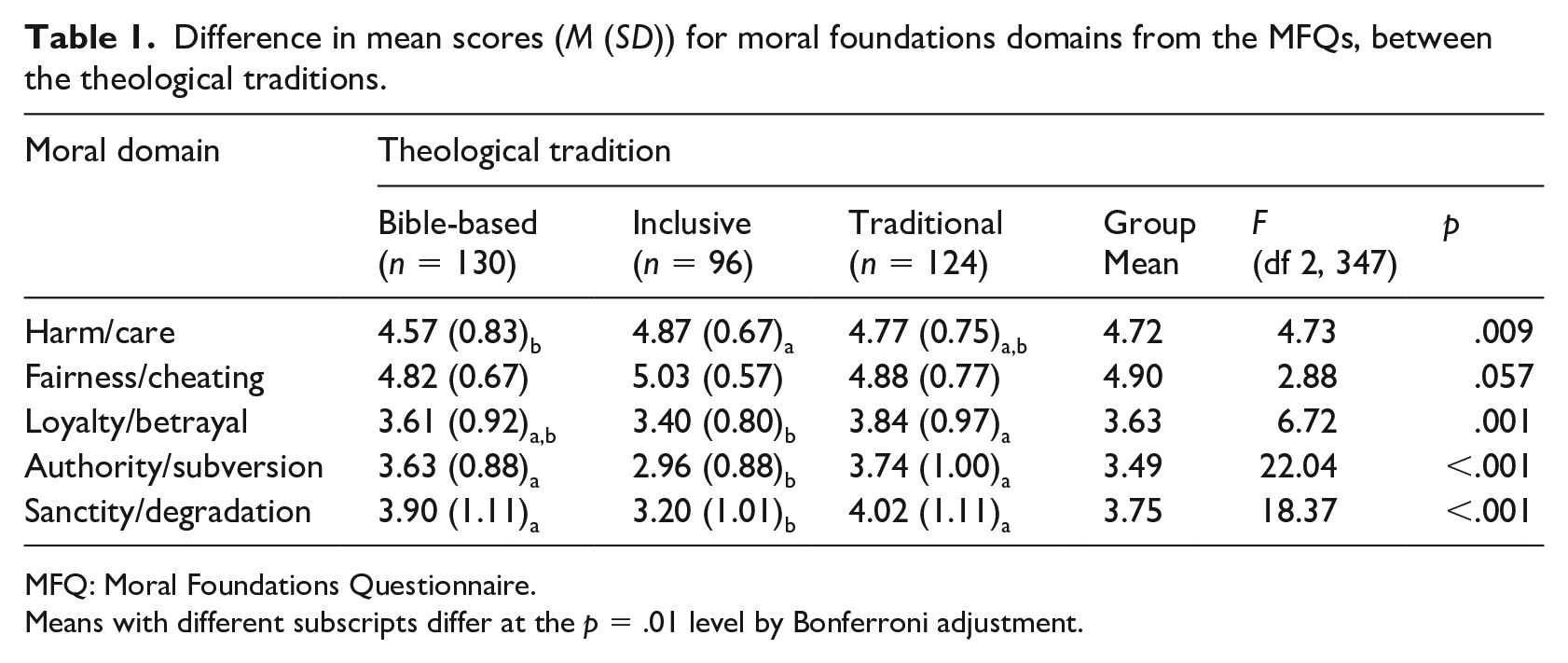
MFQ: Moral Foundations Questionnaire.
Means with different subscripts differ at the p = .01 level by Bonferroni adjustment.
The relationship of personal moral importance to perceived congregational moral importance and moral domains
To investigate the possible moral constructs identified by our measures of personal and perceived congregational moral importance, exploratory factor analysis of the moral importance items was conducted using principle-axis factoring without rotation. We first conducted principal-axis factoring on the personal moral importance items. The Kaiser−Meyer−Olkin criterion (.79) and Bartlett’s test of sphericity, χ2(55) = 1328.96, p < .001, both indicated sufficient sample size and data quality (Brace et al., 2016). Three factors with an eigenvalue greater than 1.0 were identified for the personal moral importance items. Together these three factors accounted for 61.0% of the total variance. These factors could be understood as representing three moral categories: general morality, encompassing all items except ‘a close relationship with God’ and ‘sexual morality’, religious morality, comprising ‘a close relationship with God’, ‘sexual morality’ and ‘sharing the faith’, and environmental morality, consisting of ‘animal welfare/animal rights’ and ‘care for the environment’.
We conducted a separate exploratory factor analysis for the perceived congregational moral importance items. Again, the Kaiser−Meyer−Olkin criterion (.88) and Bartlett’s test of sphericity, χ2(55) = 1996.27, p < .001 both indicated sufficient sample size and data quality (Brace et al., 2016). Only two factors with an eigenvalue greater than 1.0 emerged from the exploratory factor analysis of the items on the measure of perceived congregational moral importance, those representing general and religious morality. These accounted for 60.0% of the total variance. The factor loadings for both personal and perceived congregational moral importance are shown in Table 2.
Factor loadings for first (F1), second (F2) and third (F3) factors on measures of personal and perceived congregational moral importance.
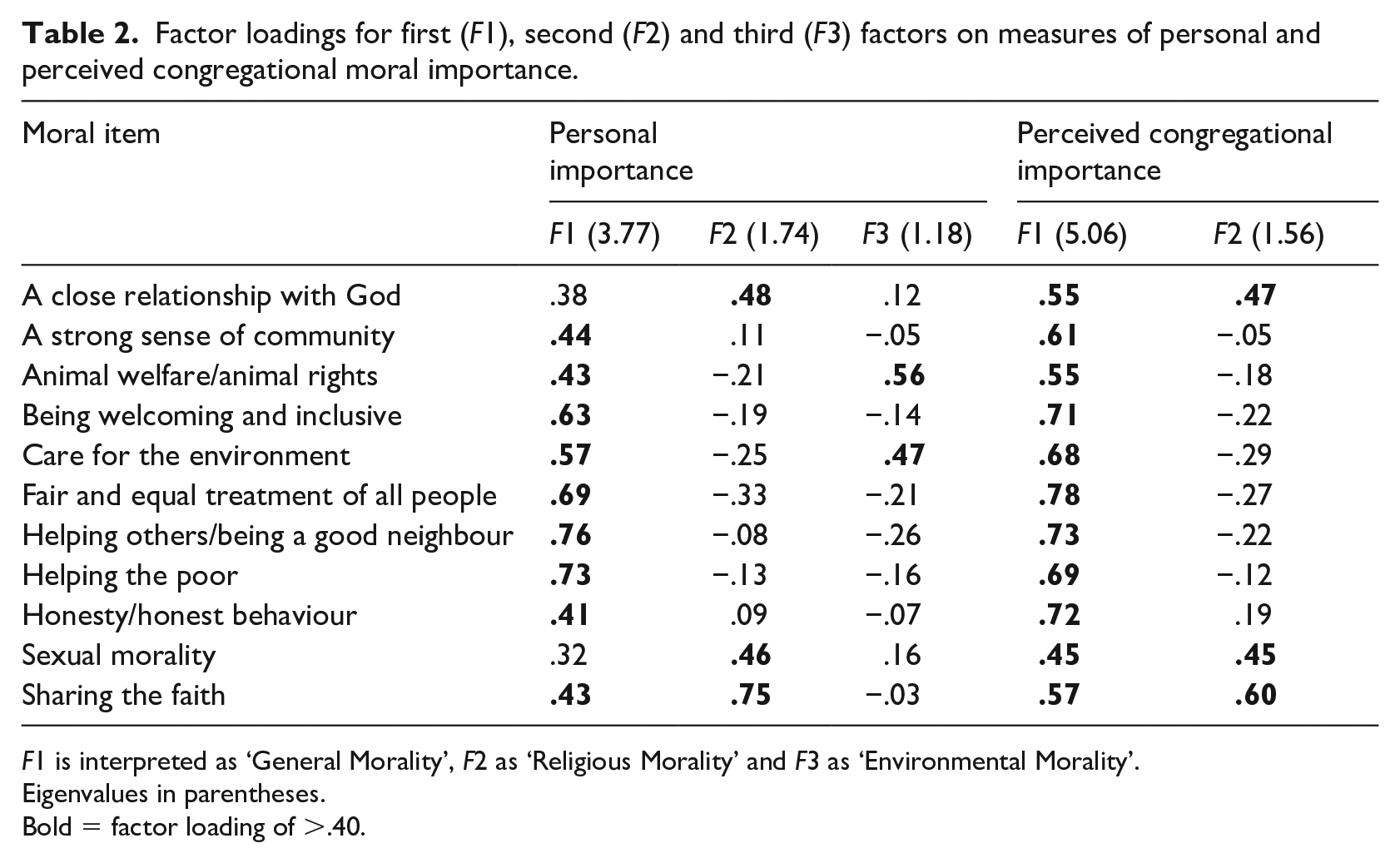
F1 is interpreted as ‘General Morality’, F2 as ‘Religious Morality’ and F3 as ‘Environmental Morality’.
Eigenvalues in parentheses.
Bold = factor loading of >.40.
The items on the moral items inventory do not represent subscales comprising a larger scale measure, and therefore for purposes of analysis, all moral items that loaded onto a factor were included in the calculating the score for that factor, even when this resulting in cross-loading of items onto more than one factor. Correlations between frequency of church attendance, scores on moral items factors, moral foundations domains, feelings of connectedness to congregation, and frequency of singing/synchronous movement are shown in Table 3.
Correlations between frequency of church attendance, moral items factors, moral foundations domains, moral similarity, connection to congregation and amount of time spent singing or in synchronous movement during a church service.
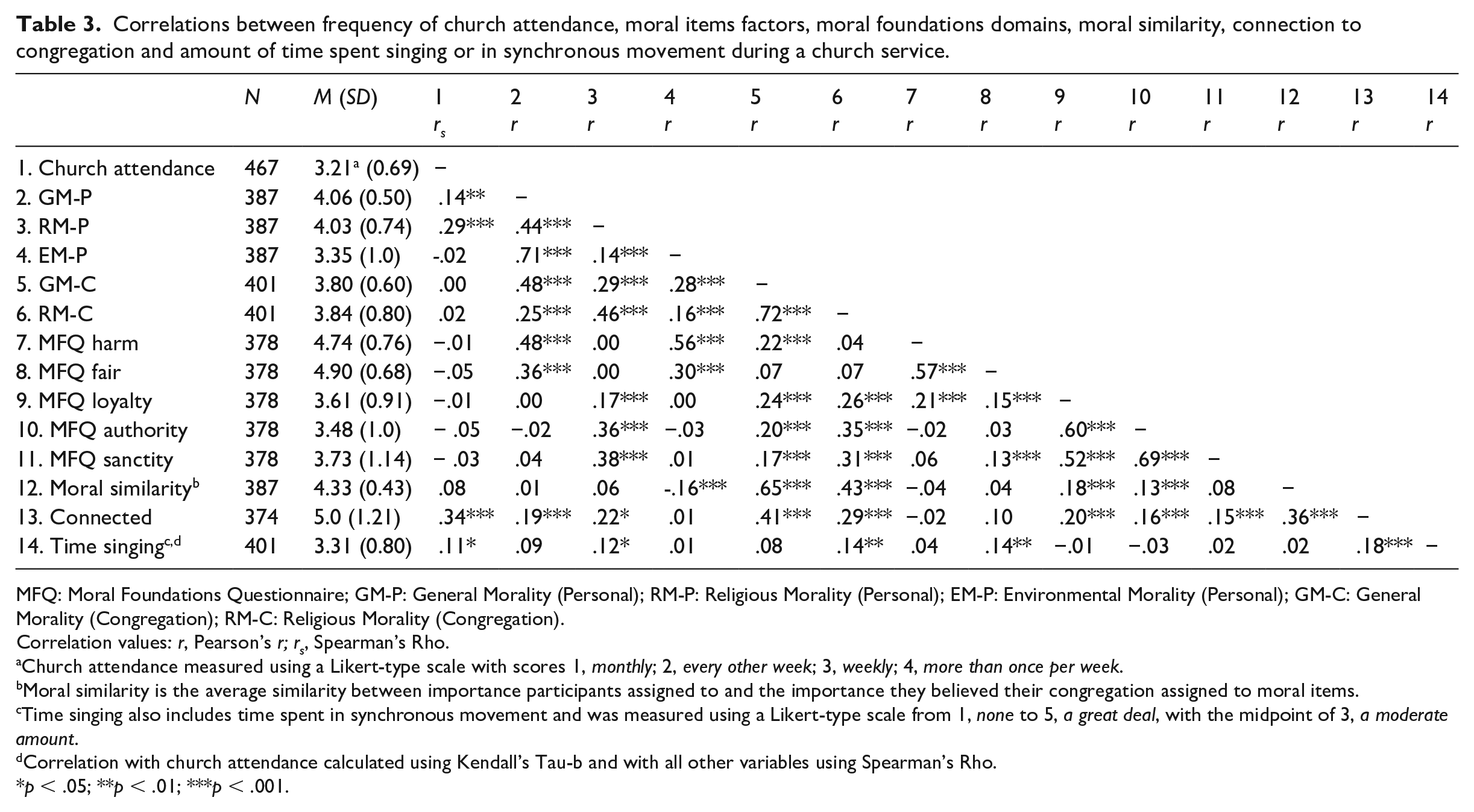
MFQ: Moral Foundations Questionnaire; GM-P: General Morality (Personal); RM-P: Religious Morality (Personal); EM-P: Environmental Morality (Personal); GM-C: General Morality (Congregation); RM-C: Religious Morality (Congregation).
Correlation values: r, Pearson’s r; rs, Spearman’s Rho.
Church attendance measured using a Likert-type scale with scores 1, monthly; 2, every other week; 3, weekly; 4, more than once per week.
Moral similarity is the average similarity between importance participants assigned to and the importance they believed their congregation assigned to moral items.
Time singing also includes time spent in synchronous movement and was measured using a Likert-type scale from 1, none to 5, a great deal, with the midpoint of 3, a moderate amount.
Correlation with church attendance calculated using Kendall’s Tau-b and with all other variables using Spearman’s Rho.
p < .05; **p < .01; ***p < .001.
We expected participants to believe that their moral values were similar to those of their church congregation and that the importance that they believed their church congregations gave to the moral issues would in most cases be similar or the same to their own (perceived moral congruity). Over 70% of participants stated that they believed that their moral values were somewhat similar or very similar to that of their church congregation. Belief that one’s moral values matched those of one’s congregation was positively correlated with the similarity between personal and the perceived congregational moral importance for all items averaged (overall similarity, r = .34, p < .001). Overall feelings of connection to one’s congregation was also positively correlated with the similarity between personal and perceived congregational moral importance (r = .36, p < .001).
When the mean scores on each moral items factor were used to compare differences between traditions on the personal importance given to moral items by participants, only the religious morality factor showed any significant difference between traditions, F(2, 355) = 17.39, p < .001. Pairwise comparison showed that mean scores for this factor were significantly higher for those from a Bible-based congregation than those from an inclusive congregation (p < .001).
Contrary to expectation, no significant correlation was found between time spent singing/in synchronous movement and the overall similarity between the importance assigned to different moral items by participants and their estimates of the importance assigned to these items by their congregations (average moral similarity, r = .02, p = .63). Following previous research demonstrating that music can facilitate group bonding and increase feelings of connectedness in a group (Cross & Tolbert, 2009; Kirschner & Tomasello, 2010; Wiltermuth & Heath, 2009) and that feeling closely bonded to a group increases the likelihood that an individual will adopt the group’s norms as their own (Hogg & Reid, 2006), we ran regressions to investigate what predicts average moral similarity. In the first regression, we predicted average moral similarity by time spent singing/in synchronous movement. In the second regression, we added feelings of connectedness as a predictor variable, to examine whether feelings of connectedness would predict average moral similarity, and if so whether it would do so over and above time spent singing/in synchronous movement or in an additive manner (means and standard deviations for all variables shown in Table 3).
The first regression, predicting average moral similarity by time spent singing/in synchronous movement, was not significant, F(1, 385) = 0.11, p = .74; see Table 4. The second regression, which included both time spent singing/in synchronous movement and feelings of connectedness as the independent variables, was significant, F(2, 371) = 29.27, p < .001. In this regression, only connectedness significantly predicted average similarity in moral importance.
Regression analysis predicting similarity between personal and perceived congregational moral importance (averaged across all items) by time spent singing or in synchronous movement and feelings of connection to congregation.
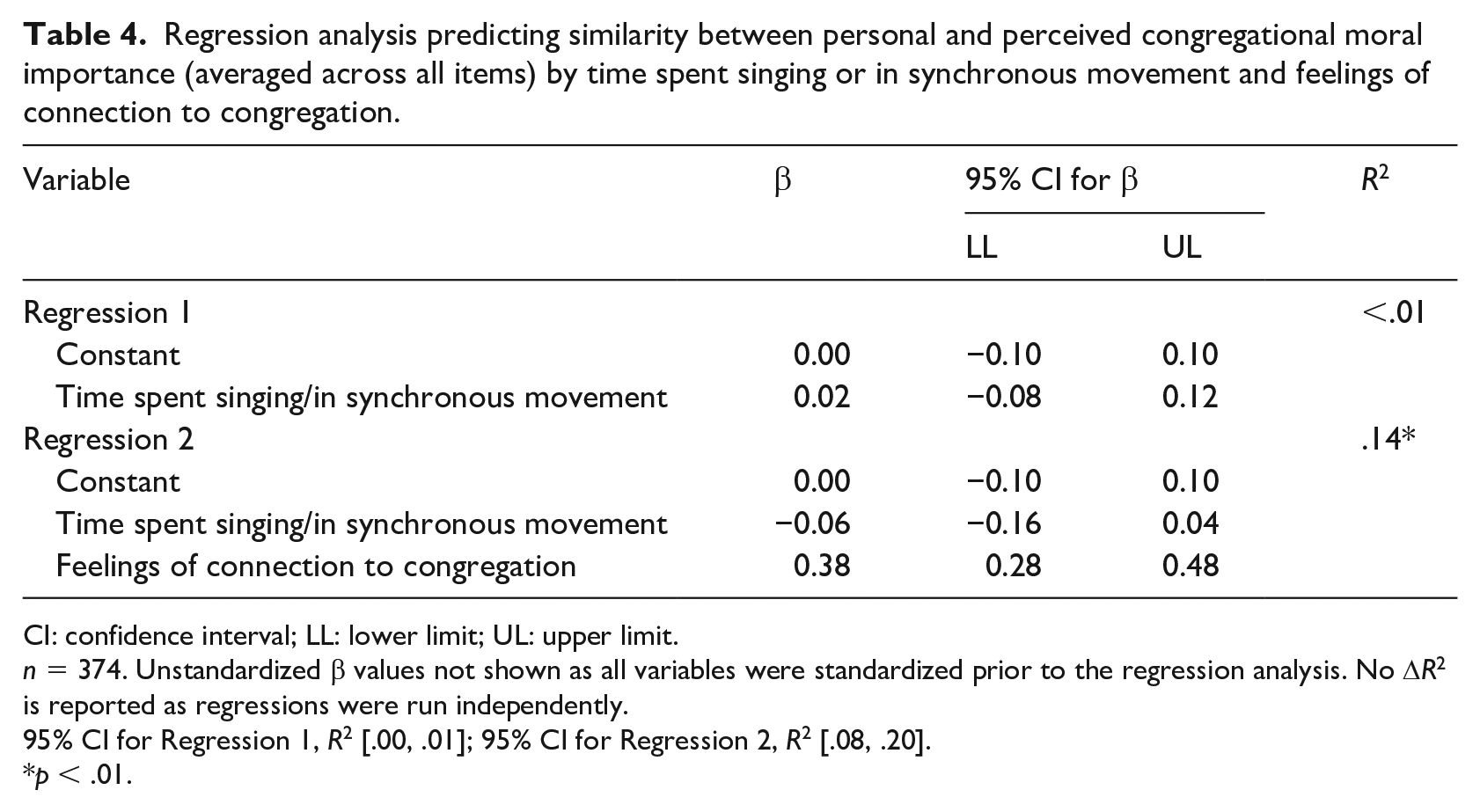
CI: confidence interval; LL: lower limit; UL: upper limit.
n = 374. Unstandardized β values not shown as all variables were standardized prior to the regression analysis. No ΔR2 is reported as regressions were run independently.
95% CI for Regression 1, R2 [.00, .01]; 95% CI for Regression 2, R2 [.08, .20].
p < .01.
As noted previously, it is possible that individuals choose to worship with a congregation believed to share their personal values, and this itself might promote feelings of connectedness. We therefore ran the second set of regression analyses, predicting connectedness by average similarity in personal and perceived congregational moral importance and time spent singing/in synchronous movement; see Table 5. The first regression, F(1, 372) = 56.95, p < .001, demonstrates that average moral similarity predicts feelings of connection on its own, and the second regression, F(2, 371) = 37.73, p < .001, shows that when time spent singing or in movement is added, they both remain significant predictors of feelings of connection. Importantly, the change in model fit from Regression 1 to Regression 2 significant, F(1, 371) = 16.18, p < .001, and indicates that time spent singing/in synchronous movement explains variance in feelings of connectedness in addition to average moral similarity.
Regression analysis predicting feelings of connection to congregation by average similarity between personal and perceived congregational moral importance and time spent singing or in synchronous movement.
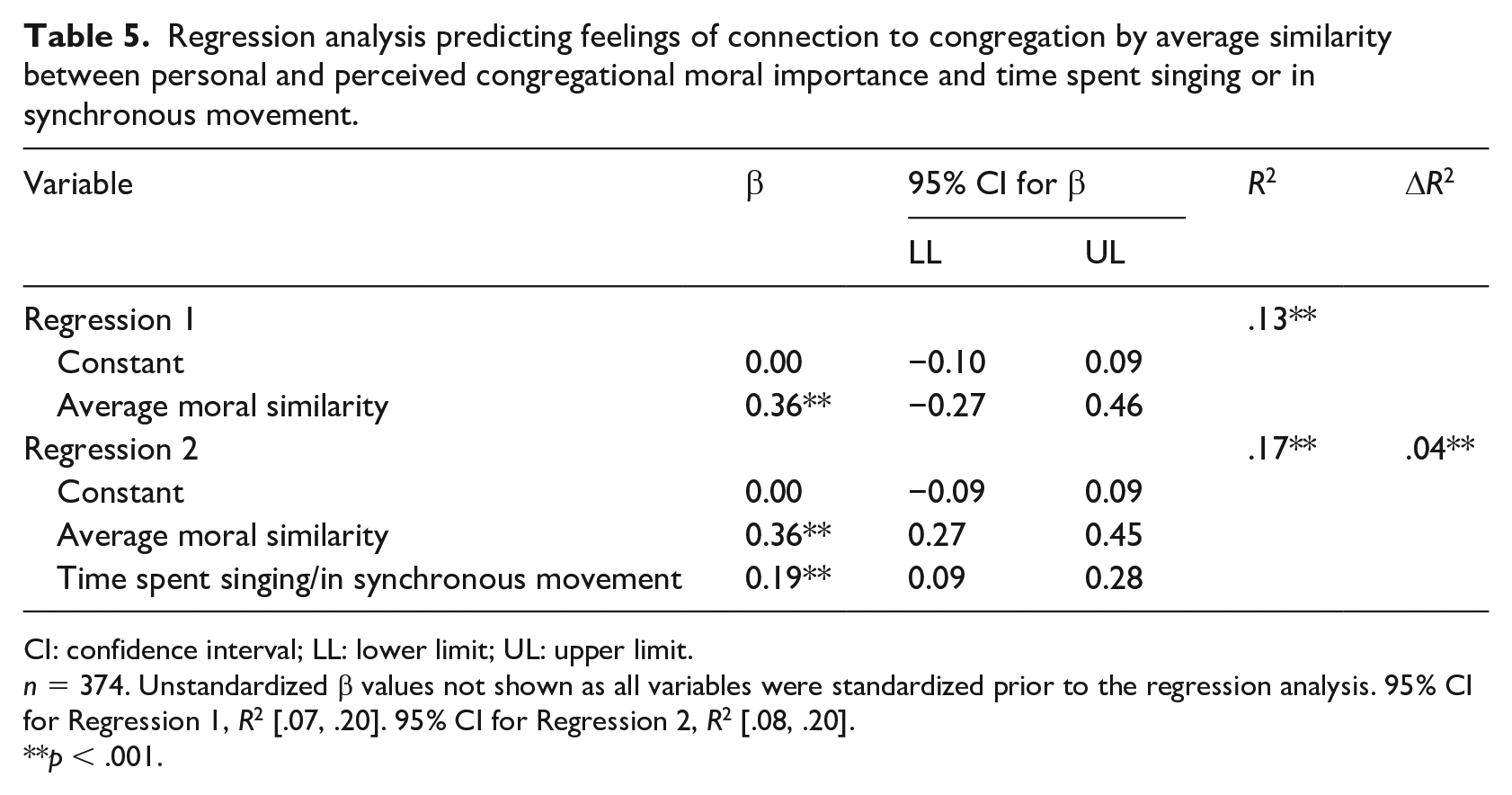
CI: confidence interval; LL: lower limit; UL: upper limit.
n = 374. Unstandardized β values not shown as all variables were standardized prior to the regression analysis. 95% CI for Regression 1, R2 [.07, .20]. 95% CI for Regression 2, R2 [.08, .20].
**p < .001.
Of the factors identified for personal moral importance items, both general morality and environmental morality were positively correlated with the MFQ domains of harm/care (r = .48, p < .001 and r = .52, p < .001, respectively) and fairness/cheating (r = .36, p < .001 and r = .30, p < .001, respectively), and religious morality was positively correlated with the MFQ domains of loyalty/betrayal (r = .17, p < .001), authority/subversion (r = .36, p < .001) and sanctity/degradation (r = .37, p < .001).
Discussion
In this study, we aimed to explore the relationship between the use of music in worship, feelings of connection to one’s congregation, and the degree to which people believe their moral values align with those of their church congregation. We also sought to examine differences in moral values between theological traditions.
The majority of participants in our study believed that their own moral values and priorities matched those of their church congregations. This is unsurprising, as it is reasonable to assume that a group with which one shares core beliefs, such as the tenets of a faith, will also hold beliefs similar to one’s own in other areas. As we expected, positive correlations were found between participants’ levels of felt connection to their congregation and the similarity in reported participant and perceived congregational importance given to moral items. This finding is in line with the suggestion that the more strongly one identifies with a group, the more likely that individual is to incorporate the group’s norms (real or perceived) into his or her own self-identity and to behave in accordance with the group norms (Hogg & Reid, 2006; Jetten et al., 2002), although it is also possible that individuals choose to belong to a congregation that they believe shares their values. If that is the case, then it is possible that the perception of shared values strengthens feelings of identity with the group. The relationship between the strength of felt connection to one’s congregation and the degree to which participants believed that their own moral values matched those of their church community suggests that the social identity approach may provide a framework for further exploration of the link between religious involvement and moral values and behaviour.
Although there was little reported variation in the use of singing/synchronous movement, with more than half of participants reporting that their church congregation spent ‘a moderate amount’ of time singing together or engaged in synchronous movement, correlations were still found between this and levels of felt connectedness with the congregation, as we had anticipated. Synchronous activity, including singing together, is known to increase feelings of group connectedness (Wiltermuth & Heath, 2009), and to promote social bonding (see Launay et al., 2016 for a review of literature on synchrony and bonding). It is therefore likely that even moderate amounts of singing would lead to increased levels of felt connectedness among a congregation. Kirschner and Tomasello (2010) have suggested that group singing allows individuals to satisfy the basic desire to share emotions and experiences with others, while Dunbar and colleagues (2012) have postulated that the endorphin release that results from music facilitates group bonding. It is likely that both of these processes result when church congregations sing together.
Regression analyses showed that time spent singing or in synchronous worship did not predict for similarity in personal and perceived congregational moral importance, while feelings of connectedness to the congregation did. A separate regression analysis showed that both the degree of perceived moral similarity between individual and congregation and time spent singing or in synchronous movement in turn predicted feelings of connectedness. Therefore, it is possible that feelings of connectedness may result, at least in part, from the perception of shared values and this is reinforced by the use of singing or synchronous movement in worship. These results suggest that there may be a complex interplay between these variables that is still to be teased out, and this might be an interesting area for experimental or longitudinal studies.
As Hogg and Reid (2006) have noted, strength of identification with one’s group is related to the degree to which one internalizes the group’s norms. While this clearly can be applied to the importance given to individual moral items, or issues, might it also apply to the moral domains one prefers in making moral judgements? Graham and Haidt (2010) have suggested that members of religious groups prioritize issues related to the so-called binding moral domains of loyalty/betrayal, authority/subversion and sanctity/degradation, and previous studies that have shown that frequent religious attendance is positively correlated with high scores in these domains and negatively correlated with high scores in the domains of harm/care and fairness/cheating (Haidt et al., 2009; Koleva et al., 2012). We therefore expected that mean scores for the binding domains would be higher than for the domains of harm/care and fairness/cheating. Contrary to this expectation, mean scores for harm/care and fairness/cheating exceeded those for loyalty/betrayal, authority/subversion and sanctity/degradation. Roughly equal proportions of participants in the current study classified their church’s theology as ‘inclusive’ (a liberal stance), ‘traditional’ or ‘Bible-based’ (conservative with a literal interpretation of the Bible), which would seem to rule out a higher proportion of liberal than conservative respondents as an explanation. One possibility is that these results may reflect a cultural difference between the United Kingdom and the United States. Much of the research on MFT has been conducted in the United States, and although at least one study on MFT has included European participants (Graham et al., 2009), these were greatly outnumbered by participants from the United States (513 European vs 6728 from the United States, Graham et al., 2009).
When compared across theological traditions, significant differences in the moral domain scores for our sample were found between those who reported their congregation’s theology to be ‘inclusive’ and those from congregations with the more conservative ‘Bible-based’ or ‘traditional’ theologies, with those reporting an ‘inclusive’ theology scoring more highly in the domain of harm/care and lower in the domains of loyalty/betrayal, authority/subversion and sanctity/degradation than those from the other two traditions. It should be noted that MFT is not without its problems and critics. There is evidence to suggest that it is not as robust among non-Western, non-English-speaking cultures as it is among Western English-speaking societies (Iurino & Saucier, 2020), and this calls into question whether it does, in fact, describe universal, evolutionarily based moral constructs. It may be, however, that the questions used on the MFQ represent aspects of the five moral domains relevant to Western cultures but not to non-Western cultures. As our sample was drawn entirely from the United Kingdom, a Western, English-speaking culture, this limitation is unlikely to have impacted our results, although it does provide support for the idea that the study of morality should include questions about specific moral concerns as well as questions such as those on the MFQ. Our findings are in line with those of previous studies (Graham et al., 2009; Greenway et al., 2019), and reflects Haidt and colleagues’ (2009) findings that the subgroup they call the ‘religious left’ does score more highly on the domains of harm/care and fairness/cheating than on the binding foundations. Graham and colleagues (2009) reported finding more harm/care and fairness/cheating references and fewer references to authority and sanctity in sermons from a liberal denomination than were found in sermons from a conservative denomination. Frimer (2020), however, was largely unable to replicate this finding, suggesting that there may be little difference in the moral language of liberal and conservative Christian preachers. That does not rule out differences between theological traditions in the importance that they assign to difference moral domains or individual moral items, and we have been able to demonstrate that such differences do appear to exist.
We found significant differences between traditions in the importance given to different moral items along the lines expected, with those from Bible-based congregations giving greater importance to religious morality items than did those from inclusive congregations. In addition, the factors identified for personal moral importance correlated with MFQ domains along the lines that would be expected, with religious morality correlating with the binding domains and the other factors correlating with harm/care and fairness/cheating. This suggests that our measure is tapping into genuine differences in moral values applied to moral items that people may need to consider in their day-to-day decision-making.
The differences between traditions identified for MFQ scores together with the difference between traditions in importance assigned to items relating to religious morality indicate that it may not be enough to compare religious with non-religious individuals or churchgoers with non-churchgoers, as has been the case with most research in this area. Differences in theological tradition and teaching need to be taken into account when considering the relationship between religion and morality. This has already been recognized in other areas, such as medical ethics, where it has been argued that when making difficult moral decisions regarding medical procedures and care, it should not be assumed that all Christians will hold the same views and that moral decisions will vary based on theological tradition (Engelhardt & Smith Iltis, 2005).
There are several limitations to this study that should be noted. While efforts were made to recruit participants from a range of church denominations and backgrounds, the sample was self-selecting, increasing the possibility that it may not be representative of the wider churchgoing population. There is some evidence for this in the fact that 64% of respondents in the current study who gave their denomination were from the Church of England, and a further 17.6% from other Anglican denominations, whereas Roman Catholics made up only 3.5% of the sample. In contrast, the Faith Survey (2018) recorded roughly equal numbers of Anglicans and Roman Catholics attending church in the United Kingdom in 2015. As a result of the disparity in the representation of different denominations, numbers did not allow for between-denominations comparisons. We were, nevertheless, able to make comparisons between theological traditions. Even within the Church of England a range of theological traditions exists, commonly divided into Evangelical (conservative), Anglo-Catholic (traditional) and broad church (liberal), and psychological differences between adherents of these traditions has been studied previously (Village, 2013). Although our terminology (‘Bible-based’, ‘traditional’, ‘inclusive’), in order to encompass a range of denominations, differed from that often used within the Church of England, the essential differences between those traditions was captured using our terms. Data were collected via an anonymous online survey. We were therefore unable to analyse or compare responses by congregation, as it was unknown whether multiple participants attended the same church. Further research involving visiting churches to obtain data that can be analysed for within-congregation similarities and differences has been undertaken as a follow-up to the study reported here. As with any self-report questionnaire, responses could be influenced by social desirability bias, particularly as this study focused on moral values. It is also possible that respondents may have elected to answer questions in a manner that they felt ‘fit’ the theological tradition with which they identified. The fact that responses were anonymous and collected on-line (i.e. respondents were not being observed by a researcher) may have mitigated these effects. The nature of data collection also did not permit for follow-up questions to elaborate on or clarify initial responses. Finally, the response options for the amount of time a congregation spent singing or in synchronous movement were open to interpretation by respondents and there is no guarantee that the amount of time reported as ‘moderate’ was the same for all, or indeed, any respondents. Despite this, ‘a moderate amount’ of time can reasonably be interpreted as representing something more than a minimal or token presence within a service (e.g. one hymn) but not constituting the majority of the service time, and may well be reflective of many church services in the United Kingdom, where our study was conducted, which may mix the singing of hymns with scripture readings, a sermon and a sacramental act, such as Holy Communion.
This study does indicate further avenues for future research. The findings reported here show that churchgoers believe that the level of importance that they give to moral items is similar to that of their church congregations. This raises the question of whether this is an accurate belief and, if so, whether the items given highest moral importance are those specifically included in the elements of a worship service. Direct observation of worship would provide opportunity to record mentions of ethical issues in sermons, prayers, hymns and other elements of worship. Doing this in conjunction with the survey employed in this study would reveal the accuracy of participants’ estimates and also allow for evaluation of the relative importance of different aspects of worship in conveying moral teaching. A comparison of different types of music, for example, traditional hymns and contemporary worship songs, and synchronous movement is another area of study of potential interest − do different styles of music or different types of synchronous movement have different levels of influence in promoting social bonding or shaping moral values? Comparison with a non-religious organization would provide a means of exploring whether churches are more or less effective than other communities in instilling a shared set of moral values in their members. The current study was unable to identify whether or not people chose to attend a particular church because it reflected the moral values they already held or for other reasons, such as it being their local church. Some direct measure of why people choose to attend a particular church might, therefore, also shed light on the relationship between church attendance and moral values and behaviour. Do people consciously base their moral principles on their church’s teaching, or do they choose to belong to a congregation that reflects their pre-existing moral values, thereby reinforcing, rather than challenging, their beliefs?
There appears to be a complex relationship between the use of music in worship, feelings of connectedness to one’s congregation, and churchgoers’ perception of the similarity between the importance that they give to moral items and that given by their church congregation. Of interest is whether differences in time spent singing during worship are, in fact, reflected in different levels of felt connectedness and similarity of moral values among congregation members. The question of whether the inclusion of moral issues in the musical elements of worship is more effective in shaping moral values than their inclusion in the spoken elements of worship, such as sermons and prayers, is also of interest. The measure of time spent singing or in synchronous music used in this study was based on participants’ estimates of what takes place in their church’s worship and did not ask for a precise amount of time or percentage of the total worship service. Responses may not, therefore, accurately reflect what takes place within a worship service. Direct observation of church services would allow more accurate measures of the amount of time spent singing to be made and analysed in relation to levels of felt connectedness and similarity in moral values within a congregation, as well as providing opportunity to evaluate the content of the different aspects of worship and explore their relative influence on moral values.
In this study, we have been able to show that as well as differences in the moral domains that are preferred when making moral decisions, the moral items, or issues, that are deemed to be important differ for different theological traditions. We have also demonstrated that a relationship exists between the use of music or synchronous movement in a church service and feelings of social bonding, and that there is also a relationship between the degree to which a churchgoer identifies with his or her church community and the degree to which individual church members believe their moral values match those of their congregation, although further research is needed to determine the precise nature of these relationships.
Supplemental Material
sj-docx-1-prj-10.1177_00846724211070858 – Supplemental material for Exploring the relationship between church worship, social bonding and moral values
Supplemental material, sj-docx-1-prj-10.1177_00846724211070858 for Exploring the relationship between church worship, social bonding and moral values by Jennifer E Brown, Valerie van Mulukom, Jonathan Jong, Fraser Watts and Miguel Farias in Archive for the Psychology of Religion/Archiv Für Religionpsychologie
Footnotes
Authors’ note
The data included in this paper are part of an ongoing PhD research project and, as such, are not currently available for use by others. The study reported here was self-funded by the first author. Additional analyses and information are available in the  submitted with this paper. Some of the data included in this paper have been disseminated as part of conference presentations.
Declaration of conflicting interests
The author(s) declared no potential conflicts of interest with respect to the research, authorship and/or publication of this article.
Funding
The author(s) received no financial support for the research, authorship and/or publication of this article.
Supplemental material
Supplemental material for this article is available online.
Notes
References
Supplementary Material
Please find the following supplemental material available below.
For Open Access articles published under a Creative Commons License, all supplemental material carries the same license as the article it is associated with.
For non-Open Access articles published, all supplemental material carries a non-exclusive license, and permission requests for re-use of supplemental material or any part of supplemental material shall be sent directly to the copyright owner as specified in the copyright notice associated with the article.
